International Research Journal of Engineering and Technology (IRJET) e-ISSN: 2395-0056
Volume: 09 Issue: 08 | Aug 2022 www.irjet.net p-ISSN: 2395-0072
© 2022, IRJET | Impact Factor value: 7.529 | ISO 9001:2008 Certified Journal | Page 1855
AUTOMATIC ACCELERATION CONTROL IN TRAFFIC SIGNAL/SCHOOL
ZONE
VIKRAM.N , SRIDHAR.S , SIVASUBRAMANIAN.R
DR.P.F.KHALEELUR RAHIMAN DEPT OF ECE, HINDUSTHAN COLLEGE OF ENGINEERING AND TECHNOLOGY,
TAMILNADU, INDIA
------------------------------------------------------------------------***--------------------------------------------------------------------
ABSTRACT - A vehicle Speed Control System is designed to control the speed of the vehicle in specific zones to avoid
accidents in low-speed areas. In this system, the low-speed zone is considered to be with an RF range. implementation is
based on the light vehicle speed control, when the vehicle is running at full speed and gets entered into the low-speed zone
its speed will be automatically reduced to the allowed speed in the low-speed zone. The microcontroller will interface with
the sensors to detect the vehicle's speed, and based on this input, the controller will take appropriate action and generate a
control signal for the vehicle control system, which will then activate the Speed control mechanism in the vehicle, reducing
the vehicle's speed to the required speed in that zone. The zone will be fixed using the RF range. RF receiver will be
connected with every low-speed zone entrance. And each vehicle carries an RF transmitter with it. So when the vehicle
enters the low-speed zone then it will be predicted with the RF receiver and the information will send to the micro
controller Arduino Uno connected here. The speed of the vehicle will automatically be reduced with the help of a motor
driver connected with the engine motor
INTRODUCTION:
Nowadays lots of accidents happen on the signal due to increase traffic and also due to rash driving of the drivers.
As we know, as we accelerate the car, the engine begins to run faster, and as the throttle is opened further, the engine
suctions sucks more quantity of load (air + fuel), which burns and creates more energy in the form of radiations. In this
system, we have implemented the speed limiting mechanism which will be effective for the reduction of fuel towards the
engine. The Indian Law Commission has an advisory to limit the speed at critical zones, reduce road accidents, and make a
peaceful environment for the people. Hence speed control is in needs to be implemented in all vehicles. Here's a new
proposal of ours: install an automated speed control system in automobiles, primarily in congested regions. Here, a device
is set up as a transmitter, and multiple devices are combined to monitor the speed of the vehicle when it exceeds the
prescribed speed and control it by placing a receiver at the vehicle, and the speed of the vehicle is reduced by interfacing a
microcontroller based on the signals transmitted.
EXISTING METHOD:
In the existing system, we have used IR sensors as IR Transmitter units and IR Receiver units. The Transmitter unit
is to be placed some meters earlier than the traffic signal. The IR Receiver module is been implemented inside the car
mechanism. The Transmitter section includes an IR sensor, which Transmits continuous IR rays that are invisible to human
eyes, and that battery regulator micro controller IR sensor motor driver motor LCD display can be detected by an IR
receiver module. The motor speed will thereafter be lowered.
PROPOSED METHOD:
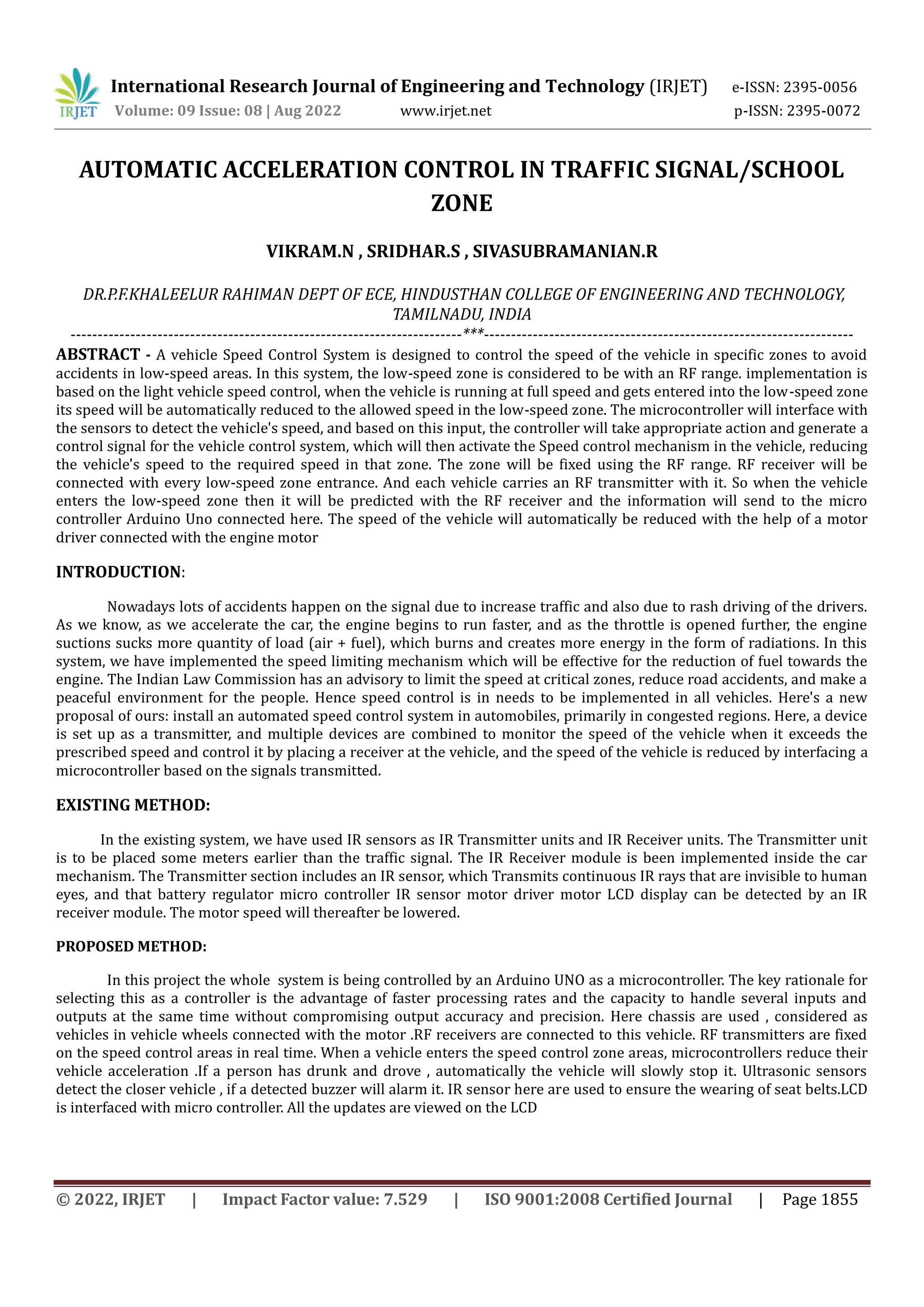
In this project the whole system is being controlled by an Arduino UNO as a microcontroller. The key rationale for
selecting this as a controller is the advantage of faster processing rates and the capacity to handle several inputs and
outputs at the same time without compromising output accuracy and precision. Here chassis are used , considered as
vehicles in vehicle wheels connected with the motor .RF receivers are connected to this vehicle. RF transmitters are fixed
on the speed control areas in real time. When a vehicle enters the speed control zone areas, microcontrollers reduce their
vehicle acceleration .If a person has drunk and drove , automatically the vehicle will slowly stop it. Ultrasonic sensors
detect the closer vehicle , if a detected buzzer will alarm it. IR sensor here are used to ensure the wearing of seat belts.LCD
is interfaced with micro controller. All the updates are viewed on the LCD
International Research Journal of Engineering and Technology (IRJET) e-ISSN: 2395-0056
Volume: 09 Issue: 08 | Aug 2022 www.irjet.net p-ISSN: 2395-0072
© 2022, IRJET | Impact Factor value: 7.529 | ISO 9001:2008 Certified Journal | Page 1856
HARDWARE USED:
1 Motor driver
2 Motor
3 RF transmitter
4 RF receiver
5 Battery(9v,12v)
6 Ultrasonic sensor
7 Ir sensor
SOFTWARE USED:
1 Arduino ide
2 Embedded c
3 Proteus 7
BLOCK DIAGRAM:
HARDWARE DESCRIPTION:
1.MOTOR DRIVER:
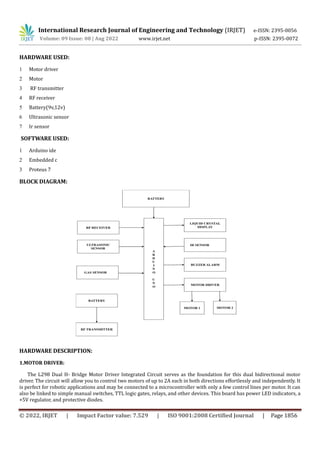
The L298 Dual H- Bridge Motor Driver Integrated Circuit serves as the foundation for this dual bidirectional motor
driver. The circuit will allow you to control two motors of up to 2A each in both directions effortlessly and independently. It
is perfect for robotic applications and may be connected to a microcontroller with only a few control lines per motor. It can
also be linked to simple manual switches, TTL logic gates, relays, and other devices. This board has power LED indicators, a
+5V regulator, and protective diodes.
International Research Journal of Engineering and Technology (IRJET) e-ISSN: 2395-0056
Volume: 09 Issue: 08 | Aug 2022 www.irjet.net p-ISSN: 2395-0072
© 2022, IRJET | Impact Factor value: 7.529 | ISO 9001:2008 Certified Journal | Page 1857
MOTOR DRIVER
2.GEAR MOTOR:
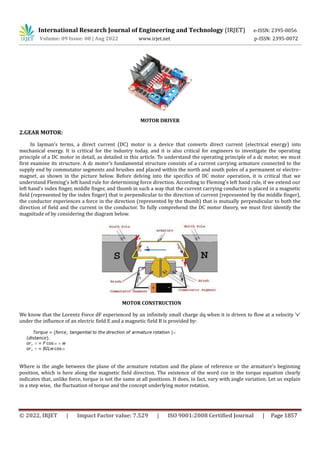
In layman's terms, a direct current (DC) motor is a device that converts direct current (electrical energy) into
mechanical energy. It is critical for the industry today, and it is also critical for engineers to investigate the operating
principle of a DC motor in detail, as detailed in this article. To understand the operating principle of a dc motor, we must
first examine its structure. A dc motor's fundamental structure consists of a current carrying armature connected to the
supply end by commutator segments and brushes and placed within the north and south poles of a permanent or electro-
magnet, as shown in the picture below. Before delving into the specifics of DC motor operation, it is critical that we
understand Fleming's left hand rule for determining force direction. According to Fleming's left hand rule, if we extend our
left hand's index finger, middle finger, and thumb in such a way that the current carrying conductor is placed in a magnetic
field (represented by the index finger) that is perpendicular to the direction of current (represented by the middle finger),
the conductor experiences a force in the direction (represented by the thumb) that is mutually perpendicular to both the
direction of field and the current in the conductor. To fully comprehend the DC motor theory, we must first identify the
magnitude of by considering the diagram below.
MOTOR CONSTRUCTION
We know that the Lorentz Force dF experienced by an infinitely small charge dq when it is driven to flow at a velocity 'v'
under the influence of an electric field E and a magnetic field B is provided by:
Where is the angle between the plane of the armature rotation and the plane of reference or the armature's beginning
position, which is here along the magnetic field direction. The existence of the word cos in the torque equation clearly
indicates that, unlike force, torque is not the same at all positions. It does, in fact, vary with angle variation. Let us explain
in a step wise, the fluctuation of torque and the concept underlying motor rotation.
International Research Journal of Engineering and Technology (IRJET) e-ISSN: 2395-0056
Volume: 09 Issue: 08 | Aug 2022 www.irjet.net p-ISSN: 2395-0072
© 2022, IRJET | Impact Factor value: 7.529 | ISO 9001:2008 Certified Journal | Page 1858
3.RF TRANSMITTER:
The TWS-434 transmitter accepts both linear and digital inputs, operates from 1.5 to 12 Volts-DC, and simplifies the
construction of a compact hand-held RF transmitter. The controller's P2 0, P2 1, P2 2, and P2 3 pins are presumed to be
data send pins. The encoder's DATA OUT pin is linked to the RF Transmitter's DATA IN pin, and the RF Transmitter
subsequently transmits the data to the receiver.
3.1.ENCODER: The HT-640 IC encodes 12-bits of information and serially transmits this data on receipt of a Transmit
Enable and a LOW signal on pin-14 /TE. Pin-17 the D_OUT pin of the HT-640 serially transmits whatever data is available
on pins 10, 11, 12 and 13, or D0, D1, D2 and D3 to D7.
3.2.DECODER: The 212 series of decoders are capable of decoding information’s that consist of N bits of address and 12_N
bits of data. The HT12D in this series provides 8 address bits and 4 data bits, while the HT12F decodes 12 bits of address
information. The HT-12D's VT, or valid transmission pin, could instruct the microcontroller to read the 4-bit data from the
data output pins.
4.RF RECEIVER:
The receiver, like the transmitter, works at 433.92MHz and has a sensitivity of 3uV. The TWS-434 receiver offers both
linear and digital outputs and runs from 4.5 to 5.5 volts-DC. The controller's P2 0, P2 1, P2 2, and P2 3 pins are presumed
to be data send pins. The RF Transmitter's DATA OUT pin is linked to the DECODER's DATA IN pin, and the data is
processed by the decoder.
CIRCUIT DIAGRAM
5.BATTERY:
In electricity, a battery is a device consisting of one or more electrochemical cells that convert stored chemical
energy into electrical energy. Alessandro Volta invented the first battery (or "voltaic pile") in 1800, and the technically
enhanced Daniel cell in 1836, batteries have become a widespread power source for many domestic and industrial
applications. According to a 2005 estimate, the global battery sector generates US$48 billion in yearly sales, with a 6%
annual growth rate. Primary batteries (disposable batteries) are intended to be used once and then discarded, whereas
secondary batteries (rechargeable batteries) are intended to be recharged and used several times. Batteries range in size
from tiny cells used to power hearing aids and wristwatches to room-sized battery banks that provide standby power for
phone exchanges and computer data centres. The electrolyte and the electrode to which anions (negatively charged ions)
migrate, i.e., the anode or negative electrode, are in one half of the cell; the electrolyte and the electrode to which cations
(positively charged ions) migrate, i.e., the cathode or positive electrode, are in the other half of the cell. Cations are reduced
(electrons are added) at the cathode in the redox reaction that drives the battery, while anions are oxidised (electrons are
withdrawn) at the anode. The electrodes do not come into contact with one another, but are electrically coupled by the
electrolyte. Some cells employ two half-cells containing distinct electrolytes. A separator between half-cells allows ions to
International Research Journal of Engineering and Technology (IRJET) e-ISSN: 2395-0056
Volume: 09 Issue: 08 | Aug 2022 www.irjet.net p-ISSN: 2395-0072
© 2022, IRJET | Impact Factor value: 7.529 | ISO 9001:2008 Certified Journal | Page 1859
pass while preventing electrolytes from combining. Batteries are divided into two basic types, each with its own set of pros
and limitations.
5.1.Primary batteries: convert chemical energy to electrical energy irreversibly (within practical limitations). When the
original supply of reactants is depleted, electrical energy cannot be easily supplied to the battery.
5.2.Secondary batteries: may be recharged, which means their chemical reactions can be reversed by delivering
electrical energy to the cell, restoring its original composition. Some types of primary batteries, such as those used in
telegraph circuits, were returned to use by replacing the battery components consumed by the chemical reaction.
Secondary batteries cannot be recharged indefinitely due to active material dissipation, electrolyte loss, and internal
corrosion.
6.ULTRASONIC SENSOR:
ULTRASONIC SENSOR
An ultrasonic sensor is an electronic device that measures the distance between two objects using ultrasonic sound waves
and converts the reflected sound into an electrical signal. Ultrasonic waves travel faster than audible sound waves (i.e. the
sound that humans can hear).
7. IR MODULE :
Infrared sensors are the most popular among amateur roboteers. Understanding how they behave may assist in
meeting many of your criteria and would sufficient to solve the majority of the problem statements for numerous robotics
events in India. If you have a good operational understanding of Infrared sensors, you can easily address all of these
problem statements and exercise granular control over your robot's performance, whether it is a typical white/black line
follower, a wall follower, obstacle avoidance, micro mouse, an advanced flavour of line follower like red line follower, etc.
IR Module TRANSMITTER CIRCUIT
International Research Journal of Engineering and Technology (IRJET) e-ISSN: 2395-0056
Volume: 09 Issue: 08 | Aug 2022 www.irjet.net p-ISSN: 2395-0072
© 2022, IRJET | Impact Factor value: 7.529 | ISO 9001:2008 Certified Journal | Page 1860
SOFTWARE DESCRIPTION:
1.ARDUINO IDE:
The Arduino Integrated Development Environment (IDE) includes a text editor for writing code, a message area, a text
console, a toolbar with buttons for common operations, and a series of menus. It communicates with and uploads
programmes to the Arduino and Genuino hardware.
2.EMBEDDED
C: Embedded C is a set of language extensions for the C Programming language bythe C Standards committee to address
commonality issues that exist between C extensions for different embedded systems. Historically, embedded C
programming requires nonstandard extensions to the C language in order to support exotic features such as fixed- point
arithmetic, multiple distinct memory banks, and basic I/O operations. In 2008, the C Standards Committee extended the C
language to address these issues by providing a common standard for all implementations to adhere to. It includes a
number of features not available in normal C, such as, fixed-point arithmetic, named address spaces, and basic I/O
hardware addressing. The majority of conventional C syntax and semantics are used in embedded C, such as the main()
function, variable definition, datatype declaration, conditional statements (if, switch, case), loops (while, for), functions,
arrays and strings, structures and unions,
3.PROTEOUS SOFTWARE:
Simone Zanella invented Proteus (PROcessor for Text Easy to Use) in 1998 as a fully functioning procedural
programming language. Proteus integrates many features inherited from various languages, including C, BASIC, Assembly,
and Clipper/dBase; it is extremely versatile when dealing with strings, with hundreds of dedicated functions, making it one
of the richest languages for text manipulation. Proteus gets its name from a Greek sea god (Proteus), who looked after
Neptune's audience and gave responses; he was known for his ability to alter himself into many shapes. This language's
main application is to transform data from one format to another.
CONCLUSION:
It is based on a model predictive control, combining long-term optimization and short-term adaptation. This model
takes into account regenerative braking by reframing the analytical solution for long-term optimization. An analytical
solution was developed with low computational demand. Pontryagin’s Maximum Principle (PMP) was used to solve for the
energy optimal velocity profile for EVs under control constraints. The acceleration was used as the control, and it was
bounded in the safe range by augmenting the running cost with the equality constraints. The deceleration problem was
then divided into two possible situations: one where only regenerative braking is used or a combination of regenerative
braking and hydraulic braking is required. The proposed MPC approach for EVs was also evaluated. The simulation results
for a sample scenario shows that with the proposed EcoSafe-MPC, very little hydraulic braking was used, and the
deceleration occurred primarily using regenerative braking, and resulted in a 5% energy savings while the travel time did
not increase significantly. The performance of EVs with ICEVs was also compared for the same driving scenario. The results
highlighted that eco-driving with EVs is 10% more efficient at lower speeds compared to ICEVs.
REFERENCES:
1 “INTELLIGENT VEHICLE SPEED CONTROLLER”, Amulya1 , Karuna C, International Research Journal of Engineering
and Technology (IRJET)2018.
2 “AUTOMATED SPEED CONTROL OF AUTOMOTIVES” Pranav M1, Prasath Kumar R2, Swathiga S3, Suresh Kumar V,
International Research Journal of Engineering and Technology (IRJET) -2018.
3 “Model-based Speed Control of a DC Motor Using a Combined Control Scheme,” Ihechiluru Okoro and Clinton
Enwerem,IEEE-2019
4 L. Pérez-Lombard, J. Ortiz, and C. Pout, ``A review on buildings energy consumption information,'' Energy Buildings,
vol. 40, no. 3, pp. 394_398, Jan. 2008.
International Research Journal of Engineering and Technology (IRJET) e-ISSN: 2395-0056
Volume: 09 Issue: 08 | Aug 2022 www.irjet.net p-ISSN: 2395-0072
© 2022, IRJET | Impact Factor value: 7.529 | ISO 9001:2008 Certified Journal | Page 1861
5 P. Hertzke, N. Müller, S. Schenk, and T. Wu, ``The global electric-vehicle market is amped up and on the rise,'' McKinsey
Center Future Mobility, pp. 1_8, Nov. 2018.
6 M. A. A. Abdelkareem, L. Xu, M. K. A. Ali, A. Elagouz, J. Mi, S. Guo, Y. Liu, and L. Zuo, ``Vibration energy harvesting in au-
tomotive suspension system: A detailed review,'' Appl. Energy, vol. 229, pp. 672_699, Nov. 2018.
7 A. Vahidi and A. Sciarretta, ``Energy saving potentials of connected and automated vehicles,'' Transp. Res. C, Emerg.
Technol., vol. 95, pp. 822_843, Oct. 2018.
8 G. S. Larue, A. Rakotonirainy, S. Demmel, and H. Malik, ``Fuel consumption and gas emissions of an automatic transmis-
sion vehicle following simple eco-driving instructions on urban roads,'' IET Intell. Transp. Syst., vol. 8, no. 7, pp.
590_597, Nov. 2014.

AUTOMATIC ACCELERATION CONTROL IN TRAFFIC SIGNAL/SCHOOL ZONE

  • 1.
    International Research Journalof Engineering and Technology (IRJET) e-ISSN: 2395-0056 Volume: 09 Issue: 08 | Aug 2022 www.irjet.net p-ISSN: 2395-0072 © 2022, IRJET | Impact Factor value: 7.529 | ISO 9001:2008 Certified Journal | Page 1855 AUTOMATIC ACCELERATION CONTROL IN TRAFFIC SIGNAL/SCHOOL ZONE VIKRAM.N , SRIDHAR.S , SIVASUBRAMANIAN.R DR.P.F.KHALEELUR RAHIMAN DEPT OF ECE, HINDUSTHAN COLLEGE OF ENGINEERING AND TECHNOLOGY, TAMILNADU, INDIA ------------------------------------------------------------------------***-------------------------------------------------------------------- ABSTRACT - A vehicle Speed Control System is designed to control the speed of the vehicle in specific zones to avoid accidents in low-speed areas. In this system, the low-speed zone is considered to be with an RF range. implementation is based on the light vehicle speed control, when the vehicle is running at full speed and gets entered into the low-speed zone its speed will be automatically reduced to the allowed speed in the low-speed zone. The microcontroller will interface with the sensors to detect the vehicle's speed, and based on this input, the controller will take appropriate action and generate a control signal for the vehicle control system, which will then activate the Speed control mechanism in the vehicle, reducing the vehicle's speed to the required speed in that zone. The zone will be fixed using the RF range. RF receiver will be connected with every low-speed zone entrance. And each vehicle carries an RF transmitter with it. So when the vehicle enters the low-speed zone then it will be predicted with the RF receiver and the information will send to the micro controller Arduino Uno connected here. The speed of the vehicle will automatically be reduced with the help of a motor driver connected with the engine motor INTRODUCTION: Nowadays lots of accidents happen on the signal due to increase traffic and also due to rash driving of the drivers. As we know, as we accelerate the car, the engine begins to run faster, and as the throttle is opened further, the engine suctions sucks more quantity of load (air + fuel), which burns and creates more energy in the form of radiations. In this system, we have implemented the speed limiting mechanism which will be effective for the reduction of fuel towards the engine. The Indian Law Commission has an advisory to limit the speed at critical zones, reduce road accidents, and make a peaceful environment for the people. Hence speed control is in needs to be implemented in all vehicles. Here's a new proposal of ours: install an automated speed control system in automobiles, primarily in congested regions. Here, a device is set up as a transmitter, and multiple devices are combined to monitor the speed of the vehicle when it exceeds the prescribed speed and control it by placing a receiver at the vehicle, and the speed of the vehicle is reduced by interfacing a microcontroller based on the signals transmitted. EXISTING METHOD: In the existing system, we have used IR sensors as IR Transmitter units and IR Receiver units. The Transmitter unit is to be placed some meters earlier than the traffic signal. The IR Receiver module is been implemented inside the car mechanism. The Transmitter section includes an IR sensor, which Transmits continuous IR rays that are invisible to human eyes, and that battery regulator micro controller IR sensor motor driver motor LCD display can be detected by an IR receiver module. The motor speed will thereafter be lowered. PROPOSED METHOD: In this project the whole system is being controlled by an Arduino UNO as a microcontroller. The key rationale for selecting this as a controller is the advantage of faster processing rates and the capacity to handle several inputs and outputs at the same time without compromising output accuracy and precision. Here chassis are used , considered as vehicles in vehicle wheels connected with the motor .RF receivers are connected to this vehicle. RF transmitters are fixed on the speed control areas in real time. When a vehicle enters the speed control zone areas, microcontrollers reduce their vehicle acceleration .If a person has drunk and drove , automatically the vehicle will slowly stop it. Ultrasonic sensors detect the closer vehicle , if a detected buzzer will alarm it. IR sensor here are used to ensure the wearing of seat belts.LCD is interfaced with micro controller. All the updates are viewed on the LCD
  • 2.
    International Research Journalof Engineering and Technology (IRJET) e-ISSN: 2395-0056 Volume: 09 Issue: 08 | Aug 2022 www.irjet.net p-ISSN: 2395-0072 © 2022, IRJET | Impact Factor value: 7.529 | ISO 9001:2008 Certified Journal | Page 1856 HARDWARE USED: 1 Motor driver 2 Motor 3 RF transmitter 4 RF receiver 5 Battery(9v,12v) 6 Ultrasonic sensor 7 Ir sensor SOFTWARE USED: 1 Arduino ide 2 Embedded c 3 Proteus 7 BLOCK DIAGRAM: HARDWARE DESCRIPTION: 1.MOTOR DRIVER: The L298 Dual H- Bridge Motor Driver Integrated Circuit serves as the foundation for this dual bidirectional motor driver. The circuit will allow you to control two motors of up to 2A each in both directions effortlessly and independently. It is perfect for robotic applications and may be connected to a microcontroller with only a few control lines per motor. It can also be linked to simple manual switches, TTL logic gates, relays, and other devices. This board has power LED indicators, a +5V regulator, and protective diodes.
  • 3.
    International Research Journalof Engineering and Technology (IRJET) e-ISSN: 2395-0056 Volume: 09 Issue: 08 | Aug 2022 www.irjet.net p-ISSN: 2395-0072 © 2022, IRJET | Impact Factor value: 7.529 | ISO 9001:2008 Certified Journal | Page 1857 MOTOR DRIVER 2.GEAR MOTOR: In layman's terms, a direct current (DC) motor is a device that converts direct current (electrical energy) into mechanical energy. It is critical for the industry today, and it is also critical for engineers to investigate the operating principle of a DC motor in detail, as detailed in this article. To understand the operating principle of a dc motor, we must first examine its structure. A dc motor's fundamental structure consists of a current carrying armature connected to the supply end by commutator segments and brushes and placed within the north and south poles of a permanent or electro- magnet, as shown in the picture below. Before delving into the specifics of DC motor operation, it is critical that we understand Fleming's left hand rule for determining force direction. According to Fleming's left hand rule, if we extend our left hand's index finger, middle finger, and thumb in such a way that the current carrying conductor is placed in a magnetic field (represented by the index finger) that is perpendicular to the direction of current (represented by the middle finger), the conductor experiences a force in the direction (represented by the thumb) that is mutually perpendicular to both the direction of field and the current in the conductor. To fully comprehend the DC motor theory, we must first identify the magnitude of by considering the diagram below. MOTOR CONSTRUCTION We know that the Lorentz Force dF experienced by an infinitely small charge dq when it is driven to flow at a velocity 'v' under the influence of an electric field E and a magnetic field B is provided by: Where is the angle between the plane of the armature rotation and the plane of reference or the armature's beginning position, which is here along the magnetic field direction. The existence of the word cos in the torque equation clearly indicates that, unlike force, torque is not the same at all positions. It does, in fact, vary with angle variation. Let us explain in a step wise, the fluctuation of torque and the concept underlying motor rotation.
  • 4.
    International Research Journalof Engineering and Technology (IRJET) e-ISSN: 2395-0056 Volume: 09 Issue: 08 | Aug 2022 www.irjet.net p-ISSN: 2395-0072 © 2022, IRJET | Impact Factor value: 7.529 | ISO 9001:2008 Certified Journal | Page 1858 3.RF TRANSMITTER: The TWS-434 transmitter accepts both linear and digital inputs, operates from 1.5 to 12 Volts-DC, and simplifies the construction of a compact hand-held RF transmitter. The controller's P2 0, P2 1, P2 2, and P2 3 pins are presumed to be data send pins. The encoder's DATA OUT pin is linked to the RF Transmitter's DATA IN pin, and the RF Transmitter subsequently transmits the data to the receiver. 3.1.ENCODER: The HT-640 IC encodes 12-bits of information and serially transmits this data on receipt of a Transmit Enable and a LOW signal on pin-14 /TE. Pin-17 the D_OUT pin of the HT-640 serially transmits whatever data is available on pins 10, 11, 12 and 13, or D0, D1, D2 and D3 to D7. 3.2.DECODER: The 212 series of decoders are capable of decoding information’s that consist of N bits of address and 12_N bits of data. The HT12D in this series provides 8 address bits and 4 data bits, while the HT12F decodes 12 bits of address information. The HT-12D's VT, or valid transmission pin, could instruct the microcontroller to read the 4-bit data from the data output pins. 4.RF RECEIVER: The receiver, like the transmitter, works at 433.92MHz and has a sensitivity of 3uV. The TWS-434 receiver offers both linear and digital outputs and runs from 4.5 to 5.5 volts-DC. The controller's P2 0, P2 1, P2 2, and P2 3 pins are presumed to be data send pins. The RF Transmitter's DATA OUT pin is linked to the DECODER's DATA IN pin, and the data is processed by the decoder. CIRCUIT DIAGRAM 5.BATTERY: In electricity, a battery is a device consisting of one or more electrochemical cells that convert stored chemical energy into electrical energy. Alessandro Volta invented the first battery (or "voltaic pile") in 1800, and the technically enhanced Daniel cell in 1836, batteries have become a widespread power source for many domestic and industrial applications. According to a 2005 estimate, the global battery sector generates US$48 billion in yearly sales, with a 6% annual growth rate. Primary batteries (disposable batteries) are intended to be used once and then discarded, whereas secondary batteries (rechargeable batteries) are intended to be recharged and used several times. Batteries range in size from tiny cells used to power hearing aids and wristwatches to room-sized battery banks that provide standby power for phone exchanges and computer data centres. The electrolyte and the electrode to which anions (negatively charged ions) migrate, i.e., the anode or negative electrode, are in one half of the cell; the electrolyte and the electrode to which cations (positively charged ions) migrate, i.e., the cathode or positive electrode, are in the other half of the cell. Cations are reduced (electrons are added) at the cathode in the redox reaction that drives the battery, while anions are oxidised (electrons are withdrawn) at the anode. The electrodes do not come into contact with one another, but are electrically coupled by the electrolyte. Some cells employ two half-cells containing distinct electrolytes. A separator between half-cells allows ions to
  • 5.
    International Research Journalof Engineering and Technology (IRJET) e-ISSN: 2395-0056 Volume: 09 Issue: 08 | Aug 2022 www.irjet.net p-ISSN: 2395-0072 © 2022, IRJET | Impact Factor value: 7.529 | ISO 9001:2008 Certified Journal | Page 1859 pass while preventing electrolytes from combining. Batteries are divided into two basic types, each with its own set of pros and limitations. 5.1.Primary batteries: convert chemical energy to electrical energy irreversibly (within practical limitations). When the original supply of reactants is depleted, electrical energy cannot be easily supplied to the battery. 5.2.Secondary batteries: may be recharged, which means their chemical reactions can be reversed by delivering electrical energy to the cell, restoring its original composition. Some types of primary batteries, such as those used in telegraph circuits, were returned to use by replacing the battery components consumed by the chemical reaction. Secondary batteries cannot be recharged indefinitely due to active material dissipation, electrolyte loss, and internal corrosion. 6.ULTRASONIC SENSOR: ULTRASONIC SENSOR An ultrasonic sensor is an electronic device that measures the distance between two objects using ultrasonic sound waves and converts the reflected sound into an electrical signal. Ultrasonic waves travel faster than audible sound waves (i.e. the sound that humans can hear). 7. IR MODULE : Infrared sensors are the most popular among amateur roboteers. Understanding how they behave may assist in meeting many of your criteria and would sufficient to solve the majority of the problem statements for numerous robotics events in India. If you have a good operational understanding of Infrared sensors, you can easily address all of these problem statements and exercise granular control over your robot's performance, whether it is a typical white/black line follower, a wall follower, obstacle avoidance, micro mouse, an advanced flavour of line follower like red line follower, etc. IR Module TRANSMITTER CIRCUIT
  • 6.
    International Research Journalof Engineering and Technology (IRJET) e-ISSN: 2395-0056 Volume: 09 Issue: 08 | Aug 2022 www.irjet.net p-ISSN: 2395-0072 © 2022, IRJET | Impact Factor value: 7.529 | ISO 9001:2008 Certified Journal | Page 1860 SOFTWARE DESCRIPTION: 1.ARDUINO IDE: The Arduino Integrated Development Environment (IDE) includes a text editor for writing code, a message area, a text console, a toolbar with buttons for common operations, and a series of menus. It communicates with and uploads programmes to the Arduino and Genuino hardware. 2.EMBEDDED C: Embedded C is a set of language extensions for the C Programming language bythe C Standards committee to address commonality issues that exist between C extensions for different embedded systems. Historically, embedded C programming requires nonstandard extensions to the C language in order to support exotic features such as fixed- point arithmetic, multiple distinct memory banks, and basic I/O operations. In 2008, the C Standards Committee extended the C language to address these issues by providing a common standard for all implementations to adhere to. It includes a number of features not available in normal C, such as, fixed-point arithmetic, named address spaces, and basic I/O hardware addressing. The majority of conventional C syntax and semantics are used in embedded C, such as the main() function, variable definition, datatype declaration, conditional statements (if, switch, case), loops (while, for), functions, arrays and strings, structures and unions, 3.PROTEOUS SOFTWARE: Simone Zanella invented Proteus (PROcessor for Text Easy to Use) in 1998 as a fully functioning procedural programming language. Proteus integrates many features inherited from various languages, including C, BASIC, Assembly, and Clipper/dBase; it is extremely versatile when dealing with strings, with hundreds of dedicated functions, making it one of the richest languages for text manipulation. Proteus gets its name from a Greek sea god (Proteus), who looked after Neptune's audience and gave responses; he was known for his ability to alter himself into many shapes. This language's main application is to transform data from one format to another. CONCLUSION: It is based on a model predictive control, combining long-term optimization and short-term adaptation. This model takes into account regenerative braking by reframing the analytical solution for long-term optimization. An analytical solution was developed with low computational demand. Pontryagin’s Maximum Principle (PMP) was used to solve for the energy optimal velocity profile for EVs under control constraints. The acceleration was used as the control, and it was bounded in the safe range by augmenting the running cost with the equality constraints. The deceleration problem was then divided into two possible situations: one where only regenerative braking is used or a combination of regenerative braking and hydraulic braking is required. The proposed MPC approach for EVs was also evaluated. The simulation results for a sample scenario shows that with the proposed EcoSafe-MPC, very little hydraulic braking was used, and the deceleration occurred primarily using regenerative braking, and resulted in a 5% energy savings while the travel time did not increase significantly. The performance of EVs with ICEVs was also compared for the same driving scenario. The results highlighted that eco-driving with EVs is 10% more efficient at lower speeds compared to ICEVs. REFERENCES: 1 “INTELLIGENT VEHICLE SPEED CONTROLLER”, Amulya1 , Karuna C, International Research Journal of Engineering and Technology (IRJET)2018. 2 “AUTOMATED SPEED CONTROL OF AUTOMOTIVES” Pranav M1, Prasath Kumar R2, Swathiga S3, Suresh Kumar V, International Research Journal of Engineering and Technology (IRJET) -2018. 3 “Model-based Speed Control of a DC Motor Using a Combined Control Scheme,” Ihechiluru Okoro and Clinton Enwerem,IEEE-2019 4 L. Pérez-Lombard, J. Ortiz, and C. Pout, ``A review on buildings energy consumption information,'' Energy Buildings, vol. 40, no. 3, pp. 394_398, Jan. 2008.
  • 7.
    International Research Journalof Engineering and Technology (IRJET) e-ISSN: 2395-0056 Volume: 09 Issue: 08 | Aug 2022 www.irjet.net p-ISSN: 2395-0072 © 2022, IRJET | Impact Factor value: 7.529 | ISO 9001:2008 Certified Journal | Page 1861 5 P. Hertzke, N. Müller, S. Schenk, and T. Wu, ``The global electric-vehicle market is amped up and on the rise,'' McKinsey Center Future Mobility, pp. 1_8, Nov. 2018. 6 M. A. A. Abdelkareem, L. Xu, M. K. A. Ali, A. Elagouz, J. Mi, S. Guo, Y. Liu, and L. Zuo, ``Vibration energy harvesting in au- tomotive suspension system: A detailed review,'' Appl. Energy, vol. 229, pp. 672_699, Nov. 2018. 7 A. Vahidi and A. Sciarretta, ``Energy saving potentials of connected and automated vehicles,'' Transp. Res. C, Emerg. Technol., vol. 95, pp. 822_843, Oct. 2018. 8 G. S. Larue, A. Rakotonirainy, S. Demmel, and H. Malik, ``Fuel consumption and gas emissions of an automatic transmis- sion vehicle following simple eco-driving instructions on urban roads,'' IET Intell. Transp. Syst., vol. 8, no. 7, pp. 590_597, Nov. 2014.