SOCIAL MOBILIZATION SKILLS
Mrs.Veena J V
HOD, Dept of Community Health Nursing
VINS & RC
Introduction
A process of motivating communities to organize
in a cohesive group for an active participation
towards their own development
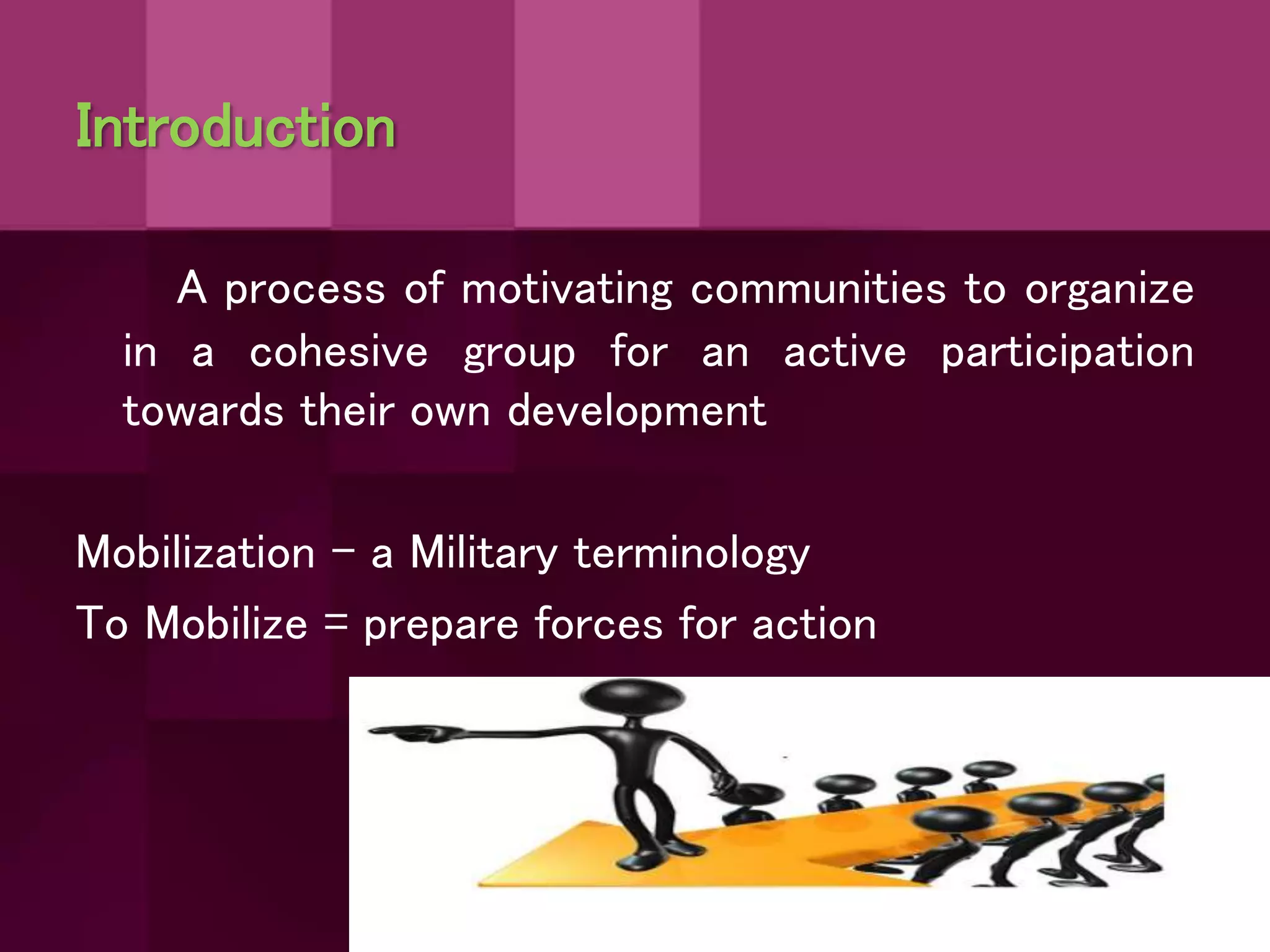
Mobilization - a Military terminology
To Mobilize = prepare forces for action
Definition
The process by which individuals or sections of
society mobilize in order to effect social change.
Oxford Dictionary
An integrative process where stakeholders are
stimulated to become active participants in social
change, using diverse strategies to meet shared
goals
A comprehensive planning approach that
emphasizes – Political coalition building –
Community action (UNICEF, 1993; Wallack, 1989)
Nature
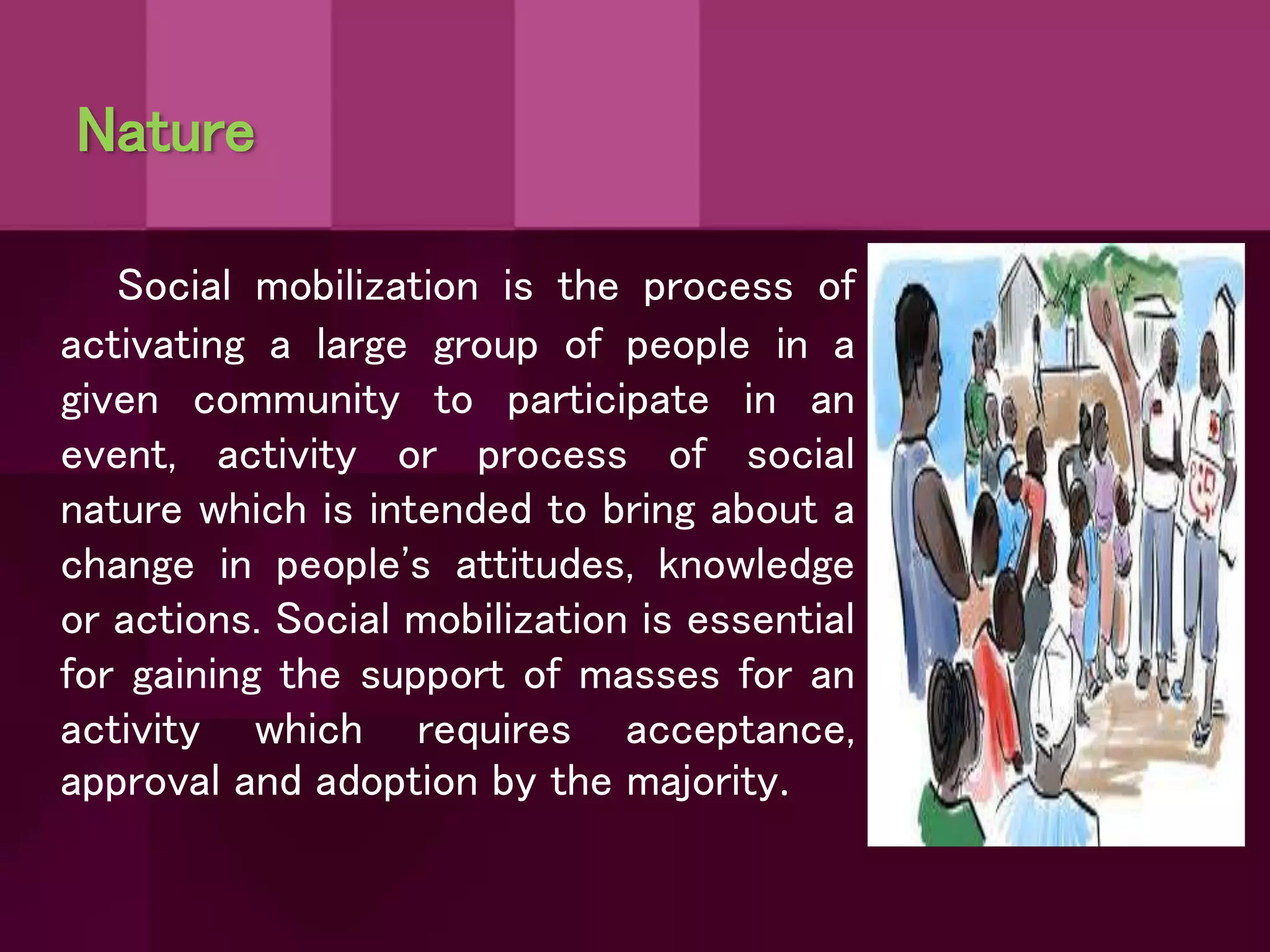
Social mobilization is the process of
activating a large group of people in a
given community to participate in an
event, activity or process of social
nature which is intended to bring about a
change in people's attitudes, knowledge
or actions. Social mobilization is essential
for gaining the support of masses for an
activity which requires acceptance,
approval and adoption by the majority.
Benefits of Social Mobilization
1. Enhances the capacity of individual, group and community, to
identify and fulfill their needs
2. Increases community participation in the programme
3. Helps to improve programme design
4. Helps to improve quality and results of the programme
5. Is a cost effective way to achieve sustainable result
6. Increases community ownership
7. Enables communities to determine their own development
8. Helps to builds trust within communities so they can work
together effectively
9. Increases capacity of communities to work with government and
other sectors(health services, research etc.)
10. Helps to apply political pressure and create positive change
Need of Social Mobilization
Social mobilization is a proven development
strategy that has helped people around the world
identify and address pressing issues. For making
any community based programme successful and
its sustainable, the involvement of community from
planning, implementation, monitoring and evaluation
is essential for which there is a need of mobilization
of the members of the community and other
stakeholders who can be involved in the
programme. The social mobilization is needed for.
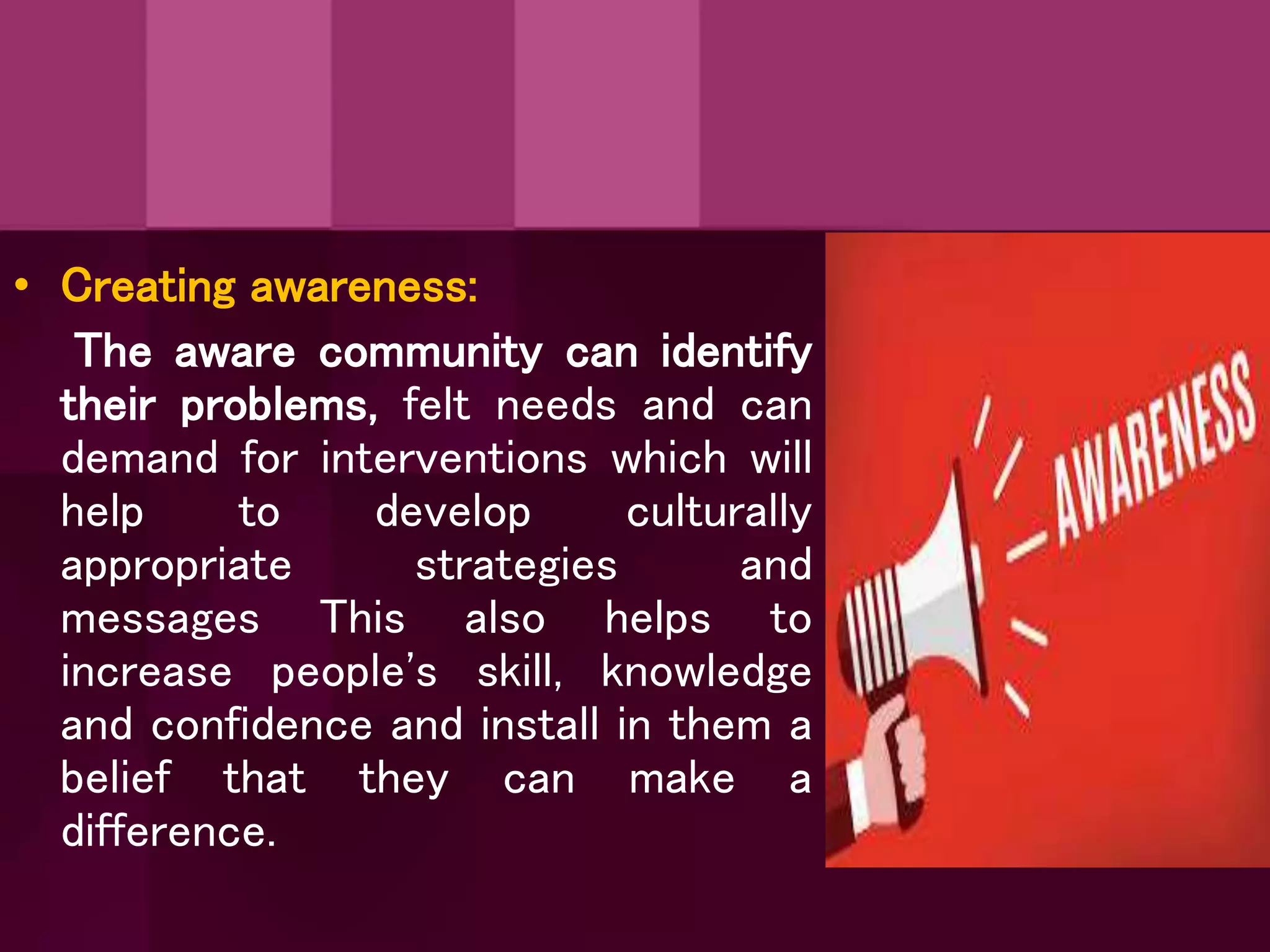
• Creating awareness:
The aware community can identify
their problems, felt needs and can
demand for interventions which will
help to develop culturally
appropriate strategies and
messages This also helps to
increase people's skill, knowledge
and confidence and install in them a
belief that they can make a
difference.
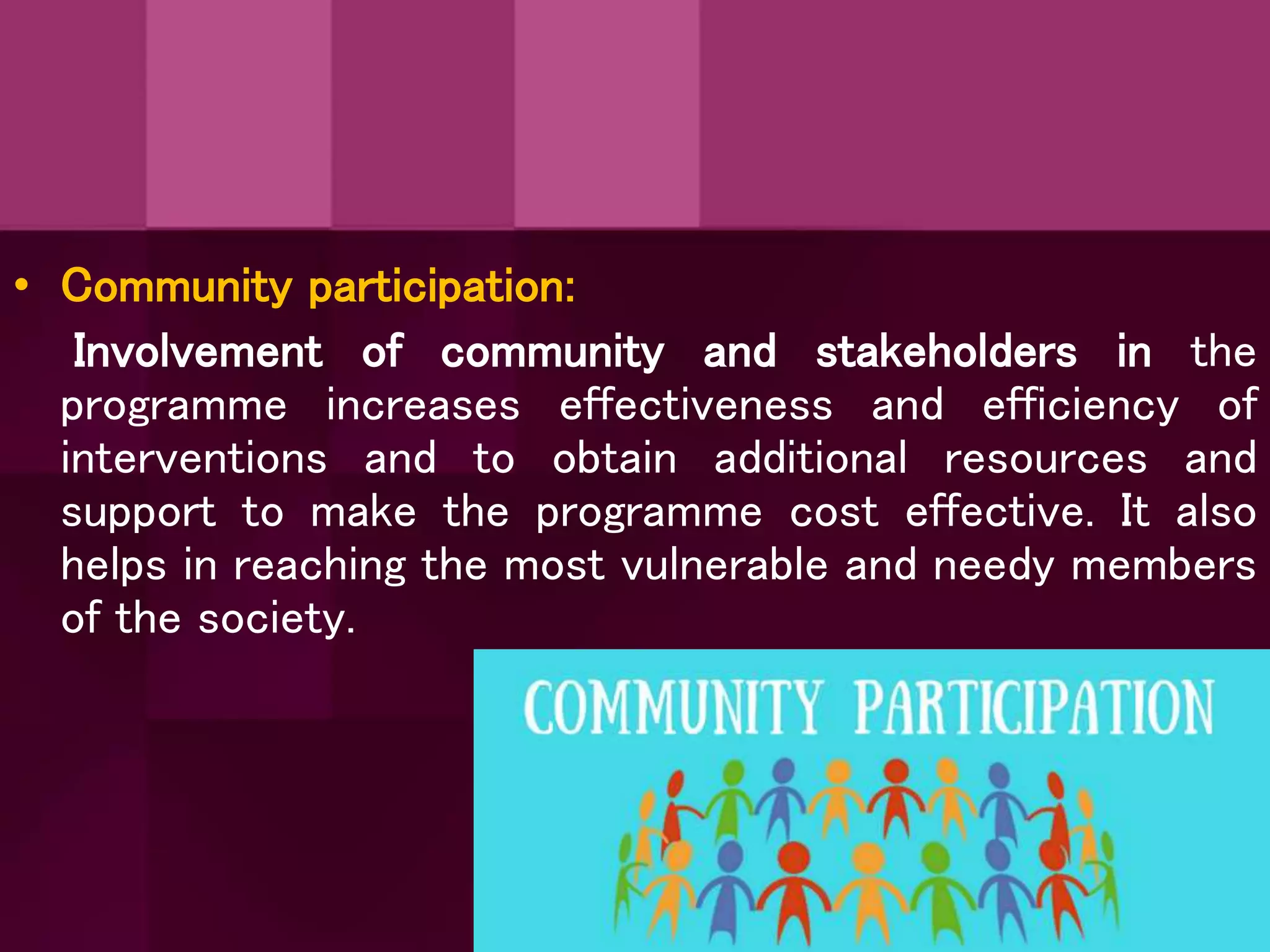
• Community participation:
Involvement of community and stakeholders in the
programme increases effectiveness and efficiency of
interventions and to obtain additional resources and
support to make the programme cost effective. It also
helps in reaching the most vulnerable and needy members
of the society.
• Increasing community ownership and sustainability:
Social mobilization is needed for developing
community ownership and sense of responsibility.
This helps in increasing coverage and access to
information and services.
• Empowering community:
The social mobilization activities increase the
capacity of the stakeholders in, decision-making,
planning, programme implementation and analysis.
When a community is empowered, people feel free
to act within the society and at the same time
associate a sense of belonging to it.
Social mobilization is needed in various
situations as given below:
• When large number of people have to be involved.
• When new programmes or policies requiring people's
opinion or participation are introduced.
• When beneficiaries involvement is crucial to the
success of the programmes.
• When behavioral changes need to be brought about
in masses.
Uses
• Social mobilisation plays an important role in social
change and development.
• The most important uses are:
• To gain public support for a policy, programme,
product or activity or service.
• To involve people in a large scale activity which the
agency wants to be
• completed within a specific period of time e.g.
camps and campaigns.
• To sustain development through involvement of
people and enhancing the
• process of behavior change.
• To ensure that the desired change take place
faster which is possible by
• inducement of people.
• It helps to understand the felt needs of the people.
• It helps to empower individuals and groups for
action.
TYPES OF SOCIAL MOBILISATION
Social mobilization process is of following types:
• Controlled and Spontaneous
• Specific and General
Controlled
Controlled mobilization starts outside the people who
are part of the process. The planning and initiative are
done elsewhere and people are only passive participants
initially. They may be convinced enough to become more
active forces later and may even take hold of the
movement and carry it forward. One example is the
immunization awareness about the benefits of
immunization and adopting the practice. Another example
is family planning. The sterilization camps were highly
effective in mobilizing the entire nation into accepting the
tubectomy / non-scalpel vasectomy as the best suited
form of birth control.
Spontaneous
Spontaneous movements start out of people's own
reactions to actual or perceived wrong and injustices. The
reactions may be against the establishment or other
agencies and individuals. The mobilisation is sparked off
through a recent even which affects peoples lives or
emotions. The initiators are filled with zeal and enthusiasm.
Everyone would like to participate and contribute to an
activity. When you went around to invite villagers for a
meeting to prepare an action plan to reduce maternal
mortality, you must have found that it is easier immediately
after this event. You could mobilize them easily.
Specific
Specific issues related to groups of people or daily
living are taken up as the content of social
mobilization. The antiliquor movement dealt with
one issue for which there was large-scale social
mobilization. The fever of activity and the high level
of participation of people after a natural calamity
like cyclone in the bay of Bengal or earthquake are
well known. Another example is the high level of
patriotic enthusiasm and activity during the Kargil
conflict.
General
The purpose of this type of social mobilization is
overall development of people. For example,
mobilization for introducing the local self-
government through the 72nd amendment of the
constitution (Panchayati Raj) is with the goal of
achieving a more decentralized process and
enhancing people's participation. This takes longer to
start as well as to maintain but once introduced it
lasts longer.
Approaches
As enumerated by McKee (1992):
• Political Mobilization
• Government Mobilization
• Community Mobilization
• Corporate Mobilization
• Beneficiary Mobilization
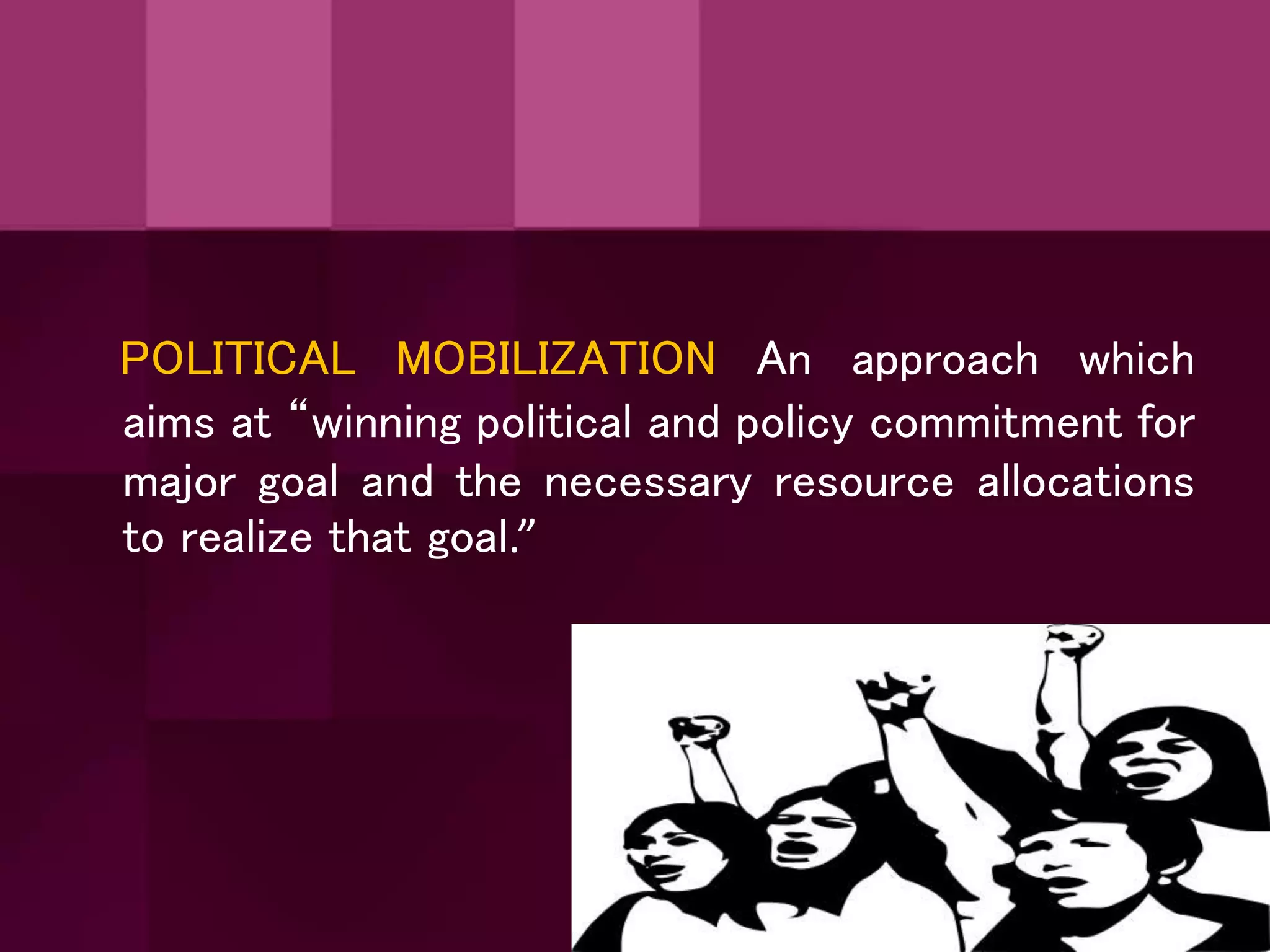
POLITICAL MOBILIZATION An approach which
aims at “winning political and policy commitment for
major goal and the necessary resource allocations
to realize that goal.”
GOVERNMENT MOBILIZATION Aims at eliciting
the cooperation of service providers and other
government organizations which can provide direct
or indirect support to the program.
COMMUNITY MOBILIZATION Aims at gaining the
commitment of local political, religious, social, and
traditional leaders, as well as local government
agencies, non-governmental organizations (NGOs),
women’s groups and cooperatives.
CORPORATE MOBILIZATION Aims at securing the
support of national or international companies in
promoting development goals, either by contributing
needed resources or carrying out the advertising
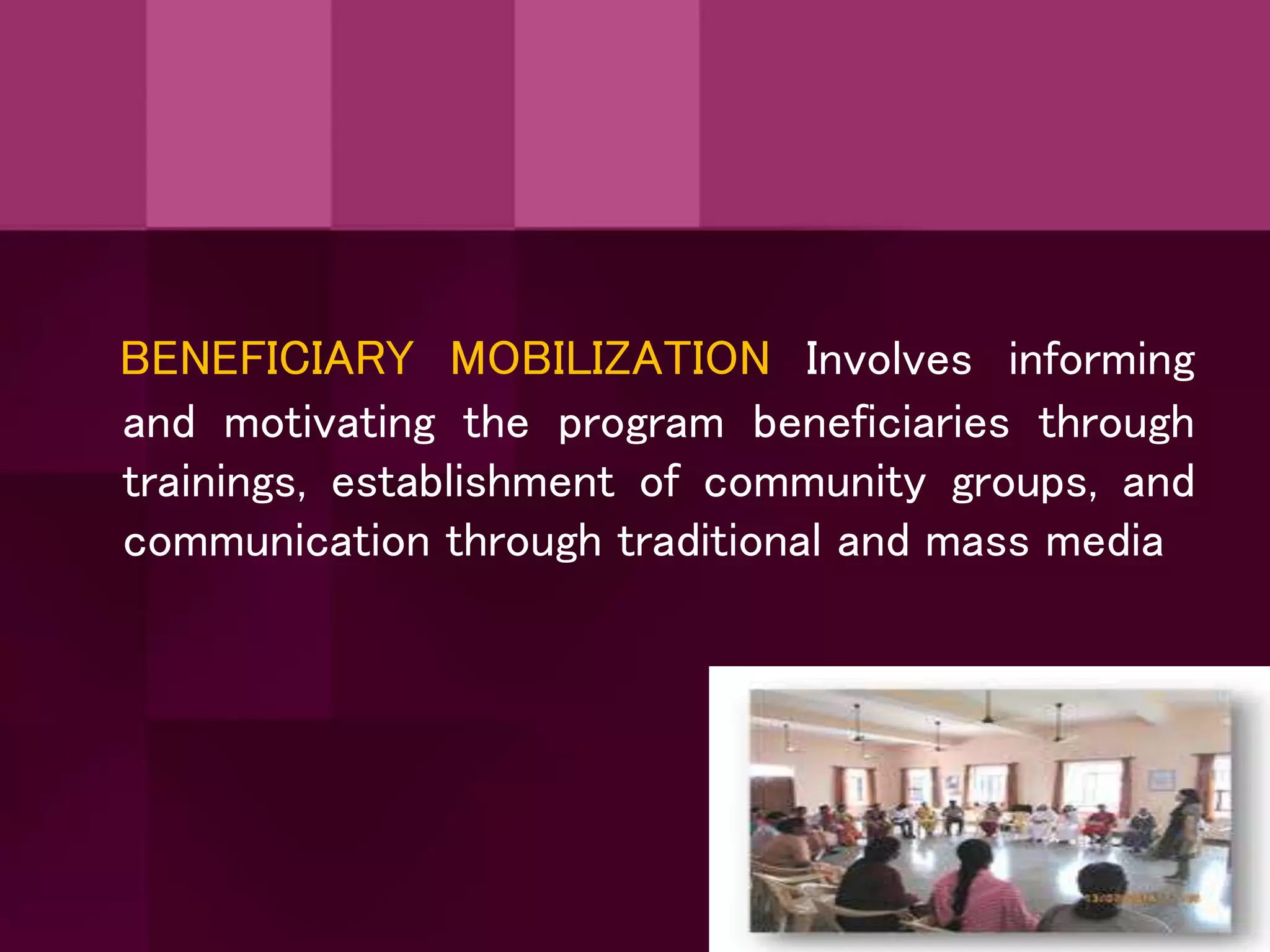
BENEFICIARY MOBILIZATION Involves informing
and motivating the program beneficiaries through
trainings, establishment of community groups, and
communication through traditional and mass media
Pre-requisites for Social Mobilization
• Pre-requisites for social mobilization include the following:
• Purpose or goal for which mobilization is required.
• Leader who will inspire and encourage participants and
spearhead the movement.
• Symbols for unification and building togetherness: slogans,
banners, songs, badges.
• Messages which are used for mobilization and the content
of these messages in the form of speeches, pamphlets,
booklets and songs etc. to keep alive the involvement and
interest.
• Network of managers and workers who will organize
and take responsibility for different components of
the social mobilization.
• Funds, which will help in keeping intention and
action closer together and make sure that the
intended activities are carried out without
obstacles.
• Publicity and news in the form of media overage,
latest reports including an efficient system of
dissemination of information.
Process of Social Mobilization at the Village Level
Social mobilization is not easy task because every
community has its own beliefs, values culture,
leadership, social systems, social groups, religion
and interests. Hence it is necessary for the social
mobilizes to understand the community for whom
the programme is being undertaken. However the
following steps can be taken for Social Mobilization.
• Initiate dialogue with community members to
understand their interests, felt needs, resources,
level of understanding, their perceptions, views
about the programme, identify all the available
resources in the community. Plan the best use of
the available resources.
• Form new or identify existing community based
organizations (like various committees, Self Help
Groups, Village Development Forum etc.) and
involve them the programme activities. Provide
training if needed.
• Try to create an environment in which individuals
can empower themselves to address their own and
their community's health needs.
• Promote community participation by developing
partnership with the community.
• Promote good leadership and democratic decision
making.
• Enable the community to better govern itself better
play a catalyst role.
Example of Social Mobilization for Health in
Rural Area
Mobilize community based groups
Forming village coordination
committee
Endorsing village coordination
committee through panchayata
Planning intervention Identifying key health issues Determining health needs
Health needs Assessment
Implementing activities Building capacity of community based organization
Improving access to health services
Village coordination committee independently manages health
activities and sustain health gain
Go to the people
Live with them
Learn from them
Start with what they have
Built with what they have
But with the best leaders
When the work is done
The task accomplished
The people will say
We have done this ourselves
A Chinese Poem
SKILLS FOR SOCIAL MOBILISATION
• A Social Mobilize is a person who mobilizes relevant
segments of society: decision and policy makers,
opinion leaders, bureaucrats and technocrats,
professional groups, religious associations,
commerce and industry, communities and
individuals.
• He/she should have the following qualities
• Good communication skills
• Good facilitation skills
• Active listener
• Committed
• Decision maker
• Active
• Negotiation skills
• Known to culture and values of society
• Catalyst
• Non judgmental
• Good Management skills
• Responsible
• Honest
• Knowledgeable
• Social
• Good observer
• Leadership
LIMITATIONS OF SOCIAL MOBILIZATION
1. An exit strategy out of the community is not always
desired by NGOs and community based organizations
providing capacity building services as it reduces their
sources of income.
2. Community mobilization can also be inherently political
and can be misused by politicians. People can be
mobilized in a negative sense, either towards violence or
towards a certain political ideology.
3. A consensus amongst all organizations undertaking
community mobilization may not be feasible in a country
due to ideological or political reasons.
Conclusion
Social Mobilization is essential in Community
Based Interventions especially in the field of
Community Health. Social mobilization is a process
that enables people in different sectors and at
various levels of society to engage in dialogue,
negotiation and collective action. And the purpose
of social mobilization is to bring together
organizations, policymakers and communities to
forge a collective identity and to work toward a
goal.
Reference
1. IGUNO (2017). Public Health and Primary Health
Care Skills. Indira Gandhi National Open University
School of Health Sciences ISBN : 978-93-86607-98-0
2. https://www.slideshare.net/MarkJoenelCastillo/soci
al-mobilization-strategies
3. https://www.slideshare.net/AlAlva1/social-
mobilization-handout

Social mobilization skills

  • 1.
    SOCIAL MOBILIZATION SKILLS Mrs.VeenaJ V HOD, Dept of Community Health Nursing VINS & RC
  • 2.
    Introduction A process ofmotivating communities to organize in a cohesive group for an active participation towards their own development Mobilization - a Military terminology To Mobilize = prepare forces for action
  • 3.
    Definition The process bywhich individuals or sections of society mobilize in order to effect social change. Oxford Dictionary An integrative process where stakeholders are stimulated to become active participants in social change, using diverse strategies to meet shared goals
  • 4.
    A comprehensive planningapproach that emphasizes – Political coalition building – Community action (UNICEF, 1993; Wallack, 1989)
  • 5.
    Nature Social mobilization isthe process of activating a large group of people in a given community to participate in an event, activity or process of social nature which is intended to bring about a change in people's attitudes, knowledge or actions. Social mobilization is essential for gaining the support of masses for an activity which requires acceptance, approval and adoption by the majority.
  • 6.
    Benefits of SocialMobilization 1. Enhances the capacity of individual, group and community, to identify and fulfill their needs 2. Increases community participation in the programme 3. Helps to improve programme design 4. Helps to improve quality and results of the programme 5. Is a cost effective way to achieve sustainable result 6. Increases community ownership 7. Enables communities to determine their own development 8. Helps to builds trust within communities so they can work together effectively 9. Increases capacity of communities to work with government and other sectors(health services, research etc.) 10. Helps to apply political pressure and create positive change
  • 7.
    Need of SocialMobilization Social mobilization is a proven development strategy that has helped people around the world identify and address pressing issues. For making any community based programme successful and its sustainable, the involvement of community from planning, implementation, monitoring and evaluation is essential for which there is a need of mobilization of the members of the community and other stakeholders who can be involved in the programme. The social mobilization is needed for.
  • 8.
    • Creating awareness: Theaware community can identify their problems, felt needs and can demand for interventions which will help to develop culturally appropriate strategies and messages This also helps to increase people's skill, knowledge and confidence and install in them a belief that they can make a difference.
  • 9.
    • Community participation: Involvementof community and stakeholders in the programme increases effectiveness and efficiency of interventions and to obtain additional resources and support to make the programme cost effective. It also helps in reaching the most vulnerable and needy members of the society.
  • 10.
    • Increasing communityownership and sustainability: Social mobilization is needed for developing community ownership and sense of responsibility. This helps in increasing coverage and access to information and services.
  • 11.
    • Empowering community: Thesocial mobilization activities increase the capacity of the stakeholders in, decision-making, planning, programme implementation and analysis. When a community is empowered, people feel free to act within the society and at the same time associate a sense of belonging to it.
  • 12.
    Social mobilization isneeded in various situations as given below: • When large number of people have to be involved. • When new programmes or policies requiring people's opinion or participation are introduced. • When beneficiaries involvement is crucial to the success of the programmes. • When behavioral changes need to be brought about in masses.
  • 13.
    Uses • Social mobilisationplays an important role in social change and development. • The most important uses are: • To gain public support for a policy, programme, product or activity or service. • To involve people in a large scale activity which the agency wants to be • completed within a specific period of time e.g. camps and campaigns.
  • 14.
    • To sustaindevelopment through involvement of people and enhancing the • process of behavior change. • To ensure that the desired change take place faster which is possible by • inducement of people. • It helps to understand the felt needs of the people. • It helps to empower individuals and groups for action.
  • 15.
    TYPES OF SOCIALMOBILISATION Social mobilization process is of following types: • Controlled and Spontaneous • Specific and General
  • 16.
    Controlled Controlled mobilization startsoutside the people who are part of the process. The planning and initiative are done elsewhere and people are only passive participants initially. They may be convinced enough to become more active forces later and may even take hold of the movement and carry it forward. One example is the immunization awareness about the benefits of immunization and adopting the practice. Another example is family planning. The sterilization camps were highly effective in mobilizing the entire nation into accepting the tubectomy / non-scalpel vasectomy as the best suited form of birth control.
  • 17.
    Spontaneous Spontaneous movements startout of people's own reactions to actual or perceived wrong and injustices. The reactions may be against the establishment or other agencies and individuals. The mobilisation is sparked off through a recent even which affects peoples lives or emotions. The initiators are filled with zeal and enthusiasm. Everyone would like to participate and contribute to an activity. When you went around to invite villagers for a meeting to prepare an action plan to reduce maternal mortality, you must have found that it is easier immediately after this event. You could mobilize them easily.
  • 18.
    Specific Specific issues relatedto groups of people or daily living are taken up as the content of social mobilization. The antiliquor movement dealt with one issue for which there was large-scale social mobilization. The fever of activity and the high level of participation of people after a natural calamity like cyclone in the bay of Bengal or earthquake are well known. Another example is the high level of patriotic enthusiasm and activity during the Kargil conflict.
  • 19.
    General The purpose ofthis type of social mobilization is overall development of people. For example, mobilization for introducing the local self- government through the 72nd amendment of the constitution (Panchayati Raj) is with the goal of achieving a more decentralized process and enhancing people's participation. This takes longer to start as well as to maintain but once introduced it lasts longer.
  • 20.
    Approaches As enumerated byMcKee (1992): • Political Mobilization • Government Mobilization • Community Mobilization • Corporate Mobilization • Beneficiary Mobilization
  • 21.
    POLITICAL MOBILIZATION Anapproach which aims at “winning political and policy commitment for major goal and the necessary resource allocations to realize that goal.”
  • 22.
    GOVERNMENT MOBILIZATION Aimsat eliciting the cooperation of service providers and other government organizations which can provide direct or indirect support to the program.
  • 23.
    COMMUNITY MOBILIZATION Aimsat gaining the commitment of local political, religious, social, and traditional leaders, as well as local government agencies, non-governmental organizations (NGOs), women’s groups and cooperatives.
  • 24.
    CORPORATE MOBILIZATION Aimsat securing the support of national or international companies in promoting development goals, either by contributing needed resources or carrying out the advertising
  • 25.
    BENEFICIARY MOBILIZATION Involvesinforming and motivating the program beneficiaries through trainings, establishment of community groups, and communication through traditional and mass media
  • 26.
    Pre-requisites for SocialMobilization • Pre-requisites for social mobilization include the following: • Purpose or goal for which mobilization is required. • Leader who will inspire and encourage participants and spearhead the movement. • Symbols for unification and building togetherness: slogans, banners, songs, badges. • Messages which are used for mobilization and the content of these messages in the form of speeches, pamphlets, booklets and songs etc. to keep alive the involvement and interest.
  • 27.
    • Network ofmanagers and workers who will organize and take responsibility for different components of the social mobilization. • Funds, which will help in keeping intention and action closer together and make sure that the intended activities are carried out without obstacles. • Publicity and news in the form of media overage, latest reports including an efficient system of dissemination of information.
  • 28.
    Process of SocialMobilization at the Village Level Social mobilization is not easy task because every community has its own beliefs, values culture, leadership, social systems, social groups, religion and interests. Hence it is necessary for the social mobilizes to understand the community for whom the programme is being undertaken. However the following steps can be taken for Social Mobilization.
  • 29.
    • Initiate dialoguewith community members to understand their interests, felt needs, resources, level of understanding, their perceptions, views about the programme, identify all the available resources in the community. Plan the best use of the available resources. • Form new or identify existing community based organizations (like various committees, Self Help Groups, Village Development Forum etc.) and involve them the programme activities. Provide training if needed.
  • 30.
    • Try tocreate an environment in which individuals can empower themselves to address their own and their community's health needs. • Promote community participation by developing partnership with the community. • Promote good leadership and democratic decision making. • Enable the community to better govern itself better play a catalyst role.
  • 31.
    Example of SocialMobilization for Health in Rural Area Mobilize community based groups Forming village coordination committee Endorsing village coordination committee through panchayata Planning intervention Identifying key health issues Determining health needs Health needs Assessment Implementing activities Building capacity of community based organization Improving access to health services Village coordination committee independently manages health activities and sustain health gain
  • 32.
    Go to thepeople Live with them Learn from them Start with what they have Built with what they have But with the best leaders When the work is done The task accomplished The people will say We have done this ourselves A Chinese Poem
  • 33.
    SKILLS FOR SOCIALMOBILISATION • A Social Mobilize is a person who mobilizes relevant segments of society: decision and policy makers, opinion leaders, bureaucrats and technocrats, professional groups, religious associations, commerce and industry, communities and individuals. • He/she should have the following qualities
  • 34.
    • Good communicationskills • Good facilitation skills • Active listener • Committed • Decision maker • Active • Negotiation skills • Known to culture and values of society • Catalyst
  • 35.
    • Non judgmental •Good Management skills • Responsible • Honest • Knowledgeable • Social • Good observer • Leadership
  • 36.
    LIMITATIONS OF SOCIALMOBILIZATION 1. An exit strategy out of the community is not always desired by NGOs and community based organizations providing capacity building services as it reduces their sources of income. 2. Community mobilization can also be inherently political and can be misused by politicians. People can be mobilized in a negative sense, either towards violence or towards a certain political ideology. 3. A consensus amongst all organizations undertaking community mobilization may not be feasible in a country due to ideological or political reasons.
  • 37.
    Conclusion Social Mobilization isessential in Community Based Interventions especially in the field of Community Health. Social mobilization is a process that enables people in different sectors and at various levels of society to engage in dialogue, negotiation and collective action. And the purpose of social mobilization is to bring together organizations, policymakers and communities to forge a collective identity and to work toward a goal.
  • 38.
    Reference 1. IGUNO (2017).Public Health and Primary Health Care Skills. Indira Gandhi National Open University School of Health Sciences ISBN : 978-93-86607-98-0 2. https://www.slideshare.net/MarkJoenelCastillo/soci al-mobilization-strategies 3. https://www.slideshare.net/AlAlva1/social- mobilization-handout