1
AMITY SCHOOL OF ARCHITECTURE ANDPLANNING
AMITY UNIVERSITY
AMITY SCHOOL OF ARCHITECTURE & PLANNING
SEMINAR GUEST LECTURE &WORK SHOP FOR SKILL DEVELOPMENT
Course :B.Arch
Faculty :Ar Vibha Upadhyaya
‘‘MODERN CONSTRUCTION TECHNOLOGY”
By Shourya Puri
III semester
2
AMITY SCHOOL OF ARCHITECTURE ANDPLANNING
CERTIFICATE
This is to certify that Shourya puri student of B.Arch has carried out the work presented in the research of the Seminar
Guest Lecture & Workshop For Skill Development Entitled “Modern construction technology” as part of Second- Year
programme of Bachelor of Architecture from Amity School of Architecture and Planning, Amity University Rajasthan,
under my supervision.
DATE:20/10/2014
AR. VIBHA UPADHYAYA
RESEARCH GUIDE
ASAP, AUR
3
AMITY SCHOOL OF ARCHITECTURE ANDPLANNING
ACKNOWLEDGEMENT
I would like to express my gratitude to all those who gave me the possibility to complete this research. I want to thank to
AMITY UNIVERSITY RAJASTHAN for giving me such a great opportunity to work on this resaearch. I am bound to
the Honorable MS Vibha Upadhyaya mam who had given me such a great chance to prove myself…..
My classmates supported me in my research work. I want to thank them for all their help, support, interest and valuable
hints. Especially I obliged to my teachers who are providing me knowledge about my core subjects……Finally, I take
this opportunity to complete my research by giving my hundred percent……
Especially, I would like to give my special thanks to all the persons who helped me in this research…….
With warm regards,
Shourya Puri
4
AMITY SCHOOL OF ARCHITECTURE ANDPLANNING
INTRODUCTION
With developments in technology, general construction knowledge and manufacturing processes, Modern construction technology have
evolved from the more conventional methods to a large extent.Modern construction technology can be defined as those that provide greater
efficiency in the construction process, resulting in increased production, better quality, in less time and with less waste, so reducing the
environmental impact. Modern construction technology is a process to produce more, better quality homes in less time.
Modern construction technology is a collective term used to describe a number ofconstruction methods. The methods being introduced into
the world house building differ significantly from so-called conventional construction methods such as brick and block.
In this report, we use the term MCT(modern construction technology) ,This is because this term is increasingly being used and because it also
includes several important new types of construction methods that involve some element of fabrication on site.
Advanced technologies in housing construction are not used as frequently as the more standard construction technologies, which involve the
use of masonry, timber, and concrete. However, as with other innovations, it is expected that over time these newer technologies will gain
wider acceptance. For purposes of the World Housing Encyclopedia, advanced technologies include seismic isolation and passive-energy
dissipation devices.
Modern construction technology are about better products and processes. They aim to improve business efficiency, quality, customer
satisfaction, environmental performance, sustainability and the predictability of delivery timescales. Modern methods of construction are,
therefore, more broadly based than a particular focus on product. They engage people and process to seek improvement in the delivery and
performance of construction.
AIM &OBJECTIVE
1) The first objective is to achieve the modern aspects of the modern construction throughout the world and to aware the people of the
modern construction technology so as to save time , money ,resources , and energy.
2)The objective of the research is to develop a detailed study of the current level of use of Modern construction technology and market size
in different construction like cladding, concrete walls and floors,flat slabs ,precast foundation,volumetric modules etc.
The aim of this report is to make the construction market aware of the modern construction technology and to know benefits and methods so
as to provide greater efficiency in the construction process, resulting in increased production, better quality, in less time and with less waste,
so reducing the environmental impact on earth.
METHODOLOGY
My study involves the online research of the topic “Modern Construction Technology”. Securing information by discussing with the faculties
of AMITY SCHOOL OF ARCHITECTURE AND PLANNING. Also by visiting library for the research of my topic “Modern Construction
Technology” in books for detailed study and knowledge.
SCOPE
The scope of this report is to make the use of modern construction technology and their materials throughout the world for minimal use of
natural resources and to save it for future generation.
5
AMITY SCHOOL OF ARCHITECTURE ANDPLANNING
LIMITATIONS
As the topic “Modern Construction Technology” is very enormous and massive. Therefore ,it not possible to covers all the topic and chapters
in this report.Therefore , this report has limited topics related to “Modern Construction Technology” which are as follows:-
1)Concrete Walls and Floors.
2)Precast Cladding Panels.
3)Precast Flat Panel System.
4)Volumetric Modules.
5)Twin Wall Technology.
6)Flat slabs.
7)Thin Joint Masonary.
8)Concrete Formwork.
9)Precast Foundation.
CASE STUDY
Concrete walls and floors
Concrete walls is an eclectic category with options for everything: seat walls; decorative interior or exterior finishes; sound walls that abut a freeway;
retaining walls to hold back the earth; to the very walls that comprise the exterior of a home.Concrete has become the new flooring material of choice for
designers and homeowners across the United States. Concrete floors are popping up in retail stores, trendy restaurants, offices, and homes everywhere.
Whether it's acid-stained, painted, overlays, microtoppings, radiant floors, or a unique personal floor, concrete floors offer a range unlike any other
material. Concrete flooring, sometimes referred to as cement flooring, no longer has to be gray and boring. Now coloring concrete or applying textures,
patterns, saw cuts, etc., can bring new life to this traditional substrate.
One of the major benefits of concrete floors is their affordability compared to other flooring options. Installing a decorative concrete floor can be quite
cost-effective,particularly if you already have a concrete slab that’s ready for staining, polishing or application of a coating or overlay. A basic concrete
floor will carry a comparable price tag to linoleum, vinyl, ceramic tile or carpet. While a more complex concrete floor design will run you about the same
or slightly less than marble, granite, slate, or high-end wood. Furthermore, the lifetime cost of a concrete floor is very low because they require little
upkeep and last for years.
A second thing that attracts business and homeowners to concrete flooring is its ease of maintenance. When properly sealed concrete floors can be cleaned
with a quick pass of a dust mop. For an occasional deep clean a neutral cleaner and water can be used. The frequency of maintenance is dependent on the
amount of traffic the floor receives. Restaurants and businesses with considerable foot traffic may want to use a sacrificial floor wax in addition to a sealer
to further protect from abrasion.
Here are some additional benefits of concrete floors according to Barbara Sargent of Kemiko Concrete Floor Stains:
 They enhance the integrity of architect's designs.
 They are easy to change, especially if you sell your home; the next owner can place carpet or wood on top of the concrete slab.
 They are great in regions with a lot of sand or snow.
 They are a good alternative to carpet if you have allergies.
6
AMITY SCHOOL OF ARCHITECTURE ANDPLANNING
Figure 1:Concrete Floor
7
AMITY SCHOOL OF ARCHITECTURE ANDPLANNING
Figure 2:Concrete wall
Precast Cladding Panels
Precast concrete panels are reinforced concrete units available in a wide range of mixes, colours and finishes. Finishes can include acid-
etched, smooth or coarse ground, grit or sand-blasted, rubbed or polished. Mixes designed to resemble natural stone can also be produced.
Highly articulated designs can be accommodated by the mouldable concrete mix.
Benefits
 Faster programme times - not affected by weather or labour shortages.
 Improves buildability.
 Early enclosure of dry envelope enables follow-on trades to start sooner.
 Produces a high standard of workmanship in factory conditions - reduces potential for accidents, addresses on-site skill shortage.
 Has a high quality finish that can be left exposed - concrete's thermal properties can be exploited in low-energy buildings
8
AMITY SCHOOL OF ARCHITECTURE ANDPLANNING
Figure 3:ACP Cladding
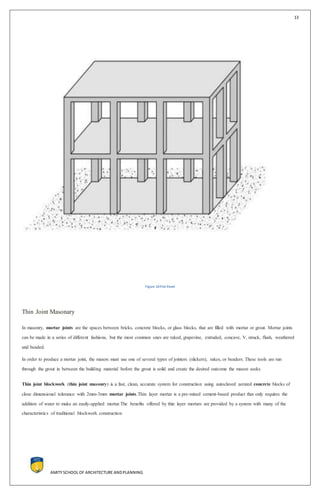
Precast Flat Panel System
Floor and wall units are produced off-site in a factory and erected on-site to form robust structures, ideal for all repetitive cellular projects.
Panels can include services, windows, doors and finishes. Building envelope panels with factory fitted insulation and decorative cladding
can also be used as load-bearing elements. This offers factory quality and accuracy, together with speed of erection on-site.
9
AMITY SCHOOL OF ARCHITECTURE ANDPLANNING
Figure 4:Panel system
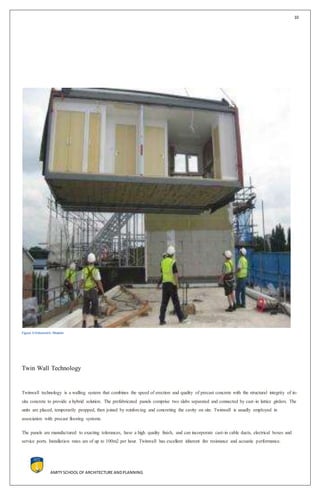
Volumetric modules
3D Volumetric construction (also known as modular construction) involves the production of three-dimensional units in controlled factory
conditions prior to transportation to site.
Modules can be brought to site in a variety of forms, ranging from a basic structure to one with all internal and
external finishes and services installed, all ready for assembly. The casting of modules uses the benefits of factory conditions to create
service-intensive units where a high degree of repetition and a need for rapid assembly on-site make its use highly desirable.
10
AMITY SCHOOL OF ARCHITECTURE ANDPLANNING
Figure 5:Volumetric Module
Twin Wall Technology
Twinwall technology is a walling system that combines the speed of erection and quality of precast concrete with the structural integrity of in-
situ concrete to provide a hybrid solution. The prefabricated panels comprise two slabs separated and connected by cast-in lattice girders. The
units are placed, temporarily propped, then joined by reinforcing and concreting the cavity on site. Twinwall is usually employed in
association with precast flooring systems.
The panels are manufactured to exacting tolerances, have a high quality finish, and can incorporate cast-in cable ducts, electrical boxes and
service ports. Installation rates are of up to 100m2 per hour. Twinwall has excellent inherent fire resistance and acoustic performance.
11
AMITY SCHOOL OF ARCHITECTURE ANDPLANNING
Figure 6:Twin Wall Technology
Flat Slabs
Flat slabs are highly versatile elements widely used in construction, providing minimum depth, fast construction and allowing flexible column
grids.Because this is one of the most common forms of construction, all construct members and many other concrete frame contractors can
undertake this work. Flat slabs are particularly appropriate for areas where tops of partitions need to be sealed to the slab soffit for acoustic or
fire reasons. Flat slabs are considered to be faster and more economic than other forms of construction, as partition heads do not need to be
cut around downstand beams or ribs.
12
AMITY SCHOOL OF ARCHITECTURE ANDPLANNING
Flat slabs can be designed with a good surface finish to the soffit, allowing exposed soffits to be used. This allows exploitation of the
building’s thermal mass in the design of heating, ventilation and cooling requirements, increasing energy efficiency.Flat slabs provide the
most flexible arrangements for services distribution as services do not have to divert around structural elements.
Figure 7:Flat Slab
Figure 8:Flat Panel
Figure 9:Flat Panel
13
AMITY SCHOOL OF ARCHITECTURE ANDPLANNING
Figure 10:Flat Panel
Thin Joint Masonary
In masonry, mortar joints are the spaces between bricks, concrete blocks, or glass blocks, that are filled with mortar or grout. Mortar joints
can be made in a series of different fashions, but the most common ones are raked, grapevine, extruded, concave, V, struck, flush, weathered
and beaded.
In order to produce a mortar joint, the mason must use one of several types of jointers (slickers), rakes, or beaders. These tools are run
through the grout in between the building material before the grout is solid and create the desired outcome the mason seeks
Thin joint blockwork (thin joint masonry) is a fast, clean, accurate system for construction using autoclaved aerated concrete blocks of
close dimensional tolerance with 2mm-3mm mortar joints.Thin layer mortar is a pre-mixed cement-based product that only requires the
addition of water to make an easily-applied mortar.The benefits offered by thin layer mortars are provided by a system with many of the
characteristics of traditional blockwork construction.
14
AMITY SCHOOL OF ARCHITECTURE ANDPLANNING
Figure 11:Brick Masonary
Concrete Formwork
Formwork is a structure, usually temporary, used to contain poured concrete and to mould it to the required dimensions and support until it is
able to support itself. It consists primarily of the face contact material and the bearers that directly support the face contact
material. Formwork systems used for concrete frame construction have continued to develop significantly since the early 1990s. The major
innovations have focused on on-site efficiency of production, health and safety, and environmental issues, driving the concrete construction
industry towards ever-increasing efficiency. Different formwork systems provide a wide range of concrete construction solutions that can be
chosen to suit the needs of a particular development.
Traditional formwork for concrete construction normally consisted of bespoke solutions requiring skilled craftsmen. This type of formwork
often had poor safety features and gave slow rates of construction on-site and huge levels of waste.
The main types of formwork systems in use now are:
 Table form/flying form
 System column formwork
 Horizontal panel
 Slip form
 Tunnel form
The modern formwork systems listed above are mostly modular, which are designed for speed and efficiency. They are designed to provide
increased accuracy and minimize waste in construction and most have enhanced health and safety features built-in.
15
AMITY SCHOOL OF ARCHITECTURE ANDPLANNING
Figure 12:Concrete Framework
Precast Foundation
Precast concrete foundation and wall panels can take many forms. Some consist of steel-reinforced concrete ribs that run vertically and
horizontally in the panels. Others are solid precast concrete panels. Panels are precast and cured in a controlled factory environment so
weather delays can be avoided. A typical panelized foundation can be erected in four to five hours, without the need to place concrete on site
for the foundation. The result is a foundation that can be installed in any climate zone in one sixth of the time needed for a formed concrete
wall.
Some manufacturers cast the concrete against foam insulation that provides the form during manufacture and added R-value in the wall.
Panels range in size from 2'-12' in width by 8' - 12' in height and are typically installed with a crane on top of 4" to 6" of compacted stone.
The stone facilitates sub-slab drainage and adequately carries and transfers the load from the foundation wall. Panel connections consist of
bolts and sealant. The foundation can be backfilled as soon as it is braced per manufacturer's specifications.
The controlled temperature of the processing plant allows the manufacturer to work with concrete admixtures that focus on ultimate strength
rather than cure time and temperature. Manufacturers are able to produce mixes that harden to 5,000 psi, which is stronger than concrete
block or concrete walls formed and cast in the field. Better control of the concrete mixture and curing environment allows the use of low
water/cement ratios that results in a dense material that prevents water penetration.
16
AMITY SCHOOL OF ARCHITECTURE ANDPLANNING
Figure 13:Precast foundation
Conclusion
The benefits of modern methods of construction are too positive to be ignored.. Modern methods of construction can provide large numbers
of sustainable, well-designed homes in a short period of time. Modern methods of construction also afford an opportunity to overcome the
skills shortage in the construction industry through factory production.. Modern methods of construction will be a key tool in addressing this
challenge and should be viewed as an opportunity for the house building sector to increase capacity and choice in the housing market.Modern
construction technology have evolved from the more conventional methods to a large extent.Modern construction technology is those that
provide greater efficiency in the construction process, resulting in increased production, better quality, in less time and with less waste, so
reducing the environmental impact. Modern construction technology is a process to produce more, better quality homes in less time.
17
AMITY SCHOOL OF ARCHITECTURE ANDPLANNING
Biblography
1) Wikipedia
2) http://www.concretecentre.com.
3)google.com
4) www.precaststructures.
5)Strength of materials : R S Khurmi
6)Strength of Materials : B C Punamia
7)Engineering materials: Rangvala

Method Of Modern Construction

  • 1.
    1 AMITY SCHOOL OFARCHITECTURE ANDPLANNING AMITY UNIVERSITY AMITY SCHOOL OF ARCHITECTURE & PLANNING SEMINAR GUEST LECTURE &WORK SHOP FOR SKILL DEVELOPMENT Course :B.Arch Faculty :Ar Vibha Upadhyaya ‘‘MODERN CONSTRUCTION TECHNOLOGY” By Shourya Puri III semester
  • 2.
    2 AMITY SCHOOL OFARCHITECTURE ANDPLANNING CERTIFICATE This is to certify that Shourya puri student of B.Arch has carried out the work presented in the research of the Seminar Guest Lecture & Workshop For Skill Development Entitled “Modern construction technology” as part of Second- Year programme of Bachelor of Architecture from Amity School of Architecture and Planning, Amity University Rajasthan, under my supervision. DATE:20/10/2014 AR. VIBHA UPADHYAYA RESEARCH GUIDE ASAP, AUR
  • 3.
    3 AMITY SCHOOL OFARCHITECTURE ANDPLANNING ACKNOWLEDGEMENT I would like to express my gratitude to all those who gave me the possibility to complete this research. I want to thank to AMITY UNIVERSITY RAJASTHAN for giving me such a great opportunity to work on this resaearch. I am bound to the Honorable MS Vibha Upadhyaya mam who had given me such a great chance to prove myself….. My classmates supported me in my research work. I want to thank them for all their help, support, interest and valuable hints. Especially I obliged to my teachers who are providing me knowledge about my core subjects……Finally, I take this opportunity to complete my research by giving my hundred percent…… Especially, I would like to give my special thanks to all the persons who helped me in this research……. With warm regards, Shourya Puri
  • 4.
    4 AMITY SCHOOL OFARCHITECTURE ANDPLANNING INTRODUCTION With developments in technology, general construction knowledge and manufacturing processes, Modern construction technology have evolved from the more conventional methods to a large extent.Modern construction technology can be defined as those that provide greater efficiency in the construction process, resulting in increased production, better quality, in less time and with less waste, so reducing the environmental impact. Modern construction technology is a process to produce more, better quality homes in less time. Modern construction technology is a collective term used to describe a number ofconstruction methods. The methods being introduced into the world house building differ significantly from so-called conventional construction methods such as brick and block. In this report, we use the term MCT(modern construction technology) ,This is because this term is increasingly being used and because it also includes several important new types of construction methods that involve some element of fabrication on site. Advanced technologies in housing construction are not used as frequently as the more standard construction technologies, which involve the use of masonry, timber, and concrete. However, as with other innovations, it is expected that over time these newer technologies will gain wider acceptance. For purposes of the World Housing Encyclopedia, advanced technologies include seismic isolation and passive-energy dissipation devices. Modern construction technology are about better products and processes. They aim to improve business efficiency, quality, customer satisfaction, environmental performance, sustainability and the predictability of delivery timescales. Modern methods of construction are, therefore, more broadly based than a particular focus on product. They engage people and process to seek improvement in the delivery and performance of construction. AIM &OBJECTIVE 1) The first objective is to achieve the modern aspects of the modern construction throughout the world and to aware the people of the modern construction technology so as to save time , money ,resources , and energy. 2)The objective of the research is to develop a detailed study of the current level of use of Modern construction technology and market size in different construction like cladding, concrete walls and floors,flat slabs ,precast foundation,volumetric modules etc. The aim of this report is to make the construction market aware of the modern construction technology and to know benefits and methods so as to provide greater efficiency in the construction process, resulting in increased production, better quality, in less time and with less waste, so reducing the environmental impact on earth. METHODOLOGY My study involves the online research of the topic “Modern Construction Technology”. Securing information by discussing with the faculties of AMITY SCHOOL OF ARCHITECTURE AND PLANNING. Also by visiting library for the research of my topic “Modern Construction Technology” in books for detailed study and knowledge. SCOPE The scope of this report is to make the use of modern construction technology and their materials throughout the world for minimal use of natural resources and to save it for future generation.
  • 5.
    5 AMITY SCHOOL OFARCHITECTURE ANDPLANNING LIMITATIONS As the topic “Modern Construction Technology” is very enormous and massive. Therefore ,it not possible to covers all the topic and chapters in this report.Therefore , this report has limited topics related to “Modern Construction Technology” which are as follows:- 1)Concrete Walls and Floors. 2)Precast Cladding Panels. 3)Precast Flat Panel System. 4)Volumetric Modules. 5)Twin Wall Technology. 6)Flat slabs. 7)Thin Joint Masonary. 8)Concrete Formwork. 9)Precast Foundation. CASE STUDY Concrete walls and floors Concrete walls is an eclectic category with options for everything: seat walls; decorative interior or exterior finishes; sound walls that abut a freeway; retaining walls to hold back the earth; to the very walls that comprise the exterior of a home.Concrete has become the new flooring material of choice for designers and homeowners across the United States. Concrete floors are popping up in retail stores, trendy restaurants, offices, and homes everywhere. Whether it's acid-stained, painted, overlays, microtoppings, radiant floors, or a unique personal floor, concrete floors offer a range unlike any other material. Concrete flooring, sometimes referred to as cement flooring, no longer has to be gray and boring. Now coloring concrete or applying textures, patterns, saw cuts, etc., can bring new life to this traditional substrate. One of the major benefits of concrete floors is their affordability compared to other flooring options. Installing a decorative concrete floor can be quite cost-effective,particularly if you already have a concrete slab that’s ready for staining, polishing or application of a coating or overlay. A basic concrete floor will carry a comparable price tag to linoleum, vinyl, ceramic tile or carpet. While a more complex concrete floor design will run you about the same or slightly less than marble, granite, slate, or high-end wood. Furthermore, the lifetime cost of a concrete floor is very low because they require little upkeep and last for years. A second thing that attracts business and homeowners to concrete flooring is its ease of maintenance. When properly sealed concrete floors can be cleaned with a quick pass of a dust mop. For an occasional deep clean a neutral cleaner and water can be used. The frequency of maintenance is dependent on the amount of traffic the floor receives. Restaurants and businesses with considerable foot traffic may want to use a sacrificial floor wax in addition to a sealer to further protect from abrasion. Here are some additional benefits of concrete floors according to Barbara Sargent of Kemiko Concrete Floor Stains:  They enhance the integrity of architect's designs.  They are easy to change, especially if you sell your home; the next owner can place carpet or wood on top of the concrete slab.  They are great in regions with a lot of sand or snow.  They are a good alternative to carpet if you have allergies.
  • 6.
    6 AMITY SCHOOL OFARCHITECTURE ANDPLANNING Figure 1:Concrete Floor
  • 7.
    7 AMITY SCHOOL OFARCHITECTURE ANDPLANNING Figure 2:Concrete wall Precast Cladding Panels Precast concrete panels are reinforced concrete units available in a wide range of mixes, colours and finishes. Finishes can include acid- etched, smooth or coarse ground, grit or sand-blasted, rubbed or polished. Mixes designed to resemble natural stone can also be produced. Highly articulated designs can be accommodated by the mouldable concrete mix. Benefits  Faster programme times - not affected by weather or labour shortages.  Improves buildability.  Early enclosure of dry envelope enables follow-on trades to start sooner.  Produces a high standard of workmanship in factory conditions - reduces potential for accidents, addresses on-site skill shortage.  Has a high quality finish that can be left exposed - concrete's thermal properties can be exploited in low-energy buildings
  • 8.
    8 AMITY SCHOOL OFARCHITECTURE ANDPLANNING Figure 3:ACP Cladding Precast Flat Panel System Floor and wall units are produced off-site in a factory and erected on-site to form robust structures, ideal for all repetitive cellular projects. Panels can include services, windows, doors and finishes. Building envelope panels with factory fitted insulation and decorative cladding can also be used as load-bearing elements. This offers factory quality and accuracy, together with speed of erection on-site.
  • 9.
    9 AMITY SCHOOL OFARCHITECTURE ANDPLANNING Figure 4:Panel system Volumetric modules 3D Volumetric construction (also known as modular construction) involves the production of three-dimensional units in controlled factory conditions prior to transportation to site. Modules can be brought to site in a variety of forms, ranging from a basic structure to one with all internal and external finishes and services installed, all ready for assembly. The casting of modules uses the benefits of factory conditions to create service-intensive units where a high degree of repetition and a need for rapid assembly on-site make its use highly desirable.
  • 10.
    10 AMITY SCHOOL OFARCHITECTURE ANDPLANNING Figure 5:Volumetric Module Twin Wall Technology Twinwall technology is a walling system that combines the speed of erection and quality of precast concrete with the structural integrity of in- situ concrete to provide a hybrid solution. The prefabricated panels comprise two slabs separated and connected by cast-in lattice girders. The units are placed, temporarily propped, then joined by reinforcing and concreting the cavity on site. Twinwall is usually employed in association with precast flooring systems. The panels are manufactured to exacting tolerances, have a high quality finish, and can incorporate cast-in cable ducts, electrical boxes and service ports. Installation rates are of up to 100m2 per hour. Twinwall has excellent inherent fire resistance and acoustic performance.
  • 11.
    11 AMITY SCHOOL OFARCHITECTURE ANDPLANNING Figure 6:Twin Wall Technology Flat Slabs Flat slabs are highly versatile elements widely used in construction, providing minimum depth, fast construction and allowing flexible column grids.Because this is one of the most common forms of construction, all construct members and many other concrete frame contractors can undertake this work. Flat slabs are particularly appropriate for areas where tops of partitions need to be sealed to the slab soffit for acoustic or fire reasons. Flat slabs are considered to be faster and more economic than other forms of construction, as partition heads do not need to be cut around downstand beams or ribs.
  • 12.
    12 AMITY SCHOOL OFARCHITECTURE ANDPLANNING Flat slabs can be designed with a good surface finish to the soffit, allowing exposed soffits to be used. This allows exploitation of the building’s thermal mass in the design of heating, ventilation and cooling requirements, increasing energy efficiency.Flat slabs provide the most flexible arrangements for services distribution as services do not have to divert around structural elements. Figure 7:Flat Slab Figure 8:Flat Panel Figure 9:Flat Panel
  • 13.
    13 AMITY SCHOOL OFARCHITECTURE ANDPLANNING Figure 10:Flat Panel Thin Joint Masonary In masonry, mortar joints are the spaces between bricks, concrete blocks, or glass blocks, that are filled with mortar or grout. Mortar joints can be made in a series of different fashions, but the most common ones are raked, grapevine, extruded, concave, V, struck, flush, weathered and beaded. In order to produce a mortar joint, the mason must use one of several types of jointers (slickers), rakes, or beaders. These tools are run through the grout in between the building material before the grout is solid and create the desired outcome the mason seeks Thin joint blockwork (thin joint masonry) is a fast, clean, accurate system for construction using autoclaved aerated concrete blocks of close dimensional tolerance with 2mm-3mm mortar joints.Thin layer mortar is a pre-mixed cement-based product that only requires the addition of water to make an easily-applied mortar.The benefits offered by thin layer mortars are provided by a system with many of the characteristics of traditional blockwork construction.
  • 14.
    14 AMITY SCHOOL OFARCHITECTURE ANDPLANNING Figure 11:Brick Masonary Concrete Formwork Formwork is a structure, usually temporary, used to contain poured concrete and to mould it to the required dimensions and support until it is able to support itself. It consists primarily of the face contact material and the bearers that directly support the face contact material. Formwork systems used for concrete frame construction have continued to develop significantly since the early 1990s. The major innovations have focused on on-site efficiency of production, health and safety, and environmental issues, driving the concrete construction industry towards ever-increasing efficiency. Different formwork systems provide a wide range of concrete construction solutions that can be chosen to suit the needs of a particular development. Traditional formwork for concrete construction normally consisted of bespoke solutions requiring skilled craftsmen. This type of formwork often had poor safety features and gave slow rates of construction on-site and huge levels of waste. The main types of formwork systems in use now are:  Table form/flying form  System column formwork  Horizontal panel  Slip form  Tunnel form The modern formwork systems listed above are mostly modular, which are designed for speed and efficiency. They are designed to provide increased accuracy and minimize waste in construction and most have enhanced health and safety features built-in.
  • 15.
    15 AMITY SCHOOL OFARCHITECTURE ANDPLANNING Figure 12:Concrete Framework Precast Foundation Precast concrete foundation and wall panels can take many forms. Some consist of steel-reinforced concrete ribs that run vertically and horizontally in the panels. Others are solid precast concrete panels. Panels are precast and cured in a controlled factory environment so weather delays can be avoided. A typical panelized foundation can be erected in four to five hours, without the need to place concrete on site for the foundation. The result is a foundation that can be installed in any climate zone in one sixth of the time needed for a formed concrete wall. Some manufacturers cast the concrete against foam insulation that provides the form during manufacture and added R-value in the wall. Panels range in size from 2'-12' in width by 8' - 12' in height and are typically installed with a crane on top of 4" to 6" of compacted stone. The stone facilitates sub-slab drainage and adequately carries and transfers the load from the foundation wall. Panel connections consist of bolts and sealant. The foundation can be backfilled as soon as it is braced per manufacturer's specifications. The controlled temperature of the processing plant allows the manufacturer to work with concrete admixtures that focus on ultimate strength rather than cure time and temperature. Manufacturers are able to produce mixes that harden to 5,000 psi, which is stronger than concrete block or concrete walls formed and cast in the field. Better control of the concrete mixture and curing environment allows the use of low water/cement ratios that results in a dense material that prevents water penetration.
  • 16.
    16 AMITY SCHOOL OFARCHITECTURE ANDPLANNING Figure 13:Precast foundation Conclusion The benefits of modern methods of construction are too positive to be ignored.. Modern methods of construction can provide large numbers of sustainable, well-designed homes in a short period of time. Modern methods of construction also afford an opportunity to overcome the skills shortage in the construction industry through factory production.. Modern methods of construction will be a key tool in addressing this challenge and should be viewed as an opportunity for the house building sector to increase capacity and choice in the housing market.Modern construction technology have evolved from the more conventional methods to a large extent.Modern construction technology is those that provide greater efficiency in the construction process, resulting in increased production, better quality, in less time and with less waste, so reducing the environmental impact. Modern construction technology is a process to produce more, better quality homes in less time.
  • 17.
    17 AMITY SCHOOL OFARCHITECTURE ANDPLANNING Biblography 1) Wikipedia 2) http://www.concretecentre.com. 3)google.com 4) www.precaststructures. 5)Strength of materials : R S Khurmi 6)Strength of Materials : B C Punamia 7)Engineering materials: Rangvala