GREEN BUILDINGS FOR
QUALITY LIVINGS
GREEN BUILDINGS
RASHID IQBAL SALEEMI
Rashidiqbalsaleemi27@gmail.com
Abstract
The concept of green buildings aretaken when the peoples thinks about to stop
environmental degradation so,the green buildingsareinventfor this purpose. Green
buildings playsan importantruleto stop environmental degradation.
1 GREEN BUILDINGS RASHID SALEEMI
GOVERNMENT COLLEGE OF TECHNOLOGY RASUL M. B. DIN
GREEN BUILDINGS FOR QUALITY LIVINGS
B.Sc. CIVIL ENGINEERING TECHNOLOGY
6TH
SEMESTER
RASHID IQBAL SALEEMI
2011-CT-15
B-TECH DEPARTMENT
GOVERNMENT COLLEGEOF TECHNOLOGYRASUL
M. B. DIN
SUBMITTED TO
SIRAURANGZAIBKHAN
INDUSTRIAL TRAINING OFFICER
2 GREEN BUILDINGS RASHID SALEEMI
GOVERNMENT COLLEGE OF TECHNOLOGY RASUL M. B. DIN
INTRODUCTION
Green building refers to a structure and using process that is environmentally
responsibleand resourceefficientthroughoutthebuilding life cycle, formsitting
to design, construction, operation, maintenance, renovation and demolition.
This requiresclose cooperation of the design team, the architects the engineers,
the client at all project stages. The green building practice expands and
compliment the classical building design concerns of economy, utility and
comfort. Green building is a new concept for us so that it will help us in a new
learnings.
OBJECTIVES
1. Protecting occupant’s health and improving employee productivity.
2. Reducing waste, pollution, and environmental degradation.
3. To providequality living for residents in economy.
4. For long lasting saving for residents.
5. For saving our world by stopping the environmentalimpact.
6. Reducing the vastuseof materials by reuseand recycle of material.
3 GREEN BUILDINGS RASHID SALEEMI
GOVERNMENT COLLEGE OF TECHNOLOGY RASUL M. B. DIN
4 GREEN BUILDINGS RASHID SALEEMI
GOVERNMENT COLLEGE OF TECHNOLOGY RASUL M. B. DIN
Dedication
Dedicated to my parents who are supported me for reaching at this stage and
respected teacher SIR. AURANGZAIBKHANwho areable to me for this work.
Rashid IqbalSaleemi
Rashidiqbalsaleemi27@gmail.com
5 GREEN BUILDINGS RASHID SALEEMI
GOVERNMENT COLLEGE OF TECHNOLOGY RASUL M. B. DIN
6 GREEN BUILDINGS RASHID SALEEMI
GOVERNMENT COLLEGE OF TECHNOLOGY RASUL M. B. DIN
CONTENTS
SR.NO. TOPICS FORSTUDY PAGE.NO.
1. Green building councils in world. 7
2. Introduction, history, necessity, merits and potential of green
buildings in Pakistan. USGBC.
9-11
3. Study of green buildings office. 11
4. Save environment with green buildings. 13
5. Business cases for the green buildings. 15
6. LEED certification (rating system for green buildings). 17
7. Requirement for the green construction. 28
8. Site location for the green building. 31
9. Orientation for the green buildings. 32
10. Green buildings massing. 37
11. Insulation. 43
12. Site and land scape planning for green buildings. 46
13. Cool roof systemfor green buildings. 48
14. Energy resources (renewable energy resources. 51
15. Saving of energy and water and reduction of waste. 58
16. Eco-friendly mosque in dubai. 61
17. Green building materials. 62
18. Green roofing system. 77
19. World greenest building in Paris. 82
20. Low, plus and zero energy buildings. 83
21. Green building design matters, developing a team. 98
22. Phases of design for green building. 103
23. Control of cost measure through green building. 108
24. Space using strategies. 112
25. Design process for green building. 116
26. Typical green building 118
27. Sustainable site design 120
28. Environmental impact of green building. 133
29. Ecommunity housing scheme. 138
30. Conclusion 143
31. References 144
32. Field training officers 145
7 GREEN BUILDINGS RASHID SALEEMI
GOVERNMENT COLLEGE OF TECHNOLOGY RASUL M. B. DIN
GREEN BUILDING COUNCILES IN WORLD
 Australia: Nabers / Green Star / BASIX (in NSW only)
 Brazil: AQUA / LEED Brasil
 Canada: LEED Canada / Green Globes / Built Green Canada
 China: GBAS
 Egypt: (Green Pyramid Rating System - GPRS)
 Finland: PromisE
 France: HQE
 Germany: DGNB / CEPHEUS
 Hong Kong: BEAM Plus
 India: Indian Green Building Council (IGBC)/ GBCIndia (Green
Building Construction India)/ GRIHA
 Indonesia: Green Building Council Indonesia (GBCI) / Greenship
 Italy: Protocollo Itaca / Green Building Council Italia
 Japan: CASBEE
 Jordan: Jordan Green Building Council
 Korea, Republic of: Green Building Certification Criteria / Korea Green
Building Council
 Malaysia: GBI Malaysia
 Mexico: LEED Mexico
 Netherlands: BREEAM Netherlands
 New Zealand: Green Star NZ
 Pakistan: Pakistan Green Building Council
 Philippines: BERDE / Philippine Green Building Council
 Portugal: Lider A / SBToolPT®
 Qatar: Qatar Sustainability Assessment System (QSAS)
 Republic of China (Taiwan): Green Building Label
 Saudi Arabia: Saudi Arabia Accredited Fronds (Sa'af)
 Singapore: Green Mark
 South Africa: Green Star SA
8 GREEN BUILDINGS RASHID SALEEMI
GOVERNMENT COLLEGE OF TECHNOLOGY RASUL M. B. DIN
 Spain: VERDE
 Switzerland: Minergie
 United States: LEED / Living Building Challenge / Green
Globes / Build it Green / NAHB NGBS / International Green Construction Code
(IGCC) / ENERGY STAR
 United Kingdom: BREEAM
 United Arab Emirates: Estidama
 Turkey : CEDBİK
 Thailand : TREES
 Vietnam: LOTUS Rating Tools
 Czech Republic: SBToolCZ
Sites for study
1. Ecommunity Sheikhupura
2. Pakistan green buildingcouncil
9 GREEN BUILDINGS RASHID SALEEMI
GOVERNMENT COLLEGE OF TECHNOLOGY RASUL M. B. DIN
HISTORY OF GREEN BUILDINGS
In early days the peoples don’t know the importance energy and environment. Underestimate
the environmental degradation and vast use of energy was a largest problem in those days.
By considering these things the concept of green buildings was upraisein mind and the people
thinks about the constructing of green buildings which should be energy efficient and waste
reduction building. Green building practices aim to reduce the environmental impact of building.
The first rule is that the greenest building is the building that doesn't get built. Since construction
almost always degrades a building site, not building at all is preferable to green building, in terms
of reducing environmental impact. The second rule is that every building should be as small as
possible. The third rule is not to contribute to sprawl, even if the most energy-efficient,
environmentally sound methods are used in design and construction. Urban infill sites are
preferable to suburban "greenfield" sites.
The Rachel Carson book, “Silent Spring”, published in 1962, is considered to be one of the first
initial efforts to describe sustainable development as related to green building. The green building
movement in the U.S. originated from the need and desire for more energy efficient
and environmentally friendly construction practices. There are a number of motives for building
green, including environmental, economic, and social benefits. However, modern sustainability
initiatives call for an integrated and synergistic design to both new construction and in
the retrofitting of existing structures. Also known as sustainable design, this approach integrates
the building life-cycle with each green practice employed with a design-purpose to create a synergy
among the practices used.
Green building brings together a vast array of practices, techniques, and skills to reduce and
ultimately eliminate the impacts of buildings on the environment and human health. It often
emphasizes taking advantage of renewable resources, e.g., using sunlight through passive
solar, active solar, and photovoltaic equipment, and using plants and trees through green
roofs, rain gardens, and reduction of rainwater run-off. Many other techniques are used, such as
using low-impact building materials or using packed gravel or permeable concrete instead of
conventional concrete or asphalt to enhance replenishment of ground water.
While the practices or technologies employed in green building are constantly evolving and may
differ from region to region, fundamental principlespersist from which the method is derived: Siting
and Structure Design Efficiency, Energy Efficiency, Water Efficiency, Materials Efficiency, Indoor
Environmental Quality Enhancement, Operations and Maintenance Optimization, and Waste and
Toxics Reduction. The essence of green building is an optimization of one or more of these
principles. Also, with the proper synergistic design, individual green building technologies may
work together to produce a greater cumulative effect.
On the aesthetic side of green architecture or sustainable design is the philosophy of designing a
building that is in harmony with the natural features and resources surrounding the site. There are
several key steps in designing sustainable buildings: specify 'green' building materials from local
sources, reduce loads, optimize systems, and generate on-site renewable energy.
Green Building and Its Benefits
“Sustainability” and “green” have become symbolic terms for environmentally responsible
behavior. The contribution of the construction industry to this trend is called “Green Building”.
10 GREEN BUILDINGS RASHID SALEEMI
GOVERNMENT COLLEGE OF TECHNOLOGY RASUL M. B. DIN
Green building is both the concept and the practice of using environmentally-responsible and
resource-efficient processes, starting from sustainable architecture to operation, maintenance,
renovation and deconstruction. Green building reduces wastage and demolition debris, improves
indoor air quality and provides a healthier environment.
In Pakistan, homes account for roughly 50% of the electricity consumed for domestic purposes
such as heating, cooling and lighting, which is still derived from non-renewable resources.
Hence homebuilders have a significant role in helping our society to address energy-related
concerns. Green buildings employ solar strategies in bulbs and lights, wind energy, roof ponds,
rainwater harvesting and cool roofs which will go a long way in reducing energy used for lighting
and comforting purposes. An energy-efficient home is also an attractive option for the home-
owners as it saves money by reducing utility bills, provides better insulation and double pane
windows make for a quieter and cooler home.
Potential of Green Buildingin Pakistan
The journey towards this sustainable construction started in 2005. After an earthquake of 7,8 -
magnitude on Richter scale hit Northern Pakistan, the government has been involved in the
speedy construction of these communities without depleting the critical resources of the country.
These deploy mud walls and strong bamboo roofs. According to data mined by Lamudi, an online
real estate portal in Pakistan, this trend has also recently caught up in the newly developed Phase
5 & 6 of D.H.A. and Bahria Town.
Pakistan has tremendous potential for developing its renewable energy resources as it has more
than 300 days of sunlight in a year, a huge capacity of producing wind energy along the Makran
Coastline. As an agricultural country it can efficiently use cow-dung to produce energy. If these
renewable energy resources are used along with other green building methods, it would
substantially reduce energy use. The costs of the green building construction is about the same
as the current construction practices, however, the government needs to educate people and
encourage energyreduction in the form of incentivesand rebatesto those who use these practices.
Some people are proactive regarding this and have launched a Pakistan Green Building
Council and now it high time the rest of the population jolts up and take over the energy shortages,
which are hobbling our economy!
USGBC
In 1993, Rick Fedrizzi, David Gottfried and Mike Italiano established the U.S. Green
Building Council. Their mission: to promote sustainability in the building and
construction industry.
That April, representatives from approximately 60 firms and a few nonprofit
organizations met in the boardroom of the American Institute of Architects for the
council’s founding meeting. It was there that ideas were first aired for an open and
balanced coalition spanning the entire building industry and a green building rating
system.
Today, USGBC’s constituency includes builders and environmentalists, corporations
and nonprofits, elected officials and concerned citizens, and teachers and students.
Since its, unveiling in March 2000, the LEED (Leadership in Energy and Environmental
Design) green building certification system has singled out commercial, institutional
11 GREEN BUILDINGS RASHID SALEEMI
GOVERNMENT COLLEGE OF TECHNOLOGY RASUL M. B. DIN
and residential projects noteworthy for their stellar environmental and health
performance in both the United States and abroad.
Projects of green buildingsin pakistan
1. British council Lahore library
2. City bank dolman harbor front Karachi
3. Jeans company Lahore
4. Pebbles housings
Systems to make the buildinggreen
1. Passive system (reduction)
2. Active system (reduction)
In the passive reduction system, to make the building green we relies the natural
resources by the use of high performance window, avoid from the south harsh and
wind catcher etc. And the other hand active reduction system is the system we may
reduce the energy consumption by the use of CFL and LED lights and by use of high
performance air condition systemby use of low energy and many other equipment’s.
Study of Pakistan green buildingcounciloffice
1. Materials used
2. Orientations, massing
3. Lights, fans, air conditions, computers and other equipment’s
4. Landscaping
 Materialused
In the office of Pakistan green building council the bricks are from the demolition debris of an
office which was occurs at the same place of the Pakistan green building council. The bricks
was purchase by the half of the original cost. The girders and tees used in office are also
purchase from the scrape. The doors and windows are alsotaken from the building which was
due dated.
12 GREEN BUILDINGS RASHID SALEEMI
GOVERNMENT COLLEGE OF TECHNOLOGY RASUL M. B. DIN
 Orientationand massing
In the orientation of the building the windows are on north wisein the direction of the air and
the building is a single story and is not fully covered by the roof. And the massing of the
building very good for the sun rays the rays are not directly affect the rooms.
 Lights, fans, air conditions, computers and other
equipment’s
The lights which are used in the building are CFL and fans also consume low voltages. In the
computers the LCDS are used and printer is also energy saver. The energy star electronic
equipment’s are preferred. The air conditions and room air coolers are also consume less
energy.
 Landscaping
Many trees and plants are present in the office which helps to make healthy environmental
by reducing the co2, clean the environment by reducing air pollution and noise pollution. And
the trees also provide shadow to the rooms of office which helps to reduce the consumption
of air conditions which is directly proportional to consumption of electricity.
13 GREEN BUILDINGS RASHID SALEEMI
GOVERNMENT COLLEGE OF TECHNOLOGY RASUL M. B. DIN
SAVE ENVIRONMENT WITH GREEN
BUILDINGS
Ever since the existence of earth human being has been a unique and unequal
creature. As it is said “necessity is the mother of invention”, the same necessity made
him to invent and discover many things on earth. The basic need of human beings are
food, cloth and shelter. i.e (Home) The meaning of home is not simply constructing
four walls and slab over it but it will provides comfort, healthy climate, aesthetic beauty
and living standards to users.
All these requirements are fulfilled by a new concept i.e. ‘GREEN BUILDING’.
Green Buildings helps in:
1. Increasing efficiency with which building and their site use, water and materials etc.
2. Reducing building impact on human health and environment through better site
planning, design, operation, and maintenance till its life period.
Today’s pollution is tremendously increasing and it has ill effect on human being as
well as environment. Day by day harmony between human being and environment get
reduces. By using green concept in our building planning ecological balance between
human and environment will be achieved.
14 GREEN BUILDINGS RASHID SALEEMI
GOVERNMENT COLLEGE OF TECHNOLOGY RASUL M. B. DIN
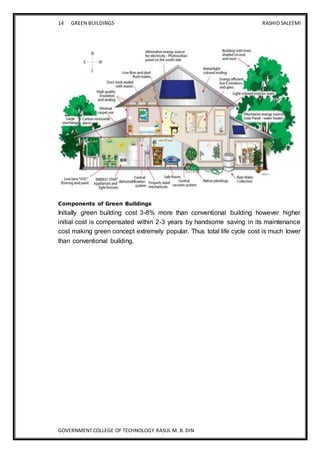
Components of Green Buildings
Initially green building cost 3-8% more than conventional building however higher
initial cost is compensated within 2-3 years by handsome saving in its maintenance
cost making green concept extremely popular. Thus total life cycle cost is much lower
than conventional building.
15 GREEN BUILDINGS RASHID SALEEMI
GOVERNMENT COLLEGE OF TECHNOLOGY RASUL M. B. DIN
The World Green Building Council Makes “The
Business Case for Green Building”
Is greenbuilding a wise business decision? That is the fundamental question
the World Green Building Council’s report, “The Business Case For Green
Building,” attempts to address. The report compiles actual cost and benefit
data from peer-reviewedpublications and includes numerous case studies of
projects throughout the world. This evidence-based report identifies five
primary factors that affect a decision whether or not to implement green
building practices in both for new constructionand renovationprojects. The
five factors and key conclusions are:
• Design and Construction Costs:
Cost premiums for green buildings are not as high as perceptions in the
development industry; long-term costs savings often offset upfront cost
premiums.
• Asset Value:
Greenbuildings in some markets easily attract tenants and command higher
rents; some markets have “brown discounts,” where buildings that are not
greenrent or sell for less thancomparable greenbuildings.
• Operating Costs:
Green buildings reduce energy and water consumption resulting in lower
long-term operating costs; the savings typically exceed design and
constructionpremiums withinareasonable payback period.
16 GREEN BUILDINGS RASHID SALEEMI
GOVERNMENT COLLEGE OF TECHNOLOGY RASUL M. B. DIN
• Workplace Productivity and Health:
Investing in higher quality indoor environments can improve employee
productivity andhealth, resulting ingreater benefitstoemployers.
• Risk Mitigation:
Incorporating green building practices can positively affect future rental
incomes and future value of assets reducing investment risk.
Interestingly,theWorldGreenBuildingCouncildidnotdirectthisreportatany
one specific project stakeholder. Rather, it provides datarelevant tothreekey
green building decision makers: developers, owners and occupants. For
example, the report describes the potential for increased market values of
greenbuildings,aconceptimportanttobothdevelopersandowners.Likewise,
the report identifiesthe greenbuilding benefits of reducedfacility downtime
and lower operating costs,conceptsimportant tobothownersandoccupants.
By quantifying the costs and benefits of greenbuilding, this report is a great
resource to those tasked with deciding whether or not to implement
sustainable strategiesandtechnologies inaproject. Overall, thereportshould
be veryhelpfultodecisionmakersconsideringtheshortandlongtermimpacts
of green building and may be the roadmap necessary to make an informed
business decisionontheir next project.
17 GREEN BUILDINGS RASHID SALEEMI
GOVERNMENT COLLEGE OF TECHNOLOGY RASUL M. B. DIN
LEED certified buildings save money and resources
and have a positive impact on the health of
occupants, while promoting renewable, clean energy.
LEED, or Leadership in Energy & Environmental Design, is a green building
certification program that recognizes best-in-class building strategies and
practices. To receive LEED certification, building projects satisfy prerequisites
and earn points to achieve different levels of certification. Prerequisites and
credits differ for each rating system, and teams choose the best fit for their
project.
LEED is flexible enough to apply to all project types.
Each rating system groups requirements that address the unique needs of
building and project types on their path towards LEED certification. Once a
project team chooses a rating system, they’ll use the appropriate credits to
guide design and operational decisions.
There are five rating systems that address multiple project types:
 BUILDING DESIGNAND CONSTRUCTION (BD +
C)
Applies to buildings that are being newly construction or going through a major
renovation.
1. New Construction
2. Core & Shell
3. Schools
4. Retail
5. Hospitality
6. Data Centers
7. Warehouses & Distribution Centers
8. Healthcare
Building Design and Construction (BD+C)
18 GREEN BUILDINGS RASHID SALEEMI
GOVERNMENT COLLEGE OF TECHNOLOGY RASUL M. B. DIN
When designing and constructing a new building project, project teams are left
with a choice: the option to build an innovative green building from the ground-
up, or maintain the status quo by creating a water-guzzling, energy-wasting
traditional structure. We’re in favor of the former. LEED for Building Design and
Construction (LEED BD+C) provides a framework for building a holistic green
building, giving you the chance to nail down every sustainability feature,
maximizing the benefits.
While you may apply the LEED BD+C rating system to any number of project
types, from commercial high-rises to data centers, we’ve provided an array of
common market sectors to give you a tailored experience that recognizes your
project’s specialized requirements.
 New Construction and Major Renovation:
Addresses design and construction activities for both new buildings and major
renovations of existing buildings. This includes major HVAC improvements,
significant building envelope modifications and major interior rehabilitation.
 Core and Shell Development:
For projects where the developer controls the design and construction of the
entire mechanical, electrical, plumbing, and fire protection system—called the
core and shell—but not the design and construction of the tenant fit-out.
 Schools:
For buildings made up of core and ancillary learning spaces on K-12 school
grounds. Can also be used for higher education and non-academic buildings on
school campuses.
 Retail:
Addresses the unique needs of retailers—from banks, restaurants,
apparel, electronics, big box and everything in between.
 Data Centers:
19 GREEN BUILDINGS RASHID SALEEMI
GOVERNMENT COLLEGE OF TECHNOLOGY RASUL M. B. DIN
Specifically designed and equipped to meet the needs of high density
computing equipment such as server racks, used for data storage and
processing.
 Warehouses and Distribution Centers:
For buildings used to store goods, manufactured products, merchandise, raw
materials, or personal belongings, like self-storage.
 Hospitality:
Dedicated to hotels, motels, inns, or other businesses within the service
industry that provide transitional or short-term lodging with or without food.
 HEALTHCARE: For hospitals that operate twenty-four hours a day, seven days
a week and provide inpatient medical treatment, including acute and long-
term care.
 INTERIOR DESIGNAND CONSTRUCTION ( ID +
C)
Applies to projects that are a complete interior fit-out.
1. Commercial Interiors
2. Retail
3. Hospitality
20 GREEN BUILDINGS RASHID SALEEMI
GOVERNMENT COLLEGE OF TECHNOLOGY RASUL M. B. DIN
As humans, we spend 90% of our time indoors. We’re of the mindset that time
should be spent in spaces that allow us to breathe easy, give us views of nature
and daylight, and make us healthier and more productive. LEED for Interior
Design and Construction (LEED ID+C) enables project teams, who may not have
control over whole building operations, the opportunity to develop indoor
spaces that are better for the planet and for people.
While you may apply the LEED ID+C rating system to any number of project
types, from commercial offices to standalone stores, we’ve provided a
specialized pathway for the retail sector that recognizes specialized
requirements.
 Commercial Interiors:
For interior spaces dedicated to functions other than retail or hospitality.
 Retail:
Guides retailers interior spaces used to conduct the retail sale of consumer
product goods. Includes both direct customer service areas (showroom) and
preparation or storage areas that support customer service.
 Hospitality:
Designed for interior spaces dedicated to hotels, motels, inns, or other
businesses within the service industry that provide transitional or short-term
lodging with or without food.
 BUILDING OPERATIONS
AND MAINTENANCE ( B + M)
Applies to existing buildings that are undergoing improvement work or little
to no construction.
1. Existing Buildings
2. Schools
3. Retail
4. Hospitality
5. Data Centers
6. Warehouses & Distribution Centers
21 GREEN BUILDINGS RASHID SALEEMI
GOVERNMENT COLLEGE OF TECHNOLOGY RASUL M. B. DIN
Building Operations and
Maintenance (O+M)
Existing buildings hold incredible promise. Many older buildings around the
world are energy hogs and water sieves. With some keen attention to building
operations, that can be turned around drastically by using LEED for Building
Operations and Maintenance (O+M). Consider that it can take up to 80 years to
make up for the environmental impacts of demolishing an old building and
constructing a new one, even if the resulting building is extremely energy
efficient. You may have heard the phrase, “The greenest building is the one
already built.” We believe it, and LEED can help you achieve it.
While you may apply the LEED O+M rating system to any number of project
types, from commercial high-rises to data centers, we’ve provided an array of
common market sectors to give you a tailored experience that recognizes your
project’s specialized requirements.
 Existing Buildings:
Specifically projects that do not primarily serve K-12 educational, retail, data
centers, warehouses and distribution centers, or hospitality uses.
 Retail:
Guides existing retail spaces, both showrooms, and storage areas.
 Schools:
For existing buildings made up of core and ancillary learning spaces on K-12
school grounds. Can also be used for higher education and non-academic
buildings on school campuses.
22 GREEN BUILDINGS RASHID SALEEMI
GOVERNMENT COLLEGE OF TECHNOLOGY RASUL M. B. DIN
Hospitality:
Existing hotels, motels, inns, or other businesses within the service industry
that provide transitional or short-term lodging with or without food.
 Data Centers:
Existing buildings specifically designed and equipped to meet the needs of
high density computing equipment such as server racks, used for data storage
and processing.
 WAREHOUSES AND DISTRIBUTION CENTERS:
Existing buildings used to store goods, manufactured products, merchandise,
raw materials, or personal belongings (such as self-storage).
 NEIGHBORHOOD DEVELOPMENT (ND)
Applies to new land development projects or redevelopment projects
containing residential uses, nonresidential uses, or a mix. Projects can be at
any stage of the development process, from conceptual planning to
construction.
1. Plan
2. Built Project
Neighborhood Development
23 GREEN BUILDINGS RASHID SALEEMI
GOVERNMENT COLLEGE OF TECHNOLOGY RASUL M. B. DIN
Is your local grocery store within walking distance…and is there a sidewalk for
you to trek there safely? Does your neighborhood boast high-performing green
buildings, parks and green space? Do bikes, pedestrians and vehicles play
nicely together on the road? LEED for Neighborhood Development (LEED ND)
was engineered to inspire and help create better, more sustainable, well-
connected neighborhoods. It looks beyond the scale of buildings to consider
entire communities. Why? Because sprawl is a scary thing. Here’s the antidote.
 Plan:
Certification is available to your neighborhood-scale project if it’s currently in
any phase of planning and design and up to 75% constructed. We designed this
offering to help you or your developers market and fund your project among
prospective tenants, financiers, public officials, etc. by affirming your intended
sustainability strategies.
 Project certification:
Designed for neighborhood-scale projects that are near completion, or were
completed within the last three years.
24 GREEN BUILDINGS RASHID SALEEMI
GOVERNMENT COLLEGE OF TECHNOLOGY RASUL M. B. DIN
 Homes (Homes)
Applies to single family homes, low-rise multi-family (one to three stories), or
mid-rise multi-family (four to six stories).
1. Homes and Multifamily Low-rise
2. Multifamily Midrise
Homes Design and Construction
A home is more than just shelter: homes are the most important buildings in our
lives. We think that every building should be a green building – but especially
homes. Why? LEED homes are built to be healthy, providing clean indoor air
and incorporating safe building materials to ensure a comfortable home. Using
less energy and water means lower utility bills each month. And in many
markets, certified green homes are now selling quicker and for more money than
comparable non-green homes. Some of the most important buildings in the
world use LEED. Shouldn’t the most important building in everyone’s world use
LEED, too?
LEED for Homes is available for building design and construction
projects for single family homes and multifamily projects up to eight stories.
 Homes and Multifamily Low-rise:
25 GREEN BUILDINGS RASHID SALEEMI
GOVERNMENT COLLEGE OF TECHNOLOGY RASUL M. B. DIN
Designed for single family homes and multifamily buildings between one
and three stories.
 Multifamily Midrise:
Designed for midrise multifamily buildings between four and eight stories.
LEED 2009 FOR NEW CONSTRUCTION AND MAJOR
RENOVATIONSPROJECT
CHECKLIST
 SustainableSites 26 possible points
 Prerequisite 1 Construction activity Pollution Prevention required
 Credit 1 site selection 1
 Credit 2 Development Density and Community Connectivity 5
 Credit 3 Brownfield redevelopment 1
 Credit 4.1alternative transportation—Public transportation access 6
 Credit 4.2alternative transportation—Bicycle storage and Changing rooms 1
 Credit 4.3alternative transportation—Low-Emitting and fuel-Efficient vehicles 3
 Credit 4.4alternative transportation—Parking Capacity 2
 Credit 5.1site Development—Protect or restore Habitat 1
 Credit 5.2site Development—Maximize open space 1
26 GREEN BUILDINGS RASHID SALEEMI
GOVERNMENT COLLEGE OF TECHNOLOGY RASUL M. B. DIN
 Credit 6.1stormwater Design—Quantity Control 1
 Credit 6.2stormwater Design—Quality Control 1
 Credit 7.1 Heat island Effect—Non roof 1
 Credit 7.2 Heat island Effect—roof 1
 Credit 8 Light Pollution reduction 1
 water efficiency 10 possible points
 Prerequisite 1water use reduction required
 Credit 1water Efficient Landscaping 2-4
 Credit 2innovative wastewater technologies 2
 Credit 3water use reduction 2-4
 energy and atmosphere 35 possible points
 Prerequisite 1fundamental Commissioning of Building Energy systems required
 Prerequisite 2 Minimum Energy Performance required
 Prerequisite 3fundamental refrigerant Management required
 Credit 1optimize Energy Performance 1–19
 Credit 2on-site renewable Energy 1–7
 Credit 3 Enhanced Commissioning 2
 Credit 4 Enhanced refrigerant Management 2
 Credit 5 Measurement and verification 3
 Credit 6 Green Power 2
 Materials and resources 14 possible points
 Prerequisite 1storage and Collection of recyclables required
 Credit 1.1 Building reuse—Maintain Existing walls, floors and roof 1-3
 Credit 1.2 Building reuse—Maintain Existing interiorNonstructural Elements 1
 Credit 2 Construction waste Management 1-2
 Credit 3 Materials reuse 1-2
 Credit 4recycled Content 1-2
 Credit 5regional Materials 1-
2
 Credit 6rapidly renewable Materials 1
 Credit 7 Certified wood 1
 Indoor environmental Quality 15 possible points
 Prerequisite 1 Minimum indoor air Quality Performance required
27 GREEN BUILDINGS RASHID SALEEMI
GOVERNMENT COLLEGE OF TECHNOLOGY RASUL M. B. DIN
 Prerequisite 2 Environmental tobaccosmoke (Ets) Control required
 Credit 1outdoor air Delivery Monitoring 1
 Credit 2increased ventilation 1
 Credit 3.1 Construction indoor air Quality Management Plan—During Construction
1
 Credit 3.2 Construction indoorair Quality Management Plan—Before occupancy 1
 Credit 4.1 Low-Emitting Materials—adhesives and sealants 1
 Credit 4.2 Low-Emitting Materials—Paints and Coatings 1
 Credit 4.3 Low-Emitting Materials—flooring systems 1
 Credit 4.4 Low-Emitting Materials—Composite wood and agrifiber Products 1
 Credit 5indoor Chemical and Pollutant source Control 1
 Credit 6.1 Controllability of systems—Lighting 1
 Credit 6.2 Controllability of systems—thermal Comfort 1
 Credit 7.1thermal Comfort—Design 1
 Credit 7.2thermal Comfort—verification 1
 Credit 8.1 Daylight and views—Daylight 1
 Credit 8.2 Daylight and views—views 1
 Innovation in Design 6 possible
points
 Credit 1innovation in Design 1-5
 Credit 2 LEED accredited Professional 1
 Regional priority 4 possible points
 Credit 1regional Priority 1-4
LEED 2009 FOR NEW CONSTRUCTION AND MAJOR
RENOVATIONS
100 base points; 6 possible innovation in Design and 4 regional Priority
points
 Certified 40–49 points
 silver 50–59 points
 Gold 60–79 points
 Platinum 80 points and above
28 GREEN BUILDINGS RASHID SALEEMI
GOVERNMENT COLLEGE OF TECHNOLOGY RASUL M. B. DIN
LEED 2009 MINIMUM PROGRAM REQUIREMENTS FOR NEW
CONSTRUCTION AND MAJOR RENOVATIONS
1. Must Comply with Environmental Laws
TheLEED project buildingorspace,allotherrealproperty withintheLEEDproject boundary,
and all project work must comply with all applicable federal, state, and local building-
related environmental laws and regulations in place where the project is located. This
condition must be satisfied from the date of LEED project registration or the initiation of
schematic design, whichever comes first, until the date that the building receives a
certificate of occupancy or similar official indication that it is ready for use.
2. Must be a Complete, Permanent Building or space
All LEED projects must be designed for, constructed on, and operated on a permanent
location on already existing land. Nobuilding orspace that is designed to move at any point
in its lifetime may pursue LEED Certification. LEED projects must include the new, ground-
up design and construction, or major renovation, of at least one building in its entirety.
Additionally, construction prerequisites and credits may not be submitted for review until
substantial completion of construction has occurred.
3. Must use a reasonable site Boundary
a. The LEED project boundary must include all contiguous land that is
associatedwithandsupportsnormalbuildingoperationsfortheLEEDproject
building, including all land that was or will be disturbed for the purpose of
undertaking the LEED project.
b. The LEED project boundary may not include land that is owned by a party
other than that which owns the LEED project unless that land is associated
with and supports normal building operations for the LEED project building.
c. LEED projects located on a campus must have project boundaries such that if
all the buildings on campus become LEED certified, then 100% of the gross
land area on the campus would be included within a LEED boundary. If this
requirement is in conflict with MPR #7, Must Comply with Minimum Building
Area to Site Area Ratio, then MPR #7 will take precedence.
d. Any given parcel of real property may only be attributed to a single LEED
project building.
29 GREEN BUILDINGS RASHID SALEEMI
GOVERNMENT COLLEGE OF TECHNOLOGY RASUL M. B. DIN
e. Gerrymandering of a LEED project boundary is prohibited: the boundary may
not unreasonably exclude sections of land to create boundaries in
unreasonable shapes for the sole purpose of complying with prerequisites or
credits.
4. Must Comply with Minimum floor area requirements.
The LEED project must include a minimum of 1,000 square feet (93 square meters) of gross
floor area.
5. Must Comply with Minimum occupancy rates full time Equivalent
occupancy
The LEED project must serve 1 or more Full Time Equivalent (FTE) occupant(s), calculated as
an annual average in order to use LEED in its entirety. If the project serves less than 1
annualized FTE, optional credits from the Indoor Environmental Quality category may not
be earned (the prerequisites must still be earned).
6. Must commit to sharing whole-Building Energy and water usage
Date
All certified projects must commit to sharing with USGBC and/or GBCI all available actual
whole-project energyandwaterusagedataforaperiodofat least 5years. Thisperiodstarts
on the date that the LEED project begins typical physical occupancy if certifying under New
Construction, Core & Shell, Schools, or Commercial Interiors, or the date that the building
is awarded certification if certifying under Existing Buildings: Operations & Maintenance.
Sharing this data includes supplying information on a regular basis in a free, accessible, and
secure online tool or, if necessary, taking any action to authorize the collection of
information directly from service or utility providers. This commitment must carry forward
if the building or space changes ownership or lessee.
7. Must comply with a Minimum Building area to site area ratio
The gross floor area of the LEED project building must be no less than 2% of the gross land
area within the LEED project boundary.
30 GREEN BUILDINGS RASHID SALEEMI
GOVERNMENT COLLEGE OF TECHNOLOGY RASUL M. B. DIN
31 GREEN BUILDINGS RASHID SALEEMI
GOVERNMENT COLLEGE OF TECHNOLOGY RASUL M. B. DIN
Sustainable Building: Location and Site
Ideally, sustainable building is about setting priorities and moving to the next decision when the
previous one has been adequately addressed. Simple as a concept, but often not a reality when
you hear different green building folks chime in to say that they have the “green” solution for you.
In this spirit, I have tried to boil down what I think of as the core principles that guide
sustainable building and how they should be ranked in importance. This is for new and old
buildings, large and small. Start at the first step and move your way up the decision chain, making
connections between the steps all the time. You may notice that many of the goodies are near the
top, which means we are not talking so much about the stuff but how the whole building is going
to work
Step one begins with location.
You have to live somewhere. That somewhere is usually inside. That inside is only one of the
insides you want to be somewhere today. Those insides have a lot to do with the outside. We
have been building our civilization bigger and wider for our convenience and pleasure, but any
commuter knows that that pleasure is fleeting when they check the traffic report. Our view
corridors and green belts wane. The beginning of sustainable building is to build closer to where
you spend the rest of your time. The LEED system calls it community connectivity. Your work,
your shopping, your parks and many other things are better simply when they are closer.
A good location is taking advantage of civilization by living in it.
Pretending that you don’t and building neighborhoods in the middle of “nowhere” achieves
neither a neighborhood nor “nowhere.” Connecting with the community means now you can
ride your bike to work on a nice day. You can walk back from the bar. You can walk to your
new friend’s place. Community connectivity is not just an esoteric green building point but a
lifestyle, and ultimately an entire society.
Siting is where and how you place your building.
The first thing to consider is reducing your environmental impact on a chosen site. Protecting
water sheds, sensitive habitat, reducing roads and other hardscapes is the first consideration.
Try to minimize land disturbance. I have long had the thought that when you find that special
place to build, build next to it, not on top of it. After all, that special place is no longer there
when you build on it.
Perhaps the biggest mistake that developers make is ignoring orientation.
The value of a home and entire neighborhoods is deeply diminished when the lots and
buildings are not adept at catching the sunshine. Poor orientation can cost a building upward
of 30% in energy cost. That is a substantial number and almost utterly ignored by your local
developer. When you look to buy a building this is one of the first things to look for. Good
orientation does not only help keep the building cool in the summer and warm in the winter it
also “future proofs” your investment. As solar technologies come into their own it would be
32 GREEN BUILDINGS RASHID SALEEMI
GOVERNMENT COLLEGE OF TECHNOLOGY RASUL M. B. DIN
obvious for you to be able to take advantage of them by having your roof properly facing the
sunshine. Oh yeah, it’s cheaper than paying a gas and electric bill.
Siting has some very subtle aspects to it. Prevailing winds are good to capture in the summer
and avoid in the winter. A wind rose is a localized chart of seasonal wind characteristics of a
location that can help you understand your site. Noise, by way of traffic or other sources, can
be addressed and avoided. Sight lines and views have long influenced a building’s siting, but
remember those change when that tree grows up or your neighbor gets ready to “pop the top”
(a turn of phrase that should perhaps be outlawed). Water runoff has a very real impact.
Before you place a building, sit on the land. Spend real time watching the environment. You
will intuitively know where the best place to build will be. There are stories of people who
spent years studying their land, the subtleness of the terrain, views, wind and light. They were
looking for a way to best harmonize their living with the land they wanted to live upon. Perhaps
they are a bit obsessive-compulsive or maybe indecisive but you can bet they have a better
home as a result.
Ultimately you do not own land, you borrow it. Being stewards of this borrowed land and
keeping it healthy and abundant is a generational effort. When you place your building
thoughtfully you have the security of light, heat, cooling and air that will be free for the taking.
Orientation/ SouthFacingWindows
Passive solar houses typically have windows on the southern side of the building.
Based on the movements of the sun, passive solar buildings typically have windows
(glazing) on the southern facing side of the building in order to absorb the sun’s heat
energy to warm a building during the winter. In order to stay cool in the
summer, passive solar houses rely on a system of shading (or an overhang) to keep the
building cool.
Simply by building in this way, a house can reduce its heating and cooling costs by 85%.
33 GREEN BUILDINGS RASHID SALEEMI
GOVERNMENT COLLEGE OF TECHNOLOGY RASUL M. B. DIN
See how the house pictured on the right achieves Net-Zero Energy.
In the northern hemisphere, in order to face the sun and obtain maximum solar gain, the
windows would face the south. In the southern hemisphere, however, it is opposite, with
the windows facing the north in order to maximize solar gain.
Seasonal Window Considerations
34 GREEN BUILDINGS RASHID SALEEMI
GOVERNMENT COLLEGE OF TECHNOLOGY RASUL M. B. DIN
The diagram shows how the low winter sun canenter the building, while the highsummer sun cannot.
Winter
The diagram to the left shows how the sun is lower in the winter, while it is much higher in
the summer. During the day, the low winter sun can shine through windows are to allow
heat energy to be absorbed into the building’s thermal mass.
While windows allow heat into a building to be absorbed, their thin and transparent nature
also allows heat to escape a building.
In order to keep this from happening in cold climates, it is recommended that the glass
panes are doubled (double glazing) or even tripled. An insulated window covering or
thick shade can also be used to help insulate the windows and help keep the heat in the
building after the sun goes down.
Summer
In the summer, as temperatures rise, a passive solar building uses its thermal mass to
help keep the building cool. In order for this to happen, the summer sun is kept from
reaching the thermal mass of the building.
The summer sun’s path aides in this process by traveling high in the summer sky, thus a
proper overhang or other type of system is needed to shade or cover the widow, in the
summer so that the sun’s heat energy is blocked or avoided when it is desired to have the
building cooler than the outside temperature.
35 GREEN BUILDINGS RASHID SALEEMI
GOVERNMENT COLLEGE OF TECHNOLOGY RASUL M. B. DIN
A properly designed overhang keeps the heat and energy from being absorbed into the
house in the summer. (In the picture at the very top of this post, you may also notice that
the overhang is keeping the high summer sun from entering the house.)
Building Orientation
Because the sun rises in the east and sets in the west, the side of the building that
is utilized for solar gain needs to be facing the south to take maximum advantage
of the sun’s potential energy. If the building’s axis is located on the east-west direction
with its longest dimension facing the south, more of the building is situated to absorb the
sun’s heat energy.
If the building in the middle were longer, stretching toward the two houses located on either side of it, more of its mass
w ou ld be ideally situated to absorb and radiate heat in the winter
Passive solar buildings are typically rectangular with the long side of the building facing
south. The distance from the source of incoming heat (south) to where it is absorbed
(typically a northern wall) should be minimized. The resulting shape is a rectangle. This
is one of the lessons learned in the construction of this Off Grid Passive Solar Earth ship-
Style Home.
South Facing Windows and Orientation
It is ideal to have the windows (solar glazing) within 5 degrees of true south.
However, windows that are within 15 degrees of true south are said to functional
most as well.
As the degree difference from true south expands, the overall potential solar efficiency of
the structure decreases. Put another way, the greater the degree variation from true south,
36 GREEN BUILDINGS RASHID SALEEMI
GOVERNMENT COLLEGE OF TECHNOLOGY RASUL M. B. DIN
will decrease the amount of the the building’s solar gain. As a result, larger amounts of
supplementary energy may be needed to heat the building in the winter. As the building’s
glass (glazing) faces more to the southwest, more energy may be needed for summer
cooling.
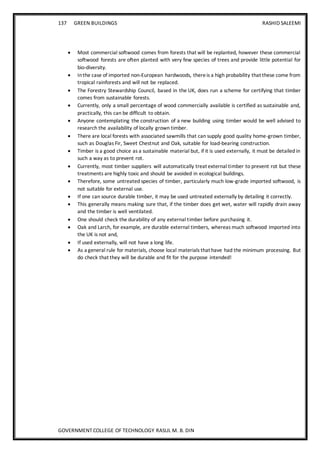
Passive solarbuildings typically have many w indows facing the south
Southern facing windows (southern solar glazing) are a vital component for a passive solar
design and building. Because the southern side of the building is the side that will
potentially receive sunlight throughout the day, most passive solar buildings will feature
glass dominating the southern side. Southern facing glass allows the sun’s energy to be
absorbed and distributed through the building’s thermal mass.
You may hear people referring to glass as glazing. Glazing is the fancy architectural word
typically used for southern facing glass that has the capacity to transfer the sun’s energy.
Another benefit of having windows on the south side, is that it allows natural light to bathe
the house throughout the day. This aspect can also lower energy use throughout the
house since it minimizes the use of artificial light.
All of these factors can be used to one’s advantage, depending upon the site location and
depending on the specific characteristics that you want within the house.
While southern facing windows (glazing) are a necessary component of passive solar
design, care must be taken to insulate them in the winter after the sun goes down, as well
as shade them in the summer.
37 GREEN BUILDINGS RASHID SALEEMI
GOVERNMENT COLLEGE OF TECHNOLOGY RASUL M. B. DIN
The northern hemisphere is highlighted in yellow. The southern hemisphere is white.
Note that because the Earth is a sphere, depending on where you are located, the sun
will interact slightly differently than in other places. For example, the angle of the summer
and winter sun will be different.
If, however, you are located in the Southern Hemisphere, in order to build a passive or
active solar home, the building will need to be oriented to the north.
Here’s a little more information about solar building in the southern hemisphere.
Vertical and Angled Glass (Glazing)
Most glass that is used in building is vertical. Angled glass, however, is frequently used
in passive solar design because it increases the amount of solar energy that can be
absorbed. Caution! This can cause overheating in the summertime.
Building Massing & Orientation
"Massing" is deciding on the overall shape and size of the building. Will
the building be tall or short? Long and thin? Will it have significant cutouts,
or be more solid? Successful massing uses the general shape and size of the
building to minimize energy loads as much as possible and to maximize free
energy from the sun and wind.
Orientation is simply what compass direction the building faces. Does it
face directly south? 80° east-northeast? Along with massing, orientation
can be the most important stepin providing a building with passive thermal
and visual comfort. Orientation should be decided together with massing
early in the design process, as neither can be truly optimized without the
other.
Aside for reducing energy use and enabling passive design strategies, successful massing and
orientation can take advantage of site conditions, such as rainwater harvesting, and can help
the building contribute to the health and vitality of the surrounding ecological, social, and
economic communities. For instance, it can be massed and oriented to connect its social spaces
38 GREEN BUILDINGS RASHID SALEEMI
GOVERNMENT COLLEGE OF TECHNOLOGY RASUL M. B. DIN
with street life, or avoid shading nearby wild lands, or could steer foot traffic away from
ecologically sensitive areas.
Building Massing
For many building types, massing is one of the most important factors in passive
heating, cooling, and day lighting, yet often these are not considered until after massing is
finished. It’s important to begin considering passive design strategies in the massing stage, so
that the surface areas exposed to sun at different times of day, building height, and building
width can all be optimized for passive comfort.
In the image below, "Opt 2" has the same area as "Opt 1" but uses less than half the energy,
because of better massing.
In this image you can see several massing strategies:
The extreme “O-shaped” building in the middle, the
blocky building on the left with the street-level protrusion,
and the large building on the right with the arched roof.
Many of these choices were made for aesthetic reasons,
but massing is very important for energy use.
39 GREEN BUILDINGS RASHID SALEEMI
GOVERNMENT COLLEGE OF TECHNOLOGY RASUL M. B. DIN
Massing decisions depend on the specifics of the project site and goals. BIM tools can provide
designers with early conceptual energy analysis to test different massing options. This analysis
can take into account how site features like natural land formations, surrounding buildings, or
vegetation affect the performance of the design. Such features can shade the sun and change
wind patterns, so this is especially important for thermal comfort and daylighting comfort. They
can also affect acoustics, rainwater harvesting, and other performance factors.
Massing for Building Program
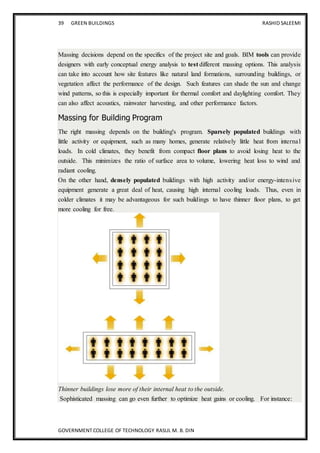
The right massing depends on the building's program. Sparsely populated buildings with
little activity or equipment, such as many homes, generate relatively little heat from internal
loads. In cold climates, they benefit from compact floor plans to avoid losing heat to the
outside. This minimizes the ratio of surface area to volume, lowering heat loss to wind and
radiant cooling.
On the other hand, densely populated buildings with high activity and/or energy-intensive
equipment generate a great deal of heat, causing high internal cooling loads. Thus, even in
colder climates it may be advantageous for such buildings to have thinner floor plans, to get
more cooling for free.
Thinner buildings lose more of their internal heat to the outside.
Sophisticated massing can go even further to optimize heat gains or cooling. For instance:
40 GREEN BUILDINGS RASHID SALEEMI
GOVERNMENT COLLEGE OF TECHNOLOGY RASUL M. B. DIN
Roofs can be angled for optimal solar heating.
 Reveals and overhangs can shade parts of a building with other parts of the same building.
 Aerodynamic curves can reduce heat loss from infiltration.
 Interior buffer zones can be placed in a building's west side to protect living and working areas
from the hot afternoon sun (for example stairs, restrooms, entry corridors, etc.)
Whether your massing is simple or sculptural, you should perform basic energy modeling
simulations of many different options.
Using building mass or overhangs to create shade
Building Orientation
Orientation is simply what compass direction the building faces. It should be optimized early-
on, along with massing, and can be the most important step for passive design.
41 GREEN BUILDINGS RASHID SALEEMI
GOVERNMENT COLLEGE OF TECHNOLOGY RASUL M. B. DIN
Different building orientations
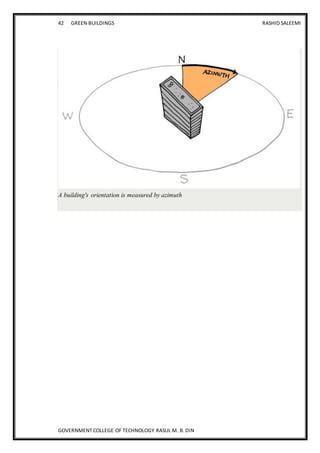
Orientation is measured by the azimuth angle of a surface relative to true north. Successful
orientation rotates the building to minimize energy loads and maximize free energy from the
sun and wind.
42 GREEN BUILDINGS RASHID SALEEMI
GOVERNMENT COLLEGE OF TECHNOLOGY RASUL M. B. DIN
A building's orientation is measured by azimuth
43 GREEN BUILDINGS RASHID SALEEMI
GOVERNMENT COLLEGE OF TECHNOLOGY RASUL M. B. DIN
Insulation
Insulation is important because it helps to keep warm areas warm and cool areas
cool. This is an important concept to understand regardless of the type of building one
builds. Insulation is important in any type of building and is the key to keeping energy costs
down.
There are many different types of insulation that include different types of foam, cellulose
and fiberglass.
Here are different types of insulation.
If a home is not properly insulated, up to two thirds of its heat energy can be lost.
44 GREEN BUILDINGS RASHID SALEEMI
GOVERNMENT COLLEGE OF TECHNOLOGY RASUL M. B. DIN
This diagram show the basic principles of passive solar design, except that insulation needs to be added underneath, to
the north wall, and roof.
In regard to passive solar design, insulation is used in the building’s design so that it can
work together with thermal mass. Thermal mass is a dense material that can store and
radiate heat.
It is recommended that a passive solar house have insulation on the outside of the thermal
mass so that the heat stored within the mass can be utilized to keep the inner temperature
warm and stable. Remember that insulation allows a warm building to stay warm and a
cool building to stay cool.
The diagram shows common leaks that allow heatto escape, Courtesy of energystar.gov
A lack of insulation will drastically impact the heating and cooling storage
capacities of any building.
The diagram shows common leaks that allow heat to escape in a traditional building.
Heat moves to constantly try to reach equilibrium and will constantly move from
warm to colder areas. When a door is opened to a cold winter evening, heat will move
45 GREEN BUILDINGS RASHID SALEEMI
GOVERNMENT COLLEGE OF TECHNOLOGY RASUL M. B. DIN
out of the house while the cold sweeps in. Similarly, when reaching for the ice cream while
the freezer door is open, heat moves into the freezer, as cold air rushes out. In regard to
both the building and the freezer, the presence of insulation functions to keep areas warm
or cool areas stable. In buildings, it is desired to live within a constant, comfortable
temperature, regardless of the temperature outside of the building.
This polystyrene SIP shows the chase for the electricity within the insulation.
There are also building materials that incorporate insulation within its structure.
These types of building materials include Structure Insulated Panels (SIPS), Insulated
Concrete Forms (ICF’s). For more on Styrofoam types of insulation, see this post on
polystyrene.
The economical solution to a warmer house in the winter and a cooler house in the
summer is to insulate it well, while understanding the movement of heat.
46 GREEN BUILDINGS RASHID SALEEMI
GOVERNMENT COLLEGE OF TECHNOLOGY RASUL M. B. DIN
GREEN BUILDING SITE AND LANDSCAPE
PLANNING
Site and Landscaping for Green Building:
The purpose of sustainable site planning is to integrate design and construction strategies
by modifying both, the site and building to achieve greater human comfort and operational
efficiency. It ensures -
 Minimum Site disruption.
 Maximum usage of microclimate features.
 Appropriate landscaping.
Sustainable site planning:
 Plan for basic amenities within walking distance of housing. This would reduce the use
of private transportation.
 Confirm that the selected site does not fall within the disaster – control zone as
specified by local authority.
 Ensure that basic amenities such as bank, child care, post office, park, library, primary
school, clinic and community hall are near to or within the site premises.
Landscaping for Green Building:
Suitably designed landscape is a very effective microclimate modifier. Landscaping plays
a very important role in modulating air flows in a building. Moreover, landscape provides
the required shading for outdoor areas, which modifies the microclimate. Care needs to
be taken to avoid undesirable increase in humidity levels, by excessive plantations.
Selection of plant species should be based on its water requirement and the microclimatic
benefits that should result from it.
The points to be noted are:
 For Projects larger than 1 hectare, remove top soil and preserve for reuse on site. For
tsunami Affected areas, ensure that top soil has not been rendered unusable.
 A pH of 6.0 to 7.5 and organic content of not less than 1.5% by mass needs to be
maintained. Add lime where pH<6.0 to adjust to 6.5 or higher, upto 7.5 any soil having
soluble salt content >500ppm should not to be used for the purpose of landscaping.
 Preserve existing vegetation on site. Mark all existing vegetation in tree survey plan.
Evolve tree preservation guidelines
 Do compensatory depository forestation in ratio of 1:5 within the site premises, for all
mature trees removed.
 Do not alter the existing drainage pattern on site.
 Existing Grades should be maintained around existing vegetation.
47 GREEN BUILDINGS RASHID SALEEMI
GOVERNMENT COLLEGE OF TECHNOLOGY RASUL M. B. DIN
Maintenance activities should be performed as needed to ensure that the vegetation
remains healthy.
Recycled plastic has been developed into a wide range of landscaping products. Plastic
lumber is widely used in outdoor furniture and decking. This lumber is made by shredding
and reforming post-consumer plastic containers such as pop bottles and milk jugs. Some
brands incorporate waste or recycled wood as well.
Plastic lumber has advantages over wood in that it is impervious to moisture and will not
warp, rot, or check. It is available as dimensional stock, or in a wide variety of
manufactured garden furniture and accessories. Traffic stops and bumpers are also being
made from recycled plastic, replacing concrete and asphalt. By recycling plastic, a major
contributor to landfill waste is put to a new use and raw materials are conserved. Water
conservation also results, because recycling plastic requires less water than processing
new plastic, wood, or concrete. When used in soil erosion control products, recycled plastic
also prevents topsoil loss and the resulting consequences of increased water turbidity. The
recycled plastic products can themselves be recycled when their useful life has ended.
Because the material is inert, it will not degrade into toxic substances if discarded in
landfills.
Landscape pavers made from recycled plastic can be used in place of bricks. Pavers are
produced in a range of colours and styles, and can be used to replicate any traditional
brick pattern. An open-grid rigid plastic mat has also been introduced.(see Figure1 –
Porous pavement system made from recycled plastic. Excellent for providing wheelchair
access to park and playground.)
Figure 1: Porous pavement system
Unlike paving, this product allows grass to grow in the open areas of the grid and permits
water to drain through it. It is idea for use in playgrounds and provides a rigid surface for
wheelchair access on to lawns.
48 GREEN BUILDINGS RASHID SALEEMI
GOVERNMENT COLLEGE OF TECHNOLOGY RASUL M. B. DIN
COOL ROOF SYSTEM FOR BUILDINGS
Cool roof system for buildings Is a roofing system that can deliver
high reflectance (the ability to the visible, infrared and ultraviolet
wavelength of the sun, reducing heat to the building) and high thermal
emittance (the ability to release a large percentage of absorbed, or non-
reflected, solar energy) is a cool roof.
Cool roof can be used as a geo-engineering technique To
tackle global warming based on the principle of solar radiation
management, provided that the materials used not only reflect solar
energy, but also emit infra-red radiation to cool the planet.
Most of the roofs in the world (including over 90% of the roofs in the world)
are dark colored. In the heat of the full sun, the surface of a black roof can
increase in temperature as much as 90 degrees F, reaching temperatures
of 150-190 degrees F (66 to 88 degrees C). This heat increase can
contribute to:
 Increased cooling energy use and higher utility bills.
 Higher peak electricity demand (the maximum energy load, in
megawatts, an electric utility afternoons as business and residences turn
up their air conditioners), raised electricity production costs, and a
potentially overburdened power grid.
 Reduced indoor comfort.
 Increased air pollution due to the intensification of the “Heat island
effect”.
 Accelerated deterioration of roofing materials, increased roof
maintenance costs, and high levels of roofing waste send to landfills.
 Cool roofs offer both immediate and long term saving in building
energy costs. White reflective membranes, coated roofs and planted or
GREEN roofs can:
 Reduced building heat gain, as a white reflective roof typically increases
only 10-25 degrees F above ambient temperature during the day.
 Create savings on summertime air conditioning expenditures.
 Enhance the life expectancy of both the roof membrane and the
building’s cooling equipment.
49 GREEN BUILDINGS RASHID SALEEMI
GOVERNMENT COLLEGE OF TECHNOLOGY RASUL M. B. DIN
 Improve thermal efficiency of the insulation; this is because as
temperature increases, the thermal conductivity of the roof’s insulation
also increases.
 Reduced the demand for electric power by as much as 10 percent.
 Reduce resulting air pollution and greenhouse gas emission.
 Provide energy savings, even in northern climates.
Types of Cool Roofs System:
 Inherently Cool Roofs (vinyl roofs (reflect 70%-80%))
 Coated Roofs (Hyper glass Rubber Roof Coating and white paints)
 Green Roofs.
Green Roofs:
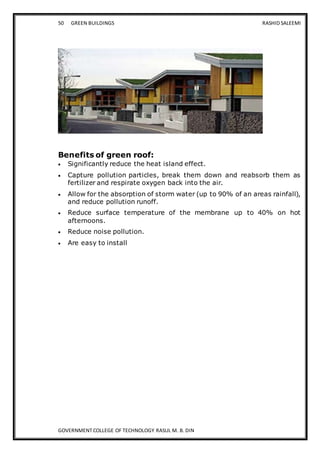
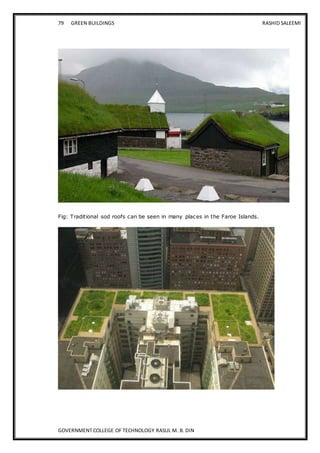
The term Green roof is used to indicate Roof that utilize some form of
Green technology. Green roof is roof of a building that is partially or
completely covered with vegetation and soil, or a growing medium,
planted over waterproofing membrane. Rooftop ponds are another form
of Green roof which are used to treat grey water. It also used to indicate
roof that utilizes some form of Green Technology such as Solar panels
or a Photovoltaic Module. A Green Roof consists of a drainage layer and
a waterproof membrane typically covered in a thin layer of 2-4 inches of
soil compacted with low growing plants. Local weather conditions,
temperature, and structural factors should determine the appropriate
types of plants that are used. Common plant species include sedum,
alpines, delosperma, succulents, and a wide variety of grasses and
mosses.
50 GREEN BUILDINGS RASHID SALEEMI
GOVERNMENT COLLEGE OF TECHNOLOGY RASUL M. B. DIN
Benefits of green roof:
 Significantly reduce the heat island effect.
 Capture pollution particles, break them down and reabsorb them as
fertilizer and respirate oxygen back into the air.
 Allow for the absorption of storm water (up to 90% of an areas rainfall),
and reduce pollution runoff.
 Reduce surface temperature of the membrane up to 40% on hot
afternoons.
 Reduce noise pollution.
 Are easy to install
51 GREEN BUILDINGS RASHID SALEEMI
GOVERNMENT COLLEGE OF TECHNOLOGY RASUL M. B. DIN
ENERGY RESOURCES
Renewable energy is energy that is derived from natural processes that are replenished constantly. Unlike
fossil fuel, renewable energy does not pollute the environment because it is a part of nature. Renewable
sources most often used are solar, wind, water (hydropower), biomass and geothermal energy. The
potential to generate energy from renewable sources is largely dependent on the availability of these
natural resources. In Singapore, some of these natural resources (such as wind, geothermal and tidal) are
unavailable or not sufficient for us to economically harness energy from it.
WIND ENERGY
Energy from the wind can be harnessed by converting the kinetic energy from the wind into mechanical
energy using wind turbines. Wind turbines aredesigned with aerodynamically-shaped fin blades that rotate
when wind flows across. The rotating blade in turn drives a shaft that is connected to a turbine to generate
electricity. Wind turbines can be separatedinto two(2) types based on theaxis in which the turbine rotates
– Vertical-Axis Wind Turbines (VAWTs) and Horizontal-Axis Wind Turbines (HAWTs). VAWTs are turbines
with a vertical axis of rotation and a shaft that points up.
HAWTs are turbines with the main turning shaft placed horizontally and points into the wind. The HAWTs
are more commonly used compared to the VAWTs. A typical commercial wind turbine has rated power of
about 200 W to 3 kW. A group of wind turbines located in the same area is called a wind farm. The wind
turbines selected for wind farms are very efficient at high wind speeds and suitable for relatively smooth
airflows in open field. The natural wind environment of Singapore urban areas can be very different. Some
sites – parks, open spaces and river banks areas –may have relatively high wind speeds and low turbulence.
In these places, the same turbines that are found in wind farms may work well. However, elsewhere in
urban areas, the presence of buildings and other features tends to cause turbulence, and average wind
speeds tend to be lower than desired. This has to be considered in theselection of the type of wind turbine.
VERTICAL AXIS WIND TURBINES(VAWTS)
52 GREEN BUILDINGS RASHID SALEEMI
GOVERNMENT COLLEGE OF TECHNOLOGY RASUL M. B. DIN
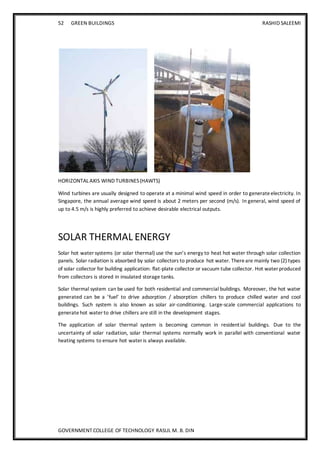
HORIZONTAL AXIS WIND TURBINES(HAWTS)
Wind turbines are usually designed to operate at a minimal wind speed in order to generateelectricity. In
Singapore, the annual average wind speed is about 2 meters per second (m/s). In general, wind speed of
up to 4.5 m/s is highly preferred to achieve desirable electrical outputs.
SOLAR THERMAL ENERGY
Solar hot water systems (or solar thermal) use the sun’s energy to heat hot water through solar collection
panels. Solar radiation is absorbed by solar collectors to produce hot water. Thereare mainly two (2) types
of solar collector for building application: flat-plate collector or vacuum tube collector. Hot water produced
from collectors is stored in insulated storage tanks.
Solar thermal system can be used for both residential and commercial buildings. Moreover, the hot water
generated can be a ’fuel’ to drive adsorption / absorption chillers to produce chilled water and cool
buildings. Such system is also known as solar air-conditioning. Large-scale commercial applications to
generatehot water to drive chillers are still in the development stages.
The application of solar thermal system is becoming common in residential buildings. Due to the
uncertainty of solar radiation, solar thermal systems normally work in parallel with conventional water
heating systems to ensure hot water is always available.
53 GREEN BUILDINGS RASHID SALEEMI
GOVERNMENT COLLEGE OF TECHNOLOGY RASUL M. B. DIN
Photovoltaic (PV) systems convert sunlight directly into electricity without generating any CO2 or other
greenhouse gases. They arequite different from solar thermal technology, in which the sun’s heat energy
is trapped and transferred to another medium such as water. Both technologies are excellent ways of
harnessing renewable energy from the sun.
GEOTHERMALENERGY
Geothermal: Geo (Earth) +thermal (heat) energy is heat energy from theEarth. Geothermal energy is ideal
where hot underground steam or water can be easily tapped and brought to the earth surface for a variety
of usage, including electricity power generation and the heating or cooling of buildings.
GEO-THERMAL ENERGY PLANT
54 GREEN BUILDINGS RASHID SALEEMI
GOVERNMENT COLLEGE OF TECHNOLOGY RASUL M. B. DIN
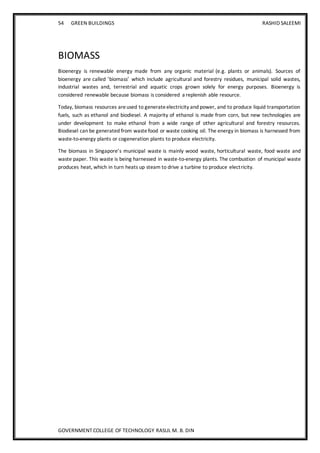
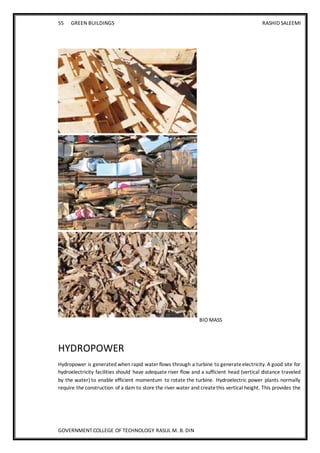
BIOMASS
Bioenergy is renewable energy made from any organic material (e.g. plants or animals). Sources of
bioenergy are called ’biomass’ which include agricultural and forestry residues, municipal solid wastes,
industrial wastes and, terrestrial and aquatic crops grown solely for energy purposes. Bioenergy is
considered renewable because biomass is considered a replenish able resource.
Today, biomass resources areused to generateelectricity and power, and to produce liquid transportation
fuels, such as ethanol and biodiesel. A majority of ethanol is made from corn, but new technologies are
under development to make ethanol from a wide range of other agricultural and forestry resources.
Biodiesel can be generated from wastefood or waste cooking oil. The energy in biomass is harnessed from
waste-to-energy plants or cogeneration plants to produce electricity.
The biomass in Singapore’s municipal waste is mainly wood waste, horticultural waste, food waste and
waste paper. This waste is being harnessed in waste-to-energy plants. The combustion of municipal waste
produces heat, which in turn heats up steam to drive a turbine to produce electricity.
55 GREEN BUILDINGS RASHID SALEEMI
GOVERNMENT COLLEGE OF TECHNOLOGY RASUL M. B. DIN
BIO MASS
HYDROPOWER
Hydropower is generated when rapid water flows through a turbine to generateelectricity. A good site for
hydroelectricity facilities should have adequate river flow and a sufficient head (vertical distance traveled
by the water) to enable efficient momentum to rotate the turbine. Hydroelectric power plants normally
require the construction of a dam to store the river water and createthis vertical height. This provides the
56 GREEN BUILDINGS RASHID SALEEMI
GOVERNMENT COLLEGE OF TECHNOLOGY RASUL M. B. DIN
water sufficient head to flow through tunnels in dams and subsequently turn the turbines and thus drive
generators.
’Low impact’ type of hydropower facility is preferred. It produces clean power using a stream or a canal’s
existing natural drop in elevation thus avoiding any environmental impact on site that may be needed to
createthat differential elevation (e.g. creation of a dam).
Hydropower does not pollute the water or the air. It is much more reliable thanwind, solar or wave power.
Hence, electricity can be generated constantly.
ILLUSTRATIONOF HYDROPOWER GENERATIONPLANT
TIDAL POWER
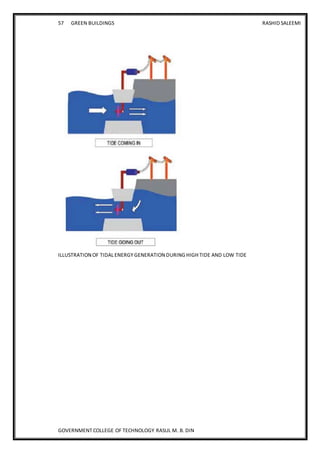
Tidal power is a form of hydropower that converts energy of tides into electricity. It is generated by the
relative motion of the Earth, Sun and Moon which interact via gravitational forces.
The tide ‘moves’ a huge amount of water twice each day. The advantage of the tides is that it is more
predictable than wind and solar energy.
Tidal power traditionally involves erecting a dam across the opening to a tidal basin. The dam includes a
sluice which when opened allows the tide to flow into the basin. The sluice is then closed. As the sea level
drops, traditional hydropower technologies can be used to generate electricity from the elevated water in
the basin.
57 GREEN BUILDINGS RASHID SALEEMI
GOVERNMENT COLLEGE OF TECHNOLOGY RASUL M. B. DIN
ILLUSTRATIONOF TIDAL ENERGY GENERATIONDURING HIGH TIDE AND LOW TIDE
58 GREEN BUILDINGS RASHID SALEEMI
GOVERNMENT COLLEGE OF TECHNOLOGY RASUL M. B. DIN
Energy savings
By energy savings, we mean all economically interesting actions undertaken to reduce energy
consumption, by for instance installing suitable equipment in electrical installations. The aim is also to
consume energy in an optimal manner (e.g. recuperate heat lost in combustion gases or produce energy
from waste). We should be awarethat energy savings do not concern just electricity. Adopting some simple
daily habits along with a judicious choice of equipment also enables us to control consumption of all other
forms of energy (gas, heating fuel, etc.). In a green building, the main priority is to identify energy savings.
Some of the main measures that enable energy savings are:
• Good thermal insulation of all exterior components (walls, windows, roof, etc.)
• Eliminate thermal bridges and other energy leaks
• Good airtight seal on the exterior building envelope
• Reduction of thermal losses through ventilation
• Efficiency of a reduced-inertia boiler
• Optimized electricity management (reduction of installed power ratings, central management, use of
lighting.
Water savings in a green building
The availability of fresh water has become a matter of increasing concern in a context where developed
and developing countries are engaged in a race to obtain resources that are inexorably becoming scarcer.
A green building must therefore be designed to use water efficiently. Managing waste water, irrigation
water and rain water are also essential for a sustainable approach.
The use of mixer taps reduces water consumption as it is easier to control the temperature. Aerator tap
fittings reduce the amount of water used without it being noticed during use. Waste through negligence is
to be avoided. Even if repairing a leaking tap can be a chore, tens of millions of cubic metres of water are
lost every year, just in France, because of inadequate seals on taps.
Thermostatic mixer taps can also generate savings. As water runs at a predetermined temperature, the
water that is usually lost when adjusting a shower temperatureis saved. An efficient andsustainable water-
saving approach also depends on existing knowledge or projections of water use, tracing and preventing
59 GREEN BUILDINGS RASHID SALEEMI
GOVERNMENT COLLEGE OF TECHNOLOGY RASUL M. B. DIN
leaks. Replacing unsuitable equipment and using water-efficient devices, communicating and raising user
awareness arealso potential sources for water savings.
Recuperation and use of rain water
Rain water is an inexhaustible natural resource which has its place in the green building. Rain water is
collected as it runs off a roof and is stored in a tank. Whether polluted or not, rain water is naturally slightly
acidic (pH from 5 to 6), due to its carbon dioxide content, present in the atmosphere. This acidity means it
should not be stored in plastic or metal containers. For domestic use, the ideal solution is a concrete or
limestone tank that neutralises the natural acidity of rain water.
Rain water is only rarely recuperated and often only used for watering gardens. Its use should nonetheless
be systematic both to unblock waste networks and to save on a resource that is becoming scarcer and is
weighing on household budgets. A farmer’scommon sense has always encouraged themto put a container
under the gutter pipe to recuperate rain water. If optimised, rain water collection can enable homes to be
autonomous in water use, without it being visible or visually un-aesthetic.
In certain buildings, rain water is recuperated, treated and reused in applications that do not require
potable water. This kind of solution helps reduce fresh water needs in the public network, while avoiding
the propagation of pollutants by run-off. Other solutions areavailable, such as green roofs, which not only
store rain water, but also provide a green oasis in an urban environment along with many other benefits.
Reduction of waste and toxic substances
A good green building design helps the occupants to reduce the quantity of waste generated. It also offers
solutions such as composting bins, to reduce the volume of matter going to landfills. The green architect
60 GREEN BUILDINGS RASHID SALEEMI
GOVERNMENT COLLEGE OF TECHNOLOGY RASUL M. B. DIN
also aims to reduce waste in terms of energy, water and materials used for the construction. This
considerable reduces the volume of waste sent for disposal during the construction phase. Green building
avoids the systematic burial of materials retrieved from buildings at the end of their life by recycling and
recuperating them. The extension of the useful lifetime of a structure also enables waste reduction.
The quality of interior air is an important factor in a green building. To do this, it must also seek to reduce
volatile organic compounds (VOC) and other air impurities such as microbial contaminants. The ventilation
systems must be well-designed to ensure suitable ventilation and air filtration, as well as to isolate certain
activities (kitchens, dry-cleaning, etc.) from other applications.
During design and construction, thechoice of construction materialsand interior finishing products is made
to reduce the amount of toxic substances in the building. In effect, many construction materials and
cleaning products emit toxic gases such as VOC and formaldehyde. These gases can have a negative impact
on occupant health. By avoiding these products, wecan increase the quality of the interior environment in
a building.
61 GREEN BUILDINGS RASHID SALEEMI
GOVERNMENT COLLEGE OF TECHNOLOGY RASUL M. B. DIN
First eco-friendly mosque opens in Dubai
Khalifa Al Tajer Mosque, in Bur Saeed Street, Deira has the capacity for 3,500
worshippers.
An artist's impression of the eco-friendly mosque in Dubai. (Pic credit: Emarat Al Youm)
Dubai's Awqaf and Minors Affairs Foundation (AMAF) on Friday opened the first
environmentally friendly mosque in the entire Islamic world to worshippers.
The Khalifa Al Tajer Mosque, in Bur Saeed Street, Deira, Dubai, has the capacity for some
3,500 worshippers who attended the first Friday sermon at the mosque given by Sheikh
Salih Al Maghamsi, imam of the Quba Mosque in Medinah, Saudi Arabia.
Located on 105,000 square feet of land, the new green mosque was designed with energy
efficiency in mind and was built with environmentally friendly materials.
The building which covers 45,000 square feet uses green building materials, thermal-
insulation systems for lowering energy consumption and air conditioners that emit reduced
greenhouse gases.
Tayeb Al Rais, Secretary-General of Awqaf and the Minor Affairs Foundation, a Dubai
government body, in remarks at the opening ceremony, expressed his hopes that similar
green projects will be implemented in line Dubai's vision for a sustainable future.
"Environmental awareness is a pillar in Islam", he said adding that he hopes the new
mosque will serve as a reminder for people of their duty towards the environment.
"The new mosque was built to meet guidelines set out by the US Green Building Council
Standards and Specifications. The mosque integrates renewable energy solutions in its
design.
“This is illustrated in the exterior lighting poles that are fitted with solar panels, battery
storage system that is powered by solar energy, and the use of solar panels instead of
energy draining electric heaters for the purpose of water heating," Al Rais added.
62 GREEN BUILDINGS RASHID SALEEMI
GOVERNMENT COLLEGE OF TECHNOLOGY RASUL M. B. DIN
The mosque also meets recent legislation in Dubai that requires new buildings to include
green standards in the design, construction and operation of buildings, he noted.
GREEN BUILDING MATERIALS LIST
Knowing Green Building materials is an important step in designing a green building to be
more efficient and energy saver. Green Building Materials list is present ed below.
1. Aluminium:
Aluminium, derived from bauxite ore, requires a large amount of raw material to produce
a small amount of final product. Up to six pounds of ore may be required to yield one
pound of aluminium. Aluminium manufacturing is a large consumer of electricity, which in
turn comes from burning fossil fuels. The refined bauxite is mixed with caustic soda and
heated in a kiln, to create aluminium oxide. This white powder, in turn, must undergo an
electrolytic reaction, where direct electric al current is used to separate out the oxides and
smelt the material into aluminium. The material must be heated to almost 3000°F for this
process to occur. The processing of bauxite into aluminium results in large quantities of
waste (called “mud”) that contain traces of heavy metals and other hazardous substances.
A by-product of the smelting process (called “pot liner”) contains fluoride and chlorine and
must be disposed of as hazardous waste. Aluminium can be used in a variety of ways.
Aluminium can be used as canopies, windows, doors, blinds and so on.
2. Rock:
Rock structures have existed for as long as history can recall. It is the longest lasting
building material available, and is usually readily available. There are many types of rock
63 GREEN BUILDINGS RASHID SALEEMI
GOVERNMENT COLLEGE OF TECHNOLOGY RASUL M. B. DIN
throughout the world all with differing attributes that make them better or worse for
particular uses. Rock is a very dense material so it gives a lot of protection too, its main
draw-back as a material is its weight and awkwardness. Its energy density is also
considered a big draw-back, as stone is hard to keep warm without using large amounts
of heating resources. Mostly stone buildings can be seen in most major cities, some
civilizations built entirely with stone such as the Pyramids in Egypt, the Aztec Pyramid and
the remains of the Inca civilization.
3. Thatch:
Thatch is one of the oldest of building materials known, grass is a good insulator and easily
harvested. Many African tribes have lived in homes made completely of grasses year
round. In Europe, thatch roofs on homes were once prevalent but the material fell out of
favour as industrialization and improved transport increased the availability of other
materials. Today, though, the practice is undergoing a revival. In the Netherlands, for
instance, many of new builds too have thatched roofs with special ridge tiles on top.
4. Brush:
Brush structures are built entirely from plant parts and are generally found in tropical and
sub-tropical areas, such as rainforests, where very large leaves can be used in the building.
Native Americans often built brush structures for resting and living in, too. These are built
mostly with branches, twigs and leaves, and bark, similar to a beaver’s lodge. These were
variously named wakeups, lean-tos, and so forth.
5. Ice:
Ice was used by the Inuit for igloos, but has also been used for ice hotels as a tourist
attraction in northern areas that might not otherwise see many winter tourists.
6. Mud and clay:
64 GREEN BUILDINGS RASHID SALEEMI
GOVERNMENT COLLEGE OF TECHNOLOGY RASUL M. B. DIN
The amount of each material used leads to different styles of buildings. The deciding factor
is usually connected with the quality of the soil being used. Larger amounts of clay usually
mean using the cob/adobe style, while low clay soil is usually associated with sod building.
The other main ingredients include more or less sand/gravel and straw grasses. Soil and
especially clay is good thermal mass; it is very good at keeping temperatures at a constant
level. Homes built with earth tend to be naturally cool in the summer heat and warm in
cold weather. Clay holds heat or cold, releasing it over a period of time like stone. Earthen
walls change temperature slowly, so artificially raising or lowering the temperature can
use more resources than in say a wood built house, but the heat/coolness stays longer.
Peoples building with mostly dirt and clay, such as cob, sod, and adobe, resulted in homes
that have been built for centuries in western and northern Europe as well as the rest of
the world, and continue to be built, though on a smaller scale.
7. Fabric:
The tent used to be the home of choice among nomadic groups the world over. Two well-
known types include the conical tepee and the circular yurt. It has been revived as a major
construction technique with the development of tensile architecture and synthetic fabrics.
Modern buildings can be made of flexible material such as fabric membranes, and
supported by a system of steel cables.
8. Ceramics:
Ceramics used to be just a specialized form of clay-pottery firing in kilns, but it has evolved
into more technical areas though kiln firing is still usually a major step in its creation.
Ceramics tend to be more water resistant and heat resistant than other types of pottery,
due to its high firing temperature. Ceramics often are used to make such things as tiles,
fixtures, etc. Ceramics are mostly used as fixtures, ceramic floors, walls, counter-tops,
even ceilings. Many countries use ceramic roofing tiles to cover many buildings. Other
uses of ceramics include international space programs, which have used ceramic tiles to
cover the undersides of space craft such as the space shuttle program, high temperature
engines, and dental implants and synthetic bones.
65 GREEN BUILDINGS RASHID SALEEMI
GOVERNMENT COLLEGE OF TECHNOLOGY RASUL M. B. DIN
9. Foam:
More recently synthetic polystyrene or polyurethane foam has been used on a limited
scale. It is light weight, easily shaped and an excellent insulator. It is usually used as part
of a structural insulated panel where the foam is sandwiched between wood and cement.
10. Limestone:
Limestone is perhaps the most prevalent building material obtained through mining. It is
used as a cladding material and plays an important role in the production of a wide range
of building products. Concrete and plaster are obvious examples of products that rely on
limestone; less obvious is the use of limestone in steel and glass production. An abundant
natural resource, limestone is found throughout the world. Most limestone is crushed at
the quarry, then converted to lime, by burning, at another location. The burning of
limestone creates sulphide emissions, a major contributor to acid rain. Limestone
(primarily calcium carbonate) is converted to quicklime (calcium oxide) through prolonged
exposure to high heat. This removes water and carbon from the stone and releases carbon
dioxide into the atmosphere. The quicklime is then crushed and screened. Before it can be
used in plaster or cement, it must be mixed with water and then dried. The hydrated lime
then becomes an ingredient in concrete, plaster, and mortar.
11. Petrochemicals:
The building industry is highly dependent on materials derived from petroleum and natural
gas. These are used in a wide range of products including plastics, adhesives for plywood
and particleboard, laminated countertops, insulation, carpeting, and paints. Drilling for oil
and gas is both hazardous and expensive. Heavy machinery is required, and contamination
of the groundwater and soil is common.
12. Plastic:
The term plastics covers a range of synthetic or semi-synthetic organic condensation or
polymerization products that can be moulded or extruded into objects or films or fibres.
Their name is derived from the fact that in their semi-liquid state they are malleable, or
66 GREEN BUILDINGS RASHID SALEEMI
GOVERNMENT COLLEGE OF TECHNOLOGY RASUL M. B. DIN
have the property of plasticity. Plastics vary immensely in heat tolerance, hardness, and
resiliency. Combined with this adaptability, the general uniformity of composition and
lightness of plastics ensures their use in almost all industrial applications today.
13. Glass:
Glass making is considered an art form as well as an industrial process or material. Clear
windows have been used since the invention of glass to cover small openings in a building.
They provided humans with the ability to both let light into rooms while at the same time
keeping inclement weather outside. Glass is generally made from mixtures of sand and
silicates, in a very hot fire stove called a kiln and is very brittle. Very often additives are
added to the mixture when making to produce glass with shades of colours or various
characteristics (such as bullet proof glass, or light remittance).The use of glass in
architectural buildings has become very popular in the modern culture. Glass “curtain
walls” can be used to cover the entire facade of a building, or it can be used to span over
a wide roof structure in a “space frame”. These uses though require some sort of frame to
hold sections of glass together, as glass by its self is too brittle and would require an overly
large kiln to be used to span such large areas by itself.
14. Rammed earth:
Rammed earth is similar to adobe or cob construction, because its main component is soil,
clay and sand. Very little water is used during construction, so almost 3 m high walls can
be built in a day. Most of the Great Wall of China is either rammed earth or has a large
component of rammed earth as its base. Traditionally, rammed earth buildings are
common in arid regions where wood is in scarce supply.
15. Steel:
Steel requires the mining of iron ore, coal, limestone, magnesium, and other trace
elements. To produce steel, iron must first be refined from raw ore. The iron ore, together
67 GREEN BUILDINGS RASHID SALEEMI
GOVERNMENT COLLEGE OF TECHNOLOGY RASUL M. B. DIN
with limestone and coke (heat-distilled coal) are loaded into a blast furnace. Hot air and
flames are used to melt the materials into pig iron, with the impurities (slag) floating to
the top of the molten metal. Steel is produced by controlling the amount of carbon in iron
through further smelting. Limestone and magnesium are added to remove oxygen and
make the steel stronger. A maximum carbon content of 2% is desired. Other metals are
also commonly added at this stage, to produce various steel alloys. These metals include
magnesium, chromium, and nickel, which are relatively rare and difficult to extract from
the earth’s crust. The molten steel is either moulded directly into usable shapes or milled.
16. Metal:
Metal is used as structural framework for larger buildings such as skyscrapers, or as an
external surface covering. There are many types of metals used for building. Steel is a
metal alloy whose major component is iron, and is the usual choice for metal structural
building materials. It is strong, flexible, and if refined well and/or treated lasts a long time.
Corrosion is metal’s prime enemy when it comes to longevity. The lower density and better
corrosion resistance of aluminium alloys and tin sometimes overcome their greater cost.
Brass was more common in the past, but is usually restricted to specific uses or specialty
items today. Metal figures quite prominently in prefabricated structures such as the
Quonset hut, and can be seen used in most cosmopolitan cities. It requires a great deal of
human labour to produce metal, especially in the large amounts needed for the building
industries. Other metals used include titanium, chrome, and gold, silver. Titanium can be
used for structural purposes, but it is much more expensive than steel. Chrome, gold, and
silver are used as decoration, because these materials are expensive and lack structural
qualities such as tensile strength or hardness.
17. Fly ash:
Fly ash offers environmental advantages, it also improve the performance and quality of
concrete. Fly ash affects the plastic properties of concrete by concrete by improving
workability, reducing water demand, reducing segregation and bleeding, and lowering heat
of hydration. Fly ash increases strength, reduces permeability, reduces corrosion of
reinforcing steel, increases sulphate resistance, and reduces alkali-aggregate reaction.
Provide higher strength, fly ash continues to combine with free lime, increasing
compressive strength over time.
18. Wood:
68 GREEN BUILDINGS RASHID SALEEMI
GOVERNMENT COLLEGE OF TECHNOLOGY RASUL M. B. DIN
Wood is a product of trees, and sometimes other fibrous plants, used for construction
purposes when cut or pressed into lumber and timber, such as boards, planks and similar
materials. It is a generic building material and is used in building just about any type of
structure in most climates. Wood can be very flexible under loads, keeping strength while
bending, and is incredibly strong when compressed vertically. There are many differing
qualities to the different types of wood, even among same tree species. This means specific
species are better for various uses than others. And growing conditions are important for
deciding quality. Historically, wood for building large structures was used in its
unprocessed form as logs. The trees were just cut to the needed length, sometimes
stripped of bark, and then notched or lashed into place. In earlier times, and in some parts
of the world, many country homes or communities had a personal wood-lot from which
the family or community would grow and harvest trees to build with. These lots would be
tended to like a garden.
19. ECO surfaces:
Tire rubber recycled into indoor/outdoor flooring and surfacing. They are:
20. Fas well:
Mineral-treated woodchips bonded with cement into interlocking wall forms. Mortar less
blocks are filled with cement when in place.
Comparatively this material is:
-combustible,
resistant,
69 GREEN BUILDINGS RASHID SALEEMI
GOVERNMENT COLLEGE OF TECHNOLOGY RASUL M. B. DIN
21. Durisol:
Wood shavings bonded with cement, compressed and moulded into wall, roof, floor and
facing panel forms. Used instead of concrete forms. Mortar less blocks are filled with
cement when in place.
Comparatively this material is: lightweight, having low density, thermal and sound
insulating, non-combustible, fire resistant, pest resistant, highly insulating and weather
resistant.
22. Fly ash-Stone Powder-Cement Bricks:
Fly ash-Stone Powder-Cement Bricks are manufactured by mixing weighed amount of fly
ash, cement and size stone powder in a mixer and moulded in bricks making machine. Fly
Ash can be used in the range of 40-70%. The other ingredients are lime, gypsum
(/cement), sand, stone dust/chips etc. Minimum compressive strength (28 days) of 70
kg/cm2 can easily be achieved and this can go up to 250 Kg/cm2 (in autoclaved type).
Advantage of these bricks over burnt clay bricks:
Plastering over brick can be avoided
using pigments
-efficient and environment friendly (as avoids the use of fertile
clay)
23. Cast-in-situ fly ash walls:
-in-situ walls can be built.
walls can be cast using Fal-G cement.
24. Land Fill and Landscape:
70 GREEN BUILDINGS RASHID SALEEMI
GOVERNMENT COLLEGE OF TECHNOLOGY RASUL M. B. DIN
Fly ash can be used as land fill by city authorities. It can also be used for crating mounts
topped with soil growing grass in landscaping.
25. Calcium Silicate Bricks:
-lime bricks using fly ash in place of quartz sand.
(a) Low pressure steam curing; or
(b) Autoclaving under elevated hydrothermal conditions.
26. Fly ash-Lime-Gypsum Product named ’Fal-G’:
A process of blending fly ash, lime and claimed gypsum for making a useful product, named
Fal-G has been developed. Fly ash lime mix is mixed in predetermined properties with
claimed gypsum which produces Fal-G having strong binding proportions and can be used
as cement. It can be mixed with sand and/or aggregate to produce building blocks of any
desired strength.
27. Sintered Light Weight Aggregate:
Sintered Light Weight Aggregate substitutes stone chips in concrete reduc ing dead weight.
It can also be used for various purposes such as structural light weight concrete building
units for use as load and non load bearing elements. It has got good potential in where fly
ash is locally available and stone aggregates are costly.
28. Cellular Light Weight Concrete:
Cellular light Weight concrete (CLC) can be manufactured by a process involving the
mixing of fly ash, cement. These blocks are especially useful in high rise construction
reducing the dead weight of the structure blocks. M/s. DLF universal ltd., N. Delhi are
using these blocks in their construction projects since two years. Cellular Light Weight
Concrete (CLC) blocks are substitute to bricks and conventional concrete blocks in building
with density varying from 800 kg/m3 to 1800 kg/m3.Using CLC walling and roofing panels
can also be produced. Foaming agent and the foam generator, if used for production of
CLC with over 25% fly ash content invites concession on import duty by Govt. of India.
29. Autoclaved Aerated Concrete:
71 GREEN BUILDINGS RASHID SALEEMI
GOVERNMENT COLLEGE OF TECHNOLOGY RASUL M. B. DIN
Autoclaved aerated concrete can be manufactured by a process involving mixing of fly ash,
quick lime or cement and gypsum in a high speed mixer to form thin slurry. These are
considered excellent products for walling blocks and prefab floor slabs.
30. Stabilized Mud Fly Ash Bricks:
Compacted mud fly ash blocks stabilized with lime, cement or other chemicals can be
easily made. The problem of getting dry fly ash at the site makes adoption of this
technology some what difficult.
31. Clay Fly Ash Bricks:
Twenty to fifty per cent fly ash depending upon the quality of the soil can be mixed with
it to produce burnt clay fly ash bricks by conventional or mechanized processes.
Advantages of clay fly ash bricks:
unburnt carbon.
32. Structural Insulated Panels (SIPs):
Fast becoming staples of the green building industry are pre-assembled structural
insulated panels, or SIPs, which replace conventional framing and offer greater energy
efficiency, reduced lumber usage, and quicker construction. SIPs are polystyrene foam
sandwiched between oriented strands boards that provide structural framing, insulation,
and exterior sheathing in one piece. They can be used as floors, walls, and roofs and
provide much greater energy efficiency than insulation in stud walls with an R-value
improvement of 15%-40%.
33. Cork:
Cork is a great insulating material. It keeps warmer in the winter and cooler in the summer.
The energy efficiency aids in cutting energy bills in the winter. It is much more energy
efficient than either Armstrong laminate flooring or discount wood flooring. Cork is also
good for sound insulation.
34. Cellulose Insulation:
Cellulose insulation is natural insulation material. It is made from recycled newspaper and
other recycled paper products. The recycled content is at least 75% or more. This material
is better as a sound insulation for reducing the noise in home. The coverage is more
72 GREEN BUILDINGS RASHID SALEEMI
GOVERNMENT COLLEGE OF TECHNOLOGY RASUL M. B. DIN
uniform and better at muffling sounds from outside the home or the next room. e.g.
Kitchen noises being heard in the bed room.
35. Terrazzo:
One of the most popular terrazzo surfaces is made from recycled glass and cast concrete.
The glass use is both post-consumer as well as post-industrial. The final product contains
80% -95% post-consumer recycled content and at such relies on the material being
produced and consumed in the first place. Terrazzo is as durable as granite and less porous
than marble which makes for long lasting and beautiful green.
36. Green paint:
Paints may have a negative impact on the indoor air quality of a building because they
may contain chemicals called volatile organic compounds (VOC) other toxic components
that evaporate into the air and are harmful to the health of occupants. VOC react with
sunlight and nitrogen oxide to form ground level ozone, a chemical that has detrimental
effects on human health. These problems can be eliminated by using low VOC paints
healthy occupants are more productive and have few illness related absenteeism.
37. Bamboo:
Bamboo is one of the most amazingly versatile and sustainable building materials
available. It grows remarkably fast and in a wide range of climates. It is exceedingly strong
for its weight and can be used both structurally and as a finish material. There is a long
vernacular tradition to the use of bamboo in structures in many parts of the world,
especially in more tropical climates, where it grows into larger diameter canes One tricky
aspect to the use of bamboo is in the joinery; since its strength comes from its integral
structure, it cannot be joined with many of the traditional techniques used with wood.
73 GREEN BUILDINGS RASHID SALEEMI
GOVERNMENT COLLEGE OF TECHNOLOGY RASUL M. B. DIN
38. Adobe:
Adobe is one of the oldest building materials in use. It is basically just dirt that has been
moistened with water, sometimes with chopped straw or other fibres added for strength,
and then allowed to dry in the desired shape. Commonly adobe is shaped into uniform
blocks that can be stacked like bricks to form walls, but it can also be simply piled up over
time to create a structure. The best adobe soil will have between 15% and 30% clay in it
to bind the material together, with the rest being mostly sand or larger aggregate. Too
much clay will shrink and crack excessively; too little will allow fragmentation.
Sometimes adobe is stabilized with a small amount of cement or asphalt emulsion added
to keep it intact where it will be subject to excessive weather. Adobe blocks can be formed
either by pouring it into moulds and allowing it to dry or it can pressed into blocks with a
hydraulic or leverage press. Adobe can also be used for floors that have resilience and
beauty, collared with a thin slip of clay and polished with natural oil. Adobe is a good
thermal mass material, holding heat and cool well. It does not insulate very well, so walls
made of adobe need some means of providing insulation to maintain comfort in the
building.
39. Cob:
Cob is a very old method of building with earth and straw or other fibers. It is quite similar
to adobe in that the basic mix of clay and sand is the same, but it usually has a higher
percentage of long straw fibres mixed in. Instead of creating uniform blocks to build with,
cob is normally applied by hand in large gobs (or cobs) which can be tossed from one
person to another during the building process. The traditional way of mixing the
clay/sand/straw is with the bare feet; for this reason, it is fairly labour intensive. Because
of all the straw, cob can be slightly more insulating than adobe, but it still would not make
a very comfortable house in a climate of extreme temperatures. The wonderful thing about
cob construction is that it can be a wildly freeform, sculptural affair. Cob was a common
74 GREEN BUILDINGS RASHID SALEEMI
GOVERNMENT COLLEGE OF TECHNOLOGY RASUL M. B. DIN
building material in England in the nineteenth century, and many of those buildings are
still standing.
Cob walls are externally durable, lasting for centuries and create no pollution or disposal
problems. Clay, sand and straw is mixed by foot on a trap or with a cement mixer for
faster results. Clay acts as the glue, sand hardens the structure and the straw works like
rebar to give the walls strength.
40. Cordwood:
Cordwood construction utilizes short, round pieces of wood, similar to what would normally
be considered firewood. For this reason this method of building can be very resource
efficient, since it makes use of wood that might not have much other value. Cordwood
building can also create a wall that has both properties of insulation and thermal mass.
Like straw bale walls, many building authorities require a post and beam or similar
supporting structure and then using cordwood as an infill, even though the cordwood
method creates a very strong wall that could support a considerable load. This method
produces a look that is both rustic and beautiful.
41. Earth bag:
Building with earth bags (sometimes called sandbags) is both old and new. Sandbags have
long been used, particularly by the military for creating strong, protective barriers, or for
flood control. The same reasons that make them useful for these applications carry over
to creating housing: the walls are massive and substantial, they resist all kinds of severe
weather (or even bullets and bombs), and they can be erected simply and quickly with
readily available components. Burlap bags were traditionally used for this purpose, and
they work fine until they eventually rot. Newer polypropylene bags have superior strength
and durability, as long as they are kept away from too much sunlight. For permanent
housing the bags should be covered with some kind of plaster for protection.
75 GREEN BUILDINGS RASHID SALEEMI
GOVERNMENT COLLEGE OF TECHNOLOGY RASUL M. B. DIN
42. Lightweight Concrete:
44. Poured earth:
Poured earth is similar to ordinary concrete, in that it is mixed and formed like concrete
and uses Portland cement as a binder. The main difference is that instead of the
sand/gravel used as an aggregate in concrete, poured earth uses ordinary soil (although
this soil needs to meet certain specifications) and generally uses less Portland cement.
Poured earth could be considered a “moderate strength concrete.” Little to no maintenanc e
is required of poured earth walls, since they have a high resistance to the deteriorating
effects of water and sun. When natural or synthetic fly ash and lime is added to the poured
earth mixture, the amount of Portland cement required can be reduced by up to
50%.Magnesium oxide can also be used to help further reduce the use of Portland cement.
Since poured earth is similar to concrete, local suppliers can provide the product which
can then be pumped using traditional concrete pump trucks. Standard concrete forms can
be used in preparation for the pour.
It is possible to incorporate rigid insulation within a poured earth wall, so that there is a
thermal break between the exterior and the interior, thus allowing the interior portion of
76 GREEN BUILDINGS RASHID SALEEMI
GOVERNMENT COLLEGE OF TECHNOLOGY RASUL M. B. DIN
the wall to serve as appropriate thermal mass for the building. Generally, poured earth
walls increase the overall cost of construction by 10% – 20%, mainly because of the
custom nature of the process. When more homes are built, then the economy of scale
should make this method competitive with traditional building.
45. Straw bale:
Straw is a renewable resource that acts as excellent insulation and is fairly easy to build
with. Care must be taken to assure that the straw is kept dry, or it will eventually rot. For
this reason it is generally best to allow a straw bale wall to remain breathable; any
moisture barrier will invite condensation to collect and undermine the structure. Other
possible concerns with straw bale walls are infestation of rodents or insects, so the skin
on the straw should resist these critters. There are two major c ategories of building with
straw bales: load-bearing and non-load bearing. A post and beam framework that supports
the basic structure of the building, with the bales of straw used as infill, is the most
common non-load bearing approach. This is also the only way that many building
authorities will allow. While there are many load- bearing straw bale buildings that are
standing just fine, care must be taken to consider the possible settling of the straw bales
as the weight of the roof, etc. compresses them. Erecting bale walls can go amazingly
quickly, and does not take a lot of skill, but then the rest of the creation of the building is
similar to any other wood framed house.
In fact straw bale houses typically only save about 15% of the wood used in a
conventionally framed house. The cost of finishing a straw bale house can often exceed
that of standard construction, because of the specialized work that goes into plastering
both sides of the walls. The result is often worth it though, because of the superio r
insulation and wall depth that is achieved.
77 GREEN BUILDINGS RASHID SALEEMI
GOVERNMENT COLLEGE OF TECHNOLOGY RASUL M. B. DIN
GREEN ROOFING – A STEP TOWARDS
SUSTAINABILITY
A green roof is a roof of a building that is partially or completely covered with vegetation
and a growing medium, planted over a waterproofing membrane. It may also include
additional layers such as a root barrier and drainage and irrigation systems. (The use of
“green” refers to the growing trend of environmentalism and does not refer to roofs which
are merely colored green, as with green roof tiles or roof shingles.)
Container gardens on roofs, where plants are maintained in pots, are not generally
considered to be true green roofs, although this is an area of debate. Rooft op ponds are
another form of green roofs which are used to treat grey water.
Also known as “living roofs”, green roofs serve several purposes for a building, such as
absorbing rainwater, providing insulation, creating a habitat for wildlife, and helping to
lower urban air temperatures and combat the heat island effect. There are two types of
green roofs: intensive roofs, which are thicker and can support a wider variety of plants
but are heavier and require more maintenance, and extensive roofs, which are c overed in
a light layer of vegetation and are lighter than an intensive green roof.
The term green roof may also be used to indicate roofs that use some form of "green"
technology, such as a cool roof, a roof with solar thermal collectors or photovoltaic modules
Green roofs are also referred to as eco-roofs, oikosteges, vegetated roofs, living roofs,
and green roofs.
78 GREEN BUILDINGS RASHID SALEEMI
GOVERNMENT COLLEGE OF TECHNOLOGY RASUL M. B. DIN
Figure: Cross-section of a green roof
79 GREEN BUILDINGS RASHID SALEEMI
GOVERNMENT COLLEGE OF TECHNOLOGY RASUL M. B. DIN
Fig: Traditional sod roofs can be seen in many places in the Faroe Islands.
80 GREEN BUILDINGS RASHID SALEEMI
GOVERNMENT COLLEGE OF TECHNOLOGY RASUL M. B. DIN
Fig: Green roof of City Hall in Chicago, Illinois.
Types of Green Roofs
Fig: An intensive roof garden in Manhattan
Green roofs can be categorized as intensive, "semi-intensive", or extensive, depending on
the depth of planting medium and the amount of maintenance they need. Traditional roof
gardens, which require a reasonable depth of soil to grow large plants or conventional
lawns, are considered "intensive" because they are labor intensive, requiring irrigation,
feeding and other maintenance. Intensive roofs are more park-like with easy access and
may include anything from kitchen herbs to shrubs and small trees. "Extensive" green
roofs, by contrast, are designed to be virtually self-sustaining and should require only a
minimum of maintenance, perhaps a once-yearly weeding or an application of slow-release
fertilizer to boost growth. Extensive roofs are usually only accessed for maintenance. They
can be established on a very thin layer of "soil" (most use specially formulated composts):
even a thin layer of rock wool laid directly onto a watertight roof can support a planting
of Sedum species and mosses.
Another important distinction is between pitched green roofs and flat green roofs. Pitched
sod roofs, a traditional feature of many Scandinavian buildings, tend to be of a simpler
design than flat green roofs. This is because the pitch of the roof reduces the risk of water
penetrating through the roof structure, allowing the use of fewer waterproofing and
drainage layers.
81 GREEN BUILDINGS RASHID SALEEMI
GOVERNMENT COLLEGE OF TECHNOLOGY RASUL M. B. DIN
Environmental Benefits:
Green roofs are used to:
 Reduce heating (by adding mass and thermal resistance value). A 2005 study by Brad
Bass of the University of Toronto showed that green roofs can also reduce heat loss
and energy consumption in winter conditions.
 Reduce cooling (by evaporative cooling) loads on a building by fifty to ninety percent
 especially if it is glassed in so as to act as a terrarium and passive solar heat reservoir
— a concentration of green roofs in an urban area can even reduce the city’s average
temperatures during the summer
 Reduce storm water run off
 Natural Habitat Creation
 Filter pollutants and carbon dioxide out of the air which helps lower disease rates such
as asthma
 Filter pollutants and heavy metals out of rainwater
 Help to insulate a building for sound; the soil helps to block lower frequencies and the
plants block higher frequencies
 If installed correctly many living roofs can contribute to LEED points
 Agricultural space
Financial benefits
 Increase roof life span dramatically
 Increase real estate value
A green roof is often a key component of an autonomous building.
Several studies have been carried out in Germany since the 1970s. Berlin is one of the
most important centres of green roof research in Germany. Particularly in the last 10
years, much more research has begun. About ten green roof research centres exists in the
US and activities exist in about 40 countries. In a recent study on the impacts of green
infrastructure, in particular green roofs in the Greater Manchester area, researchers found
that adding green roofs can help keep temperatures down, particularly in urban areas:
“adding green roofs to all buildings can have a dramatic effect on maximum surface
temperatures, keeping temperatures below the 1961-1990 current form case for all time
periods and emissions scenarios. Roof greening makes the biggest difference…where the
building proportion is high and the evaporative fraction is low. Thus, the largest difference
was made in the town centers.”
82 GREEN BUILDINGS RASHID SALEEMI
GOVERNMENT COLLEGE OF TECHNOLOGY RASUL M. B. DIN
World's Greenest Building Going Up In Paris -
Energy Plus
The home of the Eiffel Tower is getting a new architectural innovation- and a green one at
that. The Energy Plus office building, to be located outside of Paris, is designed to consume
no electricity other than that which it creates itself. This zero-energy building, according to
the designers, will be the greenest office building ever created.
The 70,000 square meter building is designed by architecture uberfirm Skidmore, Owings &
Merrill, who have also designed the Guandong Green Skyscraper and a proposed green
skyscraper in San Francisco. The low-rise building will be located in the Gennevilliers area of
Paris, near the Seine river. It is designed to house around 5,000 occupants.
How does this building achieve its goal? For starters, the building will be heavily insulated –
enough to reduce its energy use to about 16 kilowatts per square meter, which is considerably
lower than that of a standard building. Cold water from the Seine river will be pumped
throughout the offices eliminating the need for a standard air conditioner unit. And to actively
contribute to the highest standard of energy efficiency, designers have engineered the
building to have the largest solar array in the world installed in the roof. It is this solar array
which will provide all the energy needs of the building, as well as providing additional energy
to be fed back into the grid.
Despite its energy payments over the long term, initial construction of the Energy Plus
Building will not come cheap. The building is expected to cost anywhere from 25% to 30%
more than standard office blocks. Still, if one considers the future savings and lower
83 GREEN BUILDINGS RASHID SALEEMI
GOVERNMENT COLLEGE OF TECHNOLOGY RASUL M. B. DIN
maintenance costs, the building might come out being one of the best investments that this
developer has ever done.
Low-energy house
A thermo gram compares the "heat radiation" of the window sand walls of two buildings: sustainable low-
energy passive house (right) and conventional leaking house (left)
A low-energy house is any type of house that from design, technologies and building
products uses less energy, from any source, than a traditional or
average contemporary house. In the practice of sustainable design, sustainable
architecture, low-energy building, energy-efficient landscaping low-energy houses
often use active solar and passive solar building design techniques and components
to reduce their energy expenditure.
General usage
The meaning of the term 'low-energy house' has changed over time, but in Europe it
generally refers to a house that uses around half of the German or Swiss low-energy
standards referred to below for space heating, typically in the range from 30 kWh/m²a
to 20 kWh/m²a (9,500 Btu/ft²/yr to 6,300 Btu/ft²/yr). Below this the term 'Ultra-low-
energy building' is often used.
The term can also refer to any dwelling whose energy use is below the standards
demanded by current building codes. Because national standards vary considerably
around the world, 'low-energy' developments in one country may not meet 'normal
practice' in another.
National standards
84 GREEN BUILDINGS RASHID SALEEMI
GOVERNMENT COLLEGE OF TECHNOLOGY RASUL M. B. DIN
In some countries the term relates to a specific building standard. In particular, these seek to limit
the energy used for space heating, since in many climate zones it represents the largest energy
use. Other energy use may also be regulated. The history of passive solar building design gives
an international look at one form of low-energy building development and standards.
Europe
In Germany a low-energy house (Niedrigenergiehaus) has a limit equivalent to 7 litres
of heating oil for each square meter of room for space heating annually (50 kWh/m²a
or 15,850 Btu/ft²/yr). In Switzerland, the term is used in connection with
the MINERGIE standard (42 kWh/m²a or 13,300 Btu/ft²/yr) or the Minergie-P
(equivalent to the Passivhaus).
In comparison, the German Passivhaus ultra-low-energy standard, currently
undergoing adoption in some other European countries, has a maximum space
heating requirement of 15 kWh/m²a or 4,755 Btu/ft²/yr.
A "sub-10 passive house" is under construction in Ireland that has an independently
evaluated PHPP (Passive House) rating of 9.5 kW/m2/year. Its form of construction
also tackles the issue of embodied energy, which can significantly distort the lifecycle
CO2 emissions associated with even low energy use houses.
North America
In the United States, the ENERGY STAR program is the largest program defining low-
energy homes and consumer products. Homes earning ENERGY STAR certification
use at least 15% less energy than standard new homes built to the International
Residential Code, although homes typically achieve 20%–30% savings.
In addition, the US Department of Energy launched a program in 2008 with the goal
of spreading zero-energy housing over the US. Currently, participating builders commit
to constructing new homes that achieve 30% savings on a home energy rating scale.
Low-energy technology
Introduction
Low-energy buildings typically use high levels of insulation, energy efficient windows,
low levels of air infiltration and heat recovery ventilation to lower heating and cooling
85 GREEN BUILDINGS RASHID SALEEMI
GOVERNMENT COLLEGE OF TECHNOLOGY RASUL M. B. DIN
energy. They may also use passive solar building design techniques or active
solar technologies. These homes may use hot water heat recycling technologies to
recover heat from showers and dishwashers. Lighting and miscellaneous energy use
is alleviated with fluorescent lighting and efficient appliances. Weatherization provides
more information on increasing building energy efficiency.
Passive Houses are required to achieve a whole building air change rate of no more
than 0.6 ac/hr under forced pressurization and depressurization testing at 50Pa
minimum. On site blower door testing by certified testers is used to prove compliance.
A significant feature of ultra-low-energy buildings is the increasing importance of heat
loss through linear thermal bridging within the construction. Failure to eliminate
thermal pathways from warm to cold surfaces ("bridges") creates the conditions for
interstitial condensation forming deep within the construction and lead to potentially
serious issues of mould growth and rot. With near zero filtration losses through the
fabric of the dwelling, air movement cannot be relied upon to dry out the construction
and a comprehensive condensation risk analysis of every abutment detail is
recommended.
Improvements to heating, cooling, ventilation and water
heating
o Absorption refrigerator
o Annualized geothermal solar
o Earth cooling tubes
o Geothermal heat pump
o Heat recovery ventilation
o Hot water heat recycling
o Passive cooli
o Renewable h
o Seasonal the
o Solar air cond
o Solar hot wa
o Solar devices
Lighting and electrical appliances
To minimize the total primary energy consumption, the many passive and active day
lighting techniques are the first daytime solution to employ. For low light level days,
non-day lighted spaces, and nighttime; the use of creative-sustainable lighting
design using low-energy sources such as 'standard voltage' compact fluorescent
lamps and solid-state lighting with Light-emitting diode-LED lamps, organic light-
emitting diodes, and PLED - polymer light-emitting diodes; and 'low voltage' electrical
filament-Incandescent light bulbs, and compact Metal halide, Xenon and Halogen
lamps, can be used.
Solar powered exterior circulation, security, and landscape lighting - with photovoltaic
cells on each fixture or connecting to a central Solar panel system, are available
for gardens and outdoor needs. Low voltage systems can be used for more controlled
or independent illumination, while still using less electricity than conventional fixtures
and lamps. Timers, motion detection and natural light operation sensors reduce
energy consumption, and light pollution even further for a Low-energy house setting.
Appliance consumer products meeting independent energy efficiency testing and
receiving Ecolabel certification marks for reduced electrical-'natural-gas' consumption
86 GREEN BUILDINGS RASHID SALEEMI
GOVERNMENT COLLEGE OF TECHNOLOGY RASUL M. B. DIN
and product manufacturing carbon emission labels are preferred for use in Low-
energy houses. The eco label certification marks of Energy Star and EKO energy are
examples.
Plus Energy
Energy plus is a term used in building design to describe a structure that
produces more energy than it uses. The term was coined in 1994 by Rolf Disch when
building his private residence, the Heliotrope as the first Plus Energy house in the
world. Disch then went on to refine the concepts involved with several more projects
built by his company Rolf Disch Solar Architecture in order to promote Plus Energy for
wider adoption in residential, commercial and retail spaces. Disch maintains that Plus
Energy is more than just a method of producing environmentally-friendly housing, but
also an integrated ecological and architectural concept. As such, Plus Energy is
intended to be superior to low-energy or zero-energy designs such as those
of Passivhaus.
The Solar Settlement with the Sun Ship in the background:two Plus Energy projects in Freiburg.
Technical Approach
The Plus Energy approach uses a variety of techniques to produce a building that
generates more energy than it consumes. A typical example is to capture heat during
the day in order to reduce the need to generate heat over night. This is achieved using
large North and South facing window areas to allow sunlight to penetrate the structure,
reducing the need for energy use from light bulbs. Triple-paned windows (U-value =
87 GREEN BUILDINGS RASHID SALEEMI
GOVERNMENT COLLEGE OF TECHNOLOGY RASUL M. B. DIN
0.7) trap this heat inside, and the additionof heavy insulation then means the structure
is already warm in the evening and therefore needs less heating. In the Sun Ship, a
60,000 sq ft (5,600 m2) commercial, retail and residential Plus Energy structure,
techniques such as phase changing materials in the walls and vacuum insulation are
also used. This permits maximum availability of floor space without compromising
efficient insulation.
Social and Community Aspects
An important part of the Plus Energy approach that differentiates it from similar
concepts is that the owner or tenant of a Plus Energy building should be able to live
and work comfortably in it without sacrificing lifestyle or normal living standards. For
example, solar panels are made aesthetically pleasing so that they are integrated into
the façade of the structure. This reflects PlusEnergy's emphasis on community
planning and integration, with aspects of transportation, water management and
communication also being seen as part of the design.
Plus Energy design also emphasizes the importance of sustainable development on
communities in general. An energy-efficient community is seen as generating positive
identification and community pride. Rolf Dischsays he attracts a high quality of tenant,
innovative undertakings and creative work places through his designs. Ecological
urban planning techniques like traffic management with wide, attractive walkways,
bicycle routes and connections to public transportation are all part of the Plus Energy
ideal. At the Solar Settlement for example, tenants and owners incorporate bicycle and
car-sharing, and the neighborhood has an extensive car-free zone with many public
transportation connections.
Example Projects
Heliotrope
Built in 1994 as the private residence and special project of Rolf Disch in Freiburg,
the Heliotrope is claimed by its designer to be the first building in the world to create
88 GREEN BUILDINGS RASHID SALEEMI
GOVERNMENT COLLEGE OF TECHNOLOGY RASUL M. B. DIN
more energy than it uses, being reliant on entirely renewable power, and being
emissions free and CO2 neutral. The structure rotates to track the sun, which allows it
to use a large amount of natural sunlight and warmth during the day. Several different
energy generation technologies are used in the building, including a 603 sq ft
(56.0 m2) dual-axis solar photovoltaic tracking panel, a geothermal heat exchanger,
a combined heat and power unit (CHP) and solar-thermal balcony railing to provide
heat and warm water. These in combination with the large amounts of insulation allow
the Heliotrope to produce between four to six times its energy usage depending on the
time of year. The building is also fitted with a grey-water cleansing system and built-in
waste composting.
After the success of Freiburg’s Heliotrope, Hansgrohe contracted Rolf Disch Solar
Architecture to design and built another Heliotrope to be used as a visitors' center and
showroom in Offenburg, Germany. A third Heliotrope was then built
in Hilpoltstein, Bavaria to be used as a technical dental laboratory.

Heliotrope in Freiburg

Bird's eye view of the Heliotrope in Freiburg

Heliotrope-Hotel Schloss Waretenstein
89 GREEN BUILDINGS RASHID SALEEMI
GOVERNMENT COLLEGE OF TECHNOLOGY RASUL M. B. DIN
Solar Settlement
With the success of the Heliotrope, Rolf Disch Solar Architecture applied their Plus
Energy concept to mass residential production in the form of a community
development of 50 Plus Energy houses. The project, called Solar Settlement, won
2002 House of the Year, 2002 Residential PV Solar Integration Award, and Germany’s
Most Beautiful Housing Community, 2006. Built between 2000 and 2005 in
the Vauban quarter of Freiburg, the Solar Settlement is intended as an example of
Disch’s vision of a “fundamental environmental imperative”. As of 2011, the homes
have had more than 8 years of full occupancy and each produced more than 5,000
Euros ($5,600) of surplus energy a year, from which the owners of the houses have
benefitted.
Made from Black Forest timber, the wood interior and natural lighting provide for
happily lit spaces and a natural flow from room to room. The tenants at the Solar
Settlement claim not to have made any compromises in their living standards, and that
they have benefitted environmentally and economically.
Sun Ship
The Sun Ship, located next to the Solar Settlement in Freiburg, uses its 60,000 sq ft
(5,600 m2) for retail, commercial and residential space. The Sun Ship houses a
supermarket, convenience store and café on the first floor, offices and work spaces
on the 2nd and 4th floors, and 9 penthouses on its roof. Notable aspects of the building
are its vacuum insulated walls, ventilation with 95% heat recovery, triple paned
windows, and solar-panelled façade.
As the first positive energy office building worldwide, the Sun Ship exhibits not only
high energy efficiency but also a pleasant environment to work in. The office spaces
are flanked on both the North and South ends entirely with windows, which captures
natural sunlight and minimizes the energy wasted by artificial light. In addition to the
office and retail space, two conference rooms provide space for lectures, meetings
and as a showroom.
Awards
 2008 German Sustainability Award
 2005 Wuppertal Energy and Environment Prize
 2003 Global Energy Award
90 GREEN BUILDINGS RASHID SALEEMI
GOVERNMENT COLLEGE OF TECHNOLOGY RASUL M. B. DIN
 2002 European Solar Prize
 2001 Photovoltaic Architecture Prize Baden-Württemberg
Further Detail on Projects
 Heliotrope, Vauban, Freiburg, 1994
 Heliotrope, Offenburg, 1994
 Heliotrope, Hilpoltstein, 1995
 Solar Settlement, Vauban, Freiburg, 2002
 Sun Ship, Vauban, Freiburg, 2004

Heliotrope in Vauban, Freiburg,1994

Heliotrope builtfor Hansgrohe in Offenburg,1994

A Plus Energy home designed byRolf Disch,2000
91 GREEN BUILDINGS RASHID SALEEMI
GOVERNMENT COLLEGE OF TECHNOLOGY RASUL M. B. DIN

59 Plus Energy Homes - the Solar Settlement in Vauban, Freiburg, 2002

The Plus Energy Sun Ship in Vauban, Freiburg,2004
Zero-energy building
Zero-energy testbuilding in Tallinn,Estonia.Tallinn Universityof Technology.
A zero-energy building, also known as a zero net energy (ZNE) building, net-zero
energy building (NZEB), or net zero building, is a building with zero net energy
consumption, meaning the total amount of energy used by the building on an annual
basis is roughly equal to the amount of renewable energy created on the site. These
buildings still produce greenhouse gases because on cloudy (or non-windy) days, at
92 GREEN BUILDINGS RASHID SALEEMI
GOVERNMENT COLLEGE OF TECHNOLOGY RASUL M. B. DIN
night when the sun isn't shining, and on short winter days, conventional grid power is
still the main energy source. Because of this, most zero net energy buildings still get
half or more of their energy from the grid. Buildings that produce a surplus of energy
over the year may be called "energy-plus buildings" and buildings that consume
slightly more energy than they produce are called "near-zero energy buildings" or
"ultra-low energy houses".
Traditional buildings consume 40% of the total fossil fuel energy in the US and
European Union and are significant contributors of greenhouse gases.The zero net
energy consumption principle is viewed as a means to reduce carbon emissions and
reduce dependence on fossil fuels and although zero-energy buildings remain
uncommon even in developed countries, they are gaining importance and popularity.
Most zero-energy buildings use the electrical grid for energy storage but some are
independent of grid. Energy is usually harvested on-site through a combination of
energy producing technologies like solar and wind, while reducing the overall use of
energy with highly efficient HVAC and lighting technologies. The zero-energy goal is
becoming more practical as the costs of alternative energy technologies decrease and
the costs of traditional fossil fuels increase.
The development of modern zero-energy buildings became possible not only through
the progress made in new energy and construction technologies and techniques, but
it has also been significantly improved by academic research, which collects precise
energy performance data on traditional and experimental buildings and provides
performance parameters for advanced computer models to predict the efficacy of
engineering designs. Zero Energy Building is considered as a part of smart grid. Some
advantages of these buildings are as follow:
 Integration of renewable energy resources
 Integration of plug-in electric vehicles
 Implementation of zero-energy concepts
The zero-energy concept allows for a wide range of approaches due to the many
options for producing and conserving energy combined with the many ways of
measuring energy (relating to cost, energy, or carbon emissions).
Definitions
Despite sharing the name "zero net energy", there are several definitions of what the
term means in practice, with a particular difference in usage between North America
and Europe.
93 GREEN BUILDINGS RASHID SALEEMI
GOVERNMENT COLLEGE OF TECHNOLOGY RASUL M. B. DIN
Zero net site energy use:
In this type of ZNE, the amount of energy provided by on-site renewable
energy sources is equal to the amount of energy used by the building. In the
United States, “zero net energy building” generally refers to this type of building.
Zero net source energy use:
This ZNE generates the same amount of energy as is used, including the
energy used to transport the energy to the building. This type accounts for
losses during electricity transmission. These ZNEs must generate more
electricity than zero net site energy buildings.
Net zero energy emissions:
A ZEB is generally defined as one with zero net energy emissions, also known
as a zero carbon building or zero emissions building. Under this definition
the carbon emissions generated from on-site or off-site fossil fuel use are
balanced by the amount of on-site renewable energy production. Other
definitions include not only the carbon emissions generated by the building in
use, but also those generated in the construction of the building and
the embodied energy of the structure. Others debate whether the carbon
emissions of commuting to and from the building should also be included in the
calculation.
Net zero cost:
In this type of building, the cost of purchasing energy is balanced by income
from sales of electricity to the grid of electricity generated on-site. Such a status
depends on how a utility credits net electricity generation and the utility rate
structure the building uses.
Net off-site zero energy use:
A building may be considered a ZEB if 100% of the energy it purchases comes
from renewable energy sources, even if the energy is generated off the site.
Off-the-grid:
Off-the-grid buildings are stand-alone ZEBs that are not connected to an off-
site energy utility facility. They require distributed renewable energy generation
and energy storage capability (for when the sun is not shining, wind is not
blowing, etc.). An energy autarkic house is a building concept where the
balance of the own energy consumption and production can be made on an
hourly or even smaller basis. Energy autarkic houses can be taken off-the-grid.
Net zero-energy building
Based on scientific analysis within the joint research program “Towards Net
Zero Energy Solar Buildings” a methodological framework was set up which
allows different definitions, in accordance with country’s political targets,
specific (climate) conditions and respectively formulated requirements for
indoor conditions: The overall conceptual understanding of a Net ZEB is an
94 GREEN BUILDINGS RASHID SALEEMI
GOVERNMENT COLLEGE OF TECHNOLOGY RASUL M. B. DIN
energy efficient, grid connected building enabled to generate energy from
renewable sources to compensate its own energy demand (see figure 1)
Figure 1: The Net ZEB balance concept: balance of weighted energy import respectively energy
demand (x-axis) and energy export (feed-in credits) respectively(on-site) generation (y-axis)
The wording “Net” emphasizes the energy exchange between the building and
the energy infrastructure. By the building-grid interaction, the Net ZEBs
becomes an active part of the renewable energy infrastructure. This connection
to energy grids prevents seasonal energy storage and oversized on-site
systems for energy generation from renewable sources like in energy
autonomous buildings. The similarity of both concepts is a pathway of two
actions: 1) reduce energy demand by means of energy efficiency measures and
passive energy use; 2) generate energy from renewable sources. However, the
Net ZEBs grid interaction and plans to widely increase their numbers evoke
considerations on increased flexibility in the shift of energy loads and reduced
peak demands.
Within this balance procedure several aspects and explicit choices have to be
determined:
 The building system boundary is split into a physical boundary which determines
which renewable resources are considered (e.g. in buildings footprint, on-site or even
off-site, respectively how many buildings are included in the balance (single building,
cluster of buildings) and a balance boundary which determines the included energy
uses (e.g. heating, cooling, ventilation, hot water, lighting, appliances, IT, central
services, electric vehicles, and embodied energy, etc.). It should be noticed that
renewable energy supply options can be prioritized (e.g. by transportation or
conversion effort, availability over the lifetime of the building or replication potential
for future, etc.) and therefore create a hierarchy. It may be argued that resources
within the building footprint or on-site should be given priority over off-site supply
options.
 The weighting system converts the physical units of different energy carriers into a
uniform metric (site/final energy, source/primary energy renewable parts included or
not, energy cost, equivalent carbon emissions and even energy or environmental
credits) and allows their comparison and compensation among each other in one
single balance (e.g. exported PV electricity can compensate imported biomass).
Politically influenced and therefore possibly asymmetrically or time dependent
95 GREEN BUILDINGS RASHID SALEEMI
GOVERNMENT COLLEGE OF TECHNOLOGY RASUL M. B. DIN
conversion/weighting factors can affect the relative value of energy carriers and can
influence the required energy generation capacity.
 The balancing period is often assumed to be one year (suitable to cover all operation
energy uses). A shorter period (monthly or seasonal) could also be considered as well
as a balance over the entire life cycle (including embodied energy, which could also
be annualized and counted in addition to operational energy uses).
 The energy balance can be done in two balance types: 1) Balance of
delivered/imported and exported energy (monitoring phase as self-consumption of
energy generated on-site can be included); 2) Balance between (weighted) energy
demand and (weighted) energy generation (for design phase as normally end users
temporal consumption patterns -e.g. for lighting, appliances, etc.- are lacking).
Alternatively a balance based on monthly net values in which only residuals per month
are summed up to an annual balance is imaginable. This can be seen either as a
load/generation balance or as a special case of import/export balance where a “virtual
monthly self-consumption” is assumed (see figure 2)
Figure 2: The Net ZEB balance concept: Graphical representation ofthe different types of balance:import/export
balance between weighted exported and delivered energy, load/generation balance between weighted generation
and load, and monthlynet balance between weighted monthlynetvalues of generation and load as compare.
 Beside the energy balance, Net ZEBs can be characterized by their ability to match
the building's load by its energy generation (load matching) or to work beneficially with
respect to the needs of the local grid infrastructure (grind interaction). Both can be
expressed by suitable indicators which are intended as assessment tools only.
The information is based on the publications and in which deeper information could be
found.
Advantages and disadvantages
96 GREEN BUILDINGS RASHID SALEEMI
GOVERNMENT COLLEGE OF TECHNOLOGY RASUL M. B. DIN
Advantages
 isolation for building owners from future energy price increases
 increased comfort due to more-uniform interior temperatures (this can be
demonstrated with comparative isotherm maps)
 reduced requirement for energy austerity
 reduced total cost of ownership due to improved energy efficiency
 reduced total net monthly cost of living
 improved reliability – photovoltaic systems have 25-year warranties and seldom
fail during weather problems – the 1982 photovoltaic systems on the Walt
Disney World EPCOT Energy Pavilion are still working fine today, after going
through three recent hurricanes
 extra cost is minimized for new construction compared to an afterthought retrofit
 higher resale value as potential owners demand more ZEBs than available
supply
 the value of a ZEB building relative to similar conventional building should
increase every time energy costs increase
 future legislative restrictions, and carbon emission taxes/penalties may force
expensive retrofits to inefficient buildings
Disadvantages
 initial costs can be higher – effort required to understand, apply, and qualify for
ZEB subsidies.
 very few designers or builders have the necessary skills or experience to build
ZEBs.
 possible declines in future utility company renewable energy costs may lessen
the value of capital invested in energy efficiency
 new photovoltaic solar cells equipment technology price has been falling at
roughly 17% per year – It will lessen the value of capital invested in a solar
electric generating system – Current subsidies will be phased out as photovoltaic
mass production lowers future price
 challenge to recover higher initial costs on resale of building, but new energy
rating systems are being introduced gradually.
97 GREEN BUILDINGS RASHID SALEEMI
GOVERNMENT COLLEGE OF TECHNOLOGY RASUL M. B. DIN
 while the individual house may use an average of net zero energy over a year,
it may demand energy at the time when peak demand for the grid occurs. In
such a case, the capacity of the grid must still provide electricity to all loads.
Therefore, a ZEB may not reduce the required power plant capacity.
 without an optimised thermal envelope the embodied energy, heating and
cooling energy and resource usage is higher than needed. ZEB by definition do
not mandate a minimum heating and cooling performance level thus allowing
oversized renewable energy systems to fill the energy gap.
 solar energy capture using the house envelope only works in locations
unobstructed from the South. The solar energy capture cannot be optimized in
South (for northern hemisphere, or North for southern Hemisphere) facing shade
or wooded surroundings.
Zero energy building versus green
building
The goal of green building and sustainable architecture is to use resources more
efficiently and reduce a building's negative impact on the environment. Zero energy
buildings achieve one key green-building goal of completely or very significantly
reducing energy use and greenhouse gas emissions for the life of the building. Zero
energy buildings may or may not be considered "green" in all areas, such as reducing
waste, using recycled building materials, etc. However, zero energy, or net-zero
buildings do tend to have a much lower ecological impact over the life of the building
compared with other "green" buildings that require imported energy and/or fossil fuel
to be habitable and meet the needs of occupants.
Because of the design challenges and sensitivity to a site that are required to efficiently
meet the energy needs of a building and occupants with renewable energy (solar,
wind, geothermal, etc.), designers must apply holistic design principles, and take
advantage of the free naturally occurring assets available, such as passive solar
orientation, natural ventilation, daylighting, thermal mass, and night time cooling.
98 GREEN BUILDINGS RASHID SALEEMI
GOVERNMENT COLLEGE OF TECHNOLOGY RASUL M. B. DIN
Green building design
Design matters
o A design process that integrates a project team of dedicated professionals and
accounts for project location and climate is essential for successful green building.
Design success is achieved by developing a strong green building project team that
includes design professionals.
o Designprofessionals areexperienced home designers,architects,landscapearchitects
and interior designers, public health engineers, electrical engineers, structural
engineers, public health engineers who are trained and experienced in green building
techniques, including solar design and sustainable site planning.
o They can create a vision that reflects the project’s goals and budget. Indeed, the new
mantra for affordable housing should be, “If it’s not green, it’s not affordable.
Developing a successful green team
1.In-house staff:
o The staffdevelopment director could be the team’s key organizer for any green
project, assuming the agency has this position. For smaller organizations, the
executive director or a board member may take this role, or the agency could
partner with an experienced green for-profit developer.
o It is a good idea to bring the agency’s family coordinator or marketing director
into the process .This person’s role will include both the challenge and the
advantage of marketing to prospective owners or renters. A basic knowledge
of green building is strongly recommended for the project coordinator/
manager and family coordinator/marketing positions.
2.Architects and design professionals:
o Green building is a design-based approach that works best when at least one
design professional is included on the project team.
o For small projects an architect or competent professional designer can handle
all the design elements including site planning and architecture.
o Select an architect or design professional with demonstrated green building
experience or a professional – someone with Leadership in Energy and
Environmental Design (LEED) Accredited Professional (AP) certification or
other recognized credentials. A professional with LEED AP credentials has
demonstrated a comprehensive understanding of green building principles,
practices and implementation, and in-depth knowledge of the LEED green
building rating systemadministered though the U .S .Green Building Council.
99 GREEN BUILDINGS RASHID SALEEMI
GOVERNMENT COLLEGE OF TECHNOLOGY RASUL M. B. DIN
3.Engineers:
o The team also should include an engineer that has broad knowledge about
alternative site planning methods such as smart growth, new urbanism or
conservation design as well as understanding building orientation principles
and basic solar de-sign .Look for LEED certification or membership in Smart
Growth and/or The Congress for New Urbanism for credentials as well as
experience in working on green development projects.
o Engineers include site, design, landscape, electrical, public health engineers.
4.Landscape architect:
o For larger projects a qualified landscape architect may be a good addition to
the project team.
o A landscape architect with green building experience can take full advantage
of the site’s green potential and unique characteristics.
o Similar to architects and engineers, landscape architects should have the
necessary credentials or experience that demonstrate competency in green
building.
5.Lenders:
o Although lenders are not typically part of the core project team, having the
primary project lender included as part of the larger project team can be
advantageous.
o Although green lending is a rapidly growing sub-part of the larger green
building movement, many lenders will need education and direct experience
on a green project before they are fully on board with an agency’s green goals
and mission .Including lenders in the process will help them understand how
funding green projects can actuallydecreasethe owner’s energy costs,thereby
reducing their monthly expenditures.
o In some cases, green building will require additional up-front costs for items,
such as high efficiency HVAC systems, that need to be accounted for in the
project’s financing.
o Having the primary project lender involved from the beginning helps them
understand the benefits involved and they are more likely to support the
project’s goals and budget.
o An added benefit is that the lender also may share his/her knowledge with
other lenders, thereby spreading green awareness.
6.Community stakeholders:
100 GREEN BUILDINGS RASHID SALEEMI
GOVERNMENT COLLEGE OF TECHNOLOGY RASUL M. B. DIN
o Inviting key community stakeholders and elected officials to a project planning
meeting can go a long way toward garnering public support for the green
development and raise the agency’s profile in the community.
o If stakeholders and the community-at-large are included as part of the
planning process, problems associated with NIMBYism (Not in My Back Yard
syndrome) may be avoided.
7.Contractors, Subcontractors and Suppliers:
o The project team should also include the general contractor, various
subcontractors and technical experts from companies supplying certain
equipment or materials.
o If the project goes to bid after design work is complete (the more traditional
sequence) it may be advantageous to require potential bidders to attend pre-
bid sessions or design charities to become better acquainted with green
building requirements.
o After the bids are awarded, regular progress meetings involving the project
team and various contractors, certain suppliers and others are an essential
requirement. In both the design-build and conventional contracting approach,
it is important to coordinate material sourcing and purchasing.
o This can help avoid delays in securing materials that may be in high demand .It
also can help to obtain bulk prices and improve coordination with green
product manufacturers. The key relationship will be between the green
materials supplier, the project architect and the general contractor.
8.Progress Meetings:
o Progress meetings that occur during the construction phase must include the
general con-tractor, the various subcontractors and technical experts from
specialty equipment suppliers.
o The equipment manufacturers or suppliers play an essential role if the project
design includes systems that may be unfamiliar to the designers and
contractors (the
o Installation requirements for a grid-tied photovoltaic system, for example).
Regular progress meetings ensure that the design and construction goals
match.
o Construction progress meetings help resolve the problems of differing
interpretations between the architects and contractors on plan discrepancies,
change orders and other issues that only emerge after construction begins.
o Trades and specialties personnel that need to be involved in the construction
progress meetings include: framers, plumbers, electricians, finish carpenters,
and HVAC and insulation installers.
101 GREEN BUILDINGS RASHID SALEEMI
GOVERNMENT COLLEGE OF TECHNOLOGY RASUL M. B. DIN
o Including key suppliers as part of the project team will make the task of
specifying and securing green building products much easier as the project
moves from the planning stages to actual development. It also is a great
opportunity to educate suppliers about the diversity of green building products
available and to en-courage them to contact green and sustainable product
manufacturers and distributors.
102 GREEN BUILDINGS RASHID SALEEMI
GOVERNMENT COLLEGE OF TECHNOLOGY RASUL M. B. DIN
103 GREEN BUILDINGS RASHID SALEEMI
GOVERNMENT COLLEGE OF TECHNOLOGY RASUL M. B. DIN
Phases of design
1.Design integration:
o Design integration is a collaboration that should involve the entire project
team. It requires team building, foresight, early planning and often going
through a process such as a design charity or a visioning session.
o Collaboration early in the design development process enables the entire team
including con-tractors, maintenance and management staffto benefit from the
collective
o Knowledge of all the different skills and disciplines .For example, collaboration
between the landscape architect and the maintenance supervisor might result
in a plan to use water captured from roof drains and other site runoff as a low
maintenance, water conserving landscape plan. This includes design charities.
2.Site location and selection:
 Environmental suitability:
o Phase I Environmental Assessment must be completed and made available
before any land purchase is finalized. An environmental assessment allows
an agency to more fully understand potential liability related to previous
land uses, environmental constraints, such as flood plains, and the
presence of endangered species or conditions that may increase
construction costs.
o Remediation measures may be suggested and cost estimates determined.
o Affordable housing developers should consider soil limitations before
construction, such as slope and site drainage, depth to water table and site
orientation for solar access (especially unimpeded southern exposure for
winter season solar access).
o Also, the site may have enough suitable land to consider including trails for
hiking or bicycling, which promotes physical activity and batter health.
 Infrastructure:
o Infrastructure is expensive .It is a sizeable portion of a project budget and
uses significant resources to develop.
o Every effort should be made to reduce infrastructure costs and impacts
when deciding to develop affordable housing.
o The easiest way to do this is to locate the project adjacent to existing
development on the edge of the community, or to look for infill
opportunities within the existing community core.
104 GREEN BUILDINGS RASHID SALEEMI
GOVERNMENT COLLEGE OF TECHNOLOGY RASUL M. B. DIN
o The greatest resource and cost savings comes from developing in areas
that have existing utilities.
 Proximity to Basic Services:
o An organization might have the greenest built affordable housing
project in its state, but if it is in a remote location far from basic
services, the development’s overall sustainability will be compromise.
o In the current culture of “drive till you qualify,” we are accustomed to
linking affordability with long distances and commuting.
o With rapidly rising energy costs, distance can create economic
hardships for families who must spend an in-creasing percentage of
their monthly budget on transportation.
o For these reasons, affordable housing developers should choose sites
within close proximity to basic services, such as grocery stores,
libraries, post offices, cafes, medical facilities, hospitals and schools
.This may mean developing an undesirable site, such as a Brownfield or
underutilized commercial area .These sites may have other issues, but
they are most likely zoned for higher density that makes affordable
housing development more feasible.
 Density/compact design:
Compact development also encourages more efficient land use and usually
reduces over-all development costs.
o Compact development patterns can reduce the dependence on
automobile travel and can foster greater socialinteraction of residents.
 Site design and planning:
o Land use regulations can be a significant barrier to developing a more
compact, green project. Uniform lot size requirements, arbitrary
density limitations, excessivesetbacks andstreet widths are among the
most common regulatory constraints againstgreener sitedevelopment
and additional affordable housing units.
o Prohibitions against mixed-use developments also impose barriers to
more efficient development patterns.
o Most communities have Planned Unit Development (PUD) provisions in
their codes that allow for greater flexibility in these areas .PUDs can be
105 GREEN BUILDINGS RASHID SALEEMI
GOVERNMENT COLLEGE OF TECHNOLOGY RASUL M. B. DIN
sought as one means for making the code adjustments needed to
accommodate increasingly mainstream green living preferences.
 Workable neighborhoods:
o Green design approaches emphasize walkability, which allow, even
encourage, residents to walk within their neighborhoods to access basic
goods and services.
o Good walkability generally dictates a total walking time of five minutes or
less from any edge of the community to the commercial core where
services and goods are located.
o Not only does this practice provide for healthier, more interesting and
friendlier neighborhoods, it also has a huge impact in carbon reduction by
eliminating excessive automobile trips.
 Site Stewardship:
During construction it is important to practice good land stewardship.
o This should include erosion control measures,
o A good drainage plan,
o Native plant preservation to the extent practical and a landscaping plan
that is appropriate for local climactic conditions.
o Generally, this effort will include a combination of dust mitigation,
sensitive area fencing, designated storage and loading zones, directing
truck traffic along certain routes and establishing site protocols with all
key con-tractors and suppliers.
 Storm and Surface Water Management:
Water is a precious resource and human existence depends on its responsible
management.
o Green sites effectively manage surface water from precipitation by
capturing iton-site and using itfor landscaping or grey water purposes.
o Typically, storm runoff is simply diverted in the storm water system
rather than being directed to landscaping or retained for irrigation.
(Grey-water collection and on-site surface water retention is not
allowed in all jurisdictions.)
o Storm water can be used by incorporating pervious hardscape
materials in the landscaping.
o Where allowed by law, water alsocan be captured in cisterns and used
for landscape irrigation and/or for grey water storage systems, such as
toilet flushing.
106 GREEN BUILDINGS RASHID SALEEMI
GOVERNMENT COLLEGE OF TECHNOLOGY RASUL M. B. DIN
 Water Efficiency and Suitable Local Landscaping:
o Landscape irrigation is one of the largest water consumers in
residential development.
o Every effort should be made to minimize the disturbance of the native
landscape. Landscaping added to the site should be indigenous to the
locale or at least compatible with local climatic conditions.
o Native vegetation and xeriscaping conserves or possibly eliminates
water use for landscaping once plants are established.
o Xeriscaping technical knowledge and guides should be available for all
climactic zones in the United States and are available through most
state and county extension offices.
 Reducing Heat Island Effect:
o Buildings, pavement, concrete and other materials increase the heat
island effect — a phenomenon that increases the air temperature in
urban areas, which adds to cooling costs and affects comfort levels.
o The heat island effect can be mitigated by decreasing impervious
surface areas and incorporating a tree canopy in the landscaping.
o Tree shade surface areas absorb heat, which is radiated back to the
surrounding environment.
o Color choices also make a difference. Parking lots, roofing surfaces and
other large surface areas should be light, reflective colors to reflect
heat energy.
o Black asphalt parking lots, for example, absorb heat energy and
continue to radiate heat long after sunset.
 Building Orientation:
o Proper building orientation can save enormous amounts of energy and
reduce carbon output.
o Good solar orientation refers to the position of a building or buildings
in relation to the direction of the sun’s path in the sky. The degree of
this deviation from vertical is dependent on the season and the site
latitude.
o The general rule is to position buildings within 20 degrees of true south.
For project sites where building orientation is only possible beyond the
20-degree rule, it is possible to step the footprint to add needed
shading for southwest orientations, or open up glazing for southeast
orientations, thereby taking advantage of morning to midday sun
energy.
107 GREEN BUILDINGS RASHID SALEEMI
GOVERNMENT COLLEGE OF TECHNOLOGY RASUL M. B. DIN
 Incorporating Passive Solar Design:
o Passive solar designs work by allowing southern winter sun into
buildings and keeping unwanted summer sun out.
o The amount of heat allowed in depends largely on window size and
orientation and the shading used. It is important to use a solar chart or
calculator for the latitude to deter-mine the correct configuration of
the roof over-hang or the shading device to allow solar gain during the
heating season and avoid excessive solar gain during the summer.
o The most common error in passive solar systemconstruction is failure
to correctly design the shading to avoid excess solar gain during the
summer .Properly designed roof overhangs are the most cost effective
devices for providing proper shading.
o Once the sun energy is collected through properly placed and sized
solar glazing, it must be stored for night use when winter temperatures
drop below the human comfort range.
 Passive Cooling:
o Basic passive design should include proper cross ventilation to take
advantage of free passive cooling during the night.
o Forced air refrigeration is the most expensive component of summer
electricity usage.Passivecooling of a well-insulated building containing
sufficient thermal mass makes it possible to reduce or even eliminate
the need for mechanical cooling in many areas. Basic passive cooling,
combined with basic passive solar can substantially improve a
building’s energy performance and comfort.
o One key aspect of this strategy is to reduce unwanted heat gain by
shading the building’s western facade during the summer months.
o This is easier said than done due to the setting sun’s angle decreasing
each hour through the evening until the horizon line finally offers some
relief.
o To avoid this unwanted heat gainsimply eliminate or reduce the glazing
amount on the building’s west side.
o Other strategies include western screen porches or patios that can take
the brunt of the heat gain while protecting the main structure.
o Planting conifer trees to the west of the building will provide year-
round protection from unwanted heat gain, and planting deciduous
trees will shield the building from summer sun while allowing sunlight
through during winter months.
108 GREEN BUILDINGS RASHID SALEEMI
GOVERNMENT COLLEGE OF TECHNOLOGY RASUL M. B. DIN
Control of cost measure through green
buildings
One of the myths about green built affordable housing is that it costs more. The following
section will help dispel that myth by offering simple, time tested techniques for making
projects greener without adding additional project costs.
o Building Footprint
o One of the easiest ways to start building green is using something the
affordable housing industry has practiced for years, building smaller. Smaller
footprint size is the single biggest cost savings technique on the construction
side of the budget. It also is a great green building strategy.
o Smaller, efficient units use significantly fewer resources to construct and less
energy to operate .The afford-able housing industry has long been doing this
out of necessity to keep budgets in check, but many agencies are still building
new unit foot-print sizes based on old demographics.
o Family size and space needs have shifted dramatically since the early 1990s,
and many communities now have asignificantpopulation of one or two person
households .The trend is clearly moving away from larger families to smaller
ones. This presents a market opportunity for housing agencies that may have
typically relied on the standard three-bedroom, two-bath house plan to start
thinking about much smaller units and unit types.
109 GREEN BUILDINGS RASHID SALEEMI
GOVERNMENT COLLEGE OF TECHNOLOGY RASUL M. B. DIN
Building foot print for more affordability
 Smart Sizing
o One of the overarching goals of green building is to minimize the use of resources
that go into a building .While building small is the first “no-cost” measure in
affordable green building, the structure’s dimensions should be consistent with
the standard modules of common construction materials.For example, a building
footprint of 35 feet by 47 feet does not make nearly as much sense as one that is
36 feet by 48 feet. Odd dimensions require more material cuts, additional labor
and result in a larger volume of construction waste.
o Smart sizing calls for building footprint dimensions based on 2-foot modules.
Standard building materials are available in 2-foot measurements and smart
sizing takes advantage of this fact.
o If the entire building footprint is divisibleby 32 square feet (the sizeof allstandard
sheet goods), further efficiencies canbe realized and the total construction waste
stream can be reduced to around 5 percent—a much lower figure than the
national average of 15 percent.
o This principle not only applies to the building footprint but also to the wall
surfaces and roof planes .Therefore, the entire building envelope can be
“modularized” using the 2-foot and 32-square foot rules to transfer these building
efficiencies throughout the structure .
110 GREEN BUILDINGS RASHID SALEEMI
GOVERNMENT COLLEGE OF TECHNOLOGY RASUL M. B. DIN
Diagram for smart
sizing principal
o Building Shape
o Square dimensions are more resource efficient than are rectangular dimensions.
o Square building footprints and walls enclose more volume per square foot of building
envelope than rectangular dimensioned building envelopes. However, this benefit
must be weighed against the passive solar design benefit of a building with an
elongated east-west axis.
o Day lighting
o Natural daylight saves electricity by reducing the need for artificial lighting .Studies
have proven its effectiveness in maintaining a person’s mood and mental wellbeing,
especially during long winter months. Because people spend so much time indoors,
this becomes increasingly important.
o Good green design provides natural daylight to living and private spaces within the
structure while respecting passive solar heating and cooling rules .Window placement
and size are balanced with lighting needs for the various activities taking place within
111 GREEN BUILDINGS RASHID SALEEMI
GOVERNMENT COLLEGE OF TECHNOLOGY RASUL M. B. DIN
the building. For smaller spaces often encountered in affordable housing, it is
relatively easy to add day lighting within the building envelope.
o However, for spaces deeper in the building where direct sunlightmay not be available,
or for rooms lacking exterior walls, such as pow-der rooms or walk-in closets, tubular
skylights can be a great way to daylight these areas. For the price of a window, these
units offer excellent day lighting and are very energy efficient.
o Clerestory windows are another option for day-lighting internal spaces .Clerestories
are windows that are placed in the uppermost portion of a wall. They may require a
jog in the roofline, which can increase construction costs.
Clerestory windows add for day lighting
112 GREEN BUILDINGS RASHID SALEEMI
GOVERNMENT COLLEGE OF TECHNOLOGY RASUL M. B. DIN
Space Utilization Strategies
o For small dwelling units, good design is essential to ensure that precious space is used
to the fullest extent. Affordable housing designers need to balance the need for
activity, storage, living and private spaces.
o Effective space use is essential to a building’s livability and the reduction of its
environmental impact. The following compact design principles can help develop
interesting and functional homes that cost less and save energy.
o Eliminating Hallways
o Floor plans centered around a common living room offer more space per square foot
by eliminating all hall areas. Private rooms and auxiliary functions radiate outward
from this central living space, which not only becomes the focal point or heart of the
home, but also the main circulation hub that allows residents to move to any other
area from the central core .
o This type of configuration can be a very effective way of organizing space and
accommodating an active family lifestyle. Eliminating hallways for circulation and
access to other rooms frees up valuable space for living areas.
113 GREEN BUILDINGS RASHID SALEEMI
GOVERNMENT COLLEGE OF TECHNOLOGY RASUL M. B. DIN
o Loft Space Uses
o Most everyone has heard the old adage that “it’s cheaper to build up than to build
out.” This is true because the two most expensive building systems in a home are the
foundation and the roof. Building up does not change the cost of either of these two
systems, so the overall cost per square foot is actually reduced.
o Loft spaces take full advantage of this design trick by also eliminating the cost of
additional exterior wall space .New space gained with a loft is contained entirely
within the existing building envelope and usually only requires minimal additional
framing to make it work. Generally, a 10/12 or 12/12 roof pitch is needed to get the
proper head height in the loft.
o Day lighting for loft spaces can most effectively be accomplished by using tubular or
standard skylights and gable-end windows.
o Multi-Function Flex Spaces
o Another design tool worth considering is to create flex spaces that can change over
time as family needs change .For example, a child’s bed-room can become a home
office or studio when he/she goes off to college. The point is to design flexibility in
living and private spaces to accommodate changing family circumstances and a wider
variety of family types. Demographics are changing and many future dwelling units
114 GREEN BUILDINGS RASHID SALEEMI
GOVERNMENT COLLEGE OF TECHNOLOGY RASUL M. B. DIN
will be needed for seniors, singles and smaller families — many of whom may
telecommute.
o In smaller homes constructed in response to soaring costs, spaces may need to serve
double duty. Dining rooms may need to double as living rooms with fold-away tables;
bedrooms may need to double as informal living spaces with futon beds and
entertainment centers built into closets; guest rooms may serve as home offices; and
informal eating areas may need to be transformed into formal eating areas for special
occasions.
o Designers should consider how much space is necessary for each activity and which
spaces need to be separated.
o Built-ins and Other Storage
o Years ago, it was very common to find built-ins in affordable homes. Properly designed
and strategically placed, these features not only add a high degree of functionality,
they also add much of the charm and sense of craftsmanship that is largely absent in
today’s production housing. Although they may add a small amount to the up-front
costs, they invariably will save the occupant the cost of certain furnishings.
o Examples of built-ins that make sense include bookshelf room dividers, informal
eating nooks, children’s beds, laundry counters, storage drawers and kitchen shelving
in lieu of expensive cabinets.
o It is important to design and incorporate them into the floor plan from the beginning.
Because built-ins are likely to be around as long as the home, they should have a high
degree of functionality while providing a satisfactory aesthetic appeal. Designers and
craftsman style home builders of the past were masters of this art.
Green building provides an exciting design opportunity to save costs, add character and in-
crease the durability of affordable spaces. Thanks to the growing availability of green building
products, creative design pioneers are finding it more possible than ever before to go green.
115 GREEN BUILDINGS RASHID SALEEMI
GOVERNMENT COLLEGE OF TECHNOLOGY RASUL M. B. DIN
116 GREEN BUILDINGS RASHID SALEEMI
GOVERNMENT COLLEGE OF TECHNOLOGY RASUL M. B. DIN
ENVIRONMENTALLY RESPONSIVE DESIGN PROCESS
PRE-DESIGN
1. Develop Green Vision
2. Establish Project Goals and Green Design Criteria
3. Set Priorities
4. Develop Building Program
5. Establish Budget
6. Assemble Green Team
7. Develop Partnering Strategies
8. Develop Project Schedule
9. Review Laws and Standards
10. Conduct Research
11. Select Site
DESIGN
1. Schematic Design
2. Confirm Green Design Criteria
3. Develop Green Solutions
4. Test Green Solutions
5. Select Green Solutions
6. Check Cost
Design Development
1. Refine Green Solutions
2. Develop, Test, Select Green Systems
3. Check Cost
Construction Documents
1. Document Green Materials and Systems
2. Check Cost
BID
1. Clarify Green Solutions
2. Establish Cost
3. Sign Contract
CONSTRUCTION
1. Review Substitutions and Submittals for
2. Green Products
3. Review Materials Test Data
4. Build Project
5. Commission the Systems
117 GREEN BUILDINGS RASHID SALEEMI
GOVERNMENT COLLEGE OF TECHNOLOGY RASUL M. B. DIN
6. Testing
7. Operations and Maintenance Manuals
8. Training
OCCUPANCY
1. Re-Commission the Systems
2. Perform Maintenance
3. Conduct Post-Occupancy Evaluation
118 GREEN BUILDINGS RASHID SALEEMI
GOVERNMENT COLLEGE OF TECHNOLOGY RASUL M. B. DIN
TYPICAL GREEN BUILDING
GUIDELINE ISSUES
1. Energy efficiency and renewable energy
 Building orientation to take advantage of solar access, shading, and natural lighting
 Effects of micro-climate on building
 Thermal efficiency of building envelope and fenestration
 Properly sized and efficient heating, ventilating, and air-conditioning (HVAC) system
 Alternative energy sources
 Minimization of electric loads from lighting, appliances, and equipment
 Utility incentives to offset costs
2. Direct and indirect environmental impact
 Integrityof site and vegetation during construction
 Use of integrated pest management
 Use of native plants for landscaping
 Minimization of disturbance to the watershed and additional non-point-source pollution
 Effect of materials choice on resource depletion and air and water pollution
 Use of indigenous building materials
 Amount of energy used to produce building materials
3. Resource conservation and recycling
 Use of recyclable products and those with recycled materialcontent
 Reuse of building components, equipment, and furnishings
 Minimization of construction waste and demolition debris through reuse and recycling
 Easy access to recycling facilities for building occupants
 Minimization of sanitary waste through reuse of gray water and water-saving devices
 Use of rainwater for irrigation
 Water conservation in building operations
 Use of alternative wastewater treatment methods
4. Indoor environmental quality
 Volatile organic compound content of building materials
 Minimization of opportunity for microbial growth
 Adequate fresh air supply
 Chemical content and volatility of maintenance and cleaning materials
 Minimization of business-machine and occupant pollution sources
 Adequate acoustic control
 Access to daylight and public amenities
5. Community issues
 Access to site by mass transit and pedestrian or bicycle paths
119 GREEN BUILDINGS RASHID SALEEMI
GOVERNMENT COLLEGE OF TECHNOLOGY RASUL M. B. DIN
 Attention to culture and history of community
 Climatic characteristics as they affect design of building or building materials
 Local incentives, policies, regulations that promote greendesign
 Infrastructure in community to handle demolition-waste recycling
 Regional availability of environmental products and expertise
120 GREEN BUILDINGS RASHID SALEEMI
GOVERNMENT COLLEGE OF TECHNOLOGY RASUL M. B. DIN
Sustainable site design
This topic focuses on green site-planning strategies and practices that specifically relate to assessing and
selecting a site for uses such as office buildings and parks, institutional and research structures, retail
businesses, and industrial facilities. The purpose of sustainable site planning is to integrate design and
construction strategies by modifying both site and building to achieve greater human comfort and
operational efficiencies. Sound site planning is prescriptive and strategic. It charts appropriate patterns of
use for a site while incorporating construction methods that minimize site disruption and the expenditure
of financial and building resources.
Site planning assesses a particular landscape to determine its appropriate use, then maps the area’smost
suitable for accommodating specific activities associated with that use. The process is based upon the
premise that any landscape setting can be analyzed and studied as a series of interconnected geological,
hydrological, topographic, ecological, climatological, and cultural features and systems. An ideal site plan
is one in which the arrangement of roads, buildings, and associated uses is developed using site data and
information from the larger macro-environment, including existing historical and cultural patterns of the
community.
Selecting a building site begins the process of calculating the degree of resource use and the degree of
disturbance of existing natural systems that will be required to support a building’s development. Themost
environmentally sound development is one that disturbs as little of the existing site as possible.
Therefore, sites suitable for commercial building should ideally be located within or adjacent to existing
commercial environments. Building projects also require connections to mass transit, vehicular
infrastructure, andutility and telecommunication networks. Sound site planning andbuilding design should
consider locating building-support services in common corridors, or siting a building to take advantage of
existing service networks. This consolidation can minimize site disruption and facilitate building repair and
inspection.
The use, scale, and structural systems of a building affect its particular site requirements and associated
environmental impacts. Building characteristics, orientation, and placement should be considered in
relation to the site so that proper drainage systems, circulation patterns, landscape design, and other site-
development features can be determined.
 Site Analysis and Assessment
The purpose of a site analysis is to break down the site into basic parts, to isolate areas and systems
requiring protection, and to identify both off-site and on-site factors that may require mitigation. Site
assessment is a process that examines the data gathered and identified in the site analysis, assigns specific
site factors to hierarchies of importance, and identifies, where possible, interactive relationships. For
example, ananalysis may identify specific soils and their properties, vegetationtypes and theirdistribution,
or various slope and slope-orientation conditions to name a few site factors. An assessment applies
evaluation criteria that allow the comparison of various sites’ suitability for a specific use.
121 GREEN BUILDINGS RASHID SALEEMI
GOVERNMENT COLLEGE OF TECHNOLOGY RASUL M. B. DIN
Sustainable design practices assess both site and building program to determine the site’s capacity to
support the program without degrading vital systems, or requiring extraordinary development
expenditures. The result of analysis and assessment is a blueprint for the most appropriate ecological and
physical fit between site, building, and the resulting cultural landscape.
Data Collection
Technical Site Data
1. Perform a site analysis to determine site characteristics that influence building design. The following
site characteristics influence building design elements, including form, shape, bulk, materials, skin-to-
volume ratio, structural systems, mechanical systems, access and service, solar orientation, and
finished floor elevation:
 Geographical latitude (solar altitude) and microclimate factors, such as wind loads—Affect
building layout, including solar orientation and location of entrances, windows, and loading
docks.
 Topography and adjacent land forms—Influence building proportions, wind loads, drainage
strategies, floor elevations, and key gravity-fed sewer-line corridors
122 GREEN BUILDINGS RASHID SALEEMI
GOVERNMENT COLLEGE OF TECHNOLOGY RASUL M. B. DIN
123 GREEN BUILDINGS RASHID SALEEMI
GOVERNMENT COLLEGE OF TECHNOLOGY RASUL M. B. DIN
 Groundwater and surface runoff characteristics— D e t e r m i n e building locations as well as
natural channels for diverting storm runoff and locations of runoff detention ponds.
 Solar access—Determines position of building to take maximum advantage of natural solar
resources for passive solar heating, day lighting, and photovoltaic.
 Air movement patterns, both annual and diurnal— particularly influence siting of multiple
structures to avoid damming cold moisture-laden air, or blocking favorable cooling breezes during
periods of overheating. Properly measured wind loads and pressure differentials are essential for
designing interior air-handling systems or use of passive solar cooling strategies.
 Soil texture and its load-bearing capacity—Determinebuilding location on the site and the type of
footing required. Identify site-grading processes by the soil’s potential for erosion by wind, water,
and machine disturbance.
 Parcel shape and access—Affect a site’s capacity to accommodate a proposed development, even
if its size and environ-mental factors are favorable. Potential access points should not burden
lower-density or less compatible adjacent land use. Zoning setbacks and easements can also affect
development potential.
 Neighboring developments and proposed future developments— Affect proposed project and
may lead to requisite design changes.
124 GREEN BUILDINGS RASHID SALEEMI
GOVERNMENT COLLEGE OF TECHNOLOGY RASUL M. B. DIN
2. Analyze specific characteristics of climate zones. Climate zones (hot-humid, hot-arid, temper-
ate, and cold) have specific characteristics requiring mitigation, augmentation, and
exploitation. Each climate zone suggests historically amenable siting and building practices.
3. Analyze thesite’s existing airquality. Most stateand federalprojects require anenvironmental
impact statement (EIS) outlining the potential negative impacts of a pro-posed development
and how they might be alleviated. Site planning requires two kinds of air-quality analysis
regarding: (1) assessment of the existing air quality of the site to deter-mine the presence of
125 GREEN BUILDINGS RASHID SALEEMI
GOVERNMENT COLLEGE OF TECHNOLOGY RASUL M. B. DIN
noxious chemicals and suspended particulates, and (2) projection of the negative
consequences (if any) of the pro-posed development on existing air quality. In primarily
commercial or industrial areas, poor air quality should be a key factor in determining site
suitability and use, especially for such facilities as schools, parks, or housing for seniors.
Testing should anticipate seasonal or diurnal wind patterns to make certain that the worst
possible case is tested. Certified labs should perform testing to determine both chemical and
particulate pollution.
4. Perform soil and groundwater testing. Perform soil tests to identify the presence of chemical
residues from past agricultural activities (arsenic, pesticides, and lead); past industrial
activities (dumps, heavy metals, carcinogenic compounds and minerals, and hydrocarbons);
and any other possible contamination both on and in the vicinity of the subject site. Also, the
possibility of water contamination, in areas where the native rock and substrata are radon-
bearing deserves specific attention. These tests are crucial to determine both site feasibility
and/or the construction methods required to either mitigateor remove contaminants.
5. Test soil suitability for backfills, slope structures, infiltration. The native soil should be tested
to determine bearing, compact ability, and infiltration rates, and, in turn, structural suitability
and the best method for mechanical compaction (i.e., clay soils require non-vibrating
compaction and non-erosive angles of repose for cut-and-fill slopes).
6. Evaluate site ecosystem for existence of wetlands and endangered species. In addition to
wetland regulations governing vegetative-cover removal, grading, drainage alterations,
building siting, and storm water runoff mitigation, there are endangered species regulations
designed topreserve specific plant and animal species. Preservation and restoration strategies
require thorough economic analysis, specialized expertise, and sound baseline data gathered
through both remote and on-site sensing methods.
126 GREEN BUILDINGS RASHID SALEEMI
GOVERNMENT COLLEGE OF TECHNOLOGY RASUL M. B. DIN
127 GREEN BUILDINGS RASHID SALEEMI
GOVERNMENT COLLEGE OF TECHNOLOGY RASUL M. B. DIN
7. Examine existing vegetation to inventory significant plant populations. This will enable the
developer or owner to later specify vegetation that is susceptible to dam-age during
construction, so that protective measures can be developed and implemented.
8. Map all natural hazard potentials (such as winds, floods, and mudslides). Historic flood data,
wind-damage data, and subsidence data should be mapped along with current annual wind
and precipitation data. It is important to indicate if the pro-posed development is within a
statistically significant probability of sustaining impacts within the near future. Often,
evidence of past occurrences is not visible. Subsurface investigation mayyield data on surficial
rock strata or uncharted previous excavations. Such evidence may require that a different site
be selected, or an architectural modification be made.
9. Diagramexisting pedestrian and vehicular movement and parking toidentify patterns. Existing
traffic and parking patterns in areas which are adjacent to or near the site may need
consideration in relation to proposed building design and site circulation patterns.
10. Review the potential of utilizing existing local transportation resources. Explore the sharing of
existing transportation facilities and other resources, such as parking and shuttles, with
existing institutions. This can lead to greater site efficiencies.
11. Identify construction restraints and requirements. Special construction methods may be
required because of local soil condition, geology, earth-moving constraints, and other site-
specific factors and constraints.
Cultural and Historical Data
1. Review site’s cultural resources for possible restoration. Historical sites and features can be
incorporated as part of the project site, thereby increasing ties with the community and
preserving the area’s cultural heritage.
2. Review architectural style of the area for incorporation into building. If desirable, the
architectural style that is historically predominant in an area can be reflected in the building
and landscape design, enhancing community integration.
3. Explore use of historically compatible building types. There may be building types that are
historically matched to the region. Consider integrating such types into building development.
Infrastructure Data
1. Analyze site for existing utility and transportation infrastructure and capacity. There may be
insufficient existing infrastructure for the proposed project. The cost for required additional
capacity and associated disruption to thesurrounding area could make the project unfeasible.
Existing infrastructure should be analyzed for integration into the building and facilities.
Data Assessment
1. Identify topographic and hydrological impacts of proposed design and building use. Measure
cut-and-fill potential and assess potential for erosion, siltation, and ground-water pollution.
2. Develop general area takeoff and overall building footprint compatibility with site. For
example, measure total site coverage of impermeable surfaces to determine thresh-olds of
run-off pollution potential (i.e., over 20 percent impermeable coverage of gross site requires
mitigation to clean storm water before it enters drainage system off-site). Footprint should
also maximize site efficiencies with regard to required road, utility, and service access.
128 GREEN BUILDINGS RASHID SALEEMI
GOVERNMENT COLLEGE OF TECHNOLOGY RASUL M. B. DIN
3. Identify alternative site design concepts to minimize resource costs and disruption. Develop
several alternatives to explore optimal patternwith regardtofactors such as grading and tree-
clearing consequences and resulting infrastructure costs.
4. Review financial implications of site development, building, and projected maintenance costs.
Total cost of the project must factor in ongoing costs associated with the site design,
development, and operations, as well as hidden embodied energy costs associated with
specific materials.
5. Develop matrix of use and site compatibility index. Each site may be assessed to reveal its
development compatibility index with regard to a specific type of development. This index
may reveal a pattern of incompatibilities, suggesting that either a different site be chosen or
specific appropriate mitigation measures be undertaken.
Site Development and Layout
After the site has been selected on the basis of a thorough analysis and assessment, ideal diagrammatic
concepts arelaid out on thetopographic survey with the objective of organizing allproposed built elements
to achieve an efficient and effective site and development fit. The main goal of the concepts should be to
minimize resource consumption during construction and after human occupation. It should be noted that
during reclamation of disturbed sites, initial expenditures may be higher than normal and should be
balanced by ongoing landscape management strategies. The following practices serve to guide the initial
concept diagramming process.
129 GREEN BUILDINGS RASHID SALEEMI
GOVERNMENT COLLEGE OF TECHNOLOGY RASUL M. B. DIN
Infrastructure
Utility Corridors
1. Design the site plan to minimize road length, building footprint, and the actual ground area
required for intended improvements. Such planning decreases the length of utility connections.
Consult local codes regarding separation requirements for water, sewer, electrical, and gas lines.
2. Use gravity sewer systems wherever possible. Avoid pumped sewer systems because of ongoing
power consumption.
3. Reuse chemical-waste tanks and lines. Existing chemical-waste tanks and lines should be
inspected, protected, and reused to avoid creation of additional hazardous-materials problems.
130 GREEN BUILDINGS RASHID SALEEMI
GOVERNMENT COLLEGE OF TECHNOLOGY RASUL M. B. DIN
4. Aggregateutility corridors when feasible. Where possible, common site utility corridors should be
consolidated along previously disturbed areas or along new road or walk construction, both to
minimize unnecessary clearing and trenching and to ensure ease of access for ongoing repairs.
Transportation
1. Support reduction of vehicle miles traveled (VMT) to the site. Where applicable, existing mass-
transit infrastructure and shuttle buses should be sup-ported, or a new line developed. Carpooling
strategies should be encouraged in addition to mass-transit use. To foster the use of bicycles,
showers and lockers should be considered. All of these transportation methods reduce parking
and transportation costs for employees.
2. Use existing vehicular transportation networks to minimize the need for new infrastructure. This
practice can increase site efficiencies associated with reduced ground coverage, parking
requirements, and related costs.
3. Consider increased use of telecommuting strategies. Telecommuting and teleconferencing can
reduce commute time and VMT to and from worksites. Plan for adequate telecommunications
infrastructure and access in building design.
4. Consolidate service, pedestrian, and automobile paths. To minimize pavement costs, improve
efficiency, and centralize runoff, the pattern of roads, walkways, and parking should be compact.
This not only is a less expensive way to build, it also helps to reduce the ratio of impermeable
surfaces to the gross site area.
Building and Site Requirements
Land Features
1. Develop previously disturbed sites such as unused urban lots and commercial sites. These sites
may already be affecting the environmental quality of neighboring properties, the watersheds,
and other features, therefore redevelopment requires minimal disturbance of natural systems.
Furthermore, redevelopment is likely to improve the immediate community, potentially create
jobs, and increase land values that have been affected by the abandoned or blighted property.
2. Avoid stream channels, flood plains, wetlands, steep erodible slopes, and mature vegetation. To
avoid high site-preparation costs, and to preserve important visual and ecological features,
development activity should be configured to occupy “interstitial site space,” or those spaces
between critical resources.
Building and site orientation
1. Plan site clearing and planting to take advantage of solar and topographic conditions. Solar
orientation, sky conditions (cloudy versus clear), and topography are interrelated. A site’s latitude
determines the sun’s altitude and associated azimuth for any given time of day, each day of the
year. Site-clearing and planting strategies, which partially determine solar access, are influenced
by those requirements.
2. Orient building to take advantageof solar energy for passive and activesolar systems. Thebuilding
should be oriented to take advantage of shade and airflows for cooling in summer, and of passive
131 GREEN BUILDINGS RASHID SALEEMI
GOVERNMENT COLLEGE OF TECHNOLOGY RASUL M. B. DIN
solar energy for heating and wind protection in winter. If solar collectors or photovoltaic systems
are proposed, orientation should allow maximum access to sunlight.
3. Minimize solar shadows. Landscaped areas, open spaces, parking, and septic fields should be
aggregatedtoprovide the least solar shadow for southern orientations of the building project and
adjoining buildings. Calculating total site shadow can prevent the creation solar voids and cold-air-
drainage dams. This is especially helpful in cold and temperate climates.
4. Minimize earthwork and clearing by aligning long buildings and parking lots with landscape
contours; take up excess slope with half-basements and staggeredfloor levels.
5. Provide a north-wall design that minimizes heat loss. Provide entrances with airlocks, and limit
glass to prevent heat loss in human-occupied areas. Largebuildings in cold or temperate climates
require air-handling system compensation for balancing interior building pressure in such
circumstances.
6. Provide a building-entrance orientation that maximizes safety and ease of access. The building
should be positioned on the site so that its entrance provides maximum safety and ease of access,
as well as protection from the elements.
Landscaping and Use of Natural Resources
1. Harness solar energy, airflow patterns, natural water sources, and the insulating quality of land
forms for building temperature control. Existing water sources and landforms can be used to
create winter heat sinks in cold climates, and temperature differentials for cooling air movement
in hot climates. Existing streams or other water sources can contribute to radiant cooling for the
site. Color and surface orientation may be used to favorably absorb or reflect solar energy.
2. Use existing vegetation tomoderate weather conditions and provide protection for native wildlife.
Vegetation can be used to provide shade and transpiration in the summer and wind protection in
the winter. Additionally, vegetation can provide a natural connection for wildlife corridors.
3. Design access roads, landscaping, and ancillary structures to channel wind toward main buildings
for cooling, or away from them to reduce heat loss.
Public Amenities
1. Modify microclimates to maximize human comfort in the use of outdoor public amenities such as
plazas, sitting areas, and rest areas.
2. Modulate sun and wind. In planning outdoor public amenities, the designer needs to consider
seasonal weather patterns and climate variables such as vapor pressure in hot-humid zones,
desiccating winds and diurnal extremes in hot-arid zones, and annual temperature extremes in
temperate and cold zones.
3. Introduce structures and plantings that provide shelter from harsh elements and highlight
desirable features. Modulation of tree-canopy heights and inclusion of water fountains and other
built structures can fine-tune an exterior site by accelerating or decelerating site winds, casting
shadows, or cooling by evapotranspiration or evaporative cooling.
4. Consider sustainable site materials for public amenities. Materials should be recycled, if possible,
and have a low life-cycle cost. Albedo (solar reflectance index attributed to color) should also be
considered when choosing site materials.
Construction Methods
132 GREEN BUILDINGS RASHID SALEEMI
GOVERNMENT COLLEGE OF TECHNOLOGY RASUL M. B. DIN
1. Specify sustainable site construction methods. The construction methods employed should ensure
that each step of the building process is focused on eliminating unnecessary site disruption (e.g.,
excessive grading, blasting, clearing) and resource degradation (e.g., streamsiltation, groundwater
contamination, air-quality loss). The strategies can harness features such as ventilating breezes,
solar gain, and microclimates, and can mitigate unfavorable features such as cold, moist air
drainage; desiccating winds; and increased storm water runoff.
2. Develop sequential staging to minimize site disruption. The building process should bestrategically
charted in stages to avoid unnecessary site disruption, and to achieve an orderly construction
sequence from site clearing to site finish. Such a strategy reduces costs and damage to the site. It
requires close coordination between all sub-contractors.
133 GREEN BUILDINGS RASHID SALEEMI
GOVERNMENT COLLEGE OF TECHNOLOGY RASUL M. B. DIN
The environmentalimpact of buildingmaterials
The choice of building materials affects the environmental impact of a house. All building materials are
processed in some way before they can be incorporated into a building.
 The processing may be minimal, as in the case of a traditional cottageconstructed from materials
found locally, or
 It may be extensive, as in the case of prefabricated construction.
We can calculate the overall environmental impact of a house if we know the impacts that result from its
day-to-day use and the manufacture and delivery of its construction materials and components. We can,
with this information, see how the choice of materials affects its impact on the environment.
It will become clear that calculations to determine the exact impact of each and every dwelling are, at
present, not feasible.
MEASURING THE ENVIRONMENTAL IMPACT OF BUILDING
MATERIALS
When choosing materials several factors have to be considered, and it is unlikely that absolute rules can
be given for all situations.
The first question is how environmental impact should be assessed. This can be thought of as factors
determined by the material’s inherent qualities and as factors affected by the way materials are
incorporated into a design.
Factors determined by a material’s qualities are, for example:
• Energy required to produce the material.
•CO2 emissions resulting from the material’s manufacture.
• Impact on thelocal environment resulting from the extractionof thematerial(e.g. quarry pit, wood taken
from a forest, oil spills from an oil well, etc.)
• Toxicity of the material.
• Transportation of the material during its manufacture and delivery to site.
• Degreeof pollution resulting from the materialat the end of its useful life.
134 GREEN BUILDINGS RASHID SALEEMI
GOVERNMENT COLLEGE OF TECHNOLOGY RASUL M. B. DIN
Factors affected by material choice and design decisions include:
• Location and detailing of an architectural element.
• Maintenance required and the materials necessary for that maintenance
• Contribution that the material makes to reduce the building’s environmental impact (e.g., insulation).
• Flexibility of a design to accommodate changing uses over time.
• Lifetime of the materialand its potential for reuse if the building is demolished.
The following headings for comparing the environmental impact of
materials:
• Environmentalimpact owing to production:
• Energy use.
• Resource depletion.
• Global warming.
• Acid rain.
• Toxins.
• Environmentalimpact owing to use:
• Potential for reuse/recycling and disposal.
• Health hazard.
1. Perhaps the single most important measure of an object’s environmental impact is provided by
the concept of ‘embodied energy’. ‘Embodied energy’ describes the amount of energy used to
produce an object.
2. We can refer to the embodied energy of a brick, a window or of an entire house. The following
sections discuss embodied energy and embodied emissions in some detail.
3. As figures for the embodied energy of materials are not yet widely available, it is hoped that
understanding the factors affecting it will help the reader to ‘ask the right questions’ when
considering material selection.
135 GREEN BUILDINGS RASHID SALEEMI
GOVERNMENT COLLEGE OF TECHNOLOGY RASUL M. B. DIN
4. Embodied energy is an important measure because the use of non-renewable energy sources is
the principal reason for environ-mental degradation.
5. Degradation is caused in two main ways: 1) resulting from atmospheric emissions, principally CO
2, contributing to global warming; 2) resulting from the effects other emissions have on the
atmosphere, such as acid rain.
6. We can be fairly certain that other effects are taking place that, as yet, remain unidentified.
The concept of embodied emissions is similar to that of embodied energy and refers to the emissions
associated with the production of an object, for example the electricity used to produce a window will
result in CO2 emissions associated with that window.
In addition, the production of materials, particularly those requiring chemical treatment, can result in the
emission of toxins. If accurateembodied emissions figures are to be calculated, the types of fuels used in
any manufacturing process must be known, as each fuel gives a different mix of emissions.
Several different methods exist for calculating embodied energy, and this results in a range of figures
published for similar materials. Published data should be treated with some caution, unless it is clearly
stated how the figures have been calculated.
THE EMBODIED ENERGY OF DIFFERENT BUILDING MATERIALS
1. At present, the few published figures available for embodied energy usually refer to individual
materials, e.g. brick, concrete, timber or glass.
2. These figures are useful for making strategic decisions regarding a house, i.e. should it be built
using a timber frame or concrete blocks, but they are less useful when trying to decide if a
particular energy-saving feature should be used, for example mechanical ventilation with heat
recovery.
3. This is where cradle-to-grave or life cycle analysis becomes important and this will be considered
later in the chapter.
4. As embodied energy is usually quoted per unit weight or per unit volume of a material, one needs
to know the weight or volume of the particular material actually used in a building.
5. Certain materials, such as plastics or metals, have very high embodied energies per unit weight
but, if used in small quantities, may have an overall benefit by, for example, providing an elegant
joint between materials or by increasing the distance a material, such as timber, can span or by
increasing the lifetime of an element.
6. Plastics, timber and metals are materials about which there is much debate over their
environmental impact. There is no consensus as to the advisability of the use of plastics or
synthetic materials but, in our view, they arebest avoided.
Plastics
 The embodied energy of plastics is extremely high.
 They are, on the other hand, waste products from the production of petroleum.
136 GREEN BUILDINGS RASHID SALEEMI
GOVERNMENT COLLEGE OF TECHNOLOGY RASUL M. B. DIN
 So, it can be argued that by using plastics we reduce the accumulation of waste material. But it
can also be said that the use of plastics helps to support the very industry that is responsible for a
large amount of CO 2 emissions and for over half of all toxic emissions to the environment.
 After their production, plastics tend to release gases into the atmosphere, these are referred to as
volatile organic compounds (VOCs), which can be harmful if breathed in any quantity.
 They are found in synthetic compounds in carpets and modern paints, especially oil-based paints
such as those with an eggshell finish. The effect of VOCs is usually greatest soon after installation.
 One plastic generally thought best to avoid is polyvinyl chloride (PVC). It is particularly difficult to
dispose of in an ecologically safe manner but it can be recycled and, in its recycled form, is
beginning to appear on the market, generally for low-grade products.
Metals
 Metals are another group of materials with a high embodied energy for which the manufacturing
process results in local environmental degradation from waste products.
 Owing to the high price of metals, most waste metal is recycled, although this process is not
without its own detrimental environmental cost; the smelting process requires largeenergy inputs
and generateshighly toxic dioxin emissions because of the chlorine found in most metals.
 Until such time when the large-scale use of renewable energies makes their production more
environmentally friendly, it is best to minimize the use of metals in construction.
 Metals should only be used in small quantities or for particular purposes, e.g. for the jointing and
fixing of materials.
 Stainless steel and aluminum areboth very likely tobe recycled, but have very high environmental
impacts as a result of their initial manufacture.
 Their extensive use in buildings cannot be considered ecological.
 Lead, because of its toxic nature and associated pollution resulting from the manufacturing
process, is best avoided.
 Currently, it is mainly used for roof flashings, where it forms a long-lasting waterproofing element
between walls and roof coverings or at junctions between roof coverings.
 Water collected off roofs with lead flashings is best not used for watering edible fruits or
vegetables as these may absorb lead as they grow.
 Lead may prove a hazard when renovating older properties as paint older than 30 years may
contain the metal, which was used as a drying agent.
 Care must be taken to avoid inhaling dust or fumes. It is therefore not a good idea to burn off old
lead paint.
Timber
 Timber is a material that is generally considered to have excellent environmental credentials. As a
renewable resource, its main attributes are that it reduces the amount of CO2 in the atmosphere
until it decays or is burnt and it is easily worked.
 There are, however, possible disadvantages associated with timber, the principal one resulting
from imported timber.
 This may have been transported over long distances.
 Another potential problem has to do with the way the timber is grown and if trees are replanted
when mature ones are cut.
137 GREEN BUILDINGS RASHID SALEEMI
GOVERNMENT COLLEGE OF TECHNOLOGY RASUL M. B. DIN
 Most commercial softwood comes from forests that will be replanted, however these commercial
softwood forests are often planted with very few species of trees and provide little potential for
bio-diversity.
 Inthe case of imported non-European hardwoods, thereis a high probability that these come from
tropical rainforests and will not be replaced.
 The Forestry Stewardship Council, based in the UK, does run a scheme for certifying that timber
comes from sustainable forests.
 Currently, only a small percentage of wood commercially available is certified as sustainable and,
practically, this can be difficult to obtain.
 Anyone contemplating the construction of a new building using timber would be well advised to
research the availability of locally grown timber.
 There are local forests with associated sawmills that can supply good quality home-grown timber,
such as Douglas Fir, Sweet Chestnut and Oak, suitable for load-bearing construction.
 Timber is a good choice as a sustainable material but, if it is used externally, it must be detailed in
such a way as to prevent rot.
 Currently, most timber suppliers will automatically treat external timber to prevent rot but these
treatments are highly toxic and should be avoided in ecological buildings.
 Therefore, some untreated species of timber, particularly much low-grade imported softwood, is
not suitable for external use.
 If one can source durable timber, it may be used untreated externally by detailing it correctly.
 This generally means making sure that, if the timber does get wet, water will rapidly drain away
and the timber is well ventilated.
 One should check the durability of any external timber before purchasing it.
 Oak and Larch, for example, are durable external timbers, whereas much softwood imported into
the UK is not and,
 If used externally, will not have a long life.
 As a general rule for materials, choose local materials that have had the minimum processing. But
do check that they will be durable and fit for the purpose intended!
138 GREEN BUILDINGS RASHID SALEEMI
GOVERNMENT COLLEGE OF TECHNOLOGY RASUL M. B. DIN
ECommunity Housing Scheme
Sheikhupura – A green dream finally
come true
 Pakistan is a veritable sea of people, a huge chunk of which lives in crowded cities
polluted by exhaust fumes and waste material. In such an environment, self-
sustaining, green development is a desperate necessity, and this post features a
Good Samaritan who has come up with a project that is as green as it gets.
 Strategically located on main Sheikhupura-Lahore Road, Ecommunity Housing
Scheme has been developed by Pebbles (Pvt) Limited as an answer to Pakistan’s
smog-choked prayers. The first-ever housing scheme in Pakistan based entirely on
green building practices, the housing society has been built with the conscious aim
of conserving its natural surroundings and the wider environment.
139 GREEN BUILDINGS RASHID SALEEMI
GOVERNMENT COLLEGE OF TECHNOLOGY RASUL M. B. DIN
 In essence, the development is a modern urban project featuring a classy blend of
contemporary building practices as well as sensible use of natural resources in
complete harmony with Mother Nature.
WHAT IS A ‘GREEN’ SOCIETY?
The word ‘green’ is not just a moniker. Ecommunity Housing Society has been carefully and
meticulously planned to meet the following conservation and sustainability targets:
 Water use reduction up to 40%
 Energy use reduction up to 50%
 Renewable energy use up to 2.5%
 HVAC requirement reduction up to 30%
 Material reuse or virgin material mitigation up to 20%
 Up to 50% of material used in construction procured within a 500km radius of site
 Usage of rapidly renewable material up to 5%
 Improved indoor environmental quality and extra ventilation in all living spaces
 Reduction in carbon dioxide concentration inside residential structures
LOCATION
The grand gate of Ecommunity Housing has been imaginatively designed with towering
green walls symbolising its oneness with nature, and befittingly reflecting the unique
grandeur of the community within. It is easily accessible from both Lahore and
Sheikhupura at only 2.4km from the main gate of Sheikhupura Housing Society, 2.7km
from By-Pass Chowk Sheikhupura, and 17km from Kot Abdul Malik Interchange.
Ecommunity Housing Scheme spans over 55 acres of land fully owned by Pebbles (Pvt)
Limited, around 36% of which has been allocated for residential structures, 15% for green
areas (parks and gardens), and a significant 40% for open, wide and spacious roads lined
with trees and beautiful walkways. It also features carefully crafted commercial areas and
community centres to cater to contemporary communal aspirations.
140 GREEN BUILDINGS RASHID SALEEMI
GOVERNMENT COLLEGE OF TECHNOLOGY RASUL M. B. DIN
AMENITIES
Ecommunity Housing Schene Project is all about building a natural, beautiful community,
and a great deal of thought has gone into carefully designing and providing every possible
social requirement, and then some.
Some outstanding community features spanning over 8 acres of the project area are:
 A state-of-the-art club and community centre
 Swimming pool and spa (with steam rooms, Jacuzzi and sauna)
 Water features
 Amphitheatre
 Seating lounge
 Outdoor sitting area
 Squash courts
 Tennis courts
 Basketball court
 Indoor games area with provisions for snooker
 Gymnasium
 Planting Island
A football stadium has also been designed to be at par with international standards, and
Ecommunity Housing Scheme also features beautiful green jogging and walking tracks. As
with any great housing society, excellent security features and parking areas are also on
offer at this green development.
A residential development of this standard and quality in Sheikhupura is something of a
dream come true, so pick up the phone and see if a chunk of this dream can be reserved for
you.
OPTIONS
141 GREEN BUILDINGS RASHID SALEEMI
GOVERNMENT COLLEGE OF TECHNOLOGY RASUL M. B. DIN
Ecommunity Housing Scheme offers several cuttings to cater to everyone’s needs, and plot
sizes include full 20 marlas, 10 marlas, 7 marlas and 5 marlas. What that means is that you’re
guaranteed to find what you’re looking for, given that the payment plan allows you to pay
25% down payment and the rest of the 75% in equal quarterly instalments over the course of
a year.
Property Type Price Range
20-Marla Residential Plot
PKR 5,000,000 – PKR
7,700,000
10-Marla Residential Plot
PKR 2,500,000 – PKR
3,000,000
7-Marla Residential Plot
PKR 1,750,000 – PKR
2,450,000
5-Marla Residential Plot PKR 1,250,000
Further information’s
A rule of community development the 60% area should be saleable as residence, shops etc.
and 40% should be non-saleable for example roads, graveyards, schools, colleges, parks
ground etc. The ecommunity has 40% saleable area and gives 20% more to parks and open
area.
142 GREEN BUILDINGS RASHID SALEEMI
GOVERNMENT COLLEGE OF TECHNOLOGY RASUL M. B. DIN
Certification awards
The ecommunity awarded by the Asian pacific property awards And a commercial building
in ecommunity have awarded by 5A interior award.
Spain history
The Spain have a concept of green buildings by their construction techniques. Thy construct
buildings at their plots all-around the plots by leaving the space all-around the boundary. And
construct a pool at the center building and the windows are covered by the plantation. The
windows are located all-around the buildings. This set-up will be decrease the temperature
5◦c to 8◦c.
About off grid building in ecommunity
An off-grid building was constructed in ecommunity was constructed then its replaced by grid
electricity building because of some reasons.The solarenergy is not a proper way to generate
enough electricity because its works in sunny days about 6-8 hours and solar system have
very less efficiency.
Energy resources
Ecommunity have 3 (three) sources of energy like grid, generated and solar. Solar energy use
for street lights and a small amount use for houses individually as a sub source.
Construction Company
Pebbles Construction Company constructing the ecommunity.
Running projects
There are many projects under construction which are given below.
143 GREEN BUILDINGS RASHID SALEEMI
GOVERNMENT COLLEGE OF TECHNOLOGY RASUL M. B. DIN
1. A beautiful Mosque
2. Road pavements
3. Residential buildings
4. Parks and gardens
5. Water treatment plant
Conclusion
Green building concept is a really responsible for the environment. This saves the
environment by reduction of water, energy and materials used. In this concept we use
minimum energy by various methods and codes and the energy which we use we
produce by himself. Minimum water use by various codes and treatment of water for
reuse. And the materials are alsorecycle and reuse. By using this concepts we can save
environment and cangive this environment to our next generation. Ifwe don’t control
the broadly use of materials, water and energy and environmental degradation we
will suffer for this act by our own risk. If we don’t stop this so, there will be a huge
deficiency by the environment and the world will not be stable and may be destroy.
144 GREEN BUILDINGS RASHID SALEEMI
GOVERNMENT COLLEGE OF TECHNOLOGY RASUL M. B. DIN
References
Data type Reference
Synopsis https:uvas.edu.pk
Data Wikipedia.com
Data Emirates news 24/7
-do- Legard group
-do- Green building guide by craig nielson.
-do- Amir Adnan associates.
-do- Building construction authority by Dr. John Keung.
-do- Home rating systemby LEED.
-do- Sustainable design and green building toolkit by United States
EPA.
-do- Green schoolresourceguide by LEED.
-do- Home design by LEED.
-do- LEED for new construction and major renovation.
145 GREEN BUILDINGS RASHID SALEEMI
GOVERNMENT COLLEGE OF TECHNOLOGY RASUL M. B. DIN
Field training officers
Sr.
No.
Name Designation Location E mail address Contact
number.
Remark
s
1. Aqrab Ali
Rana
C.E.O Green Building
Council Lahore
aqrab@pakistang
bc.org
N.A
2. Muneeb
Haider
Head of
Registration
and Technical
Development
Green Building
Council Lahore
muneeb@pakista
ngbc.org
0345-4043816
3. Muzamal
Abbas
Electrical
Supervisor
Green Building
Council Lahore
N.A N.A
4. Mr. Shafqat CIVIL
Supervisor
Ecommunity Shafqat118@G
mail.com
N.A
5. Tahir Masood Construction
Manager
Ecommunity tahir@pebbles.
com.pk
0332-2223208
6. Aqeel Abbas CIVIL
Supervisor
Ecommunity N.A 0300-7710212
7. Mr. Shehzad Electrical
Supervisor
Ecommunity shehzad@peb
bles.com.pk
N.A
146 GREEN BUILDINGS RASHID SALEEMI
GOVERNMENT COLLEGE OF TECHNOLOGY RASUL M. B. DIN
147 GREEN BUILDINGS RASHID SALEEMI
GOVERNMENT COLLEGE OF TECHNOLOGY RASUL M. B. DIN

THESIS GREEN BUILDING

  • 1.
    GREEN BUILDINGS FOR QUALITYLIVINGS GREEN BUILDINGS RASHID IQBAL SALEEMI Rashidiqbalsaleemi27@gmail.com Abstract The concept of green buildings aretaken when the peoples thinks about to stop environmental degradation so,the green buildingsareinventfor this purpose. Green buildings playsan importantruleto stop environmental degradation.
  • 2.
    1 GREEN BUILDINGSRASHID SALEEMI GOVERNMENT COLLEGE OF TECHNOLOGY RASUL M. B. DIN GREEN BUILDINGS FOR QUALITY LIVINGS B.Sc. CIVIL ENGINEERING TECHNOLOGY 6TH SEMESTER RASHID IQBAL SALEEMI 2011-CT-15 B-TECH DEPARTMENT GOVERNMENT COLLEGEOF TECHNOLOGYRASUL M. B. DIN SUBMITTED TO SIRAURANGZAIBKHAN INDUSTRIAL TRAINING OFFICER
  • 3.
    2 GREEN BUILDINGSRASHID SALEEMI GOVERNMENT COLLEGE OF TECHNOLOGY RASUL M. B. DIN INTRODUCTION Green building refers to a structure and using process that is environmentally responsibleand resourceefficientthroughoutthebuilding life cycle, formsitting to design, construction, operation, maintenance, renovation and demolition. This requiresclose cooperation of the design team, the architects the engineers, the client at all project stages. The green building practice expands and compliment the classical building design concerns of economy, utility and comfort. Green building is a new concept for us so that it will help us in a new learnings. OBJECTIVES 1. Protecting occupant’s health and improving employee productivity. 2. Reducing waste, pollution, and environmental degradation. 3. To providequality living for residents in economy. 4. For long lasting saving for residents. 5. For saving our world by stopping the environmentalimpact. 6. Reducing the vastuseof materials by reuseand recycle of material.
  • 4.
    3 GREEN BUILDINGSRASHID SALEEMI GOVERNMENT COLLEGE OF TECHNOLOGY RASUL M. B. DIN
  • 5.
    4 GREEN BUILDINGSRASHID SALEEMI GOVERNMENT COLLEGE OF TECHNOLOGY RASUL M. B. DIN Dedication Dedicated to my parents who are supported me for reaching at this stage and respected teacher SIR. AURANGZAIBKHANwho areable to me for this work. Rashid IqbalSaleemi Rashidiqbalsaleemi27@gmail.com
  • 6.
    5 GREEN BUILDINGSRASHID SALEEMI GOVERNMENT COLLEGE OF TECHNOLOGY RASUL M. B. DIN
  • 7.
    6 GREEN BUILDINGSRASHID SALEEMI GOVERNMENT COLLEGE OF TECHNOLOGY RASUL M. B. DIN CONTENTS SR.NO. TOPICS FORSTUDY PAGE.NO. 1. Green building councils in world. 7 2. Introduction, history, necessity, merits and potential of green buildings in Pakistan. USGBC. 9-11 3. Study of green buildings office. 11 4. Save environment with green buildings. 13 5. Business cases for the green buildings. 15 6. LEED certification (rating system for green buildings). 17 7. Requirement for the green construction. 28 8. Site location for the green building. 31 9. Orientation for the green buildings. 32 10. Green buildings massing. 37 11. Insulation. 43 12. Site and land scape planning for green buildings. 46 13. Cool roof systemfor green buildings. 48 14. Energy resources (renewable energy resources. 51 15. Saving of energy and water and reduction of waste. 58 16. Eco-friendly mosque in dubai. 61 17. Green building materials. 62 18. Green roofing system. 77 19. World greenest building in Paris. 82 20. Low, plus and zero energy buildings. 83 21. Green building design matters, developing a team. 98 22. Phases of design for green building. 103 23. Control of cost measure through green building. 108 24. Space using strategies. 112 25. Design process for green building. 116 26. Typical green building 118 27. Sustainable site design 120 28. Environmental impact of green building. 133 29. Ecommunity housing scheme. 138 30. Conclusion 143 31. References 144 32. Field training officers 145
  • 8.
    7 GREEN BUILDINGSRASHID SALEEMI GOVERNMENT COLLEGE OF TECHNOLOGY RASUL M. B. DIN GREEN BUILDING COUNCILES IN WORLD  Australia: Nabers / Green Star / BASIX (in NSW only)  Brazil: AQUA / LEED Brasil  Canada: LEED Canada / Green Globes / Built Green Canada  China: GBAS  Egypt: (Green Pyramid Rating System - GPRS)  Finland: PromisE  France: HQE  Germany: DGNB / CEPHEUS  Hong Kong: BEAM Plus  India: Indian Green Building Council (IGBC)/ GBCIndia (Green Building Construction India)/ GRIHA  Indonesia: Green Building Council Indonesia (GBCI) / Greenship  Italy: Protocollo Itaca / Green Building Council Italia  Japan: CASBEE  Jordan: Jordan Green Building Council  Korea, Republic of: Green Building Certification Criteria / Korea Green Building Council  Malaysia: GBI Malaysia  Mexico: LEED Mexico  Netherlands: BREEAM Netherlands  New Zealand: Green Star NZ  Pakistan: Pakistan Green Building Council  Philippines: BERDE / Philippine Green Building Council  Portugal: Lider A / SBToolPT®  Qatar: Qatar Sustainability Assessment System (QSAS)  Republic of China (Taiwan): Green Building Label  Saudi Arabia: Saudi Arabia Accredited Fronds (Sa'af)  Singapore: Green Mark  South Africa: Green Star SA
  • 9.
    8 GREEN BUILDINGSRASHID SALEEMI GOVERNMENT COLLEGE OF TECHNOLOGY RASUL M. B. DIN  Spain: VERDE  Switzerland: Minergie  United States: LEED / Living Building Challenge / Green Globes / Build it Green / NAHB NGBS / International Green Construction Code (IGCC) / ENERGY STAR  United Kingdom: BREEAM  United Arab Emirates: Estidama  Turkey : CEDBİK  Thailand : TREES  Vietnam: LOTUS Rating Tools  Czech Republic: SBToolCZ Sites for study 1. Ecommunity Sheikhupura 2. Pakistan green buildingcouncil
  • 10.
    9 GREEN BUILDINGSRASHID SALEEMI GOVERNMENT COLLEGE OF TECHNOLOGY RASUL M. B. DIN HISTORY OF GREEN BUILDINGS In early days the peoples don’t know the importance energy and environment. Underestimate the environmental degradation and vast use of energy was a largest problem in those days. By considering these things the concept of green buildings was upraisein mind and the people thinks about the constructing of green buildings which should be energy efficient and waste reduction building. Green building practices aim to reduce the environmental impact of building. The first rule is that the greenest building is the building that doesn't get built. Since construction almost always degrades a building site, not building at all is preferable to green building, in terms of reducing environmental impact. The second rule is that every building should be as small as possible. The third rule is not to contribute to sprawl, even if the most energy-efficient, environmentally sound methods are used in design and construction. Urban infill sites are preferable to suburban "greenfield" sites. The Rachel Carson book, “Silent Spring”, published in 1962, is considered to be one of the first initial efforts to describe sustainable development as related to green building. The green building movement in the U.S. originated from the need and desire for more energy efficient and environmentally friendly construction practices. There are a number of motives for building green, including environmental, economic, and social benefits. However, modern sustainability initiatives call for an integrated and synergistic design to both new construction and in the retrofitting of existing structures. Also known as sustainable design, this approach integrates the building life-cycle with each green practice employed with a design-purpose to create a synergy among the practices used. Green building brings together a vast array of practices, techniques, and skills to reduce and ultimately eliminate the impacts of buildings on the environment and human health. It often emphasizes taking advantage of renewable resources, e.g., using sunlight through passive solar, active solar, and photovoltaic equipment, and using plants and trees through green roofs, rain gardens, and reduction of rainwater run-off. Many other techniques are used, such as using low-impact building materials or using packed gravel or permeable concrete instead of conventional concrete or asphalt to enhance replenishment of ground water. While the practices or technologies employed in green building are constantly evolving and may differ from region to region, fundamental principlespersist from which the method is derived: Siting and Structure Design Efficiency, Energy Efficiency, Water Efficiency, Materials Efficiency, Indoor Environmental Quality Enhancement, Operations and Maintenance Optimization, and Waste and Toxics Reduction. The essence of green building is an optimization of one or more of these principles. Also, with the proper synergistic design, individual green building technologies may work together to produce a greater cumulative effect. On the aesthetic side of green architecture or sustainable design is the philosophy of designing a building that is in harmony with the natural features and resources surrounding the site. There are several key steps in designing sustainable buildings: specify 'green' building materials from local sources, reduce loads, optimize systems, and generate on-site renewable energy. Green Building and Its Benefits “Sustainability” and “green” have become symbolic terms for environmentally responsible behavior. The contribution of the construction industry to this trend is called “Green Building”.
  • 11.
    10 GREEN BUILDINGSRASHID SALEEMI GOVERNMENT COLLEGE OF TECHNOLOGY RASUL M. B. DIN Green building is both the concept and the practice of using environmentally-responsible and resource-efficient processes, starting from sustainable architecture to operation, maintenance, renovation and deconstruction. Green building reduces wastage and demolition debris, improves indoor air quality and provides a healthier environment. In Pakistan, homes account for roughly 50% of the electricity consumed for domestic purposes such as heating, cooling and lighting, which is still derived from non-renewable resources. Hence homebuilders have a significant role in helping our society to address energy-related concerns. Green buildings employ solar strategies in bulbs and lights, wind energy, roof ponds, rainwater harvesting and cool roofs which will go a long way in reducing energy used for lighting and comforting purposes. An energy-efficient home is also an attractive option for the home- owners as it saves money by reducing utility bills, provides better insulation and double pane windows make for a quieter and cooler home. Potential of Green Buildingin Pakistan The journey towards this sustainable construction started in 2005. After an earthquake of 7,8 - magnitude on Richter scale hit Northern Pakistan, the government has been involved in the speedy construction of these communities without depleting the critical resources of the country. These deploy mud walls and strong bamboo roofs. According to data mined by Lamudi, an online real estate portal in Pakistan, this trend has also recently caught up in the newly developed Phase 5 & 6 of D.H.A. and Bahria Town. Pakistan has tremendous potential for developing its renewable energy resources as it has more than 300 days of sunlight in a year, a huge capacity of producing wind energy along the Makran Coastline. As an agricultural country it can efficiently use cow-dung to produce energy. If these renewable energy resources are used along with other green building methods, it would substantially reduce energy use. The costs of the green building construction is about the same as the current construction practices, however, the government needs to educate people and encourage energyreduction in the form of incentivesand rebatesto those who use these practices. Some people are proactive regarding this and have launched a Pakistan Green Building Council and now it high time the rest of the population jolts up and take over the energy shortages, which are hobbling our economy! USGBC In 1993, Rick Fedrizzi, David Gottfried and Mike Italiano established the U.S. Green Building Council. Their mission: to promote sustainability in the building and construction industry. That April, representatives from approximately 60 firms and a few nonprofit organizations met in the boardroom of the American Institute of Architects for the council’s founding meeting. It was there that ideas were first aired for an open and balanced coalition spanning the entire building industry and a green building rating system. Today, USGBC’s constituency includes builders and environmentalists, corporations and nonprofits, elected officials and concerned citizens, and teachers and students. Since its, unveiling in March 2000, the LEED (Leadership in Energy and Environmental Design) green building certification system has singled out commercial, institutional
  • 12.
    11 GREEN BUILDINGSRASHID SALEEMI GOVERNMENT COLLEGE OF TECHNOLOGY RASUL M. B. DIN and residential projects noteworthy for their stellar environmental and health performance in both the United States and abroad. Projects of green buildingsin pakistan 1. British council Lahore library 2. City bank dolman harbor front Karachi 3. Jeans company Lahore 4. Pebbles housings Systems to make the buildinggreen 1. Passive system (reduction) 2. Active system (reduction) In the passive reduction system, to make the building green we relies the natural resources by the use of high performance window, avoid from the south harsh and wind catcher etc. And the other hand active reduction system is the system we may reduce the energy consumption by the use of CFL and LED lights and by use of high performance air condition systemby use of low energy and many other equipment’s. Study of Pakistan green buildingcounciloffice 1. Materials used 2. Orientations, massing 3. Lights, fans, air conditions, computers and other equipment’s 4. Landscaping  Materialused In the office of Pakistan green building council the bricks are from the demolition debris of an office which was occurs at the same place of the Pakistan green building council. The bricks was purchase by the half of the original cost. The girders and tees used in office are also purchase from the scrape. The doors and windows are alsotaken from the building which was due dated.
  • 13.
    12 GREEN BUILDINGSRASHID SALEEMI GOVERNMENT COLLEGE OF TECHNOLOGY RASUL M. B. DIN  Orientationand massing In the orientation of the building the windows are on north wisein the direction of the air and the building is a single story and is not fully covered by the roof. And the massing of the building very good for the sun rays the rays are not directly affect the rooms.  Lights, fans, air conditions, computers and other equipment’s The lights which are used in the building are CFL and fans also consume low voltages. In the computers the LCDS are used and printer is also energy saver. The energy star electronic equipment’s are preferred. The air conditions and room air coolers are also consume less energy.  Landscaping Many trees and plants are present in the office which helps to make healthy environmental by reducing the co2, clean the environment by reducing air pollution and noise pollution. And the trees also provide shadow to the rooms of office which helps to reduce the consumption of air conditions which is directly proportional to consumption of electricity.
  • 14.
    13 GREEN BUILDINGSRASHID SALEEMI GOVERNMENT COLLEGE OF TECHNOLOGY RASUL M. B. DIN SAVE ENVIRONMENT WITH GREEN BUILDINGS Ever since the existence of earth human being has been a unique and unequal creature. As it is said “necessity is the mother of invention”, the same necessity made him to invent and discover many things on earth. The basic need of human beings are food, cloth and shelter. i.e (Home) The meaning of home is not simply constructing four walls and slab over it but it will provides comfort, healthy climate, aesthetic beauty and living standards to users. All these requirements are fulfilled by a new concept i.e. ‘GREEN BUILDING’. Green Buildings helps in: 1. Increasing efficiency with which building and their site use, water and materials etc. 2. Reducing building impact on human health and environment through better site planning, design, operation, and maintenance till its life period. Today’s pollution is tremendously increasing and it has ill effect on human being as well as environment. Day by day harmony between human being and environment get reduces. By using green concept in our building planning ecological balance between human and environment will be achieved.
  • 15.
    14 GREEN BUILDINGSRASHID SALEEMI GOVERNMENT COLLEGE OF TECHNOLOGY RASUL M. B. DIN Components of Green Buildings Initially green building cost 3-8% more than conventional building however higher initial cost is compensated within 2-3 years by handsome saving in its maintenance cost making green concept extremely popular. Thus total life cycle cost is much lower than conventional building.
  • 16.
    15 GREEN BUILDINGSRASHID SALEEMI GOVERNMENT COLLEGE OF TECHNOLOGY RASUL M. B. DIN The World Green Building Council Makes “The Business Case for Green Building” Is greenbuilding a wise business decision? That is the fundamental question the World Green Building Council’s report, “The Business Case For Green Building,” attempts to address. The report compiles actual cost and benefit data from peer-reviewedpublications and includes numerous case studies of projects throughout the world. This evidence-based report identifies five primary factors that affect a decision whether or not to implement green building practices in both for new constructionand renovationprojects. The five factors and key conclusions are: • Design and Construction Costs: Cost premiums for green buildings are not as high as perceptions in the development industry; long-term costs savings often offset upfront cost premiums. • Asset Value: Greenbuildings in some markets easily attract tenants and command higher rents; some markets have “brown discounts,” where buildings that are not greenrent or sell for less thancomparable greenbuildings. • Operating Costs: Green buildings reduce energy and water consumption resulting in lower long-term operating costs; the savings typically exceed design and constructionpremiums withinareasonable payback period.
  • 17.
    16 GREEN BUILDINGSRASHID SALEEMI GOVERNMENT COLLEGE OF TECHNOLOGY RASUL M. B. DIN • Workplace Productivity and Health: Investing in higher quality indoor environments can improve employee productivity andhealth, resulting ingreater benefitstoemployers. • Risk Mitigation: Incorporating green building practices can positively affect future rental incomes and future value of assets reducing investment risk. Interestingly,theWorldGreenBuildingCouncildidnotdirectthisreportatany one specific project stakeholder. Rather, it provides datarelevant tothreekey green building decision makers: developers, owners and occupants. For example, the report describes the potential for increased market values of greenbuildings,aconceptimportanttobothdevelopersandowners.Likewise, the report identifiesthe greenbuilding benefits of reducedfacility downtime and lower operating costs,conceptsimportant tobothownersandoccupants. By quantifying the costs and benefits of greenbuilding, this report is a great resource to those tasked with deciding whether or not to implement sustainable strategiesandtechnologies inaproject. Overall, thereportshould be veryhelpfultodecisionmakersconsideringtheshortandlongtermimpacts of green building and may be the roadmap necessary to make an informed business decisionontheir next project.
  • 18.
    17 GREEN BUILDINGSRASHID SALEEMI GOVERNMENT COLLEGE OF TECHNOLOGY RASUL M. B. DIN LEED certified buildings save money and resources and have a positive impact on the health of occupants, while promoting renewable, clean energy. LEED, or Leadership in Energy & Environmental Design, is a green building certification program that recognizes best-in-class building strategies and practices. To receive LEED certification, building projects satisfy prerequisites and earn points to achieve different levels of certification. Prerequisites and credits differ for each rating system, and teams choose the best fit for their project. LEED is flexible enough to apply to all project types. Each rating system groups requirements that address the unique needs of building and project types on their path towards LEED certification. Once a project team chooses a rating system, they’ll use the appropriate credits to guide design and operational decisions. There are five rating systems that address multiple project types:  BUILDING DESIGNAND CONSTRUCTION (BD + C) Applies to buildings that are being newly construction or going through a major renovation. 1. New Construction 2. Core & Shell 3. Schools 4. Retail 5. Hospitality 6. Data Centers 7. Warehouses & Distribution Centers 8. Healthcare Building Design and Construction (BD+C)
  • 19.
    18 GREEN BUILDINGSRASHID SALEEMI GOVERNMENT COLLEGE OF TECHNOLOGY RASUL M. B. DIN When designing and constructing a new building project, project teams are left with a choice: the option to build an innovative green building from the ground- up, or maintain the status quo by creating a water-guzzling, energy-wasting traditional structure. We’re in favor of the former. LEED for Building Design and Construction (LEED BD+C) provides a framework for building a holistic green building, giving you the chance to nail down every sustainability feature, maximizing the benefits. While you may apply the LEED BD+C rating system to any number of project types, from commercial high-rises to data centers, we’ve provided an array of common market sectors to give you a tailored experience that recognizes your project’s specialized requirements.  New Construction and Major Renovation: Addresses design and construction activities for both new buildings and major renovations of existing buildings. This includes major HVAC improvements, significant building envelope modifications and major interior rehabilitation.  Core and Shell Development: For projects where the developer controls the design and construction of the entire mechanical, electrical, plumbing, and fire protection system—called the core and shell—but not the design and construction of the tenant fit-out.  Schools: For buildings made up of core and ancillary learning spaces on K-12 school grounds. Can also be used for higher education and non-academic buildings on school campuses.  Retail: Addresses the unique needs of retailers—from banks, restaurants, apparel, electronics, big box and everything in between.  Data Centers:
  • 20.
    19 GREEN BUILDINGSRASHID SALEEMI GOVERNMENT COLLEGE OF TECHNOLOGY RASUL M. B. DIN Specifically designed and equipped to meet the needs of high density computing equipment such as server racks, used for data storage and processing.  Warehouses and Distribution Centers: For buildings used to store goods, manufactured products, merchandise, raw materials, or personal belongings, like self-storage.  Hospitality: Dedicated to hotels, motels, inns, or other businesses within the service industry that provide transitional or short-term lodging with or without food.  HEALTHCARE: For hospitals that operate twenty-four hours a day, seven days a week and provide inpatient medical treatment, including acute and long- term care.  INTERIOR DESIGNAND CONSTRUCTION ( ID + C) Applies to projects that are a complete interior fit-out. 1. Commercial Interiors 2. Retail 3. Hospitality
  • 21.
    20 GREEN BUILDINGSRASHID SALEEMI GOVERNMENT COLLEGE OF TECHNOLOGY RASUL M. B. DIN As humans, we spend 90% of our time indoors. We’re of the mindset that time should be spent in spaces that allow us to breathe easy, give us views of nature and daylight, and make us healthier and more productive. LEED for Interior Design and Construction (LEED ID+C) enables project teams, who may not have control over whole building operations, the opportunity to develop indoor spaces that are better for the planet and for people. While you may apply the LEED ID+C rating system to any number of project types, from commercial offices to standalone stores, we’ve provided a specialized pathway for the retail sector that recognizes specialized requirements.  Commercial Interiors: For interior spaces dedicated to functions other than retail or hospitality.  Retail: Guides retailers interior spaces used to conduct the retail sale of consumer product goods. Includes both direct customer service areas (showroom) and preparation or storage areas that support customer service.  Hospitality: Designed for interior spaces dedicated to hotels, motels, inns, or other businesses within the service industry that provide transitional or short-term lodging with or without food.  BUILDING OPERATIONS AND MAINTENANCE ( B + M) Applies to existing buildings that are undergoing improvement work or little to no construction. 1. Existing Buildings 2. Schools 3. Retail 4. Hospitality 5. Data Centers 6. Warehouses & Distribution Centers
  • 22.
    21 GREEN BUILDINGSRASHID SALEEMI GOVERNMENT COLLEGE OF TECHNOLOGY RASUL M. B. DIN Building Operations and Maintenance (O+M) Existing buildings hold incredible promise. Many older buildings around the world are energy hogs and water sieves. With some keen attention to building operations, that can be turned around drastically by using LEED for Building Operations and Maintenance (O+M). Consider that it can take up to 80 years to make up for the environmental impacts of demolishing an old building and constructing a new one, even if the resulting building is extremely energy efficient. You may have heard the phrase, “The greenest building is the one already built.” We believe it, and LEED can help you achieve it. While you may apply the LEED O+M rating system to any number of project types, from commercial high-rises to data centers, we’ve provided an array of common market sectors to give you a tailored experience that recognizes your project’s specialized requirements.  Existing Buildings: Specifically projects that do not primarily serve K-12 educational, retail, data centers, warehouses and distribution centers, or hospitality uses.  Retail: Guides existing retail spaces, both showrooms, and storage areas.  Schools: For existing buildings made up of core and ancillary learning spaces on K-12 school grounds. Can also be used for higher education and non-academic buildings on school campuses.
  • 23.
    22 GREEN BUILDINGSRASHID SALEEMI GOVERNMENT COLLEGE OF TECHNOLOGY RASUL M. B. DIN Hospitality: Existing hotels, motels, inns, or other businesses within the service industry that provide transitional or short-term lodging with or without food.  Data Centers: Existing buildings specifically designed and equipped to meet the needs of high density computing equipment such as server racks, used for data storage and processing.  WAREHOUSES AND DISTRIBUTION CENTERS: Existing buildings used to store goods, manufactured products, merchandise, raw materials, or personal belongings (such as self-storage).  NEIGHBORHOOD DEVELOPMENT (ND) Applies to new land development projects or redevelopment projects containing residential uses, nonresidential uses, or a mix. Projects can be at any stage of the development process, from conceptual planning to construction. 1. Plan 2. Built Project Neighborhood Development
  • 24.
    23 GREEN BUILDINGSRASHID SALEEMI GOVERNMENT COLLEGE OF TECHNOLOGY RASUL M. B. DIN Is your local grocery store within walking distance…and is there a sidewalk for you to trek there safely? Does your neighborhood boast high-performing green buildings, parks and green space? Do bikes, pedestrians and vehicles play nicely together on the road? LEED for Neighborhood Development (LEED ND) was engineered to inspire and help create better, more sustainable, well- connected neighborhoods. It looks beyond the scale of buildings to consider entire communities. Why? Because sprawl is a scary thing. Here’s the antidote.  Plan: Certification is available to your neighborhood-scale project if it’s currently in any phase of planning and design and up to 75% constructed. We designed this offering to help you or your developers market and fund your project among prospective tenants, financiers, public officials, etc. by affirming your intended sustainability strategies.  Project certification: Designed for neighborhood-scale projects that are near completion, or were completed within the last three years.
  • 25.
    24 GREEN BUILDINGSRASHID SALEEMI GOVERNMENT COLLEGE OF TECHNOLOGY RASUL M. B. DIN  Homes (Homes) Applies to single family homes, low-rise multi-family (one to three stories), or mid-rise multi-family (four to six stories). 1. Homes and Multifamily Low-rise 2. Multifamily Midrise Homes Design and Construction A home is more than just shelter: homes are the most important buildings in our lives. We think that every building should be a green building – but especially homes. Why? LEED homes are built to be healthy, providing clean indoor air and incorporating safe building materials to ensure a comfortable home. Using less energy and water means lower utility bills each month. And in many markets, certified green homes are now selling quicker and for more money than comparable non-green homes. Some of the most important buildings in the world use LEED. Shouldn’t the most important building in everyone’s world use LEED, too? LEED for Homes is available for building design and construction projects for single family homes and multifamily projects up to eight stories.  Homes and Multifamily Low-rise:
  • 26.
    25 GREEN BUILDINGSRASHID SALEEMI GOVERNMENT COLLEGE OF TECHNOLOGY RASUL M. B. DIN Designed for single family homes and multifamily buildings between one and three stories.  Multifamily Midrise: Designed for midrise multifamily buildings between four and eight stories. LEED 2009 FOR NEW CONSTRUCTION AND MAJOR RENOVATIONSPROJECT CHECKLIST  SustainableSites 26 possible points  Prerequisite 1 Construction activity Pollution Prevention required  Credit 1 site selection 1  Credit 2 Development Density and Community Connectivity 5  Credit 3 Brownfield redevelopment 1  Credit 4.1alternative transportation—Public transportation access 6  Credit 4.2alternative transportation—Bicycle storage and Changing rooms 1  Credit 4.3alternative transportation—Low-Emitting and fuel-Efficient vehicles 3  Credit 4.4alternative transportation—Parking Capacity 2  Credit 5.1site Development—Protect or restore Habitat 1  Credit 5.2site Development—Maximize open space 1
  • 27.
    26 GREEN BUILDINGSRASHID SALEEMI GOVERNMENT COLLEGE OF TECHNOLOGY RASUL M. B. DIN  Credit 6.1stormwater Design—Quantity Control 1  Credit 6.2stormwater Design—Quality Control 1  Credit 7.1 Heat island Effect—Non roof 1  Credit 7.2 Heat island Effect—roof 1  Credit 8 Light Pollution reduction 1  water efficiency 10 possible points  Prerequisite 1water use reduction required  Credit 1water Efficient Landscaping 2-4  Credit 2innovative wastewater technologies 2  Credit 3water use reduction 2-4  energy and atmosphere 35 possible points  Prerequisite 1fundamental Commissioning of Building Energy systems required  Prerequisite 2 Minimum Energy Performance required  Prerequisite 3fundamental refrigerant Management required  Credit 1optimize Energy Performance 1–19  Credit 2on-site renewable Energy 1–7  Credit 3 Enhanced Commissioning 2  Credit 4 Enhanced refrigerant Management 2  Credit 5 Measurement and verification 3  Credit 6 Green Power 2  Materials and resources 14 possible points  Prerequisite 1storage and Collection of recyclables required  Credit 1.1 Building reuse—Maintain Existing walls, floors and roof 1-3  Credit 1.2 Building reuse—Maintain Existing interiorNonstructural Elements 1  Credit 2 Construction waste Management 1-2  Credit 3 Materials reuse 1-2  Credit 4recycled Content 1-2  Credit 5regional Materials 1- 2  Credit 6rapidly renewable Materials 1  Credit 7 Certified wood 1  Indoor environmental Quality 15 possible points  Prerequisite 1 Minimum indoor air Quality Performance required
  • 28.
    27 GREEN BUILDINGSRASHID SALEEMI GOVERNMENT COLLEGE OF TECHNOLOGY RASUL M. B. DIN  Prerequisite 2 Environmental tobaccosmoke (Ets) Control required  Credit 1outdoor air Delivery Monitoring 1  Credit 2increased ventilation 1  Credit 3.1 Construction indoor air Quality Management Plan—During Construction 1  Credit 3.2 Construction indoorair Quality Management Plan—Before occupancy 1  Credit 4.1 Low-Emitting Materials—adhesives and sealants 1  Credit 4.2 Low-Emitting Materials—Paints and Coatings 1  Credit 4.3 Low-Emitting Materials—flooring systems 1  Credit 4.4 Low-Emitting Materials—Composite wood and agrifiber Products 1  Credit 5indoor Chemical and Pollutant source Control 1  Credit 6.1 Controllability of systems—Lighting 1  Credit 6.2 Controllability of systems—thermal Comfort 1  Credit 7.1thermal Comfort—Design 1  Credit 7.2thermal Comfort—verification 1  Credit 8.1 Daylight and views—Daylight 1  Credit 8.2 Daylight and views—views 1  Innovation in Design 6 possible points  Credit 1innovation in Design 1-5  Credit 2 LEED accredited Professional 1  Regional priority 4 possible points  Credit 1regional Priority 1-4 LEED 2009 FOR NEW CONSTRUCTION AND MAJOR RENOVATIONS 100 base points; 6 possible innovation in Design and 4 regional Priority points  Certified 40–49 points  silver 50–59 points  Gold 60–79 points  Platinum 80 points and above
  • 29.
    28 GREEN BUILDINGSRASHID SALEEMI GOVERNMENT COLLEGE OF TECHNOLOGY RASUL M. B. DIN LEED 2009 MINIMUM PROGRAM REQUIREMENTS FOR NEW CONSTRUCTION AND MAJOR RENOVATIONS 1. Must Comply with Environmental Laws TheLEED project buildingorspace,allotherrealproperty withintheLEEDproject boundary, and all project work must comply with all applicable federal, state, and local building- related environmental laws and regulations in place where the project is located. This condition must be satisfied from the date of LEED project registration or the initiation of schematic design, whichever comes first, until the date that the building receives a certificate of occupancy or similar official indication that it is ready for use. 2. Must be a Complete, Permanent Building or space All LEED projects must be designed for, constructed on, and operated on a permanent location on already existing land. Nobuilding orspace that is designed to move at any point in its lifetime may pursue LEED Certification. LEED projects must include the new, ground- up design and construction, or major renovation, of at least one building in its entirety. Additionally, construction prerequisites and credits may not be submitted for review until substantial completion of construction has occurred. 3. Must use a reasonable site Boundary a. The LEED project boundary must include all contiguous land that is associatedwithandsupportsnormalbuildingoperationsfortheLEEDproject building, including all land that was or will be disturbed for the purpose of undertaking the LEED project. b. The LEED project boundary may not include land that is owned by a party other than that which owns the LEED project unless that land is associated with and supports normal building operations for the LEED project building. c. LEED projects located on a campus must have project boundaries such that if all the buildings on campus become LEED certified, then 100% of the gross land area on the campus would be included within a LEED boundary. If this requirement is in conflict with MPR #7, Must Comply with Minimum Building Area to Site Area Ratio, then MPR #7 will take precedence. d. Any given parcel of real property may only be attributed to a single LEED project building.
  • 30.
    29 GREEN BUILDINGSRASHID SALEEMI GOVERNMENT COLLEGE OF TECHNOLOGY RASUL M. B. DIN e. Gerrymandering of a LEED project boundary is prohibited: the boundary may not unreasonably exclude sections of land to create boundaries in unreasonable shapes for the sole purpose of complying with prerequisites or credits. 4. Must Comply with Minimum floor area requirements. The LEED project must include a minimum of 1,000 square feet (93 square meters) of gross floor area. 5. Must Comply with Minimum occupancy rates full time Equivalent occupancy The LEED project must serve 1 or more Full Time Equivalent (FTE) occupant(s), calculated as an annual average in order to use LEED in its entirety. If the project serves less than 1 annualized FTE, optional credits from the Indoor Environmental Quality category may not be earned (the prerequisites must still be earned). 6. Must commit to sharing whole-Building Energy and water usage Date All certified projects must commit to sharing with USGBC and/or GBCI all available actual whole-project energyandwaterusagedataforaperiodofat least 5years. Thisperiodstarts on the date that the LEED project begins typical physical occupancy if certifying under New Construction, Core & Shell, Schools, or Commercial Interiors, or the date that the building is awarded certification if certifying under Existing Buildings: Operations & Maintenance. Sharing this data includes supplying information on a regular basis in a free, accessible, and secure online tool or, if necessary, taking any action to authorize the collection of information directly from service or utility providers. This commitment must carry forward if the building or space changes ownership or lessee. 7. Must comply with a Minimum Building area to site area ratio The gross floor area of the LEED project building must be no less than 2% of the gross land area within the LEED project boundary.
  • 31.
    30 GREEN BUILDINGSRASHID SALEEMI GOVERNMENT COLLEGE OF TECHNOLOGY RASUL M. B. DIN
  • 32.
    31 GREEN BUILDINGSRASHID SALEEMI GOVERNMENT COLLEGE OF TECHNOLOGY RASUL M. B. DIN Sustainable Building: Location and Site Ideally, sustainable building is about setting priorities and moving to the next decision when the previous one has been adequately addressed. Simple as a concept, but often not a reality when you hear different green building folks chime in to say that they have the “green” solution for you. In this spirit, I have tried to boil down what I think of as the core principles that guide sustainable building and how they should be ranked in importance. This is for new and old buildings, large and small. Start at the first step and move your way up the decision chain, making connections between the steps all the time. You may notice that many of the goodies are near the top, which means we are not talking so much about the stuff but how the whole building is going to work Step one begins with location. You have to live somewhere. That somewhere is usually inside. That inside is only one of the insides you want to be somewhere today. Those insides have a lot to do with the outside. We have been building our civilization bigger and wider for our convenience and pleasure, but any commuter knows that that pleasure is fleeting when they check the traffic report. Our view corridors and green belts wane. The beginning of sustainable building is to build closer to where you spend the rest of your time. The LEED system calls it community connectivity. Your work, your shopping, your parks and many other things are better simply when they are closer. A good location is taking advantage of civilization by living in it. Pretending that you don’t and building neighborhoods in the middle of “nowhere” achieves neither a neighborhood nor “nowhere.” Connecting with the community means now you can ride your bike to work on a nice day. You can walk back from the bar. You can walk to your new friend’s place. Community connectivity is not just an esoteric green building point but a lifestyle, and ultimately an entire society. Siting is where and how you place your building. The first thing to consider is reducing your environmental impact on a chosen site. Protecting water sheds, sensitive habitat, reducing roads and other hardscapes is the first consideration. Try to minimize land disturbance. I have long had the thought that when you find that special place to build, build next to it, not on top of it. After all, that special place is no longer there when you build on it. Perhaps the biggest mistake that developers make is ignoring orientation. The value of a home and entire neighborhoods is deeply diminished when the lots and buildings are not adept at catching the sunshine. Poor orientation can cost a building upward of 30% in energy cost. That is a substantial number and almost utterly ignored by your local developer. When you look to buy a building this is one of the first things to look for. Good orientation does not only help keep the building cool in the summer and warm in the winter it also “future proofs” your investment. As solar technologies come into their own it would be
  • 33.
    32 GREEN BUILDINGSRASHID SALEEMI GOVERNMENT COLLEGE OF TECHNOLOGY RASUL M. B. DIN obvious for you to be able to take advantage of them by having your roof properly facing the sunshine. Oh yeah, it’s cheaper than paying a gas and electric bill. Siting has some very subtle aspects to it. Prevailing winds are good to capture in the summer and avoid in the winter. A wind rose is a localized chart of seasonal wind characteristics of a location that can help you understand your site. Noise, by way of traffic or other sources, can be addressed and avoided. Sight lines and views have long influenced a building’s siting, but remember those change when that tree grows up or your neighbor gets ready to “pop the top” (a turn of phrase that should perhaps be outlawed). Water runoff has a very real impact. Before you place a building, sit on the land. Spend real time watching the environment. You will intuitively know where the best place to build will be. There are stories of people who spent years studying their land, the subtleness of the terrain, views, wind and light. They were looking for a way to best harmonize their living with the land they wanted to live upon. Perhaps they are a bit obsessive-compulsive or maybe indecisive but you can bet they have a better home as a result. Ultimately you do not own land, you borrow it. Being stewards of this borrowed land and keeping it healthy and abundant is a generational effort. When you place your building thoughtfully you have the security of light, heat, cooling and air that will be free for the taking. Orientation/ SouthFacingWindows Passive solar houses typically have windows on the southern side of the building. Based on the movements of the sun, passive solar buildings typically have windows (glazing) on the southern facing side of the building in order to absorb the sun’s heat energy to warm a building during the winter. In order to stay cool in the summer, passive solar houses rely on a system of shading (or an overhang) to keep the building cool. Simply by building in this way, a house can reduce its heating and cooling costs by 85%.
  • 34.
    33 GREEN BUILDINGSRASHID SALEEMI GOVERNMENT COLLEGE OF TECHNOLOGY RASUL M. B. DIN See how the house pictured on the right achieves Net-Zero Energy. In the northern hemisphere, in order to face the sun and obtain maximum solar gain, the windows would face the south. In the southern hemisphere, however, it is opposite, with the windows facing the north in order to maximize solar gain. Seasonal Window Considerations
  • 35.
    34 GREEN BUILDINGSRASHID SALEEMI GOVERNMENT COLLEGE OF TECHNOLOGY RASUL M. B. DIN The diagram shows how the low winter sun canenter the building, while the highsummer sun cannot. Winter The diagram to the left shows how the sun is lower in the winter, while it is much higher in the summer. During the day, the low winter sun can shine through windows are to allow heat energy to be absorbed into the building’s thermal mass. While windows allow heat into a building to be absorbed, their thin and transparent nature also allows heat to escape a building. In order to keep this from happening in cold climates, it is recommended that the glass panes are doubled (double glazing) or even tripled. An insulated window covering or thick shade can also be used to help insulate the windows and help keep the heat in the building after the sun goes down. Summer In the summer, as temperatures rise, a passive solar building uses its thermal mass to help keep the building cool. In order for this to happen, the summer sun is kept from reaching the thermal mass of the building. The summer sun’s path aides in this process by traveling high in the summer sky, thus a proper overhang or other type of system is needed to shade or cover the widow, in the summer so that the sun’s heat energy is blocked or avoided when it is desired to have the building cooler than the outside temperature.
  • 36.
    35 GREEN BUILDINGSRASHID SALEEMI GOVERNMENT COLLEGE OF TECHNOLOGY RASUL M. B. DIN A properly designed overhang keeps the heat and energy from being absorbed into the house in the summer. (In the picture at the very top of this post, you may also notice that the overhang is keeping the high summer sun from entering the house.) Building Orientation Because the sun rises in the east and sets in the west, the side of the building that is utilized for solar gain needs to be facing the south to take maximum advantage of the sun’s potential energy. If the building’s axis is located on the east-west direction with its longest dimension facing the south, more of the building is situated to absorb the sun’s heat energy. If the building in the middle were longer, stretching toward the two houses located on either side of it, more of its mass w ou ld be ideally situated to absorb and radiate heat in the winter Passive solar buildings are typically rectangular with the long side of the building facing south. The distance from the source of incoming heat (south) to where it is absorbed (typically a northern wall) should be minimized. The resulting shape is a rectangle. This is one of the lessons learned in the construction of this Off Grid Passive Solar Earth ship- Style Home. South Facing Windows and Orientation It is ideal to have the windows (solar glazing) within 5 degrees of true south. However, windows that are within 15 degrees of true south are said to functional most as well. As the degree difference from true south expands, the overall potential solar efficiency of the structure decreases. Put another way, the greater the degree variation from true south,
  • 37.
    36 GREEN BUILDINGSRASHID SALEEMI GOVERNMENT COLLEGE OF TECHNOLOGY RASUL M. B. DIN will decrease the amount of the the building’s solar gain. As a result, larger amounts of supplementary energy may be needed to heat the building in the winter. As the building’s glass (glazing) faces more to the southwest, more energy may be needed for summer cooling. Passive solarbuildings typically have many w indows facing the south Southern facing windows (southern solar glazing) are a vital component for a passive solar design and building. Because the southern side of the building is the side that will potentially receive sunlight throughout the day, most passive solar buildings will feature glass dominating the southern side. Southern facing glass allows the sun’s energy to be absorbed and distributed through the building’s thermal mass. You may hear people referring to glass as glazing. Glazing is the fancy architectural word typically used for southern facing glass that has the capacity to transfer the sun’s energy. Another benefit of having windows on the south side, is that it allows natural light to bathe the house throughout the day. This aspect can also lower energy use throughout the house since it minimizes the use of artificial light. All of these factors can be used to one’s advantage, depending upon the site location and depending on the specific characteristics that you want within the house. While southern facing windows (glazing) are a necessary component of passive solar design, care must be taken to insulate them in the winter after the sun goes down, as well as shade them in the summer.
  • 38.
    37 GREEN BUILDINGSRASHID SALEEMI GOVERNMENT COLLEGE OF TECHNOLOGY RASUL M. B. DIN The northern hemisphere is highlighted in yellow. The southern hemisphere is white. Note that because the Earth is a sphere, depending on where you are located, the sun will interact slightly differently than in other places. For example, the angle of the summer and winter sun will be different. If, however, you are located in the Southern Hemisphere, in order to build a passive or active solar home, the building will need to be oriented to the north. Here’s a little more information about solar building in the southern hemisphere. Vertical and Angled Glass (Glazing) Most glass that is used in building is vertical. Angled glass, however, is frequently used in passive solar design because it increases the amount of solar energy that can be absorbed. Caution! This can cause overheating in the summertime. Building Massing & Orientation "Massing" is deciding on the overall shape and size of the building. Will the building be tall or short? Long and thin? Will it have significant cutouts, or be more solid? Successful massing uses the general shape and size of the building to minimize energy loads as much as possible and to maximize free energy from the sun and wind. Orientation is simply what compass direction the building faces. Does it face directly south? 80° east-northeast? Along with massing, orientation can be the most important stepin providing a building with passive thermal and visual comfort. Orientation should be decided together with massing early in the design process, as neither can be truly optimized without the other. Aside for reducing energy use and enabling passive design strategies, successful massing and orientation can take advantage of site conditions, such as rainwater harvesting, and can help the building contribute to the health and vitality of the surrounding ecological, social, and economic communities. For instance, it can be massed and oriented to connect its social spaces
  • 39.
    38 GREEN BUILDINGSRASHID SALEEMI GOVERNMENT COLLEGE OF TECHNOLOGY RASUL M. B. DIN with street life, or avoid shading nearby wild lands, or could steer foot traffic away from ecologically sensitive areas. Building Massing For many building types, massing is one of the most important factors in passive heating, cooling, and day lighting, yet often these are not considered until after massing is finished. It’s important to begin considering passive design strategies in the massing stage, so that the surface areas exposed to sun at different times of day, building height, and building width can all be optimized for passive comfort. In the image below, "Opt 2" has the same area as "Opt 1" but uses less than half the energy, because of better massing. In this image you can see several massing strategies: The extreme “O-shaped” building in the middle, the blocky building on the left with the street-level protrusion, and the large building on the right with the arched roof. Many of these choices were made for aesthetic reasons, but massing is very important for energy use.
  • 40.
    39 GREEN BUILDINGSRASHID SALEEMI GOVERNMENT COLLEGE OF TECHNOLOGY RASUL M. B. DIN Massing decisions depend on the specifics of the project site and goals. BIM tools can provide designers with early conceptual energy analysis to test different massing options. This analysis can take into account how site features like natural land formations, surrounding buildings, or vegetation affect the performance of the design. Such features can shade the sun and change wind patterns, so this is especially important for thermal comfort and daylighting comfort. They can also affect acoustics, rainwater harvesting, and other performance factors. Massing for Building Program The right massing depends on the building's program. Sparsely populated buildings with little activity or equipment, such as many homes, generate relatively little heat from internal loads. In cold climates, they benefit from compact floor plans to avoid losing heat to the outside. This minimizes the ratio of surface area to volume, lowering heat loss to wind and radiant cooling. On the other hand, densely populated buildings with high activity and/or energy-intensive equipment generate a great deal of heat, causing high internal cooling loads. Thus, even in colder climates it may be advantageous for such buildings to have thinner floor plans, to get more cooling for free. Thinner buildings lose more of their internal heat to the outside. Sophisticated massing can go even further to optimize heat gains or cooling. For instance:
  • 41.
    40 GREEN BUILDINGSRASHID SALEEMI GOVERNMENT COLLEGE OF TECHNOLOGY RASUL M. B. DIN Roofs can be angled for optimal solar heating.  Reveals and overhangs can shade parts of a building with other parts of the same building.  Aerodynamic curves can reduce heat loss from infiltration.  Interior buffer zones can be placed in a building's west side to protect living and working areas from the hot afternoon sun (for example stairs, restrooms, entry corridors, etc.) Whether your massing is simple or sculptural, you should perform basic energy modeling simulations of many different options. Using building mass or overhangs to create shade Building Orientation Orientation is simply what compass direction the building faces. It should be optimized early- on, along with massing, and can be the most important step for passive design.
  • 42.
    41 GREEN BUILDINGSRASHID SALEEMI GOVERNMENT COLLEGE OF TECHNOLOGY RASUL M. B. DIN Different building orientations Orientation is measured by the azimuth angle of a surface relative to true north. Successful orientation rotates the building to minimize energy loads and maximize free energy from the sun and wind.
  • 43.
    42 GREEN BUILDINGSRASHID SALEEMI GOVERNMENT COLLEGE OF TECHNOLOGY RASUL M. B. DIN A building's orientation is measured by azimuth
  • 44.
    43 GREEN BUILDINGSRASHID SALEEMI GOVERNMENT COLLEGE OF TECHNOLOGY RASUL M. B. DIN Insulation Insulation is important because it helps to keep warm areas warm and cool areas cool. This is an important concept to understand regardless of the type of building one builds. Insulation is important in any type of building and is the key to keeping energy costs down. There are many different types of insulation that include different types of foam, cellulose and fiberglass. Here are different types of insulation. If a home is not properly insulated, up to two thirds of its heat energy can be lost.
  • 45.
    44 GREEN BUILDINGSRASHID SALEEMI GOVERNMENT COLLEGE OF TECHNOLOGY RASUL M. B. DIN This diagram show the basic principles of passive solar design, except that insulation needs to be added underneath, to the north wall, and roof. In regard to passive solar design, insulation is used in the building’s design so that it can work together with thermal mass. Thermal mass is a dense material that can store and radiate heat. It is recommended that a passive solar house have insulation on the outside of the thermal mass so that the heat stored within the mass can be utilized to keep the inner temperature warm and stable. Remember that insulation allows a warm building to stay warm and a cool building to stay cool. The diagram shows common leaks that allow heatto escape, Courtesy of energystar.gov A lack of insulation will drastically impact the heating and cooling storage capacities of any building. The diagram shows common leaks that allow heat to escape in a traditional building. Heat moves to constantly try to reach equilibrium and will constantly move from warm to colder areas. When a door is opened to a cold winter evening, heat will move
  • 46.
    45 GREEN BUILDINGSRASHID SALEEMI GOVERNMENT COLLEGE OF TECHNOLOGY RASUL M. B. DIN out of the house while the cold sweeps in. Similarly, when reaching for the ice cream while the freezer door is open, heat moves into the freezer, as cold air rushes out. In regard to both the building and the freezer, the presence of insulation functions to keep areas warm or cool areas stable. In buildings, it is desired to live within a constant, comfortable temperature, regardless of the temperature outside of the building. This polystyrene SIP shows the chase for the electricity within the insulation. There are also building materials that incorporate insulation within its structure. These types of building materials include Structure Insulated Panels (SIPS), Insulated Concrete Forms (ICF’s). For more on Styrofoam types of insulation, see this post on polystyrene. The economical solution to a warmer house in the winter and a cooler house in the summer is to insulate it well, while understanding the movement of heat.
  • 47.
    46 GREEN BUILDINGSRASHID SALEEMI GOVERNMENT COLLEGE OF TECHNOLOGY RASUL M. B. DIN GREEN BUILDING SITE AND LANDSCAPE PLANNING Site and Landscaping for Green Building: The purpose of sustainable site planning is to integrate design and construction strategies by modifying both, the site and building to achieve greater human comfort and operational efficiency. It ensures -  Minimum Site disruption.  Maximum usage of microclimate features.  Appropriate landscaping. Sustainable site planning:  Plan for basic amenities within walking distance of housing. This would reduce the use of private transportation.  Confirm that the selected site does not fall within the disaster – control zone as specified by local authority.  Ensure that basic amenities such as bank, child care, post office, park, library, primary school, clinic and community hall are near to or within the site premises. Landscaping for Green Building: Suitably designed landscape is a very effective microclimate modifier. Landscaping plays a very important role in modulating air flows in a building. Moreover, landscape provides the required shading for outdoor areas, which modifies the microclimate. Care needs to be taken to avoid undesirable increase in humidity levels, by excessive plantations. Selection of plant species should be based on its water requirement and the microclimatic benefits that should result from it. The points to be noted are:  For Projects larger than 1 hectare, remove top soil and preserve for reuse on site. For tsunami Affected areas, ensure that top soil has not been rendered unusable.  A pH of 6.0 to 7.5 and organic content of not less than 1.5% by mass needs to be maintained. Add lime where pH<6.0 to adjust to 6.5 or higher, upto 7.5 any soil having soluble salt content >500ppm should not to be used for the purpose of landscaping.  Preserve existing vegetation on site. Mark all existing vegetation in tree survey plan. Evolve tree preservation guidelines  Do compensatory depository forestation in ratio of 1:5 within the site premises, for all mature trees removed.  Do not alter the existing drainage pattern on site.  Existing Grades should be maintained around existing vegetation.
  • 48.
    47 GREEN BUILDINGSRASHID SALEEMI GOVERNMENT COLLEGE OF TECHNOLOGY RASUL M. B. DIN Maintenance activities should be performed as needed to ensure that the vegetation remains healthy. Recycled plastic has been developed into a wide range of landscaping products. Plastic lumber is widely used in outdoor furniture and decking. This lumber is made by shredding and reforming post-consumer plastic containers such as pop bottles and milk jugs. Some brands incorporate waste or recycled wood as well. Plastic lumber has advantages over wood in that it is impervious to moisture and will not warp, rot, or check. It is available as dimensional stock, or in a wide variety of manufactured garden furniture and accessories. Traffic stops and bumpers are also being made from recycled plastic, replacing concrete and asphalt. By recycling plastic, a major contributor to landfill waste is put to a new use and raw materials are conserved. Water conservation also results, because recycling plastic requires less water than processing new plastic, wood, or concrete. When used in soil erosion control products, recycled plastic also prevents topsoil loss and the resulting consequences of increased water turbidity. The recycled plastic products can themselves be recycled when their useful life has ended. Because the material is inert, it will not degrade into toxic substances if discarded in landfills. Landscape pavers made from recycled plastic can be used in place of bricks. Pavers are produced in a range of colours and styles, and can be used to replicate any traditional brick pattern. An open-grid rigid plastic mat has also been introduced.(see Figure1 – Porous pavement system made from recycled plastic. Excellent for providing wheelchair access to park and playground.) Figure 1: Porous pavement system Unlike paving, this product allows grass to grow in the open areas of the grid and permits water to drain through it. It is idea for use in playgrounds and provides a rigid surface for wheelchair access on to lawns.
  • 49.
    48 GREEN BUILDINGSRASHID SALEEMI GOVERNMENT COLLEGE OF TECHNOLOGY RASUL M. B. DIN COOL ROOF SYSTEM FOR BUILDINGS Cool roof system for buildings Is a roofing system that can deliver high reflectance (the ability to the visible, infrared and ultraviolet wavelength of the sun, reducing heat to the building) and high thermal emittance (the ability to release a large percentage of absorbed, or non- reflected, solar energy) is a cool roof. Cool roof can be used as a geo-engineering technique To tackle global warming based on the principle of solar radiation management, provided that the materials used not only reflect solar energy, but also emit infra-red radiation to cool the planet. Most of the roofs in the world (including over 90% of the roofs in the world) are dark colored. In the heat of the full sun, the surface of a black roof can increase in temperature as much as 90 degrees F, reaching temperatures of 150-190 degrees F (66 to 88 degrees C). This heat increase can contribute to:  Increased cooling energy use and higher utility bills.  Higher peak electricity demand (the maximum energy load, in megawatts, an electric utility afternoons as business and residences turn up their air conditioners), raised electricity production costs, and a potentially overburdened power grid.  Reduced indoor comfort.  Increased air pollution due to the intensification of the “Heat island effect”.  Accelerated deterioration of roofing materials, increased roof maintenance costs, and high levels of roofing waste send to landfills.  Cool roofs offer both immediate and long term saving in building energy costs. White reflective membranes, coated roofs and planted or GREEN roofs can:  Reduced building heat gain, as a white reflective roof typically increases only 10-25 degrees F above ambient temperature during the day.  Create savings on summertime air conditioning expenditures.  Enhance the life expectancy of both the roof membrane and the building’s cooling equipment.
  • 50.
    49 GREEN BUILDINGSRASHID SALEEMI GOVERNMENT COLLEGE OF TECHNOLOGY RASUL M. B. DIN  Improve thermal efficiency of the insulation; this is because as temperature increases, the thermal conductivity of the roof’s insulation also increases.  Reduced the demand for electric power by as much as 10 percent.  Reduce resulting air pollution and greenhouse gas emission.  Provide energy savings, even in northern climates. Types of Cool Roofs System:  Inherently Cool Roofs (vinyl roofs (reflect 70%-80%))  Coated Roofs (Hyper glass Rubber Roof Coating and white paints)  Green Roofs. Green Roofs: The term Green roof is used to indicate Roof that utilize some form of Green technology. Green roof is roof of a building that is partially or completely covered with vegetation and soil, or a growing medium, planted over waterproofing membrane. Rooftop ponds are another form of Green roof which are used to treat grey water. It also used to indicate roof that utilizes some form of Green Technology such as Solar panels or a Photovoltaic Module. A Green Roof consists of a drainage layer and a waterproof membrane typically covered in a thin layer of 2-4 inches of soil compacted with low growing plants. Local weather conditions, temperature, and structural factors should determine the appropriate types of plants that are used. Common plant species include sedum, alpines, delosperma, succulents, and a wide variety of grasses and mosses.
  • 51.
    50 GREEN BUILDINGSRASHID SALEEMI GOVERNMENT COLLEGE OF TECHNOLOGY RASUL M. B. DIN Benefits of green roof:  Significantly reduce the heat island effect.  Capture pollution particles, break them down and reabsorb them as fertilizer and respirate oxygen back into the air.  Allow for the absorption of storm water (up to 90% of an areas rainfall), and reduce pollution runoff.  Reduce surface temperature of the membrane up to 40% on hot afternoons.  Reduce noise pollution.  Are easy to install
  • 52.
    51 GREEN BUILDINGSRASHID SALEEMI GOVERNMENT COLLEGE OF TECHNOLOGY RASUL M. B. DIN ENERGY RESOURCES Renewable energy is energy that is derived from natural processes that are replenished constantly. Unlike fossil fuel, renewable energy does not pollute the environment because it is a part of nature. Renewable sources most often used are solar, wind, water (hydropower), biomass and geothermal energy. The potential to generate energy from renewable sources is largely dependent on the availability of these natural resources. In Singapore, some of these natural resources (such as wind, geothermal and tidal) are unavailable or not sufficient for us to economically harness energy from it. WIND ENERGY Energy from the wind can be harnessed by converting the kinetic energy from the wind into mechanical energy using wind turbines. Wind turbines aredesigned with aerodynamically-shaped fin blades that rotate when wind flows across. The rotating blade in turn drives a shaft that is connected to a turbine to generate electricity. Wind turbines can be separatedinto two(2) types based on theaxis in which the turbine rotates – Vertical-Axis Wind Turbines (VAWTs) and Horizontal-Axis Wind Turbines (HAWTs). VAWTs are turbines with a vertical axis of rotation and a shaft that points up. HAWTs are turbines with the main turning shaft placed horizontally and points into the wind. The HAWTs are more commonly used compared to the VAWTs. A typical commercial wind turbine has rated power of about 200 W to 3 kW. A group of wind turbines located in the same area is called a wind farm. The wind turbines selected for wind farms are very efficient at high wind speeds and suitable for relatively smooth airflows in open field. The natural wind environment of Singapore urban areas can be very different. Some sites – parks, open spaces and river banks areas –may have relatively high wind speeds and low turbulence. In these places, the same turbines that are found in wind farms may work well. However, elsewhere in urban areas, the presence of buildings and other features tends to cause turbulence, and average wind speeds tend to be lower than desired. This has to be considered in theselection of the type of wind turbine. VERTICAL AXIS WIND TURBINES(VAWTS)
  • 53.
    52 GREEN BUILDINGSRASHID SALEEMI GOVERNMENT COLLEGE OF TECHNOLOGY RASUL M. B. DIN HORIZONTAL AXIS WIND TURBINES(HAWTS) Wind turbines are usually designed to operate at a minimal wind speed in order to generateelectricity. In Singapore, the annual average wind speed is about 2 meters per second (m/s). In general, wind speed of up to 4.5 m/s is highly preferred to achieve desirable electrical outputs. SOLAR THERMAL ENERGY Solar hot water systems (or solar thermal) use the sun’s energy to heat hot water through solar collection panels. Solar radiation is absorbed by solar collectors to produce hot water. Thereare mainly two (2) types of solar collector for building application: flat-plate collector or vacuum tube collector. Hot water produced from collectors is stored in insulated storage tanks. Solar thermal system can be used for both residential and commercial buildings. Moreover, the hot water generated can be a ’fuel’ to drive adsorption / absorption chillers to produce chilled water and cool buildings. Such system is also known as solar air-conditioning. Large-scale commercial applications to generatehot water to drive chillers are still in the development stages. The application of solar thermal system is becoming common in residential buildings. Due to the uncertainty of solar radiation, solar thermal systems normally work in parallel with conventional water heating systems to ensure hot water is always available.
  • 54.
    53 GREEN BUILDINGSRASHID SALEEMI GOVERNMENT COLLEGE OF TECHNOLOGY RASUL M. B. DIN Photovoltaic (PV) systems convert sunlight directly into electricity without generating any CO2 or other greenhouse gases. They arequite different from solar thermal technology, in which the sun’s heat energy is trapped and transferred to another medium such as water. Both technologies are excellent ways of harnessing renewable energy from the sun. GEOTHERMALENERGY Geothermal: Geo (Earth) +thermal (heat) energy is heat energy from theEarth. Geothermal energy is ideal where hot underground steam or water can be easily tapped and brought to the earth surface for a variety of usage, including electricity power generation and the heating or cooling of buildings. GEO-THERMAL ENERGY PLANT
  • 55.
    54 GREEN BUILDINGSRASHID SALEEMI GOVERNMENT COLLEGE OF TECHNOLOGY RASUL M. B. DIN BIOMASS Bioenergy is renewable energy made from any organic material (e.g. plants or animals). Sources of bioenergy are called ’biomass’ which include agricultural and forestry residues, municipal solid wastes, industrial wastes and, terrestrial and aquatic crops grown solely for energy purposes. Bioenergy is considered renewable because biomass is considered a replenish able resource. Today, biomass resources areused to generateelectricity and power, and to produce liquid transportation fuels, such as ethanol and biodiesel. A majority of ethanol is made from corn, but new technologies are under development to make ethanol from a wide range of other agricultural and forestry resources. Biodiesel can be generated from wastefood or waste cooking oil. The energy in biomass is harnessed from waste-to-energy plants or cogeneration plants to produce electricity. The biomass in Singapore’s municipal waste is mainly wood waste, horticultural waste, food waste and waste paper. This waste is being harnessed in waste-to-energy plants. The combustion of municipal waste produces heat, which in turn heats up steam to drive a turbine to produce electricity.
  • 56.
    55 GREEN BUILDINGSRASHID SALEEMI GOVERNMENT COLLEGE OF TECHNOLOGY RASUL M. B. DIN BIO MASS HYDROPOWER Hydropower is generated when rapid water flows through a turbine to generateelectricity. A good site for hydroelectricity facilities should have adequate river flow and a sufficient head (vertical distance traveled by the water) to enable efficient momentum to rotate the turbine. Hydroelectric power plants normally require the construction of a dam to store the river water and createthis vertical height. This provides the
  • 57.
    56 GREEN BUILDINGSRASHID SALEEMI GOVERNMENT COLLEGE OF TECHNOLOGY RASUL M. B. DIN water sufficient head to flow through tunnels in dams and subsequently turn the turbines and thus drive generators. ’Low impact’ type of hydropower facility is preferred. It produces clean power using a stream or a canal’s existing natural drop in elevation thus avoiding any environmental impact on site that may be needed to createthat differential elevation (e.g. creation of a dam). Hydropower does not pollute the water or the air. It is much more reliable thanwind, solar or wave power. Hence, electricity can be generated constantly. ILLUSTRATIONOF HYDROPOWER GENERATIONPLANT TIDAL POWER Tidal power is a form of hydropower that converts energy of tides into electricity. It is generated by the relative motion of the Earth, Sun and Moon which interact via gravitational forces. The tide ‘moves’ a huge amount of water twice each day. The advantage of the tides is that it is more predictable than wind and solar energy. Tidal power traditionally involves erecting a dam across the opening to a tidal basin. The dam includes a sluice which when opened allows the tide to flow into the basin. The sluice is then closed. As the sea level drops, traditional hydropower technologies can be used to generate electricity from the elevated water in the basin.
  • 58.
    57 GREEN BUILDINGSRASHID SALEEMI GOVERNMENT COLLEGE OF TECHNOLOGY RASUL M. B. DIN ILLUSTRATIONOF TIDAL ENERGY GENERATIONDURING HIGH TIDE AND LOW TIDE
  • 59.
    58 GREEN BUILDINGSRASHID SALEEMI GOVERNMENT COLLEGE OF TECHNOLOGY RASUL M. B. DIN Energy savings By energy savings, we mean all economically interesting actions undertaken to reduce energy consumption, by for instance installing suitable equipment in electrical installations. The aim is also to consume energy in an optimal manner (e.g. recuperate heat lost in combustion gases or produce energy from waste). We should be awarethat energy savings do not concern just electricity. Adopting some simple daily habits along with a judicious choice of equipment also enables us to control consumption of all other forms of energy (gas, heating fuel, etc.). In a green building, the main priority is to identify energy savings. Some of the main measures that enable energy savings are: • Good thermal insulation of all exterior components (walls, windows, roof, etc.) • Eliminate thermal bridges and other energy leaks • Good airtight seal on the exterior building envelope • Reduction of thermal losses through ventilation • Efficiency of a reduced-inertia boiler • Optimized electricity management (reduction of installed power ratings, central management, use of lighting. Water savings in a green building The availability of fresh water has become a matter of increasing concern in a context where developed and developing countries are engaged in a race to obtain resources that are inexorably becoming scarcer. A green building must therefore be designed to use water efficiently. Managing waste water, irrigation water and rain water are also essential for a sustainable approach. The use of mixer taps reduces water consumption as it is easier to control the temperature. Aerator tap fittings reduce the amount of water used without it being noticed during use. Waste through negligence is to be avoided. Even if repairing a leaking tap can be a chore, tens of millions of cubic metres of water are lost every year, just in France, because of inadequate seals on taps. Thermostatic mixer taps can also generate savings. As water runs at a predetermined temperature, the water that is usually lost when adjusting a shower temperatureis saved. An efficient andsustainable water- saving approach also depends on existing knowledge or projections of water use, tracing and preventing
  • 60.
    59 GREEN BUILDINGSRASHID SALEEMI GOVERNMENT COLLEGE OF TECHNOLOGY RASUL M. B. DIN leaks. Replacing unsuitable equipment and using water-efficient devices, communicating and raising user awareness arealso potential sources for water savings. Recuperation and use of rain water Rain water is an inexhaustible natural resource which has its place in the green building. Rain water is collected as it runs off a roof and is stored in a tank. Whether polluted or not, rain water is naturally slightly acidic (pH from 5 to 6), due to its carbon dioxide content, present in the atmosphere. This acidity means it should not be stored in plastic or metal containers. For domestic use, the ideal solution is a concrete or limestone tank that neutralises the natural acidity of rain water. Rain water is only rarely recuperated and often only used for watering gardens. Its use should nonetheless be systematic both to unblock waste networks and to save on a resource that is becoming scarcer and is weighing on household budgets. A farmer’scommon sense has always encouraged themto put a container under the gutter pipe to recuperate rain water. If optimised, rain water collection can enable homes to be autonomous in water use, without it being visible or visually un-aesthetic. In certain buildings, rain water is recuperated, treated and reused in applications that do not require potable water. This kind of solution helps reduce fresh water needs in the public network, while avoiding the propagation of pollutants by run-off. Other solutions areavailable, such as green roofs, which not only store rain water, but also provide a green oasis in an urban environment along with many other benefits. Reduction of waste and toxic substances A good green building design helps the occupants to reduce the quantity of waste generated. It also offers solutions such as composting bins, to reduce the volume of matter going to landfills. The green architect
  • 61.
    60 GREEN BUILDINGSRASHID SALEEMI GOVERNMENT COLLEGE OF TECHNOLOGY RASUL M. B. DIN also aims to reduce waste in terms of energy, water and materials used for the construction. This considerable reduces the volume of waste sent for disposal during the construction phase. Green building avoids the systematic burial of materials retrieved from buildings at the end of their life by recycling and recuperating them. The extension of the useful lifetime of a structure also enables waste reduction. The quality of interior air is an important factor in a green building. To do this, it must also seek to reduce volatile organic compounds (VOC) and other air impurities such as microbial contaminants. The ventilation systems must be well-designed to ensure suitable ventilation and air filtration, as well as to isolate certain activities (kitchens, dry-cleaning, etc.) from other applications. During design and construction, thechoice of construction materialsand interior finishing products is made to reduce the amount of toxic substances in the building. In effect, many construction materials and cleaning products emit toxic gases such as VOC and formaldehyde. These gases can have a negative impact on occupant health. By avoiding these products, wecan increase the quality of the interior environment in a building.
  • 62.
    61 GREEN BUILDINGSRASHID SALEEMI GOVERNMENT COLLEGE OF TECHNOLOGY RASUL M. B. DIN First eco-friendly mosque opens in Dubai Khalifa Al Tajer Mosque, in Bur Saeed Street, Deira has the capacity for 3,500 worshippers. An artist's impression of the eco-friendly mosque in Dubai. (Pic credit: Emarat Al Youm) Dubai's Awqaf and Minors Affairs Foundation (AMAF) on Friday opened the first environmentally friendly mosque in the entire Islamic world to worshippers. The Khalifa Al Tajer Mosque, in Bur Saeed Street, Deira, Dubai, has the capacity for some 3,500 worshippers who attended the first Friday sermon at the mosque given by Sheikh Salih Al Maghamsi, imam of the Quba Mosque in Medinah, Saudi Arabia. Located on 105,000 square feet of land, the new green mosque was designed with energy efficiency in mind and was built with environmentally friendly materials. The building which covers 45,000 square feet uses green building materials, thermal- insulation systems for lowering energy consumption and air conditioners that emit reduced greenhouse gases. Tayeb Al Rais, Secretary-General of Awqaf and the Minor Affairs Foundation, a Dubai government body, in remarks at the opening ceremony, expressed his hopes that similar green projects will be implemented in line Dubai's vision for a sustainable future. "Environmental awareness is a pillar in Islam", he said adding that he hopes the new mosque will serve as a reminder for people of their duty towards the environment. "The new mosque was built to meet guidelines set out by the US Green Building Council Standards and Specifications. The mosque integrates renewable energy solutions in its design. “This is illustrated in the exterior lighting poles that are fitted with solar panels, battery storage system that is powered by solar energy, and the use of solar panels instead of energy draining electric heaters for the purpose of water heating," Al Rais added.
  • 63.
    62 GREEN BUILDINGSRASHID SALEEMI GOVERNMENT COLLEGE OF TECHNOLOGY RASUL M. B. DIN The mosque also meets recent legislation in Dubai that requires new buildings to include green standards in the design, construction and operation of buildings, he noted. GREEN BUILDING MATERIALS LIST Knowing Green Building materials is an important step in designing a green building to be more efficient and energy saver. Green Building Materials list is present ed below. 1. Aluminium: Aluminium, derived from bauxite ore, requires a large amount of raw material to produce a small amount of final product. Up to six pounds of ore may be required to yield one pound of aluminium. Aluminium manufacturing is a large consumer of electricity, which in turn comes from burning fossil fuels. The refined bauxite is mixed with caustic soda and heated in a kiln, to create aluminium oxide. This white powder, in turn, must undergo an electrolytic reaction, where direct electric al current is used to separate out the oxides and smelt the material into aluminium. The material must be heated to almost 3000°F for this process to occur. The processing of bauxite into aluminium results in large quantities of waste (called “mud”) that contain traces of heavy metals and other hazardous substances. A by-product of the smelting process (called “pot liner”) contains fluoride and chlorine and must be disposed of as hazardous waste. Aluminium can be used in a variety of ways. Aluminium can be used as canopies, windows, doors, blinds and so on. 2. Rock: Rock structures have existed for as long as history can recall. It is the longest lasting building material available, and is usually readily available. There are many types of rock
  • 64.
    63 GREEN BUILDINGSRASHID SALEEMI GOVERNMENT COLLEGE OF TECHNOLOGY RASUL M. B. DIN throughout the world all with differing attributes that make them better or worse for particular uses. Rock is a very dense material so it gives a lot of protection too, its main draw-back as a material is its weight and awkwardness. Its energy density is also considered a big draw-back, as stone is hard to keep warm without using large amounts of heating resources. Mostly stone buildings can be seen in most major cities, some civilizations built entirely with stone such as the Pyramids in Egypt, the Aztec Pyramid and the remains of the Inca civilization. 3. Thatch: Thatch is one of the oldest of building materials known, grass is a good insulator and easily harvested. Many African tribes have lived in homes made completely of grasses year round. In Europe, thatch roofs on homes were once prevalent but the material fell out of favour as industrialization and improved transport increased the availability of other materials. Today, though, the practice is undergoing a revival. In the Netherlands, for instance, many of new builds too have thatched roofs with special ridge tiles on top. 4. Brush: Brush structures are built entirely from plant parts and are generally found in tropical and sub-tropical areas, such as rainforests, where very large leaves can be used in the building. Native Americans often built brush structures for resting and living in, too. These are built mostly with branches, twigs and leaves, and bark, similar to a beaver’s lodge. These were variously named wakeups, lean-tos, and so forth. 5. Ice: Ice was used by the Inuit for igloos, but has also been used for ice hotels as a tourist attraction in northern areas that might not otherwise see many winter tourists. 6. Mud and clay:
  • 65.
    64 GREEN BUILDINGSRASHID SALEEMI GOVERNMENT COLLEGE OF TECHNOLOGY RASUL M. B. DIN The amount of each material used leads to different styles of buildings. The deciding factor is usually connected with the quality of the soil being used. Larger amounts of clay usually mean using the cob/adobe style, while low clay soil is usually associated with sod building. The other main ingredients include more or less sand/gravel and straw grasses. Soil and especially clay is good thermal mass; it is very good at keeping temperatures at a constant level. Homes built with earth tend to be naturally cool in the summer heat and warm in cold weather. Clay holds heat or cold, releasing it over a period of time like stone. Earthen walls change temperature slowly, so artificially raising or lowering the temperature can use more resources than in say a wood built house, but the heat/coolness stays longer. Peoples building with mostly dirt and clay, such as cob, sod, and adobe, resulted in homes that have been built for centuries in western and northern Europe as well as the rest of the world, and continue to be built, though on a smaller scale. 7. Fabric: The tent used to be the home of choice among nomadic groups the world over. Two well- known types include the conical tepee and the circular yurt. It has been revived as a major construction technique with the development of tensile architecture and synthetic fabrics. Modern buildings can be made of flexible material such as fabric membranes, and supported by a system of steel cables. 8. Ceramics: Ceramics used to be just a specialized form of clay-pottery firing in kilns, but it has evolved into more technical areas though kiln firing is still usually a major step in its creation. Ceramics tend to be more water resistant and heat resistant than other types of pottery, due to its high firing temperature. Ceramics often are used to make such things as tiles, fixtures, etc. Ceramics are mostly used as fixtures, ceramic floors, walls, counter-tops, even ceilings. Many countries use ceramic roofing tiles to cover many buildings. Other uses of ceramics include international space programs, which have used ceramic tiles to cover the undersides of space craft such as the space shuttle program, high temperature engines, and dental implants and synthetic bones.
  • 66.
    65 GREEN BUILDINGSRASHID SALEEMI GOVERNMENT COLLEGE OF TECHNOLOGY RASUL M. B. DIN 9. Foam: More recently synthetic polystyrene or polyurethane foam has been used on a limited scale. It is light weight, easily shaped and an excellent insulator. It is usually used as part of a structural insulated panel where the foam is sandwiched between wood and cement. 10. Limestone: Limestone is perhaps the most prevalent building material obtained through mining. It is used as a cladding material and plays an important role in the production of a wide range of building products. Concrete and plaster are obvious examples of products that rely on limestone; less obvious is the use of limestone in steel and glass production. An abundant natural resource, limestone is found throughout the world. Most limestone is crushed at the quarry, then converted to lime, by burning, at another location. The burning of limestone creates sulphide emissions, a major contributor to acid rain. Limestone (primarily calcium carbonate) is converted to quicklime (calcium oxide) through prolonged exposure to high heat. This removes water and carbon from the stone and releases carbon dioxide into the atmosphere. The quicklime is then crushed and screened. Before it can be used in plaster or cement, it must be mixed with water and then dried. The hydrated lime then becomes an ingredient in concrete, plaster, and mortar. 11. Petrochemicals: The building industry is highly dependent on materials derived from petroleum and natural gas. These are used in a wide range of products including plastics, adhesives for plywood and particleboard, laminated countertops, insulation, carpeting, and paints. Drilling for oil and gas is both hazardous and expensive. Heavy machinery is required, and contamination of the groundwater and soil is common. 12. Plastic: The term plastics covers a range of synthetic or semi-synthetic organic condensation or polymerization products that can be moulded or extruded into objects or films or fibres. Their name is derived from the fact that in their semi-liquid state they are malleable, or
  • 67.
    66 GREEN BUILDINGSRASHID SALEEMI GOVERNMENT COLLEGE OF TECHNOLOGY RASUL M. B. DIN have the property of plasticity. Plastics vary immensely in heat tolerance, hardness, and resiliency. Combined with this adaptability, the general uniformity of composition and lightness of plastics ensures their use in almost all industrial applications today. 13. Glass: Glass making is considered an art form as well as an industrial process or material. Clear windows have been used since the invention of glass to cover small openings in a building. They provided humans with the ability to both let light into rooms while at the same time keeping inclement weather outside. Glass is generally made from mixtures of sand and silicates, in a very hot fire stove called a kiln and is very brittle. Very often additives are added to the mixture when making to produce glass with shades of colours or various characteristics (such as bullet proof glass, or light remittance).The use of glass in architectural buildings has become very popular in the modern culture. Glass “curtain walls” can be used to cover the entire facade of a building, or it can be used to span over a wide roof structure in a “space frame”. These uses though require some sort of frame to hold sections of glass together, as glass by its self is too brittle and would require an overly large kiln to be used to span such large areas by itself. 14. Rammed earth: Rammed earth is similar to adobe or cob construction, because its main component is soil, clay and sand. Very little water is used during construction, so almost 3 m high walls can be built in a day. Most of the Great Wall of China is either rammed earth or has a large component of rammed earth as its base. Traditionally, rammed earth buildings are common in arid regions where wood is in scarce supply. 15. Steel: Steel requires the mining of iron ore, coal, limestone, magnesium, and other trace elements. To produce steel, iron must first be refined from raw ore. The iron ore, together
  • 68.
    67 GREEN BUILDINGSRASHID SALEEMI GOVERNMENT COLLEGE OF TECHNOLOGY RASUL M. B. DIN with limestone and coke (heat-distilled coal) are loaded into a blast furnace. Hot air and flames are used to melt the materials into pig iron, with the impurities (slag) floating to the top of the molten metal. Steel is produced by controlling the amount of carbon in iron through further smelting. Limestone and magnesium are added to remove oxygen and make the steel stronger. A maximum carbon content of 2% is desired. Other metals are also commonly added at this stage, to produce various steel alloys. These metals include magnesium, chromium, and nickel, which are relatively rare and difficult to extract from the earth’s crust. The molten steel is either moulded directly into usable shapes or milled. 16. Metal: Metal is used as structural framework for larger buildings such as skyscrapers, or as an external surface covering. There are many types of metals used for building. Steel is a metal alloy whose major component is iron, and is the usual choice for metal structural building materials. It is strong, flexible, and if refined well and/or treated lasts a long time. Corrosion is metal’s prime enemy when it comes to longevity. The lower density and better corrosion resistance of aluminium alloys and tin sometimes overcome their greater cost. Brass was more common in the past, but is usually restricted to specific uses or specialty items today. Metal figures quite prominently in prefabricated structures such as the Quonset hut, and can be seen used in most cosmopolitan cities. It requires a great deal of human labour to produce metal, especially in the large amounts needed for the building industries. Other metals used include titanium, chrome, and gold, silver. Titanium can be used for structural purposes, but it is much more expensive than steel. Chrome, gold, and silver are used as decoration, because these materials are expensive and lack structural qualities such as tensile strength or hardness. 17. Fly ash: Fly ash offers environmental advantages, it also improve the performance and quality of concrete. Fly ash affects the plastic properties of concrete by concrete by improving workability, reducing water demand, reducing segregation and bleeding, and lowering heat of hydration. Fly ash increases strength, reduces permeability, reduces corrosion of reinforcing steel, increases sulphate resistance, and reduces alkali-aggregate reaction. Provide higher strength, fly ash continues to combine with free lime, increasing compressive strength over time. 18. Wood:
  • 69.
    68 GREEN BUILDINGSRASHID SALEEMI GOVERNMENT COLLEGE OF TECHNOLOGY RASUL M. B. DIN Wood is a product of trees, and sometimes other fibrous plants, used for construction purposes when cut or pressed into lumber and timber, such as boards, planks and similar materials. It is a generic building material and is used in building just about any type of structure in most climates. Wood can be very flexible under loads, keeping strength while bending, and is incredibly strong when compressed vertically. There are many differing qualities to the different types of wood, even among same tree species. This means specific species are better for various uses than others. And growing conditions are important for deciding quality. Historically, wood for building large structures was used in its unprocessed form as logs. The trees were just cut to the needed length, sometimes stripped of bark, and then notched or lashed into place. In earlier times, and in some parts of the world, many country homes or communities had a personal wood-lot from which the family or community would grow and harvest trees to build with. These lots would be tended to like a garden. 19. ECO surfaces: Tire rubber recycled into indoor/outdoor flooring and surfacing. They are: 20. Fas well: Mineral-treated woodchips bonded with cement into interlocking wall forms. Mortar less blocks are filled with cement when in place. Comparatively this material is: -combustible, resistant,
  • 70.
    69 GREEN BUILDINGSRASHID SALEEMI GOVERNMENT COLLEGE OF TECHNOLOGY RASUL M. B. DIN 21. Durisol: Wood shavings bonded with cement, compressed and moulded into wall, roof, floor and facing panel forms. Used instead of concrete forms. Mortar less blocks are filled with cement when in place. Comparatively this material is: lightweight, having low density, thermal and sound insulating, non-combustible, fire resistant, pest resistant, highly insulating and weather resistant. 22. Fly ash-Stone Powder-Cement Bricks: Fly ash-Stone Powder-Cement Bricks are manufactured by mixing weighed amount of fly ash, cement and size stone powder in a mixer and moulded in bricks making machine. Fly Ash can be used in the range of 40-70%. The other ingredients are lime, gypsum (/cement), sand, stone dust/chips etc. Minimum compressive strength (28 days) of 70 kg/cm2 can easily be achieved and this can go up to 250 Kg/cm2 (in autoclaved type). Advantage of these bricks over burnt clay bricks: Plastering over brick can be avoided using pigments -efficient and environment friendly (as avoids the use of fertile clay) 23. Cast-in-situ fly ash walls: -in-situ walls can be built. walls can be cast using Fal-G cement. 24. Land Fill and Landscape:
  • 71.
    70 GREEN BUILDINGSRASHID SALEEMI GOVERNMENT COLLEGE OF TECHNOLOGY RASUL M. B. DIN Fly ash can be used as land fill by city authorities. It can also be used for crating mounts topped with soil growing grass in landscaping. 25. Calcium Silicate Bricks: -lime bricks using fly ash in place of quartz sand. (a) Low pressure steam curing; or (b) Autoclaving under elevated hydrothermal conditions. 26. Fly ash-Lime-Gypsum Product named ’Fal-G’: A process of blending fly ash, lime and claimed gypsum for making a useful product, named Fal-G has been developed. Fly ash lime mix is mixed in predetermined properties with claimed gypsum which produces Fal-G having strong binding proportions and can be used as cement. It can be mixed with sand and/or aggregate to produce building blocks of any desired strength. 27. Sintered Light Weight Aggregate: Sintered Light Weight Aggregate substitutes stone chips in concrete reduc ing dead weight. It can also be used for various purposes such as structural light weight concrete building units for use as load and non load bearing elements. It has got good potential in where fly ash is locally available and stone aggregates are costly. 28. Cellular Light Weight Concrete: Cellular light Weight concrete (CLC) can be manufactured by a process involving the mixing of fly ash, cement. These blocks are especially useful in high rise construction reducing the dead weight of the structure blocks. M/s. DLF universal ltd., N. Delhi are using these blocks in their construction projects since two years. Cellular Light Weight Concrete (CLC) blocks are substitute to bricks and conventional concrete blocks in building with density varying from 800 kg/m3 to 1800 kg/m3.Using CLC walling and roofing panels can also be produced. Foaming agent and the foam generator, if used for production of CLC with over 25% fly ash content invites concession on import duty by Govt. of India. 29. Autoclaved Aerated Concrete:
  • 72.
    71 GREEN BUILDINGSRASHID SALEEMI GOVERNMENT COLLEGE OF TECHNOLOGY RASUL M. B. DIN Autoclaved aerated concrete can be manufactured by a process involving mixing of fly ash, quick lime or cement and gypsum in a high speed mixer to form thin slurry. These are considered excellent products for walling blocks and prefab floor slabs. 30. Stabilized Mud Fly Ash Bricks: Compacted mud fly ash blocks stabilized with lime, cement or other chemicals can be easily made. The problem of getting dry fly ash at the site makes adoption of this technology some what difficult. 31. Clay Fly Ash Bricks: Twenty to fifty per cent fly ash depending upon the quality of the soil can be mixed with it to produce burnt clay fly ash bricks by conventional or mechanized processes. Advantages of clay fly ash bricks: unburnt carbon. 32. Structural Insulated Panels (SIPs): Fast becoming staples of the green building industry are pre-assembled structural insulated panels, or SIPs, which replace conventional framing and offer greater energy efficiency, reduced lumber usage, and quicker construction. SIPs are polystyrene foam sandwiched between oriented strands boards that provide structural framing, insulation, and exterior sheathing in one piece. They can be used as floors, walls, and roofs and provide much greater energy efficiency than insulation in stud walls with an R-value improvement of 15%-40%. 33. Cork: Cork is a great insulating material. It keeps warmer in the winter and cooler in the summer. The energy efficiency aids in cutting energy bills in the winter. It is much more energy efficient than either Armstrong laminate flooring or discount wood flooring. Cork is also good for sound insulation. 34. Cellulose Insulation: Cellulose insulation is natural insulation material. It is made from recycled newspaper and other recycled paper products. The recycled content is at least 75% or more. This material is better as a sound insulation for reducing the noise in home. The coverage is more
  • 73.
    72 GREEN BUILDINGSRASHID SALEEMI GOVERNMENT COLLEGE OF TECHNOLOGY RASUL M. B. DIN uniform and better at muffling sounds from outside the home or the next room. e.g. Kitchen noises being heard in the bed room. 35. Terrazzo: One of the most popular terrazzo surfaces is made from recycled glass and cast concrete. The glass use is both post-consumer as well as post-industrial. The final product contains 80% -95% post-consumer recycled content and at such relies on the material being produced and consumed in the first place. Terrazzo is as durable as granite and less porous than marble which makes for long lasting and beautiful green. 36. Green paint: Paints may have a negative impact on the indoor air quality of a building because they may contain chemicals called volatile organic compounds (VOC) other toxic components that evaporate into the air and are harmful to the health of occupants. VOC react with sunlight and nitrogen oxide to form ground level ozone, a chemical that has detrimental effects on human health. These problems can be eliminated by using low VOC paints healthy occupants are more productive and have few illness related absenteeism. 37. Bamboo: Bamboo is one of the most amazingly versatile and sustainable building materials available. It grows remarkably fast and in a wide range of climates. It is exceedingly strong for its weight and can be used both structurally and as a finish material. There is a long vernacular tradition to the use of bamboo in structures in many parts of the world, especially in more tropical climates, where it grows into larger diameter canes One tricky aspect to the use of bamboo is in the joinery; since its strength comes from its integral structure, it cannot be joined with many of the traditional techniques used with wood.
  • 74.
    73 GREEN BUILDINGSRASHID SALEEMI GOVERNMENT COLLEGE OF TECHNOLOGY RASUL M. B. DIN 38. Adobe: Adobe is one of the oldest building materials in use. It is basically just dirt that has been moistened with water, sometimes with chopped straw or other fibres added for strength, and then allowed to dry in the desired shape. Commonly adobe is shaped into uniform blocks that can be stacked like bricks to form walls, but it can also be simply piled up over time to create a structure. The best adobe soil will have between 15% and 30% clay in it to bind the material together, with the rest being mostly sand or larger aggregate. Too much clay will shrink and crack excessively; too little will allow fragmentation. Sometimes adobe is stabilized with a small amount of cement or asphalt emulsion added to keep it intact where it will be subject to excessive weather. Adobe blocks can be formed either by pouring it into moulds and allowing it to dry or it can pressed into blocks with a hydraulic or leverage press. Adobe can also be used for floors that have resilience and beauty, collared with a thin slip of clay and polished with natural oil. Adobe is a good thermal mass material, holding heat and cool well. It does not insulate very well, so walls made of adobe need some means of providing insulation to maintain comfort in the building. 39. Cob: Cob is a very old method of building with earth and straw or other fibers. It is quite similar to adobe in that the basic mix of clay and sand is the same, but it usually has a higher percentage of long straw fibres mixed in. Instead of creating uniform blocks to build with, cob is normally applied by hand in large gobs (or cobs) which can be tossed from one person to another during the building process. The traditional way of mixing the clay/sand/straw is with the bare feet; for this reason, it is fairly labour intensive. Because of all the straw, cob can be slightly more insulating than adobe, but it still would not make a very comfortable house in a climate of extreme temperatures. The wonderful thing about cob construction is that it can be a wildly freeform, sculptural affair. Cob was a common
  • 75.
    74 GREEN BUILDINGSRASHID SALEEMI GOVERNMENT COLLEGE OF TECHNOLOGY RASUL M. B. DIN building material in England in the nineteenth century, and many of those buildings are still standing. Cob walls are externally durable, lasting for centuries and create no pollution or disposal problems. Clay, sand and straw is mixed by foot on a trap or with a cement mixer for faster results. Clay acts as the glue, sand hardens the structure and the straw works like rebar to give the walls strength. 40. Cordwood: Cordwood construction utilizes short, round pieces of wood, similar to what would normally be considered firewood. For this reason this method of building can be very resource efficient, since it makes use of wood that might not have much other value. Cordwood building can also create a wall that has both properties of insulation and thermal mass. Like straw bale walls, many building authorities require a post and beam or similar supporting structure and then using cordwood as an infill, even though the cordwood method creates a very strong wall that could support a considerable load. This method produces a look that is both rustic and beautiful. 41. Earth bag: Building with earth bags (sometimes called sandbags) is both old and new. Sandbags have long been used, particularly by the military for creating strong, protective barriers, or for flood control. The same reasons that make them useful for these applications carry over to creating housing: the walls are massive and substantial, they resist all kinds of severe weather (or even bullets and bombs), and they can be erected simply and quickly with readily available components. Burlap bags were traditionally used for this purpose, and they work fine until they eventually rot. Newer polypropylene bags have superior strength and durability, as long as they are kept away from too much sunlight. For permanent housing the bags should be covered with some kind of plaster for protection.
  • 76.
    75 GREEN BUILDINGSRASHID SALEEMI GOVERNMENT COLLEGE OF TECHNOLOGY RASUL M. B. DIN 42. Lightweight Concrete: 44. Poured earth: Poured earth is similar to ordinary concrete, in that it is mixed and formed like concrete and uses Portland cement as a binder. The main difference is that instead of the sand/gravel used as an aggregate in concrete, poured earth uses ordinary soil (although this soil needs to meet certain specifications) and generally uses less Portland cement. Poured earth could be considered a “moderate strength concrete.” Little to no maintenanc e is required of poured earth walls, since they have a high resistance to the deteriorating effects of water and sun. When natural or synthetic fly ash and lime is added to the poured earth mixture, the amount of Portland cement required can be reduced by up to 50%.Magnesium oxide can also be used to help further reduce the use of Portland cement. Since poured earth is similar to concrete, local suppliers can provide the product which can then be pumped using traditional concrete pump trucks. Standard concrete forms can be used in preparation for the pour. It is possible to incorporate rigid insulation within a poured earth wall, so that there is a thermal break between the exterior and the interior, thus allowing the interior portion of
  • 77.
    76 GREEN BUILDINGSRASHID SALEEMI GOVERNMENT COLLEGE OF TECHNOLOGY RASUL M. B. DIN the wall to serve as appropriate thermal mass for the building. Generally, poured earth walls increase the overall cost of construction by 10% – 20%, mainly because of the custom nature of the process. When more homes are built, then the economy of scale should make this method competitive with traditional building. 45. Straw bale: Straw is a renewable resource that acts as excellent insulation and is fairly easy to build with. Care must be taken to assure that the straw is kept dry, or it will eventually rot. For this reason it is generally best to allow a straw bale wall to remain breathable; any moisture barrier will invite condensation to collect and undermine the structure. Other possible concerns with straw bale walls are infestation of rodents or insects, so the skin on the straw should resist these critters. There are two major c ategories of building with straw bales: load-bearing and non-load bearing. A post and beam framework that supports the basic structure of the building, with the bales of straw used as infill, is the most common non-load bearing approach. This is also the only way that many building authorities will allow. While there are many load- bearing straw bale buildings that are standing just fine, care must be taken to consider the possible settling of the straw bales as the weight of the roof, etc. compresses them. Erecting bale walls can go amazingly quickly, and does not take a lot of skill, but then the rest of the creation of the building is similar to any other wood framed house. In fact straw bale houses typically only save about 15% of the wood used in a conventionally framed house. The cost of finishing a straw bale house can often exceed that of standard construction, because of the specialized work that goes into plastering both sides of the walls. The result is often worth it though, because of the superio r insulation and wall depth that is achieved.
  • 78.
    77 GREEN BUILDINGSRASHID SALEEMI GOVERNMENT COLLEGE OF TECHNOLOGY RASUL M. B. DIN GREEN ROOFING – A STEP TOWARDS SUSTAINABILITY A green roof is a roof of a building that is partially or completely covered with vegetation and a growing medium, planted over a waterproofing membrane. It may also include additional layers such as a root barrier and drainage and irrigation systems. (The use of “green” refers to the growing trend of environmentalism and does not refer to roofs which are merely colored green, as with green roof tiles or roof shingles.) Container gardens on roofs, where plants are maintained in pots, are not generally considered to be true green roofs, although this is an area of debate. Rooft op ponds are another form of green roofs which are used to treat grey water. Also known as “living roofs”, green roofs serve several purposes for a building, such as absorbing rainwater, providing insulation, creating a habitat for wildlife, and helping to lower urban air temperatures and combat the heat island effect. There are two types of green roofs: intensive roofs, which are thicker and can support a wider variety of plants but are heavier and require more maintenance, and extensive roofs, which are c overed in a light layer of vegetation and are lighter than an intensive green roof. The term green roof may also be used to indicate roofs that use some form of "green" technology, such as a cool roof, a roof with solar thermal collectors or photovoltaic modules Green roofs are also referred to as eco-roofs, oikosteges, vegetated roofs, living roofs, and green roofs.
  • 79.
    78 GREEN BUILDINGSRASHID SALEEMI GOVERNMENT COLLEGE OF TECHNOLOGY RASUL M. B. DIN Figure: Cross-section of a green roof
  • 80.
    79 GREEN BUILDINGSRASHID SALEEMI GOVERNMENT COLLEGE OF TECHNOLOGY RASUL M. B. DIN Fig: Traditional sod roofs can be seen in many places in the Faroe Islands.
  • 81.
    80 GREEN BUILDINGSRASHID SALEEMI GOVERNMENT COLLEGE OF TECHNOLOGY RASUL M. B. DIN Fig: Green roof of City Hall in Chicago, Illinois. Types of Green Roofs Fig: An intensive roof garden in Manhattan Green roofs can be categorized as intensive, "semi-intensive", or extensive, depending on the depth of planting medium and the amount of maintenance they need. Traditional roof gardens, which require a reasonable depth of soil to grow large plants or conventional lawns, are considered "intensive" because they are labor intensive, requiring irrigation, feeding and other maintenance. Intensive roofs are more park-like with easy access and may include anything from kitchen herbs to shrubs and small trees. "Extensive" green roofs, by contrast, are designed to be virtually self-sustaining and should require only a minimum of maintenance, perhaps a once-yearly weeding or an application of slow-release fertilizer to boost growth. Extensive roofs are usually only accessed for maintenance. They can be established on a very thin layer of "soil" (most use specially formulated composts): even a thin layer of rock wool laid directly onto a watertight roof can support a planting of Sedum species and mosses. Another important distinction is between pitched green roofs and flat green roofs. Pitched sod roofs, a traditional feature of many Scandinavian buildings, tend to be of a simpler design than flat green roofs. This is because the pitch of the roof reduces the risk of water penetrating through the roof structure, allowing the use of fewer waterproofing and drainage layers.
  • 82.
    81 GREEN BUILDINGSRASHID SALEEMI GOVERNMENT COLLEGE OF TECHNOLOGY RASUL M. B. DIN Environmental Benefits: Green roofs are used to:  Reduce heating (by adding mass and thermal resistance value). A 2005 study by Brad Bass of the University of Toronto showed that green roofs can also reduce heat loss and energy consumption in winter conditions.  Reduce cooling (by evaporative cooling) loads on a building by fifty to ninety percent  especially if it is glassed in so as to act as a terrarium and passive solar heat reservoir — a concentration of green roofs in an urban area can even reduce the city’s average temperatures during the summer  Reduce storm water run off  Natural Habitat Creation  Filter pollutants and carbon dioxide out of the air which helps lower disease rates such as asthma  Filter pollutants and heavy metals out of rainwater  Help to insulate a building for sound; the soil helps to block lower frequencies and the plants block higher frequencies  If installed correctly many living roofs can contribute to LEED points  Agricultural space Financial benefits  Increase roof life span dramatically  Increase real estate value A green roof is often a key component of an autonomous building. Several studies have been carried out in Germany since the 1970s. Berlin is one of the most important centres of green roof research in Germany. Particularly in the last 10 years, much more research has begun. About ten green roof research centres exists in the US and activities exist in about 40 countries. In a recent study on the impacts of green infrastructure, in particular green roofs in the Greater Manchester area, researchers found that adding green roofs can help keep temperatures down, particularly in urban areas: “adding green roofs to all buildings can have a dramatic effect on maximum surface temperatures, keeping temperatures below the 1961-1990 current form case for all time periods and emissions scenarios. Roof greening makes the biggest difference…where the building proportion is high and the evaporative fraction is low. Thus, the largest difference was made in the town centers.”
  • 83.
    82 GREEN BUILDINGSRASHID SALEEMI GOVERNMENT COLLEGE OF TECHNOLOGY RASUL M. B. DIN World's Greenest Building Going Up In Paris - Energy Plus The home of the Eiffel Tower is getting a new architectural innovation- and a green one at that. The Energy Plus office building, to be located outside of Paris, is designed to consume no electricity other than that which it creates itself. This zero-energy building, according to the designers, will be the greenest office building ever created. The 70,000 square meter building is designed by architecture uberfirm Skidmore, Owings & Merrill, who have also designed the Guandong Green Skyscraper and a proposed green skyscraper in San Francisco. The low-rise building will be located in the Gennevilliers area of Paris, near the Seine river. It is designed to house around 5,000 occupants. How does this building achieve its goal? For starters, the building will be heavily insulated – enough to reduce its energy use to about 16 kilowatts per square meter, which is considerably lower than that of a standard building. Cold water from the Seine river will be pumped throughout the offices eliminating the need for a standard air conditioner unit. And to actively contribute to the highest standard of energy efficiency, designers have engineered the building to have the largest solar array in the world installed in the roof. It is this solar array which will provide all the energy needs of the building, as well as providing additional energy to be fed back into the grid. Despite its energy payments over the long term, initial construction of the Energy Plus Building will not come cheap. The building is expected to cost anywhere from 25% to 30% more than standard office blocks. Still, if one considers the future savings and lower
  • 84.
    83 GREEN BUILDINGSRASHID SALEEMI GOVERNMENT COLLEGE OF TECHNOLOGY RASUL M. B. DIN maintenance costs, the building might come out being one of the best investments that this developer has ever done. Low-energy house A thermo gram compares the "heat radiation" of the window sand walls of two buildings: sustainable low- energy passive house (right) and conventional leaking house (left) A low-energy house is any type of house that from design, technologies and building products uses less energy, from any source, than a traditional or average contemporary house. In the practice of sustainable design, sustainable architecture, low-energy building, energy-efficient landscaping low-energy houses often use active solar and passive solar building design techniques and components to reduce their energy expenditure. General usage The meaning of the term 'low-energy house' has changed over time, but in Europe it generally refers to a house that uses around half of the German or Swiss low-energy standards referred to below for space heating, typically in the range from 30 kWh/m²a to 20 kWh/m²a (9,500 Btu/ft²/yr to 6,300 Btu/ft²/yr). Below this the term 'Ultra-low- energy building' is often used. The term can also refer to any dwelling whose energy use is below the standards demanded by current building codes. Because national standards vary considerably around the world, 'low-energy' developments in one country may not meet 'normal practice' in another. National standards
  • 85.
    84 GREEN BUILDINGSRASHID SALEEMI GOVERNMENT COLLEGE OF TECHNOLOGY RASUL M. B. DIN In some countries the term relates to a specific building standard. In particular, these seek to limit the energy used for space heating, since in many climate zones it represents the largest energy use. Other energy use may also be regulated. The history of passive solar building design gives an international look at one form of low-energy building development and standards. Europe In Germany a low-energy house (Niedrigenergiehaus) has a limit equivalent to 7 litres of heating oil for each square meter of room for space heating annually (50 kWh/m²a or 15,850 Btu/ft²/yr). In Switzerland, the term is used in connection with the MINERGIE standard (42 kWh/m²a or 13,300 Btu/ft²/yr) or the Minergie-P (equivalent to the Passivhaus). In comparison, the German Passivhaus ultra-low-energy standard, currently undergoing adoption in some other European countries, has a maximum space heating requirement of 15 kWh/m²a or 4,755 Btu/ft²/yr. A "sub-10 passive house" is under construction in Ireland that has an independently evaluated PHPP (Passive House) rating of 9.5 kW/m2/year. Its form of construction also tackles the issue of embodied energy, which can significantly distort the lifecycle CO2 emissions associated with even low energy use houses. North America In the United States, the ENERGY STAR program is the largest program defining low- energy homes and consumer products. Homes earning ENERGY STAR certification use at least 15% less energy than standard new homes built to the International Residential Code, although homes typically achieve 20%–30% savings. In addition, the US Department of Energy launched a program in 2008 with the goal of spreading zero-energy housing over the US. Currently, participating builders commit to constructing new homes that achieve 30% savings on a home energy rating scale. Low-energy technology Introduction Low-energy buildings typically use high levels of insulation, energy efficient windows, low levels of air infiltration and heat recovery ventilation to lower heating and cooling
  • 86.
    85 GREEN BUILDINGSRASHID SALEEMI GOVERNMENT COLLEGE OF TECHNOLOGY RASUL M. B. DIN energy. They may also use passive solar building design techniques or active solar technologies. These homes may use hot water heat recycling technologies to recover heat from showers and dishwashers. Lighting and miscellaneous energy use is alleviated with fluorescent lighting and efficient appliances. Weatherization provides more information on increasing building energy efficiency. Passive Houses are required to achieve a whole building air change rate of no more than 0.6 ac/hr under forced pressurization and depressurization testing at 50Pa minimum. On site blower door testing by certified testers is used to prove compliance. A significant feature of ultra-low-energy buildings is the increasing importance of heat loss through linear thermal bridging within the construction. Failure to eliminate thermal pathways from warm to cold surfaces ("bridges") creates the conditions for interstitial condensation forming deep within the construction and lead to potentially serious issues of mould growth and rot. With near zero filtration losses through the fabric of the dwelling, air movement cannot be relied upon to dry out the construction and a comprehensive condensation risk analysis of every abutment detail is recommended. Improvements to heating, cooling, ventilation and water heating o Absorption refrigerator o Annualized geothermal solar o Earth cooling tubes o Geothermal heat pump o Heat recovery ventilation o Hot water heat recycling o Passive cooli o Renewable h o Seasonal the o Solar air cond o Solar hot wa o Solar devices Lighting and electrical appliances To minimize the total primary energy consumption, the many passive and active day lighting techniques are the first daytime solution to employ. For low light level days, non-day lighted spaces, and nighttime; the use of creative-sustainable lighting design using low-energy sources such as 'standard voltage' compact fluorescent lamps and solid-state lighting with Light-emitting diode-LED lamps, organic light- emitting diodes, and PLED - polymer light-emitting diodes; and 'low voltage' electrical filament-Incandescent light bulbs, and compact Metal halide, Xenon and Halogen lamps, can be used. Solar powered exterior circulation, security, and landscape lighting - with photovoltaic cells on each fixture or connecting to a central Solar panel system, are available for gardens and outdoor needs. Low voltage systems can be used for more controlled or independent illumination, while still using less electricity than conventional fixtures and lamps. Timers, motion detection and natural light operation sensors reduce energy consumption, and light pollution even further for a Low-energy house setting. Appliance consumer products meeting independent energy efficiency testing and receiving Ecolabel certification marks for reduced electrical-'natural-gas' consumption
  • 87.
    86 GREEN BUILDINGSRASHID SALEEMI GOVERNMENT COLLEGE OF TECHNOLOGY RASUL M. B. DIN and product manufacturing carbon emission labels are preferred for use in Low- energy houses. The eco label certification marks of Energy Star and EKO energy are examples. Plus Energy Energy plus is a term used in building design to describe a structure that produces more energy than it uses. The term was coined in 1994 by Rolf Disch when building his private residence, the Heliotrope as the first Plus Energy house in the world. Disch then went on to refine the concepts involved with several more projects built by his company Rolf Disch Solar Architecture in order to promote Plus Energy for wider adoption in residential, commercial and retail spaces. Disch maintains that Plus Energy is more than just a method of producing environmentally-friendly housing, but also an integrated ecological and architectural concept. As such, Plus Energy is intended to be superior to low-energy or zero-energy designs such as those of Passivhaus. The Solar Settlement with the Sun Ship in the background:two Plus Energy projects in Freiburg. Technical Approach The Plus Energy approach uses a variety of techniques to produce a building that generates more energy than it consumes. A typical example is to capture heat during the day in order to reduce the need to generate heat over night. This is achieved using large North and South facing window areas to allow sunlight to penetrate the structure, reducing the need for energy use from light bulbs. Triple-paned windows (U-value =
  • 88.
    87 GREEN BUILDINGSRASHID SALEEMI GOVERNMENT COLLEGE OF TECHNOLOGY RASUL M. B. DIN 0.7) trap this heat inside, and the additionof heavy insulation then means the structure is already warm in the evening and therefore needs less heating. In the Sun Ship, a 60,000 sq ft (5,600 m2) commercial, retail and residential Plus Energy structure, techniques such as phase changing materials in the walls and vacuum insulation are also used. This permits maximum availability of floor space without compromising efficient insulation. Social and Community Aspects An important part of the Plus Energy approach that differentiates it from similar concepts is that the owner or tenant of a Plus Energy building should be able to live and work comfortably in it without sacrificing lifestyle or normal living standards. For example, solar panels are made aesthetically pleasing so that they are integrated into the façade of the structure. This reflects PlusEnergy's emphasis on community planning and integration, with aspects of transportation, water management and communication also being seen as part of the design. Plus Energy design also emphasizes the importance of sustainable development on communities in general. An energy-efficient community is seen as generating positive identification and community pride. Rolf Dischsays he attracts a high quality of tenant, innovative undertakings and creative work places through his designs. Ecological urban planning techniques like traffic management with wide, attractive walkways, bicycle routes and connections to public transportation are all part of the Plus Energy ideal. At the Solar Settlement for example, tenants and owners incorporate bicycle and car-sharing, and the neighborhood has an extensive car-free zone with many public transportation connections. Example Projects Heliotrope Built in 1994 as the private residence and special project of Rolf Disch in Freiburg, the Heliotrope is claimed by its designer to be the first building in the world to create
  • 89.
    88 GREEN BUILDINGSRASHID SALEEMI GOVERNMENT COLLEGE OF TECHNOLOGY RASUL M. B. DIN more energy than it uses, being reliant on entirely renewable power, and being emissions free and CO2 neutral. The structure rotates to track the sun, which allows it to use a large amount of natural sunlight and warmth during the day. Several different energy generation technologies are used in the building, including a 603 sq ft (56.0 m2) dual-axis solar photovoltaic tracking panel, a geothermal heat exchanger, a combined heat and power unit (CHP) and solar-thermal balcony railing to provide heat and warm water. These in combination with the large amounts of insulation allow the Heliotrope to produce between four to six times its energy usage depending on the time of year. The building is also fitted with a grey-water cleansing system and built-in waste composting. After the success of Freiburg’s Heliotrope, Hansgrohe contracted Rolf Disch Solar Architecture to design and built another Heliotrope to be used as a visitors' center and showroom in Offenburg, Germany. A third Heliotrope was then built in Hilpoltstein, Bavaria to be used as a technical dental laboratory.  Heliotrope in Freiburg  Bird's eye view of the Heliotrope in Freiburg  Heliotrope-Hotel Schloss Waretenstein
  • 90.
    89 GREEN BUILDINGSRASHID SALEEMI GOVERNMENT COLLEGE OF TECHNOLOGY RASUL M. B. DIN Solar Settlement With the success of the Heliotrope, Rolf Disch Solar Architecture applied their Plus Energy concept to mass residential production in the form of a community development of 50 Plus Energy houses. The project, called Solar Settlement, won 2002 House of the Year, 2002 Residential PV Solar Integration Award, and Germany’s Most Beautiful Housing Community, 2006. Built between 2000 and 2005 in the Vauban quarter of Freiburg, the Solar Settlement is intended as an example of Disch’s vision of a “fundamental environmental imperative”. As of 2011, the homes have had more than 8 years of full occupancy and each produced more than 5,000 Euros ($5,600) of surplus energy a year, from which the owners of the houses have benefitted. Made from Black Forest timber, the wood interior and natural lighting provide for happily lit spaces and a natural flow from room to room. The tenants at the Solar Settlement claim not to have made any compromises in their living standards, and that they have benefitted environmentally and economically. Sun Ship The Sun Ship, located next to the Solar Settlement in Freiburg, uses its 60,000 sq ft (5,600 m2) for retail, commercial and residential space. The Sun Ship houses a supermarket, convenience store and café on the first floor, offices and work spaces on the 2nd and 4th floors, and 9 penthouses on its roof. Notable aspects of the building are its vacuum insulated walls, ventilation with 95% heat recovery, triple paned windows, and solar-panelled façade. As the first positive energy office building worldwide, the Sun Ship exhibits not only high energy efficiency but also a pleasant environment to work in. The office spaces are flanked on both the North and South ends entirely with windows, which captures natural sunlight and minimizes the energy wasted by artificial light. In addition to the office and retail space, two conference rooms provide space for lectures, meetings and as a showroom. Awards  2008 German Sustainability Award  2005 Wuppertal Energy and Environment Prize  2003 Global Energy Award
  • 91.
    90 GREEN BUILDINGSRASHID SALEEMI GOVERNMENT COLLEGE OF TECHNOLOGY RASUL M. B. DIN  2002 European Solar Prize  2001 Photovoltaic Architecture Prize Baden-Württemberg Further Detail on Projects  Heliotrope, Vauban, Freiburg, 1994  Heliotrope, Offenburg, 1994  Heliotrope, Hilpoltstein, 1995  Solar Settlement, Vauban, Freiburg, 2002  Sun Ship, Vauban, Freiburg, 2004  Heliotrope in Vauban, Freiburg,1994  Heliotrope builtfor Hansgrohe in Offenburg,1994  A Plus Energy home designed byRolf Disch,2000
  • 92.
    91 GREEN BUILDINGSRASHID SALEEMI GOVERNMENT COLLEGE OF TECHNOLOGY RASUL M. B. DIN  59 Plus Energy Homes - the Solar Settlement in Vauban, Freiburg, 2002  The Plus Energy Sun Ship in Vauban, Freiburg,2004 Zero-energy building Zero-energy testbuilding in Tallinn,Estonia.Tallinn Universityof Technology. A zero-energy building, also known as a zero net energy (ZNE) building, net-zero energy building (NZEB), or net zero building, is a building with zero net energy consumption, meaning the total amount of energy used by the building on an annual basis is roughly equal to the amount of renewable energy created on the site. These buildings still produce greenhouse gases because on cloudy (or non-windy) days, at
  • 93.
    92 GREEN BUILDINGSRASHID SALEEMI GOVERNMENT COLLEGE OF TECHNOLOGY RASUL M. B. DIN night when the sun isn't shining, and on short winter days, conventional grid power is still the main energy source. Because of this, most zero net energy buildings still get half or more of their energy from the grid. Buildings that produce a surplus of energy over the year may be called "energy-plus buildings" and buildings that consume slightly more energy than they produce are called "near-zero energy buildings" or "ultra-low energy houses". Traditional buildings consume 40% of the total fossil fuel energy in the US and European Union and are significant contributors of greenhouse gases.The zero net energy consumption principle is viewed as a means to reduce carbon emissions and reduce dependence on fossil fuels and although zero-energy buildings remain uncommon even in developed countries, they are gaining importance and popularity. Most zero-energy buildings use the electrical grid for energy storage but some are independent of grid. Energy is usually harvested on-site through a combination of energy producing technologies like solar and wind, while reducing the overall use of energy with highly efficient HVAC and lighting technologies. The zero-energy goal is becoming more practical as the costs of alternative energy technologies decrease and the costs of traditional fossil fuels increase. The development of modern zero-energy buildings became possible not only through the progress made in new energy and construction technologies and techniques, but it has also been significantly improved by academic research, which collects precise energy performance data on traditional and experimental buildings and provides performance parameters for advanced computer models to predict the efficacy of engineering designs. Zero Energy Building is considered as a part of smart grid. Some advantages of these buildings are as follow:  Integration of renewable energy resources  Integration of plug-in electric vehicles  Implementation of zero-energy concepts The zero-energy concept allows for a wide range of approaches due to the many options for producing and conserving energy combined with the many ways of measuring energy (relating to cost, energy, or carbon emissions). Definitions Despite sharing the name "zero net energy", there are several definitions of what the term means in practice, with a particular difference in usage between North America and Europe.
  • 94.
    93 GREEN BUILDINGSRASHID SALEEMI GOVERNMENT COLLEGE OF TECHNOLOGY RASUL M. B. DIN Zero net site energy use: In this type of ZNE, the amount of energy provided by on-site renewable energy sources is equal to the amount of energy used by the building. In the United States, “zero net energy building” generally refers to this type of building. Zero net source energy use: This ZNE generates the same amount of energy as is used, including the energy used to transport the energy to the building. This type accounts for losses during electricity transmission. These ZNEs must generate more electricity than zero net site energy buildings. Net zero energy emissions: A ZEB is generally defined as one with zero net energy emissions, also known as a zero carbon building or zero emissions building. Under this definition the carbon emissions generated from on-site or off-site fossil fuel use are balanced by the amount of on-site renewable energy production. Other definitions include not only the carbon emissions generated by the building in use, but also those generated in the construction of the building and the embodied energy of the structure. Others debate whether the carbon emissions of commuting to and from the building should also be included in the calculation. Net zero cost: In this type of building, the cost of purchasing energy is balanced by income from sales of electricity to the grid of electricity generated on-site. Such a status depends on how a utility credits net electricity generation and the utility rate structure the building uses. Net off-site zero energy use: A building may be considered a ZEB if 100% of the energy it purchases comes from renewable energy sources, even if the energy is generated off the site. Off-the-grid: Off-the-grid buildings are stand-alone ZEBs that are not connected to an off- site energy utility facility. They require distributed renewable energy generation and energy storage capability (for when the sun is not shining, wind is not blowing, etc.). An energy autarkic house is a building concept where the balance of the own energy consumption and production can be made on an hourly or even smaller basis. Energy autarkic houses can be taken off-the-grid. Net zero-energy building Based on scientific analysis within the joint research program “Towards Net Zero Energy Solar Buildings” a methodological framework was set up which allows different definitions, in accordance with country’s political targets, specific (climate) conditions and respectively formulated requirements for indoor conditions: The overall conceptual understanding of a Net ZEB is an
  • 95.
    94 GREEN BUILDINGSRASHID SALEEMI GOVERNMENT COLLEGE OF TECHNOLOGY RASUL M. B. DIN energy efficient, grid connected building enabled to generate energy from renewable sources to compensate its own energy demand (see figure 1) Figure 1: The Net ZEB balance concept: balance of weighted energy import respectively energy demand (x-axis) and energy export (feed-in credits) respectively(on-site) generation (y-axis) The wording “Net” emphasizes the energy exchange between the building and the energy infrastructure. By the building-grid interaction, the Net ZEBs becomes an active part of the renewable energy infrastructure. This connection to energy grids prevents seasonal energy storage and oversized on-site systems for energy generation from renewable sources like in energy autonomous buildings. The similarity of both concepts is a pathway of two actions: 1) reduce energy demand by means of energy efficiency measures and passive energy use; 2) generate energy from renewable sources. However, the Net ZEBs grid interaction and plans to widely increase their numbers evoke considerations on increased flexibility in the shift of energy loads and reduced peak demands. Within this balance procedure several aspects and explicit choices have to be determined:  The building system boundary is split into a physical boundary which determines which renewable resources are considered (e.g. in buildings footprint, on-site or even off-site, respectively how many buildings are included in the balance (single building, cluster of buildings) and a balance boundary which determines the included energy uses (e.g. heating, cooling, ventilation, hot water, lighting, appliances, IT, central services, electric vehicles, and embodied energy, etc.). It should be noticed that renewable energy supply options can be prioritized (e.g. by transportation or conversion effort, availability over the lifetime of the building or replication potential for future, etc.) and therefore create a hierarchy. It may be argued that resources within the building footprint or on-site should be given priority over off-site supply options.  The weighting system converts the physical units of different energy carriers into a uniform metric (site/final energy, source/primary energy renewable parts included or not, energy cost, equivalent carbon emissions and even energy or environmental credits) and allows their comparison and compensation among each other in one single balance (e.g. exported PV electricity can compensate imported biomass). Politically influenced and therefore possibly asymmetrically or time dependent
  • 96.
    95 GREEN BUILDINGSRASHID SALEEMI GOVERNMENT COLLEGE OF TECHNOLOGY RASUL M. B. DIN conversion/weighting factors can affect the relative value of energy carriers and can influence the required energy generation capacity.  The balancing period is often assumed to be one year (suitable to cover all operation energy uses). A shorter period (monthly or seasonal) could also be considered as well as a balance over the entire life cycle (including embodied energy, which could also be annualized and counted in addition to operational energy uses).  The energy balance can be done in two balance types: 1) Balance of delivered/imported and exported energy (monitoring phase as self-consumption of energy generated on-site can be included); 2) Balance between (weighted) energy demand and (weighted) energy generation (for design phase as normally end users temporal consumption patterns -e.g. for lighting, appliances, etc.- are lacking). Alternatively a balance based on monthly net values in which only residuals per month are summed up to an annual balance is imaginable. This can be seen either as a load/generation balance or as a special case of import/export balance where a “virtual monthly self-consumption” is assumed (see figure 2) Figure 2: The Net ZEB balance concept: Graphical representation ofthe different types of balance:import/export balance between weighted exported and delivered energy, load/generation balance between weighted generation and load, and monthlynet balance between weighted monthlynetvalues of generation and load as compare.  Beside the energy balance, Net ZEBs can be characterized by their ability to match the building's load by its energy generation (load matching) or to work beneficially with respect to the needs of the local grid infrastructure (grind interaction). Both can be expressed by suitable indicators which are intended as assessment tools only. The information is based on the publications and in which deeper information could be found. Advantages and disadvantages
  • 97.
    96 GREEN BUILDINGSRASHID SALEEMI GOVERNMENT COLLEGE OF TECHNOLOGY RASUL M. B. DIN Advantages  isolation for building owners from future energy price increases  increased comfort due to more-uniform interior temperatures (this can be demonstrated with comparative isotherm maps)  reduced requirement for energy austerity  reduced total cost of ownership due to improved energy efficiency  reduced total net monthly cost of living  improved reliability – photovoltaic systems have 25-year warranties and seldom fail during weather problems – the 1982 photovoltaic systems on the Walt Disney World EPCOT Energy Pavilion are still working fine today, after going through three recent hurricanes  extra cost is minimized for new construction compared to an afterthought retrofit  higher resale value as potential owners demand more ZEBs than available supply  the value of a ZEB building relative to similar conventional building should increase every time energy costs increase  future legislative restrictions, and carbon emission taxes/penalties may force expensive retrofits to inefficient buildings Disadvantages  initial costs can be higher – effort required to understand, apply, and qualify for ZEB subsidies.  very few designers or builders have the necessary skills or experience to build ZEBs.  possible declines in future utility company renewable energy costs may lessen the value of capital invested in energy efficiency  new photovoltaic solar cells equipment technology price has been falling at roughly 17% per year – It will lessen the value of capital invested in a solar electric generating system – Current subsidies will be phased out as photovoltaic mass production lowers future price  challenge to recover higher initial costs on resale of building, but new energy rating systems are being introduced gradually.
  • 98.
    97 GREEN BUILDINGSRASHID SALEEMI GOVERNMENT COLLEGE OF TECHNOLOGY RASUL M. B. DIN  while the individual house may use an average of net zero energy over a year, it may demand energy at the time when peak demand for the grid occurs. In such a case, the capacity of the grid must still provide electricity to all loads. Therefore, a ZEB may not reduce the required power plant capacity.  without an optimised thermal envelope the embodied energy, heating and cooling energy and resource usage is higher than needed. ZEB by definition do not mandate a minimum heating and cooling performance level thus allowing oversized renewable energy systems to fill the energy gap.  solar energy capture using the house envelope only works in locations unobstructed from the South. The solar energy capture cannot be optimized in South (for northern hemisphere, or North for southern Hemisphere) facing shade or wooded surroundings. Zero energy building versus green building The goal of green building and sustainable architecture is to use resources more efficiently and reduce a building's negative impact on the environment. Zero energy buildings achieve one key green-building goal of completely or very significantly reducing energy use and greenhouse gas emissions for the life of the building. Zero energy buildings may or may not be considered "green" in all areas, such as reducing waste, using recycled building materials, etc. However, zero energy, or net-zero buildings do tend to have a much lower ecological impact over the life of the building compared with other "green" buildings that require imported energy and/or fossil fuel to be habitable and meet the needs of occupants. Because of the design challenges and sensitivity to a site that are required to efficiently meet the energy needs of a building and occupants with renewable energy (solar, wind, geothermal, etc.), designers must apply holistic design principles, and take advantage of the free naturally occurring assets available, such as passive solar orientation, natural ventilation, daylighting, thermal mass, and night time cooling.
  • 99.
    98 GREEN BUILDINGSRASHID SALEEMI GOVERNMENT COLLEGE OF TECHNOLOGY RASUL M. B. DIN Green building design Design matters o A design process that integrates a project team of dedicated professionals and accounts for project location and climate is essential for successful green building. Design success is achieved by developing a strong green building project team that includes design professionals. o Designprofessionals areexperienced home designers,architects,landscapearchitects and interior designers, public health engineers, electrical engineers, structural engineers, public health engineers who are trained and experienced in green building techniques, including solar design and sustainable site planning. o They can create a vision that reflects the project’s goals and budget. Indeed, the new mantra for affordable housing should be, “If it’s not green, it’s not affordable. Developing a successful green team 1.In-house staff: o The staffdevelopment director could be the team’s key organizer for any green project, assuming the agency has this position. For smaller organizations, the executive director or a board member may take this role, or the agency could partner with an experienced green for-profit developer. o It is a good idea to bring the agency’s family coordinator or marketing director into the process .This person’s role will include both the challenge and the advantage of marketing to prospective owners or renters. A basic knowledge of green building is strongly recommended for the project coordinator/ manager and family coordinator/marketing positions. 2.Architects and design professionals: o Green building is a design-based approach that works best when at least one design professional is included on the project team. o For small projects an architect or competent professional designer can handle all the design elements including site planning and architecture. o Select an architect or design professional with demonstrated green building experience or a professional – someone with Leadership in Energy and Environmental Design (LEED) Accredited Professional (AP) certification or other recognized credentials. A professional with LEED AP credentials has demonstrated a comprehensive understanding of green building principles, practices and implementation, and in-depth knowledge of the LEED green building rating systemadministered though the U .S .Green Building Council.
  • 100.
    99 GREEN BUILDINGSRASHID SALEEMI GOVERNMENT COLLEGE OF TECHNOLOGY RASUL M. B. DIN 3.Engineers: o The team also should include an engineer that has broad knowledge about alternative site planning methods such as smart growth, new urbanism or conservation design as well as understanding building orientation principles and basic solar de-sign .Look for LEED certification or membership in Smart Growth and/or The Congress for New Urbanism for credentials as well as experience in working on green development projects. o Engineers include site, design, landscape, electrical, public health engineers. 4.Landscape architect: o For larger projects a qualified landscape architect may be a good addition to the project team. o A landscape architect with green building experience can take full advantage of the site’s green potential and unique characteristics. o Similar to architects and engineers, landscape architects should have the necessary credentials or experience that demonstrate competency in green building. 5.Lenders: o Although lenders are not typically part of the core project team, having the primary project lender included as part of the larger project team can be advantageous. o Although green lending is a rapidly growing sub-part of the larger green building movement, many lenders will need education and direct experience on a green project before they are fully on board with an agency’s green goals and mission .Including lenders in the process will help them understand how funding green projects can actuallydecreasethe owner’s energy costs,thereby reducing their monthly expenditures. o In some cases, green building will require additional up-front costs for items, such as high efficiency HVAC systems, that need to be accounted for in the project’s financing. o Having the primary project lender involved from the beginning helps them understand the benefits involved and they are more likely to support the project’s goals and budget. o An added benefit is that the lender also may share his/her knowledge with other lenders, thereby spreading green awareness. 6.Community stakeholders:
  • 101.
    100 GREEN BUILDINGSRASHID SALEEMI GOVERNMENT COLLEGE OF TECHNOLOGY RASUL M. B. DIN o Inviting key community stakeholders and elected officials to a project planning meeting can go a long way toward garnering public support for the green development and raise the agency’s profile in the community. o If stakeholders and the community-at-large are included as part of the planning process, problems associated with NIMBYism (Not in My Back Yard syndrome) may be avoided. 7.Contractors, Subcontractors and Suppliers: o The project team should also include the general contractor, various subcontractors and technical experts from companies supplying certain equipment or materials. o If the project goes to bid after design work is complete (the more traditional sequence) it may be advantageous to require potential bidders to attend pre- bid sessions or design charities to become better acquainted with green building requirements. o After the bids are awarded, regular progress meetings involving the project team and various contractors, certain suppliers and others are an essential requirement. In both the design-build and conventional contracting approach, it is important to coordinate material sourcing and purchasing. o This can help avoid delays in securing materials that may be in high demand .It also can help to obtain bulk prices and improve coordination with green product manufacturers. The key relationship will be between the green materials supplier, the project architect and the general contractor. 8.Progress Meetings: o Progress meetings that occur during the construction phase must include the general con-tractor, the various subcontractors and technical experts from specialty equipment suppliers. o The equipment manufacturers or suppliers play an essential role if the project design includes systems that may be unfamiliar to the designers and contractors (the o Installation requirements for a grid-tied photovoltaic system, for example). Regular progress meetings ensure that the design and construction goals match. o Construction progress meetings help resolve the problems of differing interpretations between the architects and contractors on plan discrepancies, change orders and other issues that only emerge after construction begins. o Trades and specialties personnel that need to be involved in the construction progress meetings include: framers, plumbers, electricians, finish carpenters, and HVAC and insulation installers.
  • 102.
    101 GREEN BUILDINGSRASHID SALEEMI GOVERNMENT COLLEGE OF TECHNOLOGY RASUL M. B. DIN o Including key suppliers as part of the project team will make the task of specifying and securing green building products much easier as the project moves from the planning stages to actual development. It also is a great opportunity to educate suppliers about the diversity of green building products available and to en-courage them to contact green and sustainable product manufacturers and distributors.
  • 103.
    102 GREEN BUILDINGSRASHID SALEEMI GOVERNMENT COLLEGE OF TECHNOLOGY RASUL M. B. DIN
  • 104.
    103 GREEN BUILDINGSRASHID SALEEMI GOVERNMENT COLLEGE OF TECHNOLOGY RASUL M. B. DIN Phases of design 1.Design integration: o Design integration is a collaboration that should involve the entire project team. It requires team building, foresight, early planning and often going through a process such as a design charity or a visioning session. o Collaboration early in the design development process enables the entire team including con-tractors, maintenance and management staffto benefit from the collective o Knowledge of all the different skills and disciplines .For example, collaboration between the landscape architect and the maintenance supervisor might result in a plan to use water captured from roof drains and other site runoff as a low maintenance, water conserving landscape plan. This includes design charities. 2.Site location and selection:  Environmental suitability: o Phase I Environmental Assessment must be completed and made available before any land purchase is finalized. An environmental assessment allows an agency to more fully understand potential liability related to previous land uses, environmental constraints, such as flood plains, and the presence of endangered species or conditions that may increase construction costs. o Remediation measures may be suggested and cost estimates determined. o Affordable housing developers should consider soil limitations before construction, such as slope and site drainage, depth to water table and site orientation for solar access (especially unimpeded southern exposure for winter season solar access). o Also, the site may have enough suitable land to consider including trails for hiking or bicycling, which promotes physical activity and batter health.  Infrastructure: o Infrastructure is expensive .It is a sizeable portion of a project budget and uses significant resources to develop. o Every effort should be made to reduce infrastructure costs and impacts when deciding to develop affordable housing. o The easiest way to do this is to locate the project adjacent to existing development on the edge of the community, or to look for infill opportunities within the existing community core.
  • 105.
    104 GREEN BUILDINGSRASHID SALEEMI GOVERNMENT COLLEGE OF TECHNOLOGY RASUL M. B. DIN o The greatest resource and cost savings comes from developing in areas that have existing utilities.  Proximity to Basic Services: o An organization might have the greenest built affordable housing project in its state, but if it is in a remote location far from basic services, the development’s overall sustainability will be compromise. o In the current culture of “drive till you qualify,” we are accustomed to linking affordability with long distances and commuting. o With rapidly rising energy costs, distance can create economic hardships for families who must spend an in-creasing percentage of their monthly budget on transportation. o For these reasons, affordable housing developers should choose sites within close proximity to basic services, such as grocery stores, libraries, post offices, cafes, medical facilities, hospitals and schools .This may mean developing an undesirable site, such as a Brownfield or underutilized commercial area .These sites may have other issues, but they are most likely zoned for higher density that makes affordable housing development more feasible.  Density/compact design: Compact development also encourages more efficient land use and usually reduces over-all development costs. o Compact development patterns can reduce the dependence on automobile travel and can foster greater socialinteraction of residents.  Site design and planning: o Land use regulations can be a significant barrier to developing a more compact, green project. Uniform lot size requirements, arbitrary density limitations, excessivesetbacks andstreet widths are among the most common regulatory constraints againstgreener sitedevelopment and additional affordable housing units. o Prohibitions against mixed-use developments also impose barriers to more efficient development patterns. o Most communities have Planned Unit Development (PUD) provisions in their codes that allow for greater flexibility in these areas .PUDs can be
  • 106.
    105 GREEN BUILDINGSRASHID SALEEMI GOVERNMENT COLLEGE OF TECHNOLOGY RASUL M. B. DIN sought as one means for making the code adjustments needed to accommodate increasingly mainstream green living preferences.  Workable neighborhoods: o Green design approaches emphasize walkability, which allow, even encourage, residents to walk within their neighborhoods to access basic goods and services. o Good walkability generally dictates a total walking time of five minutes or less from any edge of the community to the commercial core where services and goods are located. o Not only does this practice provide for healthier, more interesting and friendlier neighborhoods, it also has a huge impact in carbon reduction by eliminating excessive automobile trips.  Site Stewardship: During construction it is important to practice good land stewardship. o This should include erosion control measures, o A good drainage plan, o Native plant preservation to the extent practical and a landscaping plan that is appropriate for local climactic conditions. o Generally, this effort will include a combination of dust mitigation, sensitive area fencing, designated storage and loading zones, directing truck traffic along certain routes and establishing site protocols with all key con-tractors and suppliers.  Storm and Surface Water Management: Water is a precious resource and human existence depends on its responsible management. o Green sites effectively manage surface water from precipitation by capturing iton-site and using itfor landscaping or grey water purposes. o Typically, storm runoff is simply diverted in the storm water system rather than being directed to landscaping or retained for irrigation. (Grey-water collection and on-site surface water retention is not allowed in all jurisdictions.) o Storm water can be used by incorporating pervious hardscape materials in the landscaping. o Where allowed by law, water alsocan be captured in cisterns and used for landscape irrigation and/or for grey water storage systems, such as toilet flushing.
  • 107.
    106 GREEN BUILDINGSRASHID SALEEMI GOVERNMENT COLLEGE OF TECHNOLOGY RASUL M. B. DIN  Water Efficiency and Suitable Local Landscaping: o Landscape irrigation is one of the largest water consumers in residential development. o Every effort should be made to minimize the disturbance of the native landscape. Landscaping added to the site should be indigenous to the locale or at least compatible with local climatic conditions. o Native vegetation and xeriscaping conserves or possibly eliminates water use for landscaping once plants are established. o Xeriscaping technical knowledge and guides should be available for all climactic zones in the United States and are available through most state and county extension offices.  Reducing Heat Island Effect: o Buildings, pavement, concrete and other materials increase the heat island effect — a phenomenon that increases the air temperature in urban areas, which adds to cooling costs and affects comfort levels. o The heat island effect can be mitigated by decreasing impervious surface areas and incorporating a tree canopy in the landscaping. o Tree shade surface areas absorb heat, which is radiated back to the surrounding environment. o Color choices also make a difference. Parking lots, roofing surfaces and other large surface areas should be light, reflective colors to reflect heat energy. o Black asphalt parking lots, for example, absorb heat energy and continue to radiate heat long after sunset.  Building Orientation: o Proper building orientation can save enormous amounts of energy and reduce carbon output. o Good solar orientation refers to the position of a building or buildings in relation to the direction of the sun’s path in the sky. The degree of this deviation from vertical is dependent on the season and the site latitude. o The general rule is to position buildings within 20 degrees of true south. For project sites where building orientation is only possible beyond the 20-degree rule, it is possible to step the footprint to add needed shading for southwest orientations, or open up glazing for southeast orientations, thereby taking advantage of morning to midday sun energy.
  • 108.
    107 GREEN BUILDINGSRASHID SALEEMI GOVERNMENT COLLEGE OF TECHNOLOGY RASUL M. B. DIN  Incorporating Passive Solar Design: o Passive solar designs work by allowing southern winter sun into buildings and keeping unwanted summer sun out. o The amount of heat allowed in depends largely on window size and orientation and the shading used. It is important to use a solar chart or calculator for the latitude to deter-mine the correct configuration of the roof over-hang or the shading device to allow solar gain during the heating season and avoid excessive solar gain during the summer. o The most common error in passive solar systemconstruction is failure to correctly design the shading to avoid excess solar gain during the summer .Properly designed roof overhangs are the most cost effective devices for providing proper shading. o Once the sun energy is collected through properly placed and sized solar glazing, it must be stored for night use when winter temperatures drop below the human comfort range.  Passive Cooling: o Basic passive design should include proper cross ventilation to take advantage of free passive cooling during the night. o Forced air refrigeration is the most expensive component of summer electricity usage.Passivecooling of a well-insulated building containing sufficient thermal mass makes it possible to reduce or even eliminate the need for mechanical cooling in many areas. Basic passive cooling, combined with basic passive solar can substantially improve a building’s energy performance and comfort. o One key aspect of this strategy is to reduce unwanted heat gain by shading the building’s western facade during the summer months. o This is easier said than done due to the setting sun’s angle decreasing each hour through the evening until the horizon line finally offers some relief. o To avoid this unwanted heat gainsimply eliminate or reduce the glazing amount on the building’s west side. o Other strategies include western screen porches or patios that can take the brunt of the heat gain while protecting the main structure. o Planting conifer trees to the west of the building will provide year- round protection from unwanted heat gain, and planting deciduous trees will shield the building from summer sun while allowing sunlight through during winter months.
  • 109.
    108 GREEN BUILDINGSRASHID SALEEMI GOVERNMENT COLLEGE OF TECHNOLOGY RASUL M. B. DIN Control of cost measure through green buildings One of the myths about green built affordable housing is that it costs more. The following section will help dispel that myth by offering simple, time tested techniques for making projects greener without adding additional project costs. o Building Footprint o One of the easiest ways to start building green is using something the affordable housing industry has practiced for years, building smaller. Smaller footprint size is the single biggest cost savings technique on the construction side of the budget. It also is a great green building strategy. o Smaller, efficient units use significantly fewer resources to construct and less energy to operate .The afford-able housing industry has long been doing this out of necessity to keep budgets in check, but many agencies are still building new unit foot-print sizes based on old demographics. o Family size and space needs have shifted dramatically since the early 1990s, and many communities now have asignificantpopulation of one or two person households .The trend is clearly moving away from larger families to smaller ones. This presents a market opportunity for housing agencies that may have typically relied on the standard three-bedroom, two-bath house plan to start thinking about much smaller units and unit types.
  • 110.
    109 GREEN BUILDINGSRASHID SALEEMI GOVERNMENT COLLEGE OF TECHNOLOGY RASUL M. B. DIN Building foot print for more affordability  Smart Sizing o One of the overarching goals of green building is to minimize the use of resources that go into a building .While building small is the first “no-cost” measure in affordable green building, the structure’s dimensions should be consistent with the standard modules of common construction materials.For example, a building footprint of 35 feet by 47 feet does not make nearly as much sense as one that is 36 feet by 48 feet. Odd dimensions require more material cuts, additional labor and result in a larger volume of construction waste. o Smart sizing calls for building footprint dimensions based on 2-foot modules. Standard building materials are available in 2-foot measurements and smart sizing takes advantage of this fact. o If the entire building footprint is divisibleby 32 square feet (the sizeof allstandard sheet goods), further efficiencies canbe realized and the total construction waste stream can be reduced to around 5 percent—a much lower figure than the national average of 15 percent. o This principle not only applies to the building footprint but also to the wall surfaces and roof planes .Therefore, the entire building envelope can be “modularized” using the 2-foot and 32-square foot rules to transfer these building efficiencies throughout the structure .
  • 111.
    110 GREEN BUILDINGSRASHID SALEEMI GOVERNMENT COLLEGE OF TECHNOLOGY RASUL M. B. DIN Diagram for smart sizing principal o Building Shape o Square dimensions are more resource efficient than are rectangular dimensions. o Square building footprints and walls enclose more volume per square foot of building envelope than rectangular dimensioned building envelopes. However, this benefit must be weighed against the passive solar design benefit of a building with an elongated east-west axis. o Day lighting o Natural daylight saves electricity by reducing the need for artificial lighting .Studies have proven its effectiveness in maintaining a person’s mood and mental wellbeing, especially during long winter months. Because people spend so much time indoors, this becomes increasingly important. o Good green design provides natural daylight to living and private spaces within the structure while respecting passive solar heating and cooling rules .Window placement and size are balanced with lighting needs for the various activities taking place within
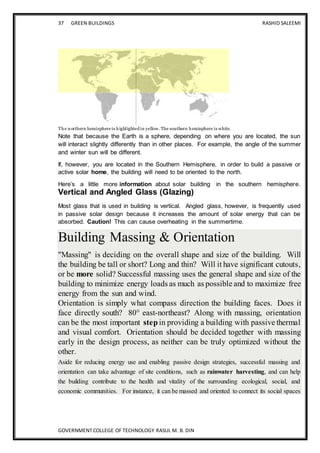
  • 112.
    111 GREEN BUILDINGSRASHID SALEEMI GOVERNMENT COLLEGE OF TECHNOLOGY RASUL M. B. DIN the building. For smaller spaces often encountered in affordable housing, it is relatively easy to add day lighting within the building envelope. o However, for spaces deeper in the building where direct sunlightmay not be available, or for rooms lacking exterior walls, such as pow-der rooms or walk-in closets, tubular skylights can be a great way to daylight these areas. For the price of a window, these units offer excellent day lighting and are very energy efficient. o Clerestory windows are another option for day-lighting internal spaces .Clerestories are windows that are placed in the uppermost portion of a wall. They may require a jog in the roofline, which can increase construction costs. Clerestory windows add for day lighting
  • 113.
    112 GREEN BUILDINGSRASHID SALEEMI GOVERNMENT COLLEGE OF TECHNOLOGY RASUL M. B. DIN Space Utilization Strategies o For small dwelling units, good design is essential to ensure that precious space is used to the fullest extent. Affordable housing designers need to balance the need for activity, storage, living and private spaces. o Effective space use is essential to a building’s livability and the reduction of its environmental impact. The following compact design principles can help develop interesting and functional homes that cost less and save energy. o Eliminating Hallways o Floor plans centered around a common living room offer more space per square foot by eliminating all hall areas. Private rooms and auxiliary functions radiate outward from this central living space, which not only becomes the focal point or heart of the home, but also the main circulation hub that allows residents to move to any other area from the central core . o This type of configuration can be a very effective way of organizing space and accommodating an active family lifestyle. Eliminating hallways for circulation and access to other rooms frees up valuable space for living areas.
  • 114.
    113 GREEN BUILDINGSRASHID SALEEMI GOVERNMENT COLLEGE OF TECHNOLOGY RASUL M. B. DIN o Loft Space Uses o Most everyone has heard the old adage that “it’s cheaper to build up than to build out.” This is true because the two most expensive building systems in a home are the foundation and the roof. Building up does not change the cost of either of these two systems, so the overall cost per square foot is actually reduced. o Loft spaces take full advantage of this design trick by also eliminating the cost of additional exterior wall space .New space gained with a loft is contained entirely within the existing building envelope and usually only requires minimal additional framing to make it work. Generally, a 10/12 or 12/12 roof pitch is needed to get the proper head height in the loft. o Day lighting for loft spaces can most effectively be accomplished by using tubular or standard skylights and gable-end windows. o Multi-Function Flex Spaces o Another design tool worth considering is to create flex spaces that can change over time as family needs change .For example, a child’s bed-room can become a home office or studio when he/she goes off to college. The point is to design flexibility in living and private spaces to accommodate changing family circumstances and a wider variety of family types. Demographics are changing and many future dwelling units
  • 115.
    114 GREEN BUILDINGSRASHID SALEEMI GOVERNMENT COLLEGE OF TECHNOLOGY RASUL M. B. DIN will be needed for seniors, singles and smaller families — many of whom may telecommute. o In smaller homes constructed in response to soaring costs, spaces may need to serve double duty. Dining rooms may need to double as living rooms with fold-away tables; bedrooms may need to double as informal living spaces with futon beds and entertainment centers built into closets; guest rooms may serve as home offices; and informal eating areas may need to be transformed into formal eating areas for special occasions. o Designers should consider how much space is necessary for each activity and which spaces need to be separated. o Built-ins and Other Storage o Years ago, it was very common to find built-ins in affordable homes. Properly designed and strategically placed, these features not only add a high degree of functionality, they also add much of the charm and sense of craftsmanship that is largely absent in today’s production housing. Although they may add a small amount to the up-front costs, they invariably will save the occupant the cost of certain furnishings. o Examples of built-ins that make sense include bookshelf room dividers, informal eating nooks, children’s beds, laundry counters, storage drawers and kitchen shelving in lieu of expensive cabinets. o It is important to design and incorporate them into the floor plan from the beginning. Because built-ins are likely to be around as long as the home, they should have a high degree of functionality while providing a satisfactory aesthetic appeal. Designers and craftsman style home builders of the past were masters of this art. Green building provides an exciting design opportunity to save costs, add character and in- crease the durability of affordable spaces. Thanks to the growing availability of green building products, creative design pioneers are finding it more possible than ever before to go green.
  • 116.
    115 GREEN BUILDINGSRASHID SALEEMI GOVERNMENT COLLEGE OF TECHNOLOGY RASUL M. B. DIN
  • 117.
    116 GREEN BUILDINGSRASHID SALEEMI GOVERNMENT COLLEGE OF TECHNOLOGY RASUL M. B. DIN ENVIRONMENTALLY RESPONSIVE DESIGN PROCESS PRE-DESIGN 1. Develop Green Vision 2. Establish Project Goals and Green Design Criteria 3. Set Priorities 4. Develop Building Program 5. Establish Budget 6. Assemble Green Team 7. Develop Partnering Strategies 8. Develop Project Schedule 9. Review Laws and Standards 10. Conduct Research 11. Select Site DESIGN 1. Schematic Design 2. Confirm Green Design Criteria 3. Develop Green Solutions 4. Test Green Solutions 5. Select Green Solutions 6. Check Cost Design Development 1. Refine Green Solutions 2. Develop, Test, Select Green Systems 3. Check Cost Construction Documents 1. Document Green Materials and Systems 2. Check Cost BID 1. Clarify Green Solutions 2. Establish Cost 3. Sign Contract CONSTRUCTION 1. Review Substitutions and Submittals for 2. Green Products 3. Review Materials Test Data 4. Build Project 5. Commission the Systems
  • 118.
    117 GREEN BUILDINGSRASHID SALEEMI GOVERNMENT COLLEGE OF TECHNOLOGY RASUL M. B. DIN 6. Testing 7. Operations and Maintenance Manuals 8. Training OCCUPANCY 1. Re-Commission the Systems 2. Perform Maintenance 3. Conduct Post-Occupancy Evaluation
  • 119.
    118 GREEN BUILDINGSRASHID SALEEMI GOVERNMENT COLLEGE OF TECHNOLOGY RASUL M. B. DIN TYPICAL GREEN BUILDING GUIDELINE ISSUES 1. Energy efficiency and renewable energy  Building orientation to take advantage of solar access, shading, and natural lighting  Effects of micro-climate on building  Thermal efficiency of building envelope and fenestration  Properly sized and efficient heating, ventilating, and air-conditioning (HVAC) system  Alternative energy sources  Minimization of electric loads from lighting, appliances, and equipment  Utility incentives to offset costs 2. Direct and indirect environmental impact  Integrityof site and vegetation during construction  Use of integrated pest management  Use of native plants for landscaping  Minimization of disturbance to the watershed and additional non-point-source pollution  Effect of materials choice on resource depletion and air and water pollution  Use of indigenous building materials  Amount of energy used to produce building materials 3. Resource conservation and recycling  Use of recyclable products and those with recycled materialcontent  Reuse of building components, equipment, and furnishings  Minimization of construction waste and demolition debris through reuse and recycling  Easy access to recycling facilities for building occupants  Minimization of sanitary waste through reuse of gray water and water-saving devices  Use of rainwater for irrigation  Water conservation in building operations  Use of alternative wastewater treatment methods 4. Indoor environmental quality  Volatile organic compound content of building materials  Minimization of opportunity for microbial growth  Adequate fresh air supply  Chemical content and volatility of maintenance and cleaning materials  Minimization of business-machine and occupant pollution sources  Adequate acoustic control  Access to daylight and public amenities 5. Community issues  Access to site by mass transit and pedestrian or bicycle paths
  • 120.
    119 GREEN BUILDINGSRASHID SALEEMI GOVERNMENT COLLEGE OF TECHNOLOGY RASUL M. B. DIN  Attention to culture and history of community  Climatic characteristics as they affect design of building or building materials  Local incentives, policies, regulations that promote greendesign  Infrastructure in community to handle demolition-waste recycling  Regional availability of environmental products and expertise
  • 121.
    120 GREEN BUILDINGSRASHID SALEEMI GOVERNMENT COLLEGE OF TECHNOLOGY RASUL M. B. DIN Sustainable site design This topic focuses on green site-planning strategies and practices that specifically relate to assessing and selecting a site for uses such as office buildings and parks, institutional and research structures, retail businesses, and industrial facilities. The purpose of sustainable site planning is to integrate design and construction strategies by modifying both site and building to achieve greater human comfort and operational efficiencies. Sound site planning is prescriptive and strategic. It charts appropriate patterns of use for a site while incorporating construction methods that minimize site disruption and the expenditure of financial and building resources. Site planning assesses a particular landscape to determine its appropriate use, then maps the area’smost suitable for accommodating specific activities associated with that use. The process is based upon the premise that any landscape setting can be analyzed and studied as a series of interconnected geological, hydrological, topographic, ecological, climatological, and cultural features and systems. An ideal site plan is one in which the arrangement of roads, buildings, and associated uses is developed using site data and information from the larger macro-environment, including existing historical and cultural patterns of the community. Selecting a building site begins the process of calculating the degree of resource use and the degree of disturbance of existing natural systems that will be required to support a building’s development. Themost environmentally sound development is one that disturbs as little of the existing site as possible. Therefore, sites suitable for commercial building should ideally be located within or adjacent to existing commercial environments. Building projects also require connections to mass transit, vehicular infrastructure, andutility and telecommunication networks. Sound site planning andbuilding design should consider locating building-support services in common corridors, or siting a building to take advantage of existing service networks. This consolidation can minimize site disruption and facilitate building repair and inspection. The use, scale, and structural systems of a building affect its particular site requirements and associated environmental impacts. Building characteristics, orientation, and placement should be considered in relation to the site so that proper drainage systems, circulation patterns, landscape design, and other site- development features can be determined.  Site Analysis and Assessment The purpose of a site analysis is to break down the site into basic parts, to isolate areas and systems requiring protection, and to identify both off-site and on-site factors that may require mitigation. Site assessment is a process that examines the data gathered and identified in the site analysis, assigns specific site factors to hierarchies of importance, and identifies, where possible, interactive relationships. For example, ananalysis may identify specific soils and their properties, vegetationtypes and theirdistribution, or various slope and slope-orientation conditions to name a few site factors. An assessment applies evaluation criteria that allow the comparison of various sites’ suitability for a specific use.
  • 122.
    121 GREEN BUILDINGSRASHID SALEEMI GOVERNMENT COLLEGE OF TECHNOLOGY RASUL M. B. DIN Sustainable design practices assess both site and building program to determine the site’s capacity to support the program without degrading vital systems, or requiring extraordinary development expenditures. The result of analysis and assessment is a blueprint for the most appropriate ecological and physical fit between site, building, and the resulting cultural landscape. Data Collection Technical Site Data 1. Perform a site analysis to determine site characteristics that influence building design. The following site characteristics influence building design elements, including form, shape, bulk, materials, skin-to- volume ratio, structural systems, mechanical systems, access and service, solar orientation, and finished floor elevation:  Geographical latitude (solar altitude) and microclimate factors, such as wind loads—Affect building layout, including solar orientation and location of entrances, windows, and loading docks.  Topography and adjacent land forms—Influence building proportions, wind loads, drainage strategies, floor elevations, and key gravity-fed sewer-line corridors
  • 123.
    122 GREEN BUILDINGSRASHID SALEEMI GOVERNMENT COLLEGE OF TECHNOLOGY RASUL M. B. DIN
  • 124.
    123 GREEN BUILDINGSRASHID SALEEMI GOVERNMENT COLLEGE OF TECHNOLOGY RASUL M. B. DIN  Groundwater and surface runoff characteristics— D e t e r m i n e building locations as well as natural channels for diverting storm runoff and locations of runoff detention ponds.  Solar access—Determines position of building to take maximum advantage of natural solar resources for passive solar heating, day lighting, and photovoltaic.  Air movement patterns, both annual and diurnal— particularly influence siting of multiple structures to avoid damming cold moisture-laden air, or blocking favorable cooling breezes during periods of overheating. Properly measured wind loads and pressure differentials are essential for designing interior air-handling systems or use of passive solar cooling strategies.  Soil texture and its load-bearing capacity—Determinebuilding location on the site and the type of footing required. Identify site-grading processes by the soil’s potential for erosion by wind, water, and machine disturbance.  Parcel shape and access—Affect a site’s capacity to accommodate a proposed development, even if its size and environ-mental factors are favorable. Potential access points should not burden lower-density or less compatible adjacent land use. Zoning setbacks and easements can also affect development potential.  Neighboring developments and proposed future developments— Affect proposed project and may lead to requisite design changes.
  • 125.
    124 GREEN BUILDINGSRASHID SALEEMI GOVERNMENT COLLEGE OF TECHNOLOGY RASUL M. B. DIN 2. Analyze specific characteristics of climate zones. Climate zones (hot-humid, hot-arid, temper- ate, and cold) have specific characteristics requiring mitigation, augmentation, and exploitation. Each climate zone suggests historically amenable siting and building practices. 3. Analyze thesite’s existing airquality. Most stateand federalprojects require anenvironmental impact statement (EIS) outlining the potential negative impacts of a pro-posed development and how they might be alleviated. Site planning requires two kinds of air-quality analysis regarding: (1) assessment of the existing air quality of the site to deter-mine the presence of
  • 126.
    125 GREEN BUILDINGSRASHID SALEEMI GOVERNMENT COLLEGE OF TECHNOLOGY RASUL M. B. DIN noxious chemicals and suspended particulates, and (2) projection of the negative consequences (if any) of the pro-posed development on existing air quality. In primarily commercial or industrial areas, poor air quality should be a key factor in determining site suitability and use, especially for such facilities as schools, parks, or housing for seniors. Testing should anticipate seasonal or diurnal wind patterns to make certain that the worst possible case is tested. Certified labs should perform testing to determine both chemical and particulate pollution. 4. Perform soil and groundwater testing. Perform soil tests to identify the presence of chemical residues from past agricultural activities (arsenic, pesticides, and lead); past industrial activities (dumps, heavy metals, carcinogenic compounds and minerals, and hydrocarbons); and any other possible contamination both on and in the vicinity of the subject site. Also, the possibility of water contamination, in areas where the native rock and substrata are radon- bearing deserves specific attention. These tests are crucial to determine both site feasibility and/or the construction methods required to either mitigateor remove contaminants. 5. Test soil suitability for backfills, slope structures, infiltration. The native soil should be tested to determine bearing, compact ability, and infiltration rates, and, in turn, structural suitability and the best method for mechanical compaction (i.e., clay soils require non-vibrating compaction and non-erosive angles of repose for cut-and-fill slopes). 6. Evaluate site ecosystem for existence of wetlands and endangered species. In addition to wetland regulations governing vegetative-cover removal, grading, drainage alterations, building siting, and storm water runoff mitigation, there are endangered species regulations designed topreserve specific plant and animal species. Preservation and restoration strategies require thorough economic analysis, specialized expertise, and sound baseline data gathered through both remote and on-site sensing methods.
  • 127.
    126 GREEN BUILDINGSRASHID SALEEMI GOVERNMENT COLLEGE OF TECHNOLOGY RASUL M. B. DIN
  • 128.
    127 GREEN BUILDINGSRASHID SALEEMI GOVERNMENT COLLEGE OF TECHNOLOGY RASUL M. B. DIN 7. Examine existing vegetation to inventory significant plant populations. This will enable the developer or owner to later specify vegetation that is susceptible to dam-age during construction, so that protective measures can be developed and implemented. 8. Map all natural hazard potentials (such as winds, floods, and mudslides). Historic flood data, wind-damage data, and subsidence data should be mapped along with current annual wind and precipitation data. It is important to indicate if the pro-posed development is within a statistically significant probability of sustaining impacts within the near future. Often, evidence of past occurrences is not visible. Subsurface investigation mayyield data on surficial rock strata or uncharted previous excavations. Such evidence may require that a different site be selected, or an architectural modification be made. 9. Diagramexisting pedestrian and vehicular movement and parking toidentify patterns. Existing traffic and parking patterns in areas which are adjacent to or near the site may need consideration in relation to proposed building design and site circulation patterns. 10. Review the potential of utilizing existing local transportation resources. Explore the sharing of existing transportation facilities and other resources, such as parking and shuttles, with existing institutions. This can lead to greater site efficiencies. 11. Identify construction restraints and requirements. Special construction methods may be required because of local soil condition, geology, earth-moving constraints, and other site- specific factors and constraints. Cultural and Historical Data 1. Review site’s cultural resources for possible restoration. Historical sites and features can be incorporated as part of the project site, thereby increasing ties with the community and preserving the area’s cultural heritage. 2. Review architectural style of the area for incorporation into building. If desirable, the architectural style that is historically predominant in an area can be reflected in the building and landscape design, enhancing community integration. 3. Explore use of historically compatible building types. There may be building types that are historically matched to the region. Consider integrating such types into building development. Infrastructure Data 1. Analyze site for existing utility and transportation infrastructure and capacity. There may be insufficient existing infrastructure for the proposed project. The cost for required additional capacity and associated disruption to thesurrounding area could make the project unfeasible. Existing infrastructure should be analyzed for integration into the building and facilities. Data Assessment 1. Identify topographic and hydrological impacts of proposed design and building use. Measure cut-and-fill potential and assess potential for erosion, siltation, and ground-water pollution. 2. Develop general area takeoff and overall building footprint compatibility with site. For example, measure total site coverage of impermeable surfaces to determine thresh-olds of run-off pollution potential (i.e., over 20 percent impermeable coverage of gross site requires mitigation to clean storm water before it enters drainage system off-site). Footprint should also maximize site efficiencies with regard to required road, utility, and service access.
  • 129.
    128 GREEN BUILDINGSRASHID SALEEMI GOVERNMENT COLLEGE OF TECHNOLOGY RASUL M. B. DIN 3. Identify alternative site design concepts to minimize resource costs and disruption. Develop several alternatives to explore optimal patternwith regardtofactors such as grading and tree- clearing consequences and resulting infrastructure costs. 4. Review financial implications of site development, building, and projected maintenance costs. Total cost of the project must factor in ongoing costs associated with the site design, development, and operations, as well as hidden embodied energy costs associated with specific materials. 5. Develop matrix of use and site compatibility index. Each site may be assessed to reveal its development compatibility index with regard to a specific type of development. This index may reveal a pattern of incompatibilities, suggesting that either a different site be chosen or specific appropriate mitigation measures be undertaken. Site Development and Layout After the site has been selected on the basis of a thorough analysis and assessment, ideal diagrammatic concepts arelaid out on thetopographic survey with the objective of organizing allproposed built elements to achieve an efficient and effective site and development fit. The main goal of the concepts should be to minimize resource consumption during construction and after human occupation. It should be noted that during reclamation of disturbed sites, initial expenditures may be higher than normal and should be balanced by ongoing landscape management strategies. The following practices serve to guide the initial concept diagramming process.
  • 130.
    129 GREEN BUILDINGSRASHID SALEEMI GOVERNMENT COLLEGE OF TECHNOLOGY RASUL M. B. DIN Infrastructure Utility Corridors 1. Design the site plan to minimize road length, building footprint, and the actual ground area required for intended improvements. Such planning decreases the length of utility connections. Consult local codes regarding separation requirements for water, sewer, electrical, and gas lines. 2. Use gravity sewer systems wherever possible. Avoid pumped sewer systems because of ongoing power consumption. 3. Reuse chemical-waste tanks and lines. Existing chemical-waste tanks and lines should be inspected, protected, and reused to avoid creation of additional hazardous-materials problems.
  • 131.
    130 GREEN BUILDINGSRASHID SALEEMI GOVERNMENT COLLEGE OF TECHNOLOGY RASUL M. B. DIN 4. Aggregateutility corridors when feasible. Where possible, common site utility corridors should be consolidated along previously disturbed areas or along new road or walk construction, both to minimize unnecessary clearing and trenching and to ensure ease of access for ongoing repairs. Transportation 1. Support reduction of vehicle miles traveled (VMT) to the site. Where applicable, existing mass- transit infrastructure and shuttle buses should be sup-ported, or a new line developed. Carpooling strategies should be encouraged in addition to mass-transit use. To foster the use of bicycles, showers and lockers should be considered. All of these transportation methods reduce parking and transportation costs for employees. 2. Use existing vehicular transportation networks to minimize the need for new infrastructure. This practice can increase site efficiencies associated with reduced ground coverage, parking requirements, and related costs. 3. Consider increased use of telecommuting strategies. Telecommuting and teleconferencing can reduce commute time and VMT to and from worksites. Plan for adequate telecommunications infrastructure and access in building design. 4. Consolidate service, pedestrian, and automobile paths. To minimize pavement costs, improve efficiency, and centralize runoff, the pattern of roads, walkways, and parking should be compact. This not only is a less expensive way to build, it also helps to reduce the ratio of impermeable surfaces to the gross site area. Building and Site Requirements Land Features 1. Develop previously disturbed sites such as unused urban lots and commercial sites. These sites may already be affecting the environmental quality of neighboring properties, the watersheds, and other features, therefore redevelopment requires minimal disturbance of natural systems. Furthermore, redevelopment is likely to improve the immediate community, potentially create jobs, and increase land values that have been affected by the abandoned or blighted property. 2. Avoid stream channels, flood plains, wetlands, steep erodible slopes, and mature vegetation. To avoid high site-preparation costs, and to preserve important visual and ecological features, development activity should be configured to occupy “interstitial site space,” or those spaces between critical resources. Building and site orientation 1. Plan site clearing and planting to take advantage of solar and topographic conditions. Solar orientation, sky conditions (cloudy versus clear), and topography are interrelated. A site’s latitude determines the sun’s altitude and associated azimuth for any given time of day, each day of the year. Site-clearing and planting strategies, which partially determine solar access, are influenced by those requirements. 2. Orient building to take advantageof solar energy for passive and activesolar systems. Thebuilding should be oriented to take advantage of shade and airflows for cooling in summer, and of passive
  • 132.
    131 GREEN BUILDINGSRASHID SALEEMI GOVERNMENT COLLEGE OF TECHNOLOGY RASUL M. B. DIN solar energy for heating and wind protection in winter. If solar collectors or photovoltaic systems are proposed, orientation should allow maximum access to sunlight. 3. Minimize solar shadows. Landscaped areas, open spaces, parking, and septic fields should be aggregatedtoprovide the least solar shadow for southern orientations of the building project and adjoining buildings. Calculating total site shadow can prevent the creation solar voids and cold-air- drainage dams. This is especially helpful in cold and temperate climates. 4. Minimize earthwork and clearing by aligning long buildings and parking lots with landscape contours; take up excess slope with half-basements and staggeredfloor levels. 5. Provide a north-wall design that minimizes heat loss. Provide entrances with airlocks, and limit glass to prevent heat loss in human-occupied areas. Largebuildings in cold or temperate climates require air-handling system compensation for balancing interior building pressure in such circumstances. 6. Provide a building-entrance orientation that maximizes safety and ease of access. The building should be positioned on the site so that its entrance provides maximum safety and ease of access, as well as protection from the elements. Landscaping and Use of Natural Resources 1. Harness solar energy, airflow patterns, natural water sources, and the insulating quality of land forms for building temperature control. Existing water sources and landforms can be used to create winter heat sinks in cold climates, and temperature differentials for cooling air movement in hot climates. Existing streams or other water sources can contribute to radiant cooling for the site. Color and surface orientation may be used to favorably absorb or reflect solar energy. 2. Use existing vegetation tomoderate weather conditions and provide protection for native wildlife. Vegetation can be used to provide shade and transpiration in the summer and wind protection in the winter. Additionally, vegetation can provide a natural connection for wildlife corridors. 3. Design access roads, landscaping, and ancillary structures to channel wind toward main buildings for cooling, or away from them to reduce heat loss. Public Amenities 1. Modify microclimates to maximize human comfort in the use of outdoor public amenities such as plazas, sitting areas, and rest areas. 2. Modulate sun and wind. In planning outdoor public amenities, the designer needs to consider seasonal weather patterns and climate variables such as vapor pressure in hot-humid zones, desiccating winds and diurnal extremes in hot-arid zones, and annual temperature extremes in temperate and cold zones. 3. Introduce structures and plantings that provide shelter from harsh elements and highlight desirable features. Modulation of tree-canopy heights and inclusion of water fountains and other built structures can fine-tune an exterior site by accelerating or decelerating site winds, casting shadows, or cooling by evapotranspiration or evaporative cooling. 4. Consider sustainable site materials for public amenities. Materials should be recycled, if possible, and have a low life-cycle cost. Albedo (solar reflectance index attributed to color) should also be considered when choosing site materials. Construction Methods
  • 133.
    132 GREEN BUILDINGSRASHID SALEEMI GOVERNMENT COLLEGE OF TECHNOLOGY RASUL M. B. DIN 1. Specify sustainable site construction methods. The construction methods employed should ensure that each step of the building process is focused on eliminating unnecessary site disruption (e.g., excessive grading, blasting, clearing) and resource degradation (e.g., streamsiltation, groundwater contamination, air-quality loss). The strategies can harness features such as ventilating breezes, solar gain, and microclimates, and can mitigate unfavorable features such as cold, moist air drainage; desiccating winds; and increased storm water runoff. 2. Develop sequential staging to minimize site disruption. The building process should bestrategically charted in stages to avoid unnecessary site disruption, and to achieve an orderly construction sequence from site clearing to site finish. Such a strategy reduces costs and damage to the site. It requires close coordination between all sub-contractors.
  • 134.
    133 GREEN BUILDINGSRASHID SALEEMI GOVERNMENT COLLEGE OF TECHNOLOGY RASUL M. B. DIN The environmentalimpact of buildingmaterials The choice of building materials affects the environmental impact of a house. All building materials are processed in some way before they can be incorporated into a building.  The processing may be minimal, as in the case of a traditional cottageconstructed from materials found locally, or  It may be extensive, as in the case of prefabricated construction. We can calculate the overall environmental impact of a house if we know the impacts that result from its day-to-day use and the manufacture and delivery of its construction materials and components. We can, with this information, see how the choice of materials affects its impact on the environment. It will become clear that calculations to determine the exact impact of each and every dwelling are, at present, not feasible. MEASURING THE ENVIRONMENTAL IMPACT OF BUILDING MATERIALS When choosing materials several factors have to be considered, and it is unlikely that absolute rules can be given for all situations. The first question is how environmental impact should be assessed. This can be thought of as factors determined by the material’s inherent qualities and as factors affected by the way materials are incorporated into a design. Factors determined by a material’s qualities are, for example: • Energy required to produce the material. •CO2 emissions resulting from the material’s manufacture. • Impact on thelocal environment resulting from the extractionof thematerial(e.g. quarry pit, wood taken from a forest, oil spills from an oil well, etc.) • Toxicity of the material. • Transportation of the material during its manufacture and delivery to site. • Degreeof pollution resulting from the materialat the end of its useful life.
  • 135.
    134 GREEN BUILDINGSRASHID SALEEMI GOVERNMENT COLLEGE OF TECHNOLOGY RASUL M. B. DIN Factors affected by material choice and design decisions include: • Location and detailing of an architectural element. • Maintenance required and the materials necessary for that maintenance • Contribution that the material makes to reduce the building’s environmental impact (e.g., insulation). • Flexibility of a design to accommodate changing uses over time. • Lifetime of the materialand its potential for reuse if the building is demolished. The following headings for comparing the environmental impact of materials: • Environmentalimpact owing to production: • Energy use. • Resource depletion. • Global warming. • Acid rain. • Toxins. • Environmentalimpact owing to use: • Potential for reuse/recycling and disposal. • Health hazard. 1. Perhaps the single most important measure of an object’s environmental impact is provided by the concept of ‘embodied energy’. ‘Embodied energy’ describes the amount of energy used to produce an object. 2. We can refer to the embodied energy of a brick, a window or of an entire house. The following sections discuss embodied energy and embodied emissions in some detail. 3. As figures for the embodied energy of materials are not yet widely available, it is hoped that understanding the factors affecting it will help the reader to ‘ask the right questions’ when considering material selection.
  • 136.
    135 GREEN BUILDINGSRASHID SALEEMI GOVERNMENT COLLEGE OF TECHNOLOGY RASUL M. B. DIN 4. Embodied energy is an important measure because the use of non-renewable energy sources is the principal reason for environ-mental degradation. 5. Degradation is caused in two main ways: 1) resulting from atmospheric emissions, principally CO 2, contributing to global warming; 2) resulting from the effects other emissions have on the atmosphere, such as acid rain. 6. We can be fairly certain that other effects are taking place that, as yet, remain unidentified. The concept of embodied emissions is similar to that of embodied energy and refers to the emissions associated with the production of an object, for example the electricity used to produce a window will result in CO2 emissions associated with that window. In addition, the production of materials, particularly those requiring chemical treatment, can result in the emission of toxins. If accurateembodied emissions figures are to be calculated, the types of fuels used in any manufacturing process must be known, as each fuel gives a different mix of emissions. Several different methods exist for calculating embodied energy, and this results in a range of figures published for similar materials. Published data should be treated with some caution, unless it is clearly stated how the figures have been calculated. THE EMBODIED ENERGY OF DIFFERENT BUILDING MATERIALS 1. At present, the few published figures available for embodied energy usually refer to individual materials, e.g. brick, concrete, timber or glass. 2. These figures are useful for making strategic decisions regarding a house, i.e. should it be built using a timber frame or concrete blocks, but they are less useful when trying to decide if a particular energy-saving feature should be used, for example mechanical ventilation with heat recovery. 3. This is where cradle-to-grave or life cycle analysis becomes important and this will be considered later in the chapter. 4. As embodied energy is usually quoted per unit weight or per unit volume of a material, one needs to know the weight or volume of the particular material actually used in a building. 5. Certain materials, such as plastics or metals, have very high embodied energies per unit weight but, if used in small quantities, may have an overall benefit by, for example, providing an elegant joint between materials or by increasing the distance a material, such as timber, can span or by increasing the lifetime of an element. 6. Plastics, timber and metals are materials about which there is much debate over their environmental impact. There is no consensus as to the advisability of the use of plastics or synthetic materials but, in our view, they arebest avoided. Plastics  The embodied energy of plastics is extremely high.  They are, on the other hand, waste products from the production of petroleum.
  • 137.
    136 GREEN BUILDINGSRASHID SALEEMI GOVERNMENT COLLEGE OF TECHNOLOGY RASUL M. B. DIN  So, it can be argued that by using plastics we reduce the accumulation of waste material. But it can also be said that the use of plastics helps to support the very industry that is responsible for a large amount of CO 2 emissions and for over half of all toxic emissions to the environment.  After their production, plastics tend to release gases into the atmosphere, these are referred to as volatile organic compounds (VOCs), which can be harmful if breathed in any quantity.  They are found in synthetic compounds in carpets and modern paints, especially oil-based paints such as those with an eggshell finish. The effect of VOCs is usually greatest soon after installation.  One plastic generally thought best to avoid is polyvinyl chloride (PVC). It is particularly difficult to dispose of in an ecologically safe manner but it can be recycled and, in its recycled form, is beginning to appear on the market, generally for low-grade products. Metals  Metals are another group of materials with a high embodied energy for which the manufacturing process results in local environmental degradation from waste products.  Owing to the high price of metals, most waste metal is recycled, although this process is not without its own detrimental environmental cost; the smelting process requires largeenergy inputs and generateshighly toxic dioxin emissions because of the chlorine found in most metals.  Until such time when the large-scale use of renewable energies makes their production more environmentally friendly, it is best to minimize the use of metals in construction.  Metals should only be used in small quantities or for particular purposes, e.g. for the jointing and fixing of materials.  Stainless steel and aluminum areboth very likely tobe recycled, but have very high environmental impacts as a result of their initial manufacture.  Their extensive use in buildings cannot be considered ecological.  Lead, because of its toxic nature and associated pollution resulting from the manufacturing process, is best avoided.  Currently, it is mainly used for roof flashings, where it forms a long-lasting waterproofing element between walls and roof coverings or at junctions between roof coverings.  Water collected off roofs with lead flashings is best not used for watering edible fruits or vegetables as these may absorb lead as they grow.  Lead may prove a hazard when renovating older properties as paint older than 30 years may contain the metal, which was used as a drying agent.  Care must be taken to avoid inhaling dust or fumes. It is therefore not a good idea to burn off old lead paint. Timber  Timber is a material that is generally considered to have excellent environmental credentials. As a renewable resource, its main attributes are that it reduces the amount of CO2 in the atmosphere until it decays or is burnt and it is easily worked.  There are, however, possible disadvantages associated with timber, the principal one resulting from imported timber.  This may have been transported over long distances.  Another potential problem has to do with the way the timber is grown and if trees are replanted when mature ones are cut.
  • 138.
    137 GREEN BUILDINGSRASHID SALEEMI GOVERNMENT COLLEGE OF TECHNOLOGY RASUL M. B. DIN  Most commercial softwood comes from forests that will be replanted, however these commercial softwood forests are often planted with very few species of trees and provide little potential for bio-diversity.  Inthe case of imported non-European hardwoods, thereis a high probability that these come from tropical rainforests and will not be replaced.  The Forestry Stewardship Council, based in the UK, does run a scheme for certifying that timber comes from sustainable forests.  Currently, only a small percentage of wood commercially available is certified as sustainable and, practically, this can be difficult to obtain.  Anyone contemplating the construction of a new building using timber would be well advised to research the availability of locally grown timber.  There are local forests with associated sawmills that can supply good quality home-grown timber, such as Douglas Fir, Sweet Chestnut and Oak, suitable for load-bearing construction.  Timber is a good choice as a sustainable material but, if it is used externally, it must be detailed in such a way as to prevent rot.  Currently, most timber suppliers will automatically treat external timber to prevent rot but these treatments are highly toxic and should be avoided in ecological buildings.  Therefore, some untreated species of timber, particularly much low-grade imported softwood, is not suitable for external use.  If one can source durable timber, it may be used untreated externally by detailing it correctly.  This generally means making sure that, if the timber does get wet, water will rapidly drain away and the timber is well ventilated.  One should check the durability of any external timber before purchasing it.  Oak and Larch, for example, are durable external timbers, whereas much softwood imported into the UK is not and,  If used externally, will not have a long life.  As a general rule for materials, choose local materials that have had the minimum processing. But do check that they will be durable and fit for the purpose intended!
  • 139.
    138 GREEN BUILDINGSRASHID SALEEMI GOVERNMENT COLLEGE OF TECHNOLOGY RASUL M. B. DIN ECommunity Housing Scheme Sheikhupura – A green dream finally come true  Pakistan is a veritable sea of people, a huge chunk of which lives in crowded cities polluted by exhaust fumes and waste material. In such an environment, self- sustaining, green development is a desperate necessity, and this post features a Good Samaritan who has come up with a project that is as green as it gets.  Strategically located on main Sheikhupura-Lahore Road, Ecommunity Housing Scheme has been developed by Pebbles (Pvt) Limited as an answer to Pakistan’s smog-choked prayers. The first-ever housing scheme in Pakistan based entirely on green building practices, the housing society has been built with the conscious aim of conserving its natural surroundings and the wider environment.
  • 140.
    139 GREEN BUILDINGSRASHID SALEEMI GOVERNMENT COLLEGE OF TECHNOLOGY RASUL M. B. DIN  In essence, the development is a modern urban project featuring a classy blend of contemporary building practices as well as sensible use of natural resources in complete harmony with Mother Nature. WHAT IS A ‘GREEN’ SOCIETY? The word ‘green’ is not just a moniker. Ecommunity Housing Society has been carefully and meticulously planned to meet the following conservation and sustainability targets:  Water use reduction up to 40%  Energy use reduction up to 50%  Renewable energy use up to 2.5%  HVAC requirement reduction up to 30%  Material reuse or virgin material mitigation up to 20%  Up to 50% of material used in construction procured within a 500km radius of site  Usage of rapidly renewable material up to 5%  Improved indoor environmental quality and extra ventilation in all living spaces  Reduction in carbon dioxide concentration inside residential structures LOCATION The grand gate of Ecommunity Housing has been imaginatively designed with towering green walls symbolising its oneness with nature, and befittingly reflecting the unique grandeur of the community within. It is easily accessible from both Lahore and Sheikhupura at only 2.4km from the main gate of Sheikhupura Housing Society, 2.7km from By-Pass Chowk Sheikhupura, and 17km from Kot Abdul Malik Interchange. Ecommunity Housing Scheme spans over 55 acres of land fully owned by Pebbles (Pvt) Limited, around 36% of which has been allocated for residential structures, 15% for green areas (parks and gardens), and a significant 40% for open, wide and spacious roads lined with trees and beautiful walkways. It also features carefully crafted commercial areas and community centres to cater to contemporary communal aspirations.
  • 141.
    140 GREEN BUILDINGSRASHID SALEEMI GOVERNMENT COLLEGE OF TECHNOLOGY RASUL M. B. DIN AMENITIES Ecommunity Housing Schene Project is all about building a natural, beautiful community, and a great deal of thought has gone into carefully designing and providing every possible social requirement, and then some. Some outstanding community features spanning over 8 acres of the project area are:  A state-of-the-art club and community centre  Swimming pool and spa (with steam rooms, Jacuzzi and sauna)  Water features  Amphitheatre  Seating lounge  Outdoor sitting area  Squash courts  Tennis courts  Basketball court  Indoor games area with provisions for snooker  Gymnasium  Planting Island A football stadium has also been designed to be at par with international standards, and Ecommunity Housing Scheme also features beautiful green jogging and walking tracks. As with any great housing society, excellent security features and parking areas are also on offer at this green development. A residential development of this standard and quality in Sheikhupura is something of a dream come true, so pick up the phone and see if a chunk of this dream can be reserved for you. OPTIONS
  • 142.
    141 GREEN BUILDINGSRASHID SALEEMI GOVERNMENT COLLEGE OF TECHNOLOGY RASUL M. B. DIN Ecommunity Housing Scheme offers several cuttings to cater to everyone’s needs, and plot sizes include full 20 marlas, 10 marlas, 7 marlas and 5 marlas. What that means is that you’re guaranteed to find what you’re looking for, given that the payment plan allows you to pay 25% down payment and the rest of the 75% in equal quarterly instalments over the course of a year. Property Type Price Range 20-Marla Residential Plot PKR 5,000,000 – PKR 7,700,000 10-Marla Residential Plot PKR 2,500,000 – PKR 3,000,000 7-Marla Residential Plot PKR 1,750,000 – PKR 2,450,000 5-Marla Residential Plot PKR 1,250,000 Further information’s A rule of community development the 60% area should be saleable as residence, shops etc. and 40% should be non-saleable for example roads, graveyards, schools, colleges, parks ground etc. The ecommunity has 40% saleable area and gives 20% more to parks and open area.
  • 143.
    142 GREEN BUILDINGSRASHID SALEEMI GOVERNMENT COLLEGE OF TECHNOLOGY RASUL M. B. DIN Certification awards The ecommunity awarded by the Asian pacific property awards And a commercial building in ecommunity have awarded by 5A interior award. Spain history The Spain have a concept of green buildings by their construction techniques. Thy construct buildings at their plots all-around the plots by leaving the space all-around the boundary. And construct a pool at the center building and the windows are covered by the plantation. The windows are located all-around the buildings. This set-up will be decrease the temperature 5◦c to 8◦c. About off grid building in ecommunity An off-grid building was constructed in ecommunity was constructed then its replaced by grid electricity building because of some reasons.The solarenergy is not a proper way to generate enough electricity because its works in sunny days about 6-8 hours and solar system have very less efficiency. Energy resources Ecommunity have 3 (three) sources of energy like grid, generated and solar. Solar energy use for street lights and a small amount use for houses individually as a sub source. Construction Company Pebbles Construction Company constructing the ecommunity. Running projects There are many projects under construction which are given below.
  • 144.
    143 GREEN BUILDINGSRASHID SALEEMI GOVERNMENT COLLEGE OF TECHNOLOGY RASUL M. B. DIN 1. A beautiful Mosque 2. Road pavements 3. Residential buildings 4. Parks and gardens 5. Water treatment plant Conclusion Green building concept is a really responsible for the environment. This saves the environment by reduction of water, energy and materials used. In this concept we use minimum energy by various methods and codes and the energy which we use we produce by himself. Minimum water use by various codes and treatment of water for reuse. And the materials are alsorecycle and reuse. By using this concepts we can save environment and cangive this environment to our next generation. Ifwe don’t control the broadly use of materials, water and energy and environmental degradation we will suffer for this act by our own risk. If we don’t stop this so, there will be a huge deficiency by the environment and the world will not be stable and may be destroy.
  • 145.
    144 GREEN BUILDINGSRASHID SALEEMI GOVERNMENT COLLEGE OF TECHNOLOGY RASUL M. B. DIN References Data type Reference Synopsis https:uvas.edu.pk Data Wikipedia.com Data Emirates news 24/7 -do- Legard group -do- Green building guide by craig nielson. -do- Amir Adnan associates. -do- Building construction authority by Dr. John Keung. -do- Home rating systemby LEED. -do- Sustainable design and green building toolkit by United States EPA. -do- Green schoolresourceguide by LEED. -do- Home design by LEED. -do- LEED for new construction and major renovation.
  • 146.
    145 GREEN BUILDINGSRASHID SALEEMI GOVERNMENT COLLEGE OF TECHNOLOGY RASUL M. B. DIN Field training officers Sr. No. Name Designation Location E mail address Contact number. Remark s 1. Aqrab Ali Rana C.E.O Green Building Council Lahore aqrab@pakistang bc.org N.A 2. Muneeb Haider Head of Registration and Technical Development Green Building Council Lahore muneeb@pakista ngbc.org 0345-4043816 3. Muzamal Abbas Electrical Supervisor Green Building Council Lahore N.A N.A 4. Mr. Shafqat CIVIL Supervisor Ecommunity Shafqat118@G mail.com N.A 5. Tahir Masood Construction Manager Ecommunity tahir@pebbles. com.pk 0332-2223208 6. Aqeel Abbas CIVIL Supervisor Ecommunity N.A 0300-7710212 7. Mr. Shehzad Electrical Supervisor Ecommunity shehzad@peb bles.com.pk N.A
  • 147.
    146 GREEN BUILDINGSRASHID SALEEMI GOVERNMENT COLLEGE OF TECHNOLOGY RASUL M. B. DIN
  • 148.
    147 GREEN BUILDINGSRASHID SALEEMI GOVERNMENT COLLEGE OF TECHNOLOGY RASUL M. B. DIN