Yarn Construction
Introduction-
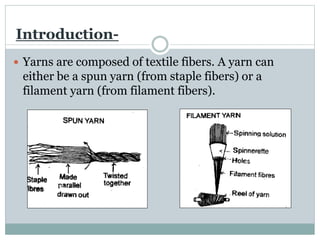
 Yarns are composed of textile fibers. A yarn can
either be a spun yarn (from staple fibers) or a
filament yarn (from filament fibers).
 The different ways in which fibers can be joined
together aid in providing the variety of structures
that in turn create a wide variety of fabrics.
 Yarn is an assemblage of fibers twisted together. A
yarn composed of a group of fibers laid in parallel &
kept together by twisting.
Yarn Twist-
 The fibers & yarns are strengthening by giving them
twist.
 The spiral deposition of the components of a twist is
the measure of the spiral turns given to a yarn in
order to hold the constituent fibers or threads
together.
 The amount of twist is measured by the number of
twists given to staple yarns per inch. It is also called
(tpi).
 Low twist is- 0-3tpi
 Medium twist is 4-7 tpi
 High twist is 8-12tpi
Twist Direction-
 The direction of the twist at each stage
of manufacture is indicated by the use
of letters S or Z in accordance with the
following convection:
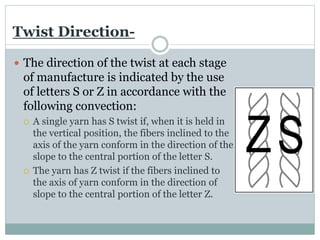
 A single yarn has S twist if, when it is held in
the vertical position, the fibers inclined to the
axis of the yarn conform in the direction of the
slope to the central portion of the letter S.
 The yarn has Z twist if the fibers inclined to
the axis of yarn conform in the direction of
slope to the central portion of the letter Z.
 As twist increases, yarn strength and yarn stiffness
increase up to a point, level off, then begin to fall at
very high twist levels.
 Yarns with extremely high levels of twist are called
“crepe yarns”. Crepe yarns, have a high tpi (turns per
inch).
 Yarn Number/ Yarn count-
 A measure of the fineness or size of a yarn expressed
either as ‘mass per unit length' Or length per unit
mass depending upon the yarn numbering system
used.
 This relation indicates the thickness of the yarn.
Yarn Formation-
 The following are the main steps for natural fibers
(making yarn from staple fibers) - Ring spinning
 Opening/Blending-
 Opening is necessary in order to loosen hard lumps
of fibers & disentangle them.
 Cleaning is required to remove trash –The fibers
must be sorted ,based on grade, cleaned to remove
particles of dirt, twigs, and leaves, and blended with
fibers from different bales to improve the
consistency of the fiber mix.
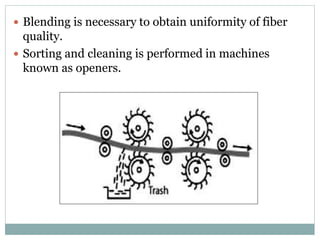
 Blending is necessary to obtain uniformity of fiber
quality.
 Sorting and cleaning is performed in machines
known as openers.
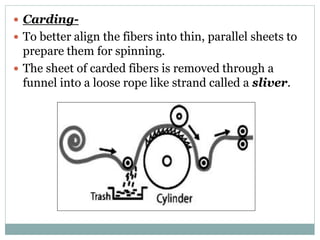
 Carding-
 To better align the fibers into thin, parallel sheets to
prepare them for spinning.
 The sheet of carded fibers is removed through a
funnel into a loose rope like strand called a sliver.
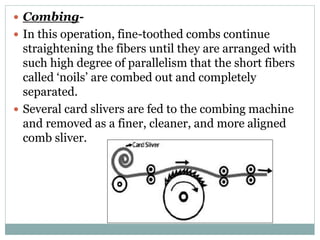
 Combing-
 In this operation, fine-toothed combs continue
straightening the fibers until they are arranged with
such high degree of parallelism that the short fibers
called ‘noils’ are combed out and completely
separated.
 Several card slivers are fed to the combing machine
and removed as a finer, cleaner, and more aligned
comb sliver.
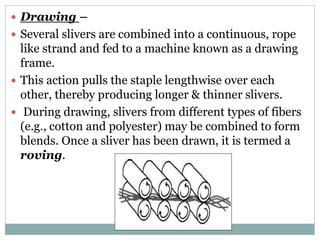
 Drawing –
 Several slivers are combined into a continuous, rope
like strand and fed to a machine known as a drawing
frame.
 This action pulls the staple lengthwise over each
other, thereby producing longer & thinner slivers.
 During drawing, slivers from different types of fibers
(e.g., cotton and polyester) may be combined to form
blends. Once a sliver has been drawn, it is termed a
roving.
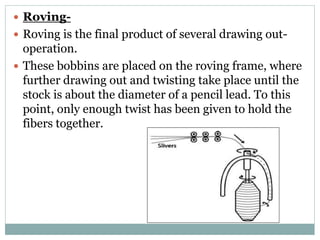
 Roving-
 Roving is the final product of several drawing out-
operation.
 These bobbins are placed on the roving frame, where
further drawing out and twisting take place until the
stock is about the diameter of a pencil lead. To this
point, only enough twist has been given to hold the
fibers together.
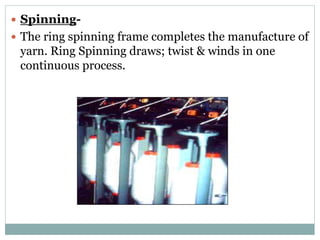
 Spinning-
 The ring spinning frame completes the manufacture of
yarn. Ring Spinning draws; twist & winds in one
continuous process.
Man Made Fiber Formation-
 Man-made fibers are polymeric forms that are produced
by some type of chemical or by the regeneration & natural
polymers in a new physical form.
 The liquid polymer is extruded through a spinneret. Each
spinneret has a number of holes, and each hole produces
one filament.
 As they exit the spinneret the filament fibers are solidified
by cooling of melted polymers, by evaporating the solvent,
or by precipitating the polymer from solution.
 Most spinnerets are made with round openings, some
may use other shape is order to produce fiber with special
characteristics.
Chemical Spinning’s to convert Synthetic
Fibers into Yarns-
 Wet Spinning.
 Melt Spinning.
 Dry Spinning.
 Note- Prepare Assignment on Chemical Spinning.
Yarn construction

Yarn construction

  • 1.
  • 2.
    Introduction-  Yarns arecomposed of textile fibers. A yarn can either be a spun yarn (from staple fibers) or a filament yarn (from filament fibers).
  • 3.
     The differentways in which fibers can be joined together aid in providing the variety of structures that in turn create a wide variety of fabrics.  Yarn is an assemblage of fibers twisted together. A yarn composed of a group of fibers laid in parallel & kept together by twisting.
  • 4.
    Yarn Twist-  Thefibers & yarns are strengthening by giving them twist.  The spiral deposition of the components of a twist is the measure of the spiral turns given to a yarn in order to hold the constituent fibers or threads together.  The amount of twist is measured by the number of twists given to staple yarns per inch. It is also called (tpi).  Low twist is- 0-3tpi  Medium twist is 4-7 tpi  High twist is 8-12tpi
  • 5.
    Twist Direction-  Thedirection of the twist at each stage of manufacture is indicated by the use of letters S or Z in accordance with the following convection:  A single yarn has S twist if, when it is held in the vertical position, the fibers inclined to the axis of the yarn conform in the direction of the slope to the central portion of the letter S.  The yarn has Z twist if the fibers inclined to the axis of yarn conform in the direction of slope to the central portion of the letter Z.
  • 6.
     As twistincreases, yarn strength and yarn stiffness increase up to a point, level off, then begin to fall at very high twist levels.  Yarns with extremely high levels of twist are called “crepe yarns”. Crepe yarns, have a high tpi (turns per inch).
  • 7.
     Yarn Number/Yarn count-  A measure of the fineness or size of a yarn expressed either as ‘mass per unit length' Or length per unit mass depending upon the yarn numbering system used.  This relation indicates the thickness of the yarn.
  • 8.
    Yarn Formation-  Thefollowing are the main steps for natural fibers (making yarn from staple fibers) - Ring spinning  Opening/Blending-  Opening is necessary in order to loosen hard lumps of fibers & disentangle them.  Cleaning is required to remove trash –The fibers must be sorted ,based on grade, cleaned to remove particles of dirt, twigs, and leaves, and blended with fibers from different bales to improve the consistency of the fiber mix.
  • 9.
     Blending isnecessary to obtain uniformity of fiber quality.  Sorting and cleaning is performed in machines known as openers.
  • 10.
     Carding-  Tobetter align the fibers into thin, parallel sheets to prepare them for spinning.  The sheet of carded fibers is removed through a funnel into a loose rope like strand called a sliver.
  • 11.
     Combing-  Inthis operation, fine-toothed combs continue straightening the fibers until they are arranged with such high degree of parallelism that the short fibers called ‘noils’ are combed out and completely separated.  Several card slivers are fed to the combing machine and removed as a finer, cleaner, and more aligned comb sliver.
  • 12.
     Drawing – Several slivers are combined into a continuous, rope like strand and fed to a machine known as a drawing frame.  This action pulls the staple lengthwise over each other, thereby producing longer & thinner slivers.  During drawing, slivers from different types of fibers (e.g., cotton and polyester) may be combined to form blends. Once a sliver has been drawn, it is termed a roving.
  • 13.
     Roving-  Rovingis the final product of several drawing out- operation.  These bobbins are placed on the roving frame, where further drawing out and twisting take place until the stock is about the diameter of a pencil lead. To this point, only enough twist has been given to hold the fibers together.
  • 14.
     Spinning-  Thering spinning frame completes the manufacture of yarn. Ring Spinning draws; twist & winds in one continuous process.
  • 15.
    Man Made FiberFormation-  Man-made fibers are polymeric forms that are produced by some type of chemical or by the regeneration & natural polymers in a new physical form.  The liquid polymer is extruded through a spinneret. Each spinneret has a number of holes, and each hole produces one filament.  As they exit the spinneret the filament fibers are solidified by cooling of melted polymers, by evaporating the solvent, or by precipitating the polymer from solution.  Most spinnerets are made with round openings, some may use other shape is order to produce fiber with special characteristics.
  • 16.
    Chemical Spinning’s toconvert Synthetic Fibers into Yarns-  Wet Spinning.  Melt Spinning.  Dry Spinning.  Note- Prepare Assignment on Chemical Spinning.