
Selecting Empirical
  Methods for SE
     Research

      Daniel Cukier
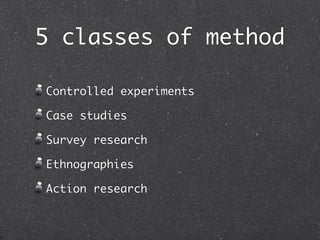
5 classes of method

Controlled experiments

Case studies

Survey research

Ethnographies

Action research
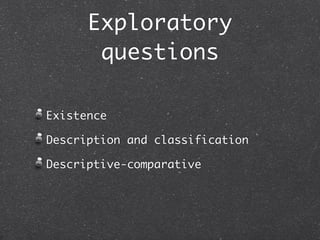
Exploratory
       questions

Existence

Description and classification

Descriptive-comparative
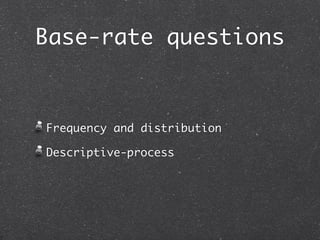
Base-rate questions


Frequency and distribution

Descriptive-process
Relationship
      questions


Is X related to Y?

If X occurs, will Y also occur?
Causality questions


Does X cause Y? Does X prevent Y?

Causality-Comparative

Does context affects causality?
Design questions


How effectively achieve X?

What helps?

What does not help?
Empirical truth
epistemology
the nature of human knowledge,
    and how we obtain it.


         onthology
  the nature of the world
irrespective of our attempts
     to understand it.
Plato about knowledge

 to know something, you must
  believe it to be true, and
have a clear justification for
   believing it to be true
Constructivists

we cannot separate knowledge
from the language we use to
         express it
The philosophical
     stances

Positivism

Constructivism

Critical Theory

Pragmatism
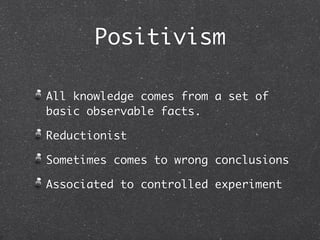
Positivism

All knowledge comes from a set of
basic observable facts.

Reductionist

Sometimes comes to wrong conclusions

Associated to controlled experiment
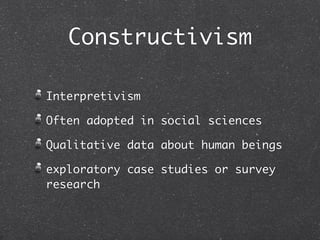
Constructivism

Interpretivism

Often adopted in social sciences

Qualitative data about human beings

exploratory case studies or survey
research
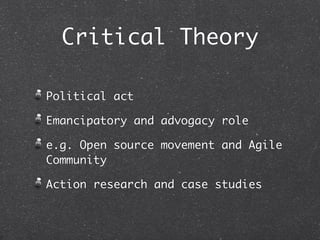
Critical Theory

Political act

Emancipatory and advogacy role

e.g. Open source movement and Agile
Community

Action research and case studies
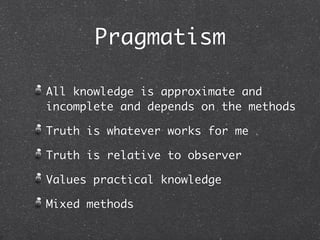
Pragmatism

All knowledge is approximate and
incomplete and depends on the methods

Truth is whatever works for me

Truth is relative to observer

Values practical knowledge

Mixed methods
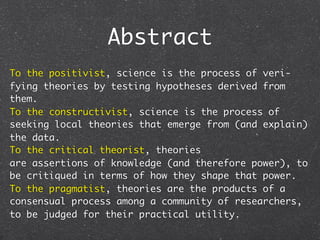
Abstract
To the positivist, science is the process of veri-
fying theories by testing hypotheses derived from
them.
To the constructivist, science is the process of
seeking local theories that emerge from (and explain)
the data.
To the critical theorist, theories
are assertions of knowledge (and therefore power), to
be critiqued in terms of how they shape that power.
To the pragmatist, theories are the products of a
consensual process among a community of researchers,
to be judged for their practical utility.
Theories


Theory becomes a “lens” through
  which the world is observed
Theories

 Real-world phenomena are
    simply too rich and
complex to study without a
 huge amount of filtering
Theories

 Software Engineering
    researchers have
traditionally been very
poor at making theories
Method Selection

Research Design is the
process of selecting a
method for a particular
        problem
Controlled Experiments
Independent variables effects over dependent ones

Precondition: a clear hypothesis

Demonstrate hypothesis by testing it on a
representative population

Control unwanted variables

If critical variables are ignored, experiment
might not generalize real world

Theory-driven is both a strength and a weakness
Case Studies
Exploratory or confirmatory

Critical case

Multiple case

Weakness: open to interpretation and
researcher bias

All philosophical stances
Survey Research
Questionnaires for data collection

Representative sample from well
defined population

Challenge: control for sampling bias

Harder challenge: ensure that
questions are designed in a way that
yields useful and valid data

Positivism tradition
Ethnographies
Goal: study community of people

Result: a rich description of it

Participant observation - possible if
researcher is technical guy

Challenge: avoid preconceptions on
data observation and analysis

Constructivism
Action Research
Solve real-problem while study it.
Researcher is also a change agent

Education, information science fields

Long term commitment, expensive

Is a new idea, immature method

Iterative process

No attempt to create a control group

Critical theory
Mixed-Methods
Sequential explanatory - quantitative
followed by qualitative

Sequential exploratory - qualitative
followed by quantitative

Concurrent triangulation - what
people say is different from what
people do

Difficult to resolve contradictions
Data Collection

Each technique has its strengths and
weakness

If different kinds of data support
the same conclusions, it strengthens
the study

Pilot-test the data collection
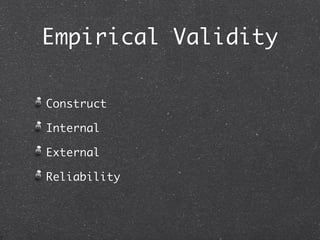
Empirical Validity

Construct

Internal

External

Reliability
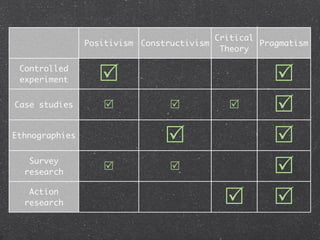
Critical
                Positivism Constructivism          Pragmatism
                                           Theory

 Controlled
 experiment       R                                  R
Case studies       R            R          R       R
Ethnographies                   R                    R
   Survey
  research
                   R            R                   R
   Action
  research                                  R        R

Selecting Empirical Methods for Software Engineering

  • 1.
    Selecting Empirical Methods for SE Research Daniel Cukier
  • 2.
    5 classes ofmethod Controlled experiments Case studies Survey research Ethnographies Action research
  • 3.
    Exploratory questions Existence Description and classification Descriptive-comparative
  • 4.
    Base-rate questions Frequency anddistribution Descriptive-process
  • 5.
    Relationship questions Is X related to Y? If X occurs, will Y also occur?
  • 6.
    Causality questions Does Xcause Y? Does X prevent Y? Causality-Comparative Does context affects causality?
  • 7.
    Design questions How effectivelyachieve X? What helps? What does not help?
  • 8.
  • 9.
    epistemology the nature ofhuman knowledge, and how we obtain it. onthology the nature of the world irrespective of our attempts to understand it.
  • 10.
    Plato about knowledge to know something, you must believe it to be true, and have a clear justification for believing it to be true
  • 11.
    Constructivists we cannot separateknowledge from the language we use to express it
  • 12.
    The philosophical stances Positivism Constructivism Critical Theory Pragmatism
  • 13.
    Positivism All knowledge comesfrom a set of basic observable facts. Reductionist Sometimes comes to wrong conclusions Associated to controlled experiment
  • 14.
    Constructivism Interpretivism Often adopted insocial sciences Qualitative data about human beings exploratory case studies or survey research
  • 15.
    Critical Theory Political act Emancipatoryand advogacy role e.g. Open source movement and Agile Community Action research and case studies
  • 16.
    Pragmatism All knowledge isapproximate and incomplete and depends on the methods Truth is whatever works for me Truth is relative to observer Values practical knowledge Mixed methods
  • 17.
    Abstract To the positivist,science is the process of veri- fying theories by testing hypotheses derived from them. To the constructivist, science is the process of seeking local theories that emerge from (and explain) the data. To the critical theorist, theories are assertions of knowledge (and therefore power), to be critiqued in terms of how they shape that power. To the pragmatist, theories are the products of a consensual process among a community of researchers, to be judged for their practical utility.
  • 18.
    Theories Theory becomes a“lens” through which the world is observed
  • 19.
    Theories Real-world phenomenaare simply too rich and complex to study without a huge amount of filtering
  • 20.
    Theories Software Engineering researchers have traditionally been very poor at making theories
  • 21.
    Method Selection Research Designis the process of selecting a method for a particular problem
  • 22.
    Controlled Experiments Independent variableseffects over dependent ones Precondition: a clear hypothesis Demonstrate hypothesis by testing it on a representative population Control unwanted variables If critical variables are ignored, experiment might not generalize real world Theory-driven is both a strength and a weakness
  • 23.
    Case Studies Exploratory orconfirmatory Critical case Multiple case Weakness: open to interpretation and researcher bias All philosophical stances
  • 24.
    Survey Research Questionnaires fordata collection Representative sample from well defined population Challenge: control for sampling bias Harder challenge: ensure that questions are designed in a way that yields useful and valid data Positivism tradition
  • 25.
    Ethnographies Goal: study communityof people Result: a rich description of it Participant observation - possible if researcher is technical guy Challenge: avoid preconceptions on data observation and analysis Constructivism
  • 26.
    Action Research Solve real-problemwhile study it. Researcher is also a change agent Education, information science fields Long term commitment, expensive Is a new idea, immature method Iterative process No attempt to create a control group Critical theory
  • 27.
    Mixed-Methods Sequential explanatory -quantitative followed by qualitative Sequential exploratory - qualitative followed by quantitative Concurrent triangulation - what people say is different from what people do Difficult to resolve contradictions
  • 28.
    Data Collection Each techniquehas its strengths and weakness If different kinds of data support the same conclusions, it strengthens the study Pilot-test the data collection
  • 29.
  • 30.
    Critical Positivism Constructivism Pragmatism Theory Controlled experiment R R Case studies R R R R Ethnographies R R Survey research R R R Action research R R