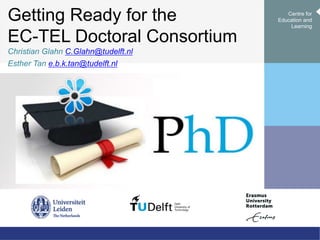
Getting Ready for the
EC-TEL Doctoral Consortium
Christian Glahn C.Glahn@tudelft.nl
Esther Tan e.b.k.tan@tudelft.nl
Centre for
Education and
Learning
• A clear formulation of the research question.
• An identification of the significant problems in the field of research within the
TEL domain.
• An outline of the current knowledge of the problem domain, as well as
the state of existing solutions (use references!).
• A presentation of any preliminary ideas, the proposed approach
• An outline of the results achieved so far.
• A sketch of the applied research methodology.
• A description of the Ph.D. project's contribution to the problem solution in the
TEL domain.
• A discussion of how the suggested solution is different, new, or better as
compared to existing approaches to the problem.
+ a signed letter from your supervisor!
The ECTEL DC formalities
http://www.ec-tel.eu/index.php?id=910
Without references you will be
rejected!
3-4 Pages incl. references
Centre for
Education and
Learning
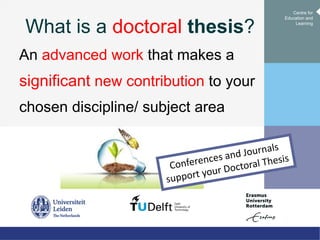
An advanced work that makes a
significant new contribution to your
chosen discipline/ subject area
What is a doctoral thesis?
Conferences and Journals
support your Doctoral Thesis
Centre for
Education and
Learning
A complex project that responds to a non-
trivial research question and that requires
risk management and decision making!
What is a doctoral project?
The DC supports
your Doctoral Project
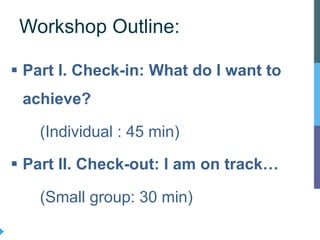
§ Part I. Check-in: What do I want to
achieve?
(Individual : 45 min)
§ Part II. Check-out: I am on track…
(Small group: 30 min)
Workshop Outline:
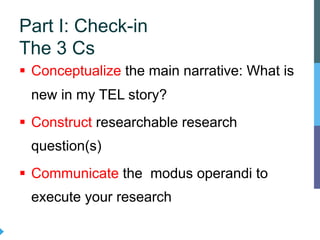
§ Conceptualize the main narrative: What is
new in my TEL story?
§ Construct researchable research
question(s)
§ Communicate the modus operandi to
execute your research
Part I: Check-in
The 3 Cs
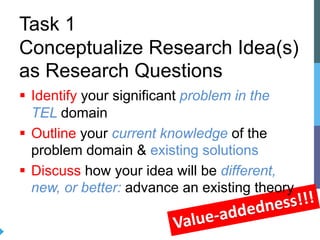
Value-addedness!!!
§ Identify your significant problem in the
TEL domain
§ Outline your current knowledge of the
problem domain & existing solutions
§ Discuss how your idea will be different,
new, or better: advance an existing theory
Task 1
Conceptualize Research Idea(s)
as Research Questions
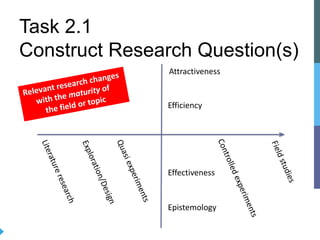
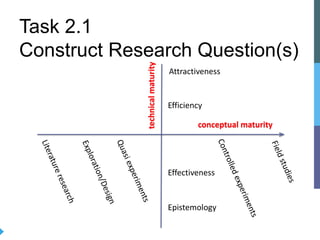
Task 2.1
Construct Research Question(s)
Effectiveness
Efficiency
Attractiveness
Epistemology
Literatureresearch
Quasiexperiments
Controlledexperiments
Fieldstudies
Exploration/Design
Relevant research changes
with the maturity of
the field or topic
Task 2.1
Construct Research Question(s)
Effectiveness
Efficiency
Attractiveness
Epistemology
Literatureresearch
Quasiexperiments
Controlledexperiments
Fieldstudies
Exploration/Design
technicalmaturity
conceptual maturity
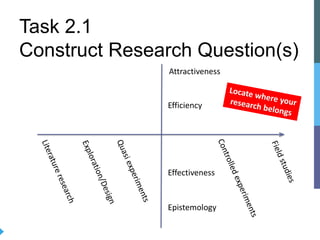
Task 2.1
Construct Research Question(s)
Effectiveness
Efficiency
Attractiveness
Epistemology
Literatureresearch
Quasiexperiments
Controlledexperiments
Fieldstudies
Exploration/Design
Locate where yourresearch belongs
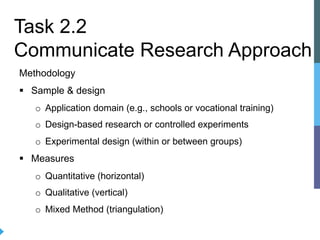
Methodology
§ Sample & design
o Application domain (e.g., schools or vocational training)
o Design-based research or controlled experiments
o Experimental design (within or between groups)
§ Measures
o Quantitative (horizontal)
o Qualitative (vertical)
o Mixed Method (triangulation)
Task 2.2
Communicate Research Approach
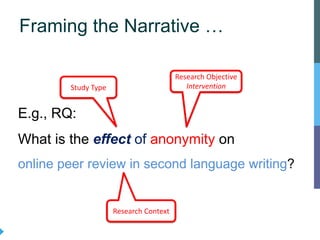
E.g., RQ:
What is the effect of anonymity on
online peer review in second language writing?
Framing the Narrative …
Study Type
Research Objective
Intervention
Research Context
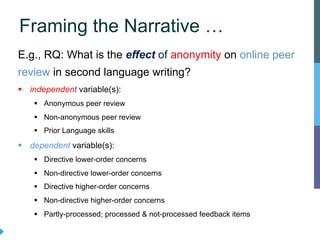
E.g., RQ: What is the effect of anonymity on online peer
review in second language writing?
§ independent variable(s):
§ Anonymous peer review
§ Non-anonymous peer review
§ Prior Language skills
§ dependent variable(s):
§ Directive lower-order concerns
§ Non-directive lower-order concerns
§ Directive higher-order concerns
§ Non-directive higher-order concerns
§ Partly-processed; processed & not-processed feedback items
Framing the Narrative …
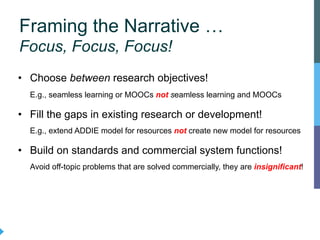
• Choose between research objectives!
E.g., seamless learning or MOOCs not seamless learning and MOOCs
• Fill the gaps in existing research or development!
E.g., extend ADDIE model for resources not create new model for resources
• Build on standards and commercial system functions!
Avoid off-topic problems that are solved commercially, they are insignificant!
Framing the Narrative …
Focus, Focus, Focus!
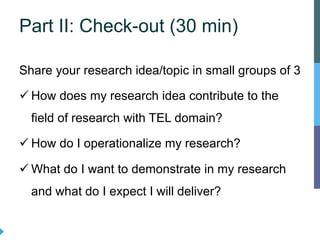
Share your research idea/topic in small groups of 3
ü How does my research idea contribute to the
field of research with TEL domain?
ü How do I operationalize my research?
ü What do I want to demonstrate in my research
and what do I expect I will deliver?
Part II: Check-out (30 min)
Centre for
Education and
Learning
Thank you for
your participation.
Now get ready for the ECTEL DC
Deadline: 17 June 2019

Getting Ready for the EC-TEL Doctoral Consortium

  • 1.
    Getting Ready forthe EC-TEL Doctoral Consortium Christian Glahn C.Glahn@tudelft.nl Esther Tan e.b.k.tan@tudelft.nl Centre for Education and Learning
  • 2.
    • A clearformulation of the research question. • An identification of the significant problems in the field of research within the TEL domain. • An outline of the current knowledge of the problem domain, as well as the state of existing solutions (use references!). • A presentation of any preliminary ideas, the proposed approach • An outline of the results achieved so far. • A sketch of the applied research methodology. • A description of the Ph.D. project's contribution to the problem solution in the TEL domain. • A discussion of how the suggested solution is different, new, or better as compared to existing approaches to the problem. + a signed letter from your supervisor! The ECTEL DC formalities http://www.ec-tel.eu/index.php?id=910 Without references you will be rejected! 3-4 Pages incl. references
  • 3.
    Centre for Education and Learning Anadvanced work that makes a significant new contribution to your chosen discipline/ subject area What is a doctoral thesis? Conferences and Journals support your Doctoral Thesis
  • 4.
    Centre for Education and Learning Acomplex project that responds to a non- trivial research question and that requires risk management and decision making! What is a doctoral project? The DC supports your Doctoral Project
  • 5.
    § Part I.Check-in: What do I want to achieve? (Individual : 45 min) § Part II. Check-out: I am on track… (Small group: 30 min) Workshop Outline:
  • 6.
    § Conceptualize themain narrative: What is new in my TEL story? § Construct researchable research question(s) § Communicate the modus operandi to execute your research Part I: Check-in The 3 Cs
  • 7.
    Value-addedness!!! § Identify yoursignificant problem in the TEL domain § Outline your current knowledge of the problem domain & existing solutions § Discuss how your idea will be different, new, or better: advance an existing theory Task 1 Conceptualize Research Idea(s) as Research Questions
  • 8.
    Task 2.1 Construct ResearchQuestion(s) Effectiveness Efficiency Attractiveness Epistemology Literatureresearch Quasiexperiments Controlledexperiments Fieldstudies Exploration/Design Relevant research changes with the maturity of the field or topic
  • 9.
    Task 2.1 Construct ResearchQuestion(s) Effectiveness Efficiency Attractiveness Epistemology Literatureresearch Quasiexperiments Controlledexperiments Fieldstudies Exploration/Design technicalmaturity conceptual maturity
  • 10.
    Task 2.1 Construct ResearchQuestion(s) Effectiveness Efficiency Attractiveness Epistemology Literatureresearch Quasiexperiments Controlledexperiments Fieldstudies Exploration/Design Locate where yourresearch belongs
  • 11.
    Methodology § Sample &design o Application domain (e.g., schools or vocational training) o Design-based research or controlled experiments o Experimental design (within or between groups) § Measures o Quantitative (horizontal) o Qualitative (vertical) o Mixed Method (triangulation) Task 2.2 Communicate Research Approach
  • 12.
    E.g., RQ: What isthe effect of anonymity on online peer review in second language writing? Framing the Narrative … Study Type Research Objective Intervention Research Context
  • 13.
    E.g., RQ: Whatis the effect of anonymity on online peer review in second language writing? § independent variable(s): § Anonymous peer review § Non-anonymous peer review § Prior Language skills § dependent variable(s): § Directive lower-order concerns § Non-directive lower-order concerns § Directive higher-order concerns § Non-directive higher-order concerns § Partly-processed; processed & not-processed feedback items Framing the Narrative …
  • 14.
    • Choose betweenresearch objectives! E.g., seamless learning or MOOCs not seamless learning and MOOCs • Fill the gaps in existing research or development! E.g., extend ADDIE model for resources not create new model for resources • Build on standards and commercial system functions! Avoid off-topic problems that are solved commercially, they are insignificant! Framing the Narrative … Focus, Focus, Focus!
  • 15.
    Share your researchidea/topic in small groups of 3 ü How does my research idea contribute to the field of research with TEL domain? ü How do I operationalize my research? ü What do I want to demonstrate in my research and what do I expect I will deliver? Part II: Check-out (30 min)
  • 16.
    Centre for Education and Learning Thankyou for your participation. Now get ready for the ECTEL DC Deadline: 17 June 2019