Becoming a researcher in mathematics education –  what  do we need to think about? Barbara Jaworski
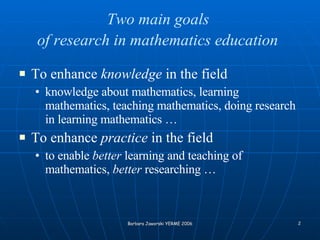
Two main goals  of research in mathematics education   To enhance  knowledge  in the field   knowledge about mathematics, learning mathematics, teaching mathematics, doing research in learning mathematics …   To enhance  practice  in the field   to enable  better  learning and teaching of mathematics,  better  researching …
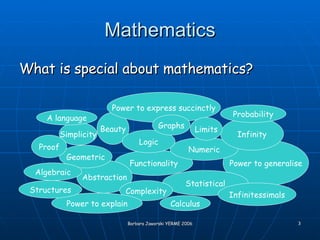
Mathematics What is special about mathematics? Beauty Functionality Power to express succinctly Power to generalise Abstraction Geometric Numeric Infinity Logic Statistical Limits Simplicity Complexity A language Algebraic Infinitessimals Graphs Power to explain Proof Probability Calculus Structures
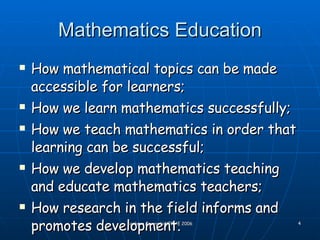
Mathematics Education How mathematical topics can be made accessible for learners; How we learn mathematics successfully; How we teach mathematics in order that learning can be successful; How we develop mathematics teaching and educate mathematics teachers; How research in the field informs and promotes development.
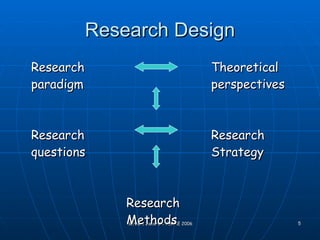
Research Design Research Theoretical paradigm perspectives Research  Research questions  Strategy   Research    Methods
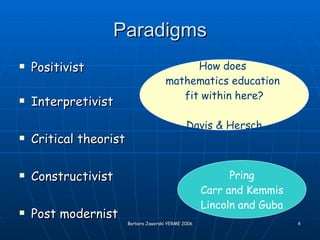
Paradigms Positivist Interpretivist Critical theorist Constructivist Post modernist Pring Carr and Kemmis Lincoln and Guba How does  mathematics education  fit within here? Davis & Hersch
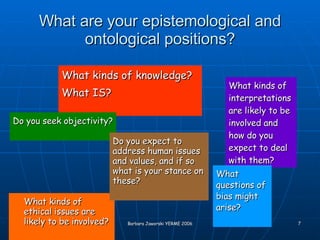
What are your epistemological and ontological positions? What kinds of ethical issues are likely to be involved? What kinds of knowledge?  What IS? Do you seek objectivity? What kinds of interpretations are likely to be involved and how do you expect to deal with them? What questions of bias might arise? Do you expect to address human issues and values, and if so what is your stance on these?
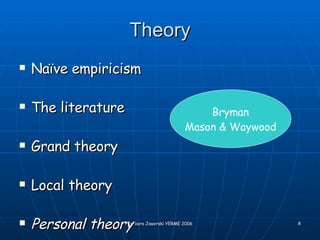
Theory Naïve empiricism The literature Grand theory Local theory Personal theory Bryman Mason & Waywood
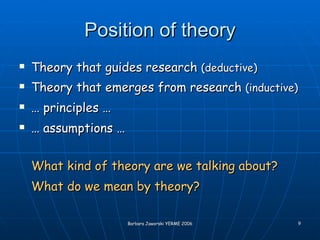
Position of theory Theory that guides research  (deductive) Theory that emerges from research  (inductive) …  principles … …  assumptions … What kind of theory are we talking about? What do we mean by theory?
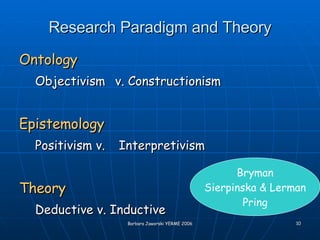
Research Paradigm and Theory Ontology   Objectivism v. Constructionism Epistemology Positivism v.  Interpretivism Theory Deductive v. Inductive Bryman Sierpinska & Lerman Pring
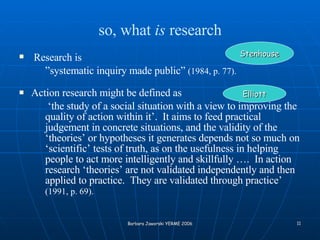
so, what  is  research Research is   ” systematic inquiry made public”  (1984, p. 77). Action research might be defined as  ‘ the study of a social situation with a view to improving the quality of action within it’.  It aims to feed practical judgement in concrete situations, and the validity of the ‘theories’ or hypotheses it generates depends not so much on ‘scientific’ tests of truth, as on the usefulness in helping people to act more intelligently and skillfully ….  In action research ‘theories’ are not validated independently and then applied to practice.  They are validated through practice’  (1991, p. 69).   Stenhouse Elliott
Formal Educational Research We want to know   Research Questions   Research Design (Methodology+Methods)   Data Collection     Data Analysis   Validation   Ethics   Results/Findings   New Knowledge (Dissemination) [New Practice?]
Practitioner (action) Research We want to know   Research Questions     Plan for action   Action (new practice?)     Reflection  on  action   New knowledge [Dissemination?] New Practice
Research questions What do I want to find out? What is my field of research? Can I express this more succinctly? Are there specific questions I want answers to Refining Refining Refining … .
Collecting suitable data Do you want to find out how many, or what percentage or proportion? Do you want to find out what people know, or think, their beliefs or attitudes? Do you want to explore the impact of some learning and/or teaching approach, methods or materials? Do you want to design materials or models to achieve better learning or teaching? Do you envisage a documentary study?
Quantitative or Qualitative or both? Quantitative:  where you quantify your data and analyse it using statistical techniques Qualitative:  where you describe, characterise, look deeply into human actions, thinking, values … Both: where you use methods of both sorts, or where the boundaries are blurred. Gorard Bassey Teppo
Relations between researcher and researched Data extraction agreements Externally objective Subjects  of research Clinical partnerships Outsider and insider  participants  with mutual respect Co-learning agreements All participants are both insiders and outsiders Wagner
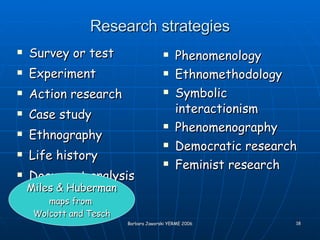
Research strategies Survey or test Experiment Action research Case study Ethnography Life history Document analysis Phenomenology Ethnomethodology Symbolic interactionism Phenomenography Democratic research Feminist research Miles & Huberman maps from  Wolcott and Tesch
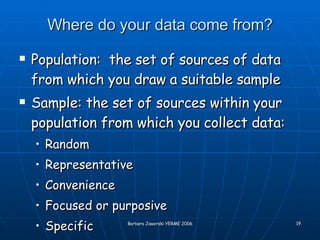
Where do your data come from? Population:  the set of sources of data from which you draw a suitable sample Sample: the set of sources within your population from which you collect data: Random Representative Convenience Focused or purposive Specific
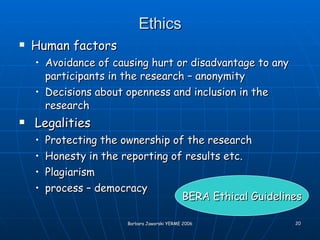
Ethics Human factors Avoidance of causing hurt or disadvantage to any participants in the research – anonymity Decisions about openness and inclusion in the research Legalities Protecting the ownership of the research Honesty in the reporting of results etc. Plagiarism process – democracy BERA Ethical Guidelines
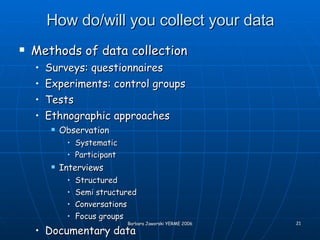
How do/will you collect your data Methods of data collection Surveys: questionnaires Experiments: control groups Tests Ethnographic approaches Observation Systematic Participant Interviews Structured Semi structured Conversations Focus groups Documentary data
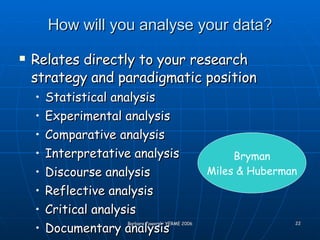
How will you analyse your data? Relates directly to your research strategy and paradigmatic position Statistical analysis Experimental analysis Comparative analysis Interpretative analysis Discourse analysis Reflective analysis Critical analysis Documentary analysis Bryman Miles & Huberman
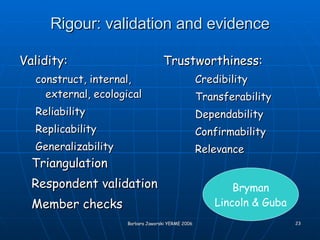
Rigour: validation and evidence Validity:  construct, internal, external, ecological Reliability Replicability Generalizability Bryman Lincoln & Guba Trustworthiness: Credibility Transferability Dependability Confirmability Relevance Triangulation Respondent validation Member checks
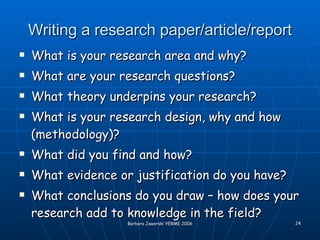
Writing a research paper/article/report What is your research area and why? What are your research questions? What theory underpins your research? What is your research design, why and how (methodology)? What did you find and how? What evidence or justification do you have? What conclusions do you draw – how does your research add to knowledge in the field?
References Bassey, M. (1999)  Case Study Research in Educational Settings.   Buckingham:  Open University Press BERA (2004).  Revised Ethical Guidelines for educational research.   On-line.  http://www.bera.ac.uk/publications/pdfs/ETHICA1.PDF  [01.03.06] Bryman, A. (2001)  Social Research Methods . Oxford:  Oxford University Press. Carr, W. and Kemmis, S. (1986)  Becoming Critical:  Education, Knowledge and Action Research .  London:  Falmer Press Davis, P. J. And Hersh, R. (1981)  The Mathematical Experience.   London:  Penguin Elliott, J. (1991)  Action Research for Educational Change . Buckingham:  Open University Press Gorard, S. (2001)  Quantitative Methods in Educational Research .  London:  Continuum Lincoln, Y. S. & Guba, E. G. (2000).Paradigmatic controversias, contradictions and emerging confluences.  In N. K. Denzin & Y. S. Lincoln (Eds.)  Handbook of Qualitative Research , 2nd Edition pp. 163-188. London:  Sage.
References Mason, J. & Waywood, A. (1996).  The Role of Theory in Mathematics Education and Research.  In A. Bishop et al.,  International Handbook of Mathematics Education .  Dordrecht:  Kluwer Miles, M. B. & Huberman, A. N. (1994 ).Qualitative Data Analysis:  An expanded sourcebook .  Second Edition.  London:  Sage Pring, R. (2000)  Philosophy of Educational Research .  London:  Continuum Sierpinska, A. & Lerman, S. (1996).  Epistemologies of Mathematics and Mathematics Education. In A. Bishop et al.,  International Handbook of Mathematics Education .  Dordrecht:  Kluwer Stenhouse, L. (1979). Research as a basis for teaching: Inaugural Lecture, University of East Anglia, February, 1979.  In L. Stenhouse (1983) Authority,Education and Emancipation.  London:  Heinemann Educational, pp. 177-195.  Reprinted in Ruddock, J. and Kopkins, D. (1985).  Research as a basis for teaching:  Readings from the work of Lawrence Stenhouse.  Pp 113-128. Teppo, A. (1998) (Ed.) Qualitative Research Methods in Mathematics Education.  Journal for Research in Mathematics Education, Monograph Number 9 .  Reston, Va:  National Council of Teacher of Mathematics. Wagner, J. (1997).  The unavoidable intervention of educational research:  a framework for reconsidering researcher-practitioner cooperation.  Educational Researcher, 26 (7) pp. 13-22

Yess4 Barbara Jaworski

  • 1.
    Becoming a researcherin mathematics education – what do we need to think about? Barbara Jaworski
  • 2.
    Two main goals of research in mathematics education To enhance knowledge in the field knowledge about mathematics, learning mathematics, teaching mathematics, doing research in learning mathematics … To enhance practice in the field to enable better learning and teaching of mathematics, better researching …
  • 3.
    Mathematics What isspecial about mathematics? Beauty Functionality Power to express succinctly Power to generalise Abstraction Geometric Numeric Infinity Logic Statistical Limits Simplicity Complexity A language Algebraic Infinitessimals Graphs Power to explain Proof Probability Calculus Structures
  • 4.
    Mathematics Education Howmathematical topics can be made accessible for learners; How we learn mathematics successfully; How we teach mathematics in order that learning can be successful; How we develop mathematics teaching and educate mathematics teachers; How research in the field informs and promotes development.
  • 5.
    Research Design ResearchTheoretical paradigm perspectives Research Research questions Strategy Research Methods
  • 6.
    Paradigms Positivist InterpretivistCritical theorist Constructivist Post modernist Pring Carr and Kemmis Lincoln and Guba How does mathematics education fit within here? Davis & Hersch
  • 7.
    What are yourepistemological and ontological positions? What kinds of ethical issues are likely to be involved? What kinds of knowledge? What IS? Do you seek objectivity? What kinds of interpretations are likely to be involved and how do you expect to deal with them? What questions of bias might arise? Do you expect to address human issues and values, and if so what is your stance on these?
  • 8.
    Theory Naïve empiricismThe literature Grand theory Local theory Personal theory Bryman Mason & Waywood
  • 9.
    Position of theoryTheory that guides research (deductive) Theory that emerges from research (inductive) … principles … … assumptions … What kind of theory are we talking about? What do we mean by theory?
  • 10.
    Research Paradigm andTheory Ontology Objectivism v. Constructionism Epistemology Positivism v. Interpretivism Theory Deductive v. Inductive Bryman Sierpinska & Lerman Pring
  • 11.
    so, what is research Research is ” systematic inquiry made public” (1984, p. 77). Action research might be defined as ‘ the study of a social situation with a view to improving the quality of action within it’. It aims to feed practical judgement in concrete situations, and the validity of the ‘theories’ or hypotheses it generates depends not so much on ‘scientific’ tests of truth, as on the usefulness in helping people to act more intelligently and skillfully …. In action research ‘theories’ are not validated independently and then applied to practice. They are validated through practice’ (1991, p. 69). Stenhouse Elliott
  • 12.
    Formal Educational ResearchWe want to know  Research Questions  Research Design (Methodology+Methods)  Data Collection  Data Analysis  Validation  Ethics  Results/Findings  New Knowledge (Dissemination) [New Practice?]
  • 13.
    Practitioner (action) ResearchWe want to know  Research Questions  Plan for action  Action (new practice?)  Reflection on action  New knowledge [Dissemination?] New Practice
  • 14.
    Research questions Whatdo I want to find out? What is my field of research? Can I express this more succinctly? Are there specific questions I want answers to Refining Refining Refining … .
  • 15.
    Collecting suitable dataDo you want to find out how many, or what percentage or proportion? Do you want to find out what people know, or think, their beliefs or attitudes? Do you want to explore the impact of some learning and/or teaching approach, methods or materials? Do you want to design materials or models to achieve better learning or teaching? Do you envisage a documentary study?
  • 16.
    Quantitative or Qualitativeor both? Quantitative: where you quantify your data and analyse it using statistical techniques Qualitative: where you describe, characterise, look deeply into human actions, thinking, values … Both: where you use methods of both sorts, or where the boundaries are blurred. Gorard Bassey Teppo
  • 17.
    Relations between researcherand researched Data extraction agreements Externally objective Subjects of research Clinical partnerships Outsider and insider participants with mutual respect Co-learning agreements All participants are both insiders and outsiders Wagner
  • 18.
    Research strategies Surveyor test Experiment Action research Case study Ethnography Life history Document analysis Phenomenology Ethnomethodology Symbolic interactionism Phenomenography Democratic research Feminist research Miles & Huberman maps from Wolcott and Tesch
  • 19.
    Where do yourdata come from? Population: the set of sources of data from which you draw a suitable sample Sample: the set of sources within your population from which you collect data: Random Representative Convenience Focused or purposive Specific
  • 20.
    Ethics Human factorsAvoidance of causing hurt or disadvantage to any participants in the research – anonymity Decisions about openness and inclusion in the research Legalities Protecting the ownership of the research Honesty in the reporting of results etc. Plagiarism process – democracy BERA Ethical Guidelines
  • 21.
    How do/will youcollect your data Methods of data collection Surveys: questionnaires Experiments: control groups Tests Ethnographic approaches Observation Systematic Participant Interviews Structured Semi structured Conversations Focus groups Documentary data
  • 22.
    How will youanalyse your data? Relates directly to your research strategy and paradigmatic position Statistical analysis Experimental analysis Comparative analysis Interpretative analysis Discourse analysis Reflective analysis Critical analysis Documentary analysis Bryman Miles & Huberman
  • 23.
    Rigour: validation andevidence Validity: construct, internal, external, ecological Reliability Replicability Generalizability Bryman Lincoln & Guba Trustworthiness: Credibility Transferability Dependability Confirmability Relevance Triangulation Respondent validation Member checks
  • 24.
    Writing a researchpaper/article/report What is your research area and why? What are your research questions? What theory underpins your research? What is your research design, why and how (methodology)? What did you find and how? What evidence or justification do you have? What conclusions do you draw – how does your research add to knowledge in the field?
  • 25.
    References Bassey, M.(1999) Case Study Research in Educational Settings. Buckingham: Open University Press BERA (2004). Revised Ethical Guidelines for educational research. On-line. http://www.bera.ac.uk/publications/pdfs/ETHICA1.PDF [01.03.06] Bryman, A. (2001) Social Research Methods . Oxford: Oxford University Press. Carr, W. and Kemmis, S. (1986) Becoming Critical: Education, Knowledge and Action Research . London: Falmer Press Davis, P. J. And Hersh, R. (1981) The Mathematical Experience. London: Penguin Elliott, J. (1991) Action Research for Educational Change . Buckingham: Open University Press Gorard, S. (2001) Quantitative Methods in Educational Research . London: Continuum Lincoln, Y. S. & Guba, E. G. (2000).Paradigmatic controversias, contradictions and emerging confluences. In N. K. Denzin & Y. S. Lincoln (Eds.) Handbook of Qualitative Research , 2nd Edition pp. 163-188. London: Sage.
  • 26.
    References Mason, J.& Waywood, A. (1996). The Role of Theory in Mathematics Education and Research. In A. Bishop et al., International Handbook of Mathematics Education . Dordrecht: Kluwer Miles, M. B. & Huberman, A. N. (1994 ).Qualitative Data Analysis: An expanded sourcebook . Second Edition. London: Sage Pring, R. (2000) Philosophy of Educational Research . London: Continuum Sierpinska, A. & Lerman, S. (1996). Epistemologies of Mathematics and Mathematics Education. In A. Bishop et al., International Handbook of Mathematics Education . Dordrecht: Kluwer Stenhouse, L. (1979). Research as a basis for teaching: Inaugural Lecture, University of East Anglia, February, 1979. In L. Stenhouse (1983) Authority,Education and Emancipation. London: Heinemann Educational, pp. 177-195. Reprinted in Ruddock, J. and Kopkins, D. (1985). Research as a basis for teaching: Readings from the work of Lawrence Stenhouse. Pp 113-128. Teppo, A. (1998) (Ed.) Qualitative Research Methods in Mathematics Education. Journal for Research in Mathematics Education, Monograph Number 9 . Reston, Va: National Council of Teacher of Mathematics. Wagner, J. (1997). The unavoidable intervention of educational research: a framework for reconsidering researcher-practitioner cooperation. Educational Researcher, 26 (7) pp. 13-22