Research Methodology
Lecture 1 : Introduction
Syllabus
• Research Methodology : An Introduction
• Defining the Research Problem
• Research Design
• Sampling Design
• Measurement and Scaling Techniques
• Methods of Data Collection
• Processing and Analysis of Data
• Sampling Fundamentals
• Testing of Hypotheses – I (Parametric of Standard Tests of Hypotheses)
• Chi-square Test
• Analysis of Variance and Covariance
• Testing of Hypotheses – II (Nonparametric or Distribution-free Tests)
• Multivariate Analysis Techniques
• Interpretation and Report Writing
• Research proposal
Research Defined and Described
“Research is the systematic approach to
obtaining and confirming new and reliable
knowledge”
– Systematic and orderly (following a series of
steps)
– Purpose is new knowledge, which must be
reliable
This is a general definition which applies to all
disciplines
3
Notice that:
“… truth was not used in the definition of
research”
“This concept of truth is outside of the
productive realm of thinking by researchers”
4
Research is not
Accidental discovery :
1. Accidental discovery may occur in structured
research process
2. Usually takes the form of a phenomenon not
previously noticed
3. May lead to a structured research process to
verify or understand the observation
5
Research is not … cont.
Data Collection
• an intermediate step to gain reliable
knowledge
• collecting reliable data is part of the research
process
6
Research is not … cont.
Searching out published research results in
libraries (or the internet)
• This is an important early step of research
• The research process always includes
synthesis and analysis
• But, just reviewing of literature is not research
7
Research is…
1. Searching for explanation of events,
phenomena, relationships and causes
– What, how and why things occur
– Are there interactions?
2. A process
– Planned and managed – to make the information
generated credible
– The process is creative
– It is circular – always leads to more questions
8
• All well designed and conducted research has
potential application.
• Failure to see applications can be due to:
– Users not trained or experienced in the specialized
methods of Engineering research and reasoning
– Researchers often do not provide adequate
interpretations and guidance on applications of
the research
• Researchers are responsible to help users
understand research implications
(How?)
9
Public good
• Public research is a public good
– May be more rigorous and objective because it is
subject to more scrutiny
• Private research may also be rigorous
– But research on a company’s product may be
questioned as biased.
10
Classification of Research
• Before classification, we must first define types
of research
• Different criteria are used to classify research
types
(All of these are somewhat arbitrary and artificial)
11
Basic vs Applied Research
• Basic – to determine or establish fundamental
facts and relationships within a discipline or field
of study. Develop theories … (examples in
Engineering?)
• Applied – undertaken specifically for the purpose
of obtaining information to help resolve a
particular problem
• The distinction between them is in the
application
– Basic has little application to real world policy and
management but could be done to guide applied
research
12
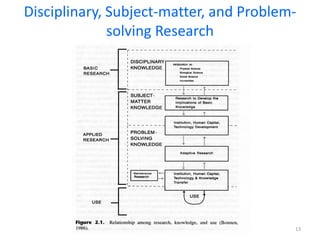
13
Disciplinary, Subject-matter, and Problem-
solving Research
• designed to improve a discipline
• dwells on theories, fundamental relationships
and analytical procedures and techniques
• Provides the conceptual and analytical base
for other research
• It is synergistic and complementary with
subject matter and problem-solving research
14
Disciplinary
• Provides the foundations for applied research
• Circular as applied research reveals the
shortcomings of disciplinary research
• Examples of some Engineering theories?
(supply & demand, concrete strength, wave
height, consumer utility …)
15
Disciplinary… cont.
Subject-matter research
• “research on a subject of interest to a set of
decision makers “ (p 22)
• Tends to follow subject-matter boundaries within
a discipline ( eg. Transportation Engineering,
infrastructure, Geotechnical Engineering)
• Inherently multidisciplinary, drawing information
from many disciplines
– eg. Traffic light created by Electrical Engineering, while
the green time for the traffic light, suggested by Traffic
Engineer.
16
Subject-matter research … cont.
• Provides policy makers with general
knowledge to make decisions about various
problems.
• A primary source of policy applications for
Engineering
• Subject-matter research is a cornerstone in
Engineering – it involves direct application of
Engineering to contemporary issues.
17
Problem-solving research
• Designed to solve a specific problem for a specific
decision maker
• Often results in recommendations on decisions or
actions
• Problem-solving research is holistic – uses all
information relevant to the specific problem
(while disciplinary research tends to be
reductionist)
• Disciplinary research is generally the most
“durable” (long lasting); problem-solving research
the least durable
18
Analytic vs Descriptive Research
• Descriptive Research – the attempt to
determine, describe, or identify something
– The intent is often synthesis, which pulls
knowledge or information together
• Analytic – the attempt to establish why
something occurs or how it came to be
• All disciplines generally engage in both
19
Methodology Defined & Described
Methodology and Method are often (incorrectly)
used interchangeable
• Methodology – the study of the general
approach to inquiry in a given field
• Method – the specific techniques, tools or
procedures applied to achieve a given objective
– Research methods in Engineering include regression
analysis, mathematical analysis, operations
research, surveys, data gathering, etc.
20
The Process of Research
• The process is initiated with a question or
problem (step 1)
• Next, goals and objectives are formulated to
deal with the question or problem (step 2)
• Then the research design is developed to
achieve the objectives (step 3)
• Results are generated by conducting the
research (step 4)
• Interpretation and analysis of results follow
(step 5)
21
22
1
2
3
4
5
The Process of Research
Creativity in the Research Process
• Research is a creative process
• “…research includes far more than mere logic … It
includes insight, genius, groping, pondering –
‘sense’ … The logic we can teach; the art we
cannot” (p 30)
• Research requires (or at least works best) with
imagination, initiative, intuition, and curiosity.
• There are different types of creativity,
characteristic of different situations – “applied”
and “theoretical” most closely associate with
Engineering research
23
Fostering Creativity (Ladd 1987)
A. Gather and use previously developed knowledge
B. Exchange ideas
C. Apply deductive logic
D. Look at things alternate ways
E. Question or challenge assumptions
F. Search for patterns or relationships
G. Take risks
H. Cultivate tolerance for uncertainty
24
Fostering Creativity … cont.
I. Allow curiosity to grow
J. Set problems aside … and come back to them
K. Write down your thoughts
“… frequently I don’t know what I think until I write it”
L. Freedom from distraction … some time to think.
Creativity may provide the difference between
satisfactory and outstanding research.
25

Lecture_1_-_Research_Methods_-_Introduction.pdf

  • 1.
  • 2.
    Syllabus • Research Methodology: An Introduction • Defining the Research Problem • Research Design • Sampling Design • Measurement and Scaling Techniques • Methods of Data Collection • Processing and Analysis of Data • Sampling Fundamentals • Testing of Hypotheses – I (Parametric of Standard Tests of Hypotheses) • Chi-square Test • Analysis of Variance and Covariance • Testing of Hypotheses – II (Nonparametric or Distribution-free Tests) • Multivariate Analysis Techniques • Interpretation and Report Writing • Research proposal
  • 3.
    Research Defined andDescribed “Research is the systematic approach to obtaining and confirming new and reliable knowledge” – Systematic and orderly (following a series of steps) – Purpose is new knowledge, which must be reliable This is a general definition which applies to all disciplines 3
  • 4.
    Notice that: “… truthwas not used in the definition of research” “This concept of truth is outside of the productive realm of thinking by researchers” 4
  • 5.
    Research is not Accidentaldiscovery : 1. Accidental discovery may occur in structured research process 2. Usually takes the form of a phenomenon not previously noticed 3. May lead to a structured research process to verify or understand the observation 5
  • 6.
    Research is not… cont. Data Collection • an intermediate step to gain reliable knowledge • collecting reliable data is part of the research process 6
  • 7.
    Research is not… cont. Searching out published research results in libraries (or the internet) • This is an important early step of research • The research process always includes synthesis and analysis • But, just reviewing of literature is not research 7
  • 8.
    Research is… 1. Searchingfor explanation of events, phenomena, relationships and causes – What, how and why things occur – Are there interactions? 2. A process – Planned and managed – to make the information generated credible – The process is creative – It is circular – always leads to more questions 8
  • 9.
    • All welldesigned and conducted research has potential application. • Failure to see applications can be due to: – Users not trained or experienced in the specialized methods of Engineering research and reasoning – Researchers often do not provide adequate interpretations and guidance on applications of the research • Researchers are responsible to help users understand research implications (How?) 9
  • 10.
    Public good • Publicresearch is a public good – May be more rigorous and objective because it is subject to more scrutiny • Private research may also be rigorous – But research on a company’s product may be questioned as biased. 10
  • 11.
    Classification of Research •Before classification, we must first define types of research • Different criteria are used to classify research types (All of these are somewhat arbitrary and artificial) 11
  • 12.
    Basic vs AppliedResearch • Basic – to determine or establish fundamental facts and relationships within a discipline or field of study. Develop theories … (examples in Engineering?) • Applied – undertaken specifically for the purpose of obtaining information to help resolve a particular problem • The distinction between them is in the application – Basic has little application to real world policy and management but could be done to guide applied research 12
  • 13.
    13 Disciplinary, Subject-matter, andProblem- solving Research
  • 14.
    • designed toimprove a discipline • dwells on theories, fundamental relationships and analytical procedures and techniques • Provides the conceptual and analytical base for other research • It is synergistic and complementary with subject matter and problem-solving research 14 Disciplinary
  • 15.
    • Provides thefoundations for applied research • Circular as applied research reveals the shortcomings of disciplinary research • Examples of some Engineering theories? (supply & demand, concrete strength, wave height, consumer utility …) 15 Disciplinary… cont.
  • 16.
    Subject-matter research • “researchon a subject of interest to a set of decision makers “ (p 22) • Tends to follow subject-matter boundaries within a discipline ( eg. Transportation Engineering, infrastructure, Geotechnical Engineering) • Inherently multidisciplinary, drawing information from many disciplines – eg. Traffic light created by Electrical Engineering, while the green time for the traffic light, suggested by Traffic Engineer. 16
  • 17.
    Subject-matter research …cont. • Provides policy makers with general knowledge to make decisions about various problems. • A primary source of policy applications for Engineering • Subject-matter research is a cornerstone in Engineering – it involves direct application of Engineering to contemporary issues. 17
  • 18.
    Problem-solving research • Designedto solve a specific problem for a specific decision maker • Often results in recommendations on decisions or actions • Problem-solving research is holistic – uses all information relevant to the specific problem (while disciplinary research tends to be reductionist) • Disciplinary research is generally the most “durable” (long lasting); problem-solving research the least durable 18
  • 19.
    Analytic vs DescriptiveResearch • Descriptive Research – the attempt to determine, describe, or identify something – The intent is often synthesis, which pulls knowledge or information together • Analytic – the attempt to establish why something occurs or how it came to be • All disciplines generally engage in both 19
  • 20.
    Methodology Defined &Described Methodology and Method are often (incorrectly) used interchangeable • Methodology – the study of the general approach to inquiry in a given field • Method – the specific techniques, tools or procedures applied to achieve a given objective – Research methods in Engineering include regression analysis, mathematical analysis, operations research, surveys, data gathering, etc. 20
  • 21.
    The Process ofResearch • The process is initiated with a question or problem (step 1) • Next, goals and objectives are formulated to deal with the question or problem (step 2) • Then the research design is developed to achieve the objectives (step 3) • Results are generated by conducting the research (step 4) • Interpretation and analysis of results follow (step 5) 21
  • 22.
  • 23.
    Creativity in theResearch Process • Research is a creative process • “…research includes far more than mere logic … It includes insight, genius, groping, pondering – ‘sense’ … The logic we can teach; the art we cannot” (p 30) • Research requires (or at least works best) with imagination, initiative, intuition, and curiosity. • There are different types of creativity, characteristic of different situations – “applied” and “theoretical” most closely associate with Engineering research 23
  • 24.
    Fostering Creativity (Ladd1987) A. Gather and use previously developed knowledge B. Exchange ideas C. Apply deductive logic D. Look at things alternate ways E. Question or challenge assumptions F. Search for patterns or relationships G. Take risks H. Cultivate tolerance for uncertainty 24
  • 25.
    Fostering Creativity …cont. I. Allow curiosity to grow J. Set problems aside … and come back to them K. Write down your thoughts “… frequently I don’t know what I think until I write it” L. Freedom from distraction … some time to think. Creativity may provide the difference between satisfactory and outstanding research. 25