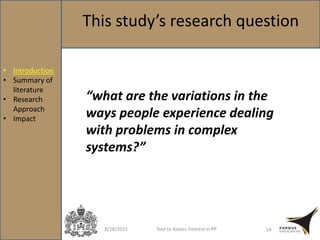
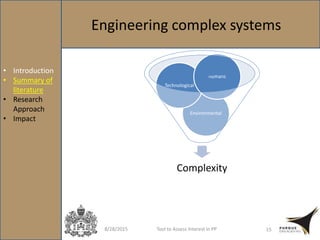
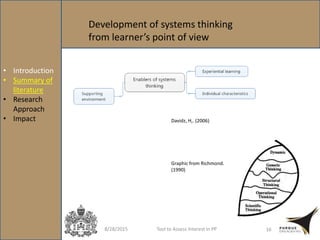
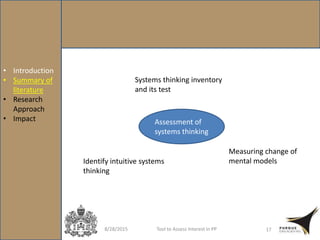
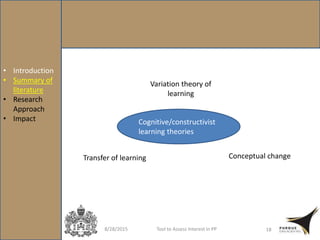
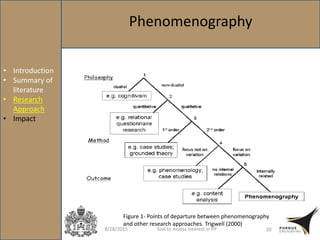
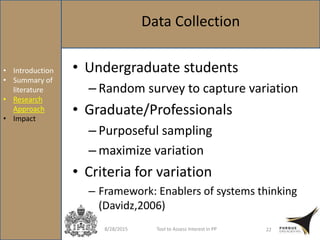
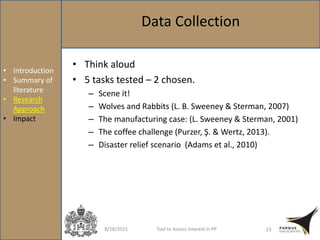
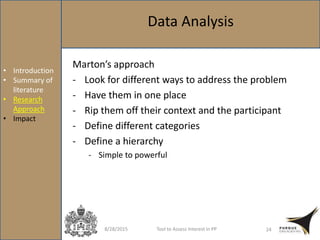
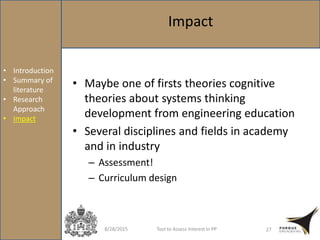
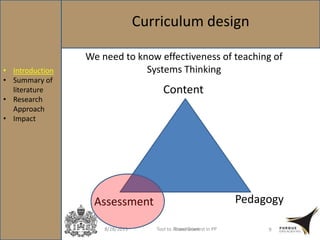
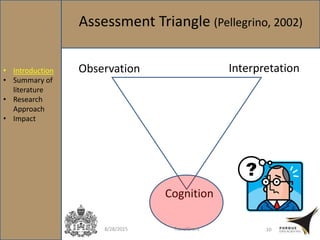
This document outlines a study that aims to identify variations in how people experience dealing with problems in complex systems. It will do so using a phenomenographic research approach, which seeks to understand the limited number of qualitatively different ways a phenomenon can be experienced. 20 participants, including students and professionals, will complete thinking-aloud tasks centered around complex systems problems. The results will be analyzed using Marton's approach to identify hierarchies of increasingly powerful ways the tasks are understood. The study expects to produce one of the first cognitive theories of systems thinking development from an engineering education perspective, with potential impacts for assessment, curriculum design, and supporting claims of current programs.



![Variation theory of learning
learning is about an increase of the amount of
critical aspects and features the learner can
discern and be focused on simultaneously
[from a dimension or conception]. (Marton,
2014, p. 60
Learning can be seen as moving from one
way of seeing and dealing with the
problem to another more powerful
(Marton, 2014)
• Introduction
• Summary of
literature
• Research
Approach
• Impact](https://image.slidesharecdn.com/2ea60231-2c51-40e0-91a4-411bdd9f8c15-150828074349-lva1-app6892/85/Identifying-the-variation-in-ways-to-deal-13-320.jpg)