


Steve Saffhill
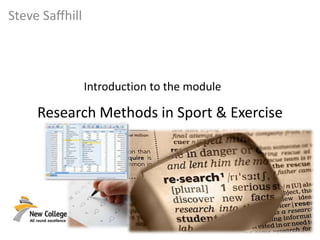
Research Methods in Sport & Exercise
Introduction to the module
• Introduce the content of the module
• Introduce the assessments
• Demonstrate how the content of the module is
linked to assessment...and later into your
dissertation!
Purpose of today is to...
Who am I?
• Steve Saffhill
• Email: steve.saffhill@stamford.ac.uk
• Office: Borderville
What is this unit?
• It is an extremely important unit you will complete this
year
• It provides insights into research process as a whole
• Makes you aware of:
– different components of research
– different phases of research
– different processes of research
• After the module you should have all the skills you
need to think about research as a holistic process
rather than merely a combination of separate parts
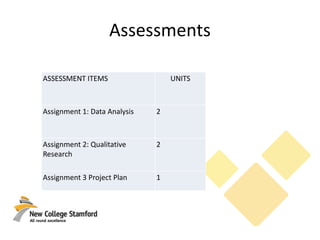
Assessments
ASSESSMENT ITEMS UNITS
Assignment 1: Data Analysis 2
Assignment 2: Qualitative
Research
2
Assignment 3 Project Plan 1
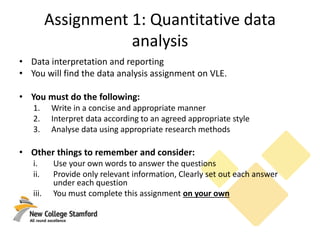
Assignment 1: Quantitative data
analysis
• Data interpretation and reporting
• You will find the data analysis assignment on VLE.
• You must do the following:
1. Write in a concise and appropriate manner
2. Interpret data according to an agreed appropriate style
3. Analyse data using appropriate research methods
• Other things to remember and consider:
i. Use your own words to answer the questions
ii. Provide only relevant information, Clearly set out each answer
under each question
iii. You must complete this assignment on your own
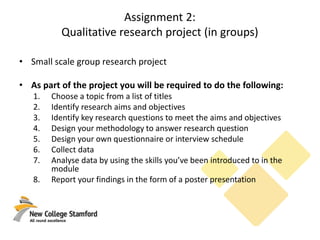
Assignment 2:
Qualitative research project (in groups)
• Small scale group research project
• As part of the project you will be required to do the following:
1. Choose a topic from a list of titles
2. Identify research aims and objectives
3. Identify key research questions to meet the aims and objectives
4. Design your methodology to answer research question
5. Design your own questionnaire or interview schedule
6. Collect data
7. Analyse data by using the skills you’ve been introduced to in the
module
8. Report your findings in the form of a poster presentation
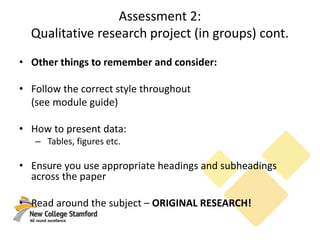
Assessment 2:
Qualitative research project (in groups) cont.
• Other things to remember and consider:
• Follow the correct style throughout
(see module guide)
• How to present data:
– Tables, figures etc.
• Ensure you use appropriate headings and subheadings
across the paper
• Read around the subject – ORIGINAL RESEARCH!
What you will be assessed on...
Element Description
General Presentation Use of appropriate style and formatting Clarity of writing and
use of appropriate academic English, ability to present
coherent arguments succinctly, use of correct referencing
Knowledge and
understanding
Demonstrate the understanding of the research process by
having clear link between research aims, objectives and
methods
Evidence of the research
process
Aims and objectives presented clearly and coherently
Evidence of the research
process
Chosen methods explained and presented clearly and
coherently, with appropriate use of subheadings as
highlighted in the assignment brief, present enough
information to ensure replicability
Evidence of the research
process
Clear evidence of data collection (copies of typed transcripts
in suitable format, the measures used in presented in the
appendix)
Evidence of the research
process
Clear evidence of appropriate data analysis and reporting of
the findings (evidence of data analysis description as part of
the method section, evidence of the analysis as appendix,
and evidence of coherent description and reporting of the
results of the analysis in the result section)
What you will be assessed on...
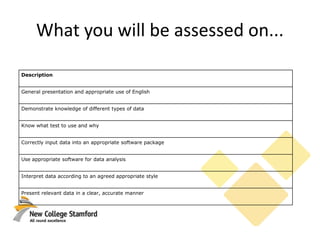
Description
General presentation and appropriate use of English
Demonstrate knowledge of different types of data
Know what test to use and why
Correctly input data into an appropriate software package
Use appropriate software for data analysis
Interpret data according to an agreed appropriate style
Present relevant data in a clear, accurate manner
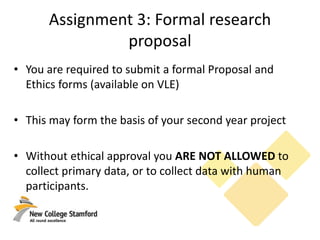
Assignment 3: Formal research
proposal
• You are required to submit a formal Proposal and
Ethics forms (available on VLE)
• This may form the basis of your second year project
• Without ethical approval you ARE NOT ALLOWED to
collect primary data, or to collect data with human
participants.
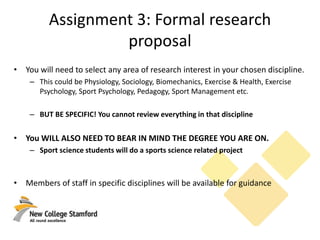
Assignment 3: Formal research
proposal
• You will need to select any area of research interest in your chosen discipline.
– This could be Physiology, Sociology, Biomechanics, Exercise & Health, Exercise
Psychology, Sport Psychology, Pedagogy, Sport Management etc.
– BUT BE SPECIFIC! You cannot review everything in that discipline
• You WILL ALSO NEED TO BEAR IN MIND THE DEGREE YOU ARE ON.
– Sport science students will do a sports science related project
• Members of staff in specific disciplines will be available for guidance
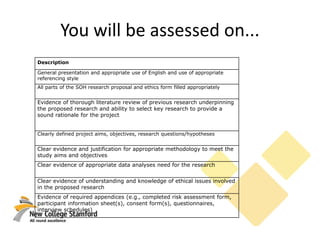
You will be assessed on...
Description
General presentation and appropriate use of English and use of appropriate
referencing style
All parts of the SOH research proposal and ethics form filled appropriately
Evidence of thorough literature review of previous research underpinning
the proposed research and ability to select key research to provide a
sound rationale for the project
Clearly defined project aims, objectives, research questions/hypotheses
Clear evidence and justification for appropriate methodology to meet the
study aims and objectives
Clear evidence of appropriate data analyses need for the research
Clear evidence of understanding and knowledge of ethical issues involved
in the proposed research
Evidence of required appendices (e.g., completed risk assessment form,
participant information sheet(s), consent form(s), questionnaires,
interview schedules)
Linking content into assessment...
• All lectures matter!
• Unit is built to reflect the research process
• Assessment 1 – All about quantitative methodology and
analysis
• Assessment 2- All about qualitative methodology and
analysis
• Assessment 3 – All about the research process as a whole –
and will form the basis of your dissertation
My/your expectations...
• Seating arrangements
• Classroom housekeeping
– Mobile phones, use of laptops etc.
• Weekly readings – do them!
• VLE
• Ownership
• Engagement
Ask questions (no question is a stupid question)
• Respect
Reading prior to next week...
Gratton, C., & Jones, I., (2010). Research
methods for sports studies. Abingdon:
Routledge. Chapter 1.
• Kumar, R., (2011), Research methodology: a
step-by-step guide for beginners. London:
Sage. Chapter 1.

1. introduction to research methods

  • 2.
    Steve Saffhill Research Methodsin Sport & Exercise Introduction to the module
  • 3.
    • Introduce thecontent of the module • Introduce the assessments • Demonstrate how the content of the module is linked to assessment...and later into your dissertation! Purpose of today is to...
  • 4.
    Who am I? •Steve Saffhill • Email: steve.saffhill@stamford.ac.uk • Office: Borderville
  • 5.
    What is thisunit? • It is an extremely important unit you will complete this year • It provides insights into research process as a whole • Makes you aware of: – different components of research – different phases of research – different processes of research • After the module you should have all the skills you need to think about research as a holistic process rather than merely a combination of separate parts
  • 6.
    Assessments ASSESSMENT ITEMS UNITS Assignment1: Data Analysis 2 Assignment 2: Qualitative Research 2 Assignment 3 Project Plan 1
  • 7.
    Assignment 1: Quantitativedata analysis • Data interpretation and reporting • You will find the data analysis assignment on VLE. • You must do the following: 1. Write in a concise and appropriate manner 2. Interpret data according to an agreed appropriate style 3. Analyse data using appropriate research methods • Other things to remember and consider: i. Use your own words to answer the questions ii. Provide only relevant information, Clearly set out each answer under each question iii. You must complete this assignment on your own
  • 8.
    Assignment 2: Qualitative researchproject (in groups) • Small scale group research project • As part of the project you will be required to do the following: 1. Choose a topic from a list of titles 2. Identify research aims and objectives 3. Identify key research questions to meet the aims and objectives 4. Design your methodology to answer research question 5. Design your own questionnaire or interview schedule 6. Collect data 7. Analyse data by using the skills you’ve been introduced to in the module 8. Report your findings in the form of a poster presentation
  • 9.
    Assessment 2: Qualitative researchproject (in groups) cont. • Other things to remember and consider: • Follow the correct style throughout (see module guide) • How to present data: – Tables, figures etc. • Ensure you use appropriate headings and subheadings across the paper • Read around the subject – ORIGINAL RESEARCH!
  • 10.
    What you willbe assessed on... Element Description General Presentation Use of appropriate style and formatting Clarity of writing and use of appropriate academic English, ability to present coherent arguments succinctly, use of correct referencing Knowledge and understanding Demonstrate the understanding of the research process by having clear link between research aims, objectives and methods Evidence of the research process Aims and objectives presented clearly and coherently Evidence of the research process Chosen methods explained and presented clearly and coherently, with appropriate use of subheadings as highlighted in the assignment brief, present enough information to ensure replicability Evidence of the research process Clear evidence of data collection (copies of typed transcripts in suitable format, the measures used in presented in the appendix) Evidence of the research process Clear evidence of appropriate data analysis and reporting of the findings (evidence of data analysis description as part of the method section, evidence of the analysis as appendix, and evidence of coherent description and reporting of the results of the analysis in the result section)
  • 11.
    What you willbe assessed on... Description General presentation and appropriate use of English Demonstrate knowledge of different types of data Know what test to use and why Correctly input data into an appropriate software package Use appropriate software for data analysis Interpret data according to an agreed appropriate style Present relevant data in a clear, accurate manner
  • 12.
    Assignment 3: Formalresearch proposal • You are required to submit a formal Proposal and Ethics forms (available on VLE) • This may form the basis of your second year project • Without ethical approval you ARE NOT ALLOWED to collect primary data, or to collect data with human participants.
  • 13.
    Assignment 3: Formalresearch proposal • You will need to select any area of research interest in your chosen discipline. – This could be Physiology, Sociology, Biomechanics, Exercise & Health, Exercise Psychology, Sport Psychology, Pedagogy, Sport Management etc. – BUT BE SPECIFIC! You cannot review everything in that discipline • You WILL ALSO NEED TO BEAR IN MIND THE DEGREE YOU ARE ON. – Sport science students will do a sports science related project • Members of staff in specific disciplines will be available for guidance
  • 14.
    You will beassessed on... Description General presentation and appropriate use of English and use of appropriate referencing style All parts of the SOH research proposal and ethics form filled appropriately Evidence of thorough literature review of previous research underpinning the proposed research and ability to select key research to provide a sound rationale for the project Clearly defined project aims, objectives, research questions/hypotheses Clear evidence and justification for appropriate methodology to meet the study aims and objectives Clear evidence of appropriate data analyses need for the research Clear evidence of understanding and knowledge of ethical issues involved in the proposed research Evidence of required appendices (e.g., completed risk assessment form, participant information sheet(s), consent form(s), questionnaires, interview schedules)
  • 15.
    Linking content intoassessment... • All lectures matter! • Unit is built to reflect the research process • Assessment 1 – All about quantitative methodology and analysis • Assessment 2- All about qualitative methodology and analysis • Assessment 3 – All about the research process as a whole – and will form the basis of your dissertation
  • 16.
    My/your expectations... • Seatingarrangements • Classroom housekeeping – Mobile phones, use of laptops etc. • Weekly readings – do them! • VLE • Ownership • Engagement Ask questions (no question is a stupid question) • Respect
  • 17.
    Reading prior tonext week... Gratton, C., & Jones, I., (2010). Research methods for sports studies. Abingdon: Routledge. Chapter 1. • Kumar, R., (2011), Research methodology: a step-by-step guide for beginners. London: Sage. Chapter 1.