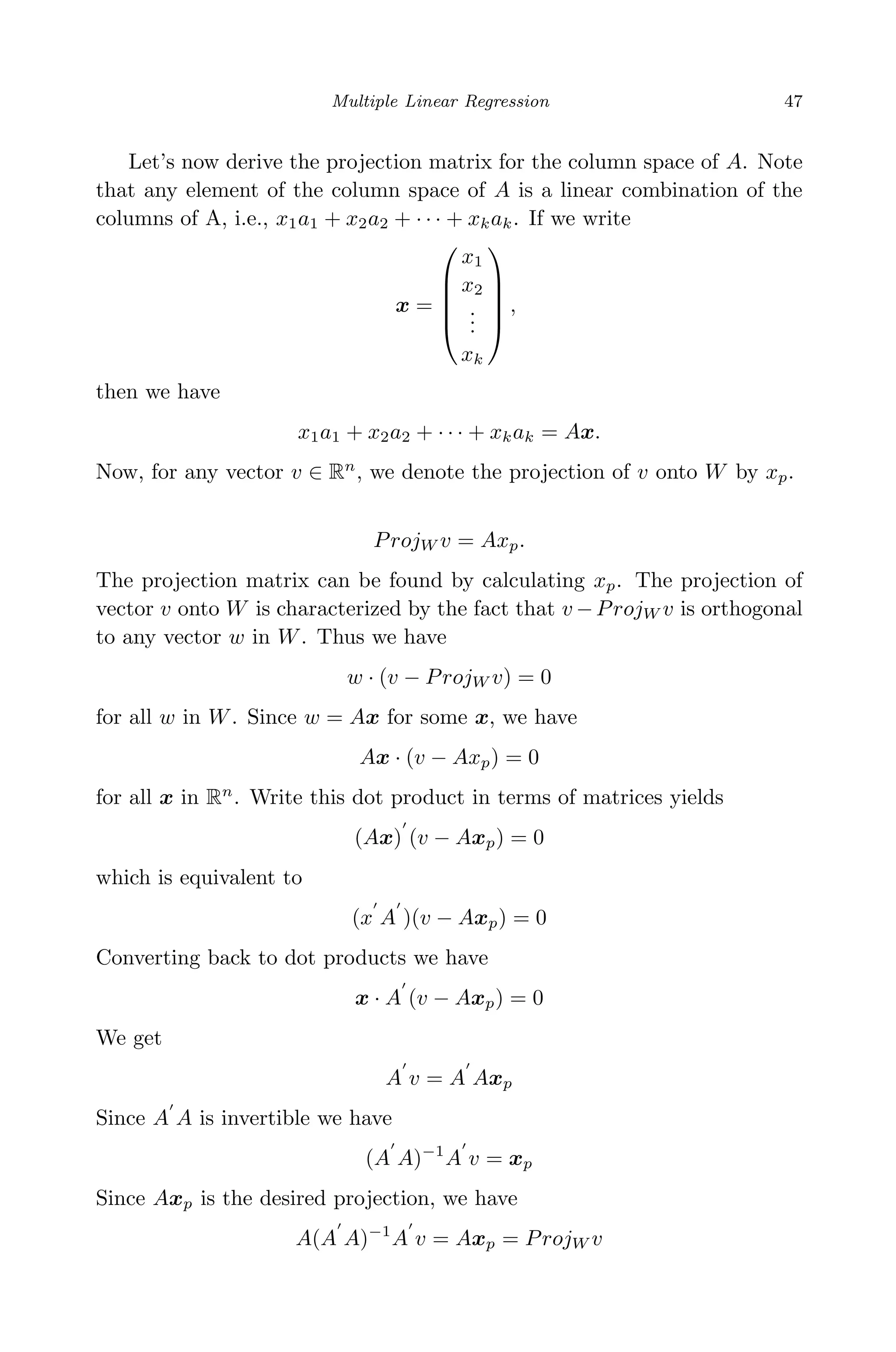
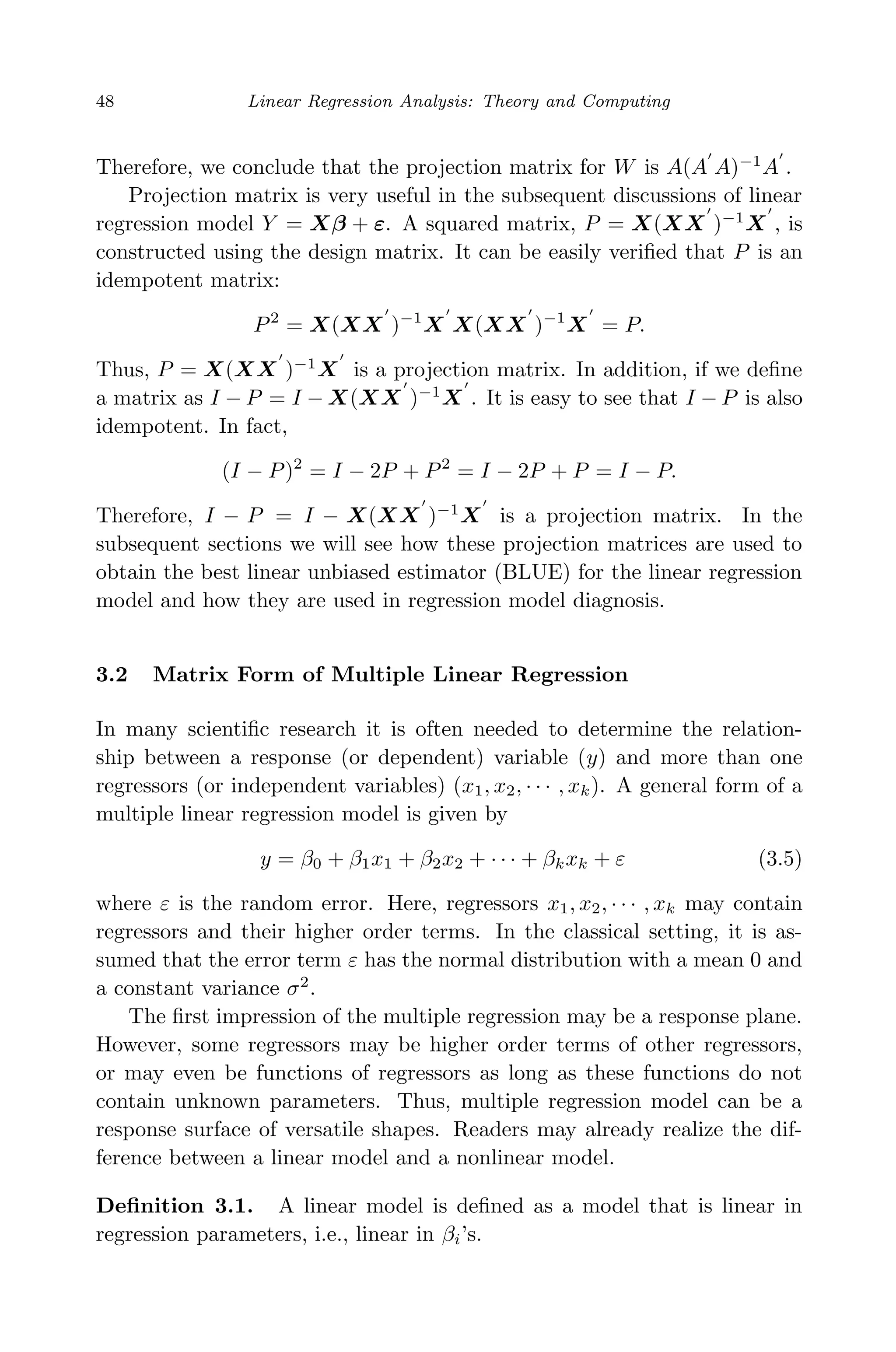
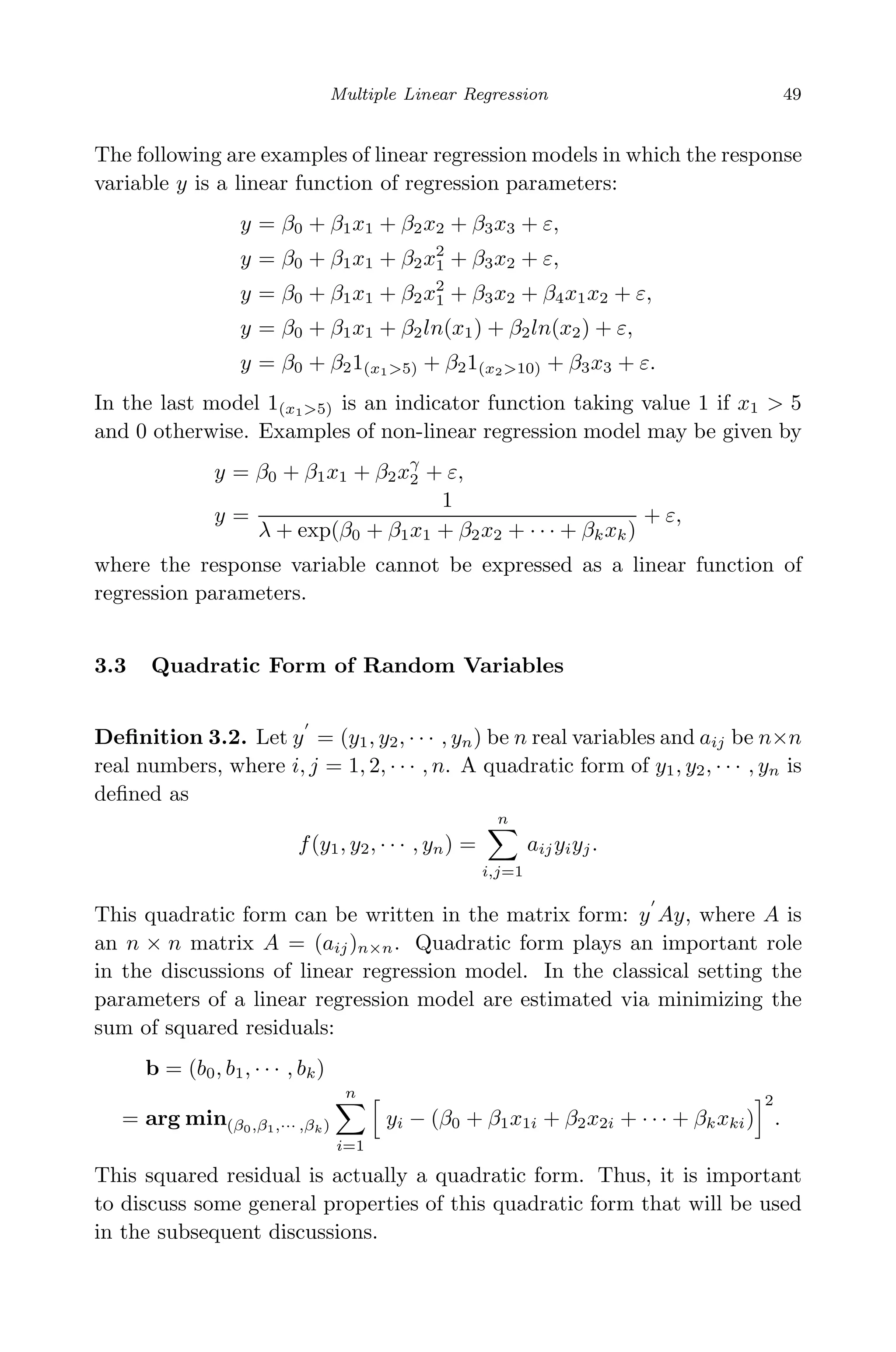
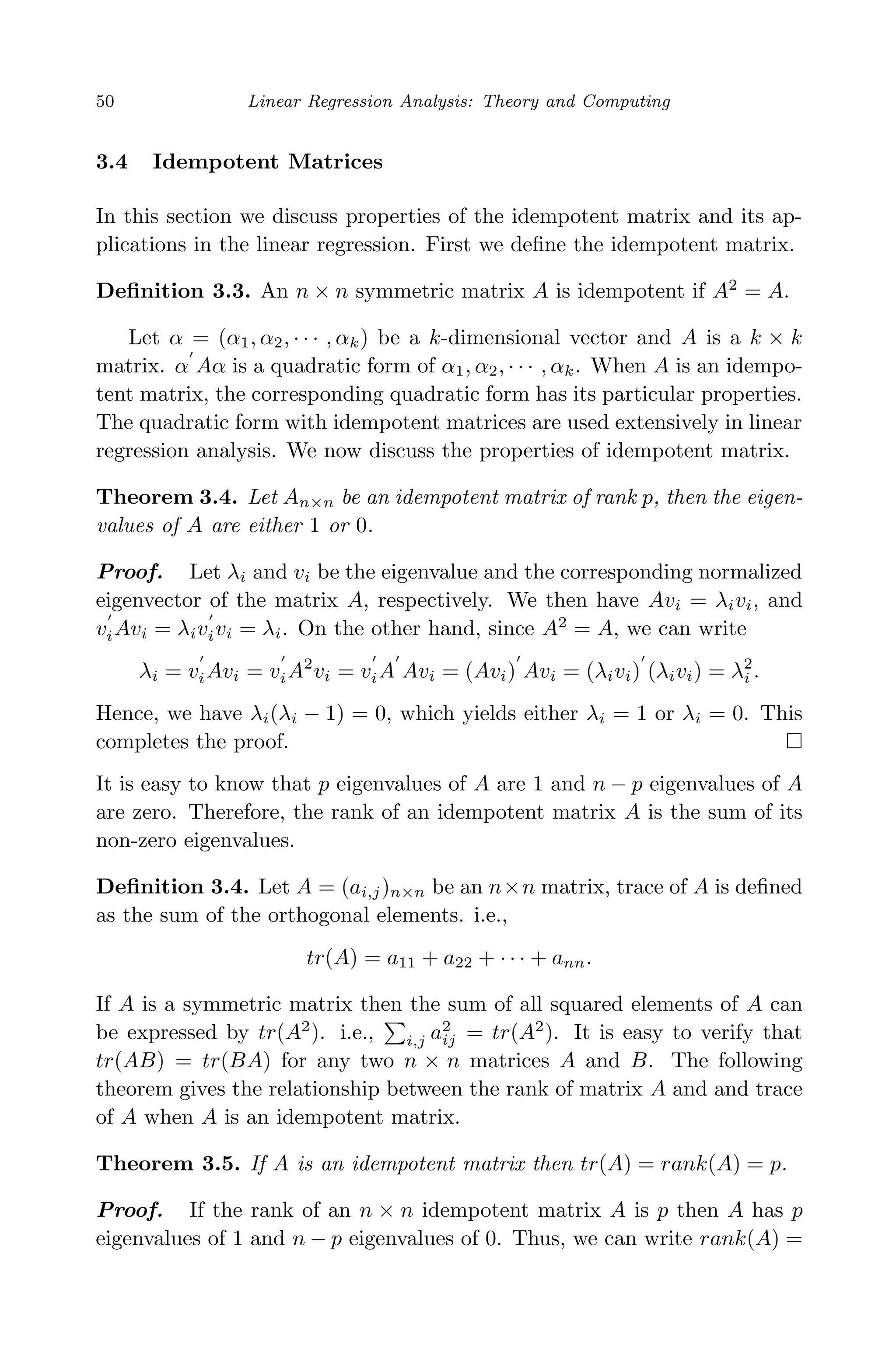
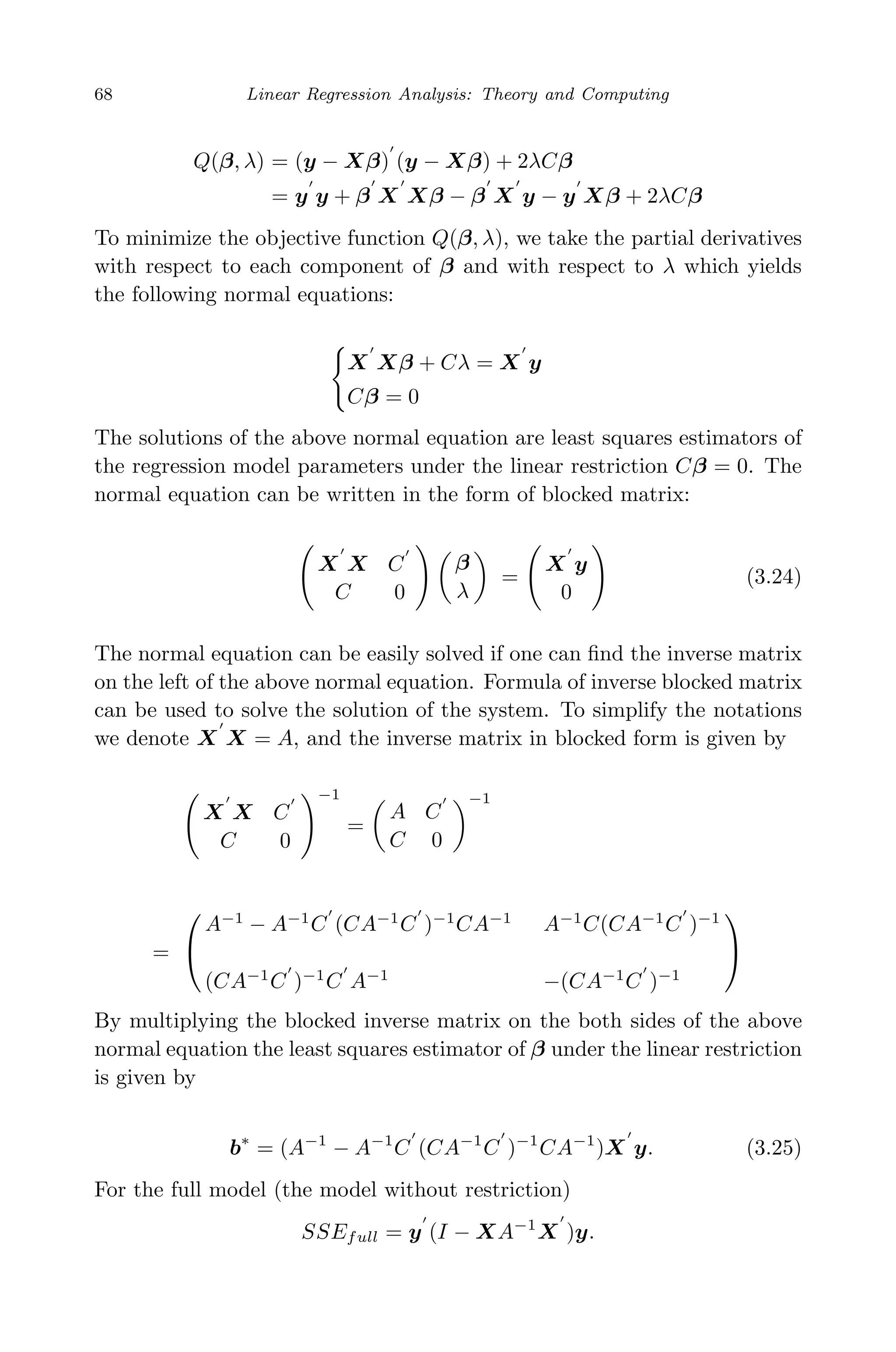
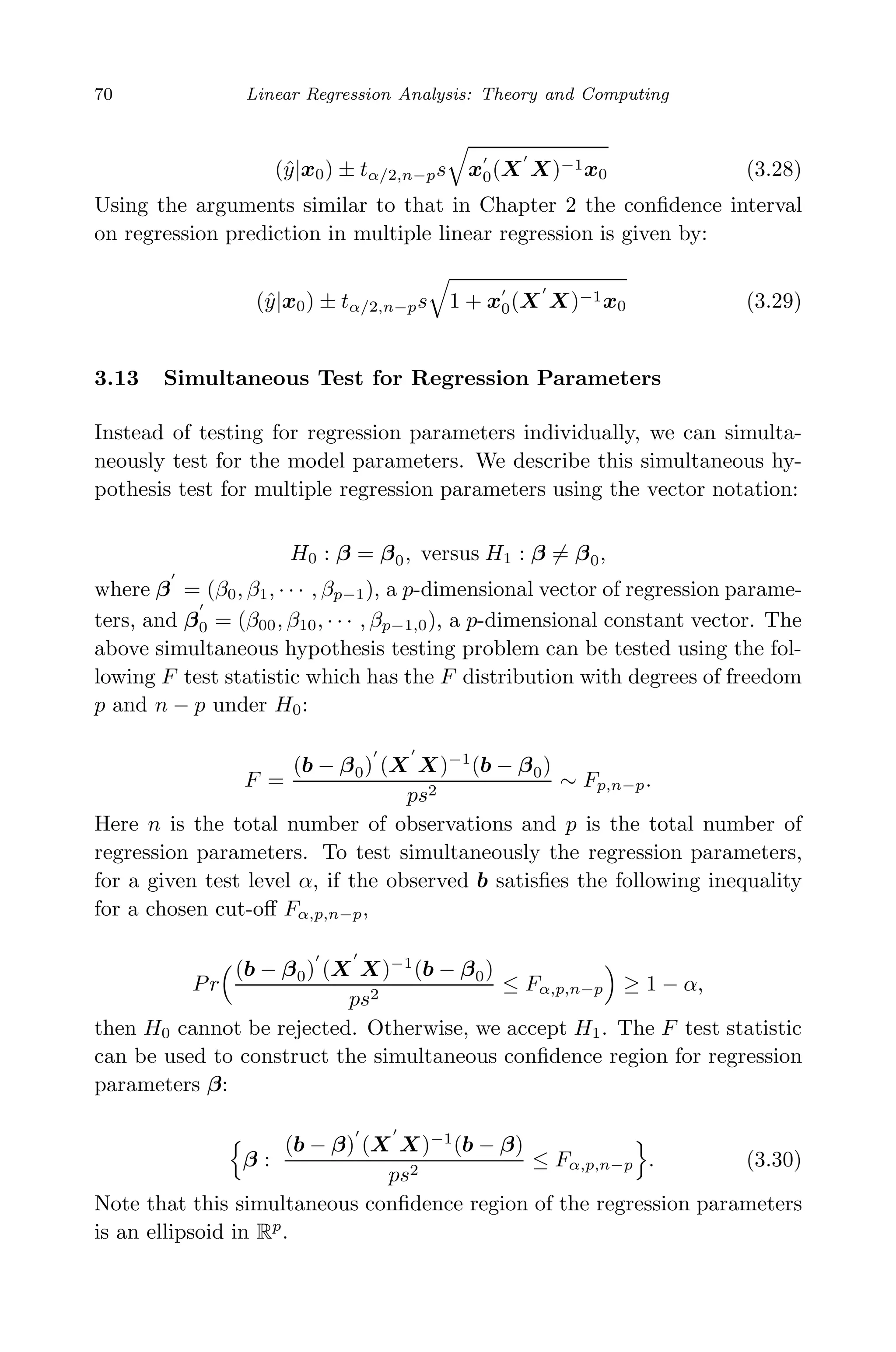
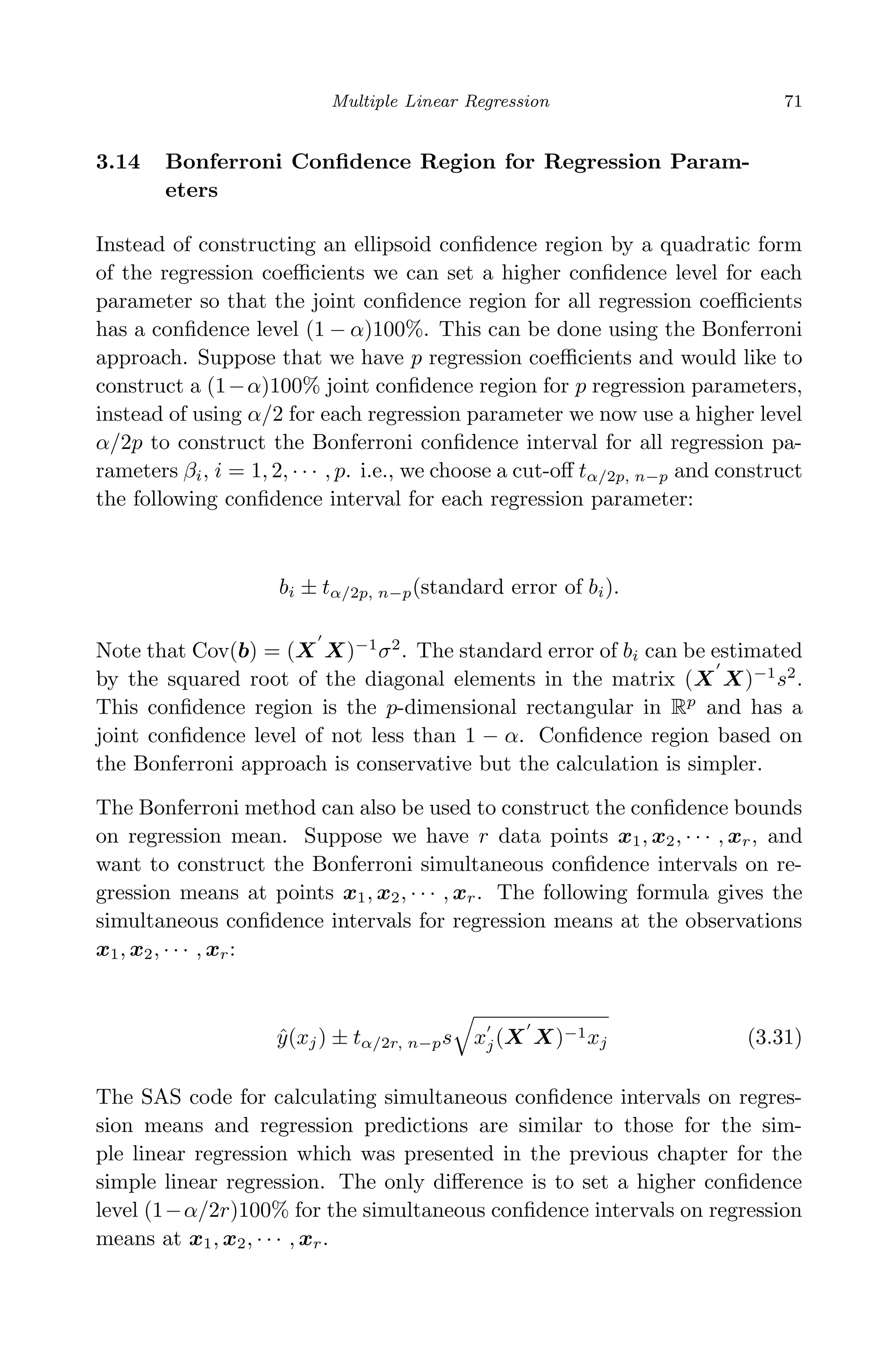
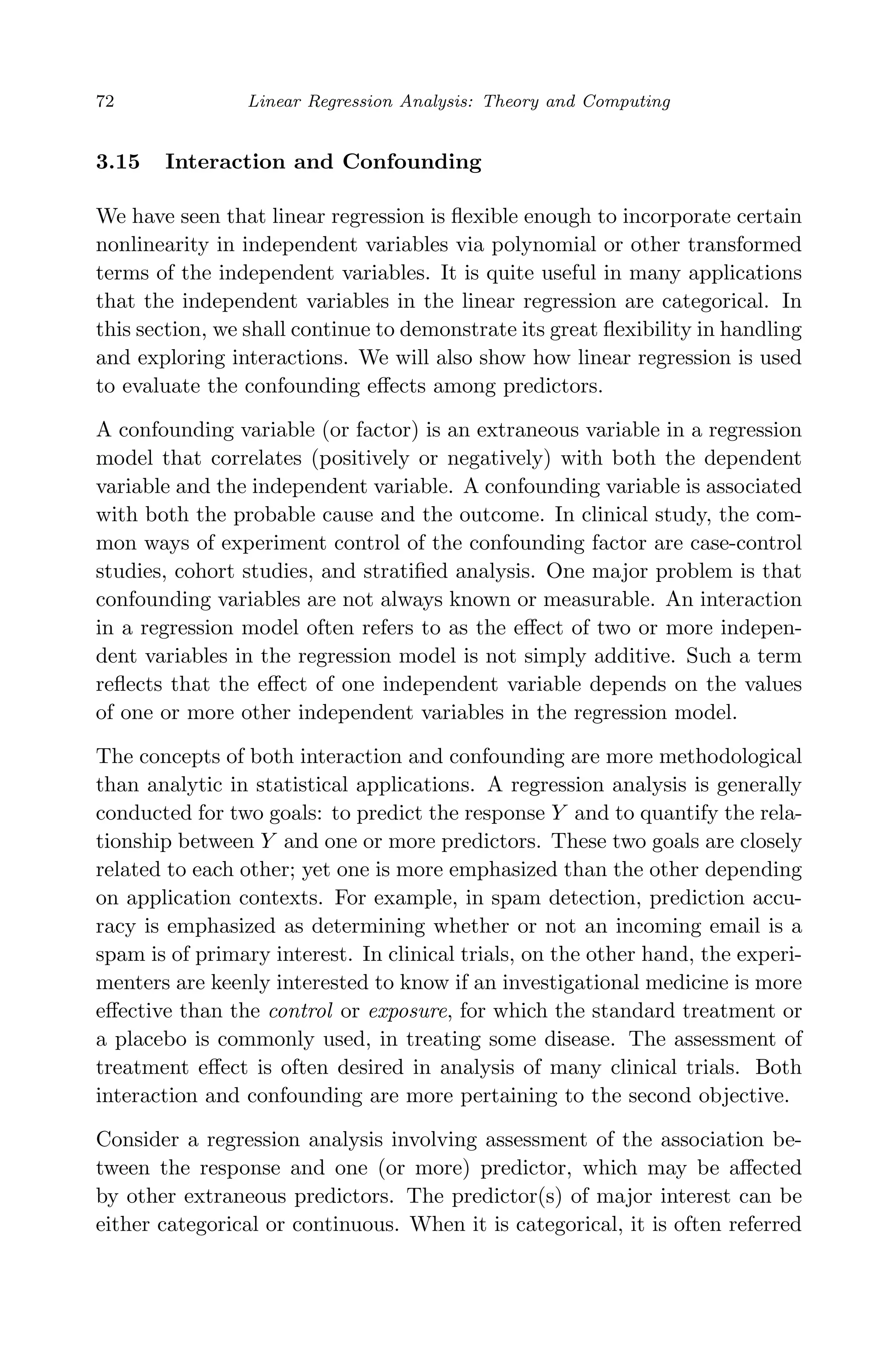
Linear
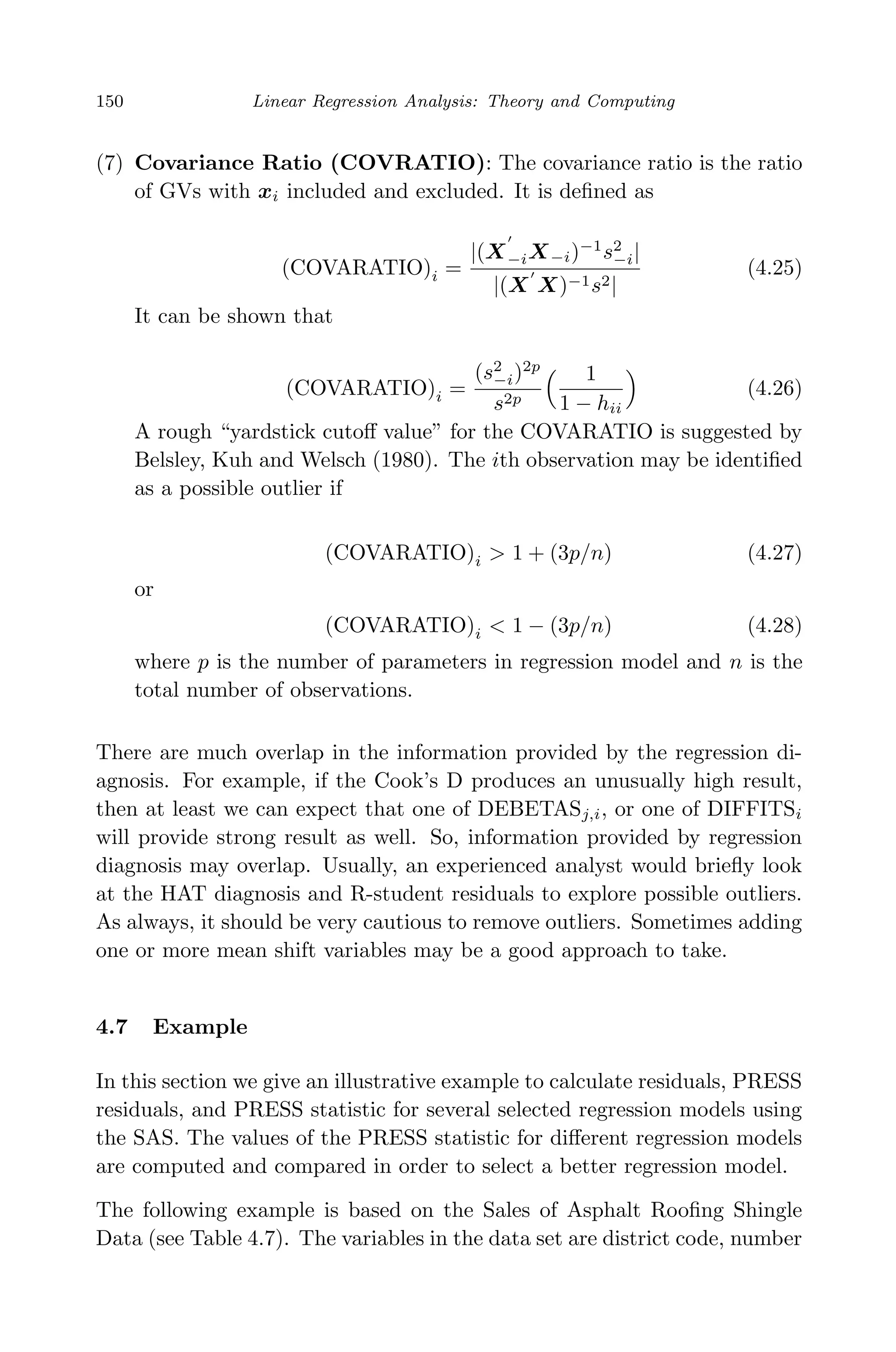
Regression
Analysis
Theory and Computing
This page intentionally left blankThis page intentionally left blank
Linear
Regression
Analysis
Theory and Computing
Xin Yan
University of Missouri–Kansas City, USA
Xiao Gang Su
University of Central Florida, USA
World Scientific
NEW JERSEY . LONDON . SINGAPORE . BEIJING . SHANGHAI . HONG KONG . TAIPEI . CHENNAI
Library of Congress Cataloging-in-Publication Data
Yan, Xin
Linear regression analysis : theory and computing / by Xin Yan & Xiaogang Su.
p. cm.
Includes bibliographical references and index.
ISBN-13: 978-981-283-410-2 (hardcover : alk. paper)
ISBN-10: 981-283-410-9 (hardcover : alk. paper)
1. Regression analysis. I. Su, Xiaogang II. Title.
QA278.2.Y36 2009
519.5'36--dc22
2009012000
British Library Cataloguing-in-Publication Data
A catalogue record for this book is available from the British Library.
For photocopying of material in this volume, please pay a copying fee through the Copyright
Clearance Center, Inc., 222 Rosewood Drive, Danvers, MA 01923, USA. In this case permission to
photocopy is not required from the publisher.
All rights reserved. This book, or parts thereof, may not be reproduced in any form or by any means,
electronic or mechanical, including photocopying, recording or any information storage and retrieval
system now known or to be invented, without written permission from the Publisher.
Copyright © 2009 by World Scientific Publishing Co. Pte. Ltd.
Published by
World Scientific Publishing Co. Pte. Ltd.
5 Toh Tuck Link, Singapore 596224
USA office: 27 Warren Street, Suite 401-402, Hackensack, NJ 07601
UK office: 57 Shelton Street, Covent Garden, London WC2H 9HE
Printed in Singapore.
EH - Linear Regression.pmd 5/8/2009, 12:11 PM1
April 29, 2009 11:50 World Scientific Book - 9in x 6in Regression˙master
Preface
In statistics, regression analysis consists of techniques for modeling the
relationship between a dependent variable (also called response variable)
and one or more independent variables (also known as explanatory vari-
ables or predictors). In regression, the dependent variable is modeled as
a function of independent variables, corresponding regression parameters
(coefficients), and a random error term which represents variation in the
dependent variable unexplained by the function of the dependent variables
and coefficients. In linear regression the dependent variable is modeled as
a linear function of a set of regression parameters and a random error. The
parameters need to be estimated so that the model gives the “ best fit ”
to the data. The parameters are estimated based on predefined criterion.
The most commonly used criterion is the least squares method, but other
criteria have also been used that will result in different estimators of the
regression parameters. The statistical properties of the estimator derived
using different criteria will be different from the estimator using the least
squares principle. In this book the least squares principle will be utilized
to derive estimates of the regression parameters. If a regression model ad-
equately reflects the true relationship between the response variable and
independent variables, this model can be used for predicting dependent
variable, identifying important independent variables, and establishing de-
sired causal relationship between the response variable and independent
variables.
To perform regression analysis, an investigator often assembles data on un-
derlying variables of interest and employs regression model to estimate the
quantitative causal effect of the independent variables to the response vari-
able. The investigator also typically assesses the “ statistical significance ”
of the estimated relationship between the independent variables and depen-
v
April 29, 2009 11:50 World Scientific Book - 9in x 6in Regression˙master
vi Linear Regression Analysis: Theory and Computing
dent variable, that is, the degree of confidence on how the true relationship
is close to the estimated statistical relationship.
Regression analysis is a process used to estimate a function which predicts
value of response variable in terms of values of other independent variables.
If the regression function is determined only through a set of parameters
the type of regression is the parametric regression. Many methods have
been developed to determine various parametric relationships between re-
sponse variable and independent variables. These methods typically depend
on the form of parametric regression function and the distribution of the
error term in a regression model. For example, linear regression, logistic
regression, Poisson regression, and probit regression, etc. These particu-
lar regression models assume different regression functions and error terms
from corresponding underline distributions. A generalization of linear re-
gression models has been formalized in the “ generalized linear model ”
and it requires to specify a link function which provides the relationship
between the linear predictor and the mean of the distribution function.
The regression model often relies heavily on the underlying assumptions
being satisfied. Regression analysis has been criticized as being misused for
these purposes in many cases where the appropriate assumptions cannot
be verified to hold. One important factor for such criticism is due to the
fact that a regression model is easier to be criticized than to find a method
to fit a regression model (Cook and Weisberg (1982)). However, checking
model assumptions should never be oversighted in regression analysis.
By saying much about regression model we would like to go back to the
purpose of this book. The goal of the book is to provide a comprehensive,
one-semester textbook in the area of regression analysis. The book includes
carefully selected topics and will not assume to serve as a complete refer-
ence book in the area of regression analysis, but rather as an easy-to-read
textbook to provide readers, particularly the graduate students majoring
in either statistics or biostatistics, or those who use regression analysis
substantially in their subject fields, the fundamental theories on regression
analysis, methods for regression model diagnosis, and computing techniques
in regression. In addition to carefully selected classical topics for regression
analysis, we also include some recent developments in the area of regres-
sion analysis such as the least absolute shrinkage and selection operator
(LASSO) proposed by Tibshirani (1996) and Bayes averaging method.
April 29, 2009 11:50 World Scientific Book - 9in x 6in Regression˙master
Preface vii
The topics on regression analysis covered in this book are distributed among
9 chapters. Chapter 1 briefly introduces the basic concept of regression and
defines the linear regression model. Chapters 2 and 3 cover the simple linear
regression and multiple linear regression. Although the simple linear regres-
sion is a special case of the multiple linear regression, we present it without
using matrix and give detailed derivations that highlight the fundamental
concepts in linear regression. The presentation of multiple regression fo-
cus on the concept of vector space, linear projection, and linear hypothesis
test. The theory of matrix is used extensively for the proofs of the statisti-
cal properties of linear regression model. Chapters 4 through 6 discuss the
diagnosis of linear regression model. These chapters cover outlier detection,
influential observations identification, collinearity, confounding, regression
on dummy variables, checking for equal variance assumption, graphical dis-
play of residual diagnosis, and variable transformation technique in linear
regression analysis. Chapters 7 and 8 provide further discussions on the
generalizations of the ordinary least squares estimation in linear regres-
sion. In these two chapters we discuss how to extend the regression model
to situation where the equal variance assumption on the error term fails.
To model the regression data with unequal variance the generalized least
squares method is introduced. In Chapter 7, two shrinkage estimators, the
ridge regression and the LASSO are introduced and discussed. A brief dis-
cussion on the least squares method for nonlinear regression is also included.
Chapter 8 briefly introduces the generalized linear models. In particular,
the Poisson Regression for count data and the logistic regression for binary
data are discussed. Chapter 9 briefly discussed the Bayesian linear regres-
sion models. The Bayes averaging method is introduced and discussed.
The purpose of including these topics in the book is to foster a better un-
derstanding of regression modeling. Although these topics and techniques
are presented largely for regression, the ideas behind these topics and the
techniques are also applicable in other areas of statistical modeling. The
topics presented in the book cover fundamental theories in linear regres-
sion analysis and we think that they are the most useful and relevant to
the future research into this area. A thorough understanding of the basic
theories, model diagnosis, and computing techniques in linear regression
analysis is necessary for those who would like to learn statistics either as
a discipline or as a substantial tool in their subject field. To this end,
we provide detailed proofs of fundamental theories related to linear regres-
sion modeling, diagnosis, and computing so that readers can understand
April 29, 2009 11:50 World Scientific Book - 9in x 6in Regression˙master
viii Linear Regression Analysis: Theory and Computing
the methods in regression analysis and actually model the data using the
methods presented in the book.
To enable the book serves the intended purpose as a graduate textbook
for regression analysis, in addition to detailed proofs, we also include many
examples to illustrate relevant computing techniques in regression analysis
and diagnosis. We hope that this would increase the readability and help
to understand the regression methods for students who expect a thorough
understanding of regression methods and know how to use these methods
to solve for practical problems. In addition, we tried to avoid an oversized-
textbook so that it can be taught in one semester. We do not intend to write
a complete reference book for regression analysis because it will require a
significantly larger volume of the book and may not be suitable for a text-
book of regression course. In our practice we realize that graduate students
often feel overwhelming when try to read an oversized textbook. There-
fore, we focus on presenting fundamental theories and detailed derivations
that can highlight the most important methods and techniques in linear
regression analysis.
Most computational examples of regression analysis and diagnosis in the
book use one of popular software package the Statistical Analysis System
(SAS), although readers are not discouraged to use other statistical software
packages in their subject area. Including illustrative SAS programs for the
regression analysis and diagnosis in the book is to help readers to become
familiar with various computing techniques that are necessary to regression
analysis. In addition, the SAS Output Delivery System (ODS) is introduced
to enable readers to generate output tables and figures in a desired format.
These illustrative programs are often arranged in the end of each chapter
with brief explanations. In addition to the SAS, we also briefly introduce
the software R which is a freeware. R has many user-written functions for
implementation of various statistical methods including regression. These
functions are similar to the built-in functions in the commercial software
package S-PLUS. We provide some programs in R to produce desired re-
gression diagnosis graphs. Readers are encouraged to learn how to use the
software R to perform regression analysis, diagnosis, and producing graphs.
X. Yan and X. G. Su
April 29, 2009 11:50 World Scientific Book - 9in x 6in Regression˙master
Contents
Preface v
List of Figures xv
List of Tables xvii
1. Introduction 1
1.1 Regression Model . . . . . . . . . . . . . . . . . . . . . . . 1
1.2 Goals of Regression Analysis . . . . . . . . . . . . . . . . 4
1.3 Statistical Computing in Regression Analysis . . . . . . . 5
2. Simple Linear Regression 9
2.1 Introduction . . . . . . . . . . . . . . . . . . . . . . . . . . 9
2.2 Least Squares Estimation . . . . . . . . . . . . . . . . . . 10
2.3 Statistical Properties of the Least Squares Estimation . . 13
2.4 Maximum Likelihood Estimation . . . . . . . . . . . . . . 18
2.5 Confidence Interval on Regression Mean and Regression
Prediction . . . . . . . . . . . . . . . . . . . . . . . . . . . 19
2.6 Statistical Inference on Regression Parameters . . . . . . 21
2.7 Residual Analysis and Model Diagnosis . . . . . . . . . . 25
2.8 Example . . . . . . . . . . . . . . . . . . . . . . . . . . . . 28
3. Multiple Linear Regression 41
3.1 Vector Space and Projection . . . . . . . . . . . . . . . . . 41
3.1.1 Vector Space . . . . . . . . . . . . . . . . . . . . . 41
3.1.2 Linearly Independent Vectors . . . . . . . . . . . 44
3.1.3 Dot Product and Projection . . . . . . . . . . . . 44
ix
May 7, 2009 10:22 World Scientific Book - 9in x 6in Regression˙master
x Linear Regression Analysis: Theory and Computing
3.2 Matrix Form of Multiple Linear Regression . . . . . . . . 48
3.3 Quadratic Form of Random Variables . . . . . . . . . . . 49
3.4 Idempotent Matrices . . . . . . . . . . . . . . . . . . . . . 50
3.5 Multivariate Normal Distribution . . . . . . . . . . . . . . 54
3.6 Quadratic Form of the Multivariate Normal Variables . . 56
3.7 Least Squares Estimates of the Multiple Regression
Parameters . . . . . . . . . . . . . . . . . . . . . . . . . . 58
3.8 Matrix Form of the Simple Linear Regression . . . . . . . 62
3.9 Test for Full Model and Reduced Model . . . . . . . . . . 64
3.10 Test for General Linear Hypothesis . . . . . . . . . . . . . 66
3.11 The Least Squares Estimates of Multiple Regression
Parameters Under Linear Restrictions . . . . . . . . . . . 67
3.12 Confidence Intervals of Mean and Prediction in Multiple
Regression . . . . . . . . . . . . . . . . . . . . . . . . . . . 69
3.13 Simultaneous Test for Regression Parameters . . . . . . . 70
3.14 Bonferroni Confidence Region for Regression Parameters . 71
3.15 Interaction and Confounding . . . . . . . . . . . . . . . . 72
3.15.1 Interaction . . . . . . . . . . . . . . . . . . . . . . 73
3.15.2 Confounding . . . . . . . . . . . . . . . . . . . . . 75
3.16 Regression with Dummy Variables . . . . . . . . . . . . . 77
3.17 Collinearity in Multiple Linear Regression . . . . . . . . . 81
3.17.1 Collinearity . . . . . . . . . . . . . . . . . . . . . . 81
3.17.2 Variance Inflation . . . . . . . . . . . . . . . . . . 85
3.18 Linear Model in Centered Form . . . . . . . . . . . . . . . 87
3.19 Numerical Computation of LSE via QR Decomposition . 92
3.19.1 Orthogonalization . . . . . . . . . . . . . . . . . . 92
3.19.2 QR Decomposition and LSE . . . . . . . . . . . . 94
3.20 Analysis of Regression Residual . . . . . . . . . . . . . . . 96
3.20.1 Purpose of the Residual Analysis . . . . . . . . . 96
3.20.2 Residual Plot . . . . . . . . . . . . . . . . . . . . 97
3.20.3 Studentized Residuals . . . . . . . . . . . . . . . . 103
3.20.4 PRESS Residual . . . . . . . . . . . . . . . . . . . 103
3.20.5 Identify Outlier Using PRESS Residual . . . . . . 106
3.20.6 Test for Mean Shift Outlier . . . . . . . . . . . . . 108
3.21 Check for Normality of the Error Term in Multiple
Regression . . . . . . . . . . . . . . . . . . . . . . . . . . . 115
3.22 Example . . . . . . . . . . . . . . . . . . . . . . . . . . . . 115
May 8, 2009 15:56 World Scientific Book - 9in x 6in Regression˙master
Contents xi
4. Detection of Outliers and Influential Observations
in Multiple Linear Regression 129
4.1 Model Diagnosis for Multiple Linear Regression . . . . . . 130
4.1.1 Simple Criteria for Model Comparison . . . . . . 130
4.1.2 Bias in Error Estimate from Under-specified Model 131
4.1.3 Cross Validation . . . . . . . . . . . . . . . . . . . 132
4.2 Detection of Outliers in Multiple Linear Regression . . . . 133
4.3 Detection of Influential Observations in Multiple Linear
Regression . . . . . . . . . . . . . . . . . . . . . . . . . . . 134
4.3.1 Influential Observation . . . . . . . . . . . . . . . 134
4.3.2 Notes on Outlier and Influential Observation . . . 136
4.3.3 Residual Mean Square Error for Over-fitted
Regression Model . . . . . . . . . . . . . . . . . . 137
4.4 Test for Mean-shift Outliers . . . . . . . . . . . . . . . . . 139
4.5 Graphical Display of Regression Diagnosis . . . . . . . . . 142
4.5.1 Partial Residual Plot . . . . . . . . . . . . . . . . 142
4.5.2 Component-plus-residual Plot . . . . . . . . . . . 146
4.5.3 Augmented Partial Residual Plot . . . . . . . . . 147
4.6 Test for Inferential Observations . . . . . . . . . . . . . . 147
4.7 Example . . . . . . . . . . . . . . . . . . . . . . . . . . . . 150
5. Model Selection 157
5.1 Effect of Underfitting and Overfitting . . . . . . . . . . . 157
5.2 All Possible Regressions . . . . . . . . . . . . . . . . . . . 165
5.2.1 Some Naive Criteria . . . . . . . . . . . . . . . . 165
5.2.2 PRESS and GCV . . . . . . . . . . . . . . . . . . 166
5.2.3 Mallow’s CP . . . . . . . . . . . . . . . . . . . . . 167
5.2.4 AIC, AICC, and BIC . . . . . . . . . . . . . . . . 169
5.3 Stepwise Selection . . . . . . . . . . . . . . . . . . . . . . 171
5.3.1 Backward Elimination . . . . . . . . . . . . . . . . 171
5.3.2 Forward Addition . . . . . . . . . . . . . . . . . . 172
5.3.3 Stepwise Search . . . . . . . . . . . . . . . . . . . 172
5.4 Examples . . . . . . . . . . . . . . . . . . . . . . . . . . . 173
5.5 Other Related Issues . . . . . . . . . . . . . . . . . . . . 179
5.5.1 Variance Importance or Relevance . . . . . . . . 180
5.5.2 PCA and SIR . . . . . . . . . . . . . . . . . . . . 186
May 7, 2009 10:22 World Scientific Book - 9in x 6in Regression˙master
xii Linear Regression Analysis: Theory and Computing
6. Model Diagnostics 195
6.1 Test Heteroscedasticity . . . . . . . . . . . . . . . . . . . . 197
6.1.1 Heteroscedasticity . . . . . . . . . . . . . . . . . . 197
6.1.2 Likelihood Ratio Test, Wald, and Lagrange Multi-
plier Test . . . . . . . . . . . . . . . . . . . . . . . 198
6.1.3 Tests for Heteroscedasticity . . . . . . . . . . . . . 201
6.2 Detection of Regression Functional Form . . . . . . . . . . 204
6.2.1 Box-Cox Power Transformation . . . . . . . . . . 205
6.2.2 Additive Models . . . . . . . . . . . . . . . . . . . 207
6.2.3 ACE and AVAS . . . . . . . . . . . . . . . . . . . 210
6.2.4 Example . . . . . . . . . . . . . . . . . . . . . . . 211
7. Extensions of Least Squares 219
7.1 Non-Full-Rank Linear Regression Models . . . . . . . . . 219
7.1.1 Generalized Inverse . . . . . . . . . . . . . . . . . 221
7.1.2 Statistical Inference on Null-Full-Rank Regression
Models . . . . . . . . . . . . . . . . . . . . . . . . 223
7.2 Generalized Least Squares . . . . . . . . . . . . . . . . . . 229
7.2.1 Estimation of (β, σ2
) . . . . . . . . . . . . . . . . 230
7.2.2 Statistical Inference . . . . . . . . . . . . . . . . . 231
7.2.3 Misspecification of the Error Variance Structure . 232
7.2.4 Typical Error Variance Structures . . . . . . . . 233
7.2.5 Example . . . . . . . . . . . . . . . . . . . . . . . 236
7.3 Ridge Regression and LASSO . . . . . . . . . . . . . . . . 238
7.3.1 Ridge Shrinkage Estimator . . . . . . . . . . . . . 239
7.3.2 Connection with PCA . . . . . . . . . . . . . . . 243
7.3.3 LASSO and Other Extensions . . . . . . . . . . . 246
7.3.4 Example . . . . . . . . . . . . . . . . . . . . . . . 250
7.4 Parametric Nonlinear Regression . . . . . . . . . . . . . . 259
7.4.1 Least Squares Estimation in Nonlinear Regression 261
7.4.2 Example . . . . . . . . . . . . . . . . . . . . . . . 263
8. Generalized Linear Models 269
8.1 Introduction: A Motivating Example . . . . . . . . . . . . 269
8.2 Components of GLM . . . . . . . . . . . . . . . . . . . . 272
8.2.1 Exponential Family . . . . . . . . . . . . . . . . . 272
8.2.2 Linear Predictor and Link Functions . . . . . . . 273
8.3 Maximum Likelihood Estimation of GLM . . . . . . . . . 274
May 7, 2009 10:22 World Scientific Book - 9in x 6in Regression˙master
Contents xiii
8.3.1 Likelihood Equations . . . . . . . . . . . . . . . . 274
8.3.2 Fisher’s Information Matrix . . . . . . . . . . . . 275
8.3.3 Optimization of the Likelihood . . . . . . . . . . . 276
8.4 Statistical Inference and Other Issues in GLM . . . . . . 278
8.4.1 Wald, Likelihood Ratio, and Score Test . . . . . 278
8.4.2 Other Model Fitting Issues . . . . . . . . . . . . 281
8.5 Logistic Regression for Binary Data . . . . . . . . . . . . 282
8.5.1 Interpreting the Logistic Model . . . . . . . . . . 282
8.5.2 Estimation of the Logistic Model . . . . . . . . . 284
8.5.3 Example . . . . . . . . . . . . . . . . . . . . . . . 285
8.6 Poisson Regression for Count Data . . . . . . . . . . . . 287
8.6.1 The Loglinear Model . . . . . . . . . . . . . . . . 287
8.6.2 Example . . . . . . . . . . . . . . . . . . . . . . . 288
9. Bayesian Linear Regression 297
9.1 Bayesian Linear Models . . . . . . . . . . . . . . . . . . . 297
9.1.1 Bayesian Inference in General . . . . . . . . . . . 297
9.1.2 Conjugate Normal-Gamma Priors . . . . . . . . . 299
9.1.3 Inference in Bayesian Linear Model . . . . . . . . 302
9.1.4 Bayesian Inference via MCMC . . . . . . . . . . . 303
9.1.5 Prediction . . . . . . . . . . . . . . . . . . . . . . 306
9.1.6 Example . . . . . . . . . . . . . . . . . . . . . . . 307
9.2 Bayesian Model Averaging . . . . . . . . . . . . . . . . . 309
Bibliography 317
Index 325
April 29, 2009 11:50 World Scientific Book - 9in x 6in Regression˙master
This page intentionally left blankThis page intentionally left blank
April 29, 2009 11:50 World Scientific Book - 9in x 6in Regression˙master
List of Figures
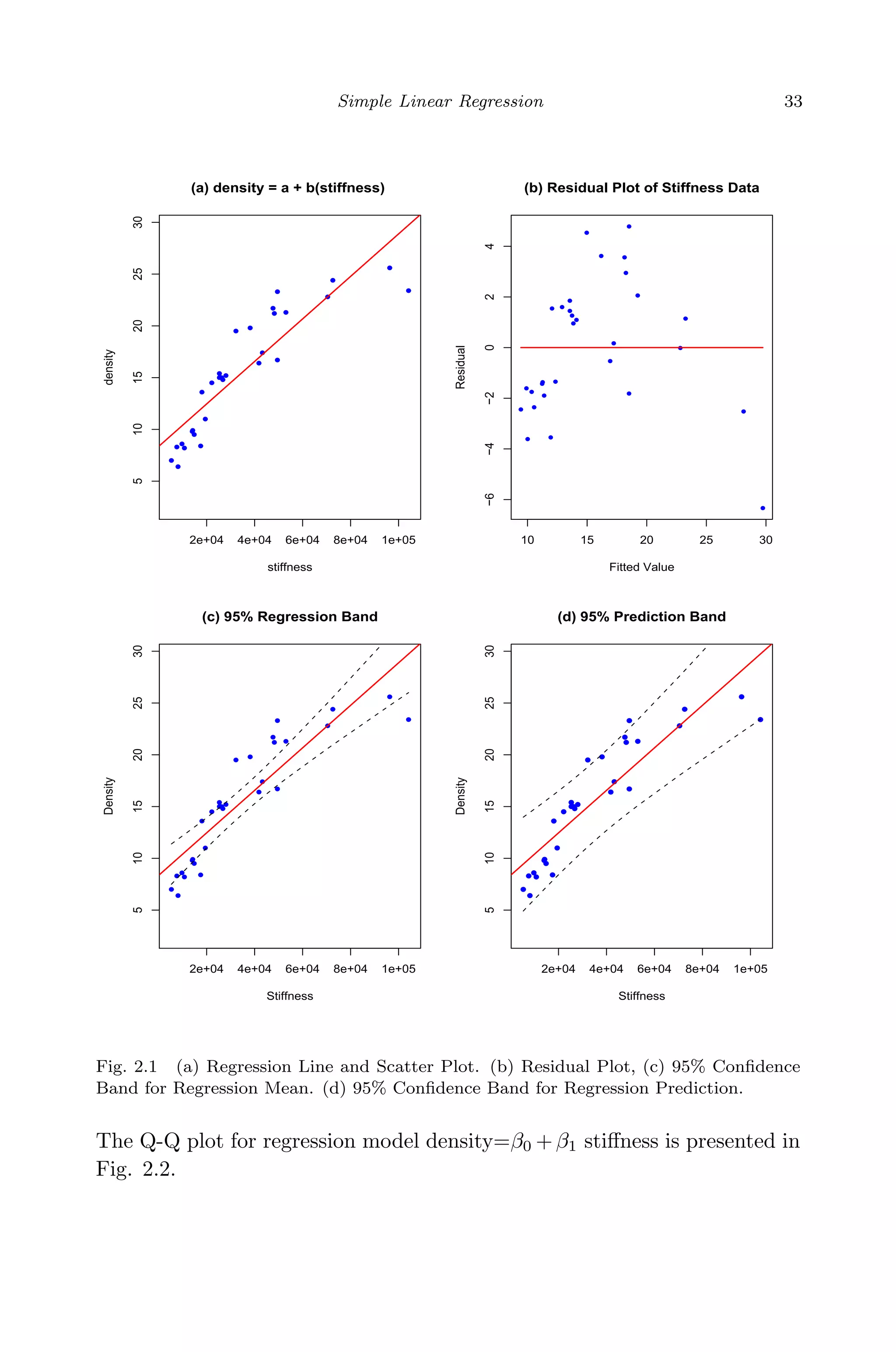
2.1 (a) Regression Line and Scatter Plot. (b) Residual Plot, (c)
95% Confidence Band for Regression Mean. (d) 95% Confidence
Band for Regression Prediction. . . . . . . . . . . . . . . . . . . 33
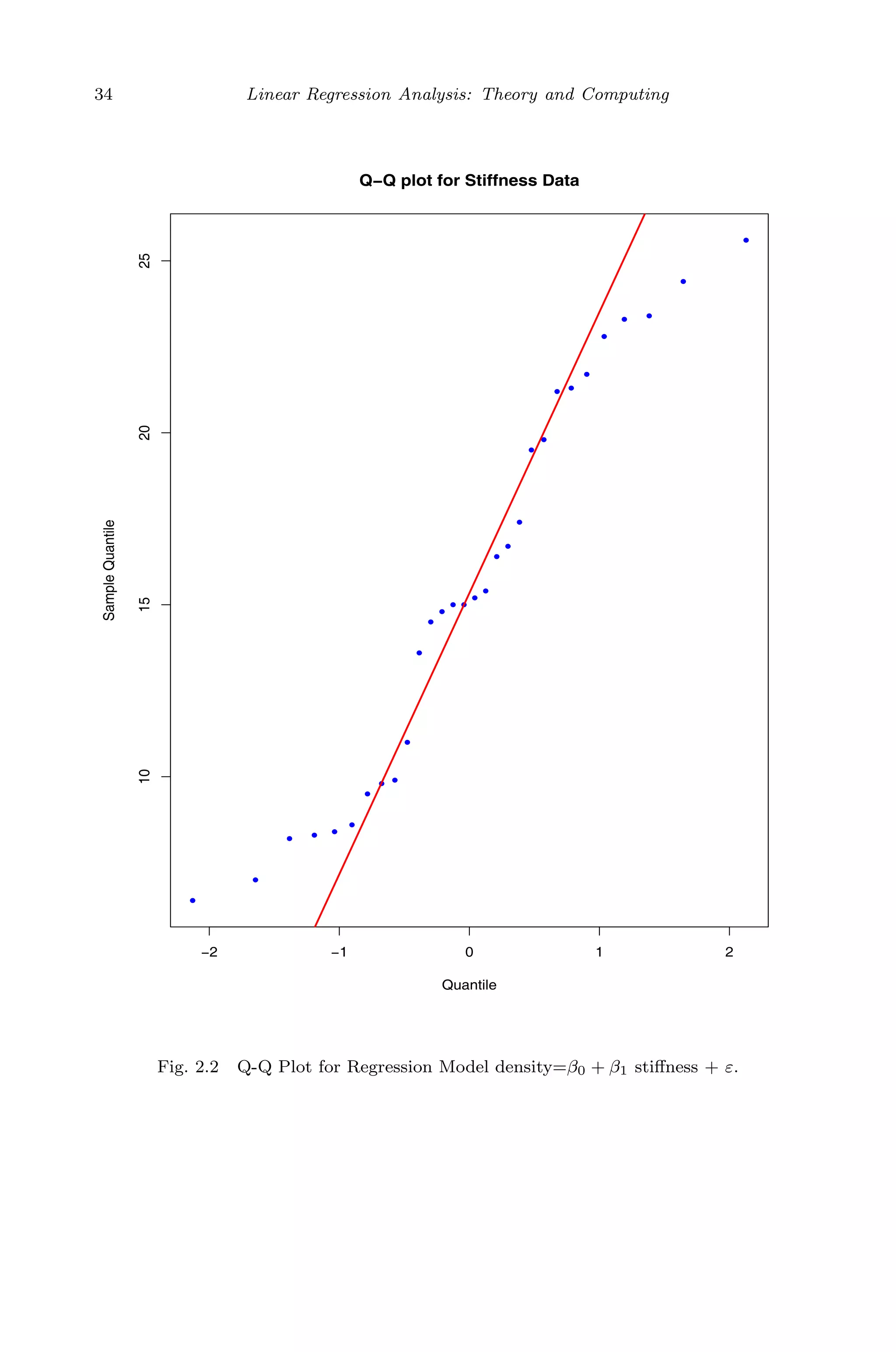
2.2 Q-Q Plot for Regression Model density=β0 + β1 stiffness + ε . 34
3.1 Response Curves of Y Versus X1 at Different Values of X2 in
Models (3.33) and (3.32). . . . . . . . . . . . . . . . . . . . . . 74
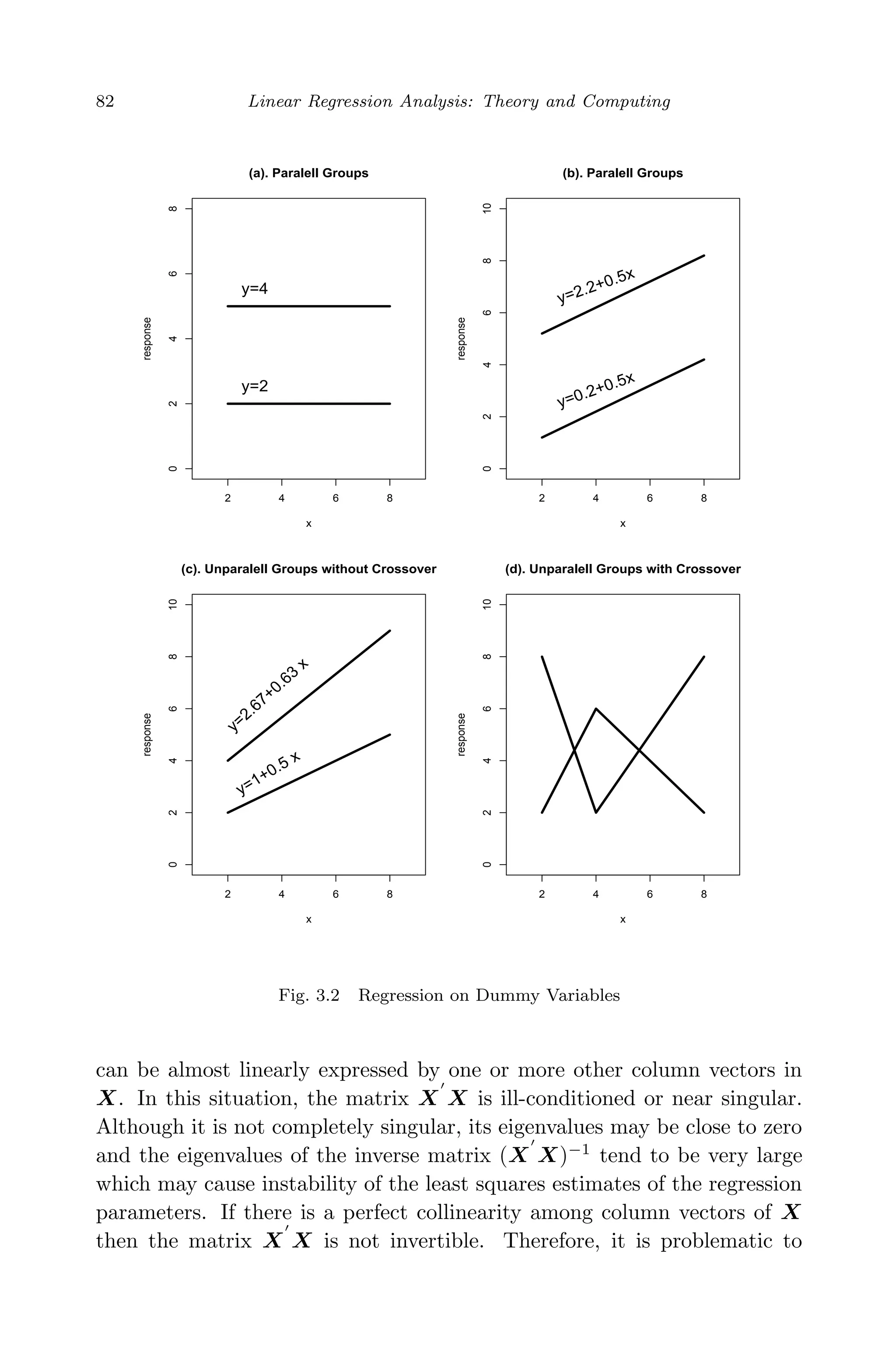
3.2 Regression on Dummy Variables . . . . . . . . . . . . . . . . . 82
3.3 Various Shapes of Residual Plots . . . . . . . . . . . . . . . . . 98
3.4 Residual Plots of the Regression Model of the US Population . 100
4.1 Partial Residual Plots for Regression Models . . . . . . . . . . 145
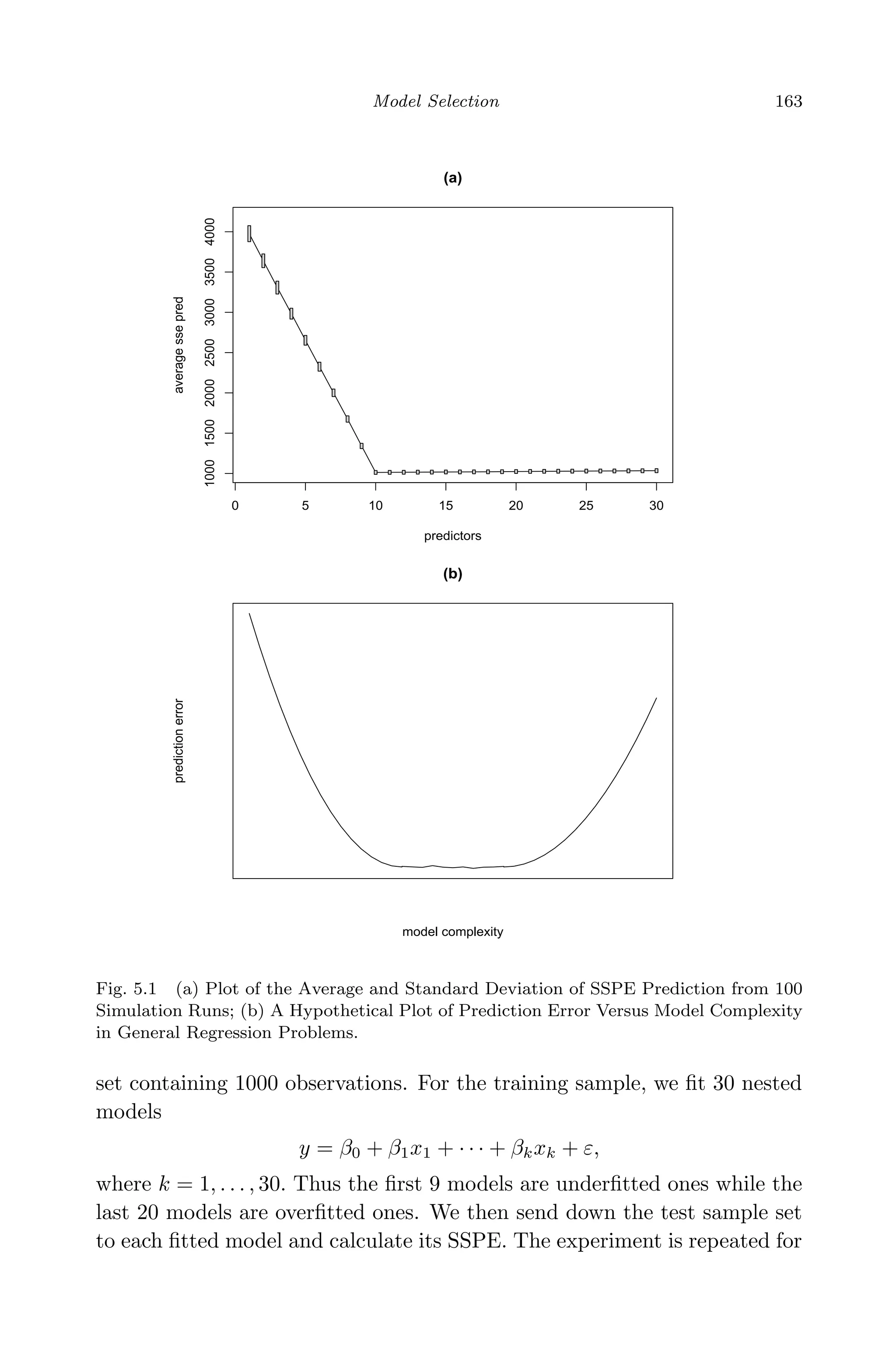
5.1 (a) Plot of the Average and Standard Deviation of SSPE Pre-
diction from 100 Simulation Runs; (b) A Hypothetical Plot of
Prediction Error Versus Model Complexity in General Regres-
sion Problems. . . . . . . . . . . . . . . . . . . . . . . . . . . . 163
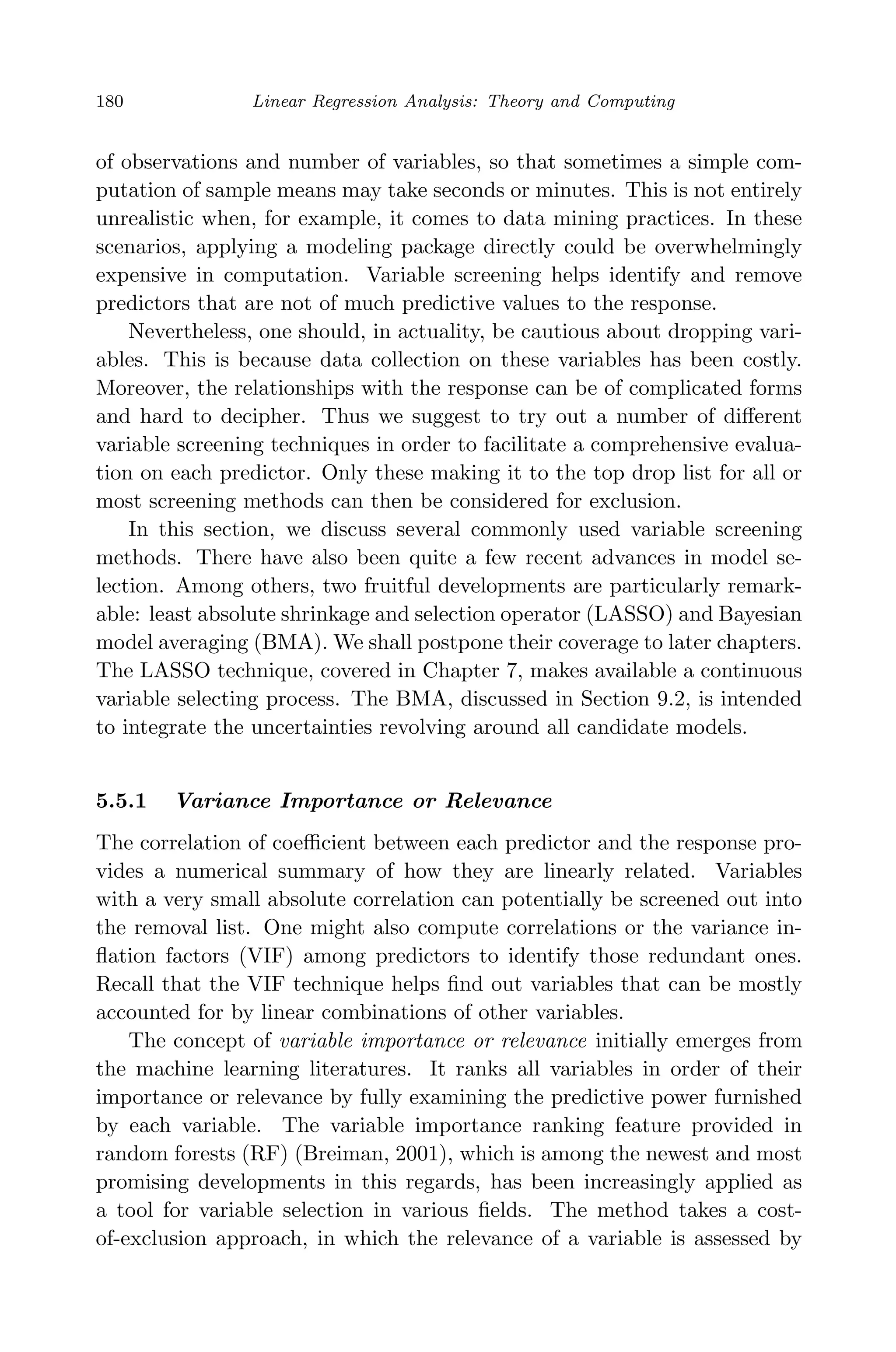
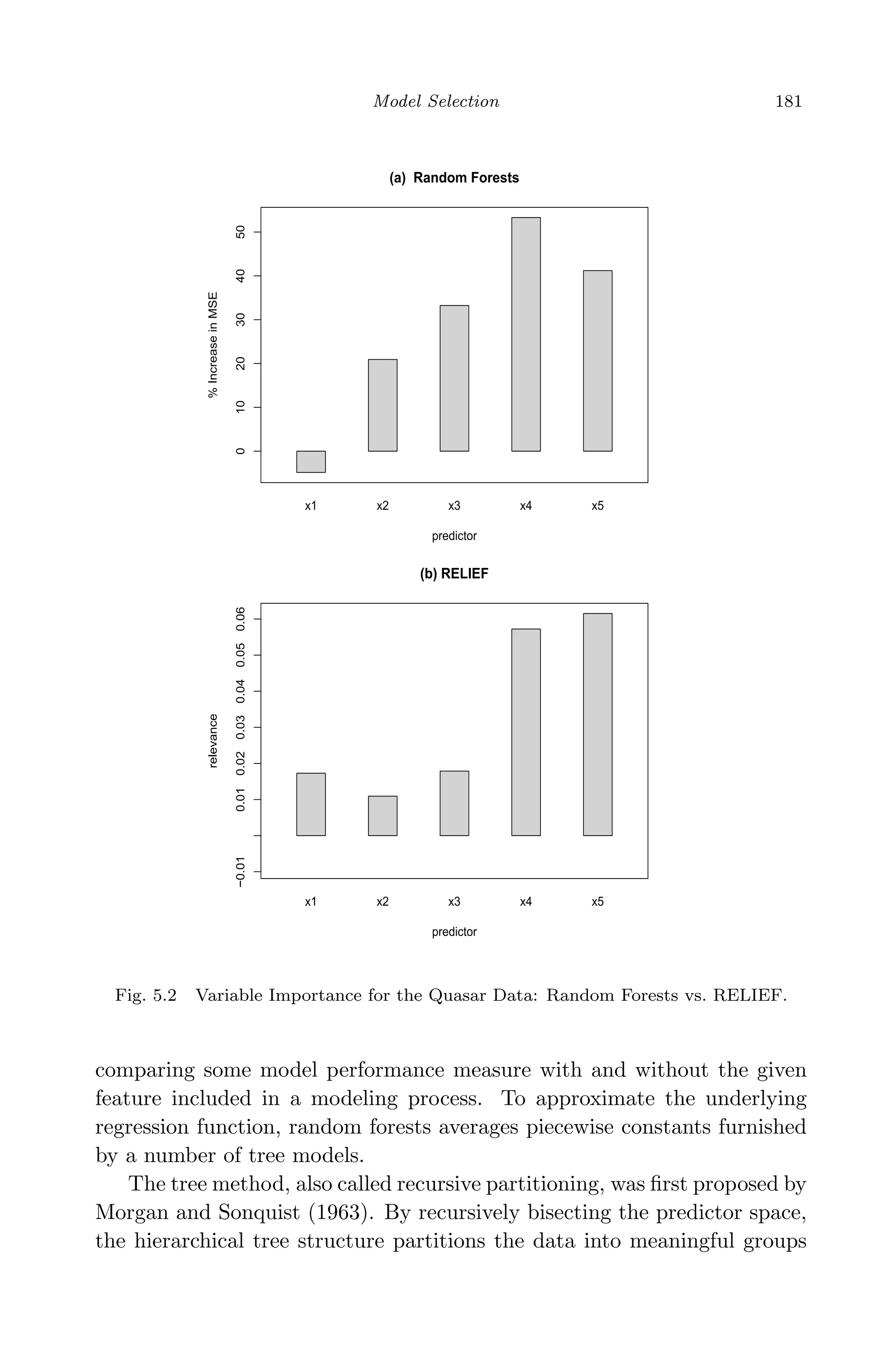
5.2 Variable Importance for the Quasar Data: Random Forests
vs. RELIEF. . . . . . . . . . . . . . . . . . . . . . . . . . . . . 181
5.3 A Simulation Example on Variable Importance: Random
Forests vs. RELIEF. . . . . . . . . . . . . . . . . . . . . . . . . 185
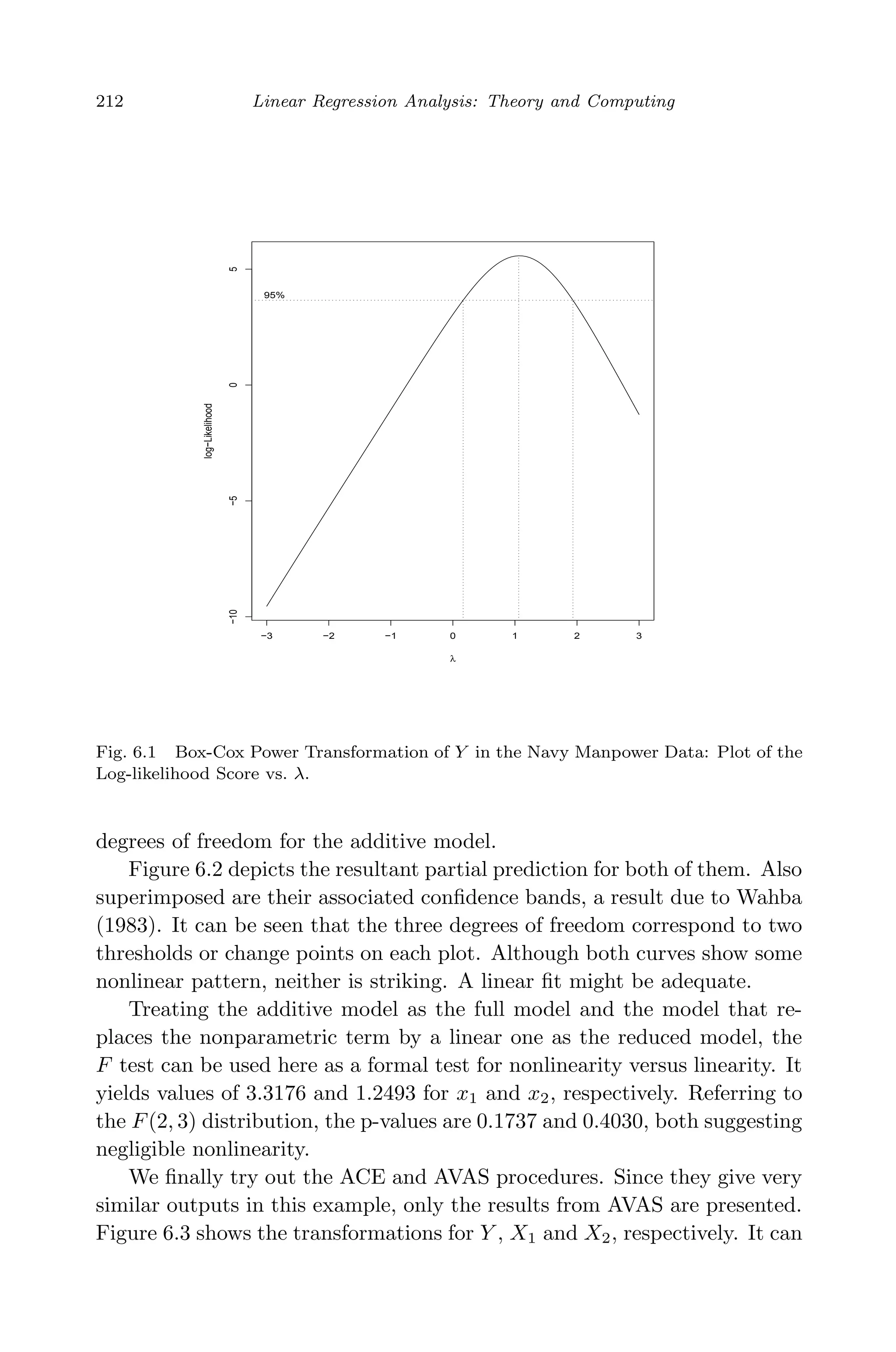
6.1 Box-Cox Power Transformation of Y in the Navy Manpower
Data: Plot of the Log-likelihood Score vs. λ. . . . . . . . . . . 212
6.2 Detecting the Nonlinear Effect of x1 and x2 via Additive Models
in the Navy Manpower Data. . . . . . . . . . . . . . . . . . . . 213
6.3 AVAS Results for the Navy Manpower Data: (a) Plot of g(Y );
(b) Plot of f1(X1); (c) Plot of f2(X2). . . . . . . . . . . . . . . 214
xv
April 29, 2009 11:50 World Scientific Book - 9in x 6in Regression˙master
xvi Linear Regression Analysis: Theory and Computing
6.4 AVAS Results for the Navy Manpower Data: (a) 3-D Scat-
ter Plot of the Original Data; (b) 3-D Scatter Plot of g(Y )
vs. f1(X1) and f2(X2) after Transformation. . . . . . . . . . . 215
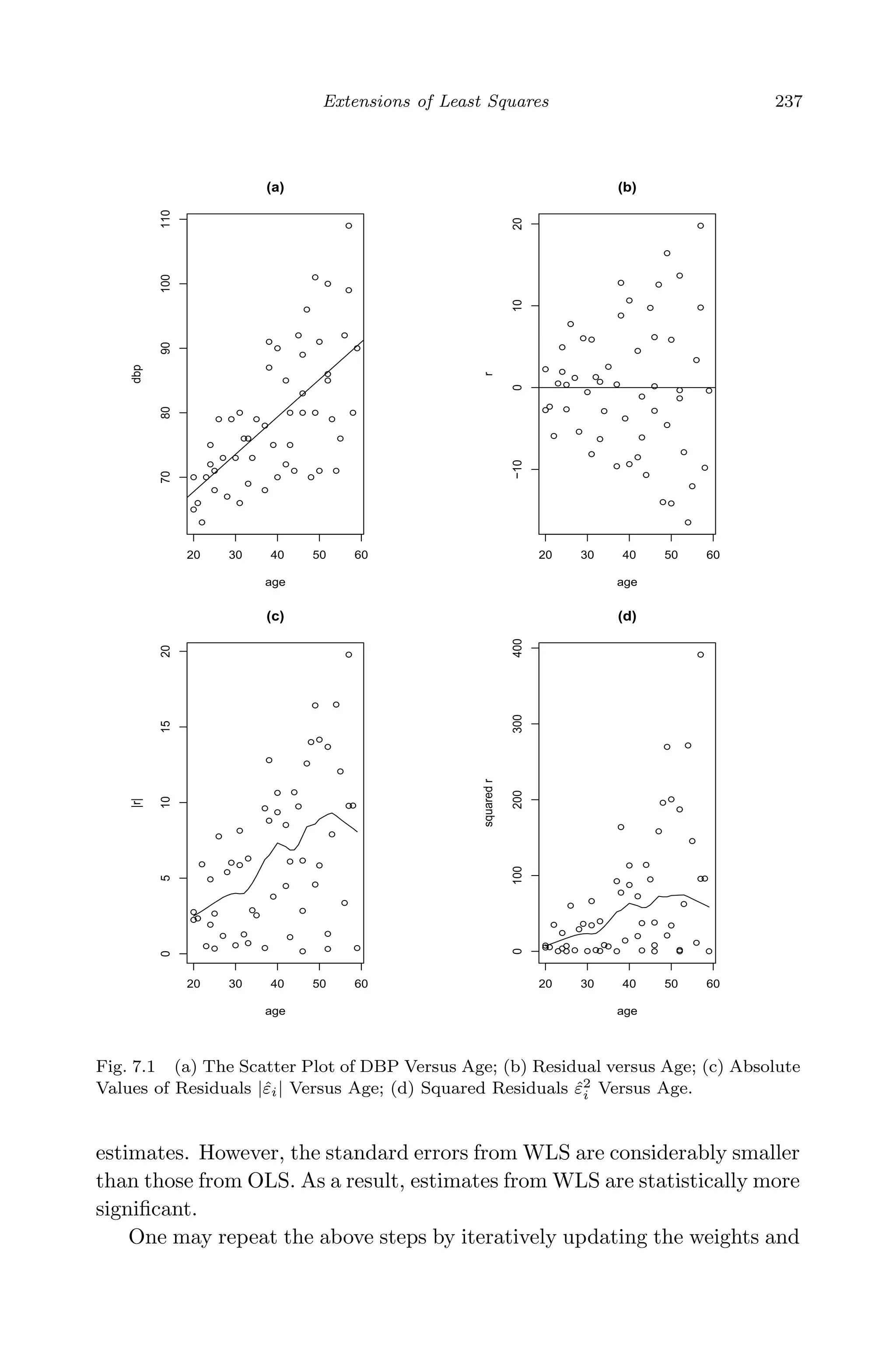
7.1 (a) The Scatter Plot of DBP Versus Age; (b) Residual ver-
sus Age; (c) Absolute Values of Residuals |ˆεi| Versus Age; (d)
Squared Residuals ˆε2
i Versus Age. . . . . . . . . . . . . . . . . . 237
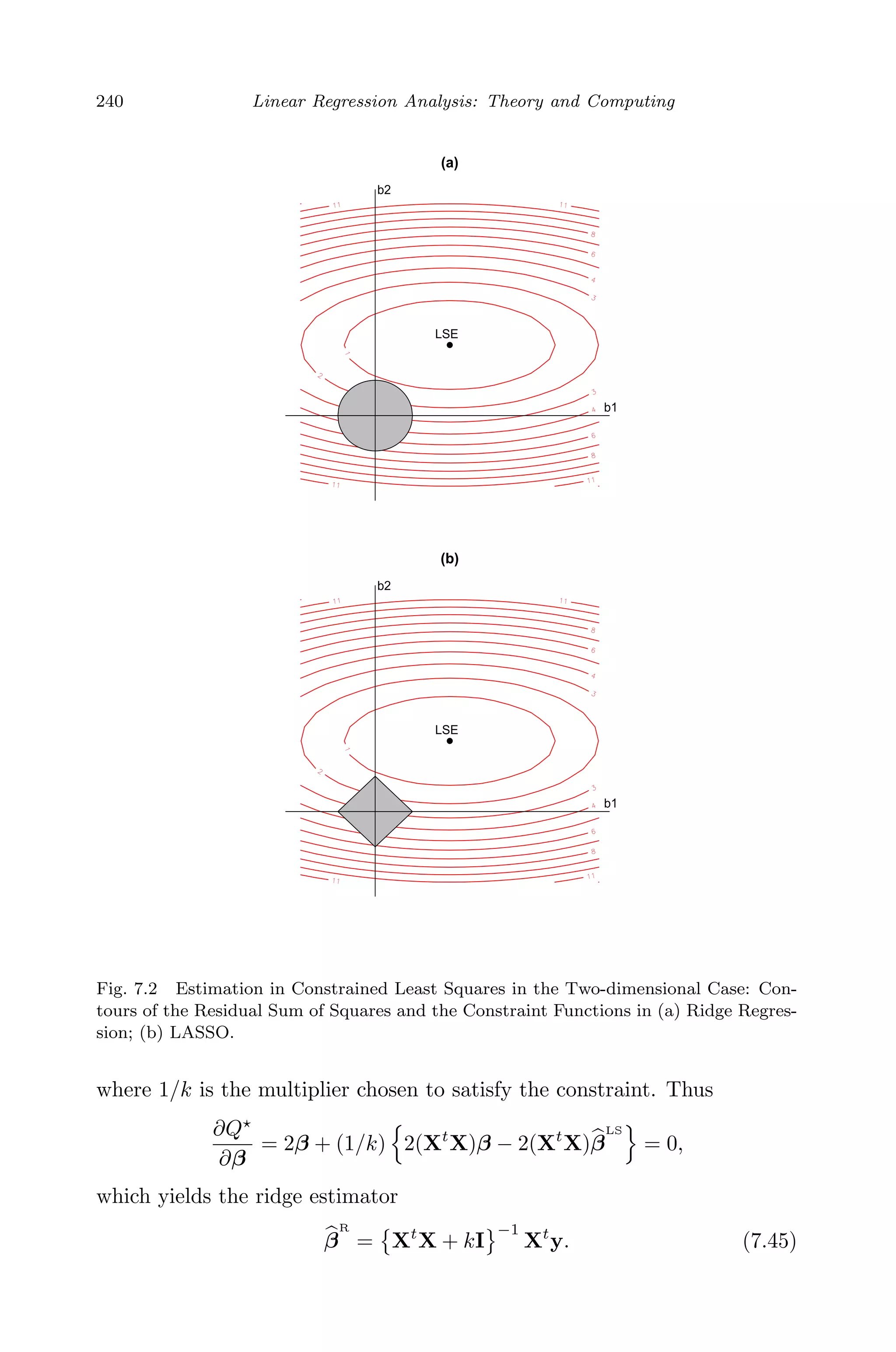
7.2 Estimation in Constrained Least Squares in the Two-
dimensional Case: Contours of the Residual Sum of Squares and
the Constraint Functions in (a) Ridge Regression; (b) LASSO. 240
7.3 Paired Scatter Plots for Longley’s (1967) Economic Data. . . . 251
7.4 Ridge Regression for Longley’s (1967) Economic Data: (a) Plot
of Parameter Estimates Versus s; (b) Plot of GCV Values Versus s.254
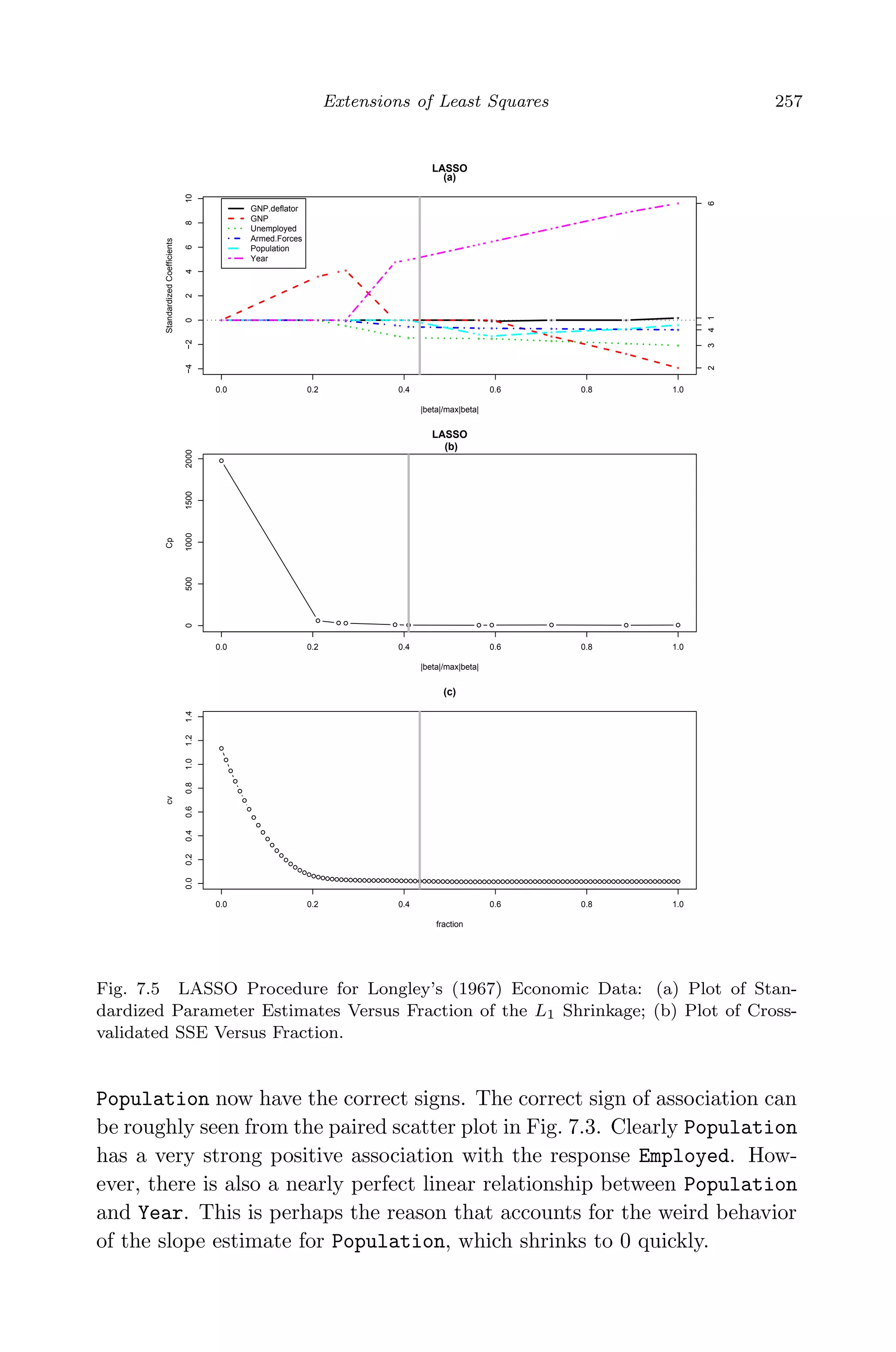
7.5 LASSO Procedure for Longley’s (1967) Economic Data: (a) Plot
of Standardized Parameter Estimates Versus Fraction of the L1
Shrinkage; (b) Plot of Cross-validated SSE Versus Fraction. . . 257
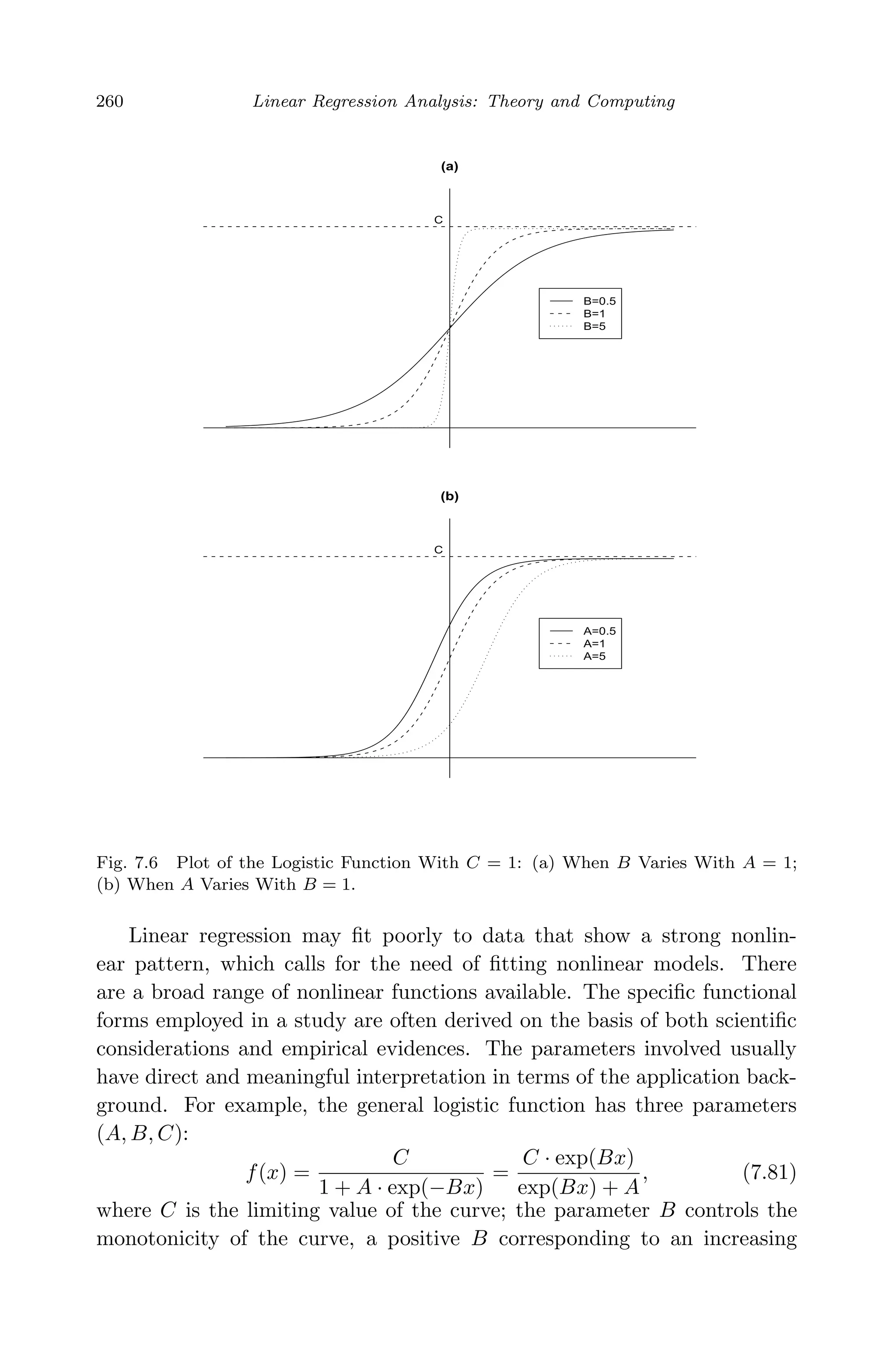
7.6 Plot of the Logistic Function With C = 1: (a) When B Varies
With A = 1; (b) When A Varies With B = 1. . . . . . . . . . . 260
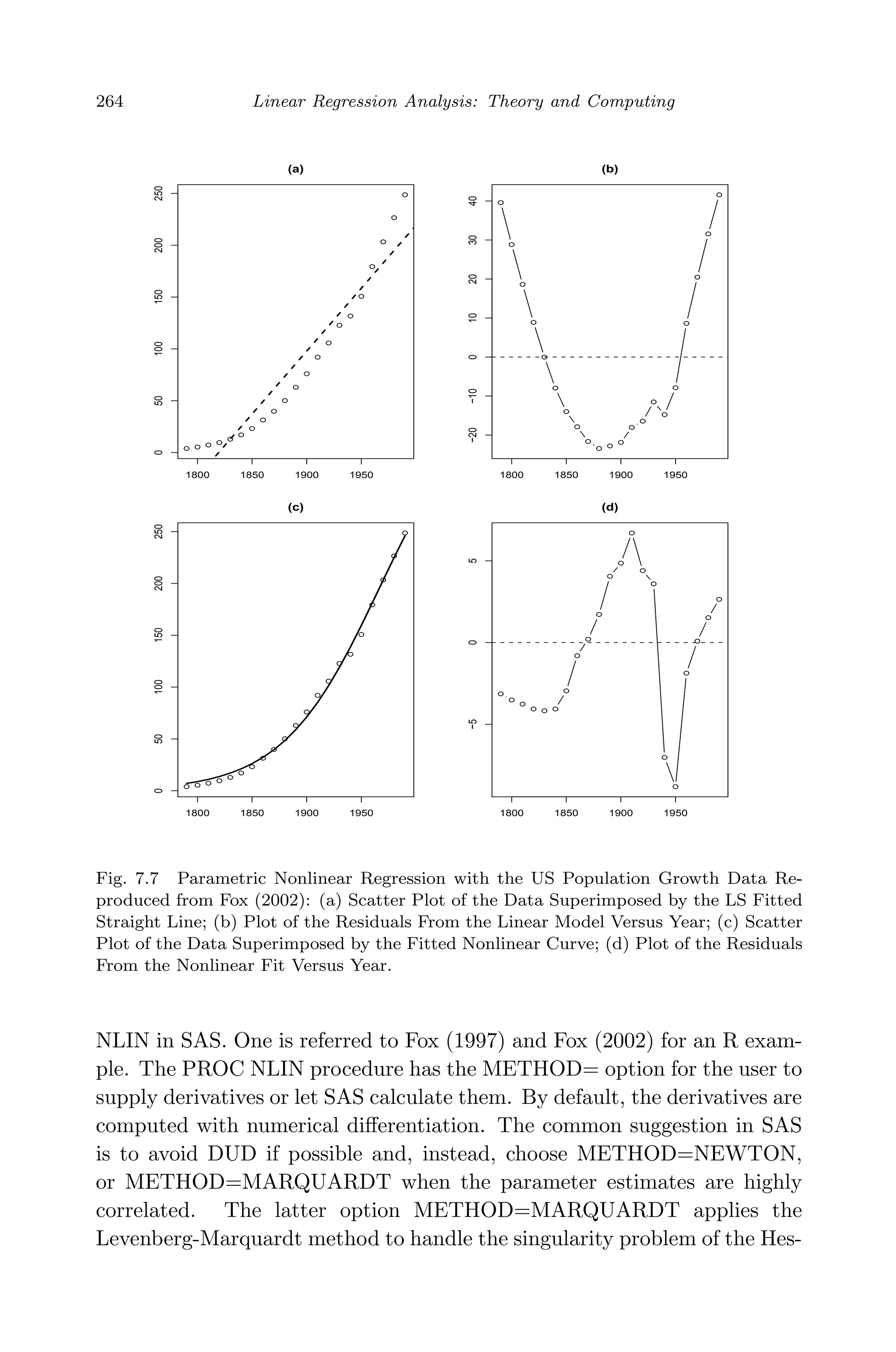
7.7 Parametric Nonlinear Regression with the US Population
Growth Data Reproduced from Fox (2002): (a) Scatter Plot
of the Data Superimposed by the LS Fitted Straight Line; (b)
Plot of the Residuals From the Linear Model Versus Year; (c)
Scatter Plot of the Data Superimposed by the Fitted Nonlinear
Curve; (d) Plot of the Residuals From the Nonlinear Fit Versus
Year. . . . . . . . . . . . . . . . . . . . . . . . . . . . . . . . . . 264
8.1 (a) Scatterplot of the CHD Data, Superimposed With the
Straight Line from Least Squares Fit; (b) Plot of the Percentage
of Subjects With CHD Within Each Age Group, Superimposed
by LOWESS Smoothed Curve. . . . . . . . . . . . . . . . . . . 270
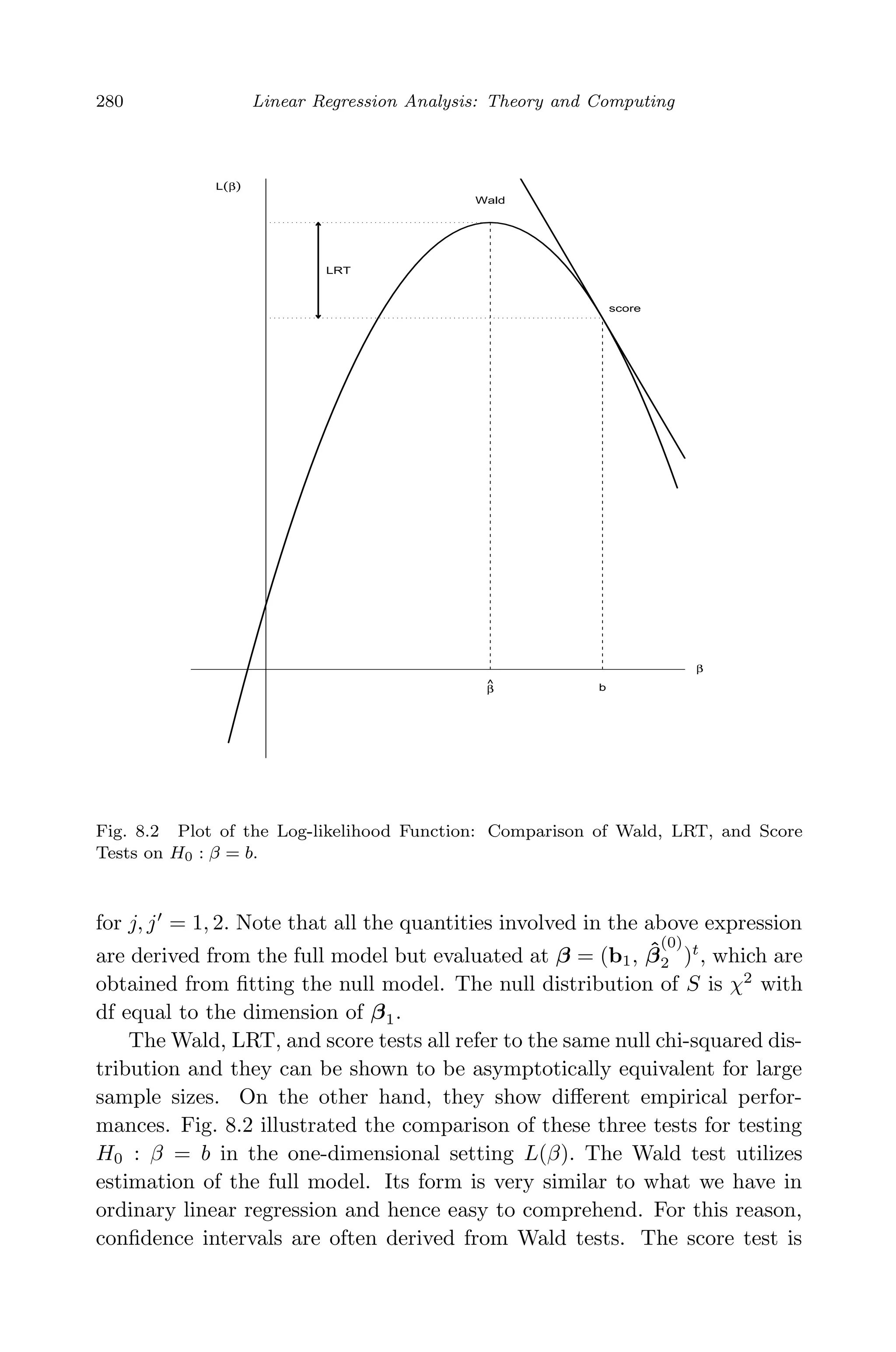
8.2 Plot of the Log-likelihood Function: Comparison of Wald, LRT,
and Score Tests on H0 : β = b. . . . . . . . . . . . . . . . . . . 280
9.1 Posterior Marginal Densities of (β, σ2
): Bayesian Linear Regres-
sion for Shingle Data. . . . . . . . . . . . . . . . . . . . . . . . 308
9.2 Posterior Densities for Predicting yp: the Shingle Data. . . . . 309
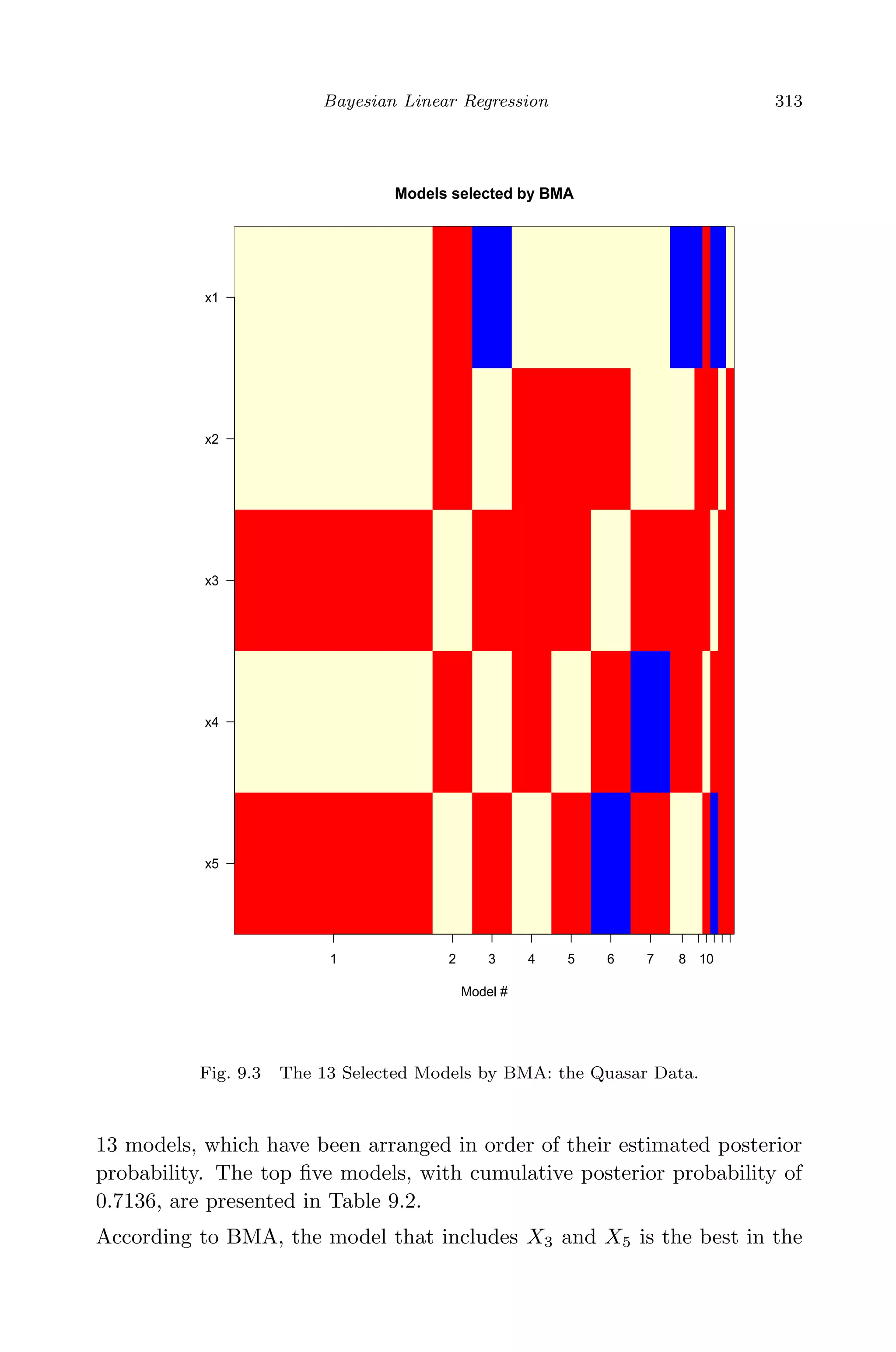
9.3 The 13 Selected Models by BMA: the Quasar Data. . . . . . . 313
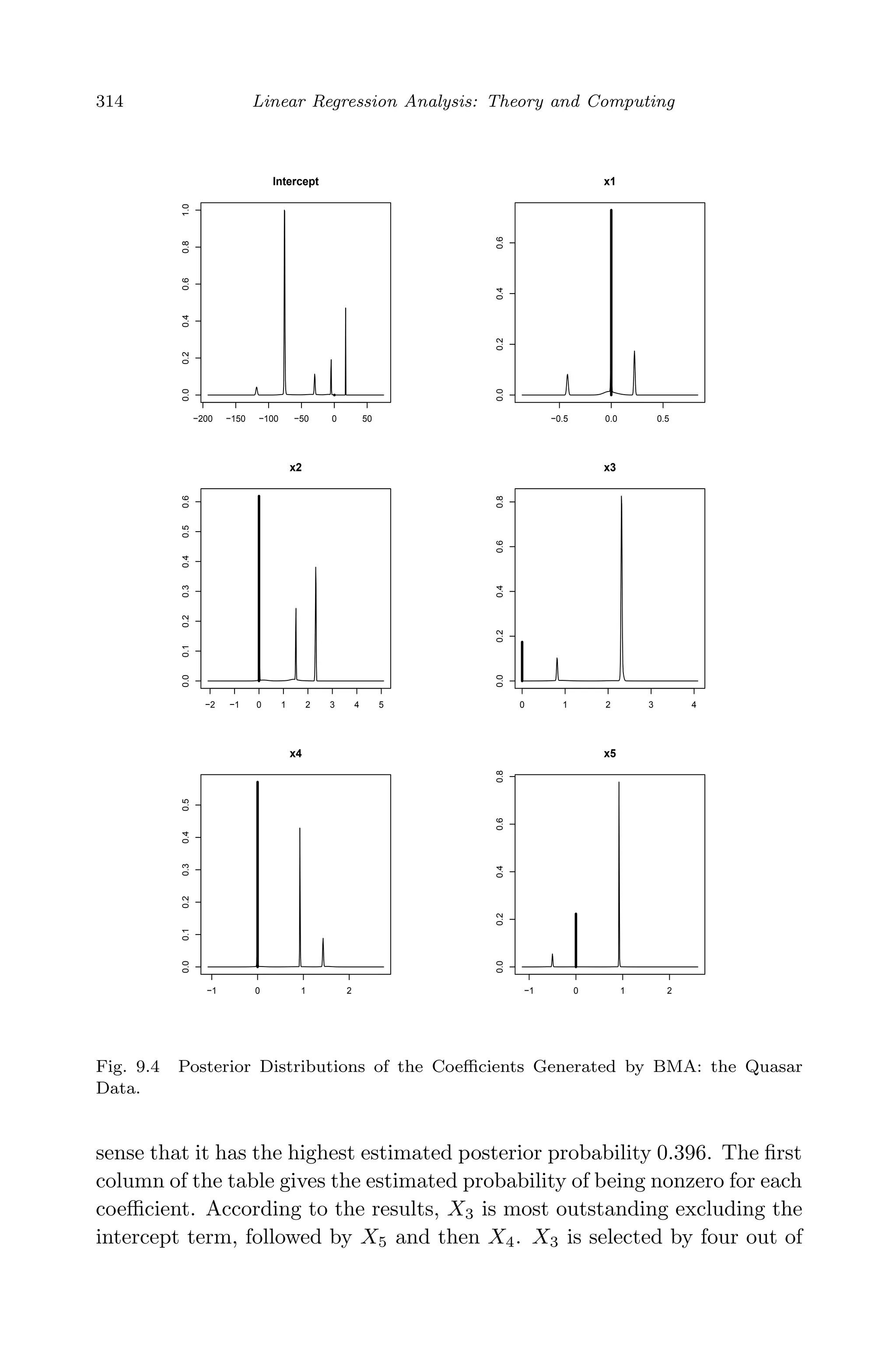
9.4 Posterior Distributions of the Coefficients Generated by BMA:
the Quasar Data. . . . . . . . . . . . . . . . . . . . . . . . . . . 314
April 29, 2009 11:50 World Scientific Book - 9in x 6in Regression˙master
List of Tables
1.1 Smoking and Mortality Data . . . . . . . . . . . . . . . . . . . 1
2.1 Parent’s Height and Children’s Height . . . . . . . . . . . . . . 9
2.2 Degrees of Freedom in Partition of Total Variance . . . . . . . 22
2.3 Distributions of Partition of Total Variance . . . . . . . . . . . 23
2.4 ANOVA Table 1 . . . . . . . . . . . . . . . . . . . . . . . . . . 23
2.5 Confidence Intervals on Parameter Estimates . . . . . . . . . . 29
2.6 ANOVA Table 2 . . . . . . . . . . . . . . . . . . . . . . . . . . 30
2.7 Regression Table . . . . . . . . . . . . . . . . . . . . . . . . . . 30
2.8 Parameter Estimates of Simple Linear Regression . . . . . . . . 30
2.9 Table for Fitted Values and Residuals . . . . . . . . . . . . . . 31
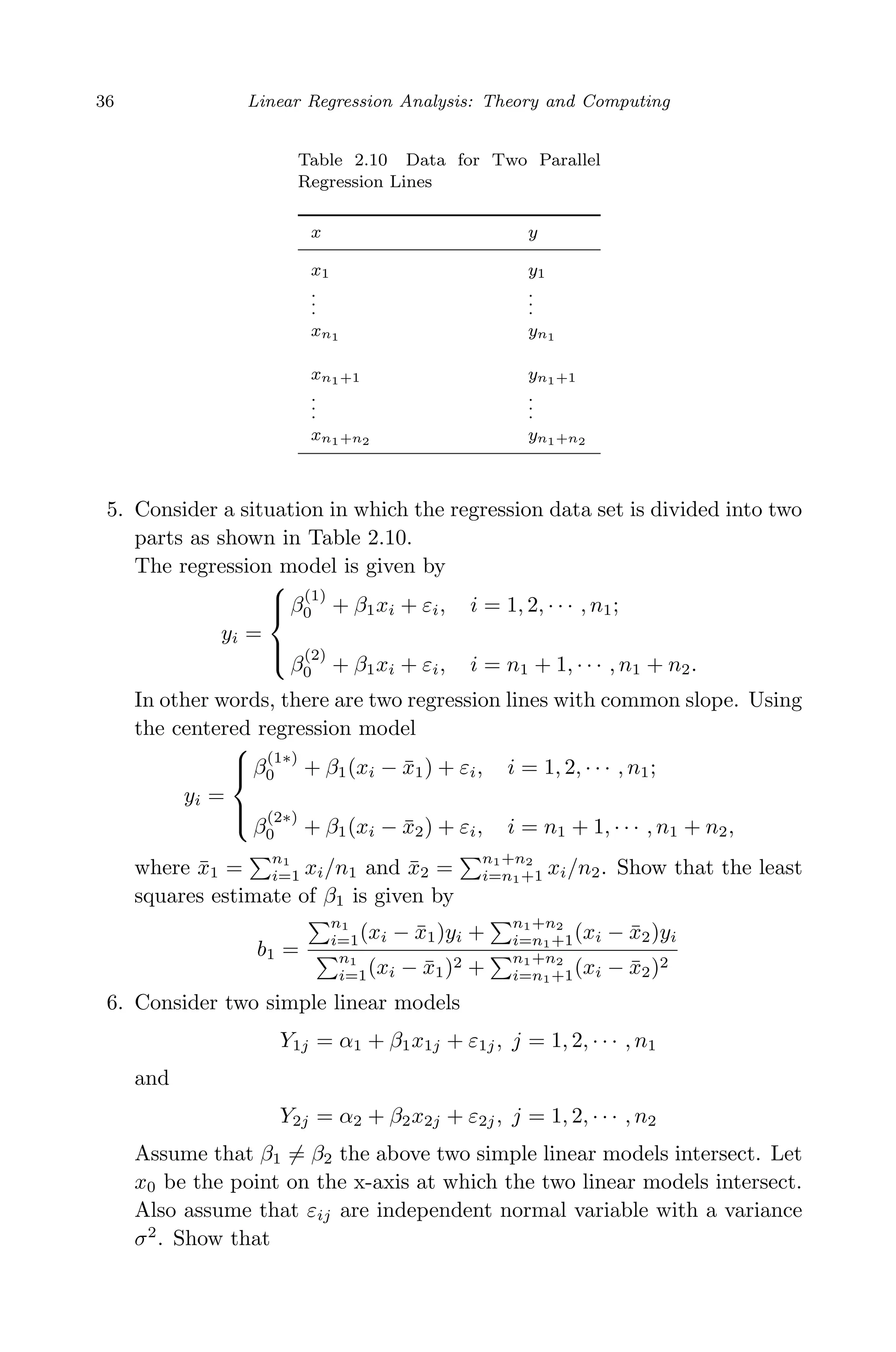
2.10 Data for Two Parallel Regression Lines . . . . . . . . . . . . . 36
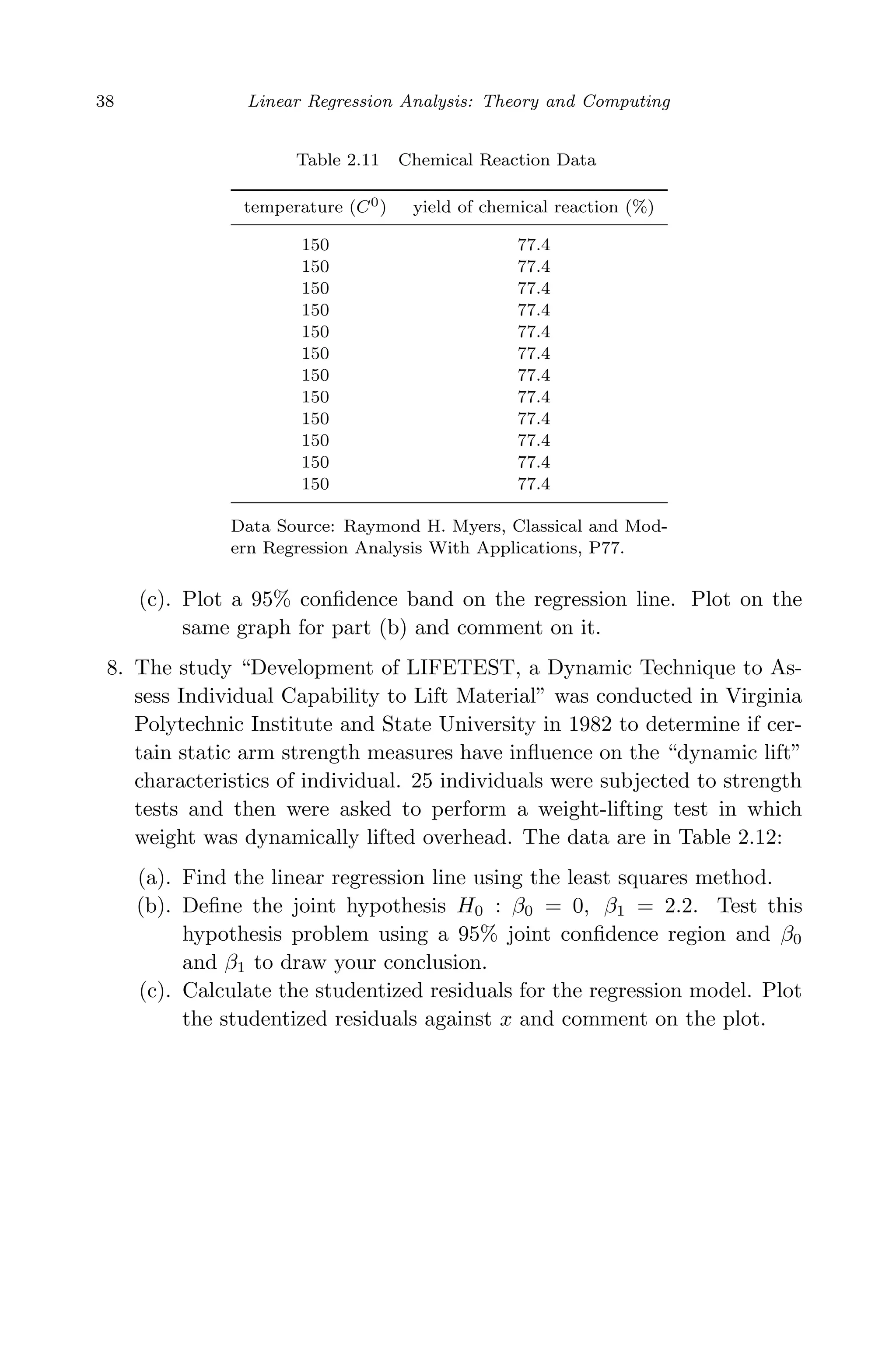
2.11 Chemical Reaction Data . . . . . . . . . . . . . . . . . . . . . 38
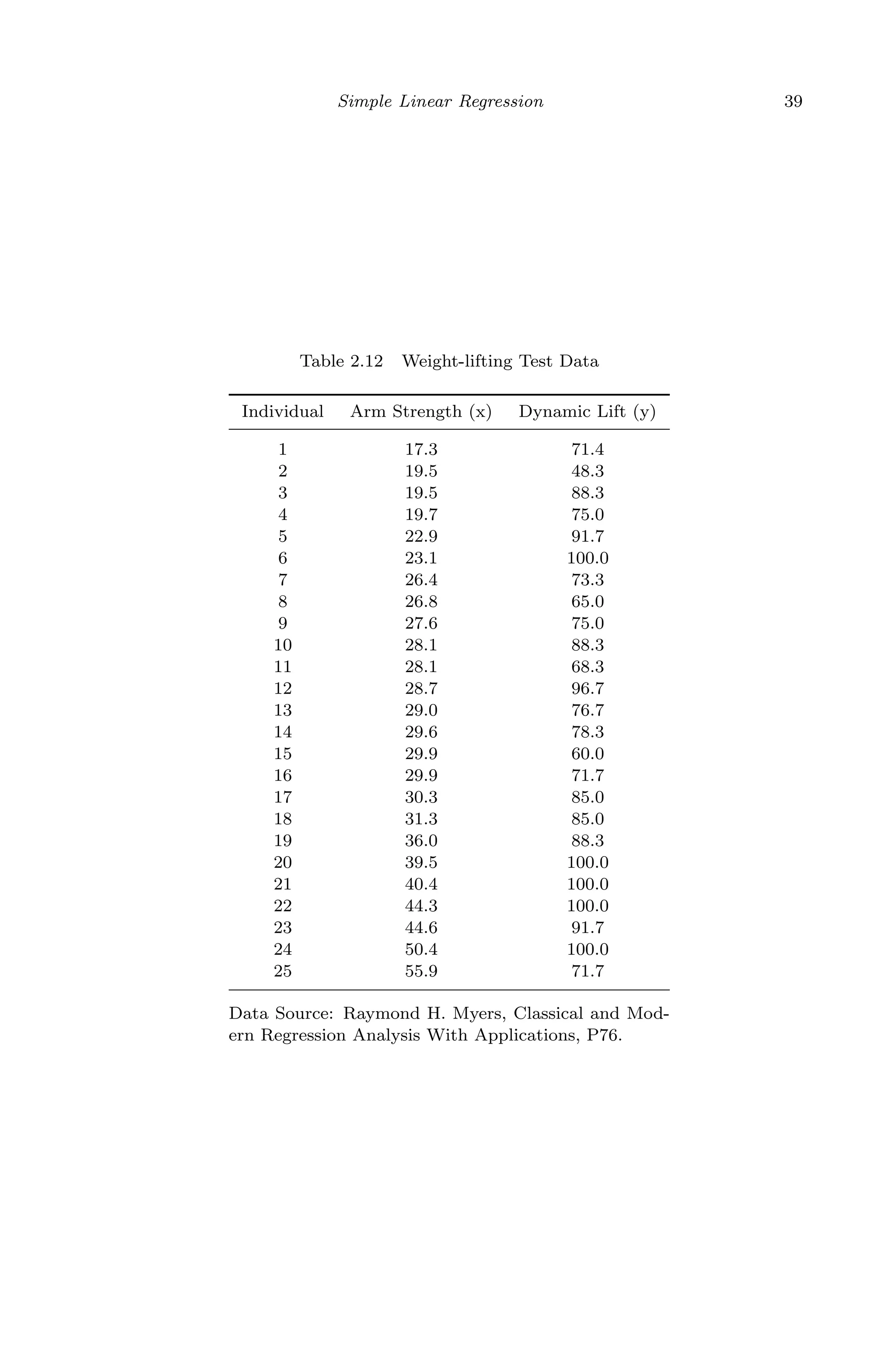
2.12 Weight-lifting Test Data . . . . . . . . . . . . . . . . . . . . . . 39
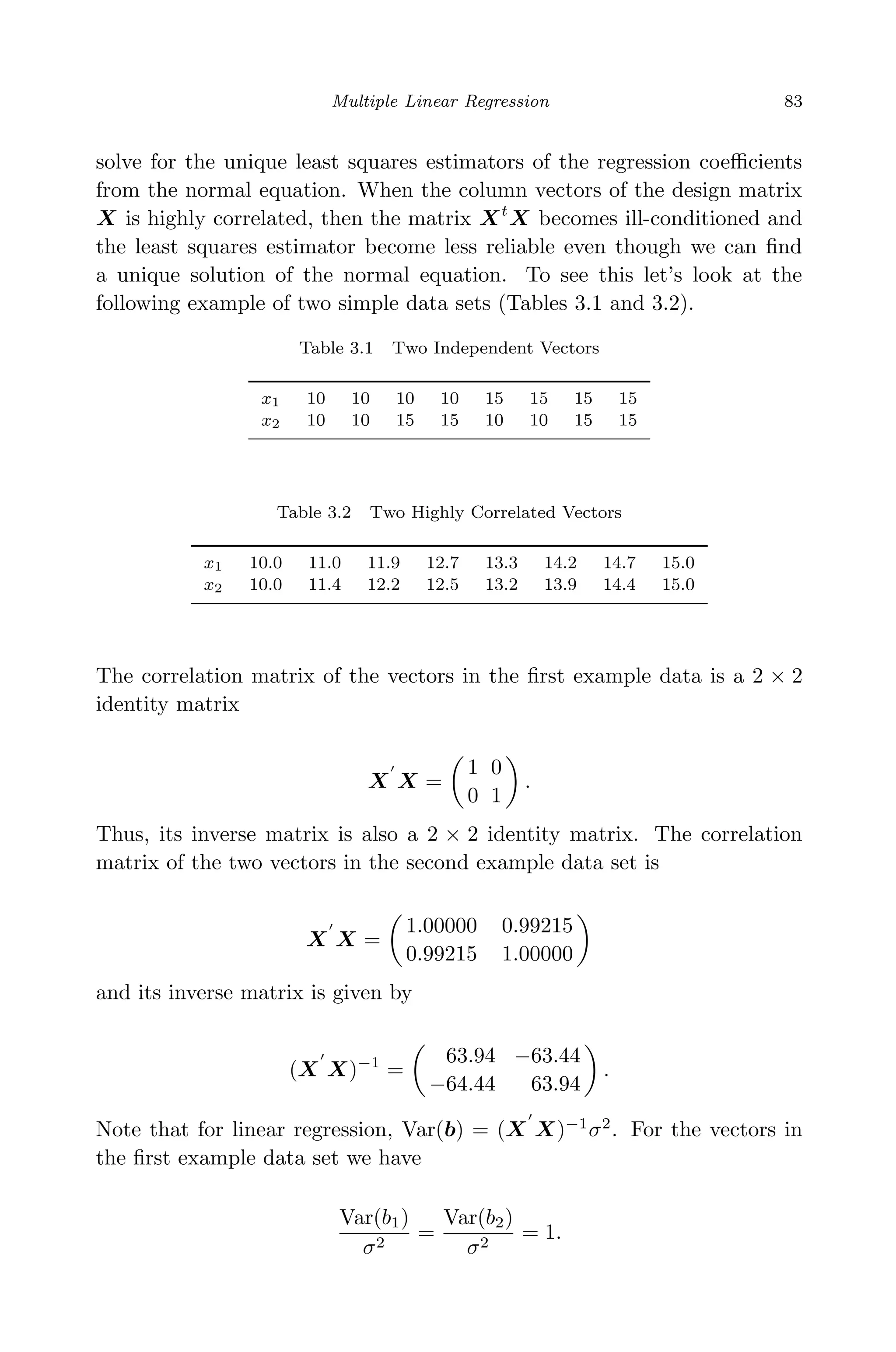
3.1 Two Independent Vectors . . . . . . . . . . . . . . . . . . . . . 83
3.2 Two Highly Correlated Vectors . . . . . . . . . . . . . . . . . . 83
3.3 Correlation Matrix for Variables x1, x2, · · · , x5 . . . . . . . . . 88
3.4 Parameter Estimates and Variance Inflation . . . . . . . . . . . 88
3.5 Correlation Matrix after Deleting Variable x1 . . . . . . . . . . 88
3.6 Variance Inflation after Deleting x1 . . . . . . . . . . . . . . . . 88
3.7 United States Population Data (in Millions) . . . . . . . . . . . 97
3.8 Parameter Estimates for Model Population=Year . . . . . . . . 99
3.9 Parameter Estimates for Model Population=Year+Year2
. . . . 99
3.10 Parameter Estimates for Regression Model Population=β0 +β1
Year+ β2 Year2
+z . . . . . . . . . . . . . . . . . . . . . . . . . 101
3.11 Coal-cleansing Data . . . . . . . . . . . . . . . . . . . . . . . . 109
xvii
April 29, 2009 11:50 World Scientific Book - 9in x 6in Regression˙master
xviii Linear Regression Analysis: Theory and Computing
3.12 Parameter Estimates for Regression Model for Coal-Cleansing
Data . . . . . . . . . . . . . . . . . . . . . . . . . . . . . . . . . 109
3.13 Residuals . . . . . . . . . . . . . . . . . . . . . . . . . . . . . . 110
3.14 Manpower Data . . . . . . . . . . . . . . . . . . . . . . . . . . 111
3.15 Simultaneous Outlier Detection . . . . . . . . . . . . . . . . . . 113
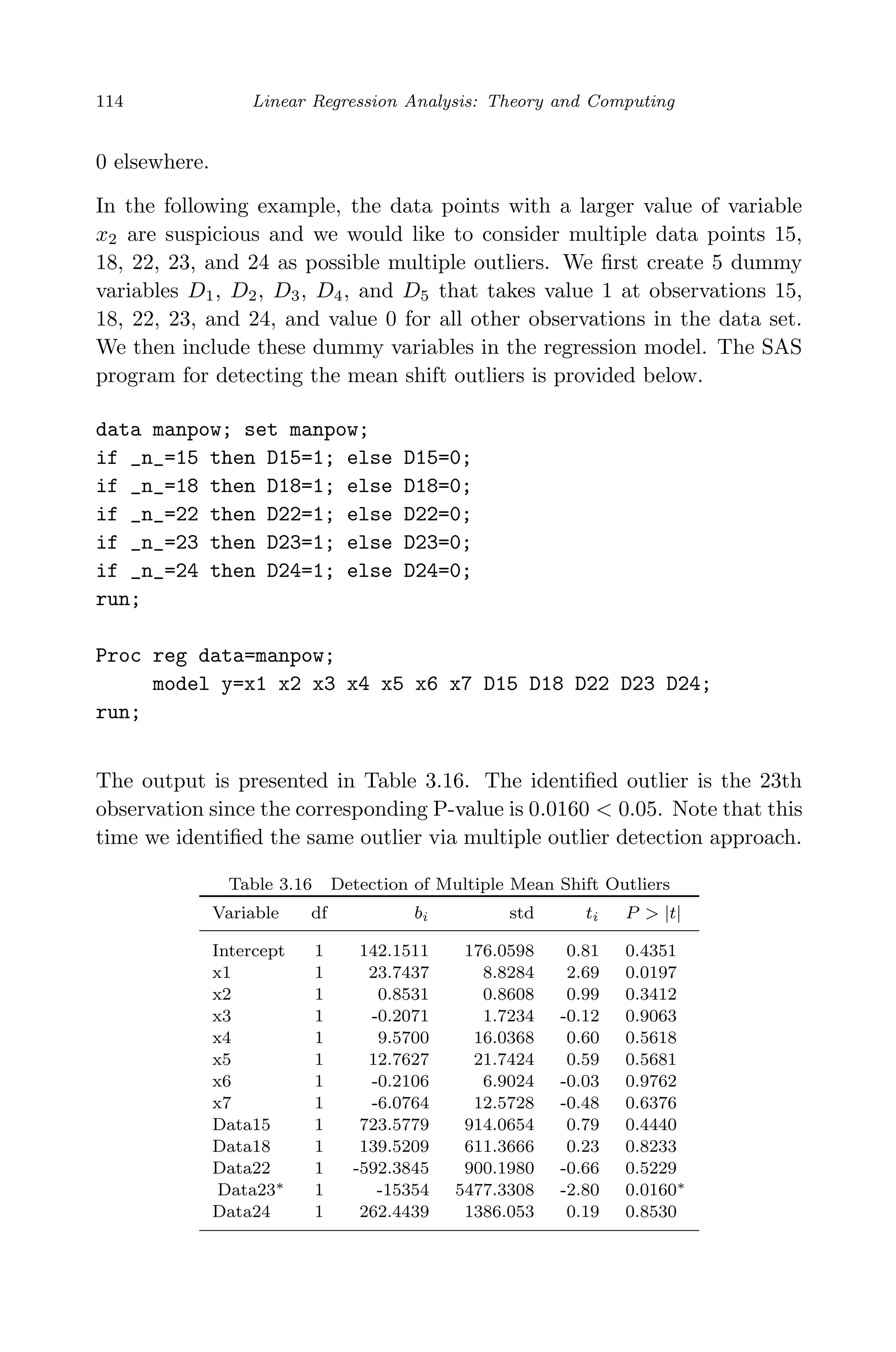
3.16 Detection of Multiple Mean Shift Outliers . . . . . . . . . . . . 114
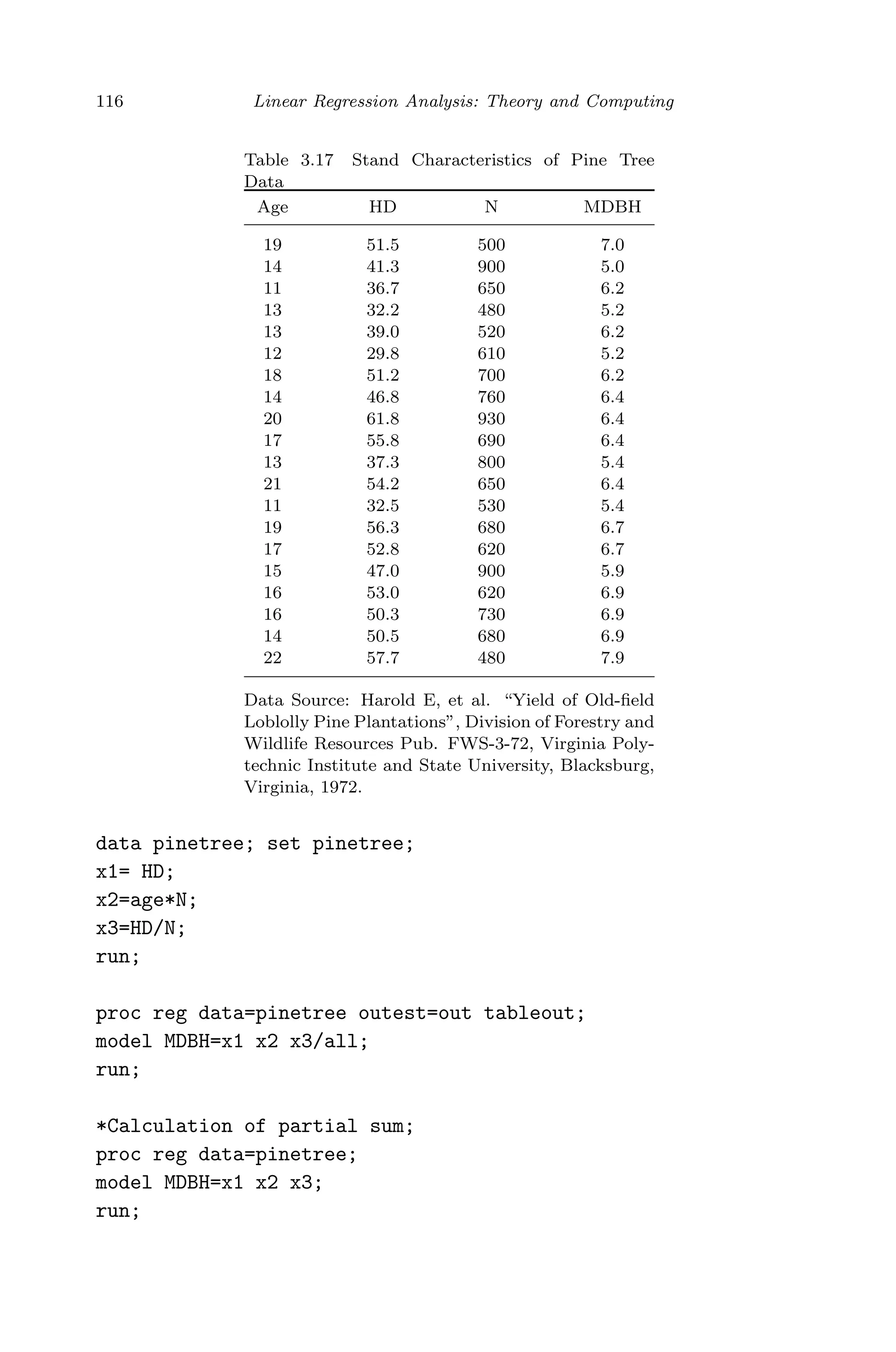
3.17 Stand Characteristics of Pine Tree Data . . . . . . . . . . . . . 116
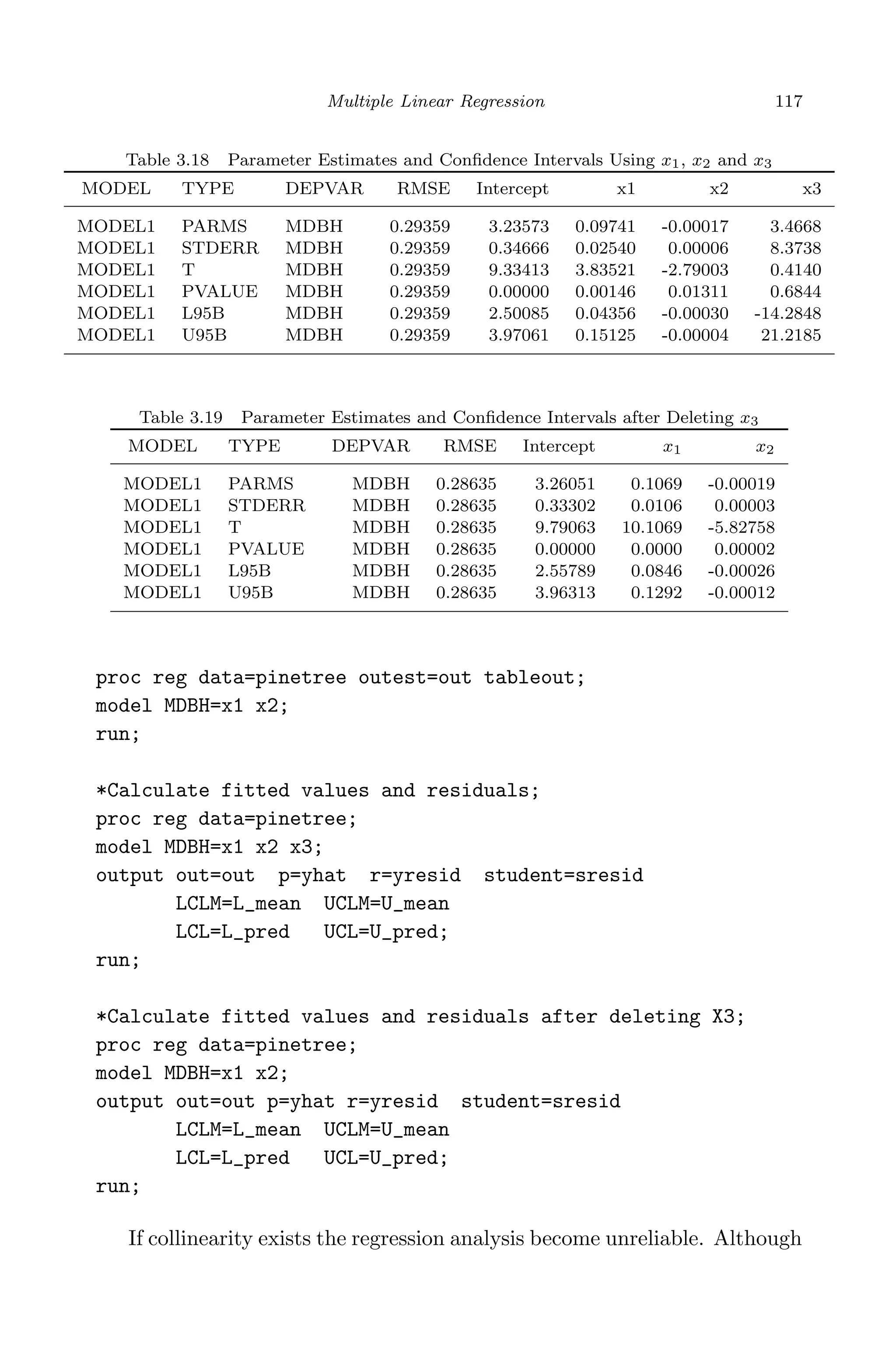
3.18 Parameter Estimates and Confidence Intervals Using x1, x2 and
x3 . . . . . . . . . . . . . . . . . . . . . . . . . . . . . . . . . . 117
3.19 Parameter Estimates and Confidence Intervals after Deleting x3 117
3.20 Confidence Intervals on Regression Mean and Prediction With-
out Deletion . . . . . . . . . . . . . . . . . . . . . . . . . . . . . 118
3.21 Confidence Intervals on Regression Mean and Prediction After
Deleting x3 . . . . . . . . . . . . . . . . . . . . . . . . . . . . . 118
3.22 Regression Model for Centralized Data . . . . . . . . . . . . . . 119
3.23 Test for Equal Slope Among 3 Groups . . . . . . . . . . . . . . 121
3.24 Regression by Group . . . . . . . . . . . . . . . . . . . . . . . . 121
3.25 Data Set for Calculation of Confidence Interval on Regression
Prediction . . . . . . . . . . . . . . . . . . . . . . . . . . . . . . 123
3.26 Propellant Grain Data . . . . . . . . . . . . . . . . . . . . . . . 124
3.27 Data Set for Testing Linear Hypothesis . . . . . . . . . . . . . 124
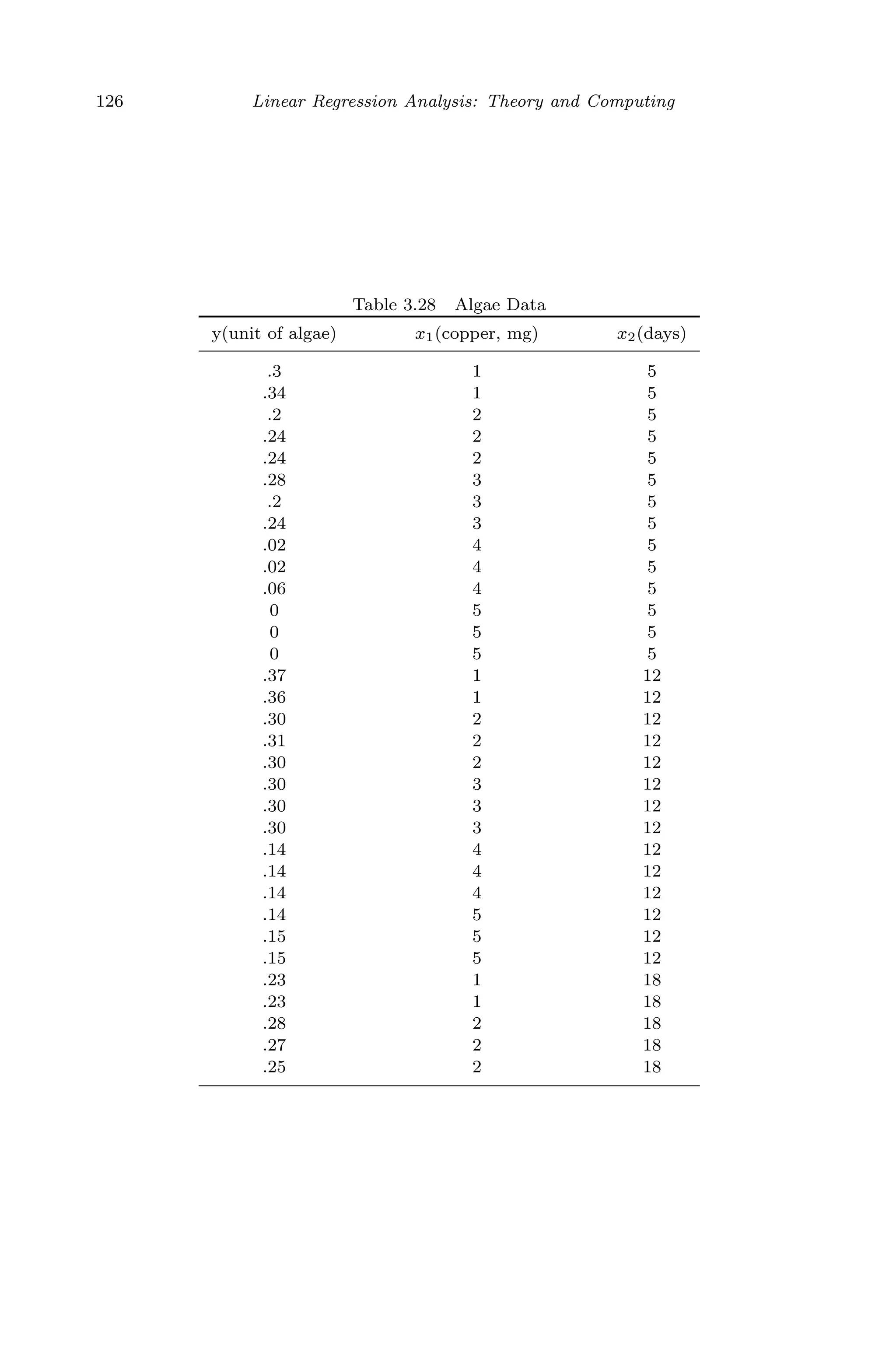
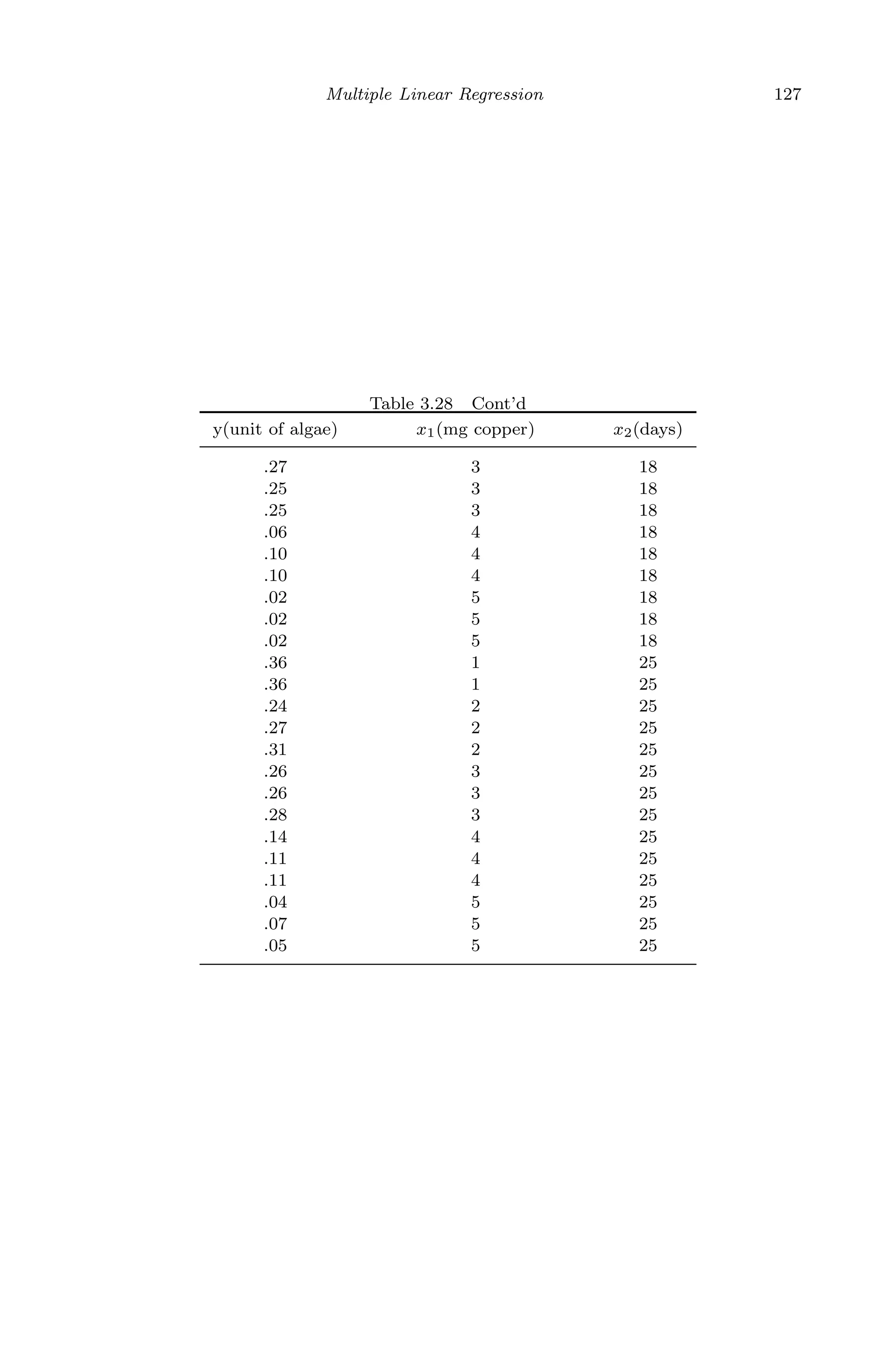
3.28 Algae Data . . . . . . . . . . . . . . . . . . . . . . . . . . . . . 126
4.1 Coal-cleansing Data . . . . . . . . . . . . . . . . . . . . . . . . 141
4.2 Parameter Estimates for y = b0 + b1x1 + b2x2 + b3x3 . . . . . . 141
4.3 Residuals, Leverage, and ti . . . . . . . . . . . . . . . . . . . . 142
4.4 Navy Manpower Data . . . . . . . . . . . . . . . . . . . . . . . 144
4.5 Residuals for Model With Regressors x1 and x2 . . . . . . . . . 146
4.6 Residuals for Model With Regressors x
1
3
1 and x2 . . . . . . . . 146
4.7 Sales Data for Asphalt Shingles . . . . . . . . . . . . . . . . . . 151
4.8 Values of PRESS Statistic for Various Regression Models . . . 152
4.9 PRESS Residuals and Leverages for Models Including x1, x2
(press12, h12) and Including x1, x2, x3 (press123, h123) . . . . 153
4.10 Data Set for Multiple Mean Shift Outliers . . . . . . . . . . . 154
4.11 Fish Biomass Data . . . . . . . . . . . . . . . . . . . . . . . . . 155
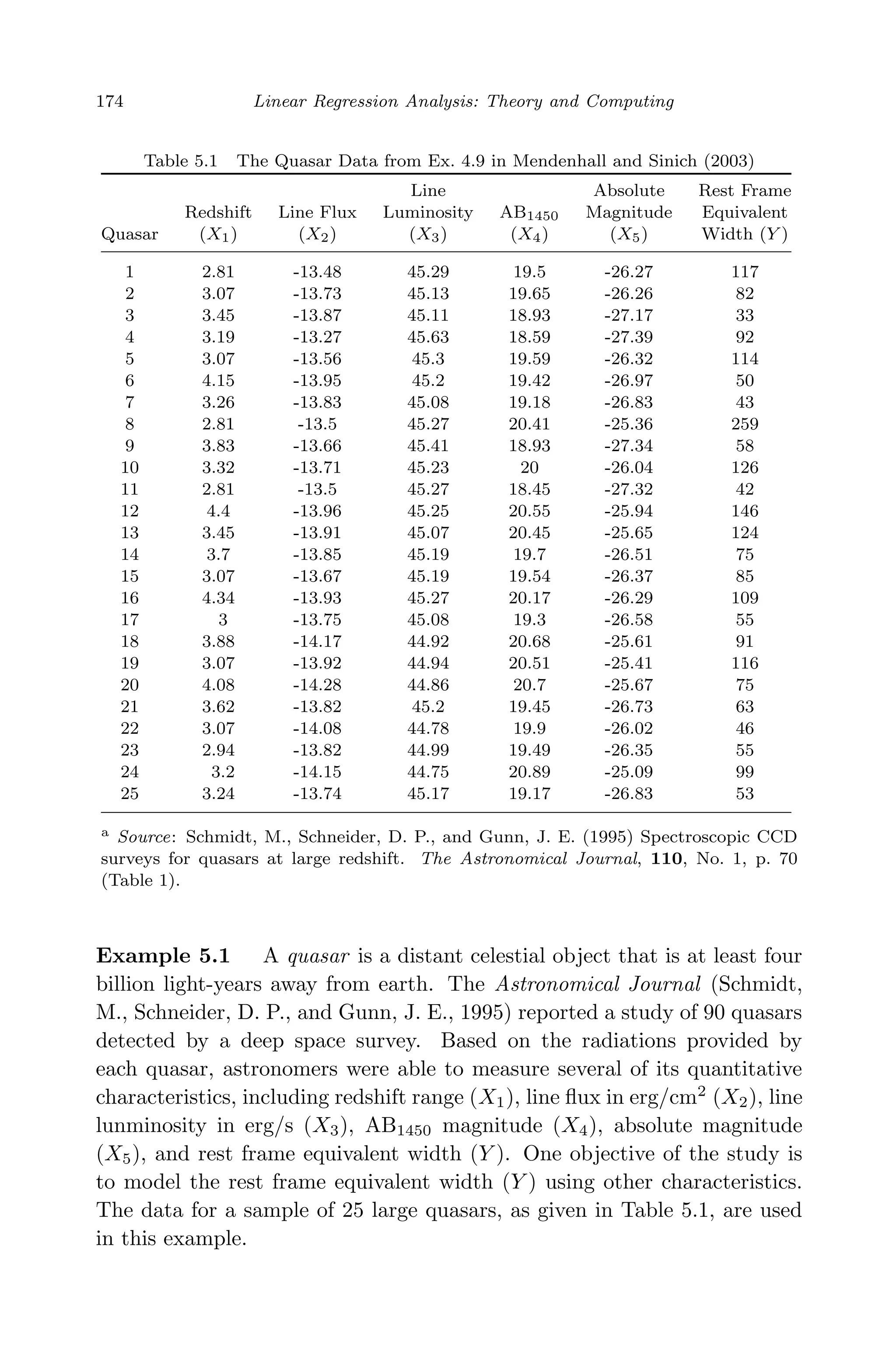
5.1 The Quasar Data from Ex. 4.9 in Mendenhall and Sinich (2003) 174
5.2 All Possible Regression Selection for the Quasar Data. . . . . . 175
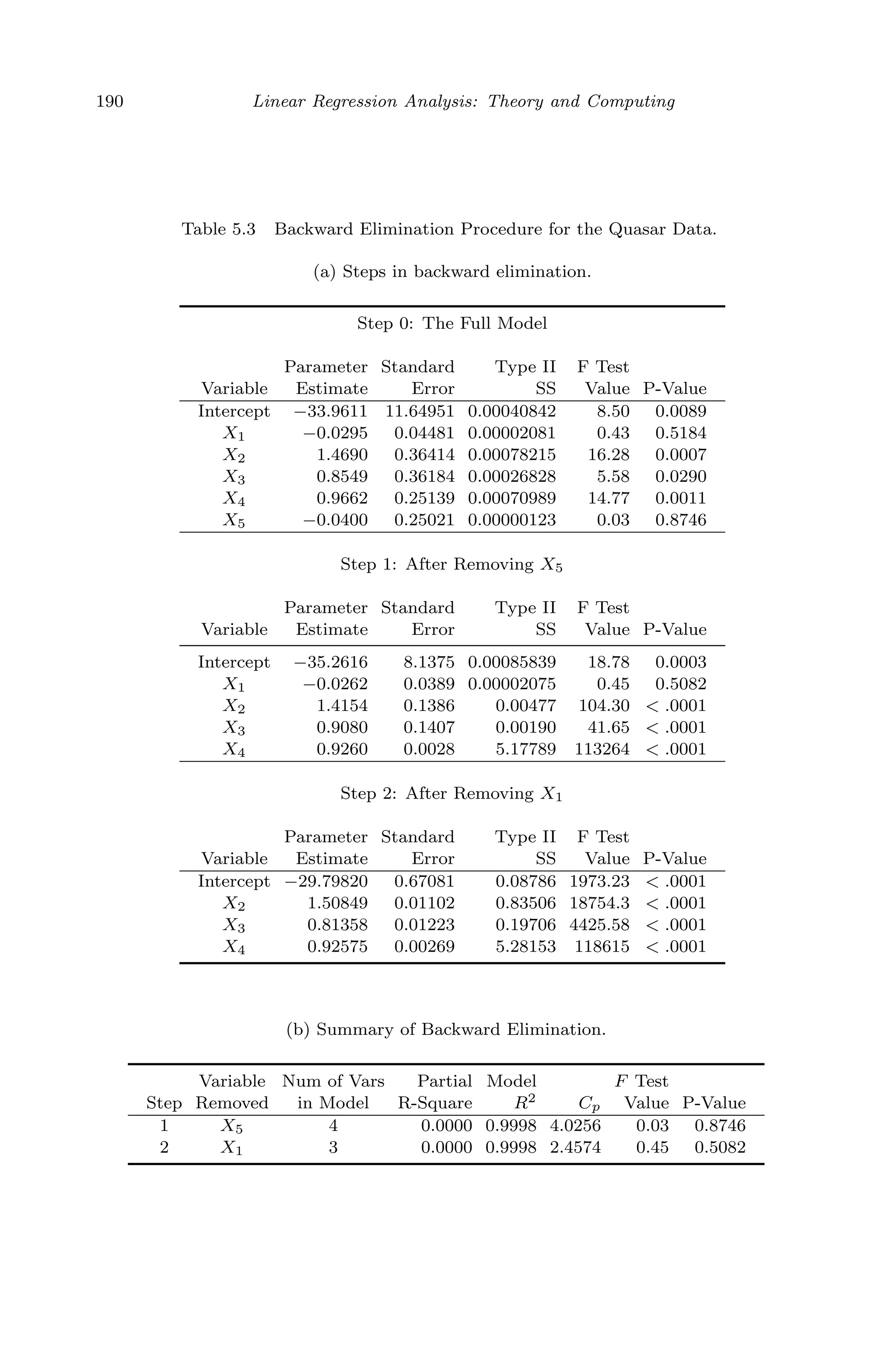
5.3 Backward Elimination Procedure for the Quasar Data. . . . . . 190
April 29, 2009 11:50 World Scientific Book - 9in x 6in Regression˙master
List of Tables xix
5.4 Forward Addition Procedure for the Quasar Data. . . . . . . . 191
5.5 The Clerical Data from Ex. 6.4 in Mendenhall and Sinich (2003) 192
5.6 Backward Elimination Results for the Clerical Data. . . . . . . 193
5.7 Results of a Simulated Example for Inspecting Overall Signifi-
cance in Stepwise Selection . . . . . . . . . . . . . . . . . . . . 193
5.8 Female Teachers Effectiveness Data . . . . . . . . . . . . . . . . 194
5.9 All-subset-regression for Female Teacher Effectiveness Data . . 194
6.1 Results of Efficiency Tests . . . . . . . . . . . . . . . . . . . . . 216
7.1 Layouts for Data Collected in One-way ANOVA Experiments. 220
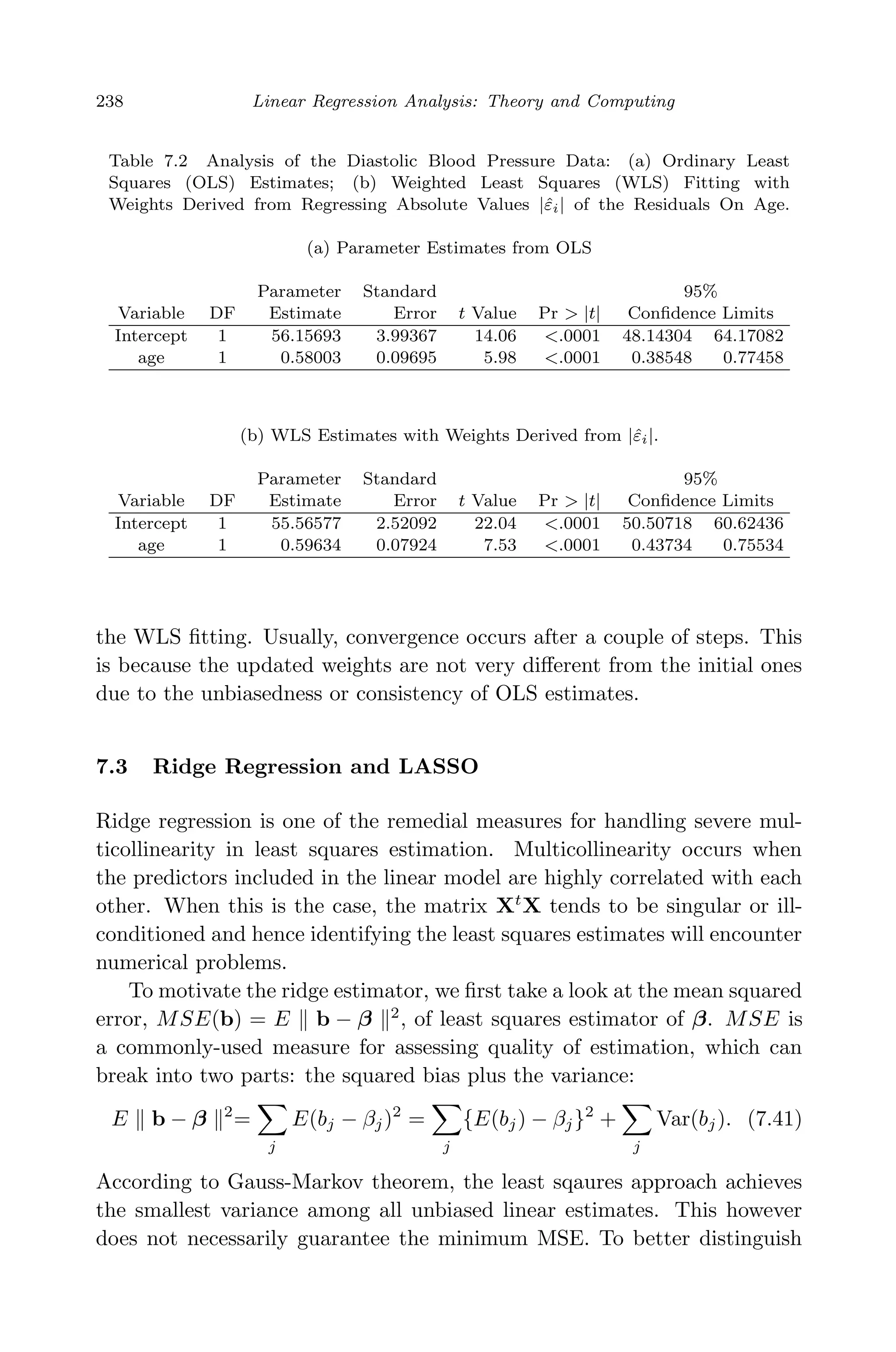
7.2 Analysis of the Diastolic Blood Pressure Data: (a) Ordinary
Least Squares (OLS) Estimates; (b) Weighted Least Squares
(WLS) Fitting with Weights Derived from Regressing Absolute
Values |ˆεi| of the Residuals On Age. . . . . . . . . . . . . . . . 238
7.3 The Macroeconomic Data Set in Longley (1967). . . . . . . . . 249
7.4 Variable Description for Longley’s (1967) Macroeconomic Data. 250
7.5 Least Squares Results for Longley’s (1967) Economic Data. . . 252
7.6 Ridge Regression and LASSO for Longley’s (1967) Data. . . . . 255
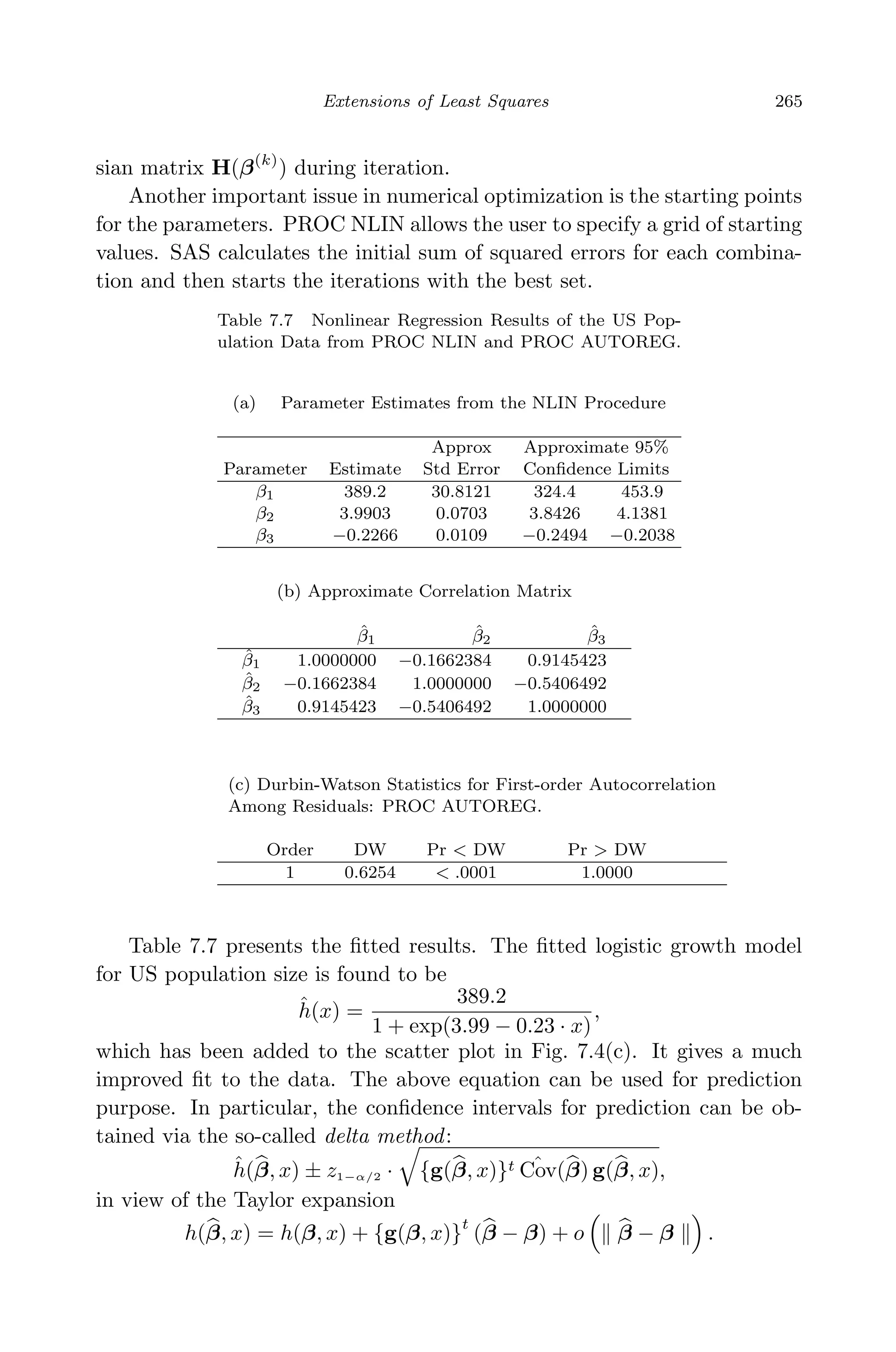
7.7 Nonlinear Regression Results of the US Population Data from
PROC NLIN and PROC AUTOREG. . . . . . . . . . . . . . . 265
8.1 Frequency Table of AGE Group by CHD. . . . . . . . . . . . . 271
8.2 Variable Description for the Kyphosis Data: Logistic Regression
Example. . . . . . . . . . . . . . . . . . . . . . . . . . . . . . . 285
8.3 Analysis Results for the Kyphosis Data from PROC LOGISTIC. 286
8.4 Variable Description for the Log-Linear Regression Example. . 288
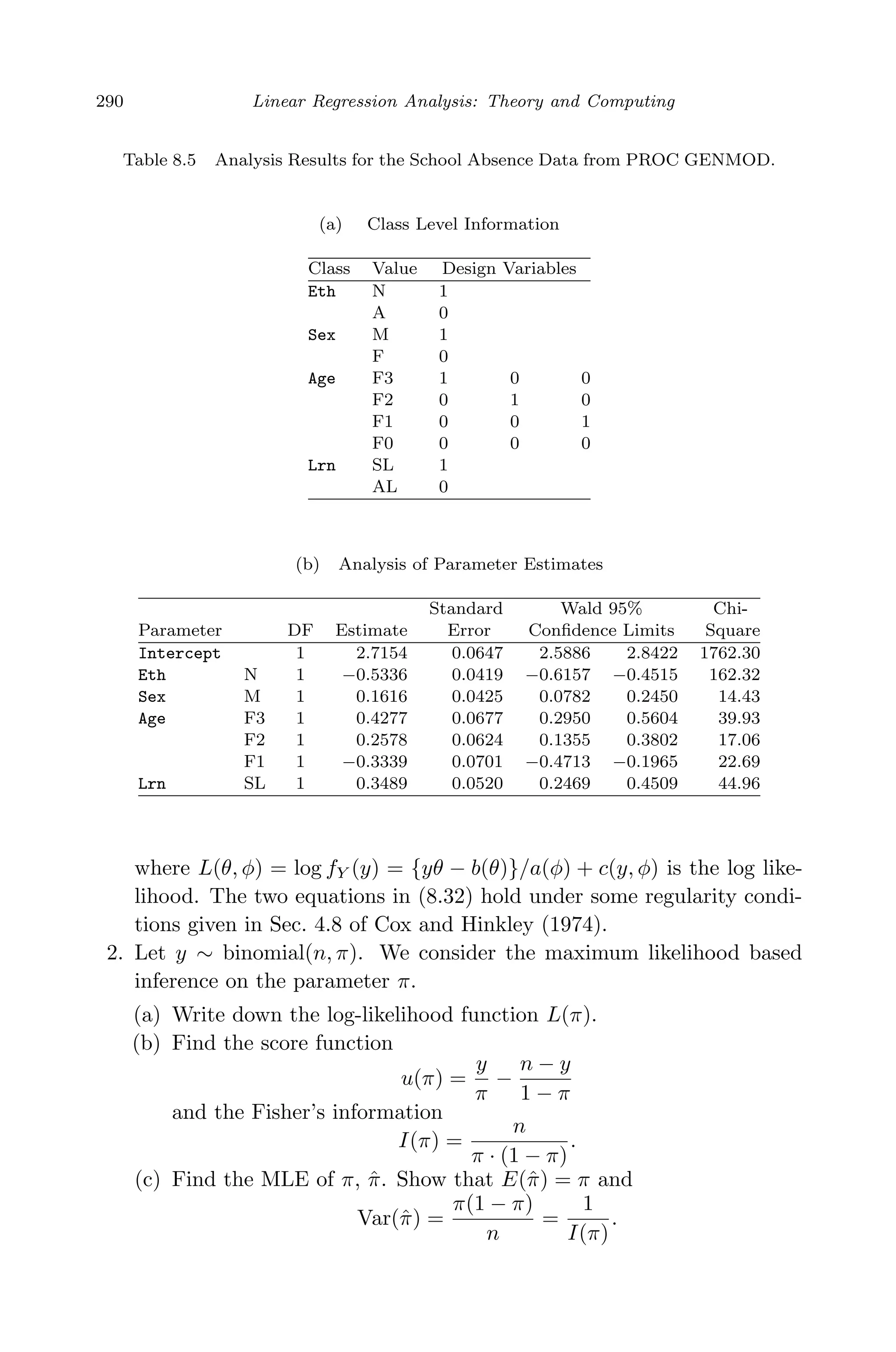
8.5 Analysis Results for the School Absence Data from PROC GEN-
MOD. . . . . . . . . . . . . . . . . . . . . . . . . . . . . . . . . 290
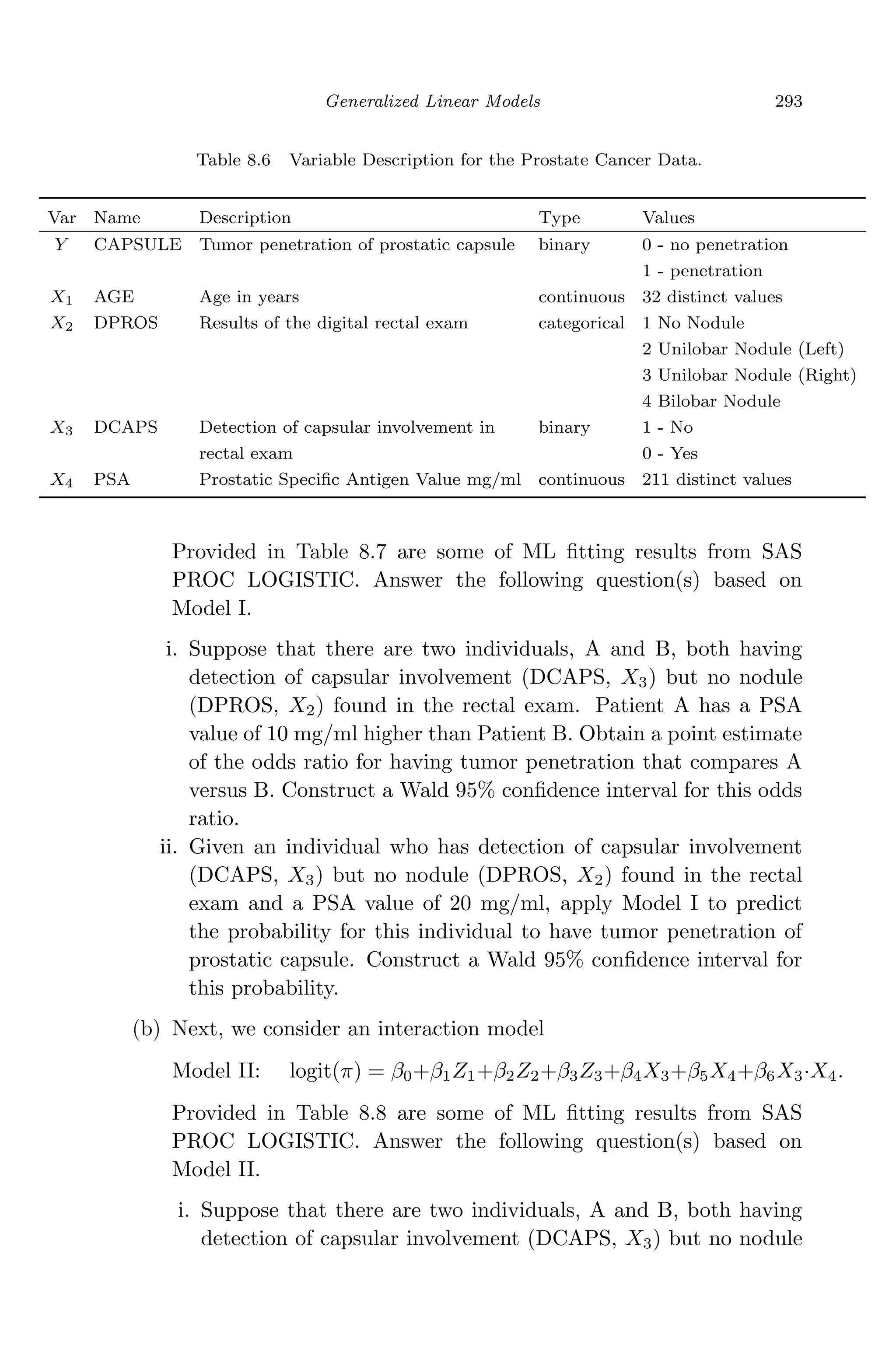
8.6 Variable Description for the Prostate Cancer Data. . . . . . . . 293
8.7 Table of Parameter Estimates and the Estimated Covariance
Matrix for Model I: the Prostate Cancer Data. . . . . . . . . . 294
8.8 Table of Parameter Estimates and the Estimated Covariance
Matrix for Model II: the Prostate Cancer Data. 295
8.9 The Maximized Loglikelihood Scores for Several Fitted Models
with the Prostate Cancer Data. . . . . . . . . . . . . . . . . . 295
9.1 Bayesian Linear Regression Results With the Shingle Data. . . 307
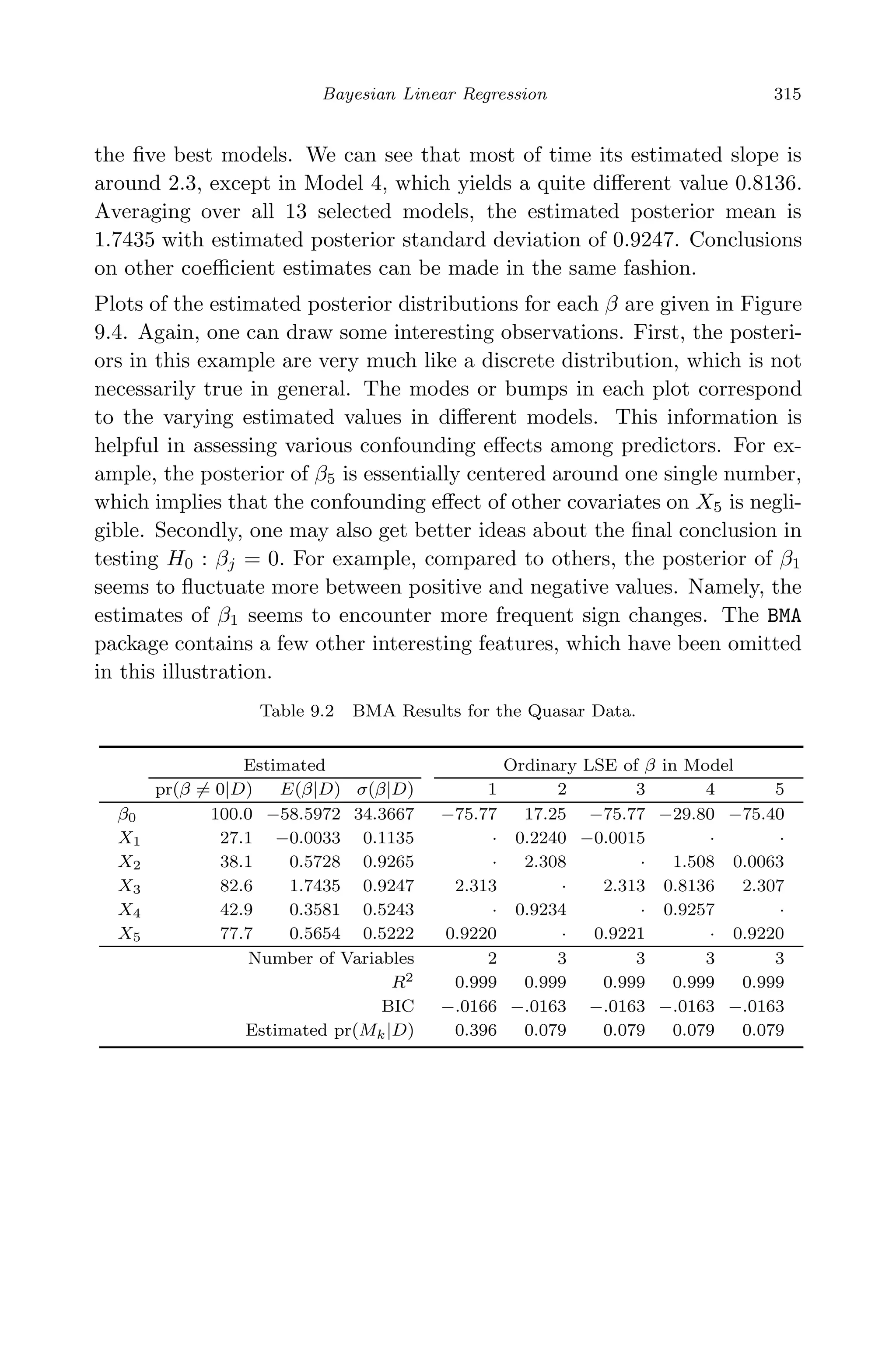
9.2 BMA Results for the Quasar Data. . . . . . . . . . . . . . . . . 315
April 29, 2009 11:50 World Scientific Book - 9in x 6in Regression˙master
This page intentionally left blankThis page intentionally left blank
April 29, 2009 11:50 World Scientific Book - 9in x 6in Regression˙master
Chapter 1
Introduction
1.1 Regression Model
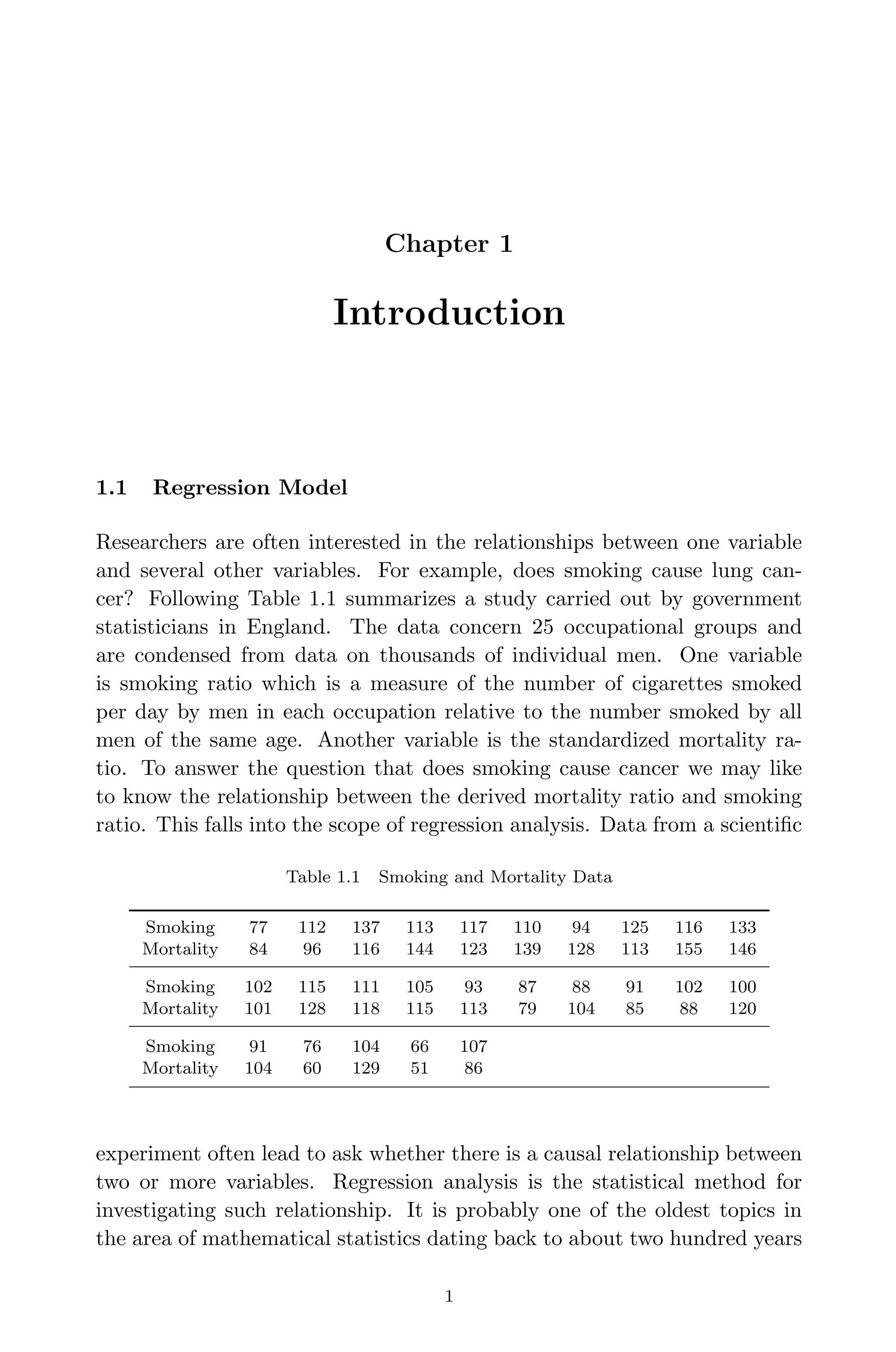
Researchers are often interested in the relationships between one variable
and several other variables. For example, does smoking cause lung can-
cer? Following Table 1.1 summarizes a study carried out by government
statisticians in England. The data concern 25 occupational groups and
are condensed from data on thousands of individual men. One variable
is smoking ratio which is a measure of the number of cigarettes smoked
per day by men in each occupation relative to the number smoked by all
men of the same age. Another variable is the standardized mortality ra-
tio. To answer the question that does smoking cause cancer we may like
to know the relationship between the derived mortality ratio and smoking
ratio. This falls into the scope of regression analysis. Data from a scientific
Table 1.1 Smoking and Mortality Data
Smoking 77 112 137 113 117 110 94 125 116 133
Mortality 84 96 116 144 123 139 128 113 155 146
Smoking 102 115 111 105 93 87 88 91 102 100
Mortality 101 128 118 115 113 79 104 85 88 120
Smoking 91 76 104 66 107
Mortality 104 60 129 51 86
experiment often lead to ask whether there is a causal relationship between
two or more variables. Regression analysis is the statistical method for
investigating such relationship. It is probably one of the oldest topics in
the area of mathematical statistics dating back to about two hundred years
1
April 29, 2009 11:50 World Scientific Book - 9in x 6in Regression˙master
2 Linear Regression Analysis: Theory and Computing
ago. The earliest form of the linear regression was the least squares method,
which was published by Legendre in 1805, and by Gauss in 1809. The term
“least squares” is from Legendre’s term. Legendre and Gauss both applied
the method to the problem of determining, from astronomical observations,
the orbits of bodies about the sun. Euler had worked on the same problem
(1748) without success. Gauss published a further development of the the-
ory of least squares in 1821, including a version of the today’s well-known
Gauss-Markov theorem, which is a fundamental theorem in the area of the
general linear models.
What is a statistical model? A statistical model is a simple description of
a state or process. “A model is neither a hypothesis nor a theory. Unlike
scientific hypotheses, a model is not verifiable directly by an experiment.
For all models of true or false, the validation of a model is not that it is
“true” but that it generates good testable hypotheses relevant to important
problems.” (R. Levins, Am. Scientist 54: 421-31, 1966)
Linear regression requires that model is linear in regression parameters.
Regression analysis is the method to discover the relationship between one
or more response variables (also called dependent variables, explained vari-
ables, predicted variables, or regressands, usually denoted by y) and the
predictors (also called independent variables, explanatory variables, con-
trol variables, or regressors, usually denoted by x1, x2, · · · , xp).
There are three types of regression. The first is the simple linear regression.
The simple linear regression is for modeling the linear relationship between
two variables. One of them is the dependent variable y and another is
the independent variable x. For example, the simple linear regression can
model the relationship between muscle strength (y) and lean body mass
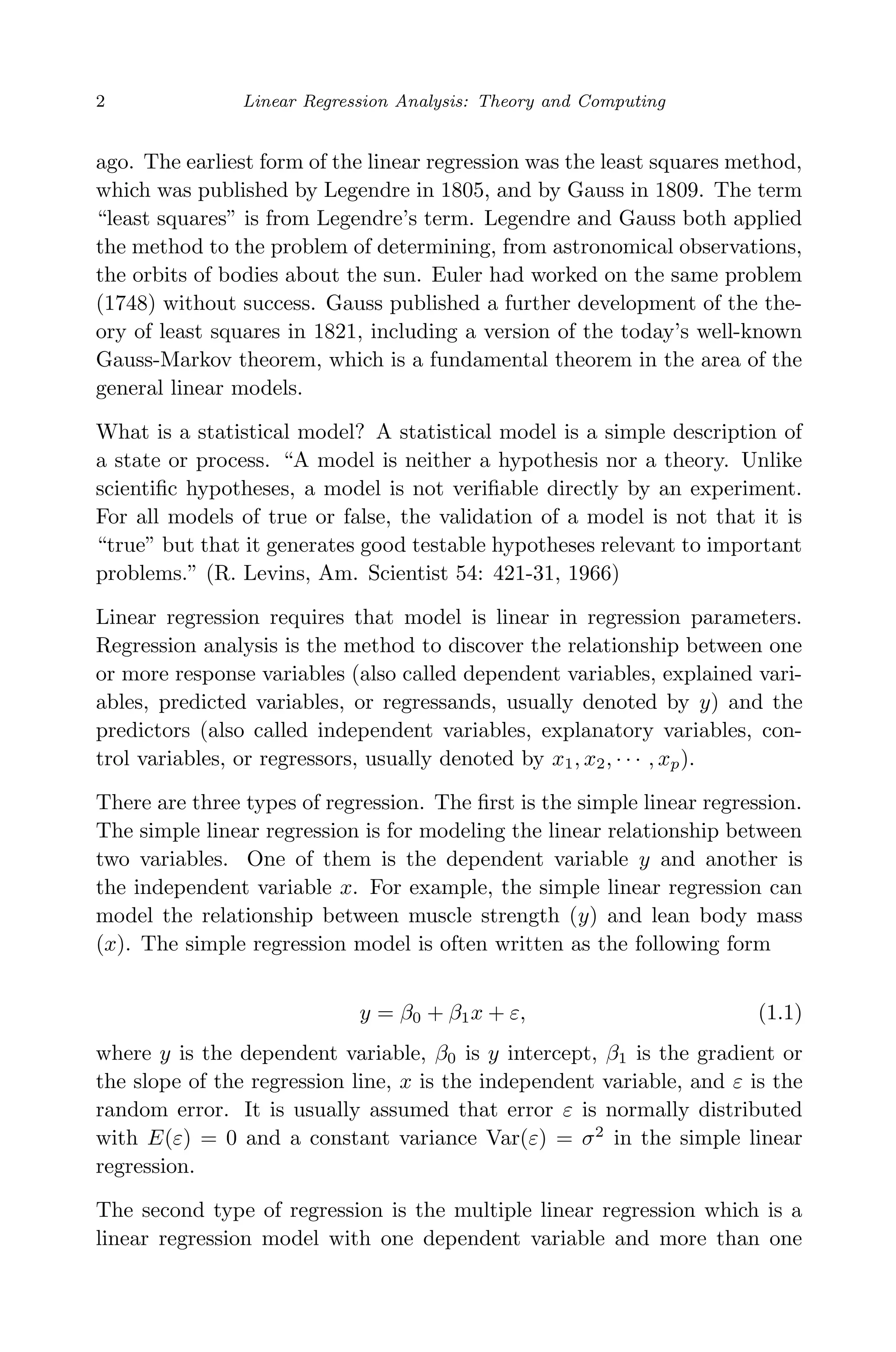
(x). The simple regression model is often written as the following form
y = β0 + β1x + ε, (1.1)
where y is the dependent variable, β0 is y intercept, β1 is the gradient or
the slope of the regression line, x is the independent variable, and ε is the
random error. It is usually assumed that error ε is normally distributed
with E(ε) = 0 and a constant variance Var(ε) = σ2
in the simple linear
regression.
The second type of regression is the multiple linear regression which is a
linear regression model with one dependent variable and more than one
April 29, 2009 11:50 World Scientific Book - 9in x 6in Regression˙master
Introduction 3
independent variables. The multiple linear regression assumes that the
response variable is a linear function of the model parameters and there
are more than one independent variables in the model. The general form
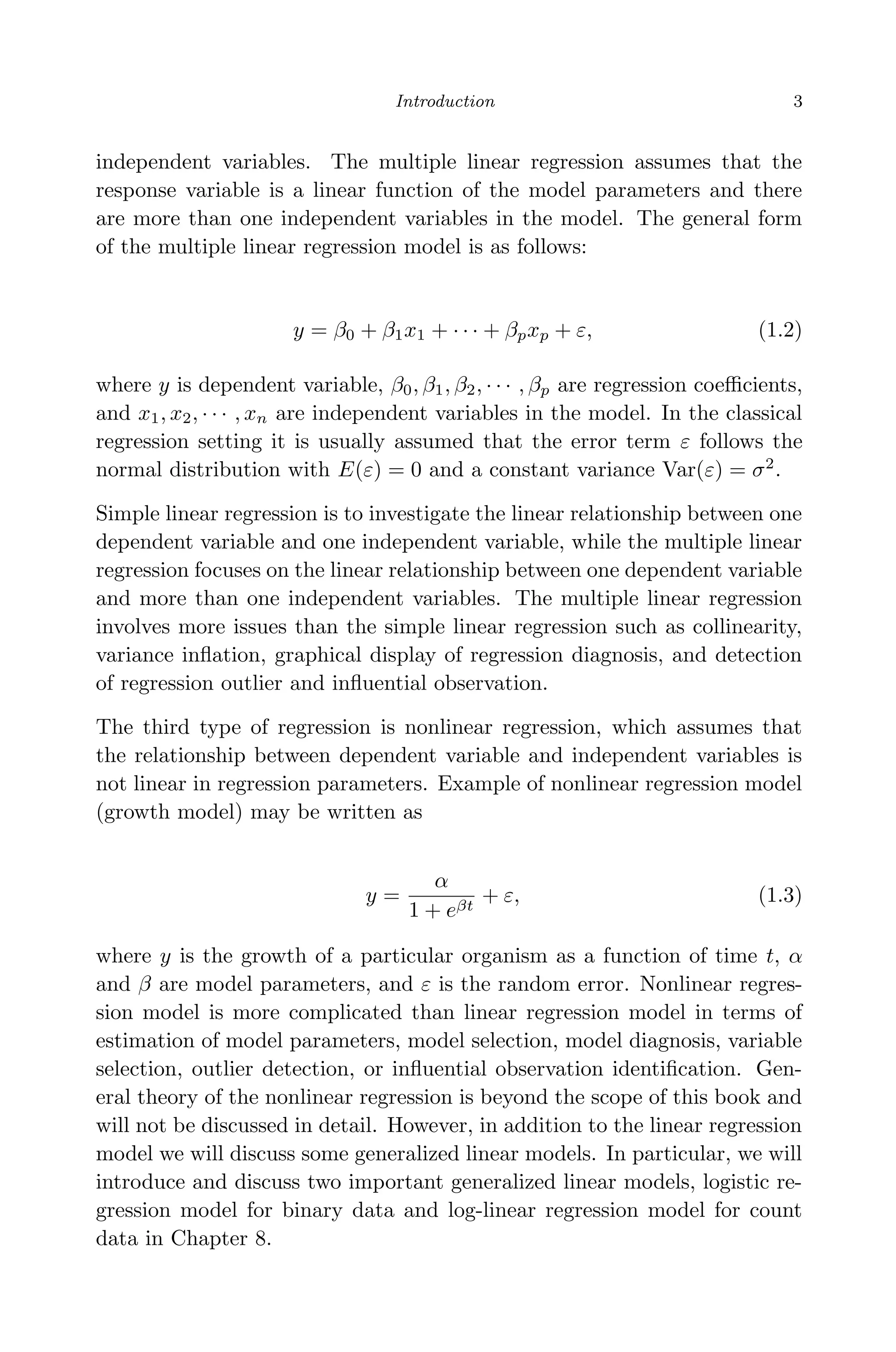
of the multiple linear regression model is as follows:
y = β0 + β1x1 + · · · + βpxp + ε, (1.2)
where y is dependent variable, β0, β1, β2, · · · , βp are regression coefficients,
and x1, x2, · · · , xn are independent variables in the model. In the classical
regression setting it is usually assumed that the error term ε follows the
normal distribution with E(ε) = 0 and a constant variance Var(ε) = σ2
.
Simple linear regression is to investigate the linear relationship between one
dependent variable and one independent variable, while the multiple linear
regression focuses on the linear relationship between one dependent variable
and more than one independent variables. The multiple linear regression
involves more issues than the simple linear regression such as collinearity,
variance inflation, graphical display of regression diagnosis, and detection
of regression outlier and influential observation.
The third type of regression is nonlinear regression, which assumes that
the relationship between dependent variable and independent variables is
not linear in regression parameters. Example of nonlinear regression model
(growth model) may be written as
y =
α
1 + eβt
+ ε, (1.3)
where y is the growth of a particular organism as a function of time t, α
and β are model parameters, and ε is the random error. Nonlinear regres-
sion model is more complicated than linear regression model in terms of
estimation of model parameters, model selection, model diagnosis, variable
selection, outlier detection, or influential observation identification. Gen-
eral theory of the nonlinear regression is beyond the scope of this book and
will not be discussed in detail. However, in addition to the linear regression
model we will discuss some generalized linear models. In particular, we will
introduce and discuss two important generalized linear models, logistic re-
gression model for binary data and log-linear regression model for count
data in Chapter 8.
April 29, 2009 11:50 World Scientific Book - 9in x 6in Regression˙master
4 Linear Regression Analysis: Theory and Computing
1.2 Goals of Regression Analysis
Regression analysis is one of the most commonly used statistical methods
in practice. Applications of regression analysis can be found in many scien-
tific fields including medicine, biology, agriculture, economics, engineering,
sociology, geology, etc. The purposes of regression analysis are three-folds:
(1) Establish a casual relationship between response variable y and regres-
sors x1, x2, · · · , xn.
(2) Predict y based on a set of values of x1, x2, · · · , xn.
(3) Screen variables x1, x2, · · · , xn to identify which variables are more im-
portant than others to explain the response variable y so that the causal
relationship can be determined more efficiently and accurately.
An analyst often follows, but not limited, the following procedures in
the regression analysis.
(1) The first and most important step is to understand the real-life problem
which is often fallen into a specific scientific field. Carefully determine
whether the scientific question falls into scope of regression analysis.
(2) Define a regression model which may be written as
Response variable = a function of regressors + random error,
or simply in a mathematical format
y = f(x1, x2, · · · , xp) + ε.
You may utilize a well-accepted model in a specific scientific field or
try to define your own model based upon a sound scientific judgement
by yourself or expert scientists in the subject area. Defining a model
is often a joint effort among statisticians and experts in a scientific
discipline. Choosing an appropriate model is the first step for statistical
modeling and often involve further refinement procedures.
(3) Make distributional assumptions on the random error ε in the regression
model. These assumptions need to be verified or tested by the data
collected from experiment. The assumptions are often the basis upon
which the regression model may be solved and statistical inference is
drawn.
(4) Collect data y and x1, x2, · · · , xp. This data collection step usually
involves substantial work that includes, but not limited to, experimen-
tal design, sample size determination, database design, data cleaning,
April 29, 2009 11:50 World Scientific Book - 9in x 6in Regression˙master
Introduction 5
and derivations of analysis variables that will be used in the statistical
analysis. In many real-life applications, this is a crucial step that often
involve significant amount of work.
(5) According to the software used in the analysis, create data sets in an
appropriate format that are easy to be read into a chosen software. In
addition, it often needs to create more specific analysis data sets for
planned or exploratory statistical analysis.
(6) Carefully evaluate whether or not the selected model is appropriate for
answering the desired scientific questions. Various diagnosis methods
may be used to evaluate the performance of the selected statistical
model. It should be kept in mind that the model diagnosis is for the
judgment of whether the selected statistical model is a sound model
that can answer the desired scientific questions.
(7) If the model is deemed to be appropriate according to a well accepted
model diagnosis criteria, it may be used to answer the desired scientific
questions; otherwise, the model is subject to refinement or modifica-
tion. Several iterations of model selection, model diagnosis, and model
refinement may be necessary and very common in practice.
1.3 Statistical Computing in Regression Analysis
After a linear regression model is chosen and a database is created, the next
step is statistical computing. The purposes of the statistical computing are
to solve for the actual model parameters and to conduct model diagnosis.
Various user-friendly statistical softwares have been developed to make the
regression analysis easier and more efficient.
Statistical Analysis System (SAS) developed by SAS Institute, Inc. is one
of the popular softwares which can be used to perform regression analysis.
The SAS System is an integrated system of software products that enables
users to perform data entry and data management, to produce statistical
graphics, to conduct wide range of statistical analyses, to retrieve data
from data warehouse (extract, transform, load) platform, and to provide
dynamic interface to other software, etc. One great feature of SAS is that
many standard statistical methods have been integrated into various SAS
procedures that enable analysts easily find desired solutions without writing
source code from the original algorithms of statistical methods. The SAS
“macro” language allows user to write subroutines to perform particular
user-defined statistical analysis. SAS compiles and runs on UNIX platform
April 29, 2009 11:50 World Scientific Book - 9in x 6in Regression˙master
6 Linear Regression Analysis: Theory and Computing
and Windows operating system.
Software S-PLUS developed by Insightful Inc. is another one of the most
popular softwares that have been used substantially by analysts in various
scientific fields. This software is a rigorous computing tool covering a broad
range of methods in statistics. Various built-in S-PLUS functions have been
developed that enable users to perform statistical analysis and generate
analysis graphics conveniently and efficiently. The S-PLUS offers a wide
collection of specialized modules that provide additional functionality to the
S-PLUS in areas such as: volatility forecasting, optimization, clinical trials
analysis, environmental statistics, and spatial data analysis, data mining.
In addition, user can write S-PLUS programs or functions using the S-
language to perform statistical analysis of specific needs. The S-PLUS
compiles and runs on UNIX platform and Windows operating system.
Statistical Package for Social Sciences (SPSS) is also one of the most widely
used softwares for the statistical analysis in the area of social sciences. It
is one of the preferred softwares used by market researchers, health re-
searchers, survey companies, government, education researchers, among
others. In addition to statistical analysis, data management (case selection,
file reshaping, creating derived data) and data documentation (a metadata
dictionary is stored) are features of the SPSS. Many features of SPSS are
accessible via pull-down menus or can be programmed with a proprietary
4GL command syntax language. Additionally, a “macro” language can be
used to write command language subroutines to facilitate special needs of
user-desired statistical analysis.
Another popular software that can be used for various statistical analyses
is R. R is a language and environment for statistical computing and graph-
ics. It is a GNU project similar to the S language and environment. R can
be considered as a different implementation of S language. There are some
important differences, but much code written for S language runs unaltered
under R. The S language is often the vehicle of choice for research in sta-
tistical methodology, and R provides an open source route to participation
in that activity. One of R’s strengths is the ease with which well-designed
publication-quality plots can be produced, including mathematical symbols
and formulae where needed. Great care has been taken over the defaults for
the design choices in graphics, but user retains full control. R is available
as free software under the terms of the Free Software Foundation’s GNU
General Public License in source code form. It compiles and runs on a wide
April 29, 2009 11:50 World Scientific Book - 9in x 6in Regression˙master
Introduction 7
variety of UNIX platforms and similar system Linux, as well as Windows.
Regression analysis can be performed using various softwares such as SAS,
S-PLUS, R, or SPSS. In this book we choose the software SAS to illustrate
the computing techniques in regression analysis and diagnosis. Extensive
examples are provided in the book to enable readers to become familiar
with regression analysis and diagnosis using SAS. We also provide some
examples of regression graphic plots using the software R. However, readers
are not discouraged to use other softwares to perform regression analysis
and diagnosis.
April 29, 2009 11:50 World Scientific Book - 9in x 6in Regression˙master
This page intentionally left blankThis page intentionally left blank
April 29, 2009 11:50 World Scientific Book - 9in x 6in Regression˙master
Chapter 2
Simple Linear Regression
2.1 Introduction
The term “regression” and the methods for investigating the relationships
between two variables may date back to about 100 years ago. It was first
introduced by Francis Galton in 1908, the renowned British biologist, when
he was engaged in the study of heredity. One of his observations was that
the children of tall parents to be taller than average but not as tall as their
parents. This “regression toward mediocrity” gave these statistical meth-
ods their name. The term regression and its evolution primarily describe
statistical relations between variables. In particular, the simple regression
is the regression method to discuss the relationship between one dependent
variable (y) and one independent variable (x). The following classical data
set contains the information of parent’s height and children’s height.
Table 2.1 Parent’s Height and Children’s Height
Parent 64.5 65.5 66.5 67.5 68.5 69.5 70.5 71.5 72.5
Children 65.8 66.7 67.2 67.6 68.2 68.9 69.5 69.9 72.2
The mean height is 68.44 for children and 68.5 for parents. The regression
line for the data of parents and children can be described as
child height = 21.52 + 0.69 parent height.
The simple linear regression model is typically stated in the form
y = β0 + β1x + ε,
where y is the dependent variable, β0 is the y intercept, β1 is the slope of
the simple linear regression line, x is the independent variable, and ε is the
9
April 29, 2009 11:50 World Scientific Book - 9in x 6in Regression˙master
10 Linear Regression Analysis: Theory and Computing
random error. The dependent variable is also called response variable, and
the independent variable is called explanatory or predictor variable. An
explanatory variable explains causal changes in the response variables. A
more general presentation of a regression model may be written as
y = E(y) + ,
where E(y) is the mathematical expectation of the response variable. When
E(y) is a linear combination of exploratory variables x1, x2, · · · , xk the
regression is the linear regression. If k = 1 the regression is the simple linear
regression. If E(y) is a nonlinear function of x1, x2, · · · , xk the regression
is nonlinear. The classical assumptions on error term are E(ε) = 0 and a
constant variance Var(ε) = σ2
. The typical experiment for the simple linear
regression is that we observe n pairs of data (x1, y1), (x2, y2), · · · , (xn, yn)
from a scientific experiment, and model in terms of the n pairs of the data
can be written as
yi = β0 + β1xi + εi for i = 1, 2, · · · , n,
with E(εi) = 0, a constant variance Var(εi) = σ2
, and all εi’s are indepen-
dent. Note that the actual value of σ2
is usually unknown. The values of
xi’s are measured “exactly”, with no measurement error involved. After
model is specified and data are collected, the next step is to find “good”
estimates of β0 and β1 for the simple linear regression model that can best
describe the data came from a scientific experiment. We will derive these
estimates and discuss their statistical properties in the next section.
2.2 Least Squares Estimation
The least squares principle for the simple linear regression model is to
find the estimates b0 and b1 such that the sum of the squared distance
from actual response yi and predicted response ˆyi = β0 + β1xi reaches the
minimum among all possible choices of regression coefficients β0 and β1.
i.e.,
(b0, b1) = arg min
(β0,β1)
n
i=1
[yi − (β0 + β1xi)]2
.
The motivation behind the least squares method is to find parameter es-
timates by choosing the regression line that is the most “closest” line to
April 29, 2009 11:50 World Scientific Book - 9in x 6in Regression˙master
Simple Linear Regression 11
all data points (xi, yi). Mathematically, the least squares estimates of the
simple linear regression are given by solving the following system:
∂
∂β0
n
i=1
[yi − (β0 + β1xi)]2
= 0 (2.1)
∂
∂β1
n
i=1
[yi − (β0 + β1xi)]2
= 0 (2.2)
Suppose that b0 and b1 are the solutions of the above system, we can de-
scribe the relationship between x and y by the regression line ˆy = b0 + b1x
which is called the fitted regression line by convention. It is more convenient
to solve for b0 and b1 using the centralized linear model:
yi = β∗
0 + β1(xi − ¯x) + εi,
where β0 = β∗
0 − β1 ¯x. We need to solve for
∂
∂β∗
0
n
i=1
[yi − (β∗
0 + β1(xi − ¯x))]2
= 0
∂
∂β1
n
i=1
[yi − (β∗
0 + β1(xi − ¯x))]2
= 0
Taking the partial derivatives with respect to β0 and β1 we have
n
i=1
[yi − (β∗
0 + β1(xi − ¯x))] = 0
n
i=1
[yi − (β∗
0 + β1(xi − ¯x))](xi − ¯x) = 0
Note that
n
i=1
yi = nβ∗
0 +
n
i=1
β1(xi − ¯x) = nβ∗
0 (2.3)
Therefore, we have β∗
0 =
1
n
n
i=1
yi = ¯y. Substituting β∗
0 by ¯y in (2.3) we
obtain
n
i=1
[yi − (¯y + β1(xi − ¯x))](xi − ¯x) = 0.
April 29, 2009 11:50 World Scientific Book - 9in x 6in Regression˙master
12 Linear Regression Analysis: Theory and Computing
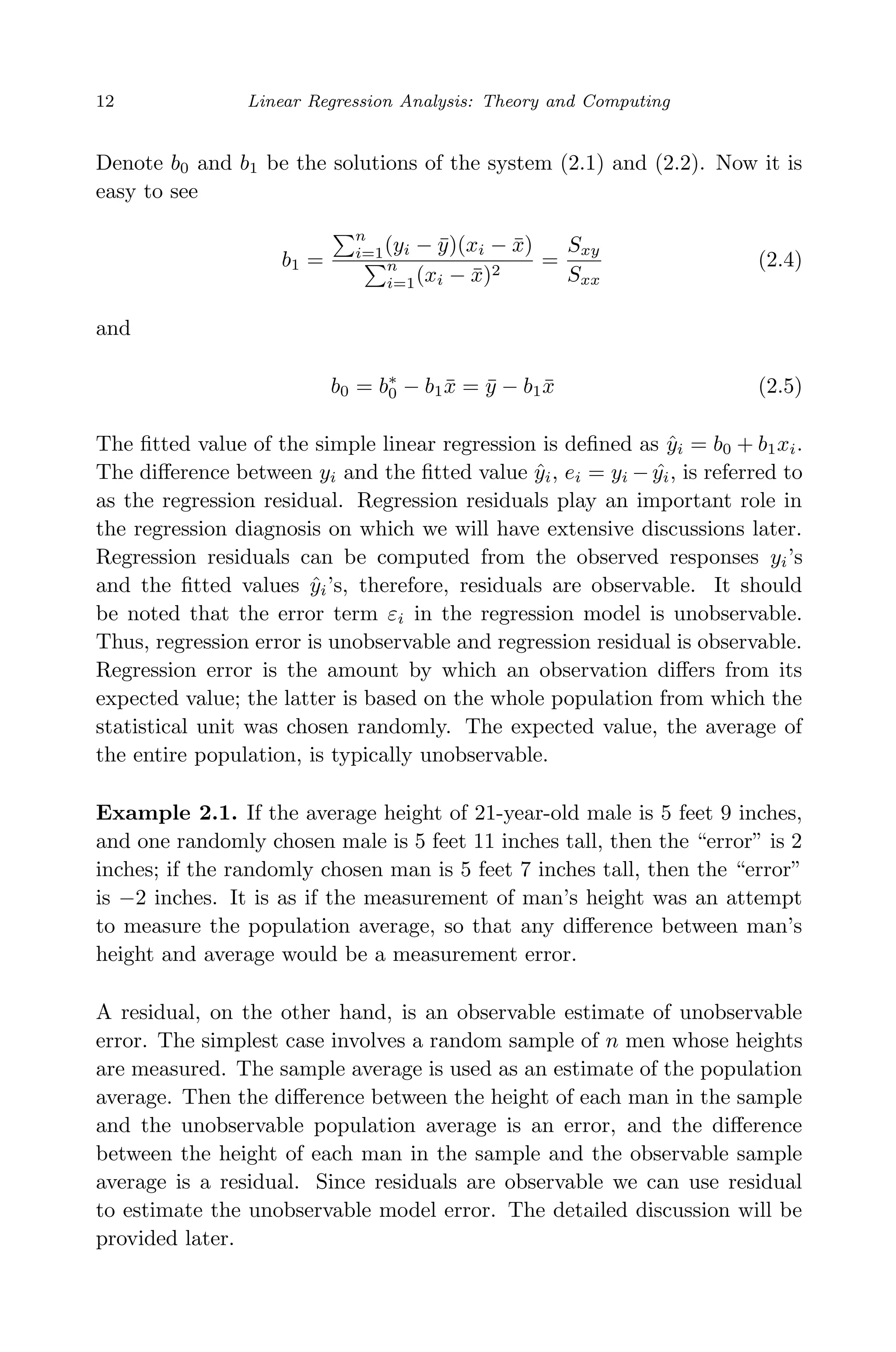
Denote b0 and b1 be the solutions of the system (2.1) and (2.2). Now it is
easy to see
b1 =
n
i=1(yi − ¯y)(xi − ¯x)
n
i=1(xi − ¯x)2
=
Sxy
Sxx
(2.4)
and
b0 = b∗
0 − b1 ¯x = ¯y − b1 ¯x (2.5)
The fitted value of the simple linear regression is defined as ˆyi = b0 + b1xi.
The difference between yi and the fitted value ˆyi, ei = yi − ˆyi, is referred to
as the regression residual. Regression residuals play an important role in
the regression diagnosis on which we will have extensive discussions later.
Regression residuals can be computed from the observed responses yi’s
and the fitted values ˆyi’s, therefore, residuals are observable. It should
be noted that the error term εi in the regression model is unobservable.
Thus, regression error is unobservable and regression residual is observable.
Regression error is the amount by which an observation differs from its
expected value; the latter is based on the whole population from which the
statistical unit was chosen randomly. The expected value, the average of
the entire population, is typically unobservable.
Example 2.1. If the average height of 21-year-old male is 5 feet 9 inches,
and one randomly chosen male is 5 feet 11 inches tall, then the “error” is 2
inches; if the randomly chosen man is 5 feet 7 inches tall, then the “error”
is −2 inches. It is as if the measurement of man’s height was an attempt
to measure the population average, so that any difference between man’s
height and average would be a measurement error.
A residual, on the other hand, is an observable estimate of unobservable
error. The simplest case involves a random sample of n men whose heights
are measured. The sample average is used as an estimate of the population
average. Then the difference between the height of each man in the sample
and the unobservable population average is an error, and the difference
between the height of each man in the sample and the observable sample
average is a residual. Since residuals are observable we can use residual
to estimate the unobservable model error. The detailed discussion will be
provided later.
April 29, 2009 11:50 World Scientific Book - 9in x 6in Regression˙master
Simple Linear Regression 13
2.3 Statistical Properties of the Least Squares Estimation
In this section we discuss the statistical properties of the least squares
estimates for the simple linear regression. We first discuss statistical prop-
erties without the distributional assumption on the error term, but we shall
assume that E( i) = 0, Var( i) = σ2
, and i’s for i = 1, 2, · · · , n are inde-
pendent.
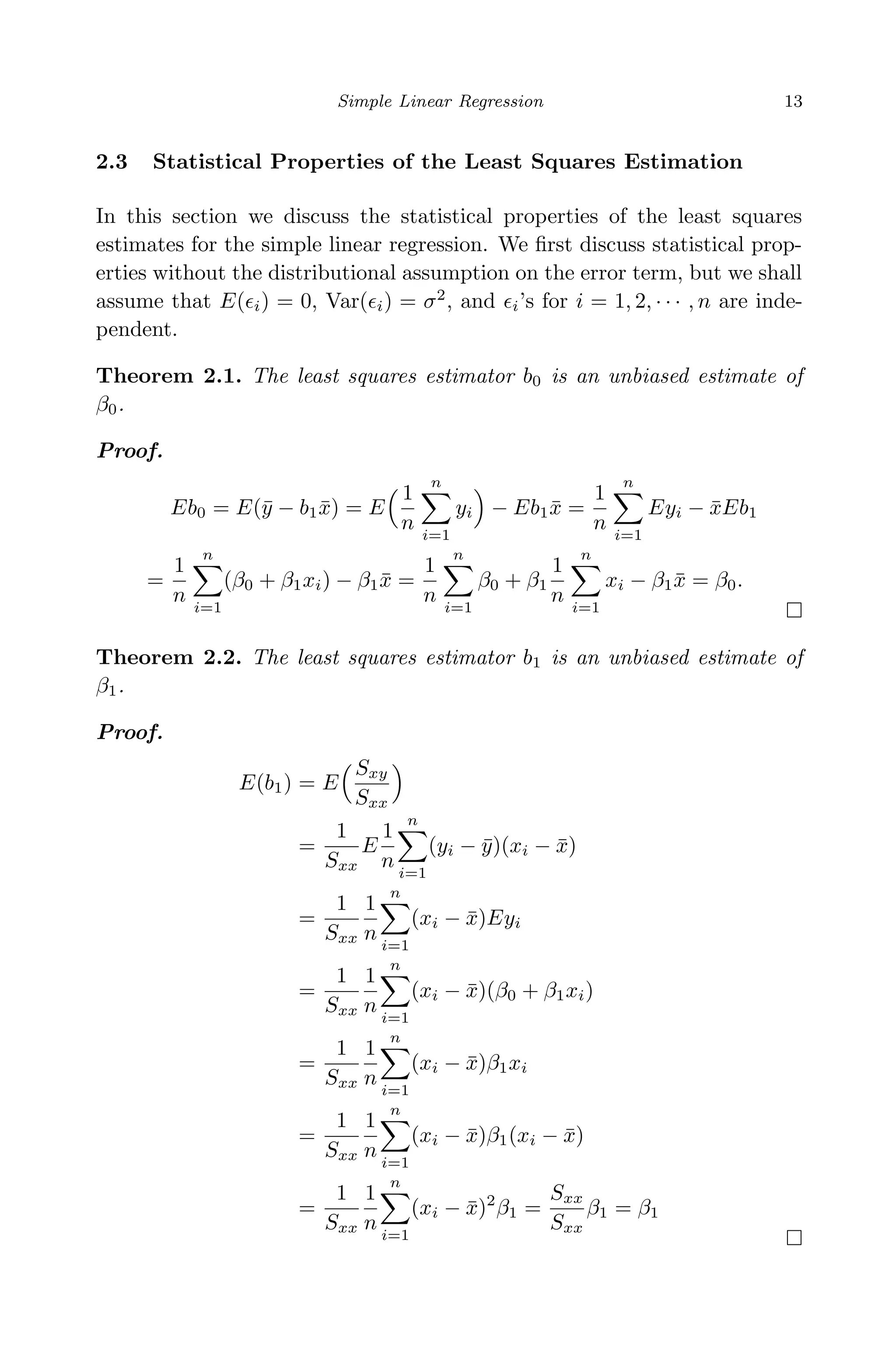
Theorem 2.1. The least squares estimator b0 is an unbiased estimate of
β0.
Proof.
Eb0 = E(¯y − b1 ¯x) = E
1
n
n
i=1
yi − Eb1 ¯x =
1
n
n
i=1
Eyi − ¯xEb1
=
1
n
n
i=1
(β0 + β1xi) − β1 ¯x =
1
n
n
i=1
β0 + β1
1
n
n
i=1
xi − β1 ¯x = β0.
Theorem 2.2. The least squares estimator b1 is an unbiased estimate of
β1.
Proof.
E(b1) = E
Sxy
Sxx
=
1
Sxx
E
1
n
n
i=1
(yi − ¯y)(xi − ¯x)
=
1
Sxx
1
n
n
i=1
(xi − ¯x)Eyi
=
1
Sxx
1
n
n
i=1
(xi − ¯x)(β0 + β1xi)
=
1
Sxx
1
n
n
i=1
(xi − ¯x)β1xi
=
1
Sxx
1
n
n
i=1
(xi − ¯x)β1(xi − ¯x)
=
1
Sxx
1
n
n
i=1
(xi − ¯x)2
β1 =
Sxx
Sxx
β1 = β1
April 29, 2009 11:50 World Scientific Book - 9in x 6in Regression˙master
14 Linear Regression Analysis: Theory and Computing
Theorem 2.3. Var(b1) =
σ2
nSxx
.
Proof.
Var(b1) = Var
Sxy
Sxx
=
1
S2
xx
Var
1
n
n
i=1
(yi − ¯y)(xi − ¯x)
=
1
S2
xx
Var
1
n
n
i=1
yi(xi − ¯x)
=
1
S2
xx
1
n2
n
i=1
(xi − ¯x)2
Var(yi)
=
1
S2
xx
1
n2
n
i=1
(xi − ¯x)2
σ2
=
σ2
nSxx
Theorem 2.4. The least squares estimator b1 and ¯y are uncorrelated. Un-
der the normality assumption of yi for i = 1, 2, · · · , n, b1 and ¯y are normally
distributed and independent.
Proof.
Cov(b1, ¯y) = Cov(
Sxy
Sxx
, ¯y)
=
1
Sxx
Cov(Sxy, ¯y)
=
1
nSxx
Cov
n
i=1
(xi − ¯x)(yi − ¯y), ¯y
=
1
nSxx
Cov
n
i=1
(xi − ¯x)yi, ¯y
=
1
n2Sxx
Cov
n
i=1
(xi − ¯x)yi,
n
i=1
yi
=
1
n2Sxx
n
i,j=1
(xi − ¯x) Cov(yi, yj)
Note that Eεi = 0 and εi’s are independent we can write
Cov(yi, yj) = E[ (yi − Eyi)(yj − Eyj) ] = E(εi, εj) =
σ2
, if i = j
0, if i = j
April 29, 2009 11:50 World Scientific Book - 9in x 6in Regression˙master
Simple Linear Regression 15
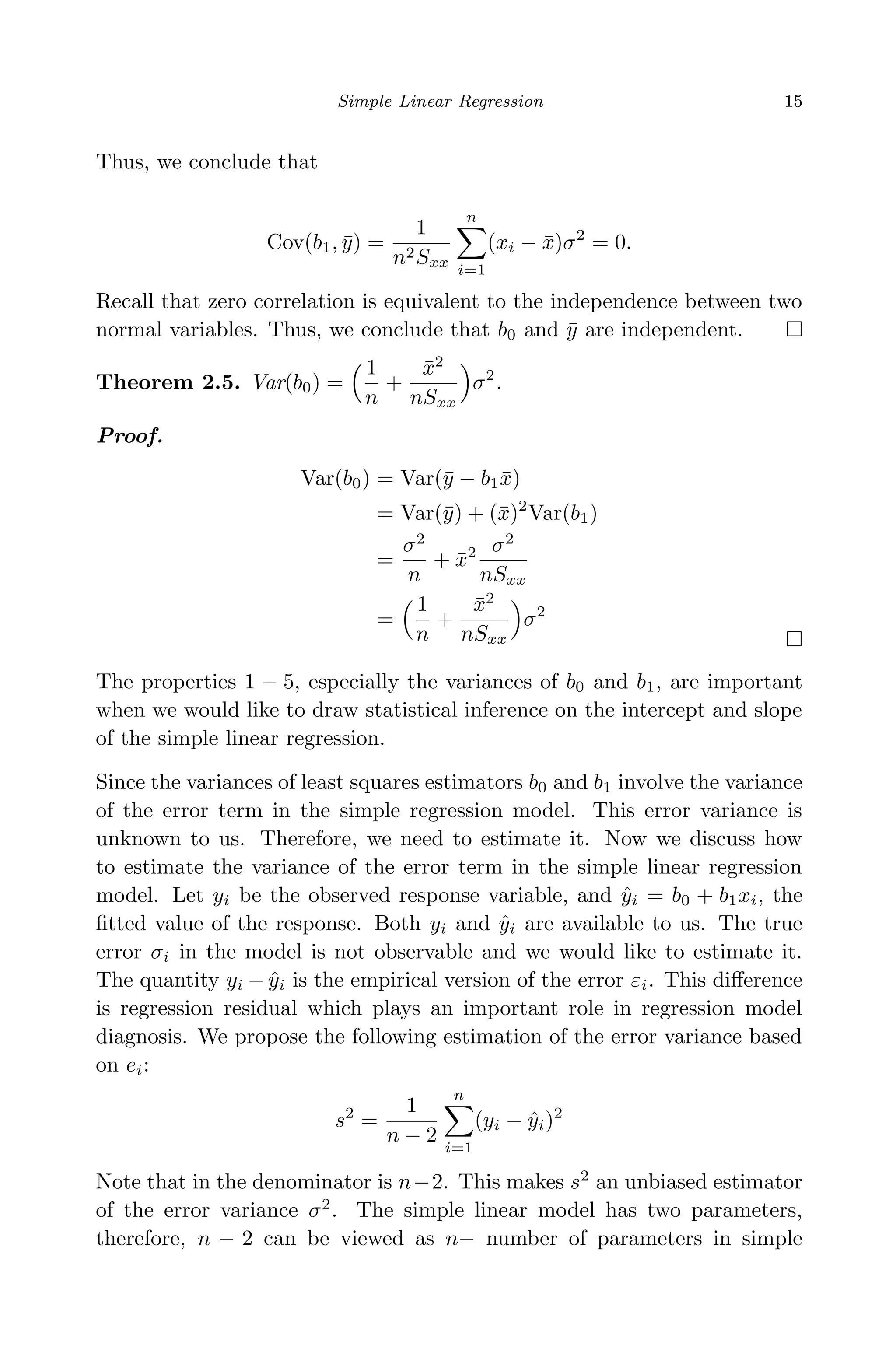
Thus, we conclude that
Cov(b1, ¯y) =
1
n2Sxx
n
i=1
(xi − ¯x)σ2
= 0.
Recall that zero correlation is equivalent to the independence between two
normal variables. Thus, we conclude that b0 and ¯y are independent.
Theorem 2.5. Var(b0) =
1
n
+
¯x2
nSxx
σ2
.
Proof.
Var(b0) = Var(¯y − b1 ¯x)
= Var(¯y) + (¯x)2
Var(b1)
=
σ2
n
+ ¯x2 σ2
nSxx
=
1
n
+
¯x2
nSxx
σ2
The properties 1 − 5, especially the variances of b0 and b1, are important
when we would like to draw statistical inference on the intercept and slope
of the simple linear regression.
Since the variances of least squares estimators b0 and b1 involve the variance
of the error term in the simple regression model. This error variance is
unknown to us. Therefore, we need to estimate it. Now we discuss how
to estimate the variance of the error term in the simple linear regression
model. Let yi be the observed response variable, and ˆyi = b0 + b1xi, the
fitted value of the response. Both yi and ˆyi are available to us. The true
error σi in the model is not observable and we would like to estimate it.
The quantity yi − ˆyi is the empirical version of the error εi. This difference
is regression residual which plays an important role in regression model
diagnosis. We propose the following estimation of the error variance based
on ei:
s2
=
1
n − 2
n
i=1
(yi − ˆyi)2
Note that in the denominator is n−2. This makes s2
an unbiased estimator
of the error variance σ2
. The simple linear model has two parameters,
therefore, n − 2 can be viewed as n− number of parameters in simple
April 29, 2009 11:50 World Scientific Book - 9in x 6in Regression˙master
16 Linear Regression Analysis: Theory and Computing
linear regression model. We will see in later chapters that it is true for all
general linear models. In particular, in a multiple linear regression model
with p parameters the denominator should be n − p in order to construct
an unbiased estimator of the error variance σ2
. Detailed discussion can be
found in later chapters. The unbiasness of estimator s2
for the simple linear
regression can be shown in the following derivations.
yi − ˆyi = yi − b0 − b1xi = yi − (¯y − b1 ¯x) − b1xi = (yi − ¯y) − b1(xi − ¯x)
It follows that
n
i=1
(yi − ˆyi) =
n
i=1
(yi − ¯y) − b1
n
i=1
(xi − ¯x) = 0.
Note that (yi − ˆyi)xi = [(yi − ¯y) − b1(xi − ¯x)]xi, hence we have
n
i=1
(yi − ˆyi)xi =
n
i=1
[(yi − ¯y) − b1(xi − ¯x)]xi
=
n
i=1
[(yi − ¯y) − b1(xi − ¯x)](xi − ¯x)
=
n
i=1
(yi − ¯y)(xi − ¯x) − b1
n
i=1
(xi − ¯x)2
= n(Sxy − b1Sxx) = n Sxy −
Sxy
Sxx
Sxx = 0
To show that s2
is an unbiased estimate of the error variance, first we note
that
(yi − ˆyi)2
= [(yi − ¯y) − b1(xi − ¯x)]2
,
therefore,
n
i=1
(yi − ˆyi)2
=
n
i=1
[(yi − ¯y) − b1(xi − ¯x)]2
=
n
i=1
(yi − ¯y)2
− 2b1
n
i=1
(xi − ¯x)(yi − ¯yi) + b2
1
n
i=1
(xi − ¯x)2
=
n
i=1
(yi − ¯y)2
− 2nb1Sxy + nb2
1Sxx
=
n
i=1
(yi − ¯y)2
− 2n
Sxy
Sxx
Sxy + n
S2
xy
S2
xx
Sxx
=
n
i=1
(yi − ¯y)2
− n
S2
xy
Sxx
April 29, 2009 11:50 World Scientific Book - 9in x 6in Regression˙master
Simple Linear Regression 17
Since
(yi − ¯y)2
= [β1(xi − ¯x) + (εi − ¯ε)]2
and
(yi − ¯y)2
= β2
1(xi − ¯x)2
+ (εi − ¯ε)2
+ 2β1(xi − ¯x)(εi − ¯ε),
therefore,
E(yi − ¯y)2
= β2
1(xi − ¯x)2
+ E(εi − ¯ε)2
= β2
1(xi − ¯x)2
+
n − 1
n
σ2
,
and
n
i=1
E(yi − ¯y)2
= nβ2
1Sxx +
n
i=1
n − 1
n
σ2
= nβ2
1Sxx + (n − 1)σ2
.
Furthermore, we have
E(Sxy) = E
1
n
n
i=1
(xi − ¯x)(yi − ¯y)
=
1
n
E
n
i=1
(xi − ¯x)yi
=
1
n
n
i=1
(xi − ¯x)Eyi
=
1
n
n
i=1
(xi − ¯x)(β0 + β1xi)
=
1
n
β1
n
i=1
(xi − ¯x)xi
=
1
n
β1
n
i=1
(xi − ¯x)2
= β1Sxx
and
Var Sxy = Var
1
n
n
i=1
(xi − ¯x)yi =
1
n2
n
i=1
(xi − ¯x)2
Var(yi) =
1
n
Sxxσ2
Thus, we can write
E(S2
xy) = Var(Sxy) + [E(Sxy)]2
=
1
n
Sxxσ2
+ β2
1S2
xx
and
E
nS2
xy
Sxx
= σ2
+ nβ2
1Sxx.
April 29, 2009 11:50 World Scientific Book - 9in x 6in Regression˙master
18 Linear Regression Analysis: Theory and Computing
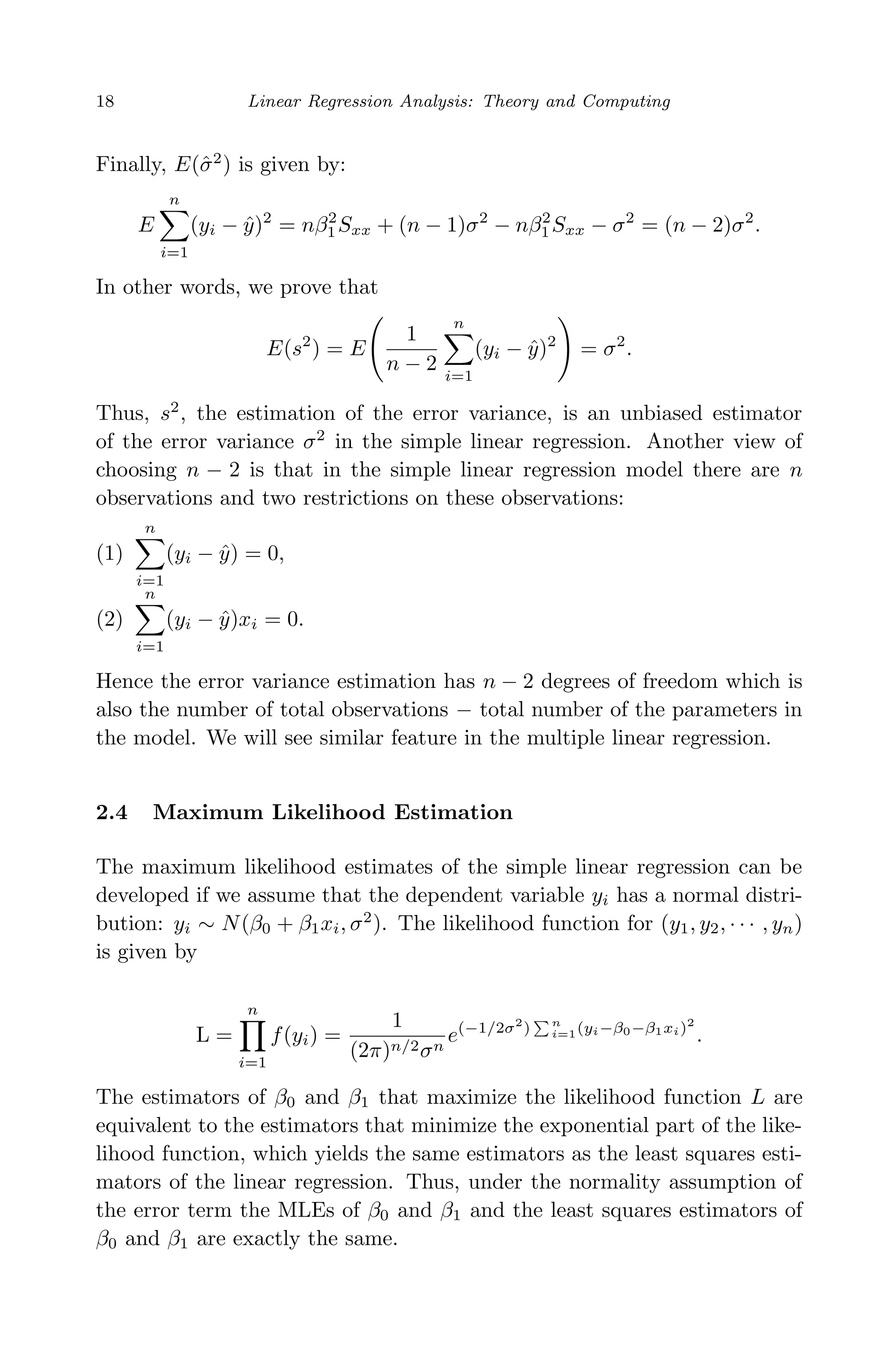
Finally, E(ˆσ2
) is given by:
E
n
i=1
(yi − ˆy)2
= nβ2
1Sxx + (n − 1)σ2
− nβ2
1Sxx − σ2
= (n − 2)σ2
.
In other words, we prove that
E(s2
) = E
1
n − 2
n
i=1
(yi − ˆy)2
= σ2
.
Thus, s2
, the estimation of the error variance, is an unbiased estimator
of the error variance σ2
in the simple linear regression. Another view of
choosing n − 2 is that in the simple linear regression model there are n
observations and two restrictions on these observations:
(1)
n
i=1
(yi − ˆy) = 0,
(2)
n
i=1
(yi − ˆy)xi = 0.
Hence the error variance estimation has n − 2 degrees of freedom which is
also the number of total observations − total number of the parameters in
the model. We will see similar feature in the multiple linear regression.
2.4 Maximum Likelihood Estimation
The maximum likelihood estimates of the simple linear regression can be
developed if we assume that the dependent variable yi has a normal distri-
bution: yi ∼ N(β0 + β1xi, σ2
). The likelihood function for (y1, y2, · · · , yn)
is given by
L =
n
i=1
f(yi) =
1
(2π)n/2σn
e(−1/2σ2
) n
i=1(yi−β0−β1xi)2
.
The estimators of β0 and β1 that maximize the likelihood function L are
equivalent to the estimators that minimize the exponential part of the like-
lihood function, which yields the same estimators as the least squares esti-
mators of the linear regression. Thus, under the normality assumption of
the error term the MLEs of β0 and β1 and the least squares estimators of
β0 and β1 are exactly the same.
April 29, 2009 11:50 World Scientific Book - 9in x 6in Regression˙master
Simple Linear Regression 19
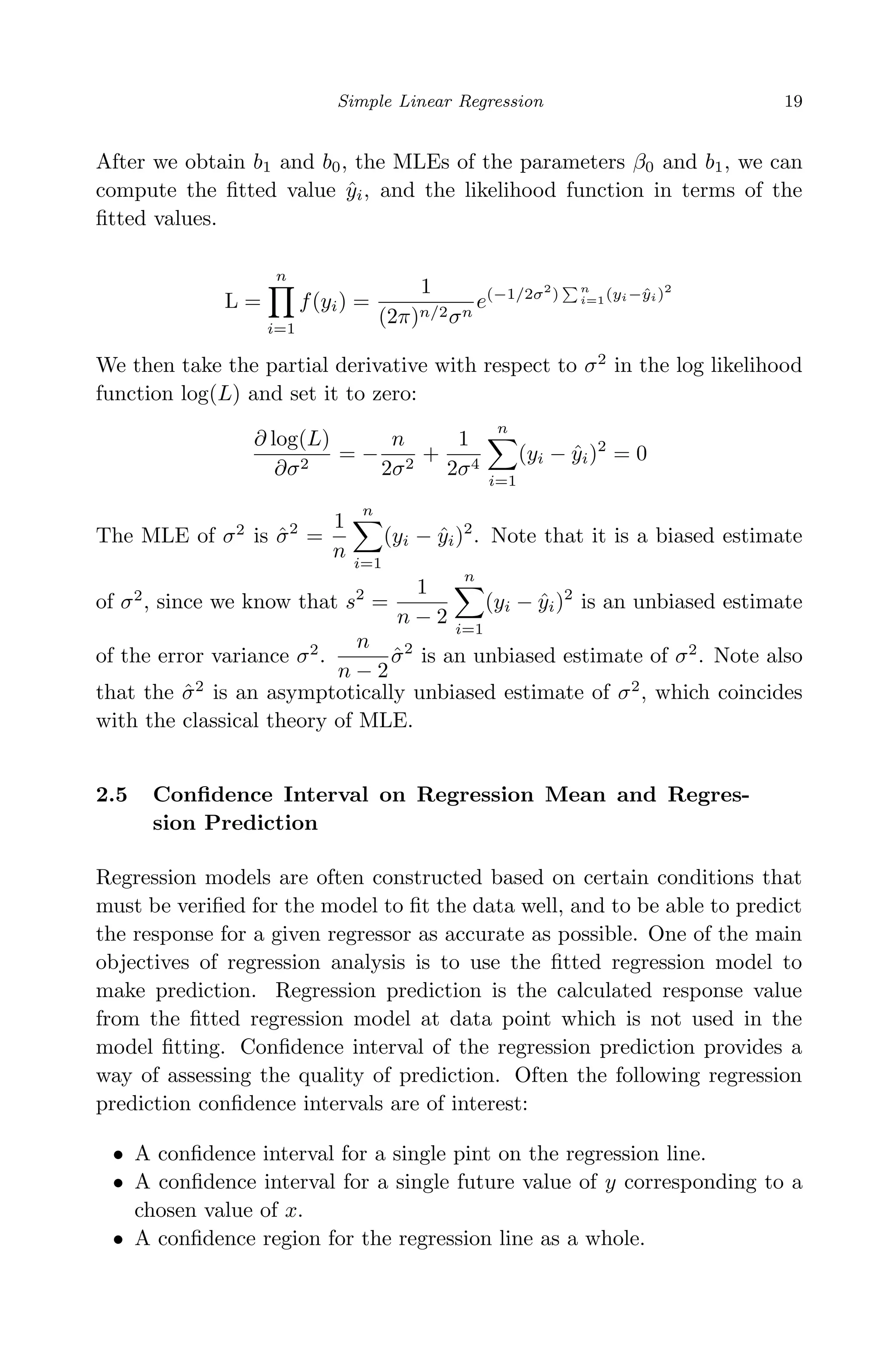
After we obtain b1 and b0, the MLEs of the parameters β0 and b1, we can
compute the fitted value ˆyi, and the likelihood function in terms of the
fitted values.
L =
n
i=1
f(yi) =
1
(2π)n/2σn
e(−1/2σ2
) n
i=1(yi−ˆyi)2
We then take the partial derivative with respect to σ2
in the log likelihood
function log(L) and set it to zero:
∂ log(L)
∂σ2
= −
n
2σ2
+
1
2σ4
n
i=1
(yi − ˆyi)2
= 0
The MLE of σ2
is ˆσ2
=
1
n
n
i=1
(yi − ˆyi)2
. Note that it is a biased estimate
of σ2
, since we know that s2
=
1
n − 2
n
i=1
(yi − ˆyi)2
is an unbiased estimate
of the error variance σ2
.
n
n − 2
ˆσ2
is an unbiased estimate of σ2
. Note also
that the ˆσ2
is an asymptotically unbiased estimate of σ2
, which coincides
with the classical theory of MLE.
2.5 Confidence Interval on Regression Mean and Regres-
sion Prediction
Regression models are often constructed based on certain conditions that
must be verified for the model to fit the data well, and to be able to predict
the response for a given regressor as accurate as possible. One of the main
objectives of regression analysis is to use the fitted regression model to
make prediction. Regression prediction is the calculated response value
from the fitted regression model at data point which is not used in the
model fitting. Confidence interval of the regression prediction provides a
way of assessing the quality of prediction. Often the following regression
prediction confidence intervals are of interest:
• A confidence interval for a single pint on the regression line.
• A confidence interval for a single future value of y corresponding to a
chosen value of x.
• A confidence region for the regression line as a whole.
April 29, 2009 11:50 World Scientific Book - 9in x 6in Regression˙master
20 Linear Regression Analysis: Theory and Computing
If a particular value of predictor variable is of special importance, a con-
fidence interval for the corresponding response variable y at particular re-
gressor x may be of interest.
A confidence interval of interest can be used to evaluate the accuracy of
a single future value of y at a chosen value of regressor x. Confidence
interval estimator for a future value of y provides confidence interval for an
estimated value y at x with a desirable confidence level 1 − α.
It is of interest to compare the above two different kinds of confidence
interval. The second kind has larger confidence interval which reflects the
less accuracy resulting from the estimation of a single future value of y
rather than the mean value computed for the first kind confidence interval.
When the entire regression line is of interest, a confidence region can provide
simultaneous statements about estimates of y for a number of values of the
predictor variable x. i.e., for a set of values of the regressor the 100(1 − α)
percent of the corresponding response values will be in this interval.
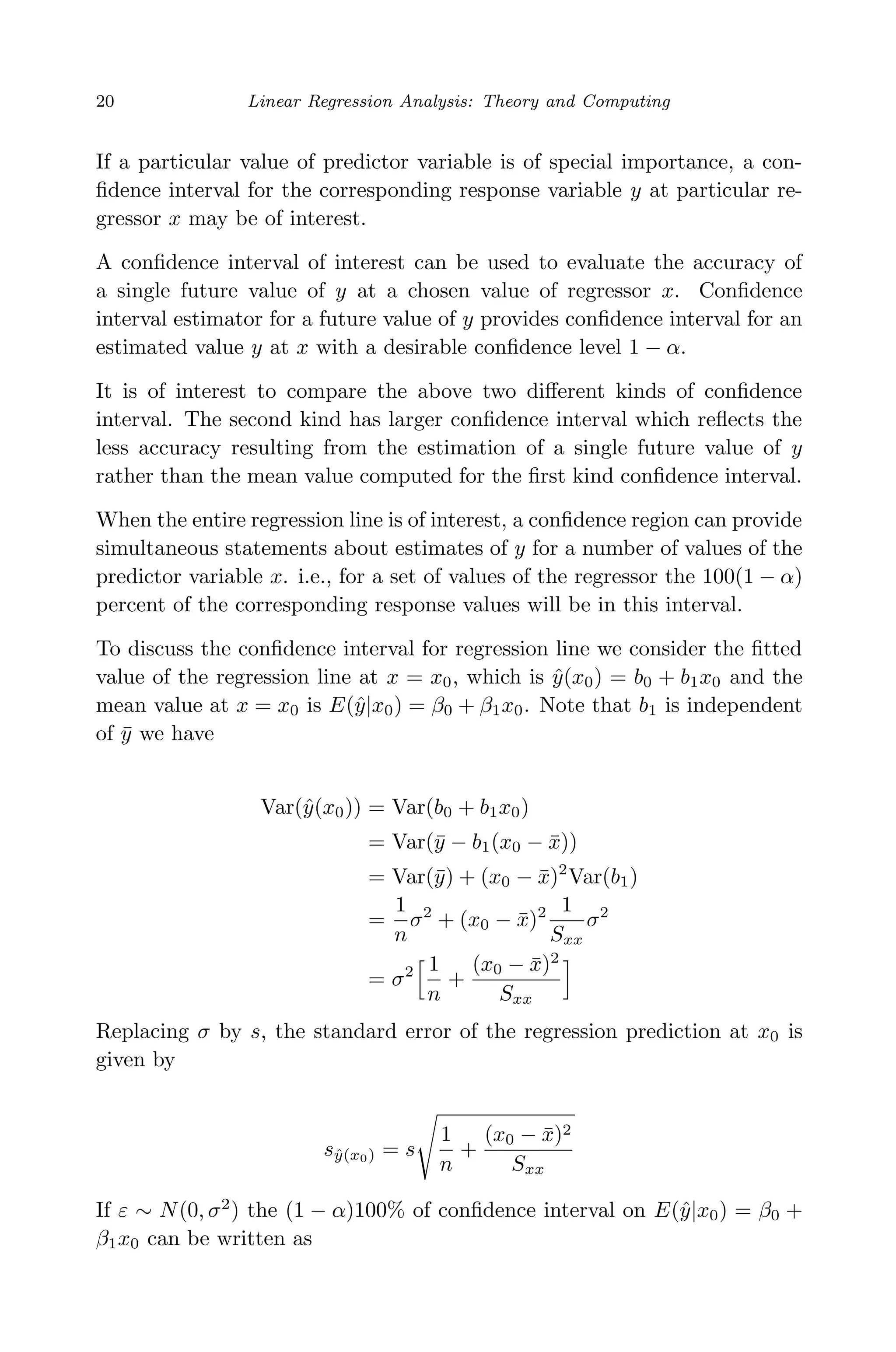
To discuss the confidence interval for regression line we consider the fitted
value of the regression line at x = x0, which is ˆy(x0) = b0 + b1x0 and the
mean value at x = x0 is E(ˆy|x0) = β0 + β1x0. Note that b1 is independent
of ¯y we have
Var(ˆy(x0)) = Var(b0 + b1x0)
= Var(¯y − b1(x0 − ¯x))
= Var(¯y) + (x0 − ¯x)2
Var(b1)
=
1
n
σ2
+ (x0 − ¯x)2 1
Sxx
σ2
= σ2 1
n
+
(x0 − ¯x)2
Sxx
Replacing σ by s, the standard error of the regression prediction at x0 is
given by
sˆy(x0) = s
1
n
+
(x0 − ¯x)2
Sxx
If ε ∼ N(0, σ2
) the (1 − α)100% of confidence interval on E(ˆy|x0) = β0 +
β1x0 can be written as
May 7, 2009 10:22 World Scientific Book - 9in x 6in Regression˙master
Simple Linear Regression 21
ˆy(x0) ± tα/2,n−2 s
1
n
+
(x0 − ¯x)2
Sxx
.
We now discuss confidence interval on the regression prediction. Denoting
the regression prediction at x0 by y0 and assuming that y0 is independent
of ˆy(x0), where y(x0) = b0 + b1x0, and E(y − ˆy(x0)) = 0, we have
Var y0 − ˆy(x0) = σ2
+ σ2 1
n
+
(x0 − ¯x)2
Sxx
= σ2
1 +
1
n
+
(x0 − ¯x)2
Sxx
.
Under the normality assumption of the error term
y0 − ˆy(x0)
σ 1 + 1
n + (x0−¯x)2
Sxx
∼ N(0, 1).
Substituting σ with s we have
y0 − ˆy(x0)
s 1 + 1
n + (x0−¯x)2
Sxx
∼ tn−2.
Thus the (1 − α)100% confidence interval on regression prediction y0 can
be expressed as
ˆy(x0) ± tα/2,n−2 s 1 +
1
n
+
(x0 − ¯x)2
Sxx
.
2.6 Statistical Inference on Regression Parameters
We start with the discussions on the total variance of regression model
which plays an important role in the regression analysis. In order to parti-
tion the total variance
n
i=1
(yi − ¯y)2
, we consider the fitted regression equa-
tion ˆyi = b0 + b1xi, where b0 = ¯y − b1 ¯x and b1 = Sxy/Sxx. We can write
¯ˆy =
1
n
n
i=1
ˆyi =
1
n
n
i=1
[(¯y − b1 ¯x) + b1xi] =
1
n
n
i=1
[¯y + b1(xi − ¯x)] = ¯y.
April 29, 2009 11:50 World Scientific Book - 9in x 6in Regression˙master
22 Linear Regression Analysis: Theory and Computing
For the regression response yi, the total variance is
1
n
n
i=1
(yi − ¯y)2
. Note
that the product term is zero and the total variance can be partitioned into
two parts:
1
n
n
i=1
(yi − ¯y)2
=
1
n
n
i=1
[(yi − ˆy)2
+ (ˆyi − ¯y)]2
=
1
n
n
i=1
(ˆyi − ¯y)2
+
1
n
n
i=1
(yi − ˆy)2
= SSReg + SSRes
= Variance explained by regression + Variance unexplained
It can be shown that the product term in the partition of variance is zero:
n
i=1
(ˆyi − ¯y)(yi − ˆyi) (use the fact that
n
i=1
(yi − ˆyi) = 0)
=
n
i=1
ˆyi(yi − ˆyi) =
n
i=1
b0 + b1(xi − ¯x) (yi − ˆy)
= b1
n
i=1
xi(yi − ˆyi) = b1
n
i=1
xi[yi − b0 − b1(xi − ¯x)]
= b1
n
i=1
xi (yi − ¯y) − b1(xi − ¯x)
= b1
n
i=1
(xi − ¯x)(yi − ¯y) − b1
n
i=1
(xi − ¯x)2
= b1[Sxy − b1Sxx] = b1[Sxy − (Sxy/Sxx)Sxx] = 0
The degrees of freedom for SSReg and SSRes are displayed in Table 2.2.
Table 2.2 Degrees of Freedom in Parti-
tion of Total Variance
SST otal = SSReg + SSRes
n-1 = 1 + n-2
To test the hypothesis H0 : β1 = 0 versus H1 : β1 = 0 it is needed
to assume that εi ∼ N(0, σ2
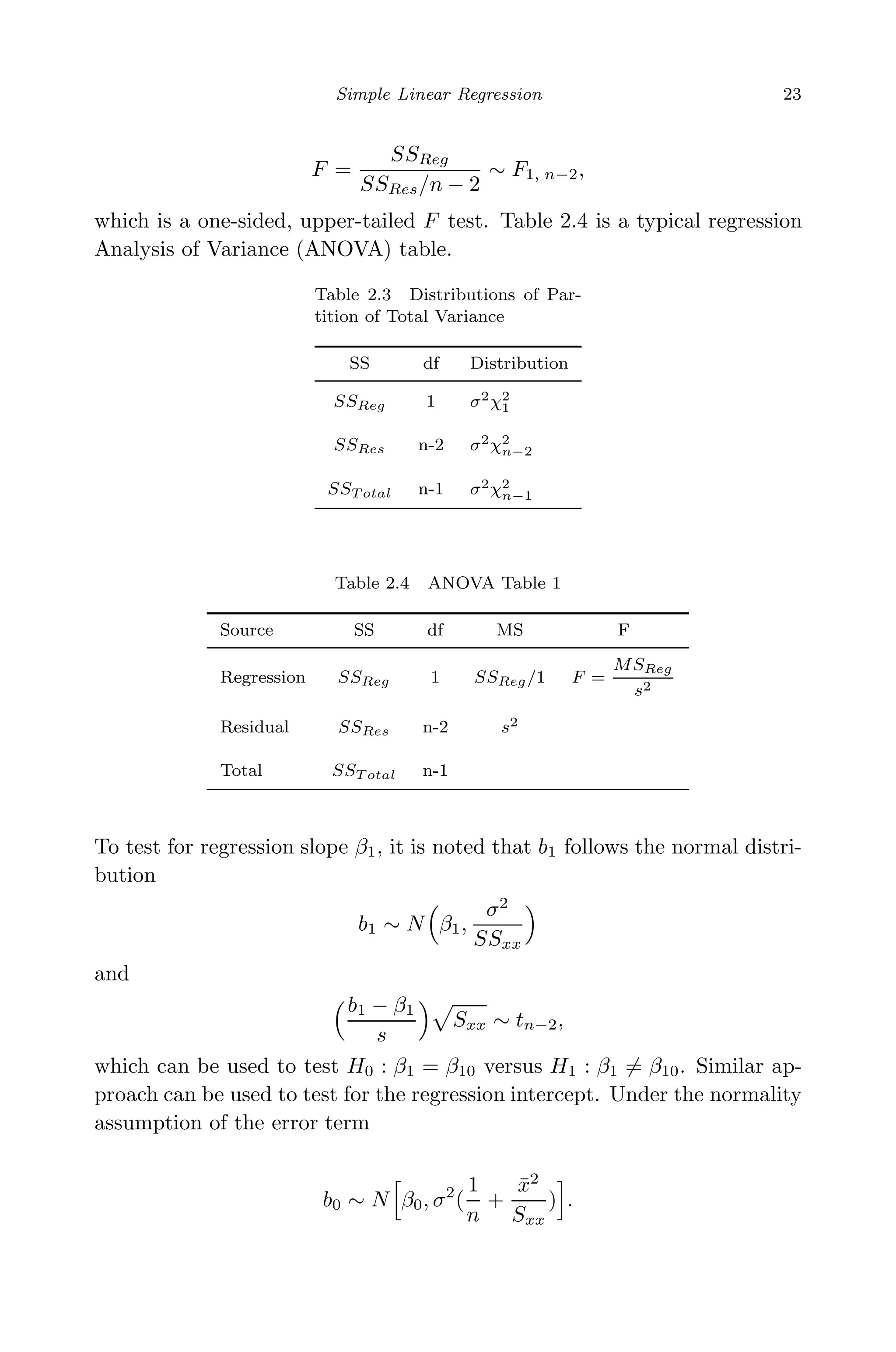
). Table 2.3 lists the distributions of SSReg,
SSRes and SST otal under the hypothesis H0. The test statistic is given by
May 7, 2009 10:22 World Scientific Book - 9in x 6in Regression˙master
Simple Linear Regression 23
F =
SSReg
SSRes/n − 2
∼ F1, n−2,
which is a one-sided, upper-tailed F test. Table 2.4 is a typical regression
Analysis of Variance (ANOVA) table.
Table 2.3 Distributions of Par-
tition of Total Variance
SS df Distribution
SSReg 1 σ2χ2
1
SSRes n-2 σ2χ2
n−2
SST otal n-1 σ2χ2
n−1
Table 2.4 ANOVA Table 1
Source SS df MS F
Regression SSReg 1 SSReg/1 F =
MSReg
s2
Residual SSRes n-2 s2
Total SST otal n-1
To test for regression slope β1, it is noted that b1 follows the normal distri-
bution
b1 ∼ N β1,
σ2
SSxx
and
b1 − β1
s
Sxx ∼ tn−2,
which can be used to test H0 : β1 = β10 versus H1 : β1 = β10. Similar ap-
proach can be used to test for the regression intercept. Under the normality
assumption of the error term
b0 ∼ N β0, σ2
(
1
n
+
¯x2
Sxx
) .
April 29, 2009 11:50 World Scientific Book - 9in x 6in Regression˙master
24 Linear Regression Analysis: Theory and Computing
Therefore, we can use the following t test statistic to test H0 : β0 = β00
versus H1 : β0 = β00.
t =
b0 − β0
s 1/n + (¯x2/Sxx)
∼ tn−2
It is straightforward to use the distributions of b0 and b1 to obtain the
(1 − α)100% confidence intervals of β0 and β1:
b0 ± tα/2,n−2 s
1
n
+
¯x2
Sxx
,
and
b1 ± tα/2,n−2 s
1
Sxx
.
Suppose that the regression line pass through (0, β0). i.e., the y intercept
is a known constant β0. The model is given by yi = β0 + β1xi + εi with
known constant β0. Using the least squares principle we can estimate β1:
b1 =
xiyi
x2
i
.
Correspondingly, the following test statistic can be used to test for H0 :
β1 = β10 versus H1 : β1 = β10. Under the normality assumption on εi
t =
b1 − β10
s
n
i=1
x2
i ∼ tn−1
Note that we only have one parameter for the fixed y-intercept regression
model and the t test statistic has n−1 degrees of freedom, which is different
from the simple linear model with 2 parameters.
The quantity R2
, defined as below, is a measurement of regression fit:
R2
=
SSReg
SST otal
=
n
i=1(ˆyi − ¯y)2
n
i=1(yi − ¯y)2
= 1 −
SSRes
SST otal
Note that 0 ≤ R2
≤ 1 and it represents the proportion of total variation
explained by regression model.
April 29, 2009 11:50 World Scientific Book - 9in x 6in Regression˙master
Simple Linear Regression 25
Quantity CV =
s
¯y
×100 is called the coefficient of variation, which is also
a measurement of quality of fit and represents the spread of noise around
the regression line. The values of R2
and CV can be found from Table 2.7,
an ANOVA table generated by SAS procedure REG.
We now discuss simultaneous inference on the simple linear regression. Note
that so far we have discussed statistical inference on β0 and β1 individually.
The individual test means that when we test H0 : β0 = β00 we only test
this H0 regardless of the values of β1. Likewise, when we test H0 : β1 = β10
we only test H0 regardless of the values of β0. If we would like to test
whether or not a regression line falls into certain region we need to test the
multiple hypothesis: H0 : β0 = β00, β1 = β10 simultaneously. This falls into
the scope of multiple inference. For the multiple inference on β0 and β1 we
notice that
b0 − β0, b1 − β1
n
n
i=1 xi
n
i=1 xi
n
i=1 x2
i
b0 − β0
b1 − β1
∼ 2s2
F2,n−2.
Thus, the (1 − α)100% confidence region of the β0 and β1 is given by
b0 − β0, b1 − β1
n
n
i=1 xi
n
i=1 xi
n
i=1 x2
i
b0 − β0
b1 − β1
≤ 2s2
Fα,2,n−2,
where Fα,2,n−2 is the upper tail of the αth percentage point of the F-
distribution. Note that this confidence region is an ellipse.
2.7 Residual Analysis and Model Diagnosis
One way to check performance of a regression model is through regression
residual, i.e., ei = yi − ˆyi. For the simple linear regression a scatter plot
of ei against xi provides a good graphic diagnosis for the regression model.
An evenly distributed residuals around mean zero is an indication of a good
regression model fit.
We now discuss the characteristics of regression residuals if a regression
model is misspecified. Suppose that the correct model should take the
quadratic form:
May 7, 2009 10:22 World Scientific Book - 9in x 6in Regression˙master
26 Linear Regression Analysis: Theory and Computing
yi = β0 + β1(xi − ¯x) + β2x2
i + εi
with E(εi) = 0. Assume that the incorrectly specified linear regression
model takes the following form:
yi = β0 + β1(xi − ¯x) + ε∗
i .
Then ε∗
i = β2x2
i + ε∗
i which is unknown to the analyst. Now, the mean
of the error for the simple linear regression is not zero at all and it is a
function of xi. From the quadratic model we have
b0 = ¯y = β0 + β2 ¯x2
+ ¯ε
and
b1 =
Sxy
Sxx
=
n
i=1(xi − ¯x)(β0 + β1(xi − ¯x) + β2x2
i + εi)
Sxx
b1 = β1 + β2
n
i=1(xi − ¯x)x2
i
Sxx
+
n
i=1(xi − ¯x)εi
Sxx
.
It is easy to know that
E(b0) = β0 + β2 ¯x2
and
E(b1) = β1 + β2
n
i=1(xi − ¯x)x2
i
Sxx
.
Therefore, the estimators b0 and b1 are biased estimates of β0 and β1.
Suppose that we fit the linear regression model and the fitted values are
given by ˆyi = b0 + b1(xi − ¯x), the expected regression residual is given by
E(ei) = E(yi − ˆyi) = β0 + β1(xi − ¯x) + β2x2
i − E(b0) + E(b1)(xi − ¯x)
= β0 + β1(xi − ¯x) + β2x2
i − β0 + β2 ¯x2
− β1 + β2
n
i=1(xi − ¯x)x2
i
Sxx
(xi − ¯x)
= β2 (x2
i − ¯x2
) −
n
i=1(xi − ¯x)x2
i
Sxx
April 29, 2009 11:50 World Scientific Book - 9in x 6in Regression˙master
Simple Linear Regression 27
If β2 = 0 then the fitted model is correct and E(yi − ˆyi) = 0. Otherwise,
the expected value of residual takes the quadratic form of xi’s. As a re-
sult, the plot of residuals against xi’s should have a curvature of quadratic
appearance.
Statistical inference on regression model is based on the normality assump-
tion of the error term. The least squares estimators and the MLEs of the
regression parameters are exactly identical only under the normality as-
sumption of the error term. Now, question is how to check the normality
of the error term? Consider the residual yi − ˆyi: we have E(yi − ˆyi) = 0
and
Var(yi − ˆyi) = V ar(yi) + Var(ˆyi) − 2Cov(yi, ˆyi)
= σ2
+ σ2 1
n
+
(xi − ¯x)2
Sxx
− 2Cov(yi, ¯y + b1(xi − ¯x))
We calculate the last term
Cov(yi, ¯y + b1(xi − ¯x)) = Cov(yi, ¯y) + (xi − ¯x)Cov(yi, b1)
=
σ2
n
+ (xi − ¯x)Cov(yi, Sxy/Sxx)
=
σ2
n
+ (xi − ¯x)
1
Sxx
Cov yi,
n
i=1
(xi − ¯x)(yi − ¯y)
=
σ2
n
+ (xi − ¯x)
1
Sxx
Cov yi,
n
i=1
(xi − ¯x)yi =
σ2
n
+
(xi − ¯x)2
Sxx
σ2
Thus, the variance of the residual is given by
Var(ei) = V ar(yi − ˆyi) = σ2
1 −
1
n
+
(xi − ¯x)2
Sxx
,
which can be estimated by
sei = s 1 −
1
n
+
(xi − ¯x)2
Sxx
.
If the error term in the simple linear regression is correctly specified, i.e.,
error is normally distributed, the standardized residuals should behave like
the standard normal random variable. Therefore, the quantile of the stan-
dardized residuals in the simple linear regression will be similar to the
quantile of the standardized normal random variable. Thus, the plot of the
April 29, 2009 11:50 World Scientific Book - 9in x 6in Regression˙master
28 Linear Regression Analysis: Theory and Computing
quantile of the standardized residuals versus the normal quantile should
follow a straight line in the first quadrant if the normality assumption on
the error term is correct. It is usually called the normal plot and has been
used as a useful tool for checking the normality of the error term in simple
linear regression. Specifically, we can
(1) Plot ordered residual
yi − ˆyi
s
against the normal quantile Z i−0.375
n+0.25
(2) Plot ordered standardized residual
yi − ˆyi
sei
against the normal quantile
Z i−0.375
n+0.25
2.8 Example
The SAS procedure REG can be used to perform regression analysis. It is
convenient and efficient. The REG procedure provides the most popular
parameter estimation, residual analysis, regression diagnosis. We present
the example of regression analysis of the density and stiffness data using
SAS.
data example1;
input density stiffness @@;
datalines;
9.5 14814 8.4 17502 9.8 14007 11.0 19443 8.3 7573
9.9 14191 8.6 9714 6.4 8076 7.0 5304 8.2 10728
17.4 43243 15.0 25319 15.2 28028 16.4 41792 16.7 49499
15.4 25312 15.0 26222 14.5 22148 14.8 26751 13.6 18036
25.6 96305 23.4 104170 24.4 72594 23.3 49512 19.5 32207
21.2 48218 22.8 70453 21.7 47661 19.8 38138 21.3 53045
;
proc reg data=example1 outest=out1 tableout;
model stiffness=density/all;
run;
ods rtf file="C:Example1_out1.rtf";
proc print data=out1;
title "Parameter Estimates and CIs";
run;
ods rtf close;
April 29, 2009 11:50 World Scientific Book - 9in x 6in Regression˙master
Simple Linear Regression 29
*Trace ODS to find out the names of the output data sets;
ods trace on;
ods show;
ods rtf file="C:Example1_out2.rtf";
proc reg data=Example1 alpha=0.05;
model stiffness=density;
ods select Reg.MODEL1.Fit.stiffness.ANOVA;
ods select Reg.MODEL1.Fit.stiffness.FitStatistics;
ods select Reg.MODEL1.Fit.stiffness.ParameterEstimates;
ods rtf close;
proc reg data=Example1;
model stiffness=density;
output out=out3 p=yhat r=yresid student=sresid;
run;
ods rtf file="C:Example1_out3.rtf";
proc print data=out3;
title "Predicted Values and Residuals";
run;
ods rtf close;
The above SAS code generate the following output tables 2.5, 2.6, 2.7, 2.8,
and 2.9.
Table 2.5 Confidence Intervals on Parameter Estimates
Obs MODEL TYPE DEPVAR RMSE Intercept density
1 Model1 Parms stiffness 11622.44 -25433.74 3884.98
2 Model1 Stderr stiffness 11622.44 6104.70 370.01
3 Model1 T stiffness 11622.44 -4.17 10.50
4 Model1 P-value stiffness 11622.44 0.00 0.00
5 Model1 L95B stiffness 11622.44 -37938.66 3127.05
6 Model1 U95B stiffness 11622.44 -12928.82 4642.91
Data Source: density and stiffness data
The following is an example of SAS program for computing the confi-
dence band of regression mean, the confidence band for regression predic-
April 29, 2009 11:50 World Scientific Book - 9in x 6in Regression˙master
30 Linear Regression Analysis: Theory and Computing
Table 2.6 ANOVA Table 2
Sum of Mean
Source DF Squares Square F Value Pr >F
Model 1 14891739363 14891739363 110.24 <.0001
Error 28 3782270481 135081089
Corrected Total 29 18674009844
Data Source: density and stiffness data
Table 2.7 Regression Table
Root MSE 11622.00 R-Square 0.7975
Dependent Mean 34667.00 Adj R-Sq 0.7902
Coeff Var 33.53
Data Source: density and stiffness data
Table 2.8 Parameter Estimates of Simple Linear Regression
Parameter Standard
Variable DF Estimate Error t Value Pr > |t|
Intercept 1 -25434.00 6104.70 -4.17 0.0003
density 1 3884.98 370.01 10.50 < .0001
Data Source: density and stiffness data
tion, and probability plot (QQ-plot and PP-plot).
data Example2;
input density stiffness @@;
datalines;
9.5 14814 8.4 17502 9.8 14007 11 19443 8.3 7573
9.9 14191 8.6 9714 6.4 8076 7 5304 8.2 10728
17.4 43243 15 25319 15.2 28028 16.4 41792 16.7 49499
15.4 25312 15 26222 14.5 22148 14.8 26751 13.6 18036
25.6 96305 23.4 104170 24.4 72594 23.3 49512 19.5 32207
21.2 48218 22.8 70453 21.7 47661 19.8 38138 21.3 53045
;
across=1 cborder=red offset=(0,0)
shape=symbol(3,1) label=none value=(height=1);
symbol1 c=black value=- h=1;
symbol2 c=red;
April 29, 2009 11:50 World Scientific Book - 9in x 6in Regression˙master
Simple Linear Regression 31
Table 2.9 Table for Fitted Values and Residuals
Obs density stiffness yhat yresid
1 9.5 14814 11473.53 3340.47
2 8.4 17502 7200.06 10301.94
3 9.8 14007 12639.02 1367.98
4 11 19443 17300.99 2142.01
5 8.3 7573 6811.56 761.44
6 9.9 14191 13027.52 1163.48
7 8.6 9714 7977.05 1736.95
8 6.4 8076 -569.90 8645.90
9 7.0 5304 1761.09 3542.91
10 8.2 10728 6423.06 4304.94
11 17.4 43243 42164.84 1078.16
12 15.0 25319 32840.89 -7521.89
13 15.2 28028 33617.89 -5589.89
14 16.4 41792 38279.86 3512.14
15 16.7 49499 39445.35 10053.65
16 15.4 25312 34394.89 -9082.89
17 15.0 26222 32840.89 -6618.89
18 14.5 22148 30898.41 -8750.41
19 14.8 26751 32063.90 -5312.90
20 13.6 18036 27401.93 -9365.93
21 25.6 96305 74021.64 22283.36
22 23.4 104170 65474.69 38695.31
23 24.4 72594 69359.67 3234.33
24 23.3 49512 65086.19 -15574.19
25 19.5 32207 50323.28 -18116.28
26 21.2 48218 56927.74 -8709.74
27 22.8 70453 63143.70 7309.30
28 21.7 47661 58870.23 -11209.23
29 19.8 38138 51488.78 -13350.78
30 21.3 53045 57316.24 -4271.24
Data Source: density and stiffness data
symbol3 c=blue;
symbol4 c=blue;
proc reg data=Example2;
model density=stiffness /noprint p r;
output out=out p=pred r=resid LCL=lowpred
UCL=uppred LCLM=lowreg UCLM=upreg;
run;
ods rtf file="C:Example2.rtf";
ods graphics on;
title "PP Plot";
April 29, 2009 11:50 World Scientific Book - 9in x 6in Regression˙master
32 Linear Regression Analysis: Theory and Computing
plot npp.*r./caxis=red ctext=blue nostat cframe=ligr;
run;
title "QQ Plot";
plot r.*nqq. /noline mse
caxis=red ctext=blue cframe=ligr;
run;
*Compute confidence band of regression mean;
plot density*stiffness/conf caxis=red ctext=blue
cframe=ligr legend=legend1;
run;
*Compute confidence band of regression prediction;
plot density*stiffness/pred caxis=red ctext=blue
cframe=ligr legend=legend1;
run;
ods graphics off;
ods rtf close;
quit;
The regression scatterplot, residual plot, 95% confidence bands for re-
gression mean and prediction are presented in Fig. 2.1.
April 29, 2009 11:50 World Scientific Book - 9in x 6in Regression˙master
Simple Linear Regression 33
2e+04 4e+04 6e+04 8e+04 1e+05
51015202530
(a) density = a + b(stiffness)
stiffness
density
10 15 20 25 30
−6−4−2024
(b) Residual Plot of Stiffness Data
Fitted Value
Residual
2e+04 4e+04 6e+04 8e+04 1e+05
51015202530
(c) 95% Regression Band
Stiffness
Density
2e+04 4e+04 6e+04 8e+04 1e+05
51015202530
(d) 95% Prediction Band
Stiffness
Density
Fig. 2.1 (a) Regression Line and Scatter Plot. (b) Residual Plot, (c) 95% Confidence
Band for Regression Mean. (d) 95% Confidence Band for Regression Prediction.
The Q-Q plot for regression model density=β0 + β1 stiffness is presented in
Fig. 2.2.
May 7, 2009 10:22 World Scientific Book - 9in x 6in Regression˙master
34 Linear Regression Analysis: Theory and Computing
−2 −1 0 1 2
10152025
Q−Q plot for Stiffness Data
Quantile
SampleQuantile
Fig. 2.2 Q-Q Plot for Regression Model density=β0 + β1 stiffness + ε.
April 29, 2009 11:50 World Scientific Book - 9in x 6in Regression˙master
Simple Linear Regression 35
Problems
1. Consider a set of data (xi, yi), i = 1, 2, · · · , n, and the following two
regression models:
yi = β0 + β1xi + ε, (i = 1, 2, · · · , n), Model A
yi = γ0 + γ1xi + γ2x2
i + ε, (i = 1, 2, · · · , n), Model B
Suppose both models are fitted to the same data. Show that
SSRes, A ≥ SSRes, B
If more higher order terms are added into the above Model B, i.e.,
yi = γ0 + γ1xi + γ2x2
i + γ3x3
i + · · · + γkxk
i + ε, (i = 1, 2, · · · , n),
show that the inequality SSRes, A ≥ SSRes, B still holds.
2. Consider the zero intercept model given by
yi = β1xi + εi, (i = 1, 2, · · · , n)
where the εi’s are independent normal variables with constant variance
σ2
. Show that the 100(1 − α)% confidence interval on E(y|x0) is given
by
b1x0 + tα/2, n−1s
x2
0
n
i=1 x2
i
where s =
n
i=1
(yi − b1xi)/(n − 1) and b1 =
n
i=1 yixi
n
i=1 x2
i
.
3. Derive and discuss the (1 − α)100% confidence interval on the slope β1
for the simple linear model with zero intercept.
4. Consider the fixed zero intercept regression model
yi = β1xi + εi, (i = 1, 2, · · · , n)
The appropriate estimator of σ2
is given by
s2
=
n
i=1
(yi − ˆyi)2
n − 1
Show that s2
is an unbiased estimator of σ2
.
April 29, 2009 11:50 World Scientific Book - 9in x 6in Regression˙master
36 Linear Regression Analysis: Theory and Computing
Table 2.10 Data for Two Parallel
Regression Lines
x y
x1 y1
.
..
.
..
xn1 yn1
xn1+1 yn1+1
..
.
..
.
xn1+n2 yn1+n2
5. Consider a situation in which the regression data set is divided into two
parts as shown in Table 2.10.
The regression model is given by
yi =



β
(1)
0 + β1xi + εi, i = 1, 2, · · · , n1;
β
(2)
0 + β1xi + εi, i = n1 + 1, · · · , n1 + n2.
In other words, there are two regression lines with common slope. Using
the centered regression model
yi =



β
(1∗)
0 + β1(xi − ¯x1) + εi, i = 1, 2, · · · , n1;
β
(2∗)
0 + β1(xi − ¯x2) + εi, i = n1 + 1, · · · , n1 + n2,
where ¯x1 =
n1
i=1 xi/n1 and ¯x2 =
n1+n2
i=n1+1 xi/n2. Show that the least
squares estimate of β1 is given by
b1 =
n1
i=1(xi − ¯x1)yi +
n1+n2
i=n1+1(xi − ¯x2)yi
n1
i=1(xi − ¯x1)2 +
n1+n2
i=n1+1(xi − ¯x2)2
6. Consider two simple linear models
Y1j = α1 + β1x1j + ε1j, j = 1, 2, · · · , n1
and
Y2j = α2 + β2x2j + ε2j, j = 1, 2, · · · , n2
Assume that β1 = β2 the above two simple linear models intersect. Let
x0 be the point on the x-axis at which the two linear models intersect.
Also assume that εij are independent normal variable with a variance
σ2
. Show that
May 7, 2009 10:22 World Scientific Book - 9in x 6in Regression˙master
Simple Linear Regression 37
(a). x0 =
α1 − α2
β1 − β2
(b). Find the maximum likelihood estimates (MLE) of x0 using the
least squares estimators ˆα1, ˆα2, ˆβ1, and ˆβ2.
(c). Show that the distribution of Z, where
Z = (ˆα1 − ˆα2) + x0(ˆβ1 − ˆβ2),
is the normal distribution with mean 0 and variance A2
σ2
, where
A2
=
x2
1j − 2x0 x1j + x2
0n1
n1 (x1j − ¯x1)2
+
x2
2j − 2x0 x2j + x2
0n2
n2 (x2j − ¯x2)2
.
(d). Show that U = N ˆσ2
/σ2
is distributed as χ2
(N), where N =
n1 + n2 − 4.
(e). Show that U and Z are independent.
(f). Show that W = Z2
/A2
ˆσ2
has the F distribution with degrees of
freedom 1 and N.
(g). Let S2
1 = (x1j − ¯x1)2
and S2
2 = (x2j − ¯x2)2
, show that the
solution of the following quadratic equation about x0, q(x0) =
ax2
0 + 2bx0 + c = 0,
(ˆβ1 − ˆβ2)2
−
1
S2
1
+
1
S2
2
ˆσ2
Fα,1,N x2
0
+ 2 (ˆα1 − ˆα2)(ˆβ1 − ˆβ2) +
¯x1
S2
1
+
¯x2
S2
2
ˆσ2
Fα,1,N x0
+ (ˆα1 − ˆα2)2
−
x2
1j
n1S2
1
+
x2
2j
n2S2
2
ˆσ2
Fα,1,N = 0.
Show that if a ≥ 0 and b2
− ac ≥ 0, then 1 − α confidence interval
on x0 is
−b −
√
b2 − ac
a
≤ x0 ≤
−b +
√
b2 − ac
a
.
7. Observations on the yield of a chemical reaction taken at various tem-
peratures were recorded in Table 2.11:
(a). Fit a simple linear regression and estimate β0 and β1 using the
least squares method.
(b). Compute 95% confidence intervals on E(y|x) at 4 levels of temper-
atures in the data. Plot the upper and lower confidence intervals
around the regression line.
April 29, 2009 11:50 World Scientific Book - 9in x 6in Regression˙master
38 Linear Regression Analysis: Theory and Computing
Table 2.11 Chemical Reaction Data
temperature (C0) yield of chemical reaction (%)
150 77.4
150 77.4
150 77.4
150 77.4
150 77.4
150 77.4
150 77.4
150 77.4
150 77.4
150 77.4
150 77.4
150 77.4
Data Source: Raymond H. Myers, Classical and Mod-
ern Regression Analysis With Applications, P77.
(c). Plot a 95% confidence band on the regression line. Plot on the
same graph for part (b) and comment on it.
8. The study “Development of LIFETEST, a Dynamic Technique to As-
sess Individual Capability to Lift Material” was conducted in Virginia
Polytechnic Institute and State University in 1982 to determine if cer-
tain static arm strength measures have influence on the “dynamic lift”
characteristics of individual. 25 individuals were subjected to strength
tests and then were asked to perform a weight-lifting test in which
weight was dynamically lifted overhead. The data are in Table 2.12:
(a). Find the linear regression line using the least squares method.
(b). Define the joint hypothesis H0 : β0 = 0, β1 = 2.2. Test this
hypothesis problem using a 95% joint confidence region and β0
and β1 to draw your conclusion.
(c). Calculate the studentized residuals for the regression model. Plot
the studentized residuals against x and comment on the plot.
April 29, 2009 11:50 World Scientific Book - 9in x 6in Regression˙master
Simple Linear Regression 39
Table 2.12 Weight-lifting Test Data
Individual Arm Strength (x) Dynamic Lift (y)
1 17.3 71.4
2 19.5 48.3
3 19.5 88.3
4 19.7 75.0
5 22.9 91.7
6 23.1 100.0
7 26.4 73.3
8 26.8 65.0
9 27.6 75.0
10 28.1 88.3
11 28.1 68.3
12 28.7 96.7
13 29.0 76.7
14 29.6 78.3
15 29.9 60.0
16 29.9 71.7
17 30.3 85.0
18 31.3 85.0
19 36.0 88.3
20 39.5 100.0
21 40.4 100.0
22 44.3 100.0
23 44.6 91.7
24 50.4 100.0
25 55.9 71.7
Data Source: Raymond H. Myers, Classical and Mod-
ern Regression Analysis With Applications, P76.
April 29, 2009 11:50 World Scientific Book - 9in x 6in Regression˙master
This page intentionally left blankThis page intentionally left blank
April 29, 2009 11:50 World Scientific Book - 9in x 6in Regression˙master
Chapter 3
Multiple Linear Regression
The general purpose of multiple linear regression is to seek for the linear re-
lationship between a dependent variable and several independent variables.
Multiple regression allows researchers to examine the effect of more than
one independent variables on response at the same time. For some research
questions, regression can be used to examine how much a particular set of
independent variables can explain sufficiently the outcome. In other cases,
multiple regression is used to examine the effect of outcome while account-
ing for more than one factor that could influence the outcome. In this
chapter we discuss multiple linear regression. To facilitate the discussion of
the theory of the multiple regression model we start with a brief introduc-
tion of the linear space and the projection in the linear space. Then we will
introduce multiple linear model in matrix form. All subsequent discussions
of multiple regression will be based on its matrix form.
3.1 Vector Space and Projection
First we briefly discuss the vector space, subspace, projection, and
quadratic form of multivariate normal variable, which are useful in the
discussions of the subsequent sections of this chapter.
3.1.1 Vector Space
A vector is a geometric object which has both magnitude and direction.
A vector is frequently represented by a line segment connecting the initial
point A with the terminal point B and denoted by
−−→
AB. The magnitude
of the vector
−−→
AB is the length of the segment and the direction of this
vector characterizes the displacement of the point B relative to the point
41
May 7, 2009 10:22 World Scientific Book - 9in x 6in Regression˙master
42 Linear Regression Analysis: Theory and Computing
A. Vectors can be added, subtracted, multiplied by a number, and flipped
around (multiplying by number −1) so that the direction is reversed. These
operations obey the familiar algebraic laws: commutativity, associativity,
and distributivity. The sum of two vectors with the same initial point
can be found geometrically using the parallelogram law. Multiplication
by a positive number, commonly called a scalar in this context, amounts
to changing the magnitude of vector, that is, stretching or compressing it
while keeping its direction; multiplication by −1 preserves the magnitude
of the vector but reverses its direction. Cartesian coordinates provide a
systematic way of describing vectors and operations on them.
A vector space is a set of vectors that is closed under finite vector ad-
dition and scalar multiplication. The basic example is n-dimensional Eu-
clidean space, where every element is represented by a list of real numbers,
such as
x = (x1, x2, · · · , xn).
Scalars are real numbers, addition is componentwise, and scalar multiplica-
tion is multiplication on each term separately. Suppose V is closed under
vector addition on Rn
: if u, v ∈ V , then u + v ∈ V . V is also closed un-
der scalar multiplication: if a ∈ R1
, v ∈ V , then av ∈ V . Then V is a
vector space (on Rn
). We will focus our discussion only on vector space
on n-dimensional Euclidean space. For example, for any positive integer n,
the space of all n-tuples of elements of real line R1
forms an n-dimensional
real vector space sometimes called real coordinate space and denoted by
Rn
. An element in Rn
can be written as
x = (x1, x2, · · · , xn),
where each xi is an element of R1
. The addition on Rn
is defined by
x + y = (x1 + y1, x2 + y2, · · · , xn + yn),
and the scalar multiplication on Rn
is defined by
a x = (ax1, ax2, · · · , axn).
When a = −1 the vector ax has the same length as x but with a geomet-
rically reversed direction.
It was F. Hausdorff who first proved that every vector space has a basis.
A basis makes it possible to express every vector of the space as a unique
tuple of the field elements, although caution must be exercised when a
vector space does not have a finite basis. In linear algebra, a basis is a
set of vectors that, in a linear combination, can represent every vector in a
April 29, 2009 11:50 World Scientific Book - 9in x 6in Regression˙master
Multiple Linear Regression 43
given vector space, and such that no element of the set can be represented
as a linear combination of the others. In other words, a basis is a linearly
independent spanning set. The following is an example of basis of Rn
:
e1 = (1, 0, 0, · · · , 0)1×n
e2 = (0, 1, 0, · · · , 0)1×n
e3 = (0, 0, 1, · · · , 0)1×n
...
en = (0, 0, 0, · · · , 1)1×n.
Actually, the above vectors consist of the standard orthogonal basis of the
vector space Rn
. Any vector x = (x1, x2, · · · , xn) in the Rn
can be a linear
combination of e1, e2, · · · , en. In fact,
x = x1e1 + x2e2 + x3e3 + · · · + xnen.
This representation is unique. i.e., if there is another representation such
that
x = x∗
1e1 + x∗
2e2 + x∗
3e3 + · · · + x∗
nen,
then
(x1 − x∗
1)e1 + (x2 − x∗
2)e2 + · · · + (xn − x∗
n)en
= (x1 − x∗
1, x2 − x∗
2, · · · , x2 − x∗
2) = (0, 0, · · · , 0).
Therefore, we have xi = x∗
i for all i = 1, 2, · · · , n.
Given a vector space V , a nonempty subset W of V that is closed
under addition and scalar multiplication is called a subspace of V . The
intersection of all subspaces containing a given set of vectors is called its
span. If no vector can be removed without changing the span, the vectors
in this set is said to be linearly independent. A linearly independent set
whose span is V is called a basis for V . A vector span by two vectors v and
w can be defined as: x : x = av + bw, for all (a, b) ∈ R2
. Note that v and
w may not be necessarily independent. If a vector space S is spanned by a
set of independent vectors v1, v2, · · · , vp, i.e., S is the set of vectors
{x : x = a1 + v1 + a2v2 + · · · + apvp, for all (a1, a2, · · · , ap) ∈ Rp
},
then the dimension of S is p. Vectors v1, v2, · · · , vp are the basis of the
vector space S. The dimension of a vector space S is the largest number of
a set of independent vectors in S. If the dimension of a linear space S is p
we write Dim(S) = p.
April 29, 2009 11:50 World Scientific Book - 9in x 6in Regression˙master
44 Linear Regression Analysis: Theory and Computing
3.1.2 Linearly Independent Vectors
If there exist a finite number of distinct vectors v1, v2, · · · , vn in vector
space V and scalars a1, a2, · · · , an, not all zero, such that
a1v1 + a2v2 + a3v3 + · · · + anvn = 0,
then the vectors v1, v2, · · · , vn are said to be linearly dependent. If
v1, v2, · · · , vn are dependent then out of these n vectors there is at least
one vector that can be expressed as a linear combination of other vectors.
Note that the zero on the right is the zero vector, not the number zero.
If no such scalars exist, then the vectors v1, v2, · · · , vn are said to be lin-
early independent. This condition can be reformulated as follows: whenever
a1, a2, · · · , an are scalars such that
a1v1 + a2v2 + a3v3 + · · · + anvn = 0,
we have ai = 0 for i = 1, 2, · · · , n, then v1, v2, · · · , vn are linearly indepen-
dent.
A basis of a vector space V is defined as a subset of vectors in V that
are linearly independent and these vectors span space V . Consequently,
if (v1, v2, · · · , vn) is a list of vectors in V , then these vectors form a basis
if and only if every vector x ∈ V can be uniquely expressed by a linear
combination of v1, v2, · · · , vp. i.e.,
x = a1v1 + a2v2 + · · · + anvn, for any x ∈ V.
The number of basis vectors in V is called the dimension of linear space
V. Note that a vector space can have more than one basis, but the number
of vectors which form a basis of the vector space V is always fixed. i.e.,
the dimension of vector space V is fixed but there will be more than one
basis. In fact, if the dimension of vector space V is n, then any n linearly
independent vectors in V form its basis.
3.1.3 Dot Product and Projection
If x = (x1, x2, · · · , xn) and y = (y1, y2, · · · , yn) are two vectors in a vector
Euclidean space Rn
. The dot product of two vectors x and y is defined as
x · y = x1y1 + x2y2 + · · · + xnyn.
Two vectors are said to be orthogonal if their dot product is 0. If θ is the
angle between two vectors (x1, x2, · · · , xn) and (y1, y2, · · · , yn), the cosine
of the angle between the two vectors is defined as
cos(θ) =
x · y
|x||y|
=
x1y1 + x2y2 + · · · + xnyn
x2
1 + x2
2 + · · · + x2
n y2
1 + y2
2 + · · · + y2
n
(3.1)
April 29, 2009 11:50 World Scientific Book - 9in x 6in Regression˙master
Multiple Linear Regression 45
Two orthogonal vectors meet at 90◦
; i.e., they are perpendicular. One
important application of the dot product is projection. The projection of
a vector y onto another vector x forms a new vector that has the same
direction as the vector x and the length |y| cos(θ), where |y| denotes the
length of vector y and θ is the angle between two vectors x and y. We
write this projection as Pxy. The projection vector can be expressed as
Pxy = |y| cos(θ)
x
|x|
= |y|
x · y
|x||y|
x
|x|
=
x1y1 + x2y2 + · · · + xnyn
x2
1 + x2
2 + · · · + x2
n
x = λx, (3.2)
where λ is a scalar and
λ =
x1y1 + x2y2 + · · · + xnyn
x2
1 + x2
2 + · · · + x2
n
=
x · y
xx
.
Thus, the projection of y onto vector x is a vector x multiplying a scalar
λ where λ is the cos(θ) and θ is the angle between two vectors x and y.
If x and y are two vectors in Rn
. Consider the difference vector between
the vector e, e = λx−y, and λ = x · y/x · x. The vector e is perpendicular
to the vector x when λ = (x · y)/(x · x). To see this we simply calculate
the dot product of e and x:
e · x = (λx − y) · x = λx · x − x · y =
x · y
x · x
x · x − x · y = 0
Thus, the angle between e and x is indeed 90o
, i.e., they are perpendicular
to each other. In addition, since e is perpendicular to x, it is the vector
with the shortest distance among all the vectors starting from the end of y
and ending at any point on x.
If a vector space has a basis and the length of the basis vectors is a
unity then this basis is an orthonormal basis. Any basis divided by its
length forms an orthonormal basis. If S is a p-dimensional subspace of a
vector space V , then it is possible to project vectors in V onto S. If the
subspace S has an orthonormal basis (w1, w2, · · · , wp), for any vector y in
V , the projection of y onto the subspace S is
PSy =
p
i=1
(y · wi)wi. (3.3)
Let vector spaces S and T be the two subspaces of a vector space V and
union S ∪ T = V . If for any vector x ∈ S and any vector y ∈ T, the
dot product x · y = 0, then the two vector spaces S and T are said to be
orthogonal. Or we can say that T is the orthogonal space of S, denoted by
April 29, 2009 11:50 World Scientific Book - 9in x 6in Regression˙master
46 Linear Regression Analysis: Theory and Computing
T = S⊥
. Thus, for a vector space V , if S is a vector subspace in V , then
V = S ∪S⊥
. Any vector y in V can be written uniquely as yS +y⊥
S , where
yS ∈ S and y⊥
S is in S⊥
, the orthogonal subspace of S.
A projection of a vector onto a linear space S is actually a linear trans-
formation of the vector and can be represented by a projection matrix times
the vector. A projection matrix P is an n × n square matrix that gives the
projection from Rn
onto subspace S. The columns of P are the projections
of the standard basis vectors, and S is the image of P. For the projection
matrix we have the following theorems.
Theorem 3.1. A square matrix P is a projection matrix if and only if it
is idempotent, i.e., P2
= P.
Theorem 3.2. Let U = (u1, u2, · · · , uk) be an orthonormal basis for a
subspace W of linear space V . The matrix UU is a projection matrix
of V onto W. i.e., for any vector v ∈ V the projection of v onto W is
ProjW v = UU v.
The matrix UU is called the projection matrix for the subspace W. It
does not depend on the choice of orthonormal basis. If we do not start with
an orthonormal basis of W, we can still construct the projection matrix.
This can be summarized in the following theorem.
Theorem 3.3. Let A = (a1, a2, · · · , ak) be any basis for a subspace W of
V . The matrix A(A A)−1
A is a projection matrix of V onto W. i.e., for
any vector v ∈ V the projection of v onto W is
ProjW v = A(A A)−1
A v. (3.4)
To understand the above three theorems the following lemma is impor-
tant.
Lemma 3.1. Suppose that A is an n×k matrix whose columns are linearly
independent. Then AA is invertible.
Proof. Consider the transformation A: Rk
→ Rk
determined by A. Since
the columns of A are linearly independent, this transformation is one-to-
one. In addition, the null space of A is orthogonal to the column space of
A. Thus, A is one-to-one on the column space of A, and as a result, A A
is one-to-one transformation Rk
→ Rk
. By invertible matrix theorem, A A
is invertible.
April 29, 2009 11:50 World Scientific Book - 9in x 6in Regression˙master
Multiple Linear Regression 47
Let’s now derive the projection matrix for the column space of A. Note
that any element of the column space of A is a linear combination of the
columns of A, i.e., x1a1 + x2a2 + · · · + xkak. If we write
x =





x1
x2
...
xk





,
then we have
x1a1 + x2a2 + · · · + xkak = Ax.
Now, for any vector v ∈ Rn
, we denote the projection of v onto W by xp.
ProjW v = Axp.
The projection matrix can be found by calculating xp. The projection of
vector v onto W is characterized by the fact that v −ProjW v is orthogonal
to any vector w in W. Thus we have
w · (v − ProjW v) = 0
for all w in W. Since w = Ax for some x, we have
Ax · (v − Axp) = 0
for all x in Rn
. Write this dot product in terms of matrices yields
(Ax) (v − Axp) = 0
which is equivalent to
(x A )(v − Axp) = 0
Converting back to dot products we have
x · A (v − Axp) = 0
We get
A v = A Axp
Since A A is invertible we have
(A A)−1
A v = xp
Since Axp is the desired projection, we have
A(A A)−1
A v = Axp = ProjW v
April 29, 2009 11:50 World Scientific Book - 9in x 6in Regression˙master
48 Linear Regression Analysis: Theory and Computing
Therefore, we conclude that the projection matrix for W is A(A A)−1
A .
Projection matrix is very useful in the subsequent discussions of linear
regression model Y = Xβ + ε. A squared matrix, P = X(XX )−1
X , is
constructed using the design matrix. It can be easily verified that P is an
idempotent matrix:
P2
= X(XX )−1
X X(XX )−1
X = P.
Thus, P = X(XX )−1
X is a projection matrix. In addition, if we define
a matrix as I − P = I − X(XX )−1
X . It is easy to see that I − P is also
idempotent. In fact,
(I − P)2
= I − 2P + P2
= I − 2P + P = I − P.
Therefore, I − P = I − X(XX )−1
X is a projection matrix. In the
subsequent sections we will see how these projection matrices are used to
obtain the best linear unbiased estimator (BLUE) for the linear regression
model and how they are used in regression model diagnosis.
3.2 Matrix Form of Multiple Linear Regression
In many scientific research it is often needed to determine the relation-
ship between a response (or dependent) variable (y) and more than one
regressors (or independent variables) (x1, x2, · · · , xk). A general form of a
multiple linear regression model is given by
y = β0 + β1x1 + β2x2 + · · · + βkxk + ε (3.5)
where ε is the random error. Here, regressors x1, x2, · · · , xk may contain
regressors and their higher order terms. In the classical setting, it is as-
sumed that the error term ε has the normal distribution with a mean 0 and
a constant variance σ2
.
The first impression of the multiple regression may be a response plane.
However, some regressors may be higher order terms of other regressors,
or may even be functions of regressors as long as these functions do not
contain unknown parameters. Thus, multiple regression model can be a
response surface of versatile shapes. Readers may already realize the dif-
ference between a linear model and a nonlinear model.
Definition 3.1. A linear model is defined as a model that is linear in
regression parameters, i.e., linear in βi’s.
May 7, 2009 10:22 World Scientific Book - 9in x 6in Regression˙master
Multiple Linear Regression 49
The following are examples of linear regression models in which the response
variable y is a linear function of regression parameters:
y = β0 + β1x1 + β2x2 + β3x3 + ε,
y = β0 + β1x1 + β2x2
1 + β3x2 + ε,
y = β0 + β1x1 + β2x2
1 + β3x2 + β4x1x2 + ε,
y = β0 + β1x1 + β2ln(x1) + β2ln(x2) + ε,
y = β0 + β21(x1>5) + β21(x2>10) + β3x3 + ε.
In the last model 1(x1>5) is an indicator function taking value 1 if x1 > 5
and 0 otherwise. Examples of non-linear regression model may be given by
y = β0 + β1x1 + β2xγ
2 + ε,
y =
1
λ + exp(β0 + β1x1 + β2x2 + · · · + βkxk)
+ ε,
where the response variable cannot be expressed as a linear function of
regression parameters.
3.3 Quadratic Form of Random Variables
Definition 3.2. Let y = (y1, y2, · · · , yn) be n real variables and aij be n×n
real numbers, where i, j = 1, 2, · · · , n. A quadratic form of y1, y2, · · · , yn is
defined as
f(y1, y2, · · · , yn) =
n
i,j=1
aijyiyj.
This quadratic form can be written in the matrix form: y Ay, where A is
an n × n matrix A = (aij)n×n. Quadratic form plays an important role
in the discussions of linear regression model. In the classical setting the
parameters of a linear regression model are estimated via minimizing the
sum of squared residuals:
b = (b0, b1, · · · , bk)
= arg min(β0,β1,··· ,βk)
n
i=1
yi − (β0 + β1x1i + β2x2i + · · · + βkxki)
2
.
This squared residual is actually a quadratic form. Thus, it is important
to discuss some general properties of this quadratic form that will be used
in the subsequent discussions.
April 29, 2009 11:50 World Scientific Book - 9in x 6in Regression˙master
50 Linear Regression Analysis: Theory and Computing
3.4 Idempotent Matrices
In this section we discuss properties of the idempotent matrix and its ap-
plications in the linear regression. First we define the idempotent matrix.
Definition 3.3. An n × n symmetric matrix A is idempotent if A2
= A.
Let α = (α1, α2, · · · , αk) be a k-dimensional vector and A is a k × k
matrix. α Aα is a quadratic form of α1, α2, · · · , αk. When A is an idempo-
tent matrix, the corresponding quadratic form has its particular properties.
The quadratic form with idempotent matrices are used extensively in linear
regression analysis. We now discuss the properties of idempotent matrix.
Theorem 3.4. Let An×n be an idempotent matrix of rank p, then the eigen-
values of A are either 1 or 0.
Proof. Let λi and vi be the eigenvalue and the corresponding normalized
eigenvector of the matrix A, respectively. We then have Avi = λivi, and
viAvi = λivivi = λi. On the other hand, since A2
= A, we can write
λi = viAvi = viA2
vi = viA Avi = (Avi) Avi = (λivi) (λivi) = λ2
i .
Hence, we have λi(λi − 1) = 0, which yields either λi = 1 or λi = 0. This
completes the proof.
It is easy to know that p eigenvalues of A are 1 and n − p eigenvalues of A
are zero. Therefore, the rank of an idempotent matrix A is the sum of its
non-zero eigenvalues.
Definition 3.4. Let A = (ai,j)n×n be an n×n matrix, trace of A is defined
as the sum of the orthogonal elements. i.e.,
tr(A) = a11 + a22 + · · · + ann.
If A is a symmetric matrix then the sum of all squared elements of A can
be expressed by tr(A2
). i.e., i,j a2
ij = tr(A2
). It is easy to verify that
tr(AB) = tr(BA) for any two n × n matrices A and B. The following
theorem gives the relationship between the rank of matrix A and and trace
of A when A is an idempotent matrix.
Theorem 3.5. If A is an idempotent matrix then tr(A) = rank(A) = p.
Proof. If the rank of an n × n idempotent matrix A is p then A has p
eigenvalues of 1 and n − p eigenvalues of 0. Thus, we can write rank(A) =
April 29, 2009 11:50 World Scientific Book - 9in x 6in Regression˙master
Multiple Linear Regression 51
n
i=1 λi = p. Since A2
= A, the eigenvalues of the idempotent matrix A
is either 1 or 0. From matrix theory there is an orthogonal matrix V such
that
V AV =
Ip 0
0 0
.
Therefore, we have
tr(V AV ) = tr(V V A) = tr(A) = tr
Ip 0
0 0
= p = rank(A).
Here we use the simple fact: tr(AB) = tr(BA) for any matrices An×n and
Bn×n.
A quadratic form of a random vector y = (y1, y2, · · · , yn) can be written
in a matrix form y Ay, where A is an n × n matrix. It is of interest to
find the expectation and variance of y Ay. The following theorem gives
the expected value of y Ay when the components of y are independent.
Theorem 3.6. Let y = (y1, y2, · · · , yn) be an n × 1 random vector with
mean µ = (µ1, µ2, · · · , µn) and variance σ2
for each component. Further,
it is assumed that y1, y2, · · · , yn are independent. Let A be an n×n matrix,
y Ay is a quadratic form of random variables. The expectation of this
quadratic form is given by
E(y Ay) = σ2
tr(A) + µ Aµ. (3.6)
Proof. First we observe that
y Ay = (y − µ) A(y − µ) + 2µ A(y − µ) + µ Aµ.
We can write
E(y Ay) = E[(y − µ) A(y − µ)] + 2E[µ A(y − µ)] + µ Aµ
= E
n
i,j=1
aij(yi − µi)(yj − µj) + 2µ AE(y − µ) + µ Aµ
=
n
i=1
aiiE(yi − µi)2
+ µ Aµ = σ2
tr(A) + µ Aµ.
April 29, 2009 11:50 World Scientific Book - 9in x 6in Regression˙master
52 Linear Regression Analysis: Theory and Computing
We now discuss the variance of the quadratic form y Ay.
Theorem 3.7. Let y be an n × 1 random vector with mean µ =
(µ1, µ2, · · · , µn) and variance σ2
for each component. It is assumed that
y1, y2, · · · , yn are independent. Let A be an n × n symmetric matrix,
E(yi − µi)4
= µ
(4)
i , E(yi − µi)3
= µ
(3)
i , and a = (a11, a22, · · · , ann). The
variance of the quadratic form Y AY is given by
Var(y Ay) = (µ(4)
− 3σ2
)a a + σ4
(2tr(A2
) + [tr(A)]2
)
+4σ2
µ A2
µ + 4µ(3)
a Aµ. (3.7)
Proof. Let Z = y − µ, A = (A1, A2, · · · , An), and b = (b1, b2, · · · , bn) =
µ (A1, A2, · · · , An) = µ A we can write
y Ay = (y − µ)A(y − µ) + 2µ A(y − µ) + µ Aµ
= Z AZ + 2bZ + µ Aµ.
Thus
Var(y Ay) = Var(Z AZ) + 4V ar(bZ) + 4Cov(Z AZ, bZ).
We then calculate each term separately:
(Z AZ)2
=
ij
aijalmZiZjZlZm
E(Z AZ)2
=
i j l m
aijalmE(ZiZjZlZm)
Note that
E(ZiZjZlZm) =



µ(4)
, if i = j = k = l;
σ4
, if i = j, l = k or i = l, j = k, or i = k, j = l ;
0, else.
We have
E(Z AZ)2
=
i j l m
aijalmE(ZiZjZlZm)
= µ(4)
n
i=1
a2
ii + σ4
i=k
aiiakk +
i=j
a2
ij +
i=j
aijaji
April 29, 2009 11:50 World Scientific Book - 9in x 6in Regression˙master
Multiple Linear Regression 53
Since A is symmetric, aij = aji, we have
i=j
a2
ij +
i=j
aijaji
= 2
i=j
a2
ij = 2
i,j
a2
ij − 2
i=j
a2
ij
= 2tr(A2
) − 2
n
i=1
a2
ii
= 2tr(A2
) − 2a a
and
i=k
aiiakk =
i,k
aiiakk −
i=k
aiiakk
= [tr(A)]2
−
n
i=1
a2
ii = [tr(A)]2
− a a.
So we can write
E(Z AZ)2
= (µ(4)
− 3σ4
)a a + σ4
(2tr(A2
) + [tr(A)]2
). (3.8)
For Var(bZ) we have
Var(bZ) = bVar(Z)b = bb σ2
= (µ A)(µ A) σ2
= µ A2
µσ2
. (3.9)
To calculate Cov(Z AZ, bZ), note that EZ = 0, we have
Cov(Z AZ, bZ)
= Cov
i,j
aijZiZj,
k
bkZk
=
i,j,k
aijbkCov(ZiZj, Zk)
=
i,j,k
aijbkE[(ZiZj − E(ZiZj))Zk]
=
i,j,k
aijbk[E(ZiZjZk) − E(ZiZj)EZk]
=
i,j,k
aijbk[E(ZiZjZk)] (since EZk = 0).
It is easy to know that
E(ZiZjZk) =
µ(3)
, if i = j = k;
0, else.
April 29, 2009 11:50 World Scientific Book - 9in x 6in Regression˙master
54 Linear Regression Analysis: Theory and Computing
Thus,
Cov(Z AZ, bZ) =
n
i=1
aiibiµ(3)
=
n
i=1
aiiµ Aiµ(3)
=
n
i=1
aiiAiµ µ(3)
= a Aµ µ(3)
. (3.10)
Combining the results above completes the proof.
3.5 Multivariate Normal Distribution
A random variable Y is said to follow the normal distribution N(µ, σ2
) if
and only if the probability density function of Y is
f(y) =
1
√
2πσ
exp −
(y − µ)2
σ2
for − ∞ < y < ∞. (3.11)
The cumulative distribution of Y is defined as
F(y) = P(Y ≤ y) =
1
√
2πσ
y
−∞
exp −
(y − µ)2
σ2
dy. (3.12)
The moment generating function for the normal random variable Y ∼
N(µ, σ) is
M(t) = E(etY
) = exp(tµ +
1
2
t2
σ2
). (3.13)
The multivariate normal distribution is an extension of the univariate nor-
mal distribution. A random vector y = (y1, y2, · · · , yp) is said to follow
the multivariate normal distribution if and only if its probability density
function has the following form
f(y1, y2, · · · , yp) (3.14)
=
1
(2π)p/2|Σ|1/2
exp −
1
2
(y − µ) Σ−1
(y − µ) ,
where Σ = (σij)p×p is the covariance matrix of y and the inverse matrix
Σ−1
exists. µ = (µ1, µ2, · · · , µp) is the mean vector of y.
When Σ is a diagonal matrix Σ = diag(σ2
1, σ2
2, · · · , σ2
p), or σij = 0 for all
i = j, then y1, y2, · · · , yp are not correlated since it is easy to know that the
April 29, 2009 11:50 World Scientific Book - 9in x 6in Regression˙master
Multiple Linear Regression 55
density function of y can be written as a product of p univariate normal
density function:
1
(2π)p/2|Σ|1/2
exp −
1
2
(y−µ) Σ−1
(y−µ) =
p
i=1
1
√
2πσi
exp −
(yi − µi)2
σ2
i
Since density function of multivariate normal vector y is a product of den-
sity functions of y1, y2, · · · , yp, they are jointly independent. For multivari-
ate normal variables, the uncorrelated normal random variables are jointly
independent. We summarize this into the following theorem:
Theorem 3.8. If random vector y = (y1, y2, · · · , yp) follows a multivari-
ate normal distribution N(µ, Σ) and the covariance matrix Σ = (σij)p×p
is a diagonal matrix diag(σ11, σ22, · · · , σpp), then y1, y2, · · · , yp are jointly
independent.
We now introduce the central χ2
distribution. Let y1, y2, · · · , yp be p inde-
pendent standard normal random variables, i.e., E(yi) = 0 and Var(yi) = 1.
The special quadratic form Z =
p
i=1 y2
i has the chi-square distribution
with p degrees of freedom and non-centrality parameter λ = 0. In addition,
the random variable Z has the density function
f(z) =
1
Γ(p/2)2p/2
z(p−2)/2
e−z/2
for 0 < z < ∞. (3.15)
The moment generating function for Z is given by
M(t) = E(etZ
) = (1 − 2t)−n/2
for t <
1
2
. (3.16)
Using this moment generating function it is easy to find E(Z) = p and
Var(Z) = 2p. In addition, the following results are obtained through direct
calculations:
April 29, 2009 11:50 World Scientific Book - 9in x 6in Regression˙master
56 Linear Regression Analysis: Theory and Computing
E(Z2
) = p (p + 2),
E(
√
Z ) =
√
2 Γ[(p + 1)/2]
Γ(p/2)
,
E
1
Z
=
1
p − 2
,
E
1
Z2
=
1
(n − 2)(n − 4)
,
E
1
√
Z
=
Γ[(p − 1/2)]
√
2 Γ(p/2)
.
3.6 Quadratic Form of the Multivariate Normal Variables
The distribution of the quadratic form y Ay when y follows the multivari-
ate normal distribution plays a significant role in the discussion of linear
regression methods. We should further discuss some theorems about the
distribution of the quadratic form based upon the mean and covariance
matrix of a normal vector y, as well as the matrix A.
Theorem 3.9. Let y be an n × 1 normal vector and y ∼ N(0, I). Let A be
an idempotent matrix of rank p. i.e., A2
= A. The quadratic form y Ay
has the chi-square distribution with p degrees of freedom.
Proof. Since A is an idempotent matrix of rank p. The eigenvalues of A
are 1’s and 0’s. Moreover, there is an orthogonal matrix V such that
V AV =
Ip 0
0 0
.
Now, define a new vector z = V y and z is a multivariate normal vector.
E(z) = V E(y) = 0 and Cov(z) = Cov(V y) = V Cov(y)V = V IpV = Ip.
Thus, z ∼ N(0, Ip). Notice that V is an orthogonal matrix and
y Ay = (V z) AV z = z V AV z = z Ipz =
p
i=1
z2
i .
By the definition of the chi-square random variable,
p
i=1 z2
i has the chi-
square distribution with p degrees of freedom.
April 29, 2009 11:50 World Scientific Book - 9in x 6in Regression˙master
Multiple Linear Regression 57
The above theorem is for the quadratic form of a normal vector y when
Ey = 0. This condition is not completely necessary. However, if this
condition is removed, i.e., if E(y) = µ = 0 the quadratic form of y Ay
still follows the chi-square distribution but with a non-centrality parameter
λ =
1
2
µ Aµ. We state the theorem and the proofs of the theorem should
follow the same lines as the proofs of the theorem for the case of µ = 0.
Theorem 3.10. Let y be an n × 1 normal vector and y ∼ N(µ, I). Let
A be an idempotent matrix of rank p. The quadratic form y Ay has the
chi-square distribution with degrees of freedom p and the non-centrality pa-
rameter λ =
1
2
µ Aµ.
We now discuss more general situation where the normal vector y follows
a multivariate normal distribution with mean µ and covariance matrix Σ.
Theorem 3.11. Let y be a multivariate normal vector with mean µ and co-
variance matrix Σ. If AΣ is an idempotent matrix of rank p, The quadratic
form of y Ay follows a chi-square distribution with degrees of freedom p
and non-centrality parameter λ =
1
2
µ Aµ.
Proof. First, for covariance matrix Σ there exists an orthogonal matrix
Γ such that Σ = ΓΓ . Define Z = Γ−1
(y − µ) and Z is a normal vector
with E(Z) = 0 and
Cov(Z) = Cov(Γ−1
(y − µ)) = Γ−1
Cov(y)Γ −1
= Γ−1
ΣΓ −1
= Γ−1
(ΓΓ )Γ −1
= Ip.
i.e., Z ∼ N(0, I). Moreover, since y = ΓZ + µ we have
y Ay = [ΓZ + µ)] A(ΓZ + µ) = (Z + Γ −1
µ) (Γ AΓ)(Z + Γ −1
µ) = V BV,
where V = Z + Γ −1
µ ∼ N(Γ −1
µ, Ip) and B = Γ AΓ. We now need to
show that B is an idempotent matrix. In fact,
B2
= (Γ AΓ)(Γ AΓ) = Γ (AΓΓ A)Γ
Since AΣ is idempotent we can write
AΣ = AΓΓ = AΣAΣ = (AΓΓ A)ΓΓ = (AΓΓ A)Σ.
Note that Σ is non-singular we have
April 29, 2009 11:50 World Scientific Book - 9in x 6in Regression˙master
58 Linear Regression Analysis: Theory and Computing
A = AΓΓ A.
Thus,
B2
= Γ (AΓΓ A)Γ = Γ AΓ = B.
i.e., B is an idempotent matrix. This concludes that V BV is a chi-square
random variable with degrees of freedom p. To find the non-centrality
parameter we have
λ =
1
2
(Γ −1
µ) B(Γ −1
µ)
=
1
2
µ Γ −1
(Γ AΓ)Γ −1
µ =
1
2
µ Aµ.
This completes the proof.
3.7 Least Squares Estimates of the Multiple Regression Pa-
rameters
The multiple linear regression model is typically stated in the following
form
yi = β0 + β1x1i + β2x2i + · · · + βkxki + εi,
where yi is the dependent variable, β0, β1, β2, · · · , βk are the regression
coefficients, and εi’s are the random errors assuming E(εi) = 0 and
Var(εi) = σ2
for i = 1, 2, · · · , n. In the classical regression setting the
error term is assumed to be normally distributed with a constant vari-
ance σ2
. The regression coefficients are estimated using the least squares
principle. It should be noted that it is not necessary to assume that the
regression error term follows the normal distribution in order to find the
least squares estimation of the regression coefficients. It is rather easy to
show that under the assumption of normality of the error term, the least
squares estimation of the regression coefficients are exactly the same as the
maximum likelihood estimations (MLE) of the regression coefficients.
The multiple linear model can also be expressed in the matrix format
y = Xβ + ε,
April 29, 2009 11:50 World Scientific Book - 9in x 6in Regression˙master
Multiple Linear Regression 59
where
X =




x11 x12 · · · x1k
x21 x22 · · · x2k
· · ·
xn1 xn2 · · · xnk



 β =






β0
β1
β2
· · ·
βk−1






ε =






ε1
ε2
ε3
· · ·
εn






(3.17)
The matrix form of the multiple regression model allows us to discuss and
present many properties of the regression model more conveniently and
efficiently. As we will see later the simple linear regression is a special case
of the multiple linear regression and can be expressed in a matrix format.
The least squares estimation of β can be solved through the least squares
principle:
b = arg minβ[(y − Xβ) (y − Xβ)],
where b = (b0, b1, · · · bk−1) , a k-dimensional vector of the estimations of
the regression coefficients.
Theorem 3.12. The least squares estimation of β for the multiple linear
regression model y = Xβ + ε is b = (X X)−1
X y, assuming (X X) is
a non-singular matrix. Note that this is equivalent to assuming that the
column vectors of X are independent.
Proof. To obtain the least squares estimation of β we need to minimize
the residual of sum squares by solving the following equation:
∂
∂b
[(y − Xb) (y − Xb)] = 0,
or equivalently,
∂
∂b
[(y y − 2y Xb + b X Xb)] = 0.
By taking partial derivative with respect to each component of β we obtain
the following normal equation of the multiple linear regression model:
X Xb = X y.
Since X X is non-singular it follows that b = (X X)−1
X y. This com-
pletes the proof.
April 29, 2009 11:50 World Scientific Book - 9in x 6in Regression˙master
60 Linear Regression Analysis: Theory and Computing
We now discuss statistical properties of the least squares estimation of the
regression coefficients. We first discuss the unbiasness of the least squares
estimation b.
Theorem 3.13. The estimator b = (X X)−1
X y is an unbiased estimator
of β. In addition,
Var(b) = (X X)−1
σ2
. (3.18)
Proof. We notice that
Eb = E((X X)−1
X y) = (X X)−1
X E(y) = (X X)−1
X Xβ = β.
This completes the proof of the unbiasness of b. Now we further discuss
how to calculate the variance of b. The variance of the b can be computed
directly:
Var(b) = Var((X X)−1
X y)
= (X X)−1
X Var(b)((X X)−1
X )
= (X X)−1
X X(X X)−1
σ2
= (X X)−1
σ2
.
Another parameter in the classical linear regression is the variance σ2
, a
quantity that is unobservable. Statistical inference on regression coefficients
and regression model diagnosis highly depend on the estimation of error
variance σ2
. In order to estimate σ2
, consider the residual sum of squares:
et
e = (y − Xb) (y − Xb) = y [I − X(X X)−1
X ]y = y Py.
This is actually a distance measure between observed y and fitted regression
value ˆy. Note that it is easy to verify that P = [I − X(X X)−1
X ] is
idempotent. i.e.,
P2
= [I − X(X X)−1
X ][I − X(X X)−1
X ] = [I − X(X X)−1
X ] = P.
Therefore, the eigenvalues of P are either 1 or 0. Note that the matrix
X(X X)−1
X is also idempotent. Thus, we have
rank(X(X X)−1
X ) = tr(X(X X)−1
X )
= tr(X X(X X)−1
) = tr(Ip) = p.
April 29, 2009 11:50 World Scientific Book - 9in x 6in Regression˙master
Multiple Linear Regression 61
Since tr(A − B) = tr(A) − tr(B) we have
rank(I − X(X X)−1
X ) = tr(I − X(X X)−1
X )
= tr(In) − tr(X X(X X)−1
) = n − p
The residual of sum squares in the multiple linear regression is e e which
can be written as a quadratic form of the response vector y.
e e = (y − Xb) (y − Xb) = y (I − X(X X)−1
X )y.
Using the result of the mathematical expectation of the quadratic form we
have
E(e e) = E y (I − X(X X)−1
X )y
= (Xβ) (I − X(X X)−1
X )(Xβ) + σ2
(n − p)
= (Xβ) (Xβ − X(X X)−1
X Xβ) + σ2
(n − p) = σ2
(n − p)
We summarize the discussions above into the following theorem:
Theorem 3.14. The unbiased estimator of the variance in the multiple
linear regression is given by
s2
=
e e
n − p
=
y (I − X(X X)−1
X )y
n − p
=
1
n − p
n
i=1
(yi − ˆyi)2
. (3.19)
Let P = X(X X)−1
X . The vector y can be partitioned into two vectors
(I − P)y = (I − X(X X)−1
X )y and Py = X(X X)−1
X )y. Assuming
the normality of regression error term (I − P)y is independent of Py. To
see this we simply calculate the covariance of (I − P)y and Py:
Cov (I − P)y, Py
= (I − P)Cov(y)P = (I − P)Pσ2
= (I − X(X X)−1
X )X(X X)−1
X σ2
= [X(X X)−1
X − (X(X X)−1
X )X(X X)−1
X ]σ2
= (X(X X)−1
X − X(X X)−1
X )σ2
= 0
Since (I − P)y and Py are normal vectors, the zero covariance implies
that they are independent of each other. Thus, the quadratic functions
April 29, 2009 11:50 World Scientific Book - 9in x 6in Regression˙master
62 Linear Regression Analysis: Theory and Computing
y (I − P)y and y Py are independent as well. When P is idempotent,
the quadratic function of a normal vector y Py follows the chi-square dis-
tribution with degrees of freedom p, where p = rank(P). This property
can be used to construct the F test statistic that is commonly used in the
hypothesis testing problem for multiple linear regression.
The above calculations can be simplified if we introduce the following the-
orem for the two linear transformations of a multivariate normal variable
y.
Theorem 3.15. Let y ∼ N(µ, I) and A and B be two matrices. Two
normal vectors Ay and By are independent if and only if AB = 0.
Proof. Recall that the independence of two normal vectors is equivalent
to zero covariance between them. We calculate the covariance of Ay and
By.
Cov(Ay, By) = ACov(y)B = AB
Thus, the independence of two normal vectors Ay and By is equivalent to
AB = 0.
By using this theorem we can easily show that (I − P)y and Py are inde-
pendent. In fact, because P is idempotent, therefore, (I −P)P = P −P2
=
P − P = 0. The result follows immediately.
3.8 Matrix Form of the Simple Linear Regression
The simple linear regression model is a special case of the multiple linear
regression and can be expressed in the matrix format. In particular,
X =




1 x1
1 x2
· · ·
1 xn



 , β =
β0
β1
, ε =




ε1
ε2
· · ·
εn



 .
The formula for calculating b in matrix format can be applied to the simple
linear regression.
X X =
n xi
xi x2
i
.
April 29, 2009 11:50 World Scientific Book - 9in x 6in Regression˙master
Multiple Linear Regression 63
It is not difficult to solve for (X X)−1
analytically. In fact, the inverse
matrix of X X is given by
(X X)−1
=
1
n
n
i=1 x2
i − (
n
i=1 xi)2
x2
i − xi
− xi n
=
1
n
n
i=1(xi − ¯x)2
x2
i − xi
− xi n
.
The least squares estimation of the simple linear regression can be calcu-
lated based on its matrix form:
b = (X X)−1
X y ==
1
n
n
i=1(xi − ¯x)2
x2
i − xi
− xi n
yi
xiyi
=
1
n
n
i=1(xi − ¯x)2
x2
i yi − xi xiyi
n xiyi − xi yi
=






x2
i yi − xi xiyi
n
i=1(xi − ¯x)2
(xi − ¯x)(yi − ¯y)
n
i=1(xi − ¯x)2






.
Thus, we have
b0 =
x2
i yi − xi xiyi
n
i=1(xi − ¯x)2
= ¯y − b1 ¯x
and
b1 =
(xi − ¯x)(yi − ¯y)
n
i=1(xi − ¯x)2
.
The results are exactly identical to the results derived in Chapter 2. The
unbiasness of the b and the covariance of b can be shown for the simple
linear regression using its matrix form as well. We left this to the readers.
April 29, 2009 11:50 World Scientific Book - 9in x 6in Regression˙master
64 Linear Regression Analysis: Theory and Computing
3.9 Test for Full Model and Reduced Model
Before an appropriate linear regression model is chosen it is often unknown
how many variables should be included in the regression model. A linear
regression model with more variables may not always perform better than
the regression model with less variables when both models are compared
in terms of residual of sum squares. To compare two regression models in
terms of the independent variables included in the models we need to test if
the regression model with more independent variables performs statistically
better than the regression model with less independent variables. To this
end, we define the full regression model as:
y = X1β1 + X2β2 + ε, (3.20)
and the reduced regression model as:
y = X2β2 + ε. (3.21)
A full linear regression model is the model with more independent variables
and a reduced model is the model with a subset of the independent variables
in the full model. In other words, the reduced regression model is the model
nested in the full regression model. We would like to test the following
hypothesis
H0 : β1 = 0 versus H1 : β1 = 0.
Under the null hypothesis H0, the error term of the regression model ε ∼
N(0, σ2
In). Denote X = (X1, X2), where X1 is an n × p1 matrix, X2 is
an n×p2 matrix, and n is the total number of observations. A test statistic
needs to be constructed in order to compare the full regression model with
the reduced regression regression model. Consider the difference between
the SSE of the full model and the SSE of the reduced model:
SSEreduced = y (I − X2(X2X2)−1
X2)y
and
SSEfull = y (I − X(X X)−1
X )y,
SSEreduced − SSEfull = y X(X X)−1
X − X2(X2X2)−1
X2 y.
The matrices X(X X)−1
X and X2(X2X2)−1
X2 are idempotent.
In addition, it can be shown that the matrix X(X X)−1
X −
April 29, 2009 11:50 World Scientific Book - 9in x 6in Regression˙master
Multiple Linear Regression 65
X2(X2X2)−1
X2 is also idempotent and the rank of this matrix is p1
which is the dimension of β1:
Rank of X(X X)−1
X − X2(X2X2)−1
X2
= tr X(X X)−1
X − X2(X2X2)−1
X2
= tr X(X X)−1
X − tr X2(X2X2)−1
X2
= tr(X X(X X)−1
) − tr(X2X2(X2X2)−1
)
= (p1 + p2) − p2 = p1
The distribution of the following quadratic form is the chi-square distribu-
tion with degrees of freedom p1:
y X(X X)−1
X − X2(X2X2)−1
X2 y ∼ σ2
χ2
p1
.
Note that the matrix I−X(X X)−1
X is idempotent and its rank is n−p1.
Applying the theorem of the distribution of the quadratic form, it can be
shown that total sum of residuals
s2
= y I − X(X X)−1
X y ∼ σ2
χ2
n−p,
where p is the total number of parameters. In addition, It can be shown
that s2
is independent of SSEreduced − SSEfull. In fact, we only need to
show
X(X X)−1
X − X2(X2X2)−1
X2 I − X(X X)−1
X = 0.
It is easy to verify that
I − X(X X)−1
X X(X X)−1
X = 0.
It remains to show
I − X(X X)−1
X X2(X2X2)−1
X2 = 0.
It is straightforward that
I − X(X X)−1
X X = I − X(X X)−1
X (X1, X2) = 0.
April 29, 2009 11:50 World Scientific Book - 9in x 6in Regression˙master
66 Linear Regression Analysis: Theory and Computing
Note that X = (X1, X2) we have
I − X(X X)−1
X X2 = 0.
Therefore,
I − X(X X)−1
X X2 (X2X2)−1
X2 = 0.
Thus, we can construct the following F test statistic:
F =
y X(X X)−1
X − X2(X2X2)−1
X2 y/p1
y I − X(X X)−1X y/n − p
∼ Fp1,n−p. (3.22)
This test statistic can be used to test hypothesis H0 : β1 = 0 versus H1 :
β1 = 0.
3.10 Test for General Linear Hypothesis
Consider the following multiple linear regression model
y = βX + ε,
where ε ∼ N(0, σ2
In). It may be of interest to test the linear function of
model parameters. This can be formulated into the following general linear
hypothesis testing problem:
H0 : Cβ = d versus H1 : Cβ = d.
Here, C is a r×p matrix of rank r and r ≤ p, p is the number of parameters
in the regression model, or the dimension of β. Suppose that b is the least
squares estimation of β then we have
b ∼ N(β, σ2
(X X)−1
)
and
Cb ∼ N(Cβ, σ2
C(X X)−1
C ).
Under the null hypothesis H0 : Cβ = d, we have
May 7, 2009 10:22 World Scientific Book - 9in x 6in Regression˙master
Multiple Linear Regression 67
[Cb − d ] [C(X X)−1
C ]−1
[Cb − d ] ∼ σ2
χ2
r,
therefore, the statistic that can be used for testing H0 : Cβ = d versus
H1 : Cβ = d is the F test statistic in the following form:
F =
(Cb − d) [C(X X)−1
C ]−1
(Cb − d)
rs2
∼ Fr,n−p. (3.23)
3.11 The Least Squares Estimates of Multiple Regression
Parameters Under Linear Restrictions
Sometimes, we may have more knowledge about regression parameters, or
we would like to see the effect of one or more independent variables in a
regression model when the restrictions are imposed on other independent
variables. This way, the parameters in such a regression model may be
useful for answering a particular scientific problem of interest. Although
restrictions on regression model parameters could be non-linear we only
deal with the estimation of parameters under general linear restrictions.
Consider a linear regression model
y = βX + ε.
Suppose that it is of interest to test the general linear hypothesis: H0 :
Cβ = d versus H1 : Cβ = d, where d is a known constant vector. We
would like to explore the relationship of SSEs between the full model and
the reduced model. Here, the full model is referred to as the regression
model without restrictions on the parameters and the reduced model is
the model with the linear restrictions on parameters. We would like to
find the least squares estimation of β under the general linear restriction
Cβ = d. Here C is a r ×p matrix of rank r and r ≤ p. With a simple linear
transformation the general linear restriction Cβ = d can be rewritten as
Cβ∗
= 0. So, without loss of generality, we consider homogeneous linear
restriction: Cβ = 0. This will simplify the derivations. The estimator we
are seeking for will minimize the least squares (y − Xβ) (y − Xβ) under
the linear restriction Cβ = 0. This minimization problem under the linear
restriction can be solved by using the method of the Lagrange multiplier.
To this end, we construct the objective function Q(β, λ) with Lagrange
multiplier λ:
May 7, 2009 10:22 World Scientific Book - 9in x 6in Regression˙master
68 Linear Regression Analysis: Theory and Computing
Q(β, λ) = (y − Xβ) (y − Xβ) + 2λCβ
= y y + β X Xβ − β X y − y Xβ + 2λCβ
To minimize the objective function Q(β, λ), we take the partial derivatives
with respect to each component of β and with respect to λ which yields
the following normal equations:
X Xβ + Cλ = X y
Cβ = 0
The solutions of the above normal equation are least squares estimators of
the regression model parameters under the linear restriction Cβ = 0. The
normal equation can be written in the form of blocked matrix:
X X C
C 0
β
λ
=
X y
0
(3.24)
The normal equation can be easily solved if one can find the inverse matrix
on the left of the above normal equation. Formula of inverse blocked matrix
can be used to solve the solution of the system. To simplify the notations
we denote X X = A, and the inverse matrix in blocked form is given by
X X C
C 0
−1
=
A C
C 0
−1
=


A−1
− A−1
C (CA−1
C )−1
CA−1
A−1
C(CA−1
C )−1
(CA−1
C )−1
C A−1
−(CA−1
C )−1


By multiplying the blocked inverse matrix on the both sides of the above
normal equation the least squares estimator of β under the linear restriction
is given by
b∗
= (A−1
− A−1
C (CA−1
C )−1
CA−1
)X y. (3.25)
For the full model (the model without restriction)
SSEfull = y (I − XA−1
X )y.
April 29, 2009 11:50 World Scientific Book - 9in x 6in Regression˙master
Multiple Linear Regression 69
For the reduced model (the model with a linear restriction):
SSEred = y (I − XA−1
X + XA−1
C (CA−1
C )−1
CA−1
X )y
Note that b = (X X)−1
X y and we have
SSEred − SSEfull = y (XA−1
C(CA−1
C )−1
CA−1
X )y
= y X(X X)−1
C (C(X X)−1
C )−1
C(X X)−1
X y
= (Cb) (C(X X)−1
C )−1
Cb.
Under the normality assumption the above expression is a quadratic form of
the normal variables. It can be shown that it has the chi-square distribution
with degrees of freedom as the rank of the matrix C(X X)−1
C , which is
r, the number of parameters in the model. Thus, we can write
(Cb) [C(X X)−1
C ]−1
(Cb) ∼ σ2
χ2
r. (3.26)
It can be shown that the s2
is independent of the above χ2
variable. Finally,
we can construct the F test statistic:
F =
(Cb) [C(X X)−1
)C ]−1
(Cb)
rs2
∼ Fr, n−p, (3.27)
which can be used to test the general linear hypothesis H0 : Cβ = 0 versus
H1 : Cβ = 0.
3.12 Confidence Intervals of Mean and Prediction in Mul-
tiple Regression
We now discuss the confidence intervals on regression mean and regression
prediction for multiple linear regression. For a given data point x0 the fit-
ted value is ˆy|x0 = x0b and V ar(ˆy|x0) = x0Cov(b)x0 = x0(X X)−1
x0σ2
.
Note that under the normality assumption on the model error term
E(ˆy|x0) = E(x0b) = x0β and
(ˆy|x0) − E(ˆy|x0)
s x0(X X)−1x0
∼ tn−p
where n is the total number of observations and p is the number of the
parameters in the regression model. Thus, the (1 − α)100% confidence
interval for E(ˆy|x0) is given by
May 7, 2009 10:22 World Scientific Book - 9in x 6in Regression˙master
70 Linear Regression Analysis: Theory and Computing
(ˆy|x0) ± tα/2,n−ps x0(X X)−1x0 (3.28)
Using the arguments similar to that in Chapter 2 the confidence interval
on regression prediction in multiple linear regression is given by:
(ˆy|x0) ± tα/2,n−ps 1 + x0(X X)−1x0 (3.29)
3.13 Simultaneous Test for Regression Parameters
Instead of testing for regression parameters individually, we can simulta-
neously test for the model parameters. We describe this simultaneous hy-
pothesis test for multiple regression parameters using the vector notation:
H0 : β = β0, versus H1 : β = β0,
where β = (β0, β1, · · · , βp−1), a p-dimensional vector of regression parame-
ters, and β0 = (β00, β10, · · · , βp−1,0), a p-dimensional constant vector. The
above simultaneous hypothesis testing problem can be tested using the fol-
lowing F test statistic which has the F distribution with degrees of freedom
p and n − p under H0:
F =
(b − β0) (X X)−1
(b − β0)
ps2
∼ Fp,n−p.
Here n is the total number of observations and p is the total number of
regression parameters. To test simultaneously the regression parameters,
for a given test level α, if the observed b satisfies the following inequality
for a chosen cut-off Fα,p,n−p,
Pr
(b − β0) (X X)−1
(b − β0)
ps2
≤ Fα,p,n−p ≥ 1 − α,
then H0 cannot be rejected. Otherwise, we accept H1. The F test statistic
can be used to construct the simultaneous confidence region for regression
parameters β:
β :
(b − β) (X X)−1
(b − β)
ps2
≤ Fα,p,n−p . (3.30)
Note that this simultaneous confidence region of the regression parameters
is an ellipsoid in Rp
.
April 29, 2009 11:50 World Scientific Book - 9in x 6in Regression˙master
Multiple Linear Regression 71
3.14 Bonferroni Confidence Region for Regression Param-
eters
Instead of constructing an ellipsoid confidence region by a quadratic form
of the regression coefficients we can set a higher confidence level for each
parameter so that the joint confidence region for all regression coefficients
has a confidence level (1 − α)100%. This can be done using the Bonferroni
approach. Suppose that we have p regression coefficients and would like to
construct a (1−α)100% joint confidence region for p regression parameters,
instead of using α/2 for each regression parameter we now use a higher level
α/2p to construct the Bonferroni confidence interval for all regression pa-
rameters βi, i = 1, 2, · · · , p. i.e., we choose a cut-off tα/2p, n−p and construct
the following confidence interval for each regression parameter:
bi ± tα/2p, n−p(standard error of bi).
Note that Cov(b) = (X X)−1
σ2
. The standard error of bi can be estimated
by the squared root of the diagonal elements in the matrix (X X)−1
s2
.
This confidence region is the p-dimensional rectangular in Rp
and has a
joint confidence level of not less than 1 − α. Confidence region based on
the Bonferroni approach is conservative but the calculation is simpler.
The Bonferroni method can also be used to construct the confidence bounds
on regression mean. Suppose we have r data points x1, x2, · · · , xr, and
want to construct the Bonferroni simultaneous confidence intervals on re-
gression means at points x1, x2, · · · , xr. The following formula gives the
simultaneous confidence intervals for regression means at the observations
x1, x2, · · · , xr:
ˆy(xj) ± tα/2r, n−ps xj(X X)−1xj (3.31)
The SAS code for calculating simultaneous confidence intervals on regres-
sion means and regression predictions are similar to those for the sim-
ple linear regression which was presented in the previous chapter for the
simple linear regression. The only difference is to set a higher confidence
level (1−α/2r)100% for the simultaneous confidence intervals on regression
means at x1, x2, · · · , xr.
April 29, 2009 11:50 World Scientific Book - 9in x 6in Regression˙master
72 Linear Regression Analysis: Theory and Computing
3.15 Interaction and Confounding
We have seen that linear regression is flexible enough to incorporate certain
nonlinearity in independent variables via polynomial or other transformed
terms of the independent variables. It is quite useful in many applications
that the independent variables in the linear regression are categorical. In
this section, we shall continue to demonstrate its great flexibility in handling
and exploring interactions. We will also show how linear regression is used
to evaluate the confounding effects among predictors.
A confounding variable (or factor) is an extraneous variable in a regression
model that correlates (positively or negatively) with both the dependent
variable and the independent variable. A confounding variable is associated
with both the probable cause and the outcome. In clinical study, the com-
mon ways of experiment control of the confounding factor are case-control
studies, cohort studies, and stratified analysis. One major problem is that
confounding variables are not always known or measurable. An interaction
in a regression model often refers to as the effect of two or more indepen-
dent variables in the regression model is not simply additive. Such a term
reflects that the effect of one independent variable depends on the values
of one or more other independent variables in the regression model.
The concepts of both interaction and confounding are more methodological
than analytic in statistical applications. A regression analysis is generally
conducted for two goals: to predict the response Y and to quantify the rela-
tionship between Y and one or more predictors. These two goals are closely
related to each other; yet one is more emphasized than the other depending
on application contexts. For example, in spam detection, prediction accu-
racy is emphasized as determining whether or not an incoming email is a
spam is of primary interest. In clinical trials, on the other hand, the experi-
menters are keenly interested to know if an investigational medicine is more
effective than the control or exposure, for which the standard treatment or
a placebo is commonly used, in treating some disease. The assessment of
treatment effect is often desired in analysis of many clinical trials. Both
interaction and confounding are more pertaining to the second objective.
Consider a regression analysis involving assessment of the association be-
tween the response and one (or more) predictor, which may be affected
by other extraneous predictors. The predictor(s) of major interest can be
either categorical or continuous. When it is categorical, it is often referred
April 29, 2009 11:50 World Scientific Book - 9in x 6in Regression˙master
Multiple Linear Regression 73
to as treatment in experimental designs. The difference it makes on the
responses is cited as the treatment effect. The extraneous predictors that
potentially influence the treatment effect are termed as covariates or control
variables. Interaction and confounding can be viewed as different manners
in which the covariates influence the treatment effect.
3.15.1 Interaction
By definition, interaction is referred to as the situation where the asso-
ciation of major concern or the treatment effect varies with the levels or
values of the covariates. Consider, for example, the treatment-by-center
interaction in a multi-center clinical trial, a common issue involved in a
clinical trial that is conducted in different medical centers. If the treat-
ment effect remains the same among different medical centers, then we say
that no interaction exists between treatment and center; if the treatment is
found effective, nevertheless, more or less across different medical centers,
then we say interaction exists between treatment and center and interaction
involved is referred to as quantitative interaction; if the new treatment is
found effective than the control in some medical centers but harmful than
the control in some other centers, then the interaction is referred to as qual-
itative interaction. There is a directional change in treatment effect across
centers in the case of qualitative interaction while the treatment effect only
differs in amount, not in direction of the comparison, with quantitative in-
teractions. Quantitative interactions are quite common. But if qualitative
interaction exists, it causes much more concerns. It is thus imperative in
clinical trials to detect and, if exists, fully explore and test for qualitative
interaction. In the following discussion, we shall treat these two types of
interaction by the same token, while referring interested readers to Gail and
Simon (1985) and Yan and Su (2005) for more discussion on their important
differences.
In linear regression, interaction is commonly formulated by cross-
product terms. Consider the regression setting of response Y and two
continuous regressors X1 and X2. The interaction model can be stated as,
ignoring the subscript i for observations,
y = β0 + β1x1 + β2x2 + β3x1x2 + ε. (3.32)
Recall that in the additive or main effect model
y = β0 + β1x1 + β2x2 + ε, (3.33)
May 7, 2009 10:22 World Scientific Book - 9in x 6in Regression˙master
74 Linear Regression Analysis: Theory and Computing
the association between Y and X1 is mainly carried by its slope β1, which
corresponds to the amount of change in the mean response E(Y ) with one
unit increase in X1, holding X2 fixed. Here the slope β1, which does not
depend on X2, remains unchanged with different values of X2 and hence
can be interpreted as the main effect of X1. Similar interpretation holds
for the slope β1 of X2.
x1
y
(a) main effect model
x1
y
(b) interaction model
Fig. 3.1 Response Curves of Y Versus X1 at Different Values of X2 in Models (3.33)
and (3.32).
In model (3.32), we can extract the ‘slopes’ for X1 and X2 by rewriting
E(y) = (β0 + β2x2) + (β1 + β3x2) · x1
= (β0 + β1x1) + (β2 + β3x1) · x2
The slope for X1 now becomes (β1 + β3x2), which depends on what value
X2 is fixed at. For this reason, X2 is said to be an effect-modifier of X1.
April 29, 2009 11:50 World Scientific Book - 9in x 6in Regression˙master
Multiple Linear Regression 75
It is instructive to plot the response curves for Y versus X1 at different
values of X2 for models (3.33) and (3.32), as shown in Fig. 3.1. We can
see that the response curves in the main effect model are parallel lines
with the same slope and different intercepts while in the interaction model
the lines are no longer parallel. This explains why no interaction is often
viewed as synonymous to parallelism, a principle in interaction detection
that is applicable to various settings such as two-way analysis of variance
(ANOVA) and comparing two or more response curves. Analogously, the
slope for X2 is (β2 + β3x1), which depends on what value X1 is fixed at.
Interaction among predictors can be generally formulated as cross prod-
uct terms. For instance, an interaction model for Y versus X1, X2, and X3
can be written as
y = β0 + β1x1 + β2x2 + β3x3 + β4x1x2 + β5x1x3 + β6x2x3 + β7x1x2x3 + ε
= (β0 + β2x2 + β3x3 + β6x2x3) + (β1 + β4x2 + β5x3 + β7x2x3) x1 + ε.
The products involving two terms xixj, i = j, are referred to as first-order
interactions; the three-term cross-products such as xixjxk, i = j = k, are
called second-order interactions; and so on for higher-order interactions in
general. The higher order of the interaction, the more difficult it would be
in model interpretation. As seen in the above model, the slope for X1 is
(β1 + β4x2 + β5x3 + β7x2x3), which depends on both x2 and x3 values in
a complicated manner. To retain meaningful and simple model interpre-
tation, it is often advised to consider interactions only up to the second
order. In reality, interaction can be of high order with a complicated form
other than cross products, which renders interaction detection a dunting
task sometimes.
3.15.2 Confounding
Confounding is generally related to the broad topic of variable controlling or
adjustment. Variable controlling and adjustment, which plays an important
role to help prevent bias and reduce variation in treatment effect assessment,
can be incorporated into a study at two stages. The first stage is in the
design of the study. Consider, for instance, a study where the objective is to
compare the prices of soft drinks of different brands, say, (A, B, and C). In
a completely randomized design, one randomly goes to a number of grocery
stores, pick up a drink of Brand A from each store, and record its price;
then another set of grocery stores are randomly selected for Brand B; and so
on for Brand C. Data collected in this manner result in several independent
April 29, 2009 11:50 World Scientific Book - 9in x 6in Regression˙master
76 Linear Regression Analysis: Theory and Computing
random samples, one for each treatment or brand, and the analysis can be
carried out using the one-way ANOVA technique. The potential problem
with this design, however, is that the treatment effect, as measured by the
differences in price among the three groups, would be contaminated due to
heterogeneity in other factors. Imagine what would happen if it turns out
that price data collected for Brand A are taken from stores, mostly located
in Minnesota in winter times while data collected for Brand B are taken
during summer times from stores mostly located in Florida. In this case,
we will be unable to obtain a genuine evaluation of the price difference due
to brands. A better approach in this study is to employ a randomized block
design with grocery stores being blocks, which can be described as follows.
One randomly selects a number of grocery stores first; at each store, pick
up a Brand A drink, a Brand B drink, and a Brand C drink and record
their prices. In this way, we are able to control for many other geographical
and longitudinal factors. By controlling, it means to make sure that they
have the same or similar values. In general, if we know which factors are
potentially important, then we can make control for them beforehand by
using block or stratified designs.
However, very often we are pretty much blind about which factors are
important. Sometimes, even if we have a good idea about them according
to previous studies or literatures, we nevertheless do not have the authority
or convenience to perform the control beforehand in the design stage. This
is the case in many observational studies. Or perhaps there are too many
of them; it is impossible to control for all. In this case, the adjustment
can still be made in a post hoc manner at the data analysis stage. This
is exactly what the analysis of covariance (ANCOVA) is aimed for. The
approach is to fit models by including the important covariates.
The conception of confounding is casted into the post hoc variable ad-
justment at the data analysis stage. In general, confounding occurs if in-
terpretations of the treatment effect are statistically different when some
covariates are excluded or included in the model. It is usually assessed
through a comparison between a crude estimator of the treatment effect
by ignoring the extraneous variables and an estimate after adjusting for
the covariates. Consider a setting (Y vs. Z, X1, . . . , Xp), where variable Z
denotes the treatment variable of major interest and X1, . . . , Xp denote the
associated covariates. The comparison can be carried out in terms of the
following two models:
y = β0 + β1z + ε (3.34)
April 29, 2009 11:50 World Scientific Book - 9in x 6in Regression˙master
Multiple Linear Regression 77
and
y = β0 + β1z + α1x1 + · · · + αpxp + ε. (3.35)
Let ˆβ
(c)
1 denote the least squares estimator of β1 in model (3.34), which
gives a rudimentary assessment of the treatment effect. Let ˆβ
(a)
1 denote the
least squares estimator of β1 in model (3.35), which evaluates the treatment
effect after adjusting or controlling for covariates (X1, . . . , Xp). We say
confounding is present if these two estimates, combined with their standard
errors, are statistically different from each other. In this case, (X1, . . . , Xp)
are called confounders (or confounding factors) of Z.
In the traditional assessment of confounding effects, a statistical test is
not required, perhaps because the analytical properties of (ˆβ
(a)
1 − ˆβ
(c)
1 ) are
not easy to comprehend unless resampling techniques such as bootstrap is
used. It is mainly up to field experts to decide on existence of confounders
and hence can be subjective. Another important point about confounding
is that its assessment would become irrelevant if the treatment is strongly
interacted with covariates. Interaction should be assessed before looking
for confounders as it no longer makes sense to purse the main or separate
effect of the treatment when it really depends on the levels or values of the
covariates.
3.16 Regression with Dummy Variables
In regression analysis, a dummy variable is one that takes the value 0 or
1 to indicate the absence or presence of some categorical effect that may
be expected to shift outcome. The reason we say “dummy” because it is
not a variable that carries value of actual magnitude. For example, in a
clinical trial, it is often useful to define a dummy variable D and D = 1
represents treatment group and D = 0 indicates placebo group; or we can
introduce dummy variable S and define S = 1 for male group and 0 for
female group. The mean value of a dummy variable is the proportion of
the cases in the category coded 1. The variance of a dummy variable is
D2
i n − ( Di n)2
= p − p2
= p(1 − p), where p is the proportion of the
cases in the category coded 1. Example of a regression model with dummy
variable gender is:
Yi = β0 + β1Xi + β2Di + εi (3.36)
April 29, 2009 11:50 World Scientific Book - 9in x 6in Regression˙master
78 Linear Regression Analysis: Theory and Computing
where Yi is the annual salary of a lawyer, Di = 1 if the lawyer is male and
Di = 0 if the lawyer is female, and Xi is years of experience. This model
assumes that there is a mean salary shift between male lawyers and female
lawyers. Thus, the mean salary is E(Yi|Di = 1) = β0 + β2 + β1Xi for a
male lawyer and is E(Yi|Di = 0) = β0 +β1Xi for a female lawyer. A test of
the hypothesis H0 : β2 = 0 is a test of the hypothesis that the wage is the
same for male lawyers and female lawyers when they have the same years
of experience.
Several dummy variables can be used together to deal with more complex
situation where more than two categories are needed for regression analysis.
For example, variable race usually refers to the concept of categorizing
humans into populations on the basis of various sets of characteristics. A
variable race can have more than two categories. Suppose that we wanted
to include a race variable with three categories White/Asian/Black in a
regression model. We need to create a whole new set of dummy variables
as follows



D1i = 1, if the person is white
D1i = 0, otherwise
D2i = 1, if the person is asian
D2i = 0, otherwise
Here, the ‘black’ person category is treated as the base category and there
is no need to create a dummy variable for this base category. All salary
comparisons between two races in the regression model will be relative to
the base category. In general, if there are m categories that need to be con-
sidered in a regression model it is needed to create m−1 dummy variables,
since the inclusion of all categories will result in perfect collinearity. Sup-
pose that we would like to model the relation between the salary of a lawyer
in terms of years of experience (Xi) and his/her race determined jointly by
two dummy variables D1i, D2i, we can use the following regression model
with the two dummy variables :
Yi = β0 + β1Xi + β2D1i + β3D2i + εi, (3.37)
where Yi is the salary of the lawyer, Xi is years of his/her working experi-
ence, and D1i and D2i are dummy variables that determine the race of the
lawyer. For example, based on the above regression model, the expected
salary for a black lawyer with Xi years of working experience is
May 7, 2009 10:22 World Scientific Book - 9in x 6in Regression˙master
Multiple Linear Regression 79
E(Yi|D1i = 0, D2i = 0) = β0 + β1Xi.
The expected salary for a white lawyer with Xi years of working experience
is
E(Yi|D1i = 1, D2i = 0) = β0 + β1Xi + β2.
The expected salary for an asian lawyer with Xi years of working experience
is
E(Yi|D1i = 0, D2i = 1) = β0 + β1Xi + β3.
In each case the coefficient of the dummy variable in the regression
model represents the difference with the base race (the black lawyer’s
salary). Thus, the interpretation of β2 is that a white lawyer earns β2
more than a black lawyer, and the interpretation of β3 is that an asian
lawyer earns β3 more than a black lawyer. The hypothesis test H0 : β2 = 0
is to test whether the wage is identical for a white lawyer and a black lawyer
with same years of experience. And the hypothesis test H0 : β3 = 0 is to
test that whether the wage is identical for an asian lawyer and a black
lawyer with same years of experience.
Furthermore, if we would like to consider race effect and gender effect to-
gether, the following model with multiple dummy variables can be used:
Yi = β0 + β1Xi + β2D1i + β3D2i + β4Di + εi (3.38)
According to model (3.38), for example, the expected salary for a female
black lawyer with Xi years of experience is
E(Yi|D1i = 0, D2i = 0, Di = 0) = β0 + β1Xi.
For a black male lawyer with Xi years of experience, the expected salary is
E(Yi|D1i = 0, D2i = 0, Di = 1) = β0 + β1Xi + β4.
For a white male lawyer with Xi years of experience, the expected salary is
May 7, 2009 10:22 World Scientific Book - 9in x 6in Regression˙master
80 Linear Regression Analysis: Theory and Computing
E(Yi|D1i = 1, D2i = 0, Di = 1) = β0 + β1Xi + β2 + β4.
The hypothesis test H0 : β4 = 0 is to test if the wage is the same for
male lawyer and female lawyer with the same years of experience. The
hypothesis test H0 : β2 = β4 = 0 is to test if the wage is the same for male
white lawyer and black lawyer with the same years of experience and if the
gender has no impact on the salary.
If we have k categories then k − 1 dummy variables are needed. This is
because in the classical regression it is required that none of exploratory
variable should be a linear combination of remaining exploratory model
variables to avoid collinearity. For example, we can use the dummy variable
D and code D = 1 for male, if we also use another dummy variable S =
0 to indicate female, then there is a linear relation between D and S:
D = 1 − S. Therefore, information become redundant. Thus, one dummy
variable should be sufficient to represent information on gender. In general,
k − 1 dummy variables are sufficient to represent k categories. Note that if
Di’s, i = 1, 2, · · · , k − 1, are k − 1 dummy variables then Di = 1 represents
a category out of the total k categories, and all Di = 0 represents the base
category out of the total k categories. Thus, k − 1 dummy variables are
sufficient to represent k distinct categories.
If a regression model involves a nominal variable and the nominal vari-
able has more than two levels, it is needed to create multiple dummy vari-
ables to replace the original nominal variable. For example, imagine that
you wanted to predict depression level of a student according to status of
freshman, sophomore, junior, or senior. Obviously, it has more than two
levels. What you need to do is to recode “year in school” into a set of
dummy variables, each of which has two levels. The first step in this pro-
cess is to decide the number of dummy variables. This is simply k − 1,
where k is the number of levels of the original nominal variable. In this
instance, 3 dummy variables are needed to represent 4 categories of student
status.
In order to create these variables, we are going to take 3 levels of “year
in school”, and create a variable corresponding to each level, which will
have the value of yes or no (i.e., 1 or 0). In this example, we create three
variables sophomore, junior, and senior. Each instance of “year in school”
would then be recoded into a value for sophomore, junior, and senior. If
a person is a junior, then variables sophomore and senior would be equal
April 29, 2009 11:50 World Scientific Book - 9in x 6in Regression˙master
Multiple Linear Regression 81
to 0, and variable junior would be equal to 1. A student with all variables
sophomore, junior, and senior being all 0 is a freshman.
The decision as to which level is not coded is often arbitrary. The level
which is not coded is the category to which all other categories will be
compared. As such, often the biggest group will be the not-coded category.
In a clinical trial often the placebo group or control group can be chosen
as the not-coded group. In our example, freshman was not coded so that
we could determine if being a sophomore, junior, or senior predicts a differ-
ent depression level than being a freshman. Consequently, if the variable
“junior” is significant in our regression, with a positive coefficient β, this
would mean that juniors are significantly more depressive than freshmen.
Alternatively, we could have decided to not code “senior”, then the coeffi-
cients for freshman, sophomore and junior in the regression model would be
interpreted as how much more depressive if being a freshman, sophomore,
or junior predicts a different depressive level than being a senior.
For the purpose of illustration, the simple regression model with one dummy
variable is shown in Fig. 3.2. In the figure, (a) represents regression model
with only dummy variable and without regressor. The two groups are
parallel. (b) represents the model with dummy variable and regressor x,
but two groups are still parallel, (c) represents the model with dummy
variable and regressor x. The two groups are not parallel but without
crossover. (d) represents the model with dummy variable and regressor x.
The two groups are not parallel and with crossover. In situations (c) and
(d) we say that there is interaction which means that the response of one
group is not always better/higher than the response of the other group by
the same magnitude. Situation (c) is quantitative interaction and (d) is
qualitative interaction or crossover interaction.
3.17 Collinearity in Multiple Linear Regression
3.17.1 Collinearity
What is the collinearity in multiple linear regression? The collinearity refers
to the situation in which two or more independent variables in a multiple
linear regression model are highly correlated. Let the regression model be
y = X +ε with the design matrix X = (1, x1, x2, · · · , xk). The collinearity
occurs if the independent variable xi is highly linearly correlated to another
one or more independent variables xj1, xj2, · · · , xjk. In other words, xi
April 29, 2009 11:50 World Scientific Book - 9in x 6in Regression˙master
82 Linear Regression Analysis: Theory and Computing
2 4 6 8
02468
(a). Paralell Groups
x
response
y=2
y=4
2 4 6 8
0246810
(b). Paralell Groups
x
response
y=0.2+0.5x
y=2.2+0.5x
2 4 6 8
0246810
(c). Unparalell Groups without Crossover
x
response
y=1+0.5 x
y=2.67+0.63
x
2 4 6 8
0246810
(d). Unparalell Groups with Crossover
x
response
Fig. 3.2 Regression on Dummy Variables
can be almost linearly expressed by one or more other column vectors in
X. In this situation, the matrix X X is ill-conditioned or near singular.
Although it is not completely singular, its eigenvalues may be close to zero
and the eigenvalues of the inverse matrix (X X)−1
tend to be very large
which may cause instability of the least squares estimates of the regression
parameters. If there is a perfect collinearity among column vectors of X
then the matrix X X is not invertible. Therefore, it is problematic to
April 29, 2009 11:50 World Scientific Book - 9in x 6in Regression˙master
Multiple Linear Regression 83
solve for the unique least squares estimators of the regression coefficients
from the normal equation. When the column vectors of the design matrix
X is highly correlated, then the matrix Xt
X becomes ill-conditioned and
the least squares estimator become less reliable even though we can find
a unique solution of the normal equation. To see this let’s look at the
following example of two simple data sets (Tables 3.1 and 3.2).
Table 3.1 Two Independent Vectors
x1 10 10 10 10 15 15 15 15
x2 10 10 15 15 10 10 15 15
Table 3.2 Two Highly Correlated Vectors
x1 10.0 11.0 11.9 12.7 13.3 14.2 14.7 15.0
x2 10.0 11.4 12.2 12.5 13.2 13.9 14.4 15.0
The correlation matrix of the vectors in the first example data is a 2 × 2
identity matrix
X X =
1 0
0 1
.
Thus, its inverse matrix is also a 2 × 2 identity matrix. The correlation
matrix of the two vectors in the second example data set is
X X =
1.00000 0.99215
0.99215 1.00000
and its inverse matrix is given by
(X X)−1
=
63.94 −63.44
−64.44 63.94
.
Note that for linear regression, Var(b) = (X X)−1
σ2
. For the vectors in
the first example data set we have
Var(b1)
σ2
=
Var(b2)
σ2
= 1.
April 29, 2009 11:50 World Scientific Book - 9in x 6in Regression˙master
84 Linear Regression Analysis: Theory and Computing
For the vectors in the second example data set we have
Var(b1)
σ2
=
Var(b2)
σ2
= 63.94
The variances of the regression coefficients are inflated in the example of
the second data set. This is because the collinearity of the two vectors in
the second data set. The above example is the two extreme cases of the
relationship between the two vectors. One is the case where two vectors
are orthogonal to each other and the other is the case where two vectors
are highly correlated.
Let us further examine the expected Euclidean distance between the least
squares estimate b and the true parameter β, E(b − β) (b − β) when
collinearity exists among the column vectors of X. First, it is easy to
know that E[(b − β) (b − β)] = E(b b) − β β. We then calculate E(b b).
E(b b)
= E[(X X)−1
X y (X X)−1
X y]
= E[y X(X X)−1
(X X)−1
X y]
= (Xβ) X(X X)−1
(X X)−1
X Xβ + σ2
tr[X(X X)−1
(X X)−1
X ]
= β X X(X X)−1
(X X)−1
X Xβ + σ2
tr[X X(X X)−1
(X X)−1
]
= β β + σ2
tr[(X X)−1
]
Thus, we have
E[(b − β) (b − β)] = σ2
tr[(X X)−1
].
Note that E[(b − β) (b − β)] is the average Euclidean distance measure
between the estimate b and the true parameter β. Assuming that (X X)
has k distinct eigenvalues λ1, λ2, · · · , λk, and the corresponding normalized
eigenvectors V = (v1, v2, · · · , vk), we can write
V (X X)V = diag(λ1, λ2, · · · , λk).
Moreover,
tr[V (X X)V ] = tr[V V (X X)] = tr(X X) =
k
i=1
λi.
April 29, 2009 11:50 World Scientific Book - 9in x 6in Regression˙master
Multiple Linear Regression 85
Since the eigenvalues of (X X)−1
are
1
λ1
,
1
λ2
, · · · ,
1
λk
we have
E(b b) = β β + σ2
k
i=1
1
λi
,
or it can be written as
E
k
i=1
b2
i =
k
i=1
β2
i + σ2
k
i=1
1
λi
. (3.39)
Now it is easy to see that if one of λ is very small, say, λi = 0.0001, then
roughly,
k
i=1 b2
i may over-estimate
k
i=1 β2
i by 1000σ2
times. The above
discussions indicate that if some columns in X are highly correlated with
other columns in X then the covariance matrix (XX )−1
σ2
will have one
or more large eigenvalues so that the mean Euclidean distance of E[(b −
β) (b − β)] will be inflated. Consequently, this makes the estimation of
the regression parameter β less reliable. Thus, the collinearity in column
vectors of X will have negative impact on the least squares estimates of
regression parameters and this need to be examined carefully when doing
regression modeling.
How to deal with the collinearity in the regression modeling? One easy
way to combat collinearity in multiple regression is to centralize the data.
Centralizing the data is to subtract mean of the predictor observations from
each observation. If we are not able to produce reliable parameter estimates
from the original data set due to collinearity and it is very difficult to judge
whether one or more independent variables can be deleted, one possible
and quick remedy to combat collinearity in X is to fit the centralized data
to the same regression model. This would possibly reduce the degree of
collinearity and produce better estimates of regression parameters.
3.17.2 Variance Inflation
Collinearity can be checked by simply computing the correlation matrix of
the original data X. As we have discussed, the variance inflation of the
least squares estimator in multiple linear regression is caused by collinearity
of the column vectors in X. When collinearity exists, the eigenvalues of
the covariance matrix (X X)−1
σ2
become extremely large, which causes
severe fluctuation in the estimates of regression parameters and makes these
April 29, 2009 11:50 World Scientific Book - 9in x 6in Regression˙master
86 Linear Regression Analysis: Theory and Computing
estimates less reliable. Variance inflation factor is the measure that can be
used to quantify collinearity. The ith variance inflation factor is the scaled
version of the multiple correlation coefficient between the ith independent
variable and the rest of the independent variables. Specifically, the variance
inflation factor for the ith regression coefficient is
VIFi =
1
1 − R2
i
, (3.40)
where R2
i is the coefficient of multiple determination of regression produced
by regressing the variable xi against the other independent variables xj, j =
i. Measure of variance inflation is also given as the reciprocal of the above
formula. In this case, they are referred to as tolerances.
If Ri equals zero (i.e., no correlation between xi and the remaining in-
dependent variables), then VIFi equals 1. This is the minimum value of
variance inflation factor. For the multiple regression model it is recom-
mended looking at the largest VIF value. A VIF value greater than 10 may
be an indication of potential collinearity problems. The SAS procedure
REG provides information on variance inflation factor and tolerance for
each regression coefficient. The following example illustrates how to obtain
this information using SAS procedure REG.
Example 3.1. SAS code for detection of collinearity and calculation the
variance inflation factor.
Data example;
input x1 x2 x3 x4 x5 y;
datalines;
15.57 2463 472.92 18.0 4.45 566.52
44.02 2048 1339.75 9.5 6.92 696.82
20.42 3940 620.25 12.8 4.28 1033.15
18.74 6505 568.33 36.7 3.90 1603.62
49.20 5723 1497.60 35.7 5.50 1611.37
44.92 11520 1365.83 24.0 4.6 1613.27
55.48 5779 1687.00 43.3 5.62 1854.17
59.28 5969 1639.92 46.7 5.15 2160.55
94.39 8461 2872.33 78.7 6.18 2305.58
128.02 20106 3655.08 180.5 6.15 3503.93
96.00 13313 2912.00 60.9 5.88 3571.89
131.42 10771 3921.00 103.7 4.88 3741.40
127.21 15543 3865.67 126.8 5.50 4026.52
April 29, 2009 11:50 World Scientific Book - 9in x 6in Regression˙master
Multiple Linear Regression 87
252.90 36194 7684.10 157.7 7.00 10343.81
409.20 34703 12446.33 169.4 10.78 11732.17
463.70 39204 14098.40 331.4 7.05 15414.94
510.22 86533 15524.00 371.6 6.35 18854.45
;
run;
proc reg data=example corr alpha=0.05;
model y=x1 x2 x3 x4 x5/tol vif collin;
run;
*Fit the regression model after deleting variable X1;
proc reg data=example corr alpha=0.05; ;
model y=x2 x3 x4 x5/tol vif collin;
run;
The keyword TOL requests tolerance values for the estimates, VIF gives
the variance inflation factors with the parameter estimates, and COLLIN
requests a detailed analysis of collinearity among regressors. Variance infla-
tion (VIF) is the reciprocal of tolerance (TOL). The above SAS procedures
produce the following Table 3.3. The table shows that variables x1 and x3
are highly correlated. Due to this high correlation the variance inflation for
both the variables x1 and x3 are rather significant and it can be found in
Table 3.4.
We then delete variable x1 and recalculate the correlation matrix. It
can be seen that the variance inflations for all independent variables become
much smaller after deleting x1. The results of the correlation matrix and
variance inflation are presented in Tables 3.5 and 3.6.
The least squares estimates in the regression model including the in-
dependent variables x2, x3, x4 and x5 behave much better than the model
including all independent variables. The collinearity is eliminated by delet-
ing one independent variable x1 in this example.
3.18 Linear Model in Centered Form
The linear model can be rewritten in terms of centered x’s as
yi = β0 + β1xi1 + β2xi2 + · · · + βkxik + εi
= α + β1(xi1 − ¯x1) + β2(xi2 − ¯x2) + · · · + βk(xik − ¯xk) + εi (3.41)
April 29, 2009 11:50 World Scientific Book - 9in x 6in Regression˙master
88 Linear Regression Analysis: Theory and Computing
Table 3.3 Correlation Matrix for Variables x1, x2, · · · , x5
Variable x1 x2 x3 x4 x5 y
x1 1.0000 0.9074 0.9999 0.9357 0.6712 0.9856
x2 0.9074 1.0000 0.9071 0.9105 0.4466 0.9452
x3 0.9999 0.9071 1.0000 0.9332 0.6711 0.9860
x4 0.9357 0.9105 0.9332 1.0000 0.4629 0.9404
x5 0.6712 0.4466 0.6711 0.4629 1.0000 0.5786
y 0.9856 0.9452 0.9860 0.9404 0.5786 1.0000
Table 3.4 Parameter Estimates and Variance Inflation
Variable Parameter STD t value P > |t| Tolerance Inflation
Intercept 1962.95 1071.36 1.83 0.094 0
x1 -15.85 97.66 -0.16 0.874 0.0001042 9597.57
x2 0.06 0.02 2.63 0.023 0.12594 7.94
x3 1.59 3.09 0.51 0.617 0.000112 8933.09
x4 -4.23 7.18 -0.59 0.569 0.04293 23.29
x5 -394.31 209.64 -1.88 0.087 0.23365 4.28
Table 3.5 Correlation Matrix after Deleting Variable x1
Variable x2 x3 x4 x5 y
x2 1.0000 0.9071 0.9105 0.4466 0.9452
x3 0.9071 1.0000 0.9332 0.6711 0.9860
x4 0.9105 0.9332 1.0000 0.4629 0.9404
x5 0.4466 0.6711 0.4629 1.0000 0.5786
y 0.9452 0.9860 0.9404 0.5786 1.0000
Table 3.6 Variance Inflation after Deleting x1
variable parameter std t value P > |t| tolerance inflation
intercept 2032.19 942.075 2.16 0.0520 0
x2 0.056 0.020 2.75 0.0175 0.126 7.926
x3 1.088 0.153 7.10 < .0001 0.042 23.927
x4 -5.00 5.081 -0.98 0.3441 0.079 12.706
x5 -410.083 178.078 -2.30 0.0400 0.298 3.361
for i = 1, . . . , n, where
α = β0 + β1 ¯x1 + · · · + βk ¯xk
or
β0 = α − (β1 ¯x1 + · · · + βk ¯xk) = α − ¯x β1; (3.42)
April 29, 2009 11:50 World Scientific Book - 9in x 6in Regression˙master
Multiple Linear Regression 89
¯x = (¯x1, ¯x2, . . . , ¯xk) ; β1 = (β1, β2, . . . , βk) ; and ¯xj denotes the sample
average of xij’s for j = 1, . . . , k. In the centered form, Y is regressed on
centered X’s, in which case the slope parameters in β1 remain the same.
This centered form sometimes brings convenience in derivations of esti-
mators of the linear models. Also, one can try the regression model in
centered form when collinearity is observed among the independent vari-
ables and independent variables are difficult to be eliminated. Expressed
in matrix form, model (3.41) becomes
y = (j, Xc)
α
β1
+ ε, (3.43)
where
Xc = I −
1
n
J X1 = (xij − ¯xj) ; (3.44)
and X1 = (xij) for i = 1, . . . , n and j = 1, . . . , k. Here matrix X1 is the
sub-matrix of X after removing the first column of all 1’s.
The matrix C = I − 1/n · J is called the centering matrix, where J = jj
is an n × n matrix with all elements being 1. A geometric look at the
centering matrix shows that
C = I −
1
n
· J = I − j(j j)−1
j , noting j j = n
= I − PW = PW⊥ ,
where W = C(j) denotes the subspace spanned by j; W⊥
is the subspace
perpendicular to W; and PW and PW⊥ are their respective projection
matrices. Namely, matrix C is the project matrix on the subspace that is
perpendicular to the subspace spanned by j. It follows immediately that
(I −
1
n
· J)j = 0 and j Xc = 0 (3.45)
Using (3.45), the least squared estimators of (α, β1) are given by,
ˆα
β1
= {(j, Xc) (j, Xc)}
−1
(j, Xc) y =
n 0
0 XcXc
−1
n¯y
Xcy
=
1/n 0
0 (XcXc)−1
n¯y
Xcy
=
¯y
(XcXc)−1
Xcy
.
April 29, 2009 11:50 World Scientific Book - 9in x 6in Regression˙master
90 Linear Regression Analysis: Theory and Computing
Thus, β1 is the same as in the ordinary least squares estimator β1 and
ˆβ0 = ¯y − ¯x β1 (3.46)
in view of (3.42) and uniqueness of LSE.
Using the centered form, many interesting properties of the least squares
estimation can be easily obtained. First, the LS fitted regression plane
satisfies
y − ˆα = y − ¯y = (x − ¯x) β1
and hence must pass through the center of the data (¯x, ¯y).
Denote Vc = C(Xc). Since W = C(j) ⊥ Vc using (3.45),
V = C(X) = W ⊕ Vc.
The vector fitted values is
y = PV y = PW y + PVc y = ¯yj + Xc(XcXc)−1
Xcy = ¯yj + Xcβ1 (3.47)
and the residual vector is
e = (I − PW − PVc )y = (PW⊥ − PVc )y. (3.48)
Consider the sum of squared error (SSE), which becomes
SSE = y − y 2
= e e
= y (PW⊥ − PVc )y = y PW⊥ y − y PVc y
=
n
i=1
(yi − ¯y)2
− β1Xcy = SST − β1Xcy. (3.49)
Namely, the sum of squares regression (SSR) is SSR = β1Xcy.
The leverage hi = xi(X X)−1
xi can also be reexpressed for better inter-
pretation using the centered form. Letting x1i = (xi1, x2i, . . . , xik) ,
hi = (1, x1i − ¯x ) {(j, Xc) (j, Xc)}
−1 1
x1i − ¯x
= (1, x1i − ¯x )
1/n 0
0 (XcXc)−1
1
x1i − ¯x
=
1
n
+ (x1i − ¯x) (XcXc)−1
(x1i − ¯x). (3.50)
April 29, 2009 11:50 World Scientific Book - 9in x 6in Regression˙master
Multiple Linear Regression 91
Note that
XcXc = (n − 1)Sxx, (3.51)
where
Sxx =





s2
1 s12 · · · s1k
s21 s2
2 · · · s2k
...
...
...
sk1 sk2 · · · s2
k





with
s2
j =
n
i=1(xij − ¯xj)2
sjj =
n
i=1(xij − ¯xj)(xij − ¯xj )
is the sample variance-covariance matrix for x vectors. Therefore, hi in
(3.50) is
hi =
1
n
+
(x1i − ¯x) S−1
xx (x1i − ¯x)
n − 1
. (3.52)
Clearly, the term (x1i − ¯x) S−1
xx (x1i − ¯x) gives the Mahalanobis distance
between x1i and the center of the data ¯x, which renders hi an important
diagnostic measure for assessing how outlying an observation is in terms of
its predictor values.
Furthermore, both ˆβ0 and β1 can be expressed in terms of the sample
variances and covariances. Let syx denote the covariance vector between Y
and Xj’s. Namely,
syx = (sy1, sy2, . . . , syk) , (3.53)
where
syj =
n
i=1(xij − ¯xj) · (yi − ¯y)
n − 1
=
n
i=1(xij − ¯xj) · yi
n − 1
.
It can be easily seen that
(n − 1) · syx = X y. (3.54)
Using equations (3.51) and (3.54), we have
β1 =
XcXc
n − 1
−1
Xcy
n − 1
= S−1
xx syx (3.55)
and
ˆβ0 = ¯y − β1¯x = ¯y − syxS−1
xx ¯x. (3.56)
The above forms are now analogous to those formulas for ˆβ1 and ˆβ0 in
simple linear regression.
April 29, 2009 11:50 World Scientific Book - 9in x 6in Regression˙master
92 Linear Regression Analysis: Theory and Computing
Besides, the coefficient of determination R2
can also be expressed in
terms of Sxx and syx as below
R2
=
SSR
SST
=
β1XcXcβ1
n
i=1(yi − ¯y)2
=
syxS−1
xx (n − 1)SxxS−1
xx syx
n
i=1(yi − ¯y)2
=
syx S−1
xx syx
s2
y
. (3.57)
3.19 Numerical Computation of LSE via QR Decomposi-
tion
According to earlier derivation, the least squares estimator β is obtained
by solving the normal equations
X Xβ = X y. (3.58)
Nevertheless, the approach is not very computationally attractive because
it can be difficult to form matrices in (3.58) to a great numerical accuracy.
Instead, computation of LSE, as well as many other related quantities, is
carried out through QR decomposition of the design matrix X. The basic
idea of this approach utilizes a successive orthogonalization process on the
predictors to form an orthogonal basis for the linear space V = C(X).
3.19.1 Orthogonalization
To motivate, we first consider the simple regression (Y versus X) with
design matrix X = (j, x). The LSE of β1 is given by
ˆβ1 =
n
i=1(xi − ¯x) · (yi − ¯y)
n
i=1(xi − ¯x)2
=
n
i=1(xi − ¯x) · yi
n
i=1(xi − ¯x)2
=
x − ¯xj, y
x − ¯xj, x − ¯xj
,
where x, y = xt
y denotes the inner product between x and y. The above
estimate ˆβ1 can be obtained in two steps, either applying a simple linear
regression without intercept. In step 1, regress x on j without intercept
and obtain the residual e = x − ¯xj; and in step 2, regress y on the residual
e without intercept to produce ˆβ1.
Note that regressing u on v without intercept by fitting model
ui = γvi + εi
April 29, 2009 11:50 World Scientific Book - 9in x 6in Regression˙master
Multiple Linear Regression 93
gives
ˆγ =
u, v
v, v
and residual vector e = u − ˆγv, (3.59)
which is exactly the step in linear algebra taken to orthogonalize one vector
u with respect to another vector v. The key point is to ensure residual vector
e to be orthogonal to v, i.e., e ⊥ v or e, v = 0.
Orthogonality often provides great convenience and efficiency in de-
signed experiments. It is easy to show, for example, that if the k predictors
x1, x2, . . . , xk in a multiple linear regression model are orthogonal to each
other, then the LSE of the j-th slope equals
ˆβj =
xj, y
xj, xj
,
which is the same as the slope estimator obtained in a simple linear regres-
sion model that regresses y on xj. This implies that orthogonal predictors
have no confounding effect on each other at all.
In the two-step approach, the subspace C(j, x) spanned by (j, x) is the
same as the subspace spanned by the orthogonal basis (j, e). This idea
can be generalized to multiple linear regression, which leads to the algo-
rithm outlined below. This is the well-known Gram-Schmidt procedure for
constructing an orthogonal basis from an arbitrary basis. Given a design
matrix X = (x0 = j, x1, . . . , xk) with columns xj, the result of the algo-
rithm is an orthogonal basis (e0, e1, . . . , ek) for the column subspace of X,
V = C(X).
Algorithm 9.1: Gram-Schmidt Algorithm for Successive Orthogonalization.
• Set e0 = j;
• Compute γ01 = x1, e0 / e0, e0 and e1 = x1 − γ01 e0;
• Compute γ02 = x2, e0 / e0, e0 and γ12 = x2, e1 / e1, e1 and ob-
tain e2 = x2 − (γ02 e0 + γ12 e1).
...
• Continue the process up to xk, which involves computing
(γ0k, γ1k, . . . , γ(k−1)k) with γjk = xk, ej / ej, ej for j = 0, 1, . . . , (k−
1) and then obtaining ek = xk − (γ0k e0 + γ1k e1 + · · · + γ(k−1)k ek−1).
Note that ej ⊥ ej for j = j . It is interesting and insightful to take a
few observations, as listed below. First, the slope estimate obtained by
April 29, 2009 11:50 World Scientific Book - 9in x 6in Regression˙master
94 Linear Regression Analysis: Theory and Computing
regressing y on ek without intercept is the same as the LS slope estimate
for xk in multiple linear model of y versus (x0, x1, . . . , xk). That is,
ˆβk =
y, ek
ek, ek
=
y, ek
ek
2
. (3.60)
This can be verified by using the fact that ej’s form an orthogonal basis for
the column space of X and xk is only involved in ek = xk −
k−1
j=0 γjkej,
with coefficient 1.
Secondly, since (e0, e1, . . . ek−1) spans the same subspace as
(x0, x1, . . . , xk−1) does, the residual vector ek is identical to the residual
vector obtained by regressing xk versus (x0, x1, . . . , xk−1). This is the result
that motivates the partial regression plots, in which the residuals obtained
from regressing y on (x0, x1, . . . , xk−1) are plotted versus ek.
Thirdly, the same results clearly hold for any one of the predictors
if one rearranges it to the last position. The general conclusion is that
the j-th slope ˆβj can be obtained by fitting a simple linear regression
of y on the residuals obtained from regressing xj on other predictors
(x0, x1, . . . , xj−1, xj+1, . . . , xk). Thus, ˆβj can be interpreted as the addi-
tional contribution of xj on y after xj has been adjusted for other predic-
tors. Furthermore, from (3.60) the variance of ˆβk is
Var(ˆβk) =
σ2
ek
2
. (3.61)
In other words, ek, which represents how much of xp is unexplained by
other predictors, plays an important role in estimating βk.
Fourthly, if xp is highly correlation with some of the other predictors, a
situation to which multicolinearity is referred, then the residual vector ek
will be close to zero in length |e|. From (3.60), the estimate ˆβk would be
very unstable. From (3.61), the precision of the estimate would be poor as
well. The effect due to multicolinearity is clearly true for all predictors in
the correlated predictors.
3.19.2 QR Decomposition and LSE
The Gram-Schmidt algorithm can be represented in matrix form. It can be
easily verified that
γjl =
xl, ej
ej, ej
=
1 if j = l
0 if j < l
(3.62)
April 29, 2009 11:50 World Scientific Book - 9in x 6in Regression˙master
Multiple Linear Regression 95
for j, l = 0, 1, . . . , k. Denoting
Γ = (γjl) =







1 γ01 γ02 · · · γ0(k−1) γ0k
0 1 γ12 · · · γ1(k−1) γ1k
...
...
...
...
...
0 0 0 · · · 1 γ(k−1)k
0 0 0 · · · 0 1







and E = (e0, e1, . . . , ek),
we have
X = EΓ = (ED−1
)(DΓ) = QR, (3.63)
where D = diag(djj) with djj = ej−1 for j = 1, . . . , (k + 1). The form
given in (3.63) is the so-called QR decomposition of X. The matrix
Q = ED−1
(3.64)
is an orthogonal matrix of dimension n × (k + 1) satisfying Q Q = I and
the matrix
R = DΓ (3.65)
is a (k + 1) × (k + 1) upper triangular matrix.
Using the decomposition in (3.63), the normal equations becomes
Xt
Xβ = Xt
y
=⇒ R Qt
QRβ = R Q y
=⇒ Rβ = Qy, (3.66)
which are easy to solve since R is upper triangular. This leads to the LSE
β = R−1
Q y. (3.67)
Its variance-covariance matrix can be expressed as
Cov(β) = σ2
· (Xt
X)−1
= σ2
· (Rt
R)−1
= σ2
· R−1
(Rt
)−1
. (3.68)
To compute, R−1
is needed. Since R is upper triangular, R−1
= W can
be easily obtained with back-substitution in the system of linear equations
R W = I. (3.69)
Various other desired quantities in linear regression including the F
test statistic for linear hypotheses can also be computed using the QR
decomposition. For example, the predicted vector is
y = Xβ = QQt
y,
the residual vector is
e = y − y = (I − QQt
)y
and the sum of squared errors (SSE) is
SSE = et
e = yt
(I − QQt
)y = y 2
− Qt
y 2
.
April 29, 2009 11:50 World Scientific Book - 9in x 6in Regression˙master
96 Linear Regression Analysis: Theory and Computing
3.20 Analysis of Regression Residual
3.20.1 Purpose of the Residual Analysis
Definition 3.5. The residual of the linear regression model y = Xβ + ε
is defined as the difference between observed response variable y and the
fitted value ˆy, i.e., e = y − ˆy.
The regression error term ε is unobservable and the residual is observ-
able. Residual is an important measurement of how close the calculated
response from the fitted regression model to the observed response. The
purposes of the residual analysis are to detect model mis-specification and
to verify model assumptions. Residuals can be used to estimate the er-
ror term in regression model, and the empirical distribution of residuals
can be utilized to check the normality assumption of the error term (QQ
plot), equal variance assumption, model over-fitting, model under-fitting,
and outlier detection. Overall, residual analysis is useful for assessing a
regression model.
Simple statistical properties of the regression residual can be discussed.
The ith residual of the linear regression model can be written as
ei = yi − ˆyi = yi − xib = yi − xi(X X)−1
X y.
Regression residual can be expressed in a vector form
e = y − X(X X)−1
X y = (I − X(X X)−1
X )y = (I − H)y, (3.70)
where H = X(X X)−1
X is called the HAT matrix. Note that I − H is
symmetric and idempotent, i.e., I − H = (I − H)2
. The covariance matrix
of the residual e is given by:
Cov(e) = (I − H)Var(y)(I − H) = (I − H)σ2
.
Denote the hat matrix H = (hij) we have
Var(ei) = (1 − hii)σ2
and
Cov(ei, ej) = −hijσ2
.
The HAT matrix contains useful information for detecting outliers and
identifying influential observations.
April 29, 2009 11:50 World Scientific Book - 9in x 6in Regression˙master
Multiple Linear Regression 97
Table 3.7 United States Population Data (in Millions)
Year Population Year Population Year Population Year Population
1790 3.929 1800 5.308 1810 7.239 1820 9.638
1830 12.866 1840 17.069 1850 23.191 1860 31.443
1870 39.818 1880 50.155 1890 62.947 1900 75.994
1910 91.972 1920 105.710 1930 122.775 1940 131.669
1950 151.325 1960 179.323 1970 203.211
3.20.2 Residual Plot
A plot of residuals ei’s against the fitted values ˆyi’s is residual plot, which
is a simple and convenient tool for regression model diagnosis. The resid-
uals evenly distributed on both sides of y = 0 imply that the assumptions
E(ε) = 0 and constant variance Var(εi) = σ2
are appropriate. A curva-
ture appearance in residual plot implies that some higher order terms in
regression model may be missing. A funnel shape of residual plot indicates
heterogeneous variance and violation of model assumption Var(ε) = σ2
.
In addition, periodical and curvature residuals may indicate that the pos-
sible regression model may be piecewise and some higher order terms in
the model may be missing. The following Fig. 3.3 illustrate different sit-
uations of the residuals in regression model. Figure (a) displays residuals
evenly distributed about 0, (b) shows residuals with uneven variances, (c)
displays residuals with curvature pattern, and (d) displays periodic and
curvature residuals. The classical regression model assumptions E(ε) = 0
and Var(εi) = σ2
are satisfied only when residuals are evenly distributed
about 0. The other residual plots imply some deviations from the classical
regression model assumptions. When model assumptions are violated the
model is no longer valid and statistical inference based on model is not
reliable anymore.
We now discuss how to use residual plot to improve regression model. The
illustrative example is the regression model of the populations of the United
States from Year 1790 to Year 1970. We will show how to improve the
regression model based on residual diagnosis. The population data (in
millions) are presented in Table 3.7.
Example 3.2. First, we fit the data to the simple linear regression model
Population = β0 + β1Year + ε.
The estimates of the model parameters are presented in Table 3.8. We
then compute the residuals and plot the residuals against the fitted values
April 29, 2009 11:50 World Scientific Book - 9in x 6in Regression˙master
98 Linear Regression Analysis: Theory and Computing
0 20 40 60 80 100
−2−1012
(a)
Evenly distributed residuals
Residuals
0 20 40 60 80 100
−1000100200
(b)
Unequal variances
Residuals
0 20 40 60 80 100
−16−14−12−10−8−6−4
(c)
Residuals with curvature
Residuals
0 50 100 150 200 250 300
−0.50.00.5
(d)
Curvature and periodic residuals
residuals
Fig. 3.3 Various Shapes of Residual Plots
ˆy for regression model Population = β0 + β1Year + ε. The residual plot is
presented in Fig. 3.4 (b). The curvature appearance of the residual plot
implies that the proposed regression model may be under-fitted. i.e., some
necessary higher order terms in the regression model may be missing.
April 29, 2009 11:50 World Scientific Book - 9in x 6in Regression˙master
Multiple Linear Regression 99
Table 3.8 Parameter Estimates for Model Population=Year
MODEL TYPE DEPVAR RMSE Intercept year
MODEL1 PARMS population 18.1275 -1958.37 1.0788
MODEL1 STDERR population 18.1275 142.80 0.0759
MODEL1 T population 18.1275 -13.71 14.2082
MODEL1 PVALUE population 18.1275 0.00 0.0000
MODEL1 L95B population 18.1275 -2259.66 0.9186
MODEL1 U95B population 18.1275 -1657.08 1.2390
Table 3.9 Parameter Estimates for Model Population=Year+Year2
TYPE DEPVAR RMSE Intercept Year Year2
PARMS population 2.78102 20450.43 -22.7806 0.0063
STDERR population 2.78102 843.48 0.8978 0.0002
T population 2.78102 24.25 -25.3724 26.5762
PVALUE population 2.78102 0.00 0.0000 0.0000
L95B population 2.78102 18662.35 -24.684 0.0058
U95B population 2.78102 22238.52 -20.8773 0.0069
The curvature of a quadratic appearance in the residual plot suggests that
a quadratic term in the model may be missing. We then add a term Y ear2
into the model and fit the data to the following regression model:
Population = β0 + β1Year + β2Year2
+ ε.
The estimates of the model parameters are presented in Table 3.9. The
residual plot of above regression model is presented in Fig. 3.4 (c) and the
shape of the residual plot is clearly better than the residual plot Fig. 3.4
(b), since residuals become more evenly distributed on both sides of y = 0.
If we take a closer look at the residual plot, we still observe that two
residuals, which are at years 1940 and 1950, are far from the line y = 0.
We know that in the history these are the years during the World War II.
We think there might be a shift of populations due to the war. So we try
to add a dummy variable z into the model. The dummy variable z takes
value 1 at years 1940 and 1950, and 0 elsewhere. The regression model with
mean shift term z can be written as
Population = β0 + β1Year + β2Year2
+ β3z + ε.
We then fit the US population data to the above model. The estimates of
the model parameters are presented in Table 3.10. The residual plot for
April 29, 2009 11:50 World Scientific Book - 9in x 6in Regression˙master
100 Linear Regression Analysis: Theory and Computing
1800 1850 1900 1950
050100150200
(a). Populations by Year
Year
population
0 50 100 150
−20−100102030
(b). Population=Year
Fitted Values
Residual
0 50 100 150 200
−6−4−2024
(c). Population=Year+Year^2
Fitted Values
Residual
0 50 100 150 200
−1.5−1.0−0.50.00.51.01.52.0
(d). Population=Year+Year^2+ Z
Fitted Values
Residual
Fig. 3.4 Residual Plots of the Regression Model of the US Population
this model is presented in Fig 3.4 (d) and it is clearly improved, since the
residuals are much more evenly distributed on both sides of y = 0, including
the residuals at Years 1940 and 1950.
The SAS program for generating analysis results above is provided below
for illustrative purpose.
April 29, 2009 11:50 World Scientific Book - 9in x 6in Regression˙master
Multiple Linear Regression 101
Table 3.10 Parameter Estimates for Regression Model Population=β0 +β1 Year+
β2 Year2+z
TYPE DEPVAR RMSE Intercept Year Year2 z
PARMS population 0.93741 20982.75 -23.3664 0.0065 -8.7415
STDERR population 0.93741 288.25 0.3071 0.0001 0.7793
T population 0.93741 72.79 -76.0838 79.5883 -11.2170
PVALUE population 0.93741 0.00 0.0000 0.0000 0.0000
L95B population 0.93741 20368.37 -24.0210 0.0063 -10.4026
U95B population 0.93741 21597.14 -22.7118 0.0067 -7.0805
data pop; set pop;
yyear=year*year;
if year in (1940, 1950) then z=1;
else z=0;
run;
proc reg data=pop outest=out1 tableout;
model population=year;
output out=out2
p=yhat r=yresid student=sresid;
run;
proc reg data=pop outest=out3 tableout;
model population=year yyear;
output out=out4
p=yhat r=yresid student=sresid;
run;
proc reg data=pop outest=out5 tableout;
model population=year yyear z;
output out=out6
p=yhat r=yresid student=sresid;
run;
proc gplot data=out2; symbol v=dot h=1;
plot yresid*yhat/caxis=red ctext=blue vref=0;
title "population=year";
proc gplot data=out4; symbol v=dot h=1;
April 29, 2009 11:50 World Scientific Book - 9in x 6in Regression˙master
102 Linear Regression Analysis: Theory and Computing
plot yresid*yhat/caxis=red ctext=blue vref=0;
title "population=year+year*year";
proc gplot data=out6; symbol v=dot h=1;
plot yresid*yhat/caxis=red ctext=blue vref=0;
title "population=year+year*year +Z";
run;
The above regression analysis of the US population over years can be per-
formed using the free software R. One advantage of software R over SAS is
that R generates regression diagnosis graphs relatively easily. We present
the following R code that perform the regression analysis of the US pop-
ulation over years and generate all regression diagnosis plots in postscript
format for different regression models.
year<-c(1790,1800,1810,1820,1830,1840,1850,1860,1870,1880,
1890,1900,1910,1920,1930,1940,1950,1960,1970)
pop<-c(3.929,5.308,7.239,9.638,12.866,17.069,23.191,31.443,
39.818,50.155, 62.947,75.994,91.972,105.710,122.775,
131.669,151.325,179.323,203.211)
postscript("C:uspop.eps",horizontal=FALSE, onefile= FALSE,
print.it=FALSE)
par(mfrow=c(2, 2))
plot(pop~year, pch=20, font=2, font.lab=2,
ylab="population",xlab="Year",
main="populations by Year")
fit<-lm(pop~year)
fitted<-fit$fitted
resid<-fit$residual
plot(fitted, resid, pch=20, cex=1.5, font=2, font.lab=2,
ylab="Residual", xlab="Fitted Values",
main="Population=Year")
yyear<-year*year
fit1<-lm(pop ~ year + yyear)
fitted1<-fit1$fitted
resid1<-fit1$residual
April 29, 2009 11:50 World Scientific Book - 9in x 6in Regression˙master
Multiple Linear Regression 103
plot(fitted1, resid1, pch=20, cex=1.5, font=2, font.lab=2,
ylab="Residual", xlab="Fitted Values",
main="population=Year+Year^2")
z<-ifelse((year==1940)|(year==1950), 1, 0)
fit2<-lm(pop ~ year + yyear +z)
fitted2<-fit2$fitted
resid2<-fit2$residual
plot(fitted2, resid2, pch=20, cex=1.5, font=2, font.lab=2,
ylab="Residual", xlab="Fitted Values",
main="population=Year+Year^2+ Z")
dev.off()
3.20.3 Studentized Residuals
Without normalization the usual residual ei = yi − ˆyi is subject to the
scale of the response yi. It is inconvenient when several regression models
are discussed together. We then consider the normalized residual. Since
Var(ei) = (1 − hii)σ2
the normalized regression residual can be defined as
ri =
ei
s
√
1 − hii
. (3.71)
This normalized residual is called the studentized residual. Note that σ is
unknown and it can be estimated by s. The studentized residual is scale-
free and can be used for checking model assumption. Also it can be used for
model diagnosis. If several regression models need to be compared the scale-
free studentized residuals is a better measurement for model comparison.
3.20.4 PRESS Residual
The PRESS residual is the leave-one-out residual. To obtain the PRESS
residual we fit the regression model without using the ith observation and
calculate the fitted value from that model
ˆyi,−i = xib−i,
where b−i is the least squares estimate of regression parameters without
using the ith observation. ˆyi,−i is the fitted value calculated from the re-
gression model without using the ith observation. The ith PRESS residual
is defined as
ei,−i = yi − ˆyi,−i = yi − xib−i. (3.72)
April 29, 2009 11:50 World Scientific Book - 9in x 6in Regression˙master
104 Linear Regression Analysis: Theory and Computing
The PRESS residual is the measurement of influential effect of the ith obser-
vation on the regression model. If the ith observation has a small influence
on the regression model then ˆyi should be fairly close to ˆyi,−i, therefore,
the PRESS residual ei,−i should be close to the usual residual ei. In order
to discuss the PRESS residual and establish the relationship between usual
the residual ei and the PRESS residual ei,−i we first introduce the following
the theorem (see Rao, 1973).
Theorem 3.16. Let A be a nonsingular square p × p matrix and z be a
p-dimensional column vector. The matrix (A − zz )−1
is given by
(A − zz )−1
= A−1
+
A−1
zz A−1
1 − z A−1z
. (3.73)
The proof of the theorem is to directly show that A − zz multiply the
matrix on the right side of the above formula yields an identity matrix. This
theorem will be used later to establish the relationship between the PRESS
residual and the ordinary residual. For regression model y = Xβ +ε, write
X as (1, x2, x2, · · · , xp), where xi is an n-dimensional vector. It is easy to
verify that
X X =


















n 1 x1 1 x2 · · · 1 xp
1 x1 x1x1 x1x2 · · · x1xp
1 x2 x1x1 x2x2 · · · x2xp
· · ·
1 xp x2xp x3x2 · · · xpxp


















=


















n j x1j j x2i · · · j xpj
j x1j j x2
1j j x1jx2j · · · j x1jxpj
j x2j j x2jx2j j x2
2j · · · j x2jxpj
· · ·
j xpj j xpjxpj j xpjx2j · · · j x2
pj


















.
April 29, 2009 11:50 World Scientific Book - 9in x 6in Regression˙master
Multiple Linear Regression 105
Remove the ith observation from X and perform the matrix multiplication
of X−iX−i we have
X−iX−i =


















n − 1 j=i x1j j=i x2j · · · j=i xpj
j=i x1j j=i x2
1j j=i x1jx2j · · · j=i x1jxpj
j=i x2j j=i x2jx2j j=i x2
2j · · · j=i x2jxpj
· · ·
j=i xpj j=i xpjxpj j=i xpjx2j · · · j=i x2
pj


















= X X − xixi.
Thus, we establish that
X−iX−i = X X − xixi.
Using the formula above and set A = X X we find
(X−iX−i)−1
= (X X − xjxi)−1
= (X X)−1
+
(X X)−1
xixi(X X)−1
1 − xi(X X)−1xi
= (X X)−1
+
(X X)−1
xixi(X X)−1
1 − hii
The following theorem gives the relationship between the PRESS residual
and the usual residual.
Theorem 3.17. Let regression model be y = Xβ + ε. The relationship
between the ith PRESS residual ei,−i and the ordinary ith residual ei is
given by
ei,−i =
ei
1 − hii
(3.74)
Var(ei,−i) =
σ2
1 − hii
. (3.75)
April 29, 2009 11:50 World Scientific Book - 9in x 6in Regression˙master
106 Linear Regression Analysis: Theory and Computing
Proof. For the regression model without using the ith observation the
residual is
ei,−i = yi − xib−i = yi − xi(X−iX−i)−1
X−iy−i
= yi − xi (X X)−1
+
(X X)−1
xixi(X X)−1
1 − hii
X−iy−i
=
(1 − hii)yi − (1 − hii)xi(X X)−1
X−iy−i − hiixi(X X)−1
X−iy−i
1 − hii
=
(1 − hii)yi − xi(X X)−1
X−iy−i
1 − hii
Note that X−iy−i + xiyi = X y we have
ei,−i =
(1 − hii)yi − xi(X X)−1
(X y − xiyi)
1 − hii
=
(1 − hii)yi − xi(X X)−1
X y + xi(X X)−1
xiyi
1 − hii
=
(1 − hii)yi − ˆyi + hiiyi
1 − hii
=
yi − ˆyi
1 − hii
=
ei
1 − hii
For variance of PRESS residual Var(ei,−i) we have
Var(ei,−i) = Var(ei)
1
(1 − hii)2
= [σ2
(1 − hii)]
1
(1 − hii)2
=
σ2
1 − hii
The ith standardized PRESS residual is
ei,−i
σi,−i
=
ei
σ
√
1 − hii
. (3.76)
3.20.5 Identify Outlier Using PRESS Residual
The standardized PRESS residual can be used to detect outliers since it is
related to the ith observation and is scale free. If the ith PRESS residual
is large enough then the ith observation may be considered as a potential
outlier. In addition to looking at the magnitude of the ith PRESS residual,
according to the relationship between the PRESS residual ei,−i and the
regular residual ei, the ith observation may be a potential outlier if the
leverage hii is close to 1.
April 29, 2009 11:50 World Scientific Book - 9in x 6in Regression˙master
Multiple Linear Regression 107
We now discuss how to deal with outlier in regression model. First, what is
an outlier? An outlier is an observation at which the fitted value is not close
enough to the observed response. i.e., there is breakdown in the model at
the ith observation such that the location of the response is shifted. In this
situation, the ith data point could be a potential outlier. To mathematically
formulate this mean shift or model breakdown, we can write E(εi) = ∆ = 0.
i.e., there is a non-zero mean shift in error term at the ith observation. If
we believe that the choice and model assumptions are appropriate, it is
suspectable that the ith observation might be an outlier in terms of the
shift of the response from the model at that observation.
Another aspect of an outlier is that at the ith data point the Var(ε) exceeds
the error variance at other data points. i.e., there might be an inflation in
variance at the ith observation. If the equal variance assumption is appro-
priate we may consider the ith observation as an outlier if the variance is
inflated at the ith observation. So, outlier could be examined by checking
both the mean response shift and the variance inflation at the ith data
point. If equal variance assumption is no longer appropriate in the regres-
sion model we can use the generalized least squares estimate where the
equal variance assumption is not required. The generalized least squares
estimate will be discussed later.
A convenient test statistic used to detect outlier in regression model is the
ith PRESS residual
ei,−i = yi − ˆyi,−i.
If there is a mean shift at the ith data point, then we have
E(yi − ˆyi,−i) = E(e)i, −i = ∆i > 0.
Similarly, if there is a variance inflation at the ith data point we would like
to use the standardized PRESS residual
ei,−i
σi,−i
=
ei
σ
√
1 − hii
to detect a possible outlier. Since σ is unknown, we can replace σ by its
estimate s to calculate the standardized PRESS residual. Note that in the
presence of a mean shift outlier s is not an ideal estimate of true standard
deviation of σ. If we consider the situation where there is a mean shift
outlier, the sample standard deviation s is biased upward, and is not an
ideal estimate of standard error σ. One way to cope with it is to leave the
April 29, 2009 11:50 World Scientific Book - 9in x 6in Regression˙master
108 Linear Regression Analysis: Theory and Computing
ith observation out and calculate the leave-one-out sum of squared residuals
s−i. It can be shown that the relationship between s−i and regular s is
s−i =
(n − p)s2 − e2
i /(1 − hii)
n − p − 1
. (3.77)
Replacing σ with s−i we can construct a test statistic
ti =
yi − ˆyi
s−i
√
1 − hii
∼ tn−p−1. (3.78)
Under the null hypothesis H0 : ∆i = 0, the above test statistic has the
centralized t distribution with degrees of freedom n − p − 1, where n is the
sample size and p + 1 is the total number of parameters in the regression
model. This test statistic can be used to test the hypothesis H0 : ∆i = 0
versus the alternative H1 : ∆i = 0. The above statistic is often called the
R-student statistic. It tends larger if the ith data point is a mean shift
outlier. Note that the two-tailed t-test should be used to test a mean shift
outlier using the R-student statistic.
The R-student statistic can also be used to test variance inflation at the
ith observation. If there is inflation in variance at the ith observation we
should have Var(εi) = σ2
+ σ2
i . Here σ2
i represents the increase in variance
at the ith data point. The hypothesis may be defined as H0 : σ2
i = 0 versus
H1 : σ2
i = 0. Note that the two-tailed t-test should be used as well.
3.20.6 Test for Mean Shift Outlier
Example 3.3. The coal-cleansing data will be used to illustrate the mean
shift outlier detection in multiple regression. The data set has three inde-
pendent variables. Variable x1 is the percent solids in the input solution;
x2 is the pH value of the tank that holds the solution; and x3 is the flow
rate of the cleansing polymer in ml/minute. The response variable y is the
measurement of experiment efficiency. The data set is presented in Table
3.11.
We first fit the coal-cleansing data to the multiple regression model:
y = β0 + β1x1 + β2x2 + β3x3 + ε.
The SAS procedure REG is used to calculate the parameter estimates, HAT
matrix, ordinary residuals, and R-student residuals for the above regression
model. The program is presented as follows:
April 29, 2009 11:50 World Scientific Book - 9in x 6in Regression˙master
Multiple Linear Regression 109
Table 3.11 Coal-cleansing Data
Experiment x1 x2 x3 y
1 1.5 6.0 1315 243
2 1.5 6.0 1315 261
3 1.5 9.0 1890 244
4 1.5 9.0 1890 285
5 2.0 7.5 1575 202
6 2.0 7.5 1575 180
7 2.0 7.5 1575 183
8 2.0 7.5 1575 207
9 2.5 9.0 1315 216
10 2.5 9.0 1315 160
11 2.5 6.0 1890 104
12 2.5 6.0 1890 110
proc reg data=coal outest=out1 tableout;
model y=x1 x2 x3;
output out=out2
p=yhat r=resid h=hat rstudent=Rresid;
run;
The fitted regression model is found to be
ˆy = 397.087 − 110.750x1 + 15.5833x2 − 0.058x3.
The estimates of the regression parameters and the corresponding P-values
are presented in Table 3.12.
Table 3.12 Parameter Estimates for Regression Model for Coal–
Cleansing Data
Type RMSE Intercept x1 x2 x3
PARMS 20.8773 397.087 -110.750 15.5833 -0.05829
STDERR 20.8773 62.757 14.762 4.9208 0.02563
T 20.8773 6.327 -7.502 3.1668 -2.27395
PVALUE 20.8773 0.000 0.000 0.0133 0.05257
L95B 20.8773 252.370 -144.792 4.2359 -0.11741
U95B 20.8773 541.805 -76.708 26.9308 0.00082
Before the analysis there was suspicion by the experimental engineer that
the 9th data point was keyed in erroneously. We first fit the model with-
out deleting the 9th data point. The fitted responses, residuals, values of
April 29, 2009 11:50 World Scientific Book - 9in x 6in Regression˙master
110 Linear Regression Analysis: Theory and Computing
diagonal elements in the HAT matrix, and values of the R-student statistic
associated with each observation are calculated and listed in Table 3.13.
The largest residual is the 9th residual (e9 = 32.192) and the correspond-
ing R-student statistic value is 2.86951, which implies that the 9th residual
is greater than zero statistically. This finding would support the suspicion
that the 9th data point was originally keyed in incorrectly.
Table 3.13 Residuals
Experiment yi ˆyi ei hii ti
1 243 247.808 -4.8080 0.45013 -0.29228
2 261 247.808 13.1920 0.45013 0.83594
3 244 261.040 -17.0400 0.46603 -1.13724
4 285 261.040 23.9600 0.46603 1.76648
5 202 200.652 1.3480 0.08384 0.06312
6 180 200.652 -20.6520 0.08384 -1.03854
7 183 200.652 -17.6520 0.08384 -0.86981
8 207 200.652 6.3480 0.08384 0.29904
9∗ 216 183.808 32.1920∗ 0.45013 2.86951∗
10 160 183.808 -23.8080 0.45013 -1.71405
11 104 103.540 0.4600 0.46603 0.02821
12 110 103.540 6.4600 0.46603 0.40062
Note that the statistical analysis only confirms that the 9th data point does
not fit the proposed regression model well. Therefore, it may be a potential
mean shift outlier. The decision on whether or not keeping this data point in
the model has to be made jointly by regression model diagnosis, rechecking
the experimental data, and consulting with the engineer who collected the
data.
In the example above the mean shift outlier is tested individually. If there
are multiple mean shift outliers, we can test these mean shift outliers simul-
taneously. To do so the threshold is calculated by the t distribution with
degrees of freedom n−p−1 and test level α is chosen to be 0.025/m, where
n=total number of observations, p + 1=number of regression parameters
in the model, and m is the number of potential outliers that need to be
tested. For small data set one may choose m = n. The Manpower data will
be used to illustrate the simultaneous test for multiple mean shift outliers.
The data were collected from 25 office sites by U.S. Navy. The purpose
of the regression analysis is to determine the needs for the manpower in
Bachelor Officers Quarters. The 7 independent variables and the response
April 29, 2009 11:50 World Scientific Book - 9in x 6in Regression˙master
Multiple Linear Regression 111
variable y in the data set are
x1: Average daily occupancy
x2: Monthly average numbers of check-ins
x3: Weekly hours of service desk operation
x4: Square feet of common use area
x5: Number of building wings
x6: Operational berthing capacity
x7: Number of rooms
y : Monthly man-hours
The data set is presented in Table 3.14:
Table 3.14 Manpower Data
Site x1 x2 x3 x4 x5 x6 x7 y
1 2.00 4.00 4 1.26 1 6 6 180.23
2 3.00 1.58 40 1.25 1 5 5 182.61
3 16.60 23.78 40 1.00 1 13 13 164.38
4 7.00 2.37 168 1.00 1 7 8 284.55
5 5.30 1.67 42.5 7.79 3 25 25 199.92
6 16.50 8.25 168 1.12 2 19 19 267.38
7 25.89 3.00 40 0 3 36 36 999.09
8 44.42 159.75 168 0.60 18 48 48 1103.24
9 39.63 50.86 40 27.37 10 77 77 944.21
10 31.92 40.08 168 5.52 6 47 47 931.84
11 97.33 255.08 168 19.00 6 165 130 2268.06
12 56.63 373.42 168 6.03 4 36 37 1489.50
13 96.67 206.67 168 17.86 14 120 120 1891.70
14 54.58 207.08 168 7.77 6 66 66 1387.82
15 113.88 981.00 168 24.48 6 166 179 3559.92
16 149.58 233.83 168 31.07 14 185 202 3115.29
17 134.32 145.82 168 25.99 12 192 192 2227.76
18 188.74 937.00 168 45.44 26 237 237 4804.24
19 110.24 410.00 168 20.05 12 115 115 2628.32
20 96.83 677.33 168 20.31 10 302 210 1880.84
21 102.33 288.83 168 21.01 14 131 131 3036.63
22 274.92 695.25 168 46.63 58 363 363 5539.98
23 811.08 714.33 168 22.76 17 242 242 3534.49
24 384.50 1473.66 168 7.36 24 540 453 8266.77
25 95.00 368.00 168 30.26 9 292 196 1845.89
Data Source: Procedure and Analyses for Staffing Standards: Data Re-
gression Analysis handbook (San Diego, California: Navy Manpower and
Material Analysis Center, 1979).
April 29, 2009 11:50 World Scientific Book - 9in x 6in Regression˙master
112 Linear Regression Analysis: Theory and Computing
The SAS program for the simultaneous outlier detection is provided as
follows. In this example we choose m = n = 25 since data set is not too
large and we can test all observations simultaneously in the data set.
proc reg data=manpow outest=out1 tableout;
model y=x1 x2 x3 x4 x5 x6 x7;
output out=out2
p=yhat r=e h=h RSTUDENT=t ;
run;
data out2; set out2;
cutoff=-quantile(’T’, 0.025/50, 25-8-1);
if abs(t)> cutoff then outlier="Yes";
else outlier="No";
run;
The output with information on multiple mean shift outliers is presented
in Table 3.15. Note that in this example we tested all data points (n = 25)
simultaneously. The cutoff for identifying multiple mean shift outlier is
α/2n = 0.025/25 quantile from the t distribution with degrees of freedom
n − 1 − number of parameters = 25 − 1 − 8 = 16. In the output, “No”
indicates that the corresponding observation is not a mean shift outlier and
“Yes” means a mean shift outlier.
In Table 3.15, we detect outlier using all data points as a whole. This
approach is based on rather conservative Bonferroni inequality, i.e., set the
critical value to be tα/2n,n−p−1, where n is the total number of observations
to be tested and p is the total number of parameters in the regression
model. We use this approach in situation where individual outlier detection
and residual plot do not provide us enough information on model fitting.
Detection of outlier as a whole may tell us that even individually there
is no evidence to identify an outlier, but as compare to other residuals in
the overall data set, one residual may be more extreme than other. The
idea behind this approach is that when we fit data to a model we would
expect the model can provide satisfactory fitted values for all data points
as a whole.
In this example we set α = 0.05, n = 25, and p = 8. The cutoff for the test
statistic is
−tα/2n,n−p−1 = −t0.05/50,16 = 3.686155.
April 29, 2009 11:50 World Scientific Book - 9in x 6in Regression˙master
Multiple Linear Regression 113
Table 3.15 Simultaneous Outlier Detection
Obs yi ˆyi ei hii ti Outlier
1 180.23 209.98 -29.755 0.25729 -0.07360 No
2 182.61 213.80 -31.186 0.16088 -0.07257 No
3 164.38 360.49 -196.106 0.16141 -0.45944 No
4 284.55 360.11 -75.556 0.16311 -0.17621 No
5 199.92 380.70 -180.783 0.14748 -0.41961 No
6 267.38 510.37 -242.993 0.15890 -0.57043 No
7 999.09 685.17 313.923 0.18288 0.75320 No
8 1103.24 1279.30 -176.059 0.35909 -0.47199 No
9 944.21 815.47 128.744 0.28081 0.32464 No
10 931.84 891.85 39.994 0.12954 0.09139 No
11 2268.06 1632.14 635.923 0.12414 1.55370 No
12 1489.50 1305.18 184.323 0.20241 0.44258 No
13 1891.70 1973.42 -81.716 0.08020 -0.18179 No
14 1387.82 1397.79 -9.966 0.09691 -0.02235 No
15 3559.92 4225.13 -665.211 0.55760 -2.51918 No
16 3115.29 3134.90 -19.605 0.40235 -0.05406 No
17 2227.76 2698.74 -470.978 0.36824 -1.33105 No
18 4804.24 4385.78 418.462 0.44649 1.25660 No
19 2628.32 2190.33 437.994 0.08681 1.00741 No
20 1880.84 2750.91 -870.070 0.36629 -2.86571 No
21 3036.63 2210.13 826.496 0.07039 2.05385 No
22 5539.98 5863.87 -323.894 0.78537 -1.60568 No
23 3534.49 3694.77 -160.276 0.98846 -5.24234 Yes
24 8266.77 7853.50 413.265 0.87618 3.20934 No
25 1845.89 1710.86 135.029 0.54674 0.42994 No
We then compare the absolute value of each ti with this cutoff to determine
whether the corresponding observation is a possible outlier. Assuming that
the regression model is correctly specified, the comparison between this
cutoff and each observation in the data set alerts that the 23th observation
might be an outlier.
The following example demonstrates the detection of multiple mean shift
outliers. The magnitude of mean shift at different data point may be dif-
ferent. The technique for multiple outlier detection is to create variables
which take value 1 at these suspicious data point and 0 elsewhere. We need
to create as many such columns as the number of suspicious outliers if we
believe there are different mean shifts at those data points. This way, we
can take care of different magnitudes of mean shift for all possible outliers.
If we think some outliers are of the same mean shift then for these outlier
we should create a dummy variable that takes value 1 at these outliers and
April 29, 2009 11:50 World Scientific Book - 9in x 6in Regression˙master
114 Linear Regression Analysis: Theory and Computing
0 elsewhere.
In the following example, the data points with a larger value of variable
x2 are suspicious and we would like to consider multiple data points 15,
18, 22, 23, and 24 as possible multiple outliers. We first create 5 dummy
variables D1, D2, D3, D4, and D5 that takes value 1 at observations 15,
18, 22, 23, and 24, and value 0 for all other observations in the data set.
We then include these dummy variables in the regression model. The SAS
program for detecting the mean shift outliers is provided below.
data manpow; set manpow;
if _n_=15 then D15=1; else D15=0;
if _n_=18 then D18=1; else D18=0;
if _n_=22 then D22=1; else D22=0;
if _n_=23 then D23=1; else D23=0;
if _n_=24 then D24=1; else D24=0;
run;
Proc reg data=manpow;
model y=x1 x2 x3 x4 x5 x6 x7 D15 D18 D22 D23 D24;
run;
The output is presented in Table 3.16. The identified outlier is the 23th
observation since the corresponding P-value is 0.0160 < 0.05. Note that this
time we identified the same outlier via multiple outlier detection approach.
Table 3.16 Detection of Multiple Mean Shift Outliers
Variable df bi std ti P > |t|
Intercept 1 142.1511 176.0598 0.81 0.4351
x1 1 23.7437 8.8284 2.69 0.0197
x2 1 0.8531 0.8608 0.99 0.3412
x3 1 -0.2071 1.7234 -0.12 0.9063
x4 1 9.5700 16.0368 0.60 0.5618
x5 1 12.7627 21.7424 0.59 0.5681
x6 1 -0.2106 6.9024 -0.03 0.9762
x7 1 -6.0764 12.5728 -0.48 0.6376
Data15 1 723.5779 914.0654 0.79 0.4440
Data18 1 139.5209 611.3666 0.23 0.8233
Data22 1 -592.3845 900.1980 -0.66 0.5229
Data23∗ 1 -15354 5477.3308 -2.80 0.0160∗
Data24 1 262.4439 1386.053 0.19 0.8530
April 29, 2009 11:50 World Scientific Book - 9in x 6in Regression˙master
Multiple Linear Regression 115
3.21 Check for Normality of the Error Term in Multiple
Regression
We now discuss how to check normality assumption on error term of a
multiple regression model. It is known that the sum of squared residuals,
divided by n−p, is a good estimate of the error variance, where n is the total
number of observations and p is the number of parameters in the regression
model, The residual vector in a multiple linear regression is given by
e = (I − H)y = (I − H)(Xβ + ε) = (I − H)ε,
where H is the HAT matrix for this regression model. Each component
ei = εi −
n
j=1
hijεj. Therefore, the normality of residual is not simply the
normality of the error term in the multiple regression model. Note that
Cov(e) = (I − H)σ2
(I − H) = (I − H)σ2
.
Hence we can write Var(ei) = (1 − hii)σ2
. If sample size is much larger
than the number of the model parameters, i.e., n >> p, or sample size n is
large enough, hii will be small as compared to 1, then Var(ei) ≈ σ2
. Thus,
a residual in multiple regression model behaves like error if sample size is
large. However, it is not true for small sample size. We point out that
it is unreliable to check normality assumption using the residuals from a
multiple regression model when sample size is small.
3.22 Example
In this section we provide some illustrative examples of multiple regression
using SAS. The following SAS program is for calculating confidence inter-
vals on regression mean and regression prediction. The Pine Tree data set
used in this example is presented in Table 3.17.
The corresponding estimated of regression parameters for the model
including all independent variables x1, x2, x3 and the model including x3, x2
are presented in Tables 3.18 and 3.19. The confidence intervals on regression
mean and regression prediction for the model including all variables and the
model including x1, x2 are presented in Tables 3.20 and 3.21.
April 29, 2009 11:50 World Scientific Book - 9in x 6in Regression˙master
116 Linear Regression Analysis: Theory and Computing
Table 3.17 Stand Characteristics of Pine Tree
Data
Age HD N MDBH
19 51.5 500 7.0
14 41.3 900 5.0
11 36.7 650 6.2
13 32.2 480 5.2
13 39.0 520 6.2
12 29.8 610 5.2
18 51.2 700 6.2
14 46.8 760 6.4
20 61.8 930 6.4
17 55.8 690 6.4
13 37.3 800 5.4
21 54.2 650 6.4
11 32.5 530 5.4
19 56.3 680 6.7
17 52.8 620 6.7
15 47.0 900 5.9
16 53.0 620 6.9
16 50.3 730 6.9
14 50.5 680 6.9
22 57.7 480 7.9
Data Source: Harold E, et al. “Yield of Old-field
Loblolly Pine Plantations”, Division of Forestry and
Wildlife Resources Pub. FWS-3-72, Virginia Poly-
technic Institute and State University, Blacksburg,
Virginia, 1972.
data pinetree; set pinetree;
x1= HD;
x2=age*N;
x3=HD/N;
run;
proc reg data=pinetree outest=out tableout;
model MDBH=x1 x2 x3/all;
run;
*Calculation of partial sum;
proc reg data=pinetree;
model MDBH=x1 x2 x3;
run;
April 29, 2009 11:50 World Scientific Book - 9in x 6in Regression˙master
Multiple Linear Regression 117
Table 3.18 Parameter Estimates and Confidence Intervals Using x1, x2 and x3
MODEL TYPE DEPVAR RMSE Intercept x1 x2 x3
MODEL1 PARMS MDBH 0.29359 3.23573 0.09741 -0.00017 3.4668
MODEL1 STDERR MDBH 0.29359 0.34666 0.02540 0.00006 8.3738
MODEL1 T MDBH 0.29359 9.33413 3.83521 -2.79003 0.4140
MODEL1 PVALUE MDBH 0.29359 0.00000 0.00146 0.01311 0.6844
MODEL1 L95B MDBH 0.29359 2.50085 0.04356 -0.00030 -14.2848
MODEL1 U95B MDBH 0.29359 3.97061 0.15125 -0.00004 21.2185
Table 3.19 Parameter Estimates and Confidence Intervals after Deleting x3
MODEL TYPE DEPVAR RMSE Intercept x1 x2
MODEL1 PARMS MDBH 0.28635 3.26051 0.1069 -0.00019
MODEL1 STDERR MDBH 0.28635 0.33302 0.0106 0.00003
MODEL1 T MDBH 0.28635 9.79063 10.1069 -5.82758
MODEL1 PVALUE MDBH 0.28635 0.00000 0.0000 0.00002
MODEL1 L95B MDBH 0.28635 2.55789 0.0846 -0.00026
MODEL1 U95B MDBH 0.28635 3.96313 0.1292 -0.00012
proc reg data=pinetree outest=out tableout;
model MDBH=x1 x2;
run;
*Calculate fitted values and residuals;
proc reg data=pinetree;
model MDBH=x1 x2 x3;
output out=out p=yhat r=yresid student=sresid
LCLM=L_mean UCLM=U_mean
LCL=L_pred UCL=U_pred;
run;
*Calculate fitted values and residuals after deleting X3;
proc reg data=pinetree;
model MDBH=x1 x2;
output out=out p=yhat r=yresid student=sresid
LCLM=L_mean UCLM=U_mean
LCL=L_pred UCL=U_pred;
run;
If collinearity exists the regression analysis become unreliable. Although
April 29, 2009 11:50 World Scientific Book - 9in x 6in Regression˙master
118 Linear Regression Analysis: Theory and Computing
Table 3.20 Confidence Intervals on Regression Mean and Prediction Without Deletion
Obs MDBH yhat Lmean Umean Lpred Upred yresid sresid
1 7.0 7.00509 6.69973 7.31046 6.31183 7.69835 -0.00509 -0.01991
2 5.0 5.29011 4.99935 5.58088 4.60316 5.97707 -0.29011 -1.11762
3 6.2 5.79896 5.53676 6.06115 5.12360 6.47431 0.40104 1.50618
4 5.2 5.55111 5.23783 5.86439 4.85433 6.24789 -0.35111 -1.38404
5 6.2 6.15311 5.92449 6.38173 5.49007 6.81615 0.04689 0.17171
6 5.2 5.07177 4.76288 5.38066 4.37695 5.76659 0.12823 0.50309
7 6.2 6.34891 6.17875 6.51908 5.70369 6.99414 -0.14891 -0.52731
8 6.4 6.21119 5.98863 6.43376 5.55021 6.87217 0.18881 0.68863
Table 3.21 Confidence Intervals on Regression Mean and Prediction After Deleting x3
Obs MDBH yhat Lmean Umean Lpred Upred yresid sresid
1 7.0 6.96391 6.74953 7.17829 6.32286 7.60495 0.03609 0.13482
2 5.0 5.28516 5.00400 5.56632 4.61880 5.95151 -0.28516 -1.12512
3 6.2 5.82751 5.61623 6.03878 5.18749 6.46752 0.37249 1.38853
4 5.2 5.51907 5.26001 5.77813 4.86173 6.17641 -0.31907 -1.23345
5 6.2 6.14741 5.92731 6.36751 5.50443 6.79039 0.05259 0.19721
6 5.2 5.05755 4.76617 5.34892 4.38681 5.72828 0.14245 0.56791
7 6.2 6.34360 6.18055 6.50665 5.71785 6.96935 -0.14360 -0.52082
8 6.4 6.24510 6.10990 6.38030 5.62602 6.86418 0.15490 0.55504
we can identify highly dependent regressors and include one of them in the
regression model to eliminate collinearity. In many applications, often it
is rather difficulty to determine variable deletion. A simple way to com-
bat collinearity is to fit the regression model using centralized data. The
following example illustrates how to perform regression analysis on the cen-
tralized data using SAS. The regression model for centralized data is given
by
yi = β0 + β1(x1i − ¯x1) + β2(x2i − ¯x2) + εi.
We then create the centralize variables, (x1i − ¯x1) and (x2i − ¯x2), before
performing the regression analysis. The following SAS code is for regression
analysis using centralized data. The regression parameter estimators using
the centralized data are presented in Table 3.22.
data example;
input yield temp time @@;
datalines;
77 180 1 79 160 2 82 165 1 83 165 2
April 29, 2009 11:50 World Scientific Book - 9in x 6in Regression˙master
Multiple Linear Regression 119
85 170 1 88 170 2 90 175 1 93 175 2;
run;
*Centralize data;
proc means data=example noprint;
var temp time;
output out=aa mean=meantemp meantime;
run;
data aa; set aa;
call symput(’mtemp’, meantemp);
call symput(’mtime’, meantime);
run;
*Created centralized data ctime and ctemp;
data example; set example;
ctemp=temp-&mtemp;
ctime=time-&mtime;
run;
proc reg data=example outest=out1 tableout;
model yield=ctemp ctime/noprint;
run;
Table 3.22 Regression Model for Centralized Data
Obs MODEL TYPE DEPVAR RMSE Intercept ctemp ctime
1 MODEL1 PARMS yield 5.75369 84.6250 0.37000 4.1000
2 MODEL1 STDERR yield 5.75369 2.0342 0.36390 4.4568
3 MODEL1 T yield 5.75369 41.6003 1.01678 0.9199
4 MODEL1 PVALUE yield 5.75369 0.0000 0.35591 0.3998
5 MODEL1 L95B yield 5.75369 79.3958 -0.56542 -7.3566
6 MODEL1 U95B yield 5.75369 89.8542 1.30542 15.5566
The final multiple regression model is
yield = 84.625 + 0.37(temperature − 170) + 4.10(time − 1.5)
The test for linear hypothesis is useful in many applications. For linear
regression models, SAS procedures GLM and MIXED are often used. The
following SAS program uses the procedure GLM for testing linear hypoth-
esis. Note that SAS procedure REG can also be used for testing linear
April 29, 2009 11:50 World Scientific Book - 9in x 6in Regression˙master
120 Linear Regression Analysis: Theory and Computing
hypothesis. The variable GROUP in the following example is a class vari-
able. The results of the linear hypothesis tests are presented in Tables 3.23
and 3.24.
data example; input group weight HDL;
datalines;
1 163.5 75.0
...
1 144.0 63.5
2 141.0 49.5
...
2 216.5 74.0
3 136.5 54.5
...
3 139.0 68.0
;
run;
*Regression analysis by group;
proc sort data=example;
by group;
run;
proc reg data=example outest=out1 tableout;
model HDL=weight/noprint;
by group;
run;
*Test for linear hypothesis of equal slopes;
proc glm data=example outstat=out1;
class group;
model HDL=group weight group*weight/ss3;
run;
proc print data=out1;
var _SOURCE_ _TYPE_ DF SS F PROB;
run;
We use the Pine Trees Data in Table 3.17 to illustrate how to test for
April 29, 2009 11:50 World Scientific Book - 9in x 6in Regression˙master
Multiple Linear Regression 121
Table 3.23 Test for Equal Slope Among 3 Groups
SOURCE TYPE DF SS F PROB
error error 20 1712.36
group SS3 2 697.20 4.07157 0.03285
weight SS3 1 244.12 2.85124 0.10684
weight*group SS3 2 505.05 2.94946 0.07542
Table 3.24 Regression by Group
Group Model Type Depvar Rmse Intercept Weight
1 MODEL1 PARMS HDL 7.2570 23.054 0.24956
1 MODEL1 STDERR HDL 7.2570 25.312 0.15733
1 MODEL1 T HDL 7.2570 0.911 1.58629
1 MODEL1 PVALUE HDL 7.2570 0.398 0.16377
1 MODEL1 L95B HDL 7.2570 -38.883 -0.13540
1 MODEL1 U95B HDL 7.2570 84.991 0.63452
2 MODEL1 PARMS HDL 10.3881 14.255 0.25094
2 MODEL1 STDERR HDL 10.3881 17.486 0.11795
2 MODEL1 T HDL 10.3881 0.815 2.12741
2 MODEL1 PVALUE HDL 10.3881 0.446 0.07749
2 MODEL1 L95B HDL 10.3881 -28.532 -0.03769
2 MODEL1 U95B HDL 10.3881 57.042 0.53956
3 MODEL1 PARMS HDL 9.6754 76.880 -0.08213
3 MODEL1 STDERR HDL 9.6754 16.959 0.10514
3 MODEL1 T HDL 9.6754 4.533 -0.78116
3 MODEL1 PVALUE HDL 9.6754 0.002 0.45720
3 MODEL1 L95B HDL 9.6754 37.773 -0.32458
3 MODEL1 U95B HDL 9.6754 115.987 0.16032
linear hypothesis. The following SAS code test the linear hypothesis (a)
H0: β0 = β1 = β2 = β3 = 0 versus H1: at least one βi = βj. (b) H0:
β1 = β2 versus H1: β1 = β2, both at a level 0.05 (default).
proc reg data=pinetree alpha=0.05;
model MDBH=x1 x2 x3;
test intercept=0,
x1=0,
x2=0,
x3=0;
test x1=x2;
run;
April 29, 2009 11:50 World Scientific Book - 9in x 6in Regression˙master
122 Linear Regression Analysis: Theory and Computing
The first hypothesis test (a) is the multiple test for checking if all parameters
are zero and the observed value of the corresponding F test statistic is
2302.95 with the p-value < .0001. Thus, we cannot confirm H0. For the
second hypothesis test (b) the observed value of the corresponding F test
statistic is 14.69 with the p-value 0.0015. Since the p-value is less than the
significance level we cannot confirm H0 either.
Again, we use the Pine Trees Data to illustrate how to find the least squares
estimation under linear restrictions. The following SAS code compute the
least squares estimates under the linear restrictions β0 = 3.23 and β1 = β2.
proc reg data=pinetree;
model MDBH=x1 x2 x3;
restrict intercept=3.23, x1=x2/print;
run;
It is noted that the least squares estimates from the regression model with-
out any linear restrictions are b0 = 3.2357, b1 = 0.09741, b2 = −0.000169
and b3 = 3.4668. The least squares estimates with the linear restric-
tions β0 = 3.23 and β1 = β2 are b0 = 3.23, b1 = b2 = 0.00005527 and
b3 = 33.92506.
Problems
1. Using the matrix form of the simple linear regression to show the un-
biasness of the b. Also, calculate the covariance of b using the matrix
format of the simple linear regression.
2. Let X be a matrix of n × m and X = (X1, X2), where X1 is n × k
matrix and X2 is n × (m − k) matrix. Show that
(a). The matrices X(X X)−1
X and X1(X1X1)−1
X1 are idempo-
tent.
(b). The matrix X(X X)−1
X − X2(X2X2)−1
X2 is idempotent.
(c). Find the rank of the matrix X(X X)−1
X − X2(X2X2)−1
X2.
3. The least squares estimators of the regression model Y = Xβ + ε are
linear function of the y-observations. When (X X)−1
exists the least
squares estimators of β is b = (X X)−1
Xy. Let A be a constant
matrix. Using Var(Ay) = AVar(y)A and Var(y) = σ2
I to show that
Var(b) = σ2
(X X)−1
.
April 29, 2009 11:50 World Scientific Book - 9in x 6in Regression˙master
Multiple Linear Regression 123
4. Show that the HAT matrix in linear regression model has the property
tr(H) = p where p is the total numbers of the model parameters.
5. Let hii be the ith diagonal elements of the HAT matrix. Prove that
(a). For a multiple regression model with a constant term hii ≥ 1/n.
(b). Show that hii ≤ 1. (Hint: Use the fact that the HAT matrix is
idempotent.)
6. Assume that the data given in Table 3.25 satisfy the model
yi = β0 + β1x1i + β2x2i + εi,
where εi’s are iid N(0, σ2
).
Table 3.25 Data Set for Calculation of Confidence Interval on Regression Prediction
y 12.0 11.7 9.3 11.9 11.8 9.5 9.3 7.2 8.1 8.3 7.0 6.5 5.9
x1 3 4 5 6 7 8 9 10 11 12 13 14 15
x2 6 4 2 1 0 1 2 1 -1 0 -2 -1 -3
Data Source: Franklin A. Grabill, (1976), Theory and Application of the linear model.
p. 326.
(a). Find 80 percent, 90 percent, 95 percent, and 99 percent confidence
interval for y0, the mean of one future observation at x1 = 9.5 and
x2 = 2.5.
(b). Find a 90 percent confidence interval for ¯y0, the mean of six ob-
servations at x1 = 9.5 and x2 = 2.5.
7. Consider the general linear regression model y = Xβ + ε and the least
squares estimate b = (X X)−1
X y. Show that
b = β + Rε,
where R = (X X)−1
X .
8. A scientist collects experimental data on the radius of a propellant grain
(y) as a function of powder temperature, x1, extrusion rate, x2, and
die temperature, x3. The data is presented in Table 3.26.
(a). Consider the linear regression model
yi = β0 + β1(x1i − ¯x1) + β2(x2i − ¯x2) + β3(x3i − ¯x3) + i.
Write the vector y, the matrix X, and vector β in the model
y = Xβ + ε.
April 29, 2009 11:50 World Scientific Book - 9in x 6in Regression˙master
124 Linear Regression Analysis: Theory and Computing
Table 3.26 Propellant Grain Data
Grain Radius Powder Temp (x1) Extrusion Rate (x2) Die Temp (x3)
82 150 12 220
92 190 12 220
114 150 24 220
124 150 12 250
111 190 24 220
129 190 12 250
157 150 24 250
164 190 24 250
(b). Write out the normal equation (X X)b = X y. Comment on
what is special about the X X matrix. What characteristic in
this experiment do you suppose to produce this special form of
X X.
(c). Estimate the coefficients in the multiple linear regression model.
(d). Test the hypothesis H0 : Lβ1 = 0, H0 : β2 = 0 and make conclu-
sion.
(e). Compute 100(1−α)% confidence interval on E(y|x) at each of the
locations of x1, x2, and x3 described by the data points.
(f). Compute the HAT diagonals at eight data points and comment.
(g). Compute the variance inflation factors of the coefficients b1, b2,
and b3. Do you have any explanations as to why these measures
of damage due to collinearity give the results that they do?
9. For the data set given in Table 3.27
Table 3.27 Data Set for Testing Linear Hypothesis
y x1 x2
3.9 1.5 2.2
7.5 2.7 4.5
4.4 1.8 2.8
8.7 3.9 4.4
9.6 5.5 4.3
19.5 10.7 8.4
29.3 14.6 14.6
12.2 4.9 8.5
(a). Find the linear regression model.
April 29, 2009 11:50 World Scientific Book - 9in x 6in Regression˙master
Multiple Linear Regression 125
(b). Use the general linear hypothesis test to test
H0 : β1 = β2 = 0
and make your conclusion. Use full and restricted model residual
sums of squares.
10. Consider the general linear regression model y = Xβ + ε and the least
squares estimate b = (X X)−1
X y. Show that
b = β + Rε,
where R = (X X)−1
X .
11. In an experiment in the civil engineering department of Virginia Poly-
technic Institute and State University in 1988, a growth of certain type
of algae in water was observed as a function of time and dosage of
copper added into the water. The collected data are shown in Table
3.28.
(a). Consider the following regression model
yi = β0 + β1x1i + β2x2i + β12x1ix2i + εi
Estimate the coefficients of the model, using multiple linear re-
gression.
(b). Test H0 : β12 = 0 versus H1 : β12 = 0. Do you have any reason to
change the model given in part (a).
(c). Show a partitioning of total degrees of freedom into those at-
tributed to regression, pure error, and lack of fit.
(d). Using the model you adopted in part (b), make a test for lack of
fit and draw conclusion.
(e). Plot residuals of your fitted model against x1 and x2 separately,
and comment.
April 29, 2009 11:50 World Scientific Book - 9in x 6in Regression˙master
126 Linear Regression Analysis: Theory and Computing
Table 3.28 Algae Data
y(unit of algae) x1(copper, mg) x2(days)
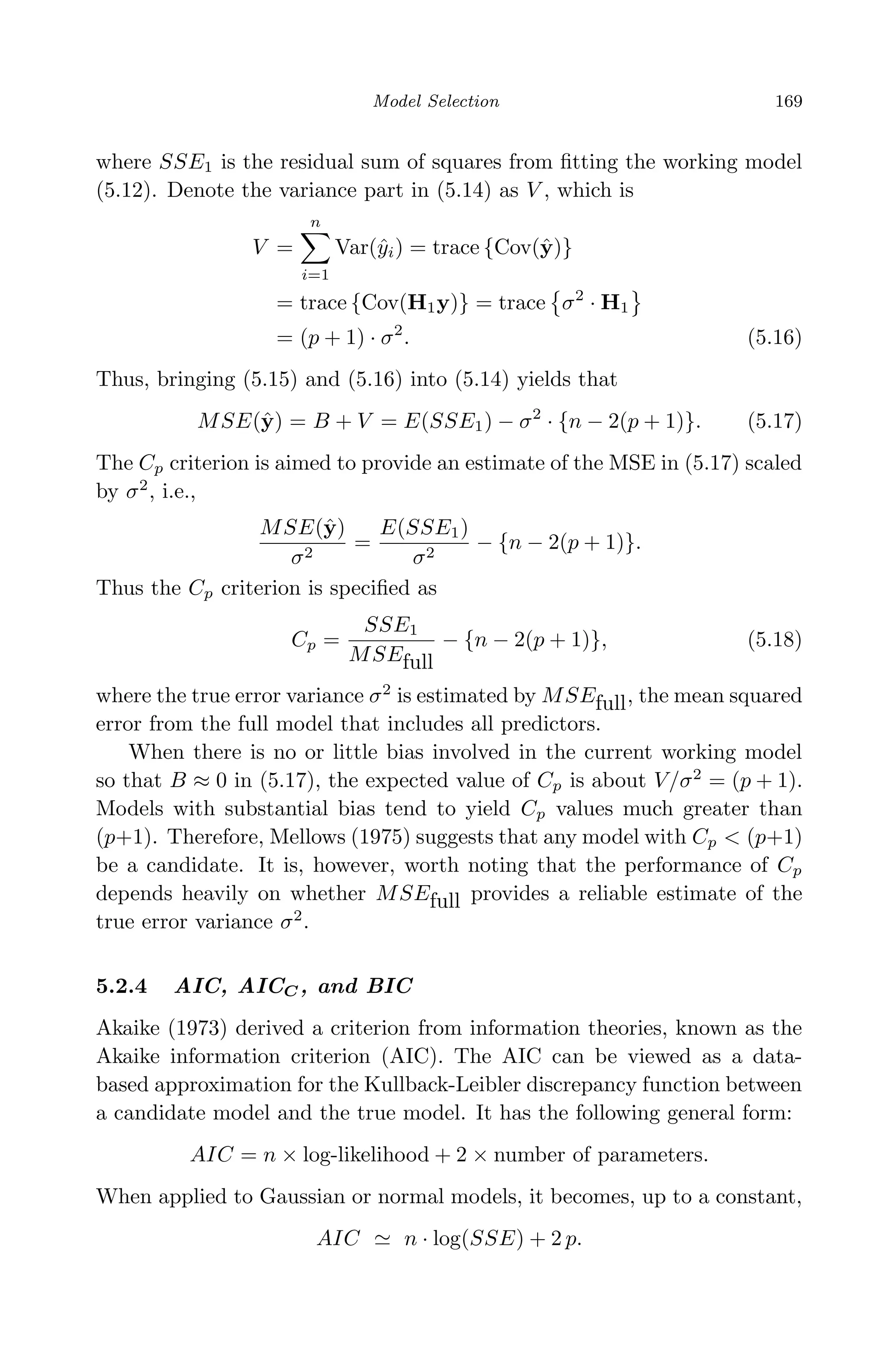
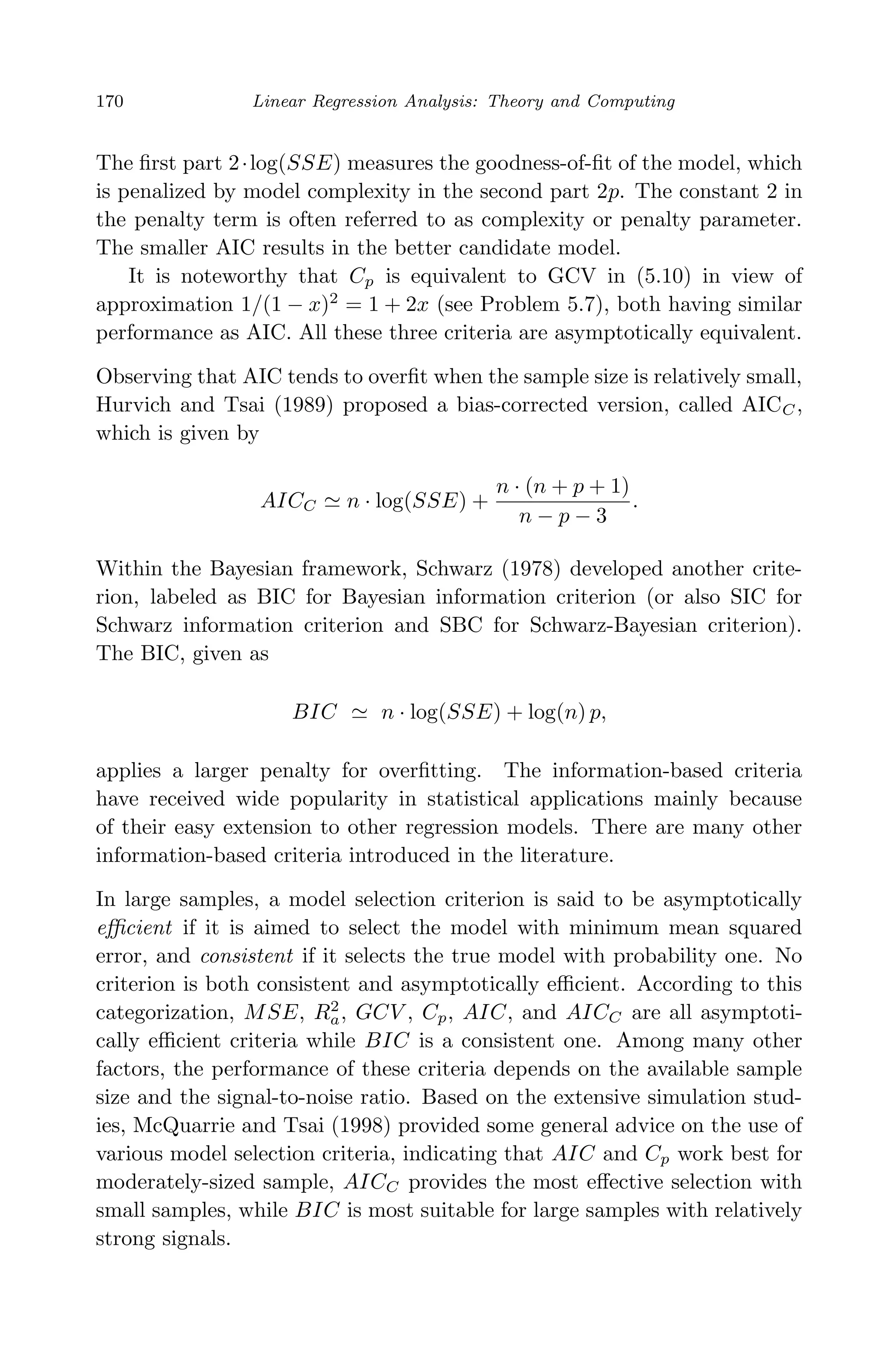
.3 1 5
.34 1 5
.2 2 5
.24 2 5
.24 2 5
.28 3 5
.2 3 5
.24 3 5
.02 4 5
.02 4 5
.06 4 5
0 5 5
0 5 5
0 5 5
.37 1 12
.36 1 12
.30 2 12
.31 2 12
.30 2 12
.30 3 12
.30 3 12
.30 3 12
.14 4 12
.14 4 12
.14 4 12
.14 5 12
.15 5 12
.15 5 12
.23 1 18
.23 1 18
.28 2 18
.27 2 18
.25 2 18
May 7, 2009 10:22 World Scientific Book - 9in x 6in Regression˙master
Multiple Linear Regression 127
Table 3.28 Cont’d
y(unit of algae) x1(mg copper) x2(days)
.27 3 18
.25 3 18
.25 3 18
.06 4 18
.10 4 18
.10 4 18
.02 5 18
.02 5 18
.02 5 18
.36 1 25
.36 1 25
.24 2 25
.27 2 25
.31 2 25
.26 3 25
.26 3 25
.28 3 25
.14 4 25
.11 4 25
.11 4 25
.04 5 25
.07 5 25
.05 5 25
April 29, 2009 11:50 World Scientific Book - 9in x 6in Regression˙master
This page intentionally left blankThis page intentionally left blank
April 29, 2009 11:50 World Scientific Book - 9in x 6in Regression˙master
Chapter 4
Detection of Outliers and Influential
Observations in Multiple Linear
Regression
After data is collected, and cleaned the next step is to fit the data to a
selected statistical model so that the relationship between response variable
and independent variables may be established. Choosing a statistical model
largely depends on the nature of data from the experiment and the scientific
questions that need to be answered. If linear regression model is selected,
determination of the model is to solve for the regression parameters. After
that it is needed to perform hypothesis tests for those parameters and it is
necessary to perform model diagnosis.
We have already stated that for classical regression model the method
for solving regression parameters is the least squares method. If the error
term in the regression model is normally distributed the least squares esti-
mates of the regression parameters are the same as the maximum likelihood
estimates. After the estimates of the linear regression model are obtained,
the next question is to answer whether or not this linear regression model
is reasonably and adequately reflect the true relationship between response
variable and independent variables. This falls into the area of regression
diagnosis. There are two aspects of the regression diagnosis. One is to
check if a chosen model is reasonable enough to reflect the true relation-
ship between response variable and independent variables. Another is to
check if there are any data points that deviate significantly from the as-
sumed model. The first question belongs to model diagnosis and the second
question is to check outliers and influential observations. We focus on the
detection of outliers and influential observations in this section.
Identifying outliers and influential observations for a regression model
is based on the assumption that the regression model is correctly specified.
That is, the selected regression model adequately specifies the relationship
between response variable and independent variables. Any data points that
129
April 29, 2009 11:50 World Scientific Book - 9in x 6in Regression˙master
130 Linear Regression Analysis: Theory and Computing
fit well the assumed model are the right data points for the assumed model.
Sometimes, however, not all data points fit the model equally well. There
may be some data points that may deviate significantly from the assumed
model. These data points may be considered as outliers if we believe that
the selected model is correct. Geometrically, linear regression is a line
(for simple linear regression) or a hyperplane (for multiple regression). If
a regression model is appropriately selected, most data points should be
fairly close to regression line or hyperplane. The data points which are far
away from regression line or hyperplane may not be “ideal” data points for
the selected model and could potentially be identified as the outliers for
the model. An outlier is the data point that is statistically far away from
the chosen model if we believe that the selected regression model is correct.
An influential observation is one that has a relatively larger impact on the
estimates of one or more regression parameters. i.e., including or excluding
it in the regression model fitting will result in unusual change in one or
more estimates of regression parameters. We will discuss the statistical
procedures for identifying outliers and influential observations.
4.1 Model Diagnosis for Multiple Linear Regression
4.1.1 Simple Criteria for Model Comparison
Before checking a regression model, one has to understand the following:
• Scientific questions to be answered
• Experiment from which the data is collected
• Statistical model and model assumptions
It should be understood that the model selection may be rather complicated
and sometimes it is difficult to find a “perfect model” for your data. David
R. Cox made famous comment on model selection, “all models are wrong,
but some are useful”. This implies that no “optimal scheme” is ever in
practice optimal. The goal of statistical modeling is to find a reasonable
and useful model upon which we can answer desired scientific questions
based on data obtained from well-designed scientific experiment. This can
be done through model comparison. The following are some basic criteria
that are commonly used for regression model diagnosis:
1. Coefficients of determination R2
= 1 −
SSRes
SST otal
. The preferred model
April 29, 2009 11:50 World Scientific Book - 9in x 6in Regression˙master
Detection of Outliers and Influential Observations in Multiple Linear Regression 131
would be the model with R2
value close to 1. If the data fit well the
regression model then it should be expected that yi is close enough to
ˆyi. Hence, SSRes should be fairly close to zero. Therefore, R2
should
be close to 1.
2. Estimate of error variance s2
. Among a set of possible regression models
a preferred regression model should be one that has a smaller value of
s2
since this corresponds to the situation where the fitted values are
closer to the response observations as a whole.
3. Adjusted ¯R2
. Replace SSRes and SST otal by their means:
¯R2
= 1 −
SSRes/n − p
SST otal/n − 1
= 1 −
s2
(n − 1)
SST otal
Note that SST otal is the same for all models and the ranks of R2
for all
models are the same as the ranks of s2
for all models. We would like
to choose a regression model with adjusted ¯R2
close to 1.
4.1.2 Bias in Error Estimate from Under-specified Model
We now discuss the situation where the selected model is under-specified.
i.e.,
y = X1β1 + ε. (4.1)
Here, the under-specified model is a model with inadequate regressors. In
other words, if more regressors are added into the model, the linear com-
bination of the regressors can better predict the response variable. Some-
times, the under-specified model is also called as reduced model. Assuming
that the full model is
y = X1β1 + X2β2 + ε, (4.2)
and the number of parameters in the reduced model is p, let s2
p be the error
estimate based on the under-specified regression model. The fitted value
from the under-specified regression model is
ˆy = X1(X1X1)−1
X1y
and error estimate from the under-specified regression model is
s2
p = y (I − X1(X1X1)−1
X1)y.
We then compute the expectation of the error estimate s2
p.
E(s2
p) = σ2
+
β2[X2X2 − X2X1(X1X1)−1
X2X1]β2
n − p
. (4.3)
April 29, 2009 11:50 World Scientific Book - 9in x 6in Regression˙master
132 Linear Regression Analysis: Theory and Computing
The above derivations need to use the formula of inverse matrix of par-
titioned matrix and the fact that E(y) = X1β1 + X2β2. Note that s2
p
based on the under-specified regression model is a biased estimate of the
error variance. The bias due to under-specification of a regression model is
a function of deleted parameters β2 and its covariance matrix.
4.1.3 Cross Validation
Suppose that yi is the ith response and (xi1, xi2, · · · , xip) is the ith regressor
observation vector. The data can be written in the following matrix format:
(y, X) =













y1 x1,1 · · · x1,p
y2 x2,1 · · · x2,p
...
yn1 xn11 · · · xn1,p
yn1+1 xn1+1,1 · · · xn1+1,p
...
yn xn,1 · · · xn,p













=
y1 X1
y2 X2
, (4.4)
where 1 < n1 < n. The cross validation approach is to select n1 data
points out of n data points to fit regression model and use the rest n − n1
data points to assess the model. This way, the first n1 data points serve as
the learning sample and the remaining n − n1 data points are the testing
sample. To assess the model using the rest n − n1 data points we use sum
of prediction errors
n
i=n1+1(yi − ˆyi)2
as assessment criterion. Note that
the prediction ˆyi is computed using the regression model from the first n1
data points and the observations in the remaining n − n1 data points. The
idea behind this model checking approach is that the model parameters are
obtained using the first n1 data points. If this is an appropriate model for
the whole data set then it should also yield a smaller value of the sum of
the squared prediction errors from the remaining n−n1 observations. Note
that this criterion is harder than the criterion we have previously discussed,
where the mean square error criterion is used rather than the criterion of
prediction error. Furthermore, it should be noted that the prediction has
a larger variance than the fitted value.
The above cross validation approach can be modified by randomly
choosing a subset of size ν to fit a regression model, then the remaining n−ν
data points are used to calculate the prediction error. This can be done
k times, where k is a pre-defined integer. Suppose that β1, β2, · · · , βk are
April 29, 2009 11:50 World Scientific Book - 9in x 6in Regression˙master
Detection of Outliers and Influential Observations in Multiple Linear Regression 133
the least squares estimates each uses the randomly selected ν data points.
We can use the average β = 1
k
k
i=1 βi as the estimate of the regression
parameters and check the regression model using the average prediction
errors. This average of prediction errors can be used as the criterion of
regression model diagnosis. This technique is called ν-fold cross validation
method and is often better than the cross validation method of choosing
only one subset as a learning sample.
When the cross validation approach is used, the entire data set is split
into learning sample and testing sample to fit the regression model and
to test the regression model. If selected regression model is appropriate
through model checking using the testing samples mentioned above, the
final regression model parameters should be estimated by the entire data
set. Finally, studied by Snee (1977), as a rule of thumb, the total number
of observations required for applying the cross validation approach is n ≥
2p + 20, where p is the number of parameters in the regression model.
4.2 Detection of Outliers in Multiple Linear Regression
If the difference between fitted value ˆyi and response yi is large, we may sus-
pect that the ith observation is a potential outlier. The purpose of outlier
detection in regression analysis is tempted to eliminate some observations
that have relatively larger residuals so that the model fitting may be im-
proved. However, eliminating observations cannot be made solely based
on statistical procedure. Determination of outlier should be made jointly
by statisticians and subject scientists. In many situations, eliminating ob-
servations is never made too easy. Some observations that do not fit the
model well may imply a flaw in the selected model and outlier detection
might actually result in altering the model.
Regression residuals carry the most useful information for model fitting.
There are two types of residuals that are commonly used in the outlier
detection: the standardized residual and the studentized residual.
Definition 4.1. Let s be the mean square error of a regression model. The
standardized residual is defined as
zi =
yi − ˆyi
s
(4.5)
The standardized residual is simply the normalized residual or the z-score
of the residual.
April 29, 2009 11:50 World Scientific Book - 9in x 6in Regression˙master
134 Linear Regression Analysis: Theory and Computing
Definition 4.2. Let s be the mean square error of a regression model. The
studentized residual is defined as
zi =
yi − ˆyi
s
√
1 − hii
(4.6)
where hii is the ith diagonal element of the HAT matrix (also called lever-
age). The studentized residuals are so named because they follow approxi-
mately the t-distribution.
According to Chebyshev’s inequality, for any random variable X, if E(X)
exists, P(|X − E(X)| ≤ kσ) ≥ 1 − 1/k2
. If k = 3, the probability of a
random variable within 3 times of standard deviation from its mean is not
less than 1 − 1/32
= 8/9 ≈ 88.9%. One would like to define an observation
as a potential outlier if it is 3 times of the standard deviation away from
its mean value.
Definition 4.3. If the residual of an observation is larger than 3 times of
the standard deviation (or standardized residual is larger than 3) then the
observation may be considered as an outlier.
Note that this outlier definition considers outlier individually. If we con-
sider multiple outliers simultaneously then the simplest way is to use t-
distribution and the Bonferroni multiplicity adjustment.
4.3 Detection of Influential Observations in Multiple Linear
Regression
4.3.1 Influential Observation
It is known that data points may have different influences on the regression
model. Different influences mean that some data points may have larger
impact on the estimates of regression coefficients than that of other data
points.
An influential observation is the data point that causes a significant change
in the regression parameter estimates if it is deleted from the whole data
set. Based on this idea we remove one observation at a time to fit the same
regression model then calculate the fitted value ˆyi,−i from the regression
model without using the ith data point. The fitted value of y without using
the ith data point is defined as
ˆyi,−i = xib−i,
April 29, 2009 11:50 World Scientific Book - 9in x 6in Regression˙master
Detection of Outliers and Influential Observations in Multiple Linear Regression 135
where xi is the ith regressor vector, and b−i is the least squares estimate
based on the same regression model using all data points except for the
response yi and the regressor vector xi. To measure the difference between
response yi and ˆyi,−i we introduce the following PRESS residual.
Definition 4.4. The PRESS residual is defined as
ei,−i = yi − ˆyi,−i (4.7)
The PRESS residual measures the impact of the ith observation on the
regression model. An observation with a larger PRESS residual may be
a possible influential observation. i.e., the fitted regression model based
on the data excluding this observation is quite different from the fitted
regression model based on the data including this observation. The sum of
the squared PRESS residuals is defined as the PRESS statistic.
Definition 4.5. The PRESS statistic is defined as
PRESS =
n
i=1
(yi − ˆyi,−i)2
=
n
i=1
(ei,−i)2
(4.8)
The PRESS residual can be expressed by the usual residual. It can be
shown that
PRESS =
n
i=1
(ei,−i)2
=
n
i=1
yi − ˆyi
1 − xi(X X)−1xi
2
=
n
i=1
ei
1 − hii
2
, (4.9)
where hii is the ith diagonal element of the HAT matrix. This relationship
makes calculation of the PRESS residual easier. Note that hii is always be-
tween 0 and 1. If hii is small (close to 0), even a larger value of the ordinary
residual ei may result in a smaller value of the PRESS residual. If hii is
larger (close to 1), even a small value of residual ei could result in a larger
value of the PRESS residual. Thus, an influential observation is determined
not only by the magnitude of residual but also by the corresponding value
of leverage hii.
The PRESS statistic can be used in the regression model selection. A better
regression model should be less sensitive to each individual observation. In
other words, a better regression model should be less impacted by excluding
one observation. Therefore, a regression model with a smaller value of the
PRESS statistic should be a preferred model.
May 7, 2009 10:22 World Scientific Book - 9in x 6in Regression˙master
136 Linear Regression Analysis: Theory and Computing
4.3.2 Notes on Outlier and Influential Observation
What is outlier? If there is breakdown in the model at the ith data point
such that the mean is shifted. Typically, it is the phenomenon that E( i) =
∆ = 0. i.e., there is a mean shift for the ith observation. If we believe that
the regression model is correctly specified, the ith observation may be a
possible outlier when there is a mean shift at the ith observation.
Another aspect of an outlier is that the variance of is larger at the ith
observation. i.e., there might be an inflation in variance at ith observa-
tion. If we believe that equal variance assumption is appropriate, the ith
observation may be a potential outlier when its variance is inflated. So,
an outlier could be examined by looking at both mean shift and variance
inflation at a particular data point. In addition, the ith PRESS residual
ei,−i = yi − ˆyi,−i can be used to determine outlier in regression model. If
there is a mean shift at the ith data point, then we have
E(yi − ˆyi,−i) = ∆i.
Similarly, if there is a variance inflation at the ith data point we would like
to use the standardized PRESS residual
ei,−i
σi,−i
=
ei
σ
√
1 − hii
(4.10)
to detect a possible outlier. Since σ is unknown, we can replace σ by its
estimate s in the calculation of the standardized PRESS residual. However,
in the presence of a mean shift outlier s is not an ideal estimate of true
standard deviation of σ.
If there is a mean shift outlier at the ith observation, then s is biased
upward. Hence, s is not an ideal estimate of σ. One way to deal with
this situation is to leave the ith observation out and calculate the standard
deviation with using the ith observation, denoted by s−i. s−i can be easily
calculated based on the relationship between s−i and s:
s−i =
(n − p)s2 − e2
i /(1 − hii)
n − p − 1
. (4.11)
If equal variance assumption is suspicious for a regression model, we can
use the generalized least squares estimate where the equal variance assump-
tion is not required. To conclude the discussion on outlier and influential
April 29, 2009 11:50 World Scientific Book - 9in x 6in Regression˙master
Detection of Outliers and Influential Observations in Multiple Linear Regression 137
observation in regression model, we point out that each observation can be
examined under the following four groups.
(1). Usual observation: this is the observation which has equal effects on
the fitted values. Regression model will not be affected with or without
this observation. This type of observations should be used to estimate
the model parameters.
(2). Outlier: an outlier is an observation for which the studentized residual
is large in magnitude as compared to the studentized residuals of other
observations in the data set. Outlier may indicate the violation of
model assumptions or may imply the need for an alternative model.
(3). High leverage point: it is an observation which is far from the center
of X space compared to other observations. Note that the concept of
leverage is only related to the regressors, not the response variable.
(4). Influential observation: influential observation is the observation that
has more impact on the regression coefficients or the estimate of vari-
ance as compared to other observations in the data set.
The relationship among outlier, influential observation, and high-
leverage observation can be summarized as follows:
(1). An outlier needs not be an influential observation.
(2). An influential observation need not be an outlier.
(3). There is a tendency for a high-leverage observation to have small resid-
uals and to influence the regression fit disproportionately.
(4). A high-leverage observation may not necessarily be an influential ob-
servation and an influential observation may not necessarily be a high-
leverage observation.
(5). An observation might be an outlier, a high-leverage point, or an influ-
ential observation, simultaneously.
4.3.3 Residual Mean Square Error for Over-fitted Regres-
sion Model
In this section we discuss the consequence of under-fitting and over-fitting
in regression analysis. Let’s assume that the correct model should include
all regressors X1 and X2, where X1 and X2 have p1 and p2 independent
variables, respectively. We thus write the following full regression model:
y = X1β1 + X2β2 + ε.
April 29, 2009 11:50 World Scientific Book - 9in x 6in Regression˙master
138 Linear Regression Analysis: Theory and Computing
Assume that the under-fitted model only includes X1 and is given by
y = X1β1 + ε∗
.
In other words, an under-fitted regression model is the model from which
some necessary regressors are omitted. Based on the under-fitted model we
can solve for the least squares estimate of β1:
b1 = (X1X1)−1
X1y.
It can be verified that b1 is a biased estimate of β1:
E(b1) = (X1X1)−1
X1E(y)
= (X1X1)−1
X1(X1β1 + X2β2)
= β1 + (X1X1)−1
X1X2β2
= β1 + Aβ2.
Thus, an under-fitted model has a bias (X1X1)−1
X1X2β2. Suppose that
we over-fit a regression model with m parameters
y = X1β1 + X2β2 + ε
when the right model would be the one with β2 = 0. The residual mean
square of the over-fitted model is
s2
m =
y (I − X(X X)−1
X)y
n − m
. (4.12)
We have
E(s2
m) = σ2
+
1
n − m
β1X1(I − X(X X)−1
X)X1β1. (4.13)
It is known that the linear space spanned by the columns of (I −
X(X X)−1
X) is perpendicular to the linear space spanned by the column
X, therefore, to the linear space spanned by the columns of X1. Thus, we
have
X1(I − X(X X)−1
X)X1 = 0.
April 29, 2009 11:50 World Scientific Book - 9in x 6in Regression˙master
Detection of Outliers and Influential Observations in Multiple Linear Regression 139
This yields E(s2
m) = σ2
which implies that s2
m is an unbiased estimate
of the true variance σ2
regardless of over-fitting. Furthermore, under the
normality assumption of the model error term we have
(n − m)s2
m
σ2
∼ χ2
n−m. (4.14)
According to the χ2
distribution we have
Var(s2
m) =
σ4
(n − m)2
Var(χ2
n−m) =
2σ4
n − m
. (4.15)
Note that if the model is over-fitted the degrees of freedom is n − m, which
is smaller than that from an ideal regression model. Therefore, for an over-
fitted regression model, even s2
m is an unbiased estimate of the true variance
σ2
, the variance of s2
m tends to be larger. We will further discuss the effect
of under-fitting and over-fitting for multiple regression model in the next
chapter.
4.4 Test for Mean-shift Outliers
When the ith observation is suspected to be an outlier, we can consider the
so-called mean-shift outlier model
y = Xβ + eiγ + ε, (4.16)
where ei denotes the ith n × 1 unit vector. The problem to test whether
or not the ith observation is a possible outlier can be formulated into the
following hypothesis testing problem in the mean-shift outlier model:
H0 : γ = 0 versus H1 : γ = 0.
We now discuss how to test mean shift outlier individually using the t-test
statistic. When the ith observation is a potential mean shift outlier s2
is a
biased estimate of the error variance σ2
; therefore, we would prefer to use
the leave-one-out s−i and replacing σ by s−i to construct the following test
statistic
ti =
yi − ˆyi
s−i
√
1 − hii
∼ tn−p−1. (4.17)
Under the null hypothesis H0 : ∆i = 0, the above test statistic has the
centralized t distribution with degrees of freedom of n − p − 1. It can be
May 7, 2009 10:22 World Scientific Book - 9in x 6in Regression˙master
140 Linear Regression Analysis: Theory and Computing
used to test the hypothesis H0 : ∆i = 0 versus the alternative H1 : ∆i = 0.
The above statistic is often called the R-student statistic. It tends to be
larger if the ith observation is a mean shift outlier. Note that the two-tailed
t-test should be used. The rejection of H0 implies that the ith observation
may be a possible mean shift outlier. Note also that this test requires prior
knowledge about a chosen observation being a potential outlier. If such
knowledge is not available, then we can weaken the alternative hypothesis
to “there is at least one outlier in the model”. One may use the test statistic
tmax = max
1≤i≤n
ti
and reject the null hypothesis H0 at level α if
|tmax| = | max
1≤i≤n
ti| > tn−p−1, α/2n. (4.18)
This is equivalent to testing each individual observation and rejecting the
null hypothesis if at least one test is significant. Note that we have to choose
the test level to be α/n, which is the Bonferroni multiplicity adjustment,
in order to ensure that the probability of the Type I error for the overall
test is bounded by α.
The R-student statistic can also be used to test variance inflation at the ith
observation. If there is a variance inflation at the ith observation then we
should have Var( i) = σ2
+ σ2
i . Here σ2
i represents the increase in variance
at ith observation. The hypothesis is H0 : σ2
i = 0 versus H1 : σ2
i = 0. Note
that the two-tailed t-test should be used.
We use the following example to illustrate how to compute R-student statis-
tic to test mean shift outlier. The Coal-cleansing Data is used in the exam-
ple. There are 3 variables in the data set. Variable x1 is the percent solids
in the input solution; x2 is the pH of the tank that holds the solution; and
x3 is the flow rate of the cleansing polymer in ml/minute. The response
variable y is the polymer used to clean coal and suspended solids (mg/l).
There are a total of 15 experiments performed. The data set is presented
in Table 4.1.
proc reg data=coal outest=out1 tableout;
model y=x1 x2 x3;
output out=out2
p=yhat r=yresid h=h RSTUDENT=rstudent;
run;
April 29, 2009 11:50 World Scientific Book - 9in x 6in Regression˙master
Detection of Outliers and Influential Observations in Multiple Linear Regression 141
Table 4.1 Coal-cleansing Data
x1 x2 x3 y
Experiment Percent Solids pH Value Flow Rate Cleansing Polymer
1 1.5 6.0 1315 243
2 1.5 6.0 1315 261
3 1.5 9.0 1890 244
4 1.5 9.0 1890 285
5 2.0 7.5 1575 202
6 2.0 7.5 1575 180
7 2.0 7.5 1575 183
8 2.0 7.5 1575 207
9 2.5 9.0 1315 216
10 2.5 9.0 1315 160
11 2.5 6.0 1890 104
12 2.5 6.0 1890 110
Data Source: Data were generated by the Mining Engineering Department and
analyzed by the Statistical Consulting Center, Virginia Polytechnic Institute and
State University, Blacksburg, Virginia, 1979.
Table 4.2 Parameter Estimates for y = b0 + b1x1 + b2x2 + b3x3
TYPE RMSE Intercept x1 x2 x3
PARMS 20.8773 397.087 -110.750 15.5833 -0.05829
STDERR 20.8773 62.757 14.762 4.9208 0.02563
T 20.8773 6.327 -7.502 3.1668 -2.27395
PVALUE 20.8773 0.000 0.000 0.0133 0.05257
L95B 20.8773 252.370 -144.792 4.2359 -0.11741
U95B 20.8773 541.805 -76.708 26.9308 0.00082
The fitted regression model is found to be
ˆy = 397.087 − 110.750x1 + 15.5833x2 − 0.058x3.
Before the analysis there was suspicion by experimental engineer that the
9th data point was keyed in erroneously. We then fit the model without
deleting the 9th data point. The fitted responses, residuals, values of di-
agonal elements in the HAT matrix, and values of the R-student statistic
associated with each observation are calculated and listed in Table 4.3.
The largest residual is the 9th residual, e9 = 32.192, and the corresponding
value of the R-student statistic is 2.86951 which is statistically significant
when test level α is 0.05. This adds suspicion that the 9th observation was
originally keyed in erroneously.
Note that the statistical analysis only confirms that the 9th observation
dose not fit the model well and may be a possible outlier. The decision on
April 29, 2009 11:50 World Scientific Book - 9in x 6in Regression˙master
142 Linear Regression Analysis: Theory and Computing
Table 4.3 Residuals, Leverage, and ti
Experiment yi ˆyi ei hii ti
1 243 247.808 -4.8080 0.45013 -0.29228
2 261 247.808 13.1920 0.45013 0.83594
3 244 261.040 -17.0400 0.46603 -1.13724
4 285 261.040 23.9600 0.46603 1.76648
5 202 200.652 1.3480 0.08384 0.06312
6 180 200.652 -20.6520 0.08384 -1.03854
7 183 200.652 -17.6520 0.08384 -0.86981
8 207 200.652 6.3480 0.08384 0.29904
9∗ 216 183.808 32.1920∗ 0.45013 2.86951∗
10 160 183.808 -23.8080 0.45013 -1.71405
11 104 103.540 0.4600 0.46603 0.02821
12 110 103.540 6.4600 0.46603 0.40062
whether or not this data point should be deleted must be made jointly by
statistical model diagnosis and scientific judgement.
4.5 Graphical Display of Regression Diagnosis
4.5.1 Partial Residual Plot
In simple regression model, the visualization of the outlier is the residual
plot which is the plot of regression residuals ei against fitted values ˆyi. How-
ever, in the multiple regression setting, there are more than one regressors
and the plot of residuals against fitted values may not be able to tell which
regressor is the cause of outlier. We may consider to plot y against individ-
ual regressor, but these plots may not highlight the effect of each regressor
on the predictor since regressors may be dependent. The problem of outlier
detection using residual plot in the multiple regression can be resolved by
introducing the partial regression plot. To this end, we rearrange the X as
(xj, X−j), where xj is the jth column in the X and X−j is the remaining
X after deleting the jth column. If we regress y against X−j the vector
of residuals is
y − X−j(X−jX−j)−1
X−jy = ey|X−j
.
These residuals are not impacted by variable xj. We further consider the
regression of xj against X−j. The corresponding vector of residuals is
xj − X−j(X−jX−j)−1
X−jxj = exj |X−j
April 29, 2009 11:50 World Scientific Book - 9in x 6in Regression˙master
Detection of Outliers and Influential Observations in Multiple Linear Regression 143
This regression is to assess how much of xj can be explained by the other
independent variables X−j. The partial regression plot is the plot of
ey|X−j
against exj |X−j
The partial regression plot was proposed by Mosteller and Turkey (1977).
To understand what is expected in the partial regression plot we proceed
with the following derivations:
y = Xβ + ε = X−jβ−j + xjβj + ε
Multiply both sides by I − H−j, where H−j = X−j(X−jX−j)−1
X−j, the
HAT matrix without using the ith column in X,
(I − H−j)y = (I − H−j)(X−jβ−j + xjβj + ε)
Since (I − H−j)X−j = 0 we have
ey|X−j
= βjexj |X−j
+ ε∗
,
where ε∗
= (I − H−j)ε. Thus, we expect that the partial regression plot
is almost a line passing through the origin with the slope βj. For any
multiple regression model with p regressors there are a total of p partial
residual plots to be produced.
The following example illustrates how to create a partial regression plot
using SAS. Note that the ID statement is introduced to indicate the data
points in the partial regression plot so that it helps identifying the obser-
vations that may be misrepresented in the model. We leave discussions on
variable transformation to later chapter. For partial residual plot, the navy
functional activity data is used in the example. There are 4 variables in the
data set: man-hours is the response variable; the independent variables are
site and two workload factors x1 and x2 which have substantial influence
on man-hours.
The starting model in the example is
y = β0 + β1x1 + β2x2 + .
We generate two partial plots ey|X−1
versus ex1|X−1
and ey|X−2
versus
ex1|X−2
. The partial regression plot of ey|X−1
versus ex1|X−1
shows a
April 29, 2009 11:50 World Scientific Book - 9in x 6in Regression˙master
144 Linear Regression Analysis: Theory and Computing
Table 4.4 Navy Manpower Data
site y(man-hours) x1 x2
A 1015.09 1160.33 9390.83
B 1105.18 1047.67 14942.33
C 1598.09 4435.67 14189.08
D 1204.65 5797.72 4998.58
E 2037.35 15409.60 12134.67
F 2060.42 7419.25 20267.75
G 2400.30 38561.67 11715.00
H 3183.13 36047.17 18358.29
I 3217.26 40000.00 20000.00
J 2776.20 35000.00 15000.00
Data Source: SAS Institute Inc. SAS User’s Guide: Statistics,
Version 5 (Carry, North Carolina, SAS Institute Inc. 1985.
flat pattern in the last four sites G, H, I and J. This suggests that adding
a cubic term of x1 into the model may improve model fitting. We then fit
the regression model with a term x
1
3
1 added:
y = β0 + β1x
1
3
1 + β2x2 + .
The partial regression plot for the model with the transformed term x
1
3
1 is
clearly improved. The SAS program is provided as follows.
data navy; set navy;
label y ="Manpower hours"
x1="Manpower factor 1"
x2="Manpower factor 2"
X3="Cubic Root of x1";
x3=x1**(1/3);
run;
proc reg data=navy;
model y=x1 x2/partial;
id site;
output out=out1 p=pred r=resid;
run;
proc reg data=navy;
model y=x3 x2/partial;
id site;
April 29, 2009 11:50 World Scientific Book - 9in x 6in Regression˙master
Detection of Outliers and Influential Observations in Multiple Linear Regression 145
output out=out2 p=pred r=resid;
run;
Fig. 4.1 Partial Residual Plots for Regression Models
April 29, 2009 11:50 World Scientific Book - 9in x 6in Regression˙master
146 Linear Regression Analysis: Theory and Computing
Table 4.5 Residuals for Model With Regressors x1 and x2
site y x1 x2 ˆyi ei
A 1015.09 1160.33 9390.83 1110.76 -95.672
B 1105.18 1047.67 14942.33 1433.61 -328.431
C 1598.09 4435.67 14189.08 1520.50 77.589
D 1204.65 5797.72 4998.58 1031.58 173.072
E 2037.35 15409.60 12134.67 1824.66 212.690
F 2060.42 7419.25 20267.75 1994.40 66.015
G 2400.30 38561.67 11715.00 2697.09 -296.787
H 3183.13 36047.17 18358.29 2991.22 191.915
I 3217.26 40000.00 20000.00 3241.16 -23.896
J 2776.20 35000.00 15000.00 2752.69 23.507
R2
= 0.9468 s = 216.672
Table 4.6 Residuals for Model With Regressors x
1
3
1 and x2
site y x1 x2 x
1
3
1 ˆyi ei
A 1015.09 1160.33 9390.83 10.5082 896.57 118.525
B 1105.18 1047.67 14942.33 10.1564 1203.15 -97.966
C 1598.09 4435.67 14189.08 16.4306 1590.56 7.529
D 1204.65 5797.72 4998.58 17.9647 1148.60 56.052
E 2037.35 15409.60 12134.67 24.8846 2050.64 -13.287
F 2060.42 7419.25 20267.75 19.5038 2164.54 -104.124
G 2400.30 38561.67 11715.00 33.7846 2638.86 -238.557
H 3183.13 36047.17 18358.29 33.0337 2982.99 200.136
I 3217.26 40000.00 20000.00 34.1995 3161.15 56.108
J 2776.20 35000.00 15000.00 32.7107 2760.62 15.584
R2
= 0.9776 s = 140.518
4.5.2 Component-plus-residual Plot
The component-plus-residual (CPR) plot is one of regression diagnosis
plots. It is useful for assessing nonlinearity in independent variables in
the model. The CPR plot is the scatter plot of
ey|X + xjbj against xj
This plot was introduced by Ezekiel (1924), and was recommended later by
Larsen and McCleary (1972). This scatter plot has the least squares slope
of bj and the abscissa xj and is effective when one wants to find nonlinearity
of xj in regression model.
April 29, 2009 11:50 World Scientific Book - 9in x 6in Regression˙master
Detection of Outliers and Influential Observations in Multiple Linear Regression 147
4.5.3 Augmented Partial Residual Plot
The augmented partial residual (APR) plot is another graphical display of
regression diagnosis. The APR plot is the plot of
ey|Xx2
j
+ xjbj + x2
j bjj against xj
where bj and bjj are the least squares estimates from model
y = Xβ + βjxj + βjjx2
j + ε.
This plot was suggested by Mallows (1986) to explore whether or not a
transformation of xj is needed in the linear multiple regression model. Note
that the APR plot does not just intend to detect the need for a quadratic
term in the regression model. The introduced quadratic term is really a
truncated version of the potential nonlinear form of xj.
The CPR plot is not very sensitive in finding the transformation for an
entering variable or in detecting nonlinearity. The APR plot appears to
be more sensitive to nonlinearity. In the absence of nonlinearity the CPR
plot is similar to the APR plot. However, if the nonlinearity is present in
a variable for a regression model (it may not be necessarily quadratic), in
general, the APR plot gives a better picture to show the nonlinearity of the
variable than the CPR plot.
4.6 Test for Inferential Observations
Outliers and Influential Observations are easy to understand in simple re-
gression model y = a + bx + ε since there is only one independent variable
in the model. We can simply plot the fitted regression line, a data point
which lies far away from the regression line (and thus has a large residual
value) is known as a potential outlier. Such point may represent erroneous
data, or may indicate a poorly fitting of the regression model. If a data
point lies far away from the other data points in the horizontal direction, it
is known as potential influential observation since this data point may have
a significant impact on the slope of the regression line. If the data point
is far away from other data points but the residual at this data point is
small then this data point may not be an influential observation. However,
if the residual is large at this observation then including or excluding this
data point may have great impact on the regression slope. Hence, this data
point may be an influential observation for the regression model.
April 29, 2009 11:50 World Scientific Book - 9in x 6in Regression˙master
148 Linear Regression Analysis: Theory and Computing
The outlier detection for linear regression analysis is to find observations
with larger residuals which are larger than it would actually be produced by
chance. i.e., the possible error in y-direction. A data analyst may also want
to identify the extent whether or not these observations influence predicted
values, estimators of regression coefficients, and performance criteria of a
regression model. This is the detection of inferential observations.
Source of influential observation to the regression model depends on the
location of the observation in either y-direction or x-direction. If a data
point is far away from the rest of the data points in x-direction this data
point may be an influential observation since it may affect the slope of the
simple regression line. If a data point is far away from the rest of the data
points in y-direction then it may not be an influential observation to the
regression slope. We now briefly discuss the quantities that could affect the
regression model in various ways.
(1) HAT diagonal elements: A data point with a large HAT diagonal
element may or may not be an influential observation to the regression
coefficients, but it could be an outlier to affect the variance of the
estimate of regression coefficients. The HAT diagonal element hii can
be used to detect a possible outlier if
hii = xi(X X)−1
xi > 2p/n (4.19)
where n is the total number of observations and p is the number of
independent variables in the regression model.
(2) R-student residual: Any R-student residual deviates from zero by 2
times of the estimated standard error could be a potential outlier.
(3) DFITTS : The DFITTS is defined as the difference between the stan-
dardized fitted values with and without the ith observation xi:
DFITTSi =
ˆyi − ˆyi,−i
s−i
√
hii
(4.20)
It can be shown that
DFITTSi = R-studenti
hii
1 − hii
1/2
(4.21)
It can be seen from (4.21) that a larger value of R-studenti or a near-
one value of hii may cause the ith observation to be a potential outlier.
April 29, 2009 11:50 World Scientific Book - 9in x 6in Regression˙master
Detection of Outliers and Influential Observations in Multiple Linear Regression 149
DFITTSi is useful in application and it tells how much changes you can
expect in the response variable with deletion of the ith observation.
To take into account for sample size, as suggested by some authors, the
“yardstick cutoff values” are 2 p/n for DFFITSi to detect possible
outliers. In situations of moderate and small sample size, a yardstick
cutoff of ±2 can be used to detect possible outliers.
(4) DEBETAS: The DEBETAS is the difference of regression estimate bj
between with the ith observation included and with the ith observation
excluded. Namely it is given by
DFBETASj,−i =
bj − bj,−i
s−i
√
cjj
, (4.22)
where cjj is the diagonal element of (X X)−1
. A larger value of
DFBETASj,−i implies that the ith observation may be a potential out-
lier. DEBETASj,−i is useful in application and it tells the change of
regression parameter estimate bj due to the deletion of the ith obser-
vation.
To take into account for sample size, as suggested by some authors, the
“yardstick cutoff values” are 2/
√
n for DEBETASj,−i to detect possible
outliers. In situations of moderate and small sample size, a yardstick
cutoff of ±2 can be used to detect possible outliers.
(5) Cook’s D: The Cook’s D is the distance between the least squares
estimates of regression coefficients with xi included and excluded. The
composite measurement Cook’s D is defined as
Di =
(b − b−i) (X X)(b − b−i)
ps2
, (4.23)
where b is the least squares estimate of the parameter βj using all
observations and b−i is the least squares estimate of the parameter βj
with the ith observation deleted.
(6) Generalized Variance (GV): The GV provides a scalar measure of
the variance-covariance properties of the regression coefficients. It is
defined as
GV = |(X X)−1
σ2
| (4.24)
April 29, 2009 11:50 World Scientific Book - 9in x 6in Regression˙master
150 Linear Regression Analysis: Theory and Computing
(7) Covariance Ratio (COVRATIO): The covariance ratio is the ratio
of GVs with xi included and excluded. It is defined as
(COVARATIO)i =
|(X−iX−i)−1
s2
−i|
|(X X)−1s2|
(4.25)
It can be shown that
(COVARATIO)i =
(s2
−i)2p
s2p
1
1 − hii
(4.26)
A rough “yardstick cutoff value” for the COVARATIO is suggested by
Belsley, Kuh and Welsch (1980). The ith observation may be identified
as a possible outlier if
(COVARATIO)i > 1 + (3p/n) (4.27)
or
(COVARATIO)i < 1 − (3p/n) (4.28)
where p is the number of parameters in regression model and n is the
total number of observations.
There are much overlap in the information provided by the regression di-
agnosis. For example, if the Cook’s D produces an unusually high result,
then at least we can expect that one of DEBETASj,i, or one of DIFFITSi
will provide strong result as well. So, information provided by regression
diagnosis may overlap. Usually, an experienced analyst would briefly look
at the HAT diagnosis and R-student residuals to explore possible outliers.
As always, it should be very cautious to remove outliers. Sometimes adding
one or more mean shift variables may be a good approach to take.
4.7 Example
In this section we give an illustrative example to calculate residuals, PRESS
residuals, and PRESS statistic for several selected regression models using
the SAS. The values of the PRESS statistic for different regression models
are computed and compared in order to select a better regression model.
The following example is based on the Sales of Asphalt Roofing Shingle
Data (see Table 4.7). The variables in the data set are district code, number
April 29, 2009 11:50 World Scientific Book - 9in x 6in Regression˙master
Detection of Outliers and Influential Observations in Multiple Linear Regression 151
Table 4.7 Sales Data for Asphalt Shingles
x1 x2 x3 x4 y
Promotional Active Competing Sale Sales in
District Accounts Accounts Brands Potential Thousands of Dollars
1 5.5 31 10 8 79.3
2 2.5 55 8 6 200.1
3 8.67 12 9 1 63.2
4 3.0 50 7 16 200.1
5 3.0 38 8 15 146.0
6 2.9 71 12 17 177.7
7 8.0 30 12 8 30.9
8 9.0 56 5 10 291.9
9 4.0 42 8 4 160.0
10 6.5 73 5 16 339.4
11 5.5 60 11 7 159.6
12 5.0 44 12 12 86.3
13 6.0 50 6 6 237.5
14 5.0 39 10 4 107.2
15 3.5 55 10 4 155.0
Data Source: Raymond H. Myers, Classical and Modern Regression with Applications.
Duxbury, p. 174.
of promotional accounts (x1), number of active accounts (x2), number of
competing brands (x3), and sale potential for district (x4). The response
variable is the sales in thousands of dollars (y).
The SAS program for computing values of the PRESS statistic for various
regression models is presented as follows:
proc reg data=sale;
model y=x2 x3;
output out=out1
r=r12 press=press12 H=h12;
proc reg data=sale;
model y=x1 x2 x3;
output out=out2
r=r123 press=press123 H=h123;
proc reg data=sale;
model y=x1 x2 x3 x4;
output out=out3
r=r1234 press=presss1234 H=h1234;
April 29, 2009 11:50 World Scientific Book - 9in x 6in Regression˙master
152 Linear Regression Analysis: Theory and Computing
run;
proc sort data=out1; by district;
proc sort data=out2; by district;
proc sort data=out3; by district;
run;
data all; merge out1 out2 out3;
by district;
p12=press12*press12;
p123=press123*press123;
p1234=press1234*press1234;
run;
proc means data=all;
var p12 p123 p1234;
output out=summary sum=p12 p123 p1234;
run;
Table 4.8 Values of PRESS Statistic for Various Regression Mod-
els
Model includes Model includes Model includes
x2, x3 x1, x2, x3 x1, x2, x3, x4
PRESS 782.19 643.36 741.76
Data Source: Asphalt Roofing Shingle Data
After calculating the values of the PRESS statistic for different regres-
sion models, we select the model with the regressors x1, x2, x3 because it
has the smallest value of the PRESS statistic.
Problems
1. Let the ith residual of the regression model be ei = yi − ˆyi. Prove
that Var(ei) = s2
(1 − hii), where s2
is the mean square error of the
regression model and hii is the ith diagonal element of the HAT matrix.
April 29, 2009 11:50 World Scientific Book - 9in x 6in Regression˙master
Detection of Outliers and Influential Observations in Multiple Linear Regression 153
Table 4.9 PRESS Residuals and Leverages for Models Including x1, x2
(press12, h12) and Including x1, x2, x3 (press123, h123)
district yresid12 press12 h12 yresid123 press123 h123
1 1.5744 2.0192 0.22030 0.64432 0.8299 0.22360
2 -7.8345 -8.5519 0.08389 -2.11269 -2.6705 0.20889
3 1.5332 2.1855 0.29847 -4.59006 -8.2204 0.44163
4 -12.2631 -13.8695 0.11582 -7.54144 -9.4379 0.20094
5 -1.2586 -1.4852 0.15253 3.29538 4.2893 0.23171
6 1.7565 2.7618 0.36402 6.39862 11.5561 0.44630
7 1.2924 1.8385 0.29705 -5.08116 -9.2747 0.45215
8 13.5731 18.1046 0.25030 5.87488 11.2237 0.47657
9 -1.5353 -1.7361 0.11564 0.94022 1.0921 0.13904
10 0.3972 0.6555 0.39405 -1.92210 -3.2833 0.41459
11 0.6429 0.7600 0.15403 -0.17736 -0.2103 0.15660
12 6.7240 8.0934 0.16919 6.76184 8.1389 0.16920
13 2.8625 3.4654 0.17397 1.35393 1.6565 0.18266
14 0.9210 1.0521 0.12456 1.09787 1.2542 0.12468
15 -8.3857 -9.1765 0.08619 -4.94225 -5.6903 0.13146
2. Show the following relationship between the leave-one-out residual and
the ordinary residual:
PRESS =
n
i=1
(ei,−i)2
=
n
i=1
yi − ˆyi
1 − xi(X X)−1xi
2
=
n
i=1
ei
1 − hii
2
,
where hii is the ith diagonal elements of the HAT matrix.
3. Consider the data set in Table 4.10. It is known a prior that in ob-
servations 10, 16, and 17 there were some difficulties in measuring the
response y. Apply the mean shift model and test simultaneously
H0 : ∆10 = 0, ∆16 = 0, ∆17 = 0.
Make your conclusions (hint: Use indicator variables).
4. In the partial residual plot discussed in this chapter, show that the
least squares slope of the elements ey|Xj
regressed against exj |X−j
is
bj, the slope of xj in the multiple regression of y on X.
5. The variance inflation model can be written
yi = xiβ + i fori = 1, 2, · · · , n
with model error being normally distributed and
E( j) = σ2
+ σ2
∆ andE( i) = σ2
for all i = j
and E( i) = 0.
April 29, 2009 11:50 World Scientific Book - 9in x 6in Regression˙master
154 Linear Regression Analysis: Theory and Computing
Table 4.10 Data Set for Multiple Mean Shift Outliers
Observation x1 x2 x3 y
1 12.980 0.317 9.998 57.702
2 14.295 2.028 6.776 59.296
3 15.531 5.305 2.947 56.166
4 15.133 4.738 4.201 55.767
5 15.342 7.038 2.053 51.722
6 17.149 5.982 -0.055 60.466
7 15.462 2.737 4.657 50.715
8 12.801 10.663 3.408 37.441
9 13.172 2.039 8.738 55.270
10 16.125 2.271 2.101 59.289
11 14.340 4.077 5.545 54.027
12 12.923 2.643 9.331 53.199
13 14.231 10.401 1.041 41.896
14 15.222 1.22 6.149 63.264
15 15.74 10.612 -1.691 45.798
16 14.958 4.815 4.111 58.699
17 14.125 3.153 8.453 50.086
18 16.391 9.698 -1.714 48.890
19 16.452 3.912 2.145 62.213
20 13.535 7.625 3.851 45.625
21 14.199 4.474 5.112 53.923
22 16.565 8.546 8.974 56.741
23 13.322 8.598 4.011 43.145
24 15.945 8.290 -0.248 50.706
25 14.123 0.578 -0.543 56.817
To identify variance inflation outlier it is needed to test the hypothesis
H0 : σ2
∆ = 0 and the corresponding test statistic is the R-student statis-
tic. Thus, the R-student statistic is appropriate for testing regression
outlier no matter which type of outlier exists.
(a). Show that the (R−student)j has the t-distribution under H0 : σ2
∆ =
0.
(b). Find the distribution of (R − student)2
j under H0 : σ2
∆ = 0.
6. The following data in Table 4.11 was collected from a study of the effect
of stream characteristics on fish biomass. The regressor variables are
x1: Average depth of 50 cells
x2: Area of stream cover (i.e., undercut banks, logs, boulders, etc.)
x3: Percent of canopy cover (average of 12)
x4: Area ≥ 25cm in depth
The response variable is y, the fish biomass. The data set is as follows:
April 29, 2009 11:50 World Scientific Book - 9in x 6in Regression˙master
Detection of Outliers and Influential Observations in Multiple Linear Regression 155
Table 4.11 Fish Biomass Data
Observation y x1 x2 x3 x4
1 100 14.3 15.0 12.2 48.0
2 388 19.1 29.4 26.0 152.2
3 755 54.6 58.0 24.2 469.7
4 1288 28.8 42.6 26.1 485.9
5 230 16.1 15.9 31.6 87.6
6 0.0 10.0 56.4 23.3 6.9
7 551 28.5 95.1 13.0 192.9
8 345 13.8 60.6 7.5 105.8
9 0.0 10.7 35.2 40.3 0.0
10 348 25.9 52.0 40.3 116.6
Data Source: Raymond H. Myers: Classical and Mod-
ern Regression With Application, p. 201.
(a). Compute s2
, Cp, PRESS residuals, and PRESS statistic for the
model y = β0 + β1x1 + β2x2 + β3x3 + β4x4 + .
(b). Compute s2
, Cp, PRESS residuals, and PRESS statistic for the
model y = β0 + β1x1 + β2x3 + β3x4 + .
(c). Compare the regression models from parts (a) and (b) and comments
on the prediction of fish biomass.
April 29, 2009 11:50 World Scientific Book - 9in x 6in Regression˙master
This page intentionally left blankThis page intentionally left blank
April 29, 2009 11:50 World Scientific Book - 9in x 6in Regression˙master
Chapter 5
Model Selection
In previous chapters, we have proceeded as if predictors included in the
model, as well as their functional forms (i.e., linear), are known. This is
certainly not the case in reality. Practically, model misspecification occurs
in various ways. In particular, the proposed model may underfit or overfit
the data, which respectively correspond to situations where we mistak-
enly exclude important predictors or include unnecessary predictors. Thus,
there involves an issue of variable selection. Furthermore, the simple yet
naive linear functions might be neither adequate nor proper for some pre-
dictors. One needs to evaluate the adequacy of linearity for predictors, and
if inadequacy identified, seek appropriate functional forms that fit better.
In this chapter, we mainly deal with variable selection, while deferring the
latter issues, linearity assessment and functional form detection, to model
diagnostics. To gain motivation of and insight into variable selection, we
first take a look at the adverse effects on model inference that overfitting or
underfitting may cause. Then we discuss two commonly used methods for
variable selection. The first is the method of all possible regressions, which
is most suitable for situations where total number of predictors, p, is small
or moderate. The second type is stepwise algorithmic procedures. There
are many other concerns that warrant caution and care and new advances
newly developed in the domain of model selection. We will discuss some
important ones at the end of the chapter.
5.1 Effect of Underfitting and Overfitting
Consider the linear model y = Xβ+ε, where X is n×(k+1) of full column
rank (k+1) and ε ∼ MVN{0, σ2
·I}. To facilitate a setting for underfitting
157
May 7, 2009 10:22 World Scientific Book - 9in x 6in Regression˙master
158 Linear Regression Analysis: Theory and Computing
and overfitting, we rewrite it in a partitioned form
y = (X1 X2)
β1
β2
+ ε
= X1β1 + X2β2 + ε, (5.1)
where X1 is n × (p + 1) of full rank (p + 1) and X2 is n × (k − p). Then the
following two situations may be encountered: underfitting if X2β2 is left
out when it should be included and overfitting if X2β2 is included when it
should be left out, both related to another model of reduced form
y = X1β1 + ε , (5.2)
with ε ∼ MVN{0, σ2
· I}. Let ˆβ = (X X)−1
X y from model (5.1) parti-
tioned as
ˆβ =
ˆβ1
β2
.
Let β1 = (X1X1)−1
X1y denote the LSE of β1 in model (5.2).
We shall next present two theorems that characterize the effects of under-
fitting and overfitting on least squares estimation and model prediction,
respectively. In their proofs that follow, some matrix properties listed in
the lemma below are useful.
Lemma 5.1.
(1) If A is a positive definite (p.d.) matrix, then A−1
is also positive
definite. This can be proved by using the fact that a symmetric matrix
A is p.d. if and only if there exists a nonsingular matrix P such that
A = P P.
(2) If A is p × p p.d. and B is k × p with k ≤ p, then BAB is positive
semidefinite (p.s.d.). Furthermore, if B is of rank k, then BAB is
p.d.
(3) If a symmetric p.d. matrix A is partitioned in the form
A =
A11 A12
A21 A22
,
where A11 and A22 are square matrices, then both A11 and A22 are
p.d. and the inverse of A is given by
A−1
=
A11 + A−1
11 A12B−1
A21A−1
11 −A−1
11 A12B−1
−BA21A−1
11 B−1 ,
April 29, 2009 11:50 World Scientific Book - 9in x 6in Regression˙master
Model Selection 159
with B = A22−A21A−1
11 A12. Besides, one can verify by straightforward
algebra that
( x1 x2 ) A−1 x1
x2
= x1A−1
11 x1 + b B−1
b, (5.3)
where b = x2 − A21A−1
11 x1.
Theorem 5.1. Suppose that Model y = X1β1 + X2β2 + ε is the true
underlying model, but we actually fit model y = X1β1 + ε , which is thus
an underfitted model. Then:
(i) E(β1) = β1 + Aβ2, where A = (X1X1)−1
X1X2.
(ii) Cov(β1) = σ2
(X1X1)−1
and
Cov( ˆβ1) = σ2
· (X1X1)−1
+ AB−1
A ,
where B = X2X2 − X2X1(X1X1)−1
X1X2. We have
Cov( ˆβ1) − Cov( ˆβ1) ≥ 0 i.e. positive semi-definite.
(iii) Let V1 denote the column space of X1 and
PV⊥
1
= I − PV1 = I − X1(X1X1)−1
X1
be the projection matric of subspace V⊥
1 . Then an estimator of σ2
ˆσ2
=
PV⊥
1
y 2
n − p − 1
has the expected value of
E(ˆσ2
) = σ2
+
PV⊥
1
(X2β2) 2
n − p − 1
.
(iv) Given x0 =
x01
x02
, let ˆy = x01β1 denote the estimate based on the
working model and ˆy0 = x0β =
ˆy01
ˆy02
denote the estimate based on
the true model. Then it can be found that
E(ˆy ) = x01 (β1 + Aβ2)
and
Var(ˆy ) = σ2
· x01(X1X1)−1
x01 ≤ min {Var(ˆy01), Var(ˆy0)} ,
where Var(ˆy01) = Var(x01β1).
April 29, 2009 11:50 World Scientific Book - 9in x 6in Regression˙master
160 Linear Regression Analysis: Theory and Computing
Proof.
(i) Consider
E(β1) = E{(X1X1)−1
X1y} = (X1X1)−1
X1E(y)
= (X1X1)−1
X1(X1β1 + X2β2)
= β1 + (X1X1)−1
X1X2β2
(ii) First
Cov( ˆβ ) = cov{(X1X1)−1
X1y}
= (X1X1)−1
X1(σ2
I)X1(X1X1)−1
= σ2
(X1X1)−1
Next, to find Cov( ˆβ1), consider
Cov( ˆβ) = Cov
ˆβ1
ˆβ2
= σ2
· (X X)−1
= σ2 X1X1 X1X2
X2X1 X2X2
−1
= σ2 G11
G12
G21
G22 ,
where Gij
is the corresponding block of the partitioned inverse matrix
(X X)−1
. It can be found that
G11
= (X1X1)−1
+ AB−1
A and G22
= B−1
Hence, Cov( ˆβ1) − Cov( ˆβ 1) = σ2
AB−1
A . Now (X X)−1
is p.d., so
is G22
= B−1
. Hence, matrix AB−1
A is p.s.d. This implies that
Var(ˆβj) ≥ Var(ˆβj ).
(iii) The sum of squared error, SSE1, associated with model y = X1β1+ε
is
SSE1 = y − X1
ˆβ 2
= y − PV1 y 2
= PV⊥
1
y 2
= y PV⊥
1
y.
We have
E(SSE1) = E(y PV⊥
1
y) = tr{PV⊥
1
σ2
I} + β X PV⊥
1
Xβ
= (n − p − 1)σ2
+ PV⊥
1
(X1β1 + X2β2) 2
= (n − p − 1)σ2
+ PV⊥
1
(X2β2) 2
, (5.4)
since PV⊥
1
(X1β1) = 0. Therefore,
E(ˆσ2
) =
E(SSE1)
n − p − 1
= σ2
+
PV⊥
1
(X2β2) 2
n − p − 1
,
which is larger than or equal to σ2
.
April 29, 2009 11:50 World Scientific Book - 9in x 6in Regression˙master
Model Selection 161
(iv) First,
E(ˆy0) = E(x01
ˆβ1 = x01(β1 + Aβ2) = x01β1
= x0β − (x02 − A x01) β2 = x0β.
Next, it can be found that
Var(ˆy0) = x01Cov(β1x01) = σ2
x01(X X)−1
x01.
On the other hand,
Var(ˆy01) = Var(x01
ˆβ1) = x01Cov( ˆβ1)x01
= σ2
· x01 (X1X1)−1
+ AB−1
A x01
≥ Var(ˆy0).
Also,
Var(x0
ˆβ) = σ2
· x0(X X)−1
x0
= σ2
· x01(X1X1)−1
x01 + σ2
· b B−1
b by equation (5.3),
≥ σ2
· x01(X1X1)−1
x01 = Var(ˆy0), as B−1
is p.d.,
where b = x02 − A x01.
Theorem 5.1 indicates that underfitting would result in biased estimation
and prediction, while leading to deflated variance. Subsequently, we con-
sider the overfitting scenario.
Theorem 5.2. Suppose that model y = X1β1 + ε is the true underlying
model, but we actually fit model y = X1β1 + X2β2 + ε, an overfitted one.
Then
(i) E(β) =
β1
0
.
(ii) Cov(β) = σ2
· (X X)−1
and Cov( ˆβ1) = σ2
· (X1X1)−1
+ AB−1
A .
Again, compared to Cov( ˆβ ) = σ2
· (X1X1)−1
, we have Cov(β1) −
Cov(β1) ≥ 0, i.e. positive semi-definite.
(iii) An estimator of σ2
,
ˆσ2
=
PV⊥ y 2
n − k − 1
has the expected value of σ2
.
April 29, 2009 11:50 World Scientific Book - 9in x 6in Regression˙master
162 Linear Regression Analysis: Theory and Computing
(iv) Given x0 =
x01
x02
, let ˆy0 = x0β =
ˆy01
ˆy02
denote the estimate based
on the working model and ˆy = x01β1 denote the estimate based on
the true model. Then it can be found that E(ˆy) = x01β1 and Var(ˆy) =
σ2
· x0(X X)−1
x0 ≥ Var(ˆy ).
Proof. We will prove (i) and (iii) only, leaving the rest for exercise.
(i) Consider
E( ˆβ) = E{(X X)−1
X y} = (X X)−1
X X1β1
= (X X)−1
X X1 X1
β1
0
= (X X)−1
X X
β1
0
=
β1
0
(iii) Consider the SSE associated with Model (5.1),
E(SSE) = E(y PV⊥ y) = tr{PV⊥ σ2
I} + β1 X1PV⊥ X1β1
= (n − k − 1)σ2
,
since PV⊥ (X1β1) = 0. Thus, E(ˆσ2
) = E {SSE/(n − k − 1)} = σ2
.
Theorem 5.2 implies that overfitting would yield unbiased estimation and
prediction, however result in inflated variances.
Example (A Simulation Study) In some situations such as predictive
data mining, prediction accuracy is the ultimate yardstick to judge the
model performance. In order to see how overfitting or underfitting affects
the generalization ability of a model to new observations, one may study
the sum of squared prediction error (SSPE) within the similar theoretical
framework as in Theorems 5.1 and 5.2. Alternatively, empirical evaluation
can be made via simulation studies. Here, we illustrate the latter approach
using a simple example. The data are generated from the following model
y = β0 + β1x1 + · · · + β10x10 + ε,
with xj ∼ uniform(0, 1) and ε ∼ N(0, 1) independently. Each data set
also includes 20 additional predictors, also from uniform(0,1), which are
totally unrelated to the response. In each simulation run, we generated
two data sets: a set containing 1000 observations and another independent
April 29, 2009 11:50 World Scientific Book - 9in x 6in Regression˙master
Model Selection 163
0 5 10 15 20 25 30
1000150020002500300035004000
(a)
predictors
averagessepred
(b)
model complexity
predictionerror
Fig. 5.1 (a) Plot of the Average and Standard Deviation of SSPE Prediction from 100
Simulation Runs; (b) A Hypothetical Plot of Prediction Error Versus Model Complexity
in General Regression Problems.
set containing 1000 observations. For the training sample, we fit 30 nested
models
y = β0 + β1x1 + · · · + βkxk + ε,
where k = 1, . . . , 30. Thus the first 9 models are underfitted ones while the
last 20 models are overfitted ones. We then send down the test sample set
to each fitted model and calculate its SSPE. The experiment is repeated for
May 7, 2009 10:22 World Scientific Book - 9in x 6in Regression˙master
164 Linear Regression Analysis: Theory and Computing
100 simulation runs and we integrated the results by computing the average
and standard deviation (sd) of SSPE values for each of the 30 models.
Figure 5.1 (a) gives a plot of the results. The line shows the average
SSPE and the hight of the vertical bar at each point corresponds to the sd
of the SSPE values for each model. It can be seen that both the average
of SSPE reaches the minimum when the true model is fit. However, the
averaged SSPE is inflated much more in the underfitting cases than in the
overfitting ones. A similar observation can be drawn for the sd of SSPE.
The pattern shown here about the prediction error is generally true in
many regression problems. When the model complexity increases starting
from the null model, the prediction error drops gradually to its bottom and
then slowly increases after a flat valley, as shown in a hypothetical plot in
Fig. 5.1 (b). The specific shape of the curve and length of the flat valley
would vary depending on types of the regression methods being used, the
signal-to-noise ratio in the data, and other factors.
In summary, both underfitting and overfitting cause concerns. Although
a simplified scenario for model mis-specification has been employed to
make inference, we, again, see that underfitting leads to biased estima-
tion and overfitting leads to increased variances, which is the well-known
bias-variance tradeoff principle. The task of variable selection is to seek an
appropriate balance between this bias-variance tradeoff.
The bias-variance tradeoff can also be viewed via the concept of mean
square error (MSE). In statistics, MSE is a widely used criterion for mea-
suring the quality of estimation. Consider a typical problem of estimating
parameter θ, which may correspond to the true effect or sloe of a predictor,
or prediction for a new observation. Let ˆθ be an estimator of θ. The MSE
of ˆθ is defined as
MSE(ˆθ) = E(ˆθ − θ)2
. (5.5)
MSE provides a way, by applying the squared error loss, to quantify the
amount by which an estimator differs from the true value of the parameter
being estimated. Note that MSE is an expectation, a real number, not a
random variable. It may be a function of the unknown parameter θ, but it
does not involve any random quantity. It can be easily verified that
MSE(ˆθ) = E ˆθ − E(ˆθ) + E(ˆθ) − θ
2
= E ˆθ − E(ˆθ)
2
+ E(ˆθ) − θ
2
= Var(ˆθ) + bias2
(ˆθ). (5.6)
April 29, 2009 11:50 World Scientific Book - 9in x 6in Regression˙master
Model Selection 165
Namely, MSE is the the sum of the variance and the squared bias of the
estimator ˆθ. An under-fitted model suffers from bias in both estimation
of the regression coefficients and the regression prediction while an over-
fitted model suffers from inflated variance. It is reasonable to expect that
a good balance between variance and bias is achieved by models that yield
small MSEs. This idea motivates the derivation of a model selection criteria
called Mellow’s Cp, as we shall discuss in the next section.
5.2 All Possible Regressions
In the method of all possible regressions (also called all subset regressions),
one evaluates all model choices by trying out every possible combination of
predictors and then compares them via a model selection criterion. Suppose
there are k predictors in total. Excluding the null model that has the
intercept term only, there are a total of 2k
− 1 different combinations. If
k ≥ 20 for example, which is not uncommon at all in real applications, then
2k
− 1 ≥ 1, 048, 575 possible distinct combinations need to be considered.
It is abundantly clear that this method is feasible only when the number
of predictors in the data set is moderately small.
There have been many criteria proposed in the literature for evaluating
the performance of competing models. These are often referred to as model
selection criteria. As we have seen in section 5.1, a simple model leads to
smaller variation, yet with biased or inaccurate estimation, while a complex
model yields unbiased estimation or better goodness-of-fit to the current
data, yet with inflated variation or imprecise estimation. As we will see,
many model selection criteria are intended to balance off between bias and
variation by penalizing the goodness-of-fit of the model with its complexity.
5.2.1 Some Naive Criteria
A natural yet naive criterion for model evaluation is the sum of square
errors,
SSE = (yi − ˆyi)2
,
which yields an overall distance between observed responses and their pre-
dicted values. A good model is expected to have relatively small SSE. How-
ever, it is known that for nested models, a smaller SSE is always associated
with a more complex model. As a result, the full model that includes all
April 29, 2009 11:50 World Scientific Book - 9in x 6in Regression˙master
166 Linear Regression Analysis: Theory and Computing
predictors would have the smallest SSE. Therefore, SSE alone is not a good
model selection criterion for direct use, because it measures goodness-of-fit
only and fails to take model complexity into consideration.
Similar conclusion applies to the coefficient of determination,
R2
= 1 −
SSE
SST
,
which is a monotone increasing function of SSE, noting that the sum of
square total SST stays invariant with different model choices. Nevertheless,
R2
is a very popular goodness-of-fit measure due to its easy interpretation.
With a slight modification on R2
, the adjusted R-squared is defined as
R2
a = 1 −
MSE
s2
y
,
where s2
y is the sample variance of Y . After replacing the sum of squares in
R2
by mean squares, R2
a is not necessarily increasing with model complexity
for nested models. However, R2
a, as well as MSE, is inadequate as a criterion
for variable selection. Besides, it lacks the easy interpretability of R2
as
the proportion of the total variation in observed responses that can be
accounted for by the regression model. In fact, R2
a turns out to be not very
useful for practical purposes.
5.2.2 PRESS and GCV
In predictive modeling tasks, candidates models are often evaluated based
on their generalization abilities. If the sample size is large, the common
approach is to employ an independent test sample. To do so, one partitions
the whole data L into two parts: the training (or learning) set L1 and the
test set L2. Candidate models are then built or estimated using the training
set L1 and validated with the test set L2. Models that yield small sum of
squared prediction errors for L2,
SSPE =
i∈L2
(yi − ˆyi)2
, (5.7)
are preferable. Note that, in (5.7), ˆyi is the predicted value based on the
model fit obtained from training data, would be preferable.
When an independent test data set is unavailable due to insufficient
sample size, one has to get around, either analytically or by efficient sample
re-use, in order to facilitate validation. The prediction sum of squares
April 29, 2009 11:50 World Scientific Book - 9in x 6in Regression˙master
Model Selection 167
(PRESS) criterion is of the latter type. Related to the jackknife technique,
PRESS is defined as
PRESS =
n
i=1
yi − ˆyi(−i)
2
, (5.8)
where ˆyi(−i) is the predicted value for the ith case based on the regression
model that is fitted by excluding the ith case. The jackknife or leave-one-out
mechanism utilizes the independence between yi and ˆyi(−i) and facilitates a
way of mimicking the prediction errors. A small PRESS value is associated
with a good model in the sense that it yields small prediction errors. To
compute PRESS, one does not have to fit the regression model repeatedly
by removing each observation at a time. It can be shown that
PRESS =
n
i=1
ei
1 − hii
2
, (5.9)
where ei = yi − ˆyi is the ith ordinary residual and hii is the ith leverage
defined as the ith diagonal element of the hat or projection matrix H =
X(X X)−1
X .
PRESS is heavily used in many modern modeling procedures besides linear
regression. In scenarios where explicit computation of the components hii’s
is difficult, Craven and Wahba (1979) proposed to replace each of hi’s in
PRESS/n by their average tr(H)/n = (p + 1)/n, which leads to the well-
known generalized cross-validation (GCV) criterion. Nevertheless, it can
be easily shown that in linear regression
GCV =
1
n
·
n
i=1 e2
i
{1 − (p + 1)/n}2
=
n · SSE
{n − (p + 1)}2
=
n
n − (p + 1)
· MSE.
(5.10)
In Section 7.3.4, the use of PRESS and GCV is further discussed in more
general settings.
5.2.3 Mallow’s CP
Subsequently we shall introduce several criteria that are derived analyti-
cally. The first one is the Cp criterion proposed by Mellows (1973). The
Cp criterion is concerned with the mean squared errors of the fitted values.
Its derivation starts with assuming that the true model that generates
the data is a massive full linear model involving many predictors, perhaps
even those on which we do not collect any information. Let X, of dimension
April 29, 2009 11:50 World Scientific Book - 9in x 6in Regression˙master
168 Linear Regression Analysis: Theory and Computing
n×(k +1), denote the design matrix associated with this full model, which
can then be stated as
y = Xβ + ε with ε ∼ MVN{0, σ2
· I}. (5.11)
Furthermore, it is assumed that the working model is a sub-model nested
into the full true model. Let X1, of dimension n×(p+1), denote the design
matrix associated with the working model:
y = X1β1 + ε with ε ∼ MVN{0, σ2
· I}. (5.12)
Thus, the setting employed here is exactly the same as that in Section 5.1.
The working model (5.12) is assumed to underfit the data.
To evaluate a typical working model (5.12), we consider the performance
of its fitted values ˆy = (ˆyi) for i = 1, . . . , n. Let V1 = C(X1) be the column
space of matrix X1 and H1 = PV1 = X1(Xt
1X1)t
Xt
1 be the projection
matrix of V1. Then the fitted mean vector from the working model (5.12)
is
ˆy = H1y, (5.13)
which is aimed to estimate or predict the true mean response vector
µ = Xβ. Since model (5.12) provides underfitting, ˆy with E(ˆy) = H1Xβ is
biased for Xβ. For model selection purpose, however, we seek the best pos-
sible working model that provides the smallest mean squared error (MSE),
recalling that a small MSE balances the bias-variance tradeoff.
The MSE of ˆy, again, can be written as the sum of variance and squared
bias:
MSE(ˆy) = E (ˆy − Xβ)t
(ˆy − Xβ) =
i
E(ˆyi − xt
iβ)2
=
n
i=1
{E(ˆyi) − xt
iβ}2
+ Var(ˆyi)
=
n
i=1
bias2
(ˆyi) +
n
i=1
Var(ˆyi). (5.14)
Denote the bias part in (5.14) as B. Using the results established in Section
5.1, it follows that
B =
n
i=1
{bias(ˆyi)}2
= {E(ˆy) − Xβ}
t
{E(ˆy) − Xβ}
= (H1Xβ − Xβ)
t
(H1Xβ − Xβ) = βt
X(I − H1)Xβ
= (X1β1 + X2β2)t
(I − H1)(X1β1 + X2β2)
= (βt
2X2)t
(I − H1)(βt
2X2), since (I − H1)X1 = PV⊥
1
X1 = 0
= E(SSE1) − (n − p − 1)σ2
using (5.4), (5.15)
April 29, 2009 11:50 World Scientific Book - 9in x 6in Regression˙master
Model Selection 169
where SSE1 is the residual sum of squares from fitting the working model
(5.12). Denote the variance part in (5.14) as V , which is
V =
n
i=1
Var(ˆyi) = trace {Cov(ˆy)}
= trace {Cov(H1y)} = trace σ2
· H1
= (p + 1) · σ2
. (5.16)
Thus, bringing (5.15) and (5.16) into (5.14) yields that
MSE(ˆy) = B + V = E(SSE1) − σ2
· {n − 2(p + 1)}. (5.17)
The Cp criterion is aimed to provide an estimate of the MSE in (5.17) scaled
by σ2
, i.e.,
MSE(ˆy)
σ2
=
E(SSE1)
σ2
− {n − 2(p + 1)}.
Thus the Cp criterion is specified as
Cp =
SSE1
MSEfull
− {n − 2(p + 1)}, (5.18)
where the true error variance σ2
is estimated by MSEfull, the mean squared
error from the full model that includes all predictors.
When there is no or little bias involved in the current working model
so that B ≈ 0 in (5.17), the expected value of Cp is about V/σ2
= (p + 1).
Models with substantial bias tend to yield Cp values much greater than
(p+1). Therefore, Mellows (1975) suggests that any model with Cp < (p+1)
be a candidate. It is, however, worth noting that the performance of Cp
depends heavily on whether MSEfull provides a reliable estimate of the
true error variance σ2
.
5.2.4 AIC, AICC, and BIC
Akaike (1973) derived a criterion from information theories, known as the
Akaike information criterion (AIC). The AIC can be viewed as a data-
based approximation for the Kullback-Leibler discrepancy function between
a candidate model and the true model. It has the following general form:
AIC = n × log-likelihood + 2 × number of parameters.
When applied to Gaussian or normal models, it becomes, up to a constant,
AIC n · log(SSE) + 2 p.
April 29, 2009 11:50 World Scientific Book - 9in x 6in Regression˙master
170 Linear Regression Analysis: Theory and Computing
The first part 2·log(SSE) measures the goodness-of-fit of the model, which
is penalized by model complexity in the second part 2p. The constant 2 in
the penalty term is often referred to as complexity or penalty parameter.
The smaller AIC results in the better candidate model.
It is noteworthy that Cp is equivalent to GCV in (5.10) in view of
approximation 1/(1 − x)2
= 1 + 2x (see Problem 5.7), both having similar
performance as AIC. All these three criteria are asymptotically equivalent.
Observing that AIC tends to overfit when the sample size is relatively small,
Hurvich and Tsai (1989) proposed a bias-corrected version, called AICC,
which is given by
AICC n · log(SSE) +
n · (n + p + 1)
n − p − 3
.
Within the Bayesian framework, Schwarz (1978) developed another crite-
rion, labeled as BIC for Bayesian information criterion (or also SIC for
Schwarz information criterion and SBC for Schwarz-Bayesian criterion).
The BIC, given as
BIC n · log(SSE) + log(n) p,
applies a larger penalty for overfitting. The information-based criteria
have received wide popularity in statistical applications mainly because
of their easy extension to other regression models. There are many other
information-based criteria introduced in the literature.
In large samples, a model selection criterion is said to be asymptotically
efficient if it is aimed to select the model with minimum mean squared
error, and consistent if it selects the true model with probability one. No
criterion is both consistent and asymptotically efficient. According to this
categorization, MSE, R2
a, GCV , Cp, AIC, and AICC are all asymptoti-
cally efficient criteria while BIC is a consistent one. Among many other
factors, the performance of these criteria depends on the available sample
size and the signal-to-noise ratio. Based on the extensive simulation stud-
ies, McQuarrie and Tsai (1998) provided some general advice on the use of
various model selection criteria, indicating that AIC and Cp work best for
moderately-sized sample, AICC provides the most effective selection with
small samples, while BIC is most suitable for large samples with relatively
strong signals.
April 29, 2009 11:50 World Scientific Book - 9in x 6in Regression˙master
Model Selection 171
5.3 Stepwise Selection
As mentioned earlier, the method of all possible regressions is infeasible
when the number of predictors is large. A common alternative in this case is
to apply a stepwise algorithm. There are three types of stepwise procedures
available: backward elimination, forward addition, and stepwise search. In
these algorithmic approaches, variables are added into or deleted from the
model in an iterative manner, one at a time. Another important feature
of stepwise selection is that competitive models evaluated in a particular
step have the same complexity level. For this reason, measures such as
SSE or R2
can be directly used for model comparisons with equivalence to
other model selection criteria such as AIC. In order to determine a stopping
rule for the algorithm, a test statistic is often employment instead, which,
nevertheless, inevitably raises the multiplicity concern. A natural choice,
as implemented in SAS, is the F statistic that evaluates the reduction in
Type III sum of squares (SS) or the main effect of each individual predictor.
In the R implementation stepAIC(), AIC is used instead, in which case
the procedure stops when further modification (i.e., adding or deleting a
selected variable) on the model no longer decreases AIC.
5.3.1 Backward Elimination
The backward elimination procedure proceeds as follows. Start with fit-
ting the whole model that includes all k predictors. For each predictor
Xj, compute the F test statistic that compares the whole model with the
reduced model that excludes Xj. Identify the least significant predictor
X that corresponds to the largest p-value associated with the F test. If
this largest p-value is smaller than a threshold significance level αstay, the
procedure is stopped and this whole model is claimed as the final model.
Otherwise, we remove X from the current model and fit the model that
contains the remaining k−1 predictors. Next, the least significant predictor
is identified and may be removed by examining the F test statistics and
their p-values. This procedure is repeated till all p-values in the model are
less than αstay. The resultant model is then claimed as the final model.
The final model identified by backward elimination is sensitive to the thresh-
old αstay. Common choices for αstay are 0.10 and 0.05. The default value
in SAS is 0.10. Backward elimination is the most computationally efficient
one among the three stepwise procedures. It takes at most k steps or model
April 29, 2009 11:50 World Scientific Book - 9in x 6in Regression˙master
172 Linear Regression Analysis: Theory and Computing
fittings to arrive at a final model. This property renders it a popular vari-
able selection or screening method in situations where the data set contains
a large number of predictors. Nevertheless, there is one problem with back-
ward elimination. That is, a dropped variable would have no more chance
to re-enter the model. However, a variable that has been excluded in an
earlier stage may become significant after dropping other predictors.
5.3.2 Forward Addition
Forward addition is sort of like a reversed procedure of backward elimina-
tion. Starting with the null model that has the intercept only, the procedure
fits all k simple linear regression models, each with one predictor included
only. Again, the F test statistic that compares each simple linear model
with the null is computed, as well as its corresponding p-value. Let X
denote the most significant predictor, the one associated with the small-
est p-value. This very first step amounts to find the predictor that has
the highest correlation with Y . If this smallest p-value is smaller than a
threshold significance level αentry, the procedure is stopped and the null
model is claimed as the final model. Otherwise, X is added into the null
model. Subsequently, with X included, one identifies the next most sig-
nificant variable to add. This procedure is repeated till no more variable is
eligible to add.
The default value for αentry in SAS is 0.05. Computationally, forward
addition is slower than backward deletion. It involves at most k +(k −1)+
· · · + 1 = k(k + 1)/2 model fittings to finally stop. The problem associated
with forward addition is analogous to the one with backward elimination.
Once added, a variable would always stay in the final model. However, a
variable that was added in an earlier stage may become insignificant after
including other predictors into the model. As a matter of fact, forward
addition is not very often used in applications.
5.3.3 Stepwise Search
The stepwise search method is intended to avoid the problems with both
backward elimination and forward addition so that variables already in the
model may be removed due to insignificance and variables excluded may
be added later on when it becomes significant. The procedure itself is more
similar to the forward addition algorithm. As in forward addition, the most
significant variable is added to the model at each step, if its corresponding
May 7, 2009 10:22 World Scientific Book - 9in x 6in Regression˙master
Model Selection 173
F test is significant at the level of αentry. Before the next variable is added,
however, the stepwise search method takes an additional look-back step to
check all variables included in the current model and deletes any variable
that has a p-value greater than αstay. Only after the necessary deletions are
accomplished can the procedure move to the next step of adding another
variable into the model. The stepwise search continues till every variable
in the model is significant at the αstay level and every variables not in the
model is insignificant at the αentry level if added.
Among all three stepwise selection procedures, the stepwise search algo-
rithm performs best, although computationally the backward elimination
algorithm is the fastest one.
One should be very careful with these automatic selection procedures. Since
a largest number of F tests have been conducted, there is a very high prob-
ability of making Type I error (including unimportant predictors) and Type
II error (excluding important predictors). As demonstrated via simulation
in Cook and Weisberg (1999), the algorithmic stepwise model selection
can considerably overstate the significance of predictors. The predictors
left in the final model may appear much more important than they really
are. Furthermore, there are arguments indicating that, same as other data-
adaptive algorithms, results from stepwise procedures are sample-specific
and unlikely to replicate. See, e.g., Thompson (2001). This is because a
small change or variation that is specific to one sample may give a predic-
tor an advantage over another that it would not have been seen in other
samples, making stepwise selection results unlikely to generalize. Besides,
in order to arrive at a successful model fit, one needs consider transforma-
tions such as high-order terms and interactions among predictors. Thus it
is sometimes advised to use stepwise procedures for variable screening pur-
poses only, instead of for final model determination. Furthermore, even if
a ‘best’ model is obtained, there are still model diagnostic issues to follow.
Diagnostic results may suggest further modifications of the model. Thus it
is also advised to conduct the model building process in an iterative manner
by alternating between model selection and model diagnostics.
5.4 Examples
To illustrate, we first consider an astronomical data set taken from Ex. 4.9
in Mendenhall and Sinich (2003).
April 29, 2009 11:50 World Scientific Book - 9in x 6in Regression˙master
174 Linear Regression Analysis: Theory and Computing
Table 5.1 The Quasar Data from Ex. 4.9 in Mendenhall and Sinich (2003)
Line Absolute Rest Frame
Redshift Line Flux Luminosity AB1450 Magnitude Equivalent
Quasar (X1) (X2) (X3) (X4) (X5) Width (Y )
1 2.81 -13.48 45.29 19.5 -26.27 117
2 3.07 -13.73 45.13 19.65 -26.26 82
3 3.45 -13.87 45.11 18.93 -27.17 33
4 3.19 -13.27 45.63 18.59 -27.39 92
5 3.07 -13.56 45.3 19.59 -26.32 114
6 4.15 -13.95 45.2 19.42 -26.97 50
7 3.26 -13.83 45.08 19.18 -26.83 43
8 2.81 -13.5 45.27 20.41 -25.36 259
9 3.83 -13.66 45.41 18.93 -27.34 58
10 3.32 -13.71 45.23 20 -26.04 126
11 2.81 -13.5 45.27 18.45 -27.32 42
12 4.4 -13.96 45.25 20.55 -25.94 146
13 3.45 -13.91 45.07 20.45 -25.65 124
14 3.7 -13.85 45.19 19.7 -26.51 75
15 3.07 -13.67 45.19 19.54 -26.37 85
16 4.34 -13.93 45.27 20.17 -26.29 109
17 3 -13.75 45.08 19.3 -26.58 55
18 3.88 -14.17 44.92 20.68 -25.61 91
19 3.07 -13.92 44.94 20.51 -25.41 116
20 4.08 -14.28 44.86 20.7 -25.67 75
21 3.62 -13.82 45.2 19.45 -26.73 63
22 3.07 -14.08 44.78 19.9 -26.02 46
23 2.94 -13.82 44.99 19.49 -26.35 55
24 3.2 -14.15 44.75 20.89 -25.09 99
25 3.24 -13.74 45.17 19.17 -26.83 53
a Source: Schmidt, M., Schneider, D. P., and Gunn, J. E. (1995) Spectroscopic CCD
surveys for quasars at large redshift. The Astronomical Journal, 110, No. 1, p. 70
(Table 1).
Example 5.1 A quasar is a distant celestial object that is at least four
billion light-years away from earth. The Astronomical Journal (Schmidt,
M., Schneider, D. P., and Gunn, J. E., 1995) reported a study of 90 quasars
detected by a deep space survey. Based on the radiations provided by
each quasar, astronomers were able to measure several of its quantitative
characteristics, including redshift range (X1), line flux in erg/cm2
(X2), line
lunminosity in erg/s (X3), AB1450 magnitude (X4), absolute magnitude
(X5), and rest frame equivalent width (Y ). One objective of the study is
to model the rest frame equivalent width (Y ) using other characteristics.
The data for a sample of 25 large quasars, as given in Table 5.1, are used
in this example.
April 29, 2009 11:50 World Scientific Book - 9in x 6in Regression˙master
Model Selection 175
data quasar;
input obs x1 x2 x3 x4 x5 y;
y = log(y);
cards;
1 2.81 -13.48 45.29 19.50 -26.27 117
2 3.07 -13.73 45.13 19.65 -26.26 82
......
25 3.24 -13.74 45.17 19.17 -26.83 53
;
Table 5.2 All Possible Regression Selection for the Quasar Data.
# of Variables Adjusted Variables
in Model R2 R2 Cp AIC BIC in the Model
1 0.4383 0.4139 63741.50 −48.4771 −52.4740 X5
0.3938 0.3674 68798.74 −46.5690 −50.5661 X4
0.0317 −.0104 109901.7 −34.8618 −38.8600 X3
0.0219 −.0206 111008.5 −34.6114 −38.6096 X2
0.0001 −.0433 113483.1 −34.0603 −38.0585 X1
2 0.9997 0.9997 16.6433 −233.7111 −233.6811 X3 X5
0.9637 0.9604 4100.948 −114.9603 −120.8996 X2 X4
0.8468 0.8328 17377.12 −78.9501 −84.9357 X3 X4
0.7560 0.7339 27674.90 −67.3260 −73.3169 X2 X5
0.4387 0.3876 63703.35 −46.4929 −52.4890 X1 X5
0.4383 0.3873 63743.21 −46.4772 −52.4733 X4 X5
0.4308 0.3790 64598.78 −46.1440 −52.1402 X1 X4
0.0342 −.0536 109621.4 −32.9261 −38.9239 X1 X2
0.0317 −.0563 109897.7 −32.8632 −38.8609 X1 X3
0.0317 −.0563 109902.7 −32.8621 −38.8598 X2 X3
3 0.9998 0.9998 2.4574 −246.8445 −242.7279 X2 X3 X4
0.9998 0.9997 8.2375 −240.3419 −238.4174 X2 X4 X5
0.9997 0.9996 18.2860 −231.9630 −232.4650 X2 X3 X5
0.9997 0.9996 18.3879 −231.8909 −232.4116 X1 X3 X5
0.9997 0.9996 18.4107 −231.8748 −232.3996 X3 X4 X5
0.9995 0.9994 41.6504 −219.2603 −222.5086 X1 X2 X4
0.9990 0.9988 101.2419 −201.7318 −207.2841 X1 X3 X4
0.9978 0.9975 232.8692 −183.0267 −189.8461 X1 X2 X5
0.4993 0.4278 56821.44 −47.3509 −55.3457 X1 X4 X5
0.0507 −.0849 107747.7 −31.3575 −39.3547 X1 X2 X3
4 0.9998 0.9998 4.0256 −245.4055 −240.4626 X1 X2 X3 X4
0.9998 0.9998 4.4329 −244.8759 −240.1753 X2 X3 X4 X5
0.9998 0.9997 9.5825 −238.9992 −236.8300 X1 X2 X4 X5
0.9997 0.9996 18.7720 −231.0593 −231.7917 X1 X2 X3 X5
0.9997 0.9996 20.2756 −229.9703 −231.0530 X1 X3 X4 X5
5 0.9998 0.9998 6.0000 −243.4392 −237.8491 X1 X2 X3 X4 X5
To proceed, a logarithm transformation is first applied to the response
April 29, 2009 11:50 World Scientific Book - 9in x 6in Regression˙master
176 Linear Regression Analysis: Theory and Computing
(Y ). In RPOC REG, the SELECTION= option in the MODEL statement
is designed for variable selection purposes. The following program shows
how to do the all possible regressions selection with the quasar data. Note
that, with SELECTION=RSQUARE, all the possible models are sorted in
order of model complexity. The option BEST=m outputs the best m model
choices only. Table 5.2 presents the SAS output for all possible regression
selection. Since the SAS output are self-explanatory and easy to follow, we
shall explain all the results very briefly. It can be seen that all three criteria
Cp, AIC, and BIC yield the same selection: {X2, X3, X4}.
proc reg data=quasar;
ods output SubsetSelSummary = dat;
ods select SubsetSelSummary;
model y = x1-x5/ selection=RSQUARE CP AIC BIC ADJRSQ;
model y = x1-x5/ selection=CP RSQUARE AIC BIC ADJRSQ BEST=1;
run;
ods rtf file="C:...SAS-5-1.rtf" bodytitle startpage=no
keepn notoc_data;
ods ps FILE="C:...SAS-5-1.EPS";
title "ALL POSSIBLE REGRESSIONS SELECTION FOR QUASAR DATA";
title2 "The Last Line is the best model selected by Cp.";
data dat; set dat;
drop Model Dependent Control;
proc print data=dat;
run;
ods _all_ close;
The SELECTION=STEPWISE option requests the stepwise search al-
gorithm. Other choices would be BACKWARD and FORWARD, as shown
in the next program. The threshold significance levels are set by two pa-
rameters, SLENTRY and SLSTAY.
ods rtf file="C:...SAS-5-2.rtf";
proc reg data=quasar;
ods select SelParmEst SelectionSummary RemovalStatistics
EntryStatistics;
model y = x1-x5 / selection=backward slstay=0.05 details;
model y = x1-x5 / selection=forward slentry=0.05 details=steps;
model y = x1-x5 / selection=stepwise slentry=0.05 slstay=0.05
details=summary;
run;
ods rtf close;
April 29, 2009 11:50 World Scientific Book - 9in x 6in Regression˙master
Model Selection 177
The DETAILS and DETAILS= options help control the level of details
produced in these stepwise procedures. Table 5.3 displays the SAS output
for backward elimination. Penal (a) shows the detailed steps. Starting with
the full model that included all five covariates, the procedure seeks the one
showing least significance with the F test. One column lists the hierarchical
Type II sum of squares in SAS, which is reduction in SSE due to adding
a term or variable to the model that contains all terms other than those
containing that variable (e.g., a cross-product interaction). Since there is
no interaction or polynomial term considered in the model, Type II SSE is
essentially the same as the Type III SSE, which is the reduction in error SS
due to adding the term after all other terms have been added to the model.
One is referred to SAS/STAT User’s Guide (SAS Institute Inc., 2004) for
more details on different types of sum of squares in analysis of variance.
As a result, X5, with a p-value of 0.8746 greater than SLSTAY=0.05, is
dropped. Next, the resultant model with X1 − X4 is checked and X1 is
dropped. The procedure stops at the model containing {X2, X3, X4} as
none of them has a p-value greater than SLSTAY. Panel (b) summarizes
all the elimination steps taken in the procedure. The partial R2
presented
in the summary is calculated as the ratio of the Type II SSE versus total
variation.
Table 5.4 presents the results from forward addition. It starts with
adding X5 which has the highest correlation with the response, followed by
adding X3. At this step, no other covariate makes it to the list because none
of their associated p-values is lower than SLENTRY. The stepwise selection
procedure results in the same results as those provided by forward addition
in this example. We have omitted the presentation. Basically, it performs
an additional check, e.g., to see whether X5 becomes insignificant after
adding X3 in Step 2.
It is interesting to notice that these selection methods did not pick up the
same model even with this simple example, which somehow demonstrates
the inherent instability and great variability in general model selection.
This motivates the Bayesian model averaging (BMA) method in Section
9.2.
Another noteworthy issue is that PROC REG cannot handle categorical
variables directly. One needs to define dummy variables manually. For each
categorical predictor, we want to evaluate all its related dummy variables
together with the F test. In this case, a stepwise regression method that
works on sets of variables would be useful, as illustrated by the following
April 29, 2009 11:50 World Scientific Book - 9in x 6in Regression˙master
178 Linear Regression Analysis: Theory and Computing
example. With this approach, the dummy variables defined for the same
categorical predictor are either all included into or completely excluded
from the model.
Example 5.2 We consider another data set used in Ex. 6.4 from Menden-
hall and Sinich (2003). In any production process where one or more work-
ers are engaged in a variety of tasks, the total time spent in production
varies as a function of the size of the work pool and the level of output of
the various activities. The data in Table 5.5 were collected from a large
metropolitan department store, in which the number of hours worked (Y )
per day by the clerical staff may depend on the following variables: number
of pieces of mail processed (X1), number of money orders and gift certifi-
cates sold (X2), number of window payments transacted (X3), number of
change order transactions processed (X4), number of checks cashed (X5),
number of pieces of miscellaneous mail processed on an “as available” basis
(X6), number of bus tickets sold (X7) and the day of work (X8). Here, X8
is categorical taking 6 values {M, T, W, Th, F, S}. To account for it, five 0-1
binary dummy variables {Zt, Zw, Zth, Zf, Zs} are defined with the refer-
ence cell coding scheme, leaving the level of ‘M’ (Monday) as baseline.
data clerical;
input weekday $ y x1-X7;
Zt =0; Zw=0; Zth=0; Zf=0; Zs=0;
if weekday="T" then Zt= 1;
if weekday="W" then Zw = 1;
if weekday="Th" then Zth = 1;
if weekday="F" then Zf = 1;
if weekday="S" then Zs = 1;
datalines;
M 128.5 7781 100 886 235 644 56 737
T 113.6 7004 110 962 388 589 57 1029
......
Th 86.6 6847 14 810 230 547 40 614
;
title "ALL POSSIBLE REGRESSIONS SELECTION FOR CLERICAL DATA";
ods rtf file="C:...SAS-5-2.rtf";
proc reg data=clerical;
ods select SelParmEst SelectionSummary RemovalStatistics
EntryStatistics;
model y = x1-x7 {Zt Zw Zth Zf Zs}/
selection=backward slstay=0.05 details;
model Y = x1-x7 {Zt Zw Zth Zf Zs}/
April 29, 2009 11:50 World Scientific Book - 9in x 6in Regression˙master
Model Selection 179
selection=forward slentry=0.05 details=steps;
model Y = x1-x7 {Zt Zw Zth Zf Zs}/selection=stepwise
slentry=0.05 slstay=0.05 details=summary;
run;
ods rtf close;
The above SAS program shows how to perform stepwise selection while
keeping the five dummy variables processed in a groupwise manner. Note
that this groupwise method, unfortunately, is not available for the all pos-
sible regressions selection method.
Table 5.6 presents the results from backward elimination. The vari-
ables dropped from the model are X7, X1, X2, X3, and X4 in the order of
elimination. In every step, the dummy variables {Zt, Zw, Zth, Zf , Zs} are
evaluated altogether with an F test. The final model in penal (b) selects
X5, X6, and the categorical predictor.
Another alternative SAS procedure for linear regression is PROC GLM.
The CLASS statement in PROC GLM automatically define dummy vari-
ables for categorical predictors. However, it does not have the facility for
automatic model selection. One has to get around by writing macros or
applying a number of MODEL statements interactively.
5.5 Other Related Issues
Model selection is crucial and fundamental in statistical analysis. Whenever
a statistical model, simple or complicated, is attempted, one has to face the
issue of model identification. Its general scope, much broader than selecting
the best subset of variables, ranges from variable screening, throughout
bandwidth selection in kernel smoothing, tree size selection in decision trees,
weight decay in neural networks and etc., to model ensemble methods such
as boosting. On the other hand, model selection is tricky and sometimes
controversial. It is common to see different selection methods result in quite
different model choices.
In the analysis of large data sets, variable screening is an important pre-
liminary step. Very often it has been overlooked from classical statistical
textbooks. But it is critical for practical data analysis. Mainly motivated
by fear of information loss and desire to optimize the profit of the experi-
ment, investigators always try to collect as much information as they could
in a study. The resultant data set is often of enormous size, both in number
April 29, 2009 11:50 World Scientific Book - 9in x 6in Regression˙master
180 Linear Regression Analysis: Theory and Computing
of observations and number of variables, so that sometimes a simple com-
putation of sample means may take seconds or minutes. This is not entirely
unrealistic when, for example, it comes to data mining practices. In these
scenarios, applying a modeling package directly could be overwhelmingly
expensive in computation. Variable screening helps identify and remove
predictors that are not of much predictive values to the response.
Nevertheless, one should, in actuality, be cautious about dropping vari-
ables. This is because data collection on these variables has been costly.
Moreover, the relationships with the response can be of complicated forms
and hard to decipher. Thus we suggest to try out a number of different
variable screening techniques in order to facilitate a comprehensive evalua-
tion on each predictor. Only these making it to the top drop list for all or
most screening methods can then be considered for exclusion.
In this section, we discuss several commonly used variable screening
methods. There have also been quite a few recent advances in model se-
lection. Among others, two fruitful developments are particularly remark-
able: least absolute shrinkage and selection operator (LASSO) and Bayesian
model averaging (BMA). We shall postpone their coverage to later chapters.
The LASSO technique, covered in Chapter 7, makes available a continuous
variable selecting process. The BMA, discussed in Section 9.2, is intended
to integrate the uncertainties revolving around all candidate models.
5.5.1 Variance Importance or Relevance
The correlation of coefficient between each predictor and the response pro-
vides a numerical summary of how they are linearly related. Variables
with a very small absolute correlation can potentially be screened out into
the removal list. One might also compute correlations or the variance in-
flation factors (VIF) among predictors to identify those redundant ones.
Recall that the VIF technique helps find out variables that can be mostly
accounted for by linear combinations of other variables.
The concept of variable importance or relevance initially emerges from
the machine learning literatures. It ranks all variables in order of their
importance or relevance by fully examining the predictive power furnished
by each variable. The variable importance ranking feature provided in
random forests (RF) (Breiman, 2001), which is among the newest and most
promising developments in this regards, has been increasingly applied as
a tool for variable selection in various fields. The method takes a cost-
of-exclusion approach, in which the relevance of a variable is assessed by
April 29, 2009 11:50 World Scientific Book - 9in x 6in Regression˙master
Model Selection 181
01020304050
(a) Random Forests
predictor
%IncreaseinMSE
x1 x2 x3 x4 x5
−0.010.010.020.030.040.050.06
(b) RELIEF
predictor
relevance
x1 x2 x3 x4 x5
Fig. 5.2 Variable Importance for the Quasar Data: Random Forests vs. RELIEF.
comparing some model performance measure with and without the given
feature included in a modeling process. To approximate the underlying
regression function, random forests averages piecewise constants furnished
by a number of tree models.
The tree method, also called recursive partitioning, was first proposed by
Morgan and Sonquist (1963). By recursively bisecting the predictor space,
the hierarchical tree structure partitions the data into meaningful groups
May 7, 2009 10:22 World Scientific Book - 9in x 6in Regression˙master
182 Linear Regression Analysis: Theory and Computing
and makes available a piecewise approximation of the underlying relation-
ship between the response and its associated predictors. The applications
of tree models have been greatly advanced in various fields especially since
the development of classification and regression trees (CART) by Breiman
et al. (1984). Tree construction in CART consists of three major steps:
(1) growing a large initial tree; (2) a pruning algorithm; and (3) a valida-
tion method for determining the best tree size. The pruning idea for tree
size selection in CART has become and remains the current standard in
constructing tree models.
Recursive partitioning, together with its various extensions such as
MARS, bagging, boosting, and random forests, has come into play very
actively in modern statistical modeling and data mining practice. A de-
tailed coverage of this techniques is beyond the scope. We refer interested
readers to Breiman et al. (1984) and Breiman (2001) for a full account
of trees and random forests. The variable importance ranking in random
forests (RF) is available from the R package randomForest.
With the advent of modern computing facilities, various feature selec-
tion algorithms have been proposed and studied in the field of machine
learning and data mining. Among others, the RELIEF algorithm devel-
oped by Kira and Rendel (1992), Kononenko, Simec, and Robnik-Sikonja
(1997), and Robnik-Sikonja and Kononenko (1997) is particularly worth
mentioning. RELIEF ranks the relevance of each feature or variable by ac-
cumulatively collecting information on its ability to distinguish responses of
different values and agree on responses of similar values or patterns across
sets of neighborhoods. Here, we shall only outline the RELIEF algorithm
initially proposed for classification problems where the response variable Y
is binary. A handy way of how to apply it to data with continuous responses
is described in the example.
Suppose that the data set available consists of {(yi, xi) : i = 1, . . . , n},
where yi is the binary outcome with value being 0 or 1 and xi ∈ Rp
is
a p-dimensional predictor vector. The RELIEF algorithm is illustrated in
Algorithm 5.1. At each step of an iterative process, an instance is chosen at
random from the data set and the importance measure for each variable is
updated according to how well it recognizes distanced and similar response
values.
May 7, 2009 10:22 World Scientific Book - 9in x 6in Regression˙master
Model Selection 183
Algorithm 5.1: RELIEF for Data with Binary Responses.
• Initialize all importance measures Wj = W (Xj) = 0 for j =
1, 2, . . . , p;
• Do k = 1, 2, . . . , K
– Randomly select an observation {k : (yk, xk)}, call it “Obs-k”;
– Find the observation m, called ‘the nearest miss’ , which is closest,
in terms of the distance in x, to “Obs-k” and has response ym equal
to yk;
– Find the observation h, called ‘the nearest hit’ , which is closest,
in terms of the distance in x, to “Obs-k” and has response yh
unequal to yk;
– Do j = 1, 2, . . . , p,
Update Wj ←− Wj − diff(xkj, xmj )/m + diff(xkj, xhj )/m;
– End do;
• End do.
In the outlined algorithm, function diff(xkj, xk j) computes the differ-
ence between xkj and xk j, the values of predictor Xj for observations k and
k . While various distance definitions can apply to measure the difference,
it is defined in the original proposal, for categorical predictors, as
diff(xkj, xk j) =
0 if xkj = xk j
1 otherwise
and for continuous predictors as
diff(Xkj, Xk j) =
|xkj − xk j|
max(Xj) − min(Xj)
,
where max(Xj) and min(Xj) are the maximum and minimum of Xj, re-
spectively. With this formulation, it is no need to normalize or standardize
variables that are measured in different scales. An implementation of RE-
LIEF is available in R package: dprep.
Example We use the quasar data again to illustrate the two variable
importance ranking techniques. Figure 5.2 (a) plots the importance, mea-
sured by percentage of increase in MSE, for each predictor from a 2,000
random trees. Although it has been extended to continuous responses,
the initial rationale in RELIEF works best in classification problems with
binary responses. One simple alternative way is to dichotomize the contin-
uous response y into two classes by some randomly selected cutoff point,
then proceed with RELIEF as if it is a classification problem. Repeat the
May 7, 2009 10:22 World Scientific Book - 9in x 6in Regression˙master
184 Linear Regression Analysis: Theory and Computing
procedure for multiple times, each time with different cutoff points, and
finally integrate the results by averaging the importance measures.
Figure 5.2 (b) plots the averaged relevance measure of each variable
obtained from RELIEF in the manner just described. Since the sample
size n = 25 is small, two classes are used with 500 repetitions and, at each
repetition, five randomly selected observations are used for computing the
relevance. It can be seen that the two methods match somehow in their
findings, both ranking X4 and X5 higher than others, except for that RF
found X4 as the most important while X5 is deemed most important by
RELIEF.
While the variable importance techniques in RF packages are becoming
very popular due to their novelty and nonparametric nature, we would like
to call the reader’s attention to a selection bias problem brought up by,
e.g., Strobl et al. (2007). It has been found that continuous predictors and
categorical predictors are treated differently. In particular, a variable that
has more distinct values or levels tends to be more weighted than a variable
that has much fewer distinct values or levels. This is an inherent problem
in recursive partitioning, as a predictor with more distinct values generates
a much larger number of permissible splits. To put it in another way, if
one would like to apply some kind of critical values to signal the statistical
significance for the importance measures, the critical value can be quite
different for different predictors. Thus great caution should be exercised
when comparing the importance measures cross predictors.
To illustrate, we consider a simple simulation study on classification. In
this study, each data set contains four covariates (X1, X2, X3, X4), none of
which is really related to a binary response Y . Here, X1 is binary taking
values 0 and 1; X2 is categorical with 10 levels; X3 is continuous with values
being randomly taken from {0.0, 0.1, . . ., 1.0}; X4 is continuous with values
in {0.00, 0.01, . . ., 1.00}; and the response Y is generated independently as
(+1, −1) with pr(Y = +1) = pr(Y = −1) = 0.5. Two sample sizes are
considered: n = 100 and n = 1000. For each generated data sets, both
RELIEF and RF are applied to extract variable importance.
Figure 5.3 gives boxplots of the resultant importance measures obtained
in 200 simulation runs. For random forests, the Gini importance, which
describes the improvement in the “Gini gain” splitting criterion, is used. We
can see that X2 is systematically weighted more than X1 merely due to more
levels it has. Similar behaviors can be observed for the comparison between
X4 over X3. This selection bias problem remains even with increased sample
size. On the other hand, RELIEF does not seem to suffer much from this
April 29, 2009 11:50 World Scientific Book - 9in x 6in Regression˙master
Model Selection 185
X1 X2 X3 X4
0.00.20.40.6
(a) RELIEF n=100
X1 X2 X3 X4
5101520
(b) RF n=100
X1 X2 X3 X4
0.0000.0050.010
(a) RELIEF n=1000
X1 X2 X3 X4
50100150200
(b) RF n=1000
Fig. 5.3 A Simulation Example on Variable Importance: Random Forests vs. RELIEF.
bias problem. The relevance measures it provided stay around 0 for all
four predictors, although variations of the measures for categorical and
continuous variables are inherently different.
To amend the selection bias in random forests, Strobl et al. (2007), fol-
lowing the series work of Loh (2002) in tree construction, suggests first se-
April 29, 2009 11:50 World Scientific Book - 9in x 6in Regression˙master
186 Linear Regression Analysis: Theory and Computing
lecting the most important variable at every split and then partitioning data
according to the most important variable selected. Furthermore, they found
that subsampling without replacement, instead of bootstrapping, helps a
great deal in producing unbiased variable importance measures. This is
because subsampling without replacement tends to yield less correlated im-
portance measures. Alternatively, one might consider obtaining a critical
value for each variable to refer to by efficient use of permutation.
5.5.2 PCA and SIR
Dimension reduction techniques can be useful for variable selection in some
circumstances. The classical principal component analysis (PCA) finds
directions or linear combinations of predictors, at
x, that explain most of
the variations in predictors. Note that PCA is executed with no account
of the response. When applying PCA in regression problems, one is hoping
that the response also varies most in the directions that predictors vary
most. A slightly more elaborated explanation on PCA can be found in
Section 7.3.2.
Another technique, the sliced inverse regression (SIR), addresses dimen-
sion reduction in regression directly. SIR assumes a multiple index model
given as
yi = f(at
1xi, . . . , at
Kxi, εi). (5.19)
Namely, y depends on x only through a set of indices. The dimension re-
duction is achieved when K is much smaller than p, the dimension of x. The
space spanned by ak’s, k = 1, . . . , K is called effective dimension reduction
(EDR) space. Under fairly general conditions specified by Li (1991), it can
be shown that the standardized inverse regression curve E(Σ−1/2
x|y) is
contained in the subspace spanned by Σ1/2
ak’s, where Σ = Cov(x). Apply
PCA or spectral decomposition on matrix
Σ−1/2
Cov{E(x|y)} Σ−1/2
(5.20)
and let bk, for k = 1 . . . , K, denotes the nonzero eigenvalues. The bk’s
are the EDR directions spanning the EDR space. To compute bk, Σ is
replaced by the sample variance-covariance matrix of x and Cov{E(x|y)}
can be estimated by slicing the data according to y values. Alternatively,
Li (1992) suggested to replace Cov{E(x|y)} in (5.20) by
E {z − E(z)}{x − E(x)}{x − E(x)}t
,
April 29, 2009 11:50 World Scientific Book - 9in x 6in Regression˙master
Model Selection 187
where the random vector z can be either the response vector y or the
residual vector obtained from a linear regression of y on x.
One remaining practical question is how the identified PCA or SIR di-
rections can be used for regression or prediction. Plugging the PCA or SIR
directions directly into linear models is not a very appealing approach due to
the blurred interpretation. Two better model choices are projection pursuit
regression (see, e.g., Friedman and Stuetzle, 1981) and neural networks (see,
e.g., Bishop, 1995) when, in particular, the multi-layer perceptron (MLP)
with one hidden layer is used. Both facilitate a ridge approximation to the
underlying regression function through models of the form
yi =
K
k=1
gk(at
kxi) + εi. (5.21)
A ridge function is referred to a function of some linear combination of
multivariate components. While projection pursuit achieves nonparametric
ridge approximation with unspecified gk(·)’s, the neural networks model can
be viewed as a parametric version assuming that the functions gk(·) have
a known form. The directions identified by PCA or SIR fit naturally into
these two modeling processes.
May 7, 2009 10:22 World Scientific Book - 9in x 6in Regression˙master
188 Linear Regression Analysis: Theory and Computing
Problems
1. Verify the following properties of partitioned matrices. Given a sym-
metric p.d. matrix A is partitioned in the form
A =
A11 A12
A21 A22
,
where A11 and A22 are square matrices, both A11 and A22 are p.d.
and the inverse of A is given by
A−1
=
A11 + A−1
11 A12B−1
A21A−1
11 −A−1
11 A12B−1
−BA21A−1
11 B−1 ,
with B = A22 − A21A−1
11 A12. Besides, by straightforward algebra, one
can verify that
(x1 x2 ) A−1 x1
x2
= x1A−1
11 x1 + b B−1
b,
where b = x2 − A21A−1
11 x1.
2. Complete the remaining steps in the proof of Theorem 5.2.
3. Use the following simulation experiment (Cook and Weisberg, 1999,
pp. 280-282) to inspect how stepwise selection overstates significance.
Generate a data set of n = 100 cases with a response and 50 predictors,
all from the standard normal distribution independently. Thus none of
the predictors is really related to the response. Fit the following three
models: a, Including all 50 predictors, fit the whole model without
selection; b, obtain the final model by performing a forward addition
procedure with αentry = 0.25; c, Obtain the final model by performing a
forward addition procedure with αentry = 0.05. Repeat the experiment
with n = 1, 000. Use Table 5.7 to summarize your results and make
comments.
4. The variance of the regression prediction and variance of the least
squares estimators tend to be larger when the regression model is over-
fitted. Show the following results for an over-fitted regression model:
(a) Let x1, x2, · · · , xk be the regressors and b0, b1, · · · , bk be the esti-
mates of the regression model, if (k + 1)-th regressor xk+1 is added
into the model and the estimates are denoted by b∗
0, b∗
1, · · · , b∗
k, b∗
k+1
then
Var(b∗
i ) ≥ Var(bi) for i = 0, 1, 2, · · · , k.
April 29, 2009 11:50 World Scientific Book - 9in x 6in Regression˙master
Model Selection 189
(b) The variance of fitted value based on an over-fitted model is larger.
i.e., denote ˆy1 =
k
i=0 bixi and ˆy2 =
k+1
i=0 b∗
i xi, then
Var(ˆy1) ≤ Var(ˆy2).
5. Consider the quasar data used in Example 5.1. Define Y = log(Y ).
Perform variable selection via both the all possible regressions method
and the three stepwise procedures. Examine the results and make com-
ments.
6. All-subset-regression approach is an exhausted search and it is feasi-
ble only in situation where the number of the regressors is not too
large. Table 5.8 is the female teacher effectiveness data that has 7 in-
dependent variables. In the data set, the response variable y is the
quantitative evaluation made by the cooperating female teachers and
the regressors are the scores of the seven standard tests. Then the
all-subset-regression approach would search for 27
− 1 = 127 regression
models if the regression model with no regressors is excluded. Using the
SAS procedure REG and PRESS criteria to verify among all possible
127 regression models that the best regression models containing one,
two, · · · , seven regressors are the models in Table 5.9.
7. As a criterion for comparing models, The Cp measure in (5.18) can
alternatively be given by
Cp ≈ MSE +
2 · (p + 1)
n
ˆσ2
.
Suppose that MSE from the current model is used to estimate the true
noise variance, i.e., ˆσ2
= MSE. Show that Cp is similar to the GCV
criterion given in (5.10), using approximation
1
1 − x2
≈ 1 + 2x.
April 29, 2009 11:50 World Scientific Book - 9in x 6in Regression˙master
190 Linear Regression Analysis: Theory and Computing
Table 5.3 Backward Elimination Procedure for the Quasar Data.
(a) Steps in backward elimination.
Step 0: The Full Model
Parameter Standard Type II F Test
Variable Estimate Error SS Value P-Value
Intercept −33.9611 11.64951 0.00040842 8.50 0.0089
X1 −0.0295 0.04481 0.00002081 0.43 0.5184
X2 1.4690 0.36414 0.00078215 16.28 0.0007
X3 0.8549 0.36184 0.00026828 5.58 0.0290
X4 0.9662 0.25139 0.00070989 14.77 0.0011
X5 −0.0400 0.25021 0.00000123 0.03 0.8746
Step 1: After Removing X5
Parameter Standard Type II F Test
Variable Estimate Error SS Value P-Value
Intercept −35.2616 8.1375 0.00085839 18.78 0.0003
X1 −0.0262 0.0389 0.00002075 0.45 0.5082
X2 1.4154 0.1386 0.00477 104.30 < .0001
X3 0.9080 0.1407 0.00190 41.65 < .0001
X4 0.9260 0.0028 5.17789 113264 < .0001
Step 2: After Removing X1
Parameter Standard Type II F Test
Variable Estimate Error SS Value P-Value
Intercept −29.79820 0.67081 0.08786 1973.23 < .0001
X2 1.50849 0.01102 0.83506 18754.3 < .0001
X3 0.81358 0.01223 0.19706 4425.58 < .0001
X4 0.92575 0.00269 5.28153 118615 < .0001
(b) Summary of Backward Elimination.
Variable Num of Vars Partial Model F Test
Step Removed in Model R-Square R2 Cp Value P-Value
1 X5 4 0.0000 0.9998 4.0256 0.03 0.8746
2 X1 3 0.0000 0.9998 2.4574 0.45 0.5082
April 29, 2009 11:50 World Scientific Book - 9in x 6in Regression˙master
Model Selection 191
Table 5.4 Forward Addition Procedure for the Quasar Data.
(a) Steps in forward addition.
Step 1: X5 Added
Parameter Standard Type II F Test
Variable Estimate Error SS Value P-Value
Intercept 17.19298 3.02830 4.29432 32.23 < .0001
X5 0.48707 0.11497 2.39122 17.95 0.0003
Step 2: X3 Added
Parameter Standard Type II F Test
Variable Estimate Error SS Value P-Value
Intercept −75.76681 0.47440 1.98599 25507.5 < .0001
X3 2.31295 0.01166 3.06250 39333.9 < .0001
X5 0.92205 0.00354 5.28081 67825.2 < .0001
(b) Summary of Forward Addition.
Variable Num of Vars Partial Model F Test
Step Entered in Model R-Square R2 Cp Value P-Value
1 X5 1 0.4383 0.4383 63741.5 17.95 0.0003
2 X3 2 0.5614 0.9997 16.6433 39333.9 < .0001
April 29, 2009 11:50 World Scientific Book - 9in x 6in Regression˙master
192 Linear Regression Analysis: Theory and Computing
Table 5.5 The Clerical Data from Ex. 6.4 in Mendenhall and Sinich (2003)
Day of
Obs. Week Y X1 X2 X3 X4 X5 X6 X7
1 M 128.5 7781 100 886 235 644 56 737
2 T 113.6 7004 110 962 388 589 57 1029
3 W 146.6 7267 61 1342 398 1081 59 830
4 Th 124.3 2129 102 1153 457 891 57 1468
5 F 100.4 4878 45 803 577 537 49 335
6 S 119.2 3999 144 1127 345 563 64 918
7 M 109.5 11777 123 627 326 402 60 335
8 T 128.5 5764 78 748 161 495 57 962
9 W 131.2 7392 172 876 219 823 62 665
10 Th 112.2 8100 126 685 287 555 86 577
11 F 95.4 4736 115 436 235 456 38 214
12 S 124.6 4337 110 899 127 573 73 484
13 M 103.7 3079 96 570 180 428 59 456
14 T 103.6 7273 51 826 118 463 53 907
15 W 133.2 4091 116 1060 206 961 67 951
16 Th 111.4 3390 70 957 284 745 77 1446
17 F 97.7 6319 58 559 220 539 41 440
18 S 132.1 7447 83 1050 174 553 63 1133
19 M 135.9 7100 80 568 124 428 55 456
20 T 131.3 8035 115 709 174 498 78 968
21 W 150.4 5579 83 568 223 683 79 660
22 Th 124.9 4338 78 900 115 556 84 555
23 F 97 6895 18 442 118 479 41 203
24 S 114.1 3629 133 644 155 505 57 781
25 M 88.3 5149 92 389 124 405 59 236
26 T 117.6 5241 110 612 222 477 55 616
27 W 128.2 2917 69 1057 378 970 80 1210
28 Th 138.8 4390 70 974 195 1027 81 1452
29 F 109.5 4957 24 783 358 893 51 616
30 S 118.9 7099 130 1419 374 609 62 957
31 M 122.2 7337 128 1137 238 461 51 968
32 T 142.8 8301 115 946 191 771 74 719
33 W 133.9 4889 86 750 214 513 69 489
34 Th 100.2 6308 81 461 132 430 49 341
35 F 116.8 6908 145 864 164 549 57 902
36 S 97.3 5345 116 604 127 360 48 126
37 M 98 6994 59 714 107 473 53 726
38 T 136.5 6781 78 917 171 805 74 1100
39 W 111.7 3142 106 809 335 702 70 1721
40 Th 98.6 5738 27 546 126 455 52 502
41 F 116.2 4931 174 891 129 481 71 737
42 S 108.9 6501 69 643 129 334 47 473
43 M 120.6 5678 94 828 107 384 52 1083
44 T 131.8 4619 100 777 164 834 67 841
45 W 112.4 1832 124 626 158 571 71 627
46 Th 92.5 5445 52 432 121 458 42 313
47 F 120 4123 84 432 153 544 42 654
48 S 112.2 5884 89 1061 100 391 31 280
49 M 113 5505 45 562 84 444 36 814
50 T 138.7 2882 94 601 139 799 44 907
51 W 122.1 2395 89 637 201 747 30 1666
52 Th 86.6 6847 14 810 230 547 40 614
a Source: Adapted from Work Measurement, by G. L. Smith, Grid Publishing
Co., Columbus, Ohio, 1978 (Table 3.1).
May 7, 2009 10:22 World Scientific Book - 9in x 6in Regression˙master
Model Selection 193
Table 5.6 Backward Elimination Results for the Clerical Data.
(a) Summary of the Steps in Backward Elimination.
Variable Num of Vars Partial Model F Test
Step Removed in Model R-Square R2 Cp Value P-Value
1 X7 11 0.0024 0.6479 11.2717 0.27 0.6051
2 X1 10 0.0066 0.6413 10.0045 0.75 0.3928
3 X2 9 0.0060 0.6354 8.6689 0.68 0.4141
4 X3 8 0.0187 0.6166 8.7571 2.16 0.1494
5 X4 7 0.0232 0.5934 9.3472 2.60 0.1139
(b) The Final Model Selected.
Parameter Standard Type II F Test
Variable Estimate Error SS Value P-Value
intercept 77.1920 7.85734 10981 96.51 < .0001
Group 1972.6617 3.47 0.0100
Zt 3.43653 5.3905 46.2429 0.41 0.5271
Zw −0.7867 6.0585 1.9184 0.02 0.8973
Zth −13.7984 5.3820 747.8711 6.57 0.0138
Zf −9.5425 5.3646 359.9975 3.16 0.0822
Zs 0.5064 5.1973 1.0801 0.01 0.9228
X5 0.0410 0.0104 1763.8950 15.50 0.0003
X6 0.3289 0.1223 822.7474 7.23 0.0101
Table 5.7 Results of a Simulated Example for Inspecting Overall
Significance in Stepwise Selection.
# of Terms
Sample # of Terms Overall F with p-Value ≤
Size (n) αentry in the Model R2 p-Value 0.25 0.05
100 1.00
0.25
0.05
1,000 1.00
0.25
0.05
April 29, 2009 11:50 World Scientific Book - 9in x 6in Regression˙master
194 Linear Regression Analysis: Theory and Computing
Table 5.8 Female Teachers Effectiveness Data
y x1 x2 x3 x4 x5 x6 x7
Effectiveness Standard Standard Standard Standard Standard Standard Standard
Score Test 1 Test 2 Test 3 Test 4 Test 5 Test 6 Test 7
410 69 125 93 3.70 59.00 52.5 55.66
569 57 131 95 3.64 31.75 56.0 63.97
425 77 141 99 3.12 80.50 44.0 45.32
344 81 122 98 2.22 75.00 37.3 46.67
324 0 141 106 1.57 49.00 40.8 41.21
505 53 152 110 3.33 49.35 40.2 43.83
235 77 141 97 2.48 60.75 44.0 41.61
501 76 132 98 3.10 41.25 66.3 64.57
400 65 157 95 3.07 50.75 37.3 42.41
584 97 166 120 3.61 32.25 62.4 57.95
434 76 141 106 3.51 54.50 61.9 57.90
Data Source: Raymond H. Myers, Classical and Modern Regression with Applications.
Duxbury, p. 191.
Table 5.9 All-subset-regression for Female Teacher Effectiveness Data
Vars Intercept x1 x2 x3 x4 x5 x6 x7 CP PRESS
x7 14.72 . . . . . . 8.14 23.71 82293
x2x7 -577.84 . 3.73 . . . . 9.47 12.42 51498
x2x6x7 -911.68 . 5.48 . . . -10.10 20.97 5.64 35640.82
x1x2x6x7 -920.41 -0.32 5.57 . . . -10.00 21.22 7.35 40279.35
x1x2x5x6x7 -1654.82 -1.32 8.16 . . 3.24 -11.64 27.96 6.81 34607.30
x1x2x4x5x6x7 -1510.98 -1.42 7.44 . 22.80 2.89 -10.69 25.37 8.38 42295
x1x2x3x4x5x6x7 -1499.47 -1.22 5.05 4.10 39.44 2.24 -11.54 23.79 8.00 115019
April 29, 2009 11:50 World Scientific Book - 9in x 6in Regression˙master
Chapter 6
Model Diagnostics:
Heteroscedasticity and Linearity
Model diagnostics involve two aspects: outlier detection and model assump-
tion checking. In Chapter 4, we have discussed various criteria on how to
detect regression outliers that have unusual response or predictor values
and influential observations whose inclusion in the data set would have
substantial impact on model estimation and prediction. In this chapter,
we continue to study the second aspect of model diagnostics, i.e., how to
evaluate the validity of model assumptions and how to make remedies if
any of the model assumptions is found violated.
There are four major assumptions involved in the classical linear regres-
sion model:
y = Xβ + ε with ε ∼ N(0, σ2
I), (6.1)
where X is n × (k + 1) of rank (k + 1). These are listed below.
• Linearity: The linearity assumption is referred to as the assumed linear
relationship between the mean response E(yi|xi) and the predictors xi.
It is this assumption that leads to E(εi) = 0.
• Independence: The independence assumption states that the observa-
tions in the data set are randomly selected, which corresponds to the
independence of random errors.
• Homoscedasticity: The homoscedasticity assumption requires that all
random errors have the same constant variance.
• Normality: Normally distributed random errors are assumed.
All the four assumptions can be summarized in short by εi
iid
∼ N(0, σ2
) for
i = 1, . . . , n.
We shall briefly discuss how to check the independence and normal-
ity assumptions. Among these four, the independence assumption is the
195
April 29, 2009 11:50 World Scientific Book - 9in x 6in Regression˙master
196 Linear Regression Analysis: Theory and Computing
hardest to check. There are only a couple of limited tests available for test-
ing independence. For example, the Durbin-Watson test, which tests for
autocorrelation, is discussed on page 235 and illustrated on page 266. Nev-
ertheless, the plausibility of independence usually can be inspected from
data collection schemes. If data are collected by simple random sampling,
it is reasonable to assume independence. If, on the other hand, the data are
collected over time in a longitudinal study or several measures are taken re-
peatedly from the same unit in a cluster study, then the dependence among
observations becomes manifest and should not be ignored. Random and/or
mixed effect models (McCulloch, Searle, and Neuhaus, 2008) are often used
to model the intra-cluster correlation or time-related dependence structure.
The normality assumption can be checked (see Section 3.17) by graph-
ically or numerically examining the studentized jackknife residuals,
r(−i) =
yi − ˆyi
MSE(−i) · (1 − hii)
= ri
(n − 1) − (k + 1)
{n − (k + 1)} − r2
i
, (6.2)
where MSE(−i) is the resultant MSE from fitting the linear model with
i-th observation excluded; hii is the i-th leverage; and
ri =
yi − ˆyi
MSE · (1 − hii)
is the i-th studentized residual. Under the model assumptions, it can be
shown that r(−i) follows the t distribution with {(n − 1) − (k + 1)} degrees
of freedom, which be approximated by N(0, 1) for large dfs. Graphically,
the quantile-quantile (or Q-Q) normal probability plot of the studentized
jackknife residuals can be used to examine normality. Numerically, various
goodness-of-fit tests can be used to formally test for normality. The most
commonly used one, for example, is the Shapiro-Wilk test, which is available
in PROC UNIVARIATE with the NORMAL option in SAS and in the R
function shapiro.test(). Nevertheless, we would like to comment that
the normality assumption is of somewhat lesser concern for large data in
the spirit of the central limit theorem. The inferences in linear regression
show considerable robustness to violation of normality as long as the sample
size is reasonably large.
However, the two other assumptions, linearity and homoscedasticity,
are closely related to the bias and variance in model estimation. Viola-
tion of either assumption may result in severely misleading results. The
errors induced by misspecified homoscedasticity or linearity will not be
lessened with increased sample size and the problems remain for large sam-
ples. In this chapter, we shall consider tests for assessing homoscedasticity
and strategies for exploring the appropriate functional form.
April 29, 2009 11:50 World Scientific Book - 9in x 6in Regression˙master
Model Diagnostics 197
6.1 Test Heteroscedasticity
In classical regression, the equal variance assumption simply states that,
given X, the conditional variance of the error terms are constant for all ob-
servations. In other words, whenever X varies, the corresponding response
Y has the same variance around the regression line. This is so-called ho-
moscedasticity. Referring to the weighted least square estimation in Section
7.2.4, this assumption implies that all Y values corresponding to various
X’s are equally important and should be evenly weighted. In contrast, the
condition of the error variance not being constant over all observations is
called heteroscedasticity.
6.1.1 Heteroscedasticity
In statistics, a sequence or a vector of random variables is said to be het-
eroscedastic, if the random variables have different variances. When sta-
tistical techniques, such as the ordinary least squares (OLS), is applied to
the regression model, a number of assumptions are typically made. One
of these is that the error term in the model has a constant variance. This
will be true if the observations of the error term are assumed to be drawn
from identical distributions. Heteroscedasticity is the violation of this as-
sumption. What is the validity of this assumption and what happens if
this assumption is not fulfilled? Specifically, the following questions can be
asked:
1. What is the nature of heteroscedasticity?
2. What are the consequences of heteroscedasticity?
3. How do we detect heteroscedasticity?
4. How do we control for heteroscedasticity?
In general, there are several reasons why stochastic disturbance terms
in the model may be heteroscedastic:
1. Response variable may change its magnitude according to the values
of one or more independent variables in the model. Therefore, it may
induce heteroscedastic error.
2. As data collecting techniques improve, it is likely to decrease the vari-
ation and to commit fewer errors.
3. Outlier observations are much different in relation to the other obser-
vations in the sample. The inclusion or exclusion of such observations,
April 29, 2009 11:50 World Scientific Book - 9in x 6in Regression˙master
198 Linear Regression Analysis: Theory and Computing
especially if the sample size is small, can substantially alter the results
of regression analysis.
4. Very often the heteroscedasticity may be due to the misspecified re-
gression model such that some important variables are omitted from
the model.
The consequences of heteroscedasticity are as follows:
1. The ordinary least squares (OLS) estimators and regression predictions
based on them remain unbiased and consistent.
2. The OLS estimators are no longer the BLUE because they are no longer
efficient. As a result, regression predictions will be inefficient as well.
3. Because of the inconsistency of the covariance matrix of the estimated
regression coefficients, the tests of hypotheses, that is, t-tests or F-tests,
are no longer valid.
In short, if we persist in using the usual testing procedures despite the fact
of heteroscedasticity in the regression model, whatever conclusions we draw
or inferences we make may be very misleading.
An informal method for detecting heteroscedasticity is the graphical
method. If there is no a priori or empirical information about the nature
of heteroscedasticity, in practice one can do the regression analysis on the
assumption that there is no heteroscedasticity and then do a postmortem
examination of the residual squared e2
i to see if they exhibit any systematic
pattern. Although e2
i ’s are not the same thing as ε2
, they can be used as
proxies especially if the sample size is sufficiently large. To carry out this
informal method, one can simply plot e2
i against either ˆyi or any of the
explanatory variables.
6.1.2 Likelihood Ratio Test, Wald, and Lagrange Multiplier
Test
Since the tests we will discuss in the subsequent sections will be related to
the Langrange multiplier test we first briefly discuss the standard likelihood
ratio test (LR), Wald (W) test, and Lagrange multiplier test (LM). Denote
the log likelihood to be L(x, θ) = log l(x, θ) and the second derivative of
the likelihood to be C(θ) =
∂2
L(x, θ)
∂θ2
. The standard likelihood ratio test
April 29, 2009 11:50 World Scientific Book - 9in x 6in Regression˙master
Model Diagnostics 199
is defined as
LR = 2[log l(x, ˆθ) − log l(x, ˜θ)], (6.3)
where ˆθ is the likelihood estimate without restrictions, ˜θ is the likelihood
estimate with restrictions, and g is the number of the restrictions imposed.
The asymptotic distribution of the LR test is the χ2
with g degrees of
freedom. The Wald test is defined as
W = (ˆθ − θ0) I(ˆθ)(ˆθ − θ0), (6.4)
where I(θ) = Eθ
∂2
log l(x, θ)
∂θ2
, the information matrix.
The basic idea of the Lagrange multiplier test focuses on the characteristic
of the log-likelihood function when the restrictions are imposed on the null
hypothesis. Suppose that the null hypothesis is H0 : β = β0, we consider
a maximization problem of log-likelihood function when the restriction of
the null hypothesis which we believe to be true is imposed. That is, we
try to solve for maximization problem under the constrain β = β0. This
restricted maximization problem can be solved via the Lagrange multiplier
method. i.e., we can solve for the unconstrained maximization problem:
max
β
L(β) + λ(β − β0) .
Differentiating with respect to β and λ and setting the results equal to
zero yield the restricted maximum likelihood estimation, β∗
= β0, and the
estimate of the Lagrange multiplier, λ∗
= S(β∗
) = S(β0), where S(·) is
the slope of the log-likelihood function, S(β) =
dL(β)
dβ
, evaluated at the
restricted value β0. The greater the agreement between the data and the
null hypothesis, i.e., ˆβ ≈ β0, the closer the slope will be to zero. Hence,
the Lagrange multiplier can be used to measure the distance between ˆβ
and β0. The standard form for the LM test is defined as
LM = [S(θ0)]2
I(θ0)−1
∼ χ2
1 (6.5)
The generalization to the multivariate version is a straightforward extension
of (6.5) and can be written as
LM = S(˜θ) I(˜θ)−1
S(˜θ) ∼ χ2
g, (6.6)
where g is the number of linear restrictions imposed.
April 29, 2009 11:50 World Scientific Book - 9in x 6in Regression˙master
200 Linear Regression Analysis: Theory and Computing
Example We now give an example to compute the LR, Wald, and LM
tests for the elementary problem of the null hypothesis H0 : µ = µ0 against
Ha : µ = µ0 from a sample size n drawn from a normal distribution with
variance of unity. i.e., X ∼ N(µ, 1) and the log-likelihood function is
L(µ) = −
n
2
log(2π) −
1
2
n
i=1
(Xi − µ)2
,
which is a quadratic form in µ. The first derivative of the log-likelihood is
dL(µ)
dµ
=
n
i=1
(Xi − µ) = n( ¯X − µ),
and the first derivative of the log-likelihood is a quadratic form in µ. The
second derivative of the log-likelihood is a constant:
d2
L(µ)
dµ2
= −n.
The maximum likelihood estimate of µ is ˆµ = ¯X and LR test is given by
LR = 2[L(ˆµ) − L(µ0)]
=
n
i=1
(Xi − µ0)2
−
n
i=1
(Xi − ¯X)2
= n( ¯X − µ0)2
. (6.7)
The Wald test is given by
W = (µ − µ0)2
I(θ0) = n( ¯X − µ0)2
. (6.8)
Since
dL(µ0)
dµ
= n( ¯X − µ0), the LM test is given by
W = S(µ0)2
C(θ0)−1
= n( ¯X − µ0)2
. (6.9)
Note that ¯X ∼ N(µ0, n−1
), each statistic is the square of a standard normal
variable and hence is distributed as χ2
with one degree of freedom. Thus,
in this particular example the test statistics are χ2
for all sample sizes and
therefore are also asymptotically χ2
1.
April 29, 2009 11:50 World Scientific Book - 9in x 6in Regression˙master
Model Diagnostics 201
6.1.3 Tests for Heteroscedasticity
There are several formal tests that can be used to test for the assumption
that the residuals are homoscedastic in a regression model. White’s (1980)
test is general and does not presume a particular form of heteroscedasticity.
Unfortunately, little can be said about its power and it has poor small
sample properties unless there are very few number of regressors. If we have
prior knowledge that the variance σ2
i is a linear (in parameters) function of
explanatory variables, the Breusch-Pagan (1979) test is more powerful. In
addition, Koenker (1981) proposes a variant of the Breusch-Pagan test that
does not assume normally distributed errors. We explain these methods as
follows.
6.1.3.1 White’s Test
In statistics, White’s test (1980), named after Halbert White, is a test
which establishes whether the variance in a regression model is constant
(homoscedasticity). To test for constant variance we regresses the squared
residuals from a regression model onto the regressors, the cross-products of
the regressors, and the squared regressors. Then the White’s test statistic
will be used to perform the test. The White’s test does not require any
prior knowledge about the source of heteroscedasticity. It is actually a
large sample Lagrange Multiplier (LM) test, and it does not depend on
the normality of population errors. We use the regression model yi =
β0 + β1x1i + β2x2i + εi to illustrate the White’s test.
(1) Given the data, estimate the regression model and obtain the residuals
ei = yi − ˆyi.
(2) Next, estimate the following auxiliary regression model and obtain its
R2
:
ei = β0 + β1x1i + β2x2i + β3x2
1i + β4x2
2i + β5x1ix2i + εi.
(3) Compute White’s test statistic: Under the null hypothesis that there is
no heteroscedasticity, it can be shown that the sample size n times the
R2
obtained from the auxiliary regression asymptotically follows the
chi-square distribution with degrees of freedom equal to the number of
regressors (not including the constant term) in the auxiliary regression.
That is,
nR2
∼ χ2
5.
April 29, 2009 11:50 World Scientific Book - 9in x 6in Regression˙master
202 Linear Regression Analysis: Theory and Computing
(4) Perform the test by comparing nR2
to the chi-square critical value.
If nR2
> χ2
α, 5, the conclusion is that there is heteroscedasticity. If
nR2 < χ2
α, 5, there is no heteroscedasticity, which implies that
β1 = β2 = β3 = β4 = β5 = 0.
6.1.3.2 Park, Glesjer, and Breusch-Pagan-Godfrey Tests
All three of these tests are similar. Like White’s test, each of these tests
is the Lagrange Multiplier (LM) test and thus follows the same general
procedure. Given the regression model,
yi = β0 + β1x1i + β2x2i + · · · + βkxki + εi.
The Park, Glesjer, and Breusch-Pagan-Godfrey Tests carry out the follow-
ing steps:
(1) Given the data, estimate the regression model and obtain the residuals,
ei = yi − ˆyi.
(2) Estimate the following auxiliary regression models and obtain their
R2
’s.
(a) For Park Test the auxiliary regression model is:
log e2
i = α0 + α1 log Z1i + α2 log Z2i + · · · + αp log Zpi + εi
(b) For Glesjer test the auxiliary regression is:
e2
i = α0 + α1Z1i + α2Z2i + · · · + αpZpi + εi
(c) For Breusch-Pagan-Godfrey test the auxiliary regression is:
˜e2
i = α0 + α1Z1i + α2Z2i + · · · + αpZpi + εi,
where ˜e2
i = e2
i /
n
i=1 e2
i /n . In each auxiliary regression, the Zi’s
may be some or all of the Xi’s.
(3) Compute the LM test statistic: Under the null hypothesis that there is
no heteroscedasticity, it can be shown that the sample size n times the
R2
obtained from the auxiliary regressions asymptotically follows the
chi-square distribution with degrees of freedom equal to the number of
regressors (not including the constant term) in the auxiliary regression
model. That is,
nR2
∼ χ2
p.
April 29, 2009 11:50 World Scientific Book - 9in x 6in Regression˙master
Model Diagnostics 203
It is important to note that the test statistics originally proposed by
Park and Glesjer are Wald test statistics, and the test statistic origi-
nally suggested in the Breusch-Pagan-Godfrey Test is one-half of the
auxiliary regressions explained sum of squares, distributed chi-square
with p degrees of freedom. However, as pointed out by Engle (1984),
since all of these tests are simply large-sample tests, they are all oper-
ationally equivalent to the LM test.
(4) Perform the LM test by comparing nR2
to the chi-square critical value.
If nR2
> χ2
α, p, the conclusion is that there is heteroscedasticity. If
nR2
< χ2
α, p, there is no heteroscedasticity, which implies that
α1 = α2 = · · · = αp = 0.
The Park, Glesjer, and Breusch-Pagan-Godfrey tests all require knowledge
about the source of heteroscedasticity. i.e., the Z variables are known to
be responsible for the heteroscedasticity. These tests are all, in essence,
LM tests. In the Park test, the error term in the auxiliary regression may
not satisfy the classical nonlinear regression model (CNLRM) assumptions
and may be heteroscedastic itself. In the Glejser test, the error term ei
is nonzero, is serially correlated, and is ironically heteroscedastic. In the
Breusch-Pagan-Godfrey test, the error term is quite sensitive to the nor-
mality assumption in small samples.
6.1.3.3 Goldfeld-Quandt test
If population errors are homoscedastic, and thus share the same variance
over all observations, then the variance of residuals from a part of the sam-
ple observations should be equal to the variance of residuals from another
part of the sample observations. Thus, a “natural” approach to test for het-
eroscedasticity would be to perform the F-test for the equality of residual
variances, where the F-statistic is simply the ratio of two sample variances.
Consider the following regression model:
yi = β0 + β1x1i + β2x2i + · · · + βkxki + εi.
(1) Identify a variable to which the population error variance is related. For
illustrative purpose, we assume that X1 is related to Var(εi) positively.
(2) Order or rank the observations according to the values of X1, beginning
with the lowest X1 value.
(3) Omit c central observations, where c is specified a priori, and divide
the remaining n − c observations into two groups each of (n − c)/2
April 29, 2009 11:50 World Scientific Book - 9in x 6in Regression˙master
204 Linear Regression Analysis: Theory and Computing
observations. The choice of c, for the most part, is arbitrary; however,
as a rule of thumb, it will usually lie between one-sixth and one-third
of the total observations.
(4) Run separate regressions on the first (n − c)/2 observations and the
last (n − c)/2 observations, and obtain the respective residual sum
of squares: ESS1 representing the residual sum of squares from the
regression corresponding to the smaller X1 values (the small variance
group) and ESS2 from the larger X1 values (the large variance group).
(5) Compute the F-statistic
F =
ESS1/df
ESS2/df
,
where df =
n − c − 2(k + 1)
2
and k is the number of estimated slope
coefficients.
(6) Perform the F-test. If εi’s are normally distributed, and if the ho-
moscedasticity assumption is valid, then it can be shown that F fol-
lows the F distribution with degrees of freedom in both the numerator
and denominator. If F > Fα, df, df , then we can reject the hypothe-
sis of homoscedasticity, otherwise we cannot reject the hypothesis of
homoscedasticity.
The Goldfeld-Quandt test depends importantly on the value of c and on
identifying the correct X variable with which to order the observations.
This test cannot accommodate situations where the combination of several
variables is the source of heteroscedasticity. In this case, because no single
variable is the cause of the problem, the Goldfeld-Quandt test will likely
conclude that no heteroscedasticity exists when in fact it does.
6.2 Detection of Regression Functional Form
Despite all the favorable properties of linear regression, the effects of pre-
dictors might be curvilinear in reality and the straight line can only offer
a rather poor approximation. The partial residual plot or the partial re-
gression plot graphically helps depict the linear or nonlinear relationship
between the response and an individual predictor after adjusting for other
predictors. However, eventually it would be preferable to have available an
explicit functional form that characterizes their relationship.
April 29, 2009 11:50 World Scientific Book - 9in x 6in Regression˙master
Model Diagnostics 205
6.2.1 Box-Cox Power Transformation
Transformation on response and/or predictors may help deal with nonlin-
earity. In the early development, Box and Cox (1964) considered the power
family of transformations on the response:
fλ(y) =
(yλ
− 1)/λ when λ = 0,
log(y) when λ = 0.
(6.10)
Note that
lim
λ→0
(yλ
− 1)/λ = log(y),
which motivates the form in (6.10). The aim of the Box-Cox transforma-
tions is to ensure the usual assumptions for linear model are more likely
to hold after the transformation. That is, fλ(y) ∼ N(Xβ, σ2
I), where
fλ(y) is the transformed response. The Box-Cox transformation provides
the option to simultaneously estimate transformation parameter λ and the
regression parameters β0, β1, · · · , βk.
When the Box-Cox transformation is applied to the response variable
Y in the multiple regression model
fλ(yi) = β0 + β1x1i + β2x2i + · · · + βkxki + εi for i = 1, 2, · · · , n, (6.11)
we can jointly estimate λ and all regression parameters, we hope that for
the transformed data the classical linear model assumptions are satisfied so
that model (6.11) gives a better fit to the data.
One main convenience in the Box-Cox transformation is that statistical
inference on the transformation parameter λ is available via the maximum
likelihood (ML) approach. This ML method is commonly used since it is
conceptually easy to understand and a profile likelihood function is easy to
compute in this case. Also it is convenient to obtain an approximate CI for
λ based on the asymptotic property of MLE. This allows us to evaluate the
necessity of transformation or adequacy of linearity.
In order to jointly estimate the transformation parameter λ and regres-
sion parameters β in model (6.11), we start with the density of fλ(y), which
is given by
1
(2πσ2)n/2
exp −
fλ(y) − Xβ 2
2σ2
.
Thus, the likelihood function l(y|β, λ, σ2
) is
l(y|β, λ, σ2
) =
1
(2πσ2)n/2
exp −
fλ(y) − Xβ 2
2σ2
J(λ, y), (6.12)
April 29, 2009 11:50 World Scientific Book - 9in x 6in Regression˙master
206 Linear Regression Analysis: Theory and Computing
where J(λ, y) is the Jocobian of the transformation
J(λ, y) =
∂fλ(y)
∂y
=
n
i=1
yλ−1
i .
To obtain the MLE from the likelihood equation, observe that for each
fixed λ, the likelihood equation is proportional to the likelihood equation
for estimating (β, σ2
) for observed fλ(y). Thus the MLEs for regression
parameter β and error variance σ2
are given by
β = (Xt
X)−1
Xfλ(y) (6.13)
ˆσ2
=
fλ(y)t
(I − X(Xt
X)−1
Xt
)fλ(y)
n
=
SSE
n
. (6.14)
Substituting β and ˆσ2
into the likelihood equation, we could obtain the
so-called profile log likelihood for λ, given by
Lp(λ) = L λ|y, X, ˆβ(λ), ˆσ2
(λ)
∝ −
n
2
log{ˆσ2
(λ)} + (λ − 1)
n
i=1
log yi,
where the notation ∝ means “up to a constant, is equal to.” Note that the
profile likelihood is the likelihood function maximized over (β, σ2
).
Let
g =
n
i=1
yi
1/n
be the geometric mean of the responses and define
fλ(y, g) =
fλ(y)
gλ−1
.
Then the profile log likelihood function can be rewritten as follows
Lp(λ) ∝ −
n
2
log
fλ(y, g)t
(I − X(Xt
X)−1
Xt
)fλ(y, g)
n
. (6.15)
To maximize (6.15), we only need to find the λ that minimizes
SSE(λ) = fλ(y, g)t
(I − X(Xt
X)−1
Xt
)fλ(y, g)
= SSE · g2−2λ
. (6.16)
We can apply likelihood ratio test to test for H0 : λ = λ0. The test
statistic is
LRT = 2 LP (ˆλ) − LP (λ0)
= n log
SSE(λ0)
SSE(ˆλ)
H0
−→ χ2
1. (6.17)
April 29, 2009 11:50 World Scientific Book - 9in x 6in Regression˙master
Model Diagnostics 207
Asymptotically LRT is distributed as χ2
1 under the null. An approximate
(1 − α) × 100% CI for λ is given by
λ : log
SSE(λ)
SSE(ˆλ)
≤
χ2
1−α(1)
n
. (6.18)
To apply the Box-Cox transformation fλ(·), the response Y has to be
positive. In the case of having negative Y values, we can always subtract
every observation by a constant that is less than the minimum, e.g., yi =
yi−b with b < min(y1, y2, · · · , yn). The Box-Cox transformation is reported
to be successful in transform unimodal skewed distributions into normal
distributions, but is not quite helpful for bimodal or U-shaped distributions.
There are also various extensions of it, e.g., transformations on both the
response and the predictors, for which we shall not go into further details.
Implementation of the Box-Cox transformation on the response is available
in SAS PROC TRANSREG and the R MASS library.
6.2.2 Additive Models
Stone (1985) proposed the additive models, which provide a nonparametric
way of exploring and assessing the functional forms of predictors. These
models approximate the unknown underlying regression function through
additive functions of the predictors. The general form of an additive model
is given by
yi = β0 +
k
j=1
fj(xij) + εi, (6.19)
where fj(·)’s are some smooth functions for xj. This model specification
is nonparametric in nature with fj(·)’s left as totally unspecified smooth
functions and, at the same time, can be flexible by mixing in linear and other
parametric forms. For example, a semi-parametric model of the following
form is a special case:
yi = β0 +
m
j=1
βjxij +
k
j=m+1
fi(xij) + εi. (6.20)
This semi-parametric additive model is of practical importance and is fre-
quently used in detecting functional forms. Furthermore, it allows for non-
linear interaction components in two independent variables. For example,
the following model is interaction additive model:
yi = β0 + f12(xi1, xi2) +
k
j=3
fj(xij) + εi. (6.21)
April 29, 2009 11:50 World Scientific Book - 9in x 6in Regression˙master
208 Linear Regression Analysis: Theory and Computing
An iterative algorithm, known as backfitting, is used to estimate the
model. In this approach, each function fj(·) is estimated using a scatter-
plot smoother and, by iteration, all p functions can be simultaneously esti-
mated. The scatterplot smoother is referred to as a two-dimensional (i.e.,
one y versus one x) smoothing technique. Any commonly used smoothing
methods, i.e., the kernel method (including local polynomial regression)
or splines (including regression splines or smoothing splines), can be em-
ployed to do the smoothing. The nonparametric nonlinear interaction terms
f12(xi1, xi2) in (6.21) are often fit with the so-called thin-plate splines. See,
e.g., Chapters 5 and 6 of Hastie, Tibshirani, and Friedman (2002) for a
coverage of smoothing techniques. If, in particular, a linear smoother such
as smoothing spline is used, the fitted additive model remains linear, with
nonlinearity achieved by predefined spline basis functions.
Algorithm 6.1: Backfitting Algorithm for Fitting Additive Models.
Initialize ˆβ0 = ¯y and ˆfj = 0 for j = 1, 2, . . . , k.
Do j = 1, 2, . . . , k; 1, 2, . . . , k; . . .,
• Compute the partial residuals eij = yi − ˆβ0 + l=j
ˆfl(xil) .
• Update ˆfj as the sactterplot smoother regressing eij on xij.
• Numerical zero adjustment
ˆfj = ˆfj − (1/n) ·
n
i=1
ˆfj(xij)
to prevent slippage due to machine rounding.
End do till convergence.
The backfitting algorithm is outlined in Algorithm 6.1. Set ˆβ0 = ¯y and
initialize all ˆfj to zeroes. Start with finding the partial residuals e1i for the
first predictor xi1. Smoothing ei1 versus xi1 yields an estimator of ˆf1. Next,
obtain the partial residual e2i for the second predictor x2i, with updated
ˆf1. Smoothing ei2 versus xi2 yields an estimator of ˆf2. Continue this to
the p-th predictor xip. And then repeat the whole procedure for multiple
rounds till all estimates of ˆfj stabilize.
The main idea of backfitting is about partial residuals. The effect of
each predictor is well preserved under the additivity assumption and can be
isolated by its associated partial residuals. Another way of understanding
April 29, 2009 11:50 World Scientific Book - 9in x 6in Regression˙master
Model Diagnostics 209
the algorithm is that, if a linear smoother is used, backfitting is equivalent
to a Gauss-Seidel algorithm for solving a linear system of equations. In
order to solve for z in a linear system of equations Az = b, one may
proceed successively to solve each zj in the j-th equation with the current
guess of other z’s and repeat the process until convergence.
The estimated ˆfj’s help identify and characterize nonlinear covariate
effects. The smoothness of ˆfj is controlled by some smoothing parame-
ters, e.g., the bandwidth in kernel methods and the penalty in smoothing
splines. In practice, selection of the smoothing parameter is made either by
specifying the number of degrees of freedom or via minimum generalized
cross-validation (GCV). Recall that GCV is yet another model selection
criterion obtained as an approximation to PRESS in Chapter 5. We shall
further explore its use in Section 7.3.4.
The additive models provide a useful extension of linear models and
make them more flexible. With retained additivity, the resultant model fit
can be interpreted in the same way as in linear models. This technique
is generalized by Hastie and Tibshirani (1986) and Hastie and Tibshirani
(1990) to handle other typed of responses, in which case it is called a Gen-
eralized Additive Model. A GAM assumes that the mean of the dependent
variable depends on an additive form of functions of predictors through a
link function. GAM permits the probability distribution of the response to
be any member from the exponential family. Many widely used statistical
models belong to this general family class, including Gaussian models for
continuous data, logistic models for binary data, and Poisson models for
count data. We shall study these models in Chapter 8.
Algorithm 6.2: alternating conditional expectation (ACE)
(i) Initialization: set vi = ˆg(yi) = (yi − ¯y)/sy.
(ii) Regressing vi on xij, apply the backfitting algorithm for additive
models to estimate ˆfj(·)’s.
(iii) Compute ui = j
ˆfj(xij). Regressing ui on yi, update the esti-
mate ˆg(·) as a scatterplot smoother.
(iv) Obtain the updated vi = ˆg(yi) values and standardize them such
that vi ← (vi − ¯v)/sv.
(v) Go back to Step (ii) and iterate till convergence.
In terms of implementation, additive models and generalized additive
May 7, 2009 10:22 World Scientific Book - 9in x 6in Regression˙master
210 Linear Regression Analysis: Theory and Computing
models can be fit with PROC GAM in SAS. Two R packages, gam and
mgcv, are also available.
6.2.3 ACE and AVAS
In the same vein as additive models, Breiman and Friedman (1985) put
forward the ACE (alternating conditional expectation) algorithm, which
seeks optimal nonparametric transformations of both the response and pre-
dictors. The working model of ACE is
g(yi) = β0 +
k
j=1
fj(xi1) + εi. (6.22)
Consider the simple regression setting when k = 1. ACE approaches
the problem by minimizing the squared-error loss
E{g(Y ) − f(X)}2
.
Note that for fixed g, the function f that minimizes the squared loss is
f(X) = E{g(Y )|X}, and conversely, for fixed f the function g that mini-
mizes the squared loss is g(Y ) = E{f(X)|Y }. This is the key idea of the
ACE algorithm: it alternates between computations of these two condi-
tional expectations via smoothing until convergence. When both g and f
are zero functions, the squared error loss is perfectly minimized. To pre-
vent the procedure from convergence to this trivial case, ACE standardizes
g(Y ) so that var{g(Y )} = 1 at each step. The ACE procedure is outlined
in Algorithm 6.2.
Algorithm 6.3: AVAS Modification to Step (3) in the ACE Algorithm
• Compute ˆfj (xij)’s and obtain ui = j
ˆfj (xij);
• Compute the squared residuals r2
i = (vi − ui)2
.
• Estimate the variance function of g(Y ), ˆV (·), as a scatterplot
smoother that regresses r2
i against ui.
• Update the estimate ˆg(·) as the variance stabilizing transformation
(see Ex. 6.2.4)
ˆg(y) =
y
0
1
V (u)
du.
ACE has a close connection to canonical correlation analysis. ACE basi-
cally searches for transformations to maximize the correlation between the
April 29, 2009 11:50 World Scientific Book - 9in x 6in Regression˙master
Model Diagnostics 211
transformed response and the sum of the transformed predictors. Thus,
ACE is a closer kin to correlation analysis than to regression. One un-
desirable feature of ACE is that it treats the dependent and independent
variables symmetrically. Therefore, small changes can lead to radically dif-
ferent solutions. See Hastie and Tibshirani (1990) for a discussion of other
anomalies of ACE.
To overcome the shortcomings of the ACE, Tibshirani (1988) proposed
the AVAS (additivity and variance stabilization) algorithm. The AVAS
estimates the same working model (6.22) as ACE with a similar algorithm.
However, instead of fitting a scatterplot smoother to obtain ˆg(·) directly
in step (3), it first estimates the variance of g(yi) as a function of vi and
then estimates g(·) as an asymptotic variance stabilizing transformation, as
detailed in Algorithm 6.3. With this alteration, the role of the response and
predictors become quite distinct and functions g and fj become fixed points
of the optimization problem in various model configurations. Besides, AVAS
is invariant under monotone transformations. Both ACE and AVAS are
available in the R package acepack.
In general, transformations not only lead to enhanced linearity in a
regression model but also help improve normality and stabilize variances.
On the other hand, one should keep in mind that transforming variables
would complicate the model interpretation, especially when a nonparamet-
ric smoothing transformation is used. Consider, for example, a regression
problem where prediction is the main purpose and the ACE is used. One
would have to find the inverse transformation of g(·) in order to compute
the predicted values, which may not always work well. So the ACE or
GAM findings, often showing a rough form of thresholds or change-points,
is frequently used to suggest parametric transformations.
6.2.4 Example
We use the navy manpower data for illustration. First, we consider the
Box-Cox power transformation for the response Y only. Figure 6.1 plots
the resultant log-likelihood score versus a number of λ values, together with
95% confidence interval about the best choice of λ. It can be seen that the
maximum log-likelihood score occurs around ˆλ = 1, suggesting that no
transformation on Y is necessary.
Next, we fit an additive model with the data. Due to the very limited
sample size (n = 10), smoothing splines with three degrees of freedom are
used to model both the effect of x1 and x2, leaving 10 − (1 + 3 + 3) = 3
April 29, 2009 11:50 World Scientific Book - 9in x 6in Regression˙master
212 Linear Regression Analysis: Theory and Computing
−3 −2 −1 0 1 2 3
−10−505
λ
log−Likelihood
95%
Fig. 6.1 Box-Cox Power Transformation of Y in the Navy Manpower Data: Plot of the
Log-likelihood Score vs. λ.
degrees of freedom for the additive model.
Figure 6.2 depicts the resultant partial prediction for both of them. Also
superimposed are their associated confidence bands, a result due to Wahba
(1983). It can be seen that the three degrees of freedom correspond to two
thresholds or change points on each plot. Although both curves show some
nonlinear pattern, neither is striking. A linear fit might be adequate.
Treating the additive model as the full model and the model that re-
places the nonparametric term by a linear one as the reduced model, the
F test can be used here as a formal test for nonlinearity versus linearity. It
yields values of 3.3176 and 1.2493 for x1 and x2, respectively. Referring to
the F(2, 3) distribution, the p-values are 0.1737 and 0.4030, both suggesting
negligible nonlinearity.
We finally try out the ACE and AVAS procedures. Since they give very
similar outputs in this example, only the results from AVAS are presented.
Figure 6.3 shows the transformations for Y , X1 and X2, respectively. It can
April 29, 2009 11:50 World Scientific Book - 9in x 6in Regression˙master
Model Diagnostics 213
0 10 20 30 40
−1.0−0.50.00.51.0
x1
s(x1,df=3)
5 10 15 20
−0.6−0.4−0.20.00.20.40.6
x2
s(x2,df=3)
Fig. 6.2 Detecting the Nonlinear Effect of x1 and x2 via Additive Models in the Navy
Manpower Data.
be seen that all of them are roughly linear, although f2(X2) shows a slight
threshold effect. Figure 6.4 gives the 3-D scatter plots before and after the
transformation. The plot after transformation, presented in Fig. 6.4(b),
clearly shows some enhanced linearity.
April 29, 2009 11:50 World Scientific Book - 9in x 6in Regression˙master
214 Linear Regression Analysis: Theory and Computing
1.0 1.5 2.0 2.5 3.0
−1.0−0.50.00.51.01.5
(a)
y
g(y)
0 10 20 30 40
−0.50.00.51.0
(b)
x1
f1(x1)
5 10 15 20
−0.6−0.4−0.20.00.20.4
(c)
x2
f2(x2)
Fig. 6.3 AVAS Results for the Navy Manpower Data: (a) Plot of g(Y ); (b) Plot of
f1(X1); (c) Plot of f2(X2).
Problems
1. Let y(λ)
be the response vector after applying a Box-Cox power trans-
formation with λ. Assuming that y(λ)
is normally distributed with
mean Xβ and variance-covariance σ2
I, show that the maximized log-
likelihood score is given as in (6.15).
2. Given that variable W has mean u and variance V (u), show, using the
April 29, 2009 11:50 World Scientific Book - 9in x 6in Regression˙master
Model Diagnostics 215
(a)
0 10 20 30 40
1.01.52.02.53.03.5
0
5
10
15
20
25
x1
x2
y
(b)
−1.0 −0.5 0.0 0.5 1.0 1.5
−1.5−1.0−0.50.00.51.01.52.0
−0.6
−0.4
−0.2
0.0
0.2
0.4
0.6
f1(x1)
f2(x2)
g(y)
Fig. 6.4 AVAS Results for the Navy Manpower Data: (a) 3-D Scatter Plot of the
Original Data; (b) 3-D Scatter Plot of g(Y ) vs. f1(X1) and f2(X2) after Transformation.
Delta method, that the asymptotic variance-stabilizing transformation
for W is given by g(W)
g(w) =
w
0
1
V (u)
du
April 29, 2009 11:50 World Scientific Book - 9in x 6in Regression˙master
216 Linear Regression Analysis: Theory and Computing
and find the stabilized variance.
3. Suppose an oil company get it crude oil from 4 different sources, refines
it in 3 different refineries, using the same 2 processes in each refinery.
In one part if the refining process a measurement of efficiency is taken
as a percentage and recorded as an integer between 0 and 100. The fol-
lowing table shows the available measurements of efficiency for different
samples of oil.
Table 6.1 Results of Efficiency Tests
Source
Refinery Peocess Texas Oklahoma Gulf of Mexico Iran
Galveston 1 31, 33, 44, 36 38 26 -
2 37, 59 42 - -
Newark 1 - - 42 34, 42, 28
2 39 36 32, 38 -
Savannah 1 42 36 - 22
2 - 42, 46 26 37, 43
(a). For the 8 observations on Texas oil write out the equations for a
regression on dummy variables for considering the effect of refinery
and process on efficiency.
(b). Rewrite the equations in terms of a linear model.
(c). Write down the equations in terms of a linear model.
4. Repeat Exercise 1 for the Oklahoma data.
5. Repeat Exercise 1 for the Gulf of Mexico data.
6. Repeat Exercise 1 for the Iran data.
7. Repeat Exercises 1-4 with interactions between refinery and processes
included.
8.(a). For all 25 observations in Table 6.1 write down the equations of the
linear model for considering the effect of source, refinery and process
in efficiency. Do not include interactions.
(b). Write down the equation of the general model for this situation.
(c). Write down the normal equations.
9. Repeat Exercise 6 with interactions between source and refinery and
between refinery and process.
10. Repeat Exercise 6 with all possible interactions included.
11. In any of the above exercises derive two solutions of the normal equa-
tions and investigate functions of the elements of the solutions that
April 29, 2009 11:50 World Scientific Book - 9in x 6in Regression˙master
Model Diagnostics 217
might be invariant to whatever solution is used.
12. Repeat the above exercises assuming that processes are nested within
refineries, suitably modifying the interaction where necessary.
April 29, 2009 11:50 World Scientific Book - 9in x 6in Regression˙master
This page intentionally left blankThis page intentionally left blank
April 29, 2009 11:50 World Scientific Book - 9in x 6in Regression˙master
Chapter 7
Extensions of Least Squares
In this chapter, we study four extended uses of least squares for dealing
with a variety of regression problems often encountered in practice. The
first section deals with non-full rank linear models in which the design
matrix is not of full column rank. The generalized least squares (GLS)
method is then introduced in Section 2. The GLS is useful for handling
correlated observations or nonconstant variances. In Section 3, we discuss
the ridge regression and the least absolute shrinkage and selection operator
(LASSO) proposed by Tibshirani (1996). Both are shrinkage estimators.
The ridge regression is a remedial measure taken to handle severe multi-
collinearity problems while the LASSO is particularly useful for variable
selection. Finally, parametric nonlinear regression, where numerical meth-
ods are necessary for solving the optimization with least squares, is briefly
covered in Section 4.
7.1 Non-Full-Rank Linear Regression Models
We first consider linear models with a non-full-rank design matrix X. The
model specification is given as y = Xβ + ε, where X is n × (k + 1) of rank
p < (k + 1) and ε ∼ (0, σ2
I). Non-full-rank linear models often emerge in
dealing with data from analysis-of-variance (ANOVA) designs.
Example Consider, for instance, the One-Way ANOVA setting, which
compares several population means due to different treatments received.
This is essentially a regression problem that involves one continuous re-
sponse Y and a categorial predictor Z. Suppose Z has c levels. With the
regression approach, (c − 1) dummy or indicator variables are defined in
order to adequately and necessarily account for the c levels of Z. Inclusion
219
April 29, 2009 11:50 World Scientific Book - 9in x 6in Regression˙master
220 Linear Regression Analysis: Theory and Computing
Table 7.1 Layouts for Data Collected in One-way ANOVA Experiments.
(a) ANOVA Data Layout
category
1 2 · · · c
Y11 Y21 · · · Yc1
Y12 Y22 · · · Yc2
..
.
..
.
..
.
... Y2n2 · · ·
...
.
.. Ycnc
Y1n1
(b) Regression Data Layout
Dummy Variables
subject Y Z Z1 Z1 · · · Zc
1 Y11 −→ Y1 1 1 0 · · · 0
..
.
..
.
..
.
..
.
..
.
..
.
..
.
n1 Y1n1 −→ Yn1 1 1 0 · · · 0
n1 + 1 Y21 −→ Yn1+1 2 0 1 · · · 0
...
...
...
...
...
...
...
n1 + n2 Y2n2 −→ Yn1+n2 2 0 1 · · · 0
..
.
..
.
..
.
..
.
..
.
..
.
..
.
n Ycnc −→ Yn c 0 0 · · · 1
of the (c − 1) dummy variables into the linear model results in a full-rank
design matrix X and the estimation can be proceeded with ordinary least
squares as usual.
On the other hand, one may alternatively define c indicator variables
{Z1, Z2, . . . , Zc}, one for each level, such that
Zij =
1, if the i-th subject is in the j-th catgory;
0, otherwise
(7.1)
for j = 1, . . . , c and i = 1, . . . , n and then consider model
Yi = β0 + β1Zi1 + · · · + βcZic + εi,
= β0 + βj + εi, if the i-th subject falls into the j-th category,(7.2)
for i = 1, . . . , n. This model has the equivalent form to the classical one-way
ANOVA model given by
Yij = µ + αj + εij (7.3)
for j = 1, . . . , ni and i = 1, . . . , c with correspondences µ = β0, αj = βj,
and n = n1 + n2 + . . . + nc.
To better see the correspondences, it is instructive to take a look at the
different data layouts for ANOVA and regression analysis, as illustrated in
Table 7.1. Data for one-way ANOVA involve several independent random
samples. The data originally collected arrive in with the layout shown in
Table 7.1(a). In the study, ni individuals are randomly assigned to the i-th
treatment category for i = 1, . . . , c. When ni are all the same, the design is
April 29, 2009 11:50 World Scientific Book - 9in x 6in Regression˙master
Extensions of Least Squares 221
said to be balanced; otherwise, it is an unbalanced design. Let Yij denote
the response value on j-th observation assigned to the i-th treatment or
category. To prepare data for the regression approach, we put all response
values Yij’s into one column and relabel the data as shown in Table 7.1(b).
Also displayed in the table is the categorical variable Z which indicates the
assignment of treatment, as well as the c dummy variables induced by Z.
Models (7.3) and (7.2) have very easy interpretation. Consider the
balanced design for example. With side condition j αj = 0, µ = µi/c
corresponds to the overall mean and αj = µj − µ is the difference between
the j-th treatment mean and the overall mean, measuring the effect of the
j-th treatment. With model (7.2), the n × (c + 1) design matrix X is given
by
X =























1 1 0 · · · 0
...
...
...
...
1 1 0 · · · 0
1 0 1 · · · 0
...
...
...
...
1 0 1 · · · 0
...
...
...
...
1 0 0 · · · 1
...
...
...
...
1 0 0 · · · 1























, (7.4)
which is of rank c as adding the last c columns gives the first column j. 
For non-full rank models, the matrix Xt
X is no longer non-singular
or invertible. Thus the ordinary LSE β = (Xt
X)−1
Xt
y is not directly
applicable. There are a few ways to get around this problem. We shall
focus on the one that utilizes the generalized inverse of Xt
X.
7.1.1 Generalized Inverse
We first give the definition of the generalized inverse and outline some of
its general properties.
Definition 7.1. Given an n × m matrix X, a generalized inverse of X,
denoted by X−
, is an m × n matrix such that XX−
X = X.
April 29, 2009 11:50 World Scientific Book - 9in x 6in Regression˙master
222 Linear Regression Analysis: Theory and Computing
The following theorem establishes the existence of generalized inverses.
Theorem 7.1. Any matrix has a generalized inverse.
Proof. Consider an n×m matrix X of rank p. Let A be an n×p matrix
whose columns are a maximal set of linearly independent columns of X.
Then every column of X can be expressed as a linear combination of A.
Thus X = AB for some p × m matrix B which consists of the coefficients
for these linear combinations. Since rank(AB) ≤ min{rank(A), rank(B)},
it follows that both A and B are of rank p.
Since A is of full column rank, At
A must be positive definite. This can
be easily verified by considering quadratic form at
At
Aa = (Aa)t
Aa ≥ 0
for any nonzero vector a. Moreover, Aa = 0 implies a = 0 as the columns
of A are linear independent. So at
At
Aa = (Aa)t
Aa > 0. Similarly, since
B is of full row rank, BBt
must be positive definite.
Rewrite
X = AB = ABBt
(BBt
)−1
(At
A)−1
At
AB = XBt
(BBt
)−1
(At
A)−1
At
X.
In other words, matrix A−
= Bt
(BBt
)−1
(At
A)−1
At
is a generalized in-
verse of X.
A generalized inverse is not unique unless X is square and nonsingular,
in which case X−
= X−1
. On the other hand, it can be made unique by
imposing additional constraints. For example, the unique Moore-Penrose
generalized inverse matrix of X satisfies that XX−
X = X, X−
XX−
= X−
,
(XX−
)t
= X−
X, and (X−
X)t
= XX−
.
The following theorem provides important basis for inferences in non-
full-rank models. We start with two useful lemmas.
Lemma 7.1. Given an n × m matrix X of rank p,
(i) XP = O for some matrix P if and only if Xt
XP = O.
(ii) X = X(Xt
X)−
Xt
X and Xt
= (Xt
X)−
(Xt
X)Xt
.
Proof.
(i) Let X = AB where A is n × p of rank p and B is p × m of rank p.
Matrix A has linearly independent columns while matrix B has linearly
independent rows. So both AA
and BBt
are invertible. It follows that
Xt
XP = O ⇐⇒ (AB)t
(AB)P = Bt
At
ABP = O
⇐⇒ (BBt
)(At
A)BP = O ⇐⇒ BP = O
⇐⇒ ABP = XP = O.
April 29, 2009 11:50 World Scientific Book - 9in x 6in Regression˙master
Extensions of Least Squares 223
(ii) Consider (Xt
X)(Xt
X)−
(Xt
X) = Xt
X by the definition of (Xt
X)−
,
which can be rewritten as (Xt
X){(Xt
X)−
(Xt
X) − I} = O. Thus, by
part (1) of the lemma, X{(Xt
X)−
(Xt
X) − I} = O. The desired results
follow.
Theorem 7.2. Given an n × m matrix X of rank p, let
V = C(X) = {µ ∈ Rn
: µ = Xb for some vector b in Rm
} (7.5)
denote the column space of X. The projection matrix of V is given by
PV = X(Xt
X)−
Xt
(7.6)
for any generalized inverse of Xt
X. It follows that the matrix X(Xt
X)−
Xt
remains invariant with any choice of (Xt
X)−
.
Proof. To show X(Xt
X)−
Xt
y is the projection of y on V for any given
y ∈ Rn
, one needs to verify two conditions:
(i) X(Xt
X)−
Xt
y ∈ V, which is obvious as
X(Xt
X)−
Xt
y = X{(Xt
X)−
Xt
y} = Xb.
(ii) {y − X(Xt
X)−
Xt
y} ⊥ V. This is because, for any v ∈ V, v = Xb for
some b by the definition of V. We have
{y − X(Xt
X)−
Xt
y}t
Xb = 0
using (ii) of Lemma 7.1.
The invariance of X(Xt
X)−
Xt
with respect to the choices of (Xt
X)−
is
due to the uniqueness of projection matrix.
7.1.2 Statistical Inference on Null-Full-Rank Regression
Models
With the least squares criterion, we seek β that minimizes
Q(β) = y − Xβ 2
.
Put in another way, we seek µ = Xβ that minimizes
Q(β) = y − µ 2
, for all µ ∈ V.
The mean vector µ is of form Xβ and hence must be in V. However,
Q(β) = y − µ 2
= (y − PV y) + (PV y − µ) 2
= y − PV y 2
+ PV y − µ 2
, since (y − PV y) ⊥ µ ∈ V
≥ y − PV y 2
.
April 29, 2009 11:50 World Scientific Book - 9in x 6in Regression˙master
224 Linear Regression Analysis: Theory and Computing
Note that PV y ∈ V. Therefore, we have
µ = PV y = X(Xt
X)−
Xt
y = Xβ
for any generalized inverse (Xt
X)−
. A solution of β is given by
β = (Xt
X)−
Xt
y. (7.7)
Unfortunately, the form β = (Xt
X)−
Xt
y is not invariant with different
choices of (Xt
X)
−
. Furthermore, the expected value of β is
E(β) = (Xt
X)−
Xt
E(y) = (Xt
X)−
Xt
Xβ = β.
Namely, β in (7.7) is not an unbiased estimator of β. In fact, β does not
have a linear unbiased estimator (LUE) at all. Suppose that there exists a
(k + 1) × n matrix A such that E(Ay) = β. Then
β = E(Ay) = AE(y) = AXβ,
which holds for any vector β ∈ Rk+1
. So we must have AX = Ik+1. This
is however impossible because, otherwise,
k + 1 = rank(Ik+1) = rank(AX) ≤ rank(X) = p < (k + 1).
In fact, we can say that β is not estimable according to the following
definition.
Definition 7.2. A linear combination of β, λt
β, is said to be estimable if it
has an LUE. That is, there exists a vector a ∈ Rn
such that E(at
y) = λt
β.
The following theorem characterizes estimable functions by providing a
necessary and sufficient condition.
Theorem 7.3. In the non-full-rank linear model, λt
β is estimable if and
only if λt
= at
X, for some a ∈ Rn
. In this case, λt
β = at
Xβ = at
µ. In
other words, functions of form at
µ for any a ∈ Rn
are estimable and this
form takes in ALL estimable functions available.
Proof. If λt
β is estimable, then there must exist a vector a such that
E(at
y) = λt
β. Consider λ ∈ R(X), consider
E(at
y) = at
Xβ = λβ.
Since this holds for any β, we have at
X = λt
, which implies that λ ∈ R(X),
the row space of X defined as
R(X) = r ∈ Rk+1
: r = at
X for some a ∈ Rn
.
April 29, 2009 11:50 World Scientific Book - 9in x 6in Regression˙master
Extensions of Least Squares 225
On the other hand, if at
X = λt
for some vector a, then
E{at
X(Xt
X)−
Xt
y} = at
X(Xt
X)−
Xt
E(y)
= at
X(Xt
X)−
Xt
X β
= at
Xβ using Lemma 7.1(ii),
= λt
β
Namely, λt
β has an LUE.
A set of estimable functions λt
1β, λt
2β, . . ., λt
mβ, is said to be linearly
independent if the vectors λ1, . . . , λm are linearly independent. From the
above theorem, λi ∈ R(X). In addition, every row of Xβ must be estimable.
Thus the following corollary becomes obvious.
Corollary 7.1. The maximum number of linearly independent estimable
functions of β is p, the rank of X.
The next question is how to come up with a best linear unbiased esti-
mator (BLUE) for an estimable function λt
β = at
µ. This question is nicely
addressed by the following Guass-Markov theorem. It turns out that the
solution can simply be obtained by plugging β or µ = Xβ.
Theorem 7.4. (Gauss-Markov) at
µ is the BLUE of at
µ.
Proof. First
at
µ = at
PV y = at
X(Xt
X)−
Xt
y
is linearly in y. Also, since µ ∈ V and hence PV µ = µ, it follows that
E(at
µ) = at
PV E(y) = at
PV µ = at
µ.
Therefore, at
µ is an LUE of at
µ.
Furthermore,
Var(at
µ) = Var(at
PV y) = σ2
at
PV Pt
V a
= σ2
at
PV a = σ2
PV a 2
,
since the projection matrix PV is idempotent. Suppose bt
y is any other
LUE of at
µ. It follows from its unbiasedness that
E(bt
y) = bt
µ = at
µ
⇐⇒ a − b, µ = 0 for any µ ∈ V;
⇐⇒ (a − b) ∈ V⊥
⇐⇒ PV (a − b) = 0 or PV a = PV b.
April 29, 2009 11:50 World Scientific Book - 9in x 6in Regression˙master
226 Linear Regression Analysis: Theory and Computing
Consider
Var(bt
y) = σ2
bt
b = σ2
b 2
= σ2
b − PV b 2
+σ2
PV b 2
= σ2
b − PV b 2
+σ2
PV a 2
≥ σ2
PV a 2
= Var(at
µ),
with “=” held if and only if b = PV b = PV a, in which case bt
y = at
PV y =
at
µ. Therefore, at
µ is the BLUE.
The following corollary gives the BLUE of λt
β.
Corollary 7.2. If λt
β is estimable, then λt
β = λ(Xt
X)−
Xt
y, for any
generalized inverse (Xt
X)−
, is the BLUE.
Most theories in linear models can be justified using either properties of
multivariate normal distributions or arguments from subspace and projects.
The latter approach offers attractive geometric interpretations. We have
followed this route to prove the Gauss-Markov (GM) theorem. It is clear
that the arguments in the proof apply with entirety to the full-rank linear
models. The key point about the GM theorem is that, in order for at
µ
to be the BLUE of at
µ, µ needs to be the projection of y on V = C(X).
Whether or not X is of full column rank only affects the way of computing
the projection matrix.
The sum of squared error (SSE) in non-full-rank models can be analo-
gously defined:
SSE = (y − Xβ)t
(y − Xβ) = yt
y − β
t
Xt
y
= y − PV y 2
= PV⊥ y 2
= yt
PV⊥ y, (7.8)
which is invariant with different choices of β. It is easy to check that
trace(PV⊥ ) = n − rank(X) = n − p and hence E(SSE) = (n − p) · σ2
using the fact that
E(yt
Ay) = trace(AΣ) + µt
Aµ
for y ∼ (µ, Σ). A natural unbiased estimator of σ2
is given by
ˆσ2
=
SSE
n − p
. (7.9)
It is important to note that we have not used the normality assumption
in any of the steps so far. In other words, all the above results hold without
the normality assumption.
April 29, 2009 11:50 World Scientific Book - 9in x 6in Regression˙master
Extensions of Least Squares 227
Example We continue with the earlier one-way ANOVA example. It can
be found that
Xt
X =








n n1 n2 · · · nc
n1 n1 0 · · · 0
n2 0 n2 · · · 0
...
...
...
...
nc 0 0 · · · nc








(7.10)
and
Xt
y =


c
i=1
ni
j=1
yij,
n1
j=1
y1j, . . . ,
nc
j=1
ycj


t
. (7.11)
A generalized inverse of Xt
X is given by
(Xt
X)−
=








0 0 0 · · · 0
0 1/n1 0 · · · 0
0 0 1/n2 · · · 0
...
...
...
...
0 0 0 · · · 1/nc








. (7.12)
With this generalized inverse, it can be found that
β = (Xt
X)−
Xt
y = (0, ¯y1, ¯y2, . . . , ¯yc)
t
(7.13)
and
µ = Xβ = (ˆy1, . . . , ˆy1, ˆy2, . . . , ¯y2, . . . , ¯yc, . . . , ¯yc)
t
. (7.14)
There are other choices for (Xt
X)−
, which yield different forms of β. Nev-
ertheless, the predicted mean vector µ would remain the same.
Now we add the normality assumption so that the non-full-rank model is
specified as
y ∼ N Xβ, σ2
I , where X is n × (k + 1) of rank p. (7.15)
It follows immediately that
λt
β ∼ N λt
β, σ2
· λt
(Xt
X)−
λ (7.16)
for any estimable linear function λt
β, since
Cov(λt
β) = Cov(λt
(Xt
X)−
Xt
y) = σ2
λt
(Xt
X)−
Xt
X(Xt
X)−
λ
= σ2
at
X(Xt
X)−
Xt
X(Xt
X)−
λ, plugging in λt
= at
X
= σ2
· at
X(Xt
X)−
λ, using Lemma 7.1(ii)
= σ2
· λt
(Xt
X)−
λ.
April 29, 2009 11:50 World Scientific Book - 9in x 6in Regression˙master
228 Linear Regression Analysis: Theory and Computing
Also,
(n − p) · ˆσ2
σ2
=
SSE
σ2
∼ χ2
(n − p). (7.17)
Furthermore, it can be verified that SSE = PV⊥ y 2
is independent of
µ = PV y (and hence λt
β), using the fact that PV y and PV⊥ y jointly
follow a multivariate normal distribution with
Cov(PV y, PV⊥ y) = σ2
PV Pt
V⊥ = O.
Putting (7.16), (7.17), and their independence together yields
t =
(λt
β − λt
β)
σ2 · λt
(XtX)−λ
SSE/σ2
n − p
=
(λt
β − λt
β)
ˆσ2 · λt
(XtX)−λ
∼ t(n − p) (7.18)
according to the definition of the central t distribution. This fact can be
used to construct confidence intervals or conduct hypothesis testings for
λt
β. For example, a (1 − α) × 100% CI for an estimable λt
β is given by
λt
β ± t
(n−p)
1−α/2 ˆσ2 · λt
(XtX)−λ. (7.19)
More generally, let Λ be an m × (k + 1) matrix with rows λt
i for
i = 1, . . . , m. Λβ is said to be estimable if every of its components, λt
iβ, is
estimable. Furthermore, we assume that Λβ is a set of m linearly indepen-
dent estimable functions, in which case Λ is of full row rank m. Under this
assumption, it can be verified that matrix Λ(Xt
X)−
Λt
is invertible (See
Problem 0c). Following the same arguments as above, we have
Λβ ∼ N Λβ, σ2
· Λ(Xt
X)−
Λt
and hence
(Λβ − Λβ)t
Λ(Xt
X)−
Λt −1
(Λβ − Λβ)
σ2
∼ χ2
(m), (7.20)
which is independent of SSE/σ2
∼ χ2
(n − p). Therefore, according to the
definition of F distribution,
F =
(Λβ − Λβ)t
Λ(Xt
X)−
Λt −1
(Λβ − Λβ)/(σ2
· m)
SSE/(σ2 · (n − p))
=
(Λβ − Λβ)t
Λ(Xt
X)−
Λt −1
(Λβ − Λβ)/m
SSE/(n − p)
∼ F(m, n − p), (7.21)
a fact being useful for testing general linear hypothesis H0 : Λβ = b.
May 7, 2009 10:22 World Scientific Book - 9in x 6in Regression˙master
Extensions of Least Squares 229
7.2 Generalized Least Squares
In an ordinary linear regression model, the assumption Cov(ε) = σ2
I im-
plies that yi’s are independent sharing the same constant variance σ2
. We
now consider data in which the continuous responses are correlated or have
differing variances. The model can be stated in a more general form given
by
y = Xβ + ε with ε ∼ 0, σ2
V , (7.22)
where X is n × (p + 1) of full rank (p + 1) and V is a known positive
definite matrix. The notation ε ∼ 0, σ2
V means that E(ε) = 0 and
Cov(ε) = σ2
V.
Estimation of Model (7.22) can be generally proceeded in the following
way. By applying a transformation, we first establish a connection between
model (7.22) and an ordinary linear regression model where random errors
are independent with constant variance. All the statistical inference asso-
ciated with model (7.22) can then be made through available results with
the ordinary linear model.
Using spectral decomposition, it can be established that V is positive
definite if and only if there exists a nonsingular matrix P such that V =
PPt
. In particular, V 1/2
satisfies this condition. Multiplying Model (7.22)
by P−1
on both sides yields that
P−1
y = P−1
Xβ + P−1
ε,
where
Cov(P−1
ε) = P−1
Cov(ε)(P−1
)t
= P−1
σ2
V(P−1
)t
= σ2
· P−1
PPt
(P−1
)t
= σ2
I.
Define u = P−1
y, Z = P−1
X, and e = P−1
ε. Then Model (7.22) can be
written as an ordinary linear model form
u = Zβ + e with e ∼ 0, σ2
I , (7.23)
where the design matrix Z is n × (p + 1) also of full rank (p + 1). All the
inferences with Model (7.22) can be first processed through Model (7.23)
and then re-expressed in terms of quantities in (7.22).
April 29, 2009 11:50 World Scientific Book - 9in x 6in Regression˙master
230 Linear Regression Analysis: Theory and Computing
7.2.1 Estimation of (β, σ2
)
First of all, the least squares criterion is
Q(β) = (u − Zβ)t
(u − Zβ)
= (y − Xβ)t
(P−1
)t
P−1
(y − Xβ)
= (y − Xβ)t
V−1
(y − Xβ) (7.24)
According to Model (7.23), the least squares estimator (LSE)
β = Zt
Z
−1
Zt
u
is the BLUE of β. Re-expressing it gives
β = (P−1
X)t
(P−1
X)
−1
(P−1
X)t
P−1
y
= Xt
(Pt
)−1
P−1
X
−1
Xt
(Pt
)−1
P−1
y
= Xt
(PPt
)−1
X
−1
Xt
(PPt
)−1
y
= Xt
V−1
X
−1
Xt
V−1
y. (7.25)
The estimator of this form β = Xt
V−1
X
−1
Xt
V−1
y is often termed
as the generalized least squares estimator (GLSE). At the same time, the
variance-covariance matrix of β can also be obtained via Model (7.23):
Cov(β) = σ2
Zt
Z
−1
= σ2
(P−1
X)t
P−1
X
−1
= σ2
Xt
PPt −1
X
−1
= σ2
Xt
V−1
X
−1
. (7.26)
Similarly, an unbiased estimator of σ2
is
ˆσ2
=
(u − Zβ)t
(u − Zβ)
n − (p + 1)
=
(V−1
y − V−1
Xβ)t
(V−1
y − V−1
Xβ)
n − (p + 1)
=
(y − Xβ)t
V−1
(y − Xβ)
n − (p + 1)
(7.27)
Expanding the numerator and plugging (7.25) give
σ2
=
yt
V−1
− V−1
X(Xt
V−1
X)−1
Xt
V−1
y
n − (p + 1)
. (7.28)
Many other measures associated with the GLS model (7.22) can be
extracted in a similar manner. For example, the project or hat matrix H
in GLS is
H = Z(Zt
Z)−1
Zt
= P−1
X(Xt
V−1
X)−1
Xt
P−1
= V−1/2
X(Xt
V−1
X)−1
Xt
V−1/2
, if P = V1/2
is used. (7.29)
April 29, 2009 11:50 World Scientific Book - 9in x 6in Regression˙master
Extensions of Least Squares 231
7.2.2 Statistical Inference
In order to facilitate statistical inference, we add the normality assumption
so that ε ∼ N 0, σ2
V . Hence Model (7.22) becomes
u = Zβ + e with e ∼ N 0, σ2
I . (7.30)
Again this allows us to apply the established results directly and then con-
vert back to the GLS model (7.22).
First of all, β and σ2
are independent with
β ∼ N β, σ2
(Xt
V−1
X)−1
, (7.31)
{n − (p + 1)} · σ2
σ2
∼ χ2
{n − (p + 1)}. (7.32)
These distributional properties make available the statistical inference on
an individual regression parameter βj and the variance parameter σ2
. For
example, one may make the following probability statement according to
(7.32)
P χ2
α/2(n − p − 1) <
{n − (p + 1)} · σ2
σ2
< χ2
1−α/2(n − p − 1) = 1 − α,
where χ2
α/2(n−p−1) denotes the (α/2)-th percentile of the χ2
with (n−p−1)
df. It follows that a (1 − α) × 100% CI for σ2
can be given by
{n − (p + 1)} · σ2
χ2
1−α/2(n − p − 1)
,
{n − (p + 1)} · σ2
χ2
α/2(n − p − 1)
.
Consider testing a general linear hypothesis about β of form H0 : Λβ =
b, where Λ is m × (p + 1) of rank m < (p + 1). Working with Model (7.30),
the F test applies with test statistic given by
F =
(Λβ − b)t
Λ(Zt
Z)−1
Λt −1
(Λβ − b) / m
σ2
=
(Λβ − b)t
Λ(Xt
V−1
X)−1
Λt −1
(Λβ − b) / m
σ2
,
using Zt
Z = Xt
V−1
X. The test statistic F is distributed as F(m, n − p −
1, λ) with noncentrality parameter
λ =
(Λβ − b)t
Λ(Xt
V−1
X)−1
Λt −1
(Λβ − b)
σ2
,
which reduces to central F(m, n − p − 1) under H0.
May 7, 2009 10:22 World Scientific Book - 9in x 6in Regression˙master
232 Linear Regression Analysis: Theory and Computing
Under the normality assumption, estimation of (β, σ2
) can alternatively
be done via maximum likelihood. The likelihood function would be
l(β, σ2
) =
1
(2π)n/2 |σ2V|1/2
exp −
(y − Xβ)t
(σ2
V)−1
(y − Xβ)
2
=
1
(2πσ2)n/2 |V|1/2
exp −
(y − Xβ)t
V−1
(y − Xβ)
2σ2
,
since |σ2
V| = (σ2
)n
|V|. Differentiation of the log-likelihood log l(β, σ2
)
with respect to β and σ2
leads to their MLEs
β = (Xt
V−1
X)−1
Xt
V−1
y, (7.33)
σ2
=
(y − Xβ)t
V−1
(y − Xβ)
n
. (7.34)
7.2.3 Misspecification of the Error Variance Structure
Suppose that the true model underlying the data is y = Xβ + ε with
ε ∼ (0, σ2
V) in (7.22), and one mistakenly fits ordinary linear model with
constant variance for the error terms. Let β = (Xt
X)−1
Xt
y denote the
resultant least squares estimator. We will compare it to the BLUE β =
(Xt
V−1
X)−1
X V−1
y in (7.25) to investigate the effects of mis-specification
of the error variance structure.
First consider
E(β ) = E (Xt
X)−1
Xt
y = (Xt
X)−1
Xt
E(y)
= (Xt
X)−1
Xt
Xβ
= β.
Namely, β remains unbiased for β with misspecified error variance struc-
ture. Next, consider
Cov(β ) = Cov (Xt
X)−1
Xt
y = (Xt
X)−1
Xt
Cov(y)X(Xt
X)−1
= σ2
· (Xt
X)−1
Xt
VX(Xt
X)−1
. (7.35)
Comparatively, Cov(β) = σ2
(Xt
V−1
X)−1
as in (7.26). Since β is the
BLUE of β and β is an LUE, we must have that matrix Cov(β )−Cov(β)
is semi-positive definite (see Problem 7.4). As a result, the standard errors
of the components βj in β are typically larger than the standard errors
of the components βj in β, which may lead to statistical insignificance for
important predictors. In model diagnostics, unusually large standard errors
are often recognized as signals of misspecified error variance structure such
as heteroscedasticity, although other model deficiencies could be the cause.
April 29, 2009 11:50 World Scientific Book - 9in x 6in Regression˙master
Extensions of Least Squares 233
7.2.4 Typical Error Variance Structures
In the section, we list and discuss several common structures for the error
variance.
Weighted Least Squares
The first case is when V = diag(vi) is diagonal. Thus P−1
= diag(1/
√
vi).
The least squares criterion in (7.24) becomes
Q(β) =
n
i=1
1
vi
yi − xt
iβ
2
.
The quantity 1/vi plays the role of weight for the i-th observation. Ac-
cordingly, the resultant estimate of β is termed as a weighted least squares
(WLS) estimate. The diagonal structure of V implies independent errors
yet with nonconstant variances, which renders WLS a useful remedial tech-
nique for handling the heteroscedasticity problem.
Note that the weights 1/vi are inversely proportional to the variances
σ2
vi. Thus, observations yi with larger variance receive less weight and
hence have less influence on the analysis than observations with smaller
variance. This weighting strategy intuitively makes sense because the more
precise is yi (i.e., with smaller variance), the more information it provides
about E(yi), and therefore the more weight it should receive in fitting the
regression function.
It is important to notice that we have assumed the weights are specified
explicitly, or known up to a proportionality constant. This assumption is
not entirely unrealistic. In situations when the response variable Yi itself is
the average of a unit containing mi individuals from a population, the unit
size mi can be naturally used as the weight, recalling that Var(Yi) is equal
to the population variance divided by mi. In addition, the error variances
sometimes vary with a predictor variable Xj in a systematic fashion. The
relation, for instance, could be Var(εi) = σ2
xij. Hence V = diag(xij). The
associated weights are 1/xij.
On the other hand, the matrix V is usually unknown in practice. The
weights must be estimated by modeling the heteroscedasticity. One com-
mon approach formulates the variance as a known function of predictors
or the expected response. See, e.g., Carroll and Ruppert (1988) for a de-
tailed treatment. An iterative weighted least squares (IWLS) procedure can
be employed to get improved estimation. In this procedure, one initially
estimates the weights from the data, and then obtain the WLS estimates
April 29, 2009 11:50 World Scientific Book - 9in x 6in Regression˙master
234 Linear Regression Analysis: Theory and Computing
of β. Based on the residuals, the weights are re-estimated and the WLS
estimation is updated. The process is iterated until the WLS fit gets stable.
AR(1) Variance Structure
Variance structures from time series models can be employed to model
data collected over time in longitudinal studies. Consider a multiple linear
regression model with random errors that follow a first-order autoregressive
process:
yi = xt
iβ + εi with εi = ρεi−1 + νi, (7.36)
where νi ∼ N(0, σ2
) independently and −1 < ρ < 1.
To find out the matrix V, we first rewrite εi
εi = ρ · εi−1 + νi
= ρ · (ρεi−2 + νi−1) + νi
= νt + ρνi−1 + ρ2
νi−2 + ρ3
νi−3 + · · ·
=
∞
s=0
ρs
νi−s.
It follows that E(εi) =
∞
s=0 ρs
E(νi−s) = 0 and
Var(εi) =
∞
s=0
ρ2s
Var(νi−s) = σ2
∞
s=0
ρ2s
=
σ2
1 − ρ2
. (7.37)
Furthermore, the general formula for the covariance between two observa-
tions can be derived. Consider
Cov(εi, εi−1) = E(εiεi−1) = E {(ρ εi−1 + νi) · εi−1}
= E ρ ε2
i−1 + νiεi−1 = ρ · E(ε2
i−1)
= ρ · Var(εi−1) = ρ ·
σ2
1 − ρ2
Also, using εi = ρ · εi−1 + νi = ρ · (ρεi−2 + νi−1) + νi, it can be found that
Cov(εi, εi−2) = E(εiεi−2) = E [{ρ · (ρεi−2 + νi−1) + νi} · εi−2]
= ρ2
·
σ2
1 − ρ2
.
In general, the covariance between error terms that are s steps apart is
Cov(εi, εi−s) = ρs σ2
1 − ρ2
. (7.38)
Thus, the correlation coefficient is
cov(εi, εi−s) = ρs
,
April 29, 2009 11:50 World Scientific Book - 9in x 6in Regression˙master
Extensions of Least Squares 235
which indicates a smaller correlation for any two observations that are fur-
ther apart.
From (7.37) and (7.38), we have
V =
σ2
1 − ρ2
·








1 ρ ρ2
. . . ρn−1
ρ 1 ρ . . . ρn−2
ρ2
ρ 1 . . . ρn−3
...
...
...
...
ρn−1
ρn−2
ρn−3
. . . 1








,
with inverse
V−1
=
1
σ2
·











1 −ρ 0 . . . 0 0 0
−ρ 1 + ρ2
−ρ . . . 0 0 0
0 −ρ 1 + ρ2
. . . 0 0 0
...
...
...
...
...
...
0 0 0 . . . −ρ 1 + ρ2
−ρ
0 0 0 . . . 0 −ρ 1











.
Note that ρ = 0 implies independent random errors. The Durbin-Watson
test (Durbin and Watson, 1951) for H0 : ρ = 0 is one of the few tests
available for checking the independence assumption in linear regression.
The test statistic is computed using the residuals from the ordinary least
squares fit ˆεi = yi − ˆyi = yi − xt
iβ:
DW =
n
i=2(ˆεi − ˆεi−1)2
n
i=1 ˆε2
i
. (7.39)
Durbin and Watson (1951) have also obtained the critical values of DW for
decision purposes.
Common Correlation
Another variance structure is
V =






1 ρ . . . ρ
ρ 1 . . . ρ
...
...
...
ρ ρ . . . 1






,
in which all observations have the same variance and all pairs of them have
the same correlation ρ. This structure is appropriate in certain repeated
measures designs. Rewrite
V = (1 − ρ)I + ρJ, (7.40)
April 29, 2009 11:50 World Scientific Book - 9in x 6in Regression˙master
236 Linear Regression Analysis: Theory and Computing
where J is the n × n matrix with all elements being 1. Its inverse is given
by
V−1
=
1
1 − ρ
I −
ρ
1 + (n − 1)ρ
J .
It can be, very interestingly, shown (see, e.g., Rencher, 2000) that, with
the covariance structure in (7.40), the ordinary least squares estimates β =
(Xt
X)−1
Xt
y turns out to be the BLUE of β.
7.2.5 Example
A data set is collected on 54 adult women in a study of the relationship
between diastolic blood pressure (DBP) and age. Fig. 7.1(a) gives a scat-
ter plot of the data. There seems to be a very nice linear association,
with greater variability are associated with larger DBO values though. Al-
though transformations on the response or predictors may help stabilize the
variability, one might prefer the original form of DBP and age for better
interpretation.
A simple linear regression model is first fit with ordinary least squares
(OLS). The estimated coefficients are given in Panel (a) of Table 7.2.
Fig. 7.1(b) plots the resultant residuals from OLS versus age. It can be
seen that the variation increases dramatically with age, signaling heteroge-
neous errors.
In order to apply the weighted least squares method, one must estimate
the weights. Common methods formulate the weights or the error variance
as a function of the predictors or the expected response. Alternatively, one
may group data in a way such that observations within the same group
share a common variance.
Fig. 7.1 (c) and (d) plot |εi| and ˆε2
i versus age, respectively. In order to
estimate weights, we regress the absolute value |εi| of residuals linearly on
age. More specifically, the following steps are taken to obtain the WLS fit.
– Fit simple linear regression of |εi| versus age;
– Obtain the fitted values, denoted by ˆri;
– Compute weights as vi = 1/ˆr2
i .
– Refit the linear model of DBP versus age with weights vi.
Panel (b) of Table 7.2 presents the resulting WLS fit, obtained from PROC
REG with the WEIGHT statement. It can be seen that the LSE and WLSE
are very close to each other. This is not surprising as both are unbiased
April 29, 2009 11:50 World Scientific Book - 9in x 6in Regression˙master
Extensions of Least Squares 237
20 30 40 50 60
708090100110
(a)
age
dbp
20 30 40 50 60
−1001020
(b)
age
r
20 30 40 50 60
05101520
(c)
age
|r|
20 30 40 50 60
0100200300400
(d)
age
squaredr
Fig. 7.1 (a) The Scatter Plot of DBP Versus Age; (b) Residual versus Age; (c) Absolute
Values of Residuals |ˆεi| Versus Age; (d) Squared Residuals ˆε2
i Versus Age.
estimates. However, the standard errors from WLS are considerably smaller
than those from OLS. As a result, estimates from WLS are statistically more
significant.
One may repeat the above steps by iteratively updating the weights and
April 29, 2009 11:50 World Scientific Book - 9in x 6in Regression˙master
238 Linear Regression Analysis: Theory and Computing
Table 7.2 Analysis of the Diastolic Blood Pressure Data: (a) Ordinary Least
Squares (OLS) Estimates; (b) Weighted Least Squares (WLS) Fitting with
Weights Derived from Regressing Absolute Values |ˆεi| of the Residuals On Age.
(a) Parameter Estimates from OLS
Parameter Standard 95%
Variable DF Estimate Error t Value Pr > |t| Confidence Limits
Intercept 1 56.15693 3.99367 14.06 <.0001 48.14304 64.17082
age 1 0.58003 0.09695 5.98 <.0001 0.38548 0.77458
(b) WLS Estimates with Weights Derived from |ˆεi|.
Parameter Standard 95%
Variable DF Estimate Error t Value Pr > |t| Confidence Limits
Intercept 1 55.56577 2.52092 22.04 <.0001 50.50718 60.62436
age 1 0.59634 0.07924 7.53 <.0001 0.43734 0.75534
the WLS fitting. Usually, convergence occurs after a couple of steps. This
is because the updated weights are not very different from the initial ones
due to the unbiasedness or consistency of OLS estimates.
7.3 Ridge Regression and LASSO
Ridge regression is one of the remedial measures for handling severe mul-
ticollinearity in least squares estimation. Multicollinearity occurs when
the predictors included in the linear model are highly correlated with each
other. When this is the case, the matrix Xt
X tends to be singular or ill-
conditioned and hence identifying the least squares estimates will encounter
numerical problems.
To motivate the ridge estimator, we first take a look at the mean squared
error, MSE(b) = E b − β 2
, of least squares estimator of β. MSE is
a commonly-used measure for assessing quality of estimation, which can
break into two parts: the squared bias plus the variance:
E b − β 2
=
j
E(bj − βj)2
=
j
{E(bj) − βj}2
+
j
Var(bj). (7.41)
According to Gauss-Markov theorem, the least sqaures approach achieves
the smallest variance among all unbiased linear estimates. This however
does not necessarily guarantee the minimum MSE. To better distinguish
April 29, 2009 11:50 World Scientific Book - 9in x 6in Regression˙master
Extensions of Least Squares 239
different types of estimators, let β
LS
denote the ordinary least squares es-
timator of β. Recall that E(β
LS
) = β and Cov(β
LS
) = σ2
· (Xt
X)−1
. We
have
MSE(β
LS
) = E β
LS
2
− β 2
= tr σ2
(Xt
X)−1
= σ2
· tr (Xt
X)−1
. (7.42)
Thus
E( β
LS
2
) = β 2
+σ2
· tr (Xt
X)−1
. (7.43)
It can be seen that, with ill-conditioned Xt
X, the resultant LSE β
LS
would
be large in length β
LS
and associated with inflated standard errors.
This inflated variation would lead to poor model prediction as well.
The ridge regression is a constrained version of least squares. It tack-
les the estimation problem by producing biased estimator yet with small
variances.
7.3.1 Ridge Shrinkage Estimator
For any estimator b, the least squares criterion can be rewritten as its
minimum, reached at β
LS
, plus a quadratic form in b:
Q(b) = y − Xβ
LS
+ Xβ
LS
− Xb 2
= (y − Xβ
LS
)t
(y − Xβ
LS
) + (b − β
LS
)t
Xt
X(b − β
LS
)
= Qmin + φ(b). (7.44)
Contours for each constant of the quadratic form φ(b) are hyper-ellipsoids
centered at the ordinary LSE β
LS
. In view of (7.43), it is reasonable to
expect that, if one moves away from Qmin, the movement is in a direction
which shortens the length of b.
The optimization problem in ridge regression can be stated as
minimizing β 2
subject to (β − β
LS
)t
Xt
X(β − β
LS
) = φ0
for some constant φ0. The enforced constrain guarantees a relatively small
residual sum of squares Q(β) when compared to its minimum Qmin.
Fig. 7.2(a) depicts the contours of residual sum of squares together with the
L2 ridge constraint in the two-dimensional case. As a Lagrangian problem,
it is equivalent to minimizing
Q (β) = β 2
+(1/k) (β − β
LS
)t
Xt
X(β − β
LS
) − φ0 ,
April 29, 2009 11:50 World Scientific Book - 9in x 6in Regression˙master
240 Linear Regression Analysis: Theory and Computing
(a)
b2
b1
LSE
(b)
b2
b1
LSE
Fig. 7.2 Estimation in Constrained Least Squares in the Two-dimensional Case: Con-
tours of the Residual Sum of Squares and the Constraint Functions in (a) Ridge Regres-
sion; (b) LASSO.
where 1/k is the multiplier chosen to satisfy the constraint. Thus
∂Q
∂β
= 2β + (1/k) 2(Xt
X)β − 2(Xt
X)β
LS
= 0,
which yields the ridge estimator
β
R
= Xt
X + kI
−1
Xt
y. (7.45)
April 29, 2009 11:50 World Scientific Book - 9in x 6in Regression˙master
Extensions of Least Squares 241
An equivalent way is to write the ridge problem in the penalized or
constrained least squares form by
minimizing y − Xβ 2
, subject to β 2
≤ s, (7.46)
for some constant s. The Lagrangian problem becomes minimizing
y − Xβ 2
+λ· β 2
,
which yields the same estimator given in (7.45). The penalty parameter
λ ≥ 0 controls the amount of shrinkage in β 2
. The larger value of λ,
the greater amount of shrinkage. For this reason, the ridge estimator is
also called the shrinkage estimator. There is a one-to-one correspondence
among λ, s, k, and φ0.
It is important to note that the ridge solution is not invariant under
scaling of the inputs. Thus one should standardize both the inputs and the
response
xij =
xij − ¯xj
sxj
and yi =
yi − ¯y
sy
before computing the shrinkage estimator in (7.45). With the standardized
variables, the matrices Xt
X and Xt
y become
Xt
X = RXX and Xt
y = rXY ,
where RXX denotes the correlation matrix among Xj’s and rY X denotes
the correlation vector between Y and all Xj’s. Hence the ridge estimator
becomes
β
R
= {RXX + kI}
−1
rY X . (7.47)
In the case of orthogonal predictors where Xt
X = I, it can be easily seen
that the ridge estimates are just a scaled version of LSE, i.e., β
R
= 1/(1 +
k)·β
LS
for some constant shrinkage 0 ≤ 1/(1+k) ≤ 1. Besides, the intercept
β0 is automatically suppressed as 0 when working with standardized data.
Given a ridge estimator β
R
, one needs transform its components back
in order to get the fitted linear equation between the original Y and Xj
values. It is convenient to express in matrix form the normalization and its
inverse transformation involved. Let X0 be the original design matrix. Its
centered version is
Xc = (I − jnjt
n/n)X0
and its normalized version is
X = XcL−1/2
April 29, 2009 11:50 World Scientific Book - 9in x 6in Regression˙master
242 Linear Regression Analysis: Theory and Computing
where jn is the n-dimensional vector with elements ones and L is a diagonal
matrix with diagonal elements from the matrix Xt
cXc, i.e.,
L = diag Xt
cXc .
Similarly, the original response vector y0 can be normalized as
y =
(I − jnjn/n) y0
sy
,
where sy denotes the sample standard deviation of y0. Given the ridge
estimator β
R
in (7.45), suppose that we want to predict with a new data
matrix Xnew, which is m × p on the original data scale. Note that we do
not need to add jm as the first column of Xnew as the intercept has been
suppressed. The predicted vector ˆynew is then given as
ˆynew = sy · Xnew − jmjt
nX/n L−1/2
β
R
+ jmjt
ny/n . (7.48)
Next, we shall compute the expectation and variance of β
R
. Eventually,
we want to compare β
R
with β
LS
to see whether a smaller MSE can be
achieved by β
R
for certain values of k. Denote
Z = I + k(Xt
X)−1 −1
. (7.49)
Then
β
R
= Z β
LS
. (7.50)
It follows that
E(β
R
) = Zβ (7.51)
Cov(β
R
) = σ2
· Z(Xt
X)−1
Zt
. (7.52)
Let
λmax = λ1 ≥ λ2 ≥ · · · ≥ λm = λmin > 0 (7.53)
denote the eigenvalues of Xt
X, then the corresponding eigenvalues of Z are
λj/(λj + k). From (7.42),
MSE(β
LS
) = σ2
·
j
1/λj (7.54)
For the components in ridge estimator, it can be found from (7.51) and
(7.52) that the sum of their squared biases is
j
E(ˆβR
j ) − βj
2
= E(β
R
) − β
t
E(β
R
) − β
= βt
(I − Z)t
(I − Z)β
= k2
βt
(Xt
X + kI)−2
, β using Problem 7.7.4.2,
April 29, 2009 11:50 World Scientific Book - 9in x 6in Regression˙master
Extensions of Least Squares 243
and the sum of their variances is
tr{Cov(β
R
)} = σ2
· tr (Xt
X)−1
Zt
Z
= σ2
j
1
λj
·
λ2
j
(λj + k)2
= σ2
·
j
λj
(λj + k)2
.
Therefore, the MSE for the ridge estimator is
MSE(β
R
, k) = σ2
·
j
λj
(λj + k)2
+ k2
βt
(Xt
X + kI)−2
β
= γ1(k) + γ2(k). (7.55)
The function γ1(k) is a monotonic decreasing function of k while γ2(k)
is monotonically increasing. The constant k reflects the amount of bias
increased and the variance reduced. When k = 0, it becomes the LSE.
Hoerl and Kennard (1970) showed that there always exists a k > 0 such
that
MSE(β
R
, k) < MSE(β
R
, 0) = MSE(β
LS
).
In other words, the ridge estimator can outperform the LSE in terms of
providing a smaller MSE. Nevertheless, in practice the choice of k is yet to
be determined and hence there is no guarantee that a smaller MSE always
be attained by ridge regression.
7.3.2 Connection with PCA
The singular value decomposition (SVD) of the design matrix X can provide
further insights into the nature of ridge regression. We shall establish,
following Hastie, Tibshirani, and Friedman (2002), a connection between
ridge regression and principal component analysis (PCA).
Assume the variables are standardized or centered so that the matrix
S = Xt
X/n (7.56)
gives either the sample variance-covariance matrix or the sample correlation
matrix among predictors Xj’s. The SVD of the n × p design matrix X has
the form
X = UDVt
, (7.57)
May 7, 2009 10:22 World Scientific Book - 9in x 6in Regression˙master
244 Linear Regression Analysis: Theory and Computing
where U and V are n×p and p×p orthogonal matrices such that the columns
of U form an orthonormal basis of the column space of X and the columns
of V form an orthonormal basis of the row space of X; the p × p diagonal
matrix D = diag(dj) with diagonal entries dj, |d1| ≥ |d2| ≥ · · · ≥ |dp| being
the singular values of X. It follows that
Xt
X = VD2
Vt
, (7.58)
which provides the spectral decomposition of Xt
X. Referring to (7.53), we
have the correspondence λj = d2
j . In addition, the spectral decomposition
for S in (7.56) would be
S = (1/n) · VD2
Vt
, (7.59)
with eigenvalues d2
j /n and eigenvectors vj (i.e., the j-th column of V).
We first briefly outline the main results of principal component analysis
(PCA). A PCA is concerned with explaining the variance-covariance struc-
ture through uncorrelated linear combinations of original variables. We
consider the sample version of PCA. Let xi denote the i-th row in the cen-
tered or standardized design matrix X for i = 1, . . . , n. It can be easily seen
that the n values {qt
x1, qt
x2, . . . , qt
xn} of any linear combination qt
xi has
sample variance qt
Sq. These n values are elements in vector Xq induced
by the direction q.
The problem of PCA can be formulated as follows. We seek the direction
q1 subject to qt
1q1 = 1 such that values in Xq1, referred to the first sample
principal component, has the largest sample variance. Next, we seek the
second sample principal component Xq2 with qt
2q2 = 1 such that its values
have the largest sample variance and zero sample covariance with values of
the first principal component. In general, at the j-th step for j = 1, . . . , p,
we seek the j-th principal component Xqj subject to qt
jqj = 1 such that
its values have the largest sample variance and zero sample covariance with
values in each of the preceding principal components. It turns out that the
principal component directions are exactly provided by the eigenvectors of
S, i.e., qj = vj. The j-th principal component is Xvj, which has a sample
variance of d2
j /n. A small singular value d2
j is associated with PC directions
having small variance. Since Xvj = dj · uj according to (7.57), uj, the j-th
column of U, is the j-th normalized principal component. The proof and
detailed elaboration of PCA can be found in, e.g., Johnson and Wichern
(2001).
Using the SVD of X in (7.57), the least squares fitted vector µLS
can
April 29, 2009 11:50 World Scientific Book - 9in x 6in Regression˙master
Extensions of Least Squares 245
be rewritten as
µLS
= Xβ
LS
= X(Xt
X)−1
Xt
y
= UDVt
(VDt
Ut
UDVt
)−1
VDt
Ut
y
= UDVt
(VD−2
Vt
)−1
VDt
Ut
y
= UDVt
VD2
Vt
VDt
Ut
y
= UUt
y
=
p
j=1
(ut
jy) · uj (7.60)
Note that Ut
y or ut
jy’s are the coordinates of y with respect to the columns
of U. Recall that uj’s are the orthonormal basis spanning the column space
of X and also the normalized sample principal components.
Another approach to deal with multicollinearity is called principal com-
ponents regression (PCR). In this approach, y is regressed on the first m
principal components by rejecting the last (p−m) components that explain
a relatively small portion of variation in X. Thus the fitted response vector
would be
µPCR
=
m
j=1
(ut
jy) · uj. (7.61)
The implicit assumption is that the response tends to vary most in the
directions where the predictors have large variations.
The fitted vector based on ridge regression, after similar simplification,
is
µR
= Xβ
R
= X(Xt
X + kI)−1
Xt
y
= UD(D2
+ kI)−1
DUt
y
=
p
j=1
d2
j
d2
j + k
(ut
jy) · uj. (7.62)
Thus, similar to least squares regression, the ridge solution computes the
coordinates of y with respect to the orthonormal basis U and then shrinks
them by the factor d2
j /(d2
j + k). Note that d2
j /(d2
j + k) ≤ 1 as k ≥ 0. With
this strategy, a greater amount of shrinkage is applied to basis vectors or
principal component vectors corresponding to smaller d2
j = λj. Instead
of rejecting low-variance directions as in PCR, ridge regression keeps all
principal component directions but weighs the coefficients by shrinking low-
variance directions more.
April 29, 2009 11:50 World Scientific Book - 9in x 6in Regression˙master
246 Linear Regression Analysis: Theory and Computing
7.3.3 LASSO and Other Extensions
The LASSO or lasso (least absolute shrinkage and selection operator) is
another shrinkage method like ridge regression, yet with an important and
attractive feature in variable selection.
To motivate, we continue with the comparison between ridge regression
and PCR from the variable selection perspective. PCR, same as subset
selection procedures, is a discrete selecting process - regressors or the prin-
cipal components of them are either fully retained or completely dropped
from the model. Comparatively, the ridge regression makes the selection
process continuous by varying shrinkage parameter k and hence is more sta-
ble. On the other hand, since ridge regression does not set any coefficients
to 0, it does not give an easily interpretable model as in subset selection.
The lasso technique is intended to balance off in between and retains the
favorable features of both subset selection and ridge regression by shrinking
some coefficients and setting others to 0.
The lasso estimator of β is obtained by
minimizing y − Xβ 2
, subject to
p
j=1
|βj| ≤ s. (7.63)
Namely, the L2 penalty j β2
j in ridge regression is replaced by the L1
penalty j |βj| in lasso. If s is chosen greater than or equal to j |βLS
j |,
then the lasso estimates are the same as the LSE; if s is chosen to be smaller,
then it will cause shrinkage of the solutions towards 0.
Fig. 7.2(b) portrays the lasso estimation problem in the two dimensional
case. The constraint region in ridge regression has a disk shape while the
constraint region in lasso is a diamond. Both methods find the first point
at which the elliptical contours hit the constraint region. However, unlike
the disk, the diamond has corners. If the solution occurs at a corner, then
it has one coefficient ˆβj equal to zero.
The lasso solution is generally competitive with ridge solution yet with
many zero coefficient estimates. Insight about the nature of the lasso can
be further gleaned from orthonormal designs where Xt
X = I. In this case,
the lasso estimator can be shown to be
ˆβlasso
j = sign(ˆβLS
j ) |ˆβLS
j | − γ
+
, (7.64)
where γ is determined by the condition j |ˆβlasso
j | = s. Thus, coefficients
less than the threshold γ would be automatically suppressed to 0 while
coefficients larger than γ would be shrunk by a unit of γ. Hence, the lasso
May 7, 2009 10:22 World Scientific Book - 9in x 6in Regression˙master
Extensions of Least Squares 247
technique performs as a variable selection operator. By increasing s in
discrete steps, one obtains a sequence of regression coefficients where those
nonzero coefficients at each step correspond to selected predictors.
In general, the nonsmooth nature of the lasso constraint makes the so-
lutions nonlinear in y. In the initial proposal of lasso by Tibshirani (1996),
quadratic programming was employed to solve the optimization problem
by using the fact that the condition j |βj| ≤ s is equivalent to δt
iβ ≤ s
for all i = 1, 2, . . . , 2p
, where δi is the p-tuples of form (±1, ±1, . . ., ±1).
Later, Osborne, Presnell, and Turlach (2000a, 2000b) developed a compact
descent method for solving the constrained lasso problem for any fixed s
and a “homotopy method” that completely describe the possible selection
regimes in the lasso solution. In the same vein, Efron et al. (2004) derived a
parallel variant, called the least angle regression (LARS). LARS facilitates
a variable selection method in its own right. More importantly, the entire
path of lasso solutions as s varies from 0 to +∞ can be extracted with a
slight modification on LARS.
The LARS method works with normalized data and iteratively builds up
the predicted response µ with updating steps, analogous to boosting (see,
e.g., Freund and Schapire, 1997). The main steps of LARS are first briefly
outlined, with some details following up. Initially all coefficients are set to
zero. The predictor that has highest correlation with the current residual,
which is the response itself in this stage, is identified. A step is then taken in
the direction of this predictor. The length of this step, which corresponds to
the coefficient for this predictor, is chosen such that some other predictor
(i.e., the second predictor entering the model) and the current predicted
response have the same correlation with the current residual. Next, the
predicted response moves in the direction that is equiangular between or
equally correlated with these two predictors. Moving in this joint direction
ensures that these two predictors continue to have a common correlation
with the current residual. The predicted response moves in this direction
until a third predictor has the same correlation with the current residual
as the two predictors already in the model. A new joint direction that is
equiangular between these three predictors is determined and the predicted
response moves in this direction until a fourth predictor having the same
correlation with the current residual joins the set. This process continues
till all predictors have entered the model.
More specifically, start with µ0 = 0. Let µA denote the current LARS
estimate for the predicted vector, where A is the active set of indices cor-
responding to predictors that have the great absolute correlations with the
April 29, 2009 11:50 World Scientific Book - 9in x 6in Regression˙master
248 Linear Regression Analysis: Theory and Computing
current residuals, i.e., predictors in the current model. The sample corre-
lation between the residuals and values of each predictor indexed in A is
given as
c = Xt
(y − yA)
owing to normalization. Thus,
A = {j : |cj| = C} with C = max
j
(|cj|).
Let sj = sign(cj) for j ∈ A be the sign of the correlation between Xj in the
active set and the current residuals and let XA = (sjxj), for j ∈ A, be the
design matrix containing all signed active predictors. Compute matrices
GA = Xt
AXA, (7.65)
AA = (jt
AG−1
A jA)−1/2
, (7.66)
wA = AAG−1
A jA, (7.67)
where jA is the vector of 1’s of dimension equal to |A|, the cardinality of
A. Then the equiangular vector
uA = XAwA with uA = 1 (7.68)
makes equal angles, less than 90◦
, with each column of XA, i.e.,
Xt
AuA = AAjA. (7.69)
Also compute the correlations between each predictor with the equiangular
vector uA, given as
a = Xt
uA.
Then, the next updating step of the LARS algorithm is
µA+ = µA + ˆγuA, (7.70)
where
ˆγ = min+
j∈Ac
C − cj
AA − aj
,
C + cj
AA + aj
(7.71)
and the min+
means that the minimum is taken over only these positive
components. Let ˆj be the minimizing index in (7.71). Then Xˆj is the
variable added to the active set and the new maximum absolute correlation
becomes C − ˆγAA.
Two notable remarks are in order. First, LARS is rather thrifty in
computation, simply requiring a total of p steps. Secondly, surprisingly,
with a slight modification of LARS, one can obtain a sequence of lasso
April 29, 2009 11:50 World Scientific Book - 9in x 6in Regression˙master
Extensions of Least Squares 249
estimates, from which all other lasso solutions can be obtained by linear
interpolation. The modification is that, if a non-zero coefficient turns into
zero, it will be removed from the active set of predictors and the joint
direction will be recomputed.
Extensions and further explorations of LASSO are currently under in-
tensive research. For example, the BRIDGE regression, introduced by
Frank and Friedman (1993), generalizes the penalty term by applying a
Lq constraint with q ≥ 0. The optimization problem becomes
minimizing y − Xβ 2
, subject to |βj|q
≤ s, (7.72)
or equivalently,
minimizing y − Xβ 2
+λ · |βj|q
.
The case when q = 0 corresponds to variable subset selection as the con-
straint simply counts the number of nonzero parameters and hence penalizes
for model complexity; q = 1 corresponds to the lasso penalty and q = 2
corresponds to the ridge regression; when q > 2, the constraint region be-
comes a polyhedron with many corners, flat edges, and faces, and hence it
is more likely to have zero-valued coefficients.
Table 7.3 The Macroeconomic Data Set in Longley (1967).
GNP.deflator GNP Unemployed Armed.Forces Population Year Employed
83.0 234.289 235.6 159.0 107.608 1947 60.323
88.5 259.426 232.5 145.6 108.632 1948 61.122
88.2 258.054 368.2 161.6 109.773 1949 60.171
89.5 284.599 335.1 165.0 110.929 1950 61.187
96.2 328.975 209.9 309.9 112.075 1951 63.221
98.1 346.999 193.2 359.4 113.270 1952 63.639
99.0 365.385 187.0 354.7 115.094 1953 64.989
100.0 363.112 357.8 335.0 116.219 1954 63.761
101.2 397.469 290.4 304.8 117.388 1955 66.019
104.6 419.180 282.2 285.7 118.734 1956 67.857
108.4 442.769 293.6 279.8 120.445 1957 68.169
110.8 444.546 468.1 263.7 121.950 1958 66.513
112.6 482.704 381.3 255.2 123.366 1959 68.655
114.2 502.601 393.1 251.4 125.368 1960 69.564
115.7 518.173 480.6 257.2 127.852 1961 69.331
116.9 554.894 400.7 282.7 130.081 1962 70.551
mean 101.681 387.698 319.331 260.669 117.424 8.5 65.317
sd 10.792 99.395 93.446 69.592 6.956 4.761 3.512
April 29, 2009 11:50 World Scientific Book - 9in x 6in Regression˙master
250 Linear Regression Analysis: Theory and Computing
7.3.4 Example
Implementation of ridge regression is widely available, e.g., in PROC REG
of SAS and the function lm.ridge in R (http://www.r-project.org/) pack-
age MASS. LASSO is relatively new, available in the experimental SAS pro-
cedure PROC GLMSELECT and in the R packages: lasso2 and lars.
We shall discuss many practical issues involved in both ridge regression
and LASSO through a macroeconomic data set in Longley (1967), which
is a well-known example for highly collinear regression. The data set, as
provided in Table 7.3, contains n = 16 observations on seven economical
variables, observed yearly from 1947 to 1962. The response variable is
Employed. A brief description of the data set is provided in Table 7.4.
Table 7.4 Variable Description for Longley’s (1967) Macroeconomic Data.
Variable Name Description
X1 GNP.deflator GNP implicit price deflator (1954=100)
X1 GNP Gross National Product.
X1 Unemployed number of unemployed.
X1 Armed.Forces number of people in the armed forces.
X1 Population “noninstitutionalized” population ≥ 14 years of age.
X1 Year the year (time).
Y1 Employed number of people employed.
To proceed, we first take the transformation Year = Year−1946 so that
the time points are integers from 1 to 16 and then standardize or normalize
every variable in the data set. Thus the intercept term is suppressed in all
the following models that we consider.
For exploratory data analysis (EDA) purposes, Fig. 7.3 gives a scatter
plot for every pair of the variables. It can be seen that several predictors
have strong linear relationships with each other, as also evidenced by high
correlation coefficients from the correlation matrix given in panel (a) of
Table 7.5. Indeed, the variance inflation factor (VIF) values, given in the
last column of panel (b) in Table 7.5, show that severe multicollinearity
exists among all predictors except Armed.Forces (X4). Recall that the
VIF is a commonly used indicator for multicollinearity and computed as
the coefficient of determination or R2
in the linear model that regresses
Xj on other predictors (X1, . . . , Xj−1, Xj+1, . . . , Xp) in the model, for j =
1, . . . , p. It measures how large the variance of ˆβLS
j is relative to its variance
when predictors are uncorrelated. Usually a VIF value larger than 10, in
April 29, 2009 11:50 World Scientific Book - 9in x 6in Regression˙master
Extensions of Least Squares 251
GNP.deflator
−1.5 0.0 1.5 −1.5 0.0 1.0 −1.5 0.0 1.0
−1.5−0.50.51.5
−1.5−0.50.51.5
GNP
Unemployed
−1.5−0.50.51.5
−1.5−0.50.51.5
Armed.Forces
Population
−1.5−0.50.51.5
−1.5−0.50.51.5
Year
−1.5 0.0 1.0 −1.5 0.0 1.0 −1.5 0.0 1.5 −1.5 0.0 1.0
−1.5−0.50.51.5
Employed
longley data
Fig. 7.3 Paired Scatter Plots for Longley’s (1967) Economic Data.
which case R2
> .90, causes concerns.
The least squares estimation shows insignificance of both GNP and
Population. This contradicts the impression gained from the paired scat-
ter plots. Applying the stepwise selection procedure leads to elimination
April 29, 2009 11:50 World Scientific Book - 9in x 6in Regression˙master
252 Linear Regression Analysis: Theory and Computing
Table 7.5 Least Squares Results for Longley’s (1967) Economic Data.
(a) Correlation Matrix
X1 X2 X3 X4 X5 X6 Y
X1 1.000 0.992 0.621 0.465 0.979 0.991 0.971
X2 0.992 1.000 0.604 0.446 0.991 0.995 0.984
X3 0.621 0.604 1.000 −0.177 0.687 0.668 0.502
X4 0.465 0.446 −0.177 1.000 0.364 0.417 0.457
X5 0.979 0.991 0.687 0.364 1.000 0.994 0.960
X6 0.991 0.995 0.668 0.417 0.994 1.000 0.971
Y 0.971 0.984 0.502 0.457 0.960 0.971 1.000
(b) The Full Model with All Six Predictors
Standard t Test Two-Sided
Estimate Error Statistic P-Value VIF
GNP.deflator 0.0463 0.2475 0.19 0.85542 135.532
GNP −1.0137 0.8992 −1.13 0.28591 1788.513
Unemployed −0.5375 0.1233 −4.36 0.00142 33.619
Armed.Forces −0.2047 0.0403 −5.08 0.00048 3.589
Population −0.1012 0.4248 −0.24 0.81648 399.151
Year 2.4797 0.5858 4.23 0.00174 758.981
(c) The Best Subset Model Obtained by Stepwise Selection
Standard t Test Two-Sided
Estimate Error Statistic P-Value VIF
GNP −1.1375 0.4464 −2.55 0.02555 515.124
Unemployed −0.5557 0.0739 −7.52 0.0000 14.109
Armed.Forces −0.2011 0.0349 −5.77 < 0.00001 3.142
Year 2.5586 0.4968 5.15 0.00024 638.128
of both GNP.deflator and Population. The best subset model with the
remaining four predictors is presented in penal (c) of Table 7.5. Note that
VIF values for GNP and Year remains to be strikingly high. In conclusion,
the least squares estimates together with their associated standard errors
are quite unstable and inference based on them is not very reliable.
The ridge regression may be preferred by providing a more stable estima-
April 29, 2009 11:50 World Scientific Book - 9in x 6in Regression˙master
Extensions of Least Squares 253
tor that has a small bias but is substantially more precise when predictors
are highly correlated. By comparing ridge regression estimates with least
squares estimates, we are able to assess how sensitive the fitted model is
with small changes in the data.
To apply ridge regression, one needs to determine an optimal choice of
the biasing constant k. A plot of the ridge trace is helpful. The ridge trace
is a simultaneous plot of the standardized ridge estimates in (7.45) of the
regression coefficient with different values of k. Panel (a) in Fig. 7.4 plots
the ridge trace. Instead of k itself, the parameter s in (7.46), expressed as
a fraction form
s =
ˆβR
j
2
ˆβLS
j
2 , (7.73)
is used in the plot. Recall that, when ˆβR
j
2
≥ ˆβLS
j
2
, the ridge
regression estimates are the same as LSE. It can be seen from Fig. 7.4
that an estimated coefficient fluctuates widely, more or less, as s is changed
slightly from 0, and may even change signs. Gradually, however, these wide
fluctuations cease and the magnitude of the regression coefficient tends to
vary slightly as s further increases.
The optimal choice of the biasing constant k is often a judgemental
one. One convenient way is to apply an AIC-typed criterion, e.g., the
generalized cross-validation (GCV). Recall that the GCV is intended to
provide an approximation to PRESS, the sum of squared errors computed
with the jackknife or leave-one-out cross-validation technique. Suppose that
in a linear fitting method, the predicted vector can be expressed as
ˆy = Hy, (7.74)
for some matrix H. In ordinary linear regression, H is the projection ma-
trix H = X(Xt
X)−1
Xt
. Let hii be the i-th diagonal element of H. The
jackknife-based SSE, which is often called PRESS in (5.8) and (5.9), is
given by
PRESS = (1/n)
n
i=1
yi − ˆyi(−i)
2
= (1/n)
n
i=1
(yi − ˆyi)2
1 − hii
, (7.75)
where ˆyi(−i) is the predicted value for the i-th observation based on the
estimated model that is fit without the i-th observation. Craven and Wahba
(1979) proposed to replace hi by its average tr(H)/n in (7.75), which leads
to the GCV approximation given by
GCV =
1
n
n
i=1(yi − ˆyi)2
1 − tr(H)/n
. (7.76)
April 29, 2009 11:50 World Scientific Book - 9in x 6in Regression˙master
254 Linear Regression Analysis: Theory and Computing
0.00 0.02 0.04 0.06 0.08 0.10
−1.00.00.51.01.52.02.5
(a)
k
coefficients
GNP.deflator
GNP
Unemployed
Armed.Forces
Population
Year
min.GCV at k=0.005
0.00 0.02 0.04 0.06 0.08 0.10
7e−048e−049e−041e−03
(b)
k
GCV
min.GCV at k=0.005
Fig. 7.4 Ridge Regression for Longley’s (1967) Economic Data: (a) Plot of Parameter
Estimates Versus s; (b) Plot of GCV Values Versus s.
The quantity tr(H) is referred to the effective number of degrees of free-
dom. GCV, which is asymptotically equivalent to AIC and Cp, has been
widely used as a model selection criterion in modern statistical applications.
Again, it is important to note that equation (7.75) holds and hence the def-
inition of GCV applies in a wide variety of problems that go far beyond
ordinary linear regression. Similar results are also available for the leaving-
May 7, 2009 10:22 World Scientific Book - 9in x 6in Regression˙master
Extensions of Least Squares 255
Table 7.6 Ridge Regression and LASSO for Longley’s (1967)
Data.
(a) The Ridge Regression Results When k = 0.005.
Standard t Test Two-Sided
Estimate Error Statistic P-Value
GNP.deflator −0.0031 0.0414 −0.0758 0.9396
GNP −0.4768 0.3171 −1.5038 0.1326
Unemployed −0.4505 0.0066 −68.0210 0.0000
Armed.Forces −0.1836 0.0013 −145.6954 0.0000
Population −0.2323 0.0968 −2.4009 0.0164
Year 2.0263 0.1732 11.6987 0.0000
(b) The Ridge Regression Results When k = 0.03.
Standard t Test Two-Sided
Estimate Error Statistic P-Value
GNP.deflator 0.0627 0.0285 2.1996 0.0278
GNP 0.2191 0.0298 7.3520 0.0000
Unemployed −0.3387 0.0022 −156.7838 0.0000
Armed.Forces −0.1487 0.0014 −102.8985 0.0000
Population −0.1954 0.0369 −5.2883 0.0000
Year 1.1408 0.0499 22.8567 0.0000
(c) LASSO Fit with s = 1.904 or Fraction of 43.43%.
The Lagrangian for the Bound Is 0.02541.
Standard t Test Two-Sided
Estimate Error Statistic P-Value
GNP.deflator 0.000 0.298 0.000 1.000
GNP 0.000 0.992 0.000 1.000
Unemployed −0.378 0.132 −2.871 0.004
Armed.Forces −0.146 0.041 −3.526 0.000
Population −0.048 0.512 −0.095 0.925
Year 1.331 0.502 2.650 0.008
several-out cases or the general v-fold cross-validation. In ridge regression,
for a given k, we have
df = tr(H) = tr{X(Xt
X + kI)−1
Xt
}
=
p
j=1
d2
j
d2
j + k
, (7.77)
in view of (7.62).
Figure 7.4(b) plots the GCV values for different choices of s in Longley’s
April 29, 2009 11:50 World Scientific Book - 9in x 6in Regression˙master
256 Linear Regression Analysis: Theory and Computing
data example. The minimum GCV occurs at s = 0.005. Panel (a) of Table
7.6 gives the ridge estimates at s = 0.005. In contrast to the least squares
estimates, there are two remarkable issues. First, the slope estimate for
GNP.deflator has changed sign while remaining insignificant. Secondly,
Population now becomes significant. Nevertheless, from the ridge trace
plot in Fig. 7.4(a), the performance of ridge estimates is not stable yet at
s = 0.005.
There are two other alternative ways of determining k in the literature.
The HKB (Hoerl, Kennard, and Baldwin, 1975) estimator of k is given as
ˆk =
n · ˆσ2
β
LS
2
,
where ˆσ2
is the unbiased estimate of the error variance from ordinary least
squares (OLS). The rationale behind this choice of k is to provide a smaller
MSE than that of OLS, which occurs when k < σ2
/ β 2
. Farebrother
(1975) observed that if Xt
X = I, then MSE is minimized at this value of
k. In various other examples, ˆk generated approximately the minimal value
of MSE even when Xt
X = I. Hoerl, Kennard, and Baldwin (1975) shows
that significant improvement over OLS in terms of MSE is obtained with ˆk.
Lawless and Wang (1976) also proposed a method, the L-M estimator of k,
based on the connection between ridge regression and principal components
analysis. All these three selection methods for k are available in the R
function lm.ridge.
The HKB estimate of s in this example is 0.0038, which is close to the
choice supplied by minimum GCV. The L-M estimate of s is 0.03. After all,
the ridge trace in Fig. 7.4(a) provides an ultimate demonstration of how
sensitive the coefficient estimates are with different choices of s. Quite a
few interesting observations can be taken from the plot of the ridge trace.
The slope for Armed.Forces, which is the least collinear variable, remains
unaltered with varying s. Year has a constantly positive strong effect while
Unemployed has a negative effect. The wrong negative sign of GNP has
changed to positive as s increases. Accordingly, Hoerl and Kennard (1970)
suggest to pick up a k value from the ridge trace plot by inspecting when
the system stabilizes and has the general characteristics of an orthogonal
system. They deem this to be the best method for selecting an admissible
value of s. In this example, s = 0.03, also suggested by L-M, seems an
appropriate and favorable choice. Panel (b) of Table 7.6 gives the ridge
estimates at s = 0.03, the choice of the L-M method. Interestingly, all
predictors become significant in the model. All slopes except the one for
April 29, 2009 11:50 World Scientific Book - 9in x 6in Regression˙master
Extensions of Least Squares 257
* * * * * * * * * * *
0.0 0.2 0.4 0.6 0.8 1.0
−4−20246810
(a)
|beta|/max|beta|
StandardizedCoefficients
*
*
* *
* * * *
*
*
*
* *
* *
* * * * * * *
* * * * * * * * * * *
* * * * * *
* * * * *
* * * *
* *
* *
*
*
*
LASSO
23416
GNP.deflator
GNP
Unemployed
Armed.Forces
Population
Year
0.0 0.2 0.4 0.6 0.8 1.0
0500100015002000
LASSO
|beta|/max|beta|
Cp
(b)
0.0 0.2 0.4 0.6 0.8 1.0
0.00.20.40.60.81.01.21.4
fraction
cv
(c)
Fig. 7.5 LASSO Procedure for Longley’s (1967) Economic Data: (a) Plot of Stan-
dardized Parameter Estimates Versus Fraction of the L1 Shrinkage; (b) Plot of Cross-
validated SSE Versus Fraction.
Population now have the correct signs. The correct sign of association can
be roughly seen from the paired scatter plot in Fig. 7.3. Clearly Population
has a very strong positive association with the response Employed. How-
ever, there is also a nearly perfect linear relationship between Population
and Year. This is perhaps the reason that accounts for the weird behavior
of the slope estimate for Population, which shrinks to 0 quickly.
May 7, 2009 10:22 World Scientific Book - 9in x 6in Regression˙master
258 Linear Regression Analysis: Theory and Computing
Finally, we obtained the LASSO estimation via the LARS implemen-
tation. Figure 7.5(a) depicts the LASSO trace, which is the plot of the
standardized coefficients versus s, expressed in the form of a fraction
j |ˆβlasso
j |/ j |ˆβLS
j |. Compared to the ridge trace, we see some similar per-
formance of the slope estimates, e.g., the sign change of GNP, the suppression
of GNP.deflator, the relative stability of Armed.Forces and Unemployed,
the prominent positive effect of Year. The most striking difference, how-
ever, is that there are always some zero coefficients for a given value of
s ∈ [0, 1], which renders lasso an automatic variable selector.
Two methods are suggested by Efron et al. (2004) to determine an
optimal s. The first is to apply a Cp estimate for prediction error. Efron
et al. (2004) found that the effective number of degrees of freedom involved
in lasso can be well approximated simply by k0, the number of predictors
with nonzero coefficients. The Cp criterion is then given by
Cp(s) =
SSE(s)
ˆσ2
− n + 2k0,
where, SSE(s) is the resulting sum of squared errors from LASSO fit for a
given value of s and ˆσ2
is the unbiased estimate of σ2
from OLS fitting of the
full model. The second method is through v-fold cross validation. In this
approach, the data set is randomly divided into v equally-sized subsets. For
observations in each subset, their predicted values ˆyCV
are computed based
on the model fit using the other v − 1 subsets. Then the cross-validated
sum of squared errors is i(yi − ˆyCV
i )2
. Figure 7.5 (b) and (c) plot the
Cp values and 10-fold cross-validated sum of squared errors, both versus s.
The minimum Cp yields an optimal fraction of 0.41, which is very close to
the choice, 0.43, selected by minimum cross-validated SSE.
With a fixed s, the standard errors of LASSO estimates can be com-
puted either via bootstrap (Efron and Tibshirani, 1993) or by analytical
approximation. In the bootstrap or resampling approach, one generates B
replicates, called bootstrap samples, from the original data set by sampling
with replacement. For the b-th bootstrap sample, the LASSO estimate β
lasso
b
is computed. Then the standard errors of lasso estimates are computed as
the sample standard deviation of β
lasso
b ’s. Tibshirani (1996) derived an ap-
proximate close form for the standard errors by rewriting the lasso penalty
|βj| as β2
j /|βj|. The lasso solution can then be approximated by a
ridge regression of form
β
lasso
≈ (Xt
X + kW−
)−1
Xt
y, (7.78)
where W is a diagonal matrix with diagonal elements | ˆβj
lasso
|; W−
denotes
a generalized inverse of W; and k is chosen so that | ˆβj
lasso
| = s. The
April 29, 2009 11:50 World Scientific Book - 9in x 6in Regression˙master
Extensions of Least Squares 259
covariance matrix of the lasso estimates can then be approximated by
ˆσ2
lasso · (Xt
X + kW−
)−1
Xt
X(Xt
X + kW−
)−1
, (7.79)
where ˆσ2
lasso is an estimate of the error variance. Clearly, this approximation
suggests an iterative way to compute the lasso estimates by alternating the
estimates of W and β
lasso
. Besides, equation (7.78) implies a linear form
of the predicted vector; hence GCV in (7.76) can be applied. A difficulty
with the formula (7.79), however, is that the standard errors for zero co-
efficient estimates are all zeroes. To get around this difficulty, Osborne,
Presnell, and Turlach (2000b) proposed a smooth approximation method
for estimating the lasso standard errors.
Panel (c) in Table 7.5 presents the LASSO fit at s = 1.904 with a frac-
tion 43% out of the saturated |β
LS
|, a choice suggested by minimum cross-
validated SSE. The standard errors are estimated via bootstrap. The model
fit roughly corresponds to keeping just four of the predictors: Unemployed,
Armer.Forces, Population, and Year, although Population appears to
be rather insignificant. This selection is somewhat different from the best
subset selection in Table 7.4 (c). The variable GNP is included in the best
subset, significant with a wrong sign, but does not show up in the lasso fit.
Notice that the coefficients in the lasso fit have been shrunk in absolute
value, which results in reduced significance.
7.4 Parametric Nonlinear Regression
Given data {(yi, xi) : i = 1, . . . , n}, where yi is a continuous response and
xi is the predictor vector containing mixed types of variables, one may
consider model
yi = h(β, xi) + εi with εi
i.i.d.
∼ N(0, σ2
), (7.80)
where the function h(·) is assumed to have a fully specified nonlinear form
up to the parameter vector β ∈ Rp
. This model is generally termed as a
parametric nonlinear model. If, on the other hand, the form of h(·) is left
completely or partially unspecified, it would result in a nonparametric or
semiparametric nonlinear model, which are often approached with kernel-
or spline-based smoothing techniques. The additive model (AM) discussed
in Section 6.2 is of the semiparametric type. In this section, we focus on
parametric nonlinear models only. Detailed treatment of nonparametric
nonlinear models is beyond the scope of this text.
April 29, 2009 11:50 World Scientific Book - 9in x 6in Regression˙master
260 Linear Regression Analysis: Theory and Computing
(a)
C
B=0.5
B=1
B=5
(b)
C
A=0.5
A=1
A=5
Fig. 7.6 Plot of the Logistic Function With C = 1: (a) When B Varies With A = 1;
(b) When A Varies With B = 1.
Linear regression may fit poorly to data that show a strong nonlin-
ear pattern, which calls for the need of fitting nonlinear models. There
are a broad range of nonlinear functions available. The specific functional
forms employed in a study are often derived on the basis of both scientific
considerations and empirical evidences. The parameters involved usually
have direct and meaningful interpretation in terms of the application back-
ground. For example, the general logistic function has three parameters
(A, B, C):
f(x) =
C
1 + A · exp(−Bx)
=
C · exp(Bx)
exp(Bx) + A
, (7.81)
where C is the limiting value of the curve; the parameter B controls the
monotonicity of the curve, a positive B corresponding to an increasing
May 7, 2009 10:22 World Scientific Book - 9in x 6in Regression˙master
Extensions of Least Squares 261
function and a negative B for a decreasing relationship; the parameter A
controls the rate of change. Figure 7.6 plots the logistic function for some
selected parameter values. The logistic function has a sigmoid shape. This
type of functions are often seen in describing certain kinds of growth, which
the growth rate of growth becomes progressively smaller over time.
Another advantage of using a parametric nonlinear model is that it has
the convenience to enforce some desired constraints that are, otherwise,
hard to do for linear regression. For example, the mean response may be
desired to be positive or stay within certain range, which can be easily
built in a nonlinear model. Many nonlinear functions can also achieve an
asymptote or limiting value as X approaches a certain value.
7.4.1 Least Squares Estimation in Nonlinear Regression
The least squares (LS) method can be used to fit nonlinear models, in
which case it is termed as nonlinear least squares. The nonlinear LSE β is
obtained by minimizing the same objective function
Q(β) =
n
i=1
{yi − h(β, xi)}
2
as in linear regression. However, fitting a nonlinear model is more involved.
Due to the nonlinearity of h(·), there is no general close-form solution of
β. The optimization of Q(β) is typically done with numerical iterative
algorithms.
Assume that Q has continuous first and second derivatives in the sense
that its gradient vector of Q
g = Q (β) =
∂Q
∂β
= −2
n
i=1
{yi − h(β, xi)}
∂h
∂β
and its Hessian matrix
H = Q (β) =
∂2
Q
∂β∂β
=
∂2
Q
∂βj∂βj
(7.82)
both have continuous components. The nonlinear LSE β is basically a
stationary point of Q, satisfying g(β) = 0. In order for β to be a local
minimizer of Q, we further assume that the Hessian matrix H is positive
definite at β.
A numerical algorithm updates an initial guess β(0)
iteratively with the
general form
β(k+1)
= β(k)
+ a(k)
d(k)
,
April 29, 2009 11:50 World Scientific Book - 9in x 6in Regression˙master
262 Linear Regression Analysis: Theory and Computing
where d(k)
satisfying d = 1 is the step direction and the scalar a(k)
is
called the step size or step length. If there exists a δ such that Q(β(k+1)
) =
β(k)
+ a(k)
d(k)
< Q(β(k)
) for any a ∈ (0, δ), we say that the step d(k)
is
acceptable. The following theorem (Bard, 1974) characterizes acceptable
directions by establishing a necessary and sufficient condition.
Theorem 7.5. A direction d(k)
is acceptable if and only if there exists a
positive definite matrix R such that
d(k)
= −R g(β(k)
).
Various optimization methods usually differ in their criteria used to find
the step directions and step sizes. In particular, methods that have step
directions of the form given in Theorem 7.5 are called the gradient methods.
The Newton-Raphson method is the most commonly used gradient al-
gorithm for optimization. To motivate, consider the Taylor’s expansion of
g(β) at an initial guess β:
0 = g(β) = g(β) + H(β) β − β .
Solving it for β leads to the updating formula:
β(k+1)
= β(k)
− H(β(k)
)
−1
g(β(k)
). (7.83)
However, it can be difficult to supply explicit derivative formula for a
complicated function h(·). One solution, known as a DUD (Does not Use
Derivatives) algorithm, approximates the derivatives by a finite-difference
method. Take a one-dimensional function g(x) for instance. The finite
difference method numerically approximate its first derivative
g (x) = lim
t→0
g(x + t) − g(x)
t
by
g (x) ≈
g(x + t) − g(x)
t
for a small value of t. Nevertheless, the approximation from the DUD
algorithm is known to perform poorly when the model function h(·) is not
well behaved.
Under some mild regularity conditions as given in Amemiya (1985), the
nonlinear LSE β is asymptotically normally distributed as
β ∼ N β, Cov(β) , (7.84)
May 7, 2009 10:22 World Scientific Book - 9in x 6in Regression˙master
Extensions of Least Squares 263
where Cov(β) denotes the asymptotic variance-covariance matrix of β. De-
note
F = (Fij)n×p =
∂h(β, xi)
∂βj
.
It can be shown to be
Cov(β) = σ2
Ft
F
−1
(7.85)
The error variance σ2
can be estimated in the similar manner as
ˆσ2
=
SSE
n − p
=
n
i=1 yi − h(β, xi)
2
n − p
.
Substituting (β, ˆσ2
) for (β, σ2
) in (7.85) yields estimates for the variance-
covariance matrix for β. Statistical inference on β, as well as at
β, can
be made accordingly. At a given x, confidence intervals for prediction
purposes, i.e., estimating h(β, x), are also available via the delta method,
as we shall illustrate in the following example.
7.4.2 Example
To illustrate, we consider an example taken from (Fox, 2002), pertaining
to the US population growth. The data set contains the decennial census
population data in the United States of America from 1970 through 1990.
It is interesting to study the growth pattern of population (in millions)
over years. Figure 7.7 (a) plots the population size (Y ) versus year (X),
exhibiting a strong curvature. The superimposed LS straight line y =
−35.65409 + 12.13828x clearly does not seem to provide a satisfactory fit,
as also evidenced by the systematic pattern shown in the residual plot given
by Fig. 7.7(b).
We consider a logistic function of special form
yi =
β1
1 + exp(β2 + β3xi)
+ εi,
where yi is the population size at time xi; β1 is the asymptote towards
which the population grows; β2 reflects the size of the population at time
x = 0 relative to its asymptote; and β3 controls the growth rate of the
population.
Nonlinear regression can be fit with PROC NLIN in SAS or the R func-
tion nls() in the nls library. In this illustrate, we shall only discuss PROC
April 29, 2009 11:50 World Scientific Book - 9in x 6in Regression˙master
264 Linear Regression Analysis: Theory and Computing
1800 1850 1900 1950
050100150200250
(a)
year
population
1800 1850 1900 1950
−20−10010203040
(b)
year
residuals(lm.fit)
1800 1850 1900 1950
050100150200250
(c)
population
1800 1850 1900 1950
−505
(d)
residuals(pop.mod)
Fig. 7.7 Parametric Nonlinear Regression with the US Population Growth Data Re-
produced from Fox (2002): (a) Scatter Plot of the Data Superimposed by the LS Fitted
Straight Line; (b) Plot of the Residuals From the Linear Model Versus Year; (c) Scatter
Plot of the Data Superimposed by the Fitted Nonlinear Curve; (d) Plot of the Residuals
From the Nonlinear Fit Versus Year.
NLIN in SAS. One is referred to Fox (1997) and Fox (2002) for an R exam-
ple. The PROC NLIN procedure has the METHOD= option for the user to
supply derivatives or let SAS calculate them. By default, the derivatives are
computed with numerical differentiation. The common suggestion in SAS
is to avoid DUD if possible and, instead, choose METHOD=NEWTON,
or METHOD=MARQUARDT when the parameter estimates are highly
correlated. The latter option METHOD=MARQUARDT applies the
Levenberg-Marquardt method to handle the singularity problem of the Hes-
April 29, 2009 11:50 World Scientific Book - 9in x 6in Regression˙master
Extensions of Least Squares 265
sian matrix H(β(k)
) during iteration.
Another important issue in numerical optimization is the starting points
for the parameters. PROC NLIN allows the user to specify a grid of starting
values. SAS calculates the initial sum of squared errors for each combina-
tion and then starts the iterations with the best set.
Table 7.7 Nonlinear Regression Results of the US Pop-
ulation Data from PROC NLIN and PROC AUTOREG.
(a) Parameter Estimates from the NLIN Procedure
Approx Approximate 95%
Parameter Estimate Std Error Confidence Limits
β1 389.2 30.8121 324.4 453.9
β2 3.9903 0.0703 3.8426 4.1381
β3 −0.2266 0.0109 −0.2494 −0.2038
(b) Approximate Correlation Matrix
ˆβ1
ˆβ2
ˆβ3
ˆβ1 1.0000000 −0.1662384 0.9145423
ˆβ2 −0.1662384 1.0000000 −0.5406492
ˆβ3 0.9145423 −0.5406492 1.0000000
(c) Durbin-Watson Statistics for First-order Autocorrelation
Among Residuals: PROC AUTOREG.
Order DW Pr < DW Pr > DW
1 0.6254 < .0001 1.0000
Table 7.7 presents the fitted results. The fitted logistic growth model
for US population size is found to be
ˆh(x) =
389.2
1 + exp(3.99 − 0.23 · x)
,
which has been added to the scatter plot in Fig. 7.4(c). It gives a much
improved fit to the data. The above equation can be used for prediction
purpose. In particular, the confidence intervals for prediction can be ob-
tained via the so-called delta method:
ˆh(β, x) ± z1−α/2 · {g(β, x)}t ˆCov(β) g(β, x),
in view of the Taylor expansion
h(β, x) = h(β, x) + {g(β, x)}
t
(β − β) + o β − β .
May 7, 2009 10:22 World Scientific Book - 9in x 6in Regression˙master
266 Linear Regression Analysis: Theory and Computing
The estimated correlation matrix is presented in Penal (b) of Table 7.7.
Multiplying it by ˆσ2
= MSE = 19.8025 would give the estimated covari-
ance matrix.
Figure 7.7 (d) gives the residual plot from the nonlinear model fit. It can
be seen that the systematic pattern due to lack-of-fit in the mean function
has mostly been eliminated. Nevertheless, the residual seems to fluctuate
cyclically with time. The Durbin-Watson statistic is used to test for auto-
correlation and lack of independence of residuals, which are commonly seen
in time series data. The test statistic provided by PROC AUTOREG in
SAS ranges from 0 to 4. A value close to 2.0 indicates no strong evidence
against the null hypothesis of no autocorrelation. The first-order Durbin-
Watson statistic is printed by default. This statistic can be used to test
for first-order autocorrelation. The DWPROB option prints the p-values
for the Durbin-Watson test. Since these p-values are computationally ex-
pensive, they are not reported by default. One can also use the DW=
option to request higher-order Durbin-Watson statistics, called generalized
Durbin-Watson statistics, for testing higher-order autocorrelations.
Panel (c) Table 7.7 presents the results from PROC AUTOREG. Note
that Pr < DW is the p-value for testing positive autocorrelation, and
Pr > DW is the p-value for testing negative autocorrelation. Thus the
residuals from the nonlinear fit shows a statistically significant (with p-
value < .0001) first-order positive autocorrelation.
Problems
1. Consider the non-full-rank model y = Xβ + ε, where X is n × (k + 1)
of rank p and ε ∼ (0, σ2
I). Show that a linear function of β, λt
β, is
estimable if and only if any of the following equivalent conditions is
met:
(a) λ ∈ C(Xt
X), the column space of Xt
X; or, equivalently, λt
∈
R(Xt
X), the row space of Xt
X.
(b) λ such that
Xt
X(Xt
X)−
λ = λ or λt
(Xt
X)−
Xt
X = λt
2. Using Guass-Markov Thoerem, prove Corollary 7.2.
3. Consider estimable functions Λβ, where Λ be an m × (k + 1) matrix
with rows λt
i for i = 1, . . . , m.
May 7, 2009 10:22 World Scientific Book - 9in x 6in Regression˙master
Extensions of Least Squares 267
(a) Show that Λβ if and only if Λ = AX for some m × n matrix A.
In this way, Λβ = AXβ = Aµ.
(b) Let By be an LUE of Aµ. Show that Cov(By)−Cov(Aµ) ≥ 0, i.e.,
is semi-positive definite. In other words, Aµ is the BLUE of Aµ.
(Hint: consider the problem of estimating at
Aµ, for any nonzero
vector a. According to Theorem 7.4, at
Aµ is the BLUE of at
Aµ.
Next, show that at
By is an LUE of at
Aµ. Thus Var(at
Aµ) ≤
Var(at
By), which leads to the desired conclusion by the definition
of semi-positive definite matrices.)
(c) If Λ is of rank m < (k + 1) and Λβ is estimable, show that matrix
Λ(Xt
X)−
Λt
is nonsingular.
4. Show that the difference of Cov(β ) in (7.35) and Cov(β) in (7.26),
i.e., Cov(β )−Cov(β) is a positive definite matrix. (Hint: Use the fact
that λt
β is the BLUE and λt
β is an LUE of λt
β for any λ.)
5. Referring to (7.49) for the definition of matrix Z in ridge regression,
show that the eigenvalues of Z are λj/(λj + k).
6. Define W = {Xt
X + kI}−1
. Show that the eigenvalues of W are
1/(λi + k) and Z = I − kW. (Hint: To establish Z = I − kW, it
suffices to show ZW−1
= W−1
− kI = (Xt
X + kI) − kI = Xt
X. First
Z−1
= I + k(Xt
X)−1
. Thus (Xt
X)Z−1
= Xt
X + kI = W−1
. Q.E.D.)
7. Using (7.50), establish that
β
R
≤
λ1
λ1 + k
β
LS
,
where λ1 is the largest eigenvalue of Xt
X. Now since k > 0, it follows
that
β
R
2
< β
LS
2
.
8. Referring to Section 7.3.3, check that the normalized equianglular vec-
tor uA that makes equal angles with each predictor in XA is given by
(7.68). (Hint: Start with
Xt
AXA(Xt
AXA)−1
jA = Xt
A XA(Xt
AXA)−1
jA = IjA = jA.
Let u = XA(Xt
AXA)−1
jA , which can then be normalized to have
length 1 by the scalar AA given in (7.66). Also, use the fact that
cos(θ) =
a, b
a · b
if θ is the angle (less than 90◦
) formed by a and b for any two vectors
a and b.)
April 29, 2009 11:50 World Scientific Book - 9in x 6in Regression˙master
This page intentionally left blankThis page intentionally left blank
April 29, 2009 11:50 World Scientific Book - 9in x 6in Regression˙master
Chapter 8
Generalized Linear Models
Linear regression has wide and fundamental applications in various fields.
Its popularity can be attributed to its simple form, sound theoretical sup-
port, efficient computation in estimation, great flexibility to incorporate
interactions, dummy variables, and other transformations, and easy inter-
pretations. For all the linear models discussed so far, the response Y is
a continuous variable. Many studies or experiments are often involve re-
sponses of other types. Consider, for example, evaluation of the academic
performance of college students. Instead of the continuous grade point
average (GPA) score, the categorical grade A–F may have been used. Gen-
eralized linear models (GLM; McCullagh and Nelder, 1983) extends linear
regression to encompass other types of response while, at the same time,
enjoying nearly all the merits of linear modeling.
In this chapter, we study how linear regression is generalized to handle
data with different types of responses. We first motivate the problem using
an example on simple logistic regression in Section 8.1, followed by general
discussion on the basic components (Section 8.2), estimation (Section 8.3),
statistical inference, and other issues (Section 8.4) in GLM. We then in-
troduce two important and very commonly used GLMs, logistic regression
models for binary responses in Section 8.5 and log-linear models for count
data in Section 8.6.
8.1 Introduction: A Motivating Example
We first reproduce an example from Hosmer and Lemeshow (2000) that
gives an excellent motivation to the problem with a real application. The
data set, which can be downloaded at
ftp://ftp.wiley.com/public/sci−tech−med/logistic/alr.zip,
269
April 29, 2009 11:50 World Scientific Book - 9in x 6in Regression˙master
270 Linear Regression Analysis: Theory and Computing
20 30 40 50 60 70
0.00.20.40.60.81.0
(a)
age
CHD
30 40 50 60
0.10.20.30.40.50.60.70.8
(b)
age
proportionCHD
Fig. 8.1 (a) Scatterplot of the CHD Data, Superimposed With the Straight Line from
Least Squares Fit; (b) Plot of the Percentage of Subjects With CHD Within Each Age
Group, Superimposed by LOWESS Smoothed Curve.
was collected from a retrospective coronary heart disease (CHD) study.
It contains three variables: ID for each subject, AGE (X), and a binary
indicator CHD (Y ) indicating whether CHD occurs to the subject. The
objective is to explore the relationship between age and prevalence of CHD.
A scatterplot of the data is given in Fig. 8.1(a). Although one can see
larger values of AGE tend to be more associated with “1”’s of CHD, the
May 7, 2009 10:22 World Scientific Book - 9in x 6in Regression˙master
Generalized Linear Models 271
plot is not very informative due to discreteness of the response Y .
Recall that linear regression relates the conditional mean of the re-
sponse, E(Y |X), to a linear combination of predictors. Can we do the
same with binary data? Let the binary response yi = 1 if CHD is found in
the ith individual and 0 otherwise for i = 1, . . . , n. Denote πi = Pr(yi = 1).
Thus, the conditional distribution of yi given xi is a Bernoulli trial with
parameter πi. It can be found that E(yi) = πi. Hence, the linear model
would be
E(yi) = πi = β0 + β1xi. (8.1)
Figure 8.1(a) plots the straight line fitted by least squares. Clearly, it is
not a good fit. There is another inherent problem with Model (8.1). The
left-hand side πi ranges from 0 to 1, which does not mathematically match
well with the range (−∞, ∞) of the linear equation on the right-hand side.
A transformation on πi, g(·), which maps [0, 1] onto (−∞, ∞), would help.
This transformation function is referred to the link function.
In order to explore the functional form between πi and xi, we must
have available estimates of the proportions πi. One approach is group the
data by categorizing AGE into several intervals and record the relatively
frequency of CHD within each interval. Table 8.1 shows the worksheet for
this calculation.
Table 8.1 Frequency Table of AGE Group by CHD.
CHD
Age Group n Absent Present Proportion
20-29 10 9 1 0.10
30-34 15 23 2 0.13
35-39 12 9 3 0.25
40-44 15 10 5 0.33
45-49 13 7 6 0.46
50-54 8 3 5 0.63
55-59 17 4 13 0.76
60-69 10 2 8 0.80
Total 100 57 43 0.43
Figure 8.1(b) plots the proportions of subjects with CHD in each age
interval versus the middle value of the interval. It can be seen that the
conditional mean of yi or proportion gradually approaches zero and one to
each end. The plot shows an ‘S’-shaped or sigmoid nonlinear relationship,
in which the change in π(x) with per unit increase in x grows quickly at first,
but gradually slows down and then eventually levels off. Such a pattern is
April 29, 2009 11:50 World Scientific Book - 9in x 6in Regression˙master
272 Linear Regression Analysis: Theory and Computing
rather representative and can be generally seen in many other applications.
It is often expected to see that a fixed change in x has less impact when
π(x) is near 0 or 1 than when π(x) is near 0.5. Suppose, for example, that
π(x) denotes the probability to pass away for a person of age x. An increase
of five years in age would have less effect on π(x) when x = 70, in which
case π(x) is perhaps close to 1, than when x = 40.
In sum, a suitable link function g(πi) is desired to satisfy two conditions:
it maps [0, 1] onto the whole real line and has the sigmoid shape. A natural
choice for g(·) would be a cumulative distribution function of a random
variable. In particular, the logistic distribution, whose CDF is the simplified
logistic function g(x) = exp(x)/{1 + exp(x)} in (7.81), yields the most
popular link. Under the logistic link, the relationship between the CHD
prevalence rate and AGE can be formulated by the following simple model
logit(πi) = log
πi
1 − πi
= β0 + β1xi.
When several predictors {X1, . . . , Xp} are involved, the multiple logistic
regression can be generally expressed as
log
πi
1 − πi
= xiβ.
We shall explore more on logistic regression in Section 8.5.
8.2 Components of GLM
The logistic regression model is one of the generalized linear models (GLM).
Many models in the class had been well studied by the time when Nelder
and Wedderburn (1972) introduced the unified GLM family. The specifica-
tion of a GLM generally consists of three components: a random component
specifies the probability distribution of the response; a systematic compo-
nent forms the linear combination of predictors; and a link function relates
the mean response to the systematic component.
8.2.1 Exponential Family
The random component assumes a probability distribution for the response
yi. This distribution is taken from the natural exponential distribution
family of form
f(yi; θi, φ) = exp
yiθi − b(θi)
a(φ)
+ c(yi; φ) , (8.2)
April 29, 2009 11:50 World Scientific Book - 9in x 6in Regression˙master
Generalized Linear Models 273
where θi is the natural parameter and φ is termed as the dispersion param-
eter. It can be shown (see Exercise 8.6.2) that
E(yi) = µi = b (θi) and Var(yi) = b (θi)a(φ), (8.3)
both moments determined by the function b(·).
Take the Gaussian distribution for example. The probability density
function (pdf) of N(µ, σ2
) can be rewritten as
fY (y) =
1
√
2πσ2
exp −
(y − µ)2
2σ2
= exp
yµ − µ2
/2
σ2
−
y2
/σ2
+ log(2πσ2
)
2
.
Therefore, θ = µ, φ = σ2
, a(φ) = φ, b(θ) = θ2
/2, and c(y, φ) =
− y2
/φ + log(2πφ) /2.
8.2.2 Linear Predictor and Link Functions
The systematic component is the linear predictor, denoted as
ηi =
j
βjxij = xiβ,
for i = 1, . . . , n and j = 0, 1, . . . , p with xi0 = 1 to account for the in-
tercept. Similar to ordinary linear regression, this specification allows for
incorporation of interaction, polynomial terms, and dummy variables.
The link function in GLM relates the linear predictor ηi to the mean
response µi. Thus
g(µi) = ηi
or inversely
µi = g−1
(ηi).
In classical Gaussian linear models, the identity link g(µi) = µi is applied.
A preferable link function usually not only maps the range of µi onto the
whole real line, but also provides good empirical approximation and carries
meaningful interpretation when it comes to real applications.
As an important special case, the link function g such that
g(µi) = θi
is called the canonical link. Under this link, the direct relationship θi = ηi
occurs. Since µi = b (θi), we have θi = (b )−1
(µi). Namely, the canonical
link is the inverse of b (·):
(b )−1
(µi) = ηi =
j
βjxij. (8.4)
April 29, 2009 11:50 World Scientific Book - 9in x 6in Regression˙master
274 Linear Regression Analysis: Theory and Computing
In Gaussian linear models, the canonical link is the identity function. With
the canonical link, the sufficient statistic is Xt
y in vector notation with com-
ponents i xijyi for j = 0, 1, . . . , p. The canonical link provides mathemat-
ical convenience in deriving statistical properties of the model; at the same
time, they are also often found eminently sensible on scientific grounds.
8.3 Maximum Likelihood Estimation of GLM
The least squares (LS) method is no longer directly appropriate when the re-
sponse variable Y is not continuous. Estimation of GLM is processed within
the maximum likelihood (ML) framework. However, as we will see, the ML
estimation in GLM has a close connection with an iteratively weighted least
squares method.
Given data {(yi, xi) : i = 1, . . . , n}, the log likelihood function is
L(β) =
i
Li =
i
log fY (yi; θi, φ) =
i
yiθi − b(θi)
a(φ)
+
i
c(yi, φ). (8.5)
8.3.1 Likelihood Equations
The likelihood equations are
∂L(β)
∂βj
=
i
∂Li
∂βj
= 0
for j = 0, 1, . . . , p. Using the chain rule, we have
∂Li
∂βj
=
∂Li
∂θi
∂θi
∂µi
∂µi
∂ηi
∂ηi
∂βj
,
where
∂Li
∂θi
=
yi − b (θi)
a(φ)
=
yi − µi
a(φ)
using µi = b (θi);
∂θi
∂µi
= b (θi) = Var(yi)/a(φ) using Var(yi) = b (θi)a(φ);
∂µi
∂ηi
= (g−1
) (ηi);
and
∂ηi
∂βj
= xij.
Therefore, the likelihood equations for β become
n
i=1
(yi − µi) xij
Var(yi)
·
∂µi
∂ηi
= 0, for j = 0, 1, . . . , p. (8.6)
April 29, 2009 11:50 World Scientific Book - 9in x 6in Regression˙master
Generalized Linear Models 275
In the case of a canonical link ηi = θi, we have
∂µi
∂ηi
=
∂µi
∂θi
=
∂b (θi)
∂θi
= b (θi).
Thus
∂Li
∂βj
=
yi − µi
Var(yi)
b (θi)xij =
(yi − µi)xij
a(φ)
(8.7)
using (8.3) and the likelihood equations simplify to
i
xijyi =
i
xijµi, for j = 0, 1, . . . , p.
Or in matrix notations, Xt
(y − µ) = 0, which is in the same form as seen
in ordinary linear regression
Xt
Xβ = Xt
y =⇒ Xt
(y − Xβ) = Xt
(y − µ) = 0.
8.3.2 Fisher’s Information Matrix
Fisher’s information matrix I is defined as the negative expectation of the
second derivatives of the log-likelihood with respect to β, i.e., I = E(−L )
with elements E{−∂2
L(β)/∂βj∂βj }.
Using the general likelihood results
E
∂2
Li
∂βj∂βj
= −E
∂Li
∂βj
∂Li
∂βj
,
which holds for distributions in the exponential family (Cox and Hinkley,
1974, Sec. 4.8), we have
E
∂Li
∂βj
∂Li
∂βj
= −E
(yi − µi)xij
Var(yi)
∂µi
∂ηi
(yi − µi)xij
Var(yi)
∂µi
∂ηi
from (8.6)
= −
xijxij
Var(yi)
∂µi
∂ηi
2
and hence
E −
∂2
L(β)
∂βjβj
=
n
i=1
xijxij
Var(yi)
∂µi
∂ηi
2
. (8.8)
Let W = diag(wi) be the diagonal matrix with diagonal elements
wi =
1
Var(yi)
∂µi
∂ηi
2
. (8.9)
Then the information matrix is given by
I = Xt
WX (8.10)
April 29, 2009 11:50 World Scientific Book - 9in x 6in Regression˙master
276 Linear Regression Analysis: Theory and Computing
If the canonical link is used, then from equation (8.7)
∂2
L(β)
∂βjβj
= −
xij
a(φ)
·
∂µi
∂βj
,
which does not involve the random variable yi. This implies that
∂2
L(β)
∂βjβj
= E
∂2
L(β)
∂βjβj
. (8.11)
In other words, the observed information matrix is equal to the expected
information matrix with the canonical link.
8.3.3 Optimization of the Likelihood
The log-likelihood function of a GLM is typically nonlinear in β. Optimiza-
tion of the likelihood is usually done via iterative numerical algorithms such
as the Newton-Raphson method or Fisher scoring method.
Denote the maximum likelihood estimate (MLE) of β as β, which sat-
isfies L (β) = 0. Applying the first-order Taylor series expansion on L (β)
at the current estimate β(k)
gives
0 = L (β) = L (β(k)
) + L (β(k)
)(β − β(k)
).
Solving the equation for β leads to the Newton-Raphson updating formula
as in (7.83)
β(k+1)
= β(k)
− H(k)
−1
u(k)
, (8.12)
where u(k)
= L (β(k)
) is the first derivative or gradient of the log-likelihood
evaluated at β(k)
and H(k)
= L (β(k)
) is its second derivative or Hessian
matrix evaluated at β(k)
.
Fisher scoring resembles the Newton-Raphson method, except for that
Fisher scoring uses the expected value of −H(k)
, called the expected infor-
mation, whereas Newton-Raphson applies the matrix directly, called the
observed information. Note that I(k)
= E −H(k)
. Plugging it into ex-
pression (8.12) yields the updating formula for Fisher scoring
β(k+1)
= β(k)
+ I(k)
−1
u(k)
. (8.13)
It is worth noting that, from (8.11), the Newton-Raphson method is iden-
tical to Fisher scoring under the canonical link, in which case the observed
information is non-random and hence equal to the expected information.
May 7, 2009 10:22 World Scientific Book - 9in x 6in Regression˙master
Generalized Linear Models 277
Next, we shall show that implementation of Fisher scoring in GLM takes
the form of an iteratively reweighted least squares algorithm. The weighted
least squares (WLS; see Section 7.2) estimator of β is referred to
β = (Xt
V−1
X)−1
Xt
V−1
z, (8.14)
when the linear model is
z = Xβ + ε
with ε ∼ (0, V).
From (8.6), the component of the gradient u is
uj =
n
i=1
(yi − µi) xij
Var(yi)
·
∂µi
∂ηi
2
·
∂ηi
∂µi
.
Hence, u can be rewritten in matrix form as
u = Xt
W∆(y − µ), (8.15)
where ∆ = diag (∂ηi/∂µi) and W is given in equation (8.9).
Also, from equation (8.10), I = Xt
WX. Therefore,
β(k+1)
= β(k)
+ I(k)
−1
u(k)
, where I(k)
= Xt
W(k)
X from (8.10),
= (Xt
W(k)
X)−1
Xt
W(k)
Xβ(k)
+
(Xt
W(k)
X)−1
Xt
W(k)
∆(k)
(y − µ(k)
)
= Xt
W(k)
X
−1
Xt
W(k)
Xβ(k)
+ ∆(k)
(y − µ(k)
)
= Xt
W(k)
X
−1
Xt
W(k)
η(k)
+ ∆(k)
(y − µ(k)
)
= Xt
W(k)
X
−1
Xt
W(k)
z(k)
(8.16)
if one defines an adjusted response
z(k)
= η(k)
+ ∆(k)
(y − µ(k)
)
with components
z
(k)
i = η
(k)
i + yi − µ
(k)
i ·
∂ηi
∂µi β=β(k)
(8.17)
for i = 1, . . . , n. Note that z
(k)
i ’s are continuously scaled. Comparing (8.16)
to (8.14), it is clear that β(k+1)
is the WLS solution for fitting ordinary
linear model
z(k)
= Xβ(k)
+ ε, with ε ∼ 0, W(k)
−1
.
April 29, 2009 11:50 World Scientific Book - 9in x 6in Regression˙master
278 Linear Regression Analysis: Theory and Computing
8.4 Statistical Inference and Other Issues in GLM
8.4.1 Wald, Likelihood Ratio, and Score Test
The maximum likelihood framework is a well-established system for statis-
tical inference. The maximum likelihood estimators have many attractive
properties. For example, they are asymptotically consistent and efficient.
Large-sample normality is also readily available under weak regularity con-
ditions. Standard ML results supplies that
β
d
−→ N β, I−1
or N β, Xt
WX
−1
as n → ∞ (8.18)
where the notation
d
−→ means “converges in distribution to.” The asymp-
totic variance-covariance matrix of β is
Cov(β) = I−1
= Xt
WX
−1
,
which can be estimated by replacing W with its estimate ˆW. Another
immediate ML result is the so-called delta method, which can be used to
obtain asymptotic distributions for any smooth function of β, g(β). Let
g = ∂g(β)/∂β. Then
g(β)
d
−→ N g(β), (g )t
I−1
g , (8.19)
where the asymptotic variance Var{g(β)} = g
t
I−1
g can be estimated by
substituting β with its MLE β. This result can be heuristically justified by
the Taylor expansion
g(β) − g(β) ≈ (g )t
(β − β).
Within the ML framework, there are three commonly-used methods for
making statistical inference on β: the Wald test, the likelihood ratio test,
and the score test, all exploiting the asymptotic normality of maximum
likelihood estimation. We will briefly discuss each of them from the hy-
pothesis testing prospective. Confidence intervals can be generally derived
by inverting the testing procedures.
The Wald statistic for testing the null H0: Λβ = b where Λ is q×(p+1)
of rank q takes a similar form seen in ordinary linear regression:
G = Λβ − b
t
Λ Xt ˆWX
−1
Λt
−1
Λβ − b . (8.20)
The null distribution of G is referred to χ2
(q). As a special case, for H0:
βj = b, the z test
z =
√
G =
ˆβj − b
s.e.(ˆβj)
H0
∼ N(0, 1)
April 29, 2009 11:50 World Scientific Book - 9in x 6in Regression˙master
Generalized Linear Models 279
can be used. It is most convenient to derive confidence intervals from the
Wald test. For example, (1 − α) × 100% CI for βj is given by
ˆβj ± z1− α
2
s.e.(ˆβj).
Clearly, Wald-typed inference is also readily available for functions of β,
g(β), using results in (8.19).
The likelihood ratio test (LRT) compares the maximized log-likelihood
functions between two nested models. Suppose that we have a model, called
the full model, and a null hypothesis H0. Bringing the conditions in H0 into
the full model gives a reduced model. Let Lfull and Lreduced denote their
respective maximized log-likelihoods. The likelihood ratio test statistic is
LRT = −2 · Lreduced − Lfull . (8.21)
The null distribution of LRT is again χ2
(ν), where ν is the difference in
number of degrees of freedom between two models.
The third alternative for testing H0 : β = b is the score test, which is
also the Lagrange multiplier test. It is based on the slope and expected
curvature of L(β) at the null value b. Let
u0 = u(b) =
∂L
∂β β = b
be the score function of the full model evaluated at the null value b (recall
that u( ˆβ) = 0) and
I0 = I(b) = − E
∂2
L
∂β ∂βt
β = b
be the Fisher’s information matrix of the full model evaluated at b. The
score test statistic is a quadratic form given as
S = ut
0 I−1
0 u0. (8.22)
Under H0, the score test statistic follows the same chi-squared null dis-
tribution. Consider another illustration, which is more practically use-
ful. Suppose that β can be partitioned into (β1, β2)t
and we want to test
H0 : β1 = b1. Let ˆβ
(0)
2 denote the MLE of β2 obtained from fitting the
reduced model or the null model. The score test statistic is then given by
S = ut
1 I11 − I12I−1
22 I21
−1
u1
β = (b1, ˆβ
(0)
2 )t
, (8.23)
where
u1 =
∂L
∂β1
and Ijj =
∂2
L
∂βj ∂βt
j
April 29, 2009 11:50 World Scientific Book - 9in x 6in Regression˙master
280 Linear Regression Analysis: Theory and Computing
L(β)
β
β
^ b
Wald
score
LRT
Fig. 8.2 Plot of the Log-likelihood Function: Comparison of Wald, LRT, and Score
Tests on H0 : β = b.
for j, j = 1, 2. Note that all the quantities involved in the above expression
are derived from the full model but evaluated at β = (b1, ˆβ
(0)
2 )t
, which are
obtained from fitting the null model. The null distribution of S is χ2
with
df equal to the dimension of β1.
The Wald, LRT, and score tests all refer to the same null chi-squared dis-
tribution and they can be shown to be asymptotically equivalent for large
sample sizes. On the other hand, they show different empirical perfor-
mances. Fig. 8.2 illustrated the comparison of these three tests for testing
H0 : β = b in the one-dimensional setting L(β). The Wald test utilizes
estimation of the full model. Its form is very similar to what we have in
ordinary linear regression and hence easy to comprehend. For this reason,
confidence intervals are often derived from Wald tests. The score test is
April 29, 2009 11:50 World Scientific Book - 9in x 6in Regression˙master
Generalized Linear Models 281
solely based on the null or reduced model estimation. A heuristic deriva-
tion of the score test can be carried out as follows. At the null point b, the
tangent line of the loglikelihood function L(·) is given by
y − L(b) = u(b)(x − b) (8.24)
with slope
u(b) =
∂L
∂β β=b
is the score function or the first derivative of L(·), evaluated at b. Note
that u(ˆβ) = 0 as the tangent line at ˆβ is flat. Thus how different u(b) is
from u(ˆβ) = 0 naturally signalizes how different ˆβ is from b. Furthermore,
applying Taylor expansion
0 = u(ˆβ) ≈ u(b) + I(b)(ˆβ − b)
yields u(b) = −I(b)(ˆβ − b). Under H0 : β = b, ˆβ
d
−→ N{b, I−1
(b)}. It
follows that, under H0, u(b)
d
−→ N{0, I(b)}. Therefore, the score test is
S = u(b)2
/I(b)
H0
∼ χ2
(1). The LRT combines information from both mod-
els and is the more resourceful. In fact, the LRT can be shown to be the
most powerful test asymptotically. Often more complex in its specific form,
the score test is advantageous computationally as its calculation only re-
quires estimation of the null model, i.e., the reduced model under the null
hypothesis. This property renders the score test a very attractive technique
in many scenarios where computational efficiency is a major concern. Ex-
amples include evaluation of the added variables in stepwise selection and
evaluation of allowable splits in recursive partitioning.
8.4.2 Other Model Fitting Issues
Many other methods and procedures of linear regression are readily ex-
tended to generalized linear models. In the following, we shall briefly dis-
cuss several important aspects. First, the sum of squares error (SSE), also
named as residual sum of squares (RSS), is an important lack-of-fit mea-
sure in linear regression. In GLM, the deviance plays the same role as SSE.
Let ˆL denote the maximized log likelihood score for the current model and
ˆLmax denote the maximum possible log likelihood score for the given data,
achieved by the so-called saturated model. The deviance is defined as
D = 2 × ˆLmax − ˆL . (8.25)
April 29, 2009 11:50 World Scientific Book - 9in x 6in Regression˙master
282 Linear Regression Analysis: Theory and Computing
For nested models, a larger deviance is always associated with a reduced
or simpler model. The analysis of deviance compares two nested models
with an LRT chi-squared test, analogous to the use of analysis of variance
(ANOVA) in linear regression.
Similar to linear regression, categorical predictors are handled by defin-
ing dummy variables. Interaction among variables are often quantified by
cross-product terms. The model selection technique in Chapter 5 can be in-
corporated in its entirety into GLM as well. The AIC criterion, for example,
is
AIC = −2 ˆL + 2 × number of parameters.
For model diagnostic purposes, two types of residuals are commonly
used in GLM. The first type uses components of the deviance contributed
by individual observations. Let D =
n
i=1 di. The deviance residual for ith
observation is
√
di · sign(yi − ˆµi). An alternative is the Pearson residuals,
defined as
ei =
yi − ˆµi
√ ˆVar(yi)
. (8.26)
Besides, the hat matrix, whose diagonal elements supply the leverage, is
given by
H = W1/2
X Xt
WX
−1
Xt
W1/2
following (7.29). Various jackknife-based diagnostic measures, such as
Cook’s distance, also find their natural extensions in GLM.
A detailed description of all GLM fitting aspects is beyond the scope of
this book. we refer interested readers to McCullagh and Nelder (1989) for
a full account.
8.5 Logistic Regression for Binary Data
8.5.1 Interpreting the Logistic Model
A logistic regression model is a GLM for modeling data with binary re-
sponses. Consider data that contain n observations {(yi, xi) : i = 1, . . . , n} ,
where yi is the binary 0-1 response for the ith individual and xi is its asso-
ciated predictor vector.
A natural model for yi is the Bernoulli trial with parameter πi = E(yi) =
µi = P{yi = 1}. The probability distribution function of yi can be written
April 29, 2009 11:50 World Scientific Book - 9in x 6in Regression˙master
Generalized Linear Models 283
in the exponential family form
fY (yi) = πyi
i (1 − πi)1−yi
= (1 − πi)
πi
1 − πi
yi
= exp yi log
πi
1 − πi
+ log(1 − πi)
= exp
yi log{πi/(1 − πi)} − {− log(1 − πi)}
1
+ 0
Correspondingly, we have θi = log {πi/(1 − πi)} , a(φ) = 1, c(yi, φ) = 0,
and
b(θi) = − log(1 − πi) = log
1
1 − πi
= log 1 +
πi
1 − πi
= log 1 + eθi
.
It follows that E(yi|xi) = πi and Var(yi|xi) = πi(1 − πi).
The logistic regression model applies the canonical link θi = ηi, which
leads to the following formulation:
logit(πi) = log
πi
1 − πi
= xt
iβ, (8.27)
or, equivalently,
πi = logistic xt
iβ =
exp(xt
iβ)
1 + exp(xt
iβ)
. (8.28)
Interpretation of the regression coefficients in β in logistic regression,
extracted analogously as in linear regression, has to do with the so-called
odds ratio. The quantity
π
1 − π
=
P(Y = 1|xi)
P(Y = 0|xi)
is often referred to as the odds of having Y = 1 conditioning on xi, which
is a critical risk measure in many applications. The logistic model can be
expressed in terms of odds
log(odds) = xt
iβ. (8.29)
The ratio of two odds, each from a different scenario, is termed as the odds
ratio (OR). The odds ratio is an appealing measure for comparing risks.
For example,
OR =
P(Y = 1|X = 1)/P(Y = 0|X = 1)
P(Y = 1|X = 0)/P(Y = 0|X = 0)
is the ratio of odds for having Y = 1 between two different states: X = 1
vs. X = 0. If Y = 1{lung cancer is present} indicates the status of lung
April 29, 2009 11:50 World Scientific Book - 9in x 6in Regression˙master
284 Linear Regression Analysis: Theory and Computing
cancer for an individual and X = 1{smoker} indicates whether he or she is
a smoker, then OR = 3 implies that the odds of developing lung cancer for
smokers is three times as much as that for non-smokers.
With similar arguments in linear regression, model (8.29) implies that
every one-unit increase in Xj, while holding other predictors fixed, would
lead to an amount of βj change in the logarithm of the odds. That is
βj = log OddsXj =x+1 − log OddsXj =x = log OR(x+1):x .
In other words, the odds ratio comparing Xj = x + 1 vs. Xj = x, with
other predictor fixed, is OR(x+1):x = exp(βj).
8.5.2 Estimation of the Logistic Model
The log likelihood for the logistic model (8.27) is
L(β) =
n
i
yi log
πi
1 − πi
+ log(1 − πi) .
The regression coefficients in β enter the log likelihood through its relation-
ship with πi in (8.27). But it is often a tactical manoeuvre not to make the
direct substitution for πi. Instead, differentiation of the log-likelihood with
respect to β is done via the chain rule.
It can be found from equations (8.6) and (8.7) that the gradient
u =
∂L
∂β
= Xt
(y − π),
where π = (πi) is the vector of expected values. From equations (8.9) and
(8.10), the Fisher’s information matrix is
I = Xt
diag{πi(1 − πi)}X.
Thus the updating formula in Fisher scoring becomes, according to (8.13),
β(k+1)
= β(k)
+ Xt
diag{π
(k)
i (1 − π
(k)
i )}X
−1
(y − π(k)
).
When implemented with the iterative reweighted least squares, the rede-
fined response in (8.17) at each intermediate step would be
z = Xβ
(k)
+ diag π
(k)
i (1 − π
(k)
i )
−1
(y − π(k)
),
with components
z
(k)
i = log
π
(k)
i
1 − π
(k)
i
+
yi − π
(k)
i
π
(k)
i (1 − π
(k)
i )
.
The asymptotic variance-covariance matrix of the MLE β is given by
Cov β = Xt
diag{πi(1 − πi)}X
−1
, (8.30)
which can be estimated by substituting πi with ˆπi.
April 29, 2009 11:50 World Scientific Book - 9in x 6in Regression˙master
Generalized Linear Models 285
8.5.3 Example
To illustrate, we consider the kyphosis data (Chambers and Hastie, 1992)
from a study of children who have had corrective spinal surgery. The data
set contains 81 observations and four variables. A brief variable description
is given below. The binary response, kyphosis, indicates whether kyphosis,
a type of deformation was found on the child after the operation.
Table 8.2 Variable Description for the Kyphosis Data: Logistic
Regression Example.
kyphosis indicating if kyphosis is absent or present;
age age of the child (in months);
number number of vertebrae involved;
start number of the first (topmost) vertebra operated on.
Logistic regression models can be fit using PROC LOGISTIC, PROC
GLM, PROC CATMOD, and PROC GENMOD in SAS. In R, the function
glm in the base library can be used. Another R implementation is also
available in the package Design. In particular, function lrm provides pe-
nalized maximum likelihood estimation, i.e., the ridge estimator, for logistic
regression.
Table 8.1 presents some selected fitting results from PROC LOGISTIC
for model
log
P(kyphosis = 1)
P(kyphosis = 0)
= β0 + β1 · age + β2 · number + β3 · start.
Panel (a) gives the table of parameter estimates. The fitted logistic model
is
logit{P(kyphosis = 1)} = −2.0369 + 0.0109 × age + 0.4106 × number
−0.2065 × start.
Accordingly, prediction of P(kyphosis = 1) can be obtained using (8.28).
Panel (b) provides the estimates for the odds ratios (OR), exp(ˆβj), and
the associated 95% confidence intervals. The confidence interval for OR
is constructed by taking the exponential of the lower and upper bounds
of the confidence interval for β. Based on the results, we can conclude
with 95% confidence that the odds of having kyphosis would be within
[0.712, 0.929] times if the number of the first (topmost) vertebra operated
on, start, increases by one, for children with same fixed age and number
values. Since 1 is not included in this confidence interval, the effect of
April 29, 2009 11:50 World Scientific Book - 9in x 6in Regression˙master
286 Linear Regression Analysis: Theory and Computing
Table 8.3 Analysis Results for the Kyphosis Data from PROC LOGISTIC.
(a) Analysis of Maximum Likelihood Estimates
Standard Wald
Parameter DF Estimate Error Chi-Square Pr > ChiSq
Intercept 1 −2.0369 1.4496 1.9744 0.1600
Age 1 0.0109 0.00645 2.8748 0.0900
Number 1 0.4106 0.2249 3.3340 0.0679
Start 1 −0.2065 0.0677 9.3045 0.0023
(b) Odds Ratio Estimates
Point 95% Wald
Effect Estimate Confidence Limits
Age 1.011 0.998 1.024
Number 1.508 0.970 2.343
Start 0.813 0.712 0.929
(d) Wald Test for H0 : β1 = β2 = 0.
Wald
Chi-Square DF Pr > ChiSq
5.0422 2 0.0804
(c) Estimated Covariance Matrix
Intercept Age Number Start
Intercept 2.101364 −0.00433 −0.27646 −0.0371
Age −0.00433 0.000042 0.000337 −0.00012
Number −0.27646 0.000337 0.050565 0.001681
Start −0.0371 −0.00012 0.001681 0.004583
start is significant at α = 0.05, which is consistent with the Wald test in
Panel (a). Panel (c) gives an example of the Wald test in its more general
form for testing H0 : β1 = β2 = 0. In this case,
Λ =
0 1 0 0
0 0 1 0
of rank 2 when applying equation (8.20). The calculation also involves
the estimated variance-covariance matrix for β, as shown in Panel (d).
Referred to χ2
(2), the resultant p-value, 0.0804, is rather marginal. At
the significance level α = 0.05, one might consider dropping both age and
number from the model.
April 29, 2009 11:50 World Scientific Book - 9in x 6in Regression˙master
Generalized Linear Models 287
8.6 Poisson Regression for Count Data
We next study the loglinear or Poisson models for count data as another
example of GLM. Counts are frequencies of some event. Examples include
the number of car accidents in different cities over a given period of time,
the number of daily phone calls received in a call center, the number of
students graduated from a high school, and so on. Count data are also
commonly encountered in contingency tables.
8.6.1 The Loglinear Model
The Poisson or log-linear model is a popular GLM for count data, ideally
when successive events occur independently and at the same rate. When the
response Yi follows Poisson(µi) for i = 1, . . . , n, its probability distribution
function is
fYi
(yi) = e−µi
µyi
i /yi! = exp {yi log µi − µi − log yi!}
= exp
yiθi − exp(θi)
1
+ (− log yi!)
with the natural parameter θi = log(µi). Thus, in exponential family form,
b(θi) = exp(θi), a(φ) = 1, and c(yi, φ) = − log(yi!). It follows from (8.3)
that
E(Yi) = b (θi) = exp(θi) = µi
Var(Yi) = b (θi) = exp(θi) = µi.
The log-linear model is specified as
log(µi) = ηi = xt
iβ for i = 1, . . . , n. (8.31)
The canonical link, i.e., the logarithm function, is applied. In this model,
one-unit increase in Xj has a multiplicative impact exp(βj) on the mean
response, holding other predictors fixed. It is worth mentioning that the
log-linear or Poisson model in (8.31) is different from the ordinary Gaussian
linear model with logarithm transformation on the response
log yi = xt
iβ + εi with εi ∼ N(0, σ2
).
The log likelihood for the Poisson model (8.31) is given as
L(β) =
i
yi log µi −
i
µi −
i
log yi!.
April 29, 2009 11:50 World Scientific Book - 9in x 6in Regression˙master
288 Linear Regression Analysis: Theory and Computing
The last term i log yi! can be ignored as it does not involve any parameter.
It follows from (8.6), (8.7), and (8.10) that the gradient and the Fisher’s
information matrix are
u =
∂L
∂β
= Xt
(y − µ)
I = Xt
diag(µ)X =
n
i=1
µixijxij ,
where µ = (µi) denote the mean response vector and W = diag(µ) is
a diagonal matrix with diagonal elements µi. Therefore, in the iterative
reweighted least squares algorithm for Fisher scoring, the intermediate re-
sponse z(k)
in (8.17) has components
z
(k)
i = log µ
(k)
i +
yi − µ
(k)
i
µ
(k)
i
.
The resulting MLE β has asymptotic variance-covariance matrix
Cov β = Xt
diag(µ)X
−1
.
8.6.2 Example
We consider a school attendance data from Aitkin (1978), in which 146 chil-
dren from Walgett, New South Wales, Australia, were classified by Culture,
Age, Sex and Learner status. The response variable (Y ) is the number of
days absent from school in a particular school year. A brief description of
the variables is provided in Table 8.4.
Table 8.4 Variable Description for the Log-Linear Regression Example.
Variable Description Levels
Eth Ethnic background Aboriginal (“A”) or Not (“N”)
Sex Sex “F” or “M”
Age Age group “F0”, “F1”, “F2”, or “F3”
Lrn Learner status: Average or Slow “AL” or “SL”
Days Days absent from school in the year Integer
The objective is to explore the relationship between the four categorical
predictors and school absence. To account for the four levels of Age, three
dummy variables {Z Age
1 , Z Age
2 , Z Age
3 } are introduced using the reference cell
April 29, 2009 11:50 World Scientific Book - 9in x 6in Regression˙master
Generalized Linear Models 289
coding scheme such that
Z Age
1 =
1 if the child is in the “F3” age group;
0 otherwise.
Z Age
2 =
1 if the child is in the “F2” age group;
0 otherwise.
Z Age
3 =
1 if the child is in the “F1” age group;
0 otherwise.
The other three predictors {Sex, Lrn, Days} are all binary and 0-1 coded.
The specific coding information for them is given in Panel (a) of Table 8.5.
We consider the following log-linear model
log(days) = β0 + β1 · Ethβ2 · Sex + β31 · Z Age
1 + β32 · Z Age
2
+ β33 · Z
Age
3 + β4 · Lrn.
Panel (b) of Table 8.5 presents the fitting results from PROC GENMOD.
The ML estimates βs are shown in the first column, followed by their stan-
dard errors, the Wald 95% confidence intervals, and the χ2
test of H0:
βj = 0 for each of the individual parameters.
Therefore, given a set of predictor values, the predicted response can be
obtained by equation
µ = exp 2.7154 − 0.5336 · Eth + 0.1616 · Sex + 0.4277 · Z Age
1
+ 0.2578 · Z Age
2 − 0.3339 · Z Age
3 + 0.3489 · Lrn.
The model can be interpreted in the following way. Take the slope estimate
for Sex for example. One may make the following statement: given boys
and girls who are of the same ethnicity, same age, same learning status, the
average number of absence days for boys is estimated to be exp(0.1616) =
1.1754 times of that for girls, associated with a 95% confidence interval
{exp(0.0782), exp(0.2450)} = (1.0813, 1.2776).
Problems
1. Given that Y follows a distribution in the exponential family of form
in (8.2), show that E(Y ) = b (θ) and Var(Y ) = b (θ)a(φ) by using the
following two general likelihood results
E
∂L
∂θ
= 0 and − E
∂2
L
∂θ2
= E
∂L
∂θ
2
, (8.32)
April 29, 2009 11:50 World Scientific Book - 9in x 6in Regression˙master
290 Linear Regression Analysis: Theory and Computing
Table 8.5 Analysis Results for the School Absence Data from PROC GENMOD.
(a) Class Level Information
Class Value Design Variables
Eth N 1
A 0
Sex M 1
F 0
Age F3 1 0 0
F2 0 1 0
F1 0 0 1
F0 0 0 0
Lrn SL 1
AL 0
(b) Analysis of Parameter Estimates
Standard Wald 95% Chi-
Parameter DF Estimate Error Confidence Limits Square
Intercept 1 2.7154 0.0647 2.5886 2.8422 1762.30
Eth N 1 −0.5336 0.0419 −0.6157 −0.4515 162.32
Sex M 1 0.1616 0.0425 0.0782 0.2450 14.43
Age F3 1 0.4277 0.0677 0.2950 0.5604 39.93
F2 1 0.2578 0.0624 0.1355 0.3802 17.06
F1 1 −0.3339 0.0701 −0.4713 −0.1965 22.69
Lrn SL 1 0.3489 0.0520 0.2469 0.4509 44.96
where L(θ, φ) = log fY (y) = {yθ − b(θ)}/a(φ) + c(y, φ) is the log like-
lihood. The two equations in (8.32) hold under some regularity condi-
tions given in Sec. 4.8 of Cox and Hinkley (1974).
2. Let y ∼ binomial(n, π). We consider the maximum likelihood based
inference on the parameter π.
(a) Write down the log-likelihood function L(π).
(b) Find the score function
u(π) =
y
π
−
n − y
1 − π
and the Fisher’s information
I(π) =
n
π · (1 − π)
.
(c) Find the MLE of π, ˆπ. Show that E(ˆπ) = π and
Var(ˆπ) =
π(1 − π)
n
=
1
I(π)
.
May 7, 2009 10:22 World Scientific Book - 9in x 6in Regression˙master
Generalized Linear Models 291
(d) Consider the test of H0 : π = π0. Show that the Wald test statistic
has the form of
G =
(ˆπ − π0)2
ˆπ(1 − ˆπ)/n
;
the score test is given by
S =
(ˆπ − π0)2
π0(1 − π0)/n
;
and the LRT can be simplified as
LRT = 2 y log
y
nπ0
+ (n − y) log
n − y
n − nπ0
.
3. Log-linear model is often applied in the analysis of contingency tables,
especially when more than one of the classification factors can be re-
garded as response variables. Consider a 2 × 2 × K contingency table
induced by classification factors (X, Y, V ). Namely, both X and Y have
two levels and V has K levels. The cell frequencies can be modeled by
Poisson models. Consider the following model
log µ = β0 + β1 ZX
+ β2 ZY
+ β31 ZV
1 + β32 ZV
2 +
· · · + β3,K−1 ZV
K−1 + β4 ZX
· ZY
. (8.34)
Let µijk denote the expected frequency in the ijk-th cell for i = 1, 2,
j = 1, 2, and k = 1, . . . , K. Express the conditional odds ratio θXY (k)
between X and Y , conditioning on V = k,
log θXY (k) = log
µ00k µ11k
µ01k µ10k
in terms of the regression parameters β’s. Then argue that, under
model (8.34), X and Y are independent when conditioning on V.
4. Consider data involves a binary response Y and a categorical pre-
dictor X that has K levels. We define (K − 1) dummy variables
{Z1, Z2, . . . , ZK−1} using the reference cell coding scheme such that
Zik =
1 if the ith subject falls into the kth category,
0 otherwise,
for k = 1, 2, . . . , K − 1. In this manner, the last category, level K, is
left as the baseline. Denote πi = Pr{Yi = 1|Zi) and consider model
log
πi
1 − πi
= β0 + β1Zi1 + · · · + βK−1Zi(K−1).
Let ORk:k denote the odds ratio of having Y = 1 that compares Level
k and Level k .
April 29, 2009 11:50 World Scientific Book - 9in x 6in Regression˙master
292 Linear Regression Analysis: Theory and Computing
(a) Express ORk:K in terms of βj, for k = 1, . . . , (K − 1) and describe
how to obtain a confidence interval for ORk:K.
(b) Express ORk:k in terms of βj, for k = k = 1, . . . , (K − 1) and
describe how to obtain a confidence interval for ORk:k .
5. In studying the association between smoking (X) and the incidence of
some disease (Y ), let π1 denote the probability of getting this disease
for smokers and π2 denote the probability of getting this disease for
non-smokers. Note that both π1 and π2 are conditional probabilities.
The collected data from this study are presented in the following 2 × 2
table.
Disease
Yes (1) No (0)
Smoke Yes (1) 13 137
No (0) 6 286
(a) Obtain the sample estimates of π1 and π2 based on the above data.
(b) Let π = Pr {Y = 1|X} . Suppose that the logistic regression model
logit(π) = β0 + β1X
is used to quantify their association. Construct a 95% confidence
interval for the slope β1.
(c) Obtain a 95% confidence interval for the odds ratio θ for comparing
π1 with π2 and interpret.
6. We consider a data set collected from a study on prostate cancer, avail-
able from
http://www.biostat.au.dk/teaching/postreg/AllData.htm.
One of study objectives is to see if information collected at a baseline
exam of a patient with prostate cancer, could predict whether the tu-
mor has penetrated the prostatic capsule. The data set contains 380
observations and 5 variables. A brief description is given in Table 8.6.
Denote π = Pr {Y = 1|X1, X2, X3, X4} . Logistic regression is applied
to model the relationship. To account for DPROS, three dummy vari-
ables {Z1, Z2, Z3} are introduced with the reference cell coding scheme.
(a) We first fit an additive logistic model
Model I: logit(π) = β0 + β1Z1 + β2Z2 + β3Z3 + β4X3 + β5X4.
April 29, 2009 11:50 World Scientific Book - 9in x 6in Regression˙master
Generalized Linear Models 293
Table 8.6 Variable Description for the Prostate Cancer Data.
Var Name Description Type Values
Y CAPSULE Tumor penetration of prostatic capsule binary 0 - no penetration
1 - penetration
X1 AGE Age in years continuous 32 distinct values
X2 DPROS Results of the digital rectal exam categorical 1 No Nodule
2 Unilobar Nodule (Left)
3 Unilobar Nodule (Right)
4 Bilobar Nodule
X3 DCAPS Detection of capsular involvement in binary 1 - No
rectal exam 0 - Yes
X4 PSA Prostatic Specific Antigen Value mg/ml continuous 211 distinct values
Provided in Table 8.7 are some of ML fitting results from SAS
PROC LOGISTIC. Answer the following question(s) based on
Model I.
i. Suppose that there are two individuals, A and B, both having
detection of capsular involvement (DCAPS, X3) but no nodule
(DPROS, X2) found in the rectal exam. Patient A has a PSA
value of 10 mg/ml higher than Patient B. Obtain a point estimate
of the odds ratio for having tumor penetration that compares A
versus B. Construct a Wald 95% confidence interval for this odds
ratio.
ii. Given an individual who has detection of capsular involvement
(DCAPS, X3) but no nodule (DPROS, X2) found in the rectal
exam and a PSA value of 20 mg/ml, apply Model I to predict
the probability for this individual to have tumor penetration of
prostatic capsule. Construct a Wald 95% confidence interval for
this probability.
(b) Next, we consider an interaction model
Model II: logit(π) = β0+β1Z1+β2Z2+β3Z3+β4X3+β5X4+β6X3·X4.
Provided in Table 8.8 are some of ML fitting results from SAS
PROC LOGISTIC. Answer the following question(s) based on
Model II.
i. Suppose that there are two individuals, A and B, both having
detection of capsular involvement (DCAPS, X3) but no nodule
April 29, 2009 11:50 World Scientific Book - 9in x 6in Regression˙master
294 Linear Regression Analysis: Theory and Computing
Table 8.7 Table of Parameter Estimates and the Estimated
Covariance Matrix for Model I: the Prostate Cancer Data.
(a) Analysis of Maximum Likelihood Estimates
Standard Wald
Parameter DF Estimate Error Chi-Square Pr > ChiSq
Intercept 1 0.4069 0.5144 0.6258 0.4289
DPROS 3 1 0.0977 0.3970 0.0605 0.8056
DPROS 2 1 −0.5910 0.3855 2.3503 0.1253
DPROS 1 1 −1.5724 0.4293 13.4169 0.0002
DCAPS 1 −1.0309 0.4284 5.7899 0.0161
PSA 1 0.0468 0.00967 23.4280 < .0001
(b) Estimated Covariance Matrix for β.
DPROS DPROS DPROS
Intercept 3 2 1 DCAPS PSA
Intercept 0.2646 −0.10357 −0.09627 −0.06 −0.1561 −0.00182
DPROS 3 −0.1036 0.15762 0.11179 0.10964 −0.0150 0.00051
DPROS 2 −0.0963 0.11179 0.14864 0.11032 −0.0212 0.00036
DPROS 1 −0.0899 0.10964 0.11032 0.18429 −0.0216 −0.00001
DCAPS −0.1561 −0.01502 −0.02117 −0.02156 0.1836 0.00038
PSA −0.0018 0.00051 0.00036 −0.00001 0.0004 0.00009
(DPROS, X2) found in the rectal exam. A has a PSA score of
10 mg/ml higher than B. Obtain a point estimate of the odds
ratio for having tumor penetration that compares A versus B.
Construct a Wald 95% confidence interval for this odds ratio.
7. Table 8.9 presents minus two times of the maximized log-likelihood
score for several candidate models for the prostate cancer data.
i. Compute the AIC and BIC for each of the above models. Based
on these two criteria, which one is the best?
ii. Concerning Model I, use the likelihood ratio test to see at signif-
icance level α = 0.05 if the categorical predictor DPROS (X2)
can be dropped.
May 8, 2009 15:56 World Scientific Book - 9in x 6in Regression˙master
Generalized Linear Models 295
Table 8.8 Table of Parameter Estimates and the Estimated Covariance Matrix for
Model II: the Prostate Cancer Data.
(a) Analysis of Maximum Likelihood Estimates
Standard Wald
Parameter DF Estimate Error Chi-Square Pr > ChiSq
Intercept 1 1.0626 0.6222 2.9163 0.0877
DPROS 3 1 0.0667 0.3982 0.0280 0.8670
DPROS 2 1 −0.6133 0.3854 2.5321 0.1116
DPROS 1 1 −1.6477 0.4353 14.3295 0.0002
DCAPS 1 −1.7478 0.5787 9.1221 0.0025
PSA 1 0.0149 0.0164 0.8187 0.3656
DCAPS*PSA 1 0.0397 0.0198 4.0215 0.0449
(b) Estimated Covariance Matrix for β
DPROS DPROS DPROS
Intercept 3 2 1 DCAPS PSA DCAPSPSA
Intercept 0.387192 −0.10879 −0.1008 −0.10779 −0.29216 −0.00696 0.006791
DPROS 3 −0.10879 0.158585 0.111772 0.110618 −0.00932 0.000783 −0.00037
DPROS 2 −0.1008 0.111772 0.14857 0.110755 −0.01573 0.000581 −0.0003
DPROS 1 −0.10779 0.110618 0.110755 0.189455 −0.00201 0.000847 −0.0011
DCAPS −0.29216 −0.00932 −0.01573 −0.00201 0.334893 0.006327 −0.00782
PSA −0.00696 0.000783 0.000581 0.000847 0.006327 0.00027 −0.00027
DCAPSPSA 0.006791 −0.00037 −0.0003 −0.0011 −0.00782 −0.00027 0.000392
Table 8.9 The Maximized Loglikelihood Scores for Several Fitted Models with the Prostate Cancer
Data.
Model Form −2 log L AIC BIC
I logit(π) = β0 + β1Z1 + β2Z2 + β3Z3 + β4X3 + β5X4 424.018 (1) (2)
II logit(π) = β0 + β1Z1 + β2Z2 + β3Z3 + β4X3 + β5X4 + β6X3 · X4. 420.897 (3) (4)
III logit(π) = β0 + β1X1 + β2Z1 + β3Z2 + β4Z3 + β5X3 + β6X4 423.964 (5) (6)
IV logit(π) = β0 + β1X3 + β2X4 452.461 (7) (8)
April 29, 2009 11:50 World Scientific Book - 9in x 6in Regression˙master
This page intentionally left blankThis page intentionally left blank
April 29, 2009 11:50 World Scientific Book - 9in x 6in Regression˙master
Chapter 9
Bayesian Linear Regression
The Bayesian approach, offering different viewpoints towards statistical
modeling, takes additional or historical evidences into account of the in-
ference and analysis of current data. The advances in Bayesian statistics
have been innovative and fruitful in both theories and computation over
decades. In this chapter, we shall discuss the Bayesian approaches com-
monly used in linear regression. In order to miss small, we shall aim small
in our coverage of this topic. Specifically we first discuss Bayesian linear
models with conjugate normal-gamma priors. Then we discuss a relatively
new development, Bayesian model averaging (BMA), for model selection
and evaluation.
9.1 Bayesian Linear Models
9.1.1 Bayesian Inference in General
There are two main streams of viewpoints and approaches in statistics, un-
derlaid respectively by the Fisherian and the Bayesian philosophies. So far
we have mainly followed the Fisherian approach, named after Sir Ronald
Fisher, to present the linear regression techniques. One key feature in this
paradigm is that the regression coefficients in β and the error variance
σ2
are considered as fixed parameters or unknown constants. Therefore
concepts such as unbiased estimators, hypothesis testing, confidence inter-
vals, etc. follow. The Fisherian inference is often combined with likelihood
methods. On the other hand, the Bayesian philosophy, named after the
Reverend Thomas Bayes, allows for parameters to be treated as random
variables as well, under the premise that all uncertainties should be prob-
abilistically modelled. An important advantage for doing so is to facilitate
297
April 29, 2009 11:50 World Scientific Book - 9in x 6in Regression˙master
298 Linear Regression Analysis: Theory and Computing
incorporation of prior knowledge and beliefs from scientific field experts
and information from historic studies into the inference and analysis. The
Bayesian approach involves concepts such as prior, posterior distributions,
and Bayes estimation or decision rules. One is referred to Berger (1993) for
a full account of Bayesian inference.
The main idea of the Bayesian analysis is outlined in the following.
In Bayesian approach, all information or uncertainties are integrated with
various types of distribution functions, from which inference and conclusion
are then made, obeying the laws of probability theories such as Bayes’ rule.
Let D be a generic notation for the observed data. To draw conclusions
on parameter vector θ of interest, the Bayesian inference is based on its its
conditional distribution conditioning on D, i.e., the posterior distribution,
given by
f(θ|D) =
f(θ, D)
f(D)
, (9.1)
where f(θ, D) is the joint density of D and θ and f(D) is the marginal
density of D. With slight abuse of notations, we have used f(·) as a generic
symbol for all density functions for the sake of convenience. Applying the
Bayes’ rule, we have
f(θ, D) = f(D|θ)f(θ), (9.2)
where f(D|θ) is the conditional density of D given θ, i.e., the likelihood
function, and f(θ) is the prior density of θ which integrates prior beliefs
about θ. The marginal density of D, f(D), can be obtained by integrating
θ out of f(θ, D). Thus, the posterior distribution in (9.1) becomes
f(θ|D) =
f(D|θ)f(θ)
f(D)
=
f(D|θ)f(θ)
Ω
f(D|θ)f(θ)dθ
= c · f(D|θ)f(θ)
∝ f(D|θ)f(θ), (9.3)
where Ω denotes the range of θ; the notation ∝ means “up to a constant”;
and the normalizing constant c = Ω
f(D|θ)f(θ)dθ, which ensures that
f(θ|D) is a valid density function satisfying Ω
f(θ|D)dθ = 1, does not in-
volve θ. Point estimates and confidence intervals of θ can then be obtained
from the joint posterior density f(θ|D) and its associated marginal poste-
riors f(θj|D) for each component θj of θ. A marginal posterior f(θj|D) is
derived by integrating other components out of the joint posterior f(θ|D).
April 29, 2009 11:50 World Scientific Book - 9in x 6in Regression˙master
Bayesian Linear Regression 299
As opposed to likelihood optimization in the Fisherian approach,
Bayesian computation essentially involves derivations of assorted proba-
bility distributions by solving integrals. The difficulty level of a Bayesian
analysis depends on prior specification besides many other aspects. Some-
times, a prior is chosen for mathematical convenience to have easily solv-
able integrals. Conjugate priors, for instance, result in posteriors from the
same family. Most often, the integrals involved are complicated or even in-
tractable. In this case, approximations of multiple integration can be made
either analytically by techniques such as Laplace transforms or computa-
tionally by numerical integration. One is referred to Bayesian texts, e.g.,
Tanner (1998) and Carlin and Louis (2000), for detailed implementation
and computation issues in Bayesian analysis.
9.1.2 Conjugate Normal-Gamma Priors
We now discuss the Bayesian approach for fitting normal linear regression
models given by y ∼ N Xβ, σ2
I , with X being n×(k +1) of full column
rank (k +1). We first reparametrize the model by introducing the precision
parameter ν = 1/σ2
. Then the likelihood function can be written as, up to
a constant
L(β, σ2
) = f(y|β, ν) ∝ νn/2
exp −ν · (y − Xβ)t
(y − Xβ)/2 . (9.4)
To seek conjugate priors that yields posteriors of similar functional form,
we rewrite the likelihood so that terms involving β are in a multivariate
normal density function form. Using
(y − Xβ)t
(y − Xβ) = (y − Xβ)t
(y − Xβ) + (β − β)t
(Xt
X)(β − β)
= {n − (k + 1)} · ˆσ2
+ (β − β)t
(Xt
X)(β − β),
the likelihood in (9.4) can be expressed as
f(y|β, ν) ∝ ν
n−(k+1)
2 exp −
{n − (k + 1)}ˆσ2
2
ν
× ν
k+1
2 exp −
(β − β)t
(ν · Xt
X)(β − β)
2
. (9.5)
It has two parts: the first part contains a kernel of a
Γ
n − (k + 1)
2
− 1,
{n − (k + 1)}ˆσ2
2
density for ν and the second part contains a kernel of a multivariate normal
N β, (ν · Xt
X)−1
distribution for β.
April 29, 2009 11:50 World Scientific Book - 9in x 6in Regression˙master
300 Linear Regression Analysis: Theory and Computing
In general, a positive random variable U follows a Γ(a, b) distribution
with a shape parameter a > 0 and a rate parameter b > 0, i.e., U ∼ Γ(a, b),
if its density is given by
f(u; a, b) =
ba
Γ(a)
ua−1
e−bu
, (9.6)
where Γ(a) =
∞
0
ua−1
e−u
du is the Gamma function. Alternatively, the
scale parameter 1/b can be used to express the gamma density (9.6). Given
U ∼ Γ(a, b), we have
E(U) =
a
b
and Var(U) =
a
b2
.
The inverse of U, 1/U, is said to follow the inverse Gamma distribution
with mean and variance given by
E(1/U) =
b
a − 1
and Var(1/U) =
b2
(a − 1)2(a − 2)
. (9.7)
Note that in (9.5), the multivariate normal distri-
bution N β, (ν · Xt
X)−1
for β depends on ν. This suggests a natural
choice for the priors of form
f(β, ν) = f(β|ν)f(ν),
where ν ∼ Γ(a, b) with density f(ν) given as in (9.6); β|ν ∼ N(β0, V/ν)
with density
f(β|ν) = ν(k+1)/2
exp −ν · (β − β0)t
V−1
(β − β0)/2 ; (9.8)
and the quantities (a, b, β0, V) are the so-called super-parameters.
To summarize, the Bayesian linear regression model we shall consider
has the following specification:



y|(β, ν) ∼ N(Xβ, I/ν)
β|ν ∼ Nk+1(β0, V/ν)
ν ∼ Γ(a, b).
(9.9)
Under this model, the posterior joint density f(β, ν|y) is, using (9.4), (9.6),
and (9.8),
f(β, ν|y) ∝ f(y|β, ν)f(β|ν)f(ν) (9.10)
∝ ν(n+2a+k+1)/2−1
exp −(ν/2) · 2b + (β − β0)t
V−1
(β − β0)
+ (y − Xβ)t
(y − Xβ) (9.11)
April 29, 2009 11:50 World Scientific Book - 9in x 6in Regression˙master
Bayesian Linear Regression 301
Subsequently, expand the two quadratic forms and combine them into one
quadratic form on β. After a tedious yet straightforward simplification, the
posterior joint density of (β, ν) becomes
f(β, ν|y) ∝ ν( n
2 +a)−1
exp(−ν · ˜b)
×ν
k+1
2 exp −
ν
2
· (β − β)t
Xt
X + V−1
(β − β) (9.12)
where
˜a =
n
2
+ a; (9.13)
˜b = b +
yt
y − (Xt
y + V−1
β0)t
(Xt
X + V−1
)−1
(Xt
y + V−1
β0)
2
; (9.14)
β = (Xt
X + V−1
)−1
(Xt
y + V−1
β0). (9.15)
Note that the posterior in (9.12) is still in the form of f(ν)f(β|ν). Thus
the marginal posterior density of ν is Γ(˜a,˜b).
The marginal posterior density of β, f(β|y), which can be obtained by
integrating ν out of (9.12), is given by
f(β|y) ∝ 2˜b + (β − β)t
(Xt
X + V−1
)(β − β)
−(2˜a+k+1)/2
∝


1 +
(β − β)t
(Xt
X + V−1
) · ˜a
˜b
(β − β)
2˜a



−(2˜a+k+1)/2
. (9.16)
The above form is recognized as a multivariate t distribution with 2˜a degrees
of freedom, mean vector β, and covariance matrix
V =
˜a
˜a − 1
·
˜b
˜a
Xt
X + V−1 −1
=
˜b
˜a − 1
Xt
X + V−1 −1
= (˜vij). (9.17)
We denote it as β|y ∼ t(2˜a, β, V · (˜a − 1)/˜a).
In general, a p-dimensional vector x is said to follow a non-singular
multivariate t distribution (Kotz and Nadarajah, 2004) with v degrees of
freedom (df), mean vector µ, and covariance matrix ν(ν − 2)−1
· Σ if it has
joint probability density function given by
f(x) =
Γ{(v + p)/2}
(πv)v/2Γ(v/2)|Σ|1/2
1 +
(x − µ)t
Σ−1
(x − µ)
v
−(v+p)/2
. (9.18)
We denote it as tp(v, µ, Σ). The df parameter v is also called the shape
parameter as it determines how peaked the distribution is. The distribution
is said to be central if µ = 0; and noncentral otherwise. A multivariate t
random vector can be characterized by the following representation: given
April 29, 2009 11:50 World Scientific Book - 9in x 6in Regression˙master
302 Linear Regression Analysis: Theory and Computing
that y ∼ Np(µ, Σ) is independent of v · s2
∼ χ2
(v), if we define x = y/s,
then x ∼ tp(v, µ, Σ). With this representation, it follows an important
property (Lin, 1971) that,
x ∼ tp(v, µ, Σ) ⇐⇒
at
(x − µ)
√
atΣa
∼ t(v) (9.19)
for any p-dimensional nonzero vector a. This property is useful in statistical
inference about β.
9.1.3 Inference in Bayesian Linear Model
The posterior mean can be used as the Bayesian point estimator. Since
β|y ∼ t(2˜a, β, V · (˜a − 1)/˜a), the Bayesian estimate of β in model (9.9) is
β = (Xt
X + V−1
)−1
(Xt
y + V−1
β0) = (βj) (9.20)
as also given by (9.15). It is interesting to note that β can be obtained as
the generalized least squares estimator (see Section 7.2) of β in the following
augmented linear model:
y
β0
=
X
Ik+1
β +
ε
ε0
, where
ε
ε0
∼ N
I O
O V
. (9.21)
The implication is that the prior information on β can be integrated into
the least squares estimation by adding some pseudo-data.
Two special cases are worth noting. The first situation, corresponding
to noninformative priors, is when β0 = 0, a = b ≈ 0, and V−1
≈ O. In this
case, it can be easily verified that 2˜b ≈ SSE = yt
y−yt
X(Xt
X)−1
Xt
y and
˜a = n/2. Thus the posterior mean vector and covariance matrix of β are
β ≈ (Xt
X)−1
Xt
y
V ≈
SSE
n − 2
(Xt
X)−1
,
which are similar to their counterparts in ordinary LS estimation. The
second case is when β0 = 0 and V−1
= λI for some constant λ > 0. It can
be seen that the Bayesian point estimator of β becomes
β = (Xt
X + λI)−1
Xt
y, (9.22)
a form known as the ridge or shrinkage estimator. The ridge or shrinkage
estimator is initially proposed as a remedial measure for handling the mul-
ticollinearity problem encountered in linear regression. We shall further
explore it in Section 7.3.
April 29, 2009 11:50 World Scientific Book - 9in x 6in Regression˙master
Bayesian Linear Regression 303
Interval inference and hypothesis testing about β and its components
can be derived from property (9.19). The posterior distribution of a linear
combination on β is a t distribution with df 2˜a = n + 2a, i.e.,
at
β − at
β
atVa
y ∼ t(n + 2a), (9.23)
where β and V are given in (9.20) and (9.17). In particular, the posterior
distribution of βj is
βj − ˜βj
˜vjj
y ∼ t(n + 2a). (9.24)
A 100 × (1 − α)% Bayesian confidence interval for βj can be given as
˜βj ± t(1 − α/2, n + 2a) · ˜vjj, (9.25)
where t(1 − α/2, n + 2a) denotes the (1 − α/2) × 100-th percentile of the
t(n+2a) distribution. Since β’s are random variables in Bayesian inference,
it is simply and correctly safe to state that, with (1−α) probability, βj falls
into the (1−α)×100% Bayesian confidence interval. Recall that in classical
inference one has to be careful not to interpret confidence intervals in such
a manner. Clearly, equation (9.23) can also be useful in Bayesian interval
estimation of the expected response E(yp) = xt
pβ at any given predictor
vector x = xp.
In addition, since ν|y ∼ Γ(˜a,˜b) where ˜a and ˜b are given in (9.13) and
(9.14), the posterior distribution of σ2
= 1/ν is an inverse Gamma distri-
bution. Using (9.7), a Bayesian point estimator of σ2
is the posterior mean
˜b/(˜a − 1), i.e.,
˜σ2
=
b + yt
y − (Xt
y + V−1
β0)t
(Xt
X + V−1
)−1
(Xt
y + V−1
β0) /2
n/2 + a − 1
.
A (1−α)×100% Bayesian confidence interval for σ2
can also be constructed
using percentiles from the inverse Gamma distribution.
9.1.4 Bayesian Inference via MCMC
More often the marginal posterior density function for a parameter of in-
terest is not explicitly available in Bayesian analysis. In this case, the
solutions are provided by Markov Chain Monte Carlo (MCMC) simulation
methods. The Monte Carlo methods, traced back to Metropolis and Ulam
(1949) and then extensively studied and expanded by many others, are a
April 29, 2009 11:50 World Scientific Book - 9in x 6in Regression˙master
304 Linear Regression Analysis: Theory and Computing
very general class of computational methods that perform complicated cal-
culations, most notably those involving integration and optimization, by
using repetitive random number generation. The Markov chain is referred
to a stochastic process or a sequence of random variables, say, X1, X2, . . . ,
that satisfies the Markov property
Pr(Xm+1 ∈ A|X1, . . . , Xm) = Pr(Xm+1 ∈ A|Xm). (9.26)
Namely, the distribution of the random variable at any state of the pro-
cess only depends on the random variable at the immediately preceding
step. In other words, the description of the present state fully captures all
the information that could influence the future evolution of the process.
The Markov property in (9.26) can be viewed as a generalization of the
concept of independence. Samples obtained from MCMC can be used to
approximate distributions or to compute integrals such as expected values.
The ergodic theory states that, under some mild regularity conditions, the
Markov chain process satisfies
lim
M→∞
1
M
M
m=1
h(Xm) = E{h(X)}. (9.27)
The MCMC methods have fundamental use in many, if not all, scientific
fields and encompass a prohibitively long list of related references in the
literature. In Bayesian analysis, MCMC methods provide empirical realiza-
tion and exploration of posterior distributions especially when their closed
forms are not easily available.
While a few different ways to perform MCMC in Bayesian linear regres-
sion are available, we describe a very popular algorithm, called the Gibbs
sampler or Gibbs sampling. Gibbs sampler, as a special case of the MCMC
methods, is particularly useful when the conditional posterior distribution
of each parameter is explicitly known. The idea of Gibbs sampler is to
alternate a sequence of random draws from conditional distributions to
eventually characterize the joint distribution of interest.
Consider the Bayesian linear model with specification given by (9.9).
From the joint posterior density f(β, ν|y) in (9.12), it can be seen that the
conditional posterior density of (β|ν, y) is multivariate normal with mean
β and covariance matrix ν−1
(Xt
X + V−1
)−1
, i.e.,
β|(ν, y) ∼ Nk+1 β, ν−1
(Xt
X + V−1
)−1
. (9.28)
The conditional posterior density of (ν|β, y) is
f(ν|β, y) ∝ νa1−1
exp(−ν × b1),
April 29, 2009 11:50 World Scientific Book - 9in x 6in Regression˙master
Bayesian Linear Regression 305
where
a1 =
n + k + 1
2
+ a, (9.29)
b1 = ˜b +
(β − β)t
Xt
X + V−1
(β − β)
2
. (9.30)
That is, ν|(β, y) ∼ Γ(a1, b1).
Algorithm 9.1: Gibbas Sampler for Bayesian Linear Regression.
• Set β(0) = β, the ordinary LSE of β;
• Do m = 1 to M,
– Given β = β(m−1), generate ν(m) ∼ Γ(a1, b1);
– Given ν = ν(m), generate β(m) ∼ Nk+1 β, ν−1
(Xt
X + V−1
)−1
;
– (Optional) Prediction at xp: Generate y(m) ∼ N(xt
pβ(m), ν−1
(m));
• End do;
• Burn-In: Throw away the first N0 observations of (β(m), ν(m)).
The Gibbas sampler is outlined in the above algorithm. In the com-
putation, β0 and V are super-parameters pre-specified by the user and
β is given in (9.20). Since each draw is always conditional on the past
draw, the resultant sample is a Markov chain sequence. The very last step
of discarding a few initial observations, known as the “burn-in” strategy,
ensures a purer MCMC sample from the posterior densities and leads to
improved performance. Once an MCMC sample (with large M) is available
for (β, ν), all their inferential properties can be obtained empirically. For
example, the bounds of confidence intervals for βj’s can be simply found as
appropriate percentiles from the corresponding MCMC sample values.
Note that prior specification plays a critical role in Bayesian analysis.
It is often emphasized that priors should reflect a reasonable approxima-
tion of the actual information and those developed by statisticians should
always refer to experts for validation. The natural normal-gamma conju-
gate prior, which has been chosen mainly for mathematical convenience,
also has considerable flexibilities to reflect expert prior knowledge on the
parameters. For example, these prior distributions could be devised with
small variances to have strong influence on the posteriors. They could also
be formulated with large variances so as to have little effect on the posterior
April 29, 2009 11:50 World Scientific Book - 9in x 6in Regression˙master
306 Linear Regression Analysis: Theory and Computing
distributions. In the latter case, the priors are termed as noninformative,
diffuse, or improper priors.
As a final note, variations for prior specification exist in Bayesian lin-
ear models. For example, it is also widely popular to consider indepen-
dent normal-gamma priors for β and ν, a scenario referred to as the semi-
conjugate priors. The Bayesian model with a semi-conjugate prior becomes



y|(β, ν) ∼ N(Xβ, I/ν)
β ∼ Nk+1(β0, V)
ν ∼ Γ(a, b).
(9.31)
The resultant joint posterior density of (β, ν) is
f(β, ν|y) ∝ f(y|β, ν)f(β)f(ν)
∝ ν(n+2a)/2−1
exp −(ν/2) · 2b + (y − Xβ)t
(y − Xβ)
+ (β − β0)t
V−1
(β − β0) . (9.32)
It has a different analytic form as in (9.12). However, the conditional
posteriors of β and ν can be easily derived as
β|ν, y ∼ Nk+1 (νXt
X + V−1
)−1
(νXt
y + V−1
β0), (νXt
X + V−1
)−1
,
ν|β, y ∼ Γ n + a/2, b +
(y − Xβ)t
(y − Xβ)
2
,
which allows for direct application of the Gibbs sampler.
9.1.5 Prediction
Prediction in Bayesian models is also made in a way that is quite different
from conventional approaches. Given a vector xp, the Bayesian inference
on the associated future response yp is again based on its posterior distri-
bution f(yp|y). Applying the Bayes’ rule, the posterior density of yp can
be analytically found as,
f(yp|y) =
ν β
f(yp, β, ν|y)dβdν
=
ν β
f(yp|β, ν, y)f(β, ν|y)dβdν
=
ν β
f(yp|β, ν)f(β, ν|y)dβdν. (9.33)
It is important to note that yp is not independent of y in the Bayesian
setting, as yp depends on parameters (β, ν) whose distribution is depen-
dent on y. Nevertheless, yp depends on y only through (β, ν). Functions
April 29, 2009 11:50 World Scientific Book - 9in x 6in Regression˙master
Bayesian Linear Regression 307
f(yp|β, ν) and f(β, ν|y) in equation (9.33) can be obtained using
yp|β, ν ∼ N(xt
pβ, ν−1
), (9.34)
and the Bayesian linear model specification in (9.9). However, the inte-
grations involved in (9.33) are still difficult to solve. Comparatively, it is
more convenient to base the inference of yp on Gibbs sampler, as outlined
in Algorithm 9.1.
Table 9.1 Bayesian Linear Regression Results With the Shingle Data.
Least Squares Estimation Bayesian Analysis
Estimate 95% CI Estimate 95% CI
β0 5.656147 4.777982 6.534312 5.656913 4.762665 6.548519
β1 −0.060878 −0.122139 0.000382 −0.060839 −0.122124 0.001082
β2 0.024041 0.014840 0.033242 0.024087 0.014737 0.033405
β3 −0.159635 −0.211159 −0.108110 −0.159749 −0.211082 −0.107679
β4 −0.013595 −0.040586 0.013397 −0.013858 −0.039959 0.013536
σ2 0.038055 0.018579 0.117201 0.047764 0.018721 0.118779
9.1.6 Example
Implementation of Bayesian linear models techniques is available in both
SAS (PROC MCMC and the BAYES statement in PROC GENMOD) and
R (several packages available).
To illustrate, we analyze the shingle sales data in Table 4.1. The R
package MCMCpack, which implements Bayesian linear regression with semi-
conjugate priors in model (9.31), is used for analysis. A logarithm trans-
formation is first applied to the response Y. Here we employ a set of non-
informative priors with the default specification
β0 = 0, V ≈ O, a = 0.0005, and b = 0.0005.
Gibbs sampler is used to generate 10, 000 MC observations after a “burn-in”
of the first N0 = 1, 000 random draws.
Figure 9.1 plots the resultant marginal densities for regression coeffi-
cients (β0, β1, . . . , β4) and σ2
, obtained by smoothing the empirical density
of the MC samples. Table 9.1 shows the Bayesian estimate together with
their 95% confidence intervals, which are very similar to the results from LS.
This comes as no surprise considering the noninformative priors employed.
We next consider prediction at xp = (1, 5.20, 47.07, 8.87, 8.93)t
, which
corresponds to sample averages of (x0 = 1, x1, x2, x3, x4). To do so, a MC
April 29, 2009 11:50 World Scientific Book - 9in x 6in Regression˙master
308 Linear Regression Analysis: Theory and Computing
3 4 5 6 7 8 9
0.00.20.40.60.81.0
N = 10000 Bandwidth = 0.06824
Density of (Intercept)
−0.2 −0.1 0.0 0.1
02468101214
N = 10000 Bandwidth = 0.004781
Density of x1
0.00 0.01 0.02 0.03 0.04 0.05
020406080
N = 10000 Bandwidth = 0.0007307
Density of x2
−0.35 −0.25 −0.15 −0.05
051015
N = 10000 Bandwidth = 0.004005
Density of x3
−0.10 −0.05 0.00 0.05 0.10
051015202530
N = 10000 Bandwidth = 0.002105
Density of x4
0.0 0.1 0.2 0.3 0.4 0.5 0.6
0510152025
N = 10000 Bandwidth = 0.003236
Density of sigma2
Fig. 9.1 Posterior Marginal Densities of (β, σ2): Bayesian Linear Regression for Shingle
Data.
sample for yp can be formed by computing xt
pβ(m), where β(m) denotes the
m-th observation of β in the MC sample. Figure 9.2 plots the posterior den-
sity of yp. Based on the MC sample for yp, the point estimate for prediction
is the sample mean, 4.934. The 95% prediction interval is (4.823, 5.046),
April 29, 2009 11:50 World Scientific Book - 9in x 6in Regression˙master
Bayesian Linear Regression 309
4.6 4.7 4.8 4.9 5.0 5.1 5.2 5.3
02468
Posterior Density for the Predicted Response
N = 10000 Bandwidth = 0.007542
Density
Fig. 9.2 Posterior Densities for Predicting yp: the Shingle Data.
which are the 2.5% and 97.5% percentiles. Comparatively, the ordinary
LSE yields a predicted value of 4.934, with 95% CI (4.485, 5.383), at xp.
9.2 Bayesian Model Averaging
As we have demonstrated in Chapter 5, the term “best model” can only be
vaguely defined. This is essentially because part of the information in the
data has been spent to specify or estimate the model, which invokes con-
siderable ambiguities revolving around different model choices. As argued
by Hoeting et al. (1999), there may exist alternative models that provide a
good fit to the data but leads to substantially different model forms or pre-
dictions. If one, however, bases all the inferences on a single selected model,
it would lead to underestimated uncertainty and overly optimistic conclu-
sions about the quantities of interest. Bayesian model averaging (BMA)
provides a coherent mechanism to account for model uncertainties. The
April 29, 2009 11:50 World Scientific Book - 9in x 6in Regression˙master
310 Linear Regression Analysis: Theory and Computing
philosophy underlying BMA is to integrate the information from those rea-
sonable models together in an effort to provide a more comprehensive as-
sessment and a better understanding of the problems under study. Note
that BMA is not meant to do model ensemble or have combined predictions,
a common wrong impression carried by the term ‘model averaging’.
The original idea of BMA can be traced back to the proposal of Leamer
(1978). Let M = {M1, . . . , MK} be the set of all models under considera-
tion. Let ∆ denote some quantity that is of central interest to the inference,
such as a parameter or a future observation, then its posterior distribution
given data D is
pr(∆|D) =
K
k=1
pr(∆|Mk, D)pr(Mk|D), (9.35)
which is an average of the posterior distributions under each of the mod-
els, weighted by the posterior model probabilities. The posterior model
probability of Mk can be computed as
pr(Mk|D) =
pr(D|Mk)pr(Mk)
K
l=1 pr(D|Ml)pr(Ml)
, (9.36)
where
pr(D|Mk) = pr(D|βk, Mk)pr(βk|Mk)dβk (9.37)
is the integrated marginal likelihood of model Mk; βk is the parameters
involved in Mk; pr(βk|Mk) is the prior distribution of βk; pr(D|βk, Mk) is
the likelihood; and pr(Mk) is the prior model probability that Mk is the
true model. Define the Bayes factor, B21, for a model M2 against another
model M1 given data D to be the ratio of the posterior to prior odds or the
ratio of their marginal likelihoods. Namely,
B21 = pr(D|M2)/pr(D|M1). (9.38)
Then clearly the posterior probability of Mk can be rewritten as
pr(Mk|D) =
akBk1
K
r=1 arBr1
, (9.39)
where ak = pr(Mk)/pr(M1) is the prior odds for Mk against M1 for k =
1, . . . , K.
Once the posterior distribution of ∆ is available, many of its properties
can be derived. The posterior mean and variance of ∆, for instance, are
April 29, 2009 11:50 World Scientific Book - 9in x 6in Regression˙master
Bayesian Linear Regression 311
given by
E(∆|D) =
K
k=1
ˆ∆k · pr(Mk|D) (9.40)
Var(∆|D) =
K
k=1
Var(∆|D, Mk) + ˆ∆2
k · pr(Mk|D) − E(∆2
|D), (9.41)
where ˆ∆k = E(∆|D, Mk).
Nevertheless, implementation of BMA is practically easier said than
done because of two major difficulties. First, the integrals in (9.37) can
be hard to compute. In linear regression, explicit form for pr(D|Mk) is
available with appropriate prior specification. Consider model Mk of form
y = Xβ + ε with ε ∼ MVN(0, σ2
· I),
where the design matrix X is of dimension n × (p + 1). Raftery, Madigan,
and Hoeting (1997) applied the standard normal-gamma conjugate class of
priors for (β, σ2
):
β|σ2
∼ MVN(b, σ2
V) and
ν · λ
σ2
∼ χ2
ν, (9.42)
where (ν, λ, V, b) are hyper-parameters to be chosen. In this case, the
marginal likelihood for y under a model Mk can be explicitly given by
pr(y|Mk) =
Γ{ν+n
2 }(νλ)
ν
2
π
n
2 Γ(ν
2 ) |I + Hk|1/2
· a
− ν+n
2
k (9.43)
where Hk = Xk(Xt
kXk)−1
Xt
k is the projection matrix associated with Xk,
the design matrix for model Mk; ek = y − Xkbk is the residual vector; and
ak = λν +et
k(I+Hk)−1
ek for k = 1, . . . , K. Thus, the Bayes factor, defined
in (9.38), is
B12 =
|I + H1|
|I + H2|
1/2
·
a1
a2
− ν+n
2
. (9.44)
In more general cases such as generalized linear models (see Chapter 8),
an explicit form of the Bayes factor is seldom easily obtainable and its
calculation must resort to various approximations.
The second difficulty stems from the large number K of possible models.
Two solutions have been proposed to get around this problem. The first
approach applies the Occam’s window method, which averages over a set
of parsimonious and data-supported models. Madigan and Raftery (1994)
argued that if a model predicts the data far less well than the model which
April 29, 2009 11:50 World Scientific Book - 9in x 6in Regression˙master
312 Linear Regression Analysis: Theory and Computing
provides the best predictions, then it should be effectively discredited and
hence not be considered. Under this principal, they exclude models in set
A1 = Mk :
maxl{pr(Ml|D)}
pr(Mk|D)
> C , (9.45)
for some user-defined threshold C. Moreover, they suggested to exclude
complex models which receive less support from the data than their simpler
counterparts, a principle appealing to Occam’s razor. Namely, models in
set
A2 = Mk : ∃ Ml /∈ A1, Ml ⊂ Mk and
pr(Ml|D)
pr(Mk|D)
> 1 (9.46)
could also be excluded from averaging. The notation Ml ⊂ Mk means
that Ml is nested into or a sub-model of Mk. This strategy greatly reduces
the number of models and all the probabilities in (9.35) – (9.37) are then
implicitly conditional on the reduced set. The second approach, called
Markov chain Monte Carlo model composition (MC3
) due to Madigan and
York (1995), approximates the posterior distribution in (9.35) numerically
with a Markov chain Monte Carlo procedure.
One additional issue in implementation of BMA is how to assign the
prior model probabilities. When little prior information about the relative
plausibility of the models consider, a noninformative prior that treats all
models equally likely is advised. When prior information about the impor-
tance of a variable is available for model structures that have a coefficient
associated with each predictor (e.g., linear regression), a prior probability
on model Mk can be specified as
pr(Mk) =
p
j=1
π
δkj
j (1 − πj)1−δkj
, (9.47)
where πj ∈ [0, 1] is the prior probability that βj = 0 in a regression model,
and δki is an indicator of whether or not Xj is included in model Mk. See
Raftery, Madigan, and Hoeting (1997) and Hoeting et al. (1999) for more
details and other issues in BMA implementation. BMA is available in the
R package BMA.
Example We revisit the quasar example with an analysis of BMA in
Chapter 5. The data set, given in Table 5.1, involves 5 predictors. Thus
there are a total of 25
= 32 linear models under consideration. With a
threshold C = 40 in (9.46), 13 models are selected according to Occam’s
window. Figure 9.3 shows the variable selection information for all the
April 29, 2009 11:50 World Scientific Book - 9in x 6in Regression˙master
Bayesian Linear Regression 313
Models selected by BMA
Model #
1 2 3 4 5 6 7 8 10
x5
x4
x3
x2
x1
Fig. 9.3 The 13 Selected Models by BMA: the Quasar Data.
13 models, which have been arranged in order of their estimated posterior
probability. The top five models, with cumulative posterior probability of
0.7136, are presented in Table 9.2.
According to BMA, the model that includes X3 and X5 is the best in the
April 29, 2009 11:50 World Scientific Book - 9in x 6in Regression˙master
314 Linear Regression Analysis: Theory and Computing
−200 −150 −100 −50 0 50
0.00.20.40.60.81.0
Intercept
−0.5 0.0 0.5
0.00.20.40.6
x1
−2 −1 0 1 2 3 4 5
0.00.10.20.30.40.50.6
x2
0 1 2 3 4
0.00.20.40.60.8
x3
−1 0 1 2
0.00.10.20.30.40.5
x4
−1 0 1 2
0.00.20.40.60.8
x5
Fig. 9.4 Posterior Distributions of the Coefficients Generated by BMA: the Quasar
Data.
sense that it has the highest estimated posterior probability 0.396. The first
column of the table gives the estimated probability of being nonzero for each
coefficient. According to the results, X3 is most outstanding excluding the
intercept term, followed by X5 and then X4. X3 is selected by four out of
May 7, 2009 10:22 World Scientific Book - 9in x 6in Regression˙master
Bayesian Linear Regression 315
the five best models. We can see that most of time its estimated slope is
around 2.3, except in Model 4, which yields a quite different value 0.8136.
Averaging over all 13 selected models, the estimated posterior mean is
1.7435 with estimated posterior standard deviation of 0.9247. Conclusions
on other coefficient estimates can be made in the same fashion.
Plots of the estimated posterior distributions for each β are given in Figure
9.4. Again, one can draw some interesting observations. First, the posteri-
ors in this example are very much like a discrete distribution, which is not
necessarily true in general. The modes or bumps in each plot correspond
to the varying estimated values in different models. This information is
helpful in assessing various confounding effects among predictors. For ex-
ample, the posterior of β5 is essentially centered around one single number,
which implies that the confounding effect of other covariates on X5 is negli-
gible. Secondly, one may also get better ideas about the final conclusion in
testing H0 : βj = 0. For example, compared to others, the posterior of β1
seems to fluctuate more between positive and negative values. Namely, the
estimates of β1 seems to encounter more frequent sign changes. The BMA
package contains a few other interesting features, which have been omitted
in this illustration.
Table 9.2 BMA Results for the Quasar Data.
Estimated Ordinary LSE of β in Model
pr(β = 0|D) E(β|D) σ(β|D) 1 2 3 4 5
β0 100.0 −58.5972 34.3667 −75.77 17.25 −75.77 −29.80 −75.40
X1 27.1 −0.0033 0.1135 · 0.2240 −0.0015 · ·
X2 38.1 0.5728 0.9265 · 2.308 · 1.508 0.0063
X3 82.6 1.7435 0.9247 2.313 · 2.313 0.8136 2.307
X4 42.9 0.3581 0.5243 · 0.9234 · 0.9257 ·
X5 77.7 0.5654 0.5222 0.9220 · 0.9221 · 0.9220
Number of Variables 2 3 3 3 3
R2 0.999 0.999 0.999 0.999 0.999
BIC −.0166 −.0163 −.0163 −.0163 −.0163
Estimated pr(Mk|D) 0.396 0.079 0.079 0.079 0.079
May 7, 2009 10:22 World Scientific Book - 9in x 6in Regression˙master
316 Linear Regression Analysis: Theory and Computing
Problems
1. Show that the posterior joint density in (9.13) can be rewritten as the
form given by (9.14).
2. Concerning the Bayesian linear model (9.11), construct a 95% Bayesian
confidence interval for the mean response, E(yp|xp, β, ν) = xt
pβ, of all
individuals that have predictor values equal to x = xp.
3. Show that the Bayesian estimator of β in (9.22) can be viewed as
the generalized least squares estimator in the augmented linear model
(9.23).
4. Concerning the semi-conjugate Bayesian linear model as given by
(9.34), derive the conditional posterior distributions for β and ν.
5. For the quasar data in Table 5.1, apply a logarithm transformation
on the response Y so that Y ← log(Y ). Consider the semi-conjugate
Bayesian linear model that includes all five predictors.
(a) With specification
β0 = 0, V ≈ O, a = 0.0001, and b = 0.0001,
obtain the Bayesian estimator of β and σ2
, as well as their cor-
responding 95% confidence interval. Compare them to the results
from ordinary least square estimation.
(b) With the same prior specification in part (a), obtain the posterior
densities of each β and ν using two methods, the analytic method
and Gibbs sampler. Plot them on the same figure and comment on
how the MCMC method approximates the true posterior densities.
(c) Using the Gibbs sampler, construct a 95% Bayesian inter-
val for predicting the response of a newcomer who has x =
(3, −14, 45, 20, −27)t
.
(d) Redo the above analysis with a different prior specification
β0 = 0, V ≈ 0.04 · I, a = 0.1, and b = 0.1,
and compare to see how an informative prior affects the results.
6. Verify equation (9.43).
7. Apply the BMA technique to the shingle sales data in Table 4.1. In
particular, identify the best model according to the highest posterior
model probability. Comments on the effect of each predictor on the
response.
April 29, 2009 11:50 World Scientific Book - 9in x 6in Regression˙master
Bibliography
Agresti, A. (2002). Categorical Data Analysis. 2nd Edition. New York: John
Wiley & Sons, Inc.
Akaike, H. (1973). Information theory and an extension of the maximum like-
lihood principle. In Procedings of Second International Symposium on In-
formation Theory, (eds B. N. Petrov and F. Csaki). Budapest: Akademiai
Kiado, pp. 267–281.
Aitkin, M. (1978). The analysis of unbalanced cross classifications (with discus-
sion). Journal of the Royal Statistical Society, Series A, 141, pp. 195–223.
Amemiya, T. (1985). Advanced Econometrics. Harvard University Press, Cam-
bridge, USA.
Baltagi, B. H. (2001). Econometric Analysis of Panel Data. Wiley, John & Sons:
New York.
Bard, Y. (1974). Nonlinear Regression Estiamtion. Academic Presss: New York.
Belsley, D. A., Kuh, E., and Welsch, R. E. (1980). Regression diagnostics. New
York, John Wiley.
Berger, J. (1993). Statistical Decision Theory and Bayesian Analysis, 2nd edition.
Springer-Verlag, New York.
Bishop, C. (1995). Neural Networks for Pattern Recognition. Clarendon Press,
Oxford.
Box, G. E. P. (1979). Robustness in the strategy of scientific model building, Ro-
bustness in Statistics, R. L. Launer and G. N. Wilkinson, Editors. Academic
317
April 29, 2009 11:50 World Scientific Book - 9in x 6in Regression˙master
318 Linear Regression Analysis: Theory and Computing
Press: New York.
Box, G. E. P. and Cox, D. R. (1964). An analysis of transformations. Journal of
the Royal Statistical Society, Series B, 26, pp. 211–252.
Box, G. E. P. and Tidwell, P. W. (1962). Transformations of the independent
variable. Technometrics, 4, pp. 531–550.
Breiman, Leo (2001). Random Forests. Machine Learning, 45 (1), pp. 5–32.
Breiman, L. and Friedman, J. H. (1985). Estimating optimal transformations
for multiple regression and correlation (with discussion). Journal of the
American Statistical Association, 80, pp. 580–619.
Breiman, L., J. H. Friedman, L. J., Olshen, R. A., and Stone, C. J. (1984).
Classification and Regression Trees. Monterey, Calif., U.S.A.: Wadsworth,
Inc.
Breusch, T. S. and Pagan, A. R. (1979). A simple test for heteroscedasticity and
random coefficient variation. Econometrica, 47, pp. 987–1007.
Buse, A. (1982). The likelihood ratio, wald, and Lagrange multiplier tests: an
expository note. The American Statistician, 36, pp. 153–157.
Carlin, B. P. and Louis, T. A. (2000). Bayes and Empirical Bayes Methods for
Data Analysis, Second Edition. Chapman & Hall/CRC.
Carroll, R. J. and Ruppert, D. (1988). Transformation and Weighting in Regres-
sion. New York, NY: Chapman and Hall.
Chambers, J. M., and Trevor J. Hastie, T. J. (eds.) (1992) Statistical Models in
S. Pacific Grove, CA: Wadsworth and Brooks/Cole.
Chib, S. and Greenberg, E. (1995). Understanding the MetropolisCHastings al-
gorithm. The American Statistician, 49, pp. 327–335.
Cook, R. D. (1977). Detection of influential observations in linear regression.
Technometrics, 19, pp. 15–18.
Cook, R. D. and Weisberg, S. (1982) Residuals and Influence in Regression. New
York: Chapman and Hall.
Cook, R. D., and Weisberg, S. (1999). Applied regression Including Computing
and Graphics. New York: John Wiley & Sons, Inc.
Cox, D. R., and Hinkley, D. V. (1974). Theoretical Statistics. London: Chapman
April 29, 2009 11:50 World Scientific Book - 9in x 6in Regression˙master
Bibliography 319
& Hall.
Craven, P., and Wahba, G. (1979). Smoothing Noisy Data With Spline Functions.
Numerische Mathematik, 31, pp. 377–403.
Durbin, J., and Watason, G. S. (1951). Testing for serial correlation in least
squares regression. II. Biometrika, 38, pp. 159–178.
Efron, B. and Tibshirani, R. (1993). An Introduction to the Bootstrap. London,
UK: Chapman & Hall.
Efron, B., Hastie, T., Johnstone, I., and Tibshirani, R. (2004). Least Angle Re-
gression (with discussion). Annals of Statistics, 32, pp. 407–499.
Farebrother, R. W. (1975). The minimum mean square error linear estimator and
ridge regression. Technometrics, 17, pp. 127–128.
Fernandez, G. C. J. (1997). Detection of model specification , outlier, and
multicollinearity in multiple linear regression models using partial regres-
sion/residual plots. SAS Institute Inc., Proceedings of the 22nd annual SAS
users group international conference, pp. 1246–1251.
Fox, J. (1997). Applied Regression Analysis, Linear Models, and Related Methods.
Newbury Park, CA: Sage.
Fox, J. (2002). An R and S-PLUS Companion to Applied Regression. Thousand
Oaks, CA: Sage Publications Inc.
Friedman, J. and and Stuetzle, W. (1981). Projection pursuit regression. Journal
of the American Statistical Association, 76, pp. 817–823.
Freund, R. J. and Littell, R. C. (2000). SAS System for Regression, 3rd ed. Cary,
NC: SAS Institute.
Freund, Y. and Schapire, R. E. (1997). A decision-theoretic generalization of on-
line learning and an application to boosting. Journal of Computer and Sys-
tem Sciences, 55,119–139. http://www.cse.ucsd.edu/~yfreund/papers/
adaboost.pdf
Frank, I. E. and Friedman, J. H. (1993). A Statistical View of Some Chemometrics
Regression Tools. Technometrics, 35, pp. 109–148.
Gail, M. and Simon, R. (1985). Testing for qualitative interactions between treat-
ment effects and patient subsets. Biometrics, 41, pp. 361–372.
April 29, 2009 11:50 World Scientific Book - 9in x 6in Regression˙master
320 Linear Regression Analysis: Theory and Computing
Greene, W. H. (2000). Econometric Analysis, 4th Edition. Prentice Hall.
Grimmett, G. and Stirzaker, D. (2001). Probability and Random Processes, 3rd
ed. Oxford. Section 7.3.
Hastie, T. J. and Tibshirani, R. J. (1986). Generalized Additive Models (with
discussion). Statistical Science, 1, pp. 297–318.
Hastie, T. J. and Tibshirani, R. J. (1990). Generalized Additive Models. New
York: Chapman and Hall.
Hastie, T., Tibshirani, R., and Friedman, J. (2002). The Elements of Statis-
tical Learning: Data Mining, Inference, and Prediction. New York, NY:
Springer-Verlag.
Hastings, W. K. (1970). Monte Carlo sampling methods using Markov Chains
and their applications. Biometrika, 57, pp. 97–109.
Hoerl, A. E. and Kennard, R. W. (1970). Ridge regression: biased rstimation for
nonorthogonal problems. Technometrics, 12, pp. 55–67.
Hoerl, A. E., Kennard, R. W., and Baldwin, K. F. (1975). Ridge regression: some
simulations. Communications in Statistics, 4, pp. 105–123.
Hoeting, J. A., Madigan, D., Raftery, A., and Volinsky, C. T. (1999). Bayesian
Model Averaging: A Tutorial (with discussion). Statistical Science, 14 (4),
pp. 382–417.
Hosmer, D. W. and Lemeshow, S. (2000). Applied Logisitc Regression. New York:
John Wiley & Sons, Inc.
Hurvich, C. M., and Tsai C.-L. (1989). Regression and Time Series Model Selec-
tion in Small Samples, Biometrika, 76, pp. 297–307.
Johnson, R. A. and Wichern, D. W. (2001). Applied Multivariate Statistical Anal-
ysis. Upper Saddle River, NJ: Prentice Hall, Inc.
Kira, K. and Rendel, L. (1992). The Feature Selection Problem: Traditional
Methods and a New Algorithm. Proceedings of the Tenth National Confer-
ence on Artificial Intelligence, MIT Press, pp. 129–134.
Koenker, R. (1981), A Note on Studentizing a Test for Heteroskedasticity. Journal
of Econometrics, 29, pp. 305–326.
Kononenko, I., Simec, E., and Robnik-Sikonja, M. (1997). Overcoming the myopia
April 29, 2009 11:50 World Scientific Book - 9in x 6in Regression˙master
Bibliography 321
of induction learning algorithms with RELIEFF. Applied Intelligence, l7(1),
pp. 39–55.
Kotz, S. and Nadarajah, S. (2004). Multivariate t Distributions and Their Appli-
cations. Cambridge University Press.
Larsen, W. A. and McCleary, S. J. (1972). The use of partial residual plots in
Regression analysis. Technometrics, 14, pp. 781–790.
Lawless, J. F. and Wang, P. (1976). A simulation study of ridge and other regres-
sion estimators. Communications in Statistics, 5, pp. 307–323.
Leamer, E. E. (1978). Specification Searches. New York: Wiley.
Li, K. C. (1991). Sliced inverse regression for dimension reduction (with discus-
sions). Journal of the American Statistical Association, 86, pp. 316–342.
Li, K. C. (1992). On principal Hessian directions for data visualization and di-
mension reduction: another application of Stein’s Lemma. Journal of the
American Statistical Association, 87, pp. 1025–1039.
Lin, P.-E. (1971). Some characterization of the multivariate t distribution. Florida
State University Statistics Report M200.
Loh, W.-Y. (2002). Regression trees with unbiased variable selection and inter-
action detection. Statistica Sinica, 12, pp. 361–386.
Longley, J. W. (1967) An appraisal of least-squares programs from the point
of view of the user. Journal of the American Statistical Association, 62,
pp. 819–841.
Madigan, D. and Raftery, A. E. (1994). Model Selection and Accounting for Model
Uncertainty in Graphical Models Using Occam’s Window. Journal of the
American Statistical Association, 89, pp. 1535–1546.
Maddala, G. S. (1977). Econometrics. New York: McGraw-Hill, pp. 315–317.
Madigan, D. and York, J. (1995). Bayesian Graphical Models for Discrete Data.
International Statistical Review, 63, pp. 215–232.
Mallows, C. L. (1986). Augmented partial residual Plots. Technometrics, 28,
pp. 313–319.
Mason, R. L., Gunt, R. F. and Hess, J. L., (1989). Statistical design and analysis of
experiments with applications to engineering and science. New York: Wiley.
April 29, 2009 11:50 World Scientific Book - 9in x 6in Regression˙master
322 Linear Regression Analysis: Theory and Computing
Mason, R. L., Gunst, R. F., and Webster, J. T. (1975). Regression analysis and
problem of multicollinearity. Communication in Statistics, 4, pp. 277–292.
McCullagh, P., and Nelder, J. A. (1989). Generalized Linear Models. London:
Chapman & Hall.
McCulloch, C. E., Searle, S. R., Neuhaus, J. M. (2008). Generalized, Linear, and
Mixed Models. New York: Wiley.
McQuarrie, A. D. R. and Tsai, C.-L. (1998). Regression and Time Series Model
Selection. Singapore River Edge, NJ: World Scientific.
Mellows, C. L. (1973). Some comments on Cp, Technometrics, 15, pp. 661–675.
Mellows, C. L. (1975). More comments on Cp, Technometrics, 37, pp. 362–372.
Mendenhall, W. and Sinich, T. (2003). Regression Analysis: A Second Course in
Statistics, 6th edition. Upper Saddle River, NJ: Prentice Hall.
Metropolis, N. and Ulam, S. (1949). The Monte Carlo method. Journal of the
American Statistical Association, 44, pp. 335–341.
Montgomery, D. C. and Peck, E. A. (1992). Introduction to Linear regression
analysis, 2nd Edition. New York, NY: John Wiley.
Morgan, J. and Sonquist, J. (1963). Problems in the analysis of survey data and a
proposal. Journal of the American Statistical Association, 58, pp. 415–434.
Myers, R. H. (1990). Classical and Modern Regression with Applications, 2nd
Edition. Pacific Grove, CA: Duxbury Press.
Nelder, J. and Wedderburn, R. W. M. (1972). Generalized linear models. Journal
of Royal Statistical Society, Series B, 135, pp. 370–384.
Osborne, M. R., Presnell, B., and Turlach, B. A. (2000). A New Approach to
Variable Selection in Least Squares Problems. IMA Journal of Numerical
Analysis, 20, pp. 389–404.
Osborne, M. R., Presnell, B., and Turlach, B. A. (2000). On the LASSO and its
dual. Journal of Computational and Graphical Statistics, 9(2), pp. 319–337.
Papoulis, A. (1991). Probability, Random Variables, and Stochastic Processes, 3rd
ed. McGraw-Hill, pp. 113–114.
Raftery, A. E., Madigan, D., and Hoeting, J. A. (1997). Bayesian Model Av-
eraging for Linear Regression Models. Journal of the American Statistical
April 29, 2009 11:50 World Scientific Book - 9in x 6in Regression˙master
Bibliography 323
Association, 92, pp. 179–191.
Rencher, A. C. (2000). Linear Models in Statistics. New York, NY: John Wiley
& Sons, Inc.
Robnik-Sikonja, M., Kononenko, I. (2003). Theoretical and empirical analysis of
ReliefF and RReliefF. Machine Learning, 53, pp. 23–69.
Sall, J. (1990). Leverage plots for general linear hypothesis. The American Statis-
tician, 44, pp. 308–315.
SAS, SAS/GRAPH, and SAS/STAT (2009) are registered trademarks of SAS
Institute Inc. in the USA and other countries.
SAS Institute Inc. (2004). SAS/STAT 9.1 User’s Guide. Cary, NC: SAS Institute
Inc.
Schwarz, G. (1978). Estimating the Dimension of a Model, The Annals of Statis-
tics, 6, pp. 461–464.
Smith, Petricia L. (1979). Splines as a Useful and Convenient Statistical Tool.
The American Statistician, 33, pp. 57–62.
Stine R. A. (1995). Graphical Interpretation of Variance Inflation Factors. The
American Statistician, 49, pp. 53–56.
Stone, C. J. (1985). Additive Regression and Other Nonparametric Models. An-
nals of Statistics, 13, pp. 689–705.
Strobl, C., Boulesteix, A.-L., Zeileis, A., and Hothorn, T. (2007). Bias in random
forest variable importance measures: Illustrations, sources and a solution.
BMC Bioinformatics, 8, article 25.
Tanner, M. (1998). Tools for Statistical Inference: Methods for the Exploration of
Posterior Distributions and Likelihood Functions, 3rd Edition. New York:
Springer-Verlag.
Thompson, B. (2001). Significance, effect sizes, stepwise methods, and other is-
sues: Strong arguments move the field. The Journal of Experimental Edu-
cation, 70, pp. 80–93.
Tibshirani, R. (1988). Estimating optimal transformations for regression via ad-
ditivity and variance stabilization. Journal of American Statistical Associ-
ation, 83, pp. 394–405.
April 29, 2009 11:50 World Scientific Book - 9in x 6in Regression˙master
324 Linear Regression Analysis: Theory and Computing
Tibshirani, R. (1996). Regression shrinkage and selection via the Lasso. Journal
of the Royal Statistical Society, Series B, 58, pp. 267–288.
Wahba, G. (1983). Bayesian ‘confidence intervals’ for the cross validated smooth-
ing spline. Journal of the Royal Statistical Society, Series B, 45, pp. 133–
150.
White, H. (1980), A heteroscedasticity-consistent covariance matrix estimator
and a direct test for heteroscedasticity. Econometrica, 48, pp. 817–838.
Wood, S. N. (2006). Generalized Additive Models: An Introduction with R. Chap-
man and Hall/CRC.
Yan, X. and Su, X. G. (2005). Testing for Qualitative Interaction. Encyclopedia of
Biopharmaceutical Statistics: Second Edition, Revised and Expanded, Ed.
By Dr. Shein-Chung Chow. Marcel Dekker, Inc.: New York, NY.
April 29, 2009 11:50 World Scientific Book - 9in x 6in Regression˙master
Index
ν-folder cross validation, 133
additive models, 207
additivity and variance stabilization
(AVAS), 211
AIC, 282
AICC , 170
Akaike information criterion (AIC),
169
all possible regressions, 165
alternating conditional expectation
(ACE), 210
analysis of covariance (ANCOVA), 76
analysis of deviance, 282
analysis of variance, 282
ANOVA, 23
autocorrelation, 266
backfitting, 208
basis, 43
Bayes factor, 310
Bayesian
approach in general, 297
linear regression, 297
Bayesian information criterion, 170
Bayesian model averaging (BMA),
297, 309
BIC, 170
Bonferroni, 134
Bonferroni CI for regression means,
71
Bonferroni CI for regression
parameters, 71
boosting, 247
Box-Cox power transformation, 205
Breusch-Pagan-Godfrey test, 202
Chebyshev, 134
Chi-square distribution, 55
classical nonlinear regression model,
203
classification and regression trees
(CART), 182
coefficient of variation, 25
collinearity, 81
confidence interval for regression
mean, 69
confidence interval for regression
prediction, 70
confounding, 72, 76
conjugate prior, 299
Cook’s D, 149
corrected AIC, 170
covariance ratio, 150
325
April 29, 2009 11:50 World Scientific Book - 9in x 6in Regression˙master
326 Linear Regression Analysis: Theory and Computing
cross validation, 132
data mining, 180, 182
DEBETAS, 149
degrees of freedom, 22
delta method, 263, 265, 278
deviance, 281
DFITTS, 148
dimension, 43
dot product, 44
dummy variable, 77, 288
Durbin-Watson test, 196, 266
effective dimension reduction (EDR),
186
effective number of degrees of
freedom, 254
exploratory data analysis (EDA), 250
exploratory variable, 10
exponential distribution family, 272
Fisher scoring, 276
Fisherian approach, 297
fitted value, 12
gamma distribution, 300
Gauss-Seidel algorithm, 209
GCV, 253
Generalized Additive Model, 209
generalized cross-validation (GCV),
167, 209, 253
generalized inverse, 221
generalized least squares (GLS), 219
F test, 231
maximum likelihood estimation,
232
Generalized linear models, 269
canonical link, 273
deviance, 281
Fisher scoring, 276
Fisher’s information matrix, 275
likelihood equations, 274
likelihood ratio test, 279
Pearson residuals, 282
generalized variance (GV), 149
Gibbs sampler, 304
Gibbs sampling, 304
Glesjer test, 202
Goldfeld-Quandt test, 204
gradient, 276
Gram-Schmidt algorithm, 93
HAT diagonal, 148
HAT matrix, 96
heteroscedasticity, 197, 233
homoscedasticity, 195
idempotent matrix, 50
influential observation, 134
interaction, 72, 293
inverse matrix of blocked matrix, 68
iterative weighted least squares
(IWLS), 233
jackknife, 167, 253
kernel method, 208
Lagrange multiplier test, 202
LASSO, 180, 219, 246
learning sample, 132
least absolute shrinkage and selection
operator (LASSO or lasso), 246
least angle regression (LARS), 247
least squares
nonlinear regression, 261
May 7, 2009 10:55 World Scientific Book - 9in x 6in Regression˙master
Index 327
least squares method, 10
leave-one-out SSE, 108
likelihood ratio test (LRT), 279
linear hypothesis test, 66
linear model, 48
linear span, 43
linear subspace, 43
linearly independent vectors, 44
link function, 272
local polynomial regression, 208
log-linear model, 287
logistic function, 260
logistic regression, 272
Markov chain, 304
Markov Chain Monte Carlo
(MCMC), 303
Markov chain Monte Carlo model
composition (MC3
), 312
maximum likelihood (ML), 205, 274
mean shift outlier, 139
mean square error, 164
Mellows Cp, 167
MLE of simple regression parameters,
18
model diagnostics, 195
model misspecification, 157
model selection criterion, 165
consistent, 170
efficient, 170
multicollinearity, 219, 238, 250
multiple linear regression, 2
multiple regression, 48
multivariate normal density function,
54
multivariate t distribution, 301
neural networks, 187
Newton-Raphson method, 262, 276
non-full-rank linear models, 219
noninformative prior, 306
nonlinear least squares, 261
nonlinear model, 49
nonlinear regression, 3
normal density, 54
normal equation, 59
odds, 283
odds ratio, 283
One-Way Analysis of Variance
(ANOVA), 219
ordinary least squares estimate, 197
orthogonal vectors, 44
outlier, 107, 134
parametric nonlinear regression, 259
Park test, 202
partial regression plot, 94
partial residual plot, 142
partial residuals, 208
Poisson regression, 287
prediction sum of squares (PRESS),
167
PRESS, 253
PRESS residual, 103, 135
PRESS statistic, 135
principal component analysis (PCA),
186, 243
principal components regression, 245
profile log likelihood, 206
project matrix, 46
projection, 45
projection pursuit, 187
QR decomposition, 95
quadratic form, 49
May 8, 2009 15:56 World Scientific Book - 9in x 6in Regression˙master
328 Linear Regression Analysis: Theory and Computing
R, 6
R-student residual, 148
R-student statistic, 140
random forests (RF), 180
recursive partitioning, 181
reference cell coding scheme, 291
regression, 2
regression error, 12
regression prediction, 19
regression residual, 25
regression splines, 208
RELIEF, 182
residual, 12, 96
ridge estimator, 302
ridge function, 187
ridge regression, 219, 238
ridge trace, 253
S-PLUS, 6, 7
SAS, 5
selection bias, 184
shrinkage, 241
shrinkage estimator, 302
simple linear regression, 2, 9
simultaneous confidence region, 70
simultaneous inference, 25
sliced inverse regression (SIR), 186
smoothing, 208
smoothing splines, 208
splines, 208
SPSS, 6
standardized PRESS residual, 106
standardized residual, 133
statistical model, 2
studentized jackknife residual, 196
studentized residual, 103, 133
sum squares of residuals, 24
super-parameter, 300
test sample, 163
testing sample, 132
total variance, 22
trace, 50
training sample, 162
tree models, 181
variable importance, 180
ranking, 180
variable screening, 179
variable selection, 157
variance inflation factor (VIF), 180,
250
variance of PRESS residual, 106
weighted least squares estimate
(WLS), 233
White’s test, 201

[Xin yan, xiao_gang_su]_linear_regression_analysis(book_fi.org)

  • 2.
  • 3.
    This page intentionallyleft blankThis page intentionally left blank
  • 4.
    Linear Regression Analysis Theory and Computing XinYan University of Missouri–Kansas City, USA Xiao Gang Su University of Central Florida, USA World Scientific NEW JERSEY . LONDON . SINGAPORE . BEIJING . SHANGHAI . HONG KONG . TAIPEI . CHENNAI
  • 5.
    Library of CongressCataloging-in-Publication Data Yan, Xin Linear regression analysis : theory and computing / by Xin Yan & Xiaogang Su. p. cm. Includes bibliographical references and index. ISBN-13: 978-981-283-410-2 (hardcover : alk. paper) ISBN-10: 981-283-410-9 (hardcover : alk. paper) 1. Regression analysis. I. Su, Xiaogang II. Title. QA278.2.Y36 2009 519.5'36--dc22 2009012000 British Library Cataloguing-in-Publication Data A catalogue record for this book is available from the British Library. For photocopying of material in this volume, please pay a copying fee through the Copyright Clearance Center, Inc., 222 Rosewood Drive, Danvers, MA 01923, USA. In this case permission to photocopy is not required from the publisher. All rights reserved. This book, or parts thereof, may not be reproduced in any form or by any means, electronic or mechanical, including photocopying, recording or any information storage and retrieval system now known or to be invented, without written permission from the Publisher. Copyright © 2009 by World Scientific Publishing Co. Pte. Ltd. Published by World Scientific Publishing Co. Pte. Ltd. 5 Toh Tuck Link, Singapore 596224 USA office: 27 Warren Street, Suite 401-402, Hackensack, NJ 07601 UK office: 57 Shelton Street, Covent Garden, London WC2H 9HE Printed in Singapore. EH - Linear Regression.pmd 5/8/2009, 12:11 PM1
  • 6.
    April 29, 200911:50 World Scientific Book - 9in x 6in Regression˙master Preface In statistics, regression analysis consists of techniques for modeling the relationship between a dependent variable (also called response variable) and one or more independent variables (also known as explanatory vari- ables or predictors). In regression, the dependent variable is modeled as a function of independent variables, corresponding regression parameters (coefficients), and a random error term which represents variation in the dependent variable unexplained by the function of the dependent variables and coefficients. In linear regression the dependent variable is modeled as a linear function of a set of regression parameters and a random error. The parameters need to be estimated so that the model gives the “ best fit ” to the data. The parameters are estimated based on predefined criterion. The most commonly used criterion is the least squares method, but other criteria have also been used that will result in different estimators of the regression parameters. The statistical properties of the estimator derived using different criteria will be different from the estimator using the least squares principle. In this book the least squares principle will be utilized to derive estimates of the regression parameters. If a regression model ad- equately reflects the true relationship between the response variable and independent variables, this model can be used for predicting dependent variable, identifying important independent variables, and establishing de- sired causal relationship between the response variable and independent variables. To perform regression analysis, an investigator often assembles data on un- derlying variables of interest and employs regression model to estimate the quantitative causal effect of the independent variables to the response vari- able. The investigator also typically assesses the “ statistical significance ” of the estimated relationship between the independent variables and depen- v
  • 7.
    April 29, 200911:50 World Scientific Book - 9in x 6in Regression˙master vi Linear Regression Analysis: Theory and Computing dent variable, that is, the degree of confidence on how the true relationship is close to the estimated statistical relationship. Regression analysis is a process used to estimate a function which predicts value of response variable in terms of values of other independent variables. If the regression function is determined only through a set of parameters the type of regression is the parametric regression. Many methods have been developed to determine various parametric relationships between re- sponse variable and independent variables. These methods typically depend on the form of parametric regression function and the distribution of the error term in a regression model. For example, linear regression, logistic regression, Poisson regression, and probit regression, etc. These particu- lar regression models assume different regression functions and error terms from corresponding underline distributions. A generalization of linear re- gression models has been formalized in the “ generalized linear model ” and it requires to specify a link function which provides the relationship between the linear predictor and the mean of the distribution function. The regression model often relies heavily on the underlying assumptions being satisfied. Regression analysis has been criticized as being misused for these purposes in many cases where the appropriate assumptions cannot be verified to hold. One important factor for such criticism is due to the fact that a regression model is easier to be criticized than to find a method to fit a regression model (Cook and Weisberg (1982)). However, checking model assumptions should never be oversighted in regression analysis. By saying much about regression model we would like to go back to the purpose of this book. The goal of the book is to provide a comprehensive, one-semester textbook in the area of regression analysis. The book includes carefully selected topics and will not assume to serve as a complete refer- ence book in the area of regression analysis, but rather as an easy-to-read textbook to provide readers, particularly the graduate students majoring in either statistics or biostatistics, or those who use regression analysis substantially in their subject fields, the fundamental theories on regression analysis, methods for regression model diagnosis, and computing techniques in regression. In addition to carefully selected classical topics for regression analysis, we also include some recent developments in the area of regres- sion analysis such as the least absolute shrinkage and selection operator (LASSO) proposed by Tibshirani (1996) and Bayes averaging method.
  • 8.
    April 29, 200911:50 World Scientific Book - 9in x 6in Regression˙master Preface vii The topics on regression analysis covered in this book are distributed among 9 chapters. Chapter 1 briefly introduces the basic concept of regression and defines the linear regression model. Chapters 2 and 3 cover the simple linear regression and multiple linear regression. Although the simple linear regres- sion is a special case of the multiple linear regression, we present it without using matrix and give detailed derivations that highlight the fundamental concepts in linear regression. The presentation of multiple regression fo- cus on the concept of vector space, linear projection, and linear hypothesis test. The theory of matrix is used extensively for the proofs of the statisti- cal properties of linear regression model. Chapters 4 through 6 discuss the diagnosis of linear regression model. These chapters cover outlier detection, influential observations identification, collinearity, confounding, regression on dummy variables, checking for equal variance assumption, graphical dis- play of residual diagnosis, and variable transformation technique in linear regression analysis. Chapters 7 and 8 provide further discussions on the generalizations of the ordinary least squares estimation in linear regres- sion. In these two chapters we discuss how to extend the regression model to situation where the equal variance assumption on the error term fails. To model the regression data with unequal variance the generalized least squares method is introduced. In Chapter 7, two shrinkage estimators, the ridge regression and the LASSO are introduced and discussed. A brief dis- cussion on the least squares method for nonlinear regression is also included. Chapter 8 briefly introduces the generalized linear models. In particular, the Poisson Regression for count data and the logistic regression for binary data are discussed. Chapter 9 briefly discussed the Bayesian linear regres- sion models. The Bayes averaging method is introduced and discussed. The purpose of including these topics in the book is to foster a better un- derstanding of regression modeling. Although these topics and techniques are presented largely for regression, the ideas behind these topics and the techniques are also applicable in other areas of statistical modeling. The topics presented in the book cover fundamental theories in linear regres- sion analysis and we think that they are the most useful and relevant to the future research into this area. A thorough understanding of the basic theories, model diagnosis, and computing techniques in linear regression analysis is necessary for those who would like to learn statistics either as a discipline or as a substantial tool in their subject field. To this end, we provide detailed proofs of fundamental theories related to linear regres- sion modeling, diagnosis, and computing so that readers can understand
  • 9.
    April 29, 200911:50 World Scientific Book - 9in x 6in Regression˙master viii Linear Regression Analysis: Theory and Computing the methods in regression analysis and actually model the data using the methods presented in the book. To enable the book serves the intended purpose as a graduate textbook for regression analysis, in addition to detailed proofs, we also include many examples to illustrate relevant computing techniques in regression analysis and diagnosis. We hope that this would increase the readability and help to understand the regression methods for students who expect a thorough understanding of regression methods and know how to use these methods to solve for practical problems. In addition, we tried to avoid an oversized- textbook so that it can be taught in one semester. We do not intend to write a complete reference book for regression analysis because it will require a significantly larger volume of the book and may not be suitable for a text- book of regression course. In our practice we realize that graduate students often feel overwhelming when try to read an oversized textbook. There- fore, we focus on presenting fundamental theories and detailed derivations that can highlight the most important methods and techniques in linear regression analysis. Most computational examples of regression analysis and diagnosis in the book use one of popular software package the Statistical Analysis System (SAS), although readers are not discouraged to use other statistical software packages in their subject area. Including illustrative SAS programs for the regression analysis and diagnosis in the book is to help readers to become familiar with various computing techniques that are necessary to regression analysis. In addition, the SAS Output Delivery System (ODS) is introduced to enable readers to generate output tables and figures in a desired format. These illustrative programs are often arranged in the end of each chapter with brief explanations. In addition to the SAS, we also briefly introduce the software R which is a freeware. R has many user-written functions for implementation of various statistical methods including regression. These functions are similar to the built-in functions in the commercial software package S-PLUS. We provide some programs in R to produce desired re- gression diagnosis graphs. Readers are encouraged to learn how to use the software R to perform regression analysis, diagnosis, and producing graphs. X. Yan and X. G. Su
  • 10.
    April 29, 200911:50 World Scientific Book - 9in x 6in Regression˙master Contents Preface v List of Figures xv List of Tables xvii 1. Introduction 1 1.1 Regression Model . . . . . . . . . . . . . . . . . . . . . . . 1 1.2 Goals of Regression Analysis . . . . . . . . . . . . . . . . 4 1.3 Statistical Computing in Regression Analysis . . . . . . . 5 2. Simple Linear Regression 9 2.1 Introduction . . . . . . . . . . . . . . . . . . . . . . . . . . 9 2.2 Least Squares Estimation . . . . . . . . . . . . . . . . . . 10 2.3 Statistical Properties of the Least Squares Estimation . . 13 2.4 Maximum Likelihood Estimation . . . . . . . . . . . . . . 18 2.5 Confidence Interval on Regression Mean and Regression Prediction . . . . . . . . . . . . . . . . . . . . . . . . . . . 19 2.6 Statistical Inference on Regression Parameters . . . . . . 21 2.7 Residual Analysis and Model Diagnosis . . . . . . . . . . 25 2.8 Example . . . . . . . . . . . . . . . . . . . . . . . . . . . . 28 3. Multiple Linear Regression 41 3.1 Vector Space and Projection . . . . . . . . . . . . . . . . . 41 3.1.1 Vector Space . . . . . . . . . . . . . . . . . . . . . 41 3.1.2 Linearly Independent Vectors . . . . . . . . . . . 44 3.1.3 Dot Product and Projection . . . . . . . . . . . . 44 ix
  • 11.
    May 7, 200910:22 World Scientific Book - 9in x 6in Regression˙master x Linear Regression Analysis: Theory and Computing 3.2 Matrix Form of Multiple Linear Regression . . . . . . . . 48 3.3 Quadratic Form of Random Variables . . . . . . . . . . . 49 3.4 Idempotent Matrices . . . . . . . . . . . . . . . . . . . . . 50 3.5 Multivariate Normal Distribution . . . . . . . . . . . . . . 54 3.6 Quadratic Form of the Multivariate Normal Variables . . 56 3.7 Least Squares Estimates of the Multiple Regression Parameters . . . . . . . . . . . . . . . . . . . . . . . . . . 58 3.8 Matrix Form of the Simple Linear Regression . . . . . . . 62 3.9 Test for Full Model and Reduced Model . . . . . . . . . . 64 3.10 Test for General Linear Hypothesis . . . . . . . . . . . . . 66 3.11 The Least Squares Estimates of Multiple Regression Parameters Under Linear Restrictions . . . . . . . . . . . 67 3.12 Confidence Intervals of Mean and Prediction in Multiple Regression . . . . . . . . . . . . . . . . . . . . . . . . . . . 69 3.13 Simultaneous Test for Regression Parameters . . . . . . . 70 3.14 Bonferroni Confidence Region for Regression Parameters . 71 3.15 Interaction and Confounding . . . . . . . . . . . . . . . . 72 3.15.1 Interaction . . . . . . . . . . . . . . . . . . . . . . 73 3.15.2 Confounding . . . . . . . . . . . . . . . . . . . . . 75 3.16 Regression with Dummy Variables . . . . . . . . . . . . . 77 3.17 Collinearity in Multiple Linear Regression . . . . . . . . . 81 3.17.1 Collinearity . . . . . . . . . . . . . . . . . . . . . . 81 3.17.2 Variance Inflation . . . . . . . . . . . . . . . . . . 85 3.18 Linear Model in Centered Form . . . . . . . . . . . . . . . 87 3.19 Numerical Computation of LSE via QR Decomposition . 92 3.19.1 Orthogonalization . . . . . . . . . . . . . . . . . . 92 3.19.2 QR Decomposition and LSE . . . . . . . . . . . . 94 3.20 Analysis of Regression Residual . . . . . . . . . . . . . . . 96 3.20.1 Purpose of the Residual Analysis . . . . . . . . . 96 3.20.2 Residual Plot . . . . . . . . . . . . . . . . . . . . 97 3.20.3 Studentized Residuals . . . . . . . . . . . . . . . . 103 3.20.4 PRESS Residual . . . . . . . . . . . . . . . . . . . 103 3.20.5 Identify Outlier Using PRESS Residual . . . . . . 106 3.20.6 Test for Mean Shift Outlier . . . . . . . . . . . . . 108 3.21 Check for Normality of the Error Term in Multiple Regression . . . . . . . . . . . . . . . . . . . . . . . . . . . 115 3.22 Example . . . . . . . . . . . . . . . . . . . . . . . . . . . . 115
  • 12.
    May 8, 200915:56 World Scientific Book - 9in x 6in Regression˙master Contents xi 4. Detection of Outliers and Influential Observations in Multiple Linear Regression 129 4.1 Model Diagnosis for Multiple Linear Regression . . . . . . 130 4.1.1 Simple Criteria for Model Comparison . . . . . . 130 4.1.2 Bias in Error Estimate from Under-specified Model 131 4.1.3 Cross Validation . . . . . . . . . . . . . . . . . . . 132 4.2 Detection of Outliers in Multiple Linear Regression . . . . 133 4.3 Detection of Influential Observations in Multiple Linear Regression . . . . . . . . . . . . . . . . . . . . . . . . . . . 134 4.3.1 Influential Observation . . . . . . . . . . . . . . . 134 4.3.2 Notes on Outlier and Influential Observation . . . 136 4.3.3 Residual Mean Square Error for Over-fitted Regression Model . . . . . . . . . . . . . . . . . . 137 4.4 Test for Mean-shift Outliers . . . . . . . . . . . . . . . . . 139 4.5 Graphical Display of Regression Diagnosis . . . . . . . . . 142 4.5.1 Partial Residual Plot . . . . . . . . . . . . . . . . 142 4.5.2 Component-plus-residual Plot . . . . . . . . . . . 146 4.5.3 Augmented Partial Residual Plot . . . . . . . . . 147 4.6 Test for Inferential Observations . . . . . . . . . . . . . . 147 4.7 Example . . . . . . . . . . . . . . . . . . . . . . . . . . . . 150 5. Model Selection 157 5.1 Effect of Underfitting and Overfitting . . . . . . . . . . . 157 5.2 All Possible Regressions . . . . . . . . . . . . . . . . . . . 165 5.2.1 Some Naive Criteria . . . . . . . . . . . . . . . . 165 5.2.2 PRESS and GCV . . . . . . . . . . . . . . . . . . 166 5.2.3 Mallow’s CP . . . . . . . . . . . . . . . . . . . . . 167 5.2.4 AIC, AICC, and BIC . . . . . . . . . . . . . . . . 169 5.3 Stepwise Selection . . . . . . . . . . . . . . . . . . . . . . 171 5.3.1 Backward Elimination . . . . . . . . . . . . . . . . 171 5.3.2 Forward Addition . . . . . . . . . . . . . . . . . . 172 5.3.3 Stepwise Search . . . . . . . . . . . . . . . . . . . 172 5.4 Examples . . . . . . . . . . . . . . . . . . . . . . . . . . . 173 5.5 Other Related Issues . . . . . . . . . . . . . . . . . . . . 179 5.5.1 Variance Importance or Relevance . . . . . . . . 180 5.5.2 PCA and SIR . . . . . . . . . . . . . . . . . . . . 186
  • 13.
    May 7, 200910:22 World Scientific Book - 9in x 6in Regression˙master xii Linear Regression Analysis: Theory and Computing 6. Model Diagnostics 195 6.1 Test Heteroscedasticity . . . . . . . . . . . . . . . . . . . . 197 6.1.1 Heteroscedasticity . . . . . . . . . . . . . . . . . . 197 6.1.2 Likelihood Ratio Test, Wald, and Lagrange Multi- plier Test . . . . . . . . . . . . . . . . . . . . . . . 198 6.1.3 Tests for Heteroscedasticity . . . . . . . . . . . . . 201 6.2 Detection of Regression Functional Form . . . . . . . . . . 204 6.2.1 Box-Cox Power Transformation . . . . . . . . . . 205 6.2.2 Additive Models . . . . . . . . . . . . . . . . . . . 207 6.2.3 ACE and AVAS . . . . . . . . . . . . . . . . . . . 210 6.2.4 Example . . . . . . . . . . . . . . . . . . . . . . . 211 7. Extensions of Least Squares 219 7.1 Non-Full-Rank Linear Regression Models . . . . . . . . . 219 7.1.1 Generalized Inverse . . . . . . . . . . . . . . . . . 221 7.1.2 Statistical Inference on Null-Full-Rank Regression Models . . . . . . . . . . . . . . . . . . . . . . . . 223 7.2 Generalized Least Squares . . . . . . . . . . . . . . . . . . 229 7.2.1 Estimation of (β, σ2 ) . . . . . . . . . . . . . . . . 230 7.2.2 Statistical Inference . . . . . . . . . . . . . . . . . 231 7.2.3 Misspecification of the Error Variance Structure . 232 7.2.4 Typical Error Variance Structures . . . . . . . . 233 7.2.5 Example . . . . . . . . . . . . . . . . . . . . . . . 236 7.3 Ridge Regression and LASSO . . . . . . . . . . . . . . . . 238 7.3.1 Ridge Shrinkage Estimator . . . . . . . . . . . . . 239 7.3.2 Connection with PCA . . . . . . . . . . . . . . . 243 7.3.3 LASSO and Other Extensions . . . . . . . . . . . 246 7.3.4 Example . . . . . . . . . . . . . . . . . . . . . . . 250 7.4 Parametric Nonlinear Regression . . . . . . . . . . . . . . 259 7.4.1 Least Squares Estimation in Nonlinear Regression 261 7.4.2 Example . . . . . . . . . . . . . . . . . . . . . . . 263 8. Generalized Linear Models 269 8.1 Introduction: A Motivating Example . . . . . . . . . . . . 269 8.2 Components of GLM . . . . . . . . . . . . . . . . . . . . 272 8.2.1 Exponential Family . . . . . . . . . . . . . . . . . 272 8.2.2 Linear Predictor and Link Functions . . . . . . . 273 8.3 Maximum Likelihood Estimation of GLM . . . . . . . . . 274
  • 14.
    May 7, 200910:22 World Scientific Book - 9in x 6in Regression˙master Contents xiii 8.3.1 Likelihood Equations . . . . . . . . . . . . . . . . 274 8.3.2 Fisher’s Information Matrix . . . . . . . . . . . . 275 8.3.3 Optimization of the Likelihood . . . . . . . . . . . 276 8.4 Statistical Inference and Other Issues in GLM . . . . . . 278 8.4.1 Wald, Likelihood Ratio, and Score Test . . . . . 278 8.4.2 Other Model Fitting Issues . . . . . . . . . . . . 281 8.5 Logistic Regression for Binary Data . . . . . . . . . . . . 282 8.5.1 Interpreting the Logistic Model . . . . . . . . . . 282 8.5.2 Estimation of the Logistic Model . . . . . . . . . 284 8.5.3 Example . . . . . . . . . . . . . . . . . . . . . . . 285 8.6 Poisson Regression for Count Data . . . . . . . . . . . . 287 8.6.1 The Loglinear Model . . . . . . . . . . . . . . . . 287 8.6.2 Example . . . . . . . . . . . . . . . . . . . . . . . 288 9. Bayesian Linear Regression 297 9.1 Bayesian Linear Models . . . . . . . . . . . . . . . . . . . 297 9.1.1 Bayesian Inference in General . . . . . . . . . . . 297 9.1.2 Conjugate Normal-Gamma Priors . . . . . . . . . 299 9.1.3 Inference in Bayesian Linear Model . . . . . . . . 302 9.1.4 Bayesian Inference via MCMC . . . . . . . . . . . 303 9.1.5 Prediction . . . . . . . . . . . . . . . . . . . . . . 306 9.1.6 Example . . . . . . . . . . . . . . . . . . . . . . . 307 9.2 Bayesian Model Averaging . . . . . . . . . . . . . . . . . 309 Bibliography 317 Index 325
  • 15.
    April 29, 200911:50 World Scientific Book - 9in x 6in Regression˙master This page intentionally left blankThis page intentionally left blank
  • 16.
    April 29, 200911:50 World Scientific Book - 9in x 6in Regression˙master List of Figures 2.1 (a) Regression Line and Scatter Plot. (b) Residual Plot, (c) 95% Confidence Band for Regression Mean. (d) 95% Confidence Band for Regression Prediction. . . . . . . . . . . . . . . . . . . 33 2.2 Q-Q Plot for Regression Model density=β0 + β1 stiffness + ε . 34 3.1 Response Curves of Y Versus X1 at Different Values of X2 in Models (3.33) and (3.32). . . . . . . . . . . . . . . . . . . . . . 74 3.2 Regression on Dummy Variables . . . . . . . . . . . . . . . . . 82 3.3 Various Shapes of Residual Plots . . . . . . . . . . . . . . . . . 98 3.4 Residual Plots of the Regression Model of the US Population . 100 4.1 Partial Residual Plots for Regression Models . . . . . . . . . . 145 5.1 (a) Plot of the Average and Standard Deviation of SSPE Pre- diction from 100 Simulation Runs; (b) A Hypothetical Plot of Prediction Error Versus Model Complexity in General Regres- sion Problems. . . . . . . . . . . . . . . . . . . . . . . . . . . . 163 5.2 Variable Importance for the Quasar Data: Random Forests vs. RELIEF. . . . . . . . . . . . . . . . . . . . . . . . . . . . . 181 5.3 A Simulation Example on Variable Importance: Random Forests vs. RELIEF. . . . . . . . . . . . . . . . . . . . . . . . . 185 6.1 Box-Cox Power Transformation of Y in the Navy Manpower Data: Plot of the Log-likelihood Score vs. λ. . . . . . . . . . . 212 6.2 Detecting the Nonlinear Effect of x1 and x2 via Additive Models in the Navy Manpower Data. . . . . . . . . . . . . . . . . . . . 213 6.3 AVAS Results for the Navy Manpower Data: (a) Plot of g(Y ); (b) Plot of f1(X1); (c) Plot of f2(X2). . . . . . . . . . . . . . . 214 xv
  • 17.
    April 29, 200911:50 World Scientific Book - 9in x 6in Regression˙master xvi Linear Regression Analysis: Theory and Computing 6.4 AVAS Results for the Navy Manpower Data: (a) 3-D Scat- ter Plot of the Original Data; (b) 3-D Scatter Plot of g(Y ) vs. f1(X1) and f2(X2) after Transformation. . . . . . . . . . . 215 7.1 (a) The Scatter Plot of DBP Versus Age; (b) Residual ver- sus Age; (c) Absolute Values of Residuals |ˆεi| Versus Age; (d) Squared Residuals ˆε2 i Versus Age. . . . . . . . . . . . . . . . . . 237 7.2 Estimation in Constrained Least Squares in the Two- dimensional Case: Contours of the Residual Sum of Squares and the Constraint Functions in (a) Ridge Regression; (b) LASSO. 240 7.3 Paired Scatter Plots for Longley’s (1967) Economic Data. . . . 251 7.4 Ridge Regression for Longley’s (1967) Economic Data: (a) Plot of Parameter Estimates Versus s; (b) Plot of GCV Values Versus s.254 7.5 LASSO Procedure for Longley’s (1967) Economic Data: (a) Plot of Standardized Parameter Estimates Versus Fraction of the L1 Shrinkage; (b) Plot of Cross-validated SSE Versus Fraction. . . 257 7.6 Plot of the Logistic Function With C = 1: (a) When B Varies With A = 1; (b) When A Varies With B = 1. . . . . . . . . . . 260 7.7 Parametric Nonlinear Regression with the US Population Growth Data Reproduced from Fox (2002): (a) Scatter Plot of the Data Superimposed by the LS Fitted Straight Line; (b) Plot of the Residuals From the Linear Model Versus Year; (c) Scatter Plot of the Data Superimposed by the Fitted Nonlinear Curve; (d) Plot of the Residuals From the Nonlinear Fit Versus Year. . . . . . . . . . . . . . . . . . . . . . . . . . . . . . . . . . 264 8.1 (a) Scatterplot of the CHD Data, Superimposed With the Straight Line from Least Squares Fit; (b) Plot of the Percentage of Subjects With CHD Within Each Age Group, Superimposed by LOWESS Smoothed Curve. . . . . . . . . . . . . . . . . . . 270 8.2 Plot of the Log-likelihood Function: Comparison of Wald, LRT, and Score Tests on H0 : β = b. . . . . . . . . . . . . . . . . . . 280 9.1 Posterior Marginal Densities of (β, σ2 ): Bayesian Linear Regres- sion for Shingle Data. . . . . . . . . . . . . . . . . . . . . . . . 308 9.2 Posterior Densities for Predicting yp: the Shingle Data. . . . . 309 9.3 The 13 Selected Models by BMA: the Quasar Data. . . . . . . 313 9.4 Posterior Distributions of the Coefficients Generated by BMA: the Quasar Data. . . . . . . . . . . . . . . . . . . . . . . . . . . 314
  • 18.
    April 29, 200911:50 World Scientific Book - 9in x 6in Regression˙master List of Tables 1.1 Smoking and Mortality Data . . . . . . . . . . . . . . . . . . . 1 2.1 Parent’s Height and Children’s Height . . . . . . . . . . . . . . 9 2.2 Degrees of Freedom in Partition of Total Variance . . . . . . . 22 2.3 Distributions of Partition of Total Variance . . . . . . . . . . . 23 2.4 ANOVA Table 1 . . . . . . . . . . . . . . . . . . . . . . . . . . 23 2.5 Confidence Intervals on Parameter Estimates . . . . . . . . . . 29 2.6 ANOVA Table 2 . . . . . . . . . . . . . . . . . . . . . . . . . . 30 2.7 Regression Table . . . . . . . . . . . . . . . . . . . . . . . . . . 30 2.8 Parameter Estimates of Simple Linear Regression . . . . . . . . 30 2.9 Table for Fitted Values and Residuals . . . . . . . . . . . . . . 31 2.10 Data for Two Parallel Regression Lines . . . . . . . . . . . . . 36 2.11 Chemical Reaction Data . . . . . . . . . . . . . . . . . . . . . 38 2.12 Weight-lifting Test Data . . . . . . . . . . . . . . . . . . . . . . 39 3.1 Two Independent Vectors . . . . . . . . . . . . . . . . . . . . . 83 3.2 Two Highly Correlated Vectors . . . . . . . . . . . . . . . . . . 83 3.3 Correlation Matrix for Variables x1, x2, · · · , x5 . . . . . . . . . 88 3.4 Parameter Estimates and Variance Inflation . . . . . . . . . . . 88 3.5 Correlation Matrix after Deleting Variable x1 . . . . . . . . . . 88 3.6 Variance Inflation after Deleting x1 . . . . . . . . . . . . . . . . 88 3.7 United States Population Data (in Millions) . . . . . . . . . . . 97 3.8 Parameter Estimates for Model Population=Year . . . . . . . . 99 3.9 Parameter Estimates for Model Population=Year+Year2 . . . . 99 3.10 Parameter Estimates for Regression Model Population=β0 +β1 Year+ β2 Year2 +z . . . . . . . . . . . . . . . . . . . . . . . . . 101 3.11 Coal-cleansing Data . . . . . . . . . . . . . . . . . . . . . . . . 109 xvii
  • 19.
    April 29, 200911:50 World Scientific Book - 9in x 6in Regression˙master xviii Linear Regression Analysis: Theory and Computing 3.12 Parameter Estimates for Regression Model for Coal-Cleansing Data . . . . . . . . . . . . . . . . . . . . . . . . . . . . . . . . . 109 3.13 Residuals . . . . . . . . . . . . . . . . . . . . . . . . . . . . . . 110 3.14 Manpower Data . . . . . . . . . . . . . . . . . . . . . . . . . . 111 3.15 Simultaneous Outlier Detection . . . . . . . . . . . . . . . . . . 113 3.16 Detection of Multiple Mean Shift Outliers . . . . . . . . . . . . 114 3.17 Stand Characteristics of Pine Tree Data . . . . . . . . . . . . . 116 3.18 Parameter Estimates and Confidence Intervals Using x1, x2 and x3 . . . . . . . . . . . . . . . . . . . . . . . . . . . . . . . . . . 117 3.19 Parameter Estimates and Confidence Intervals after Deleting x3 117 3.20 Confidence Intervals on Regression Mean and Prediction With- out Deletion . . . . . . . . . . . . . . . . . . . . . . . . . . . . . 118 3.21 Confidence Intervals on Regression Mean and Prediction After Deleting x3 . . . . . . . . . . . . . . . . . . . . . . . . . . . . . 118 3.22 Regression Model for Centralized Data . . . . . . . . . . . . . . 119 3.23 Test for Equal Slope Among 3 Groups . . . . . . . . . . . . . . 121 3.24 Regression by Group . . . . . . . . . . . . . . . . . . . . . . . . 121 3.25 Data Set for Calculation of Confidence Interval on Regression Prediction . . . . . . . . . . . . . . . . . . . . . . . . . . . . . . 123 3.26 Propellant Grain Data . . . . . . . . . . . . . . . . . . . . . . . 124 3.27 Data Set for Testing Linear Hypothesis . . . . . . . . . . . . . 124 3.28 Algae Data . . . . . . . . . . . . . . . . . . . . . . . . . . . . . 126 4.1 Coal-cleansing Data . . . . . . . . . . . . . . . . . . . . . . . . 141 4.2 Parameter Estimates for y = b0 + b1x1 + b2x2 + b3x3 . . . . . . 141 4.3 Residuals, Leverage, and ti . . . . . . . . . . . . . . . . . . . . 142 4.4 Navy Manpower Data . . . . . . . . . . . . . . . . . . . . . . . 144 4.5 Residuals for Model With Regressors x1 and x2 . . . . . . . . . 146 4.6 Residuals for Model With Regressors x 1 3 1 and x2 . . . . . . . . 146 4.7 Sales Data for Asphalt Shingles . . . . . . . . . . . . . . . . . . 151 4.8 Values of PRESS Statistic for Various Regression Models . . . 152 4.9 PRESS Residuals and Leverages for Models Including x1, x2 (press12, h12) and Including x1, x2, x3 (press123, h123) . . . . 153 4.10 Data Set for Multiple Mean Shift Outliers . . . . . . . . . . . 154 4.11 Fish Biomass Data . . . . . . . . . . . . . . . . . . . . . . . . . 155 5.1 The Quasar Data from Ex. 4.9 in Mendenhall and Sinich (2003) 174 5.2 All Possible Regression Selection for the Quasar Data. . . . . . 175 5.3 Backward Elimination Procedure for the Quasar Data. . . . . . 190
  • 20.
    April 29, 200911:50 World Scientific Book - 9in x 6in Regression˙master List of Tables xix 5.4 Forward Addition Procedure for the Quasar Data. . . . . . . . 191 5.5 The Clerical Data from Ex. 6.4 in Mendenhall and Sinich (2003) 192 5.6 Backward Elimination Results for the Clerical Data. . . . . . . 193 5.7 Results of a Simulated Example for Inspecting Overall Signifi- cance in Stepwise Selection . . . . . . . . . . . . . . . . . . . . 193 5.8 Female Teachers Effectiveness Data . . . . . . . . . . . . . . . . 194 5.9 All-subset-regression for Female Teacher Effectiveness Data . . 194 6.1 Results of Efficiency Tests . . . . . . . . . . . . . . . . . . . . . 216 7.1 Layouts for Data Collected in One-way ANOVA Experiments. 220 7.2 Analysis of the Diastolic Blood Pressure Data: (a) Ordinary Least Squares (OLS) Estimates; (b) Weighted Least Squares (WLS) Fitting with Weights Derived from Regressing Absolute Values |ˆεi| of the Residuals On Age. . . . . . . . . . . . . . . . 238 7.3 The Macroeconomic Data Set in Longley (1967). . . . . . . . . 249 7.4 Variable Description for Longley’s (1967) Macroeconomic Data. 250 7.5 Least Squares Results for Longley’s (1967) Economic Data. . . 252 7.6 Ridge Regression and LASSO for Longley’s (1967) Data. . . . . 255 7.7 Nonlinear Regression Results of the US Population Data from PROC NLIN and PROC AUTOREG. . . . . . . . . . . . . . . 265 8.1 Frequency Table of AGE Group by CHD. . . . . . . . . . . . . 271 8.2 Variable Description for the Kyphosis Data: Logistic Regression Example. . . . . . . . . . . . . . . . . . . . . . . . . . . . . . . 285 8.3 Analysis Results for the Kyphosis Data from PROC LOGISTIC. 286 8.4 Variable Description for the Log-Linear Regression Example. . 288 8.5 Analysis Results for the School Absence Data from PROC GEN- MOD. . . . . . . . . . . . . . . . . . . . . . . . . . . . . . . . . 290 8.6 Variable Description for the Prostate Cancer Data. . . . . . . . 293 8.7 Table of Parameter Estimates and the Estimated Covariance Matrix for Model I: the Prostate Cancer Data. . . . . . . . . . 294 8.8 Table of Parameter Estimates and the Estimated Covariance Matrix for Model II: the Prostate Cancer Data. 295 8.9 The Maximized Loglikelihood Scores for Several Fitted Models with the Prostate Cancer Data. . . . . . . . . . . . . . . . . . 295 9.1 Bayesian Linear Regression Results With the Shingle Data. . . 307 9.2 BMA Results for the Quasar Data. . . . . . . . . . . . . . . . . 315
  • 21.
    April 29, 200911:50 World Scientific Book - 9in x 6in Regression˙master This page intentionally left blankThis page intentionally left blank
  • 22.
    April 29, 200911:50 World Scientific Book - 9in x 6in Regression˙master Chapter 1 Introduction 1.1 Regression Model Researchers are often interested in the relationships between one variable and several other variables. For example, does smoking cause lung can- cer? Following Table 1.1 summarizes a study carried out by government statisticians in England. The data concern 25 occupational groups and are condensed from data on thousands of individual men. One variable is smoking ratio which is a measure of the number of cigarettes smoked per day by men in each occupation relative to the number smoked by all men of the same age. Another variable is the standardized mortality ra- tio. To answer the question that does smoking cause cancer we may like to know the relationship between the derived mortality ratio and smoking ratio. This falls into the scope of regression analysis. Data from a scientific Table 1.1 Smoking and Mortality Data Smoking 77 112 137 113 117 110 94 125 116 133 Mortality 84 96 116 144 123 139 128 113 155 146 Smoking 102 115 111 105 93 87 88 91 102 100 Mortality 101 128 118 115 113 79 104 85 88 120 Smoking 91 76 104 66 107 Mortality 104 60 129 51 86 experiment often lead to ask whether there is a causal relationship between two or more variables. Regression analysis is the statistical method for investigating such relationship. It is probably one of the oldest topics in the area of mathematical statistics dating back to about two hundred years 1
  • 23.
    April 29, 200911:50 World Scientific Book - 9in x 6in Regression˙master 2 Linear Regression Analysis: Theory and Computing ago. The earliest form of the linear regression was the least squares method, which was published by Legendre in 1805, and by Gauss in 1809. The term “least squares” is from Legendre’s term. Legendre and Gauss both applied the method to the problem of determining, from astronomical observations, the orbits of bodies about the sun. Euler had worked on the same problem (1748) without success. Gauss published a further development of the the- ory of least squares in 1821, including a version of the today’s well-known Gauss-Markov theorem, which is a fundamental theorem in the area of the general linear models. What is a statistical model? A statistical model is a simple description of a state or process. “A model is neither a hypothesis nor a theory. Unlike scientific hypotheses, a model is not verifiable directly by an experiment. For all models of true or false, the validation of a model is not that it is “true” but that it generates good testable hypotheses relevant to important problems.” (R. Levins, Am. Scientist 54: 421-31, 1966) Linear regression requires that model is linear in regression parameters. Regression analysis is the method to discover the relationship between one or more response variables (also called dependent variables, explained vari- ables, predicted variables, or regressands, usually denoted by y) and the predictors (also called independent variables, explanatory variables, con- trol variables, or regressors, usually denoted by x1, x2, · · · , xp). There are three types of regression. The first is the simple linear regression. The simple linear regression is for modeling the linear relationship between two variables. One of them is the dependent variable y and another is the independent variable x. For example, the simple linear regression can model the relationship between muscle strength (y) and lean body mass (x). The simple regression model is often written as the following form y = β0 + β1x + ε, (1.1) where y is the dependent variable, β0 is y intercept, β1 is the gradient or the slope of the regression line, x is the independent variable, and ε is the random error. It is usually assumed that error ε is normally distributed with E(ε) = 0 and a constant variance Var(ε) = σ2 in the simple linear regression. The second type of regression is the multiple linear regression which is a linear regression model with one dependent variable and more than one
  • 24.
    April 29, 200911:50 World Scientific Book - 9in x 6in Regression˙master Introduction 3 independent variables. The multiple linear regression assumes that the response variable is a linear function of the model parameters and there are more than one independent variables in the model. The general form of the multiple linear regression model is as follows: y = β0 + β1x1 + · · · + βpxp + ε, (1.2) where y is dependent variable, β0, β1, β2, · · · , βp are regression coefficients, and x1, x2, · · · , xn are independent variables in the model. In the classical regression setting it is usually assumed that the error term ε follows the normal distribution with E(ε) = 0 and a constant variance Var(ε) = σ2 . Simple linear regression is to investigate the linear relationship between one dependent variable and one independent variable, while the multiple linear regression focuses on the linear relationship between one dependent variable and more than one independent variables. The multiple linear regression involves more issues than the simple linear regression such as collinearity, variance inflation, graphical display of regression diagnosis, and detection of regression outlier and influential observation. The third type of regression is nonlinear regression, which assumes that the relationship between dependent variable and independent variables is not linear in regression parameters. Example of nonlinear regression model (growth model) may be written as y = α 1 + eβt + ε, (1.3) where y is the growth of a particular organism as a function of time t, α and β are model parameters, and ε is the random error. Nonlinear regres- sion model is more complicated than linear regression model in terms of estimation of model parameters, model selection, model diagnosis, variable selection, outlier detection, or influential observation identification. Gen- eral theory of the nonlinear regression is beyond the scope of this book and will not be discussed in detail. However, in addition to the linear regression model we will discuss some generalized linear models. In particular, we will introduce and discuss two important generalized linear models, logistic re- gression model for binary data and log-linear regression model for count data in Chapter 8.
  • 25.
    April 29, 200911:50 World Scientific Book - 9in x 6in Regression˙master 4 Linear Regression Analysis: Theory and Computing 1.2 Goals of Regression Analysis Regression analysis is one of the most commonly used statistical methods in practice. Applications of regression analysis can be found in many scien- tific fields including medicine, biology, agriculture, economics, engineering, sociology, geology, etc. The purposes of regression analysis are three-folds: (1) Establish a casual relationship between response variable y and regres- sors x1, x2, · · · , xn. (2) Predict y based on a set of values of x1, x2, · · · , xn. (3) Screen variables x1, x2, · · · , xn to identify which variables are more im- portant than others to explain the response variable y so that the causal relationship can be determined more efficiently and accurately. An analyst often follows, but not limited, the following procedures in the regression analysis. (1) The first and most important step is to understand the real-life problem which is often fallen into a specific scientific field. Carefully determine whether the scientific question falls into scope of regression analysis. (2) Define a regression model which may be written as Response variable = a function of regressors + random error, or simply in a mathematical format y = f(x1, x2, · · · , xp) + ε. You may utilize a well-accepted model in a specific scientific field or try to define your own model based upon a sound scientific judgement by yourself or expert scientists in the subject area. Defining a model is often a joint effort among statisticians and experts in a scientific discipline. Choosing an appropriate model is the first step for statistical modeling and often involve further refinement procedures. (3) Make distributional assumptions on the random error ε in the regression model. These assumptions need to be verified or tested by the data collected from experiment. The assumptions are often the basis upon which the regression model may be solved and statistical inference is drawn. (4) Collect data y and x1, x2, · · · , xp. This data collection step usually involves substantial work that includes, but not limited to, experimen- tal design, sample size determination, database design, data cleaning,
  • 26.
    April 29, 200911:50 World Scientific Book - 9in x 6in Regression˙master Introduction 5 and derivations of analysis variables that will be used in the statistical analysis. In many real-life applications, this is a crucial step that often involve significant amount of work. (5) According to the software used in the analysis, create data sets in an appropriate format that are easy to be read into a chosen software. In addition, it often needs to create more specific analysis data sets for planned or exploratory statistical analysis. (6) Carefully evaluate whether or not the selected model is appropriate for answering the desired scientific questions. Various diagnosis methods may be used to evaluate the performance of the selected statistical model. It should be kept in mind that the model diagnosis is for the judgment of whether the selected statistical model is a sound model that can answer the desired scientific questions. (7) If the model is deemed to be appropriate according to a well accepted model diagnosis criteria, it may be used to answer the desired scientific questions; otherwise, the model is subject to refinement or modifica- tion. Several iterations of model selection, model diagnosis, and model refinement may be necessary and very common in practice. 1.3 Statistical Computing in Regression Analysis After a linear regression model is chosen and a database is created, the next step is statistical computing. The purposes of the statistical computing are to solve for the actual model parameters and to conduct model diagnosis. Various user-friendly statistical softwares have been developed to make the regression analysis easier and more efficient. Statistical Analysis System (SAS) developed by SAS Institute, Inc. is one of the popular softwares which can be used to perform regression analysis. The SAS System is an integrated system of software products that enables users to perform data entry and data management, to produce statistical graphics, to conduct wide range of statistical analyses, to retrieve data from data warehouse (extract, transform, load) platform, and to provide dynamic interface to other software, etc. One great feature of SAS is that many standard statistical methods have been integrated into various SAS procedures that enable analysts easily find desired solutions without writing source code from the original algorithms of statistical methods. The SAS “macro” language allows user to write subroutines to perform particular user-defined statistical analysis. SAS compiles and runs on UNIX platform
  • 27.
    April 29, 200911:50 World Scientific Book - 9in x 6in Regression˙master 6 Linear Regression Analysis: Theory and Computing and Windows operating system. Software S-PLUS developed by Insightful Inc. is another one of the most popular softwares that have been used substantially by analysts in various scientific fields. This software is a rigorous computing tool covering a broad range of methods in statistics. Various built-in S-PLUS functions have been developed that enable users to perform statistical analysis and generate analysis graphics conveniently and efficiently. The S-PLUS offers a wide collection of specialized modules that provide additional functionality to the S-PLUS in areas such as: volatility forecasting, optimization, clinical trials analysis, environmental statistics, and spatial data analysis, data mining. In addition, user can write S-PLUS programs or functions using the S- language to perform statistical analysis of specific needs. The S-PLUS compiles and runs on UNIX platform and Windows operating system. Statistical Package for Social Sciences (SPSS) is also one of the most widely used softwares for the statistical analysis in the area of social sciences. It is one of the preferred softwares used by market researchers, health re- searchers, survey companies, government, education researchers, among others. In addition to statistical analysis, data management (case selection, file reshaping, creating derived data) and data documentation (a metadata dictionary is stored) are features of the SPSS. Many features of SPSS are accessible via pull-down menus or can be programmed with a proprietary 4GL command syntax language. Additionally, a “macro” language can be used to write command language subroutines to facilitate special needs of user-desired statistical analysis. Another popular software that can be used for various statistical analyses is R. R is a language and environment for statistical computing and graph- ics. It is a GNU project similar to the S language and environment. R can be considered as a different implementation of S language. There are some important differences, but much code written for S language runs unaltered under R. The S language is often the vehicle of choice for research in sta- tistical methodology, and R provides an open source route to participation in that activity. One of R’s strengths is the ease with which well-designed publication-quality plots can be produced, including mathematical symbols and formulae where needed. Great care has been taken over the defaults for the design choices in graphics, but user retains full control. R is available as free software under the terms of the Free Software Foundation’s GNU General Public License in source code form. It compiles and runs on a wide
  • 28.
    April 29, 200911:50 World Scientific Book - 9in x 6in Regression˙master Introduction 7 variety of UNIX platforms and similar system Linux, as well as Windows. Regression analysis can be performed using various softwares such as SAS, S-PLUS, R, or SPSS. In this book we choose the software SAS to illustrate the computing techniques in regression analysis and diagnosis. Extensive examples are provided in the book to enable readers to become familiar with regression analysis and diagnosis using SAS. We also provide some examples of regression graphic plots using the software R. However, readers are not discouraged to use other softwares to perform regression analysis and diagnosis.
  • 29.
    April 29, 200911:50 World Scientific Book - 9in x 6in Regression˙master This page intentionally left blankThis page intentionally left blank
  • 30.
    April 29, 200911:50 World Scientific Book - 9in x 6in Regression˙master Chapter 2 Simple Linear Regression 2.1 Introduction The term “regression” and the methods for investigating the relationships between two variables may date back to about 100 years ago. It was first introduced by Francis Galton in 1908, the renowned British biologist, when he was engaged in the study of heredity. One of his observations was that the children of tall parents to be taller than average but not as tall as their parents. This “regression toward mediocrity” gave these statistical meth- ods their name. The term regression and its evolution primarily describe statistical relations between variables. In particular, the simple regression is the regression method to discuss the relationship between one dependent variable (y) and one independent variable (x). The following classical data set contains the information of parent’s height and children’s height. Table 2.1 Parent’s Height and Children’s Height Parent 64.5 65.5 66.5 67.5 68.5 69.5 70.5 71.5 72.5 Children 65.8 66.7 67.2 67.6 68.2 68.9 69.5 69.9 72.2 The mean height is 68.44 for children and 68.5 for parents. The regression line for the data of parents and children can be described as child height = 21.52 + 0.69 parent height. The simple linear regression model is typically stated in the form y = β0 + β1x + ε, where y is the dependent variable, β0 is the y intercept, β1 is the slope of the simple linear regression line, x is the independent variable, and ε is the 9
  • 31.
    April 29, 200911:50 World Scientific Book - 9in x 6in Regression˙master 10 Linear Regression Analysis: Theory and Computing random error. The dependent variable is also called response variable, and the independent variable is called explanatory or predictor variable. An explanatory variable explains causal changes in the response variables. A more general presentation of a regression model may be written as y = E(y) + , where E(y) is the mathematical expectation of the response variable. When E(y) is a linear combination of exploratory variables x1, x2, · · · , xk the regression is the linear regression. If k = 1 the regression is the simple linear regression. If E(y) is a nonlinear function of x1, x2, · · · , xk the regression is nonlinear. The classical assumptions on error term are E(ε) = 0 and a constant variance Var(ε) = σ2 . The typical experiment for the simple linear regression is that we observe n pairs of data (x1, y1), (x2, y2), · · · , (xn, yn) from a scientific experiment, and model in terms of the n pairs of the data can be written as yi = β0 + β1xi + εi for i = 1, 2, · · · , n, with E(εi) = 0, a constant variance Var(εi) = σ2 , and all εi’s are indepen- dent. Note that the actual value of σ2 is usually unknown. The values of xi’s are measured “exactly”, with no measurement error involved. After model is specified and data are collected, the next step is to find “good” estimates of β0 and β1 for the simple linear regression model that can best describe the data came from a scientific experiment. We will derive these estimates and discuss their statistical properties in the next section. 2.2 Least Squares Estimation The least squares principle for the simple linear regression model is to find the estimates b0 and b1 such that the sum of the squared distance from actual response yi and predicted response ˆyi = β0 + β1xi reaches the minimum among all possible choices of regression coefficients β0 and β1. i.e., (b0, b1) = arg min (β0,β1) n i=1 [yi − (β0 + β1xi)]2 . The motivation behind the least squares method is to find parameter es- timates by choosing the regression line that is the most “closest” line to
  • 32.
    April 29, 200911:50 World Scientific Book - 9in x 6in Regression˙master Simple Linear Regression 11 all data points (xi, yi). Mathematically, the least squares estimates of the simple linear regression are given by solving the following system: ∂ ∂β0 n i=1 [yi − (β0 + β1xi)]2 = 0 (2.1) ∂ ∂β1 n i=1 [yi − (β0 + β1xi)]2 = 0 (2.2) Suppose that b0 and b1 are the solutions of the above system, we can de- scribe the relationship between x and y by the regression line ˆy = b0 + b1x which is called the fitted regression line by convention. It is more convenient to solve for b0 and b1 using the centralized linear model: yi = β∗ 0 + β1(xi − ¯x) + εi, where β0 = β∗ 0 − β1 ¯x. We need to solve for ∂ ∂β∗ 0 n i=1 [yi − (β∗ 0 + β1(xi − ¯x))]2 = 0 ∂ ∂β1 n i=1 [yi − (β∗ 0 + β1(xi − ¯x))]2 = 0 Taking the partial derivatives with respect to β0 and β1 we have n i=1 [yi − (β∗ 0 + β1(xi − ¯x))] = 0 n i=1 [yi − (β∗ 0 + β1(xi − ¯x))](xi − ¯x) = 0 Note that n i=1 yi = nβ∗ 0 + n i=1 β1(xi − ¯x) = nβ∗ 0 (2.3) Therefore, we have β∗ 0 = 1 n n i=1 yi = ¯y. Substituting β∗ 0 by ¯y in (2.3) we obtain n i=1 [yi − (¯y + β1(xi − ¯x))](xi − ¯x) = 0.
  • 33.
    April 29, 200911:50 World Scientific Book - 9in x 6in Regression˙master 12 Linear Regression Analysis: Theory and Computing Denote b0 and b1 be the solutions of the system (2.1) and (2.2). Now it is easy to see b1 = n i=1(yi − ¯y)(xi − ¯x) n i=1(xi − ¯x)2 = Sxy Sxx (2.4) and b0 = b∗ 0 − b1 ¯x = ¯y − b1 ¯x (2.5) The fitted value of the simple linear regression is defined as ˆyi = b0 + b1xi. The difference between yi and the fitted value ˆyi, ei = yi − ˆyi, is referred to as the regression residual. Regression residuals play an important role in the regression diagnosis on which we will have extensive discussions later. Regression residuals can be computed from the observed responses yi’s and the fitted values ˆyi’s, therefore, residuals are observable. It should be noted that the error term εi in the regression model is unobservable. Thus, regression error is unobservable and regression residual is observable. Regression error is the amount by which an observation differs from its expected value; the latter is based on the whole population from which the statistical unit was chosen randomly. The expected value, the average of the entire population, is typically unobservable. Example 2.1. If the average height of 21-year-old male is 5 feet 9 inches, and one randomly chosen male is 5 feet 11 inches tall, then the “error” is 2 inches; if the randomly chosen man is 5 feet 7 inches tall, then the “error” is −2 inches. It is as if the measurement of man’s height was an attempt to measure the population average, so that any difference between man’s height and average would be a measurement error. A residual, on the other hand, is an observable estimate of unobservable error. The simplest case involves a random sample of n men whose heights are measured. The sample average is used as an estimate of the population average. Then the difference between the height of each man in the sample and the unobservable population average is an error, and the difference between the height of each man in the sample and the observable sample average is a residual. Since residuals are observable we can use residual to estimate the unobservable model error. The detailed discussion will be provided later.
  • 34.
    April 29, 200911:50 World Scientific Book - 9in x 6in Regression˙master Simple Linear Regression 13 2.3 Statistical Properties of the Least Squares Estimation In this section we discuss the statistical properties of the least squares estimates for the simple linear regression. We first discuss statistical prop- erties without the distributional assumption on the error term, but we shall assume that E( i) = 0, Var( i) = σ2 , and i’s for i = 1, 2, · · · , n are inde- pendent. Theorem 2.1. The least squares estimator b0 is an unbiased estimate of β0. Proof. Eb0 = E(¯y − b1 ¯x) = E 1 n n i=1 yi − Eb1 ¯x = 1 n n i=1 Eyi − ¯xEb1 = 1 n n i=1 (β0 + β1xi) − β1 ¯x = 1 n n i=1 β0 + β1 1 n n i=1 xi − β1 ¯x = β0. Theorem 2.2. The least squares estimator b1 is an unbiased estimate of β1. Proof. E(b1) = E Sxy Sxx = 1 Sxx E 1 n n i=1 (yi − ¯y)(xi − ¯x) = 1 Sxx 1 n n i=1 (xi − ¯x)Eyi = 1 Sxx 1 n n i=1 (xi − ¯x)(β0 + β1xi) = 1 Sxx 1 n n i=1 (xi − ¯x)β1xi = 1 Sxx 1 n n i=1 (xi − ¯x)β1(xi − ¯x) = 1 Sxx 1 n n i=1 (xi − ¯x)2 β1 = Sxx Sxx β1 = β1
  • 35.
    April 29, 200911:50 World Scientific Book - 9in x 6in Regression˙master 14 Linear Regression Analysis: Theory and Computing Theorem 2.3. Var(b1) = σ2 nSxx . Proof. Var(b1) = Var Sxy Sxx = 1 S2 xx Var 1 n n i=1 (yi − ¯y)(xi − ¯x) = 1 S2 xx Var 1 n n i=1 yi(xi − ¯x) = 1 S2 xx 1 n2 n i=1 (xi − ¯x)2 Var(yi) = 1 S2 xx 1 n2 n i=1 (xi − ¯x)2 σ2 = σ2 nSxx Theorem 2.4. The least squares estimator b1 and ¯y are uncorrelated. Un- der the normality assumption of yi for i = 1, 2, · · · , n, b1 and ¯y are normally distributed and independent. Proof. Cov(b1, ¯y) = Cov( Sxy Sxx , ¯y) = 1 Sxx Cov(Sxy, ¯y) = 1 nSxx Cov n i=1 (xi − ¯x)(yi − ¯y), ¯y = 1 nSxx Cov n i=1 (xi − ¯x)yi, ¯y = 1 n2Sxx Cov n i=1 (xi − ¯x)yi, n i=1 yi = 1 n2Sxx n i,j=1 (xi − ¯x) Cov(yi, yj) Note that Eεi = 0 and εi’s are independent we can write Cov(yi, yj) = E[ (yi − Eyi)(yj − Eyj) ] = E(εi, εj) = σ2 , if i = j 0, if i = j
  • 36.
    April 29, 200911:50 World Scientific Book - 9in x 6in Regression˙master Simple Linear Regression 15 Thus, we conclude that Cov(b1, ¯y) = 1 n2Sxx n i=1 (xi − ¯x)σ2 = 0. Recall that zero correlation is equivalent to the independence between two normal variables. Thus, we conclude that b0 and ¯y are independent. Theorem 2.5. Var(b0) = 1 n + ¯x2 nSxx σ2 . Proof. Var(b0) = Var(¯y − b1 ¯x) = Var(¯y) + (¯x)2 Var(b1) = σ2 n + ¯x2 σ2 nSxx = 1 n + ¯x2 nSxx σ2 The properties 1 − 5, especially the variances of b0 and b1, are important when we would like to draw statistical inference on the intercept and slope of the simple linear regression. Since the variances of least squares estimators b0 and b1 involve the variance of the error term in the simple regression model. This error variance is unknown to us. Therefore, we need to estimate it. Now we discuss how to estimate the variance of the error term in the simple linear regression model. Let yi be the observed response variable, and ˆyi = b0 + b1xi, the fitted value of the response. Both yi and ˆyi are available to us. The true error σi in the model is not observable and we would like to estimate it. The quantity yi − ˆyi is the empirical version of the error εi. This difference is regression residual which plays an important role in regression model diagnosis. We propose the following estimation of the error variance based on ei: s2 = 1 n − 2 n i=1 (yi − ˆyi)2 Note that in the denominator is n−2. This makes s2 an unbiased estimator of the error variance σ2 . The simple linear model has two parameters, therefore, n − 2 can be viewed as n− number of parameters in simple
  • 37.
    April 29, 200911:50 World Scientific Book - 9in x 6in Regression˙master 16 Linear Regression Analysis: Theory and Computing linear regression model. We will see in later chapters that it is true for all general linear models. In particular, in a multiple linear regression model with p parameters the denominator should be n − p in order to construct an unbiased estimator of the error variance σ2 . Detailed discussion can be found in later chapters. The unbiasness of estimator s2 for the simple linear regression can be shown in the following derivations. yi − ˆyi = yi − b0 − b1xi = yi − (¯y − b1 ¯x) − b1xi = (yi − ¯y) − b1(xi − ¯x) It follows that n i=1 (yi − ˆyi) = n i=1 (yi − ¯y) − b1 n i=1 (xi − ¯x) = 0. Note that (yi − ˆyi)xi = [(yi − ¯y) − b1(xi − ¯x)]xi, hence we have n i=1 (yi − ˆyi)xi = n i=1 [(yi − ¯y) − b1(xi − ¯x)]xi = n i=1 [(yi − ¯y) − b1(xi − ¯x)](xi − ¯x) = n i=1 (yi − ¯y)(xi − ¯x) − b1 n i=1 (xi − ¯x)2 = n(Sxy − b1Sxx) = n Sxy − Sxy Sxx Sxx = 0 To show that s2 is an unbiased estimate of the error variance, first we note that (yi − ˆyi)2 = [(yi − ¯y) − b1(xi − ¯x)]2 , therefore, n i=1 (yi − ˆyi)2 = n i=1 [(yi − ¯y) − b1(xi − ¯x)]2 = n i=1 (yi − ¯y)2 − 2b1 n i=1 (xi − ¯x)(yi − ¯yi) + b2 1 n i=1 (xi − ¯x)2 = n i=1 (yi − ¯y)2 − 2nb1Sxy + nb2 1Sxx = n i=1 (yi − ¯y)2 − 2n Sxy Sxx Sxy + n S2 xy S2 xx Sxx = n i=1 (yi − ¯y)2 − n S2 xy Sxx
  • 38.
    April 29, 200911:50 World Scientific Book - 9in x 6in Regression˙master Simple Linear Regression 17 Since (yi − ¯y)2 = [β1(xi − ¯x) + (εi − ¯ε)]2 and (yi − ¯y)2 = β2 1(xi − ¯x)2 + (εi − ¯ε)2 + 2β1(xi − ¯x)(εi − ¯ε), therefore, E(yi − ¯y)2 = β2 1(xi − ¯x)2 + E(εi − ¯ε)2 = β2 1(xi − ¯x)2 + n − 1 n σ2 , and n i=1 E(yi − ¯y)2 = nβ2 1Sxx + n i=1 n − 1 n σ2 = nβ2 1Sxx + (n − 1)σ2 . Furthermore, we have E(Sxy) = E 1 n n i=1 (xi − ¯x)(yi − ¯y) = 1 n E n i=1 (xi − ¯x)yi = 1 n n i=1 (xi − ¯x)Eyi = 1 n n i=1 (xi − ¯x)(β0 + β1xi) = 1 n β1 n i=1 (xi − ¯x)xi = 1 n β1 n i=1 (xi − ¯x)2 = β1Sxx and Var Sxy = Var 1 n n i=1 (xi − ¯x)yi = 1 n2 n i=1 (xi − ¯x)2 Var(yi) = 1 n Sxxσ2 Thus, we can write E(S2 xy) = Var(Sxy) + [E(Sxy)]2 = 1 n Sxxσ2 + β2 1S2 xx and E nS2 xy Sxx = σ2 + nβ2 1Sxx.
  • 39.
    April 29, 200911:50 World Scientific Book - 9in x 6in Regression˙master 18 Linear Regression Analysis: Theory and Computing Finally, E(ˆσ2 ) is given by: E n i=1 (yi − ˆy)2 = nβ2 1Sxx + (n − 1)σ2 − nβ2 1Sxx − σ2 = (n − 2)σ2 . In other words, we prove that E(s2 ) = E 1 n − 2 n i=1 (yi − ˆy)2 = σ2 . Thus, s2 , the estimation of the error variance, is an unbiased estimator of the error variance σ2 in the simple linear regression. Another view of choosing n − 2 is that in the simple linear regression model there are n observations and two restrictions on these observations: (1) n i=1 (yi − ˆy) = 0, (2) n i=1 (yi − ˆy)xi = 0. Hence the error variance estimation has n − 2 degrees of freedom which is also the number of total observations − total number of the parameters in the model. We will see similar feature in the multiple linear regression. 2.4 Maximum Likelihood Estimation The maximum likelihood estimates of the simple linear regression can be developed if we assume that the dependent variable yi has a normal distri- bution: yi ∼ N(β0 + β1xi, σ2 ). The likelihood function for (y1, y2, · · · , yn) is given by L = n i=1 f(yi) = 1 (2π)n/2σn e(−1/2σ2 ) n i=1(yi−β0−β1xi)2 . The estimators of β0 and β1 that maximize the likelihood function L are equivalent to the estimators that minimize the exponential part of the like- lihood function, which yields the same estimators as the least squares esti- mators of the linear regression. Thus, under the normality assumption of the error term the MLEs of β0 and β1 and the least squares estimators of β0 and β1 are exactly the same.
  • 40.
    April 29, 200911:50 World Scientific Book - 9in x 6in Regression˙master Simple Linear Regression 19 After we obtain b1 and b0, the MLEs of the parameters β0 and b1, we can compute the fitted value ˆyi, and the likelihood function in terms of the fitted values. L = n i=1 f(yi) = 1 (2π)n/2σn e(−1/2σ2 ) n i=1(yi−ˆyi)2 We then take the partial derivative with respect to σ2 in the log likelihood function log(L) and set it to zero: ∂ log(L) ∂σ2 = − n 2σ2 + 1 2σ4 n i=1 (yi − ˆyi)2 = 0 The MLE of σ2 is ˆσ2 = 1 n n i=1 (yi − ˆyi)2 . Note that it is a biased estimate of σ2 , since we know that s2 = 1 n − 2 n i=1 (yi − ˆyi)2 is an unbiased estimate of the error variance σ2 . n n − 2 ˆσ2 is an unbiased estimate of σ2 . Note also that the ˆσ2 is an asymptotically unbiased estimate of σ2 , which coincides with the classical theory of MLE. 2.5 Confidence Interval on Regression Mean and Regres- sion Prediction Regression models are often constructed based on certain conditions that must be verified for the model to fit the data well, and to be able to predict the response for a given regressor as accurate as possible. One of the main objectives of regression analysis is to use the fitted regression model to make prediction. Regression prediction is the calculated response value from the fitted regression model at data point which is not used in the model fitting. Confidence interval of the regression prediction provides a way of assessing the quality of prediction. Often the following regression prediction confidence intervals are of interest: • A confidence interval for a single pint on the regression line. • A confidence interval for a single future value of y corresponding to a chosen value of x. • A confidence region for the regression line as a whole.
  • 41.
    April 29, 200911:50 World Scientific Book - 9in x 6in Regression˙master 20 Linear Regression Analysis: Theory and Computing If a particular value of predictor variable is of special importance, a con- fidence interval for the corresponding response variable y at particular re- gressor x may be of interest. A confidence interval of interest can be used to evaluate the accuracy of a single future value of y at a chosen value of regressor x. Confidence interval estimator for a future value of y provides confidence interval for an estimated value y at x with a desirable confidence level 1 − α. It is of interest to compare the above two different kinds of confidence interval. The second kind has larger confidence interval which reflects the less accuracy resulting from the estimation of a single future value of y rather than the mean value computed for the first kind confidence interval. When the entire regression line is of interest, a confidence region can provide simultaneous statements about estimates of y for a number of values of the predictor variable x. i.e., for a set of values of the regressor the 100(1 − α) percent of the corresponding response values will be in this interval. To discuss the confidence interval for regression line we consider the fitted value of the regression line at x = x0, which is ˆy(x0) = b0 + b1x0 and the mean value at x = x0 is E(ˆy|x0) = β0 + β1x0. Note that b1 is independent of ¯y we have Var(ˆy(x0)) = Var(b0 + b1x0) = Var(¯y − b1(x0 − ¯x)) = Var(¯y) + (x0 − ¯x)2 Var(b1) = 1 n σ2 + (x0 − ¯x)2 1 Sxx σ2 = σ2 1 n + (x0 − ¯x)2 Sxx Replacing σ by s, the standard error of the regression prediction at x0 is given by sˆy(x0) = s 1 n + (x0 − ¯x)2 Sxx If ε ∼ N(0, σ2 ) the (1 − α)100% of confidence interval on E(ˆy|x0) = β0 + β1x0 can be written as
  • 42.
    May 7, 200910:22 World Scientific Book - 9in x 6in Regression˙master Simple Linear Regression 21 ˆy(x0) ± tα/2,n−2 s 1 n + (x0 − ¯x)2 Sxx . We now discuss confidence interval on the regression prediction. Denoting the regression prediction at x0 by y0 and assuming that y0 is independent of ˆy(x0), where y(x0) = b0 + b1x0, and E(y − ˆy(x0)) = 0, we have Var y0 − ˆy(x0) = σ2 + σ2 1 n + (x0 − ¯x)2 Sxx = σ2 1 + 1 n + (x0 − ¯x)2 Sxx . Under the normality assumption of the error term y0 − ˆy(x0) σ 1 + 1 n + (x0−¯x)2 Sxx ∼ N(0, 1). Substituting σ with s we have y0 − ˆy(x0) s 1 + 1 n + (x0−¯x)2 Sxx ∼ tn−2. Thus the (1 − α)100% confidence interval on regression prediction y0 can be expressed as ˆy(x0) ± tα/2,n−2 s 1 + 1 n + (x0 − ¯x)2 Sxx . 2.6 Statistical Inference on Regression Parameters We start with the discussions on the total variance of regression model which plays an important role in the regression analysis. In order to parti- tion the total variance n i=1 (yi − ¯y)2 , we consider the fitted regression equa- tion ˆyi = b0 + b1xi, where b0 = ¯y − b1 ¯x and b1 = Sxy/Sxx. We can write ¯ˆy = 1 n n i=1 ˆyi = 1 n n i=1 [(¯y − b1 ¯x) + b1xi] = 1 n n i=1 [¯y + b1(xi − ¯x)] = ¯y.
  • 43.
    April 29, 200911:50 World Scientific Book - 9in x 6in Regression˙master 22 Linear Regression Analysis: Theory and Computing For the regression response yi, the total variance is 1 n n i=1 (yi − ¯y)2 . Note that the product term is zero and the total variance can be partitioned into two parts: 1 n n i=1 (yi − ¯y)2 = 1 n n i=1 [(yi − ˆy)2 + (ˆyi − ¯y)]2 = 1 n n i=1 (ˆyi − ¯y)2 + 1 n n i=1 (yi − ˆy)2 = SSReg + SSRes = Variance explained by regression + Variance unexplained It can be shown that the product term in the partition of variance is zero: n i=1 (ˆyi − ¯y)(yi − ˆyi) (use the fact that n i=1 (yi − ˆyi) = 0) = n i=1 ˆyi(yi − ˆyi) = n i=1 b0 + b1(xi − ¯x) (yi − ˆy) = b1 n i=1 xi(yi − ˆyi) = b1 n i=1 xi[yi − b0 − b1(xi − ¯x)] = b1 n i=1 xi (yi − ¯y) − b1(xi − ¯x) = b1 n i=1 (xi − ¯x)(yi − ¯y) − b1 n i=1 (xi − ¯x)2 = b1[Sxy − b1Sxx] = b1[Sxy − (Sxy/Sxx)Sxx] = 0 The degrees of freedom for SSReg and SSRes are displayed in Table 2.2. Table 2.2 Degrees of Freedom in Parti- tion of Total Variance SST otal = SSReg + SSRes n-1 = 1 + n-2 To test the hypothesis H0 : β1 = 0 versus H1 : β1 = 0 it is needed to assume that εi ∼ N(0, σ2 ). Table 2.3 lists the distributions of SSReg, SSRes and SST otal under the hypothesis H0. The test statistic is given by
  • 44.
    May 7, 200910:22 World Scientific Book - 9in x 6in Regression˙master Simple Linear Regression 23 F = SSReg SSRes/n − 2 ∼ F1, n−2, which is a one-sided, upper-tailed F test. Table 2.4 is a typical regression Analysis of Variance (ANOVA) table. Table 2.3 Distributions of Par- tition of Total Variance SS df Distribution SSReg 1 σ2χ2 1 SSRes n-2 σ2χ2 n−2 SST otal n-1 σ2χ2 n−1 Table 2.4 ANOVA Table 1 Source SS df MS F Regression SSReg 1 SSReg/1 F = MSReg s2 Residual SSRes n-2 s2 Total SST otal n-1 To test for regression slope β1, it is noted that b1 follows the normal distri- bution b1 ∼ N β1, σ2 SSxx and b1 − β1 s Sxx ∼ tn−2, which can be used to test H0 : β1 = β10 versus H1 : β1 = β10. Similar ap- proach can be used to test for the regression intercept. Under the normality assumption of the error term b0 ∼ N β0, σ2 ( 1 n + ¯x2 Sxx ) .
  • 45.
    April 29, 200911:50 World Scientific Book - 9in x 6in Regression˙master 24 Linear Regression Analysis: Theory and Computing Therefore, we can use the following t test statistic to test H0 : β0 = β00 versus H1 : β0 = β00. t = b0 − β0 s 1/n + (¯x2/Sxx) ∼ tn−2 It is straightforward to use the distributions of b0 and b1 to obtain the (1 − α)100% confidence intervals of β0 and β1: b0 ± tα/2,n−2 s 1 n + ¯x2 Sxx , and b1 ± tα/2,n−2 s 1 Sxx . Suppose that the regression line pass through (0, β0). i.e., the y intercept is a known constant β0. The model is given by yi = β0 + β1xi + εi with known constant β0. Using the least squares principle we can estimate β1: b1 = xiyi x2 i . Correspondingly, the following test statistic can be used to test for H0 : β1 = β10 versus H1 : β1 = β10. Under the normality assumption on εi t = b1 − β10 s n i=1 x2 i ∼ tn−1 Note that we only have one parameter for the fixed y-intercept regression model and the t test statistic has n−1 degrees of freedom, which is different from the simple linear model with 2 parameters. The quantity R2 , defined as below, is a measurement of regression fit: R2 = SSReg SST otal = n i=1(ˆyi − ¯y)2 n i=1(yi − ¯y)2 = 1 − SSRes SST otal Note that 0 ≤ R2 ≤ 1 and it represents the proportion of total variation explained by regression model.
  • 46.
    April 29, 200911:50 World Scientific Book - 9in x 6in Regression˙master Simple Linear Regression 25 Quantity CV = s ¯y ×100 is called the coefficient of variation, which is also a measurement of quality of fit and represents the spread of noise around the regression line. The values of R2 and CV can be found from Table 2.7, an ANOVA table generated by SAS procedure REG. We now discuss simultaneous inference on the simple linear regression. Note that so far we have discussed statistical inference on β0 and β1 individually. The individual test means that when we test H0 : β0 = β00 we only test this H0 regardless of the values of β1. Likewise, when we test H0 : β1 = β10 we only test H0 regardless of the values of β0. If we would like to test whether or not a regression line falls into certain region we need to test the multiple hypothesis: H0 : β0 = β00, β1 = β10 simultaneously. This falls into the scope of multiple inference. For the multiple inference on β0 and β1 we notice that b0 − β0, b1 − β1 n n i=1 xi n i=1 xi n i=1 x2 i b0 − β0 b1 − β1 ∼ 2s2 F2,n−2. Thus, the (1 − α)100% confidence region of the β0 and β1 is given by b0 − β0, b1 − β1 n n i=1 xi n i=1 xi n i=1 x2 i b0 − β0 b1 − β1 ≤ 2s2 Fα,2,n−2, where Fα,2,n−2 is the upper tail of the αth percentage point of the F- distribution. Note that this confidence region is an ellipse. 2.7 Residual Analysis and Model Diagnosis One way to check performance of a regression model is through regression residual, i.e., ei = yi − ˆyi. For the simple linear regression a scatter plot of ei against xi provides a good graphic diagnosis for the regression model. An evenly distributed residuals around mean zero is an indication of a good regression model fit. We now discuss the characteristics of regression residuals if a regression model is misspecified. Suppose that the correct model should take the quadratic form:
  • 47.
    May 7, 200910:22 World Scientific Book - 9in x 6in Regression˙master 26 Linear Regression Analysis: Theory and Computing yi = β0 + β1(xi − ¯x) + β2x2 i + εi with E(εi) = 0. Assume that the incorrectly specified linear regression model takes the following form: yi = β0 + β1(xi − ¯x) + ε∗ i . Then ε∗ i = β2x2 i + ε∗ i which is unknown to the analyst. Now, the mean of the error for the simple linear regression is not zero at all and it is a function of xi. From the quadratic model we have b0 = ¯y = β0 + β2 ¯x2 + ¯ε and b1 = Sxy Sxx = n i=1(xi − ¯x)(β0 + β1(xi − ¯x) + β2x2 i + εi) Sxx b1 = β1 + β2 n i=1(xi − ¯x)x2 i Sxx + n i=1(xi − ¯x)εi Sxx . It is easy to know that E(b0) = β0 + β2 ¯x2 and E(b1) = β1 + β2 n i=1(xi − ¯x)x2 i Sxx . Therefore, the estimators b0 and b1 are biased estimates of β0 and β1. Suppose that we fit the linear regression model and the fitted values are given by ˆyi = b0 + b1(xi − ¯x), the expected regression residual is given by E(ei) = E(yi − ˆyi) = β0 + β1(xi − ¯x) + β2x2 i − E(b0) + E(b1)(xi − ¯x) = β0 + β1(xi − ¯x) + β2x2 i − β0 + β2 ¯x2 − β1 + β2 n i=1(xi − ¯x)x2 i Sxx (xi − ¯x) = β2 (x2 i − ¯x2 ) − n i=1(xi − ¯x)x2 i Sxx
  • 48.
    April 29, 200911:50 World Scientific Book - 9in x 6in Regression˙master Simple Linear Regression 27 If β2 = 0 then the fitted model is correct and E(yi − ˆyi) = 0. Otherwise, the expected value of residual takes the quadratic form of xi’s. As a re- sult, the plot of residuals against xi’s should have a curvature of quadratic appearance. Statistical inference on regression model is based on the normality assump- tion of the error term. The least squares estimators and the MLEs of the regression parameters are exactly identical only under the normality as- sumption of the error term. Now, question is how to check the normality of the error term? Consider the residual yi − ˆyi: we have E(yi − ˆyi) = 0 and Var(yi − ˆyi) = V ar(yi) + Var(ˆyi) − 2Cov(yi, ˆyi) = σ2 + σ2 1 n + (xi − ¯x)2 Sxx − 2Cov(yi, ¯y + b1(xi − ¯x)) We calculate the last term Cov(yi, ¯y + b1(xi − ¯x)) = Cov(yi, ¯y) + (xi − ¯x)Cov(yi, b1) = σ2 n + (xi − ¯x)Cov(yi, Sxy/Sxx) = σ2 n + (xi − ¯x) 1 Sxx Cov yi, n i=1 (xi − ¯x)(yi − ¯y) = σ2 n + (xi − ¯x) 1 Sxx Cov yi, n i=1 (xi − ¯x)yi = σ2 n + (xi − ¯x)2 Sxx σ2 Thus, the variance of the residual is given by Var(ei) = V ar(yi − ˆyi) = σ2 1 − 1 n + (xi − ¯x)2 Sxx , which can be estimated by sei = s 1 − 1 n + (xi − ¯x)2 Sxx . If the error term in the simple linear regression is correctly specified, i.e., error is normally distributed, the standardized residuals should behave like the standard normal random variable. Therefore, the quantile of the stan- dardized residuals in the simple linear regression will be similar to the quantile of the standardized normal random variable. Thus, the plot of the
  • 49.
    April 29, 200911:50 World Scientific Book - 9in x 6in Regression˙master 28 Linear Regression Analysis: Theory and Computing quantile of the standardized residuals versus the normal quantile should follow a straight line in the first quadrant if the normality assumption on the error term is correct. It is usually called the normal plot and has been used as a useful tool for checking the normality of the error term in simple linear regression. Specifically, we can (1) Plot ordered residual yi − ˆyi s against the normal quantile Z i−0.375 n+0.25 (2) Plot ordered standardized residual yi − ˆyi sei against the normal quantile Z i−0.375 n+0.25 2.8 Example The SAS procedure REG can be used to perform regression analysis. It is convenient and efficient. The REG procedure provides the most popular parameter estimation, residual analysis, regression diagnosis. We present the example of regression analysis of the density and stiffness data using SAS. data example1; input density stiffness @@; datalines; 9.5 14814 8.4 17502 9.8 14007 11.0 19443 8.3 7573 9.9 14191 8.6 9714 6.4 8076 7.0 5304 8.2 10728 17.4 43243 15.0 25319 15.2 28028 16.4 41792 16.7 49499 15.4 25312 15.0 26222 14.5 22148 14.8 26751 13.6 18036 25.6 96305 23.4 104170 24.4 72594 23.3 49512 19.5 32207 21.2 48218 22.8 70453 21.7 47661 19.8 38138 21.3 53045 ; proc reg data=example1 outest=out1 tableout; model stiffness=density/all; run; ods rtf file="C:Example1_out1.rtf"; proc print data=out1; title "Parameter Estimates and CIs"; run; ods rtf close;
  • 50.
    April 29, 200911:50 World Scientific Book - 9in x 6in Regression˙master Simple Linear Regression 29 *Trace ODS to find out the names of the output data sets; ods trace on; ods show; ods rtf file="C:Example1_out2.rtf"; proc reg data=Example1 alpha=0.05; model stiffness=density; ods select Reg.MODEL1.Fit.stiffness.ANOVA; ods select Reg.MODEL1.Fit.stiffness.FitStatistics; ods select Reg.MODEL1.Fit.stiffness.ParameterEstimates; ods rtf close; proc reg data=Example1; model stiffness=density; output out=out3 p=yhat r=yresid student=sresid; run; ods rtf file="C:Example1_out3.rtf"; proc print data=out3; title "Predicted Values and Residuals"; run; ods rtf close; The above SAS code generate the following output tables 2.5, 2.6, 2.7, 2.8, and 2.9. Table 2.5 Confidence Intervals on Parameter Estimates Obs MODEL TYPE DEPVAR RMSE Intercept density 1 Model1 Parms stiffness 11622.44 -25433.74 3884.98 2 Model1 Stderr stiffness 11622.44 6104.70 370.01 3 Model1 T stiffness 11622.44 -4.17 10.50 4 Model1 P-value stiffness 11622.44 0.00 0.00 5 Model1 L95B stiffness 11622.44 -37938.66 3127.05 6 Model1 U95B stiffness 11622.44 -12928.82 4642.91 Data Source: density and stiffness data The following is an example of SAS program for computing the confi- dence band of regression mean, the confidence band for regression predic-
  • 51.
    April 29, 200911:50 World Scientific Book - 9in x 6in Regression˙master 30 Linear Regression Analysis: Theory and Computing Table 2.6 ANOVA Table 2 Sum of Mean Source DF Squares Square F Value Pr >F Model 1 14891739363 14891739363 110.24 <.0001 Error 28 3782270481 135081089 Corrected Total 29 18674009844 Data Source: density and stiffness data Table 2.7 Regression Table Root MSE 11622.00 R-Square 0.7975 Dependent Mean 34667.00 Adj R-Sq 0.7902 Coeff Var 33.53 Data Source: density and stiffness data Table 2.8 Parameter Estimates of Simple Linear Regression Parameter Standard Variable DF Estimate Error t Value Pr > |t| Intercept 1 -25434.00 6104.70 -4.17 0.0003 density 1 3884.98 370.01 10.50 < .0001 Data Source: density and stiffness data tion, and probability plot (QQ-plot and PP-plot). data Example2; input density stiffness @@; datalines; 9.5 14814 8.4 17502 9.8 14007 11 19443 8.3 7573 9.9 14191 8.6 9714 6.4 8076 7 5304 8.2 10728 17.4 43243 15 25319 15.2 28028 16.4 41792 16.7 49499 15.4 25312 15 26222 14.5 22148 14.8 26751 13.6 18036 25.6 96305 23.4 104170 24.4 72594 23.3 49512 19.5 32207 21.2 48218 22.8 70453 21.7 47661 19.8 38138 21.3 53045 ; across=1 cborder=red offset=(0,0) shape=symbol(3,1) label=none value=(height=1); symbol1 c=black value=- h=1; symbol2 c=red;
  • 52.
    April 29, 200911:50 World Scientific Book - 9in x 6in Regression˙master Simple Linear Regression 31 Table 2.9 Table for Fitted Values and Residuals Obs density stiffness yhat yresid 1 9.5 14814 11473.53 3340.47 2 8.4 17502 7200.06 10301.94 3 9.8 14007 12639.02 1367.98 4 11 19443 17300.99 2142.01 5 8.3 7573 6811.56 761.44 6 9.9 14191 13027.52 1163.48 7 8.6 9714 7977.05 1736.95 8 6.4 8076 -569.90 8645.90 9 7.0 5304 1761.09 3542.91 10 8.2 10728 6423.06 4304.94 11 17.4 43243 42164.84 1078.16 12 15.0 25319 32840.89 -7521.89 13 15.2 28028 33617.89 -5589.89 14 16.4 41792 38279.86 3512.14 15 16.7 49499 39445.35 10053.65 16 15.4 25312 34394.89 -9082.89 17 15.0 26222 32840.89 -6618.89 18 14.5 22148 30898.41 -8750.41 19 14.8 26751 32063.90 -5312.90 20 13.6 18036 27401.93 -9365.93 21 25.6 96305 74021.64 22283.36 22 23.4 104170 65474.69 38695.31 23 24.4 72594 69359.67 3234.33 24 23.3 49512 65086.19 -15574.19 25 19.5 32207 50323.28 -18116.28 26 21.2 48218 56927.74 -8709.74 27 22.8 70453 63143.70 7309.30 28 21.7 47661 58870.23 -11209.23 29 19.8 38138 51488.78 -13350.78 30 21.3 53045 57316.24 -4271.24 Data Source: density and stiffness data symbol3 c=blue; symbol4 c=blue; proc reg data=Example2; model density=stiffness /noprint p r; output out=out p=pred r=resid LCL=lowpred UCL=uppred LCLM=lowreg UCLM=upreg; run; ods rtf file="C:Example2.rtf"; ods graphics on; title "PP Plot";
  • 53.
    April 29, 200911:50 World Scientific Book - 9in x 6in Regression˙master 32 Linear Regression Analysis: Theory and Computing plot npp.*r./caxis=red ctext=blue nostat cframe=ligr; run; title "QQ Plot"; plot r.*nqq. /noline mse caxis=red ctext=blue cframe=ligr; run; *Compute confidence band of regression mean; plot density*stiffness/conf caxis=red ctext=blue cframe=ligr legend=legend1; run; *Compute confidence band of regression prediction; plot density*stiffness/pred caxis=red ctext=blue cframe=ligr legend=legend1; run; ods graphics off; ods rtf close; quit; The regression scatterplot, residual plot, 95% confidence bands for re- gression mean and prediction are presented in Fig. 2.1.
  • 54.
    April 29, 200911:50 World Scientific Book - 9in x 6in Regression˙master Simple Linear Regression 33 2e+04 4e+04 6e+04 8e+04 1e+05 51015202530 (a) density = a + b(stiffness) stiffness density 10 15 20 25 30 −6−4−2024 (b) Residual Plot of Stiffness Data Fitted Value Residual 2e+04 4e+04 6e+04 8e+04 1e+05 51015202530 (c) 95% Regression Band Stiffness Density 2e+04 4e+04 6e+04 8e+04 1e+05 51015202530 (d) 95% Prediction Band Stiffness Density Fig. 2.1 (a) Regression Line and Scatter Plot. (b) Residual Plot, (c) 95% Confidence Band for Regression Mean. (d) 95% Confidence Band for Regression Prediction. The Q-Q plot for regression model density=β0 + β1 stiffness is presented in Fig. 2.2.
  • 55.
    May 7, 200910:22 World Scientific Book - 9in x 6in Regression˙master 34 Linear Regression Analysis: Theory and Computing −2 −1 0 1 2 10152025 Q−Q plot for Stiffness Data Quantile SampleQuantile Fig. 2.2 Q-Q Plot for Regression Model density=β0 + β1 stiffness + ε.
  • 56.
    April 29, 200911:50 World Scientific Book - 9in x 6in Regression˙master Simple Linear Regression 35 Problems 1. Consider a set of data (xi, yi), i = 1, 2, · · · , n, and the following two regression models: yi = β0 + β1xi + ε, (i = 1, 2, · · · , n), Model A yi = γ0 + γ1xi + γ2x2 i + ε, (i = 1, 2, · · · , n), Model B Suppose both models are fitted to the same data. Show that SSRes, A ≥ SSRes, B If more higher order terms are added into the above Model B, i.e., yi = γ0 + γ1xi + γ2x2 i + γ3x3 i + · · · + γkxk i + ε, (i = 1, 2, · · · , n), show that the inequality SSRes, A ≥ SSRes, B still holds. 2. Consider the zero intercept model given by yi = β1xi + εi, (i = 1, 2, · · · , n) where the εi’s are independent normal variables with constant variance σ2 . Show that the 100(1 − α)% confidence interval on E(y|x0) is given by b1x0 + tα/2, n−1s x2 0 n i=1 x2 i where s = n i=1 (yi − b1xi)/(n − 1) and b1 = n i=1 yixi n i=1 x2 i . 3. Derive and discuss the (1 − α)100% confidence interval on the slope β1 for the simple linear model with zero intercept. 4. Consider the fixed zero intercept regression model yi = β1xi + εi, (i = 1, 2, · · · , n) The appropriate estimator of σ2 is given by s2 = n i=1 (yi − ˆyi)2 n − 1 Show that s2 is an unbiased estimator of σ2 .
  • 57.
    April 29, 200911:50 World Scientific Book - 9in x 6in Regression˙master 36 Linear Regression Analysis: Theory and Computing Table 2.10 Data for Two Parallel Regression Lines x y x1 y1 . .. . .. xn1 yn1 xn1+1 yn1+1 .. . .. . xn1+n2 yn1+n2 5. Consider a situation in which the regression data set is divided into two parts as shown in Table 2.10. The regression model is given by yi =    β (1) 0 + β1xi + εi, i = 1, 2, · · · , n1; β (2) 0 + β1xi + εi, i = n1 + 1, · · · , n1 + n2. In other words, there are two regression lines with common slope. Using the centered regression model yi =    β (1∗) 0 + β1(xi − ¯x1) + εi, i = 1, 2, · · · , n1; β (2∗) 0 + β1(xi − ¯x2) + εi, i = n1 + 1, · · · , n1 + n2, where ¯x1 = n1 i=1 xi/n1 and ¯x2 = n1+n2 i=n1+1 xi/n2. Show that the least squares estimate of β1 is given by b1 = n1 i=1(xi − ¯x1)yi + n1+n2 i=n1+1(xi − ¯x2)yi n1 i=1(xi − ¯x1)2 + n1+n2 i=n1+1(xi − ¯x2)2 6. Consider two simple linear models Y1j = α1 + β1x1j + ε1j, j = 1, 2, · · · , n1 and Y2j = α2 + β2x2j + ε2j, j = 1, 2, · · · , n2 Assume that β1 = β2 the above two simple linear models intersect. Let x0 be the point on the x-axis at which the two linear models intersect. Also assume that εij are independent normal variable with a variance σ2 . Show that
  • 58.
    May 7, 200910:22 World Scientific Book - 9in x 6in Regression˙master Simple Linear Regression 37 (a). x0 = α1 − α2 β1 − β2 (b). Find the maximum likelihood estimates (MLE) of x0 using the least squares estimators ˆα1, ˆα2, ˆβ1, and ˆβ2. (c). Show that the distribution of Z, where Z = (ˆα1 − ˆα2) + x0(ˆβ1 − ˆβ2), is the normal distribution with mean 0 and variance A2 σ2 , where A2 = x2 1j − 2x0 x1j + x2 0n1 n1 (x1j − ¯x1)2 + x2 2j − 2x0 x2j + x2 0n2 n2 (x2j − ¯x2)2 . (d). Show that U = N ˆσ2 /σ2 is distributed as χ2 (N), where N = n1 + n2 − 4. (e). Show that U and Z are independent. (f). Show that W = Z2 /A2 ˆσ2 has the F distribution with degrees of freedom 1 and N. (g). Let S2 1 = (x1j − ¯x1)2 and S2 2 = (x2j − ¯x2)2 , show that the solution of the following quadratic equation about x0, q(x0) = ax2 0 + 2bx0 + c = 0, (ˆβ1 − ˆβ2)2 − 1 S2 1 + 1 S2 2 ˆσ2 Fα,1,N x2 0 + 2 (ˆα1 − ˆα2)(ˆβ1 − ˆβ2) + ¯x1 S2 1 + ¯x2 S2 2 ˆσ2 Fα,1,N x0 + (ˆα1 − ˆα2)2 − x2 1j n1S2 1 + x2 2j n2S2 2 ˆσ2 Fα,1,N = 0. Show that if a ≥ 0 and b2 − ac ≥ 0, then 1 − α confidence interval on x0 is −b − √ b2 − ac a ≤ x0 ≤ −b + √ b2 − ac a . 7. Observations on the yield of a chemical reaction taken at various tem- peratures were recorded in Table 2.11: (a). Fit a simple linear regression and estimate β0 and β1 using the least squares method. (b). Compute 95% confidence intervals on E(y|x) at 4 levels of temper- atures in the data. Plot the upper and lower confidence intervals around the regression line.
  • 59.
    April 29, 200911:50 World Scientific Book - 9in x 6in Regression˙master 38 Linear Regression Analysis: Theory and Computing Table 2.11 Chemical Reaction Data temperature (C0) yield of chemical reaction (%) 150 77.4 150 77.4 150 77.4 150 77.4 150 77.4 150 77.4 150 77.4 150 77.4 150 77.4 150 77.4 150 77.4 150 77.4 Data Source: Raymond H. Myers, Classical and Mod- ern Regression Analysis With Applications, P77. (c). Plot a 95% confidence band on the regression line. Plot on the same graph for part (b) and comment on it. 8. The study “Development of LIFETEST, a Dynamic Technique to As- sess Individual Capability to Lift Material” was conducted in Virginia Polytechnic Institute and State University in 1982 to determine if cer- tain static arm strength measures have influence on the “dynamic lift” characteristics of individual. 25 individuals were subjected to strength tests and then were asked to perform a weight-lifting test in which weight was dynamically lifted overhead. The data are in Table 2.12: (a). Find the linear regression line using the least squares method. (b). Define the joint hypothesis H0 : β0 = 0, β1 = 2.2. Test this hypothesis problem using a 95% joint confidence region and β0 and β1 to draw your conclusion. (c). Calculate the studentized residuals for the regression model. Plot the studentized residuals against x and comment on the plot.
  • 60.
    April 29, 200911:50 World Scientific Book - 9in x 6in Regression˙master Simple Linear Regression 39 Table 2.12 Weight-lifting Test Data Individual Arm Strength (x) Dynamic Lift (y) 1 17.3 71.4 2 19.5 48.3 3 19.5 88.3 4 19.7 75.0 5 22.9 91.7 6 23.1 100.0 7 26.4 73.3 8 26.8 65.0 9 27.6 75.0 10 28.1 88.3 11 28.1 68.3 12 28.7 96.7 13 29.0 76.7 14 29.6 78.3 15 29.9 60.0 16 29.9 71.7 17 30.3 85.0 18 31.3 85.0 19 36.0 88.3 20 39.5 100.0 21 40.4 100.0 22 44.3 100.0 23 44.6 91.7 24 50.4 100.0 25 55.9 71.7 Data Source: Raymond H. Myers, Classical and Mod- ern Regression Analysis With Applications, P76.
  • 61.
    April 29, 200911:50 World Scientific Book - 9in x 6in Regression˙master This page intentionally left blankThis page intentionally left blank
  • 62.
    April 29, 200911:50 World Scientific Book - 9in x 6in Regression˙master Chapter 3 Multiple Linear Regression The general purpose of multiple linear regression is to seek for the linear re- lationship between a dependent variable and several independent variables. Multiple regression allows researchers to examine the effect of more than one independent variables on response at the same time. For some research questions, regression can be used to examine how much a particular set of independent variables can explain sufficiently the outcome. In other cases, multiple regression is used to examine the effect of outcome while account- ing for more than one factor that could influence the outcome. In this chapter we discuss multiple linear regression. To facilitate the discussion of the theory of the multiple regression model we start with a brief introduc- tion of the linear space and the projection in the linear space. Then we will introduce multiple linear model in matrix form. All subsequent discussions of multiple regression will be based on its matrix form. 3.1 Vector Space and Projection First we briefly discuss the vector space, subspace, projection, and quadratic form of multivariate normal variable, which are useful in the discussions of the subsequent sections of this chapter. 3.1.1 Vector Space A vector is a geometric object which has both magnitude and direction. A vector is frequently represented by a line segment connecting the initial point A with the terminal point B and denoted by −−→ AB. The magnitude of the vector −−→ AB is the length of the segment and the direction of this vector characterizes the displacement of the point B relative to the point 41
  • 63.
    May 7, 200910:22 World Scientific Book - 9in x 6in Regression˙master 42 Linear Regression Analysis: Theory and Computing A. Vectors can be added, subtracted, multiplied by a number, and flipped around (multiplying by number −1) so that the direction is reversed. These operations obey the familiar algebraic laws: commutativity, associativity, and distributivity. The sum of two vectors with the same initial point can be found geometrically using the parallelogram law. Multiplication by a positive number, commonly called a scalar in this context, amounts to changing the magnitude of vector, that is, stretching or compressing it while keeping its direction; multiplication by −1 preserves the magnitude of the vector but reverses its direction. Cartesian coordinates provide a systematic way of describing vectors and operations on them. A vector space is a set of vectors that is closed under finite vector ad- dition and scalar multiplication. The basic example is n-dimensional Eu- clidean space, where every element is represented by a list of real numbers, such as x = (x1, x2, · · · , xn). Scalars are real numbers, addition is componentwise, and scalar multiplica- tion is multiplication on each term separately. Suppose V is closed under vector addition on Rn : if u, v ∈ V , then u + v ∈ V . V is also closed un- der scalar multiplication: if a ∈ R1 , v ∈ V , then av ∈ V . Then V is a vector space (on Rn ). We will focus our discussion only on vector space on n-dimensional Euclidean space. For example, for any positive integer n, the space of all n-tuples of elements of real line R1 forms an n-dimensional real vector space sometimes called real coordinate space and denoted by Rn . An element in Rn can be written as x = (x1, x2, · · · , xn), where each xi is an element of R1 . The addition on Rn is defined by x + y = (x1 + y1, x2 + y2, · · · , xn + yn), and the scalar multiplication on Rn is defined by a x = (ax1, ax2, · · · , axn). When a = −1 the vector ax has the same length as x but with a geomet- rically reversed direction. It was F. Hausdorff who first proved that every vector space has a basis. A basis makes it possible to express every vector of the space as a unique tuple of the field elements, although caution must be exercised when a vector space does not have a finite basis. In linear algebra, a basis is a set of vectors that, in a linear combination, can represent every vector in a
  • 64.
    April 29, 200911:50 World Scientific Book - 9in x 6in Regression˙master Multiple Linear Regression 43 given vector space, and such that no element of the set can be represented as a linear combination of the others. In other words, a basis is a linearly independent spanning set. The following is an example of basis of Rn : e1 = (1, 0, 0, · · · , 0)1×n e2 = (0, 1, 0, · · · , 0)1×n e3 = (0, 0, 1, · · · , 0)1×n ... en = (0, 0, 0, · · · , 1)1×n. Actually, the above vectors consist of the standard orthogonal basis of the vector space Rn . Any vector x = (x1, x2, · · · , xn) in the Rn can be a linear combination of e1, e2, · · · , en. In fact, x = x1e1 + x2e2 + x3e3 + · · · + xnen. This representation is unique. i.e., if there is another representation such that x = x∗ 1e1 + x∗ 2e2 + x∗ 3e3 + · · · + x∗ nen, then (x1 − x∗ 1)e1 + (x2 − x∗ 2)e2 + · · · + (xn − x∗ n)en = (x1 − x∗ 1, x2 − x∗ 2, · · · , x2 − x∗ 2) = (0, 0, · · · , 0). Therefore, we have xi = x∗ i for all i = 1, 2, · · · , n. Given a vector space V , a nonempty subset W of V that is closed under addition and scalar multiplication is called a subspace of V . The intersection of all subspaces containing a given set of vectors is called its span. If no vector can be removed without changing the span, the vectors in this set is said to be linearly independent. A linearly independent set whose span is V is called a basis for V . A vector span by two vectors v and w can be defined as: x : x = av + bw, for all (a, b) ∈ R2 . Note that v and w may not be necessarily independent. If a vector space S is spanned by a set of independent vectors v1, v2, · · · , vp, i.e., S is the set of vectors {x : x = a1 + v1 + a2v2 + · · · + apvp, for all (a1, a2, · · · , ap) ∈ Rp }, then the dimension of S is p. Vectors v1, v2, · · · , vp are the basis of the vector space S. The dimension of a vector space S is the largest number of a set of independent vectors in S. If the dimension of a linear space S is p we write Dim(S) = p.
  • 65.
    April 29, 200911:50 World Scientific Book - 9in x 6in Regression˙master 44 Linear Regression Analysis: Theory and Computing 3.1.2 Linearly Independent Vectors If there exist a finite number of distinct vectors v1, v2, · · · , vn in vector space V and scalars a1, a2, · · · , an, not all zero, such that a1v1 + a2v2 + a3v3 + · · · + anvn = 0, then the vectors v1, v2, · · · , vn are said to be linearly dependent. If v1, v2, · · · , vn are dependent then out of these n vectors there is at least one vector that can be expressed as a linear combination of other vectors. Note that the zero on the right is the zero vector, not the number zero. If no such scalars exist, then the vectors v1, v2, · · · , vn are said to be lin- early independent. This condition can be reformulated as follows: whenever a1, a2, · · · , an are scalars such that a1v1 + a2v2 + a3v3 + · · · + anvn = 0, we have ai = 0 for i = 1, 2, · · · , n, then v1, v2, · · · , vn are linearly indepen- dent. A basis of a vector space V is defined as a subset of vectors in V that are linearly independent and these vectors span space V . Consequently, if (v1, v2, · · · , vn) is a list of vectors in V , then these vectors form a basis if and only if every vector x ∈ V can be uniquely expressed by a linear combination of v1, v2, · · · , vp. i.e., x = a1v1 + a2v2 + · · · + anvn, for any x ∈ V. The number of basis vectors in V is called the dimension of linear space V. Note that a vector space can have more than one basis, but the number of vectors which form a basis of the vector space V is always fixed. i.e., the dimension of vector space V is fixed but there will be more than one basis. In fact, if the dimension of vector space V is n, then any n linearly independent vectors in V form its basis. 3.1.3 Dot Product and Projection If x = (x1, x2, · · · , xn) and y = (y1, y2, · · · , yn) are two vectors in a vector Euclidean space Rn . The dot product of two vectors x and y is defined as x · y = x1y1 + x2y2 + · · · + xnyn. Two vectors are said to be orthogonal if their dot product is 0. If θ is the angle between two vectors (x1, x2, · · · , xn) and (y1, y2, · · · , yn), the cosine of the angle between the two vectors is defined as cos(θ) = x · y |x||y| = x1y1 + x2y2 + · · · + xnyn x2 1 + x2 2 + · · · + x2 n y2 1 + y2 2 + · · · + y2 n (3.1)
  • 66.
    April 29, 200911:50 World Scientific Book - 9in x 6in Regression˙master Multiple Linear Regression 45 Two orthogonal vectors meet at 90◦ ; i.e., they are perpendicular. One important application of the dot product is projection. The projection of a vector y onto another vector x forms a new vector that has the same direction as the vector x and the length |y| cos(θ), where |y| denotes the length of vector y and θ is the angle between two vectors x and y. We write this projection as Pxy. The projection vector can be expressed as Pxy = |y| cos(θ) x |x| = |y| x · y |x||y| x |x| = x1y1 + x2y2 + · · · + xnyn x2 1 + x2 2 + · · · + x2 n x = λx, (3.2) where λ is a scalar and λ = x1y1 + x2y2 + · · · + xnyn x2 1 + x2 2 + · · · + x2 n = x · y xx . Thus, the projection of y onto vector x is a vector x multiplying a scalar λ where λ is the cos(θ) and θ is the angle between two vectors x and y. If x and y are two vectors in Rn . Consider the difference vector between the vector e, e = λx−y, and λ = x · y/x · x. The vector e is perpendicular to the vector x when λ = (x · y)/(x · x). To see this we simply calculate the dot product of e and x: e · x = (λx − y) · x = λx · x − x · y = x · y x · x x · x − x · y = 0 Thus, the angle between e and x is indeed 90o , i.e., they are perpendicular to each other. In addition, since e is perpendicular to x, it is the vector with the shortest distance among all the vectors starting from the end of y and ending at any point on x. If a vector space has a basis and the length of the basis vectors is a unity then this basis is an orthonormal basis. Any basis divided by its length forms an orthonormal basis. If S is a p-dimensional subspace of a vector space V , then it is possible to project vectors in V onto S. If the subspace S has an orthonormal basis (w1, w2, · · · , wp), for any vector y in V , the projection of y onto the subspace S is PSy = p i=1 (y · wi)wi. (3.3) Let vector spaces S and T be the two subspaces of a vector space V and union S ∪ T = V . If for any vector x ∈ S and any vector y ∈ T, the dot product x · y = 0, then the two vector spaces S and T are said to be orthogonal. Or we can say that T is the orthogonal space of S, denoted by
  • 67.
    April 29, 200911:50 World Scientific Book - 9in x 6in Regression˙master 46 Linear Regression Analysis: Theory and Computing T = S⊥ . Thus, for a vector space V , if S is a vector subspace in V , then V = S ∪S⊥ . Any vector y in V can be written uniquely as yS +y⊥ S , where yS ∈ S and y⊥ S is in S⊥ , the orthogonal subspace of S. A projection of a vector onto a linear space S is actually a linear trans- formation of the vector and can be represented by a projection matrix times the vector. A projection matrix P is an n × n square matrix that gives the projection from Rn onto subspace S. The columns of P are the projections of the standard basis vectors, and S is the image of P. For the projection matrix we have the following theorems. Theorem 3.1. A square matrix P is a projection matrix if and only if it is idempotent, i.e., P2 = P. Theorem 3.2. Let U = (u1, u2, · · · , uk) be an orthonormal basis for a subspace W of linear space V . The matrix UU is a projection matrix of V onto W. i.e., for any vector v ∈ V the projection of v onto W is ProjW v = UU v. The matrix UU is called the projection matrix for the subspace W. It does not depend on the choice of orthonormal basis. If we do not start with an orthonormal basis of W, we can still construct the projection matrix. This can be summarized in the following theorem. Theorem 3.3. Let A = (a1, a2, · · · , ak) be any basis for a subspace W of V . The matrix A(A A)−1 A is a projection matrix of V onto W. i.e., for any vector v ∈ V the projection of v onto W is ProjW v = A(A A)−1 A v. (3.4) To understand the above three theorems the following lemma is impor- tant. Lemma 3.1. Suppose that A is an n×k matrix whose columns are linearly independent. Then AA is invertible. Proof. Consider the transformation A: Rk → Rk determined by A. Since the columns of A are linearly independent, this transformation is one-to- one. In addition, the null space of A is orthogonal to the column space of A. Thus, A is one-to-one on the column space of A, and as a result, A A is one-to-one transformation Rk → Rk . By invertible matrix theorem, A A is invertible.
  • 68.
    April 29, 200911:50 World Scientific Book - 9in x 6in Regression˙master Multiple Linear Regression 47 Let’s now derive the projection matrix for the column space of A. Note that any element of the column space of A is a linear combination of the columns of A, i.e., x1a1 + x2a2 + · · · + xkak. If we write x =      x1 x2 ... xk      , then we have x1a1 + x2a2 + · · · + xkak = Ax. Now, for any vector v ∈ Rn , we denote the projection of v onto W by xp. ProjW v = Axp. The projection matrix can be found by calculating xp. The projection of vector v onto W is characterized by the fact that v −ProjW v is orthogonal to any vector w in W. Thus we have w · (v − ProjW v) = 0 for all w in W. Since w = Ax for some x, we have Ax · (v − Axp) = 0 for all x in Rn . Write this dot product in terms of matrices yields (Ax) (v − Axp) = 0 which is equivalent to (x A )(v − Axp) = 0 Converting back to dot products we have x · A (v − Axp) = 0 We get A v = A Axp Since A A is invertible we have (A A)−1 A v = xp Since Axp is the desired projection, we have A(A A)−1 A v = Axp = ProjW v
  • 69.
    April 29, 200911:50 World Scientific Book - 9in x 6in Regression˙master 48 Linear Regression Analysis: Theory and Computing Therefore, we conclude that the projection matrix for W is A(A A)−1 A . Projection matrix is very useful in the subsequent discussions of linear regression model Y = Xβ + ε. A squared matrix, P = X(XX )−1 X , is constructed using the design matrix. It can be easily verified that P is an idempotent matrix: P2 = X(XX )−1 X X(XX )−1 X = P. Thus, P = X(XX )−1 X is a projection matrix. In addition, if we define a matrix as I − P = I − X(XX )−1 X . It is easy to see that I − P is also idempotent. In fact, (I − P)2 = I − 2P + P2 = I − 2P + P = I − P. Therefore, I − P = I − X(XX )−1 X is a projection matrix. In the subsequent sections we will see how these projection matrices are used to obtain the best linear unbiased estimator (BLUE) for the linear regression model and how they are used in regression model diagnosis. 3.2 Matrix Form of Multiple Linear Regression In many scientific research it is often needed to determine the relation- ship between a response (or dependent) variable (y) and more than one regressors (or independent variables) (x1, x2, · · · , xk). A general form of a multiple linear regression model is given by y = β0 + β1x1 + β2x2 + · · · + βkxk + ε (3.5) where ε is the random error. Here, regressors x1, x2, · · · , xk may contain regressors and their higher order terms. In the classical setting, it is as- sumed that the error term ε has the normal distribution with a mean 0 and a constant variance σ2 . The first impression of the multiple regression may be a response plane. However, some regressors may be higher order terms of other regressors, or may even be functions of regressors as long as these functions do not contain unknown parameters. Thus, multiple regression model can be a response surface of versatile shapes. Readers may already realize the dif- ference between a linear model and a nonlinear model. Definition 3.1. A linear model is defined as a model that is linear in regression parameters, i.e., linear in βi’s.
  • 70.
    May 7, 200910:22 World Scientific Book - 9in x 6in Regression˙master Multiple Linear Regression 49 The following are examples of linear regression models in which the response variable y is a linear function of regression parameters: y = β0 + β1x1 + β2x2 + β3x3 + ε, y = β0 + β1x1 + β2x2 1 + β3x2 + ε, y = β0 + β1x1 + β2x2 1 + β3x2 + β4x1x2 + ε, y = β0 + β1x1 + β2ln(x1) + β2ln(x2) + ε, y = β0 + β21(x1>5) + β21(x2>10) + β3x3 + ε. In the last model 1(x1>5) is an indicator function taking value 1 if x1 > 5 and 0 otherwise. Examples of non-linear regression model may be given by y = β0 + β1x1 + β2xγ 2 + ε, y = 1 λ + exp(β0 + β1x1 + β2x2 + · · · + βkxk) + ε, where the response variable cannot be expressed as a linear function of regression parameters. 3.3 Quadratic Form of Random Variables Definition 3.2. Let y = (y1, y2, · · · , yn) be n real variables and aij be n×n real numbers, where i, j = 1, 2, · · · , n. A quadratic form of y1, y2, · · · , yn is defined as f(y1, y2, · · · , yn) = n i,j=1 aijyiyj. This quadratic form can be written in the matrix form: y Ay, where A is an n × n matrix A = (aij)n×n. Quadratic form plays an important role in the discussions of linear regression model. In the classical setting the parameters of a linear regression model are estimated via minimizing the sum of squared residuals: b = (b0, b1, · · · , bk) = arg min(β0,β1,··· ,βk) n i=1 yi − (β0 + β1x1i + β2x2i + · · · + βkxki) 2 . This squared residual is actually a quadratic form. Thus, it is important to discuss some general properties of this quadratic form that will be used in the subsequent discussions.
  • 71.
    April 29, 200911:50 World Scientific Book - 9in x 6in Regression˙master 50 Linear Regression Analysis: Theory and Computing 3.4 Idempotent Matrices In this section we discuss properties of the idempotent matrix and its ap- plications in the linear regression. First we define the idempotent matrix. Definition 3.3. An n × n symmetric matrix A is idempotent if A2 = A. Let α = (α1, α2, · · · , αk) be a k-dimensional vector and A is a k × k matrix. α Aα is a quadratic form of α1, α2, · · · , αk. When A is an idempo- tent matrix, the corresponding quadratic form has its particular properties. The quadratic form with idempotent matrices are used extensively in linear regression analysis. We now discuss the properties of idempotent matrix. Theorem 3.4. Let An×n be an idempotent matrix of rank p, then the eigen- values of A are either 1 or 0. Proof. Let λi and vi be the eigenvalue and the corresponding normalized eigenvector of the matrix A, respectively. We then have Avi = λivi, and viAvi = λivivi = λi. On the other hand, since A2 = A, we can write λi = viAvi = viA2 vi = viA Avi = (Avi) Avi = (λivi) (λivi) = λ2 i . Hence, we have λi(λi − 1) = 0, which yields either λi = 1 or λi = 0. This completes the proof. It is easy to know that p eigenvalues of A are 1 and n − p eigenvalues of A are zero. Therefore, the rank of an idempotent matrix A is the sum of its non-zero eigenvalues. Definition 3.4. Let A = (ai,j)n×n be an n×n matrix, trace of A is defined as the sum of the orthogonal elements. i.e., tr(A) = a11 + a22 + · · · + ann. If A is a symmetric matrix then the sum of all squared elements of A can be expressed by tr(A2 ). i.e., i,j a2 ij = tr(A2 ). It is easy to verify that tr(AB) = tr(BA) for any two n × n matrices A and B. The following theorem gives the relationship between the rank of matrix A and and trace of A when A is an idempotent matrix. Theorem 3.5. If A is an idempotent matrix then tr(A) = rank(A) = p. Proof. If the rank of an n × n idempotent matrix A is p then A has p eigenvalues of 1 and n − p eigenvalues of 0. Thus, we can write rank(A) =
  • 72.
    April 29, 200911:50 World Scientific Book - 9in x 6in Regression˙master Multiple Linear Regression 51 n i=1 λi = p. Since A2 = A, the eigenvalues of the idempotent matrix A is either 1 or 0. From matrix theory there is an orthogonal matrix V such that V AV = Ip 0 0 0 . Therefore, we have tr(V AV ) = tr(V V A) = tr(A) = tr Ip 0 0 0 = p = rank(A). Here we use the simple fact: tr(AB) = tr(BA) for any matrices An×n and Bn×n. A quadratic form of a random vector y = (y1, y2, · · · , yn) can be written in a matrix form y Ay, where A is an n × n matrix. It is of interest to find the expectation and variance of y Ay. The following theorem gives the expected value of y Ay when the components of y are independent. Theorem 3.6. Let y = (y1, y2, · · · , yn) be an n × 1 random vector with mean µ = (µ1, µ2, · · · , µn) and variance σ2 for each component. Further, it is assumed that y1, y2, · · · , yn are independent. Let A be an n×n matrix, y Ay is a quadratic form of random variables. The expectation of this quadratic form is given by E(y Ay) = σ2 tr(A) + µ Aµ. (3.6) Proof. First we observe that y Ay = (y − µ) A(y − µ) + 2µ A(y − µ) + µ Aµ. We can write E(y Ay) = E[(y − µ) A(y − µ)] + 2E[µ A(y − µ)] + µ Aµ = E n i,j=1 aij(yi − µi)(yj − µj) + 2µ AE(y − µ) + µ Aµ = n i=1 aiiE(yi − µi)2 + µ Aµ = σ2 tr(A) + µ Aµ.
  • 73.
    April 29, 200911:50 World Scientific Book - 9in x 6in Regression˙master 52 Linear Regression Analysis: Theory and Computing We now discuss the variance of the quadratic form y Ay. Theorem 3.7. Let y be an n × 1 random vector with mean µ = (µ1, µ2, · · · , µn) and variance σ2 for each component. It is assumed that y1, y2, · · · , yn are independent. Let A be an n × n symmetric matrix, E(yi − µi)4 = µ (4) i , E(yi − µi)3 = µ (3) i , and a = (a11, a22, · · · , ann). The variance of the quadratic form Y AY is given by Var(y Ay) = (µ(4) − 3σ2 )a a + σ4 (2tr(A2 ) + [tr(A)]2 ) +4σ2 µ A2 µ + 4µ(3) a Aµ. (3.7) Proof. Let Z = y − µ, A = (A1, A2, · · · , An), and b = (b1, b2, · · · , bn) = µ (A1, A2, · · · , An) = µ A we can write y Ay = (y − µ)A(y − µ) + 2µ A(y − µ) + µ Aµ = Z AZ + 2bZ + µ Aµ. Thus Var(y Ay) = Var(Z AZ) + 4V ar(bZ) + 4Cov(Z AZ, bZ). We then calculate each term separately: (Z AZ)2 = ij aijalmZiZjZlZm E(Z AZ)2 = i j l m aijalmE(ZiZjZlZm) Note that E(ZiZjZlZm) =    µ(4) , if i = j = k = l; σ4 , if i = j, l = k or i = l, j = k, or i = k, j = l ; 0, else. We have E(Z AZ)2 = i j l m aijalmE(ZiZjZlZm) = µ(4) n i=1 a2 ii + σ4 i=k aiiakk + i=j a2 ij + i=j aijaji
  • 74.
    April 29, 200911:50 World Scientific Book - 9in x 6in Regression˙master Multiple Linear Regression 53 Since A is symmetric, aij = aji, we have i=j a2 ij + i=j aijaji = 2 i=j a2 ij = 2 i,j a2 ij − 2 i=j a2 ij = 2tr(A2 ) − 2 n i=1 a2 ii = 2tr(A2 ) − 2a a and i=k aiiakk = i,k aiiakk − i=k aiiakk = [tr(A)]2 − n i=1 a2 ii = [tr(A)]2 − a a. So we can write E(Z AZ)2 = (µ(4) − 3σ4 )a a + σ4 (2tr(A2 ) + [tr(A)]2 ). (3.8) For Var(bZ) we have Var(bZ) = bVar(Z)b = bb σ2 = (µ A)(µ A) σ2 = µ A2 µσ2 . (3.9) To calculate Cov(Z AZ, bZ), note that EZ = 0, we have Cov(Z AZ, bZ) = Cov i,j aijZiZj, k bkZk = i,j,k aijbkCov(ZiZj, Zk) = i,j,k aijbkE[(ZiZj − E(ZiZj))Zk] = i,j,k aijbk[E(ZiZjZk) − E(ZiZj)EZk] = i,j,k aijbk[E(ZiZjZk)] (since EZk = 0). It is easy to know that E(ZiZjZk) = µ(3) , if i = j = k; 0, else.
  • 75.
    April 29, 200911:50 World Scientific Book - 9in x 6in Regression˙master 54 Linear Regression Analysis: Theory and Computing Thus, Cov(Z AZ, bZ) = n i=1 aiibiµ(3) = n i=1 aiiµ Aiµ(3) = n i=1 aiiAiµ µ(3) = a Aµ µ(3) . (3.10) Combining the results above completes the proof. 3.5 Multivariate Normal Distribution A random variable Y is said to follow the normal distribution N(µ, σ2 ) if and only if the probability density function of Y is f(y) = 1 √ 2πσ exp − (y − µ)2 σ2 for − ∞ < y < ∞. (3.11) The cumulative distribution of Y is defined as F(y) = P(Y ≤ y) = 1 √ 2πσ y −∞ exp − (y − µ)2 σ2 dy. (3.12) The moment generating function for the normal random variable Y ∼ N(µ, σ) is M(t) = E(etY ) = exp(tµ + 1 2 t2 σ2 ). (3.13) The multivariate normal distribution is an extension of the univariate nor- mal distribution. A random vector y = (y1, y2, · · · , yp) is said to follow the multivariate normal distribution if and only if its probability density function has the following form f(y1, y2, · · · , yp) (3.14) = 1 (2π)p/2|Σ|1/2 exp − 1 2 (y − µ) Σ−1 (y − µ) , where Σ = (σij)p×p is the covariance matrix of y and the inverse matrix Σ−1 exists. µ = (µ1, µ2, · · · , µp) is the mean vector of y. When Σ is a diagonal matrix Σ = diag(σ2 1, σ2 2, · · · , σ2 p), or σij = 0 for all i = j, then y1, y2, · · · , yp are not correlated since it is easy to know that the
  • 76.
    April 29, 200911:50 World Scientific Book - 9in x 6in Regression˙master Multiple Linear Regression 55 density function of y can be written as a product of p univariate normal density function: 1 (2π)p/2|Σ|1/2 exp − 1 2 (y−µ) Σ−1 (y−µ) = p i=1 1 √ 2πσi exp − (yi − µi)2 σ2 i Since density function of multivariate normal vector y is a product of den- sity functions of y1, y2, · · · , yp, they are jointly independent. For multivari- ate normal variables, the uncorrelated normal random variables are jointly independent. We summarize this into the following theorem: Theorem 3.8. If random vector y = (y1, y2, · · · , yp) follows a multivari- ate normal distribution N(µ, Σ) and the covariance matrix Σ = (σij)p×p is a diagonal matrix diag(σ11, σ22, · · · , σpp), then y1, y2, · · · , yp are jointly independent. We now introduce the central χ2 distribution. Let y1, y2, · · · , yp be p inde- pendent standard normal random variables, i.e., E(yi) = 0 and Var(yi) = 1. The special quadratic form Z = p i=1 y2 i has the chi-square distribution with p degrees of freedom and non-centrality parameter λ = 0. In addition, the random variable Z has the density function f(z) = 1 Γ(p/2)2p/2 z(p−2)/2 e−z/2 for 0 < z < ∞. (3.15) The moment generating function for Z is given by M(t) = E(etZ ) = (1 − 2t)−n/2 for t < 1 2 . (3.16) Using this moment generating function it is easy to find E(Z) = p and Var(Z) = 2p. In addition, the following results are obtained through direct calculations:
  • 77.
    April 29, 200911:50 World Scientific Book - 9in x 6in Regression˙master 56 Linear Regression Analysis: Theory and Computing E(Z2 ) = p (p + 2), E( √ Z ) = √ 2 Γ[(p + 1)/2] Γ(p/2) , E 1 Z = 1 p − 2 , E 1 Z2 = 1 (n − 2)(n − 4) , E 1 √ Z = Γ[(p − 1/2)] √ 2 Γ(p/2) . 3.6 Quadratic Form of the Multivariate Normal Variables The distribution of the quadratic form y Ay when y follows the multivari- ate normal distribution plays a significant role in the discussion of linear regression methods. We should further discuss some theorems about the distribution of the quadratic form based upon the mean and covariance matrix of a normal vector y, as well as the matrix A. Theorem 3.9. Let y be an n × 1 normal vector and y ∼ N(0, I). Let A be an idempotent matrix of rank p. i.e., A2 = A. The quadratic form y Ay has the chi-square distribution with p degrees of freedom. Proof. Since A is an idempotent matrix of rank p. The eigenvalues of A are 1’s and 0’s. Moreover, there is an orthogonal matrix V such that V AV = Ip 0 0 0 . Now, define a new vector z = V y and z is a multivariate normal vector. E(z) = V E(y) = 0 and Cov(z) = Cov(V y) = V Cov(y)V = V IpV = Ip. Thus, z ∼ N(0, Ip). Notice that V is an orthogonal matrix and y Ay = (V z) AV z = z V AV z = z Ipz = p i=1 z2 i . By the definition of the chi-square random variable, p i=1 z2 i has the chi- square distribution with p degrees of freedom.
  • 78.
    April 29, 200911:50 World Scientific Book - 9in x 6in Regression˙master Multiple Linear Regression 57 The above theorem is for the quadratic form of a normal vector y when Ey = 0. This condition is not completely necessary. However, if this condition is removed, i.e., if E(y) = µ = 0 the quadratic form of y Ay still follows the chi-square distribution but with a non-centrality parameter λ = 1 2 µ Aµ. We state the theorem and the proofs of the theorem should follow the same lines as the proofs of the theorem for the case of µ = 0. Theorem 3.10. Let y be an n × 1 normal vector and y ∼ N(µ, I). Let A be an idempotent matrix of rank p. The quadratic form y Ay has the chi-square distribution with degrees of freedom p and the non-centrality pa- rameter λ = 1 2 µ Aµ. We now discuss more general situation where the normal vector y follows a multivariate normal distribution with mean µ and covariance matrix Σ. Theorem 3.11. Let y be a multivariate normal vector with mean µ and co- variance matrix Σ. If AΣ is an idempotent matrix of rank p, The quadratic form of y Ay follows a chi-square distribution with degrees of freedom p and non-centrality parameter λ = 1 2 µ Aµ. Proof. First, for covariance matrix Σ there exists an orthogonal matrix Γ such that Σ = ΓΓ . Define Z = Γ−1 (y − µ) and Z is a normal vector with E(Z) = 0 and Cov(Z) = Cov(Γ−1 (y − µ)) = Γ−1 Cov(y)Γ −1 = Γ−1 ΣΓ −1 = Γ−1 (ΓΓ )Γ −1 = Ip. i.e., Z ∼ N(0, I). Moreover, since y = ΓZ + µ we have y Ay = [ΓZ + µ)] A(ΓZ + µ) = (Z + Γ −1 µ) (Γ AΓ)(Z + Γ −1 µ) = V BV, where V = Z + Γ −1 µ ∼ N(Γ −1 µ, Ip) and B = Γ AΓ. We now need to show that B is an idempotent matrix. In fact, B2 = (Γ AΓ)(Γ AΓ) = Γ (AΓΓ A)Γ Since AΣ is idempotent we can write AΣ = AΓΓ = AΣAΣ = (AΓΓ A)ΓΓ = (AΓΓ A)Σ. Note that Σ is non-singular we have
  • 79.
    April 29, 200911:50 World Scientific Book - 9in x 6in Regression˙master 58 Linear Regression Analysis: Theory and Computing A = AΓΓ A. Thus, B2 = Γ (AΓΓ A)Γ = Γ AΓ = B. i.e., B is an idempotent matrix. This concludes that V BV is a chi-square random variable with degrees of freedom p. To find the non-centrality parameter we have λ = 1 2 (Γ −1 µ) B(Γ −1 µ) = 1 2 µ Γ −1 (Γ AΓ)Γ −1 µ = 1 2 µ Aµ. This completes the proof. 3.7 Least Squares Estimates of the Multiple Regression Pa- rameters The multiple linear regression model is typically stated in the following form yi = β0 + β1x1i + β2x2i + · · · + βkxki + εi, where yi is the dependent variable, β0, β1, β2, · · · , βk are the regression coefficients, and εi’s are the random errors assuming E(εi) = 0 and Var(εi) = σ2 for i = 1, 2, · · · , n. In the classical regression setting the error term is assumed to be normally distributed with a constant vari- ance σ2 . The regression coefficients are estimated using the least squares principle. It should be noted that it is not necessary to assume that the regression error term follows the normal distribution in order to find the least squares estimation of the regression coefficients. It is rather easy to show that under the assumption of normality of the error term, the least squares estimation of the regression coefficients are exactly the same as the maximum likelihood estimations (MLE) of the regression coefficients. The multiple linear model can also be expressed in the matrix format y = Xβ + ε,
  • 80.
    April 29, 200911:50 World Scientific Book - 9in x 6in Regression˙master Multiple Linear Regression 59 where X =     x11 x12 · · · x1k x21 x22 · · · x2k · · · xn1 xn2 · · · xnk     β =       β0 β1 β2 · · · βk−1       ε =       ε1 ε2 ε3 · · · εn       (3.17) The matrix form of the multiple regression model allows us to discuss and present many properties of the regression model more conveniently and efficiently. As we will see later the simple linear regression is a special case of the multiple linear regression and can be expressed in a matrix format. The least squares estimation of β can be solved through the least squares principle: b = arg minβ[(y − Xβ) (y − Xβ)], where b = (b0, b1, · · · bk−1) , a k-dimensional vector of the estimations of the regression coefficients. Theorem 3.12. The least squares estimation of β for the multiple linear regression model y = Xβ + ε is b = (X X)−1 X y, assuming (X X) is a non-singular matrix. Note that this is equivalent to assuming that the column vectors of X are independent. Proof. To obtain the least squares estimation of β we need to minimize the residual of sum squares by solving the following equation: ∂ ∂b [(y − Xb) (y − Xb)] = 0, or equivalently, ∂ ∂b [(y y − 2y Xb + b X Xb)] = 0. By taking partial derivative with respect to each component of β we obtain the following normal equation of the multiple linear regression model: X Xb = X y. Since X X is non-singular it follows that b = (X X)−1 X y. This com- pletes the proof.
  • 81.
    April 29, 200911:50 World Scientific Book - 9in x 6in Regression˙master 60 Linear Regression Analysis: Theory and Computing We now discuss statistical properties of the least squares estimation of the regression coefficients. We first discuss the unbiasness of the least squares estimation b. Theorem 3.13. The estimator b = (X X)−1 X y is an unbiased estimator of β. In addition, Var(b) = (X X)−1 σ2 . (3.18) Proof. We notice that Eb = E((X X)−1 X y) = (X X)−1 X E(y) = (X X)−1 X Xβ = β. This completes the proof of the unbiasness of b. Now we further discuss how to calculate the variance of b. The variance of the b can be computed directly: Var(b) = Var((X X)−1 X y) = (X X)−1 X Var(b)((X X)−1 X ) = (X X)−1 X X(X X)−1 σ2 = (X X)−1 σ2 . Another parameter in the classical linear regression is the variance σ2 , a quantity that is unobservable. Statistical inference on regression coefficients and regression model diagnosis highly depend on the estimation of error variance σ2 . In order to estimate σ2 , consider the residual sum of squares: et e = (y − Xb) (y − Xb) = y [I − X(X X)−1 X ]y = y Py. This is actually a distance measure between observed y and fitted regression value ˆy. Note that it is easy to verify that P = [I − X(X X)−1 X ] is idempotent. i.e., P2 = [I − X(X X)−1 X ][I − X(X X)−1 X ] = [I − X(X X)−1 X ] = P. Therefore, the eigenvalues of P are either 1 or 0. Note that the matrix X(X X)−1 X is also idempotent. Thus, we have rank(X(X X)−1 X ) = tr(X(X X)−1 X ) = tr(X X(X X)−1 ) = tr(Ip) = p.
  • 82.
    April 29, 200911:50 World Scientific Book - 9in x 6in Regression˙master Multiple Linear Regression 61 Since tr(A − B) = tr(A) − tr(B) we have rank(I − X(X X)−1 X ) = tr(I − X(X X)−1 X ) = tr(In) − tr(X X(X X)−1 ) = n − p The residual of sum squares in the multiple linear regression is e e which can be written as a quadratic form of the response vector y. e e = (y − Xb) (y − Xb) = y (I − X(X X)−1 X )y. Using the result of the mathematical expectation of the quadratic form we have E(e e) = E y (I − X(X X)−1 X )y = (Xβ) (I − X(X X)−1 X )(Xβ) + σ2 (n − p) = (Xβ) (Xβ − X(X X)−1 X Xβ) + σ2 (n − p) = σ2 (n − p) We summarize the discussions above into the following theorem: Theorem 3.14. The unbiased estimator of the variance in the multiple linear regression is given by s2 = e e n − p = y (I − X(X X)−1 X )y n − p = 1 n − p n i=1 (yi − ˆyi)2 . (3.19) Let P = X(X X)−1 X . The vector y can be partitioned into two vectors (I − P)y = (I − X(X X)−1 X )y and Py = X(X X)−1 X )y. Assuming the normality of regression error term (I − P)y is independent of Py. To see this we simply calculate the covariance of (I − P)y and Py: Cov (I − P)y, Py = (I − P)Cov(y)P = (I − P)Pσ2 = (I − X(X X)−1 X )X(X X)−1 X σ2 = [X(X X)−1 X − (X(X X)−1 X )X(X X)−1 X ]σ2 = (X(X X)−1 X − X(X X)−1 X )σ2 = 0 Since (I − P)y and Py are normal vectors, the zero covariance implies that they are independent of each other. Thus, the quadratic functions
  • 83.
    April 29, 200911:50 World Scientific Book - 9in x 6in Regression˙master 62 Linear Regression Analysis: Theory and Computing y (I − P)y and y Py are independent as well. When P is idempotent, the quadratic function of a normal vector y Py follows the chi-square dis- tribution with degrees of freedom p, where p = rank(P). This property can be used to construct the F test statistic that is commonly used in the hypothesis testing problem for multiple linear regression. The above calculations can be simplified if we introduce the following the- orem for the two linear transformations of a multivariate normal variable y. Theorem 3.15. Let y ∼ N(µ, I) and A and B be two matrices. Two normal vectors Ay and By are independent if and only if AB = 0. Proof. Recall that the independence of two normal vectors is equivalent to zero covariance between them. We calculate the covariance of Ay and By. Cov(Ay, By) = ACov(y)B = AB Thus, the independence of two normal vectors Ay and By is equivalent to AB = 0. By using this theorem we can easily show that (I − P)y and Py are inde- pendent. In fact, because P is idempotent, therefore, (I −P)P = P −P2 = P − P = 0. The result follows immediately. 3.8 Matrix Form of the Simple Linear Regression The simple linear regression model is a special case of the multiple linear regression and can be expressed in the matrix format. In particular, X =     1 x1 1 x2 · · · 1 xn     , β = β0 β1 , ε =     ε1 ε2 · · · εn     . The formula for calculating b in matrix format can be applied to the simple linear regression. X X = n xi xi x2 i .
  • 84.
    April 29, 200911:50 World Scientific Book - 9in x 6in Regression˙master Multiple Linear Regression 63 It is not difficult to solve for (X X)−1 analytically. In fact, the inverse matrix of X X is given by (X X)−1 = 1 n n i=1 x2 i − ( n i=1 xi)2 x2 i − xi − xi n = 1 n n i=1(xi − ¯x)2 x2 i − xi − xi n . The least squares estimation of the simple linear regression can be calcu- lated based on its matrix form: b = (X X)−1 X y == 1 n n i=1(xi − ¯x)2 x2 i − xi − xi n yi xiyi = 1 n n i=1(xi − ¯x)2 x2 i yi − xi xiyi n xiyi − xi yi =       x2 i yi − xi xiyi n i=1(xi − ¯x)2 (xi − ¯x)(yi − ¯y) n i=1(xi − ¯x)2       . Thus, we have b0 = x2 i yi − xi xiyi n i=1(xi − ¯x)2 = ¯y − b1 ¯x and b1 = (xi − ¯x)(yi − ¯y) n i=1(xi − ¯x)2 . The results are exactly identical to the results derived in Chapter 2. The unbiasness of the b and the covariance of b can be shown for the simple linear regression using its matrix form as well. We left this to the readers.
  • 85.
    April 29, 200911:50 World Scientific Book - 9in x 6in Regression˙master 64 Linear Regression Analysis: Theory and Computing 3.9 Test for Full Model and Reduced Model Before an appropriate linear regression model is chosen it is often unknown how many variables should be included in the regression model. A linear regression model with more variables may not always perform better than the regression model with less variables when both models are compared in terms of residual of sum squares. To compare two regression models in terms of the independent variables included in the models we need to test if the regression model with more independent variables performs statistically better than the regression model with less independent variables. To this end, we define the full regression model as: y = X1β1 + X2β2 + ε, (3.20) and the reduced regression model as: y = X2β2 + ε. (3.21) A full linear regression model is the model with more independent variables and a reduced model is the model with a subset of the independent variables in the full model. In other words, the reduced regression model is the model nested in the full regression model. We would like to test the following hypothesis H0 : β1 = 0 versus H1 : β1 = 0. Under the null hypothesis H0, the error term of the regression model ε ∼ N(0, σ2 In). Denote X = (X1, X2), where X1 is an n × p1 matrix, X2 is an n×p2 matrix, and n is the total number of observations. A test statistic needs to be constructed in order to compare the full regression model with the reduced regression regression model. Consider the difference between the SSE of the full model and the SSE of the reduced model: SSEreduced = y (I − X2(X2X2)−1 X2)y and SSEfull = y (I − X(X X)−1 X )y, SSEreduced − SSEfull = y X(X X)−1 X − X2(X2X2)−1 X2 y. The matrices X(X X)−1 X and X2(X2X2)−1 X2 are idempotent. In addition, it can be shown that the matrix X(X X)−1 X −
  • 86.
    April 29, 200911:50 World Scientific Book - 9in x 6in Regression˙master Multiple Linear Regression 65 X2(X2X2)−1 X2 is also idempotent and the rank of this matrix is p1 which is the dimension of β1: Rank of X(X X)−1 X − X2(X2X2)−1 X2 = tr X(X X)−1 X − X2(X2X2)−1 X2 = tr X(X X)−1 X − tr X2(X2X2)−1 X2 = tr(X X(X X)−1 ) − tr(X2X2(X2X2)−1 ) = (p1 + p2) − p2 = p1 The distribution of the following quadratic form is the chi-square distribu- tion with degrees of freedom p1: y X(X X)−1 X − X2(X2X2)−1 X2 y ∼ σ2 χ2 p1 . Note that the matrix I−X(X X)−1 X is idempotent and its rank is n−p1. Applying the theorem of the distribution of the quadratic form, it can be shown that total sum of residuals s2 = y I − X(X X)−1 X y ∼ σ2 χ2 n−p, where p is the total number of parameters. In addition, It can be shown that s2 is independent of SSEreduced − SSEfull. In fact, we only need to show X(X X)−1 X − X2(X2X2)−1 X2 I − X(X X)−1 X = 0. It is easy to verify that I − X(X X)−1 X X(X X)−1 X = 0. It remains to show I − X(X X)−1 X X2(X2X2)−1 X2 = 0. It is straightforward that I − X(X X)−1 X X = I − X(X X)−1 X (X1, X2) = 0.
  • 87.
    April 29, 200911:50 World Scientific Book - 9in x 6in Regression˙master 66 Linear Regression Analysis: Theory and Computing Note that X = (X1, X2) we have I − X(X X)−1 X X2 = 0. Therefore, I − X(X X)−1 X X2 (X2X2)−1 X2 = 0. Thus, we can construct the following F test statistic: F = y X(X X)−1 X − X2(X2X2)−1 X2 y/p1 y I − X(X X)−1X y/n − p ∼ Fp1,n−p. (3.22) This test statistic can be used to test hypothesis H0 : β1 = 0 versus H1 : β1 = 0. 3.10 Test for General Linear Hypothesis Consider the following multiple linear regression model y = βX + ε, where ε ∼ N(0, σ2 In). It may be of interest to test the linear function of model parameters. This can be formulated into the following general linear hypothesis testing problem: H0 : Cβ = d versus H1 : Cβ = d. Here, C is a r×p matrix of rank r and r ≤ p, p is the number of parameters in the regression model, or the dimension of β. Suppose that b is the least squares estimation of β then we have b ∼ N(β, σ2 (X X)−1 ) and Cb ∼ N(Cβ, σ2 C(X X)−1 C ). Under the null hypothesis H0 : Cβ = d, we have
  • 88.
    May 7, 200910:22 World Scientific Book - 9in x 6in Regression˙master Multiple Linear Regression 67 [Cb − d ] [C(X X)−1 C ]−1 [Cb − d ] ∼ σ2 χ2 r, therefore, the statistic that can be used for testing H0 : Cβ = d versus H1 : Cβ = d is the F test statistic in the following form: F = (Cb − d) [C(X X)−1 C ]−1 (Cb − d) rs2 ∼ Fr,n−p. (3.23) 3.11 The Least Squares Estimates of Multiple Regression Parameters Under Linear Restrictions Sometimes, we may have more knowledge about regression parameters, or we would like to see the effect of one or more independent variables in a regression model when the restrictions are imposed on other independent variables. This way, the parameters in such a regression model may be useful for answering a particular scientific problem of interest. Although restrictions on regression model parameters could be non-linear we only deal with the estimation of parameters under general linear restrictions. Consider a linear regression model y = βX + ε. Suppose that it is of interest to test the general linear hypothesis: H0 : Cβ = d versus H1 : Cβ = d, where d is a known constant vector. We would like to explore the relationship of SSEs between the full model and the reduced model. Here, the full model is referred to as the regression model without restrictions on the parameters and the reduced model is the model with the linear restrictions on parameters. We would like to find the least squares estimation of β under the general linear restriction Cβ = d. Here C is a r ×p matrix of rank r and r ≤ p. With a simple linear transformation the general linear restriction Cβ = d can be rewritten as Cβ∗ = 0. So, without loss of generality, we consider homogeneous linear restriction: Cβ = 0. This will simplify the derivations. The estimator we are seeking for will minimize the least squares (y − Xβ) (y − Xβ) under the linear restriction Cβ = 0. This minimization problem under the linear restriction can be solved by using the method of the Lagrange multiplier. To this end, we construct the objective function Q(β, λ) with Lagrange multiplier λ:
  • 89.
    May 7, 200910:22 World Scientific Book - 9in x 6in Regression˙master 68 Linear Regression Analysis: Theory and Computing Q(β, λ) = (y − Xβ) (y − Xβ) + 2λCβ = y y + β X Xβ − β X y − y Xβ + 2λCβ To minimize the objective function Q(β, λ), we take the partial derivatives with respect to each component of β and with respect to λ which yields the following normal equations: X Xβ + Cλ = X y Cβ = 0 The solutions of the above normal equation are least squares estimators of the regression model parameters under the linear restriction Cβ = 0. The normal equation can be written in the form of blocked matrix: X X C C 0 β λ = X y 0 (3.24) The normal equation can be easily solved if one can find the inverse matrix on the left of the above normal equation. Formula of inverse blocked matrix can be used to solve the solution of the system. To simplify the notations we denote X X = A, and the inverse matrix in blocked form is given by X X C C 0 −1 = A C C 0 −1 =   A−1 − A−1 C (CA−1 C )−1 CA−1 A−1 C(CA−1 C )−1 (CA−1 C )−1 C A−1 −(CA−1 C )−1   By multiplying the blocked inverse matrix on the both sides of the above normal equation the least squares estimator of β under the linear restriction is given by b∗ = (A−1 − A−1 C (CA−1 C )−1 CA−1 )X y. (3.25) For the full model (the model without restriction) SSEfull = y (I − XA−1 X )y.
  • 90.
    April 29, 200911:50 World Scientific Book - 9in x 6in Regression˙master Multiple Linear Regression 69 For the reduced model (the model with a linear restriction): SSEred = y (I − XA−1 X + XA−1 C (CA−1 C )−1 CA−1 X )y Note that b = (X X)−1 X y and we have SSEred − SSEfull = y (XA−1 C(CA−1 C )−1 CA−1 X )y = y X(X X)−1 C (C(X X)−1 C )−1 C(X X)−1 X y = (Cb) (C(X X)−1 C )−1 Cb. Under the normality assumption the above expression is a quadratic form of the normal variables. It can be shown that it has the chi-square distribution with degrees of freedom as the rank of the matrix C(X X)−1 C , which is r, the number of parameters in the model. Thus, we can write (Cb) [C(X X)−1 C ]−1 (Cb) ∼ σ2 χ2 r. (3.26) It can be shown that the s2 is independent of the above χ2 variable. Finally, we can construct the F test statistic: F = (Cb) [C(X X)−1 )C ]−1 (Cb) rs2 ∼ Fr, n−p, (3.27) which can be used to test the general linear hypothesis H0 : Cβ = 0 versus H1 : Cβ = 0. 3.12 Confidence Intervals of Mean and Prediction in Mul- tiple Regression We now discuss the confidence intervals on regression mean and regression prediction for multiple linear regression. For a given data point x0 the fit- ted value is ˆy|x0 = x0b and V ar(ˆy|x0) = x0Cov(b)x0 = x0(X X)−1 x0σ2 . Note that under the normality assumption on the model error term E(ˆy|x0) = E(x0b) = x0β and (ˆy|x0) − E(ˆy|x0) s x0(X X)−1x0 ∼ tn−p where n is the total number of observations and p is the number of the parameters in the regression model. Thus, the (1 − α)100% confidence interval for E(ˆy|x0) is given by
  • 91.
    May 7, 200910:22 World Scientific Book - 9in x 6in Regression˙master 70 Linear Regression Analysis: Theory and Computing (ˆy|x0) ± tα/2,n−ps x0(X X)−1x0 (3.28) Using the arguments similar to that in Chapter 2 the confidence interval on regression prediction in multiple linear regression is given by: (ˆy|x0) ± tα/2,n−ps 1 + x0(X X)−1x0 (3.29) 3.13 Simultaneous Test for Regression Parameters Instead of testing for regression parameters individually, we can simulta- neously test for the model parameters. We describe this simultaneous hy- pothesis test for multiple regression parameters using the vector notation: H0 : β = β0, versus H1 : β = β0, where β = (β0, β1, · · · , βp−1), a p-dimensional vector of regression parame- ters, and β0 = (β00, β10, · · · , βp−1,0), a p-dimensional constant vector. The above simultaneous hypothesis testing problem can be tested using the fol- lowing F test statistic which has the F distribution with degrees of freedom p and n − p under H0: F = (b − β0) (X X)−1 (b − β0) ps2 ∼ Fp,n−p. Here n is the total number of observations and p is the total number of regression parameters. To test simultaneously the regression parameters, for a given test level α, if the observed b satisfies the following inequality for a chosen cut-off Fα,p,n−p, Pr (b − β0) (X X)−1 (b − β0) ps2 ≤ Fα,p,n−p ≥ 1 − α, then H0 cannot be rejected. Otherwise, we accept H1. The F test statistic can be used to construct the simultaneous confidence region for regression parameters β: β : (b − β) (X X)−1 (b − β) ps2 ≤ Fα,p,n−p . (3.30) Note that this simultaneous confidence region of the regression parameters is an ellipsoid in Rp .
  • 92.
    April 29, 200911:50 World Scientific Book - 9in x 6in Regression˙master Multiple Linear Regression 71 3.14 Bonferroni Confidence Region for Regression Param- eters Instead of constructing an ellipsoid confidence region by a quadratic form of the regression coefficients we can set a higher confidence level for each parameter so that the joint confidence region for all regression coefficients has a confidence level (1 − α)100%. This can be done using the Bonferroni approach. Suppose that we have p regression coefficients and would like to construct a (1−α)100% joint confidence region for p regression parameters, instead of using α/2 for each regression parameter we now use a higher level α/2p to construct the Bonferroni confidence interval for all regression pa- rameters βi, i = 1, 2, · · · , p. i.e., we choose a cut-off tα/2p, n−p and construct the following confidence interval for each regression parameter: bi ± tα/2p, n−p(standard error of bi). Note that Cov(b) = (X X)−1 σ2 . The standard error of bi can be estimated by the squared root of the diagonal elements in the matrix (X X)−1 s2 . This confidence region is the p-dimensional rectangular in Rp and has a joint confidence level of not less than 1 − α. Confidence region based on the Bonferroni approach is conservative but the calculation is simpler. The Bonferroni method can also be used to construct the confidence bounds on regression mean. Suppose we have r data points x1, x2, · · · , xr, and want to construct the Bonferroni simultaneous confidence intervals on re- gression means at points x1, x2, · · · , xr. The following formula gives the simultaneous confidence intervals for regression means at the observations x1, x2, · · · , xr: ˆy(xj) ± tα/2r, n−ps xj(X X)−1xj (3.31) The SAS code for calculating simultaneous confidence intervals on regres- sion means and regression predictions are similar to those for the sim- ple linear regression which was presented in the previous chapter for the simple linear regression. The only difference is to set a higher confidence level (1−α/2r)100% for the simultaneous confidence intervals on regression means at x1, x2, · · · , xr.
  • 93.
    April 29, 200911:50 World Scientific Book - 9in x 6in Regression˙master 72 Linear Regression Analysis: Theory and Computing 3.15 Interaction and Confounding We have seen that linear regression is flexible enough to incorporate certain nonlinearity in independent variables via polynomial or other transformed terms of the independent variables. It is quite useful in many applications that the independent variables in the linear regression are categorical. In this section, we shall continue to demonstrate its great flexibility in handling and exploring interactions. We will also show how linear regression is used to evaluate the confounding effects among predictors. A confounding variable (or factor) is an extraneous variable in a regression model that correlates (positively or negatively) with both the dependent variable and the independent variable. A confounding variable is associated with both the probable cause and the outcome. In clinical study, the com- mon ways of experiment control of the confounding factor are case-control studies, cohort studies, and stratified analysis. One major problem is that confounding variables are not always known or measurable. An interaction in a regression model often refers to as the effect of two or more indepen- dent variables in the regression model is not simply additive. Such a term reflects that the effect of one independent variable depends on the values of one or more other independent variables in the regression model. The concepts of both interaction and confounding are more methodological than analytic in statistical applications. A regression analysis is generally conducted for two goals: to predict the response Y and to quantify the rela- tionship between Y and one or more predictors. These two goals are closely related to each other; yet one is more emphasized than the other depending on application contexts. For example, in spam detection, prediction accu- racy is emphasized as determining whether or not an incoming email is a spam is of primary interest. In clinical trials, on the other hand, the experi- menters are keenly interested to know if an investigational medicine is more effective than the control or exposure, for which the standard treatment or a placebo is commonly used, in treating some disease. The assessment of treatment effect is often desired in analysis of many clinical trials. Both interaction and confounding are more pertaining to the second objective. Consider a regression analysis involving assessment of the association be- tween the response and one (or more) predictor, which may be affected by other extraneous predictors. The predictor(s) of major interest can be either categorical or continuous. When it is categorical, it is often referred
  • 94.
    April 29, 200911:50 World Scientific Book - 9in x 6in Regression˙master Multiple Linear Regression 73 to as treatment in experimental designs. The difference it makes on the responses is cited as the treatment effect. The extraneous predictors that potentially influence the treatment effect are termed as covariates or control variables. Interaction and confounding can be viewed as different manners in which the covariates influence the treatment effect. 3.15.1 Interaction By definition, interaction is referred to as the situation where the asso- ciation of major concern or the treatment effect varies with the levels or values of the covariates. Consider, for example, the treatment-by-center interaction in a multi-center clinical trial, a common issue involved in a clinical trial that is conducted in different medical centers. If the treat- ment effect remains the same among different medical centers, then we say that no interaction exists between treatment and center; if the treatment is found effective, nevertheless, more or less across different medical centers, then we say interaction exists between treatment and center and interaction involved is referred to as quantitative interaction; if the new treatment is found effective than the control in some medical centers but harmful than the control in some other centers, then the interaction is referred to as qual- itative interaction. There is a directional change in treatment effect across centers in the case of qualitative interaction while the treatment effect only differs in amount, not in direction of the comparison, with quantitative in- teractions. Quantitative interactions are quite common. But if qualitative interaction exists, it causes much more concerns. It is thus imperative in clinical trials to detect and, if exists, fully explore and test for qualitative interaction. In the following discussion, we shall treat these two types of interaction by the same token, while referring interested readers to Gail and Simon (1985) and Yan and Su (2005) for more discussion on their important differences. In linear regression, interaction is commonly formulated by cross- product terms. Consider the regression setting of response Y and two continuous regressors X1 and X2. The interaction model can be stated as, ignoring the subscript i for observations, y = β0 + β1x1 + β2x2 + β3x1x2 + ε. (3.32) Recall that in the additive or main effect model y = β0 + β1x1 + β2x2 + ε, (3.33)
  • 95.
    May 7, 200910:22 World Scientific Book - 9in x 6in Regression˙master 74 Linear Regression Analysis: Theory and Computing the association between Y and X1 is mainly carried by its slope β1, which corresponds to the amount of change in the mean response E(Y ) with one unit increase in X1, holding X2 fixed. Here the slope β1, which does not depend on X2, remains unchanged with different values of X2 and hence can be interpreted as the main effect of X1. Similar interpretation holds for the slope β1 of X2. x1 y (a) main effect model x1 y (b) interaction model Fig. 3.1 Response Curves of Y Versus X1 at Different Values of X2 in Models (3.33) and (3.32). In model (3.32), we can extract the ‘slopes’ for X1 and X2 by rewriting E(y) = (β0 + β2x2) + (β1 + β3x2) · x1 = (β0 + β1x1) + (β2 + β3x1) · x2 The slope for X1 now becomes (β1 + β3x2), which depends on what value X2 is fixed at. For this reason, X2 is said to be an effect-modifier of X1.
  • 96.
    April 29, 200911:50 World Scientific Book - 9in x 6in Regression˙master Multiple Linear Regression 75 It is instructive to plot the response curves for Y versus X1 at different values of X2 for models (3.33) and (3.32), as shown in Fig. 3.1. We can see that the response curves in the main effect model are parallel lines with the same slope and different intercepts while in the interaction model the lines are no longer parallel. This explains why no interaction is often viewed as synonymous to parallelism, a principle in interaction detection that is applicable to various settings such as two-way analysis of variance (ANOVA) and comparing two or more response curves. Analogously, the slope for X2 is (β2 + β3x1), which depends on what value X1 is fixed at. Interaction among predictors can be generally formulated as cross prod- uct terms. For instance, an interaction model for Y versus X1, X2, and X3 can be written as y = β0 + β1x1 + β2x2 + β3x3 + β4x1x2 + β5x1x3 + β6x2x3 + β7x1x2x3 + ε = (β0 + β2x2 + β3x3 + β6x2x3) + (β1 + β4x2 + β5x3 + β7x2x3) x1 + ε. The products involving two terms xixj, i = j, are referred to as first-order interactions; the three-term cross-products such as xixjxk, i = j = k, are called second-order interactions; and so on for higher-order interactions in general. The higher order of the interaction, the more difficult it would be in model interpretation. As seen in the above model, the slope for X1 is (β1 + β4x2 + β5x3 + β7x2x3), which depends on both x2 and x3 values in a complicated manner. To retain meaningful and simple model interpre- tation, it is often advised to consider interactions only up to the second order. In reality, interaction can be of high order with a complicated form other than cross products, which renders interaction detection a dunting task sometimes. 3.15.2 Confounding Confounding is generally related to the broad topic of variable controlling or adjustment. Variable controlling and adjustment, which plays an important role to help prevent bias and reduce variation in treatment effect assessment, can be incorporated into a study at two stages. The first stage is in the design of the study. Consider, for instance, a study where the objective is to compare the prices of soft drinks of different brands, say, (A, B, and C). In a completely randomized design, one randomly goes to a number of grocery stores, pick up a drink of Brand A from each store, and record its price; then another set of grocery stores are randomly selected for Brand B; and so on for Brand C. Data collected in this manner result in several independent
  • 97.
    April 29, 200911:50 World Scientific Book - 9in x 6in Regression˙master 76 Linear Regression Analysis: Theory and Computing random samples, one for each treatment or brand, and the analysis can be carried out using the one-way ANOVA technique. The potential problem with this design, however, is that the treatment effect, as measured by the differences in price among the three groups, would be contaminated due to heterogeneity in other factors. Imagine what would happen if it turns out that price data collected for Brand A are taken from stores, mostly located in Minnesota in winter times while data collected for Brand B are taken during summer times from stores mostly located in Florida. In this case, we will be unable to obtain a genuine evaluation of the price difference due to brands. A better approach in this study is to employ a randomized block design with grocery stores being blocks, which can be described as follows. One randomly selects a number of grocery stores first; at each store, pick up a Brand A drink, a Brand B drink, and a Brand C drink and record their prices. In this way, we are able to control for many other geographical and longitudinal factors. By controlling, it means to make sure that they have the same or similar values. In general, if we know which factors are potentially important, then we can make control for them beforehand by using block or stratified designs. However, very often we are pretty much blind about which factors are important. Sometimes, even if we have a good idea about them according to previous studies or literatures, we nevertheless do not have the authority or convenience to perform the control beforehand in the design stage. This is the case in many observational studies. Or perhaps there are too many of them; it is impossible to control for all. In this case, the adjustment can still be made in a post hoc manner at the data analysis stage. This is exactly what the analysis of covariance (ANCOVA) is aimed for. The approach is to fit models by including the important covariates. The conception of confounding is casted into the post hoc variable ad- justment at the data analysis stage. In general, confounding occurs if in- terpretations of the treatment effect are statistically different when some covariates are excluded or included in the model. It is usually assessed through a comparison between a crude estimator of the treatment effect by ignoring the extraneous variables and an estimate after adjusting for the covariates. Consider a setting (Y vs. Z, X1, . . . , Xp), where variable Z denotes the treatment variable of major interest and X1, . . . , Xp denote the associated covariates. The comparison can be carried out in terms of the following two models: y = β0 + β1z + ε (3.34)
  • 98.
    April 29, 200911:50 World Scientific Book - 9in x 6in Regression˙master Multiple Linear Regression 77 and y = β0 + β1z + α1x1 + · · · + αpxp + ε. (3.35) Let ˆβ (c) 1 denote the least squares estimator of β1 in model (3.34), which gives a rudimentary assessment of the treatment effect. Let ˆβ (a) 1 denote the least squares estimator of β1 in model (3.35), which evaluates the treatment effect after adjusting or controlling for covariates (X1, . . . , Xp). We say confounding is present if these two estimates, combined with their standard errors, are statistically different from each other. In this case, (X1, . . . , Xp) are called confounders (or confounding factors) of Z. In the traditional assessment of confounding effects, a statistical test is not required, perhaps because the analytical properties of (ˆβ (a) 1 − ˆβ (c) 1 ) are not easy to comprehend unless resampling techniques such as bootstrap is used. It is mainly up to field experts to decide on existence of confounders and hence can be subjective. Another important point about confounding is that its assessment would become irrelevant if the treatment is strongly interacted with covariates. Interaction should be assessed before looking for confounders as it no longer makes sense to purse the main or separate effect of the treatment when it really depends on the levels or values of the covariates. 3.16 Regression with Dummy Variables In regression analysis, a dummy variable is one that takes the value 0 or 1 to indicate the absence or presence of some categorical effect that may be expected to shift outcome. The reason we say “dummy” because it is not a variable that carries value of actual magnitude. For example, in a clinical trial, it is often useful to define a dummy variable D and D = 1 represents treatment group and D = 0 indicates placebo group; or we can introduce dummy variable S and define S = 1 for male group and 0 for female group. The mean value of a dummy variable is the proportion of the cases in the category coded 1. The variance of a dummy variable is D2 i n − ( Di n)2 = p − p2 = p(1 − p), where p is the proportion of the cases in the category coded 1. Example of a regression model with dummy variable gender is: Yi = β0 + β1Xi + β2Di + εi (3.36)
  • 99.
    April 29, 200911:50 World Scientific Book - 9in x 6in Regression˙master 78 Linear Regression Analysis: Theory and Computing where Yi is the annual salary of a lawyer, Di = 1 if the lawyer is male and Di = 0 if the lawyer is female, and Xi is years of experience. This model assumes that there is a mean salary shift between male lawyers and female lawyers. Thus, the mean salary is E(Yi|Di = 1) = β0 + β2 + β1Xi for a male lawyer and is E(Yi|Di = 0) = β0 +β1Xi for a female lawyer. A test of the hypothesis H0 : β2 = 0 is a test of the hypothesis that the wage is the same for male lawyers and female lawyers when they have the same years of experience. Several dummy variables can be used together to deal with more complex situation where more than two categories are needed for regression analysis. For example, variable race usually refers to the concept of categorizing humans into populations on the basis of various sets of characteristics. A variable race can have more than two categories. Suppose that we wanted to include a race variable with three categories White/Asian/Black in a regression model. We need to create a whole new set of dummy variables as follows    D1i = 1, if the person is white D1i = 0, otherwise D2i = 1, if the person is asian D2i = 0, otherwise Here, the ‘black’ person category is treated as the base category and there is no need to create a dummy variable for this base category. All salary comparisons between two races in the regression model will be relative to the base category. In general, if there are m categories that need to be con- sidered in a regression model it is needed to create m−1 dummy variables, since the inclusion of all categories will result in perfect collinearity. Sup- pose that we would like to model the relation between the salary of a lawyer in terms of years of experience (Xi) and his/her race determined jointly by two dummy variables D1i, D2i, we can use the following regression model with the two dummy variables : Yi = β0 + β1Xi + β2D1i + β3D2i + εi, (3.37) where Yi is the salary of the lawyer, Xi is years of his/her working experi- ence, and D1i and D2i are dummy variables that determine the race of the lawyer. For example, based on the above regression model, the expected salary for a black lawyer with Xi years of working experience is
  • 100.
    May 7, 200910:22 World Scientific Book - 9in x 6in Regression˙master Multiple Linear Regression 79 E(Yi|D1i = 0, D2i = 0) = β0 + β1Xi. The expected salary for a white lawyer with Xi years of working experience is E(Yi|D1i = 1, D2i = 0) = β0 + β1Xi + β2. The expected salary for an asian lawyer with Xi years of working experience is E(Yi|D1i = 0, D2i = 1) = β0 + β1Xi + β3. In each case the coefficient of the dummy variable in the regression model represents the difference with the base race (the black lawyer’s salary). Thus, the interpretation of β2 is that a white lawyer earns β2 more than a black lawyer, and the interpretation of β3 is that an asian lawyer earns β3 more than a black lawyer. The hypothesis test H0 : β2 = 0 is to test whether the wage is identical for a white lawyer and a black lawyer with same years of experience. And the hypothesis test H0 : β3 = 0 is to test that whether the wage is identical for an asian lawyer and a black lawyer with same years of experience. Furthermore, if we would like to consider race effect and gender effect to- gether, the following model with multiple dummy variables can be used: Yi = β0 + β1Xi + β2D1i + β3D2i + β4Di + εi (3.38) According to model (3.38), for example, the expected salary for a female black lawyer with Xi years of experience is E(Yi|D1i = 0, D2i = 0, Di = 0) = β0 + β1Xi. For a black male lawyer with Xi years of experience, the expected salary is E(Yi|D1i = 0, D2i = 0, Di = 1) = β0 + β1Xi + β4. For a white male lawyer with Xi years of experience, the expected salary is
  • 101.
    May 7, 200910:22 World Scientific Book - 9in x 6in Regression˙master 80 Linear Regression Analysis: Theory and Computing E(Yi|D1i = 1, D2i = 0, Di = 1) = β0 + β1Xi + β2 + β4. The hypothesis test H0 : β4 = 0 is to test if the wage is the same for male lawyer and female lawyer with the same years of experience. The hypothesis test H0 : β2 = β4 = 0 is to test if the wage is the same for male white lawyer and black lawyer with the same years of experience and if the gender has no impact on the salary. If we have k categories then k − 1 dummy variables are needed. This is because in the classical regression it is required that none of exploratory variable should be a linear combination of remaining exploratory model variables to avoid collinearity. For example, we can use the dummy variable D and code D = 1 for male, if we also use another dummy variable S = 0 to indicate female, then there is a linear relation between D and S: D = 1 − S. Therefore, information become redundant. Thus, one dummy variable should be sufficient to represent information on gender. In general, k − 1 dummy variables are sufficient to represent k categories. Note that if Di’s, i = 1, 2, · · · , k − 1, are k − 1 dummy variables then Di = 1 represents a category out of the total k categories, and all Di = 0 represents the base category out of the total k categories. Thus, k − 1 dummy variables are sufficient to represent k distinct categories. If a regression model involves a nominal variable and the nominal vari- able has more than two levels, it is needed to create multiple dummy vari- ables to replace the original nominal variable. For example, imagine that you wanted to predict depression level of a student according to status of freshman, sophomore, junior, or senior. Obviously, it has more than two levels. What you need to do is to recode “year in school” into a set of dummy variables, each of which has two levels. The first step in this pro- cess is to decide the number of dummy variables. This is simply k − 1, where k is the number of levels of the original nominal variable. In this instance, 3 dummy variables are needed to represent 4 categories of student status. In order to create these variables, we are going to take 3 levels of “year in school”, and create a variable corresponding to each level, which will have the value of yes or no (i.e., 1 or 0). In this example, we create three variables sophomore, junior, and senior. Each instance of “year in school” would then be recoded into a value for sophomore, junior, and senior. If a person is a junior, then variables sophomore and senior would be equal
  • 102.
    April 29, 200911:50 World Scientific Book - 9in x 6in Regression˙master Multiple Linear Regression 81 to 0, and variable junior would be equal to 1. A student with all variables sophomore, junior, and senior being all 0 is a freshman. The decision as to which level is not coded is often arbitrary. The level which is not coded is the category to which all other categories will be compared. As such, often the biggest group will be the not-coded category. In a clinical trial often the placebo group or control group can be chosen as the not-coded group. In our example, freshman was not coded so that we could determine if being a sophomore, junior, or senior predicts a differ- ent depression level than being a freshman. Consequently, if the variable “junior” is significant in our regression, with a positive coefficient β, this would mean that juniors are significantly more depressive than freshmen. Alternatively, we could have decided to not code “senior”, then the coeffi- cients for freshman, sophomore and junior in the regression model would be interpreted as how much more depressive if being a freshman, sophomore, or junior predicts a different depressive level than being a senior. For the purpose of illustration, the simple regression model with one dummy variable is shown in Fig. 3.2. In the figure, (a) represents regression model with only dummy variable and without regressor. The two groups are parallel. (b) represents the model with dummy variable and regressor x, but two groups are still parallel, (c) represents the model with dummy variable and regressor x. The two groups are not parallel but without crossover. (d) represents the model with dummy variable and regressor x. The two groups are not parallel and with crossover. In situations (c) and (d) we say that there is interaction which means that the response of one group is not always better/higher than the response of the other group by the same magnitude. Situation (c) is quantitative interaction and (d) is qualitative interaction or crossover interaction. 3.17 Collinearity in Multiple Linear Regression 3.17.1 Collinearity What is the collinearity in multiple linear regression? The collinearity refers to the situation in which two or more independent variables in a multiple linear regression model are highly correlated. Let the regression model be y = X +ε with the design matrix X = (1, x1, x2, · · · , xk). The collinearity occurs if the independent variable xi is highly linearly correlated to another one or more independent variables xj1, xj2, · · · , xjk. In other words, xi
  • 103.
    April 29, 200911:50 World Scientific Book - 9in x 6in Regression˙master 82 Linear Regression Analysis: Theory and Computing 2 4 6 8 02468 (a). Paralell Groups x response y=2 y=4 2 4 6 8 0246810 (b). Paralell Groups x response y=0.2+0.5x y=2.2+0.5x 2 4 6 8 0246810 (c). Unparalell Groups without Crossover x response y=1+0.5 x y=2.67+0.63 x 2 4 6 8 0246810 (d). Unparalell Groups with Crossover x response Fig. 3.2 Regression on Dummy Variables can be almost linearly expressed by one or more other column vectors in X. In this situation, the matrix X X is ill-conditioned or near singular. Although it is not completely singular, its eigenvalues may be close to zero and the eigenvalues of the inverse matrix (X X)−1 tend to be very large which may cause instability of the least squares estimates of the regression parameters. If there is a perfect collinearity among column vectors of X then the matrix X X is not invertible. Therefore, it is problematic to
  • 104.
    April 29, 200911:50 World Scientific Book - 9in x 6in Regression˙master Multiple Linear Regression 83 solve for the unique least squares estimators of the regression coefficients from the normal equation. When the column vectors of the design matrix X is highly correlated, then the matrix Xt X becomes ill-conditioned and the least squares estimator become less reliable even though we can find a unique solution of the normal equation. To see this let’s look at the following example of two simple data sets (Tables 3.1 and 3.2). Table 3.1 Two Independent Vectors x1 10 10 10 10 15 15 15 15 x2 10 10 15 15 10 10 15 15 Table 3.2 Two Highly Correlated Vectors x1 10.0 11.0 11.9 12.7 13.3 14.2 14.7 15.0 x2 10.0 11.4 12.2 12.5 13.2 13.9 14.4 15.0 The correlation matrix of the vectors in the first example data is a 2 × 2 identity matrix X X = 1 0 0 1 . Thus, its inverse matrix is also a 2 × 2 identity matrix. The correlation matrix of the two vectors in the second example data set is X X = 1.00000 0.99215 0.99215 1.00000 and its inverse matrix is given by (X X)−1 = 63.94 −63.44 −64.44 63.94 . Note that for linear regression, Var(b) = (X X)−1 σ2 . For the vectors in the first example data set we have Var(b1) σ2 = Var(b2) σ2 = 1.
  • 105.
    April 29, 200911:50 World Scientific Book - 9in x 6in Regression˙master 84 Linear Regression Analysis: Theory and Computing For the vectors in the second example data set we have Var(b1) σ2 = Var(b2) σ2 = 63.94 The variances of the regression coefficients are inflated in the example of the second data set. This is because the collinearity of the two vectors in the second data set. The above example is the two extreme cases of the relationship between the two vectors. One is the case where two vectors are orthogonal to each other and the other is the case where two vectors are highly correlated. Let us further examine the expected Euclidean distance between the least squares estimate b and the true parameter β, E(b − β) (b − β) when collinearity exists among the column vectors of X. First, it is easy to know that E[(b − β) (b − β)] = E(b b) − β β. We then calculate E(b b). E(b b) = E[(X X)−1 X y (X X)−1 X y] = E[y X(X X)−1 (X X)−1 X y] = (Xβ) X(X X)−1 (X X)−1 X Xβ + σ2 tr[X(X X)−1 (X X)−1 X ] = β X X(X X)−1 (X X)−1 X Xβ + σ2 tr[X X(X X)−1 (X X)−1 ] = β β + σ2 tr[(X X)−1 ] Thus, we have E[(b − β) (b − β)] = σ2 tr[(X X)−1 ]. Note that E[(b − β) (b − β)] is the average Euclidean distance measure between the estimate b and the true parameter β. Assuming that (X X) has k distinct eigenvalues λ1, λ2, · · · , λk, and the corresponding normalized eigenvectors V = (v1, v2, · · · , vk), we can write V (X X)V = diag(λ1, λ2, · · · , λk). Moreover, tr[V (X X)V ] = tr[V V (X X)] = tr(X X) = k i=1 λi.
  • 106.
    April 29, 200911:50 World Scientific Book - 9in x 6in Regression˙master Multiple Linear Regression 85 Since the eigenvalues of (X X)−1 are 1 λ1 , 1 λ2 , · · · , 1 λk we have E(b b) = β β + σ2 k i=1 1 λi , or it can be written as E k i=1 b2 i = k i=1 β2 i + σ2 k i=1 1 λi . (3.39) Now it is easy to see that if one of λ is very small, say, λi = 0.0001, then roughly, k i=1 b2 i may over-estimate k i=1 β2 i by 1000σ2 times. The above discussions indicate that if some columns in X are highly correlated with other columns in X then the covariance matrix (XX )−1 σ2 will have one or more large eigenvalues so that the mean Euclidean distance of E[(b − β) (b − β)] will be inflated. Consequently, this makes the estimation of the regression parameter β less reliable. Thus, the collinearity in column vectors of X will have negative impact on the least squares estimates of regression parameters and this need to be examined carefully when doing regression modeling. How to deal with the collinearity in the regression modeling? One easy way to combat collinearity in multiple regression is to centralize the data. Centralizing the data is to subtract mean of the predictor observations from each observation. If we are not able to produce reliable parameter estimates from the original data set due to collinearity and it is very difficult to judge whether one or more independent variables can be deleted, one possible and quick remedy to combat collinearity in X is to fit the centralized data to the same regression model. This would possibly reduce the degree of collinearity and produce better estimates of regression parameters. 3.17.2 Variance Inflation Collinearity can be checked by simply computing the correlation matrix of the original data X. As we have discussed, the variance inflation of the least squares estimator in multiple linear regression is caused by collinearity of the column vectors in X. When collinearity exists, the eigenvalues of the covariance matrix (X X)−1 σ2 become extremely large, which causes severe fluctuation in the estimates of regression parameters and makes these
  • 107.
    April 29, 200911:50 World Scientific Book - 9in x 6in Regression˙master 86 Linear Regression Analysis: Theory and Computing estimates less reliable. Variance inflation factor is the measure that can be used to quantify collinearity. The ith variance inflation factor is the scaled version of the multiple correlation coefficient between the ith independent variable and the rest of the independent variables. Specifically, the variance inflation factor for the ith regression coefficient is VIFi = 1 1 − R2 i , (3.40) where R2 i is the coefficient of multiple determination of regression produced by regressing the variable xi against the other independent variables xj, j = i. Measure of variance inflation is also given as the reciprocal of the above formula. In this case, they are referred to as tolerances. If Ri equals zero (i.e., no correlation between xi and the remaining in- dependent variables), then VIFi equals 1. This is the minimum value of variance inflation factor. For the multiple regression model it is recom- mended looking at the largest VIF value. A VIF value greater than 10 may be an indication of potential collinearity problems. The SAS procedure REG provides information on variance inflation factor and tolerance for each regression coefficient. The following example illustrates how to obtain this information using SAS procedure REG. Example 3.1. SAS code for detection of collinearity and calculation the variance inflation factor. Data example; input x1 x2 x3 x4 x5 y; datalines; 15.57 2463 472.92 18.0 4.45 566.52 44.02 2048 1339.75 9.5 6.92 696.82 20.42 3940 620.25 12.8 4.28 1033.15 18.74 6505 568.33 36.7 3.90 1603.62 49.20 5723 1497.60 35.7 5.50 1611.37 44.92 11520 1365.83 24.0 4.6 1613.27 55.48 5779 1687.00 43.3 5.62 1854.17 59.28 5969 1639.92 46.7 5.15 2160.55 94.39 8461 2872.33 78.7 6.18 2305.58 128.02 20106 3655.08 180.5 6.15 3503.93 96.00 13313 2912.00 60.9 5.88 3571.89 131.42 10771 3921.00 103.7 4.88 3741.40 127.21 15543 3865.67 126.8 5.50 4026.52
  • 108.
    April 29, 200911:50 World Scientific Book - 9in x 6in Regression˙master Multiple Linear Regression 87 252.90 36194 7684.10 157.7 7.00 10343.81 409.20 34703 12446.33 169.4 10.78 11732.17 463.70 39204 14098.40 331.4 7.05 15414.94 510.22 86533 15524.00 371.6 6.35 18854.45 ; run; proc reg data=example corr alpha=0.05; model y=x1 x2 x3 x4 x5/tol vif collin; run; *Fit the regression model after deleting variable X1; proc reg data=example corr alpha=0.05; ; model y=x2 x3 x4 x5/tol vif collin; run; The keyword TOL requests tolerance values for the estimates, VIF gives the variance inflation factors with the parameter estimates, and COLLIN requests a detailed analysis of collinearity among regressors. Variance infla- tion (VIF) is the reciprocal of tolerance (TOL). The above SAS procedures produce the following Table 3.3. The table shows that variables x1 and x3 are highly correlated. Due to this high correlation the variance inflation for both the variables x1 and x3 are rather significant and it can be found in Table 3.4. We then delete variable x1 and recalculate the correlation matrix. It can be seen that the variance inflations for all independent variables become much smaller after deleting x1. The results of the correlation matrix and variance inflation are presented in Tables 3.5 and 3.6. The least squares estimates in the regression model including the in- dependent variables x2, x3, x4 and x5 behave much better than the model including all independent variables. The collinearity is eliminated by delet- ing one independent variable x1 in this example. 3.18 Linear Model in Centered Form The linear model can be rewritten in terms of centered x’s as yi = β0 + β1xi1 + β2xi2 + · · · + βkxik + εi = α + β1(xi1 − ¯x1) + β2(xi2 − ¯x2) + · · · + βk(xik − ¯xk) + εi (3.41)
  • 109.
    April 29, 200911:50 World Scientific Book - 9in x 6in Regression˙master 88 Linear Regression Analysis: Theory and Computing Table 3.3 Correlation Matrix for Variables x1, x2, · · · , x5 Variable x1 x2 x3 x4 x5 y x1 1.0000 0.9074 0.9999 0.9357 0.6712 0.9856 x2 0.9074 1.0000 0.9071 0.9105 0.4466 0.9452 x3 0.9999 0.9071 1.0000 0.9332 0.6711 0.9860 x4 0.9357 0.9105 0.9332 1.0000 0.4629 0.9404 x5 0.6712 0.4466 0.6711 0.4629 1.0000 0.5786 y 0.9856 0.9452 0.9860 0.9404 0.5786 1.0000 Table 3.4 Parameter Estimates and Variance Inflation Variable Parameter STD t value P > |t| Tolerance Inflation Intercept 1962.95 1071.36 1.83 0.094 0 x1 -15.85 97.66 -0.16 0.874 0.0001042 9597.57 x2 0.06 0.02 2.63 0.023 0.12594 7.94 x3 1.59 3.09 0.51 0.617 0.000112 8933.09 x4 -4.23 7.18 -0.59 0.569 0.04293 23.29 x5 -394.31 209.64 -1.88 0.087 0.23365 4.28 Table 3.5 Correlation Matrix after Deleting Variable x1 Variable x2 x3 x4 x5 y x2 1.0000 0.9071 0.9105 0.4466 0.9452 x3 0.9071 1.0000 0.9332 0.6711 0.9860 x4 0.9105 0.9332 1.0000 0.4629 0.9404 x5 0.4466 0.6711 0.4629 1.0000 0.5786 y 0.9452 0.9860 0.9404 0.5786 1.0000 Table 3.6 Variance Inflation after Deleting x1 variable parameter std t value P > |t| tolerance inflation intercept 2032.19 942.075 2.16 0.0520 0 x2 0.056 0.020 2.75 0.0175 0.126 7.926 x3 1.088 0.153 7.10 < .0001 0.042 23.927 x4 -5.00 5.081 -0.98 0.3441 0.079 12.706 x5 -410.083 178.078 -2.30 0.0400 0.298 3.361 for i = 1, . . . , n, where α = β0 + β1 ¯x1 + · · · + βk ¯xk or β0 = α − (β1 ¯x1 + · · · + βk ¯xk) = α − ¯x β1; (3.42)
  • 110.
    April 29, 200911:50 World Scientific Book - 9in x 6in Regression˙master Multiple Linear Regression 89 ¯x = (¯x1, ¯x2, . . . , ¯xk) ; β1 = (β1, β2, . . . , βk) ; and ¯xj denotes the sample average of xij’s for j = 1, . . . , k. In the centered form, Y is regressed on centered X’s, in which case the slope parameters in β1 remain the same. This centered form sometimes brings convenience in derivations of esti- mators of the linear models. Also, one can try the regression model in centered form when collinearity is observed among the independent vari- ables and independent variables are difficult to be eliminated. Expressed in matrix form, model (3.41) becomes y = (j, Xc) α β1 + ε, (3.43) where Xc = I − 1 n J X1 = (xij − ¯xj) ; (3.44) and X1 = (xij) for i = 1, . . . , n and j = 1, . . . , k. Here matrix X1 is the sub-matrix of X after removing the first column of all 1’s. The matrix C = I − 1/n · J is called the centering matrix, where J = jj is an n × n matrix with all elements being 1. A geometric look at the centering matrix shows that C = I − 1 n · J = I − j(j j)−1 j , noting j j = n = I − PW = PW⊥ , where W = C(j) denotes the subspace spanned by j; W⊥ is the subspace perpendicular to W; and PW and PW⊥ are their respective projection matrices. Namely, matrix C is the project matrix on the subspace that is perpendicular to the subspace spanned by j. It follows immediately that (I − 1 n · J)j = 0 and j Xc = 0 (3.45) Using (3.45), the least squared estimators of (α, β1) are given by, ˆα β1 = {(j, Xc) (j, Xc)} −1 (j, Xc) y = n 0 0 XcXc −1 n¯y Xcy = 1/n 0 0 (XcXc)−1 n¯y Xcy = ¯y (XcXc)−1 Xcy .
  • 111.
    April 29, 200911:50 World Scientific Book - 9in x 6in Regression˙master 90 Linear Regression Analysis: Theory and Computing Thus, β1 is the same as in the ordinary least squares estimator β1 and ˆβ0 = ¯y − ¯x β1 (3.46) in view of (3.42) and uniqueness of LSE. Using the centered form, many interesting properties of the least squares estimation can be easily obtained. First, the LS fitted regression plane satisfies y − ˆα = y − ¯y = (x − ¯x) β1 and hence must pass through the center of the data (¯x, ¯y). Denote Vc = C(Xc). Since W = C(j) ⊥ Vc using (3.45), V = C(X) = W ⊕ Vc. The vector fitted values is y = PV y = PW y + PVc y = ¯yj + Xc(XcXc)−1 Xcy = ¯yj + Xcβ1 (3.47) and the residual vector is e = (I − PW − PVc )y = (PW⊥ − PVc )y. (3.48) Consider the sum of squared error (SSE), which becomes SSE = y − y 2 = e e = y (PW⊥ − PVc )y = y PW⊥ y − y PVc y = n i=1 (yi − ¯y)2 − β1Xcy = SST − β1Xcy. (3.49) Namely, the sum of squares regression (SSR) is SSR = β1Xcy. The leverage hi = xi(X X)−1 xi can also be reexpressed for better inter- pretation using the centered form. Letting x1i = (xi1, x2i, . . . , xik) , hi = (1, x1i − ¯x ) {(j, Xc) (j, Xc)} −1 1 x1i − ¯x = (1, x1i − ¯x ) 1/n 0 0 (XcXc)−1 1 x1i − ¯x = 1 n + (x1i − ¯x) (XcXc)−1 (x1i − ¯x). (3.50)
  • 112.
    April 29, 200911:50 World Scientific Book - 9in x 6in Regression˙master Multiple Linear Regression 91 Note that XcXc = (n − 1)Sxx, (3.51) where Sxx =      s2 1 s12 · · · s1k s21 s2 2 · · · s2k ... ... ... sk1 sk2 · · · s2 k      with s2 j = n i=1(xij − ¯xj)2 sjj = n i=1(xij − ¯xj)(xij − ¯xj ) is the sample variance-covariance matrix for x vectors. Therefore, hi in (3.50) is hi = 1 n + (x1i − ¯x) S−1 xx (x1i − ¯x) n − 1 . (3.52) Clearly, the term (x1i − ¯x) S−1 xx (x1i − ¯x) gives the Mahalanobis distance between x1i and the center of the data ¯x, which renders hi an important diagnostic measure for assessing how outlying an observation is in terms of its predictor values. Furthermore, both ˆβ0 and β1 can be expressed in terms of the sample variances and covariances. Let syx denote the covariance vector between Y and Xj’s. Namely, syx = (sy1, sy2, . . . , syk) , (3.53) where syj = n i=1(xij − ¯xj) · (yi − ¯y) n − 1 = n i=1(xij − ¯xj) · yi n − 1 . It can be easily seen that (n − 1) · syx = X y. (3.54) Using equations (3.51) and (3.54), we have β1 = XcXc n − 1 −1 Xcy n − 1 = S−1 xx syx (3.55) and ˆβ0 = ¯y − β1¯x = ¯y − syxS−1 xx ¯x. (3.56) The above forms are now analogous to those formulas for ˆβ1 and ˆβ0 in simple linear regression.
  • 113.
    April 29, 200911:50 World Scientific Book - 9in x 6in Regression˙master 92 Linear Regression Analysis: Theory and Computing Besides, the coefficient of determination R2 can also be expressed in terms of Sxx and syx as below R2 = SSR SST = β1XcXcβ1 n i=1(yi − ¯y)2 = syxS−1 xx (n − 1)SxxS−1 xx syx n i=1(yi − ¯y)2 = syx S−1 xx syx s2 y . (3.57) 3.19 Numerical Computation of LSE via QR Decomposi- tion According to earlier derivation, the least squares estimator β is obtained by solving the normal equations X Xβ = X y. (3.58) Nevertheless, the approach is not very computationally attractive because it can be difficult to form matrices in (3.58) to a great numerical accuracy. Instead, computation of LSE, as well as many other related quantities, is carried out through QR decomposition of the design matrix X. The basic idea of this approach utilizes a successive orthogonalization process on the predictors to form an orthogonal basis for the linear space V = C(X). 3.19.1 Orthogonalization To motivate, we first consider the simple regression (Y versus X) with design matrix X = (j, x). The LSE of β1 is given by ˆβ1 = n i=1(xi − ¯x) · (yi − ¯y) n i=1(xi − ¯x)2 = n i=1(xi − ¯x) · yi n i=1(xi − ¯x)2 = x − ¯xj, y x − ¯xj, x − ¯xj , where x, y = xt y denotes the inner product between x and y. The above estimate ˆβ1 can be obtained in two steps, either applying a simple linear regression without intercept. In step 1, regress x on j without intercept and obtain the residual e = x − ¯xj; and in step 2, regress y on the residual e without intercept to produce ˆβ1. Note that regressing u on v without intercept by fitting model ui = γvi + εi
  • 114.
    April 29, 200911:50 World Scientific Book - 9in x 6in Regression˙master Multiple Linear Regression 93 gives ˆγ = u, v v, v and residual vector e = u − ˆγv, (3.59) which is exactly the step in linear algebra taken to orthogonalize one vector u with respect to another vector v. The key point is to ensure residual vector e to be orthogonal to v, i.e., e ⊥ v or e, v = 0. Orthogonality often provides great convenience and efficiency in de- signed experiments. It is easy to show, for example, that if the k predictors x1, x2, . . . , xk in a multiple linear regression model are orthogonal to each other, then the LSE of the j-th slope equals ˆβj = xj, y xj, xj , which is the same as the slope estimator obtained in a simple linear regres- sion model that regresses y on xj. This implies that orthogonal predictors have no confounding effect on each other at all. In the two-step approach, the subspace C(j, x) spanned by (j, x) is the same as the subspace spanned by the orthogonal basis (j, e). This idea can be generalized to multiple linear regression, which leads to the algo- rithm outlined below. This is the well-known Gram-Schmidt procedure for constructing an orthogonal basis from an arbitrary basis. Given a design matrix X = (x0 = j, x1, . . . , xk) with columns xj, the result of the algo- rithm is an orthogonal basis (e0, e1, . . . , ek) for the column subspace of X, V = C(X). Algorithm 9.1: Gram-Schmidt Algorithm for Successive Orthogonalization. • Set e0 = j; • Compute γ01 = x1, e0 / e0, e0 and e1 = x1 − γ01 e0; • Compute γ02 = x2, e0 / e0, e0 and γ12 = x2, e1 / e1, e1 and ob- tain e2 = x2 − (γ02 e0 + γ12 e1). ... • Continue the process up to xk, which involves computing (γ0k, γ1k, . . . , γ(k−1)k) with γjk = xk, ej / ej, ej for j = 0, 1, . . . , (k− 1) and then obtaining ek = xk − (γ0k e0 + γ1k e1 + · · · + γ(k−1)k ek−1). Note that ej ⊥ ej for j = j . It is interesting and insightful to take a few observations, as listed below. First, the slope estimate obtained by
  • 115.
    April 29, 200911:50 World Scientific Book - 9in x 6in Regression˙master 94 Linear Regression Analysis: Theory and Computing regressing y on ek without intercept is the same as the LS slope estimate for xk in multiple linear model of y versus (x0, x1, . . . , xk). That is, ˆβk = y, ek ek, ek = y, ek ek 2 . (3.60) This can be verified by using the fact that ej’s form an orthogonal basis for the column space of X and xk is only involved in ek = xk − k−1 j=0 γjkej, with coefficient 1. Secondly, since (e0, e1, . . . ek−1) spans the same subspace as (x0, x1, . . . , xk−1) does, the residual vector ek is identical to the residual vector obtained by regressing xk versus (x0, x1, . . . , xk−1). This is the result that motivates the partial regression plots, in which the residuals obtained from regressing y on (x0, x1, . . . , xk−1) are plotted versus ek. Thirdly, the same results clearly hold for any one of the predictors if one rearranges it to the last position. The general conclusion is that the j-th slope ˆβj can be obtained by fitting a simple linear regression of y on the residuals obtained from regressing xj on other predictors (x0, x1, . . . , xj−1, xj+1, . . . , xk). Thus, ˆβj can be interpreted as the addi- tional contribution of xj on y after xj has been adjusted for other predic- tors. Furthermore, from (3.60) the variance of ˆβk is Var(ˆβk) = σ2 ek 2 . (3.61) In other words, ek, which represents how much of xp is unexplained by other predictors, plays an important role in estimating βk. Fourthly, if xp is highly correlation with some of the other predictors, a situation to which multicolinearity is referred, then the residual vector ek will be close to zero in length |e|. From (3.60), the estimate ˆβk would be very unstable. From (3.61), the precision of the estimate would be poor as well. The effect due to multicolinearity is clearly true for all predictors in the correlated predictors. 3.19.2 QR Decomposition and LSE The Gram-Schmidt algorithm can be represented in matrix form. It can be easily verified that γjl = xl, ej ej, ej = 1 if j = l 0 if j < l (3.62)
  • 116.
    April 29, 200911:50 World Scientific Book - 9in x 6in Regression˙master Multiple Linear Regression 95 for j, l = 0, 1, . . . , k. Denoting Γ = (γjl) =        1 γ01 γ02 · · · γ0(k−1) γ0k 0 1 γ12 · · · γ1(k−1) γ1k ... ... ... ... ... 0 0 0 · · · 1 γ(k−1)k 0 0 0 · · · 0 1        and E = (e0, e1, . . . , ek), we have X = EΓ = (ED−1 )(DΓ) = QR, (3.63) where D = diag(djj) with djj = ej−1 for j = 1, . . . , (k + 1). The form given in (3.63) is the so-called QR decomposition of X. The matrix Q = ED−1 (3.64) is an orthogonal matrix of dimension n × (k + 1) satisfying Q Q = I and the matrix R = DΓ (3.65) is a (k + 1) × (k + 1) upper triangular matrix. Using the decomposition in (3.63), the normal equations becomes Xt Xβ = Xt y =⇒ R Qt QRβ = R Q y =⇒ Rβ = Qy, (3.66) which are easy to solve since R is upper triangular. This leads to the LSE β = R−1 Q y. (3.67) Its variance-covariance matrix can be expressed as Cov(β) = σ2 · (Xt X)−1 = σ2 · (Rt R)−1 = σ2 · R−1 (Rt )−1 . (3.68) To compute, R−1 is needed. Since R is upper triangular, R−1 = W can be easily obtained with back-substitution in the system of linear equations R W = I. (3.69) Various other desired quantities in linear regression including the F test statistic for linear hypotheses can also be computed using the QR decomposition. For example, the predicted vector is y = Xβ = QQt y, the residual vector is e = y − y = (I − QQt )y and the sum of squared errors (SSE) is SSE = et e = yt (I − QQt )y = y 2 − Qt y 2 .
  • 117.
    April 29, 200911:50 World Scientific Book - 9in x 6in Regression˙master 96 Linear Regression Analysis: Theory and Computing 3.20 Analysis of Regression Residual 3.20.1 Purpose of the Residual Analysis Definition 3.5. The residual of the linear regression model y = Xβ + ε is defined as the difference between observed response variable y and the fitted value ˆy, i.e., e = y − ˆy. The regression error term ε is unobservable and the residual is observ- able. Residual is an important measurement of how close the calculated response from the fitted regression model to the observed response. The purposes of the residual analysis are to detect model mis-specification and to verify model assumptions. Residuals can be used to estimate the er- ror term in regression model, and the empirical distribution of residuals can be utilized to check the normality assumption of the error term (QQ plot), equal variance assumption, model over-fitting, model under-fitting, and outlier detection. Overall, residual analysis is useful for assessing a regression model. Simple statistical properties of the regression residual can be discussed. The ith residual of the linear regression model can be written as ei = yi − ˆyi = yi − xib = yi − xi(X X)−1 X y. Regression residual can be expressed in a vector form e = y − X(X X)−1 X y = (I − X(X X)−1 X )y = (I − H)y, (3.70) where H = X(X X)−1 X is called the HAT matrix. Note that I − H is symmetric and idempotent, i.e., I − H = (I − H)2 . The covariance matrix of the residual e is given by: Cov(e) = (I − H)Var(y)(I − H) = (I − H)σ2 . Denote the hat matrix H = (hij) we have Var(ei) = (1 − hii)σ2 and Cov(ei, ej) = −hijσ2 . The HAT matrix contains useful information for detecting outliers and identifying influential observations.
  • 118.
    April 29, 200911:50 World Scientific Book - 9in x 6in Regression˙master Multiple Linear Regression 97 Table 3.7 United States Population Data (in Millions) Year Population Year Population Year Population Year Population 1790 3.929 1800 5.308 1810 7.239 1820 9.638 1830 12.866 1840 17.069 1850 23.191 1860 31.443 1870 39.818 1880 50.155 1890 62.947 1900 75.994 1910 91.972 1920 105.710 1930 122.775 1940 131.669 1950 151.325 1960 179.323 1970 203.211 3.20.2 Residual Plot A plot of residuals ei’s against the fitted values ˆyi’s is residual plot, which is a simple and convenient tool for regression model diagnosis. The resid- uals evenly distributed on both sides of y = 0 imply that the assumptions E(ε) = 0 and constant variance Var(εi) = σ2 are appropriate. A curva- ture appearance in residual plot implies that some higher order terms in regression model may be missing. A funnel shape of residual plot indicates heterogeneous variance and violation of model assumption Var(ε) = σ2 . In addition, periodical and curvature residuals may indicate that the pos- sible regression model may be piecewise and some higher order terms in the model may be missing. The following Fig. 3.3 illustrate different sit- uations of the residuals in regression model. Figure (a) displays residuals evenly distributed about 0, (b) shows residuals with uneven variances, (c) displays residuals with curvature pattern, and (d) displays periodic and curvature residuals. The classical regression model assumptions E(ε) = 0 and Var(εi) = σ2 are satisfied only when residuals are evenly distributed about 0. The other residual plots imply some deviations from the classical regression model assumptions. When model assumptions are violated the model is no longer valid and statistical inference based on model is not reliable anymore. We now discuss how to use residual plot to improve regression model. The illustrative example is the regression model of the populations of the United States from Year 1790 to Year 1970. We will show how to improve the regression model based on residual diagnosis. The population data (in millions) are presented in Table 3.7. Example 3.2. First, we fit the data to the simple linear regression model Population = β0 + β1Year + ε. The estimates of the model parameters are presented in Table 3.8. We then compute the residuals and plot the residuals against the fitted values
  • 119.
    April 29, 200911:50 World Scientific Book - 9in x 6in Regression˙master 98 Linear Regression Analysis: Theory and Computing 0 20 40 60 80 100 −2−1012 (a) Evenly distributed residuals Residuals 0 20 40 60 80 100 −1000100200 (b) Unequal variances Residuals 0 20 40 60 80 100 −16−14−12−10−8−6−4 (c) Residuals with curvature Residuals 0 50 100 150 200 250 300 −0.50.00.5 (d) Curvature and periodic residuals residuals Fig. 3.3 Various Shapes of Residual Plots ˆy for regression model Population = β0 + β1Year + ε. The residual plot is presented in Fig. 3.4 (b). The curvature appearance of the residual plot implies that the proposed regression model may be under-fitted. i.e., some necessary higher order terms in the regression model may be missing.
  • 120.
    April 29, 200911:50 World Scientific Book - 9in x 6in Regression˙master Multiple Linear Regression 99 Table 3.8 Parameter Estimates for Model Population=Year MODEL TYPE DEPVAR RMSE Intercept year MODEL1 PARMS population 18.1275 -1958.37 1.0788 MODEL1 STDERR population 18.1275 142.80 0.0759 MODEL1 T population 18.1275 -13.71 14.2082 MODEL1 PVALUE population 18.1275 0.00 0.0000 MODEL1 L95B population 18.1275 -2259.66 0.9186 MODEL1 U95B population 18.1275 -1657.08 1.2390 Table 3.9 Parameter Estimates for Model Population=Year+Year2 TYPE DEPVAR RMSE Intercept Year Year2 PARMS population 2.78102 20450.43 -22.7806 0.0063 STDERR population 2.78102 843.48 0.8978 0.0002 T population 2.78102 24.25 -25.3724 26.5762 PVALUE population 2.78102 0.00 0.0000 0.0000 L95B population 2.78102 18662.35 -24.684 0.0058 U95B population 2.78102 22238.52 -20.8773 0.0069 The curvature of a quadratic appearance in the residual plot suggests that a quadratic term in the model may be missing. We then add a term Y ear2 into the model and fit the data to the following regression model: Population = β0 + β1Year + β2Year2 + ε. The estimates of the model parameters are presented in Table 3.9. The residual plot of above regression model is presented in Fig. 3.4 (c) and the shape of the residual plot is clearly better than the residual plot Fig. 3.4 (b), since residuals become more evenly distributed on both sides of y = 0. If we take a closer look at the residual plot, we still observe that two residuals, which are at years 1940 and 1950, are far from the line y = 0. We know that in the history these are the years during the World War II. We think there might be a shift of populations due to the war. So we try to add a dummy variable z into the model. The dummy variable z takes value 1 at years 1940 and 1950, and 0 elsewhere. The regression model with mean shift term z can be written as Population = β0 + β1Year + β2Year2 + β3z + ε. We then fit the US population data to the above model. The estimates of the model parameters are presented in Table 3.10. The residual plot for
  • 121.
    April 29, 200911:50 World Scientific Book - 9in x 6in Regression˙master 100 Linear Regression Analysis: Theory and Computing 1800 1850 1900 1950 050100150200 (a). Populations by Year Year population 0 50 100 150 −20−100102030 (b). Population=Year Fitted Values Residual 0 50 100 150 200 −6−4−2024 (c). Population=Year+Year^2 Fitted Values Residual 0 50 100 150 200 −1.5−1.0−0.50.00.51.01.52.0 (d). Population=Year+Year^2+ Z Fitted Values Residual Fig. 3.4 Residual Plots of the Regression Model of the US Population this model is presented in Fig 3.4 (d) and it is clearly improved, since the residuals are much more evenly distributed on both sides of y = 0, including the residuals at Years 1940 and 1950. The SAS program for generating analysis results above is provided below for illustrative purpose.
  • 122.
    April 29, 200911:50 World Scientific Book - 9in x 6in Regression˙master Multiple Linear Regression 101 Table 3.10 Parameter Estimates for Regression Model Population=β0 +β1 Year+ β2 Year2+z TYPE DEPVAR RMSE Intercept Year Year2 z PARMS population 0.93741 20982.75 -23.3664 0.0065 -8.7415 STDERR population 0.93741 288.25 0.3071 0.0001 0.7793 T population 0.93741 72.79 -76.0838 79.5883 -11.2170 PVALUE population 0.93741 0.00 0.0000 0.0000 0.0000 L95B population 0.93741 20368.37 -24.0210 0.0063 -10.4026 U95B population 0.93741 21597.14 -22.7118 0.0067 -7.0805 data pop; set pop; yyear=year*year; if year in (1940, 1950) then z=1; else z=0; run; proc reg data=pop outest=out1 tableout; model population=year; output out=out2 p=yhat r=yresid student=sresid; run; proc reg data=pop outest=out3 tableout; model population=year yyear; output out=out4 p=yhat r=yresid student=sresid; run; proc reg data=pop outest=out5 tableout; model population=year yyear z; output out=out6 p=yhat r=yresid student=sresid; run; proc gplot data=out2; symbol v=dot h=1; plot yresid*yhat/caxis=red ctext=blue vref=0; title "population=year"; proc gplot data=out4; symbol v=dot h=1;
  • 123.
    April 29, 200911:50 World Scientific Book - 9in x 6in Regression˙master 102 Linear Regression Analysis: Theory and Computing plot yresid*yhat/caxis=red ctext=blue vref=0; title "population=year+year*year"; proc gplot data=out6; symbol v=dot h=1; plot yresid*yhat/caxis=red ctext=blue vref=0; title "population=year+year*year +Z"; run; The above regression analysis of the US population over years can be per- formed using the free software R. One advantage of software R over SAS is that R generates regression diagnosis graphs relatively easily. We present the following R code that perform the regression analysis of the US pop- ulation over years and generate all regression diagnosis plots in postscript format for different regression models. year<-c(1790,1800,1810,1820,1830,1840,1850,1860,1870,1880, 1890,1900,1910,1920,1930,1940,1950,1960,1970) pop<-c(3.929,5.308,7.239,9.638,12.866,17.069,23.191,31.443, 39.818,50.155, 62.947,75.994,91.972,105.710,122.775, 131.669,151.325,179.323,203.211) postscript("C:uspop.eps",horizontal=FALSE, onefile= FALSE, print.it=FALSE) par(mfrow=c(2, 2)) plot(pop~year, pch=20, font=2, font.lab=2, ylab="population",xlab="Year", main="populations by Year") fit<-lm(pop~year) fitted<-fit$fitted resid<-fit$residual plot(fitted, resid, pch=20, cex=1.5, font=2, font.lab=2, ylab="Residual", xlab="Fitted Values", main="Population=Year") yyear<-year*year fit1<-lm(pop ~ year + yyear) fitted1<-fit1$fitted resid1<-fit1$residual
  • 124.
    April 29, 200911:50 World Scientific Book - 9in x 6in Regression˙master Multiple Linear Regression 103 plot(fitted1, resid1, pch=20, cex=1.5, font=2, font.lab=2, ylab="Residual", xlab="Fitted Values", main="population=Year+Year^2") z<-ifelse((year==1940)|(year==1950), 1, 0) fit2<-lm(pop ~ year + yyear +z) fitted2<-fit2$fitted resid2<-fit2$residual plot(fitted2, resid2, pch=20, cex=1.5, font=2, font.lab=2, ylab="Residual", xlab="Fitted Values", main="population=Year+Year^2+ Z") dev.off() 3.20.3 Studentized Residuals Without normalization the usual residual ei = yi − ˆyi is subject to the scale of the response yi. It is inconvenient when several regression models are discussed together. We then consider the normalized residual. Since Var(ei) = (1 − hii)σ2 the normalized regression residual can be defined as ri = ei s √ 1 − hii . (3.71) This normalized residual is called the studentized residual. Note that σ is unknown and it can be estimated by s. The studentized residual is scale- free and can be used for checking model assumption. Also it can be used for model diagnosis. If several regression models need to be compared the scale- free studentized residuals is a better measurement for model comparison. 3.20.4 PRESS Residual The PRESS residual is the leave-one-out residual. To obtain the PRESS residual we fit the regression model without using the ith observation and calculate the fitted value from that model ˆyi,−i = xib−i, where b−i is the least squares estimate of regression parameters without using the ith observation. ˆyi,−i is the fitted value calculated from the re- gression model without using the ith observation. The ith PRESS residual is defined as ei,−i = yi − ˆyi,−i = yi − xib−i. (3.72)
  • 125.
    April 29, 200911:50 World Scientific Book - 9in x 6in Regression˙master 104 Linear Regression Analysis: Theory and Computing The PRESS residual is the measurement of influential effect of the ith obser- vation on the regression model. If the ith observation has a small influence on the regression model then ˆyi should be fairly close to ˆyi,−i, therefore, the PRESS residual ei,−i should be close to the usual residual ei. In order to discuss the PRESS residual and establish the relationship between usual the residual ei and the PRESS residual ei,−i we first introduce the following the theorem (see Rao, 1973). Theorem 3.16. Let A be a nonsingular square p × p matrix and z be a p-dimensional column vector. The matrix (A − zz )−1 is given by (A − zz )−1 = A−1 + A−1 zz A−1 1 − z A−1z . (3.73) The proof of the theorem is to directly show that A − zz multiply the matrix on the right side of the above formula yields an identity matrix. This theorem will be used later to establish the relationship between the PRESS residual and the ordinary residual. For regression model y = Xβ +ε, write X as (1, x2, x2, · · · , xp), where xi is an n-dimensional vector. It is easy to verify that X X =                   n 1 x1 1 x2 · · · 1 xp 1 x1 x1x1 x1x2 · · · x1xp 1 x2 x1x1 x2x2 · · · x2xp · · · 1 xp x2xp x3x2 · · · xpxp                   =                   n j x1j j x2i · · · j xpj j x1j j x2 1j j x1jx2j · · · j x1jxpj j x2j j x2jx2j j x2 2j · · · j x2jxpj · · · j xpj j xpjxpj j xpjx2j · · · j x2 pj                   .
  • 126.
    April 29, 200911:50 World Scientific Book - 9in x 6in Regression˙master Multiple Linear Regression 105 Remove the ith observation from X and perform the matrix multiplication of X−iX−i we have X−iX−i =                   n − 1 j=i x1j j=i x2j · · · j=i xpj j=i x1j j=i x2 1j j=i x1jx2j · · · j=i x1jxpj j=i x2j j=i x2jx2j j=i x2 2j · · · j=i x2jxpj · · · j=i xpj j=i xpjxpj j=i xpjx2j · · · j=i x2 pj                   = X X − xixi. Thus, we establish that X−iX−i = X X − xixi. Using the formula above and set A = X X we find (X−iX−i)−1 = (X X − xjxi)−1 = (X X)−1 + (X X)−1 xixi(X X)−1 1 − xi(X X)−1xi = (X X)−1 + (X X)−1 xixi(X X)−1 1 − hii The following theorem gives the relationship between the PRESS residual and the usual residual. Theorem 3.17. Let regression model be y = Xβ + ε. The relationship between the ith PRESS residual ei,−i and the ordinary ith residual ei is given by ei,−i = ei 1 − hii (3.74) Var(ei,−i) = σ2 1 − hii . (3.75)
  • 127.
    April 29, 200911:50 World Scientific Book - 9in x 6in Regression˙master 106 Linear Regression Analysis: Theory and Computing Proof. For the regression model without using the ith observation the residual is ei,−i = yi − xib−i = yi − xi(X−iX−i)−1 X−iy−i = yi − xi (X X)−1 + (X X)−1 xixi(X X)−1 1 − hii X−iy−i = (1 − hii)yi − (1 − hii)xi(X X)−1 X−iy−i − hiixi(X X)−1 X−iy−i 1 − hii = (1 − hii)yi − xi(X X)−1 X−iy−i 1 − hii Note that X−iy−i + xiyi = X y we have ei,−i = (1 − hii)yi − xi(X X)−1 (X y − xiyi) 1 − hii = (1 − hii)yi − xi(X X)−1 X y + xi(X X)−1 xiyi 1 − hii = (1 − hii)yi − ˆyi + hiiyi 1 − hii = yi − ˆyi 1 − hii = ei 1 − hii For variance of PRESS residual Var(ei,−i) we have Var(ei,−i) = Var(ei) 1 (1 − hii)2 = [σ2 (1 − hii)] 1 (1 − hii)2 = σ2 1 − hii The ith standardized PRESS residual is ei,−i σi,−i = ei σ √ 1 − hii . (3.76) 3.20.5 Identify Outlier Using PRESS Residual The standardized PRESS residual can be used to detect outliers since it is related to the ith observation and is scale free. If the ith PRESS residual is large enough then the ith observation may be considered as a potential outlier. In addition to looking at the magnitude of the ith PRESS residual, according to the relationship between the PRESS residual ei,−i and the regular residual ei, the ith observation may be a potential outlier if the leverage hii is close to 1.
  • 128.
    April 29, 200911:50 World Scientific Book - 9in x 6in Regression˙master Multiple Linear Regression 107 We now discuss how to deal with outlier in regression model. First, what is an outlier? An outlier is an observation at which the fitted value is not close enough to the observed response. i.e., there is breakdown in the model at the ith observation such that the location of the response is shifted. In this situation, the ith data point could be a potential outlier. To mathematically formulate this mean shift or model breakdown, we can write E(εi) = ∆ = 0. i.e., there is a non-zero mean shift in error term at the ith observation. If we believe that the choice and model assumptions are appropriate, it is suspectable that the ith observation might be an outlier in terms of the shift of the response from the model at that observation. Another aspect of an outlier is that at the ith data point the Var(ε) exceeds the error variance at other data points. i.e., there might be an inflation in variance at the ith observation. If the equal variance assumption is appro- priate we may consider the ith observation as an outlier if the variance is inflated at the ith observation. So, outlier could be examined by checking both the mean response shift and the variance inflation at the ith data point. If equal variance assumption is no longer appropriate in the regres- sion model we can use the generalized least squares estimate where the equal variance assumption is not required. The generalized least squares estimate will be discussed later. A convenient test statistic used to detect outlier in regression model is the ith PRESS residual ei,−i = yi − ˆyi,−i. If there is a mean shift at the ith data point, then we have E(yi − ˆyi,−i) = E(e)i, −i = ∆i > 0. Similarly, if there is a variance inflation at the ith data point we would like to use the standardized PRESS residual ei,−i σi,−i = ei σ √ 1 − hii to detect a possible outlier. Since σ is unknown, we can replace σ by its estimate s to calculate the standardized PRESS residual. Note that in the presence of a mean shift outlier s is not an ideal estimate of true standard deviation of σ. If we consider the situation where there is a mean shift outlier, the sample standard deviation s is biased upward, and is not an ideal estimate of standard error σ. One way to cope with it is to leave the
  • 129.
    April 29, 200911:50 World Scientific Book - 9in x 6in Regression˙master 108 Linear Regression Analysis: Theory and Computing ith observation out and calculate the leave-one-out sum of squared residuals s−i. It can be shown that the relationship between s−i and regular s is s−i = (n − p)s2 − e2 i /(1 − hii) n − p − 1 . (3.77) Replacing σ with s−i we can construct a test statistic ti = yi − ˆyi s−i √ 1 − hii ∼ tn−p−1. (3.78) Under the null hypothesis H0 : ∆i = 0, the above test statistic has the centralized t distribution with degrees of freedom n − p − 1, where n is the sample size and p + 1 is the total number of parameters in the regression model. This test statistic can be used to test the hypothesis H0 : ∆i = 0 versus the alternative H1 : ∆i = 0. The above statistic is often called the R-student statistic. It tends larger if the ith data point is a mean shift outlier. Note that the two-tailed t-test should be used to test a mean shift outlier using the R-student statistic. The R-student statistic can also be used to test variance inflation at the ith observation. If there is inflation in variance at the ith observation we should have Var(εi) = σ2 + σ2 i . Here σ2 i represents the increase in variance at the ith data point. The hypothesis may be defined as H0 : σ2 i = 0 versus H1 : σ2 i = 0. Note that the two-tailed t-test should be used as well. 3.20.6 Test for Mean Shift Outlier Example 3.3. The coal-cleansing data will be used to illustrate the mean shift outlier detection in multiple regression. The data set has three inde- pendent variables. Variable x1 is the percent solids in the input solution; x2 is the pH value of the tank that holds the solution; and x3 is the flow rate of the cleansing polymer in ml/minute. The response variable y is the measurement of experiment efficiency. The data set is presented in Table 3.11. We first fit the coal-cleansing data to the multiple regression model: y = β0 + β1x1 + β2x2 + β3x3 + ε. The SAS procedure REG is used to calculate the parameter estimates, HAT matrix, ordinary residuals, and R-student residuals for the above regression model. The program is presented as follows:
  • 130.
    April 29, 200911:50 World Scientific Book - 9in x 6in Regression˙master Multiple Linear Regression 109 Table 3.11 Coal-cleansing Data Experiment x1 x2 x3 y 1 1.5 6.0 1315 243 2 1.5 6.0 1315 261 3 1.5 9.0 1890 244 4 1.5 9.0 1890 285 5 2.0 7.5 1575 202 6 2.0 7.5 1575 180 7 2.0 7.5 1575 183 8 2.0 7.5 1575 207 9 2.5 9.0 1315 216 10 2.5 9.0 1315 160 11 2.5 6.0 1890 104 12 2.5 6.0 1890 110 proc reg data=coal outest=out1 tableout; model y=x1 x2 x3; output out=out2 p=yhat r=resid h=hat rstudent=Rresid; run; The fitted regression model is found to be ˆy = 397.087 − 110.750x1 + 15.5833x2 − 0.058x3. The estimates of the regression parameters and the corresponding P-values are presented in Table 3.12. Table 3.12 Parameter Estimates for Regression Model for Coal– Cleansing Data Type RMSE Intercept x1 x2 x3 PARMS 20.8773 397.087 -110.750 15.5833 -0.05829 STDERR 20.8773 62.757 14.762 4.9208 0.02563 T 20.8773 6.327 -7.502 3.1668 -2.27395 PVALUE 20.8773 0.000 0.000 0.0133 0.05257 L95B 20.8773 252.370 -144.792 4.2359 -0.11741 U95B 20.8773 541.805 -76.708 26.9308 0.00082 Before the analysis there was suspicion by the experimental engineer that the 9th data point was keyed in erroneously. We first fit the model with- out deleting the 9th data point. The fitted responses, residuals, values of
  • 131.
    April 29, 200911:50 World Scientific Book - 9in x 6in Regression˙master 110 Linear Regression Analysis: Theory and Computing diagonal elements in the HAT matrix, and values of the R-student statistic associated with each observation are calculated and listed in Table 3.13. The largest residual is the 9th residual (e9 = 32.192) and the correspond- ing R-student statistic value is 2.86951, which implies that the 9th residual is greater than zero statistically. This finding would support the suspicion that the 9th data point was originally keyed in incorrectly. Table 3.13 Residuals Experiment yi ˆyi ei hii ti 1 243 247.808 -4.8080 0.45013 -0.29228 2 261 247.808 13.1920 0.45013 0.83594 3 244 261.040 -17.0400 0.46603 -1.13724 4 285 261.040 23.9600 0.46603 1.76648 5 202 200.652 1.3480 0.08384 0.06312 6 180 200.652 -20.6520 0.08384 -1.03854 7 183 200.652 -17.6520 0.08384 -0.86981 8 207 200.652 6.3480 0.08384 0.29904 9∗ 216 183.808 32.1920∗ 0.45013 2.86951∗ 10 160 183.808 -23.8080 0.45013 -1.71405 11 104 103.540 0.4600 0.46603 0.02821 12 110 103.540 6.4600 0.46603 0.40062 Note that the statistical analysis only confirms that the 9th data point does not fit the proposed regression model well. Therefore, it may be a potential mean shift outlier. The decision on whether or not keeping this data point in the model has to be made jointly by regression model diagnosis, rechecking the experimental data, and consulting with the engineer who collected the data. In the example above the mean shift outlier is tested individually. If there are multiple mean shift outliers, we can test these mean shift outliers simul- taneously. To do so the threshold is calculated by the t distribution with degrees of freedom n−p−1 and test level α is chosen to be 0.025/m, where n=total number of observations, p + 1=number of regression parameters in the model, and m is the number of potential outliers that need to be tested. For small data set one may choose m = n. The Manpower data will be used to illustrate the simultaneous test for multiple mean shift outliers. The data were collected from 25 office sites by U.S. Navy. The purpose of the regression analysis is to determine the needs for the manpower in Bachelor Officers Quarters. The 7 independent variables and the response
  • 132.
    April 29, 200911:50 World Scientific Book - 9in x 6in Regression˙master Multiple Linear Regression 111 variable y in the data set are x1: Average daily occupancy x2: Monthly average numbers of check-ins x3: Weekly hours of service desk operation x4: Square feet of common use area x5: Number of building wings x6: Operational berthing capacity x7: Number of rooms y : Monthly man-hours The data set is presented in Table 3.14: Table 3.14 Manpower Data Site x1 x2 x3 x4 x5 x6 x7 y 1 2.00 4.00 4 1.26 1 6 6 180.23 2 3.00 1.58 40 1.25 1 5 5 182.61 3 16.60 23.78 40 1.00 1 13 13 164.38 4 7.00 2.37 168 1.00 1 7 8 284.55 5 5.30 1.67 42.5 7.79 3 25 25 199.92 6 16.50 8.25 168 1.12 2 19 19 267.38 7 25.89 3.00 40 0 3 36 36 999.09 8 44.42 159.75 168 0.60 18 48 48 1103.24 9 39.63 50.86 40 27.37 10 77 77 944.21 10 31.92 40.08 168 5.52 6 47 47 931.84 11 97.33 255.08 168 19.00 6 165 130 2268.06 12 56.63 373.42 168 6.03 4 36 37 1489.50 13 96.67 206.67 168 17.86 14 120 120 1891.70 14 54.58 207.08 168 7.77 6 66 66 1387.82 15 113.88 981.00 168 24.48 6 166 179 3559.92 16 149.58 233.83 168 31.07 14 185 202 3115.29 17 134.32 145.82 168 25.99 12 192 192 2227.76 18 188.74 937.00 168 45.44 26 237 237 4804.24 19 110.24 410.00 168 20.05 12 115 115 2628.32 20 96.83 677.33 168 20.31 10 302 210 1880.84 21 102.33 288.83 168 21.01 14 131 131 3036.63 22 274.92 695.25 168 46.63 58 363 363 5539.98 23 811.08 714.33 168 22.76 17 242 242 3534.49 24 384.50 1473.66 168 7.36 24 540 453 8266.77 25 95.00 368.00 168 30.26 9 292 196 1845.89 Data Source: Procedure and Analyses for Staffing Standards: Data Re- gression Analysis handbook (San Diego, California: Navy Manpower and Material Analysis Center, 1979).
  • 133.
    April 29, 200911:50 World Scientific Book - 9in x 6in Regression˙master 112 Linear Regression Analysis: Theory and Computing The SAS program for the simultaneous outlier detection is provided as follows. In this example we choose m = n = 25 since data set is not too large and we can test all observations simultaneously in the data set. proc reg data=manpow outest=out1 tableout; model y=x1 x2 x3 x4 x5 x6 x7; output out=out2 p=yhat r=e h=h RSTUDENT=t ; run; data out2; set out2; cutoff=-quantile(’T’, 0.025/50, 25-8-1); if abs(t)> cutoff then outlier="Yes"; else outlier="No"; run; The output with information on multiple mean shift outliers is presented in Table 3.15. Note that in this example we tested all data points (n = 25) simultaneously. The cutoff for identifying multiple mean shift outlier is α/2n = 0.025/25 quantile from the t distribution with degrees of freedom n − 1 − number of parameters = 25 − 1 − 8 = 16. In the output, “No” indicates that the corresponding observation is not a mean shift outlier and “Yes” means a mean shift outlier. In Table 3.15, we detect outlier using all data points as a whole. This approach is based on rather conservative Bonferroni inequality, i.e., set the critical value to be tα/2n,n−p−1, where n is the total number of observations to be tested and p is the total number of parameters in the regression model. We use this approach in situation where individual outlier detection and residual plot do not provide us enough information on model fitting. Detection of outlier as a whole may tell us that even individually there is no evidence to identify an outlier, but as compare to other residuals in the overall data set, one residual may be more extreme than other. The idea behind this approach is that when we fit data to a model we would expect the model can provide satisfactory fitted values for all data points as a whole. In this example we set α = 0.05, n = 25, and p = 8. The cutoff for the test statistic is −tα/2n,n−p−1 = −t0.05/50,16 = 3.686155.
  • 134.
    April 29, 200911:50 World Scientific Book - 9in x 6in Regression˙master Multiple Linear Regression 113 Table 3.15 Simultaneous Outlier Detection Obs yi ˆyi ei hii ti Outlier 1 180.23 209.98 -29.755 0.25729 -0.07360 No 2 182.61 213.80 -31.186 0.16088 -0.07257 No 3 164.38 360.49 -196.106 0.16141 -0.45944 No 4 284.55 360.11 -75.556 0.16311 -0.17621 No 5 199.92 380.70 -180.783 0.14748 -0.41961 No 6 267.38 510.37 -242.993 0.15890 -0.57043 No 7 999.09 685.17 313.923 0.18288 0.75320 No 8 1103.24 1279.30 -176.059 0.35909 -0.47199 No 9 944.21 815.47 128.744 0.28081 0.32464 No 10 931.84 891.85 39.994 0.12954 0.09139 No 11 2268.06 1632.14 635.923 0.12414 1.55370 No 12 1489.50 1305.18 184.323 0.20241 0.44258 No 13 1891.70 1973.42 -81.716 0.08020 -0.18179 No 14 1387.82 1397.79 -9.966 0.09691 -0.02235 No 15 3559.92 4225.13 -665.211 0.55760 -2.51918 No 16 3115.29 3134.90 -19.605 0.40235 -0.05406 No 17 2227.76 2698.74 -470.978 0.36824 -1.33105 No 18 4804.24 4385.78 418.462 0.44649 1.25660 No 19 2628.32 2190.33 437.994 0.08681 1.00741 No 20 1880.84 2750.91 -870.070 0.36629 -2.86571 No 21 3036.63 2210.13 826.496 0.07039 2.05385 No 22 5539.98 5863.87 -323.894 0.78537 -1.60568 No 23 3534.49 3694.77 -160.276 0.98846 -5.24234 Yes 24 8266.77 7853.50 413.265 0.87618 3.20934 No 25 1845.89 1710.86 135.029 0.54674 0.42994 No We then compare the absolute value of each ti with this cutoff to determine whether the corresponding observation is a possible outlier. Assuming that the regression model is correctly specified, the comparison between this cutoff and each observation in the data set alerts that the 23th observation might be an outlier. The following example demonstrates the detection of multiple mean shift outliers. The magnitude of mean shift at different data point may be dif- ferent. The technique for multiple outlier detection is to create variables which take value 1 at these suspicious data point and 0 elsewhere. We need to create as many such columns as the number of suspicious outliers if we believe there are different mean shifts at those data points. This way, we can take care of different magnitudes of mean shift for all possible outliers. If we think some outliers are of the same mean shift then for these outlier we should create a dummy variable that takes value 1 at these outliers and
  • 135.
    April 29, 200911:50 World Scientific Book - 9in x 6in Regression˙master 114 Linear Regression Analysis: Theory and Computing 0 elsewhere. In the following example, the data points with a larger value of variable x2 are suspicious and we would like to consider multiple data points 15, 18, 22, 23, and 24 as possible multiple outliers. We first create 5 dummy variables D1, D2, D3, D4, and D5 that takes value 1 at observations 15, 18, 22, 23, and 24, and value 0 for all other observations in the data set. We then include these dummy variables in the regression model. The SAS program for detecting the mean shift outliers is provided below. data manpow; set manpow; if _n_=15 then D15=1; else D15=0; if _n_=18 then D18=1; else D18=0; if _n_=22 then D22=1; else D22=0; if _n_=23 then D23=1; else D23=0; if _n_=24 then D24=1; else D24=0; run; Proc reg data=manpow; model y=x1 x2 x3 x4 x5 x6 x7 D15 D18 D22 D23 D24; run; The output is presented in Table 3.16. The identified outlier is the 23th observation since the corresponding P-value is 0.0160 < 0.05. Note that this time we identified the same outlier via multiple outlier detection approach. Table 3.16 Detection of Multiple Mean Shift Outliers Variable df bi std ti P > |t| Intercept 1 142.1511 176.0598 0.81 0.4351 x1 1 23.7437 8.8284 2.69 0.0197 x2 1 0.8531 0.8608 0.99 0.3412 x3 1 -0.2071 1.7234 -0.12 0.9063 x4 1 9.5700 16.0368 0.60 0.5618 x5 1 12.7627 21.7424 0.59 0.5681 x6 1 -0.2106 6.9024 -0.03 0.9762 x7 1 -6.0764 12.5728 -0.48 0.6376 Data15 1 723.5779 914.0654 0.79 0.4440 Data18 1 139.5209 611.3666 0.23 0.8233 Data22 1 -592.3845 900.1980 -0.66 0.5229 Data23∗ 1 -15354 5477.3308 -2.80 0.0160∗ Data24 1 262.4439 1386.053 0.19 0.8530
  • 136.
    April 29, 200911:50 World Scientific Book - 9in x 6in Regression˙master Multiple Linear Regression 115 3.21 Check for Normality of the Error Term in Multiple Regression We now discuss how to check normality assumption on error term of a multiple regression model. It is known that the sum of squared residuals, divided by n−p, is a good estimate of the error variance, where n is the total number of observations and p is the number of parameters in the regression model, The residual vector in a multiple linear regression is given by e = (I − H)y = (I − H)(Xβ + ε) = (I − H)ε, where H is the HAT matrix for this regression model. Each component ei = εi − n j=1 hijεj. Therefore, the normality of residual is not simply the normality of the error term in the multiple regression model. Note that Cov(e) = (I − H)σ2 (I − H) = (I − H)σ2 . Hence we can write Var(ei) = (1 − hii)σ2 . If sample size is much larger than the number of the model parameters, i.e., n >> p, or sample size n is large enough, hii will be small as compared to 1, then Var(ei) ≈ σ2 . Thus, a residual in multiple regression model behaves like error if sample size is large. However, it is not true for small sample size. We point out that it is unreliable to check normality assumption using the residuals from a multiple regression model when sample size is small. 3.22 Example In this section we provide some illustrative examples of multiple regression using SAS. The following SAS program is for calculating confidence inter- vals on regression mean and regression prediction. The Pine Tree data set used in this example is presented in Table 3.17. The corresponding estimated of regression parameters for the model including all independent variables x1, x2, x3 and the model including x3, x2 are presented in Tables 3.18 and 3.19. The confidence intervals on regression mean and regression prediction for the model including all variables and the model including x1, x2 are presented in Tables 3.20 and 3.21.
  • 137.
    April 29, 200911:50 World Scientific Book - 9in x 6in Regression˙master 116 Linear Regression Analysis: Theory and Computing Table 3.17 Stand Characteristics of Pine Tree Data Age HD N MDBH 19 51.5 500 7.0 14 41.3 900 5.0 11 36.7 650 6.2 13 32.2 480 5.2 13 39.0 520 6.2 12 29.8 610 5.2 18 51.2 700 6.2 14 46.8 760 6.4 20 61.8 930 6.4 17 55.8 690 6.4 13 37.3 800 5.4 21 54.2 650 6.4 11 32.5 530 5.4 19 56.3 680 6.7 17 52.8 620 6.7 15 47.0 900 5.9 16 53.0 620 6.9 16 50.3 730 6.9 14 50.5 680 6.9 22 57.7 480 7.9 Data Source: Harold E, et al. “Yield of Old-field Loblolly Pine Plantations”, Division of Forestry and Wildlife Resources Pub. FWS-3-72, Virginia Poly- technic Institute and State University, Blacksburg, Virginia, 1972. data pinetree; set pinetree; x1= HD; x2=age*N; x3=HD/N; run; proc reg data=pinetree outest=out tableout; model MDBH=x1 x2 x3/all; run; *Calculation of partial sum; proc reg data=pinetree; model MDBH=x1 x2 x3; run;
  • 138.
    April 29, 200911:50 World Scientific Book - 9in x 6in Regression˙master Multiple Linear Regression 117 Table 3.18 Parameter Estimates and Confidence Intervals Using x1, x2 and x3 MODEL TYPE DEPVAR RMSE Intercept x1 x2 x3 MODEL1 PARMS MDBH 0.29359 3.23573 0.09741 -0.00017 3.4668 MODEL1 STDERR MDBH 0.29359 0.34666 0.02540 0.00006 8.3738 MODEL1 T MDBH 0.29359 9.33413 3.83521 -2.79003 0.4140 MODEL1 PVALUE MDBH 0.29359 0.00000 0.00146 0.01311 0.6844 MODEL1 L95B MDBH 0.29359 2.50085 0.04356 -0.00030 -14.2848 MODEL1 U95B MDBH 0.29359 3.97061 0.15125 -0.00004 21.2185 Table 3.19 Parameter Estimates and Confidence Intervals after Deleting x3 MODEL TYPE DEPVAR RMSE Intercept x1 x2 MODEL1 PARMS MDBH 0.28635 3.26051 0.1069 -0.00019 MODEL1 STDERR MDBH 0.28635 0.33302 0.0106 0.00003 MODEL1 T MDBH 0.28635 9.79063 10.1069 -5.82758 MODEL1 PVALUE MDBH 0.28635 0.00000 0.0000 0.00002 MODEL1 L95B MDBH 0.28635 2.55789 0.0846 -0.00026 MODEL1 U95B MDBH 0.28635 3.96313 0.1292 -0.00012 proc reg data=pinetree outest=out tableout; model MDBH=x1 x2; run; *Calculate fitted values and residuals; proc reg data=pinetree; model MDBH=x1 x2 x3; output out=out p=yhat r=yresid student=sresid LCLM=L_mean UCLM=U_mean LCL=L_pred UCL=U_pred; run; *Calculate fitted values and residuals after deleting X3; proc reg data=pinetree; model MDBH=x1 x2; output out=out p=yhat r=yresid student=sresid LCLM=L_mean UCLM=U_mean LCL=L_pred UCL=U_pred; run; If collinearity exists the regression analysis become unreliable. Although
  • 139.
    April 29, 200911:50 World Scientific Book - 9in x 6in Regression˙master 118 Linear Regression Analysis: Theory and Computing Table 3.20 Confidence Intervals on Regression Mean and Prediction Without Deletion Obs MDBH yhat Lmean Umean Lpred Upred yresid sresid 1 7.0 7.00509 6.69973 7.31046 6.31183 7.69835 -0.00509 -0.01991 2 5.0 5.29011 4.99935 5.58088 4.60316 5.97707 -0.29011 -1.11762 3 6.2 5.79896 5.53676 6.06115 5.12360 6.47431 0.40104 1.50618 4 5.2 5.55111 5.23783 5.86439 4.85433 6.24789 -0.35111 -1.38404 5 6.2 6.15311 5.92449 6.38173 5.49007 6.81615 0.04689 0.17171 6 5.2 5.07177 4.76288 5.38066 4.37695 5.76659 0.12823 0.50309 7 6.2 6.34891 6.17875 6.51908 5.70369 6.99414 -0.14891 -0.52731 8 6.4 6.21119 5.98863 6.43376 5.55021 6.87217 0.18881 0.68863 Table 3.21 Confidence Intervals on Regression Mean and Prediction After Deleting x3 Obs MDBH yhat Lmean Umean Lpred Upred yresid sresid 1 7.0 6.96391 6.74953 7.17829 6.32286 7.60495 0.03609 0.13482 2 5.0 5.28516 5.00400 5.56632 4.61880 5.95151 -0.28516 -1.12512 3 6.2 5.82751 5.61623 6.03878 5.18749 6.46752 0.37249 1.38853 4 5.2 5.51907 5.26001 5.77813 4.86173 6.17641 -0.31907 -1.23345 5 6.2 6.14741 5.92731 6.36751 5.50443 6.79039 0.05259 0.19721 6 5.2 5.05755 4.76617 5.34892 4.38681 5.72828 0.14245 0.56791 7 6.2 6.34360 6.18055 6.50665 5.71785 6.96935 -0.14360 -0.52082 8 6.4 6.24510 6.10990 6.38030 5.62602 6.86418 0.15490 0.55504 we can identify highly dependent regressors and include one of them in the regression model to eliminate collinearity. In many applications, often it is rather difficulty to determine variable deletion. A simple way to com- bat collinearity is to fit the regression model using centralized data. The following example illustrates how to perform regression analysis on the cen- tralized data using SAS. The regression model for centralized data is given by yi = β0 + β1(x1i − ¯x1) + β2(x2i − ¯x2) + εi. We then create the centralize variables, (x1i − ¯x1) and (x2i − ¯x2), before performing the regression analysis. The following SAS code is for regression analysis using centralized data. The regression parameter estimators using the centralized data are presented in Table 3.22. data example; input yield temp time @@; datalines; 77 180 1 79 160 2 82 165 1 83 165 2
  • 140.
    April 29, 200911:50 World Scientific Book - 9in x 6in Regression˙master Multiple Linear Regression 119 85 170 1 88 170 2 90 175 1 93 175 2; run; *Centralize data; proc means data=example noprint; var temp time; output out=aa mean=meantemp meantime; run; data aa; set aa; call symput(’mtemp’, meantemp); call symput(’mtime’, meantime); run; *Created centralized data ctime and ctemp; data example; set example; ctemp=temp-&mtemp; ctime=time-&mtime; run; proc reg data=example outest=out1 tableout; model yield=ctemp ctime/noprint; run; Table 3.22 Regression Model for Centralized Data Obs MODEL TYPE DEPVAR RMSE Intercept ctemp ctime 1 MODEL1 PARMS yield 5.75369 84.6250 0.37000 4.1000 2 MODEL1 STDERR yield 5.75369 2.0342 0.36390 4.4568 3 MODEL1 T yield 5.75369 41.6003 1.01678 0.9199 4 MODEL1 PVALUE yield 5.75369 0.0000 0.35591 0.3998 5 MODEL1 L95B yield 5.75369 79.3958 -0.56542 -7.3566 6 MODEL1 U95B yield 5.75369 89.8542 1.30542 15.5566 The final multiple regression model is yield = 84.625 + 0.37(temperature − 170) + 4.10(time − 1.5) The test for linear hypothesis is useful in many applications. For linear regression models, SAS procedures GLM and MIXED are often used. The following SAS program uses the procedure GLM for testing linear hypoth- esis. Note that SAS procedure REG can also be used for testing linear
  • 141.
    April 29, 200911:50 World Scientific Book - 9in x 6in Regression˙master 120 Linear Regression Analysis: Theory and Computing hypothesis. The variable GROUP in the following example is a class vari- able. The results of the linear hypothesis tests are presented in Tables 3.23 and 3.24. data example; input group weight HDL; datalines; 1 163.5 75.0 ... 1 144.0 63.5 2 141.0 49.5 ... 2 216.5 74.0 3 136.5 54.5 ... 3 139.0 68.0 ; run; *Regression analysis by group; proc sort data=example; by group; run; proc reg data=example outest=out1 tableout; model HDL=weight/noprint; by group; run; *Test for linear hypothesis of equal slopes; proc glm data=example outstat=out1; class group; model HDL=group weight group*weight/ss3; run; proc print data=out1; var _SOURCE_ _TYPE_ DF SS F PROB; run; We use the Pine Trees Data in Table 3.17 to illustrate how to test for
  • 142.
    April 29, 200911:50 World Scientific Book - 9in x 6in Regression˙master Multiple Linear Regression 121 Table 3.23 Test for Equal Slope Among 3 Groups SOURCE TYPE DF SS F PROB error error 20 1712.36 group SS3 2 697.20 4.07157 0.03285 weight SS3 1 244.12 2.85124 0.10684 weight*group SS3 2 505.05 2.94946 0.07542 Table 3.24 Regression by Group Group Model Type Depvar Rmse Intercept Weight 1 MODEL1 PARMS HDL 7.2570 23.054 0.24956 1 MODEL1 STDERR HDL 7.2570 25.312 0.15733 1 MODEL1 T HDL 7.2570 0.911 1.58629 1 MODEL1 PVALUE HDL 7.2570 0.398 0.16377 1 MODEL1 L95B HDL 7.2570 -38.883 -0.13540 1 MODEL1 U95B HDL 7.2570 84.991 0.63452 2 MODEL1 PARMS HDL 10.3881 14.255 0.25094 2 MODEL1 STDERR HDL 10.3881 17.486 0.11795 2 MODEL1 T HDL 10.3881 0.815 2.12741 2 MODEL1 PVALUE HDL 10.3881 0.446 0.07749 2 MODEL1 L95B HDL 10.3881 -28.532 -0.03769 2 MODEL1 U95B HDL 10.3881 57.042 0.53956 3 MODEL1 PARMS HDL 9.6754 76.880 -0.08213 3 MODEL1 STDERR HDL 9.6754 16.959 0.10514 3 MODEL1 T HDL 9.6754 4.533 -0.78116 3 MODEL1 PVALUE HDL 9.6754 0.002 0.45720 3 MODEL1 L95B HDL 9.6754 37.773 -0.32458 3 MODEL1 U95B HDL 9.6754 115.987 0.16032 linear hypothesis. The following SAS code test the linear hypothesis (a) H0: β0 = β1 = β2 = β3 = 0 versus H1: at least one βi = βj. (b) H0: β1 = β2 versus H1: β1 = β2, both at a level 0.05 (default). proc reg data=pinetree alpha=0.05; model MDBH=x1 x2 x3; test intercept=0, x1=0, x2=0, x3=0; test x1=x2; run;
  • 143.
    April 29, 200911:50 World Scientific Book - 9in x 6in Regression˙master 122 Linear Regression Analysis: Theory and Computing The first hypothesis test (a) is the multiple test for checking if all parameters are zero and the observed value of the corresponding F test statistic is 2302.95 with the p-value < .0001. Thus, we cannot confirm H0. For the second hypothesis test (b) the observed value of the corresponding F test statistic is 14.69 with the p-value 0.0015. Since the p-value is less than the significance level we cannot confirm H0 either. Again, we use the Pine Trees Data to illustrate how to find the least squares estimation under linear restrictions. The following SAS code compute the least squares estimates under the linear restrictions β0 = 3.23 and β1 = β2. proc reg data=pinetree; model MDBH=x1 x2 x3; restrict intercept=3.23, x1=x2/print; run; It is noted that the least squares estimates from the regression model with- out any linear restrictions are b0 = 3.2357, b1 = 0.09741, b2 = −0.000169 and b3 = 3.4668. The least squares estimates with the linear restric- tions β0 = 3.23 and β1 = β2 are b0 = 3.23, b1 = b2 = 0.00005527 and b3 = 33.92506. Problems 1. Using the matrix form of the simple linear regression to show the un- biasness of the b. Also, calculate the covariance of b using the matrix format of the simple linear regression. 2. Let X be a matrix of n × m and X = (X1, X2), where X1 is n × k matrix and X2 is n × (m − k) matrix. Show that (a). The matrices X(X X)−1 X and X1(X1X1)−1 X1 are idempo- tent. (b). The matrix X(X X)−1 X − X2(X2X2)−1 X2 is idempotent. (c). Find the rank of the matrix X(X X)−1 X − X2(X2X2)−1 X2. 3. The least squares estimators of the regression model Y = Xβ + ε are linear function of the y-observations. When (X X)−1 exists the least squares estimators of β is b = (X X)−1 Xy. Let A be a constant matrix. Using Var(Ay) = AVar(y)A and Var(y) = σ2 I to show that Var(b) = σ2 (X X)−1 .
  • 144.
    April 29, 200911:50 World Scientific Book - 9in x 6in Regression˙master Multiple Linear Regression 123 4. Show that the HAT matrix in linear regression model has the property tr(H) = p where p is the total numbers of the model parameters. 5. Let hii be the ith diagonal elements of the HAT matrix. Prove that (a). For a multiple regression model with a constant term hii ≥ 1/n. (b). Show that hii ≤ 1. (Hint: Use the fact that the HAT matrix is idempotent.) 6. Assume that the data given in Table 3.25 satisfy the model yi = β0 + β1x1i + β2x2i + εi, where εi’s are iid N(0, σ2 ). Table 3.25 Data Set for Calculation of Confidence Interval on Regression Prediction y 12.0 11.7 9.3 11.9 11.8 9.5 9.3 7.2 8.1 8.3 7.0 6.5 5.9 x1 3 4 5 6 7 8 9 10 11 12 13 14 15 x2 6 4 2 1 0 1 2 1 -1 0 -2 -1 -3 Data Source: Franklin A. Grabill, (1976), Theory and Application of the linear model. p. 326. (a). Find 80 percent, 90 percent, 95 percent, and 99 percent confidence interval for y0, the mean of one future observation at x1 = 9.5 and x2 = 2.5. (b). Find a 90 percent confidence interval for ¯y0, the mean of six ob- servations at x1 = 9.5 and x2 = 2.5. 7. Consider the general linear regression model y = Xβ + ε and the least squares estimate b = (X X)−1 X y. Show that b = β + Rε, where R = (X X)−1 X . 8. A scientist collects experimental data on the radius of a propellant grain (y) as a function of powder temperature, x1, extrusion rate, x2, and die temperature, x3. The data is presented in Table 3.26. (a). Consider the linear regression model yi = β0 + β1(x1i − ¯x1) + β2(x2i − ¯x2) + β3(x3i − ¯x3) + i. Write the vector y, the matrix X, and vector β in the model y = Xβ + ε.
  • 145.
    April 29, 200911:50 World Scientific Book - 9in x 6in Regression˙master 124 Linear Regression Analysis: Theory and Computing Table 3.26 Propellant Grain Data Grain Radius Powder Temp (x1) Extrusion Rate (x2) Die Temp (x3) 82 150 12 220 92 190 12 220 114 150 24 220 124 150 12 250 111 190 24 220 129 190 12 250 157 150 24 250 164 190 24 250 (b). Write out the normal equation (X X)b = X y. Comment on what is special about the X X matrix. What characteristic in this experiment do you suppose to produce this special form of X X. (c). Estimate the coefficients in the multiple linear regression model. (d). Test the hypothesis H0 : Lβ1 = 0, H0 : β2 = 0 and make conclu- sion. (e). Compute 100(1−α)% confidence interval on E(y|x) at each of the locations of x1, x2, and x3 described by the data points. (f). Compute the HAT diagonals at eight data points and comment. (g). Compute the variance inflation factors of the coefficients b1, b2, and b3. Do you have any explanations as to why these measures of damage due to collinearity give the results that they do? 9. For the data set given in Table 3.27 Table 3.27 Data Set for Testing Linear Hypothesis y x1 x2 3.9 1.5 2.2 7.5 2.7 4.5 4.4 1.8 2.8 8.7 3.9 4.4 9.6 5.5 4.3 19.5 10.7 8.4 29.3 14.6 14.6 12.2 4.9 8.5 (a). Find the linear regression model.
  • 146.
    April 29, 200911:50 World Scientific Book - 9in x 6in Regression˙master Multiple Linear Regression 125 (b). Use the general linear hypothesis test to test H0 : β1 = β2 = 0 and make your conclusion. Use full and restricted model residual sums of squares. 10. Consider the general linear regression model y = Xβ + ε and the least squares estimate b = (X X)−1 X y. Show that b = β + Rε, where R = (X X)−1 X . 11. In an experiment in the civil engineering department of Virginia Poly- technic Institute and State University in 1988, a growth of certain type of algae in water was observed as a function of time and dosage of copper added into the water. The collected data are shown in Table 3.28. (a). Consider the following regression model yi = β0 + β1x1i + β2x2i + β12x1ix2i + εi Estimate the coefficients of the model, using multiple linear re- gression. (b). Test H0 : β12 = 0 versus H1 : β12 = 0. Do you have any reason to change the model given in part (a). (c). Show a partitioning of total degrees of freedom into those at- tributed to regression, pure error, and lack of fit. (d). Using the model you adopted in part (b), make a test for lack of fit and draw conclusion. (e). Plot residuals of your fitted model against x1 and x2 separately, and comment.
  • 147.
    April 29, 200911:50 World Scientific Book - 9in x 6in Regression˙master 126 Linear Regression Analysis: Theory and Computing Table 3.28 Algae Data y(unit of algae) x1(copper, mg) x2(days) .3 1 5 .34 1 5 .2 2 5 .24 2 5 .24 2 5 .28 3 5 .2 3 5 .24 3 5 .02 4 5 .02 4 5 .06 4 5 0 5 5 0 5 5 0 5 5 .37 1 12 .36 1 12 .30 2 12 .31 2 12 .30 2 12 .30 3 12 .30 3 12 .30 3 12 .14 4 12 .14 4 12 .14 4 12 .14 5 12 .15 5 12 .15 5 12 .23 1 18 .23 1 18 .28 2 18 .27 2 18 .25 2 18
  • 148.
    May 7, 200910:22 World Scientific Book - 9in x 6in Regression˙master Multiple Linear Regression 127 Table 3.28 Cont’d y(unit of algae) x1(mg copper) x2(days) .27 3 18 .25 3 18 .25 3 18 .06 4 18 .10 4 18 .10 4 18 .02 5 18 .02 5 18 .02 5 18 .36 1 25 .36 1 25 .24 2 25 .27 2 25 .31 2 25 .26 3 25 .26 3 25 .28 3 25 .14 4 25 .11 4 25 .11 4 25 .04 5 25 .07 5 25 .05 5 25
  • 149.
    April 29, 200911:50 World Scientific Book - 9in x 6in Regression˙master This page intentionally left blankThis page intentionally left blank
  • 150.
    April 29, 200911:50 World Scientific Book - 9in x 6in Regression˙master Chapter 4 Detection of Outliers and Influential Observations in Multiple Linear Regression After data is collected, and cleaned the next step is to fit the data to a selected statistical model so that the relationship between response variable and independent variables may be established. Choosing a statistical model largely depends on the nature of data from the experiment and the scientific questions that need to be answered. If linear regression model is selected, determination of the model is to solve for the regression parameters. After that it is needed to perform hypothesis tests for those parameters and it is necessary to perform model diagnosis. We have already stated that for classical regression model the method for solving regression parameters is the least squares method. If the error term in the regression model is normally distributed the least squares esti- mates of the regression parameters are the same as the maximum likelihood estimates. After the estimates of the linear regression model are obtained, the next question is to answer whether or not this linear regression model is reasonably and adequately reflect the true relationship between response variable and independent variables. This falls into the area of regression diagnosis. There are two aspects of the regression diagnosis. One is to check if a chosen model is reasonable enough to reflect the true relation- ship between response variable and independent variables. Another is to check if there are any data points that deviate significantly from the as- sumed model. The first question belongs to model diagnosis and the second question is to check outliers and influential observations. We focus on the detection of outliers and influential observations in this section. Identifying outliers and influential observations for a regression model is based on the assumption that the regression model is correctly specified. That is, the selected regression model adequately specifies the relationship between response variable and independent variables. Any data points that 129
  • 151.
    April 29, 200911:50 World Scientific Book - 9in x 6in Regression˙master 130 Linear Regression Analysis: Theory and Computing fit well the assumed model are the right data points for the assumed model. Sometimes, however, not all data points fit the model equally well. There may be some data points that may deviate significantly from the assumed model. These data points may be considered as outliers if we believe that the selected model is correct. Geometrically, linear regression is a line (for simple linear regression) or a hyperplane (for multiple regression). If a regression model is appropriately selected, most data points should be fairly close to regression line or hyperplane. The data points which are far away from regression line or hyperplane may not be “ideal” data points for the selected model and could potentially be identified as the outliers for the model. An outlier is the data point that is statistically far away from the chosen model if we believe that the selected regression model is correct. An influential observation is one that has a relatively larger impact on the estimates of one or more regression parameters. i.e., including or excluding it in the regression model fitting will result in unusual change in one or more estimates of regression parameters. We will discuss the statistical procedures for identifying outliers and influential observations. 4.1 Model Diagnosis for Multiple Linear Regression 4.1.1 Simple Criteria for Model Comparison Before checking a regression model, one has to understand the following: • Scientific questions to be answered • Experiment from which the data is collected • Statistical model and model assumptions It should be understood that the model selection may be rather complicated and sometimes it is difficult to find a “perfect model” for your data. David R. Cox made famous comment on model selection, “all models are wrong, but some are useful”. This implies that no “optimal scheme” is ever in practice optimal. The goal of statistical modeling is to find a reasonable and useful model upon which we can answer desired scientific questions based on data obtained from well-designed scientific experiment. This can be done through model comparison. The following are some basic criteria that are commonly used for regression model diagnosis: 1. Coefficients of determination R2 = 1 − SSRes SST otal . The preferred model
  • 152.
    April 29, 200911:50 World Scientific Book - 9in x 6in Regression˙master Detection of Outliers and Influential Observations in Multiple Linear Regression 131 would be the model with R2 value close to 1. If the data fit well the regression model then it should be expected that yi is close enough to ˆyi. Hence, SSRes should be fairly close to zero. Therefore, R2 should be close to 1. 2. Estimate of error variance s2 . Among a set of possible regression models a preferred regression model should be one that has a smaller value of s2 since this corresponds to the situation where the fitted values are closer to the response observations as a whole. 3. Adjusted ¯R2 . Replace SSRes and SST otal by their means: ¯R2 = 1 − SSRes/n − p SST otal/n − 1 = 1 − s2 (n − 1) SST otal Note that SST otal is the same for all models and the ranks of R2 for all models are the same as the ranks of s2 for all models. We would like to choose a regression model with adjusted ¯R2 close to 1. 4.1.2 Bias in Error Estimate from Under-specified Model We now discuss the situation where the selected model is under-specified. i.e., y = X1β1 + ε. (4.1) Here, the under-specified model is a model with inadequate regressors. In other words, if more regressors are added into the model, the linear com- bination of the regressors can better predict the response variable. Some- times, the under-specified model is also called as reduced model. Assuming that the full model is y = X1β1 + X2β2 + ε, (4.2) and the number of parameters in the reduced model is p, let s2 p be the error estimate based on the under-specified regression model. The fitted value from the under-specified regression model is ˆy = X1(X1X1)−1 X1y and error estimate from the under-specified regression model is s2 p = y (I − X1(X1X1)−1 X1)y. We then compute the expectation of the error estimate s2 p. E(s2 p) = σ2 + β2[X2X2 − X2X1(X1X1)−1 X2X1]β2 n − p . (4.3)
  • 153.
    April 29, 200911:50 World Scientific Book - 9in x 6in Regression˙master 132 Linear Regression Analysis: Theory and Computing The above derivations need to use the formula of inverse matrix of par- titioned matrix and the fact that E(y) = X1β1 + X2β2. Note that s2 p based on the under-specified regression model is a biased estimate of the error variance. The bias due to under-specification of a regression model is a function of deleted parameters β2 and its covariance matrix. 4.1.3 Cross Validation Suppose that yi is the ith response and (xi1, xi2, · · · , xip) is the ith regressor observation vector. The data can be written in the following matrix format: (y, X) =              y1 x1,1 · · · x1,p y2 x2,1 · · · x2,p ... yn1 xn11 · · · xn1,p yn1+1 xn1+1,1 · · · xn1+1,p ... yn xn,1 · · · xn,p              = y1 X1 y2 X2 , (4.4) where 1 < n1 < n. The cross validation approach is to select n1 data points out of n data points to fit regression model and use the rest n − n1 data points to assess the model. This way, the first n1 data points serve as the learning sample and the remaining n − n1 data points are the testing sample. To assess the model using the rest n − n1 data points we use sum of prediction errors n i=n1+1(yi − ˆyi)2 as assessment criterion. Note that the prediction ˆyi is computed using the regression model from the first n1 data points and the observations in the remaining n − n1 data points. The idea behind this model checking approach is that the model parameters are obtained using the first n1 data points. If this is an appropriate model for the whole data set then it should also yield a smaller value of the sum of the squared prediction errors from the remaining n−n1 observations. Note that this criterion is harder than the criterion we have previously discussed, where the mean square error criterion is used rather than the criterion of prediction error. Furthermore, it should be noted that the prediction has a larger variance than the fitted value. The above cross validation approach can be modified by randomly choosing a subset of size ν to fit a regression model, then the remaining n−ν data points are used to calculate the prediction error. This can be done k times, where k is a pre-defined integer. Suppose that β1, β2, · · · , βk are
  • 154.
    April 29, 200911:50 World Scientific Book - 9in x 6in Regression˙master Detection of Outliers and Influential Observations in Multiple Linear Regression 133 the least squares estimates each uses the randomly selected ν data points. We can use the average β = 1 k k i=1 βi as the estimate of the regression parameters and check the regression model using the average prediction errors. This average of prediction errors can be used as the criterion of regression model diagnosis. This technique is called ν-fold cross validation method and is often better than the cross validation method of choosing only one subset as a learning sample. When the cross validation approach is used, the entire data set is split into learning sample and testing sample to fit the regression model and to test the regression model. If selected regression model is appropriate through model checking using the testing samples mentioned above, the final regression model parameters should be estimated by the entire data set. Finally, studied by Snee (1977), as a rule of thumb, the total number of observations required for applying the cross validation approach is n ≥ 2p + 20, where p is the number of parameters in the regression model. 4.2 Detection of Outliers in Multiple Linear Regression If the difference between fitted value ˆyi and response yi is large, we may sus- pect that the ith observation is a potential outlier. The purpose of outlier detection in regression analysis is tempted to eliminate some observations that have relatively larger residuals so that the model fitting may be im- proved. However, eliminating observations cannot be made solely based on statistical procedure. Determination of outlier should be made jointly by statisticians and subject scientists. In many situations, eliminating ob- servations is never made too easy. Some observations that do not fit the model well may imply a flaw in the selected model and outlier detection might actually result in altering the model. Regression residuals carry the most useful information for model fitting. There are two types of residuals that are commonly used in the outlier detection: the standardized residual and the studentized residual. Definition 4.1. Let s be the mean square error of a regression model. The standardized residual is defined as zi = yi − ˆyi s (4.5) The standardized residual is simply the normalized residual or the z-score of the residual.
  • 155.
    April 29, 200911:50 World Scientific Book - 9in x 6in Regression˙master 134 Linear Regression Analysis: Theory and Computing Definition 4.2. Let s be the mean square error of a regression model. The studentized residual is defined as zi = yi − ˆyi s √ 1 − hii (4.6) where hii is the ith diagonal element of the HAT matrix (also called lever- age). The studentized residuals are so named because they follow approxi- mately the t-distribution. According to Chebyshev’s inequality, for any random variable X, if E(X) exists, P(|X − E(X)| ≤ kσ) ≥ 1 − 1/k2 . If k = 3, the probability of a random variable within 3 times of standard deviation from its mean is not less than 1 − 1/32 = 8/9 ≈ 88.9%. One would like to define an observation as a potential outlier if it is 3 times of the standard deviation away from its mean value. Definition 4.3. If the residual of an observation is larger than 3 times of the standard deviation (or standardized residual is larger than 3) then the observation may be considered as an outlier. Note that this outlier definition considers outlier individually. If we con- sider multiple outliers simultaneously then the simplest way is to use t- distribution and the Bonferroni multiplicity adjustment. 4.3 Detection of Influential Observations in Multiple Linear Regression 4.3.1 Influential Observation It is known that data points may have different influences on the regression model. Different influences mean that some data points may have larger impact on the estimates of regression coefficients than that of other data points. An influential observation is the data point that causes a significant change in the regression parameter estimates if it is deleted from the whole data set. Based on this idea we remove one observation at a time to fit the same regression model then calculate the fitted value ˆyi,−i from the regression model without using the ith data point. The fitted value of y without using the ith data point is defined as ˆyi,−i = xib−i,
  • 156.
    April 29, 200911:50 World Scientific Book - 9in x 6in Regression˙master Detection of Outliers and Influential Observations in Multiple Linear Regression 135 where xi is the ith regressor vector, and b−i is the least squares estimate based on the same regression model using all data points except for the response yi and the regressor vector xi. To measure the difference between response yi and ˆyi,−i we introduce the following PRESS residual. Definition 4.4. The PRESS residual is defined as ei,−i = yi − ˆyi,−i (4.7) The PRESS residual measures the impact of the ith observation on the regression model. An observation with a larger PRESS residual may be a possible influential observation. i.e., the fitted regression model based on the data excluding this observation is quite different from the fitted regression model based on the data including this observation. The sum of the squared PRESS residuals is defined as the PRESS statistic. Definition 4.5. The PRESS statistic is defined as PRESS = n i=1 (yi − ˆyi,−i)2 = n i=1 (ei,−i)2 (4.8) The PRESS residual can be expressed by the usual residual. It can be shown that PRESS = n i=1 (ei,−i)2 = n i=1 yi − ˆyi 1 − xi(X X)−1xi 2 = n i=1 ei 1 − hii 2 , (4.9) where hii is the ith diagonal element of the HAT matrix. This relationship makes calculation of the PRESS residual easier. Note that hii is always be- tween 0 and 1. If hii is small (close to 0), even a larger value of the ordinary residual ei may result in a smaller value of the PRESS residual. If hii is larger (close to 1), even a small value of residual ei could result in a larger value of the PRESS residual. Thus, an influential observation is determined not only by the magnitude of residual but also by the corresponding value of leverage hii. The PRESS statistic can be used in the regression model selection. A better regression model should be less sensitive to each individual observation. In other words, a better regression model should be less impacted by excluding one observation. Therefore, a regression model with a smaller value of the PRESS statistic should be a preferred model.
  • 157.
    May 7, 200910:22 World Scientific Book - 9in x 6in Regression˙master 136 Linear Regression Analysis: Theory and Computing 4.3.2 Notes on Outlier and Influential Observation What is outlier? If there is breakdown in the model at the ith data point such that the mean is shifted. Typically, it is the phenomenon that E( i) = ∆ = 0. i.e., there is a mean shift for the ith observation. If we believe that the regression model is correctly specified, the ith observation may be a possible outlier when there is a mean shift at the ith observation. Another aspect of an outlier is that the variance of is larger at the ith observation. i.e., there might be an inflation in variance at ith observa- tion. If we believe that equal variance assumption is appropriate, the ith observation may be a potential outlier when its variance is inflated. So, an outlier could be examined by looking at both mean shift and variance inflation at a particular data point. In addition, the ith PRESS residual ei,−i = yi − ˆyi,−i can be used to determine outlier in regression model. If there is a mean shift at the ith data point, then we have E(yi − ˆyi,−i) = ∆i. Similarly, if there is a variance inflation at the ith data point we would like to use the standardized PRESS residual ei,−i σi,−i = ei σ √ 1 − hii (4.10) to detect a possible outlier. Since σ is unknown, we can replace σ by its estimate s in the calculation of the standardized PRESS residual. However, in the presence of a mean shift outlier s is not an ideal estimate of true standard deviation of σ. If there is a mean shift outlier at the ith observation, then s is biased upward. Hence, s is not an ideal estimate of σ. One way to deal with this situation is to leave the ith observation out and calculate the standard deviation with using the ith observation, denoted by s−i. s−i can be easily calculated based on the relationship between s−i and s: s−i = (n − p)s2 − e2 i /(1 − hii) n − p − 1 . (4.11) If equal variance assumption is suspicious for a regression model, we can use the generalized least squares estimate where the equal variance assump- tion is not required. To conclude the discussion on outlier and influential
  • 158.
    April 29, 200911:50 World Scientific Book - 9in x 6in Regression˙master Detection of Outliers and Influential Observations in Multiple Linear Regression 137 observation in regression model, we point out that each observation can be examined under the following four groups. (1). Usual observation: this is the observation which has equal effects on the fitted values. Regression model will not be affected with or without this observation. This type of observations should be used to estimate the model parameters. (2). Outlier: an outlier is an observation for which the studentized residual is large in magnitude as compared to the studentized residuals of other observations in the data set. Outlier may indicate the violation of model assumptions or may imply the need for an alternative model. (3). High leverage point: it is an observation which is far from the center of X space compared to other observations. Note that the concept of leverage is only related to the regressors, not the response variable. (4). Influential observation: influential observation is the observation that has more impact on the regression coefficients or the estimate of vari- ance as compared to other observations in the data set. The relationship among outlier, influential observation, and high- leverage observation can be summarized as follows: (1). An outlier needs not be an influential observation. (2). An influential observation need not be an outlier. (3). There is a tendency for a high-leverage observation to have small resid- uals and to influence the regression fit disproportionately. (4). A high-leverage observation may not necessarily be an influential ob- servation and an influential observation may not necessarily be a high- leverage observation. (5). An observation might be an outlier, a high-leverage point, or an influ- ential observation, simultaneously. 4.3.3 Residual Mean Square Error for Over-fitted Regres- sion Model In this section we discuss the consequence of under-fitting and over-fitting in regression analysis. Let’s assume that the correct model should include all regressors X1 and X2, where X1 and X2 have p1 and p2 independent variables, respectively. We thus write the following full regression model: y = X1β1 + X2β2 + ε.
  • 159.
    April 29, 200911:50 World Scientific Book - 9in x 6in Regression˙master 138 Linear Regression Analysis: Theory and Computing Assume that the under-fitted model only includes X1 and is given by y = X1β1 + ε∗ . In other words, an under-fitted regression model is the model from which some necessary regressors are omitted. Based on the under-fitted model we can solve for the least squares estimate of β1: b1 = (X1X1)−1 X1y. It can be verified that b1 is a biased estimate of β1: E(b1) = (X1X1)−1 X1E(y) = (X1X1)−1 X1(X1β1 + X2β2) = β1 + (X1X1)−1 X1X2β2 = β1 + Aβ2. Thus, an under-fitted model has a bias (X1X1)−1 X1X2β2. Suppose that we over-fit a regression model with m parameters y = X1β1 + X2β2 + ε when the right model would be the one with β2 = 0. The residual mean square of the over-fitted model is s2 m = y (I − X(X X)−1 X)y n − m . (4.12) We have E(s2 m) = σ2 + 1 n − m β1X1(I − X(X X)−1 X)X1β1. (4.13) It is known that the linear space spanned by the columns of (I − X(X X)−1 X) is perpendicular to the linear space spanned by the column X, therefore, to the linear space spanned by the columns of X1. Thus, we have X1(I − X(X X)−1 X)X1 = 0.
  • 160.
    April 29, 200911:50 World Scientific Book - 9in x 6in Regression˙master Detection of Outliers and Influential Observations in Multiple Linear Regression 139 This yields E(s2 m) = σ2 which implies that s2 m is an unbiased estimate of the true variance σ2 regardless of over-fitting. Furthermore, under the normality assumption of the model error term we have (n − m)s2 m σ2 ∼ χ2 n−m. (4.14) According to the χ2 distribution we have Var(s2 m) = σ4 (n − m)2 Var(χ2 n−m) = 2σ4 n − m . (4.15) Note that if the model is over-fitted the degrees of freedom is n − m, which is smaller than that from an ideal regression model. Therefore, for an over- fitted regression model, even s2 m is an unbiased estimate of the true variance σ2 , the variance of s2 m tends to be larger. We will further discuss the effect of under-fitting and over-fitting for multiple regression model in the next chapter. 4.4 Test for Mean-shift Outliers When the ith observation is suspected to be an outlier, we can consider the so-called mean-shift outlier model y = Xβ + eiγ + ε, (4.16) where ei denotes the ith n × 1 unit vector. The problem to test whether or not the ith observation is a possible outlier can be formulated into the following hypothesis testing problem in the mean-shift outlier model: H0 : γ = 0 versus H1 : γ = 0. We now discuss how to test mean shift outlier individually using the t-test statistic. When the ith observation is a potential mean shift outlier s2 is a biased estimate of the error variance σ2 ; therefore, we would prefer to use the leave-one-out s−i and replacing σ by s−i to construct the following test statistic ti = yi − ˆyi s−i √ 1 − hii ∼ tn−p−1. (4.17) Under the null hypothesis H0 : ∆i = 0, the above test statistic has the centralized t distribution with degrees of freedom of n − p − 1. It can be
  • 161.
    May 7, 200910:22 World Scientific Book - 9in x 6in Regression˙master 140 Linear Regression Analysis: Theory and Computing used to test the hypothesis H0 : ∆i = 0 versus the alternative H1 : ∆i = 0. The above statistic is often called the R-student statistic. It tends to be larger if the ith observation is a mean shift outlier. Note that the two-tailed t-test should be used. The rejection of H0 implies that the ith observation may be a possible mean shift outlier. Note also that this test requires prior knowledge about a chosen observation being a potential outlier. If such knowledge is not available, then we can weaken the alternative hypothesis to “there is at least one outlier in the model”. One may use the test statistic tmax = max 1≤i≤n ti and reject the null hypothesis H0 at level α if |tmax| = | max 1≤i≤n ti| > tn−p−1, α/2n. (4.18) This is equivalent to testing each individual observation and rejecting the null hypothesis if at least one test is significant. Note that we have to choose the test level to be α/n, which is the Bonferroni multiplicity adjustment, in order to ensure that the probability of the Type I error for the overall test is bounded by α. The R-student statistic can also be used to test variance inflation at the ith observation. If there is a variance inflation at the ith observation then we should have Var( i) = σ2 + σ2 i . Here σ2 i represents the increase in variance at ith observation. The hypothesis is H0 : σ2 i = 0 versus H1 : σ2 i = 0. Note that the two-tailed t-test should be used. We use the following example to illustrate how to compute R-student statis- tic to test mean shift outlier. The Coal-cleansing Data is used in the exam- ple. There are 3 variables in the data set. Variable x1 is the percent solids in the input solution; x2 is the pH of the tank that holds the solution; and x3 is the flow rate of the cleansing polymer in ml/minute. The response variable y is the polymer used to clean coal and suspended solids (mg/l). There are a total of 15 experiments performed. The data set is presented in Table 4.1. proc reg data=coal outest=out1 tableout; model y=x1 x2 x3; output out=out2 p=yhat r=yresid h=h RSTUDENT=rstudent; run;
  • 162.
    April 29, 200911:50 World Scientific Book - 9in x 6in Regression˙master Detection of Outliers and Influential Observations in Multiple Linear Regression 141 Table 4.1 Coal-cleansing Data x1 x2 x3 y Experiment Percent Solids pH Value Flow Rate Cleansing Polymer 1 1.5 6.0 1315 243 2 1.5 6.0 1315 261 3 1.5 9.0 1890 244 4 1.5 9.0 1890 285 5 2.0 7.5 1575 202 6 2.0 7.5 1575 180 7 2.0 7.5 1575 183 8 2.0 7.5 1575 207 9 2.5 9.0 1315 216 10 2.5 9.0 1315 160 11 2.5 6.0 1890 104 12 2.5 6.0 1890 110 Data Source: Data were generated by the Mining Engineering Department and analyzed by the Statistical Consulting Center, Virginia Polytechnic Institute and State University, Blacksburg, Virginia, 1979. Table 4.2 Parameter Estimates for y = b0 + b1x1 + b2x2 + b3x3 TYPE RMSE Intercept x1 x2 x3 PARMS 20.8773 397.087 -110.750 15.5833 -0.05829 STDERR 20.8773 62.757 14.762 4.9208 0.02563 T 20.8773 6.327 -7.502 3.1668 -2.27395 PVALUE 20.8773 0.000 0.000 0.0133 0.05257 L95B 20.8773 252.370 -144.792 4.2359 -0.11741 U95B 20.8773 541.805 -76.708 26.9308 0.00082 The fitted regression model is found to be ˆy = 397.087 − 110.750x1 + 15.5833x2 − 0.058x3. Before the analysis there was suspicion by experimental engineer that the 9th data point was keyed in erroneously. We then fit the model without deleting the 9th data point. The fitted responses, residuals, values of di- agonal elements in the HAT matrix, and values of the R-student statistic associated with each observation are calculated and listed in Table 4.3. The largest residual is the 9th residual, e9 = 32.192, and the corresponding value of the R-student statistic is 2.86951 which is statistically significant when test level α is 0.05. This adds suspicion that the 9th observation was originally keyed in erroneously. Note that the statistical analysis only confirms that the 9th observation dose not fit the model well and may be a possible outlier. The decision on
  • 163.
    April 29, 200911:50 World Scientific Book - 9in x 6in Regression˙master 142 Linear Regression Analysis: Theory and Computing Table 4.3 Residuals, Leverage, and ti Experiment yi ˆyi ei hii ti 1 243 247.808 -4.8080 0.45013 -0.29228 2 261 247.808 13.1920 0.45013 0.83594 3 244 261.040 -17.0400 0.46603 -1.13724 4 285 261.040 23.9600 0.46603 1.76648 5 202 200.652 1.3480 0.08384 0.06312 6 180 200.652 -20.6520 0.08384 -1.03854 7 183 200.652 -17.6520 0.08384 -0.86981 8 207 200.652 6.3480 0.08384 0.29904 9∗ 216 183.808 32.1920∗ 0.45013 2.86951∗ 10 160 183.808 -23.8080 0.45013 -1.71405 11 104 103.540 0.4600 0.46603 0.02821 12 110 103.540 6.4600 0.46603 0.40062 whether or not this data point should be deleted must be made jointly by statistical model diagnosis and scientific judgement. 4.5 Graphical Display of Regression Diagnosis 4.5.1 Partial Residual Plot In simple regression model, the visualization of the outlier is the residual plot which is the plot of regression residuals ei against fitted values ˆyi. How- ever, in the multiple regression setting, there are more than one regressors and the plot of residuals against fitted values may not be able to tell which regressor is the cause of outlier. We may consider to plot y against individ- ual regressor, but these plots may not highlight the effect of each regressor on the predictor since regressors may be dependent. The problem of outlier detection using residual plot in the multiple regression can be resolved by introducing the partial regression plot. To this end, we rearrange the X as (xj, X−j), where xj is the jth column in the X and X−j is the remaining X after deleting the jth column. If we regress y against X−j the vector of residuals is y − X−j(X−jX−j)−1 X−jy = ey|X−j . These residuals are not impacted by variable xj. We further consider the regression of xj against X−j. The corresponding vector of residuals is xj − X−j(X−jX−j)−1 X−jxj = exj |X−j
  • 164.
    April 29, 200911:50 World Scientific Book - 9in x 6in Regression˙master Detection of Outliers and Influential Observations in Multiple Linear Regression 143 This regression is to assess how much of xj can be explained by the other independent variables X−j. The partial regression plot is the plot of ey|X−j against exj |X−j The partial regression plot was proposed by Mosteller and Turkey (1977). To understand what is expected in the partial regression plot we proceed with the following derivations: y = Xβ + ε = X−jβ−j + xjβj + ε Multiply both sides by I − H−j, where H−j = X−j(X−jX−j)−1 X−j, the HAT matrix without using the ith column in X, (I − H−j)y = (I − H−j)(X−jβ−j + xjβj + ε) Since (I − H−j)X−j = 0 we have ey|X−j = βjexj |X−j + ε∗ , where ε∗ = (I − H−j)ε. Thus, we expect that the partial regression plot is almost a line passing through the origin with the slope βj. For any multiple regression model with p regressors there are a total of p partial residual plots to be produced. The following example illustrates how to create a partial regression plot using SAS. Note that the ID statement is introduced to indicate the data points in the partial regression plot so that it helps identifying the obser- vations that may be misrepresented in the model. We leave discussions on variable transformation to later chapter. For partial residual plot, the navy functional activity data is used in the example. There are 4 variables in the data set: man-hours is the response variable; the independent variables are site and two workload factors x1 and x2 which have substantial influence on man-hours. The starting model in the example is y = β0 + β1x1 + β2x2 + . We generate two partial plots ey|X−1 versus ex1|X−1 and ey|X−2 versus ex1|X−2 . The partial regression plot of ey|X−1 versus ex1|X−1 shows a
  • 165.
    April 29, 200911:50 World Scientific Book - 9in x 6in Regression˙master 144 Linear Regression Analysis: Theory and Computing Table 4.4 Navy Manpower Data site y(man-hours) x1 x2 A 1015.09 1160.33 9390.83 B 1105.18 1047.67 14942.33 C 1598.09 4435.67 14189.08 D 1204.65 5797.72 4998.58 E 2037.35 15409.60 12134.67 F 2060.42 7419.25 20267.75 G 2400.30 38561.67 11715.00 H 3183.13 36047.17 18358.29 I 3217.26 40000.00 20000.00 J 2776.20 35000.00 15000.00 Data Source: SAS Institute Inc. SAS User’s Guide: Statistics, Version 5 (Carry, North Carolina, SAS Institute Inc. 1985. flat pattern in the last four sites G, H, I and J. This suggests that adding a cubic term of x1 into the model may improve model fitting. We then fit the regression model with a term x 1 3 1 added: y = β0 + β1x 1 3 1 + β2x2 + . The partial regression plot for the model with the transformed term x 1 3 1 is clearly improved. The SAS program is provided as follows. data navy; set navy; label y ="Manpower hours" x1="Manpower factor 1" x2="Manpower factor 2" X3="Cubic Root of x1"; x3=x1**(1/3); run; proc reg data=navy; model y=x1 x2/partial; id site; output out=out1 p=pred r=resid; run; proc reg data=navy; model y=x3 x2/partial; id site;
  • 166.
    April 29, 200911:50 World Scientific Book - 9in x 6in Regression˙master Detection of Outliers and Influential Observations in Multiple Linear Regression 145 output out=out2 p=pred r=resid; run; Fig. 4.1 Partial Residual Plots for Regression Models
  • 167.
    April 29, 200911:50 World Scientific Book - 9in x 6in Regression˙master 146 Linear Regression Analysis: Theory and Computing Table 4.5 Residuals for Model With Regressors x1 and x2 site y x1 x2 ˆyi ei A 1015.09 1160.33 9390.83 1110.76 -95.672 B 1105.18 1047.67 14942.33 1433.61 -328.431 C 1598.09 4435.67 14189.08 1520.50 77.589 D 1204.65 5797.72 4998.58 1031.58 173.072 E 2037.35 15409.60 12134.67 1824.66 212.690 F 2060.42 7419.25 20267.75 1994.40 66.015 G 2400.30 38561.67 11715.00 2697.09 -296.787 H 3183.13 36047.17 18358.29 2991.22 191.915 I 3217.26 40000.00 20000.00 3241.16 -23.896 J 2776.20 35000.00 15000.00 2752.69 23.507 R2 = 0.9468 s = 216.672 Table 4.6 Residuals for Model With Regressors x 1 3 1 and x2 site y x1 x2 x 1 3 1 ˆyi ei A 1015.09 1160.33 9390.83 10.5082 896.57 118.525 B 1105.18 1047.67 14942.33 10.1564 1203.15 -97.966 C 1598.09 4435.67 14189.08 16.4306 1590.56 7.529 D 1204.65 5797.72 4998.58 17.9647 1148.60 56.052 E 2037.35 15409.60 12134.67 24.8846 2050.64 -13.287 F 2060.42 7419.25 20267.75 19.5038 2164.54 -104.124 G 2400.30 38561.67 11715.00 33.7846 2638.86 -238.557 H 3183.13 36047.17 18358.29 33.0337 2982.99 200.136 I 3217.26 40000.00 20000.00 34.1995 3161.15 56.108 J 2776.20 35000.00 15000.00 32.7107 2760.62 15.584 R2 = 0.9776 s = 140.518 4.5.2 Component-plus-residual Plot The component-plus-residual (CPR) plot is one of regression diagnosis plots. It is useful for assessing nonlinearity in independent variables in the model. The CPR plot is the scatter plot of ey|X + xjbj against xj This plot was introduced by Ezekiel (1924), and was recommended later by Larsen and McCleary (1972). This scatter plot has the least squares slope of bj and the abscissa xj and is effective when one wants to find nonlinearity of xj in regression model.
  • 168.
    April 29, 200911:50 World Scientific Book - 9in x 6in Regression˙master Detection of Outliers and Influential Observations in Multiple Linear Regression 147 4.5.3 Augmented Partial Residual Plot The augmented partial residual (APR) plot is another graphical display of regression diagnosis. The APR plot is the plot of ey|Xx2 j + xjbj + x2 j bjj against xj where bj and bjj are the least squares estimates from model y = Xβ + βjxj + βjjx2 j + ε. This plot was suggested by Mallows (1986) to explore whether or not a transformation of xj is needed in the linear multiple regression model. Note that the APR plot does not just intend to detect the need for a quadratic term in the regression model. The introduced quadratic term is really a truncated version of the potential nonlinear form of xj. The CPR plot is not very sensitive in finding the transformation for an entering variable or in detecting nonlinearity. The APR plot appears to be more sensitive to nonlinearity. In the absence of nonlinearity the CPR plot is similar to the APR plot. However, if the nonlinearity is present in a variable for a regression model (it may not be necessarily quadratic), in general, the APR plot gives a better picture to show the nonlinearity of the variable than the CPR plot. 4.6 Test for Inferential Observations Outliers and Influential Observations are easy to understand in simple re- gression model y = a + bx + ε since there is only one independent variable in the model. We can simply plot the fitted regression line, a data point which lies far away from the regression line (and thus has a large residual value) is known as a potential outlier. Such point may represent erroneous data, or may indicate a poorly fitting of the regression model. If a data point lies far away from the other data points in the horizontal direction, it is known as potential influential observation since this data point may have a significant impact on the slope of the regression line. If the data point is far away from other data points but the residual at this data point is small then this data point may not be an influential observation. However, if the residual is large at this observation then including or excluding this data point may have great impact on the regression slope. Hence, this data point may be an influential observation for the regression model.
  • 169.
    April 29, 200911:50 World Scientific Book - 9in x 6in Regression˙master 148 Linear Regression Analysis: Theory and Computing The outlier detection for linear regression analysis is to find observations with larger residuals which are larger than it would actually be produced by chance. i.e., the possible error in y-direction. A data analyst may also want to identify the extent whether or not these observations influence predicted values, estimators of regression coefficients, and performance criteria of a regression model. This is the detection of inferential observations. Source of influential observation to the regression model depends on the location of the observation in either y-direction or x-direction. If a data point is far away from the rest of the data points in x-direction this data point may be an influential observation since it may affect the slope of the simple regression line. If a data point is far away from the rest of the data points in y-direction then it may not be an influential observation to the regression slope. We now briefly discuss the quantities that could affect the regression model in various ways. (1) HAT diagonal elements: A data point with a large HAT diagonal element may or may not be an influential observation to the regression coefficients, but it could be an outlier to affect the variance of the estimate of regression coefficients. The HAT diagonal element hii can be used to detect a possible outlier if hii = xi(X X)−1 xi > 2p/n (4.19) where n is the total number of observations and p is the number of independent variables in the regression model. (2) R-student residual: Any R-student residual deviates from zero by 2 times of the estimated standard error could be a potential outlier. (3) DFITTS : The DFITTS is defined as the difference between the stan- dardized fitted values with and without the ith observation xi: DFITTSi = ˆyi − ˆyi,−i s−i √ hii (4.20) It can be shown that DFITTSi = R-studenti hii 1 − hii 1/2 (4.21) It can be seen from (4.21) that a larger value of R-studenti or a near- one value of hii may cause the ith observation to be a potential outlier.
  • 170.
    April 29, 200911:50 World Scientific Book - 9in x 6in Regression˙master Detection of Outliers and Influential Observations in Multiple Linear Regression 149 DFITTSi is useful in application and it tells how much changes you can expect in the response variable with deletion of the ith observation. To take into account for sample size, as suggested by some authors, the “yardstick cutoff values” are 2 p/n for DFFITSi to detect possible outliers. In situations of moderate and small sample size, a yardstick cutoff of ±2 can be used to detect possible outliers. (4) DEBETAS: The DEBETAS is the difference of regression estimate bj between with the ith observation included and with the ith observation excluded. Namely it is given by DFBETASj,−i = bj − bj,−i s−i √ cjj , (4.22) where cjj is the diagonal element of (X X)−1 . A larger value of DFBETASj,−i implies that the ith observation may be a potential out- lier. DEBETASj,−i is useful in application and it tells the change of regression parameter estimate bj due to the deletion of the ith obser- vation. To take into account for sample size, as suggested by some authors, the “yardstick cutoff values” are 2/ √ n for DEBETASj,−i to detect possible outliers. In situations of moderate and small sample size, a yardstick cutoff of ±2 can be used to detect possible outliers. (5) Cook’s D: The Cook’s D is the distance between the least squares estimates of regression coefficients with xi included and excluded. The composite measurement Cook’s D is defined as Di = (b − b−i) (X X)(b − b−i) ps2 , (4.23) where b is the least squares estimate of the parameter βj using all observations and b−i is the least squares estimate of the parameter βj with the ith observation deleted. (6) Generalized Variance (GV): The GV provides a scalar measure of the variance-covariance properties of the regression coefficients. It is defined as GV = |(X X)−1 σ2 | (4.24)
  • 171.
    April 29, 200911:50 World Scientific Book - 9in x 6in Regression˙master 150 Linear Regression Analysis: Theory and Computing (7) Covariance Ratio (COVRATIO): The covariance ratio is the ratio of GVs with xi included and excluded. It is defined as (COVARATIO)i = |(X−iX−i)−1 s2 −i| |(X X)−1s2| (4.25) It can be shown that (COVARATIO)i = (s2 −i)2p s2p 1 1 − hii (4.26) A rough “yardstick cutoff value” for the COVARATIO is suggested by Belsley, Kuh and Welsch (1980). The ith observation may be identified as a possible outlier if (COVARATIO)i > 1 + (3p/n) (4.27) or (COVARATIO)i < 1 − (3p/n) (4.28) where p is the number of parameters in regression model and n is the total number of observations. There are much overlap in the information provided by the regression di- agnosis. For example, if the Cook’s D produces an unusually high result, then at least we can expect that one of DEBETASj,i, or one of DIFFITSi will provide strong result as well. So, information provided by regression diagnosis may overlap. Usually, an experienced analyst would briefly look at the HAT diagnosis and R-student residuals to explore possible outliers. As always, it should be very cautious to remove outliers. Sometimes adding one or more mean shift variables may be a good approach to take. 4.7 Example In this section we give an illustrative example to calculate residuals, PRESS residuals, and PRESS statistic for several selected regression models using the SAS. The values of the PRESS statistic for different regression models are computed and compared in order to select a better regression model. The following example is based on the Sales of Asphalt Roofing Shingle Data (see Table 4.7). The variables in the data set are district code, number
  • 172.
    April 29, 200911:50 World Scientific Book - 9in x 6in Regression˙master Detection of Outliers and Influential Observations in Multiple Linear Regression 151 Table 4.7 Sales Data for Asphalt Shingles x1 x2 x3 x4 y Promotional Active Competing Sale Sales in District Accounts Accounts Brands Potential Thousands of Dollars 1 5.5 31 10 8 79.3 2 2.5 55 8 6 200.1 3 8.67 12 9 1 63.2 4 3.0 50 7 16 200.1 5 3.0 38 8 15 146.0 6 2.9 71 12 17 177.7 7 8.0 30 12 8 30.9 8 9.0 56 5 10 291.9 9 4.0 42 8 4 160.0 10 6.5 73 5 16 339.4 11 5.5 60 11 7 159.6 12 5.0 44 12 12 86.3 13 6.0 50 6 6 237.5 14 5.0 39 10 4 107.2 15 3.5 55 10 4 155.0 Data Source: Raymond H. Myers, Classical and Modern Regression with Applications. Duxbury, p. 174. of promotional accounts (x1), number of active accounts (x2), number of competing brands (x3), and sale potential for district (x4). The response variable is the sales in thousands of dollars (y). The SAS program for computing values of the PRESS statistic for various regression models is presented as follows: proc reg data=sale; model y=x2 x3; output out=out1 r=r12 press=press12 H=h12; proc reg data=sale; model y=x1 x2 x3; output out=out2 r=r123 press=press123 H=h123; proc reg data=sale; model y=x1 x2 x3 x4; output out=out3 r=r1234 press=presss1234 H=h1234;
  • 173.
    April 29, 200911:50 World Scientific Book - 9in x 6in Regression˙master 152 Linear Regression Analysis: Theory and Computing run; proc sort data=out1; by district; proc sort data=out2; by district; proc sort data=out3; by district; run; data all; merge out1 out2 out3; by district; p12=press12*press12; p123=press123*press123; p1234=press1234*press1234; run; proc means data=all; var p12 p123 p1234; output out=summary sum=p12 p123 p1234; run; Table 4.8 Values of PRESS Statistic for Various Regression Mod- els Model includes Model includes Model includes x2, x3 x1, x2, x3 x1, x2, x3, x4 PRESS 782.19 643.36 741.76 Data Source: Asphalt Roofing Shingle Data After calculating the values of the PRESS statistic for different regres- sion models, we select the model with the regressors x1, x2, x3 because it has the smallest value of the PRESS statistic. Problems 1. Let the ith residual of the regression model be ei = yi − ˆyi. Prove that Var(ei) = s2 (1 − hii), where s2 is the mean square error of the regression model and hii is the ith diagonal element of the HAT matrix.
  • 174.
    April 29, 200911:50 World Scientific Book - 9in x 6in Regression˙master Detection of Outliers and Influential Observations in Multiple Linear Regression 153 Table 4.9 PRESS Residuals and Leverages for Models Including x1, x2 (press12, h12) and Including x1, x2, x3 (press123, h123) district yresid12 press12 h12 yresid123 press123 h123 1 1.5744 2.0192 0.22030 0.64432 0.8299 0.22360 2 -7.8345 -8.5519 0.08389 -2.11269 -2.6705 0.20889 3 1.5332 2.1855 0.29847 -4.59006 -8.2204 0.44163 4 -12.2631 -13.8695 0.11582 -7.54144 -9.4379 0.20094 5 -1.2586 -1.4852 0.15253 3.29538 4.2893 0.23171 6 1.7565 2.7618 0.36402 6.39862 11.5561 0.44630 7 1.2924 1.8385 0.29705 -5.08116 -9.2747 0.45215 8 13.5731 18.1046 0.25030 5.87488 11.2237 0.47657 9 -1.5353 -1.7361 0.11564 0.94022 1.0921 0.13904 10 0.3972 0.6555 0.39405 -1.92210 -3.2833 0.41459 11 0.6429 0.7600 0.15403 -0.17736 -0.2103 0.15660 12 6.7240 8.0934 0.16919 6.76184 8.1389 0.16920 13 2.8625 3.4654 0.17397 1.35393 1.6565 0.18266 14 0.9210 1.0521 0.12456 1.09787 1.2542 0.12468 15 -8.3857 -9.1765 0.08619 -4.94225 -5.6903 0.13146 2. Show the following relationship between the leave-one-out residual and the ordinary residual: PRESS = n i=1 (ei,−i)2 = n i=1 yi − ˆyi 1 − xi(X X)−1xi 2 = n i=1 ei 1 − hii 2 , where hii is the ith diagonal elements of the HAT matrix. 3. Consider the data set in Table 4.10. It is known a prior that in ob- servations 10, 16, and 17 there were some difficulties in measuring the response y. Apply the mean shift model and test simultaneously H0 : ∆10 = 0, ∆16 = 0, ∆17 = 0. Make your conclusions (hint: Use indicator variables). 4. In the partial residual plot discussed in this chapter, show that the least squares slope of the elements ey|Xj regressed against exj |X−j is bj, the slope of xj in the multiple regression of y on X. 5. The variance inflation model can be written yi = xiβ + i fori = 1, 2, · · · , n with model error being normally distributed and E( j) = σ2 + σ2 ∆ andE( i) = σ2 for all i = j and E( i) = 0.
  • 175.
    April 29, 200911:50 World Scientific Book - 9in x 6in Regression˙master 154 Linear Regression Analysis: Theory and Computing Table 4.10 Data Set for Multiple Mean Shift Outliers Observation x1 x2 x3 y 1 12.980 0.317 9.998 57.702 2 14.295 2.028 6.776 59.296 3 15.531 5.305 2.947 56.166 4 15.133 4.738 4.201 55.767 5 15.342 7.038 2.053 51.722 6 17.149 5.982 -0.055 60.466 7 15.462 2.737 4.657 50.715 8 12.801 10.663 3.408 37.441 9 13.172 2.039 8.738 55.270 10 16.125 2.271 2.101 59.289 11 14.340 4.077 5.545 54.027 12 12.923 2.643 9.331 53.199 13 14.231 10.401 1.041 41.896 14 15.222 1.22 6.149 63.264 15 15.74 10.612 -1.691 45.798 16 14.958 4.815 4.111 58.699 17 14.125 3.153 8.453 50.086 18 16.391 9.698 -1.714 48.890 19 16.452 3.912 2.145 62.213 20 13.535 7.625 3.851 45.625 21 14.199 4.474 5.112 53.923 22 16.565 8.546 8.974 56.741 23 13.322 8.598 4.011 43.145 24 15.945 8.290 -0.248 50.706 25 14.123 0.578 -0.543 56.817 To identify variance inflation outlier it is needed to test the hypothesis H0 : σ2 ∆ = 0 and the corresponding test statistic is the R-student statis- tic. Thus, the R-student statistic is appropriate for testing regression outlier no matter which type of outlier exists. (a). Show that the (R−student)j has the t-distribution under H0 : σ2 ∆ = 0. (b). Find the distribution of (R − student)2 j under H0 : σ2 ∆ = 0. 6. The following data in Table 4.11 was collected from a study of the effect of stream characteristics on fish biomass. The regressor variables are x1: Average depth of 50 cells x2: Area of stream cover (i.e., undercut banks, logs, boulders, etc.) x3: Percent of canopy cover (average of 12) x4: Area ≥ 25cm in depth The response variable is y, the fish biomass. The data set is as follows:
  • 176.
    April 29, 200911:50 World Scientific Book - 9in x 6in Regression˙master Detection of Outliers and Influential Observations in Multiple Linear Regression 155 Table 4.11 Fish Biomass Data Observation y x1 x2 x3 x4 1 100 14.3 15.0 12.2 48.0 2 388 19.1 29.4 26.0 152.2 3 755 54.6 58.0 24.2 469.7 4 1288 28.8 42.6 26.1 485.9 5 230 16.1 15.9 31.6 87.6 6 0.0 10.0 56.4 23.3 6.9 7 551 28.5 95.1 13.0 192.9 8 345 13.8 60.6 7.5 105.8 9 0.0 10.7 35.2 40.3 0.0 10 348 25.9 52.0 40.3 116.6 Data Source: Raymond H. Myers: Classical and Mod- ern Regression With Application, p. 201. (a). Compute s2 , Cp, PRESS residuals, and PRESS statistic for the model y = β0 + β1x1 + β2x2 + β3x3 + β4x4 + . (b). Compute s2 , Cp, PRESS residuals, and PRESS statistic for the model y = β0 + β1x1 + β2x3 + β3x4 + . (c). Compare the regression models from parts (a) and (b) and comments on the prediction of fish biomass.
  • 177.
    April 29, 200911:50 World Scientific Book - 9in x 6in Regression˙master This page intentionally left blankThis page intentionally left blank
  • 178.
    April 29, 200911:50 World Scientific Book - 9in x 6in Regression˙master Chapter 5 Model Selection In previous chapters, we have proceeded as if predictors included in the model, as well as their functional forms (i.e., linear), are known. This is certainly not the case in reality. Practically, model misspecification occurs in various ways. In particular, the proposed model may underfit or overfit the data, which respectively correspond to situations where we mistak- enly exclude important predictors or include unnecessary predictors. Thus, there involves an issue of variable selection. Furthermore, the simple yet naive linear functions might be neither adequate nor proper for some pre- dictors. One needs to evaluate the adequacy of linearity for predictors, and if inadequacy identified, seek appropriate functional forms that fit better. In this chapter, we mainly deal with variable selection, while deferring the latter issues, linearity assessment and functional form detection, to model diagnostics. To gain motivation of and insight into variable selection, we first take a look at the adverse effects on model inference that overfitting or underfitting may cause. Then we discuss two commonly used methods for variable selection. The first is the method of all possible regressions, which is most suitable for situations where total number of predictors, p, is small or moderate. The second type is stepwise algorithmic procedures. There are many other concerns that warrant caution and care and new advances newly developed in the domain of model selection. We will discuss some important ones at the end of the chapter. 5.1 Effect of Underfitting and Overfitting Consider the linear model y = Xβ+ε, where X is n×(k+1) of full column rank (k+1) and ε ∼ MVN{0, σ2 ·I}. To facilitate a setting for underfitting 157
  • 179.
    May 7, 200910:22 World Scientific Book - 9in x 6in Regression˙master 158 Linear Regression Analysis: Theory and Computing and overfitting, we rewrite it in a partitioned form y = (X1 X2) β1 β2 + ε = X1β1 + X2β2 + ε, (5.1) where X1 is n × (p + 1) of full rank (p + 1) and X2 is n × (k − p). Then the following two situations may be encountered: underfitting if X2β2 is left out when it should be included and overfitting if X2β2 is included when it should be left out, both related to another model of reduced form y = X1β1 + ε , (5.2) with ε ∼ MVN{0, σ2 · I}. Let ˆβ = (X X)−1 X y from model (5.1) parti- tioned as ˆβ = ˆβ1 β2 . Let β1 = (X1X1)−1 X1y denote the LSE of β1 in model (5.2). We shall next present two theorems that characterize the effects of under- fitting and overfitting on least squares estimation and model prediction, respectively. In their proofs that follow, some matrix properties listed in the lemma below are useful. Lemma 5.1. (1) If A is a positive definite (p.d.) matrix, then A−1 is also positive definite. This can be proved by using the fact that a symmetric matrix A is p.d. if and only if there exists a nonsingular matrix P such that A = P P. (2) If A is p × p p.d. and B is k × p with k ≤ p, then BAB is positive semidefinite (p.s.d.). Furthermore, if B is of rank k, then BAB is p.d. (3) If a symmetric p.d. matrix A is partitioned in the form A = A11 A12 A21 A22 , where A11 and A22 are square matrices, then both A11 and A22 are p.d. and the inverse of A is given by A−1 = A11 + A−1 11 A12B−1 A21A−1 11 −A−1 11 A12B−1 −BA21A−1 11 B−1 ,
  • 180.
    April 29, 200911:50 World Scientific Book - 9in x 6in Regression˙master Model Selection 159 with B = A22−A21A−1 11 A12. Besides, one can verify by straightforward algebra that ( x1 x2 ) A−1 x1 x2 = x1A−1 11 x1 + b B−1 b, (5.3) where b = x2 − A21A−1 11 x1. Theorem 5.1. Suppose that Model y = X1β1 + X2β2 + ε is the true underlying model, but we actually fit model y = X1β1 + ε , which is thus an underfitted model. Then: (i) E(β1) = β1 + Aβ2, where A = (X1X1)−1 X1X2. (ii) Cov(β1) = σ2 (X1X1)−1 and Cov( ˆβ1) = σ2 · (X1X1)−1 + AB−1 A , where B = X2X2 − X2X1(X1X1)−1 X1X2. We have Cov( ˆβ1) − Cov( ˆβ1) ≥ 0 i.e. positive semi-definite. (iii) Let V1 denote the column space of X1 and PV⊥ 1 = I − PV1 = I − X1(X1X1)−1 X1 be the projection matric of subspace V⊥ 1 . Then an estimator of σ2 ˆσ2 = PV⊥ 1 y 2 n − p − 1 has the expected value of E(ˆσ2 ) = σ2 + PV⊥ 1 (X2β2) 2 n − p − 1 . (iv) Given x0 = x01 x02 , let ˆy = x01β1 denote the estimate based on the working model and ˆy0 = x0β = ˆy01 ˆy02 denote the estimate based on the true model. Then it can be found that E(ˆy ) = x01 (β1 + Aβ2) and Var(ˆy ) = σ2 · x01(X1X1)−1 x01 ≤ min {Var(ˆy01), Var(ˆy0)} , where Var(ˆy01) = Var(x01β1).
  • 181.
    April 29, 200911:50 World Scientific Book - 9in x 6in Regression˙master 160 Linear Regression Analysis: Theory and Computing Proof. (i) Consider E(β1) = E{(X1X1)−1 X1y} = (X1X1)−1 X1E(y) = (X1X1)−1 X1(X1β1 + X2β2) = β1 + (X1X1)−1 X1X2β2 (ii) First Cov( ˆβ ) = cov{(X1X1)−1 X1y} = (X1X1)−1 X1(σ2 I)X1(X1X1)−1 = σ2 (X1X1)−1 Next, to find Cov( ˆβ1), consider Cov( ˆβ) = Cov ˆβ1 ˆβ2 = σ2 · (X X)−1 = σ2 X1X1 X1X2 X2X1 X2X2 −1 = σ2 G11 G12 G21 G22 , where Gij is the corresponding block of the partitioned inverse matrix (X X)−1 . It can be found that G11 = (X1X1)−1 + AB−1 A and G22 = B−1 Hence, Cov( ˆβ1) − Cov( ˆβ 1) = σ2 AB−1 A . Now (X X)−1 is p.d., so is G22 = B−1 . Hence, matrix AB−1 A is p.s.d. This implies that Var(ˆβj) ≥ Var(ˆβj ). (iii) The sum of squared error, SSE1, associated with model y = X1β1+ε is SSE1 = y − X1 ˆβ 2 = y − PV1 y 2 = PV⊥ 1 y 2 = y PV⊥ 1 y. We have E(SSE1) = E(y PV⊥ 1 y) = tr{PV⊥ 1 σ2 I} + β X PV⊥ 1 Xβ = (n − p − 1)σ2 + PV⊥ 1 (X1β1 + X2β2) 2 = (n − p − 1)σ2 + PV⊥ 1 (X2β2) 2 , (5.4) since PV⊥ 1 (X1β1) = 0. Therefore, E(ˆσ2 ) = E(SSE1) n − p − 1 = σ2 + PV⊥ 1 (X2β2) 2 n − p − 1 , which is larger than or equal to σ2 .
  • 182.
    April 29, 200911:50 World Scientific Book - 9in x 6in Regression˙master Model Selection 161 (iv) First, E(ˆy0) = E(x01 ˆβ1 = x01(β1 + Aβ2) = x01β1 = x0β − (x02 − A x01) β2 = x0β. Next, it can be found that Var(ˆy0) = x01Cov(β1x01) = σ2 x01(X X)−1 x01. On the other hand, Var(ˆy01) = Var(x01 ˆβ1) = x01Cov( ˆβ1)x01 = σ2 · x01 (X1X1)−1 + AB−1 A x01 ≥ Var(ˆy0). Also, Var(x0 ˆβ) = σ2 · x0(X X)−1 x0 = σ2 · x01(X1X1)−1 x01 + σ2 · b B−1 b by equation (5.3), ≥ σ2 · x01(X1X1)−1 x01 = Var(ˆy0), as B−1 is p.d., where b = x02 − A x01. Theorem 5.1 indicates that underfitting would result in biased estimation and prediction, while leading to deflated variance. Subsequently, we con- sider the overfitting scenario. Theorem 5.2. Suppose that model y = X1β1 + ε is the true underlying model, but we actually fit model y = X1β1 + X2β2 + ε, an overfitted one. Then (i) E(β) = β1 0 . (ii) Cov(β) = σ2 · (X X)−1 and Cov( ˆβ1) = σ2 · (X1X1)−1 + AB−1 A . Again, compared to Cov( ˆβ ) = σ2 · (X1X1)−1 , we have Cov(β1) − Cov(β1) ≥ 0, i.e. positive semi-definite. (iii) An estimator of σ2 , ˆσ2 = PV⊥ y 2 n − k − 1 has the expected value of σ2 .
  • 183.
    April 29, 200911:50 World Scientific Book - 9in x 6in Regression˙master 162 Linear Regression Analysis: Theory and Computing (iv) Given x0 = x01 x02 , let ˆy0 = x0β = ˆy01 ˆy02 denote the estimate based on the working model and ˆy = x01β1 denote the estimate based on the true model. Then it can be found that E(ˆy) = x01β1 and Var(ˆy) = σ2 · x0(X X)−1 x0 ≥ Var(ˆy ). Proof. We will prove (i) and (iii) only, leaving the rest for exercise. (i) Consider E( ˆβ) = E{(X X)−1 X y} = (X X)−1 X X1β1 = (X X)−1 X X1 X1 β1 0 = (X X)−1 X X β1 0 = β1 0 (iii) Consider the SSE associated with Model (5.1), E(SSE) = E(y PV⊥ y) = tr{PV⊥ σ2 I} + β1 X1PV⊥ X1β1 = (n − k − 1)σ2 , since PV⊥ (X1β1) = 0. Thus, E(ˆσ2 ) = E {SSE/(n − k − 1)} = σ2 . Theorem 5.2 implies that overfitting would yield unbiased estimation and prediction, however result in inflated variances. Example (A Simulation Study) In some situations such as predictive data mining, prediction accuracy is the ultimate yardstick to judge the model performance. In order to see how overfitting or underfitting affects the generalization ability of a model to new observations, one may study the sum of squared prediction error (SSPE) within the similar theoretical framework as in Theorems 5.1 and 5.2. Alternatively, empirical evaluation can be made via simulation studies. Here, we illustrate the latter approach using a simple example. The data are generated from the following model y = β0 + β1x1 + · · · + β10x10 + ε, with xj ∼ uniform(0, 1) and ε ∼ N(0, 1) independently. Each data set also includes 20 additional predictors, also from uniform(0,1), which are totally unrelated to the response. In each simulation run, we generated two data sets: a set containing 1000 observations and another independent
  • 184.
    April 29, 200911:50 World Scientific Book - 9in x 6in Regression˙master Model Selection 163 0 5 10 15 20 25 30 1000150020002500300035004000 (a) predictors averagessepred (b) model complexity predictionerror Fig. 5.1 (a) Plot of the Average and Standard Deviation of SSPE Prediction from 100 Simulation Runs; (b) A Hypothetical Plot of Prediction Error Versus Model Complexity in General Regression Problems. set containing 1000 observations. For the training sample, we fit 30 nested models y = β0 + β1x1 + · · · + βkxk + ε, where k = 1, . . . , 30. Thus the first 9 models are underfitted ones while the last 20 models are overfitted ones. We then send down the test sample set to each fitted model and calculate its SSPE. The experiment is repeated for
  • 185.
    May 7, 200910:22 World Scientific Book - 9in x 6in Regression˙master 164 Linear Regression Analysis: Theory and Computing 100 simulation runs and we integrated the results by computing the average and standard deviation (sd) of SSPE values for each of the 30 models. Figure 5.1 (a) gives a plot of the results. The line shows the average SSPE and the hight of the vertical bar at each point corresponds to the sd of the SSPE values for each model. It can be seen that both the average of SSPE reaches the minimum when the true model is fit. However, the averaged SSPE is inflated much more in the underfitting cases than in the overfitting ones. A similar observation can be drawn for the sd of SSPE. The pattern shown here about the prediction error is generally true in many regression problems. When the model complexity increases starting from the null model, the prediction error drops gradually to its bottom and then slowly increases after a flat valley, as shown in a hypothetical plot in Fig. 5.1 (b). The specific shape of the curve and length of the flat valley would vary depending on types of the regression methods being used, the signal-to-noise ratio in the data, and other factors. In summary, both underfitting and overfitting cause concerns. Although a simplified scenario for model mis-specification has been employed to make inference, we, again, see that underfitting leads to biased estima- tion and overfitting leads to increased variances, which is the well-known bias-variance tradeoff principle. The task of variable selection is to seek an appropriate balance between this bias-variance tradeoff. The bias-variance tradeoff can also be viewed via the concept of mean square error (MSE). In statistics, MSE is a widely used criterion for mea- suring the quality of estimation. Consider a typical problem of estimating parameter θ, which may correspond to the true effect or sloe of a predictor, or prediction for a new observation. Let ˆθ be an estimator of θ. The MSE of ˆθ is defined as MSE(ˆθ) = E(ˆθ − θ)2 . (5.5) MSE provides a way, by applying the squared error loss, to quantify the amount by which an estimator differs from the true value of the parameter being estimated. Note that MSE is an expectation, a real number, not a random variable. It may be a function of the unknown parameter θ, but it does not involve any random quantity. It can be easily verified that MSE(ˆθ) = E ˆθ − E(ˆθ) + E(ˆθ) − θ 2 = E ˆθ − E(ˆθ) 2 + E(ˆθ) − θ 2 = Var(ˆθ) + bias2 (ˆθ). (5.6)
  • 186.
    April 29, 200911:50 World Scientific Book - 9in x 6in Regression˙master Model Selection 165 Namely, MSE is the the sum of the variance and the squared bias of the estimator ˆθ. An under-fitted model suffers from bias in both estimation of the regression coefficients and the regression prediction while an over- fitted model suffers from inflated variance. It is reasonable to expect that a good balance between variance and bias is achieved by models that yield small MSEs. This idea motivates the derivation of a model selection criteria called Mellow’s Cp, as we shall discuss in the next section. 5.2 All Possible Regressions In the method of all possible regressions (also called all subset regressions), one evaluates all model choices by trying out every possible combination of predictors and then compares them via a model selection criterion. Suppose there are k predictors in total. Excluding the null model that has the intercept term only, there are a total of 2k − 1 different combinations. If k ≥ 20 for example, which is not uncommon at all in real applications, then 2k − 1 ≥ 1, 048, 575 possible distinct combinations need to be considered. It is abundantly clear that this method is feasible only when the number of predictors in the data set is moderately small. There have been many criteria proposed in the literature for evaluating the performance of competing models. These are often referred to as model selection criteria. As we have seen in section 5.1, a simple model leads to smaller variation, yet with biased or inaccurate estimation, while a complex model yields unbiased estimation or better goodness-of-fit to the current data, yet with inflated variation or imprecise estimation. As we will see, many model selection criteria are intended to balance off between bias and variation by penalizing the goodness-of-fit of the model with its complexity. 5.2.1 Some Naive Criteria A natural yet naive criterion for model evaluation is the sum of square errors, SSE = (yi − ˆyi)2 , which yields an overall distance between observed responses and their pre- dicted values. A good model is expected to have relatively small SSE. How- ever, it is known that for nested models, a smaller SSE is always associated with a more complex model. As a result, the full model that includes all
  • 187.
    April 29, 200911:50 World Scientific Book - 9in x 6in Regression˙master 166 Linear Regression Analysis: Theory and Computing predictors would have the smallest SSE. Therefore, SSE alone is not a good model selection criterion for direct use, because it measures goodness-of-fit only and fails to take model complexity into consideration. Similar conclusion applies to the coefficient of determination, R2 = 1 − SSE SST , which is a monotone increasing function of SSE, noting that the sum of square total SST stays invariant with different model choices. Nevertheless, R2 is a very popular goodness-of-fit measure due to its easy interpretation. With a slight modification on R2 , the adjusted R-squared is defined as R2 a = 1 − MSE s2 y , where s2 y is the sample variance of Y . After replacing the sum of squares in R2 by mean squares, R2 a is not necessarily increasing with model complexity for nested models. However, R2 a, as well as MSE, is inadequate as a criterion for variable selection. Besides, it lacks the easy interpretability of R2 as the proportion of the total variation in observed responses that can be accounted for by the regression model. In fact, R2 a turns out to be not very useful for practical purposes. 5.2.2 PRESS and GCV In predictive modeling tasks, candidates models are often evaluated based on their generalization abilities. If the sample size is large, the common approach is to employ an independent test sample. To do so, one partitions the whole data L into two parts: the training (or learning) set L1 and the test set L2. Candidate models are then built or estimated using the training set L1 and validated with the test set L2. Models that yield small sum of squared prediction errors for L2, SSPE = i∈L2 (yi − ˆyi)2 , (5.7) are preferable. Note that, in (5.7), ˆyi is the predicted value based on the model fit obtained from training data, would be preferable. When an independent test data set is unavailable due to insufficient sample size, one has to get around, either analytically or by efficient sample re-use, in order to facilitate validation. The prediction sum of squares
  • 188.
    April 29, 200911:50 World Scientific Book - 9in x 6in Regression˙master Model Selection 167 (PRESS) criterion is of the latter type. Related to the jackknife technique, PRESS is defined as PRESS = n i=1 yi − ˆyi(−i) 2 , (5.8) where ˆyi(−i) is the predicted value for the ith case based on the regression model that is fitted by excluding the ith case. The jackknife or leave-one-out mechanism utilizes the independence between yi and ˆyi(−i) and facilitates a way of mimicking the prediction errors. A small PRESS value is associated with a good model in the sense that it yields small prediction errors. To compute PRESS, one does not have to fit the regression model repeatedly by removing each observation at a time. It can be shown that PRESS = n i=1 ei 1 − hii 2 , (5.9) where ei = yi − ˆyi is the ith ordinary residual and hii is the ith leverage defined as the ith diagonal element of the hat or projection matrix H = X(X X)−1 X . PRESS is heavily used in many modern modeling procedures besides linear regression. In scenarios where explicit computation of the components hii’s is difficult, Craven and Wahba (1979) proposed to replace each of hi’s in PRESS/n by their average tr(H)/n = (p + 1)/n, which leads to the well- known generalized cross-validation (GCV) criterion. Nevertheless, it can be easily shown that in linear regression GCV = 1 n · n i=1 e2 i {1 − (p + 1)/n}2 = n · SSE {n − (p + 1)}2 = n n − (p + 1) · MSE. (5.10) In Section 7.3.4, the use of PRESS and GCV is further discussed in more general settings. 5.2.3 Mallow’s CP Subsequently we shall introduce several criteria that are derived analyti- cally. The first one is the Cp criterion proposed by Mellows (1973). The Cp criterion is concerned with the mean squared errors of the fitted values. Its derivation starts with assuming that the true model that generates the data is a massive full linear model involving many predictors, perhaps even those on which we do not collect any information. Let X, of dimension
  • 189.
    April 29, 200911:50 World Scientific Book - 9in x 6in Regression˙master 168 Linear Regression Analysis: Theory and Computing n×(k +1), denote the design matrix associated with this full model, which can then be stated as y = Xβ + ε with ε ∼ MVN{0, σ2 · I}. (5.11) Furthermore, it is assumed that the working model is a sub-model nested into the full true model. Let X1, of dimension n×(p+1), denote the design matrix associated with the working model: y = X1β1 + ε with ε ∼ MVN{0, σ2 · I}. (5.12) Thus, the setting employed here is exactly the same as that in Section 5.1. The working model (5.12) is assumed to underfit the data. To evaluate a typical working model (5.12), we consider the performance of its fitted values ˆy = (ˆyi) for i = 1, . . . , n. Let V1 = C(X1) be the column space of matrix X1 and H1 = PV1 = X1(Xt 1X1)t Xt 1 be the projection matrix of V1. Then the fitted mean vector from the working model (5.12) is ˆy = H1y, (5.13) which is aimed to estimate or predict the true mean response vector µ = Xβ. Since model (5.12) provides underfitting, ˆy with E(ˆy) = H1Xβ is biased for Xβ. For model selection purpose, however, we seek the best pos- sible working model that provides the smallest mean squared error (MSE), recalling that a small MSE balances the bias-variance tradeoff. The MSE of ˆy, again, can be written as the sum of variance and squared bias: MSE(ˆy) = E (ˆy − Xβ)t (ˆy − Xβ) = i E(ˆyi − xt iβ)2 = n i=1 {E(ˆyi) − xt iβ}2 + Var(ˆyi) = n i=1 bias2 (ˆyi) + n i=1 Var(ˆyi). (5.14) Denote the bias part in (5.14) as B. Using the results established in Section 5.1, it follows that B = n i=1 {bias(ˆyi)}2 = {E(ˆy) − Xβ} t {E(ˆy) − Xβ} = (H1Xβ − Xβ) t (H1Xβ − Xβ) = βt X(I − H1)Xβ = (X1β1 + X2β2)t (I − H1)(X1β1 + X2β2) = (βt 2X2)t (I − H1)(βt 2X2), since (I − H1)X1 = PV⊥ 1 X1 = 0 = E(SSE1) − (n − p − 1)σ2 using (5.4), (5.15)
  • 190.
    April 29, 200911:50 World Scientific Book - 9in x 6in Regression˙master Model Selection 169 where SSE1 is the residual sum of squares from fitting the working model (5.12). Denote the variance part in (5.14) as V , which is V = n i=1 Var(ˆyi) = trace {Cov(ˆy)} = trace {Cov(H1y)} = trace σ2 · H1 = (p + 1) · σ2 . (5.16) Thus, bringing (5.15) and (5.16) into (5.14) yields that MSE(ˆy) = B + V = E(SSE1) − σ2 · {n − 2(p + 1)}. (5.17) The Cp criterion is aimed to provide an estimate of the MSE in (5.17) scaled by σ2 , i.e., MSE(ˆy) σ2 = E(SSE1) σ2 − {n − 2(p + 1)}. Thus the Cp criterion is specified as Cp = SSE1 MSEfull − {n − 2(p + 1)}, (5.18) where the true error variance σ2 is estimated by MSEfull, the mean squared error from the full model that includes all predictors. When there is no or little bias involved in the current working model so that B ≈ 0 in (5.17), the expected value of Cp is about V/σ2 = (p + 1). Models with substantial bias tend to yield Cp values much greater than (p+1). Therefore, Mellows (1975) suggests that any model with Cp < (p+1) be a candidate. It is, however, worth noting that the performance of Cp depends heavily on whether MSEfull provides a reliable estimate of the true error variance σ2 . 5.2.4 AIC, AICC, and BIC Akaike (1973) derived a criterion from information theories, known as the Akaike information criterion (AIC). The AIC can be viewed as a data- based approximation for the Kullback-Leibler discrepancy function between a candidate model and the true model. It has the following general form: AIC = n × log-likelihood + 2 × number of parameters. When applied to Gaussian or normal models, it becomes, up to a constant, AIC n · log(SSE) + 2 p.
  • 191.
    April 29, 200911:50 World Scientific Book - 9in x 6in Regression˙master 170 Linear Regression Analysis: Theory and Computing The first part 2·log(SSE) measures the goodness-of-fit of the model, which is penalized by model complexity in the second part 2p. The constant 2 in the penalty term is often referred to as complexity or penalty parameter. The smaller AIC results in the better candidate model. It is noteworthy that Cp is equivalent to GCV in (5.10) in view of approximation 1/(1 − x)2 = 1 + 2x (see Problem 5.7), both having similar performance as AIC. All these three criteria are asymptotically equivalent. Observing that AIC tends to overfit when the sample size is relatively small, Hurvich and Tsai (1989) proposed a bias-corrected version, called AICC, which is given by AICC n · log(SSE) + n · (n + p + 1) n − p − 3 . Within the Bayesian framework, Schwarz (1978) developed another crite- rion, labeled as BIC for Bayesian information criterion (or also SIC for Schwarz information criterion and SBC for Schwarz-Bayesian criterion). The BIC, given as BIC n · log(SSE) + log(n) p, applies a larger penalty for overfitting. The information-based criteria have received wide popularity in statistical applications mainly because of their easy extension to other regression models. There are many other information-based criteria introduced in the literature. In large samples, a model selection criterion is said to be asymptotically efficient if it is aimed to select the model with minimum mean squared error, and consistent if it selects the true model with probability one. No criterion is both consistent and asymptotically efficient. According to this categorization, MSE, R2 a, GCV , Cp, AIC, and AICC are all asymptoti- cally efficient criteria while BIC is a consistent one. Among many other factors, the performance of these criteria depends on the available sample size and the signal-to-noise ratio. Based on the extensive simulation stud- ies, McQuarrie and Tsai (1998) provided some general advice on the use of various model selection criteria, indicating that AIC and Cp work best for moderately-sized sample, AICC provides the most effective selection with small samples, while BIC is most suitable for large samples with relatively strong signals.
  • 192.
    April 29, 200911:50 World Scientific Book - 9in x 6in Regression˙master Model Selection 171 5.3 Stepwise Selection As mentioned earlier, the method of all possible regressions is infeasible when the number of predictors is large. A common alternative in this case is to apply a stepwise algorithm. There are three types of stepwise procedures available: backward elimination, forward addition, and stepwise search. In these algorithmic approaches, variables are added into or deleted from the model in an iterative manner, one at a time. Another important feature of stepwise selection is that competitive models evaluated in a particular step have the same complexity level. For this reason, measures such as SSE or R2 can be directly used for model comparisons with equivalence to other model selection criteria such as AIC. In order to determine a stopping rule for the algorithm, a test statistic is often employment instead, which, nevertheless, inevitably raises the multiplicity concern. A natural choice, as implemented in SAS, is the F statistic that evaluates the reduction in Type III sum of squares (SS) or the main effect of each individual predictor. In the R implementation stepAIC(), AIC is used instead, in which case the procedure stops when further modification (i.e., adding or deleting a selected variable) on the model no longer decreases AIC. 5.3.1 Backward Elimination The backward elimination procedure proceeds as follows. Start with fit- ting the whole model that includes all k predictors. For each predictor Xj, compute the F test statistic that compares the whole model with the reduced model that excludes Xj. Identify the least significant predictor X that corresponds to the largest p-value associated with the F test. If this largest p-value is smaller than a threshold significance level αstay, the procedure is stopped and this whole model is claimed as the final model. Otherwise, we remove X from the current model and fit the model that contains the remaining k−1 predictors. Next, the least significant predictor is identified and may be removed by examining the F test statistics and their p-values. This procedure is repeated till all p-values in the model are less than αstay. The resultant model is then claimed as the final model. The final model identified by backward elimination is sensitive to the thresh- old αstay. Common choices for αstay are 0.10 and 0.05. The default value in SAS is 0.10. Backward elimination is the most computationally efficient one among the three stepwise procedures. It takes at most k steps or model
  • 193.
    April 29, 200911:50 World Scientific Book - 9in x 6in Regression˙master 172 Linear Regression Analysis: Theory and Computing fittings to arrive at a final model. This property renders it a popular vari- able selection or screening method in situations where the data set contains a large number of predictors. Nevertheless, there is one problem with back- ward elimination. That is, a dropped variable would have no more chance to re-enter the model. However, a variable that has been excluded in an earlier stage may become significant after dropping other predictors. 5.3.2 Forward Addition Forward addition is sort of like a reversed procedure of backward elimina- tion. Starting with the null model that has the intercept only, the procedure fits all k simple linear regression models, each with one predictor included only. Again, the F test statistic that compares each simple linear model with the null is computed, as well as its corresponding p-value. Let X denote the most significant predictor, the one associated with the small- est p-value. This very first step amounts to find the predictor that has the highest correlation with Y . If this smallest p-value is smaller than a threshold significance level αentry, the procedure is stopped and the null model is claimed as the final model. Otherwise, X is added into the null model. Subsequently, with X included, one identifies the next most sig- nificant variable to add. This procedure is repeated till no more variable is eligible to add. The default value for αentry in SAS is 0.05. Computationally, forward addition is slower than backward deletion. It involves at most k +(k −1)+ · · · + 1 = k(k + 1)/2 model fittings to finally stop. The problem associated with forward addition is analogous to the one with backward elimination. Once added, a variable would always stay in the final model. However, a variable that was added in an earlier stage may become insignificant after including other predictors into the model. As a matter of fact, forward addition is not very often used in applications. 5.3.3 Stepwise Search The stepwise search method is intended to avoid the problems with both backward elimination and forward addition so that variables already in the model may be removed due to insignificance and variables excluded may be added later on when it becomes significant. The procedure itself is more similar to the forward addition algorithm. As in forward addition, the most significant variable is added to the model at each step, if its corresponding
  • 194.
    May 7, 200910:22 World Scientific Book - 9in x 6in Regression˙master Model Selection 173 F test is significant at the level of αentry. Before the next variable is added, however, the stepwise search method takes an additional look-back step to check all variables included in the current model and deletes any variable that has a p-value greater than αstay. Only after the necessary deletions are accomplished can the procedure move to the next step of adding another variable into the model. The stepwise search continues till every variable in the model is significant at the αstay level and every variables not in the model is insignificant at the αentry level if added. Among all three stepwise selection procedures, the stepwise search algo- rithm performs best, although computationally the backward elimination algorithm is the fastest one. One should be very careful with these automatic selection procedures. Since a largest number of F tests have been conducted, there is a very high prob- ability of making Type I error (including unimportant predictors) and Type II error (excluding important predictors). As demonstrated via simulation in Cook and Weisberg (1999), the algorithmic stepwise model selection can considerably overstate the significance of predictors. The predictors left in the final model may appear much more important than they really are. Furthermore, there are arguments indicating that, same as other data- adaptive algorithms, results from stepwise procedures are sample-specific and unlikely to replicate. See, e.g., Thompson (2001). This is because a small change or variation that is specific to one sample may give a predic- tor an advantage over another that it would not have been seen in other samples, making stepwise selection results unlikely to generalize. Besides, in order to arrive at a successful model fit, one needs consider transforma- tions such as high-order terms and interactions among predictors. Thus it is sometimes advised to use stepwise procedures for variable screening pur- poses only, instead of for final model determination. Furthermore, even if a ‘best’ model is obtained, there are still model diagnostic issues to follow. Diagnostic results may suggest further modifications of the model. Thus it is also advised to conduct the model building process in an iterative manner by alternating between model selection and model diagnostics. 5.4 Examples To illustrate, we first consider an astronomical data set taken from Ex. 4.9 in Mendenhall and Sinich (2003).
  • 195.
    April 29, 200911:50 World Scientific Book - 9in x 6in Regression˙master 174 Linear Regression Analysis: Theory and Computing Table 5.1 The Quasar Data from Ex. 4.9 in Mendenhall and Sinich (2003) Line Absolute Rest Frame Redshift Line Flux Luminosity AB1450 Magnitude Equivalent Quasar (X1) (X2) (X3) (X4) (X5) Width (Y ) 1 2.81 -13.48 45.29 19.5 -26.27 117 2 3.07 -13.73 45.13 19.65 -26.26 82 3 3.45 -13.87 45.11 18.93 -27.17 33 4 3.19 -13.27 45.63 18.59 -27.39 92 5 3.07 -13.56 45.3 19.59 -26.32 114 6 4.15 -13.95 45.2 19.42 -26.97 50 7 3.26 -13.83 45.08 19.18 -26.83 43 8 2.81 -13.5 45.27 20.41 -25.36 259 9 3.83 -13.66 45.41 18.93 -27.34 58 10 3.32 -13.71 45.23 20 -26.04 126 11 2.81 -13.5 45.27 18.45 -27.32 42 12 4.4 -13.96 45.25 20.55 -25.94 146 13 3.45 -13.91 45.07 20.45 -25.65 124 14 3.7 -13.85 45.19 19.7 -26.51 75 15 3.07 -13.67 45.19 19.54 -26.37 85 16 4.34 -13.93 45.27 20.17 -26.29 109 17 3 -13.75 45.08 19.3 -26.58 55 18 3.88 -14.17 44.92 20.68 -25.61 91 19 3.07 -13.92 44.94 20.51 -25.41 116 20 4.08 -14.28 44.86 20.7 -25.67 75 21 3.62 -13.82 45.2 19.45 -26.73 63 22 3.07 -14.08 44.78 19.9 -26.02 46 23 2.94 -13.82 44.99 19.49 -26.35 55 24 3.2 -14.15 44.75 20.89 -25.09 99 25 3.24 -13.74 45.17 19.17 -26.83 53 a Source: Schmidt, M., Schneider, D. P., and Gunn, J. E. (1995) Spectroscopic CCD surveys for quasars at large redshift. The Astronomical Journal, 110, No. 1, p. 70 (Table 1). Example 5.1 A quasar is a distant celestial object that is at least four billion light-years away from earth. The Astronomical Journal (Schmidt, M., Schneider, D. P., and Gunn, J. E., 1995) reported a study of 90 quasars detected by a deep space survey. Based on the radiations provided by each quasar, astronomers were able to measure several of its quantitative characteristics, including redshift range (X1), line flux in erg/cm2 (X2), line lunminosity in erg/s (X3), AB1450 magnitude (X4), absolute magnitude (X5), and rest frame equivalent width (Y ). One objective of the study is to model the rest frame equivalent width (Y ) using other characteristics. The data for a sample of 25 large quasars, as given in Table 5.1, are used in this example.
  • 196.
    April 29, 200911:50 World Scientific Book - 9in x 6in Regression˙master Model Selection 175 data quasar; input obs x1 x2 x3 x4 x5 y; y = log(y); cards; 1 2.81 -13.48 45.29 19.50 -26.27 117 2 3.07 -13.73 45.13 19.65 -26.26 82 ...... 25 3.24 -13.74 45.17 19.17 -26.83 53 ; Table 5.2 All Possible Regression Selection for the Quasar Data. # of Variables Adjusted Variables in Model R2 R2 Cp AIC BIC in the Model 1 0.4383 0.4139 63741.50 −48.4771 −52.4740 X5 0.3938 0.3674 68798.74 −46.5690 −50.5661 X4 0.0317 −.0104 109901.7 −34.8618 −38.8600 X3 0.0219 −.0206 111008.5 −34.6114 −38.6096 X2 0.0001 −.0433 113483.1 −34.0603 −38.0585 X1 2 0.9997 0.9997 16.6433 −233.7111 −233.6811 X3 X5 0.9637 0.9604 4100.948 −114.9603 −120.8996 X2 X4 0.8468 0.8328 17377.12 −78.9501 −84.9357 X3 X4 0.7560 0.7339 27674.90 −67.3260 −73.3169 X2 X5 0.4387 0.3876 63703.35 −46.4929 −52.4890 X1 X5 0.4383 0.3873 63743.21 −46.4772 −52.4733 X4 X5 0.4308 0.3790 64598.78 −46.1440 −52.1402 X1 X4 0.0342 −.0536 109621.4 −32.9261 −38.9239 X1 X2 0.0317 −.0563 109897.7 −32.8632 −38.8609 X1 X3 0.0317 −.0563 109902.7 −32.8621 −38.8598 X2 X3 3 0.9998 0.9998 2.4574 −246.8445 −242.7279 X2 X3 X4 0.9998 0.9997 8.2375 −240.3419 −238.4174 X2 X4 X5 0.9997 0.9996 18.2860 −231.9630 −232.4650 X2 X3 X5 0.9997 0.9996 18.3879 −231.8909 −232.4116 X1 X3 X5 0.9997 0.9996 18.4107 −231.8748 −232.3996 X3 X4 X5 0.9995 0.9994 41.6504 −219.2603 −222.5086 X1 X2 X4 0.9990 0.9988 101.2419 −201.7318 −207.2841 X1 X3 X4 0.9978 0.9975 232.8692 −183.0267 −189.8461 X1 X2 X5 0.4993 0.4278 56821.44 −47.3509 −55.3457 X1 X4 X5 0.0507 −.0849 107747.7 −31.3575 −39.3547 X1 X2 X3 4 0.9998 0.9998 4.0256 −245.4055 −240.4626 X1 X2 X3 X4 0.9998 0.9998 4.4329 −244.8759 −240.1753 X2 X3 X4 X5 0.9998 0.9997 9.5825 −238.9992 −236.8300 X1 X2 X4 X5 0.9997 0.9996 18.7720 −231.0593 −231.7917 X1 X2 X3 X5 0.9997 0.9996 20.2756 −229.9703 −231.0530 X1 X3 X4 X5 5 0.9998 0.9998 6.0000 −243.4392 −237.8491 X1 X2 X3 X4 X5 To proceed, a logarithm transformation is first applied to the response
  • 197.
    April 29, 200911:50 World Scientific Book - 9in x 6in Regression˙master 176 Linear Regression Analysis: Theory and Computing (Y ). In RPOC REG, the SELECTION= option in the MODEL statement is designed for variable selection purposes. The following program shows how to do the all possible regressions selection with the quasar data. Note that, with SELECTION=RSQUARE, all the possible models are sorted in order of model complexity. The option BEST=m outputs the best m model choices only. Table 5.2 presents the SAS output for all possible regression selection. Since the SAS output are self-explanatory and easy to follow, we shall explain all the results very briefly. It can be seen that all three criteria Cp, AIC, and BIC yield the same selection: {X2, X3, X4}. proc reg data=quasar; ods output SubsetSelSummary = dat; ods select SubsetSelSummary; model y = x1-x5/ selection=RSQUARE CP AIC BIC ADJRSQ; model y = x1-x5/ selection=CP RSQUARE AIC BIC ADJRSQ BEST=1; run; ods rtf file="C:...SAS-5-1.rtf" bodytitle startpage=no keepn notoc_data; ods ps FILE="C:...SAS-5-1.EPS"; title "ALL POSSIBLE REGRESSIONS SELECTION FOR QUASAR DATA"; title2 "The Last Line is the best model selected by Cp."; data dat; set dat; drop Model Dependent Control; proc print data=dat; run; ods _all_ close; The SELECTION=STEPWISE option requests the stepwise search al- gorithm. Other choices would be BACKWARD and FORWARD, as shown in the next program. The threshold significance levels are set by two pa- rameters, SLENTRY and SLSTAY. ods rtf file="C:...SAS-5-2.rtf"; proc reg data=quasar; ods select SelParmEst SelectionSummary RemovalStatistics EntryStatistics; model y = x1-x5 / selection=backward slstay=0.05 details; model y = x1-x5 / selection=forward slentry=0.05 details=steps; model y = x1-x5 / selection=stepwise slentry=0.05 slstay=0.05 details=summary; run; ods rtf close;
  • 198.
    April 29, 200911:50 World Scientific Book - 9in x 6in Regression˙master Model Selection 177 The DETAILS and DETAILS= options help control the level of details produced in these stepwise procedures. Table 5.3 displays the SAS output for backward elimination. Penal (a) shows the detailed steps. Starting with the full model that included all five covariates, the procedure seeks the one showing least significance with the F test. One column lists the hierarchical Type II sum of squares in SAS, which is reduction in SSE due to adding a term or variable to the model that contains all terms other than those containing that variable (e.g., a cross-product interaction). Since there is no interaction or polynomial term considered in the model, Type II SSE is essentially the same as the Type III SSE, which is the reduction in error SS due to adding the term after all other terms have been added to the model. One is referred to SAS/STAT User’s Guide (SAS Institute Inc., 2004) for more details on different types of sum of squares in analysis of variance. As a result, X5, with a p-value of 0.8746 greater than SLSTAY=0.05, is dropped. Next, the resultant model with X1 − X4 is checked and X1 is dropped. The procedure stops at the model containing {X2, X3, X4} as none of them has a p-value greater than SLSTAY. Panel (b) summarizes all the elimination steps taken in the procedure. The partial R2 presented in the summary is calculated as the ratio of the Type II SSE versus total variation. Table 5.4 presents the results from forward addition. It starts with adding X5 which has the highest correlation with the response, followed by adding X3. At this step, no other covariate makes it to the list because none of their associated p-values is lower than SLENTRY. The stepwise selection procedure results in the same results as those provided by forward addition in this example. We have omitted the presentation. Basically, it performs an additional check, e.g., to see whether X5 becomes insignificant after adding X3 in Step 2. It is interesting to notice that these selection methods did not pick up the same model even with this simple example, which somehow demonstrates the inherent instability and great variability in general model selection. This motivates the Bayesian model averaging (BMA) method in Section 9.2. Another noteworthy issue is that PROC REG cannot handle categorical variables directly. One needs to define dummy variables manually. For each categorical predictor, we want to evaluate all its related dummy variables together with the F test. In this case, a stepwise regression method that works on sets of variables would be useful, as illustrated by the following
  • 199.
    April 29, 200911:50 World Scientific Book - 9in x 6in Regression˙master 178 Linear Regression Analysis: Theory and Computing example. With this approach, the dummy variables defined for the same categorical predictor are either all included into or completely excluded from the model. Example 5.2 We consider another data set used in Ex. 6.4 from Menden- hall and Sinich (2003). In any production process where one or more work- ers are engaged in a variety of tasks, the total time spent in production varies as a function of the size of the work pool and the level of output of the various activities. The data in Table 5.5 were collected from a large metropolitan department store, in which the number of hours worked (Y ) per day by the clerical staff may depend on the following variables: number of pieces of mail processed (X1), number of money orders and gift certifi- cates sold (X2), number of window payments transacted (X3), number of change order transactions processed (X4), number of checks cashed (X5), number of pieces of miscellaneous mail processed on an “as available” basis (X6), number of bus tickets sold (X7) and the day of work (X8). Here, X8 is categorical taking 6 values {M, T, W, Th, F, S}. To account for it, five 0-1 binary dummy variables {Zt, Zw, Zth, Zf, Zs} are defined with the refer- ence cell coding scheme, leaving the level of ‘M’ (Monday) as baseline. data clerical; input weekday $ y x1-X7; Zt =0; Zw=0; Zth=0; Zf=0; Zs=0; if weekday="T" then Zt= 1; if weekday="W" then Zw = 1; if weekday="Th" then Zth = 1; if weekday="F" then Zf = 1; if weekday="S" then Zs = 1; datalines; M 128.5 7781 100 886 235 644 56 737 T 113.6 7004 110 962 388 589 57 1029 ...... Th 86.6 6847 14 810 230 547 40 614 ; title "ALL POSSIBLE REGRESSIONS SELECTION FOR CLERICAL DATA"; ods rtf file="C:...SAS-5-2.rtf"; proc reg data=clerical; ods select SelParmEst SelectionSummary RemovalStatistics EntryStatistics; model y = x1-x7 {Zt Zw Zth Zf Zs}/ selection=backward slstay=0.05 details; model Y = x1-x7 {Zt Zw Zth Zf Zs}/
  • 200.
    April 29, 200911:50 World Scientific Book - 9in x 6in Regression˙master Model Selection 179 selection=forward slentry=0.05 details=steps; model Y = x1-x7 {Zt Zw Zth Zf Zs}/selection=stepwise slentry=0.05 slstay=0.05 details=summary; run; ods rtf close; The above SAS program shows how to perform stepwise selection while keeping the five dummy variables processed in a groupwise manner. Note that this groupwise method, unfortunately, is not available for the all pos- sible regressions selection method. Table 5.6 presents the results from backward elimination. The vari- ables dropped from the model are X7, X1, X2, X3, and X4 in the order of elimination. In every step, the dummy variables {Zt, Zw, Zth, Zf , Zs} are evaluated altogether with an F test. The final model in penal (b) selects X5, X6, and the categorical predictor. Another alternative SAS procedure for linear regression is PROC GLM. The CLASS statement in PROC GLM automatically define dummy vari- ables for categorical predictors. However, it does not have the facility for automatic model selection. One has to get around by writing macros or applying a number of MODEL statements interactively. 5.5 Other Related Issues Model selection is crucial and fundamental in statistical analysis. Whenever a statistical model, simple or complicated, is attempted, one has to face the issue of model identification. Its general scope, much broader than selecting the best subset of variables, ranges from variable screening, throughout bandwidth selection in kernel smoothing, tree size selection in decision trees, weight decay in neural networks and etc., to model ensemble methods such as boosting. On the other hand, model selection is tricky and sometimes controversial. It is common to see different selection methods result in quite different model choices. In the analysis of large data sets, variable screening is an important pre- liminary step. Very often it has been overlooked from classical statistical textbooks. But it is critical for practical data analysis. Mainly motivated by fear of information loss and desire to optimize the profit of the experi- ment, investigators always try to collect as much information as they could in a study. The resultant data set is often of enormous size, both in number
  • 201.
    April 29, 200911:50 World Scientific Book - 9in x 6in Regression˙master 180 Linear Regression Analysis: Theory and Computing of observations and number of variables, so that sometimes a simple com- putation of sample means may take seconds or minutes. This is not entirely unrealistic when, for example, it comes to data mining practices. In these scenarios, applying a modeling package directly could be overwhelmingly expensive in computation. Variable screening helps identify and remove predictors that are not of much predictive values to the response. Nevertheless, one should, in actuality, be cautious about dropping vari- ables. This is because data collection on these variables has been costly. Moreover, the relationships with the response can be of complicated forms and hard to decipher. Thus we suggest to try out a number of different variable screening techniques in order to facilitate a comprehensive evalua- tion on each predictor. Only these making it to the top drop list for all or most screening methods can then be considered for exclusion. In this section, we discuss several commonly used variable screening methods. There have also been quite a few recent advances in model se- lection. Among others, two fruitful developments are particularly remark- able: least absolute shrinkage and selection operator (LASSO) and Bayesian model averaging (BMA). We shall postpone their coverage to later chapters. The LASSO technique, covered in Chapter 7, makes available a continuous variable selecting process. The BMA, discussed in Section 9.2, is intended to integrate the uncertainties revolving around all candidate models. 5.5.1 Variance Importance or Relevance The correlation of coefficient between each predictor and the response pro- vides a numerical summary of how they are linearly related. Variables with a very small absolute correlation can potentially be screened out into the removal list. One might also compute correlations or the variance in- flation factors (VIF) among predictors to identify those redundant ones. Recall that the VIF technique helps find out variables that can be mostly accounted for by linear combinations of other variables. The concept of variable importance or relevance initially emerges from the machine learning literatures. It ranks all variables in order of their importance or relevance by fully examining the predictive power furnished by each variable. The variable importance ranking feature provided in random forests (RF) (Breiman, 2001), which is among the newest and most promising developments in this regards, has been increasingly applied as a tool for variable selection in various fields. The method takes a cost- of-exclusion approach, in which the relevance of a variable is assessed by
  • 202.
    April 29, 200911:50 World Scientific Book - 9in x 6in Regression˙master Model Selection 181 01020304050 (a) Random Forests predictor %IncreaseinMSE x1 x2 x3 x4 x5 −0.010.010.020.030.040.050.06 (b) RELIEF predictor relevance x1 x2 x3 x4 x5 Fig. 5.2 Variable Importance for the Quasar Data: Random Forests vs. RELIEF. comparing some model performance measure with and without the given feature included in a modeling process. To approximate the underlying regression function, random forests averages piecewise constants furnished by a number of tree models. The tree method, also called recursive partitioning, was first proposed by Morgan and Sonquist (1963). By recursively bisecting the predictor space, the hierarchical tree structure partitions the data into meaningful groups
  • 203.
    May 7, 200910:22 World Scientific Book - 9in x 6in Regression˙master 182 Linear Regression Analysis: Theory and Computing and makes available a piecewise approximation of the underlying relation- ship between the response and its associated predictors. The applications of tree models have been greatly advanced in various fields especially since the development of classification and regression trees (CART) by Breiman et al. (1984). Tree construction in CART consists of three major steps: (1) growing a large initial tree; (2) a pruning algorithm; and (3) a valida- tion method for determining the best tree size. The pruning idea for tree size selection in CART has become and remains the current standard in constructing tree models. Recursive partitioning, together with its various extensions such as MARS, bagging, boosting, and random forests, has come into play very actively in modern statistical modeling and data mining practice. A de- tailed coverage of this techniques is beyond the scope. We refer interested readers to Breiman et al. (1984) and Breiman (2001) for a full account of trees and random forests. The variable importance ranking in random forests (RF) is available from the R package randomForest. With the advent of modern computing facilities, various feature selec- tion algorithms have been proposed and studied in the field of machine learning and data mining. Among others, the RELIEF algorithm devel- oped by Kira and Rendel (1992), Kononenko, Simec, and Robnik-Sikonja (1997), and Robnik-Sikonja and Kononenko (1997) is particularly worth mentioning. RELIEF ranks the relevance of each feature or variable by ac- cumulatively collecting information on its ability to distinguish responses of different values and agree on responses of similar values or patterns across sets of neighborhoods. Here, we shall only outline the RELIEF algorithm initially proposed for classification problems where the response variable Y is binary. A handy way of how to apply it to data with continuous responses is described in the example. Suppose that the data set available consists of {(yi, xi) : i = 1, . . . , n}, where yi is the binary outcome with value being 0 or 1 and xi ∈ Rp is a p-dimensional predictor vector. The RELIEF algorithm is illustrated in Algorithm 5.1. At each step of an iterative process, an instance is chosen at random from the data set and the importance measure for each variable is updated according to how well it recognizes distanced and similar response values.
  • 204.
    May 7, 200910:22 World Scientific Book - 9in x 6in Regression˙master Model Selection 183 Algorithm 5.1: RELIEF for Data with Binary Responses. • Initialize all importance measures Wj = W (Xj) = 0 for j = 1, 2, . . . , p; • Do k = 1, 2, . . . , K – Randomly select an observation {k : (yk, xk)}, call it “Obs-k”; – Find the observation m, called ‘the nearest miss’ , which is closest, in terms of the distance in x, to “Obs-k” and has response ym equal to yk; – Find the observation h, called ‘the nearest hit’ , which is closest, in terms of the distance in x, to “Obs-k” and has response yh unequal to yk; – Do j = 1, 2, . . . , p, Update Wj ←− Wj − diff(xkj, xmj )/m + diff(xkj, xhj )/m; – End do; • End do. In the outlined algorithm, function diff(xkj, xk j) computes the differ- ence between xkj and xk j, the values of predictor Xj for observations k and k . While various distance definitions can apply to measure the difference, it is defined in the original proposal, for categorical predictors, as diff(xkj, xk j) = 0 if xkj = xk j 1 otherwise and for continuous predictors as diff(Xkj, Xk j) = |xkj − xk j| max(Xj) − min(Xj) , where max(Xj) and min(Xj) are the maximum and minimum of Xj, re- spectively. With this formulation, it is no need to normalize or standardize variables that are measured in different scales. An implementation of RE- LIEF is available in R package: dprep. Example We use the quasar data again to illustrate the two variable importance ranking techniques. Figure 5.2 (a) plots the importance, mea- sured by percentage of increase in MSE, for each predictor from a 2,000 random trees. Although it has been extended to continuous responses, the initial rationale in RELIEF works best in classification problems with binary responses. One simple alternative way is to dichotomize the contin- uous response y into two classes by some randomly selected cutoff point, then proceed with RELIEF as if it is a classification problem. Repeat the
  • 205.
    May 7, 200910:22 World Scientific Book - 9in x 6in Regression˙master 184 Linear Regression Analysis: Theory and Computing procedure for multiple times, each time with different cutoff points, and finally integrate the results by averaging the importance measures. Figure 5.2 (b) plots the averaged relevance measure of each variable obtained from RELIEF in the manner just described. Since the sample size n = 25 is small, two classes are used with 500 repetitions and, at each repetition, five randomly selected observations are used for computing the relevance. It can be seen that the two methods match somehow in their findings, both ranking X4 and X5 higher than others, except for that RF found X4 as the most important while X5 is deemed most important by RELIEF. While the variable importance techniques in RF packages are becoming very popular due to their novelty and nonparametric nature, we would like to call the reader’s attention to a selection bias problem brought up by, e.g., Strobl et al. (2007). It has been found that continuous predictors and categorical predictors are treated differently. In particular, a variable that has more distinct values or levels tends to be more weighted than a variable that has much fewer distinct values or levels. This is an inherent problem in recursive partitioning, as a predictor with more distinct values generates a much larger number of permissible splits. To put it in another way, if one would like to apply some kind of critical values to signal the statistical significance for the importance measures, the critical value can be quite different for different predictors. Thus great caution should be exercised when comparing the importance measures cross predictors. To illustrate, we consider a simple simulation study on classification. In this study, each data set contains four covariates (X1, X2, X3, X4), none of which is really related to a binary response Y . Here, X1 is binary taking values 0 and 1; X2 is categorical with 10 levels; X3 is continuous with values being randomly taken from {0.0, 0.1, . . ., 1.0}; X4 is continuous with values in {0.00, 0.01, . . ., 1.00}; and the response Y is generated independently as (+1, −1) with pr(Y = +1) = pr(Y = −1) = 0.5. Two sample sizes are considered: n = 100 and n = 1000. For each generated data sets, both RELIEF and RF are applied to extract variable importance. Figure 5.3 gives boxplots of the resultant importance measures obtained in 200 simulation runs. For random forests, the Gini importance, which describes the improvement in the “Gini gain” splitting criterion, is used. We can see that X2 is systematically weighted more than X1 merely due to more levels it has. Similar behaviors can be observed for the comparison between X4 over X3. This selection bias problem remains even with increased sample size. On the other hand, RELIEF does not seem to suffer much from this
  • 206.
    April 29, 200911:50 World Scientific Book - 9in x 6in Regression˙master Model Selection 185 X1 X2 X3 X4 0.00.20.40.6 (a) RELIEF n=100 X1 X2 X3 X4 5101520 (b) RF n=100 X1 X2 X3 X4 0.0000.0050.010 (a) RELIEF n=1000 X1 X2 X3 X4 50100150200 (b) RF n=1000 Fig. 5.3 A Simulation Example on Variable Importance: Random Forests vs. RELIEF. bias problem. The relevance measures it provided stay around 0 for all four predictors, although variations of the measures for categorical and continuous variables are inherently different. To amend the selection bias in random forests, Strobl et al. (2007), fol- lowing the series work of Loh (2002) in tree construction, suggests first se-
  • 207.
    April 29, 200911:50 World Scientific Book - 9in x 6in Regression˙master 186 Linear Regression Analysis: Theory and Computing lecting the most important variable at every split and then partitioning data according to the most important variable selected. Furthermore, they found that subsampling without replacement, instead of bootstrapping, helps a great deal in producing unbiased variable importance measures. This is because subsampling without replacement tends to yield less correlated im- portance measures. Alternatively, one might consider obtaining a critical value for each variable to refer to by efficient use of permutation. 5.5.2 PCA and SIR Dimension reduction techniques can be useful for variable selection in some circumstances. The classical principal component analysis (PCA) finds directions or linear combinations of predictors, at x, that explain most of the variations in predictors. Note that PCA is executed with no account of the response. When applying PCA in regression problems, one is hoping that the response also varies most in the directions that predictors vary most. A slightly more elaborated explanation on PCA can be found in Section 7.3.2. Another technique, the sliced inverse regression (SIR), addresses dimen- sion reduction in regression directly. SIR assumes a multiple index model given as yi = f(at 1xi, . . . , at Kxi, εi). (5.19) Namely, y depends on x only through a set of indices. The dimension re- duction is achieved when K is much smaller than p, the dimension of x. The space spanned by ak’s, k = 1, . . . , K is called effective dimension reduction (EDR) space. Under fairly general conditions specified by Li (1991), it can be shown that the standardized inverse regression curve E(Σ−1/2 x|y) is contained in the subspace spanned by Σ1/2 ak’s, where Σ = Cov(x). Apply PCA or spectral decomposition on matrix Σ−1/2 Cov{E(x|y)} Σ−1/2 (5.20) and let bk, for k = 1 . . . , K, denotes the nonzero eigenvalues. The bk’s are the EDR directions spanning the EDR space. To compute bk, Σ is replaced by the sample variance-covariance matrix of x and Cov{E(x|y)} can be estimated by slicing the data according to y values. Alternatively, Li (1992) suggested to replace Cov{E(x|y)} in (5.20) by E {z − E(z)}{x − E(x)}{x − E(x)}t ,
  • 208.
    April 29, 200911:50 World Scientific Book - 9in x 6in Regression˙master Model Selection 187 where the random vector z can be either the response vector y or the residual vector obtained from a linear regression of y on x. One remaining practical question is how the identified PCA or SIR di- rections can be used for regression or prediction. Plugging the PCA or SIR directions directly into linear models is not a very appealing approach due to the blurred interpretation. Two better model choices are projection pursuit regression (see, e.g., Friedman and Stuetzle, 1981) and neural networks (see, e.g., Bishop, 1995) when, in particular, the multi-layer perceptron (MLP) with one hidden layer is used. Both facilitate a ridge approximation to the underlying regression function through models of the form yi = K k=1 gk(at kxi) + εi. (5.21) A ridge function is referred to a function of some linear combination of multivariate components. While projection pursuit achieves nonparametric ridge approximation with unspecified gk(·)’s, the neural networks model can be viewed as a parametric version assuming that the functions gk(·) have a known form. The directions identified by PCA or SIR fit naturally into these two modeling processes.
  • 209.
    May 7, 200910:22 World Scientific Book - 9in x 6in Regression˙master 188 Linear Regression Analysis: Theory and Computing Problems 1. Verify the following properties of partitioned matrices. Given a sym- metric p.d. matrix A is partitioned in the form A = A11 A12 A21 A22 , where A11 and A22 are square matrices, both A11 and A22 are p.d. and the inverse of A is given by A−1 = A11 + A−1 11 A12B−1 A21A−1 11 −A−1 11 A12B−1 −BA21A−1 11 B−1 , with B = A22 − A21A−1 11 A12. Besides, by straightforward algebra, one can verify that (x1 x2 ) A−1 x1 x2 = x1A−1 11 x1 + b B−1 b, where b = x2 − A21A−1 11 x1. 2. Complete the remaining steps in the proof of Theorem 5.2. 3. Use the following simulation experiment (Cook and Weisberg, 1999, pp. 280-282) to inspect how stepwise selection overstates significance. Generate a data set of n = 100 cases with a response and 50 predictors, all from the standard normal distribution independently. Thus none of the predictors is really related to the response. Fit the following three models: a, Including all 50 predictors, fit the whole model without selection; b, obtain the final model by performing a forward addition procedure with αentry = 0.25; c, Obtain the final model by performing a forward addition procedure with αentry = 0.05. Repeat the experiment with n = 1, 000. Use Table 5.7 to summarize your results and make comments. 4. The variance of the regression prediction and variance of the least squares estimators tend to be larger when the regression model is over- fitted. Show the following results for an over-fitted regression model: (a) Let x1, x2, · · · , xk be the regressors and b0, b1, · · · , bk be the esti- mates of the regression model, if (k + 1)-th regressor xk+1 is added into the model and the estimates are denoted by b∗ 0, b∗ 1, · · · , b∗ k, b∗ k+1 then Var(b∗ i ) ≥ Var(bi) for i = 0, 1, 2, · · · , k.
  • 210.
    April 29, 200911:50 World Scientific Book - 9in x 6in Regression˙master Model Selection 189 (b) The variance of fitted value based on an over-fitted model is larger. i.e., denote ˆy1 = k i=0 bixi and ˆy2 = k+1 i=0 b∗ i xi, then Var(ˆy1) ≤ Var(ˆy2). 5. Consider the quasar data used in Example 5.1. Define Y = log(Y ). Perform variable selection via both the all possible regressions method and the three stepwise procedures. Examine the results and make com- ments. 6. All-subset-regression approach is an exhausted search and it is feasi- ble only in situation where the number of the regressors is not too large. Table 5.8 is the female teacher effectiveness data that has 7 in- dependent variables. In the data set, the response variable y is the quantitative evaluation made by the cooperating female teachers and the regressors are the scores of the seven standard tests. Then the all-subset-regression approach would search for 27 − 1 = 127 regression models if the regression model with no regressors is excluded. Using the SAS procedure REG and PRESS criteria to verify among all possible 127 regression models that the best regression models containing one, two, · · · , seven regressors are the models in Table 5.9. 7. As a criterion for comparing models, The Cp measure in (5.18) can alternatively be given by Cp ≈ MSE + 2 · (p + 1) n ˆσ2 . Suppose that MSE from the current model is used to estimate the true noise variance, i.e., ˆσ2 = MSE. Show that Cp is similar to the GCV criterion given in (5.10), using approximation 1 1 − x2 ≈ 1 + 2x.
  • 211.
    April 29, 200911:50 World Scientific Book - 9in x 6in Regression˙master 190 Linear Regression Analysis: Theory and Computing Table 5.3 Backward Elimination Procedure for the Quasar Data. (a) Steps in backward elimination. Step 0: The Full Model Parameter Standard Type II F Test Variable Estimate Error SS Value P-Value Intercept −33.9611 11.64951 0.00040842 8.50 0.0089 X1 −0.0295 0.04481 0.00002081 0.43 0.5184 X2 1.4690 0.36414 0.00078215 16.28 0.0007 X3 0.8549 0.36184 0.00026828 5.58 0.0290 X4 0.9662 0.25139 0.00070989 14.77 0.0011 X5 −0.0400 0.25021 0.00000123 0.03 0.8746 Step 1: After Removing X5 Parameter Standard Type II F Test Variable Estimate Error SS Value P-Value Intercept −35.2616 8.1375 0.00085839 18.78 0.0003 X1 −0.0262 0.0389 0.00002075 0.45 0.5082 X2 1.4154 0.1386 0.00477 104.30 < .0001 X3 0.9080 0.1407 0.00190 41.65 < .0001 X4 0.9260 0.0028 5.17789 113264 < .0001 Step 2: After Removing X1 Parameter Standard Type II F Test Variable Estimate Error SS Value P-Value Intercept −29.79820 0.67081 0.08786 1973.23 < .0001 X2 1.50849 0.01102 0.83506 18754.3 < .0001 X3 0.81358 0.01223 0.19706 4425.58 < .0001 X4 0.92575 0.00269 5.28153 118615 < .0001 (b) Summary of Backward Elimination. Variable Num of Vars Partial Model F Test Step Removed in Model R-Square R2 Cp Value P-Value 1 X5 4 0.0000 0.9998 4.0256 0.03 0.8746 2 X1 3 0.0000 0.9998 2.4574 0.45 0.5082
  • 212.
    April 29, 200911:50 World Scientific Book - 9in x 6in Regression˙master Model Selection 191 Table 5.4 Forward Addition Procedure for the Quasar Data. (a) Steps in forward addition. Step 1: X5 Added Parameter Standard Type II F Test Variable Estimate Error SS Value P-Value Intercept 17.19298 3.02830 4.29432 32.23 < .0001 X5 0.48707 0.11497 2.39122 17.95 0.0003 Step 2: X3 Added Parameter Standard Type II F Test Variable Estimate Error SS Value P-Value Intercept −75.76681 0.47440 1.98599 25507.5 < .0001 X3 2.31295 0.01166 3.06250 39333.9 < .0001 X5 0.92205 0.00354 5.28081 67825.2 < .0001 (b) Summary of Forward Addition. Variable Num of Vars Partial Model F Test Step Entered in Model R-Square R2 Cp Value P-Value 1 X5 1 0.4383 0.4383 63741.5 17.95 0.0003 2 X3 2 0.5614 0.9997 16.6433 39333.9 < .0001
  • 213.
    April 29, 200911:50 World Scientific Book - 9in x 6in Regression˙master 192 Linear Regression Analysis: Theory and Computing Table 5.5 The Clerical Data from Ex. 6.4 in Mendenhall and Sinich (2003) Day of Obs. Week Y X1 X2 X3 X4 X5 X6 X7 1 M 128.5 7781 100 886 235 644 56 737 2 T 113.6 7004 110 962 388 589 57 1029 3 W 146.6 7267 61 1342 398 1081 59 830 4 Th 124.3 2129 102 1153 457 891 57 1468 5 F 100.4 4878 45 803 577 537 49 335 6 S 119.2 3999 144 1127 345 563 64 918 7 M 109.5 11777 123 627 326 402 60 335 8 T 128.5 5764 78 748 161 495 57 962 9 W 131.2 7392 172 876 219 823 62 665 10 Th 112.2 8100 126 685 287 555 86 577 11 F 95.4 4736 115 436 235 456 38 214 12 S 124.6 4337 110 899 127 573 73 484 13 M 103.7 3079 96 570 180 428 59 456 14 T 103.6 7273 51 826 118 463 53 907 15 W 133.2 4091 116 1060 206 961 67 951 16 Th 111.4 3390 70 957 284 745 77 1446 17 F 97.7 6319 58 559 220 539 41 440 18 S 132.1 7447 83 1050 174 553 63 1133 19 M 135.9 7100 80 568 124 428 55 456 20 T 131.3 8035 115 709 174 498 78 968 21 W 150.4 5579 83 568 223 683 79 660 22 Th 124.9 4338 78 900 115 556 84 555 23 F 97 6895 18 442 118 479 41 203 24 S 114.1 3629 133 644 155 505 57 781 25 M 88.3 5149 92 389 124 405 59 236 26 T 117.6 5241 110 612 222 477 55 616 27 W 128.2 2917 69 1057 378 970 80 1210 28 Th 138.8 4390 70 974 195 1027 81 1452 29 F 109.5 4957 24 783 358 893 51 616 30 S 118.9 7099 130 1419 374 609 62 957 31 M 122.2 7337 128 1137 238 461 51 968 32 T 142.8 8301 115 946 191 771 74 719 33 W 133.9 4889 86 750 214 513 69 489 34 Th 100.2 6308 81 461 132 430 49 341 35 F 116.8 6908 145 864 164 549 57 902 36 S 97.3 5345 116 604 127 360 48 126 37 M 98 6994 59 714 107 473 53 726 38 T 136.5 6781 78 917 171 805 74 1100 39 W 111.7 3142 106 809 335 702 70 1721 40 Th 98.6 5738 27 546 126 455 52 502 41 F 116.2 4931 174 891 129 481 71 737 42 S 108.9 6501 69 643 129 334 47 473 43 M 120.6 5678 94 828 107 384 52 1083 44 T 131.8 4619 100 777 164 834 67 841 45 W 112.4 1832 124 626 158 571 71 627 46 Th 92.5 5445 52 432 121 458 42 313 47 F 120 4123 84 432 153 544 42 654 48 S 112.2 5884 89 1061 100 391 31 280 49 M 113 5505 45 562 84 444 36 814 50 T 138.7 2882 94 601 139 799 44 907 51 W 122.1 2395 89 637 201 747 30 1666 52 Th 86.6 6847 14 810 230 547 40 614 a Source: Adapted from Work Measurement, by G. L. Smith, Grid Publishing Co., Columbus, Ohio, 1978 (Table 3.1).
  • 214.
    May 7, 200910:22 World Scientific Book - 9in x 6in Regression˙master Model Selection 193 Table 5.6 Backward Elimination Results for the Clerical Data. (a) Summary of the Steps in Backward Elimination. Variable Num of Vars Partial Model F Test Step Removed in Model R-Square R2 Cp Value P-Value 1 X7 11 0.0024 0.6479 11.2717 0.27 0.6051 2 X1 10 0.0066 0.6413 10.0045 0.75 0.3928 3 X2 9 0.0060 0.6354 8.6689 0.68 0.4141 4 X3 8 0.0187 0.6166 8.7571 2.16 0.1494 5 X4 7 0.0232 0.5934 9.3472 2.60 0.1139 (b) The Final Model Selected. Parameter Standard Type II F Test Variable Estimate Error SS Value P-Value intercept 77.1920 7.85734 10981 96.51 < .0001 Group 1972.6617 3.47 0.0100 Zt 3.43653 5.3905 46.2429 0.41 0.5271 Zw −0.7867 6.0585 1.9184 0.02 0.8973 Zth −13.7984 5.3820 747.8711 6.57 0.0138 Zf −9.5425 5.3646 359.9975 3.16 0.0822 Zs 0.5064 5.1973 1.0801 0.01 0.9228 X5 0.0410 0.0104 1763.8950 15.50 0.0003 X6 0.3289 0.1223 822.7474 7.23 0.0101 Table 5.7 Results of a Simulated Example for Inspecting Overall Significance in Stepwise Selection. # of Terms Sample # of Terms Overall F with p-Value ≤ Size (n) αentry in the Model R2 p-Value 0.25 0.05 100 1.00 0.25 0.05 1,000 1.00 0.25 0.05
  • 215.
    April 29, 200911:50 World Scientific Book - 9in x 6in Regression˙master 194 Linear Regression Analysis: Theory and Computing Table 5.8 Female Teachers Effectiveness Data y x1 x2 x3 x4 x5 x6 x7 Effectiveness Standard Standard Standard Standard Standard Standard Standard Score Test 1 Test 2 Test 3 Test 4 Test 5 Test 6 Test 7 410 69 125 93 3.70 59.00 52.5 55.66 569 57 131 95 3.64 31.75 56.0 63.97 425 77 141 99 3.12 80.50 44.0 45.32 344 81 122 98 2.22 75.00 37.3 46.67 324 0 141 106 1.57 49.00 40.8 41.21 505 53 152 110 3.33 49.35 40.2 43.83 235 77 141 97 2.48 60.75 44.0 41.61 501 76 132 98 3.10 41.25 66.3 64.57 400 65 157 95 3.07 50.75 37.3 42.41 584 97 166 120 3.61 32.25 62.4 57.95 434 76 141 106 3.51 54.50 61.9 57.90 Data Source: Raymond H. Myers, Classical and Modern Regression with Applications. Duxbury, p. 191. Table 5.9 All-subset-regression for Female Teacher Effectiveness Data Vars Intercept x1 x2 x3 x4 x5 x6 x7 CP PRESS x7 14.72 . . . . . . 8.14 23.71 82293 x2x7 -577.84 . 3.73 . . . . 9.47 12.42 51498 x2x6x7 -911.68 . 5.48 . . . -10.10 20.97 5.64 35640.82 x1x2x6x7 -920.41 -0.32 5.57 . . . -10.00 21.22 7.35 40279.35 x1x2x5x6x7 -1654.82 -1.32 8.16 . . 3.24 -11.64 27.96 6.81 34607.30 x1x2x4x5x6x7 -1510.98 -1.42 7.44 . 22.80 2.89 -10.69 25.37 8.38 42295 x1x2x3x4x5x6x7 -1499.47 -1.22 5.05 4.10 39.44 2.24 -11.54 23.79 8.00 115019
  • 216.
    April 29, 200911:50 World Scientific Book - 9in x 6in Regression˙master Chapter 6 Model Diagnostics: Heteroscedasticity and Linearity Model diagnostics involve two aspects: outlier detection and model assump- tion checking. In Chapter 4, we have discussed various criteria on how to detect regression outliers that have unusual response or predictor values and influential observations whose inclusion in the data set would have substantial impact on model estimation and prediction. In this chapter, we continue to study the second aspect of model diagnostics, i.e., how to evaluate the validity of model assumptions and how to make remedies if any of the model assumptions is found violated. There are four major assumptions involved in the classical linear regres- sion model: y = Xβ + ε with ε ∼ N(0, σ2 I), (6.1) where X is n × (k + 1) of rank (k + 1). These are listed below. • Linearity: The linearity assumption is referred to as the assumed linear relationship between the mean response E(yi|xi) and the predictors xi. It is this assumption that leads to E(εi) = 0. • Independence: The independence assumption states that the observa- tions in the data set are randomly selected, which corresponds to the independence of random errors. • Homoscedasticity: The homoscedasticity assumption requires that all random errors have the same constant variance. • Normality: Normally distributed random errors are assumed. All the four assumptions can be summarized in short by εi iid ∼ N(0, σ2 ) for i = 1, . . . , n. We shall briefly discuss how to check the independence and normal- ity assumptions. Among these four, the independence assumption is the 195
  • 217.
    April 29, 200911:50 World Scientific Book - 9in x 6in Regression˙master 196 Linear Regression Analysis: Theory and Computing hardest to check. There are only a couple of limited tests available for test- ing independence. For example, the Durbin-Watson test, which tests for autocorrelation, is discussed on page 235 and illustrated on page 266. Nev- ertheless, the plausibility of independence usually can be inspected from data collection schemes. If data are collected by simple random sampling, it is reasonable to assume independence. If, on the other hand, the data are collected over time in a longitudinal study or several measures are taken re- peatedly from the same unit in a cluster study, then the dependence among observations becomes manifest and should not be ignored. Random and/or mixed effect models (McCulloch, Searle, and Neuhaus, 2008) are often used to model the intra-cluster correlation or time-related dependence structure. The normality assumption can be checked (see Section 3.17) by graph- ically or numerically examining the studentized jackknife residuals, r(−i) = yi − ˆyi MSE(−i) · (1 − hii) = ri (n − 1) − (k + 1) {n − (k + 1)} − r2 i , (6.2) where MSE(−i) is the resultant MSE from fitting the linear model with i-th observation excluded; hii is the i-th leverage; and ri = yi − ˆyi MSE · (1 − hii) is the i-th studentized residual. Under the model assumptions, it can be shown that r(−i) follows the t distribution with {(n − 1) − (k + 1)} degrees of freedom, which be approximated by N(0, 1) for large dfs. Graphically, the quantile-quantile (or Q-Q) normal probability plot of the studentized jackknife residuals can be used to examine normality. Numerically, various goodness-of-fit tests can be used to formally test for normality. The most commonly used one, for example, is the Shapiro-Wilk test, which is available in PROC UNIVARIATE with the NORMAL option in SAS and in the R function shapiro.test(). Nevertheless, we would like to comment that the normality assumption is of somewhat lesser concern for large data in the spirit of the central limit theorem. The inferences in linear regression show considerable robustness to violation of normality as long as the sample size is reasonably large. However, the two other assumptions, linearity and homoscedasticity, are closely related to the bias and variance in model estimation. Viola- tion of either assumption may result in severely misleading results. The errors induced by misspecified homoscedasticity or linearity will not be lessened with increased sample size and the problems remain for large sam- ples. In this chapter, we shall consider tests for assessing homoscedasticity and strategies for exploring the appropriate functional form.
  • 218.
    April 29, 200911:50 World Scientific Book - 9in x 6in Regression˙master Model Diagnostics 197 6.1 Test Heteroscedasticity In classical regression, the equal variance assumption simply states that, given X, the conditional variance of the error terms are constant for all ob- servations. In other words, whenever X varies, the corresponding response Y has the same variance around the regression line. This is so-called ho- moscedasticity. Referring to the weighted least square estimation in Section 7.2.4, this assumption implies that all Y values corresponding to various X’s are equally important and should be evenly weighted. In contrast, the condition of the error variance not being constant over all observations is called heteroscedasticity. 6.1.1 Heteroscedasticity In statistics, a sequence or a vector of random variables is said to be het- eroscedastic, if the random variables have different variances. When sta- tistical techniques, such as the ordinary least squares (OLS), is applied to the regression model, a number of assumptions are typically made. One of these is that the error term in the model has a constant variance. This will be true if the observations of the error term are assumed to be drawn from identical distributions. Heteroscedasticity is the violation of this as- sumption. What is the validity of this assumption and what happens if this assumption is not fulfilled? Specifically, the following questions can be asked: 1. What is the nature of heteroscedasticity? 2. What are the consequences of heteroscedasticity? 3. How do we detect heteroscedasticity? 4. How do we control for heteroscedasticity? In general, there are several reasons why stochastic disturbance terms in the model may be heteroscedastic: 1. Response variable may change its magnitude according to the values of one or more independent variables in the model. Therefore, it may induce heteroscedastic error. 2. As data collecting techniques improve, it is likely to decrease the vari- ation and to commit fewer errors. 3. Outlier observations are much different in relation to the other obser- vations in the sample. The inclusion or exclusion of such observations,
  • 219.
    April 29, 200911:50 World Scientific Book - 9in x 6in Regression˙master 198 Linear Regression Analysis: Theory and Computing especially if the sample size is small, can substantially alter the results of regression analysis. 4. Very often the heteroscedasticity may be due to the misspecified re- gression model such that some important variables are omitted from the model. The consequences of heteroscedasticity are as follows: 1. The ordinary least squares (OLS) estimators and regression predictions based on them remain unbiased and consistent. 2. The OLS estimators are no longer the BLUE because they are no longer efficient. As a result, regression predictions will be inefficient as well. 3. Because of the inconsistency of the covariance matrix of the estimated regression coefficients, the tests of hypotheses, that is, t-tests or F-tests, are no longer valid. In short, if we persist in using the usual testing procedures despite the fact of heteroscedasticity in the regression model, whatever conclusions we draw or inferences we make may be very misleading. An informal method for detecting heteroscedasticity is the graphical method. If there is no a priori or empirical information about the nature of heteroscedasticity, in practice one can do the regression analysis on the assumption that there is no heteroscedasticity and then do a postmortem examination of the residual squared e2 i to see if they exhibit any systematic pattern. Although e2 i ’s are not the same thing as ε2 , they can be used as proxies especially if the sample size is sufficiently large. To carry out this informal method, one can simply plot e2 i against either ˆyi or any of the explanatory variables. 6.1.2 Likelihood Ratio Test, Wald, and Lagrange Multiplier Test Since the tests we will discuss in the subsequent sections will be related to the Langrange multiplier test we first briefly discuss the standard likelihood ratio test (LR), Wald (W) test, and Lagrange multiplier test (LM). Denote the log likelihood to be L(x, θ) = log l(x, θ) and the second derivative of the likelihood to be C(θ) = ∂2 L(x, θ) ∂θ2 . The standard likelihood ratio test
  • 220.
    April 29, 200911:50 World Scientific Book - 9in x 6in Regression˙master Model Diagnostics 199 is defined as LR = 2[log l(x, ˆθ) − log l(x, ˜θ)], (6.3) where ˆθ is the likelihood estimate without restrictions, ˜θ is the likelihood estimate with restrictions, and g is the number of the restrictions imposed. The asymptotic distribution of the LR test is the χ2 with g degrees of freedom. The Wald test is defined as W = (ˆθ − θ0) I(ˆθ)(ˆθ − θ0), (6.4) where I(θ) = Eθ ∂2 log l(x, θ) ∂θ2 , the information matrix. The basic idea of the Lagrange multiplier test focuses on the characteristic of the log-likelihood function when the restrictions are imposed on the null hypothesis. Suppose that the null hypothesis is H0 : β = β0, we consider a maximization problem of log-likelihood function when the restriction of the null hypothesis which we believe to be true is imposed. That is, we try to solve for maximization problem under the constrain β = β0. This restricted maximization problem can be solved via the Lagrange multiplier method. i.e., we can solve for the unconstrained maximization problem: max β L(β) + λ(β − β0) . Differentiating with respect to β and λ and setting the results equal to zero yield the restricted maximum likelihood estimation, β∗ = β0, and the estimate of the Lagrange multiplier, λ∗ = S(β∗ ) = S(β0), where S(·) is the slope of the log-likelihood function, S(β) = dL(β) dβ , evaluated at the restricted value β0. The greater the agreement between the data and the null hypothesis, i.e., ˆβ ≈ β0, the closer the slope will be to zero. Hence, the Lagrange multiplier can be used to measure the distance between ˆβ and β0. The standard form for the LM test is defined as LM = [S(θ0)]2 I(θ0)−1 ∼ χ2 1 (6.5) The generalization to the multivariate version is a straightforward extension of (6.5) and can be written as LM = S(˜θ) I(˜θ)−1 S(˜θ) ∼ χ2 g, (6.6) where g is the number of linear restrictions imposed.
  • 221.
    April 29, 200911:50 World Scientific Book - 9in x 6in Regression˙master 200 Linear Regression Analysis: Theory and Computing Example We now give an example to compute the LR, Wald, and LM tests for the elementary problem of the null hypothesis H0 : µ = µ0 against Ha : µ = µ0 from a sample size n drawn from a normal distribution with variance of unity. i.e., X ∼ N(µ, 1) and the log-likelihood function is L(µ) = − n 2 log(2π) − 1 2 n i=1 (Xi − µ)2 , which is a quadratic form in µ. The first derivative of the log-likelihood is dL(µ) dµ = n i=1 (Xi − µ) = n( ¯X − µ), and the first derivative of the log-likelihood is a quadratic form in µ. The second derivative of the log-likelihood is a constant: d2 L(µ) dµ2 = −n. The maximum likelihood estimate of µ is ˆµ = ¯X and LR test is given by LR = 2[L(ˆµ) − L(µ0)] = n i=1 (Xi − µ0)2 − n i=1 (Xi − ¯X)2 = n( ¯X − µ0)2 . (6.7) The Wald test is given by W = (µ − µ0)2 I(θ0) = n( ¯X − µ0)2 . (6.8) Since dL(µ0) dµ = n( ¯X − µ0), the LM test is given by W = S(µ0)2 C(θ0)−1 = n( ¯X − µ0)2 . (6.9) Note that ¯X ∼ N(µ0, n−1 ), each statistic is the square of a standard normal variable and hence is distributed as χ2 with one degree of freedom. Thus, in this particular example the test statistics are χ2 for all sample sizes and therefore are also asymptotically χ2 1.
  • 222.
    April 29, 200911:50 World Scientific Book - 9in x 6in Regression˙master Model Diagnostics 201 6.1.3 Tests for Heteroscedasticity There are several formal tests that can be used to test for the assumption that the residuals are homoscedastic in a regression model. White’s (1980) test is general and does not presume a particular form of heteroscedasticity. Unfortunately, little can be said about its power and it has poor small sample properties unless there are very few number of regressors. If we have prior knowledge that the variance σ2 i is a linear (in parameters) function of explanatory variables, the Breusch-Pagan (1979) test is more powerful. In addition, Koenker (1981) proposes a variant of the Breusch-Pagan test that does not assume normally distributed errors. We explain these methods as follows. 6.1.3.1 White’s Test In statistics, White’s test (1980), named after Halbert White, is a test which establishes whether the variance in a regression model is constant (homoscedasticity). To test for constant variance we regresses the squared residuals from a regression model onto the regressors, the cross-products of the regressors, and the squared regressors. Then the White’s test statistic will be used to perform the test. The White’s test does not require any prior knowledge about the source of heteroscedasticity. It is actually a large sample Lagrange Multiplier (LM) test, and it does not depend on the normality of population errors. We use the regression model yi = β0 + β1x1i + β2x2i + εi to illustrate the White’s test. (1) Given the data, estimate the regression model and obtain the residuals ei = yi − ˆyi. (2) Next, estimate the following auxiliary regression model and obtain its R2 : ei = β0 + β1x1i + β2x2i + β3x2 1i + β4x2 2i + β5x1ix2i + εi. (3) Compute White’s test statistic: Under the null hypothesis that there is no heteroscedasticity, it can be shown that the sample size n times the R2 obtained from the auxiliary regression asymptotically follows the chi-square distribution with degrees of freedom equal to the number of regressors (not including the constant term) in the auxiliary regression. That is, nR2 ∼ χ2 5.
  • 223.
    April 29, 200911:50 World Scientific Book - 9in x 6in Regression˙master 202 Linear Regression Analysis: Theory and Computing (4) Perform the test by comparing nR2 to the chi-square critical value. If nR2 > χ2 α, 5, the conclusion is that there is heteroscedasticity. If nR2 < χ2 α, 5, there is no heteroscedasticity, which implies that β1 = β2 = β3 = β4 = β5 = 0. 6.1.3.2 Park, Glesjer, and Breusch-Pagan-Godfrey Tests All three of these tests are similar. Like White’s test, each of these tests is the Lagrange Multiplier (LM) test and thus follows the same general procedure. Given the regression model, yi = β0 + β1x1i + β2x2i + · · · + βkxki + εi. The Park, Glesjer, and Breusch-Pagan-Godfrey Tests carry out the follow- ing steps: (1) Given the data, estimate the regression model and obtain the residuals, ei = yi − ˆyi. (2) Estimate the following auxiliary regression models and obtain their R2 ’s. (a) For Park Test the auxiliary regression model is: log e2 i = α0 + α1 log Z1i + α2 log Z2i + · · · + αp log Zpi + εi (b) For Glesjer test the auxiliary regression is: e2 i = α0 + α1Z1i + α2Z2i + · · · + αpZpi + εi (c) For Breusch-Pagan-Godfrey test the auxiliary regression is: ˜e2 i = α0 + α1Z1i + α2Z2i + · · · + αpZpi + εi, where ˜e2 i = e2 i / n i=1 e2 i /n . In each auxiliary regression, the Zi’s may be some or all of the Xi’s. (3) Compute the LM test statistic: Under the null hypothesis that there is no heteroscedasticity, it can be shown that the sample size n times the R2 obtained from the auxiliary regressions asymptotically follows the chi-square distribution with degrees of freedom equal to the number of regressors (not including the constant term) in the auxiliary regression model. That is, nR2 ∼ χ2 p.
  • 224.
    April 29, 200911:50 World Scientific Book - 9in x 6in Regression˙master Model Diagnostics 203 It is important to note that the test statistics originally proposed by Park and Glesjer are Wald test statistics, and the test statistic origi- nally suggested in the Breusch-Pagan-Godfrey Test is one-half of the auxiliary regressions explained sum of squares, distributed chi-square with p degrees of freedom. However, as pointed out by Engle (1984), since all of these tests are simply large-sample tests, they are all oper- ationally equivalent to the LM test. (4) Perform the LM test by comparing nR2 to the chi-square critical value. If nR2 > χ2 α, p, the conclusion is that there is heteroscedasticity. If nR2 < χ2 α, p, there is no heteroscedasticity, which implies that α1 = α2 = · · · = αp = 0. The Park, Glesjer, and Breusch-Pagan-Godfrey tests all require knowledge about the source of heteroscedasticity. i.e., the Z variables are known to be responsible for the heteroscedasticity. These tests are all, in essence, LM tests. In the Park test, the error term in the auxiliary regression may not satisfy the classical nonlinear regression model (CNLRM) assumptions and may be heteroscedastic itself. In the Glejser test, the error term ei is nonzero, is serially correlated, and is ironically heteroscedastic. In the Breusch-Pagan-Godfrey test, the error term is quite sensitive to the nor- mality assumption in small samples. 6.1.3.3 Goldfeld-Quandt test If population errors are homoscedastic, and thus share the same variance over all observations, then the variance of residuals from a part of the sam- ple observations should be equal to the variance of residuals from another part of the sample observations. Thus, a “natural” approach to test for het- eroscedasticity would be to perform the F-test for the equality of residual variances, where the F-statistic is simply the ratio of two sample variances. Consider the following regression model: yi = β0 + β1x1i + β2x2i + · · · + βkxki + εi. (1) Identify a variable to which the population error variance is related. For illustrative purpose, we assume that X1 is related to Var(εi) positively. (2) Order or rank the observations according to the values of X1, beginning with the lowest X1 value. (3) Omit c central observations, where c is specified a priori, and divide the remaining n − c observations into two groups each of (n − c)/2
  • 225.
    April 29, 200911:50 World Scientific Book - 9in x 6in Regression˙master 204 Linear Regression Analysis: Theory and Computing observations. The choice of c, for the most part, is arbitrary; however, as a rule of thumb, it will usually lie between one-sixth and one-third of the total observations. (4) Run separate regressions on the first (n − c)/2 observations and the last (n − c)/2 observations, and obtain the respective residual sum of squares: ESS1 representing the residual sum of squares from the regression corresponding to the smaller X1 values (the small variance group) and ESS2 from the larger X1 values (the large variance group). (5) Compute the F-statistic F = ESS1/df ESS2/df , where df = n − c − 2(k + 1) 2 and k is the number of estimated slope coefficients. (6) Perform the F-test. If εi’s are normally distributed, and if the ho- moscedasticity assumption is valid, then it can be shown that F fol- lows the F distribution with degrees of freedom in both the numerator and denominator. If F > Fα, df, df , then we can reject the hypothe- sis of homoscedasticity, otherwise we cannot reject the hypothesis of homoscedasticity. The Goldfeld-Quandt test depends importantly on the value of c and on identifying the correct X variable with which to order the observations. This test cannot accommodate situations where the combination of several variables is the source of heteroscedasticity. In this case, because no single variable is the cause of the problem, the Goldfeld-Quandt test will likely conclude that no heteroscedasticity exists when in fact it does. 6.2 Detection of Regression Functional Form Despite all the favorable properties of linear regression, the effects of pre- dictors might be curvilinear in reality and the straight line can only offer a rather poor approximation. The partial residual plot or the partial re- gression plot graphically helps depict the linear or nonlinear relationship between the response and an individual predictor after adjusting for other predictors. However, eventually it would be preferable to have available an explicit functional form that characterizes their relationship.
  • 226.
    April 29, 200911:50 World Scientific Book - 9in x 6in Regression˙master Model Diagnostics 205 6.2.1 Box-Cox Power Transformation Transformation on response and/or predictors may help deal with nonlin- earity. In the early development, Box and Cox (1964) considered the power family of transformations on the response: fλ(y) = (yλ − 1)/λ when λ = 0, log(y) when λ = 0. (6.10) Note that lim λ→0 (yλ − 1)/λ = log(y), which motivates the form in (6.10). The aim of the Box-Cox transforma- tions is to ensure the usual assumptions for linear model are more likely to hold after the transformation. That is, fλ(y) ∼ N(Xβ, σ2 I), where fλ(y) is the transformed response. The Box-Cox transformation provides the option to simultaneously estimate transformation parameter λ and the regression parameters β0, β1, · · · , βk. When the Box-Cox transformation is applied to the response variable Y in the multiple regression model fλ(yi) = β0 + β1x1i + β2x2i + · · · + βkxki + εi for i = 1, 2, · · · , n, (6.11) we can jointly estimate λ and all regression parameters, we hope that for the transformed data the classical linear model assumptions are satisfied so that model (6.11) gives a better fit to the data. One main convenience in the Box-Cox transformation is that statistical inference on the transformation parameter λ is available via the maximum likelihood (ML) approach. This ML method is commonly used since it is conceptually easy to understand and a profile likelihood function is easy to compute in this case. Also it is convenient to obtain an approximate CI for λ based on the asymptotic property of MLE. This allows us to evaluate the necessity of transformation or adequacy of linearity. In order to jointly estimate the transformation parameter λ and regres- sion parameters β in model (6.11), we start with the density of fλ(y), which is given by 1 (2πσ2)n/2 exp − fλ(y) − Xβ 2 2σ2 . Thus, the likelihood function l(y|β, λ, σ2 ) is l(y|β, λ, σ2 ) = 1 (2πσ2)n/2 exp − fλ(y) − Xβ 2 2σ2 J(λ, y), (6.12)
  • 227.
    April 29, 200911:50 World Scientific Book - 9in x 6in Regression˙master 206 Linear Regression Analysis: Theory and Computing where J(λ, y) is the Jocobian of the transformation J(λ, y) = ∂fλ(y) ∂y = n i=1 yλ−1 i . To obtain the MLE from the likelihood equation, observe that for each fixed λ, the likelihood equation is proportional to the likelihood equation for estimating (β, σ2 ) for observed fλ(y). Thus the MLEs for regression parameter β and error variance σ2 are given by β = (Xt X)−1 Xfλ(y) (6.13) ˆσ2 = fλ(y)t (I − X(Xt X)−1 Xt )fλ(y) n = SSE n . (6.14) Substituting β and ˆσ2 into the likelihood equation, we could obtain the so-called profile log likelihood for λ, given by Lp(λ) = L λ|y, X, ˆβ(λ), ˆσ2 (λ) ∝ − n 2 log{ˆσ2 (λ)} + (λ − 1) n i=1 log yi, where the notation ∝ means “up to a constant, is equal to.” Note that the profile likelihood is the likelihood function maximized over (β, σ2 ). Let g = n i=1 yi 1/n be the geometric mean of the responses and define fλ(y, g) = fλ(y) gλ−1 . Then the profile log likelihood function can be rewritten as follows Lp(λ) ∝ − n 2 log fλ(y, g)t (I − X(Xt X)−1 Xt )fλ(y, g) n . (6.15) To maximize (6.15), we only need to find the λ that minimizes SSE(λ) = fλ(y, g)t (I − X(Xt X)−1 Xt )fλ(y, g) = SSE · g2−2λ . (6.16) We can apply likelihood ratio test to test for H0 : λ = λ0. The test statistic is LRT = 2 LP (ˆλ) − LP (λ0) = n log SSE(λ0) SSE(ˆλ) H0 −→ χ2 1. (6.17)
  • 228.
    April 29, 200911:50 World Scientific Book - 9in x 6in Regression˙master Model Diagnostics 207 Asymptotically LRT is distributed as χ2 1 under the null. An approximate (1 − α) × 100% CI for λ is given by λ : log SSE(λ) SSE(ˆλ) ≤ χ2 1−α(1) n . (6.18) To apply the Box-Cox transformation fλ(·), the response Y has to be positive. In the case of having negative Y values, we can always subtract every observation by a constant that is less than the minimum, e.g., yi = yi−b with b < min(y1, y2, · · · , yn). The Box-Cox transformation is reported to be successful in transform unimodal skewed distributions into normal distributions, but is not quite helpful for bimodal or U-shaped distributions. There are also various extensions of it, e.g., transformations on both the response and the predictors, for which we shall not go into further details. Implementation of the Box-Cox transformation on the response is available in SAS PROC TRANSREG and the R MASS library. 6.2.2 Additive Models Stone (1985) proposed the additive models, which provide a nonparametric way of exploring and assessing the functional forms of predictors. These models approximate the unknown underlying regression function through additive functions of the predictors. The general form of an additive model is given by yi = β0 + k j=1 fj(xij) + εi, (6.19) where fj(·)’s are some smooth functions for xj. This model specification is nonparametric in nature with fj(·)’s left as totally unspecified smooth functions and, at the same time, can be flexible by mixing in linear and other parametric forms. For example, a semi-parametric model of the following form is a special case: yi = β0 + m j=1 βjxij + k j=m+1 fi(xij) + εi. (6.20) This semi-parametric additive model is of practical importance and is fre- quently used in detecting functional forms. Furthermore, it allows for non- linear interaction components in two independent variables. For example, the following model is interaction additive model: yi = β0 + f12(xi1, xi2) + k j=3 fj(xij) + εi. (6.21)
  • 229.
    April 29, 200911:50 World Scientific Book - 9in x 6in Regression˙master 208 Linear Regression Analysis: Theory and Computing An iterative algorithm, known as backfitting, is used to estimate the model. In this approach, each function fj(·) is estimated using a scatter- plot smoother and, by iteration, all p functions can be simultaneously esti- mated. The scatterplot smoother is referred to as a two-dimensional (i.e., one y versus one x) smoothing technique. Any commonly used smoothing methods, i.e., the kernel method (including local polynomial regression) or splines (including regression splines or smoothing splines), can be em- ployed to do the smoothing. The nonparametric nonlinear interaction terms f12(xi1, xi2) in (6.21) are often fit with the so-called thin-plate splines. See, e.g., Chapters 5 and 6 of Hastie, Tibshirani, and Friedman (2002) for a coverage of smoothing techniques. If, in particular, a linear smoother such as smoothing spline is used, the fitted additive model remains linear, with nonlinearity achieved by predefined spline basis functions. Algorithm 6.1: Backfitting Algorithm for Fitting Additive Models. Initialize ˆβ0 = ¯y and ˆfj = 0 for j = 1, 2, . . . , k. Do j = 1, 2, . . . , k; 1, 2, . . . , k; . . ., • Compute the partial residuals eij = yi − ˆβ0 + l=j ˆfl(xil) . • Update ˆfj as the sactterplot smoother regressing eij on xij. • Numerical zero adjustment ˆfj = ˆfj − (1/n) · n i=1 ˆfj(xij) to prevent slippage due to machine rounding. End do till convergence. The backfitting algorithm is outlined in Algorithm 6.1. Set ˆβ0 = ¯y and initialize all ˆfj to zeroes. Start with finding the partial residuals e1i for the first predictor xi1. Smoothing ei1 versus xi1 yields an estimator of ˆf1. Next, obtain the partial residual e2i for the second predictor x2i, with updated ˆf1. Smoothing ei2 versus xi2 yields an estimator of ˆf2. Continue this to the p-th predictor xip. And then repeat the whole procedure for multiple rounds till all estimates of ˆfj stabilize. The main idea of backfitting is about partial residuals. The effect of each predictor is well preserved under the additivity assumption and can be isolated by its associated partial residuals. Another way of understanding
  • 230.
    April 29, 200911:50 World Scientific Book - 9in x 6in Regression˙master Model Diagnostics 209 the algorithm is that, if a linear smoother is used, backfitting is equivalent to a Gauss-Seidel algorithm for solving a linear system of equations. In order to solve for z in a linear system of equations Az = b, one may proceed successively to solve each zj in the j-th equation with the current guess of other z’s and repeat the process until convergence. The estimated ˆfj’s help identify and characterize nonlinear covariate effects. The smoothness of ˆfj is controlled by some smoothing parame- ters, e.g., the bandwidth in kernel methods and the penalty in smoothing splines. In practice, selection of the smoothing parameter is made either by specifying the number of degrees of freedom or via minimum generalized cross-validation (GCV). Recall that GCV is yet another model selection criterion obtained as an approximation to PRESS in Chapter 5. We shall further explore its use in Section 7.3.4. The additive models provide a useful extension of linear models and make them more flexible. With retained additivity, the resultant model fit can be interpreted in the same way as in linear models. This technique is generalized by Hastie and Tibshirani (1986) and Hastie and Tibshirani (1990) to handle other typed of responses, in which case it is called a Gen- eralized Additive Model. A GAM assumes that the mean of the dependent variable depends on an additive form of functions of predictors through a link function. GAM permits the probability distribution of the response to be any member from the exponential family. Many widely used statistical models belong to this general family class, including Gaussian models for continuous data, logistic models for binary data, and Poisson models for count data. We shall study these models in Chapter 8. Algorithm 6.2: alternating conditional expectation (ACE) (i) Initialization: set vi = ˆg(yi) = (yi − ¯y)/sy. (ii) Regressing vi on xij, apply the backfitting algorithm for additive models to estimate ˆfj(·)’s. (iii) Compute ui = j ˆfj(xij). Regressing ui on yi, update the esti- mate ˆg(·) as a scatterplot smoother. (iv) Obtain the updated vi = ˆg(yi) values and standardize them such that vi ← (vi − ¯v)/sv. (v) Go back to Step (ii) and iterate till convergence. In terms of implementation, additive models and generalized additive
  • 231.
    May 7, 200910:22 World Scientific Book - 9in x 6in Regression˙master 210 Linear Regression Analysis: Theory and Computing models can be fit with PROC GAM in SAS. Two R packages, gam and mgcv, are also available. 6.2.3 ACE and AVAS In the same vein as additive models, Breiman and Friedman (1985) put forward the ACE (alternating conditional expectation) algorithm, which seeks optimal nonparametric transformations of both the response and pre- dictors. The working model of ACE is g(yi) = β0 + k j=1 fj(xi1) + εi. (6.22) Consider the simple regression setting when k = 1. ACE approaches the problem by minimizing the squared-error loss E{g(Y ) − f(X)}2 . Note that for fixed g, the function f that minimizes the squared loss is f(X) = E{g(Y )|X}, and conversely, for fixed f the function g that mini- mizes the squared loss is g(Y ) = E{f(X)|Y }. This is the key idea of the ACE algorithm: it alternates between computations of these two condi- tional expectations via smoothing until convergence. When both g and f are zero functions, the squared error loss is perfectly minimized. To pre- vent the procedure from convergence to this trivial case, ACE standardizes g(Y ) so that var{g(Y )} = 1 at each step. The ACE procedure is outlined in Algorithm 6.2. Algorithm 6.3: AVAS Modification to Step (3) in the ACE Algorithm • Compute ˆfj (xij)’s and obtain ui = j ˆfj (xij); • Compute the squared residuals r2 i = (vi − ui)2 . • Estimate the variance function of g(Y ), ˆV (·), as a scatterplot smoother that regresses r2 i against ui. • Update the estimate ˆg(·) as the variance stabilizing transformation (see Ex. 6.2.4) ˆg(y) = y 0 1 V (u) du. ACE has a close connection to canonical correlation analysis. ACE basi- cally searches for transformations to maximize the correlation between the
  • 232.
    April 29, 200911:50 World Scientific Book - 9in x 6in Regression˙master Model Diagnostics 211 transformed response and the sum of the transformed predictors. Thus, ACE is a closer kin to correlation analysis than to regression. One un- desirable feature of ACE is that it treats the dependent and independent variables symmetrically. Therefore, small changes can lead to radically dif- ferent solutions. See Hastie and Tibshirani (1990) for a discussion of other anomalies of ACE. To overcome the shortcomings of the ACE, Tibshirani (1988) proposed the AVAS (additivity and variance stabilization) algorithm. The AVAS estimates the same working model (6.22) as ACE with a similar algorithm. However, instead of fitting a scatterplot smoother to obtain ˆg(·) directly in step (3), it first estimates the variance of g(yi) as a function of vi and then estimates g(·) as an asymptotic variance stabilizing transformation, as detailed in Algorithm 6.3. With this alteration, the role of the response and predictors become quite distinct and functions g and fj become fixed points of the optimization problem in various model configurations. Besides, AVAS is invariant under monotone transformations. Both ACE and AVAS are available in the R package acepack. In general, transformations not only lead to enhanced linearity in a regression model but also help improve normality and stabilize variances. On the other hand, one should keep in mind that transforming variables would complicate the model interpretation, especially when a nonparamet- ric smoothing transformation is used. Consider, for example, a regression problem where prediction is the main purpose and the ACE is used. One would have to find the inverse transformation of g(·) in order to compute the predicted values, which may not always work well. So the ACE or GAM findings, often showing a rough form of thresholds or change-points, is frequently used to suggest parametric transformations. 6.2.4 Example We use the navy manpower data for illustration. First, we consider the Box-Cox power transformation for the response Y only. Figure 6.1 plots the resultant log-likelihood score versus a number of λ values, together with 95% confidence interval about the best choice of λ. It can be seen that the maximum log-likelihood score occurs around ˆλ = 1, suggesting that no transformation on Y is necessary. Next, we fit an additive model with the data. Due to the very limited sample size (n = 10), smoothing splines with three degrees of freedom are used to model both the effect of x1 and x2, leaving 10 − (1 + 3 + 3) = 3
  • 233.
    April 29, 200911:50 World Scientific Book - 9in x 6in Regression˙master 212 Linear Regression Analysis: Theory and Computing −3 −2 −1 0 1 2 3 −10−505 λ log−Likelihood 95% Fig. 6.1 Box-Cox Power Transformation of Y in the Navy Manpower Data: Plot of the Log-likelihood Score vs. λ. degrees of freedom for the additive model. Figure 6.2 depicts the resultant partial prediction for both of them. Also superimposed are their associated confidence bands, a result due to Wahba (1983). It can be seen that the three degrees of freedom correspond to two thresholds or change points on each plot. Although both curves show some nonlinear pattern, neither is striking. A linear fit might be adequate. Treating the additive model as the full model and the model that re- places the nonparametric term by a linear one as the reduced model, the F test can be used here as a formal test for nonlinearity versus linearity. It yields values of 3.3176 and 1.2493 for x1 and x2, respectively. Referring to the F(2, 3) distribution, the p-values are 0.1737 and 0.4030, both suggesting negligible nonlinearity. We finally try out the ACE and AVAS procedures. Since they give very similar outputs in this example, only the results from AVAS are presented. Figure 6.3 shows the transformations for Y , X1 and X2, respectively. It can
  • 234.
    April 29, 200911:50 World Scientific Book - 9in x 6in Regression˙master Model Diagnostics 213 0 10 20 30 40 −1.0−0.50.00.51.0 x1 s(x1,df=3) 5 10 15 20 −0.6−0.4−0.20.00.20.40.6 x2 s(x2,df=3) Fig. 6.2 Detecting the Nonlinear Effect of x1 and x2 via Additive Models in the Navy Manpower Data. be seen that all of them are roughly linear, although f2(X2) shows a slight threshold effect. Figure 6.4 gives the 3-D scatter plots before and after the transformation. The plot after transformation, presented in Fig. 6.4(b), clearly shows some enhanced linearity.
  • 235.
    April 29, 200911:50 World Scientific Book - 9in x 6in Regression˙master 214 Linear Regression Analysis: Theory and Computing 1.0 1.5 2.0 2.5 3.0 −1.0−0.50.00.51.01.5 (a) y g(y) 0 10 20 30 40 −0.50.00.51.0 (b) x1 f1(x1) 5 10 15 20 −0.6−0.4−0.20.00.20.4 (c) x2 f2(x2) Fig. 6.3 AVAS Results for the Navy Manpower Data: (a) Plot of g(Y ); (b) Plot of f1(X1); (c) Plot of f2(X2). Problems 1. Let y(λ) be the response vector after applying a Box-Cox power trans- formation with λ. Assuming that y(λ) is normally distributed with mean Xβ and variance-covariance σ2 I, show that the maximized log- likelihood score is given as in (6.15). 2. Given that variable W has mean u and variance V (u), show, using the
  • 236.
    April 29, 200911:50 World Scientific Book - 9in x 6in Regression˙master Model Diagnostics 215 (a) 0 10 20 30 40 1.01.52.02.53.03.5 0 5 10 15 20 25 x1 x2 y (b) −1.0 −0.5 0.0 0.5 1.0 1.5 −1.5−1.0−0.50.00.51.01.52.0 −0.6 −0.4 −0.2 0.0 0.2 0.4 0.6 f1(x1) f2(x2) g(y) Fig. 6.4 AVAS Results for the Navy Manpower Data: (a) 3-D Scatter Plot of the Original Data; (b) 3-D Scatter Plot of g(Y ) vs. f1(X1) and f2(X2) after Transformation. Delta method, that the asymptotic variance-stabilizing transformation for W is given by g(W) g(w) = w 0 1 V (u) du
  • 237.
    April 29, 200911:50 World Scientific Book - 9in x 6in Regression˙master 216 Linear Regression Analysis: Theory and Computing and find the stabilized variance. 3. Suppose an oil company get it crude oil from 4 different sources, refines it in 3 different refineries, using the same 2 processes in each refinery. In one part if the refining process a measurement of efficiency is taken as a percentage and recorded as an integer between 0 and 100. The fol- lowing table shows the available measurements of efficiency for different samples of oil. Table 6.1 Results of Efficiency Tests Source Refinery Peocess Texas Oklahoma Gulf of Mexico Iran Galveston 1 31, 33, 44, 36 38 26 - 2 37, 59 42 - - Newark 1 - - 42 34, 42, 28 2 39 36 32, 38 - Savannah 1 42 36 - 22 2 - 42, 46 26 37, 43 (a). For the 8 observations on Texas oil write out the equations for a regression on dummy variables for considering the effect of refinery and process on efficiency. (b). Rewrite the equations in terms of a linear model. (c). Write down the equations in terms of a linear model. 4. Repeat Exercise 1 for the Oklahoma data. 5. Repeat Exercise 1 for the Gulf of Mexico data. 6. Repeat Exercise 1 for the Iran data. 7. Repeat Exercises 1-4 with interactions between refinery and processes included. 8.(a). For all 25 observations in Table 6.1 write down the equations of the linear model for considering the effect of source, refinery and process in efficiency. Do not include interactions. (b). Write down the equation of the general model for this situation. (c). Write down the normal equations. 9. Repeat Exercise 6 with interactions between source and refinery and between refinery and process. 10. Repeat Exercise 6 with all possible interactions included. 11. In any of the above exercises derive two solutions of the normal equa- tions and investigate functions of the elements of the solutions that
  • 238.
    April 29, 200911:50 World Scientific Book - 9in x 6in Regression˙master Model Diagnostics 217 might be invariant to whatever solution is used. 12. Repeat the above exercises assuming that processes are nested within refineries, suitably modifying the interaction where necessary.
  • 239.
    April 29, 200911:50 World Scientific Book - 9in x 6in Regression˙master This page intentionally left blankThis page intentionally left blank
  • 240.
    April 29, 200911:50 World Scientific Book - 9in x 6in Regression˙master Chapter 7 Extensions of Least Squares In this chapter, we study four extended uses of least squares for dealing with a variety of regression problems often encountered in practice. The first section deals with non-full rank linear models in which the design matrix is not of full column rank. The generalized least squares (GLS) method is then introduced in Section 2. The GLS is useful for handling correlated observations or nonconstant variances. In Section 3, we discuss the ridge regression and the least absolute shrinkage and selection operator (LASSO) proposed by Tibshirani (1996). Both are shrinkage estimators. The ridge regression is a remedial measure taken to handle severe multi- collinearity problems while the LASSO is particularly useful for variable selection. Finally, parametric nonlinear regression, where numerical meth- ods are necessary for solving the optimization with least squares, is briefly covered in Section 4. 7.1 Non-Full-Rank Linear Regression Models We first consider linear models with a non-full-rank design matrix X. The model specification is given as y = Xβ + ε, where X is n × (k + 1) of rank p < (k + 1) and ε ∼ (0, σ2 I). Non-full-rank linear models often emerge in dealing with data from analysis-of-variance (ANOVA) designs. Example Consider, for instance, the One-Way ANOVA setting, which compares several population means due to different treatments received. This is essentially a regression problem that involves one continuous re- sponse Y and a categorial predictor Z. Suppose Z has c levels. With the regression approach, (c − 1) dummy or indicator variables are defined in order to adequately and necessarily account for the c levels of Z. Inclusion 219
  • 241.
    April 29, 200911:50 World Scientific Book - 9in x 6in Regression˙master 220 Linear Regression Analysis: Theory and Computing Table 7.1 Layouts for Data Collected in One-way ANOVA Experiments. (a) ANOVA Data Layout category 1 2 · · · c Y11 Y21 · · · Yc1 Y12 Y22 · · · Yc2 .. . .. . .. . ... Y2n2 · · · ... . .. Ycnc Y1n1 (b) Regression Data Layout Dummy Variables subject Y Z Z1 Z1 · · · Zc 1 Y11 −→ Y1 1 1 0 · · · 0 .. . .. . .. . .. . .. . .. . .. . n1 Y1n1 −→ Yn1 1 1 0 · · · 0 n1 + 1 Y21 −→ Yn1+1 2 0 1 · · · 0 ... ... ... ... ... ... ... n1 + n2 Y2n2 −→ Yn1+n2 2 0 1 · · · 0 .. . .. . .. . .. . .. . .. . .. . n Ycnc −→ Yn c 0 0 · · · 1 of the (c − 1) dummy variables into the linear model results in a full-rank design matrix X and the estimation can be proceeded with ordinary least squares as usual. On the other hand, one may alternatively define c indicator variables {Z1, Z2, . . . , Zc}, one for each level, such that Zij = 1, if the i-th subject is in the j-th catgory; 0, otherwise (7.1) for j = 1, . . . , c and i = 1, . . . , n and then consider model Yi = β0 + β1Zi1 + · · · + βcZic + εi, = β0 + βj + εi, if the i-th subject falls into the j-th category,(7.2) for i = 1, . . . , n. This model has the equivalent form to the classical one-way ANOVA model given by Yij = µ + αj + εij (7.3) for j = 1, . . . , ni and i = 1, . . . , c with correspondences µ = β0, αj = βj, and n = n1 + n2 + . . . + nc. To better see the correspondences, it is instructive to take a look at the different data layouts for ANOVA and regression analysis, as illustrated in Table 7.1. Data for one-way ANOVA involve several independent random samples. The data originally collected arrive in with the layout shown in Table 7.1(a). In the study, ni individuals are randomly assigned to the i-th treatment category for i = 1, . . . , c. When ni are all the same, the design is
  • 242.
    April 29, 200911:50 World Scientific Book - 9in x 6in Regression˙master Extensions of Least Squares 221 said to be balanced; otherwise, it is an unbalanced design. Let Yij denote the response value on j-th observation assigned to the i-th treatment or category. To prepare data for the regression approach, we put all response values Yij’s into one column and relabel the data as shown in Table 7.1(b). Also displayed in the table is the categorical variable Z which indicates the assignment of treatment, as well as the c dummy variables induced by Z. Models (7.3) and (7.2) have very easy interpretation. Consider the balanced design for example. With side condition j αj = 0, µ = µi/c corresponds to the overall mean and αj = µj − µ is the difference between the j-th treatment mean and the overall mean, measuring the effect of the j-th treatment. With model (7.2), the n × (c + 1) design matrix X is given by X =                        1 1 0 · · · 0 ... ... ... ... 1 1 0 · · · 0 1 0 1 · · · 0 ... ... ... ... 1 0 1 · · · 0 ... ... ... ... 1 0 0 · · · 1 ... ... ... ... 1 0 0 · · · 1                        , (7.4) which is of rank c as adding the last c columns gives the first column j. ¶ For non-full rank models, the matrix Xt X is no longer non-singular or invertible. Thus the ordinary LSE β = (Xt X)−1 Xt y is not directly applicable. There are a few ways to get around this problem. We shall focus on the one that utilizes the generalized inverse of Xt X. 7.1.1 Generalized Inverse We first give the definition of the generalized inverse and outline some of its general properties. Definition 7.1. Given an n × m matrix X, a generalized inverse of X, denoted by X− , is an m × n matrix such that XX− X = X.
  • 243.
    April 29, 200911:50 World Scientific Book - 9in x 6in Regression˙master 222 Linear Regression Analysis: Theory and Computing The following theorem establishes the existence of generalized inverses. Theorem 7.1. Any matrix has a generalized inverse. Proof. Consider an n×m matrix X of rank p. Let A be an n×p matrix whose columns are a maximal set of linearly independent columns of X. Then every column of X can be expressed as a linear combination of A. Thus X = AB for some p × m matrix B which consists of the coefficients for these linear combinations. Since rank(AB) ≤ min{rank(A), rank(B)}, it follows that both A and B are of rank p. Since A is of full column rank, At A must be positive definite. This can be easily verified by considering quadratic form at At Aa = (Aa)t Aa ≥ 0 for any nonzero vector a. Moreover, Aa = 0 implies a = 0 as the columns of A are linear independent. So at At Aa = (Aa)t Aa > 0. Similarly, since B is of full row rank, BBt must be positive definite. Rewrite X = AB = ABBt (BBt )−1 (At A)−1 At AB = XBt (BBt )−1 (At A)−1 At X. In other words, matrix A− = Bt (BBt )−1 (At A)−1 At is a generalized in- verse of X. A generalized inverse is not unique unless X is square and nonsingular, in which case X− = X−1 . On the other hand, it can be made unique by imposing additional constraints. For example, the unique Moore-Penrose generalized inverse matrix of X satisfies that XX− X = X, X− XX− = X− , (XX− )t = X− X, and (X− X)t = XX− . The following theorem provides important basis for inferences in non- full-rank models. We start with two useful lemmas. Lemma 7.1. Given an n × m matrix X of rank p, (i) XP = O for some matrix P if and only if Xt XP = O. (ii) X = X(Xt X)− Xt X and Xt = (Xt X)− (Xt X)Xt . Proof. (i) Let X = AB where A is n × p of rank p and B is p × m of rank p. Matrix A has linearly independent columns while matrix B has linearly independent rows. So both AA and BBt are invertible. It follows that Xt XP = O ⇐⇒ (AB)t (AB)P = Bt At ABP = O ⇐⇒ (BBt )(At A)BP = O ⇐⇒ BP = O ⇐⇒ ABP = XP = O.
  • 244.
    April 29, 200911:50 World Scientific Book - 9in x 6in Regression˙master Extensions of Least Squares 223 (ii) Consider (Xt X)(Xt X)− (Xt X) = Xt X by the definition of (Xt X)− , which can be rewritten as (Xt X){(Xt X)− (Xt X) − I} = O. Thus, by part (1) of the lemma, X{(Xt X)− (Xt X) − I} = O. The desired results follow. Theorem 7.2. Given an n × m matrix X of rank p, let V = C(X) = {µ ∈ Rn : µ = Xb for some vector b in Rm } (7.5) denote the column space of X. The projection matrix of V is given by PV = X(Xt X)− Xt (7.6) for any generalized inverse of Xt X. It follows that the matrix X(Xt X)− Xt remains invariant with any choice of (Xt X)− . Proof. To show X(Xt X)− Xt y is the projection of y on V for any given y ∈ Rn , one needs to verify two conditions: (i) X(Xt X)− Xt y ∈ V, which is obvious as X(Xt X)− Xt y = X{(Xt X)− Xt y} = Xb. (ii) {y − X(Xt X)− Xt y} ⊥ V. This is because, for any v ∈ V, v = Xb for some b by the definition of V. We have {y − X(Xt X)− Xt y}t Xb = 0 using (ii) of Lemma 7.1. The invariance of X(Xt X)− Xt with respect to the choices of (Xt X)− is due to the uniqueness of projection matrix. 7.1.2 Statistical Inference on Null-Full-Rank Regression Models With the least squares criterion, we seek β that minimizes Q(β) = y − Xβ 2 . Put in another way, we seek µ = Xβ that minimizes Q(β) = y − µ 2 , for all µ ∈ V. The mean vector µ is of form Xβ and hence must be in V. However, Q(β) = y − µ 2 = (y − PV y) + (PV y − µ) 2 = y − PV y 2 + PV y − µ 2 , since (y − PV y) ⊥ µ ∈ V ≥ y − PV y 2 .
  • 245.
    April 29, 200911:50 World Scientific Book - 9in x 6in Regression˙master 224 Linear Regression Analysis: Theory and Computing Note that PV y ∈ V. Therefore, we have µ = PV y = X(Xt X)− Xt y = Xβ for any generalized inverse (Xt X)− . A solution of β is given by β = (Xt X)− Xt y. (7.7) Unfortunately, the form β = (Xt X)− Xt y is not invariant with different choices of (Xt X) − . Furthermore, the expected value of β is E(β) = (Xt X)− Xt E(y) = (Xt X)− Xt Xβ = β. Namely, β in (7.7) is not an unbiased estimator of β. In fact, β does not have a linear unbiased estimator (LUE) at all. Suppose that there exists a (k + 1) × n matrix A such that E(Ay) = β. Then β = E(Ay) = AE(y) = AXβ, which holds for any vector β ∈ Rk+1 . So we must have AX = Ik+1. This is however impossible because, otherwise, k + 1 = rank(Ik+1) = rank(AX) ≤ rank(X) = p < (k + 1). In fact, we can say that β is not estimable according to the following definition. Definition 7.2. A linear combination of β, λt β, is said to be estimable if it has an LUE. That is, there exists a vector a ∈ Rn such that E(at y) = λt β. The following theorem characterizes estimable functions by providing a necessary and sufficient condition. Theorem 7.3. In the non-full-rank linear model, λt β is estimable if and only if λt = at X, for some a ∈ Rn . In this case, λt β = at Xβ = at µ. In other words, functions of form at µ for any a ∈ Rn are estimable and this form takes in ALL estimable functions available. Proof. If λt β is estimable, then there must exist a vector a such that E(at y) = λt β. Consider λ ∈ R(X), consider E(at y) = at Xβ = λβ. Since this holds for any β, we have at X = λt , which implies that λ ∈ R(X), the row space of X defined as R(X) = r ∈ Rk+1 : r = at X for some a ∈ Rn .
  • 246.
    April 29, 200911:50 World Scientific Book - 9in x 6in Regression˙master Extensions of Least Squares 225 On the other hand, if at X = λt for some vector a, then E{at X(Xt X)− Xt y} = at X(Xt X)− Xt E(y) = at X(Xt X)− Xt X β = at Xβ using Lemma 7.1(ii), = λt β Namely, λt β has an LUE. A set of estimable functions λt 1β, λt 2β, . . ., λt mβ, is said to be linearly independent if the vectors λ1, . . . , λm are linearly independent. From the above theorem, λi ∈ R(X). In addition, every row of Xβ must be estimable. Thus the following corollary becomes obvious. Corollary 7.1. The maximum number of linearly independent estimable functions of β is p, the rank of X. The next question is how to come up with a best linear unbiased esti- mator (BLUE) for an estimable function λt β = at µ. This question is nicely addressed by the following Guass-Markov theorem. It turns out that the solution can simply be obtained by plugging β or µ = Xβ. Theorem 7.4. (Gauss-Markov) at µ is the BLUE of at µ. Proof. First at µ = at PV y = at X(Xt X)− Xt y is linearly in y. Also, since µ ∈ V and hence PV µ = µ, it follows that E(at µ) = at PV E(y) = at PV µ = at µ. Therefore, at µ is an LUE of at µ. Furthermore, Var(at µ) = Var(at PV y) = σ2 at PV Pt V a = σ2 at PV a = σ2 PV a 2 , since the projection matrix PV is idempotent. Suppose bt y is any other LUE of at µ. It follows from its unbiasedness that E(bt y) = bt µ = at µ ⇐⇒ a − b, µ = 0 for any µ ∈ V; ⇐⇒ (a − b) ∈ V⊥ ⇐⇒ PV (a − b) = 0 or PV a = PV b.
  • 247.
    April 29, 200911:50 World Scientific Book - 9in x 6in Regression˙master 226 Linear Regression Analysis: Theory and Computing Consider Var(bt y) = σ2 bt b = σ2 b 2 = σ2 b − PV b 2 +σ2 PV b 2 = σ2 b − PV b 2 +σ2 PV a 2 ≥ σ2 PV a 2 = Var(at µ), with “=” held if and only if b = PV b = PV a, in which case bt y = at PV y = at µ. Therefore, at µ is the BLUE. The following corollary gives the BLUE of λt β. Corollary 7.2. If λt β is estimable, then λt β = λ(Xt X)− Xt y, for any generalized inverse (Xt X)− , is the BLUE. Most theories in linear models can be justified using either properties of multivariate normal distributions or arguments from subspace and projects. The latter approach offers attractive geometric interpretations. We have followed this route to prove the Gauss-Markov (GM) theorem. It is clear that the arguments in the proof apply with entirety to the full-rank linear models. The key point about the GM theorem is that, in order for at µ to be the BLUE of at µ, µ needs to be the projection of y on V = C(X). Whether or not X is of full column rank only affects the way of computing the projection matrix. The sum of squared error (SSE) in non-full-rank models can be analo- gously defined: SSE = (y − Xβ)t (y − Xβ) = yt y − β t Xt y = y − PV y 2 = PV⊥ y 2 = yt PV⊥ y, (7.8) which is invariant with different choices of β. It is easy to check that trace(PV⊥ ) = n − rank(X) = n − p and hence E(SSE) = (n − p) · σ2 using the fact that E(yt Ay) = trace(AΣ) + µt Aµ for y ∼ (µ, Σ). A natural unbiased estimator of σ2 is given by ˆσ2 = SSE n − p . (7.9) It is important to note that we have not used the normality assumption in any of the steps so far. In other words, all the above results hold without the normality assumption.
  • 248.
    April 29, 200911:50 World Scientific Book - 9in x 6in Regression˙master Extensions of Least Squares 227 Example We continue with the earlier one-way ANOVA example. It can be found that Xt X =         n n1 n2 · · · nc n1 n1 0 · · · 0 n2 0 n2 · · · 0 ... ... ... ... nc 0 0 · · · nc         (7.10) and Xt y =   c i=1 ni j=1 yij, n1 j=1 y1j, . . . , nc j=1 ycj   t . (7.11) A generalized inverse of Xt X is given by (Xt X)− =         0 0 0 · · · 0 0 1/n1 0 · · · 0 0 0 1/n2 · · · 0 ... ... ... ... 0 0 0 · · · 1/nc         . (7.12) With this generalized inverse, it can be found that β = (Xt X)− Xt y = (0, ¯y1, ¯y2, . . . , ¯yc) t (7.13) and µ = Xβ = (ˆy1, . . . , ˆy1, ˆy2, . . . , ¯y2, . . . , ¯yc, . . . , ¯yc) t . (7.14) There are other choices for (Xt X)− , which yield different forms of β. Nev- ertheless, the predicted mean vector µ would remain the same. Now we add the normality assumption so that the non-full-rank model is specified as y ∼ N Xβ, σ2 I , where X is n × (k + 1) of rank p. (7.15) It follows immediately that λt β ∼ N λt β, σ2 · λt (Xt X)− λ (7.16) for any estimable linear function λt β, since Cov(λt β) = Cov(λt (Xt X)− Xt y) = σ2 λt (Xt X)− Xt X(Xt X)− λ = σ2 at X(Xt X)− Xt X(Xt X)− λ, plugging in λt = at X = σ2 · at X(Xt X)− λ, using Lemma 7.1(ii) = σ2 · λt (Xt X)− λ.
  • 249.
    April 29, 200911:50 World Scientific Book - 9in x 6in Regression˙master 228 Linear Regression Analysis: Theory and Computing Also, (n − p) · ˆσ2 σ2 = SSE σ2 ∼ χ2 (n − p). (7.17) Furthermore, it can be verified that SSE = PV⊥ y 2 is independent of µ = PV y (and hence λt β), using the fact that PV y and PV⊥ y jointly follow a multivariate normal distribution with Cov(PV y, PV⊥ y) = σ2 PV Pt V⊥ = O. Putting (7.16), (7.17), and their independence together yields t = (λt β − λt β) σ2 · λt (XtX)−λ SSE/σ2 n − p = (λt β − λt β) ˆσ2 · λt (XtX)−λ ∼ t(n − p) (7.18) according to the definition of the central t distribution. This fact can be used to construct confidence intervals or conduct hypothesis testings for λt β. For example, a (1 − α) × 100% CI for an estimable λt β is given by λt β ± t (n−p) 1−α/2 ˆσ2 · λt (XtX)−λ. (7.19) More generally, let Λ be an m × (k + 1) matrix with rows λt i for i = 1, . . . , m. Λβ is said to be estimable if every of its components, λt iβ, is estimable. Furthermore, we assume that Λβ is a set of m linearly indepen- dent estimable functions, in which case Λ is of full row rank m. Under this assumption, it can be verified that matrix Λ(Xt X)− Λt is invertible (See Problem 0c). Following the same arguments as above, we have Λβ ∼ N Λβ, σ2 · Λ(Xt X)− Λt and hence (Λβ − Λβ)t Λ(Xt X)− Λt −1 (Λβ − Λβ) σ2 ∼ χ2 (m), (7.20) which is independent of SSE/σ2 ∼ χ2 (n − p). Therefore, according to the definition of F distribution, F = (Λβ − Λβ)t Λ(Xt X)− Λt −1 (Λβ − Λβ)/(σ2 · m) SSE/(σ2 · (n − p)) = (Λβ − Λβ)t Λ(Xt X)− Λt −1 (Λβ − Λβ)/m SSE/(n − p) ∼ F(m, n − p), (7.21) a fact being useful for testing general linear hypothesis H0 : Λβ = b.
  • 250.
    May 7, 200910:22 World Scientific Book - 9in x 6in Regression˙master Extensions of Least Squares 229 7.2 Generalized Least Squares In an ordinary linear regression model, the assumption Cov(ε) = σ2 I im- plies that yi’s are independent sharing the same constant variance σ2 . We now consider data in which the continuous responses are correlated or have differing variances. The model can be stated in a more general form given by y = Xβ + ε with ε ∼ 0, σ2 V , (7.22) where X is n × (p + 1) of full rank (p + 1) and V is a known positive definite matrix. The notation ε ∼ 0, σ2 V means that E(ε) = 0 and Cov(ε) = σ2 V. Estimation of Model (7.22) can be generally proceeded in the following way. By applying a transformation, we first establish a connection between model (7.22) and an ordinary linear regression model where random errors are independent with constant variance. All the statistical inference asso- ciated with model (7.22) can then be made through available results with the ordinary linear model. Using spectral decomposition, it can be established that V is positive definite if and only if there exists a nonsingular matrix P such that V = PPt . In particular, V 1/2 satisfies this condition. Multiplying Model (7.22) by P−1 on both sides yields that P−1 y = P−1 Xβ + P−1 ε, where Cov(P−1 ε) = P−1 Cov(ε)(P−1 )t = P−1 σ2 V(P−1 )t = σ2 · P−1 PPt (P−1 )t = σ2 I. Define u = P−1 y, Z = P−1 X, and e = P−1 ε. Then Model (7.22) can be written as an ordinary linear model form u = Zβ + e with e ∼ 0, σ2 I , (7.23) where the design matrix Z is n × (p + 1) also of full rank (p + 1). All the inferences with Model (7.22) can be first processed through Model (7.23) and then re-expressed in terms of quantities in (7.22).
  • 251.
    April 29, 200911:50 World Scientific Book - 9in x 6in Regression˙master 230 Linear Regression Analysis: Theory and Computing 7.2.1 Estimation of (β, σ2 ) First of all, the least squares criterion is Q(β) = (u − Zβ)t (u − Zβ) = (y − Xβ)t (P−1 )t P−1 (y − Xβ) = (y − Xβ)t V−1 (y − Xβ) (7.24) According to Model (7.23), the least squares estimator (LSE) β = Zt Z −1 Zt u is the BLUE of β. Re-expressing it gives β = (P−1 X)t (P−1 X) −1 (P−1 X)t P−1 y = Xt (Pt )−1 P−1 X −1 Xt (Pt )−1 P−1 y = Xt (PPt )−1 X −1 Xt (PPt )−1 y = Xt V−1 X −1 Xt V−1 y. (7.25) The estimator of this form β = Xt V−1 X −1 Xt V−1 y is often termed as the generalized least squares estimator (GLSE). At the same time, the variance-covariance matrix of β can also be obtained via Model (7.23): Cov(β) = σ2 Zt Z −1 = σ2 (P−1 X)t P−1 X −1 = σ2 Xt PPt −1 X −1 = σ2 Xt V−1 X −1 . (7.26) Similarly, an unbiased estimator of σ2 is ˆσ2 = (u − Zβ)t (u − Zβ) n − (p + 1) = (V−1 y − V−1 Xβ)t (V−1 y − V−1 Xβ) n − (p + 1) = (y − Xβ)t V−1 (y − Xβ) n − (p + 1) (7.27) Expanding the numerator and plugging (7.25) give σ2 = yt V−1 − V−1 X(Xt V−1 X)−1 Xt V−1 y n − (p + 1) . (7.28) Many other measures associated with the GLS model (7.22) can be extracted in a similar manner. For example, the project or hat matrix H in GLS is H = Z(Zt Z)−1 Zt = P−1 X(Xt V−1 X)−1 Xt P−1 = V−1/2 X(Xt V−1 X)−1 Xt V−1/2 , if P = V1/2 is used. (7.29)
  • 252.
    April 29, 200911:50 World Scientific Book - 9in x 6in Regression˙master Extensions of Least Squares 231 7.2.2 Statistical Inference In order to facilitate statistical inference, we add the normality assumption so that ε ∼ N 0, σ2 V . Hence Model (7.22) becomes u = Zβ + e with e ∼ N 0, σ2 I . (7.30) Again this allows us to apply the established results directly and then con- vert back to the GLS model (7.22). First of all, β and σ2 are independent with β ∼ N β, σ2 (Xt V−1 X)−1 , (7.31) {n − (p + 1)} · σ2 σ2 ∼ χ2 {n − (p + 1)}. (7.32) These distributional properties make available the statistical inference on an individual regression parameter βj and the variance parameter σ2 . For example, one may make the following probability statement according to (7.32) P χ2 α/2(n − p − 1) < {n − (p + 1)} · σ2 σ2 < χ2 1−α/2(n − p − 1) = 1 − α, where χ2 α/2(n−p−1) denotes the (α/2)-th percentile of the χ2 with (n−p−1) df. It follows that a (1 − α) × 100% CI for σ2 can be given by {n − (p + 1)} · σ2 χ2 1−α/2(n − p − 1) , {n − (p + 1)} · σ2 χ2 α/2(n − p − 1) . Consider testing a general linear hypothesis about β of form H0 : Λβ = b, where Λ is m × (p + 1) of rank m < (p + 1). Working with Model (7.30), the F test applies with test statistic given by F = (Λβ − b)t Λ(Zt Z)−1 Λt −1 (Λβ − b) / m σ2 = (Λβ − b)t Λ(Xt V−1 X)−1 Λt −1 (Λβ − b) / m σ2 , using Zt Z = Xt V−1 X. The test statistic F is distributed as F(m, n − p − 1, λ) with noncentrality parameter λ = (Λβ − b)t Λ(Xt V−1 X)−1 Λt −1 (Λβ − b) σ2 , which reduces to central F(m, n − p − 1) under H0.
  • 253.
    May 7, 200910:22 World Scientific Book - 9in x 6in Regression˙master 232 Linear Regression Analysis: Theory and Computing Under the normality assumption, estimation of (β, σ2 ) can alternatively be done via maximum likelihood. The likelihood function would be l(β, σ2 ) = 1 (2π)n/2 |σ2V|1/2 exp − (y − Xβ)t (σ2 V)−1 (y − Xβ) 2 = 1 (2πσ2)n/2 |V|1/2 exp − (y − Xβ)t V−1 (y − Xβ) 2σ2 , since |σ2 V| = (σ2 )n |V|. Differentiation of the log-likelihood log l(β, σ2 ) with respect to β and σ2 leads to their MLEs β = (Xt V−1 X)−1 Xt V−1 y, (7.33) σ2 = (y − Xβ)t V−1 (y − Xβ) n . (7.34) 7.2.3 Misspecification of the Error Variance Structure Suppose that the true model underlying the data is y = Xβ + ε with ε ∼ (0, σ2 V) in (7.22), and one mistakenly fits ordinary linear model with constant variance for the error terms. Let β = (Xt X)−1 Xt y denote the resultant least squares estimator. We will compare it to the BLUE β = (Xt V−1 X)−1 X V−1 y in (7.25) to investigate the effects of mis-specification of the error variance structure. First consider E(β ) = E (Xt X)−1 Xt y = (Xt X)−1 Xt E(y) = (Xt X)−1 Xt Xβ = β. Namely, β remains unbiased for β with misspecified error variance struc- ture. Next, consider Cov(β ) = Cov (Xt X)−1 Xt y = (Xt X)−1 Xt Cov(y)X(Xt X)−1 = σ2 · (Xt X)−1 Xt VX(Xt X)−1 . (7.35) Comparatively, Cov(β) = σ2 (Xt V−1 X)−1 as in (7.26). Since β is the BLUE of β and β is an LUE, we must have that matrix Cov(β )−Cov(β) is semi-positive definite (see Problem 7.4). As a result, the standard errors of the components βj in β are typically larger than the standard errors of the components βj in β, which may lead to statistical insignificance for important predictors. In model diagnostics, unusually large standard errors are often recognized as signals of misspecified error variance structure such as heteroscedasticity, although other model deficiencies could be the cause.
  • 254.
    April 29, 200911:50 World Scientific Book - 9in x 6in Regression˙master Extensions of Least Squares 233 7.2.4 Typical Error Variance Structures In the section, we list and discuss several common structures for the error variance. Weighted Least Squares The first case is when V = diag(vi) is diagonal. Thus P−1 = diag(1/ √ vi). The least squares criterion in (7.24) becomes Q(β) = n i=1 1 vi yi − xt iβ 2 . The quantity 1/vi plays the role of weight for the i-th observation. Ac- cordingly, the resultant estimate of β is termed as a weighted least squares (WLS) estimate. The diagonal structure of V implies independent errors yet with nonconstant variances, which renders WLS a useful remedial tech- nique for handling the heteroscedasticity problem. Note that the weights 1/vi are inversely proportional to the variances σ2 vi. Thus, observations yi with larger variance receive less weight and hence have less influence on the analysis than observations with smaller variance. This weighting strategy intuitively makes sense because the more precise is yi (i.e., with smaller variance), the more information it provides about E(yi), and therefore the more weight it should receive in fitting the regression function. It is important to notice that we have assumed the weights are specified explicitly, or known up to a proportionality constant. This assumption is not entirely unrealistic. In situations when the response variable Yi itself is the average of a unit containing mi individuals from a population, the unit size mi can be naturally used as the weight, recalling that Var(Yi) is equal to the population variance divided by mi. In addition, the error variances sometimes vary with a predictor variable Xj in a systematic fashion. The relation, for instance, could be Var(εi) = σ2 xij. Hence V = diag(xij). The associated weights are 1/xij. On the other hand, the matrix V is usually unknown in practice. The weights must be estimated by modeling the heteroscedasticity. One com- mon approach formulates the variance as a known function of predictors or the expected response. See, e.g., Carroll and Ruppert (1988) for a de- tailed treatment. An iterative weighted least squares (IWLS) procedure can be employed to get improved estimation. In this procedure, one initially estimates the weights from the data, and then obtain the WLS estimates
  • 255.
    April 29, 200911:50 World Scientific Book - 9in x 6in Regression˙master 234 Linear Regression Analysis: Theory and Computing of β. Based on the residuals, the weights are re-estimated and the WLS estimation is updated. The process is iterated until the WLS fit gets stable. AR(1) Variance Structure Variance structures from time series models can be employed to model data collected over time in longitudinal studies. Consider a multiple linear regression model with random errors that follow a first-order autoregressive process: yi = xt iβ + εi with εi = ρεi−1 + νi, (7.36) where νi ∼ N(0, σ2 ) independently and −1 < ρ < 1. To find out the matrix V, we first rewrite εi εi = ρ · εi−1 + νi = ρ · (ρεi−2 + νi−1) + νi = νt + ρνi−1 + ρ2 νi−2 + ρ3 νi−3 + · · · = ∞ s=0 ρs νi−s. It follows that E(εi) = ∞ s=0 ρs E(νi−s) = 0 and Var(εi) = ∞ s=0 ρ2s Var(νi−s) = σ2 ∞ s=0 ρ2s = σ2 1 − ρ2 . (7.37) Furthermore, the general formula for the covariance between two observa- tions can be derived. Consider Cov(εi, εi−1) = E(εiεi−1) = E {(ρ εi−1 + νi) · εi−1} = E ρ ε2 i−1 + νiεi−1 = ρ · E(ε2 i−1) = ρ · Var(εi−1) = ρ · σ2 1 − ρ2 Also, using εi = ρ · εi−1 + νi = ρ · (ρεi−2 + νi−1) + νi, it can be found that Cov(εi, εi−2) = E(εiεi−2) = E [{ρ · (ρεi−2 + νi−1) + νi} · εi−2] = ρ2 · σ2 1 − ρ2 . In general, the covariance between error terms that are s steps apart is Cov(εi, εi−s) = ρs σ2 1 − ρ2 . (7.38) Thus, the correlation coefficient is cov(εi, εi−s) = ρs ,
  • 256.
    April 29, 200911:50 World Scientific Book - 9in x 6in Regression˙master Extensions of Least Squares 235 which indicates a smaller correlation for any two observations that are fur- ther apart. From (7.37) and (7.38), we have V = σ2 1 − ρ2 ·         1 ρ ρ2 . . . ρn−1 ρ 1 ρ . . . ρn−2 ρ2 ρ 1 . . . ρn−3 ... ... ... ... ρn−1 ρn−2 ρn−3 . . . 1         , with inverse V−1 = 1 σ2 ·            1 −ρ 0 . . . 0 0 0 −ρ 1 + ρ2 −ρ . . . 0 0 0 0 −ρ 1 + ρ2 . . . 0 0 0 ... ... ... ... ... ... 0 0 0 . . . −ρ 1 + ρ2 −ρ 0 0 0 . . . 0 −ρ 1            . Note that ρ = 0 implies independent random errors. The Durbin-Watson test (Durbin and Watson, 1951) for H0 : ρ = 0 is one of the few tests available for checking the independence assumption in linear regression. The test statistic is computed using the residuals from the ordinary least squares fit ˆεi = yi − ˆyi = yi − xt iβ: DW = n i=2(ˆεi − ˆεi−1)2 n i=1 ˆε2 i . (7.39) Durbin and Watson (1951) have also obtained the critical values of DW for decision purposes. Common Correlation Another variance structure is V =       1 ρ . . . ρ ρ 1 . . . ρ ... ... ... ρ ρ . . . 1       , in which all observations have the same variance and all pairs of them have the same correlation ρ. This structure is appropriate in certain repeated measures designs. Rewrite V = (1 − ρ)I + ρJ, (7.40)
  • 257.
    April 29, 200911:50 World Scientific Book - 9in x 6in Regression˙master 236 Linear Regression Analysis: Theory and Computing where J is the n × n matrix with all elements being 1. Its inverse is given by V−1 = 1 1 − ρ I − ρ 1 + (n − 1)ρ J . It can be, very interestingly, shown (see, e.g., Rencher, 2000) that, with the covariance structure in (7.40), the ordinary least squares estimates β = (Xt X)−1 Xt y turns out to be the BLUE of β. 7.2.5 Example A data set is collected on 54 adult women in a study of the relationship between diastolic blood pressure (DBP) and age. Fig. 7.1(a) gives a scat- ter plot of the data. There seems to be a very nice linear association, with greater variability are associated with larger DBO values though. Al- though transformations on the response or predictors may help stabilize the variability, one might prefer the original form of DBP and age for better interpretation. A simple linear regression model is first fit with ordinary least squares (OLS). The estimated coefficients are given in Panel (a) of Table 7.2. Fig. 7.1(b) plots the resultant residuals from OLS versus age. It can be seen that the variation increases dramatically with age, signaling heteroge- neous errors. In order to apply the weighted least squares method, one must estimate the weights. Common methods formulate the weights or the error variance as a function of the predictors or the expected response. Alternatively, one may group data in a way such that observations within the same group share a common variance. Fig. 7.1 (c) and (d) plot |εi| and ˆε2 i versus age, respectively. In order to estimate weights, we regress the absolute value |εi| of residuals linearly on age. More specifically, the following steps are taken to obtain the WLS fit. – Fit simple linear regression of |εi| versus age; – Obtain the fitted values, denoted by ˆri; – Compute weights as vi = 1/ˆr2 i . – Refit the linear model of DBP versus age with weights vi. Panel (b) of Table 7.2 presents the resulting WLS fit, obtained from PROC REG with the WEIGHT statement. It can be seen that the LSE and WLSE are very close to each other. This is not surprising as both are unbiased
  • 258.
    April 29, 200911:50 World Scientific Book - 9in x 6in Regression˙master Extensions of Least Squares 237 20 30 40 50 60 708090100110 (a) age dbp 20 30 40 50 60 −1001020 (b) age r 20 30 40 50 60 05101520 (c) age |r| 20 30 40 50 60 0100200300400 (d) age squaredr Fig. 7.1 (a) The Scatter Plot of DBP Versus Age; (b) Residual versus Age; (c) Absolute Values of Residuals |ˆεi| Versus Age; (d) Squared Residuals ˆε2 i Versus Age. estimates. However, the standard errors from WLS are considerably smaller than those from OLS. As a result, estimates from WLS are statistically more significant. One may repeat the above steps by iteratively updating the weights and
  • 259.
    April 29, 200911:50 World Scientific Book - 9in x 6in Regression˙master 238 Linear Regression Analysis: Theory and Computing Table 7.2 Analysis of the Diastolic Blood Pressure Data: (a) Ordinary Least Squares (OLS) Estimates; (b) Weighted Least Squares (WLS) Fitting with Weights Derived from Regressing Absolute Values |ˆεi| of the Residuals On Age. (a) Parameter Estimates from OLS Parameter Standard 95% Variable DF Estimate Error t Value Pr > |t| Confidence Limits Intercept 1 56.15693 3.99367 14.06 <.0001 48.14304 64.17082 age 1 0.58003 0.09695 5.98 <.0001 0.38548 0.77458 (b) WLS Estimates with Weights Derived from |ˆεi|. Parameter Standard 95% Variable DF Estimate Error t Value Pr > |t| Confidence Limits Intercept 1 55.56577 2.52092 22.04 <.0001 50.50718 60.62436 age 1 0.59634 0.07924 7.53 <.0001 0.43734 0.75534 the WLS fitting. Usually, convergence occurs after a couple of steps. This is because the updated weights are not very different from the initial ones due to the unbiasedness or consistency of OLS estimates. 7.3 Ridge Regression and LASSO Ridge regression is one of the remedial measures for handling severe mul- ticollinearity in least squares estimation. Multicollinearity occurs when the predictors included in the linear model are highly correlated with each other. When this is the case, the matrix Xt X tends to be singular or ill- conditioned and hence identifying the least squares estimates will encounter numerical problems. To motivate the ridge estimator, we first take a look at the mean squared error, MSE(b) = E b − β 2 , of least squares estimator of β. MSE is a commonly-used measure for assessing quality of estimation, which can break into two parts: the squared bias plus the variance: E b − β 2 = j E(bj − βj)2 = j {E(bj) − βj}2 + j Var(bj). (7.41) According to Gauss-Markov theorem, the least sqaures approach achieves the smallest variance among all unbiased linear estimates. This however does not necessarily guarantee the minimum MSE. To better distinguish
  • 260.
    April 29, 200911:50 World Scientific Book - 9in x 6in Regression˙master Extensions of Least Squares 239 different types of estimators, let β LS denote the ordinary least squares es- timator of β. Recall that E(β LS ) = β and Cov(β LS ) = σ2 · (Xt X)−1 . We have MSE(β LS ) = E β LS 2 − β 2 = tr σ2 (Xt X)−1 = σ2 · tr (Xt X)−1 . (7.42) Thus E( β LS 2 ) = β 2 +σ2 · tr (Xt X)−1 . (7.43) It can be seen that, with ill-conditioned Xt X, the resultant LSE β LS would be large in length β LS and associated with inflated standard errors. This inflated variation would lead to poor model prediction as well. The ridge regression is a constrained version of least squares. It tack- les the estimation problem by producing biased estimator yet with small variances. 7.3.1 Ridge Shrinkage Estimator For any estimator b, the least squares criterion can be rewritten as its minimum, reached at β LS , plus a quadratic form in b: Q(b) = y − Xβ LS + Xβ LS − Xb 2 = (y − Xβ LS )t (y − Xβ LS ) + (b − β LS )t Xt X(b − β LS ) = Qmin + φ(b). (7.44) Contours for each constant of the quadratic form φ(b) are hyper-ellipsoids centered at the ordinary LSE β LS . In view of (7.43), it is reasonable to expect that, if one moves away from Qmin, the movement is in a direction which shortens the length of b. The optimization problem in ridge regression can be stated as minimizing β 2 subject to (β − β LS )t Xt X(β − β LS ) = φ0 for some constant φ0. The enforced constrain guarantees a relatively small residual sum of squares Q(β) when compared to its minimum Qmin. Fig. 7.2(a) depicts the contours of residual sum of squares together with the L2 ridge constraint in the two-dimensional case. As a Lagrangian problem, it is equivalent to minimizing Q (β) = β 2 +(1/k) (β − β LS )t Xt X(β − β LS ) − φ0 ,
  • 261.
    April 29, 200911:50 World Scientific Book - 9in x 6in Regression˙master 240 Linear Regression Analysis: Theory and Computing (a) b2 b1 LSE (b) b2 b1 LSE Fig. 7.2 Estimation in Constrained Least Squares in the Two-dimensional Case: Con- tours of the Residual Sum of Squares and the Constraint Functions in (a) Ridge Regres- sion; (b) LASSO. where 1/k is the multiplier chosen to satisfy the constraint. Thus ∂Q ∂β = 2β + (1/k) 2(Xt X)β − 2(Xt X)β LS = 0, which yields the ridge estimator β R = Xt X + kI −1 Xt y. (7.45)
  • 262.
    April 29, 200911:50 World Scientific Book - 9in x 6in Regression˙master Extensions of Least Squares 241 An equivalent way is to write the ridge problem in the penalized or constrained least squares form by minimizing y − Xβ 2 , subject to β 2 ≤ s, (7.46) for some constant s. The Lagrangian problem becomes minimizing y − Xβ 2 +λ· β 2 , which yields the same estimator given in (7.45). The penalty parameter λ ≥ 0 controls the amount of shrinkage in β 2 . The larger value of λ, the greater amount of shrinkage. For this reason, the ridge estimator is also called the shrinkage estimator. There is a one-to-one correspondence among λ, s, k, and φ0. It is important to note that the ridge solution is not invariant under scaling of the inputs. Thus one should standardize both the inputs and the response xij = xij − ¯xj sxj and yi = yi − ¯y sy before computing the shrinkage estimator in (7.45). With the standardized variables, the matrices Xt X and Xt y become Xt X = RXX and Xt y = rXY , where RXX denotes the correlation matrix among Xj’s and rY X denotes the correlation vector between Y and all Xj’s. Hence the ridge estimator becomes β R = {RXX + kI} −1 rY X . (7.47) In the case of orthogonal predictors where Xt X = I, it can be easily seen that the ridge estimates are just a scaled version of LSE, i.e., β R = 1/(1 + k)·β LS for some constant shrinkage 0 ≤ 1/(1+k) ≤ 1. Besides, the intercept β0 is automatically suppressed as 0 when working with standardized data. Given a ridge estimator β R , one needs transform its components back in order to get the fitted linear equation between the original Y and Xj values. It is convenient to express in matrix form the normalization and its inverse transformation involved. Let X0 be the original design matrix. Its centered version is Xc = (I − jnjt n/n)X0 and its normalized version is X = XcL−1/2
  • 263.
    April 29, 200911:50 World Scientific Book - 9in x 6in Regression˙master 242 Linear Regression Analysis: Theory and Computing where jn is the n-dimensional vector with elements ones and L is a diagonal matrix with diagonal elements from the matrix Xt cXc, i.e., L = diag Xt cXc . Similarly, the original response vector y0 can be normalized as y = (I − jnjn/n) y0 sy , where sy denotes the sample standard deviation of y0. Given the ridge estimator β R in (7.45), suppose that we want to predict with a new data matrix Xnew, which is m × p on the original data scale. Note that we do not need to add jm as the first column of Xnew as the intercept has been suppressed. The predicted vector ˆynew is then given as ˆynew = sy · Xnew − jmjt nX/n L−1/2 β R + jmjt ny/n . (7.48) Next, we shall compute the expectation and variance of β R . Eventually, we want to compare β R with β LS to see whether a smaller MSE can be achieved by β R for certain values of k. Denote Z = I + k(Xt X)−1 −1 . (7.49) Then β R = Z β LS . (7.50) It follows that E(β R ) = Zβ (7.51) Cov(β R ) = σ2 · Z(Xt X)−1 Zt . (7.52) Let λmax = λ1 ≥ λ2 ≥ · · · ≥ λm = λmin > 0 (7.53) denote the eigenvalues of Xt X, then the corresponding eigenvalues of Z are λj/(λj + k). From (7.42), MSE(β LS ) = σ2 · j 1/λj (7.54) For the components in ridge estimator, it can be found from (7.51) and (7.52) that the sum of their squared biases is j E(ˆβR j ) − βj 2 = E(β R ) − β t E(β R ) − β = βt (I − Z)t (I − Z)β = k2 βt (Xt X + kI)−2 , β using Problem 7.7.4.2,
  • 264.
    April 29, 200911:50 World Scientific Book - 9in x 6in Regression˙master Extensions of Least Squares 243 and the sum of their variances is tr{Cov(β R )} = σ2 · tr (Xt X)−1 Zt Z = σ2 j 1 λj · λ2 j (λj + k)2 = σ2 · j λj (λj + k)2 . Therefore, the MSE for the ridge estimator is MSE(β R , k) = σ2 · j λj (λj + k)2 + k2 βt (Xt X + kI)−2 β = γ1(k) + γ2(k). (7.55) The function γ1(k) is a monotonic decreasing function of k while γ2(k) is monotonically increasing. The constant k reflects the amount of bias increased and the variance reduced. When k = 0, it becomes the LSE. Hoerl and Kennard (1970) showed that there always exists a k > 0 such that MSE(β R , k) < MSE(β R , 0) = MSE(β LS ). In other words, the ridge estimator can outperform the LSE in terms of providing a smaller MSE. Nevertheless, in practice the choice of k is yet to be determined and hence there is no guarantee that a smaller MSE always be attained by ridge regression. 7.3.2 Connection with PCA The singular value decomposition (SVD) of the design matrix X can provide further insights into the nature of ridge regression. We shall establish, following Hastie, Tibshirani, and Friedman (2002), a connection between ridge regression and principal component analysis (PCA). Assume the variables are standardized or centered so that the matrix S = Xt X/n (7.56) gives either the sample variance-covariance matrix or the sample correlation matrix among predictors Xj’s. The SVD of the n × p design matrix X has the form X = UDVt , (7.57)
  • 265.
    May 7, 200910:22 World Scientific Book - 9in x 6in Regression˙master 244 Linear Regression Analysis: Theory and Computing where U and V are n×p and p×p orthogonal matrices such that the columns of U form an orthonormal basis of the column space of X and the columns of V form an orthonormal basis of the row space of X; the p × p diagonal matrix D = diag(dj) with diagonal entries dj, |d1| ≥ |d2| ≥ · · · ≥ |dp| being the singular values of X. It follows that Xt X = VD2 Vt , (7.58) which provides the spectral decomposition of Xt X. Referring to (7.53), we have the correspondence λj = d2 j . In addition, the spectral decomposition for S in (7.56) would be S = (1/n) · VD2 Vt , (7.59) with eigenvalues d2 j /n and eigenvectors vj (i.e., the j-th column of V). We first briefly outline the main results of principal component analysis (PCA). A PCA is concerned with explaining the variance-covariance struc- ture through uncorrelated linear combinations of original variables. We consider the sample version of PCA. Let xi denote the i-th row in the cen- tered or standardized design matrix X for i = 1, . . . , n. It can be easily seen that the n values {qt x1, qt x2, . . . , qt xn} of any linear combination qt xi has sample variance qt Sq. These n values are elements in vector Xq induced by the direction q. The problem of PCA can be formulated as follows. We seek the direction q1 subject to qt 1q1 = 1 such that values in Xq1, referred to the first sample principal component, has the largest sample variance. Next, we seek the second sample principal component Xq2 with qt 2q2 = 1 such that its values have the largest sample variance and zero sample covariance with values of the first principal component. In general, at the j-th step for j = 1, . . . , p, we seek the j-th principal component Xqj subject to qt jqj = 1 such that its values have the largest sample variance and zero sample covariance with values in each of the preceding principal components. It turns out that the principal component directions are exactly provided by the eigenvectors of S, i.e., qj = vj. The j-th principal component is Xvj, which has a sample variance of d2 j /n. A small singular value d2 j is associated with PC directions having small variance. Since Xvj = dj · uj according to (7.57), uj, the j-th column of U, is the j-th normalized principal component. The proof and detailed elaboration of PCA can be found in, e.g., Johnson and Wichern (2001). Using the SVD of X in (7.57), the least squares fitted vector µLS can
  • 266.
    April 29, 200911:50 World Scientific Book - 9in x 6in Regression˙master Extensions of Least Squares 245 be rewritten as µLS = Xβ LS = X(Xt X)−1 Xt y = UDVt (VDt Ut UDVt )−1 VDt Ut y = UDVt (VD−2 Vt )−1 VDt Ut y = UDVt VD2 Vt VDt Ut y = UUt y = p j=1 (ut jy) · uj (7.60) Note that Ut y or ut jy’s are the coordinates of y with respect to the columns of U. Recall that uj’s are the orthonormal basis spanning the column space of X and also the normalized sample principal components. Another approach to deal with multicollinearity is called principal com- ponents regression (PCR). In this approach, y is regressed on the first m principal components by rejecting the last (p−m) components that explain a relatively small portion of variation in X. Thus the fitted response vector would be µPCR = m j=1 (ut jy) · uj. (7.61) The implicit assumption is that the response tends to vary most in the directions where the predictors have large variations. The fitted vector based on ridge regression, after similar simplification, is µR = Xβ R = X(Xt X + kI)−1 Xt y = UD(D2 + kI)−1 DUt y = p j=1 d2 j d2 j + k (ut jy) · uj. (7.62) Thus, similar to least squares regression, the ridge solution computes the coordinates of y with respect to the orthonormal basis U and then shrinks them by the factor d2 j /(d2 j + k). Note that d2 j /(d2 j + k) ≤ 1 as k ≥ 0. With this strategy, a greater amount of shrinkage is applied to basis vectors or principal component vectors corresponding to smaller d2 j = λj. Instead of rejecting low-variance directions as in PCR, ridge regression keeps all principal component directions but weighs the coefficients by shrinking low- variance directions more.
  • 267.
    April 29, 200911:50 World Scientific Book - 9in x 6in Regression˙master 246 Linear Regression Analysis: Theory and Computing 7.3.3 LASSO and Other Extensions The LASSO or lasso (least absolute shrinkage and selection operator) is another shrinkage method like ridge regression, yet with an important and attractive feature in variable selection. To motivate, we continue with the comparison between ridge regression and PCR from the variable selection perspective. PCR, same as subset selection procedures, is a discrete selecting process - regressors or the prin- cipal components of them are either fully retained or completely dropped from the model. Comparatively, the ridge regression makes the selection process continuous by varying shrinkage parameter k and hence is more sta- ble. On the other hand, since ridge regression does not set any coefficients to 0, it does not give an easily interpretable model as in subset selection. The lasso technique is intended to balance off in between and retains the favorable features of both subset selection and ridge regression by shrinking some coefficients and setting others to 0. The lasso estimator of β is obtained by minimizing y − Xβ 2 , subject to p j=1 |βj| ≤ s. (7.63) Namely, the L2 penalty j β2 j in ridge regression is replaced by the L1 penalty j |βj| in lasso. If s is chosen greater than or equal to j |βLS j |, then the lasso estimates are the same as the LSE; if s is chosen to be smaller, then it will cause shrinkage of the solutions towards 0. Fig. 7.2(b) portrays the lasso estimation problem in the two dimensional case. The constraint region in ridge regression has a disk shape while the constraint region in lasso is a diamond. Both methods find the first point at which the elliptical contours hit the constraint region. However, unlike the disk, the diamond has corners. If the solution occurs at a corner, then it has one coefficient ˆβj equal to zero. The lasso solution is generally competitive with ridge solution yet with many zero coefficient estimates. Insight about the nature of the lasso can be further gleaned from orthonormal designs where Xt X = I. In this case, the lasso estimator can be shown to be ˆβlasso j = sign(ˆβLS j ) |ˆβLS j | − γ + , (7.64) where γ is determined by the condition j |ˆβlasso j | = s. Thus, coefficients less than the threshold γ would be automatically suppressed to 0 while coefficients larger than γ would be shrunk by a unit of γ. Hence, the lasso
  • 268.
    May 7, 200910:22 World Scientific Book - 9in x 6in Regression˙master Extensions of Least Squares 247 technique performs as a variable selection operator. By increasing s in discrete steps, one obtains a sequence of regression coefficients where those nonzero coefficients at each step correspond to selected predictors. In general, the nonsmooth nature of the lasso constraint makes the so- lutions nonlinear in y. In the initial proposal of lasso by Tibshirani (1996), quadratic programming was employed to solve the optimization problem by using the fact that the condition j |βj| ≤ s is equivalent to δt iβ ≤ s for all i = 1, 2, . . . , 2p , where δi is the p-tuples of form (±1, ±1, . . ., ±1). Later, Osborne, Presnell, and Turlach (2000a, 2000b) developed a compact descent method for solving the constrained lasso problem for any fixed s and a “homotopy method” that completely describe the possible selection regimes in the lasso solution. In the same vein, Efron et al. (2004) derived a parallel variant, called the least angle regression (LARS). LARS facilitates a variable selection method in its own right. More importantly, the entire path of lasso solutions as s varies from 0 to +∞ can be extracted with a slight modification on LARS. The LARS method works with normalized data and iteratively builds up the predicted response µ with updating steps, analogous to boosting (see, e.g., Freund and Schapire, 1997). The main steps of LARS are first briefly outlined, with some details following up. Initially all coefficients are set to zero. The predictor that has highest correlation with the current residual, which is the response itself in this stage, is identified. A step is then taken in the direction of this predictor. The length of this step, which corresponds to the coefficient for this predictor, is chosen such that some other predictor (i.e., the second predictor entering the model) and the current predicted response have the same correlation with the current residual. Next, the predicted response moves in the direction that is equiangular between or equally correlated with these two predictors. Moving in this joint direction ensures that these two predictors continue to have a common correlation with the current residual. The predicted response moves in this direction until a third predictor has the same correlation with the current residual as the two predictors already in the model. A new joint direction that is equiangular between these three predictors is determined and the predicted response moves in this direction until a fourth predictor having the same correlation with the current residual joins the set. This process continues till all predictors have entered the model. More specifically, start with µ0 = 0. Let µA denote the current LARS estimate for the predicted vector, where A is the active set of indices cor- responding to predictors that have the great absolute correlations with the
  • 269.
    April 29, 200911:50 World Scientific Book - 9in x 6in Regression˙master 248 Linear Regression Analysis: Theory and Computing current residuals, i.e., predictors in the current model. The sample corre- lation between the residuals and values of each predictor indexed in A is given as c = Xt (y − yA) owing to normalization. Thus, A = {j : |cj| = C} with C = max j (|cj|). Let sj = sign(cj) for j ∈ A be the sign of the correlation between Xj in the active set and the current residuals and let XA = (sjxj), for j ∈ A, be the design matrix containing all signed active predictors. Compute matrices GA = Xt AXA, (7.65) AA = (jt AG−1 A jA)−1/2 , (7.66) wA = AAG−1 A jA, (7.67) where jA is the vector of 1’s of dimension equal to |A|, the cardinality of A. Then the equiangular vector uA = XAwA with uA = 1 (7.68) makes equal angles, less than 90◦ , with each column of XA, i.e., Xt AuA = AAjA. (7.69) Also compute the correlations between each predictor with the equiangular vector uA, given as a = Xt uA. Then, the next updating step of the LARS algorithm is µA+ = µA + ˆγuA, (7.70) where ˆγ = min+ j∈Ac C − cj AA − aj , C + cj AA + aj (7.71) and the min+ means that the minimum is taken over only these positive components. Let ˆj be the minimizing index in (7.71). Then Xˆj is the variable added to the active set and the new maximum absolute correlation becomes C − ˆγAA. Two notable remarks are in order. First, LARS is rather thrifty in computation, simply requiring a total of p steps. Secondly, surprisingly, with a slight modification of LARS, one can obtain a sequence of lasso
  • 270.
    April 29, 200911:50 World Scientific Book - 9in x 6in Regression˙master Extensions of Least Squares 249 estimates, from which all other lasso solutions can be obtained by linear interpolation. The modification is that, if a non-zero coefficient turns into zero, it will be removed from the active set of predictors and the joint direction will be recomputed. Extensions and further explorations of LASSO are currently under in- tensive research. For example, the BRIDGE regression, introduced by Frank and Friedman (1993), generalizes the penalty term by applying a Lq constraint with q ≥ 0. The optimization problem becomes minimizing y − Xβ 2 , subject to |βj|q ≤ s, (7.72) or equivalently, minimizing y − Xβ 2 +λ · |βj|q . The case when q = 0 corresponds to variable subset selection as the con- straint simply counts the number of nonzero parameters and hence penalizes for model complexity; q = 1 corresponds to the lasso penalty and q = 2 corresponds to the ridge regression; when q > 2, the constraint region be- comes a polyhedron with many corners, flat edges, and faces, and hence it is more likely to have zero-valued coefficients. Table 7.3 The Macroeconomic Data Set in Longley (1967). GNP.deflator GNP Unemployed Armed.Forces Population Year Employed 83.0 234.289 235.6 159.0 107.608 1947 60.323 88.5 259.426 232.5 145.6 108.632 1948 61.122 88.2 258.054 368.2 161.6 109.773 1949 60.171 89.5 284.599 335.1 165.0 110.929 1950 61.187 96.2 328.975 209.9 309.9 112.075 1951 63.221 98.1 346.999 193.2 359.4 113.270 1952 63.639 99.0 365.385 187.0 354.7 115.094 1953 64.989 100.0 363.112 357.8 335.0 116.219 1954 63.761 101.2 397.469 290.4 304.8 117.388 1955 66.019 104.6 419.180 282.2 285.7 118.734 1956 67.857 108.4 442.769 293.6 279.8 120.445 1957 68.169 110.8 444.546 468.1 263.7 121.950 1958 66.513 112.6 482.704 381.3 255.2 123.366 1959 68.655 114.2 502.601 393.1 251.4 125.368 1960 69.564 115.7 518.173 480.6 257.2 127.852 1961 69.331 116.9 554.894 400.7 282.7 130.081 1962 70.551 mean 101.681 387.698 319.331 260.669 117.424 8.5 65.317 sd 10.792 99.395 93.446 69.592 6.956 4.761 3.512
  • 271.
    April 29, 200911:50 World Scientific Book - 9in x 6in Regression˙master 250 Linear Regression Analysis: Theory and Computing 7.3.4 Example Implementation of ridge regression is widely available, e.g., in PROC REG of SAS and the function lm.ridge in R (http://www.r-project.org/) pack- age MASS. LASSO is relatively new, available in the experimental SAS pro- cedure PROC GLMSELECT and in the R packages: lasso2 and lars. We shall discuss many practical issues involved in both ridge regression and LASSO through a macroeconomic data set in Longley (1967), which is a well-known example for highly collinear regression. The data set, as provided in Table 7.3, contains n = 16 observations on seven economical variables, observed yearly from 1947 to 1962. The response variable is Employed. A brief description of the data set is provided in Table 7.4. Table 7.4 Variable Description for Longley’s (1967) Macroeconomic Data. Variable Name Description X1 GNP.deflator GNP implicit price deflator (1954=100) X1 GNP Gross National Product. X1 Unemployed number of unemployed. X1 Armed.Forces number of people in the armed forces. X1 Population “noninstitutionalized” population ≥ 14 years of age. X1 Year the year (time). Y1 Employed number of people employed. To proceed, we first take the transformation Year = Year−1946 so that the time points are integers from 1 to 16 and then standardize or normalize every variable in the data set. Thus the intercept term is suppressed in all the following models that we consider. For exploratory data analysis (EDA) purposes, Fig. 7.3 gives a scatter plot for every pair of the variables. It can be seen that several predictors have strong linear relationships with each other, as also evidenced by high correlation coefficients from the correlation matrix given in panel (a) of Table 7.5. Indeed, the variance inflation factor (VIF) values, given in the last column of panel (b) in Table 7.5, show that severe multicollinearity exists among all predictors except Armed.Forces (X4). Recall that the VIF is a commonly used indicator for multicollinearity and computed as the coefficient of determination or R2 in the linear model that regresses Xj on other predictors (X1, . . . , Xj−1, Xj+1, . . . , Xp) in the model, for j = 1, . . . , p. It measures how large the variance of ˆβLS j is relative to its variance when predictors are uncorrelated. Usually a VIF value larger than 10, in
  • 272.
    April 29, 200911:50 World Scientific Book - 9in x 6in Regression˙master Extensions of Least Squares 251 GNP.deflator −1.5 0.0 1.5 −1.5 0.0 1.0 −1.5 0.0 1.0 −1.5−0.50.51.5 −1.5−0.50.51.5 GNP Unemployed −1.5−0.50.51.5 −1.5−0.50.51.5 Armed.Forces Population −1.5−0.50.51.5 −1.5−0.50.51.5 Year −1.5 0.0 1.0 −1.5 0.0 1.0 −1.5 0.0 1.5 −1.5 0.0 1.0 −1.5−0.50.51.5 Employed longley data Fig. 7.3 Paired Scatter Plots for Longley’s (1967) Economic Data. which case R2 > .90, causes concerns. The least squares estimation shows insignificance of both GNP and Population. This contradicts the impression gained from the paired scat- ter plots. Applying the stepwise selection procedure leads to elimination
  • 273.
    April 29, 200911:50 World Scientific Book - 9in x 6in Regression˙master 252 Linear Regression Analysis: Theory and Computing Table 7.5 Least Squares Results for Longley’s (1967) Economic Data. (a) Correlation Matrix X1 X2 X3 X4 X5 X6 Y X1 1.000 0.992 0.621 0.465 0.979 0.991 0.971 X2 0.992 1.000 0.604 0.446 0.991 0.995 0.984 X3 0.621 0.604 1.000 −0.177 0.687 0.668 0.502 X4 0.465 0.446 −0.177 1.000 0.364 0.417 0.457 X5 0.979 0.991 0.687 0.364 1.000 0.994 0.960 X6 0.991 0.995 0.668 0.417 0.994 1.000 0.971 Y 0.971 0.984 0.502 0.457 0.960 0.971 1.000 (b) The Full Model with All Six Predictors Standard t Test Two-Sided Estimate Error Statistic P-Value VIF GNP.deflator 0.0463 0.2475 0.19 0.85542 135.532 GNP −1.0137 0.8992 −1.13 0.28591 1788.513 Unemployed −0.5375 0.1233 −4.36 0.00142 33.619 Armed.Forces −0.2047 0.0403 −5.08 0.00048 3.589 Population −0.1012 0.4248 −0.24 0.81648 399.151 Year 2.4797 0.5858 4.23 0.00174 758.981 (c) The Best Subset Model Obtained by Stepwise Selection Standard t Test Two-Sided Estimate Error Statistic P-Value VIF GNP −1.1375 0.4464 −2.55 0.02555 515.124 Unemployed −0.5557 0.0739 −7.52 0.0000 14.109 Armed.Forces −0.2011 0.0349 −5.77 < 0.00001 3.142 Year 2.5586 0.4968 5.15 0.00024 638.128 of both GNP.deflator and Population. The best subset model with the remaining four predictors is presented in penal (c) of Table 7.5. Note that VIF values for GNP and Year remains to be strikingly high. In conclusion, the least squares estimates together with their associated standard errors are quite unstable and inference based on them is not very reliable. The ridge regression may be preferred by providing a more stable estima-
  • 274.
    April 29, 200911:50 World Scientific Book - 9in x 6in Regression˙master Extensions of Least Squares 253 tor that has a small bias but is substantially more precise when predictors are highly correlated. By comparing ridge regression estimates with least squares estimates, we are able to assess how sensitive the fitted model is with small changes in the data. To apply ridge regression, one needs to determine an optimal choice of the biasing constant k. A plot of the ridge trace is helpful. The ridge trace is a simultaneous plot of the standardized ridge estimates in (7.45) of the regression coefficient with different values of k. Panel (a) in Fig. 7.4 plots the ridge trace. Instead of k itself, the parameter s in (7.46), expressed as a fraction form s = ˆβR j 2 ˆβLS j 2 , (7.73) is used in the plot. Recall that, when ˆβR j 2 ≥ ˆβLS j 2 , the ridge regression estimates are the same as LSE. It can be seen from Fig. 7.4 that an estimated coefficient fluctuates widely, more or less, as s is changed slightly from 0, and may even change signs. Gradually, however, these wide fluctuations cease and the magnitude of the regression coefficient tends to vary slightly as s further increases. The optimal choice of the biasing constant k is often a judgemental one. One convenient way is to apply an AIC-typed criterion, e.g., the generalized cross-validation (GCV). Recall that the GCV is intended to provide an approximation to PRESS, the sum of squared errors computed with the jackknife or leave-one-out cross-validation technique. Suppose that in a linear fitting method, the predicted vector can be expressed as ˆy = Hy, (7.74) for some matrix H. In ordinary linear regression, H is the projection ma- trix H = X(Xt X)−1 Xt . Let hii be the i-th diagonal element of H. The jackknife-based SSE, which is often called PRESS in (5.8) and (5.9), is given by PRESS = (1/n) n i=1 yi − ˆyi(−i) 2 = (1/n) n i=1 (yi − ˆyi)2 1 − hii , (7.75) where ˆyi(−i) is the predicted value for the i-th observation based on the estimated model that is fit without the i-th observation. Craven and Wahba (1979) proposed to replace hi by its average tr(H)/n in (7.75), which leads to the GCV approximation given by GCV = 1 n n i=1(yi − ˆyi)2 1 − tr(H)/n . (7.76)
  • 275.
    April 29, 200911:50 World Scientific Book - 9in x 6in Regression˙master 254 Linear Regression Analysis: Theory and Computing 0.00 0.02 0.04 0.06 0.08 0.10 −1.00.00.51.01.52.02.5 (a) k coefficients GNP.deflator GNP Unemployed Armed.Forces Population Year min.GCV at k=0.005 0.00 0.02 0.04 0.06 0.08 0.10 7e−048e−049e−041e−03 (b) k GCV min.GCV at k=0.005 Fig. 7.4 Ridge Regression for Longley’s (1967) Economic Data: (a) Plot of Parameter Estimates Versus s; (b) Plot of GCV Values Versus s. The quantity tr(H) is referred to the effective number of degrees of free- dom. GCV, which is asymptotically equivalent to AIC and Cp, has been widely used as a model selection criterion in modern statistical applications. Again, it is important to note that equation (7.75) holds and hence the def- inition of GCV applies in a wide variety of problems that go far beyond ordinary linear regression. Similar results are also available for the leaving-
  • 276.
    May 7, 200910:22 World Scientific Book - 9in x 6in Regression˙master Extensions of Least Squares 255 Table 7.6 Ridge Regression and LASSO for Longley’s (1967) Data. (a) The Ridge Regression Results When k = 0.005. Standard t Test Two-Sided Estimate Error Statistic P-Value GNP.deflator −0.0031 0.0414 −0.0758 0.9396 GNP −0.4768 0.3171 −1.5038 0.1326 Unemployed −0.4505 0.0066 −68.0210 0.0000 Armed.Forces −0.1836 0.0013 −145.6954 0.0000 Population −0.2323 0.0968 −2.4009 0.0164 Year 2.0263 0.1732 11.6987 0.0000 (b) The Ridge Regression Results When k = 0.03. Standard t Test Two-Sided Estimate Error Statistic P-Value GNP.deflator 0.0627 0.0285 2.1996 0.0278 GNP 0.2191 0.0298 7.3520 0.0000 Unemployed −0.3387 0.0022 −156.7838 0.0000 Armed.Forces −0.1487 0.0014 −102.8985 0.0000 Population −0.1954 0.0369 −5.2883 0.0000 Year 1.1408 0.0499 22.8567 0.0000 (c) LASSO Fit with s = 1.904 or Fraction of 43.43%. The Lagrangian for the Bound Is 0.02541. Standard t Test Two-Sided Estimate Error Statistic P-Value GNP.deflator 0.000 0.298 0.000 1.000 GNP 0.000 0.992 0.000 1.000 Unemployed −0.378 0.132 −2.871 0.004 Armed.Forces −0.146 0.041 −3.526 0.000 Population −0.048 0.512 −0.095 0.925 Year 1.331 0.502 2.650 0.008 several-out cases or the general v-fold cross-validation. In ridge regression, for a given k, we have df = tr(H) = tr{X(Xt X + kI)−1 Xt } = p j=1 d2 j d2 j + k , (7.77) in view of (7.62). Figure 7.4(b) plots the GCV values for different choices of s in Longley’s
  • 277.
    April 29, 200911:50 World Scientific Book - 9in x 6in Regression˙master 256 Linear Regression Analysis: Theory and Computing data example. The minimum GCV occurs at s = 0.005. Panel (a) of Table 7.6 gives the ridge estimates at s = 0.005. In contrast to the least squares estimates, there are two remarkable issues. First, the slope estimate for GNP.deflator has changed sign while remaining insignificant. Secondly, Population now becomes significant. Nevertheless, from the ridge trace plot in Fig. 7.4(a), the performance of ridge estimates is not stable yet at s = 0.005. There are two other alternative ways of determining k in the literature. The HKB (Hoerl, Kennard, and Baldwin, 1975) estimator of k is given as ˆk = n · ˆσ2 β LS 2 , where ˆσ2 is the unbiased estimate of the error variance from ordinary least squares (OLS). The rationale behind this choice of k is to provide a smaller MSE than that of OLS, which occurs when k < σ2 / β 2 . Farebrother (1975) observed that if Xt X = I, then MSE is minimized at this value of k. In various other examples, ˆk generated approximately the minimal value of MSE even when Xt X = I. Hoerl, Kennard, and Baldwin (1975) shows that significant improvement over OLS in terms of MSE is obtained with ˆk. Lawless and Wang (1976) also proposed a method, the L-M estimator of k, based on the connection between ridge regression and principal components analysis. All these three selection methods for k are available in the R function lm.ridge. The HKB estimate of s in this example is 0.0038, which is close to the choice supplied by minimum GCV. The L-M estimate of s is 0.03. After all, the ridge trace in Fig. 7.4(a) provides an ultimate demonstration of how sensitive the coefficient estimates are with different choices of s. Quite a few interesting observations can be taken from the plot of the ridge trace. The slope for Armed.Forces, which is the least collinear variable, remains unaltered with varying s. Year has a constantly positive strong effect while Unemployed has a negative effect. The wrong negative sign of GNP has changed to positive as s increases. Accordingly, Hoerl and Kennard (1970) suggest to pick up a k value from the ridge trace plot by inspecting when the system stabilizes and has the general characteristics of an orthogonal system. They deem this to be the best method for selecting an admissible value of s. In this example, s = 0.03, also suggested by L-M, seems an appropriate and favorable choice. Panel (b) of Table 7.6 gives the ridge estimates at s = 0.03, the choice of the L-M method. Interestingly, all predictors become significant in the model. All slopes except the one for
  • 278.
    April 29, 200911:50 World Scientific Book - 9in x 6in Regression˙master Extensions of Least Squares 257 * * * * * * * * * * * 0.0 0.2 0.4 0.6 0.8 1.0 −4−20246810 (a) |beta|/max|beta| StandardizedCoefficients * * * * * * * * * * * * * * * * * * * * * * * * * * * * * * * * * * * * * * * * * * * * * * * * * * * * * * * LASSO 23416 GNP.deflator GNP Unemployed Armed.Forces Population Year 0.0 0.2 0.4 0.6 0.8 1.0 0500100015002000 LASSO |beta|/max|beta| Cp (b) 0.0 0.2 0.4 0.6 0.8 1.0 0.00.20.40.60.81.01.21.4 fraction cv (c) Fig. 7.5 LASSO Procedure for Longley’s (1967) Economic Data: (a) Plot of Stan- dardized Parameter Estimates Versus Fraction of the L1 Shrinkage; (b) Plot of Cross- validated SSE Versus Fraction. Population now have the correct signs. The correct sign of association can be roughly seen from the paired scatter plot in Fig. 7.3. Clearly Population has a very strong positive association with the response Employed. How- ever, there is also a nearly perfect linear relationship between Population and Year. This is perhaps the reason that accounts for the weird behavior of the slope estimate for Population, which shrinks to 0 quickly.
  • 279.
    May 7, 200910:22 World Scientific Book - 9in x 6in Regression˙master 258 Linear Regression Analysis: Theory and Computing Finally, we obtained the LASSO estimation via the LARS implemen- tation. Figure 7.5(a) depicts the LASSO trace, which is the plot of the standardized coefficients versus s, expressed in the form of a fraction j |ˆβlasso j |/ j |ˆβLS j |. Compared to the ridge trace, we see some similar per- formance of the slope estimates, e.g., the sign change of GNP, the suppression of GNP.deflator, the relative stability of Armed.Forces and Unemployed, the prominent positive effect of Year. The most striking difference, how- ever, is that there are always some zero coefficients for a given value of s ∈ [0, 1], which renders lasso an automatic variable selector. Two methods are suggested by Efron et al. (2004) to determine an optimal s. The first is to apply a Cp estimate for prediction error. Efron et al. (2004) found that the effective number of degrees of freedom involved in lasso can be well approximated simply by k0, the number of predictors with nonzero coefficients. The Cp criterion is then given by Cp(s) = SSE(s) ˆσ2 − n + 2k0, where, SSE(s) is the resulting sum of squared errors from LASSO fit for a given value of s and ˆσ2 is the unbiased estimate of σ2 from OLS fitting of the full model. The second method is through v-fold cross validation. In this approach, the data set is randomly divided into v equally-sized subsets. For observations in each subset, their predicted values ˆyCV are computed based on the model fit using the other v − 1 subsets. Then the cross-validated sum of squared errors is i(yi − ˆyCV i )2 . Figure 7.5 (b) and (c) plot the Cp values and 10-fold cross-validated sum of squared errors, both versus s. The minimum Cp yields an optimal fraction of 0.41, which is very close to the choice, 0.43, selected by minimum cross-validated SSE. With a fixed s, the standard errors of LASSO estimates can be com- puted either via bootstrap (Efron and Tibshirani, 1993) or by analytical approximation. In the bootstrap or resampling approach, one generates B replicates, called bootstrap samples, from the original data set by sampling with replacement. For the b-th bootstrap sample, the LASSO estimate β lasso b is computed. Then the standard errors of lasso estimates are computed as the sample standard deviation of β lasso b ’s. Tibshirani (1996) derived an ap- proximate close form for the standard errors by rewriting the lasso penalty |βj| as β2 j /|βj|. The lasso solution can then be approximated by a ridge regression of form β lasso ≈ (Xt X + kW− )−1 Xt y, (7.78) where W is a diagonal matrix with diagonal elements | ˆβj lasso |; W− denotes a generalized inverse of W; and k is chosen so that | ˆβj lasso | = s. The
  • 280.
    April 29, 200911:50 World Scientific Book - 9in x 6in Regression˙master Extensions of Least Squares 259 covariance matrix of the lasso estimates can then be approximated by ˆσ2 lasso · (Xt X + kW− )−1 Xt X(Xt X + kW− )−1 , (7.79) where ˆσ2 lasso is an estimate of the error variance. Clearly, this approximation suggests an iterative way to compute the lasso estimates by alternating the estimates of W and β lasso . Besides, equation (7.78) implies a linear form of the predicted vector; hence GCV in (7.76) can be applied. A difficulty with the formula (7.79), however, is that the standard errors for zero co- efficient estimates are all zeroes. To get around this difficulty, Osborne, Presnell, and Turlach (2000b) proposed a smooth approximation method for estimating the lasso standard errors. Panel (c) in Table 7.5 presents the LASSO fit at s = 1.904 with a frac- tion 43% out of the saturated |β LS |, a choice suggested by minimum cross- validated SSE. The standard errors are estimated via bootstrap. The model fit roughly corresponds to keeping just four of the predictors: Unemployed, Armer.Forces, Population, and Year, although Population appears to be rather insignificant. This selection is somewhat different from the best subset selection in Table 7.4 (c). The variable GNP is included in the best subset, significant with a wrong sign, but does not show up in the lasso fit. Notice that the coefficients in the lasso fit have been shrunk in absolute value, which results in reduced significance. 7.4 Parametric Nonlinear Regression Given data {(yi, xi) : i = 1, . . . , n}, where yi is a continuous response and xi is the predictor vector containing mixed types of variables, one may consider model yi = h(β, xi) + εi with εi i.i.d. ∼ N(0, σ2 ), (7.80) where the function h(·) is assumed to have a fully specified nonlinear form up to the parameter vector β ∈ Rp . This model is generally termed as a parametric nonlinear model. If, on the other hand, the form of h(·) is left completely or partially unspecified, it would result in a nonparametric or semiparametric nonlinear model, which are often approached with kernel- or spline-based smoothing techniques. The additive model (AM) discussed in Section 6.2 is of the semiparametric type. In this section, we focus on parametric nonlinear models only. Detailed treatment of nonparametric nonlinear models is beyond the scope of this text.
  • 281.
    April 29, 200911:50 World Scientific Book - 9in x 6in Regression˙master 260 Linear Regression Analysis: Theory and Computing (a) C B=0.5 B=1 B=5 (b) C A=0.5 A=1 A=5 Fig. 7.6 Plot of the Logistic Function With C = 1: (a) When B Varies With A = 1; (b) When A Varies With B = 1. Linear regression may fit poorly to data that show a strong nonlin- ear pattern, which calls for the need of fitting nonlinear models. There are a broad range of nonlinear functions available. The specific functional forms employed in a study are often derived on the basis of both scientific considerations and empirical evidences. The parameters involved usually have direct and meaningful interpretation in terms of the application back- ground. For example, the general logistic function has three parameters (A, B, C): f(x) = C 1 + A · exp(−Bx) = C · exp(Bx) exp(Bx) + A , (7.81) where C is the limiting value of the curve; the parameter B controls the monotonicity of the curve, a positive B corresponding to an increasing
  • 282.
    May 7, 200910:22 World Scientific Book - 9in x 6in Regression˙master Extensions of Least Squares 261 function and a negative B for a decreasing relationship; the parameter A controls the rate of change. Figure 7.6 plots the logistic function for some selected parameter values. The logistic function has a sigmoid shape. This type of functions are often seen in describing certain kinds of growth, which the growth rate of growth becomes progressively smaller over time. Another advantage of using a parametric nonlinear model is that it has the convenience to enforce some desired constraints that are, otherwise, hard to do for linear regression. For example, the mean response may be desired to be positive or stay within certain range, which can be easily built in a nonlinear model. Many nonlinear functions can also achieve an asymptote or limiting value as X approaches a certain value. 7.4.1 Least Squares Estimation in Nonlinear Regression The least squares (LS) method can be used to fit nonlinear models, in which case it is termed as nonlinear least squares. The nonlinear LSE β is obtained by minimizing the same objective function Q(β) = n i=1 {yi − h(β, xi)} 2 as in linear regression. However, fitting a nonlinear model is more involved. Due to the nonlinearity of h(·), there is no general close-form solution of β. The optimization of Q(β) is typically done with numerical iterative algorithms. Assume that Q has continuous first and second derivatives in the sense that its gradient vector of Q g = Q (β) = ∂Q ∂β = −2 n i=1 {yi − h(β, xi)} ∂h ∂β and its Hessian matrix H = Q (β) = ∂2 Q ∂β∂β = ∂2 Q ∂βj∂βj (7.82) both have continuous components. The nonlinear LSE β is basically a stationary point of Q, satisfying g(β) = 0. In order for β to be a local minimizer of Q, we further assume that the Hessian matrix H is positive definite at β. A numerical algorithm updates an initial guess β(0) iteratively with the general form β(k+1) = β(k) + a(k) d(k) ,
  • 283.
    April 29, 200911:50 World Scientific Book - 9in x 6in Regression˙master 262 Linear Regression Analysis: Theory and Computing where d(k) satisfying d = 1 is the step direction and the scalar a(k) is called the step size or step length. If there exists a δ such that Q(β(k+1) ) = β(k) + a(k) d(k) < Q(β(k) ) for any a ∈ (0, δ), we say that the step d(k) is acceptable. The following theorem (Bard, 1974) characterizes acceptable directions by establishing a necessary and sufficient condition. Theorem 7.5. A direction d(k) is acceptable if and only if there exists a positive definite matrix R such that d(k) = −R g(β(k) ). Various optimization methods usually differ in their criteria used to find the step directions and step sizes. In particular, methods that have step directions of the form given in Theorem 7.5 are called the gradient methods. The Newton-Raphson method is the most commonly used gradient al- gorithm for optimization. To motivate, consider the Taylor’s expansion of g(β) at an initial guess β: 0 = g(β) = g(β) + H(β) β − β . Solving it for β leads to the updating formula: β(k+1) = β(k) − H(β(k) ) −1 g(β(k) ). (7.83) However, it can be difficult to supply explicit derivative formula for a complicated function h(·). One solution, known as a DUD (Does not Use Derivatives) algorithm, approximates the derivatives by a finite-difference method. Take a one-dimensional function g(x) for instance. The finite difference method numerically approximate its first derivative g (x) = lim t→0 g(x + t) − g(x) t by g (x) ≈ g(x + t) − g(x) t for a small value of t. Nevertheless, the approximation from the DUD algorithm is known to perform poorly when the model function h(·) is not well behaved. Under some mild regularity conditions as given in Amemiya (1985), the nonlinear LSE β is asymptotically normally distributed as β ∼ N β, Cov(β) , (7.84)
  • 284.
    May 7, 200910:22 World Scientific Book - 9in x 6in Regression˙master Extensions of Least Squares 263 where Cov(β) denotes the asymptotic variance-covariance matrix of β. De- note F = (Fij)n×p = ∂h(β, xi) ∂βj . It can be shown to be Cov(β) = σ2 Ft F −1 (7.85) The error variance σ2 can be estimated in the similar manner as ˆσ2 = SSE n − p = n i=1 yi − h(β, xi) 2 n − p . Substituting (β, ˆσ2 ) for (β, σ2 ) in (7.85) yields estimates for the variance- covariance matrix for β. Statistical inference on β, as well as at β, can be made accordingly. At a given x, confidence intervals for prediction purposes, i.e., estimating h(β, x), are also available via the delta method, as we shall illustrate in the following example. 7.4.2 Example To illustrate, we consider an example taken from (Fox, 2002), pertaining to the US population growth. The data set contains the decennial census population data in the United States of America from 1970 through 1990. It is interesting to study the growth pattern of population (in millions) over years. Figure 7.7 (a) plots the population size (Y ) versus year (X), exhibiting a strong curvature. The superimposed LS straight line y = −35.65409 + 12.13828x clearly does not seem to provide a satisfactory fit, as also evidenced by the systematic pattern shown in the residual plot given by Fig. 7.7(b). We consider a logistic function of special form yi = β1 1 + exp(β2 + β3xi) + εi, where yi is the population size at time xi; β1 is the asymptote towards which the population grows; β2 reflects the size of the population at time x = 0 relative to its asymptote; and β3 controls the growth rate of the population. Nonlinear regression can be fit with PROC NLIN in SAS or the R func- tion nls() in the nls library. In this illustrate, we shall only discuss PROC
  • 285.
    April 29, 200911:50 World Scientific Book - 9in x 6in Regression˙master 264 Linear Regression Analysis: Theory and Computing 1800 1850 1900 1950 050100150200250 (a) year population 1800 1850 1900 1950 −20−10010203040 (b) year residuals(lm.fit) 1800 1850 1900 1950 050100150200250 (c) population 1800 1850 1900 1950 −505 (d) residuals(pop.mod) Fig. 7.7 Parametric Nonlinear Regression with the US Population Growth Data Re- produced from Fox (2002): (a) Scatter Plot of the Data Superimposed by the LS Fitted Straight Line; (b) Plot of the Residuals From the Linear Model Versus Year; (c) Scatter Plot of the Data Superimposed by the Fitted Nonlinear Curve; (d) Plot of the Residuals From the Nonlinear Fit Versus Year. NLIN in SAS. One is referred to Fox (1997) and Fox (2002) for an R exam- ple. The PROC NLIN procedure has the METHOD= option for the user to supply derivatives or let SAS calculate them. By default, the derivatives are computed with numerical differentiation. The common suggestion in SAS is to avoid DUD if possible and, instead, choose METHOD=NEWTON, or METHOD=MARQUARDT when the parameter estimates are highly correlated. The latter option METHOD=MARQUARDT applies the Levenberg-Marquardt method to handle the singularity problem of the Hes-
  • 286.
    April 29, 200911:50 World Scientific Book - 9in x 6in Regression˙master Extensions of Least Squares 265 sian matrix H(β(k) ) during iteration. Another important issue in numerical optimization is the starting points for the parameters. PROC NLIN allows the user to specify a grid of starting values. SAS calculates the initial sum of squared errors for each combina- tion and then starts the iterations with the best set. Table 7.7 Nonlinear Regression Results of the US Pop- ulation Data from PROC NLIN and PROC AUTOREG. (a) Parameter Estimates from the NLIN Procedure Approx Approximate 95% Parameter Estimate Std Error Confidence Limits β1 389.2 30.8121 324.4 453.9 β2 3.9903 0.0703 3.8426 4.1381 β3 −0.2266 0.0109 −0.2494 −0.2038 (b) Approximate Correlation Matrix ˆβ1 ˆβ2 ˆβ3 ˆβ1 1.0000000 −0.1662384 0.9145423 ˆβ2 −0.1662384 1.0000000 −0.5406492 ˆβ3 0.9145423 −0.5406492 1.0000000 (c) Durbin-Watson Statistics for First-order Autocorrelation Among Residuals: PROC AUTOREG. Order DW Pr < DW Pr > DW 1 0.6254 < .0001 1.0000 Table 7.7 presents the fitted results. The fitted logistic growth model for US population size is found to be ˆh(x) = 389.2 1 + exp(3.99 − 0.23 · x) , which has been added to the scatter plot in Fig. 7.4(c). It gives a much improved fit to the data. The above equation can be used for prediction purpose. In particular, the confidence intervals for prediction can be ob- tained via the so-called delta method: ˆh(β, x) ± z1−α/2 · {g(β, x)}t ˆCov(β) g(β, x), in view of the Taylor expansion h(β, x) = h(β, x) + {g(β, x)} t (β − β) + o β − β .
  • 287.
    May 7, 200910:22 World Scientific Book - 9in x 6in Regression˙master 266 Linear Regression Analysis: Theory and Computing The estimated correlation matrix is presented in Penal (b) of Table 7.7. Multiplying it by ˆσ2 = MSE = 19.8025 would give the estimated covari- ance matrix. Figure 7.7 (d) gives the residual plot from the nonlinear model fit. It can be seen that the systematic pattern due to lack-of-fit in the mean function has mostly been eliminated. Nevertheless, the residual seems to fluctuate cyclically with time. The Durbin-Watson statistic is used to test for auto- correlation and lack of independence of residuals, which are commonly seen in time series data. The test statistic provided by PROC AUTOREG in SAS ranges from 0 to 4. A value close to 2.0 indicates no strong evidence against the null hypothesis of no autocorrelation. The first-order Durbin- Watson statistic is printed by default. This statistic can be used to test for first-order autocorrelation. The DWPROB option prints the p-values for the Durbin-Watson test. Since these p-values are computationally ex- pensive, they are not reported by default. One can also use the DW= option to request higher-order Durbin-Watson statistics, called generalized Durbin-Watson statistics, for testing higher-order autocorrelations. Panel (c) Table 7.7 presents the results from PROC AUTOREG. Note that Pr < DW is the p-value for testing positive autocorrelation, and Pr > DW is the p-value for testing negative autocorrelation. Thus the residuals from the nonlinear fit shows a statistically significant (with p- value < .0001) first-order positive autocorrelation. Problems 1. Consider the non-full-rank model y = Xβ + ε, where X is n × (k + 1) of rank p and ε ∼ (0, σ2 I). Show that a linear function of β, λt β, is estimable if and only if any of the following equivalent conditions is met: (a) λ ∈ C(Xt X), the column space of Xt X; or, equivalently, λt ∈ R(Xt X), the row space of Xt X. (b) λ such that Xt X(Xt X)− λ = λ or λt (Xt X)− Xt X = λt 2. Using Guass-Markov Thoerem, prove Corollary 7.2. 3. Consider estimable functions Λβ, where Λ be an m × (k + 1) matrix with rows λt i for i = 1, . . . , m.
  • 288.
    May 7, 200910:22 World Scientific Book - 9in x 6in Regression˙master Extensions of Least Squares 267 (a) Show that Λβ if and only if Λ = AX for some m × n matrix A. In this way, Λβ = AXβ = Aµ. (b) Let By be an LUE of Aµ. Show that Cov(By)−Cov(Aµ) ≥ 0, i.e., is semi-positive definite. In other words, Aµ is the BLUE of Aµ. (Hint: consider the problem of estimating at Aµ, for any nonzero vector a. According to Theorem 7.4, at Aµ is the BLUE of at Aµ. Next, show that at By is an LUE of at Aµ. Thus Var(at Aµ) ≤ Var(at By), which leads to the desired conclusion by the definition of semi-positive definite matrices.) (c) If Λ is of rank m < (k + 1) and Λβ is estimable, show that matrix Λ(Xt X)− Λt is nonsingular. 4. Show that the difference of Cov(β ) in (7.35) and Cov(β) in (7.26), i.e., Cov(β )−Cov(β) is a positive definite matrix. (Hint: Use the fact that λt β is the BLUE and λt β is an LUE of λt β for any λ.) 5. Referring to (7.49) for the definition of matrix Z in ridge regression, show that the eigenvalues of Z are λj/(λj + k). 6. Define W = {Xt X + kI}−1 . Show that the eigenvalues of W are 1/(λi + k) and Z = I − kW. (Hint: To establish Z = I − kW, it suffices to show ZW−1 = W−1 − kI = (Xt X + kI) − kI = Xt X. First Z−1 = I + k(Xt X)−1 . Thus (Xt X)Z−1 = Xt X + kI = W−1 . Q.E.D.) 7. Using (7.50), establish that β R ≤ λ1 λ1 + k β LS , where λ1 is the largest eigenvalue of Xt X. Now since k > 0, it follows that β R 2 < β LS 2 . 8. Referring to Section 7.3.3, check that the normalized equianglular vec- tor uA that makes equal angles with each predictor in XA is given by (7.68). (Hint: Start with Xt AXA(Xt AXA)−1 jA = Xt A XA(Xt AXA)−1 jA = IjA = jA. Let u = XA(Xt AXA)−1 jA , which can then be normalized to have length 1 by the scalar AA given in (7.66). Also, use the fact that cos(θ) = a, b a · b if θ is the angle (less than 90◦ ) formed by a and b for any two vectors a and b.)
  • 289.
    April 29, 200911:50 World Scientific Book - 9in x 6in Regression˙master This page intentionally left blankThis page intentionally left blank
  • 290.
    April 29, 200911:50 World Scientific Book - 9in x 6in Regression˙master Chapter 8 Generalized Linear Models Linear regression has wide and fundamental applications in various fields. Its popularity can be attributed to its simple form, sound theoretical sup- port, efficient computation in estimation, great flexibility to incorporate interactions, dummy variables, and other transformations, and easy inter- pretations. For all the linear models discussed so far, the response Y is a continuous variable. Many studies or experiments are often involve re- sponses of other types. Consider, for example, evaluation of the academic performance of college students. Instead of the continuous grade point average (GPA) score, the categorical grade A–F may have been used. Gen- eralized linear models (GLM; McCullagh and Nelder, 1983) extends linear regression to encompass other types of response while, at the same time, enjoying nearly all the merits of linear modeling. In this chapter, we study how linear regression is generalized to handle data with different types of responses. We first motivate the problem using an example on simple logistic regression in Section 8.1, followed by general discussion on the basic components (Section 8.2), estimation (Section 8.3), statistical inference, and other issues (Section 8.4) in GLM. We then in- troduce two important and very commonly used GLMs, logistic regression models for binary responses in Section 8.5 and log-linear models for count data in Section 8.6. 8.1 Introduction: A Motivating Example We first reproduce an example from Hosmer and Lemeshow (2000) that gives an excellent motivation to the problem with a real application. The data set, which can be downloaded at ftp://ftp.wiley.com/public/sci−tech−med/logistic/alr.zip, 269
  • 291.
    April 29, 200911:50 World Scientific Book - 9in x 6in Regression˙master 270 Linear Regression Analysis: Theory and Computing 20 30 40 50 60 70 0.00.20.40.60.81.0 (a) age CHD 30 40 50 60 0.10.20.30.40.50.60.70.8 (b) age proportionCHD Fig. 8.1 (a) Scatterplot of the CHD Data, Superimposed With the Straight Line from Least Squares Fit; (b) Plot of the Percentage of Subjects With CHD Within Each Age Group, Superimposed by LOWESS Smoothed Curve. was collected from a retrospective coronary heart disease (CHD) study. It contains three variables: ID for each subject, AGE (X), and a binary indicator CHD (Y ) indicating whether CHD occurs to the subject. The objective is to explore the relationship between age and prevalence of CHD. A scatterplot of the data is given in Fig. 8.1(a). Although one can see larger values of AGE tend to be more associated with “1”’s of CHD, the
  • 292.
    May 7, 200910:22 World Scientific Book - 9in x 6in Regression˙master Generalized Linear Models 271 plot is not very informative due to discreteness of the response Y . Recall that linear regression relates the conditional mean of the re- sponse, E(Y |X), to a linear combination of predictors. Can we do the same with binary data? Let the binary response yi = 1 if CHD is found in the ith individual and 0 otherwise for i = 1, . . . , n. Denote πi = Pr(yi = 1). Thus, the conditional distribution of yi given xi is a Bernoulli trial with parameter πi. It can be found that E(yi) = πi. Hence, the linear model would be E(yi) = πi = β0 + β1xi. (8.1) Figure 8.1(a) plots the straight line fitted by least squares. Clearly, it is not a good fit. There is another inherent problem with Model (8.1). The left-hand side πi ranges from 0 to 1, which does not mathematically match well with the range (−∞, ∞) of the linear equation on the right-hand side. A transformation on πi, g(·), which maps [0, 1] onto (−∞, ∞), would help. This transformation function is referred to the link function. In order to explore the functional form between πi and xi, we must have available estimates of the proportions πi. One approach is group the data by categorizing AGE into several intervals and record the relatively frequency of CHD within each interval. Table 8.1 shows the worksheet for this calculation. Table 8.1 Frequency Table of AGE Group by CHD. CHD Age Group n Absent Present Proportion 20-29 10 9 1 0.10 30-34 15 23 2 0.13 35-39 12 9 3 0.25 40-44 15 10 5 0.33 45-49 13 7 6 0.46 50-54 8 3 5 0.63 55-59 17 4 13 0.76 60-69 10 2 8 0.80 Total 100 57 43 0.43 Figure 8.1(b) plots the proportions of subjects with CHD in each age interval versus the middle value of the interval. It can be seen that the conditional mean of yi or proportion gradually approaches zero and one to each end. The plot shows an ‘S’-shaped or sigmoid nonlinear relationship, in which the change in π(x) with per unit increase in x grows quickly at first, but gradually slows down and then eventually levels off. Such a pattern is
  • 293.
    April 29, 200911:50 World Scientific Book - 9in x 6in Regression˙master 272 Linear Regression Analysis: Theory and Computing rather representative and can be generally seen in many other applications. It is often expected to see that a fixed change in x has less impact when π(x) is near 0 or 1 than when π(x) is near 0.5. Suppose, for example, that π(x) denotes the probability to pass away for a person of age x. An increase of five years in age would have less effect on π(x) when x = 70, in which case π(x) is perhaps close to 1, than when x = 40. In sum, a suitable link function g(πi) is desired to satisfy two conditions: it maps [0, 1] onto the whole real line and has the sigmoid shape. A natural choice for g(·) would be a cumulative distribution function of a random variable. In particular, the logistic distribution, whose CDF is the simplified logistic function g(x) = exp(x)/{1 + exp(x)} in (7.81), yields the most popular link. Under the logistic link, the relationship between the CHD prevalence rate and AGE can be formulated by the following simple model logit(πi) = log πi 1 − πi = β0 + β1xi. When several predictors {X1, . . . , Xp} are involved, the multiple logistic regression can be generally expressed as log πi 1 − πi = xiβ. We shall explore more on logistic regression in Section 8.5. 8.2 Components of GLM The logistic regression model is one of the generalized linear models (GLM). Many models in the class had been well studied by the time when Nelder and Wedderburn (1972) introduced the unified GLM family. The specifica- tion of a GLM generally consists of three components: a random component specifies the probability distribution of the response; a systematic compo- nent forms the linear combination of predictors; and a link function relates the mean response to the systematic component. 8.2.1 Exponential Family The random component assumes a probability distribution for the response yi. This distribution is taken from the natural exponential distribution family of form f(yi; θi, φ) = exp yiθi − b(θi) a(φ) + c(yi; φ) , (8.2)
  • 294.
    April 29, 200911:50 World Scientific Book - 9in x 6in Regression˙master Generalized Linear Models 273 where θi is the natural parameter and φ is termed as the dispersion param- eter. It can be shown (see Exercise 8.6.2) that E(yi) = µi = b (θi) and Var(yi) = b (θi)a(φ), (8.3) both moments determined by the function b(·). Take the Gaussian distribution for example. The probability density function (pdf) of N(µ, σ2 ) can be rewritten as fY (y) = 1 √ 2πσ2 exp − (y − µ)2 2σ2 = exp yµ − µ2 /2 σ2 − y2 /σ2 + log(2πσ2 ) 2 . Therefore, θ = µ, φ = σ2 , a(φ) = φ, b(θ) = θ2 /2, and c(y, φ) = − y2 /φ + log(2πφ) /2. 8.2.2 Linear Predictor and Link Functions The systematic component is the linear predictor, denoted as ηi = j βjxij = xiβ, for i = 1, . . . , n and j = 0, 1, . . . , p with xi0 = 1 to account for the in- tercept. Similar to ordinary linear regression, this specification allows for incorporation of interaction, polynomial terms, and dummy variables. The link function in GLM relates the linear predictor ηi to the mean response µi. Thus g(µi) = ηi or inversely µi = g−1 (ηi). In classical Gaussian linear models, the identity link g(µi) = µi is applied. A preferable link function usually not only maps the range of µi onto the whole real line, but also provides good empirical approximation and carries meaningful interpretation when it comes to real applications. As an important special case, the link function g such that g(µi) = θi is called the canonical link. Under this link, the direct relationship θi = ηi occurs. Since µi = b (θi), we have θi = (b )−1 (µi). Namely, the canonical link is the inverse of b (·): (b )−1 (µi) = ηi = j βjxij. (8.4)
  • 295.
    April 29, 200911:50 World Scientific Book - 9in x 6in Regression˙master 274 Linear Regression Analysis: Theory and Computing In Gaussian linear models, the canonical link is the identity function. With the canonical link, the sufficient statistic is Xt y in vector notation with com- ponents i xijyi for j = 0, 1, . . . , p. The canonical link provides mathemat- ical convenience in deriving statistical properties of the model; at the same time, they are also often found eminently sensible on scientific grounds. 8.3 Maximum Likelihood Estimation of GLM The least squares (LS) method is no longer directly appropriate when the re- sponse variable Y is not continuous. Estimation of GLM is processed within the maximum likelihood (ML) framework. However, as we will see, the ML estimation in GLM has a close connection with an iteratively weighted least squares method. Given data {(yi, xi) : i = 1, . . . , n}, the log likelihood function is L(β) = i Li = i log fY (yi; θi, φ) = i yiθi − b(θi) a(φ) + i c(yi, φ). (8.5) 8.3.1 Likelihood Equations The likelihood equations are ∂L(β) ∂βj = i ∂Li ∂βj = 0 for j = 0, 1, . . . , p. Using the chain rule, we have ∂Li ∂βj = ∂Li ∂θi ∂θi ∂µi ∂µi ∂ηi ∂ηi ∂βj , where ∂Li ∂θi = yi − b (θi) a(φ) = yi − µi a(φ) using µi = b (θi); ∂θi ∂µi = b (θi) = Var(yi)/a(φ) using Var(yi) = b (θi)a(φ); ∂µi ∂ηi = (g−1 ) (ηi); and ∂ηi ∂βj = xij. Therefore, the likelihood equations for β become n i=1 (yi − µi) xij Var(yi) · ∂µi ∂ηi = 0, for j = 0, 1, . . . , p. (8.6)
  • 296.
    April 29, 200911:50 World Scientific Book - 9in x 6in Regression˙master Generalized Linear Models 275 In the case of a canonical link ηi = θi, we have ∂µi ∂ηi = ∂µi ∂θi = ∂b (θi) ∂θi = b (θi). Thus ∂Li ∂βj = yi − µi Var(yi) b (θi)xij = (yi − µi)xij a(φ) (8.7) using (8.3) and the likelihood equations simplify to i xijyi = i xijµi, for j = 0, 1, . . . , p. Or in matrix notations, Xt (y − µ) = 0, which is in the same form as seen in ordinary linear regression Xt Xβ = Xt y =⇒ Xt (y − Xβ) = Xt (y − µ) = 0. 8.3.2 Fisher’s Information Matrix Fisher’s information matrix I is defined as the negative expectation of the second derivatives of the log-likelihood with respect to β, i.e., I = E(−L ) with elements E{−∂2 L(β)/∂βj∂βj }. Using the general likelihood results E ∂2 Li ∂βj∂βj = −E ∂Li ∂βj ∂Li ∂βj , which holds for distributions in the exponential family (Cox and Hinkley, 1974, Sec. 4.8), we have E ∂Li ∂βj ∂Li ∂βj = −E (yi − µi)xij Var(yi) ∂µi ∂ηi (yi − µi)xij Var(yi) ∂µi ∂ηi from (8.6) = − xijxij Var(yi) ∂µi ∂ηi 2 and hence E − ∂2 L(β) ∂βjβj = n i=1 xijxij Var(yi) ∂µi ∂ηi 2 . (8.8) Let W = diag(wi) be the diagonal matrix with diagonal elements wi = 1 Var(yi) ∂µi ∂ηi 2 . (8.9) Then the information matrix is given by I = Xt WX (8.10)
  • 297.
    April 29, 200911:50 World Scientific Book - 9in x 6in Regression˙master 276 Linear Regression Analysis: Theory and Computing If the canonical link is used, then from equation (8.7) ∂2 L(β) ∂βjβj = − xij a(φ) · ∂µi ∂βj , which does not involve the random variable yi. This implies that ∂2 L(β) ∂βjβj = E ∂2 L(β) ∂βjβj . (8.11) In other words, the observed information matrix is equal to the expected information matrix with the canonical link. 8.3.3 Optimization of the Likelihood The log-likelihood function of a GLM is typically nonlinear in β. Optimiza- tion of the likelihood is usually done via iterative numerical algorithms such as the Newton-Raphson method or Fisher scoring method. Denote the maximum likelihood estimate (MLE) of β as β, which sat- isfies L (β) = 0. Applying the first-order Taylor series expansion on L (β) at the current estimate β(k) gives 0 = L (β) = L (β(k) ) + L (β(k) )(β − β(k) ). Solving the equation for β leads to the Newton-Raphson updating formula as in (7.83) β(k+1) = β(k) − H(k) −1 u(k) , (8.12) where u(k) = L (β(k) ) is the first derivative or gradient of the log-likelihood evaluated at β(k) and H(k) = L (β(k) ) is its second derivative or Hessian matrix evaluated at β(k) . Fisher scoring resembles the Newton-Raphson method, except for that Fisher scoring uses the expected value of −H(k) , called the expected infor- mation, whereas Newton-Raphson applies the matrix directly, called the observed information. Note that I(k) = E −H(k) . Plugging it into ex- pression (8.12) yields the updating formula for Fisher scoring β(k+1) = β(k) + I(k) −1 u(k) . (8.13) It is worth noting that, from (8.11), the Newton-Raphson method is iden- tical to Fisher scoring under the canonical link, in which case the observed information is non-random and hence equal to the expected information.
  • 298.
    May 7, 200910:22 World Scientific Book - 9in x 6in Regression˙master Generalized Linear Models 277 Next, we shall show that implementation of Fisher scoring in GLM takes the form of an iteratively reweighted least squares algorithm. The weighted least squares (WLS; see Section 7.2) estimator of β is referred to β = (Xt V−1 X)−1 Xt V−1 z, (8.14) when the linear model is z = Xβ + ε with ε ∼ (0, V). From (8.6), the component of the gradient u is uj = n i=1 (yi − µi) xij Var(yi) · ∂µi ∂ηi 2 · ∂ηi ∂µi . Hence, u can be rewritten in matrix form as u = Xt W∆(y − µ), (8.15) where ∆ = diag (∂ηi/∂µi) and W is given in equation (8.9). Also, from equation (8.10), I = Xt WX. Therefore, β(k+1) = β(k) + I(k) −1 u(k) , where I(k) = Xt W(k) X from (8.10), = (Xt W(k) X)−1 Xt W(k) Xβ(k) + (Xt W(k) X)−1 Xt W(k) ∆(k) (y − µ(k) ) = Xt W(k) X −1 Xt W(k) Xβ(k) + ∆(k) (y − µ(k) ) = Xt W(k) X −1 Xt W(k) η(k) + ∆(k) (y − µ(k) ) = Xt W(k) X −1 Xt W(k) z(k) (8.16) if one defines an adjusted response z(k) = η(k) + ∆(k) (y − µ(k) ) with components z (k) i = η (k) i + yi − µ (k) i · ∂ηi ∂µi β=β(k) (8.17) for i = 1, . . . , n. Note that z (k) i ’s are continuously scaled. Comparing (8.16) to (8.14), it is clear that β(k+1) is the WLS solution for fitting ordinary linear model z(k) = Xβ(k) + ε, with ε ∼ 0, W(k) −1 .
  • 299.
    April 29, 200911:50 World Scientific Book - 9in x 6in Regression˙master 278 Linear Regression Analysis: Theory and Computing 8.4 Statistical Inference and Other Issues in GLM 8.4.1 Wald, Likelihood Ratio, and Score Test The maximum likelihood framework is a well-established system for statis- tical inference. The maximum likelihood estimators have many attractive properties. For example, they are asymptotically consistent and efficient. Large-sample normality is also readily available under weak regularity con- ditions. Standard ML results supplies that β d −→ N β, I−1 or N β, Xt WX −1 as n → ∞ (8.18) where the notation d −→ means “converges in distribution to.” The asymp- totic variance-covariance matrix of β is Cov(β) = I−1 = Xt WX −1 , which can be estimated by replacing W with its estimate ˆW. Another immediate ML result is the so-called delta method, which can be used to obtain asymptotic distributions for any smooth function of β, g(β). Let g = ∂g(β)/∂β. Then g(β) d −→ N g(β), (g )t I−1 g , (8.19) where the asymptotic variance Var{g(β)} = g t I−1 g can be estimated by substituting β with its MLE β. This result can be heuristically justified by the Taylor expansion g(β) − g(β) ≈ (g )t (β − β). Within the ML framework, there are three commonly-used methods for making statistical inference on β: the Wald test, the likelihood ratio test, and the score test, all exploiting the asymptotic normality of maximum likelihood estimation. We will briefly discuss each of them from the hy- pothesis testing prospective. Confidence intervals can be generally derived by inverting the testing procedures. The Wald statistic for testing the null H0: Λβ = b where Λ is q×(p+1) of rank q takes a similar form seen in ordinary linear regression: G = Λβ − b t Λ Xt ˆWX −1 Λt −1 Λβ − b . (8.20) The null distribution of G is referred to χ2 (q). As a special case, for H0: βj = b, the z test z = √ G = ˆβj − b s.e.(ˆβj) H0 ∼ N(0, 1)
  • 300.
    April 29, 200911:50 World Scientific Book - 9in x 6in Regression˙master Generalized Linear Models 279 can be used. It is most convenient to derive confidence intervals from the Wald test. For example, (1 − α) × 100% CI for βj is given by ˆβj ± z1− α 2 s.e.(ˆβj). Clearly, Wald-typed inference is also readily available for functions of β, g(β), using results in (8.19). The likelihood ratio test (LRT) compares the maximized log-likelihood functions between two nested models. Suppose that we have a model, called the full model, and a null hypothesis H0. Bringing the conditions in H0 into the full model gives a reduced model. Let Lfull and Lreduced denote their respective maximized log-likelihoods. The likelihood ratio test statistic is LRT = −2 · Lreduced − Lfull . (8.21) The null distribution of LRT is again χ2 (ν), where ν is the difference in number of degrees of freedom between two models. The third alternative for testing H0 : β = b is the score test, which is also the Lagrange multiplier test. It is based on the slope and expected curvature of L(β) at the null value b. Let u0 = u(b) = ∂L ∂β β = b be the score function of the full model evaluated at the null value b (recall that u( ˆβ) = 0) and I0 = I(b) = − E ∂2 L ∂β ∂βt β = b be the Fisher’s information matrix of the full model evaluated at b. The score test statistic is a quadratic form given as S = ut 0 I−1 0 u0. (8.22) Under H0, the score test statistic follows the same chi-squared null dis- tribution. Consider another illustration, which is more practically use- ful. Suppose that β can be partitioned into (β1, β2)t and we want to test H0 : β1 = b1. Let ˆβ (0) 2 denote the MLE of β2 obtained from fitting the reduced model or the null model. The score test statistic is then given by S = ut 1 I11 − I12I−1 22 I21 −1 u1 β = (b1, ˆβ (0) 2 )t , (8.23) where u1 = ∂L ∂β1 and Ijj = ∂2 L ∂βj ∂βt j
  • 301.
    April 29, 200911:50 World Scientific Book - 9in x 6in Regression˙master 280 Linear Regression Analysis: Theory and Computing L(β) β β ^ b Wald score LRT Fig. 8.2 Plot of the Log-likelihood Function: Comparison of Wald, LRT, and Score Tests on H0 : β = b. for j, j = 1, 2. Note that all the quantities involved in the above expression are derived from the full model but evaluated at β = (b1, ˆβ (0) 2 )t , which are obtained from fitting the null model. The null distribution of S is χ2 with df equal to the dimension of β1. The Wald, LRT, and score tests all refer to the same null chi-squared dis- tribution and they can be shown to be asymptotically equivalent for large sample sizes. On the other hand, they show different empirical perfor- mances. Fig. 8.2 illustrated the comparison of these three tests for testing H0 : β = b in the one-dimensional setting L(β). The Wald test utilizes estimation of the full model. Its form is very similar to what we have in ordinary linear regression and hence easy to comprehend. For this reason, confidence intervals are often derived from Wald tests. The score test is
  • 302.
    April 29, 200911:50 World Scientific Book - 9in x 6in Regression˙master Generalized Linear Models 281 solely based on the null or reduced model estimation. A heuristic deriva- tion of the score test can be carried out as follows. At the null point b, the tangent line of the loglikelihood function L(·) is given by y − L(b) = u(b)(x − b) (8.24) with slope u(b) = ∂L ∂β β=b is the score function or the first derivative of L(·), evaluated at b. Note that u(ˆβ) = 0 as the tangent line at ˆβ is flat. Thus how different u(b) is from u(ˆβ) = 0 naturally signalizes how different ˆβ is from b. Furthermore, applying Taylor expansion 0 = u(ˆβ) ≈ u(b) + I(b)(ˆβ − b) yields u(b) = −I(b)(ˆβ − b). Under H0 : β = b, ˆβ d −→ N{b, I−1 (b)}. It follows that, under H0, u(b) d −→ N{0, I(b)}. Therefore, the score test is S = u(b)2 /I(b) H0 ∼ χ2 (1). The LRT combines information from both mod- els and is the more resourceful. In fact, the LRT can be shown to be the most powerful test asymptotically. Often more complex in its specific form, the score test is advantageous computationally as its calculation only re- quires estimation of the null model, i.e., the reduced model under the null hypothesis. This property renders the score test a very attractive technique in many scenarios where computational efficiency is a major concern. Ex- amples include evaluation of the added variables in stepwise selection and evaluation of allowable splits in recursive partitioning. 8.4.2 Other Model Fitting Issues Many other methods and procedures of linear regression are readily ex- tended to generalized linear models. In the following, we shall briefly dis- cuss several important aspects. First, the sum of squares error (SSE), also named as residual sum of squares (RSS), is an important lack-of-fit mea- sure in linear regression. In GLM, the deviance plays the same role as SSE. Let ˆL denote the maximized log likelihood score for the current model and ˆLmax denote the maximum possible log likelihood score for the given data, achieved by the so-called saturated model. The deviance is defined as D = 2 × ˆLmax − ˆL . (8.25)
  • 303.
    April 29, 200911:50 World Scientific Book - 9in x 6in Regression˙master 282 Linear Regression Analysis: Theory and Computing For nested models, a larger deviance is always associated with a reduced or simpler model. The analysis of deviance compares two nested models with an LRT chi-squared test, analogous to the use of analysis of variance (ANOVA) in linear regression. Similar to linear regression, categorical predictors are handled by defin- ing dummy variables. Interaction among variables are often quantified by cross-product terms. The model selection technique in Chapter 5 can be in- corporated in its entirety into GLM as well. The AIC criterion, for example, is AIC = −2 ˆL + 2 × number of parameters. For model diagnostic purposes, two types of residuals are commonly used in GLM. The first type uses components of the deviance contributed by individual observations. Let D = n i=1 di. The deviance residual for ith observation is √ di · sign(yi − ˆµi). An alternative is the Pearson residuals, defined as ei = yi − ˆµi √ ˆVar(yi) . (8.26) Besides, the hat matrix, whose diagonal elements supply the leverage, is given by H = W1/2 X Xt WX −1 Xt W1/2 following (7.29). Various jackknife-based diagnostic measures, such as Cook’s distance, also find their natural extensions in GLM. A detailed description of all GLM fitting aspects is beyond the scope of this book. we refer interested readers to McCullagh and Nelder (1989) for a full account. 8.5 Logistic Regression for Binary Data 8.5.1 Interpreting the Logistic Model A logistic regression model is a GLM for modeling data with binary re- sponses. Consider data that contain n observations {(yi, xi) : i = 1, . . . , n} , where yi is the binary 0-1 response for the ith individual and xi is its asso- ciated predictor vector. A natural model for yi is the Bernoulli trial with parameter πi = E(yi) = µi = P{yi = 1}. The probability distribution function of yi can be written
  • 304.
    April 29, 200911:50 World Scientific Book - 9in x 6in Regression˙master Generalized Linear Models 283 in the exponential family form fY (yi) = πyi i (1 − πi)1−yi = (1 − πi) πi 1 − πi yi = exp yi log πi 1 − πi + log(1 − πi) = exp yi log{πi/(1 − πi)} − {− log(1 − πi)} 1 + 0 Correspondingly, we have θi = log {πi/(1 − πi)} , a(φ) = 1, c(yi, φ) = 0, and b(θi) = − log(1 − πi) = log 1 1 − πi = log 1 + πi 1 − πi = log 1 + eθi . It follows that E(yi|xi) = πi and Var(yi|xi) = πi(1 − πi). The logistic regression model applies the canonical link θi = ηi, which leads to the following formulation: logit(πi) = log πi 1 − πi = xt iβ, (8.27) or, equivalently, πi = logistic xt iβ = exp(xt iβ) 1 + exp(xt iβ) . (8.28) Interpretation of the regression coefficients in β in logistic regression, extracted analogously as in linear regression, has to do with the so-called odds ratio. The quantity π 1 − π = P(Y = 1|xi) P(Y = 0|xi) is often referred to as the odds of having Y = 1 conditioning on xi, which is a critical risk measure in many applications. The logistic model can be expressed in terms of odds log(odds) = xt iβ. (8.29) The ratio of two odds, each from a different scenario, is termed as the odds ratio (OR). The odds ratio is an appealing measure for comparing risks. For example, OR = P(Y = 1|X = 1)/P(Y = 0|X = 1) P(Y = 1|X = 0)/P(Y = 0|X = 0) is the ratio of odds for having Y = 1 between two different states: X = 1 vs. X = 0. If Y = 1{lung cancer is present} indicates the status of lung
  • 305.
    April 29, 200911:50 World Scientific Book - 9in x 6in Regression˙master 284 Linear Regression Analysis: Theory and Computing cancer for an individual and X = 1{smoker} indicates whether he or she is a smoker, then OR = 3 implies that the odds of developing lung cancer for smokers is three times as much as that for non-smokers. With similar arguments in linear regression, model (8.29) implies that every one-unit increase in Xj, while holding other predictors fixed, would lead to an amount of βj change in the logarithm of the odds. That is βj = log OddsXj =x+1 − log OddsXj =x = log OR(x+1):x . In other words, the odds ratio comparing Xj = x + 1 vs. Xj = x, with other predictor fixed, is OR(x+1):x = exp(βj). 8.5.2 Estimation of the Logistic Model The log likelihood for the logistic model (8.27) is L(β) = n i yi log πi 1 − πi + log(1 − πi) . The regression coefficients in β enter the log likelihood through its relation- ship with πi in (8.27). But it is often a tactical manoeuvre not to make the direct substitution for πi. Instead, differentiation of the log-likelihood with respect to β is done via the chain rule. It can be found from equations (8.6) and (8.7) that the gradient u = ∂L ∂β = Xt (y − π), where π = (πi) is the vector of expected values. From equations (8.9) and (8.10), the Fisher’s information matrix is I = Xt diag{πi(1 − πi)}X. Thus the updating formula in Fisher scoring becomes, according to (8.13), β(k+1) = β(k) + Xt diag{π (k) i (1 − π (k) i )}X −1 (y − π(k) ). When implemented with the iterative reweighted least squares, the rede- fined response in (8.17) at each intermediate step would be z = Xβ (k) + diag π (k) i (1 − π (k) i ) −1 (y − π(k) ), with components z (k) i = log π (k) i 1 − π (k) i + yi − π (k) i π (k) i (1 − π (k) i ) . The asymptotic variance-covariance matrix of the MLE β is given by Cov β = Xt diag{πi(1 − πi)}X −1 , (8.30) which can be estimated by substituting πi with ˆπi.
  • 306.
    April 29, 200911:50 World Scientific Book - 9in x 6in Regression˙master Generalized Linear Models 285 8.5.3 Example To illustrate, we consider the kyphosis data (Chambers and Hastie, 1992) from a study of children who have had corrective spinal surgery. The data set contains 81 observations and four variables. A brief variable description is given below. The binary response, kyphosis, indicates whether kyphosis, a type of deformation was found on the child after the operation. Table 8.2 Variable Description for the Kyphosis Data: Logistic Regression Example. kyphosis indicating if kyphosis is absent or present; age age of the child (in months); number number of vertebrae involved; start number of the first (topmost) vertebra operated on. Logistic regression models can be fit using PROC LOGISTIC, PROC GLM, PROC CATMOD, and PROC GENMOD in SAS. In R, the function glm in the base library can be used. Another R implementation is also available in the package Design. In particular, function lrm provides pe- nalized maximum likelihood estimation, i.e., the ridge estimator, for logistic regression. Table 8.1 presents some selected fitting results from PROC LOGISTIC for model log P(kyphosis = 1) P(kyphosis = 0) = β0 + β1 · age + β2 · number + β3 · start. Panel (a) gives the table of parameter estimates. The fitted logistic model is logit{P(kyphosis = 1)} = −2.0369 + 0.0109 × age + 0.4106 × number −0.2065 × start. Accordingly, prediction of P(kyphosis = 1) can be obtained using (8.28). Panel (b) provides the estimates for the odds ratios (OR), exp(ˆβj), and the associated 95% confidence intervals. The confidence interval for OR is constructed by taking the exponential of the lower and upper bounds of the confidence interval for β. Based on the results, we can conclude with 95% confidence that the odds of having kyphosis would be within [0.712, 0.929] times if the number of the first (topmost) vertebra operated on, start, increases by one, for children with same fixed age and number values. Since 1 is not included in this confidence interval, the effect of
  • 307.
    April 29, 200911:50 World Scientific Book - 9in x 6in Regression˙master 286 Linear Regression Analysis: Theory and Computing Table 8.3 Analysis Results for the Kyphosis Data from PROC LOGISTIC. (a) Analysis of Maximum Likelihood Estimates Standard Wald Parameter DF Estimate Error Chi-Square Pr > ChiSq Intercept 1 −2.0369 1.4496 1.9744 0.1600 Age 1 0.0109 0.00645 2.8748 0.0900 Number 1 0.4106 0.2249 3.3340 0.0679 Start 1 −0.2065 0.0677 9.3045 0.0023 (b) Odds Ratio Estimates Point 95% Wald Effect Estimate Confidence Limits Age 1.011 0.998 1.024 Number 1.508 0.970 2.343 Start 0.813 0.712 0.929 (d) Wald Test for H0 : β1 = β2 = 0. Wald Chi-Square DF Pr > ChiSq 5.0422 2 0.0804 (c) Estimated Covariance Matrix Intercept Age Number Start Intercept 2.101364 −0.00433 −0.27646 −0.0371 Age −0.00433 0.000042 0.000337 −0.00012 Number −0.27646 0.000337 0.050565 0.001681 Start −0.0371 −0.00012 0.001681 0.004583 start is significant at α = 0.05, which is consistent with the Wald test in Panel (a). Panel (c) gives an example of the Wald test in its more general form for testing H0 : β1 = β2 = 0. In this case, Λ = 0 1 0 0 0 0 1 0 of rank 2 when applying equation (8.20). The calculation also involves the estimated variance-covariance matrix for β, as shown in Panel (d). Referred to χ2 (2), the resultant p-value, 0.0804, is rather marginal. At the significance level α = 0.05, one might consider dropping both age and number from the model.
  • 308.
    April 29, 200911:50 World Scientific Book - 9in x 6in Regression˙master Generalized Linear Models 287 8.6 Poisson Regression for Count Data We next study the loglinear or Poisson models for count data as another example of GLM. Counts are frequencies of some event. Examples include the number of car accidents in different cities over a given period of time, the number of daily phone calls received in a call center, the number of students graduated from a high school, and so on. Count data are also commonly encountered in contingency tables. 8.6.1 The Loglinear Model The Poisson or log-linear model is a popular GLM for count data, ideally when successive events occur independently and at the same rate. When the response Yi follows Poisson(µi) for i = 1, . . . , n, its probability distribution function is fYi (yi) = e−µi µyi i /yi! = exp {yi log µi − µi − log yi!} = exp yiθi − exp(θi) 1 + (− log yi!) with the natural parameter θi = log(µi). Thus, in exponential family form, b(θi) = exp(θi), a(φ) = 1, and c(yi, φ) = − log(yi!). It follows from (8.3) that E(Yi) = b (θi) = exp(θi) = µi Var(Yi) = b (θi) = exp(θi) = µi. The log-linear model is specified as log(µi) = ηi = xt iβ for i = 1, . . . , n. (8.31) The canonical link, i.e., the logarithm function, is applied. In this model, one-unit increase in Xj has a multiplicative impact exp(βj) on the mean response, holding other predictors fixed. It is worth mentioning that the log-linear or Poisson model in (8.31) is different from the ordinary Gaussian linear model with logarithm transformation on the response log yi = xt iβ + εi with εi ∼ N(0, σ2 ). The log likelihood for the Poisson model (8.31) is given as L(β) = i yi log µi − i µi − i log yi!.
  • 309.
    April 29, 200911:50 World Scientific Book - 9in x 6in Regression˙master 288 Linear Regression Analysis: Theory and Computing The last term i log yi! can be ignored as it does not involve any parameter. It follows from (8.6), (8.7), and (8.10) that the gradient and the Fisher’s information matrix are u = ∂L ∂β = Xt (y − µ) I = Xt diag(µ)X = n i=1 µixijxij , where µ = (µi) denote the mean response vector and W = diag(µ) is a diagonal matrix with diagonal elements µi. Therefore, in the iterative reweighted least squares algorithm for Fisher scoring, the intermediate re- sponse z(k) in (8.17) has components z (k) i = log µ (k) i + yi − µ (k) i µ (k) i . The resulting MLE β has asymptotic variance-covariance matrix Cov β = Xt diag(µ)X −1 . 8.6.2 Example We consider a school attendance data from Aitkin (1978), in which 146 chil- dren from Walgett, New South Wales, Australia, were classified by Culture, Age, Sex and Learner status. The response variable (Y ) is the number of days absent from school in a particular school year. A brief description of the variables is provided in Table 8.4. Table 8.4 Variable Description for the Log-Linear Regression Example. Variable Description Levels Eth Ethnic background Aboriginal (“A”) or Not (“N”) Sex Sex “F” or “M” Age Age group “F0”, “F1”, “F2”, or “F3” Lrn Learner status: Average or Slow “AL” or “SL” Days Days absent from school in the year Integer The objective is to explore the relationship between the four categorical predictors and school absence. To account for the four levels of Age, three dummy variables {Z Age 1 , Z Age 2 , Z Age 3 } are introduced using the reference cell
  • 310.
    April 29, 200911:50 World Scientific Book - 9in x 6in Regression˙master Generalized Linear Models 289 coding scheme such that Z Age 1 = 1 if the child is in the “F3” age group; 0 otherwise. Z Age 2 = 1 if the child is in the “F2” age group; 0 otherwise. Z Age 3 = 1 if the child is in the “F1” age group; 0 otherwise. The other three predictors {Sex, Lrn, Days} are all binary and 0-1 coded. The specific coding information for them is given in Panel (a) of Table 8.5. We consider the following log-linear model log(days) = β0 + β1 · Ethβ2 · Sex + β31 · Z Age 1 + β32 · Z Age 2 + β33 · Z Age 3 + β4 · Lrn. Panel (b) of Table 8.5 presents the fitting results from PROC GENMOD. The ML estimates βs are shown in the first column, followed by their stan- dard errors, the Wald 95% confidence intervals, and the χ2 test of H0: βj = 0 for each of the individual parameters. Therefore, given a set of predictor values, the predicted response can be obtained by equation µ = exp 2.7154 − 0.5336 · Eth + 0.1616 · Sex + 0.4277 · Z Age 1 + 0.2578 · Z Age 2 − 0.3339 · Z Age 3 + 0.3489 · Lrn. The model can be interpreted in the following way. Take the slope estimate for Sex for example. One may make the following statement: given boys and girls who are of the same ethnicity, same age, same learning status, the average number of absence days for boys is estimated to be exp(0.1616) = 1.1754 times of that for girls, associated with a 95% confidence interval {exp(0.0782), exp(0.2450)} = (1.0813, 1.2776). Problems 1. Given that Y follows a distribution in the exponential family of form in (8.2), show that E(Y ) = b (θ) and Var(Y ) = b (θ)a(φ) by using the following two general likelihood results E ∂L ∂θ = 0 and − E ∂2 L ∂θ2 = E ∂L ∂θ 2 , (8.32)
  • 311.
    April 29, 200911:50 World Scientific Book - 9in x 6in Regression˙master 290 Linear Regression Analysis: Theory and Computing Table 8.5 Analysis Results for the School Absence Data from PROC GENMOD. (a) Class Level Information Class Value Design Variables Eth N 1 A 0 Sex M 1 F 0 Age F3 1 0 0 F2 0 1 0 F1 0 0 1 F0 0 0 0 Lrn SL 1 AL 0 (b) Analysis of Parameter Estimates Standard Wald 95% Chi- Parameter DF Estimate Error Confidence Limits Square Intercept 1 2.7154 0.0647 2.5886 2.8422 1762.30 Eth N 1 −0.5336 0.0419 −0.6157 −0.4515 162.32 Sex M 1 0.1616 0.0425 0.0782 0.2450 14.43 Age F3 1 0.4277 0.0677 0.2950 0.5604 39.93 F2 1 0.2578 0.0624 0.1355 0.3802 17.06 F1 1 −0.3339 0.0701 −0.4713 −0.1965 22.69 Lrn SL 1 0.3489 0.0520 0.2469 0.4509 44.96 where L(θ, φ) = log fY (y) = {yθ − b(θ)}/a(φ) + c(y, φ) is the log like- lihood. The two equations in (8.32) hold under some regularity condi- tions given in Sec. 4.8 of Cox and Hinkley (1974). 2. Let y ∼ binomial(n, π). We consider the maximum likelihood based inference on the parameter π. (a) Write down the log-likelihood function L(π). (b) Find the score function u(π) = y π − n − y 1 − π and the Fisher’s information I(π) = n π · (1 − π) . (c) Find the MLE of π, ˆπ. Show that E(ˆπ) = π and Var(ˆπ) = π(1 − π) n = 1 I(π) .
  • 312.
    May 7, 200910:22 World Scientific Book - 9in x 6in Regression˙master Generalized Linear Models 291 (d) Consider the test of H0 : π = π0. Show that the Wald test statistic has the form of G = (ˆπ − π0)2 ˆπ(1 − ˆπ)/n ; the score test is given by S = (ˆπ − π0)2 π0(1 − π0)/n ; and the LRT can be simplified as LRT = 2 y log y nπ0 + (n − y) log n − y n − nπ0 . 3. Log-linear model is often applied in the analysis of contingency tables, especially when more than one of the classification factors can be re- garded as response variables. Consider a 2 × 2 × K contingency table induced by classification factors (X, Y, V ). Namely, both X and Y have two levels and V has K levels. The cell frequencies can be modeled by Poisson models. Consider the following model log µ = β0 + β1 ZX + β2 ZY + β31 ZV 1 + β32 ZV 2 + · · · + β3,K−1 ZV K−1 + β4 ZX · ZY . (8.34) Let µijk denote the expected frequency in the ijk-th cell for i = 1, 2, j = 1, 2, and k = 1, . . . , K. Express the conditional odds ratio θXY (k) between X and Y , conditioning on V = k, log θXY (k) = log µ00k µ11k µ01k µ10k in terms of the regression parameters β’s. Then argue that, under model (8.34), X and Y are independent when conditioning on V. 4. Consider data involves a binary response Y and a categorical pre- dictor X that has K levels. We define (K − 1) dummy variables {Z1, Z2, . . . , ZK−1} using the reference cell coding scheme such that Zik = 1 if the ith subject falls into the kth category, 0 otherwise, for k = 1, 2, . . . , K − 1. In this manner, the last category, level K, is left as the baseline. Denote πi = Pr{Yi = 1|Zi) and consider model log πi 1 − πi = β0 + β1Zi1 + · · · + βK−1Zi(K−1). Let ORk:k denote the odds ratio of having Y = 1 that compares Level k and Level k .
  • 313.
    April 29, 200911:50 World Scientific Book - 9in x 6in Regression˙master 292 Linear Regression Analysis: Theory and Computing (a) Express ORk:K in terms of βj, for k = 1, . . . , (K − 1) and describe how to obtain a confidence interval for ORk:K. (b) Express ORk:k in terms of βj, for k = k = 1, . . . , (K − 1) and describe how to obtain a confidence interval for ORk:k . 5. In studying the association between smoking (X) and the incidence of some disease (Y ), let π1 denote the probability of getting this disease for smokers and π2 denote the probability of getting this disease for non-smokers. Note that both π1 and π2 are conditional probabilities. The collected data from this study are presented in the following 2 × 2 table. Disease Yes (1) No (0) Smoke Yes (1) 13 137 No (0) 6 286 (a) Obtain the sample estimates of π1 and π2 based on the above data. (b) Let π = Pr {Y = 1|X} . Suppose that the logistic regression model logit(π) = β0 + β1X is used to quantify their association. Construct a 95% confidence interval for the slope β1. (c) Obtain a 95% confidence interval for the odds ratio θ for comparing π1 with π2 and interpret. 6. We consider a data set collected from a study on prostate cancer, avail- able from http://www.biostat.au.dk/teaching/postreg/AllData.htm. One of study objectives is to see if information collected at a baseline exam of a patient with prostate cancer, could predict whether the tu- mor has penetrated the prostatic capsule. The data set contains 380 observations and 5 variables. A brief description is given in Table 8.6. Denote π = Pr {Y = 1|X1, X2, X3, X4} . Logistic regression is applied to model the relationship. To account for DPROS, three dummy vari- ables {Z1, Z2, Z3} are introduced with the reference cell coding scheme. (a) We first fit an additive logistic model Model I: logit(π) = β0 + β1Z1 + β2Z2 + β3Z3 + β4X3 + β5X4.
  • 314.
    April 29, 200911:50 World Scientific Book - 9in x 6in Regression˙master Generalized Linear Models 293 Table 8.6 Variable Description for the Prostate Cancer Data. Var Name Description Type Values Y CAPSULE Tumor penetration of prostatic capsule binary 0 - no penetration 1 - penetration X1 AGE Age in years continuous 32 distinct values X2 DPROS Results of the digital rectal exam categorical 1 No Nodule 2 Unilobar Nodule (Left) 3 Unilobar Nodule (Right) 4 Bilobar Nodule X3 DCAPS Detection of capsular involvement in binary 1 - No rectal exam 0 - Yes X4 PSA Prostatic Specific Antigen Value mg/ml continuous 211 distinct values Provided in Table 8.7 are some of ML fitting results from SAS PROC LOGISTIC. Answer the following question(s) based on Model I. i. Suppose that there are two individuals, A and B, both having detection of capsular involvement (DCAPS, X3) but no nodule (DPROS, X2) found in the rectal exam. Patient A has a PSA value of 10 mg/ml higher than Patient B. Obtain a point estimate of the odds ratio for having tumor penetration that compares A versus B. Construct a Wald 95% confidence interval for this odds ratio. ii. Given an individual who has detection of capsular involvement (DCAPS, X3) but no nodule (DPROS, X2) found in the rectal exam and a PSA value of 20 mg/ml, apply Model I to predict the probability for this individual to have tumor penetration of prostatic capsule. Construct a Wald 95% confidence interval for this probability. (b) Next, we consider an interaction model Model II: logit(π) = β0+β1Z1+β2Z2+β3Z3+β4X3+β5X4+β6X3·X4. Provided in Table 8.8 are some of ML fitting results from SAS PROC LOGISTIC. Answer the following question(s) based on Model II. i. Suppose that there are two individuals, A and B, both having detection of capsular involvement (DCAPS, X3) but no nodule
  • 315.
    April 29, 200911:50 World Scientific Book - 9in x 6in Regression˙master 294 Linear Regression Analysis: Theory and Computing Table 8.7 Table of Parameter Estimates and the Estimated Covariance Matrix for Model I: the Prostate Cancer Data. (a) Analysis of Maximum Likelihood Estimates Standard Wald Parameter DF Estimate Error Chi-Square Pr > ChiSq Intercept 1 0.4069 0.5144 0.6258 0.4289 DPROS 3 1 0.0977 0.3970 0.0605 0.8056 DPROS 2 1 −0.5910 0.3855 2.3503 0.1253 DPROS 1 1 −1.5724 0.4293 13.4169 0.0002 DCAPS 1 −1.0309 0.4284 5.7899 0.0161 PSA 1 0.0468 0.00967 23.4280 < .0001 (b) Estimated Covariance Matrix for β. DPROS DPROS DPROS Intercept 3 2 1 DCAPS PSA Intercept 0.2646 −0.10357 −0.09627 −0.06 −0.1561 −0.00182 DPROS 3 −0.1036 0.15762 0.11179 0.10964 −0.0150 0.00051 DPROS 2 −0.0963 0.11179 0.14864 0.11032 −0.0212 0.00036 DPROS 1 −0.0899 0.10964 0.11032 0.18429 −0.0216 −0.00001 DCAPS −0.1561 −0.01502 −0.02117 −0.02156 0.1836 0.00038 PSA −0.0018 0.00051 0.00036 −0.00001 0.0004 0.00009 (DPROS, X2) found in the rectal exam. A has a PSA score of 10 mg/ml higher than B. Obtain a point estimate of the odds ratio for having tumor penetration that compares A versus B. Construct a Wald 95% confidence interval for this odds ratio. 7. Table 8.9 presents minus two times of the maximized log-likelihood score for several candidate models for the prostate cancer data. i. Compute the AIC and BIC for each of the above models. Based on these two criteria, which one is the best? ii. Concerning Model I, use the likelihood ratio test to see at signif- icance level α = 0.05 if the categorical predictor DPROS (X2) can be dropped.
  • 316.
    May 8, 200915:56 World Scientific Book - 9in x 6in Regression˙master Generalized Linear Models 295 Table 8.8 Table of Parameter Estimates and the Estimated Covariance Matrix for Model II: the Prostate Cancer Data. (a) Analysis of Maximum Likelihood Estimates Standard Wald Parameter DF Estimate Error Chi-Square Pr > ChiSq Intercept 1 1.0626 0.6222 2.9163 0.0877 DPROS 3 1 0.0667 0.3982 0.0280 0.8670 DPROS 2 1 −0.6133 0.3854 2.5321 0.1116 DPROS 1 1 −1.6477 0.4353 14.3295 0.0002 DCAPS 1 −1.7478 0.5787 9.1221 0.0025 PSA 1 0.0149 0.0164 0.8187 0.3656 DCAPS*PSA 1 0.0397 0.0198 4.0215 0.0449 (b) Estimated Covariance Matrix for β DPROS DPROS DPROS Intercept 3 2 1 DCAPS PSA DCAPSPSA Intercept 0.387192 −0.10879 −0.1008 −0.10779 −0.29216 −0.00696 0.006791 DPROS 3 −0.10879 0.158585 0.111772 0.110618 −0.00932 0.000783 −0.00037 DPROS 2 −0.1008 0.111772 0.14857 0.110755 −0.01573 0.000581 −0.0003 DPROS 1 −0.10779 0.110618 0.110755 0.189455 −0.00201 0.000847 −0.0011 DCAPS −0.29216 −0.00932 −0.01573 −0.00201 0.334893 0.006327 −0.00782 PSA −0.00696 0.000783 0.000581 0.000847 0.006327 0.00027 −0.00027 DCAPSPSA 0.006791 −0.00037 −0.0003 −0.0011 −0.00782 −0.00027 0.000392 Table 8.9 The Maximized Loglikelihood Scores for Several Fitted Models with the Prostate Cancer Data. Model Form −2 log L AIC BIC I logit(π) = β0 + β1Z1 + β2Z2 + β3Z3 + β4X3 + β5X4 424.018 (1) (2) II logit(π) = β0 + β1Z1 + β2Z2 + β3Z3 + β4X3 + β5X4 + β6X3 · X4. 420.897 (3) (4) III logit(π) = β0 + β1X1 + β2Z1 + β3Z2 + β4Z3 + β5X3 + β6X4 423.964 (5) (6) IV logit(π) = β0 + β1X3 + β2X4 452.461 (7) (8)
  • 317.
    April 29, 200911:50 World Scientific Book - 9in x 6in Regression˙master This page intentionally left blankThis page intentionally left blank
  • 318.
    April 29, 200911:50 World Scientific Book - 9in x 6in Regression˙master Chapter 9 Bayesian Linear Regression The Bayesian approach, offering different viewpoints towards statistical modeling, takes additional or historical evidences into account of the in- ference and analysis of current data. The advances in Bayesian statistics have been innovative and fruitful in both theories and computation over decades. In this chapter, we shall discuss the Bayesian approaches com- monly used in linear regression. In order to miss small, we shall aim small in our coverage of this topic. Specifically we first discuss Bayesian linear models with conjugate normal-gamma priors. Then we discuss a relatively new development, Bayesian model averaging (BMA), for model selection and evaluation. 9.1 Bayesian Linear Models 9.1.1 Bayesian Inference in General There are two main streams of viewpoints and approaches in statistics, un- derlaid respectively by the Fisherian and the Bayesian philosophies. So far we have mainly followed the Fisherian approach, named after Sir Ronald Fisher, to present the linear regression techniques. One key feature in this paradigm is that the regression coefficients in β and the error variance σ2 are considered as fixed parameters or unknown constants. Therefore concepts such as unbiased estimators, hypothesis testing, confidence inter- vals, etc. follow. The Fisherian inference is often combined with likelihood methods. On the other hand, the Bayesian philosophy, named after the Reverend Thomas Bayes, allows for parameters to be treated as random variables as well, under the premise that all uncertainties should be prob- abilistically modelled. An important advantage for doing so is to facilitate 297
  • 319.
    April 29, 200911:50 World Scientific Book - 9in x 6in Regression˙master 298 Linear Regression Analysis: Theory and Computing incorporation of prior knowledge and beliefs from scientific field experts and information from historic studies into the inference and analysis. The Bayesian approach involves concepts such as prior, posterior distributions, and Bayes estimation or decision rules. One is referred to Berger (1993) for a full account of Bayesian inference. The main idea of the Bayesian analysis is outlined in the following. In Bayesian approach, all information or uncertainties are integrated with various types of distribution functions, from which inference and conclusion are then made, obeying the laws of probability theories such as Bayes’ rule. Let D be a generic notation for the observed data. To draw conclusions on parameter vector θ of interest, the Bayesian inference is based on its its conditional distribution conditioning on D, i.e., the posterior distribution, given by f(θ|D) = f(θ, D) f(D) , (9.1) where f(θ, D) is the joint density of D and θ and f(D) is the marginal density of D. With slight abuse of notations, we have used f(·) as a generic symbol for all density functions for the sake of convenience. Applying the Bayes’ rule, we have f(θ, D) = f(D|θ)f(θ), (9.2) where f(D|θ) is the conditional density of D given θ, i.e., the likelihood function, and f(θ) is the prior density of θ which integrates prior beliefs about θ. The marginal density of D, f(D), can be obtained by integrating θ out of f(θ, D). Thus, the posterior distribution in (9.1) becomes f(θ|D) = f(D|θ)f(θ) f(D) = f(D|θ)f(θ) Ω f(D|θ)f(θ)dθ = c · f(D|θ)f(θ) ∝ f(D|θ)f(θ), (9.3) where Ω denotes the range of θ; the notation ∝ means “up to a constant”; and the normalizing constant c = Ω f(D|θ)f(θ)dθ, which ensures that f(θ|D) is a valid density function satisfying Ω f(θ|D)dθ = 1, does not in- volve θ. Point estimates and confidence intervals of θ can then be obtained from the joint posterior density f(θ|D) and its associated marginal poste- riors f(θj|D) for each component θj of θ. A marginal posterior f(θj|D) is derived by integrating other components out of the joint posterior f(θ|D).
  • 320.
    April 29, 200911:50 World Scientific Book - 9in x 6in Regression˙master Bayesian Linear Regression 299 As opposed to likelihood optimization in the Fisherian approach, Bayesian computation essentially involves derivations of assorted proba- bility distributions by solving integrals. The difficulty level of a Bayesian analysis depends on prior specification besides many other aspects. Some- times, a prior is chosen for mathematical convenience to have easily solv- able integrals. Conjugate priors, for instance, result in posteriors from the same family. Most often, the integrals involved are complicated or even in- tractable. In this case, approximations of multiple integration can be made either analytically by techniques such as Laplace transforms or computa- tionally by numerical integration. One is referred to Bayesian texts, e.g., Tanner (1998) and Carlin and Louis (2000), for detailed implementation and computation issues in Bayesian analysis. 9.1.2 Conjugate Normal-Gamma Priors We now discuss the Bayesian approach for fitting normal linear regression models given by y ∼ N Xβ, σ2 I , with X being n×(k +1) of full column rank (k +1). We first reparametrize the model by introducing the precision parameter ν = 1/σ2 . Then the likelihood function can be written as, up to a constant L(β, σ2 ) = f(y|β, ν) ∝ νn/2 exp −ν · (y − Xβ)t (y − Xβ)/2 . (9.4) To seek conjugate priors that yields posteriors of similar functional form, we rewrite the likelihood so that terms involving β are in a multivariate normal density function form. Using (y − Xβ)t (y − Xβ) = (y − Xβ)t (y − Xβ) + (β − β)t (Xt X)(β − β) = {n − (k + 1)} · ˆσ2 + (β − β)t (Xt X)(β − β), the likelihood in (9.4) can be expressed as f(y|β, ν) ∝ ν n−(k+1) 2 exp − {n − (k + 1)}ˆσ2 2 ν × ν k+1 2 exp − (β − β)t (ν · Xt X)(β − β) 2 . (9.5) It has two parts: the first part contains a kernel of a Γ n − (k + 1) 2 − 1, {n − (k + 1)}ˆσ2 2 density for ν and the second part contains a kernel of a multivariate normal N β, (ν · Xt X)−1 distribution for β.
  • 321.
    April 29, 200911:50 World Scientific Book - 9in x 6in Regression˙master 300 Linear Regression Analysis: Theory and Computing In general, a positive random variable U follows a Γ(a, b) distribution with a shape parameter a > 0 and a rate parameter b > 0, i.e., U ∼ Γ(a, b), if its density is given by f(u; a, b) = ba Γ(a) ua−1 e−bu , (9.6) where Γ(a) = ∞ 0 ua−1 e−u du is the Gamma function. Alternatively, the scale parameter 1/b can be used to express the gamma density (9.6). Given U ∼ Γ(a, b), we have E(U) = a b and Var(U) = a b2 . The inverse of U, 1/U, is said to follow the inverse Gamma distribution with mean and variance given by E(1/U) = b a − 1 and Var(1/U) = b2 (a − 1)2(a − 2) . (9.7) Note that in (9.5), the multivariate normal distri- bution N β, (ν · Xt X)−1 for β depends on ν. This suggests a natural choice for the priors of form f(β, ν) = f(β|ν)f(ν), where ν ∼ Γ(a, b) with density f(ν) given as in (9.6); β|ν ∼ N(β0, V/ν) with density f(β|ν) = ν(k+1)/2 exp −ν · (β − β0)t V−1 (β − β0)/2 ; (9.8) and the quantities (a, b, β0, V) are the so-called super-parameters. To summarize, the Bayesian linear regression model we shall consider has the following specification:    y|(β, ν) ∼ N(Xβ, I/ν) β|ν ∼ Nk+1(β0, V/ν) ν ∼ Γ(a, b). (9.9) Under this model, the posterior joint density f(β, ν|y) is, using (9.4), (9.6), and (9.8), f(β, ν|y) ∝ f(y|β, ν)f(β|ν)f(ν) (9.10) ∝ ν(n+2a+k+1)/2−1 exp −(ν/2) · 2b + (β − β0)t V−1 (β − β0) + (y − Xβ)t (y − Xβ) (9.11)
  • 322.
    April 29, 200911:50 World Scientific Book - 9in x 6in Regression˙master Bayesian Linear Regression 301 Subsequently, expand the two quadratic forms and combine them into one quadratic form on β. After a tedious yet straightforward simplification, the posterior joint density of (β, ν) becomes f(β, ν|y) ∝ ν( n 2 +a)−1 exp(−ν · ˜b) ×ν k+1 2 exp − ν 2 · (β − β)t Xt X + V−1 (β − β) (9.12) where ˜a = n 2 + a; (9.13) ˜b = b + yt y − (Xt y + V−1 β0)t (Xt X + V−1 )−1 (Xt y + V−1 β0) 2 ; (9.14) β = (Xt X + V−1 )−1 (Xt y + V−1 β0). (9.15) Note that the posterior in (9.12) is still in the form of f(ν)f(β|ν). Thus the marginal posterior density of ν is Γ(˜a,˜b). The marginal posterior density of β, f(β|y), which can be obtained by integrating ν out of (9.12), is given by f(β|y) ∝ 2˜b + (β − β)t (Xt X + V−1 )(β − β) −(2˜a+k+1)/2 ∝   1 + (β − β)t (Xt X + V−1 ) · ˜a ˜b (β − β) 2˜a    −(2˜a+k+1)/2 . (9.16) The above form is recognized as a multivariate t distribution with 2˜a degrees of freedom, mean vector β, and covariance matrix V = ˜a ˜a − 1 · ˜b ˜a Xt X + V−1 −1 = ˜b ˜a − 1 Xt X + V−1 −1 = (˜vij). (9.17) We denote it as β|y ∼ t(2˜a, β, V · (˜a − 1)/˜a). In general, a p-dimensional vector x is said to follow a non-singular multivariate t distribution (Kotz and Nadarajah, 2004) with v degrees of freedom (df), mean vector µ, and covariance matrix ν(ν − 2)−1 · Σ if it has joint probability density function given by f(x) = Γ{(v + p)/2} (πv)v/2Γ(v/2)|Σ|1/2 1 + (x − µ)t Σ−1 (x − µ) v −(v+p)/2 . (9.18) We denote it as tp(v, µ, Σ). The df parameter v is also called the shape parameter as it determines how peaked the distribution is. The distribution is said to be central if µ = 0; and noncentral otherwise. A multivariate t random vector can be characterized by the following representation: given
  • 323.
    April 29, 200911:50 World Scientific Book - 9in x 6in Regression˙master 302 Linear Regression Analysis: Theory and Computing that y ∼ Np(µ, Σ) is independent of v · s2 ∼ χ2 (v), if we define x = y/s, then x ∼ tp(v, µ, Σ). With this representation, it follows an important property (Lin, 1971) that, x ∼ tp(v, µ, Σ) ⇐⇒ at (x − µ) √ atΣa ∼ t(v) (9.19) for any p-dimensional nonzero vector a. This property is useful in statistical inference about β. 9.1.3 Inference in Bayesian Linear Model The posterior mean can be used as the Bayesian point estimator. Since β|y ∼ t(2˜a, β, V · (˜a − 1)/˜a), the Bayesian estimate of β in model (9.9) is β = (Xt X + V−1 )−1 (Xt y + V−1 β0) = (βj) (9.20) as also given by (9.15). It is interesting to note that β can be obtained as the generalized least squares estimator (see Section 7.2) of β in the following augmented linear model: y β0 = X Ik+1 β + ε ε0 , where ε ε0 ∼ N I O O V . (9.21) The implication is that the prior information on β can be integrated into the least squares estimation by adding some pseudo-data. Two special cases are worth noting. The first situation, corresponding to noninformative priors, is when β0 = 0, a = b ≈ 0, and V−1 ≈ O. In this case, it can be easily verified that 2˜b ≈ SSE = yt y−yt X(Xt X)−1 Xt y and ˜a = n/2. Thus the posterior mean vector and covariance matrix of β are β ≈ (Xt X)−1 Xt y V ≈ SSE n − 2 (Xt X)−1 , which are similar to their counterparts in ordinary LS estimation. The second case is when β0 = 0 and V−1 = λI for some constant λ > 0. It can be seen that the Bayesian point estimator of β becomes β = (Xt X + λI)−1 Xt y, (9.22) a form known as the ridge or shrinkage estimator. The ridge or shrinkage estimator is initially proposed as a remedial measure for handling the mul- ticollinearity problem encountered in linear regression. We shall further explore it in Section 7.3.
  • 324.
    April 29, 200911:50 World Scientific Book - 9in x 6in Regression˙master Bayesian Linear Regression 303 Interval inference and hypothesis testing about β and its components can be derived from property (9.19). The posterior distribution of a linear combination on β is a t distribution with df 2˜a = n + 2a, i.e., at β − at β atVa y ∼ t(n + 2a), (9.23) where β and V are given in (9.20) and (9.17). In particular, the posterior distribution of βj is βj − ˜βj ˜vjj y ∼ t(n + 2a). (9.24) A 100 × (1 − α)% Bayesian confidence interval for βj can be given as ˜βj ± t(1 − α/2, n + 2a) · ˜vjj, (9.25) where t(1 − α/2, n + 2a) denotes the (1 − α/2) × 100-th percentile of the t(n+2a) distribution. Since β’s are random variables in Bayesian inference, it is simply and correctly safe to state that, with (1−α) probability, βj falls into the (1−α)×100% Bayesian confidence interval. Recall that in classical inference one has to be careful not to interpret confidence intervals in such a manner. Clearly, equation (9.23) can also be useful in Bayesian interval estimation of the expected response E(yp) = xt pβ at any given predictor vector x = xp. In addition, since ν|y ∼ Γ(˜a,˜b) where ˜a and ˜b are given in (9.13) and (9.14), the posterior distribution of σ2 = 1/ν is an inverse Gamma distri- bution. Using (9.7), a Bayesian point estimator of σ2 is the posterior mean ˜b/(˜a − 1), i.e., ˜σ2 = b + yt y − (Xt y + V−1 β0)t (Xt X + V−1 )−1 (Xt y + V−1 β0) /2 n/2 + a − 1 . A (1−α)×100% Bayesian confidence interval for σ2 can also be constructed using percentiles from the inverse Gamma distribution. 9.1.4 Bayesian Inference via MCMC More often the marginal posterior density function for a parameter of in- terest is not explicitly available in Bayesian analysis. In this case, the solutions are provided by Markov Chain Monte Carlo (MCMC) simulation methods. The Monte Carlo methods, traced back to Metropolis and Ulam (1949) and then extensively studied and expanded by many others, are a
  • 325.
    April 29, 200911:50 World Scientific Book - 9in x 6in Regression˙master 304 Linear Regression Analysis: Theory and Computing very general class of computational methods that perform complicated cal- culations, most notably those involving integration and optimization, by using repetitive random number generation. The Markov chain is referred to a stochastic process or a sequence of random variables, say, X1, X2, . . . , that satisfies the Markov property Pr(Xm+1 ∈ A|X1, . . . , Xm) = Pr(Xm+1 ∈ A|Xm). (9.26) Namely, the distribution of the random variable at any state of the pro- cess only depends on the random variable at the immediately preceding step. In other words, the description of the present state fully captures all the information that could influence the future evolution of the process. The Markov property in (9.26) can be viewed as a generalization of the concept of independence. Samples obtained from MCMC can be used to approximate distributions or to compute integrals such as expected values. The ergodic theory states that, under some mild regularity conditions, the Markov chain process satisfies lim M→∞ 1 M M m=1 h(Xm) = E{h(X)}. (9.27) The MCMC methods have fundamental use in many, if not all, scientific fields and encompass a prohibitively long list of related references in the literature. In Bayesian analysis, MCMC methods provide empirical realiza- tion and exploration of posterior distributions especially when their closed forms are not easily available. While a few different ways to perform MCMC in Bayesian linear regres- sion are available, we describe a very popular algorithm, called the Gibbs sampler or Gibbs sampling. Gibbs sampler, as a special case of the MCMC methods, is particularly useful when the conditional posterior distribution of each parameter is explicitly known. The idea of Gibbs sampler is to alternate a sequence of random draws from conditional distributions to eventually characterize the joint distribution of interest. Consider the Bayesian linear model with specification given by (9.9). From the joint posterior density f(β, ν|y) in (9.12), it can be seen that the conditional posterior density of (β|ν, y) is multivariate normal with mean β and covariance matrix ν−1 (Xt X + V−1 )−1 , i.e., β|(ν, y) ∼ Nk+1 β, ν−1 (Xt X + V−1 )−1 . (9.28) The conditional posterior density of (ν|β, y) is f(ν|β, y) ∝ νa1−1 exp(−ν × b1),
  • 326.
    April 29, 200911:50 World Scientific Book - 9in x 6in Regression˙master Bayesian Linear Regression 305 where a1 = n + k + 1 2 + a, (9.29) b1 = ˜b + (β − β)t Xt X + V−1 (β − β) 2 . (9.30) That is, ν|(β, y) ∼ Γ(a1, b1). Algorithm 9.1: Gibbas Sampler for Bayesian Linear Regression. • Set β(0) = β, the ordinary LSE of β; • Do m = 1 to M, – Given β = β(m−1), generate ν(m) ∼ Γ(a1, b1); – Given ν = ν(m), generate β(m) ∼ Nk+1 β, ν−1 (Xt X + V−1 )−1 ; – (Optional) Prediction at xp: Generate y(m) ∼ N(xt pβ(m), ν−1 (m)); • End do; • Burn-In: Throw away the first N0 observations of (β(m), ν(m)). The Gibbas sampler is outlined in the above algorithm. In the com- putation, β0 and V are super-parameters pre-specified by the user and β is given in (9.20). Since each draw is always conditional on the past draw, the resultant sample is a Markov chain sequence. The very last step of discarding a few initial observations, known as the “burn-in” strategy, ensures a purer MCMC sample from the posterior densities and leads to improved performance. Once an MCMC sample (with large M) is available for (β, ν), all their inferential properties can be obtained empirically. For example, the bounds of confidence intervals for βj’s can be simply found as appropriate percentiles from the corresponding MCMC sample values. Note that prior specification plays a critical role in Bayesian analysis. It is often emphasized that priors should reflect a reasonable approxima- tion of the actual information and those developed by statisticians should always refer to experts for validation. The natural normal-gamma conju- gate prior, which has been chosen mainly for mathematical convenience, also has considerable flexibilities to reflect expert prior knowledge on the parameters. For example, these prior distributions could be devised with small variances to have strong influence on the posteriors. They could also be formulated with large variances so as to have little effect on the posterior
  • 327.
    April 29, 200911:50 World Scientific Book - 9in x 6in Regression˙master 306 Linear Regression Analysis: Theory and Computing distributions. In the latter case, the priors are termed as noninformative, diffuse, or improper priors. As a final note, variations for prior specification exist in Bayesian lin- ear models. For example, it is also widely popular to consider indepen- dent normal-gamma priors for β and ν, a scenario referred to as the semi- conjugate priors. The Bayesian model with a semi-conjugate prior becomes    y|(β, ν) ∼ N(Xβ, I/ν) β ∼ Nk+1(β0, V) ν ∼ Γ(a, b). (9.31) The resultant joint posterior density of (β, ν) is f(β, ν|y) ∝ f(y|β, ν)f(β)f(ν) ∝ ν(n+2a)/2−1 exp −(ν/2) · 2b + (y − Xβ)t (y − Xβ) + (β − β0)t V−1 (β − β0) . (9.32) It has a different analytic form as in (9.12). However, the conditional posteriors of β and ν can be easily derived as β|ν, y ∼ Nk+1 (νXt X + V−1 )−1 (νXt y + V−1 β0), (νXt X + V−1 )−1 , ν|β, y ∼ Γ n + a/2, b + (y − Xβ)t (y − Xβ) 2 , which allows for direct application of the Gibbs sampler. 9.1.5 Prediction Prediction in Bayesian models is also made in a way that is quite different from conventional approaches. Given a vector xp, the Bayesian inference on the associated future response yp is again based on its posterior distri- bution f(yp|y). Applying the Bayes’ rule, the posterior density of yp can be analytically found as, f(yp|y) = ν β f(yp, β, ν|y)dβdν = ν β f(yp|β, ν, y)f(β, ν|y)dβdν = ν β f(yp|β, ν)f(β, ν|y)dβdν. (9.33) It is important to note that yp is not independent of y in the Bayesian setting, as yp depends on parameters (β, ν) whose distribution is depen- dent on y. Nevertheless, yp depends on y only through (β, ν). Functions
  • 328.
    April 29, 200911:50 World Scientific Book - 9in x 6in Regression˙master Bayesian Linear Regression 307 f(yp|β, ν) and f(β, ν|y) in equation (9.33) can be obtained using yp|β, ν ∼ N(xt pβ, ν−1 ), (9.34) and the Bayesian linear model specification in (9.9). However, the inte- grations involved in (9.33) are still difficult to solve. Comparatively, it is more convenient to base the inference of yp on Gibbs sampler, as outlined in Algorithm 9.1. Table 9.1 Bayesian Linear Regression Results With the Shingle Data. Least Squares Estimation Bayesian Analysis Estimate 95% CI Estimate 95% CI β0 5.656147 4.777982 6.534312 5.656913 4.762665 6.548519 β1 −0.060878 −0.122139 0.000382 −0.060839 −0.122124 0.001082 β2 0.024041 0.014840 0.033242 0.024087 0.014737 0.033405 β3 −0.159635 −0.211159 −0.108110 −0.159749 −0.211082 −0.107679 β4 −0.013595 −0.040586 0.013397 −0.013858 −0.039959 0.013536 σ2 0.038055 0.018579 0.117201 0.047764 0.018721 0.118779 9.1.6 Example Implementation of Bayesian linear models techniques is available in both SAS (PROC MCMC and the BAYES statement in PROC GENMOD) and R (several packages available). To illustrate, we analyze the shingle sales data in Table 4.1. The R package MCMCpack, which implements Bayesian linear regression with semi- conjugate priors in model (9.31), is used for analysis. A logarithm trans- formation is first applied to the response Y. Here we employ a set of non- informative priors with the default specification β0 = 0, V ≈ O, a = 0.0005, and b = 0.0005. Gibbs sampler is used to generate 10, 000 MC observations after a “burn-in” of the first N0 = 1, 000 random draws. Figure 9.1 plots the resultant marginal densities for regression coeffi- cients (β0, β1, . . . , β4) and σ2 , obtained by smoothing the empirical density of the MC samples. Table 9.1 shows the Bayesian estimate together with their 95% confidence intervals, which are very similar to the results from LS. This comes as no surprise considering the noninformative priors employed. We next consider prediction at xp = (1, 5.20, 47.07, 8.87, 8.93)t , which corresponds to sample averages of (x0 = 1, x1, x2, x3, x4). To do so, a MC
  • 329.
    April 29, 200911:50 World Scientific Book - 9in x 6in Regression˙master 308 Linear Regression Analysis: Theory and Computing 3 4 5 6 7 8 9 0.00.20.40.60.81.0 N = 10000 Bandwidth = 0.06824 Density of (Intercept) −0.2 −0.1 0.0 0.1 02468101214 N = 10000 Bandwidth = 0.004781 Density of x1 0.00 0.01 0.02 0.03 0.04 0.05 020406080 N = 10000 Bandwidth = 0.0007307 Density of x2 −0.35 −0.25 −0.15 −0.05 051015 N = 10000 Bandwidth = 0.004005 Density of x3 −0.10 −0.05 0.00 0.05 0.10 051015202530 N = 10000 Bandwidth = 0.002105 Density of x4 0.0 0.1 0.2 0.3 0.4 0.5 0.6 0510152025 N = 10000 Bandwidth = 0.003236 Density of sigma2 Fig. 9.1 Posterior Marginal Densities of (β, σ2): Bayesian Linear Regression for Shingle Data. sample for yp can be formed by computing xt pβ(m), where β(m) denotes the m-th observation of β in the MC sample. Figure 9.2 plots the posterior den- sity of yp. Based on the MC sample for yp, the point estimate for prediction is the sample mean, 4.934. The 95% prediction interval is (4.823, 5.046),
  • 330.
    April 29, 200911:50 World Scientific Book - 9in x 6in Regression˙master Bayesian Linear Regression 309 4.6 4.7 4.8 4.9 5.0 5.1 5.2 5.3 02468 Posterior Density for the Predicted Response N = 10000 Bandwidth = 0.007542 Density Fig. 9.2 Posterior Densities for Predicting yp: the Shingle Data. which are the 2.5% and 97.5% percentiles. Comparatively, the ordinary LSE yields a predicted value of 4.934, with 95% CI (4.485, 5.383), at xp. 9.2 Bayesian Model Averaging As we have demonstrated in Chapter 5, the term “best model” can only be vaguely defined. This is essentially because part of the information in the data has been spent to specify or estimate the model, which invokes con- siderable ambiguities revolving around different model choices. As argued by Hoeting et al. (1999), there may exist alternative models that provide a good fit to the data but leads to substantially different model forms or pre- dictions. If one, however, bases all the inferences on a single selected model, it would lead to underestimated uncertainty and overly optimistic conclu- sions about the quantities of interest. Bayesian model averaging (BMA) provides a coherent mechanism to account for model uncertainties. The
  • 331.
    April 29, 200911:50 World Scientific Book - 9in x 6in Regression˙master 310 Linear Regression Analysis: Theory and Computing philosophy underlying BMA is to integrate the information from those rea- sonable models together in an effort to provide a more comprehensive as- sessment and a better understanding of the problems under study. Note that BMA is not meant to do model ensemble or have combined predictions, a common wrong impression carried by the term ‘model averaging’. The original idea of BMA can be traced back to the proposal of Leamer (1978). Let M = {M1, . . . , MK} be the set of all models under considera- tion. Let ∆ denote some quantity that is of central interest to the inference, such as a parameter or a future observation, then its posterior distribution given data D is pr(∆|D) = K k=1 pr(∆|Mk, D)pr(Mk|D), (9.35) which is an average of the posterior distributions under each of the mod- els, weighted by the posterior model probabilities. The posterior model probability of Mk can be computed as pr(Mk|D) = pr(D|Mk)pr(Mk) K l=1 pr(D|Ml)pr(Ml) , (9.36) where pr(D|Mk) = pr(D|βk, Mk)pr(βk|Mk)dβk (9.37) is the integrated marginal likelihood of model Mk; βk is the parameters involved in Mk; pr(βk|Mk) is the prior distribution of βk; pr(D|βk, Mk) is the likelihood; and pr(Mk) is the prior model probability that Mk is the true model. Define the Bayes factor, B21, for a model M2 against another model M1 given data D to be the ratio of the posterior to prior odds or the ratio of their marginal likelihoods. Namely, B21 = pr(D|M2)/pr(D|M1). (9.38) Then clearly the posterior probability of Mk can be rewritten as pr(Mk|D) = akBk1 K r=1 arBr1 , (9.39) where ak = pr(Mk)/pr(M1) is the prior odds for Mk against M1 for k = 1, . . . , K. Once the posterior distribution of ∆ is available, many of its properties can be derived. The posterior mean and variance of ∆, for instance, are
  • 332.
    April 29, 200911:50 World Scientific Book - 9in x 6in Regression˙master Bayesian Linear Regression 311 given by E(∆|D) = K k=1 ˆ∆k · pr(Mk|D) (9.40) Var(∆|D) = K k=1 Var(∆|D, Mk) + ˆ∆2 k · pr(Mk|D) − E(∆2 |D), (9.41) where ˆ∆k = E(∆|D, Mk). Nevertheless, implementation of BMA is practically easier said than done because of two major difficulties. First, the integrals in (9.37) can be hard to compute. In linear regression, explicit form for pr(D|Mk) is available with appropriate prior specification. Consider model Mk of form y = Xβ + ε with ε ∼ MVN(0, σ2 · I), where the design matrix X is of dimension n × (p + 1). Raftery, Madigan, and Hoeting (1997) applied the standard normal-gamma conjugate class of priors for (β, σ2 ): β|σ2 ∼ MVN(b, σ2 V) and ν · λ σ2 ∼ χ2 ν, (9.42) where (ν, λ, V, b) are hyper-parameters to be chosen. In this case, the marginal likelihood for y under a model Mk can be explicitly given by pr(y|Mk) = Γ{ν+n 2 }(νλ) ν 2 π n 2 Γ(ν 2 ) |I + Hk|1/2 · a − ν+n 2 k (9.43) where Hk = Xk(Xt kXk)−1 Xt k is the projection matrix associated with Xk, the design matrix for model Mk; ek = y − Xkbk is the residual vector; and ak = λν +et k(I+Hk)−1 ek for k = 1, . . . , K. Thus, the Bayes factor, defined in (9.38), is B12 = |I + H1| |I + H2| 1/2 · a1 a2 − ν+n 2 . (9.44) In more general cases such as generalized linear models (see Chapter 8), an explicit form of the Bayes factor is seldom easily obtainable and its calculation must resort to various approximations. The second difficulty stems from the large number K of possible models. Two solutions have been proposed to get around this problem. The first approach applies the Occam’s window method, which averages over a set of parsimonious and data-supported models. Madigan and Raftery (1994) argued that if a model predicts the data far less well than the model which
  • 333.
    April 29, 200911:50 World Scientific Book - 9in x 6in Regression˙master 312 Linear Regression Analysis: Theory and Computing provides the best predictions, then it should be effectively discredited and hence not be considered. Under this principal, they exclude models in set A1 = Mk : maxl{pr(Ml|D)} pr(Mk|D) > C , (9.45) for some user-defined threshold C. Moreover, they suggested to exclude complex models which receive less support from the data than their simpler counterparts, a principle appealing to Occam’s razor. Namely, models in set A2 = Mk : ∃ Ml /∈ A1, Ml ⊂ Mk and pr(Ml|D) pr(Mk|D) > 1 (9.46) could also be excluded from averaging. The notation Ml ⊂ Mk means that Ml is nested into or a sub-model of Mk. This strategy greatly reduces the number of models and all the probabilities in (9.35) – (9.37) are then implicitly conditional on the reduced set. The second approach, called Markov chain Monte Carlo model composition (MC3 ) due to Madigan and York (1995), approximates the posterior distribution in (9.35) numerically with a Markov chain Monte Carlo procedure. One additional issue in implementation of BMA is how to assign the prior model probabilities. When little prior information about the relative plausibility of the models consider, a noninformative prior that treats all models equally likely is advised. When prior information about the impor- tance of a variable is available for model structures that have a coefficient associated with each predictor (e.g., linear regression), a prior probability on model Mk can be specified as pr(Mk) = p j=1 π δkj j (1 − πj)1−δkj , (9.47) where πj ∈ [0, 1] is the prior probability that βj = 0 in a regression model, and δki is an indicator of whether or not Xj is included in model Mk. See Raftery, Madigan, and Hoeting (1997) and Hoeting et al. (1999) for more details and other issues in BMA implementation. BMA is available in the R package BMA. Example We revisit the quasar example with an analysis of BMA in Chapter 5. The data set, given in Table 5.1, involves 5 predictors. Thus there are a total of 25 = 32 linear models under consideration. With a threshold C = 40 in (9.46), 13 models are selected according to Occam’s window. Figure 9.3 shows the variable selection information for all the
  • 334.
    April 29, 200911:50 World Scientific Book - 9in x 6in Regression˙master Bayesian Linear Regression 313 Models selected by BMA Model # 1 2 3 4 5 6 7 8 10 x5 x4 x3 x2 x1 Fig. 9.3 The 13 Selected Models by BMA: the Quasar Data. 13 models, which have been arranged in order of their estimated posterior probability. The top five models, with cumulative posterior probability of 0.7136, are presented in Table 9.2. According to BMA, the model that includes X3 and X5 is the best in the
  • 335.
    April 29, 200911:50 World Scientific Book - 9in x 6in Regression˙master 314 Linear Regression Analysis: Theory and Computing −200 −150 −100 −50 0 50 0.00.20.40.60.81.0 Intercept −0.5 0.0 0.5 0.00.20.40.6 x1 −2 −1 0 1 2 3 4 5 0.00.10.20.30.40.50.6 x2 0 1 2 3 4 0.00.20.40.60.8 x3 −1 0 1 2 0.00.10.20.30.40.5 x4 −1 0 1 2 0.00.20.40.60.8 x5 Fig. 9.4 Posterior Distributions of the Coefficients Generated by BMA: the Quasar Data. sense that it has the highest estimated posterior probability 0.396. The first column of the table gives the estimated probability of being nonzero for each coefficient. According to the results, X3 is most outstanding excluding the intercept term, followed by X5 and then X4. X3 is selected by four out of
  • 336.
    May 7, 200910:22 World Scientific Book - 9in x 6in Regression˙master Bayesian Linear Regression 315 the five best models. We can see that most of time its estimated slope is around 2.3, except in Model 4, which yields a quite different value 0.8136. Averaging over all 13 selected models, the estimated posterior mean is 1.7435 with estimated posterior standard deviation of 0.9247. Conclusions on other coefficient estimates can be made in the same fashion. Plots of the estimated posterior distributions for each β are given in Figure 9.4. Again, one can draw some interesting observations. First, the posteri- ors in this example are very much like a discrete distribution, which is not necessarily true in general. The modes or bumps in each plot correspond to the varying estimated values in different models. This information is helpful in assessing various confounding effects among predictors. For ex- ample, the posterior of β5 is essentially centered around one single number, which implies that the confounding effect of other covariates on X5 is negli- gible. Secondly, one may also get better ideas about the final conclusion in testing H0 : βj = 0. For example, compared to others, the posterior of β1 seems to fluctuate more between positive and negative values. Namely, the estimates of β1 seems to encounter more frequent sign changes. The BMA package contains a few other interesting features, which have been omitted in this illustration. Table 9.2 BMA Results for the Quasar Data. Estimated Ordinary LSE of β in Model pr(β = 0|D) E(β|D) σ(β|D) 1 2 3 4 5 β0 100.0 −58.5972 34.3667 −75.77 17.25 −75.77 −29.80 −75.40 X1 27.1 −0.0033 0.1135 · 0.2240 −0.0015 · · X2 38.1 0.5728 0.9265 · 2.308 · 1.508 0.0063 X3 82.6 1.7435 0.9247 2.313 · 2.313 0.8136 2.307 X4 42.9 0.3581 0.5243 · 0.9234 · 0.9257 · X5 77.7 0.5654 0.5222 0.9220 · 0.9221 · 0.9220 Number of Variables 2 3 3 3 3 R2 0.999 0.999 0.999 0.999 0.999 BIC −.0166 −.0163 −.0163 −.0163 −.0163 Estimated pr(Mk|D) 0.396 0.079 0.079 0.079 0.079
  • 337.
    May 7, 200910:22 World Scientific Book - 9in x 6in Regression˙master 316 Linear Regression Analysis: Theory and Computing Problems 1. Show that the posterior joint density in (9.13) can be rewritten as the form given by (9.14). 2. Concerning the Bayesian linear model (9.11), construct a 95% Bayesian confidence interval for the mean response, E(yp|xp, β, ν) = xt pβ, of all individuals that have predictor values equal to x = xp. 3. Show that the Bayesian estimator of β in (9.22) can be viewed as the generalized least squares estimator in the augmented linear model (9.23). 4. Concerning the semi-conjugate Bayesian linear model as given by (9.34), derive the conditional posterior distributions for β and ν. 5. For the quasar data in Table 5.1, apply a logarithm transformation on the response Y so that Y ← log(Y ). Consider the semi-conjugate Bayesian linear model that includes all five predictors. (a) With specification β0 = 0, V ≈ O, a = 0.0001, and b = 0.0001, obtain the Bayesian estimator of β and σ2 , as well as their cor- responding 95% confidence interval. Compare them to the results from ordinary least square estimation. (b) With the same prior specification in part (a), obtain the posterior densities of each β and ν using two methods, the analytic method and Gibbs sampler. Plot them on the same figure and comment on how the MCMC method approximates the true posterior densities. (c) Using the Gibbs sampler, construct a 95% Bayesian inter- val for predicting the response of a newcomer who has x = (3, −14, 45, 20, −27)t . (d) Redo the above analysis with a different prior specification β0 = 0, V ≈ 0.04 · I, a = 0.1, and b = 0.1, and compare to see how an informative prior affects the results. 6. Verify equation (9.43). 7. Apply the BMA technique to the shingle sales data in Table 4.1. In particular, identify the best model according to the highest posterior model probability. Comments on the effect of each predictor on the response.
  • 338.
    April 29, 200911:50 World Scientific Book - 9in x 6in Regression˙master Bibliography Agresti, A. (2002). Categorical Data Analysis. 2nd Edition. New York: John Wiley & Sons, Inc. Akaike, H. (1973). Information theory and an extension of the maximum like- lihood principle. In Procedings of Second International Symposium on In- formation Theory, (eds B. N. Petrov and F. Csaki). Budapest: Akademiai Kiado, pp. 267–281. Aitkin, M. (1978). The analysis of unbalanced cross classifications (with discus- sion). Journal of the Royal Statistical Society, Series A, 141, pp. 195–223. Amemiya, T. (1985). Advanced Econometrics. Harvard University Press, Cam- bridge, USA. Baltagi, B. H. (2001). Econometric Analysis of Panel Data. Wiley, John & Sons: New York. Bard, Y. (1974). Nonlinear Regression Estiamtion. Academic Presss: New York. Belsley, D. A., Kuh, E., and Welsch, R. E. (1980). Regression diagnostics. New York, John Wiley. Berger, J. (1993). Statistical Decision Theory and Bayesian Analysis, 2nd edition. Springer-Verlag, New York. Bishop, C. (1995). Neural Networks for Pattern Recognition. Clarendon Press, Oxford. Box, G. E. P. (1979). Robustness in the strategy of scientific model building, Ro- bustness in Statistics, R. L. Launer and G. N. Wilkinson, Editors. Academic 317
  • 339.
    April 29, 200911:50 World Scientific Book - 9in x 6in Regression˙master 318 Linear Regression Analysis: Theory and Computing Press: New York. Box, G. E. P. and Cox, D. R. (1964). An analysis of transformations. Journal of the Royal Statistical Society, Series B, 26, pp. 211–252. Box, G. E. P. and Tidwell, P. W. (1962). Transformations of the independent variable. Technometrics, 4, pp. 531–550. Breiman, Leo (2001). Random Forests. Machine Learning, 45 (1), pp. 5–32. Breiman, L. and Friedman, J. H. (1985). Estimating optimal transformations for multiple regression and correlation (with discussion). Journal of the American Statistical Association, 80, pp. 580–619. Breiman, L., J. H. Friedman, L. J., Olshen, R. A., and Stone, C. J. (1984). Classification and Regression Trees. Monterey, Calif., U.S.A.: Wadsworth, Inc. Breusch, T. S. and Pagan, A. R. (1979). A simple test for heteroscedasticity and random coefficient variation. Econometrica, 47, pp. 987–1007. Buse, A. (1982). The likelihood ratio, wald, and Lagrange multiplier tests: an expository note. The American Statistician, 36, pp. 153–157. Carlin, B. P. and Louis, T. A. (2000). Bayes and Empirical Bayes Methods for Data Analysis, Second Edition. Chapman & Hall/CRC. Carroll, R. J. and Ruppert, D. (1988). Transformation and Weighting in Regres- sion. New York, NY: Chapman and Hall. Chambers, J. M., and Trevor J. Hastie, T. J. (eds.) (1992) Statistical Models in S. Pacific Grove, CA: Wadsworth and Brooks/Cole. Chib, S. and Greenberg, E. (1995). Understanding the MetropolisCHastings al- gorithm. The American Statistician, 49, pp. 327–335. Cook, R. D. (1977). Detection of influential observations in linear regression. Technometrics, 19, pp. 15–18. Cook, R. D. and Weisberg, S. (1982) Residuals and Influence in Regression. New York: Chapman and Hall. Cook, R. D., and Weisberg, S. (1999). Applied regression Including Computing and Graphics. New York: John Wiley & Sons, Inc. Cox, D. R., and Hinkley, D. V. (1974). Theoretical Statistics. London: Chapman
  • 340.
    April 29, 200911:50 World Scientific Book - 9in x 6in Regression˙master Bibliography 319 & Hall. Craven, P., and Wahba, G. (1979). Smoothing Noisy Data With Spline Functions. Numerische Mathematik, 31, pp. 377–403. Durbin, J., and Watason, G. S. (1951). Testing for serial correlation in least squares regression. II. Biometrika, 38, pp. 159–178. Efron, B. and Tibshirani, R. (1993). An Introduction to the Bootstrap. London, UK: Chapman & Hall. Efron, B., Hastie, T., Johnstone, I., and Tibshirani, R. (2004). Least Angle Re- gression (with discussion). Annals of Statistics, 32, pp. 407–499. Farebrother, R. W. (1975). The minimum mean square error linear estimator and ridge regression. Technometrics, 17, pp. 127–128. Fernandez, G. C. J. (1997). Detection of model specification , outlier, and multicollinearity in multiple linear regression models using partial regres- sion/residual plots. SAS Institute Inc., Proceedings of the 22nd annual SAS users group international conference, pp. 1246–1251. Fox, J. (1997). Applied Regression Analysis, Linear Models, and Related Methods. Newbury Park, CA: Sage. Fox, J. (2002). An R and S-PLUS Companion to Applied Regression. Thousand Oaks, CA: Sage Publications Inc. Friedman, J. and and Stuetzle, W. (1981). Projection pursuit regression. Journal of the American Statistical Association, 76, pp. 817–823. Freund, R. J. and Littell, R. C. (2000). SAS System for Regression, 3rd ed. Cary, NC: SAS Institute. Freund, Y. and Schapire, R. E. (1997). A decision-theoretic generalization of on- line learning and an application to boosting. Journal of Computer and Sys- tem Sciences, 55,119–139. http://www.cse.ucsd.edu/~yfreund/papers/ adaboost.pdf Frank, I. E. and Friedman, J. H. (1993). A Statistical View of Some Chemometrics Regression Tools. Technometrics, 35, pp. 109–148. Gail, M. and Simon, R. (1985). Testing for qualitative interactions between treat- ment effects and patient subsets. Biometrics, 41, pp. 361–372.
  • 341.
    April 29, 200911:50 World Scientific Book - 9in x 6in Regression˙master 320 Linear Regression Analysis: Theory and Computing Greene, W. H. (2000). Econometric Analysis, 4th Edition. Prentice Hall. Grimmett, G. and Stirzaker, D. (2001). Probability and Random Processes, 3rd ed. Oxford. Section 7.3. Hastie, T. J. and Tibshirani, R. J. (1986). Generalized Additive Models (with discussion). Statistical Science, 1, pp. 297–318. Hastie, T. J. and Tibshirani, R. J. (1990). Generalized Additive Models. New York: Chapman and Hall. Hastie, T., Tibshirani, R., and Friedman, J. (2002). The Elements of Statis- tical Learning: Data Mining, Inference, and Prediction. New York, NY: Springer-Verlag. Hastings, W. K. (1970). Monte Carlo sampling methods using Markov Chains and their applications. Biometrika, 57, pp. 97–109. Hoerl, A. E. and Kennard, R. W. (1970). Ridge regression: biased rstimation for nonorthogonal problems. Technometrics, 12, pp. 55–67. Hoerl, A. E., Kennard, R. W., and Baldwin, K. F. (1975). Ridge regression: some simulations. Communications in Statistics, 4, pp. 105–123. Hoeting, J. A., Madigan, D., Raftery, A., and Volinsky, C. T. (1999). Bayesian Model Averaging: A Tutorial (with discussion). Statistical Science, 14 (4), pp. 382–417. Hosmer, D. W. and Lemeshow, S. (2000). Applied Logisitc Regression. New York: John Wiley & Sons, Inc. Hurvich, C. M., and Tsai C.-L. (1989). Regression and Time Series Model Selec- tion in Small Samples, Biometrika, 76, pp. 297–307. Johnson, R. A. and Wichern, D. W. (2001). Applied Multivariate Statistical Anal- ysis. Upper Saddle River, NJ: Prentice Hall, Inc. Kira, K. and Rendel, L. (1992). The Feature Selection Problem: Traditional Methods and a New Algorithm. Proceedings of the Tenth National Confer- ence on Artificial Intelligence, MIT Press, pp. 129–134. Koenker, R. (1981), A Note on Studentizing a Test for Heteroskedasticity. Journal of Econometrics, 29, pp. 305–326. Kononenko, I., Simec, E., and Robnik-Sikonja, M. (1997). Overcoming the myopia
  • 342.
    April 29, 200911:50 World Scientific Book - 9in x 6in Regression˙master Bibliography 321 of induction learning algorithms with RELIEFF. Applied Intelligence, l7(1), pp. 39–55. Kotz, S. and Nadarajah, S. (2004). Multivariate t Distributions and Their Appli- cations. Cambridge University Press. Larsen, W. A. and McCleary, S. J. (1972). The use of partial residual plots in Regression analysis. Technometrics, 14, pp. 781–790. Lawless, J. F. and Wang, P. (1976). A simulation study of ridge and other regres- sion estimators. Communications in Statistics, 5, pp. 307–323. Leamer, E. E. (1978). Specification Searches. New York: Wiley. Li, K. C. (1991). Sliced inverse regression for dimension reduction (with discus- sions). Journal of the American Statistical Association, 86, pp. 316–342. Li, K. C. (1992). On principal Hessian directions for data visualization and di- mension reduction: another application of Stein’s Lemma. Journal of the American Statistical Association, 87, pp. 1025–1039. Lin, P.-E. (1971). Some characterization of the multivariate t distribution. Florida State University Statistics Report M200. Loh, W.-Y. (2002). Regression trees with unbiased variable selection and inter- action detection. Statistica Sinica, 12, pp. 361–386. Longley, J. W. (1967) An appraisal of least-squares programs from the point of view of the user. Journal of the American Statistical Association, 62, pp. 819–841. Madigan, D. and Raftery, A. E. (1994). Model Selection and Accounting for Model Uncertainty in Graphical Models Using Occam’s Window. Journal of the American Statistical Association, 89, pp. 1535–1546. Maddala, G. S. (1977). Econometrics. New York: McGraw-Hill, pp. 315–317. Madigan, D. and York, J. (1995). Bayesian Graphical Models for Discrete Data. International Statistical Review, 63, pp. 215–232. Mallows, C. L. (1986). Augmented partial residual Plots. Technometrics, 28, pp. 313–319. Mason, R. L., Gunt, R. F. and Hess, J. L., (1989). Statistical design and analysis of experiments with applications to engineering and science. New York: Wiley.
  • 343.
    April 29, 200911:50 World Scientific Book - 9in x 6in Regression˙master 322 Linear Regression Analysis: Theory and Computing Mason, R. L., Gunst, R. F., and Webster, J. T. (1975). Regression analysis and problem of multicollinearity. Communication in Statistics, 4, pp. 277–292. McCullagh, P., and Nelder, J. A. (1989). Generalized Linear Models. London: Chapman & Hall. McCulloch, C. E., Searle, S. R., Neuhaus, J. M. (2008). Generalized, Linear, and Mixed Models. New York: Wiley. McQuarrie, A. D. R. and Tsai, C.-L. (1998). Regression and Time Series Model Selection. Singapore River Edge, NJ: World Scientific. Mellows, C. L. (1973). Some comments on Cp, Technometrics, 15, pp. 661–675. Mellows, C. L. (1975). More comments on Cp, Technometrics, 37, pp. 362–372. Mendenhall, W. and Sinich, T. (2003). Regression Analysis: A Second Course in Statistics, 6th edition. Upper Saddle River, NJ: Prentice Hall. Metropolis, N. and Ulam, S. (1949). The Monte Carlo method. Journal of the American Statistical Association, 44, pp. 335–341. Montgomery, D. C. and Peck, E. A. (1992). Introduction to Linear regression analysis, 2nd Edition. New York, NY: John Wiley. Morgan, J. and Sonquist, J. (1963). Problems in the analysis of survey data and a proposal. Journal of the American Statistical Association, 58, pp. 415–434. Myers, R. H. (1990). Classical and Modern Regression with Applications, 2nd Edition. Pacific Grove, CA: Duxbury Press. Nelder, J. and Wedderburn, R. W. M. (1972). Generalized linear models. Journal of Royal Statistical Society, Series B, 135, pp. 370–384. Osborne, M. R., Presnell, B., and Turlach, B. A. (2000). A New Approach to Variable Selection in Least Squares Problems. IMA Journal of Numerical Analysis, 20, pp. 389–404. Osborne, M. R., Presnell, B., and Turlach, B. A. (2000). On the LASSO and its dual. Journal of Computational and Graphical Statistics, 9(2), pp. 319–337. Papoulis, A. (1991). Probability, Random Variables, and Stochastic Processes, 3rd ed. McGraw-Hill, pp. 113–114. Raftery, A. E., Madigan, D., and Hoeting, J. A. (1997). Bayesian Model Av- eraging for Linear Regression Models. Journal of the American Statistical
  • 344.
    April 29, 200911:50 World Scientific Book - 9in x 6in Regression˙master Bibliography 323 Association, 92, pp. 179–191. Rencher, A. C. (2000). Linear Models in Statistics. New York, NY: John Wiley & Sons, Inc. Robnik-Sikonja, M., Kononenko, I. (2003). Theoretical and empirical analysis of ReliefF and RReliefF. Machine Learning, 53, pp. 23–69. Sall, J. (1990). Leverage plots for general linear hypothesis. The American Statis- tician, 44, pp. 308–315. SAS, SAS/GRAPH, and SAS/STAT (2009) are registered trademarks of SAS Institute Inc. in the USA and other countries. SAS Institute Inc. (2004). SAS/STAT 9.1 User’s Guide. Cary, NC: SAS Institute Inc. Schwarz, G. (1978). Estimating the Dimension of a Model, The Annals of Statis- tics, 6, pp. 461–464. Smith, Petricia L. (1979). Splines as a Useful and Convenient Statistical Tool. The American Statistician, 33, pp. 57–62. Stine R. A. (1995). Graphical Interpretation of Variance Inflation Factors. The American Statistician, 49, pp. 53–56. Stone, C. J. (1985). Additive Regression and Other Nonparametric Models. An- nals of Statistics, 13, pp. 689–705. Strobl, C., Boulesteix, A.-L., Zeileis, A., and Hothorn, T. (2007). Bias in random forest variable importance measures: Illustrations, sources and a solution. BMC Bioinformatics, 8, article 25. Tanner, M. (1998). Tools for Statistical Inference: Methods for the Exploration of Posterior Distributions and Likelihood Functions, 3rd Edition. New York: Springer-Verlag. Thompson, B. (2001). Significance, effect sizes, stepwise methods, and other is- sues: Strong arguments move the field. The Journal of Experimental Edu- cation, 70, pp. 80–93. Tibshirani, R. (1988). Estimating optimal transformations for regression via ad- ditivity and variance stabilization. Journal of American Statistical Associ- ation, 83, pp. 394–405.
  • 345.
    April 29, 200911:50 World Scientific Book - 9in x 6in Regression˙master 324 Linear Regression Analysis: Theory and Computing Tibshirani, R. (1996). Regression shrinkage and selection via the Lasso. Journal of the Royal Statistical Society, Series B, 58, pp. 267–288. Wahba, G. (1983). Bayesian ‘confidence intervals’ for the cross validated smooth- ing spline. Journal of the Royal Statistical Society, Series B, 45, pp. 133– 150. White, H. (1980), A heteroscedasticity-consistent covariance matrix estimator and a direct test for heteroscedasticity. Econometrica, 48, pp. 817–838. Wood, S. N. (2006). Generalized Additive Models: An Introduction with R. Chap- man and Hall/CRC. Yan, X. and Su, X. G. (2005). Testing for Qualitative Interaction. Encyclopedia of Biopharmaceutical Statistics: Second Edition, Revised and Expanded, Ed. By Dr. Shein-Chung Chow. Marcel Dekker, Inc.: New York, NY.
  • 346.
    April 29, 200911:50 World Scientific Book - 9in x 6in Regression˙master Index ν-folder cross validation, 133 additive models, 207 additivity and variance stabilization (AVAS), 211 AIC, 282 AICC , 170 Akaike information criterion (AIC), 169 all possible regressions, 165 alternating conditional expectation (ACE), 210 analysis of covariance (ANCOVA), 76 analysis of deviance, 282 analysis of variance, 282 ANOVA, 23 autocorrelation, 266 backfitting, 208 basis, 43 Bayes factor, 310 Bayesian approach in general, 297 linear regression, 297 Bayesian information criterion, 170 Bayesian model averaging (BMA), 297, 309 BIC, 170 Bonferroni, 134 Bonferroni CI for regression means, 71 Bonferroni CI for regression parameters, 71 boosting, 247 Box-Cox power transformation, 205 Breusch-Pagan-Godfrey test, 202 Chebyshev, 134 Chi-square distribution, 55 classical nonlinear regression model, 203 classification and regression trees (CART), 182 coefficient of variation, 25 collinearity, 81 confidence interval for regression mean, 69 confidence interval for regression prediction, 70 confounding, 72, 76 conjugate prior, 299 Cook’s D, 149 corrected AIC, 170 covariance ratio, 150 325
  • 347.
    April 29, 200911:50 World Scientific Book - 9in x 6in Regression˙master 326 Linear Regression Analysis: Theory and Computing cross validation, 132 data mining, 180, 182 DEBETAS, 149 degrees of freedom, 22 delta method, 263, 265, 278 deviance, 281 DFITTS, 148 dimension, 43 dot product, 44 dummy variable, 77, 288 Durbin-Watson test, 196, 266 effective dimension reduction (EDR), 186 effective number of degrees of freedom, 254 exploratory data analysis (EDA), 250 exploratory variable, 10 exponential distribution family, 272 Fisher scoring, 276 Fisherian approach, 297 fitted value, 12 gamma distribution, 300 Gauss-Seidel algorithm, 209 GCV, 253 Generalized Additive Model, 209 generalized cross-validation (GCV), 167, 209, 253 generalized inverse, 221 generalized least squares (GLS), 219 F test, 231 maximum likelihood estimation, 232 Generalized linear models, 269 canonical link, 273 deviance, 281 Fisher scoring, 276 Fisher’s information matrix, 275 likelihood equations, 274 likelihood ratio test, 279 Pearson residuals, 282 generalized variance (GV), 149 Gibbs sampler, 304 Gibbs sampling, 304 Glesjer test, 202 Goldfeld-Quandt test, 204 gradient, 276 Gram-Schmidt algorithm, 93 HAT diagonal, 148 HAT matrix, 96 heteroscedasticity, 197, 233 homoscedasticity, 195 idempotent matrix, 50 influential observation, 134 interaction, 72, 293 inverse matrix of blocked matrix, 68 iterative weighted least squares (IWLS), 233 jackknife, 167, 253 kernel method, 208 Lagrange multiplier test, 202 LASSO, 180, 219, 246 learning sample, 132 least absolute shrinkage and selection operator (LASSO or lasso), 246 least angle regression (LARS), 247 least squares nonlinear regression, 261
  • 348.
    May 7, 200910:55 World Scientific Book - 9in x 6in Regression˙master Index 327 least squares method, 10 leave-one-out SSE, 108 likelihood ratio test (LRT), 279 linear hypothesis test, 66 linear model, 48 linear span, 43 linear subspace, 43 linearly independent vectors, 44 link function, 272 local polynomial regression, 208 log-linear model, 287 logistic function, 260 logistic regression, 272 Markov chain, 304 Markov Chain Monte Carlo (MCMC), 303 Markov chain Monte Carlo model composition (MC3 ), 312 maximum likelihood (ML), 205, 274 mean shift outlier, 139 mean square error, 164 Mellows Cp, 167 MLE of simple regression parameters, 18 model diagnostics, 195 model misspecification, 157 model selection criterion, 165 consistent, 170 efficient, 170 multicollinearity, 219, 238, 250 multiple linear regression, 2 multiple regression, 48 multivariate normal density function, 54 multivariate t distribution, 301 neural networks, 187 Newton-Raphson method, 262, 276 non-full-rank linear models, 219 noninformative prior, 306 nonlinear least squares, 261 nonlinear model, 49 nonlinear regression, 3 normal density, 54 normal equation, 59 odds, 283 odds ratio, 283 One-Way Analysis of Variance (ANOVA), 219 ordinary least squares estimate, 197 orthogonal vectors, 44 outlier, 107, 134 parametric nonlinear regression, 259 Park test, 202 partial regression plot, 94 partial residual plot, 142 partial residuals, 208 Poisson regression, 287 prediction sum of squares (PRESS), 167 PRESS, 253 PRESS residual, 103, 135 PRESS statistic, 135 principal component analysis (PCA), 186, 243 principal components regression, 245 profile log likelihood, 206 project matrix, 46 projection, 45 projection pursuit, 187 QR decomposition, 95 quadratic form, 49
  • 349.
    May 8, 200915:56 World Scientific Book - 9in x 6in Regression˙master 328 Linear Regression Analysis: Theory and Computing R, 6 R-student residual, 148 R-student statistic, 140 random forests (RF), 180 recursive partitioning, 181 reference cell coding scheme, 291 regression, 2 regression error, 12 regression prediction, 19 regression residual, 25 regression splines, 208 RELIEF, 182 residual, 12, 96 ridge estimator, 302 ridge function, 187 ridge regression, 219, 238 ridge trace, 253 S-PLUS, 6, 7 SAS, 5 selection bias, 184 shrinkage, 241 shrinkage estimator, 302 simple linear regression, 2, 9 simultaneous confidence region, 70 simultaneous inference, 25 sliced inverse regression (SIR), 186 smoothing, 208 smoothing splines, 208 splines, 208 SPSS, 6 standardized PRESS residual, 106 standardized residual, 133 statistical model, 2 studentized jackknife residual, 196 studentized residual, 103, 133 sum squares of residuals, 24 super-parameter, 300 test sample, 163 testing sample, 132 total variance, 22 trace, 50 training sample, 162 tree models, 181 variable importance, 180 ranking, 180 variable screening, 179 variable selection, 157 variance inflation factor (VIF), 180, 250 variance of PRESS residual, 106 weighted least squares estimate (WLS), 233 White’s test, 201