Canonical Correlation
Introduction If we have two sets of variables, x1,...., xn and y1,….., ym, and there are correlations among the variables, then canonical correlation analysis will enable us to find linear combinations of the x's and the y's which have maximum correlation with each other.Canonical correlation begin with the observed values of two sets of variables relating to the same set of areas, and a theory or hypothesis that suggests that the two are interrelated.The overriding concern is with the structural relationship between the two sets of data  as a whole, rather than the associations between individual variables
Canonical correlation is the most general form of correlation.Multiple regression analysis is a more specific case in which  one of the sets of data contains only one variable, while product moment correlation is the most specific case in that both sets of data contain only one variable.Canonical correlation analysis is not related to factor/principal components  analysis despite certain conceptual and terminological similarities. Canonical correlation analysis is used to investigate the inter-correlation between two sets of variables, whereas factor/principal components analysis identifies the patterns of relationship within one set of data.
Difficulties in Canonical CorrelationCanonical correlation is not the easiest of techniques to follow, though the problems of comprehension are conceptual rather than mathematical.Unlike multiple regression and principal components analysis, we cannot provide a graphic device to illustrate even the simplest form. For with canonical correlation analysis we are dealing with  two sets of data. Even the most elementary example must, therefore, have at least two variables on each side and so we require 2 + 2 = 4 dimensions. Tied as we are, however, to a three dimensional world, a true understanding of the technique in the conventional cognitive/visual sense of the term, is beyond our grasp.
Conceptual OverviewData InputThe size of the matrices : There is no requirement in canonical analysis that there must be the same number of variables (columns) in each matrix, though there must be the same number of areas (rows). (There must of course be more than one variable in each set otherwise we would be dealing with multiple regression analysis)The order of the matrices :  Neither set of data is given priority in the analysis so it does not matter which we term the criteria and which the predictors. Unlike simple linear regression there is no concept of a 'dependent' set or an 'independent' set. But in practice the smaller set is always taken second as this simplifies the calculation enormously
AdvantagesUseful and powerful technique for exploring the relationships among multiple dependent and independent variables. Results obtained from a canonical analysis should suggest answers to questions concerning the number of ways in which the two sets of multiple variables are related, the strengths of the relationships.Multiple regressions are used for many-to-one relationships, canonical correlation is used for many-to-many relationships.                                       Canonical Correlation- More than one such linear correlation                                                                               relating the two sets of variables, with each                                                                             such correlation representing a different                                                                             dimension by which the independent set of                                                                             variables is related to the dependent set.
Interpretability:Although mathematically elegant, canonical  solutions are often un-           interpretable.  Furthermore, the rotation of canonical variates to           improve  interpretability is not a common practice in research, even            though it is commonplace to do this for factor analysis and principle            components analysis.Linear relationship:Another problem using canonical correlation for research is that           the algorithm used emphasizes the linear relationship between            two sets of variables. If the relationship between variables is not           linear, then using a canonical correlation for the analysis may           miss some or most of the relationship between variables.
The Canonical ProblemLatent Roots and weights Canonical ScoresResults and InterpretationLatent RootsCanonical Weights Canonical Scores
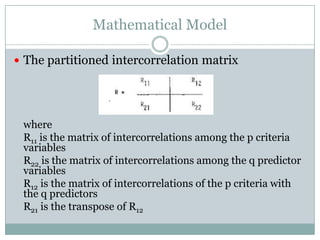
Mathematical ModelThe partitioned intercorrelation matrixwhere 	R11 is the matrix of intercorrelations among the p criteria variables	R22 is the matrix of intercorrelations among the q predictor variables	R12 is the matrix of intercorrelations of the p criteria with the q predictors	R21 is the transpose of R12
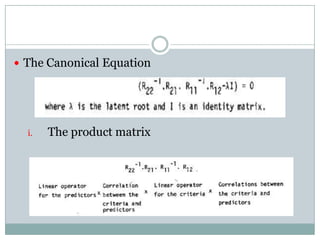
The Canonical EquationThe product matrix
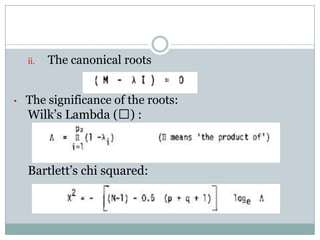
The canonical rootsThe significance of the roots:Wilk’s Lambda (ᴧ) :  Bartlett’s chi squared:
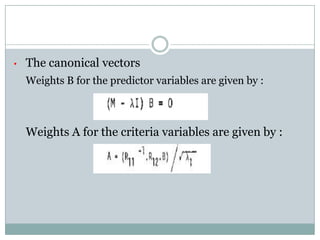
The canonical vectors Weights B for the predictor variables are given by : 	Weights A for the criteria variables are given by :
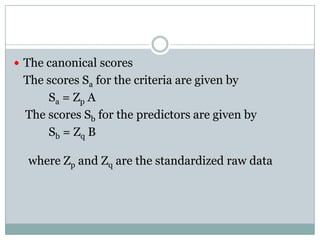
The canonical scores	The scores Sa for the criteria are given by  Sa = Zp A    The scores Sb for the predictors are given by Sb = Zq B where Zp and Zq are the standardized raw data
Canonical correlation analysis-promotion bias scoring detector(a case study of American university of Nigeria(AUN))Researchers-A. O. Unegbu &James J. Adefila`
IntroductionProblem: AUN bids to keep with her value statement 		i.e. highest standards of integrity, 				transparency and academic honest.Solution: Appraise & select Faculties for promotion   		based on various promotion committees’ 			scores.Issues      : Dwindling funding, 			need for a bias free selection technique,
Research HypothesesH01 : CCA cannot detect bias scoring for any of the       	  	  candidates from any  of the named 			  	  committees with 90% confidence level.
H02: CCA cannot detect significantly whether or 		  not score-weights of each of the Promotion 	 	  Assessors have over bearing influence on the 	 	  promotability of candidates.
H03: CCA cannot at 90% level of certainity 	 	  	  discriminate between candidates that have 	 	  earned promotion scores and those that could not 	  from various promotion committees of the 	 	  university.Research objectives To test the efficacy of Canonical Correlation Analysis as a relevant statistical tool for adaption  in bias free promotion score processing and promotion bias scoring detector so as to ensure fairness, integrity, transparency and academic honest in analysis of applicants’ score and in reaching Faculties’ promotion decision.
Steps of the ResearchData collectionManual computationsSPSS analysisTest the Hypothesis
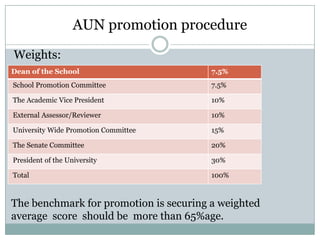
AUN promotion procedure Weights:The benchmark for promotion is securing a weighted average  score  should be  more than 65%age.
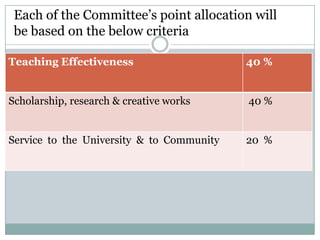
Each of the Committee’s point allocation will be based on the below criteria
Supporting documents for Teaching Effectiveness Peer evaluation  Student evaluation Course Syllabi Record of participation in teaching seminars, workshops, etcContributions  to  the  development  of  new  academic  programsFaculty awards for excellence in teaching
Scholarship, Research and Creative WorksTerminal degrees/Professional qualificationsAt  least  Five  publications,  three  of  which shall be journal articlesComputer  Software and Program  developmentCreative  work  in  the  areas  of  advertising, public  relations,  layout  design,  photography  and graphics, visual arts etc.
Service to the University, Profession and                  CommunityMembership/leadership     in     departmental,  school-wide  or university-wide committeesPlanning  or  participation  in  workshops, conferences, seminars .Evidence  of  participation  in  mentoring  or career counseling of students.Membership in Civil Society organizationsEvidence  of  service  as  external  assessor  or      external examiner on examination committees
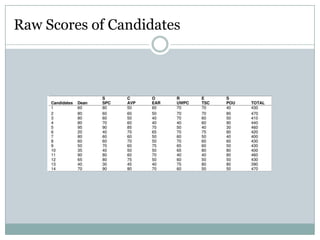
Raw Scores of Candidates
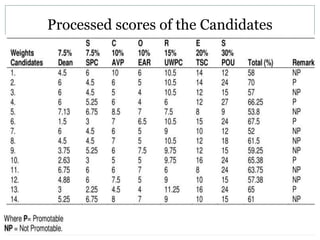
Processed scores of the Candidates
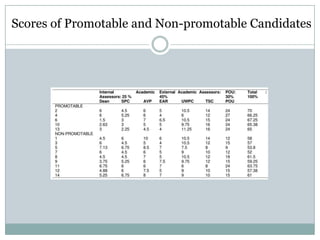
Scores of Promotable and Non-promotable Candidates
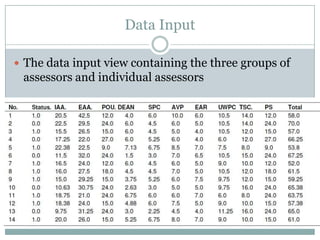
Data InputThe data input view containing the three groups of assessors and individual assessors
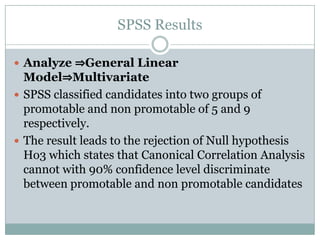
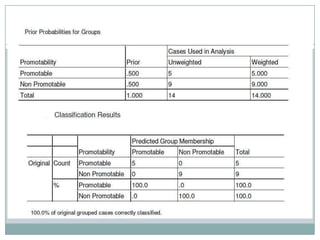
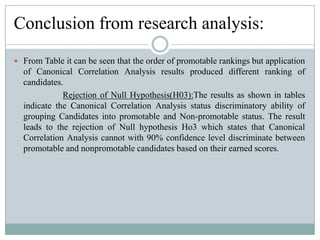
SPSS Results Analyze ⇒General Linear Model⇒MultivariateSPSS classified candidates into two groups of promotable and non promotable of 5 and 9 respectively.The result leads to the rejection of Null hypothesis Ho3 which states that Canonical Correlation Analysis cannot with 90% confidence level discriminate between promotable and non promotable candidates
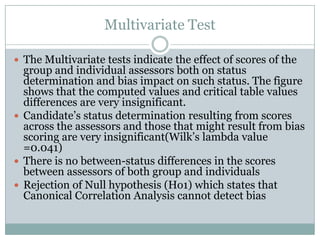
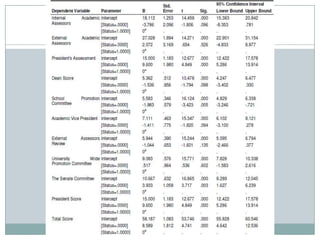
Multivariate TestThe Multivariate tests indicate the effect of scores of the group and individual assessors both on status determination and bias impact on such status. The figure shows that the computed values and critical table values differences are very insignificant.
Candidate’s status determination resulting from scores across the assessors and those that might result from bias scoring are very insignificant(Wilk’s lambda value =0.041)
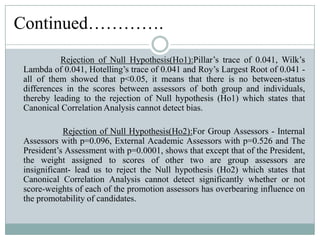
There is no between-status differences in the scores between assessors of both group and individuals
Rejection of Null hypothesis (Ho1) which states that Canonical Correlation Analysis cannot detect bias
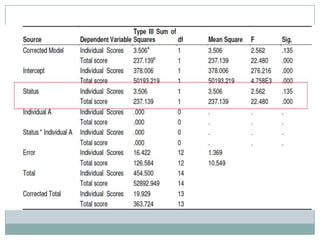
The results of the table show that the scores of each assessor had a significant effect on the determination of each Candidate Status as the significance is 0.135.
Test for homogeneity of varianceOverbearing score weight influence test hypothesis is aimed at detecting across the individual assessors’ mark allocations and weights assigned to each.In this test, the assessors having low significance value mean that there is homogeneity of variance.
This Leads to rejection of null hypothesis (Ho2) which states that Canonical Correlation Analysis cannot detect significantly whether or not score-weights of each of the promotion assessors has overbearing influence on the promotability of candidates.
Shortcomings and limitations of the process Procedures that maximize correlation between canonical variate pairs do not   necessarily lead to solutions that make logical sense. it is the canonical variates  that are actually being  interpreted and they are interpreted in pairs. a variate is interpreted by considering the pattern of variables that are highly correlated (loaded) with it. variables in one set of the solution can be very sensitive to the identity of the variables in the other set.

Cannonical Correlation

  • 1.
  • 2.
    Introduction If we havetwo sets of variables, x1,...., xn and y1,….., ym, and there are correlations among the variables, then canonical correlation analysis will enable us to find linear combinations of the x's and the y's which have maximum correlation with each other.Canonical correlation begin with the observed values of two sets of variables relating to the same set of areas, and a theory or hypothesis that suggests that the two are interrelated.The overriding concern is with the structural relationship between the two sets of data as a whole, rather than the associations between individual variables
  • 3.
    Canonical correlation isthe most general form of correlation.Multiple regression analysis is a more specific case in which one of the sets of data contains only one variable, while product moment correlation is the most specific case in that both sets of data contain only one variable.Canonical correlation analysis is not related to factor/principal components analysis despite certain conceptual and terminological similarities. Canonical correlation analysis is used to investigate the inter-correlation between two sets of variables, whereas factor/principal components analysis identifies the patterns of relationship within one set of data.
  • 4.
    Difficulties in CanonicalCorrelationCanonical correlation is not the easiest of techniques to follow, though the problems of comprehension are conceptual rather than mathematical.Unlike multiple regression and principal components analysis, we cannot provide a graphic device to illustrate even the simplest form. For with canonical correlation analysis we are dealing with two sets of data. Even the most elementary example must, therefore, have at least two variables on each side and so we require 2 + 2 = 4 dimensions. Tied as we are, however, to a three dimensional world, a true understanding of the technique in the conventional cognitive/visual sense of the term, is beyond our grasp.
  • 5.
    Conceptual OverviewData InputThesize of the matrices : There is no requirement in canonical analysis that there must be the same number of variables (columns) in each matrix, though there must be the same number of areas (rows). (There must of course be more than one variable in each set otherwise we would be dealing with multiple regression analysis)The order of the matrices : Neither set of data is given priority in the analysis so it does not matter which we term the criteria and which the predictors. Unlike simple linear regression there is no concept of a 'dependent' set or an 'independent' set. But in practice the smaller set is always taken second as this simplifies the calculation enormously
  • 6.
    AdvantagesUseful and powerfultechnique for exploring the relationships among multiple dependent and independent variables. Results obtained from a canonical analysis should suggest answers to questions concerning the number of ways in which the two sets of multiple variables are related, the strengths of the relationships.Multiple regressions are used for many-to-one relationships, canonical correlation is used for many-to-many relationships. Canonical Correlation- More than one such linear correlation relating the two sets of variables, with each such correlation representing a different dimension by which the independent set of variables is related to the dependent set.
  • 7.
    Interpretability:Although mathematically elegant,canonical solutions are often un- interpretable. Furthermore, the rotation of canonical variates to improve interpretability is not a common practice in research, even though it is commonplace to do this for factor analysis and principle components analysis.Linear relationship:Another problem using canonical correlation for research is that the algorithm used emphasizes the linear relationship between two sets of variables. If the relationship between variables is not linear, then using a canonical correlation for the analysis may miss some or most of the relationship between variables.
  • 8.
    The Canonical ProblemLatentRoots and weights Canonical ScoresResults and InterpretationLatent RootsCanonical Weights Canonical Scores
  • 9.
    Mathematical ModelThe partitionedintercorrelation matrixwhere R11 is the matrix of intercorrelations among the p criteria variables R22 is the matrix of intercorrelations among the q predictor variables R12 is the matrix of intercorrelations of the p criteria with the q predictors R21 is the transpose of R12
  • 10.
  • 11.
    The canonical rootsThesignificance of the roots:Wilk’s Lambda (ᴧ) : Bartlett’s chi squared:
  • 12.
    The canonical vectorsWeights B for the predictor variables are given by : Weights A for the criteria variables are given by :
  • 13.
    The canonical scores Thescores Sa for the criteria are given by Sa = Zp A The scores Sb for the predictors are given by Sb = Zq B where Zp and Zq are the standardized raw data
  • 14.
    Canonical correlation analysis-promotionbias scoring detector(a case study of American university of Nigeria(AUN))Researchers-A. O. Unegbu &James J. Adefila`
  • 15.
    IntroductionProblem: AUN bidsto keep with her value statement i.e. highest standards of integrity, transparency and academic honest.Solution: Appraise & select Faculties for promotion based on various promotion committees’ scores.Issues : Dwindling funding, need for a bias free selection technique,
  • 16.
    Research HypothesesH01 :CCA cannot detect bias scoring for any of the candidates from any of the named committees with 90% confidence level.
  • 17.
    H02: CCA cannotdetect significantly whether or not score-weights of each of the Promotion Assessors have over bearing influence on the promotability of candidates.
  • 18.
    H03: CCA cannotat 90% level of certainity discriminate between candidates that have earned promotion scores and those that could not from various promotion committees of the university.Research objectives To test the efficacy of Canonical Correlation Analysis as a relevant statistical tool for adaption in bias free promotion score processing and promotion bias scoring detector so as to ensure fairness, integrity, transparency and academic honest in analysis of applicants’ score and in reaching Faculties’ promotion decision.
  • 19.
    Steps of theResearchData collectionManual computationsSPSS analysisTest the Hypothesis
  • 20.
    AUN promotion procedureWeights:The benchmark for promotion is securing a weighted average score should be more than 65%age.
  • 21.
    Each of theCommittee’s point allocation will be based on the below criteria
  • 22.
    Supporting documents forTeaching Effectiveness Peer evaluation Student evaluation Course Syllabi Record of participation in teaching seminars, workshops, etcContributions to the development of new academic programsFaculty awards for excellence in teaching
  • 23.
    Scholarship, Research andCreative WorksTerminal degrees/Professional qualificationsAt least Five publications, three of which shall be journal articlesComputer Software and Program developmentCreative work in the areas of advertising, public relations, layout design, photography and graphics, visual arts etc.
  • 24.
    Service to theUniversity, Profession and CommunityMembership/leadership in departmental, school-wide or university-wide committeesPlanning or participation in workshops, conferences, seminars .Evidence of participation in mentoring or career counseling of students.Membership in Civil Society organizationsEvidence of service as external assessor or external examiner on examination committees
  • 25.
    Raw Scores ofCandidates
  • 26.
    Processed scores ofthe Candidates
  • 27.
    Scores of Promotableand Non-promotable Candidates
  • 28.
    Data InputThe datainput view containing the three groups of assessors and individual assessors
  • 29.
    SPSS Results Analyze⇒General Linear Model⇒MultivariateSPSS classified candidates into two groups of promotable and non promotable of 5 and 9 respectively.The result leads to the rejection of Null hypothesis Ho3 which states that Canonical Correlation Analysis cannot with 90% confidence level discriminate between promotable and non promotable candidates
  • 31.
    Multivariate TestThe Multivariatetests indicate the effect of scores of the group and individual assessors both on status determination and bias impact on such status. The figure shows that the computed values and critical table values differences are very insignificant.
  • 32.
    Candidate’s status determinationresulting from scores across the assessors and those that might result from bias scoring are very insignificant(Wilk’s lambda value =0.041)
  • 33.
    There is nobetween-status differences in the scores between assessors of both group and individuals
  • 34.
    Rejection of Nullhypothesis (Ho1) which states that Canonical Correlation Analysis cannot detect bias
  • 35.
    The results ofthe table show that the scores of each assessor had a significant effect on the determination of each Candidate Status as the significance is 0.135.
  • 36.
    Test for homogeneityof varianceOverbearing score weight influence test hypothesis is aimed at detecting across the individual assessors’ mark allocations and weights assigned to each.In this test, the assessors having low significance value mean that there is homogeneity of variance.
  • 38.
    This Leads torejection of null hypothesis (Ho2) which states that Canonical Correlation Analysis cannot detect significantly whether or not score-weights of each of the promotion assessors has overbearing influence on the promotability of candidates.
  • 39.
    Shortcomings and limitationsof the process Procedures that maximize correlation between canonical variate pairs do not necessarily lead to solutions that make logical sense. it is the canonical variates that are actually being interpreted and they are interpreted in pairs. a variate is interpreted by considering the pattern of variables that are highly correlated (loaded) with it. variables in one set of the solution can be very sensitive to the identity of the variables in the other set.

Editor's Notes

  • #3 In employment example the area was different zones, and in another example the area were particular people ( 3 psychological variables , 4 academic variables and 1 gender variable and area were 600 students )