

Josh Patterson
 Email:                   Past
                            Published in IAAI-09:
  josh@floe.tv                   “TinyTermite: A Secure Routing Algorithm”

 Twitter:                        Grad work in Meta-heuristics, Ant-algorithms

                            Tennessee Valley Authority (TVA)
  @jpatanooga                    Hadoop and the Smartgrid

 Github:                    Cloudera
                                 Principal Solution Architect

  https://github.com/jp   Today
  atanooga                  Independent Consultant
Sections

1. Modern Data Analytics
2. Parallel Linear Regression
3. Performance and Results
The World as Optimization
 Data tells us about our model/engine/product
   We take this data and evolve our product towards a
   state of minimal market error
 WSJ Special Section, Monday March 11, 2013
   Zynga changing games based off player behavior
   UPS cut fuel consumption by 8.4MM gallons
   Ford used sentiment analysis to look at how new car
   features would be received
The Modern Data Landscape
 Apps are coming but they need
   Platforms
   Components
   Workflows
 Lots of investment in Hadoop in this space
   Lots of ETL pipelines
   Lots of descriptive Statistics
   Growing interest in Machine Learning
Hadoop as The Linux of Data

 Hadoop has won the Cycle      “Hadoop is the
                               kernel of a
  Gartner: Hadoop will be in
                               distributed operating
  2/3s of advanced analytics
  products by 2015 [1]         system, and all the
                               other components
                               around the kernel
                               are now arriving on
                               this stage”
                                  ---Doug Cutting
Today’s Hadoop ML Pipeline
 Data cleansing / ETL performed with Hive or Pig
 Data In Place Processed
    Mahout
    R
    Custom MapReduce Algorithm
  Or Externally Processed
    SAS
    SPSS
    KXEN
    Weka
As Focus Shifts to Applications

 Data rates have been climbing fast

   Speed at Scale becomes the new Killer App
 Companies will want to leverage the Big Data
 infrastructure they’ve already been working with

   Hadoop
   HDFS as main storage system
 A drive to validate big data investments with results

   Emergence of applications which create “data products”
Patterson’s Law

“As the percent of your total data held
in a storage system approaches 100%
the amount of in-system processing
and analytics also approaches 100%”
Tools Will Move onto Hadoop

 Already seeing this with Vendors
  Who hasn’t announced a SQL engine on Hadoop
  lately?
 Trend will continue with machine learning tools
  Mahout was the beginning
  More are following
  But what about parallel iterative algorithms?
Distributed Systems Are Hard
 Lots of moving parts
   Especially as these applications become more complicated
 Machine learning can be a non-trivial operation
   We need great building blocks that work well together
 I agree with Jimmy Lin [3]: “keep it simple”
   “make sure costs don’t outweigh benefits”
 Minimize “Yet Another Tool To Learn” (YATTL) as much as
 we can!
To Summarize
 Data moving into Hadoop everywhere
   Patterson’s Law
   Focus on hadoop, build around next-gen “linux of data”
 Need simple components to build next-gen data base apps
   They should work cleanly with the cluster that the fortune
   500 has: Hadoop
   Also should be easy to integrate into Hadoop and with the
   hadoop-tool ecosystem
   Minimize YATTL
Linear Regression
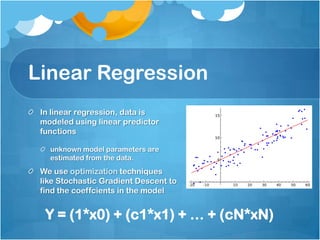
 In linear regression, data is
 modeled using linear predictor
 functions

   unknown model parameters are
   estimated from the data.
 We use optimization techniques
 like Stochastic Gradient Descent to
 find the coeffcients in the model


  Y = (1*x0) + (c1*x1) + … + (cN*xN)
16


     Machine Learning and Optimization

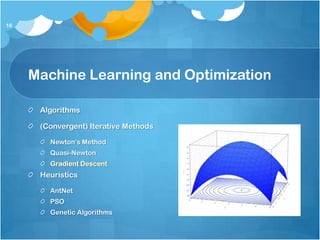
      Algorithms

      (Convergent) Iterative Methods

        Newton’s Method
        Quasi-Newton
        Gradient Descent
      Heuristics

        AntNet
        PSO
        Genetic Algorithms
17


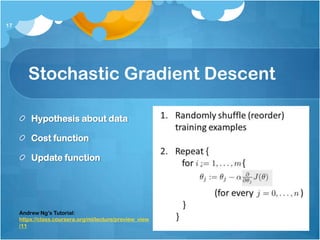
        Stochastic Gradient Descent

         Hypothesis about data

         Cost function

         Update function


     Andrew Ng’s Tutorial:
     https://class.coursera.org/ml/lecture/preview_view
     /11
18


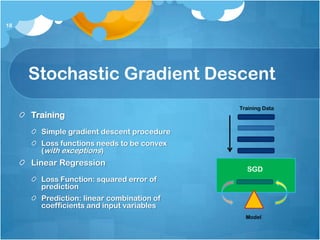
     Stochastic Gradient Descent
                                           Training Data
     Training
       Simple gradient descent procedure
       Loss functions needs to be convex
       (with exceptions)
     Linear Regression
                                             SGD
       Loss Function: squared error of
       prediction
       Prediction: linear combination of
       coefficients and input variables
                                             Model
19


     Mahout’s SGD
      Currently Single Process
       Multi-threaded parallel, but not cluster parallel
       Runs locally, not deployed to the cluster
       Tied to logistic regression implementation
20


     Current Limitations
     Sequential algorithms on a single node only goes so
     far
     The “Data Deluge”
      Presents algorithmic challenges when combined with
      large data sets
      need to design algorithms that are able to perform in a
      distributed fashion
     MapReduce only fits certain types of algorithms
21


     Distributed Learning Strategies

      McDonald, 2010
        Distributed Training Strategies for the Structured
        Perceptron
      Langford, 2007
        Vowpal Wabbit
      Jeff Dean’s Work on Parallel SGD
        DownPour SGD
        Sandblaster
22


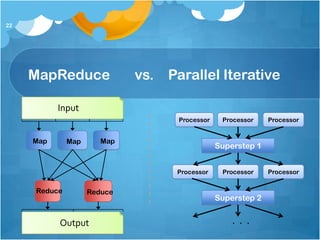
     MapReduce               vs. Parallel Iterative

           Input
                                   Processor    Processor    Processor


     Map      Map      Map
                                               Superstep 1


                                   Processor    Processor    Processor


     Reduce         Reduce
                                               Superstep 2


           Output                                  . . .
23


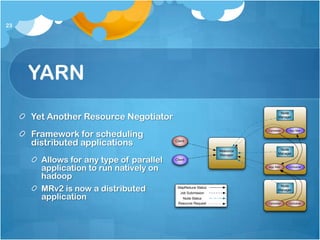
     YARN
     Yet Another Resource Negotiator
                                                                                Node
                                                                               Manager


     Framework for scheduling
                                                                        Container   App Mstr


     distributed applications            Client

                                                             Resource           Node
                                                             Manager           Manager

       Allows for any type of parallel   Client

       application to run natively on                                   App Mstr    Container


       hadoop
       MRv2 is now a distributed          MapReduce Status                      Node
                                                                               Manager

       application
                                            Job Submission
                                            Node Status
                                          Resource Request              Container   Container
24


     IterativeReduce
      Designed specifically for parallel iterative
      algorithms on Hadoop
        Implemented directly on top of YARN
      Intrinsic Parallelism
        Easier to focus on problem
        Not focusing on the distributed application part
25


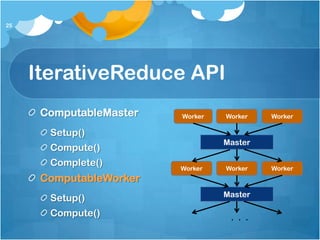
     IterativeReduce API
      ComputableMaster   Worker   Worker   Worker

       Setup()
                                  Master
       Compute()
       Complete()        Worker   Worker   Worker
      ComputableWorker
                                  Master
       Setup()
       Compute()                   . . .
26


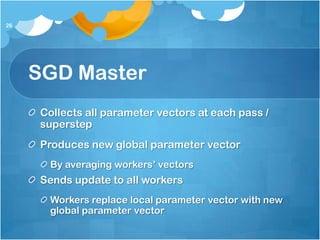
     SGD Master
      Collects all parameter vectors at each pass /
      superstep
      Produces new global parameter vector
       By averaging workers’ vectors
      Sends update to all workers
       Workers replace local parameter vector with new
       global parameter vector
27


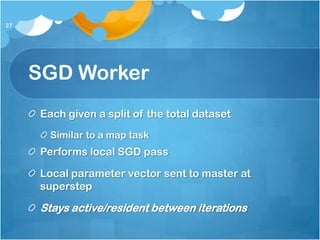
     SGD Worker
     Each given a split of the total dataset
       Similar to a map task
     Performs local SGD pass

     Local parameter vector sent to master at
     superstep

     Stays active/resident between iterations
28


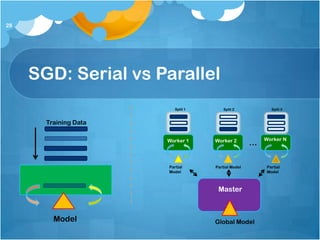
     SGD: Serial vs Parallel
                          Split 1       Split 2            Split 3


       Training Data

                                                        Worker N
                       Worker 1     Worker 2
                                                    …

                       Partial      Partial Model        Partial
                       Model                             Model


                                     Master


         Model                      Global Model
Parallel Linear Regression with IterativeReduce


  Based directly on work we did with Knitting Boar
    Parallel logistic regression
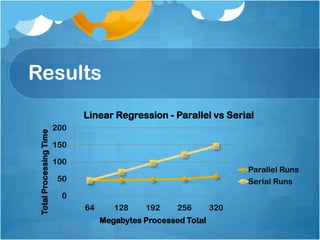
  Scales linearly with input size
  Can produce a linear regression model off large amounts
  of data
  Packaged in a new suite of parallel iterative algorithms
  called Metronome
    100% Java, ASF 2.0 Licensed, on github
Unit Testing and IRUnit
 Simulates the IterativeReduce parallel framework
   Uses the same app.properties file that YARN applications do
 Examples
   https://github.com/jpatanooga/Metronome/blob/master/src/test/jav
   a/tv/floe/metronome/linearregression/iterativereduce/TestSimulat
   eLinearRegressionIterativeReduce.java
   https://github.com/jpatanooga/KnittingBoar/blob/master/src/test/j
   ava/com/cloudera/knittingboar/sgd/iterativereduce/TestKnittingB
   oar_IRUnitSim.java
Running the Job via YARN
 Build with Maven

 Copy Jar to host with cluster access

 Copy dataset to HDFS

 Run job
  Yarn jar iterativereduce-0.1-SNAPSNOT.jar app.properties
Results
                               Linear Regression - Parallel vs Serial
                         200
 Total Processing Time


                         150

                         100
                                                                      Parallel Runs
                          50                                          Serial Runs
                           0
                               64      128    192     256       320
                                    Megabytes Processed Total
Lessons Learned
 Linear scale continues to be achieved with
 parameter averaging variations
 Tuning is critical
   Need to be good at selecting a learning rate
 YARN still experimental, has caveats
   Container allocation is still slow
   Metronome continues to be experimental
Special Thanks
 Michael Katzenellenbollen

 Dr. James Scott
  University of Texas at Austin
 Dr. Jason Baldridge
  University of Texas at Austin
Future Directions
 More testing, stability
 Cache vectors in memory for speed
 Metronome
   Take on properties of LibLinear
     Plugable optimization, general linear models
   YARN-centric first class Hadoop citizen
   Focus on being a complement to Mahout
   K-means, PageRank implementations
Github
 IterativeReduce
  https://github.com/emsixteeen/IterativeReduce
 Metronome
  https://github.com/jpatanooga/Metronome
 Knitting Boar
  https://github.com/jpatanooga/KnittingBoar
References
1. http://www.infoworld.com/d/business-
   intelligence/gartner-hadoop-will-be-in-two-thirds-of-
   advanced-analytics-products-2015-211475

2. https://cwiki.apache.org/MAHOUT/logistic-
   regression.html

3. MapReduce is Good Enough? If All You Have is a
   Hammer, Throw Away Everything That’s Not a Nail!
  •   http://arxiv.org/pdf/1209.2191.pdf

Hadoop Summit EU 2013: Parallel Linear Regression, IterativeReduce, and YARN

  • 2.
    Josh Patterson Email: Past Published in IAAI-09: josh@floe.tv “TinyTermite: A Secure Routing Algorithm” Twitter: Grad work in Meta-heuristics, Ant-algorithms Tennessee Valley Authority (TVA) @jpatanooga Hadoop and the Smartgrid Github: Cloudera Principal Solution Architect https://github.com/jp Today atanooga Independent Consultant
  • 3.
    Sections 1. Modern DataAnalytics 2. Parallel Linear Regression 3. Performance and Results
  • 5.
    The World asOptimization Data tells us about our model/engine/product We take this data and evolve our product towards a state of minimal market error WSJ Special Section, Monday March 11, 2013 Zynga changing games based off player behavior UPS cut fuel consumption by 8.4MM gallons Ford used sentiment analysis to look at how new car features would be received
  • 6.
    The Modern DataLandscape Apps are coming but they need Platforms Components Workflows Lots of investment in Hadoop in this space Lots of ETL pipelines Lots of descriptive Statistics Growing interest in Machine Learning
  • 7.
    Hadoop as TheLinux of Data Hadoop has won the Cycle “Hadoop is the kernel of a Gartner: Hadoop will be in distributed operating 2/3s of advanced analytics products by 2015 [1] system, and all the other components around the kernel are now arriving on this stage” ---Doug Cutting
  • 8.
    Today’s Hadoop MLPipeline Data cleansing / ETL performed with Hive or Pig Data In Place Processed Mahout R Custom MapReduce Algorithm Or Externally Processed SAS SPSS KXEN Weka
  • 9.
    As Focus Shiftsto Applications Data rates have been climbing fast Speed at Scale becomes the new Killer App Companies will want to leverage the Big Data infrastructure they’ve already been working with Hadoop HDFS as main storage system A drive to validate big data investments with results Emergence of applications which create “data products”
  • 10.
    Patterson’s Law “As thepercent of your total data held in a storage system approaches 100% the amount of in-system processing and analytics also approaches 100%”
  • 11.
    Tools Will Moveonto Hadoop Already seeing this with Vendors Who hasn’t announced a SQL engine on Hadoop lately? Trend will continue with machine learning tools Mahout was the beginning More are following But what about parallel iterative algorithms?
  • 12.
    Distributed Systems AreHard Lots of moving parts Especially as these applications become more complicated Machine learning can be a non-trivial operation We need great building blocks that work well together I agree with Jimmy Lin [3]: “keep it simple” “make sure costs don’t outweigh benefits” Minimize “Yet Another Tool To Learn” (YATTL) as much as we can!
  • 13.
    To Summarize Datamoving into Hadoop everywhere Patterson’s Law Focus on hadoop, build around next-gen “linux of data” Need simple components to build next-gen data base apps They should work cleanly with the cluster that the fortune 500 has: Hadoop Also should be easy to integrate into Hadoop and with the hadoop-tool ecosystem Minimize YATTL
  • 15.
    Linear Regression Inlinear regression, data is modeled using linear predictor functions unknown model parameters are estimated from the data. We use optimization techniques like Stochastic Gradient Descent to find the coeffcients in the model Y = (1*x0) + (c1*x1) + … + (cN*xN)
  • 16.
    16 Machine Learning and Optimization Algorithms (Convergent) Iterative Methods Newton’s Method Quasi-Newton Gradient Descent Heuristics AntNet PSO Genetic Algorithms
  • 17.
    17 Stochastic Gradient Descent Hypothesis about data Cost function Update function Andrew Ng’s Tutorial: https://class.coursera.org/ml/lecture/preview_view /11
  • 18.
    18 Stochastic Gradient Descent Training Data Training Simple gradient descent procedure Loss functions needs to be convex (with exceptions) Linear Regression SGD Loss Function: squared error of prediction Prediction: linear combination of coefficients and input variables Model
  • 19.
    19 Mahout’s SGD Currently Single Process Multi-threaded parallel, but not cluster parallel Runs locally, not deployed to the cluster Tied to logistic regression implementation
  • 20.
    20 Current Limitations Sequential algorithms on a single node only goes so far The “Data Deluge” Presents algorithmic challenges when combined with large data sets need to design algorithms that are able to perform in a distributed fashion MapReduce only fits certain types of algorithms
  • 21.
    21 Distributed Learning Strategies McDonald, 2010 Distributed Training Strategies for the Structured Perceptron Langford, 2007 Vowpal Wabbit Jeff Dean’s Work on Parallel SGD DownPour SGD Sandblaster
  • 22.
    22 MapReduce vs. Parallel Iterative Input Processor Processor Processor Map Map Map Superstep 1 Processor Processor Processor Reduce Reduce Superstep 2 Output . . .
  • 23.
    23 YARN Yet Another Resource Negotiator Node Manager Framework for scheduling Container App Mstr distributed applications Client Resource Node Manager Manager Allows for any type of parallel Client application to run natively on App Mstr Container hadoop MRv2 is now a distributed MapReduce Status Node Manager application Job Submission Node Status Resource Request Container Container
  • 24.
    24 IterativeReduce Designed specifically for parallel iterative algorithms on Hadoop Implemented directly on top of YARN Intrinsic Parallelism Easier to focus on problem Not focusing on the distributed application part
  • 25.
    25 IterativeReduce API ComputableMaster Worker Worker Worker Setup() Master Compute() Complete() Worker Worker Worker ComputableWorker Master Setup() Compute() . . .
  • 26.
    26 SGD Master Collects all parameter vectors at each pass / superstep Produces new global parameter vector By averaging workers’ vectors Sends update to all workers Workers replace local parameter vector with new global parameter vector
  • 27.
    27 SGD Worker Each given a split of the total dataset Similar to a map task Performs local SGD pass Local parameter vector sent to master at superstep Stays active/resident between iterations
  • 28.
    28 SGD: Serial vs Parallel Split 1 Split 2 Split 3 Training Data Worker N Worker 1 Worker 2 … Partial Partial Model Partial Model Model Master Model Global Model
  • 29.
    Parallel Linear Regressionwith IterativeReduce Based directly on work we did with Knitting Boar Parallel logistic regression Scales linearly with input size Can produce a linear regression model off large amounts of data Packaged in a new suite of parallel iterative algorithms called Metronome 100% Java, ASF 2.0 Licensed, on github
  • 30.
    Unit Testing andIRUnit Simulates the IterativeReduce parallel framework Uses the same app.properties file that YARN applications do Examples https://github.com/jpatanooga/Metronome/blob/master/src/test/jav a/tv/floe/metronome/linearregression/iterativereduce/TestSimulat eLinearRegressionIterativeReduce.java https://github.com/jpatanooga/KnittingBoar/blob/master/src/test/j ava/com/cloudera/knittingboar/sgd/iterativereduce/TestKnittingB oar_IRUnitSim.java
  • 32.
    Running the Jobvia YARN Build with Maven Copy Jar to host with cluster access Copy dataset to HDFS Run job Yarn jar iterativereduce-0.1-SNAPSNOT.jar app.properties
  • 33.
    Results Linear Regression - Parallel vs Serial 200 Total Processing Time 150 100 Parallel Runs 50 Serial Runs 0 64 128 192 256 320 Megabytes Processed Total
  • 34.
    Lessons Learned Linearscale continues to be achieved with parameter averaging variations Tuning is critical Need to be good at selecting a learning rate YARN still experimental, has caveats Container allocation is still slow Metronome continues to be experimental
  • 35.
    Special Thanks MichaelKatzenellenbollen Dr. James Scott University of Texas at Austin Dr. Jason Baldridge University of Texas at Austin
  • 36.
    Future Directions Moretesting, stability Cache vectors in memory for speed Metronome Take on properties of LibLinear Plugable optimization, general linear models YARN-centric first class Hadoop citizen Focus on being a complement to Mahout K-means, PageRank implementations
  • 37.
    Github IterativeReduce https://github.com/emsixteeen/IterativeReduce Metronome https://github.com/jpatanooga/Metronome Knitting Boar https://github.com/jpatanooga/KnittingBoar
  • 38.
    References 1. http://www.infoworld.com/d/business- intelligence/gartner-hadoop-will-be-in-two-thirds-of- advanced-analytics-products-2015-211475 2. https://cwiki.apache.org/MAHOUT/logistic- regression.html 3. MapReduce is Good Enough? If All You Have is a Hammer, Throw Away Everything That’s Not a Nail! • http://arxiv.org/pdf/1209.2191.pdf

Editor's Notes

  • #9 Reference some thoughts on attribution pipelines
  • #16 Talk about how you normally would use the Normal equation, notes from Andrew Ng
  • #18 “Unlikely optimization algorithms such as stochastic gradient descent show  amazing performance for large-scale problems.“Bottou, 2010SGD has been around for decadesyet recently Langford, Bottou, others have shown impressive speed increasesSGD has been shown to train multiple orders of magnitude faster than batch style learnerswith no loss on model accuracy
  • #19 “Unlikely optimization algorithms such as stochastic gradient descent show  amazing performance for large-scale problems.“Bottou, 2010SGD has been around for decadesyet recently Langford, Bottou, others have shown impressive speed increasesSGD has been shown to train multiple orders of magnitude faster than batch style learnerswith no loss on model accuracy
  • #20 The most important additions in Mahout’s SGD are:confidence weighted learning rates per termevolutionary tuning of hyper-parametersmixed ranking and regressiongrouped AUCImplications of it being local is that you are limited to the compute capacity of the local machine as opposed to even a single machine on the cluster.
  • #21 At current disk bandwidth and capacity (2TB at 100MB/s throughput) 6 hours to read the content of a single HD
  • #22 Bottou similar to Xu2010 in the 2010 paper
  • #23 Benefits of data flow: runtime can decide where to run tasks and can automatically recover from failuresAcyclic data flow is a powerful abstraction, but is not efficient for applications that repeatedly reuse a working set of data:Iterative algorithms (many in machine learning)• No single programming model or framework can excel atevery problem; there are always tradeoffs between simplicity, expressivity, fault tolerance, performance, etc.
  • #25 Performance still largely dependent on implementation of algo
  • #29 POLR: Parallel Online Logistic RegressionTalking points:wanted to start with a known tool to the hadoop community, with expected characteristicsMahout’s SGD is well known, and so we used that as a base point