Refresher on Regression
Analysis
By:
Weam Banjar. DDS., MS in clinical research
Overview:
• Regression Analysis is a technique to find out the relationship between
different variables.
• Regression looks closely into how a dependent variable is affected upon
varying an independent variable while keeping the other independent
variables constant
• Regression analysis is used for prediction and forecasting.
• Regression analysis is a form of predictive modelling technique which
investigates the relationship between a dependent (target) and independent
variable (s) (predictor).
Advantages:
• Can be used to predict the future: By using the relevant model to a data set,
Regression Analysis can accurately predict a lot of useful information like
Stock Prices, Medical Conditions and even Sentiments of the public
Advantages:
• Can be used to predict the future: By using the relevant model to a data set,
Regression Analysis can accurately predict a lot of useful information like
Stock Prices, Medical Conditions and even Sentiments of the public
• Can be used to back major decisions and policies: Results from
regression analysis adds a scientific backing to a decision or policy and
makes it even more reliable as it likelihood of success is then high.
Advantages:
• Can be used to predict the future: By using the relevant model to a data set,
Regression Analysis can accurately predict a lot of useful information like
Stock Prices, Medical Conditions and even Sentiments of the public
• Can be used to back major decisions and policies: Results from
regression analysis adds a scientific backing to a decision or policy and
makes it even more reliable as it likelihood of success is then high.
• Can correct an error in thinking or disabuse: Sometimes, an anomaly
between the prediction of regression analysis and a decision/thinking can help
correct the fallacy of the decision.
Advantages:
• Can be used to predict the future: By using the relevant model to a data set,
Regression Analysis can accurately predict a lot of useful information like Stock
Prices, Medical Conditions and even Sentiments of the public
• Can be used to back major decisions and policies: Results from regression
analysis adds a scientific backing to a decision or policy and makes it even more
reliable as it likelihood of success is then high.
• Can correct an error in thinking or disabuse: Sometimes, an anomaly between
the prediction of regression analysis and a decision/thinking can help correct the
fallacy of the decision.
• Provides a new perspective: Large data sets realise their potential to provide new
dimensions to a study through the application of Regression Analysis.
How to select the right regression model:
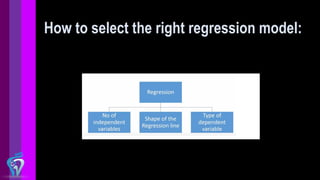
• Data exploration is an inevitable part of building predictive model. It should be
you first step before selecting the right model like identify the relationship and
impact of variables
• To compare the goodness of fit for different models, we can analyse different
metrics like statistical significance of parameters, R-square, Adjusted r-
square, AIC, BIC and error term. Another one is the Mallow’s Cp criterion. This
essentially checks for possible bias in your model, by comparing the model
with all possible submodels (or a careful selection of them).
How to select the right regression model:
• Cross-validation is the best way to evaluate models used for prediction. Here you
divide your data set into two group (train and validate). A simple mean squared
difference between the observed and predicted values give you a measure for the
prediction accuracy.
• If your data set has multiple confounding variables, you should not
choose automatic model selection method because you do not want to put these in
a model at the same time.
• It’ll also depend on your objective. It can occur that a less powerful model is easy to
implement as compared to a highly statistically significant model.
• Regression regularization methods(Lasso, Ridge and ElasticNet) works well in case
of high dimensionality and multicollinearity among the variables in the data set.
How to select the right regression model:
Linear Regression
Overview:
• Linear regression is the most simple regression analysis technique. It is the
most commonly regression analysis mechanism in predictive analysis
• In this technique, the dependent variable is continuous, independent
variable(s) can be continuous or discrete, and nature of regression line is
linear.
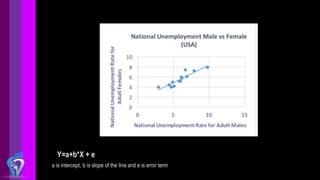
• Linear Regression establishes a relationship between dependent variable
(Y) and one or more independent variables (X) using a best fit straight
line (also known as regression line).
Y=a+b*X + e
a is intercept, b is slope of the line and e is error term
Important notes:
• There must be linear relationship between independent and dependent variables
• Multiple regression suffers from multicollinearity, autocorrelation,
heteroskedasticity.
• Linear Regression is very sensitive to Outliers. It can terribly affect the regression
line and eventually the forecasted values.
• Multicollinearity can increase the variance of the coefficient estimates and make the
estimates very sensitive to minor changes in the model. The result is that the
coefficient estimates are unstable
• In case of multiple independent variables, we can go with forward
selection, backward elimination and step wise approach for selection of most
significant independent variables.
• The difference between simple linear regression and multiple linear regression is
that, multiple linear regression has (>1) independent variables, whereas simple
linear regression has only 1 independent variable
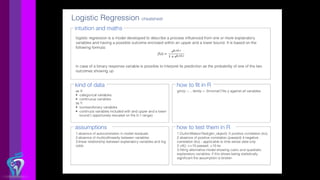
Logistic Regression
Overview:
• In Logistic Regression, the dependent variable is binary that is it has two
values. It can have values like True/False or 0/1 or Yes/No
• This model is used to determine the chance whether a dichotomous outcome
depends on one or more free (independent) variables
• Logistic regression is used to find the probability of event=Success and
event=Failure. We should use logistic regression when the dependent variable
is binary (0/ 1, True/ False, Yes/ No) in nature. Here the value of Y ranges
from 0 to 1 and it can represented by following equation.
Differences between linear and logistic
regressions:
• In Logistic Regression, Conditional Distribution y|x is not a Gaussian
distribution but a Bernoulli distribution.
• In Logistic Regression, the predicted outcomes are probabilities determined
through logistic function and they are circumscribed between 0 and 1.
Understanding the concept
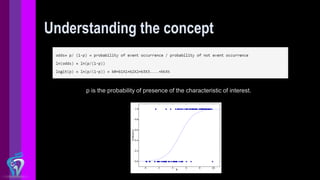
p is the probability of presence of the characteristic of interest.
Understanding the concept
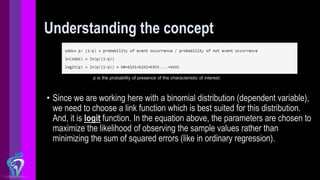
p is the probability of presence of the characteristic of interest.
• Since we are working here with a binomial distribution (dependent variable),
we need to choose a link function which is best suited for this distribution.
And, it is logit function. In the equation above, the parameters are chosen to
maximize the likelihood of observing the sample values rather than
minimizing the sum of squared errors (like in ordinary regression).
Important notes:
• It is widely used for classification problems
• Logistic regression doesn’t require linear relationship between dependent and
independent variables. It can handle various types of relationships because it
applies a non-linear log transformation to the predicted odds ratio
• To avoid over fitting and under fitting, we should include all significant
variables. A good approach to ensure this practice is to use a step wise
method to estimate the logistic regression
Important notes:
• It requires large sample sizes because maximum likelihood estimates are
less powerful at low sample sizes than ordinary least square
• The independent variables should not be correlated with each other i.e. no
multi collinearity. However, we have the options to include interaction
effects of categorical variables in the analysis and in the model.
• If the values of dependent variable is ordinal, then it is called as Ordinal
logistic regression
• If dependent variable is multi class then it is known as Multinomial Logistic
regression.
Regression analysis made easy

Regression analysis made easy

  • 1.
    Refresher on Regression Analysis By: WeamBanjar. DDS., MS in clinical research
  • 2.
    Overview: • Regression Analysisis a technique to find out the relationship between different variables. • Regression looks closely into how a dependent variable is affected upon varying an independent variable while keeping the other independent variables constant • Regression analysis is used for prediction and forecasting. • Regression analysis is a form of predictive modelling technique which investigates the relationship between a dependent (target) and independent variable (s) (predictor).
  • 3.
    Advantages: • Can beused to predict the future: By using the relevant model to a data set, Regression Analysis can accurately predict a lot of useful information like Stock Prices, Medical Conditions and even Sentiments of the public
  • 4.
    Advantages: • Can beused to predict the future: By using the relevant model to a data set, Regression Analysis can accurately predict a lot of useful information like Stock Prices, Medical Conditions and even Sentiments of the public • Can be used to back major decisions and policies: Results from regression analysis adds a scientific backing to a decision or policy and makes it even more reliable as it likelihood of success is then high.
  • 5.
    Advantages: • Can beused to predict the future: By using the relevant model to a data set, Regression Analysis can accurately predict a lot of useful information like Stock Prices, Medical Conditions and even Sentiments of the public • Can be used to back major decisions and policies: Results from regression analysis adds a scientific backing to a decision or policy and makes it even more reliable as it likelihood of success is then high. • Can correct an error in thinking or disabuse: Sometimes, an anomaly between the prediction of regression analysis and a decision/thinking can help correct the fallacy of the decision.
  • 6.
    Advantages: • Can beused to predict the future: By using the relevant model to a data set, Regression Analysis can accurately predict a lot of useful information like Stock Prices, Medical Conditions and even Sentiments of the public • Can be used to back major decisions and policies: Results from regression analysis adds a scientific backing to a decision or policy and makes it even more reliable as it likelihood of success is then high. • Can correct an error in thinking or disabuse: Sometimes, an anomaly between the prediction of regression analysis and a decision/thinking can help correct the fallacy of the decision. • Provides a new perspective: Large data sets realise their potential to provide new dimensions to a study through the application of Regression Analysis.
  • 7.
    How to selectthe right regression model: • Data exploration is an inevitable part of building predictive model. It should be you first step before selecting the right model like identify the relationship and impact of variables • To compare the goodness of fit for different models, we can analyse different metrics like statistical significance of parameters, R-square, Adjusted r- square, AIC, BIC and error term. Another one is the Mallow’s Cp criterion. This essentially checks for possible bias in your model, by comparing the model with all possible submodels (or a careful selection of them).
  • 8.
    How to selectthe right regression model: • Cross-validation is the best way to evaluate models used for prediction. Here you divide your data set into two group (train and validate). A simple mean squared difference between the observed and predicted values give you a measure for the prediction accuracy. • If your data set has multiple confounding variables, you should not choose automatic model selection method because you do not want to put these in a model at the same time. • It’ll also depend on your objective. It can occur that a less powerful model is easy to implement as compared to a highly statistically significant model. • Regression regularization methods(Lasso, Ridge and ElasticNet) works well in case of high dimensionality and multicollinearity among the variables in the data set.
  • 9.
    How to selectthe right regression model:
  • 10.
  • 11.
    Overview: • Linear regressionis the most simple regression analysis technique. It is the most commonly regression analysis mechanism in predictive analysis • In this technique, the dependent variable is continuous, independent variable(s) can be continuous or discrete, and nature of regression line is linear. • Linear Regression establishes a relationship between dependent variable (Y) and one or more independent variables (X) using a best fit straight line (also known as regression line).
  • 12.
    Y=a+b*X + e ais intercept, b is slope of the line and e is error term
  • 13.
    Important notes: • Theremust be linear relationship between independent and dependent variables • Multiple regression suffers from multicollinearity, autocorrelation, heteroskedasticity. • Linear Regression is very sensitive to Outliers. It can terribly affect the regression line and eventually the forecasted values. • Multicollinearity can increase the variance of the coefficient estimates and make the estimates very sensitive to minor changes in the model. The result is that the coefficient estimates are unstable • In case of multiple independent variables, we can go with forward selection, backward elimination and step wise approach for selection of most significant independent variables. • The difference between simple linear regression and multiple linear regression is that, multiple linear regression has (>1) independent variables, whereas simple linear regression has only 1 independent variable
  • 14.
  • 15.
    Overview: • In LogisticRegression, the dependent variable is binary that is it has two values. It can have values like True/False or 0/1 or Yes/No • This model is used to determine the chance whether a dichotomous outcome depends on one or more free (independent) variables • Logistic regression is used to find the probability of event=Success and event=Failure. We should use logistic regression when the dependent variable is binary (0/ 1, True/ False, Yes/ No) in nature. Here the value of Y ranges from 0 to 1 and it can represented by following equation.
  • 16.
    Differences between linearand logistic regressions: • In Logistic Regression, Conditional Distribution y|x is not a Gaussian distribution but a Bernoulli distribution. • In Logistic Regression, the predicted outcomes are probabilities determined through logistic function and they are circumscribed between 0 and 1.
  • 17.
    Understanding the concept pis the probability of presence of the characteristic of interest.
  • 18.
    Understanding the concept pis the probability of presence of the characteristic of interest. • Since we are working here with a binomial distribution (dependent variable), we need to choose a link function which is best suited for this distribution. And, it is logit function. In the equation above, the parameters are chosen to maximize the likelihood of observing the sample values rather than minimizing the sum of squared errors (like in ordinary regression).
  • 19.
    Important notes: • Itis widely used for classification problems • Logistic regression doesn’t require linear relationship between dependent and independent variables. It can handle various types of relationships because it applies a non-linear log transformation to the predicted odds ratio • To avoid over fitting and under fitting, we should include all significant variables. A good approach to ensure this practice is to use a step wise method to estimate the logistic regression
  • 20.
    Important notes: • Itrequires large sample sizes because maximum likelihood estimates are less powerful at low sample sizes than ordinary least square • The independent variables should not be correlated with each other i.e. no multi collinearity. However, we have the options to include interaction effects of categorical variables in the analysis and in the model. • If the values of dependent variable is ordinal, then it is called as Ordinal logistic regression • If dependent variable is multi class then it is known as Multinomial Logistic regression.