
This work is licensed under a Creative Commons Attribution-NonCommercial-ShareAlike License. Your use of this
material constitutes acceptance of that license and the conditions of use of materials on this site.
Copyright 2006, The Johns Hopkins University and Elizabeth Garrett-Mayer. All rights reserved. Use of these
materials permitted only in accordance with license rights granted. Materials provided โ€œAS ISโ€; no representations or
warranties provided. User assumes all responsibility for use, and all liability related thereto, and must independently
review all materials for accuracy and efficacy. May contain materials owned by others. User is responsible for
obtaining permissions for use from third parties as needed.
Statistics in Psychosocial
Research
Lecture 8
Factor Analysis I
Lecturer: Elizabeth Garrett-Mayer
Motivating Example: Frailty
โ€ข We have a concept of what โ€œfrailtyโ€ is, but
we canโ€™t measure it directly.
โ€ข We think it combines strength, weight,
speed, agility, balance, and perhaps other
โ€œfactorsโ€
โ€ข We would like to be able to describe the
components of frailty with a summary of
strength, weight, etc.
Factor Analysis
โ€ข Data reduction tool
โ€ข Removes redundancy or duplication from a set of
correlated variables
โ€ข Represents correlated variables with a smaller
set of โ€œderivedโ€ variables.
โ€ข Factors are formed that are relatively
independent of one another.
โ€ข Two types of โ€œvariablesโ€:
โ€“ latent variables: factors
โ€“ observed variables
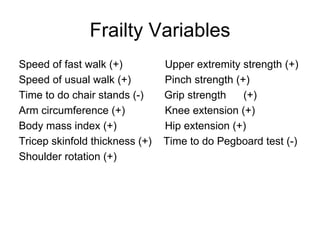
Frailty Variables
Speed of fast walk (+) Upper extremity strength (+)
Speed of usual walk (+) Pinch strength (+)
Time to do chair stands (-) Grip strength (+)
Arm circumference (+) Knee extension (+)
Body mass index (+) Hip extension (+)
Tricep skinfold thickness (+) Time to do Pegboard test (-)
Shoulder rotation (+)
Other examples
โ€ข Diet
โ€ข Air pollution
โ€ข Personality
โ€ข Customer satisfaction
โ€ข Depression
Applications of Factor Analysis
1. Identification of Underlying Factors:
โ€“ clusters variables into homogeneous sets
โ€“ creates new variables (i.e. factors)
โ€“ allows us to gain insight to categories
2. Screening of Variables:
โ€“ identifies groupings to allow us to select one
variable to represent many
โ€“ useful in regression (recall collinearity)
Applications of Factor
Analysis
3. Summary:
โ€“ Allows us to describe many variables using a few
factors
4. Sampling of variables:
โ€“ helps select small group of variables of
representative variables from larger set
5. Clustering of objects:
โ€“ Helps us to put objects (people) into categories
depending on their factor scores
โ€œPerhaps the most widely used (and misused) multivariate
[technique] is factor analysis. Few statisticians are neutral about
this technique. Proponents feel that factor analysis is the
greatest invention since the double bed, while its detractors feel
it is a useless procedure that can be used to support nearly any
desired interpretation of the data. The truth, as is usually the case,
lies somewhere in between. Used properly, factor analysis can
yield much useful information; when applied blindly, without
regard for its limitations, it is about as useful and informative as
Tarot cards. In particular, factor analysis can be used to explore
the data for patterns, confirm our hypotheses, or reduce the
Many variables to a more manageable number.
-- Norman Streiner, PDQ Statistics
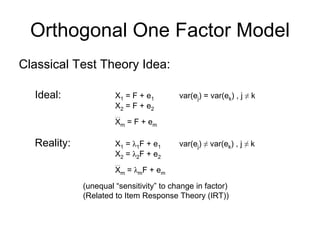
Orthogonal One Factor Model
Classical Test Theory Idea:
Ideal: X1 = F + e1 var(ej) = var(ek) , j โ‰  k
X2 = F + e2
โ€ฆ
Xm = F + em
Reality: X1 = ฮป1F + e1 var(ej) โ‰  var(ek) , j โ‰  k
X2 = ฮป2F + e2
โ€ฆ
Xm = ฮปmF + em
(unequal โ€œsensitivityโ€ to change in factor)
(Related to Item Response Theory (IRT))
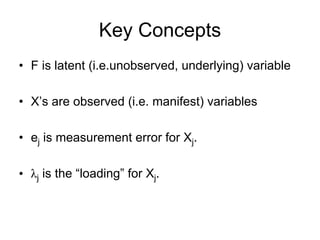
Key Concepts
โ€ข F is latent (i.e.unobserved, underlying) variable
โ€ข Xโ€™s are observed (i.e. manifest) variables
โ€ข ej is measurement error for Xj.
โ€ข ฮปj is the โ€œloadingโ€ for Xj.
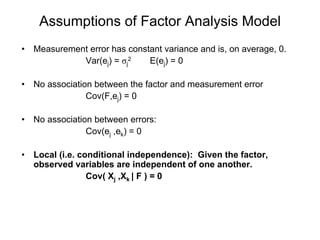
Assumptions of Factor Analysis Model
โ€ข Measurement error has constant variance and is, on average, 0.
Var(ej) = ฯƒj
2 E(ej) = 0
โ€ข No association between the factor and measurement error
Cov(F,ej) = 0
โ€ข No association between errors:
Cov(ej ,ek) = 0
โ€ข Local (i.e. conditional independence): Given the factor,
observed variables are independent of one another.
Cov( Xj ,Xk | F ) = 0
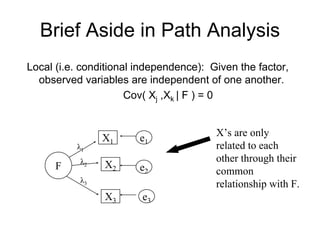
Brief Aside in Path Analysis
Local (i.e. conditional independence): Given the factor,
observed variables are independent of one another.
Cov( Xj ,Xk | F ) = 0
Xโ€™s are only
related to each
other through their
common
relationship with F.
X1 e1
X2
X3
e2
e3
F
ฮป1
ฮป2
ฮป3
Optional Assumptions
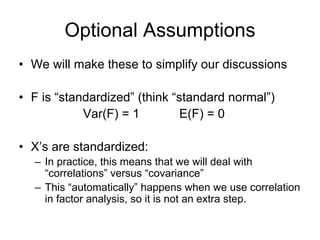
โ€ข We will make these to simplify our discussions
โ€ข F is โ€œstandardizedโ€ (think โ€œstandard normalโ€)
Var(F) = 1 E(F) = 0
โ€ข Xโ€™s are standardized:
โ€“ In practice, this means that we will deal with
โ€œcorrelationsโ€ versus โ€œcovarianceโ€
โ€“ This โ€œautomaticallyโ€ happens when we use correlation
in factor analysis, so it is not an extra step.
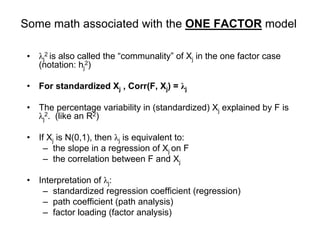
Some math associated with the ONE FACTOR model
โ€ข ฮปj
2 is also called the โ€œcommunalityโ€ of Xj in the one factor case
(notation: hj
2)
โ€ข For standardized Xj , Corr(F, Xj) = ฮปj
โ€ข The percentage variability in (standardized) Xj explained by F is
ฮปj
2. (like an R2)
โ€ข If Xj is N(0,1), then ฮปj is equivalent to:
โ€“ the slope in a regression of Xj on F
โ€“ the correlation between F and Xj
โ€ข Interpretation of ฮปj:
โ€“ standardized regression coefficient (regression)
โ€“ path coefficient (path analysis)
โ€“ factor loading (factor analysis)
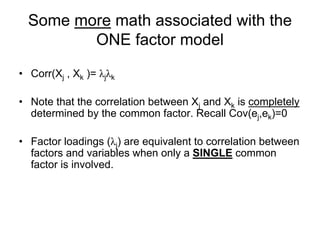
Some more math associated with the
ONE factor model
โ€ข Corr(Xj , Xk )= ฮปjฮปk
โ€ข Note that the correlation between Xj and Xk is completely
determined by the common factor. Recall Cov(ej,ek)=0
โ€ข Factor loadings (ฮปj) are equivalent to correlation between
factors and variables when only a SINGLE common
factor is involved.
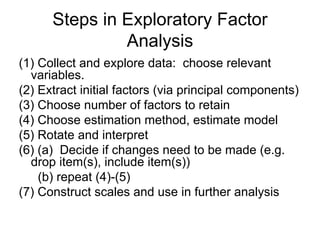
Steps in Exploratory Factor
Analysis
(1) Collect and explore data: choose relevant
variables.
(2) Extract initial factors (via principal components)
(3) Choose number of factors to retain
(4) Choose estimation method, estimate model
(5) Rotate and interpret
(6) (a) Decide if changes need to be made (e.g.
drop item(s), include item(s))
(b) repeat (4)-(5)
(7) Construct scales and use in further analysis
Data Exploration
โ€ข Histograms
โ€“ normality
โ€“ discreteness
โ€“ outliers
โ€ข Covariance and correlations between variables
โ€“ very high or low correlations?
โ€ข Same scale
โ€ข high = good, low = bad?
Aside: Correlation vs. Covariance
โ€ข >90% of Factor Analyses use correlation matrix
โ€ข <10% use covariance matrix
โ€ข We will focus on correlation matrix because
โ€“ It is less confusing than switching between the two
โ€“ It is much more commonly used and more commonly
applicable
โ€ข Covariance does have its place (weโ€™ll address
that next time).
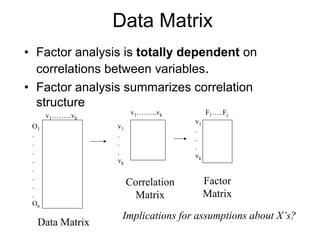
Data Matrix
โ€ข Factor analysis is totally dependent on
correlations between variables.
โ€ข Factor analysis summarizes correlation
structure
v1โ€ฆโ€ฆ...vk
O1
.
.
.
.
.
.
.
.
On
Data Matrix
v1โ€ฆโ€ฆ...vk
v1
.
.
.
vk
v1
.
.
.
vk
F1โ€ฆ..Fj
Correlation
Matrix
Factor
Matrix
Implications for assumptions about Xโ€™s?
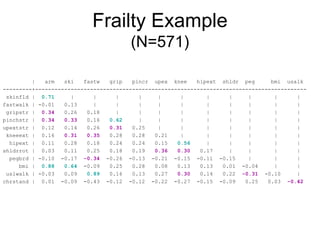
Frailty Example
(N=571)
| arm ski fastw grip pincr upex knee hipext shldr peg bmi usalk
---------+------------------------------------------------------------------------------------
skinfld | 0.71 | | | | | | | | | | |
fastwalk | -0.01 0.13 | | | | | | | | | |
gripstr | 0.34 0.26 0.18 | | | | | | | | |
pinchstr | 0.34 0.33 0.16 0.62 | | | | | | | |
upextstr | 0.12 0.14 0.26 0.31 0.25 | | | | | | |
kneeext | 0.16 0.31 0.35 0.28 0.28 0.21 | | | | | |
hipext | 0.11 0.28 0.18 0.24 0.24 0.15 0.56 | | | | |
shldrrot | 0.03 0.11 0.25 0.18 0.19 0.36 0.30 0.17 | | | |
pegbrd | -0.10 -0.17 -0.34 -0.26 -0.13 -0.21 -0.15 -0.11 -0.15 | | |
bmi | 0.88 0.64 -0.09 0.25 0.28 0.08 0.13 0.13 0.01 -0.04 | |
uslwalk | -0.03 0.09 0.89 0.16 0.13 0.27 0.30 0.14 0.22 -0.31 -0.10 |
chrstand | 0.01 -0.09 -0.43 -0.12 -0.12 -0.22 -0.27 -0.15 -0.09 0.25 0.03 -0.42
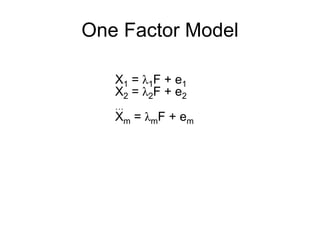
One Factor Model
X1 = ฮป1F + e1
X2 = ฮป2F + e2
โ€ฆ
Xm = ฮปmF + em
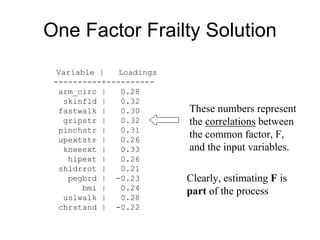
One Factor Frailty Solution
Variable | Loadings
----------+----------
arm_circ | 0.28
skinfld | 0.32
fastwalk | 0.30
gripstr | 0.32
pinchstr | 0.31
upextstr | 0.26
kneeext | 0.33
hipext | 0.26
shldrrot | 0.21
pegbrd | -0.23
bmi | 0.24
uslwalk | 0.28
chrstand | -0.22
These numbers represent
the correlations between
the common factor, F,
and the input variables.
Clearly, estimating F is
part of the process
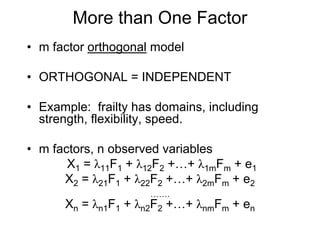
More than One Factor
โ€ข m factor orthogonal model
โ€ข ORTHOGONAL = INDEPENDENT
โ€ข Example: frailty has domains, including
strength, flexibility, speed.
โ€ข m factors, n observed variables
X1 = ฮป11F1 + ฮป12F2 +โ€ฆ+ ฮป1mFm + e1
X2 = ฮป21F1 + ฮป22F2 +โ€ฆ+ ฮป2mFm + e2
โ€ฆโ€ฆ.
Xn = ฮปn1F1 + ฮปn2F2 +โ€ฆ+ ฮปnmFm + en
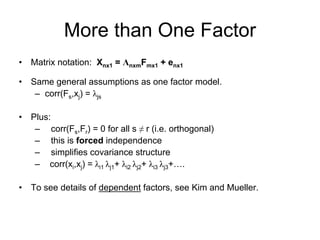
More than One Factor
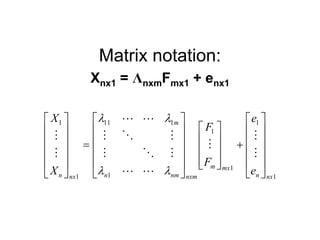
โ€ข Matrix notation: Xnx1 = ฮ›nxmFmx1 + enx1
โ€ข Same general assumptions as one factor model.
โ€“ corr(Fs,xj) = ฮปjs
โ€ข Plus:
โ€“ corr(Fs,Fr) = 0 for all s โ‰  r (i.e. orthogonal)
โ€“ this is forced independence
โ€“ simplifies covariance structure
โ€“ corr(xi,xj) = ฮปi1 ฮปj1+ ฮปi2 ฮปj2+ ฮปi3 ฮปj3+โ€ฆ.
โ€ข To see details of dependent factors, see Kim and Mueller.
Matrix notation:
Xnx1 = ฮ›nxmFmx1 + enx1
X
X
F
F
e
en nx
m
n nm nxm
m mx
n nx
1
1
11 1
1
1
1
1
1
M
M
L L
M O M
M O M
L L
M
M
M
โŽก
โŽฃ
โŽข
โŽข
โŽข
โŽข
โŽค
โŽฆ
โŽฅ
โŽฅ
โŽฅ
โŽฅ
=
โŽก
โŽฃ
โŽข
โŽข
โŽข
โŽข
โŽค
โŽฆ
โŽฅ
โŽฅ
โŽฅ
โŽฅ
โŽก
โŽฃ
โŽข
โŽข
โŽข
โŽค
โŽฆ
โŽฅ
โŽฅ
โŽฅ
+
โŽก
โŽฃ
โŽข
โŽข
โŽข
โŽข
โŽค
โŽฆ
โŽฅ
โŽฅ
โŽฅ
โŽฅ
ฮป ฮป
ฮป ฮป
ฮป ฮป ฮป
ฮป ฮป ฮป
ฮป ฮป ฮป
11 12 1
21 22 2
1 1
L
L
M M O M
L
m
m
n n nm nxm
โŽก
โŽฃ
โŽข
โŽข
โŽข
โŽข
โŽค
โŽฆ
โŽฅ
โŽฅ
โŽฅ
โŽฅ
Factor Matrix
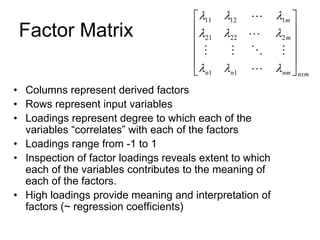
โ€ข Columns represent derived factors
โ€ข Rows represent input variables
โ€ข Loadings represent degree to which each of the
variables โ€œcorrelatesโ€ with each of the factors
โ€ข Loadings range from -1 to 1
โ€ข Inspection of factor loadings reveals extent to which
each of the variables contributes to the meaning of
each of the factors.
โ€ข High loadings provide meaning and interpretation of
factors (~ regression coefficients)
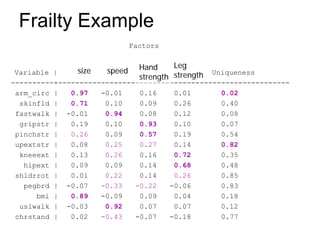
Frailty Example
Variable | 1 2 3 4 Uniqueness
----------+------------------------------------------------------
arm_circ | 0.97 -0.01 0.16 0.01 0.02
skinfld | 0.71 0.10 0.09 0.26 0.40
fastwalk | -0.01 0.94 0.08 0.12 0.08
gripstr | 0.19 0.10 0.93 0.10 0.07
pinchstr | 0.26 0.09 0.57 0.19 0.54
upextstr | 0.08 0.25 0.27 0.14 0.82
kneeext | 0.13 0.26 0.16 0.72 0.35
hipext | 0.09 0.09 0.14 0.68 0.48
shldrrot | 0.01 0.22 0.14 0.26 0.85
pegbrd | -0.07 -0.33 -0.22 -0.06 0.83
bmi | 0.89 -0.09 0.09 0.04 0.18
uslwalk | -0.03 0.92 0.07 0.07 0.12
chrstand | 0.02 -0.43 -0.07 -0.18 0.77
Factors
size speed Hand
strength
Leg
strength
Communalities
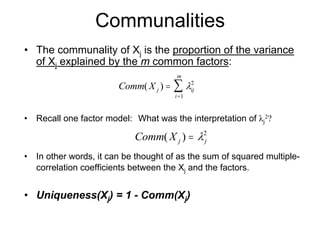
โ€ข The communality of Xj is the proportion of the variance
of Xj explained by the m common factors:
โ€ข Recall one factor model: What was the interpretation of ฮปj
2?
โ€ข In other words, it can be thought of as the sum of squared multiple-
correlation coefficients between the Xj and the factors.
โ€ข Uniqueness(Xj) = 1 - Comm(Xj)
Comm X j ij
i
m
( ) =
=
โˆ‘ ฮป2
1
Comm X j j( ) = ฮป2
Communality of Xj
โ€ข โ€œCommonโ€ part of variance
โ€“ covariance between Xj and the part of Xj due to the
underlying factors
โ€“ For standardized Xj:
โ€ข 1 = communality + uniqueness
โ€ข uniqueness = 1 โ€“ communality
โ€“ Can think of uniqueness = var(ej)
If Xj is informative, communality is high
If Xj is not informative, uniqueness is high
โ€ข Intuitively: variables with high communality share
more in common with the rest of the variables.
Communalities
โ€ข Unstandardized Xโ€™s:
โ€“ Var(X) = Var(F) + Var(e)
โ€“ Var(X) = Communality + Uniqueness
โ€“ Communality โ‰ˆ Var(F)
โ€“ Uniqueness โ‰ˆ Var(e)
โ€ข How can Var(X)=Var(F)= 1 when using
standardized variables? That implies that
Var(e)=0.
โ€ข After Var(F) is derived, then F is โ€˜standardizedโ€™ to
have variance of 1. Two step procedure.
โ€ข Actual variances are โ€œirrelevantโ€ when using
correlations and/or standardized Xโ€™s.
How many factors?
โ€ข Intuitively: The number of uncorrelated
constructs that are jointly measured by the Xโ€™s.
โ€ข Only useful if number of factors is less than
number of Xโ€™s (recall โ€œdata reductionโ€).
โ€ข Identifiability: Is there enough information in the
data to estimate all of the parameters in the
factor analysis? May be constrained to a certain
number of factors.
Choosing Number of Factors
Use โ€œprincipal componentsโ€ to help decide
โ€“ type of factor analysis
โ€“ number of factors is equivalent to number of
variables
โ€“ each factor is a weighted combination of the
input variables:
F1 = a11X1 + a12X2 + โ€ฆ.
โ€“ Recall: For a factor analysis, generally,
X1 = a11F1 + a12F2 +...
Estimating Principal Components
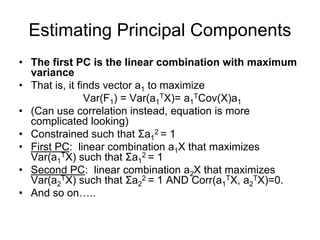
โ€ข The first PC is the linear combination with maximum
variance
โ€ข That is, it finds vector a1 to maximize
Var(F1) = Var(a1
TX)= a1
TCov(X)a1
โ€ข (Can use correlation instead, equation is more
complicated looking)
โ€ข Constrained such that ฮฃa1
2 = 1
โ€ข First PC: linear combination a1X that maximizes
Var(a1
TX) such that ฮฃa1
2 = 1
โ€ข Second PC: linear combination a2X that maximizes
Var(a2
TX) such that ฮฃa2
2 = 1 AND Corr(a1
TX, a2
TX)=0.
โ€ข And so onโ€ฆ..
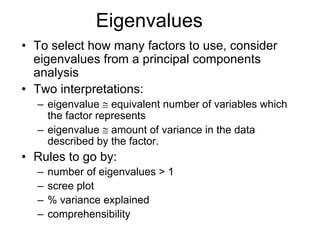
Eigenvalues
โ€ข To select how many factors to use, consider
eigenvalues from a principal components
analysis
โ€ข Two interpretations:
โ€“ eigenvalue โ‰… equivalent number of variables which
the factor represents
โ€“ eigenvalue โ‰… amount of variance in the data
described by the factor.
โ€ข Rules to go by:
โ€“ number of eigenvalues > 1
โ€“ scree plot
โ€“ % variance explained
โ€“ comprehensibility
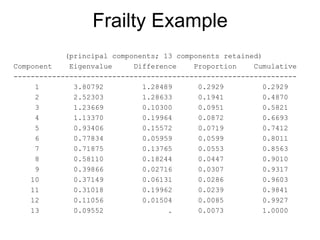
Frailty Example
(principal components; 13 components retained)
Component Eigenvalue Difference Proportion Cumulative
------------------------------------------------------------------
1 3.80792 1.28489 0.2929 0.2929
2 2.52303 1.28633 0.1941 0.4870
3 1.23669 0.10300 0.0951 0.5821
4 1.13370 0.19964 0.0872 0.6693
5 0.93406 0.15572 0.0719 0.7412
6 0.77834 0.05959 0.0599 0.8011
7 0.71875 0.13765 0.0553 0.8563
8 0.58110 0.18244 0.0447 0.9010
9 0.39866 0.02716 0.0307 0.9317
10 0.37149 0.06131 0.0286 0.9603
11 0.31018 0.19962 0.0239 0.9841
12 0.11056 0.01504 0.0085 0.9927
13 0.09552 . 0.0073 1.0000
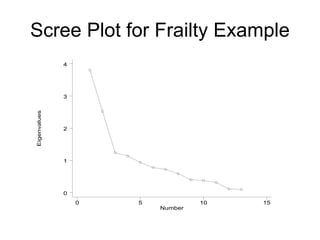
Scree Plot for Frailty ExampleEigenvalues
Number
0 5 10 15
0
1
2
3
4
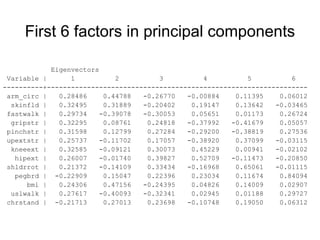
First 6 factors in principal components
Eigenvectors
Variable | 1 2 3 4 5 6
----------+-----------------------------------------------------------------
arm_circ | 0.28486 0.44788 -0.26770 -0.00884 0.11395 0.06012
skinfld | 0.32495 0.31889 -0.20402 0.19147 0.13642 -0.03465
fastwalk | 0.29734 -0.39078 -0.30053 0.05651 0.01173 0.26724
gripstr | 0.32295 0.08761 0.24818 -0.37992 -0.41679 0.05057
pinchstr | 0.31598 0.12799 0.27284 -0.29200 -0.38819 0.27536
upextstr | 0.25737 -0.11702 0.17057 -0.38920 0.37099 -0.03115
kneeext | 0.32585 -0.09121 0.30073 0.45229 0.00941 -0.02102
hipext | 0.26007 -0.01740 0.39827 0.52709 -0.11473 -0.20850
shldrrot | 0.21372 -0.14109 0.33434 -0.16968 0.65061 -0.01115
pegbrd | -0.22909 0.15047 0.22396 0.23034 0.11674 0.84094
bmi | 0.24306 0.47156 -0.24395 0.04826 0.14009 0.02907
uslwalk | 0.27617 -0.40093 -0.32341 0.02945 0.01188 0.29727
chrstand | -0.21713 0.27013 0.23698 -0.10748 0.19050 0.06312
At this stageโ€ฆ.
โ€ข Donโ€™t worry about interpretation of factors!
โ€ข Main concern: whether a smaller number
of factors can account for variability
โ€ข Researcher (i.e. YOU) needs to:
โ€“ provide number of common factors to be extracted
OR
โ€“ provide objective criterion for choosing number of
factors (e.g. scree plot, % variability, etc.)
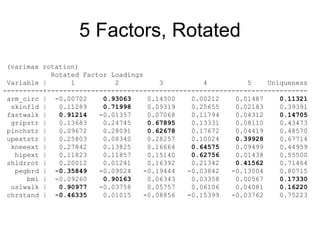
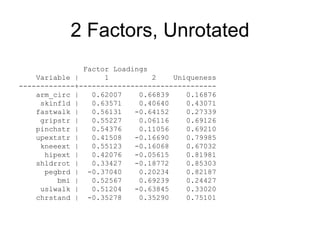
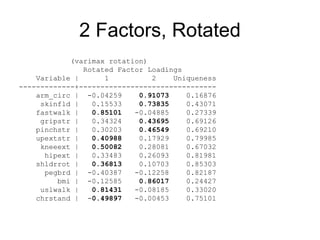
Rotation
โ€ข In principal components, the first factor
describes most of variability.
โ€ข After choosing number of factors to retain, we
want to spread variability more evenly among
factors.
โ€ข To do this we โ€œrotateโ€ factors:
โ€“ redefine factors such that loadings on various factors
tend to be very high (-1 or 1) or very low (0)
โ€“ intuitively, it makes sharper distinctions in the
meanings of the factors
โ€“ We use โ€œfactor analysisโ€ for rotation NOT
principal components!
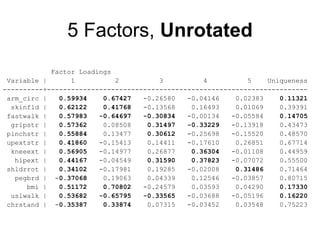
5 Factors, Unrotated
Factor Loadings
Variable | 1 2 3 4 5 Uniqueness
----------+-----------------------------------------------------------------
arm_circ | 0.59934 0.67427 -0.26580 -0.04146 0.02383 0.11321
skinfld | 0.62122 0.41768 -0.13568 0.16493 0.01069 0.39391
fastwalk | 0.57983 -0.64697 -0.30834 -0.00134 -0.05584 0.14705
gripstr | 0.57362 0.08508 0.31497 -0.33229 -0.13918 0.43473
pinchstr | 0.55884 0.13477 0.30612 -0.25698 -0.15520 0.48570
upextstr | 0.41860 -0.15413 0.14411 -0.17610 0.26851 0.67714
kneeext | 0.56905 -0.14977 0.26877 0.36304 -0.01108 0.44959
hipext | 0.44167 -0.04549 0.31590 0.37823 -0.07072 0.55500
shldrrot | 0.34102 -0.17981 0.19285 -0.02008 0.31486 0.71464
pegbrd | -0.37068 0.19063 0.04339 0.12546 -0.03857 0.80715
bmi | 0.51172 0.70802 -0.24579 0.03593 0.04290 0.17330
uslwalk | 0.53682 -0.65795 -0.33565 -0.03688 -0.05196 0.16220
chrstand | -0.35387 0.33874 0.07315 -0.03452 0.03548 0.75223
5 Factors, Rotated
(varimax rotation)
Rotated Factor Loadings
Variable | 1 2 3 4 5 Uniqueness
----------+-----------------------------------------------------------------
arm_circ | -0.00702 0.93063 0.14300 0.00212 0.01487 0.11321
skinfld | 0.11289 0.71998 0.09319 0.25655 0.02183 0.39391
fastwalk | 0.91214 -0.01357 0.07068 0.11794 0.04312 0.14705
gripstr | 0.13683 0.24745 0.67895 0.13331 0.08110 0.43473
pinchstr | 0.09672 0.28091 0.62678 0.17672 0.04419 0.48570
upextstr | 0.25803 0.08340 0.28257 0.10024 0.39928 0.67714
kneeext | 0.27842 0.13825 0.16664 0.64575 0.09499 0.44959
hipext | 0.11823 0.11857 0.15140 0.62756 0.01438 0.55500
shldrrot | 0.20012 0.01241 0.16392 0.21342 0.41562 0.71464
pegbrd | -0.35849 -0.09024 -0.19444 -0.03842 -0.13004 0.80715
bmi | -0.09260 0.90163 0.06343 0.03358 0.00567 0.17330
uslwalk | 0.90977 -0.03758 0.05757 0.06106 0.04081 0.16220
chrstand | -0.46335 0.01015 -0.08856 -0.15399 -0.03762 0.75223
2 Factors, Unrotated
Factor Loadings
Variable | 1 2 Uniqueness
-------------+--------------------------------
arm_circ | 0.62007 0.66839 0.16876
skinfld | 0.63571 0.40640 0.43071
fastwalk | 0.56131 -0.64152 0.27339
gripstr | 0.55227 0.06116 0.69126
pinchstr | 0.54376 0.11056 0.69210
upextstr | 0.41508 -0.16690 0.79985
kneeext | 0.55123 -0.16068 0.67032
hipext | 0.42076 -0.05615 0.81981
shldrrot | 0.33427 -0.18772 0.85303
pegbrd | -0.37040 0.20234 0.82187
bmi | 0.52567 0.69239 0.24427
uslwalk | 0.51204 -0.63845 0.33020
chrstand | -0.35278 0.35290 0.75101
2 Factors, Rotated
(varimax rotation)
Rotated Factor Loadings
Variable | 1 2 Uniqueness
-------------+--------------------------------
arm_circ | -0.04259 0.91073 0.16876
skinfld | 0.15533 0.73835 0.43071
fastwalk | 0.85101 -0.04885 0.27339
gripstr | 0.34324 0.43695 0.69126
pinchstr | 0.30203 0.46549 0.69210
upextstr | 0.40988 0.17929 0.79985
kneeext | 0.50082 0.28081 0.67032
hipext | 0.33483 0.26093 0.81981
shldrrot | 0.36813 0.10703 0.85303
pegbrd | -0.40387 -0.12258 0.82187
bmi | -0.12585 0.86017 0.24427
uslwalk | 0.81431 -0.08185 0.33020
chrstand | -0.49897 -0.00453 0.75101
Unique Solution?
โ€ข The factor analysis solution is NOT
unique!
โ€ข More than one solution will yield the same
โ€œresult.โ€
โ€ข We will understand this better by the end
of the lectureโ€ฆ..
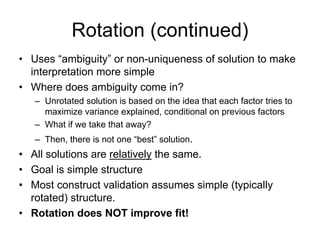
Rotation (continued)
โ€ข Uses โ€œambiguityโ€ or non-uniqueness of solution to make
interpretation more simple
โ€ข Where does ambiguity come in?
โ€“ Unrotated solution is based on the idea that each factor tries to
maximize variance explained, conditional on previous factors
โ€“ What if we take that away?
โ€“ Then, there is not one โ€œbestโ€ solution.
โ€ข All solutions are relatively the same.
โ€ข Goal is simple structure
โ€ข Most construct validation assumes simple (typically
rotated) structure.
โ€ข Rotation does NOT improve fit!
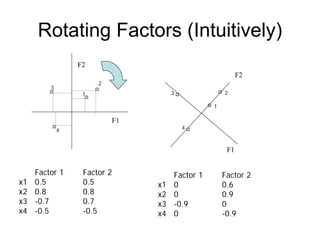
Rotating Factors (Intuitively)
F2
F2
F1
2
1
3
4
F1
2
1
3
4
Factor 1 Factor 2
x1 0.5 0.5
x2 0.8 0.8
x3 -0.7 0.7
x4 -0.5 -0.5
Factor 1 Factor 2
x1 0 0.6
x2 0 0.9
x3 -0.9 0
x4 0 -0.9
Orthogonal vs. Oblique Rotation
โ€ข Orthogonal: Factors are independent
โ€“ varimax: maximize squared loading
variance across variables (sum over
factors)
โ€“ quartimax: maximize squared loading
variance across factors (sum over
variables)
โ€“ Intuition: from previous picture, there is
a right angle between axes
โ€ข Note: โ€œUniquenessesโ€ remain the
same!
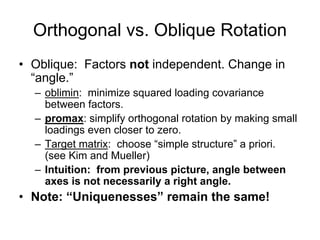
Orthogonal vs. Oblique Rotation
โ€ข Oblique: Factors not independent. Change in
โ€œangle.โ€
โ€“ oblimin: minimize squared loading covariance
between factors.
โ€“ promax: simplify orthogonal rotation by making small
loadings even closer to zero.
โ€“ Target matrix: choose โ€œsimple structureโ€ a priori.
(see Kim and Mueller)
โ€“ Intuition: from previous picture, angle between
axes is not necessarily a right angle.
โ€ข Note: โ€œUniquenessesโ€ remain the same!
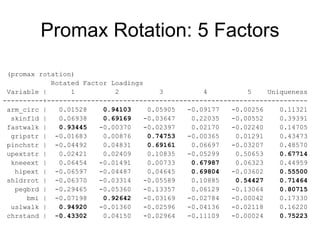
Promax Rotation: 5 Factors
(promax rotation)
Rotated Factor Loadings
Variable | 1 2 3 4 5 Uniqueness
----------+-----------------------------------------------------------------
arm_circ | 0.01528 0.94103 0.05905 -0.09177 -0.00256 0.11321
skinfld | 0.06938 0.69169 -0.03647 0.22035 -0.00552 0.39391
fastwalk | 0.93445 -0.00370 -0.02397 0.02170 -0.02240 0.14705
gripstr | -0.01683 0.00876 0.74753 -0.00365 0.01291 0.43473
pinchstr | -0.04492 0.04831 0.69161 0.06697 -0.03207 0.48570
upextstr | 0.02421 0.02409 0.10835 -0.05299 0.50653 0.67714
kneeext | 0.06454 -0.01491 0.00733 0.67987 0.06323 0.44959
hipext | -0.06597 -0.04487 0.04645 0.69804 -0.03602 0.55500
shldrrot | -0.06370 -0.03314 -0.05589 0.10885 0.54427 0.71464
pegbrd | -0.29465 -0.05360 -0.13357 0.06129 -0.13064 0.80715
bmi | -0.07198 0.92642 -0.03169 -0.02784 -0.00042 0.17330
uslwalk | 0.94920 -0.01360 -0.02596 -0.04136 -0.02118 0.16220
chrstand | -0.43302 0.04150 -0.02964 -0.11109 -0.00024 0.75223
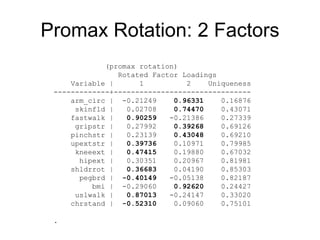
Promax Rotation: 2 Factors
(promax rotation)
Rotated Factor Loadings
Variable | 1 2 Uniqueness
-------------+--------------------------------
arm_circ | -0.21249 0.96331 0.16876
skinfld | 0.02708 0.74470 0.43071
fastwalk | 0.90259 -0.21386 0.27339
gripstr | 0.27992 0.39268 0.69126
pinchstr | 0.23139 0.43048 0.69210
upextstr | 0.39736 0.10971 0.79985
kneeext | 0.47415 0.19880 0.67032
hipext | 0.30351 0.20967 0.81981
shldrrot | 0.36683 0.04190 0.85303
pegbrd | -0.40149 -0.05138 0.82187
bmi | -0.29060 0.92620 0.24427
uslwalk | 0.87013 -0.24147 0.33020
chrstand | -0.52310 0.09060 0.75101
.
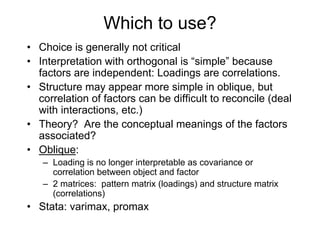
Which to use?
โ€ข Choice is generally not critical
โ€ข Interpretation with orthogonal is โ€œsimpleโ€ because
factors are independent: Loadings are correlations.
โ€ข Structure may appear more simple in oblique, but
correlation of factors can be difficult to reconcile (deal
with interactions, etc.)
โ€ข Theory? Are the conceptual meanings of the factors
associated?
โ€ข Oblique:
โ€“ Loading is no longer interpretable as covariance or
correlation between object and factor
โ€“ 2 matrices: pattern matrix (loadings) and structure matrix
(correlations)
โ€ข Stata: varimax, promax
Steps in Exploratory Factor
Analysis
(1) Collect data: choose relevant variables.
(2) Extract initial factors (via principal components)
(3) Choose number of factors to retain
(4) Choose estimation method, estimate model
(5) Rotate and interpret
(6) (a) Decide if changes need to be made (e.g.
drop item(s), include item(s))
(b) repeat (4)-(5)
(7) Construct scales and use in further analysis
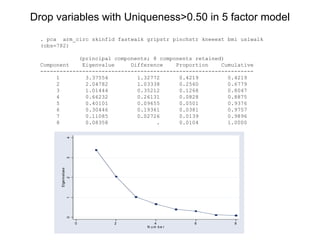
Drop variables with Uniqueness>0.50 in 5 factor model
. pca arm_circ skinfld fastwalk gripstr pinchstr kneeext bmi uslwalk
(obs=782)
(principal components; 8 components retained)
Component Eigenvalue Difference Proportion Cumulative
------------------------------------------------------------------
1 3.37554 1.32772 0.4219 0.4219
2 2.04782 1.03338 0.2560 0.6779
3 1.01444 0.35212 0.1268 0.8047
4 0.66232 0.26131 0.0828 0.8875
5 0.40101 0.09655 0.0501 0.9376
6 0.30446 0.19361 0.0381 0.9757
7 0.11085 0.02726 0.0139 0.9896
8 0.08358 . 0.0104 1.0000
01234
Eigenvalues
0 2 4 6 8
N u m b e r
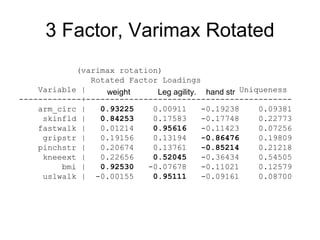
3 Factor, Varimax Rotated
(varimax rotation)
Rotated Factor Loadings
Variable | 1 2 3 Uniqueness
-------------+-------------------------------------------
arm_circ | 0.93225 0.00911 -0.19238 0.09381
skinfld | 0.84253 0.17583 -0.17748 0.22773
fastwalk | 0.01214 0.95616 -0.11423 0.07256
gripstr | 0.19156 0.13194 -0.86476 0.19809
pinchstr | 0.20674 0.13761 -0.85214 0.21218
kneeext | 0.22656 0.52045 -0.36434 0.54505
bmi | 0.92530 -0.07678 -0.11021 0.12579
uslwalk | -0.00155 0.95111 -0.09161 0.08700
weight Leg agility. hand str
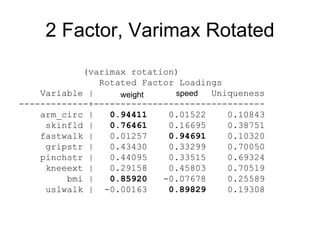
2 Factor, Varimax Rotated
(varimax rotation)
Rotated Factor Loadings
Variable | 1 2 Uniqueness
-------------+--------------------------------
arm_circ | 0.94411 0.01522 0.10843
skinfld | 0.76461 0.16695 0.38751
fastwalk | 0.01257 0.94691 0.10320
gripstr | 0.43430 0.33299 0.70050
pinchstr | 0.44095 0.33515 0.69324
kneeext | 0.29158 0.45803 0.70519
bmi | 0.85920 -0.07678 0.25589
uslwalk | -0.00163 0.89829 0.19308
weight speed

Factor analysis

  • 1.
    This work islicensed under a Creative Commons Attribution-NonCommercial-ShareAlike License. Your use of this material constitutes acceptance of that license and the conditions of use of materials on this site. Copyright 2006, The Johns Hopkins University and Elizabeth Garrett-Mayer. All rights reserved. Use of these materials permitted only in accordance with license rights granted. Materials provided โ€œAS ISโ€; no representations or warranties provided. User assumes all responsibility for use, and all liability related thereto, and must independently review all materials for accuracy and efficacy. May contain materials owned by others. User is responsible for obtaining permissions for use from third parties as needed.
  • 2.
    Statistics in Psychosocial Research Lecture8 Factor Analysis I Lecturer: Elizabeth Garrett-Mayer
  • 3.
    Motivating Example: Frailty โ€ขWe have a concept of what โ€œfrailtyโ€ is, but we canโ€™t measure it directly. โ€ข We think it combines strength, weight, speed, agility, balance, and perhaps other โ€œfactorsโ€ โ€ข We would like to be able to describe the components of frailty with a summary of strength, weight, etc.
  • 4.
    Factor Analysis โ€ข Datareduction tool โ€ข Removes redundancy or duplication from a set of correlated variables โ€ข Represents correlated variables with a smaller set of โ€œderivedโ€ variables. โ€ข Factors are formed that are relatively independent of one another. โ€ข Two types of โ€œvariablesโ€: โ€“ latent variables: factors โ€“ observed variables
  • 5.
    Frailty Variables Speed offast walk (+) Upper extremity strength (+) Speed of usual walk (+) Pinch strength (+) Time to do chair stands (-) Grip strength (+) Arm circumference (+) Knee extension (+) Body mass index (+) Hip extension (+) Tricep skinfold thickness (+) Time to do Pegboard test (-) Shoulder rotation (+)
  • 6.
    Other examples โ€ข Diet โ€ขAir pollution โ€ข Personality โ€ข Customer satisfaction โ€ข Depression
  • 7.
    Applications of FactorAnalysis 1. Identification of Underlying Factors: โ€“ clusters variables into homogeneous sets โ€“ creates new variables (i.e. factors) โ€“ allows us to gain insight to categories 2. Screening of Variables: โ€“ identifies groupings to allow us to select one variable to represent many โ€“ useful in regression (recall collinearity)
  • 8.
    Applications of Factor Analysis 3.Summary: โ€“ Allows us to describe many variables using a few factors 4. Sampling of variables: โ€“ helps select small group of variables of representative variables from larger set 5. Clustering of objects: โ€“ Helps us to put objects (people) into categories depending on their factor scores
  • 9.
    โ€œPerhaps the mostwidely used (and misused) multivariate [technique] is factor analysis. Few statisticians are neutral about this technique. Proponents feel that factor analysis is the greatest invention since the double bed, while its detractors feel it is a useless procedure that can be used to support nearly any desired interpretation of the data. The truth, as is usually the case, lies somewhere in between. Used properly, factor analysis can yield much useful information; when applied blindly, without regard for its limitations, it is about as useful and informative as Tarot cards. In particular, factor analysis can be used to explore the data for patterns, confirm our hypotheses, or reduce the Many variables to a more manageable number. -- Norman Streiner, PDQ Statistics
  • 10.
    Orthogonal One FactorModel Classical Test Theory Idea: Ideal: X1 = F + e1 var(ej) = var(ek) , j โ‰  k X2 = F + e2 โ€ฆ Xm = F + em Reality: X1 = ฮป1F + e1 var(ej) โ‰  var(ek) , j โ‰  k X2 = ฮป2F + e2 โ€ฆ Xm = ฮปmF + em (unequal โ€œsensitivityโ€ to change in factor) (Related to Item Response Theory (IRT))
  • 11.
    Key Concepts โ€ข Fis latent (i.e.unobserved, underlying) variable โ€ข Xโ€™s are observed (i.e. manifest) variables โ€ข ej is measurement error for Xj. โ€ข ฮปj is the โ€œloadingโ€ for Xj.
  • 12.
    Assumptions of FactorAnalysis Model โ€ข Measurement error has constant variance and is, on average, 0. Var(ej) = ฯƒj 2 E(ej) = 0 โ€ข No association between the factor and measurement error Cov(F,ej) = 0 โ€ข No association between errors: Cov(ej ,ek) = 0 โ€ข Local (i.e. conditional independence): Given the factor, observed variables are independent of one another. Cov( Xj ,Xk | F ) = 0
  • 13.
    Brief Aside inPath Analysis Local (i.e. conditional independence): Given the factor, observed variables are independent of one another. Cov( Xj ,Xk | F ) = 0 Xโ€™s are only related to each other through their common relationship with F. X1 e1 X2 X3 e2 e3 F ฮป1 ฮป2 ฮป3
  • 14.
    Optional Assumptions โ€ข Wewill make these to simplify our discussions โ€ข F is โ€œstandardizedโ€ (think โ€œstandard normalโ€) Var(F) = 1 E(F) = 0 โ€ข Xโ€™s are standardized: โ€“ In practice, this means that we will deal with โ€œcorrelationsโ€ versus โ€œcovarianceโ€ โ€“ This โ€œautomaticallyโ€ happens when we use correlation in factor analysis, so it is not an extra step.
  • 15.
    Some math associatedwith the ONE FACTOR model โ€ข ฮปj 2 is also called the โ€œcommunalityโ€ of Xj in the one factor case (notation: hj 2) โ€ข For standardized Xj , Corr(F, Xj) = ฮปj โ€ข The percentage variability in (standardized) Xj explained by F is ฮปj 2. (like an R2) โ€ข If Xj is N(0,1), then ฮปj is equivalent to: โ€“ the slope in a regression of Xj on F โ€“ the correlation between F and Xj โ€ข Interpretation of ฮปj: โ€“ standardized regression coefficient (regression) โ€“ path coefficient (path analysis) โ€“ factor loading (factor analysis)
  • 16.
    Some more mathassociated with the ONE factor model โ€ข Corr(Xj , Xk )= ฮปjฮปk โ€ข Note that the correlation between Xj and Xk is completely determined by the common factor. Recall Cov(ej,ek)=0 โ€ข Factor loadings (ฮปj) are equivalent to correlation between factors and variables when only a SINGLE common factor is involved.
  • 17.
    Steps in ExploratoryFactor Analysis (1) Collect and explore data: choose relevant variables. (2) Extract initial factors (via principal components) (3) Choose number of factors to retain (4) Choose estimation method, estimate model (5) Rotate and interpret (6) (a) Decide if changes need to be made (e.g. drop item(s), include item(s)) (b) repeat (4)-(5) (7) Construct scales and use in further analysis
  • 18.
    Data Exploration โ€ข Histograms โ€“normality โ€“ discreteness โ€“ outliers โ€ข Covariance and correlations between variables โ€“ very high or low correlations? โ€ข Same scale โ€ข high = good, low = bad?
  • 19.
    Aside: Correlation vs.Covariance โ€ข >90% of Factor Analyses use correlation matrix โ€ข <10% use covariance matrix โ€ข We will focus on correlation matrix because โ€“ It is less confusing than switching between the two โ€“ It is much more commonly used and more commonly applicable โ€ข Covariance does have its place (weโ€™ll address that next time).
  • 20.
    Data Matrix โ€ข Factoranalysis is totally dependent on correlations between variables. โ€ข Factor analysis summarizes correlation structure v1โ€ฆโ€ฆ...vk O1 . . . . . . . . On Data Matrix v1โ€ฆโ€ฆ...vk v1 . . . vk v1 . . . vk F1โ€ฆ..Fj Correlation Matrix Factor Matrix Implications for assumptions about Xโ€™s?
  • 21.
    Frailty Example (N=571) | armski fastw grip pincr upex knee hipext shldr peg bmi usalk ---------+------------------------------------------------------------------------------------ skinfld | 0.71 | | | | | | | | | | | fastwalk | -0.01 0.13 | | | | | | | | | | gripstr | 0.34 0.26 0.18 | | | | | | | | | pinchstr | 0.34 0.33 0.16 0.62 | | | | | | | | upextstr | 0.12 0.14 0.26 0.31 0.25 | | | | | | | kneeext | 0.16 0.31 0.35 0.28 0.28 0.21 | | | | | | hipext | 0.11 0.28 0.18 0.24 0.24 0.15 0.56 | | | | | shldrrot | 0.03 0.11 0.25 0.18 0.19 0.36 0.30 0.17 | | | | pegbrd | -0.10 -0.17 -0.34 -0.26 -0.13 -0.21 -0.15 -0.11 -0.15 | | | bmi | 0.88 0.64 -0.09 0.25 0.28 0.08 0.13 0.13 0.01 -0.04 | | uslwalk | -0.03 0.09 0.89 0.16 0.13 0.27 0.30 0.14 0.22 -0.31 -0.10 | chrstand | 0.01 -0.09 -0.43 -0.12 -0.12 -0.22 -0.27 -0.15 -0.09 0.25 0.03 -0.42
  • 22.
    One Factor Model X1= ฮป1F + e1 X2 = ฮป2F + e2 โ€ฆ Xm = ฮปmF + em
  • 23.
    One Factor FrailtySolution Variable | Loadings ----------+---------- arm_circ | 0.28 skinfld | 0.32 fastwalk | 0.30 gripstr | 0.32 pinchstr | 0.31 upextstr | 0.26 kneeext | 0.33 hipext | 0.26 shldrrot | 0.21 pegbrd | -0.23 bmi | 0.24 uslwalk | 0.28 chrstand | -0.22 These numbers represent the correlations between the common factor, F, and the input variables. Clearly, estimating F is part of the process
  • 24.
    More than OneFactor โ€ข m factor orthogonal model โ€ข ORTHOGONAL = INDEPENDENT โ€ข Example: frailty has domains, including strength, flexibility, speed. โ€ข m factors, n observed variables X1 = ฮป11F1 + ฮป12F2 +โ€ฆ+ ฮป1mFm + e1 X2 = ฮป21F1 + ฮป22F2 +โ€ฆ+ ฮป2mFm + e2 โ€ฆโ€ฆ. Xn = ฮปn1F1 + ฮปn2F2 +โ€ฆ+ ฮปnmFm + en
  • 25.
    More than OneFactor โ€ข Matrix notation: Xnx1 = ฮ›nxmFmx1 + enx1 โ€ข Same general assumptions as one factor model. โ€“ corr(Fs,xj) = ฮปjs โ€ข Plus: โ€“ corr(Fs,Fr) = 0 for all s โ‰  r (i.e. orthogonal) โ€“ this is forced independence โ€“ simplifies covariance structure โ€“ corr(xi,xj) = ฮปi1 ฮปj1+ ฮปi2 ฮปj2+ ฮปi3 ฮปj3+โ€ฆ. โ€ข To see details of dependent factors, see Kim and Mueller.
  • 26.
    Matrix notation: Xnx1 =ฮ›nxmFmx1 + enx1 X X F F e en nx m n nm nxm m mx n nx 1 1 11 1 1 1 1 1 1 M M L L M O M M O M L L M M M โŽก โŽฃ โŽข โŽข โŽข โŽข โŽค โŽฆ โŽฅ โŽฅ โŽฅ โŽฅ = โŽก โŽฃ โŽข โŽข โŽข โŽข โŽค โŽฆ โŽฅ โŽฅ โŽฅ โŽฅ โŽก โŽฃ โŽข โŽข โŽข โŽค โŽฆ โŽฅ โŽฅ โŽฅ + โŽก โŽฃ โŽข โŽข โŽข โŽข โŽค โŽฆ โŽฅ โŽฅ โŽฅ โŽฅ ฮป ฮป ฮป ฮป
  • 27.
    ฮป ฮป ฮป ฮปฮป ฮป ฮป ฮป ฮป 11 12 1 21 22 2 1 1 L L M M O M L m m n n nm nxm โŽก โŽฃ โŽข โŽข โŽข โŽข โŽค โŽฆ โŽฅ โŽฅ โŽฅ โŽฅ Factor Matrix โ€ข Columns represent derived factors โ€ข Rows represent input variables โ€ข Loadings represent degree to which each of the variables โ€œcorrelatesโ€ with each of the factors โ€ข Loadings range from -1 to 1 โ€ข Inspection of factor loadings reveals extent to which each of the variables contributes to the meaning of each of the factors. โ€ข High loadings provide meaning and interpretation of factors (~ regression coefficients)
  • 28.
    Frailty Example Variable |1 2 3 4 Uniqueness ----------+------------------------------------------------------ arm_circ | 0.97 -0.01 0.16 0.01 0.02 skinfld | 0.71 0.10 0.09 0.26 0.40 fastwalk | -0.01 0.94 0.08 0.12 0.08 gripstr | 0.19 0.10 0.93 0.10 0.07 pinchstr | 0.26 0.09 0.57 0.19 0.54 upextstr | 0.08 0.25 0.27 0.14 0.82 kneeext | 0.13 0.26 0.16 0.72 0.35 hipext | 0.09 0.09 0.14 0.68 0.48 shldrrot | 0.01 0.22 0.14 0.26 0.85 pegbrd | -0.07 -0.33 -0.22 -0.06 0.83 bmi | 0.89 -0.09 0.09 0.04 0.18 uslwalk | -0.03 0.92 0.07 0.07 0.12 chrstand | 0.02 -0.43 -0.07 -0.18 0.77 Factors size speed Hand strength Leg strength
  • 29.
    Communalities โ€ข The communalityof Xj is the proportion of the variance of Xj explained by the m common factors: โ€ข Recall one factor model: What was the interpretation of ฮปj 2? โ€ข In other words, it can be thought of as the sum of squared multiple- correlation coefficients between the Xj and the factors. โ€ข Uniqueness(Xj) = 1 - Comm(Xj) Comm X j ij i m ( ) = = โˆ‘ ฮป2 1 Comm X j j( ) = ฮป2
  • 30.
    Communality of Xj โ€ขโ€œCommonโ€ part of variance โ€“ covariance between Xj and the part of Xj due to the underlying factors โ€“ For standardized Xj: โ€ข 1 = communality + uniqueness โ€ข uniqueness = 1 โ€“ communality โ€“ Can think of uniqueness = var(ej) If Xj is informative, communality is high If Xj is not informative, uniqueness is high โ€ข Intuitively: variables with high communality share more in common with the rest of the variables.
  • 31.
    Communalities โ€ข Unstandardized Xโ€™s: โ€“Var(X) = Var(F) + Var(e) โ€“ Var(X) = Communality + Uniqueness โ€“ Communality โ‰ˆ Var(F) โ€“ Uniqueness โ‰ˆ Var(e) โ€ข How can Var(X)=Var(F)= 1 when using standardized variables? That implies that Var(e)=0. โ€ข After Var(F) is derived, then F is โ€˜standardizedโ€™ to have variance of 1. Two step procedure. โ€ข Actual variances are โ€œirrelevantโ€ when using correlations and/or standardized Xโ€™s.
  • 32.
    How many factors? โ€ขIntuitively: The number of uncorrelated constructs that are jointly measured by the Xโ€™s. โ€ข Only useful if number of factors is less than number of Xโ€™s (recall โ€œdata reductionโ€). โ€ข Identifiability: Is there enough information in the data to estimate all of the parameters in the factor analysis? May be constrained to a certain number of factors.
  • 33.
    Choosing Number ofFactors Use โ€œprincipal componentsโ€ to help decide โ€“ type of factor analysis โ€“ number of factors is equivalent to number of variables โ€“ each factor is a weighted combination of the input variables: F1 = a11X1 + a12X2 + โ€ฆ. โ€“ Recall: For a factor analysis, generally, X1 = a11F1 + a12F2 +...
  • 34.
    Estimating Principal Components โ€ขThe first PC is the linear combination with maximum variance โ€ข That is, it finds vector a1 to maximize Var(F1) = Var(a1 TX)= a1 TCov(X)a1 โ€ข (Can use correlation instead, equation is more complicated looking) โ€ข Constrained such that ฮฃa1 2 = 1 โ€ข First PC: linear combination a1X that maximizes Var(a1 TX) such that ฮฃa1 2 = 1 โ€ข Second PC: linear combination a2X that maximizes Var(a2 TX) such that ฮฃa2 2 = 1 AND Corr(a1 TX, a2 TX)=0. โ€ข And so onโ€ฆ..
  • 35.
    Eigenvalues โ€ข To selecthow many factors to use, consider eigenvalues from a principal components analysis โ€ข Two interpretations: โ€“ eigenvalue โ‰… equivalent number of variables which the factor represents โ€“ eigenvalue โ‰… amount of variance in the data described by the factor. โ€ข Rules to go by: โ€“ number of eigenvalues > 1 โ€“ scree plot โ€“ % variance explained โ€“ comprehensibility
  • 36.
    Frailty Example (principal components;13 components retained) Component Eigenvalue Difference Proportion Cumulative ------------------------------------------------------------------ 1 3.80792 1.28489 0.2929 0.2929 2 2.52303 1.28633 0.1941 0.4870 3 1.23669 0.10300 0.0951 0.5821 4 1.13370 0.19964 0.0872 0.6693 5 0.93406 0.15572 0.0719 0.7412 6 0.77834 0.05959 0.0599 0.8011 7 0.71875 0.13765 0.0553 0.8563 8 0.58110 0.18244 0.0447 0.9010 9 0.39866 0.02716 0.0307 0.9317 10 0.37149 0.06131 0.0286 0.9603 11 0.31018 0.19962 0.0239 0.9841 12 0.11056 0.01504 0.0085 0.9927 13 0.09552 . 0.0073 1.0000
  • 37.
    Scree Plot forFrailty ExampleEigenvalues Number 0 5 10 15 0 1 2 3 4
  • 38.
    First 6 factorsin principal components Eigenvectors Variable | 1 2 3 4 5 6 ----------+----------------------------------------------------------------- arm_circ | 0.28486 0.44788 -0.26770 -0.00884 0.11395 0.06012 skinfld | 0.32495 0.31889 -0.20402 0.19147 0.13642 -0.03465 fastwalk | 0.29734 -0.39078 -0.30053 0.05651 0.01173 0.26724 gripstr | 0.32295 0.08761 0.24818 -0.37992 -0.41679 0.05057 pinchstr | 0.31598 0.12799 0.27284 -0.29200 -0.38819 0.27536 upextstr | 0.25737 -0.11702 0.17057 -0.38920 0.37099 -0.03115 kneeext | 0.32585 -0.09121 0.30073 0.45229 0.00941 -0.02102 hipext | 0.26007 -0.01740 0.39827 0.52709 -0.11473 -0.20850 shldrrot | 0.21372 -0.14109 0.33434 -0.16968 0.65061 -0.01115 pegbrd | -0.22909 0.15047 0.22396 0.23034 0.11674 0.84094 bmi | 0.24306 0.47156 -0.24395 0.04826 0.14009 0.02907 uslwalk | 0.27617 -0.40093 -0.32341 0.02945 0.01188 0.29727 chrstand | -0.21713 0.27013 0.23698 -0.10748 0.19050 0.06312
  • 39.
    At this stageโ€ฆ. โ€ขDonโ€™t worry about interpretation of factors! โ€ข Main concern: whether a smaller number of factors can account for variability โ€ข Researcher (i.e. YOU) needs to: โ€“ provide number of common factors to be extracted OR โ€“ provide objective criterion for choosing number of factors (e.g. scree plot, % variability, etc.)
  • 40.
    Rotation โ€ข In principalcomponents, the first factor describes most of variability. โ€ข After choosing number of factors to retain, we want to spread variability more evenly among factors. โ€ข To do this we โ€œrotateโ€ factors: โ€“ redefine factors such that loadings on various factors tend to be very high (-1 or 1) or very low (0) โ€“ intuitively, it makes sharper distinctions in the meanings of the factors โ€“ We use โ€œfactor analysisโ€ for rotation NOT principal components!
  • 41.
    5 Factors, Unrotated FactorLoadings Variable | 1 2 3 4 5 Uniqueness ----------+----------------------------------------------------------------- arm_circ | 0.59934 0.67427 -0.26580 -0.04146 0.02383 0.11321 skinfld | 0.62122 0.41768 -0.13568 0.16493 0.01069 0.39391 fastwalk | 0.57983 -0.64697 -0.30834 -0.00134 -0.05584 0.14705 gripstr | 0.57362 0.08508 0.31497 -0.33229 -0.13918 0.43473 pinchstr | 0.55884 0.13477 0.30612 -0.25698 -0.15520 0.48570 upextstr | 0.41860 -0.15413 0.14411 -0.17610 0.26851 0.67714 kneeext | 0.56905 -0.14977 0.26877 0.36304 -0.01108 0.44959 hipext | 0.44167 -0.04549 0.31590 0.37823 -0.07072 0.55500 shldrrot | 0.34102 -0.17981 0.19285 -0.02008 0.31486 0.71464 pegbrd | -0.37068 0.19063 0.04339 0.12546 -0.03857 0.80715 bmi | 0.51172 0.70802 -0.24579 0.03593 0.04290 0.17330 uslwalk | 0.53682 -0.65795 -0.33565 -0.03688 -0.05196 0.16220 chrstand | -0.35387 0.33874 0.07315 -0.03452 0.03548 0.75223
  • 42.
    5 Factors, Rotated (varimaxrotation) Rotated Factor Loadings Variable | 1 2 3 4 5 Uniqueness ----------+----------------------------------------------------------------- arm_circ | -0.00702 0.93063 0.14300 0.00212 0.01487 0.11321 skinfld | 0.11289 0.71998 0.09319 0.25655 0.02183 0.39391 fastwalk | 0.91214 -0.01357 0.07068 0.11794 0.04312 0.14705 gripstr | 0.13683 0.24745 0.67895 0.13331 0.08110 0.43473 pinchstr | 0.09672 0.28091 0.62678 0.17672 0.04419 0.48570 upextstr | 0.25803 0.08340 0.28257 0.10024 0.39928 0.67714 kneeext | 0.27842 0.13825 0.16664 0.64575 0.09499 0.44959 hipext | 0.11823 0.11857 0.15140 0.62756 0.01438 0.55500 shldrrot | 0.20012 0.01241 0.16392 0.21342 0.41562 0.71464 pegbrd | -0.35849 -0.09024 -0.19444 -0.03842 -0.13004 0.80715 bmi | -0.09260 0.90163 0.06343 0.03358 0.00567 0.17330 uslwalk | 0.90977 -0.03758 0.05757 0.06106 0.04081 0.16220 chrstand | -0.46335 0.01015 -0.08856 -0.15399 -0.03762 0.75223
  • 43.
    2 Factors, Unrotated FactorLoadings Variable | 1 2 Uniqueness -------------+-------------------------------- arm_circ | 0.62007 0.66839 0.16876 skinfld | 0.63571 0.40640 0.43071 fastwalk | 0.56131 -0.64152 0.27339 gripstr | 0.55227 0.06116 0.69126 pinchstr | 0.54376 0.11056 0.69210 upextstr | 0.41508 -0.16690 0.79985 kneeext | 0.55123 -0.16068 0.67032 hipext | 0.42076 -0.05615 0.81981 shldrrot | 0.33427 -0.18772 0.85303 pegbrd | -0.37040 0.20234 0.82187 bmi | 0.52567 0.69239 0.24427 uslwalk | 0.51204 -0.63845 0.33020 chrstand | -0.35278 0.35290 0.75101
  • 44.
    2 Factors, Rotated (varimaxrotation) Rotated Factor Loadings Variable | 1 2 Uniqueness -------------+-------------------------------- arm_circ | -0.04259 0.91073 0.16876 skinfld | 0.15533 0.73835 0.43071 fastwalk | 0.85101 -0.04885 0.27339 gripstr | 0.34324 0.43695 0.69126 pinchstr | 0.30203 0.46549 0.69210 upextstr | 0.40988 0.17929 0.79985 kneeext | 0.50082 0.28081 0.67032 hipext | 0.33483 0.26093 0.81981 shldrrot | 0.36813 0.10703 0.85303 pegbrd | -0.40387 -0.12258 0.82187 bmi | -0.12585 0.86017 0.24427 uslwalk | 0.81431 -0.08185 0.33020 chrstand | -0.49897 -0.00453 0.75101
  • 45.
    Unique Solution? โ€ข Thefactor analysis solution is NOT unique! โ€ข More than one solution will yield the same โ€œresult.โ€ โ€ข We will understand this better by the end of the lectureโ€ฆ..
  • 46.
    Rotation (continued) โ€ข Usesโ€œambiguityโ€ or non-uniqueness of solution to make interpretation more simple โ€ข Where does ambiguity come in? โ€“ Unrotated solution is based on the idea that each factor tries to maximize variance explained, conditional on previous factors โ€“ What if we take that away? โ€“ Then, there is not one โ€œbestโ€ solution. โ€ข All solutions are relatively the same. โ€ข Goal is simple structure โ€ข Most construct validation assumes simple (typically rotated) structure. โ€ข Rotation does NOT improve fit!
  • 47.
    Rotating Factors (Intuitively) F2 F2 F1 2 1 3 4 F1 2 1 3 4 Factor1 Factor 2 x1 0.5 0.5 x2 0.8 0.8 x3 -0.7 0.7 x4 -0.5 -0.5 Factor 1 Factor 2 x1 0 0.6 x2 0 0.9 x3 -0.9 0 x4 0 -0.9
  • 48.
    Orthogonal vs. ObliqueRotation โ€ข Orthogonal: Factors are independent โ€“ varimax: maximize squared loading variance across variables (sum over factors) โ€“ quartimax: maximize squared loading variance across factors (sum over variables) โ€“ Intuition: from previous picture, there is a right angle between axes โ€ข Note: โ€œUniquenessesโ€ remain the same!
  • 49.
    Orthogonal vs. ObliqueRotation โ€ข Oblique: Factors not independent. Change in โ€œangle.โ€ โ€“ oblimin: minimize squared loading covariance between factors. โ€“ promax: simplify orthogonal rotation by making small loadings even closer to zero. โ€“ Target matrix: choose โ€œsimple structureโ€ a priori. (see Kim and Mueller) โ€“ Intuition: from previous picture, angle between axes is not necessarily a right angle. โ€ข Note: โ€œUniquenessesโ€ remain the same!
  • 50.
    Promax Rotation: 5Factors (promax rotation) Rotated Factor Loadings Variable | 1 2 3 4 5 Uniqueness ----------+----------------------------------------------------------------- arm_circ | 0.01528 0.94103 0.05905 -0.09177 -0.00256 0.11321 skinfld | 0.06938 0.69169 -0.03647 0.22035 -0.00552 0.39391 fastwalk | 0.93445 -0.00370 -0.02397 0.02170 -0.02240 0.14705 gripstr | -0.01683 0.00876 0.74753 -0.00365 0.01291 0.43473 pinchstr | -0.04492 0.04831 0.69161 0.06697 -0.03207 0.48570 upextstr | 0.02421 0.02409 0.10835 -0.05299 0.50653 0.67714 kneeext | 0.06454 -0.01491 0.00733 0.67987 0.06323 0.44959 hipext | -0.06597 -0.04487 0.04645 0.69804 -0.03602 0.55500 shldrrot | -0.06370 -0.03314 -0.05589 0.10885 0.54427 0.71464 pegbrd | -0.29465 -0.05360 -0.13357 0.06129 -0.13064 0.80715 bmi | -0.07198 0.92642 -0.03169 -0.02784 -0.00042 0.17330 uslwalk | 0.94920 -0.01360 -0.02596 -0.04136 -0.02118 0.16220 chrstand | -0.43302 0.04150 -0.02964 -0.11109 -0.00024 0.75223
  • 51.
    Promax Rotation: 2Factors (promax rotation) Rotated Factor Loadings Variable | 1 2 Uniqueness -------------+-------------------------------- arm_circ | -0.21249 0.96331 0.16876 skinfld | 0.02708 0.74470 0.43071 fastwalk | 0.90259 -0.21386 0.27339 gripstr | 0.27992 0.39268 0.69126 pinchstr | 0.23139 0.43048 0.69210 upextstr | 0.39736 0.10971 0.79985 kneeext | 0.47415 0.19880 0.67032 hipext | 0.30351 0.20967 0.81981 shldrrot | 0.36683 0.04190 0.85303 pegbrd | -0.40149 -0.05138 0.82187 bmi | -0.29060 0.92620 0.24427 uslwalk | 0.87013 -0.24147 0.33020 chrstand | -0.52310 0.09060 0.75101 .
  • 52.
    Which to use? โ€ขChoice is generally not critical โ€ข Interpretation with orthogonal is โ€œsimpleโ€ because factors are independent: Loadings are correlations. โ€ข Structure may appear more simple in oblique, but correlation of factors can be difficult to reconcile (deal with interactions, etc.) โ€ข Theory? Are the conceptual meanings of the factors associated? โ€ข Oblique: โ€“ Loading is no longer interpretable as covariance or correlation between object and factor โ€“ 2 matrices: pattern matrix (loadings) and structure matrix (correlations) โ€ข Stata: varimax, promax
  • 53.
    Steps in ExploratoryFactor Analysis (1) Collect data: choose relevant variables. (2) Extract initial factors (via principal components) (3) Choose number of factors to retain (4) Choose estimation method, estimate model (5) Rotate and interpret (6) (a) Decide if changes need to be made (e.g. drop item(s), include item(s)) (b) repeat (4)-(5) (7) Construct scales and use in further analysis
  • 54.
    Drop variables withUniqueness>0.50 in 5 factor model . pca arm_circ skinfld fastwalk gripstr pinchstr kneeext bmi uslwalk (obs=782) (principal components; 8 components retained) Component Eigenvalue Difference Proportion Cumulative ------------------------------------------------------------------ 1 3.37554 1.32772 0.4219 0.4219 2 2.04782 1.03338 0.2560 0.6779 3 1.01444 0.35212 0.1268 0.8047 4 0.66232 0.26131 0.0828 0.8875 5 0.40101 0.09655 0.0501 0.9376 6 0.30446 0.19361 0.0381 0.9757 7 0.11085 0.02726 0.0139 0.9896 8 0.08358 . 0.0104 1.0000 01234 Eigenvalues 0 2 4 6 8 N u m b e r
  • 55.
    3 Factor, VarimaxRotated (varimax rotation) Rotated Factor Loadings Variable | 1 2 3 Uniqueness -------------+------------------------------------------- arm_circ | 0.93225 0.00911 -0.19238 0.09381 skinfld | 0.84253 0.17583 -0.17748 0.22773 fastwalk | 0.01214 0.95616 -0.11423 0.07256 gripstr | 0.19156 0.13194 -0.86476 0.19809 pinchstr | 0.20674 0.13761 -0.85214 0.21218 kneeext | 0.22656 0.52045 -0.36434 0.54505 bmi | 0.92530 -0.07678 -0.11021 0.12579 uslwalk | -0.00155 0.95111 -0.09161 0.08700 weight Leg agility. hand str
  • 56.
    2 Factor, VarimaxRotated (varimax rotation) Rotated Factor Loadings Variable | 1 2 Uniqueness -------------+-------------------------------- arm_circ | 0.94411 0.01522 0.10843 skinfld | 0.76461 0.16695 0.38751 fastwalk | 0.01257 0.94691 0.10320 gripstr | 0.43430 0.33299 0.70050 pinchstr | 0.44095 0.33515 0.69324 kneeext | 0.29158 0.45803 0.70519 bmi | 0.85920 -0.07678 0.25589 uslwalk | -0.00163 0.89829 0.19308 weight speed