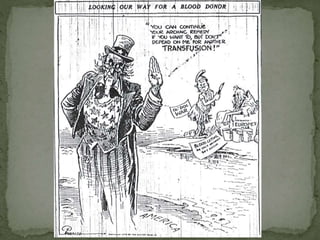
 Treaty of Versailles causes anger, resentment
in Europe
 World-wide Depression
 Dictators rise; driven by nationalism, desire
for more territory
 The rise of totalitarianism in Europe and
Asia lead to World War II.
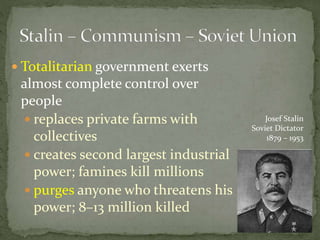
 Totalitarian government exerts
almost complete control over
people
 replaces private farms with
collectives
 creates second largest industrial
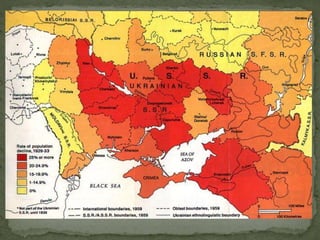
power; famines kill millions
 purges anyone who threatens his
power; 8–13 million killed
Josef Stalin
Soviet Dictator
1879 – 1953
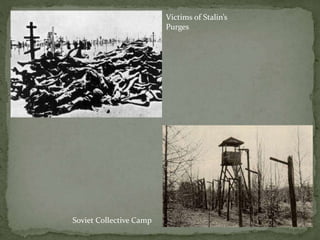
Soviet Collective Camp
Victims of Stalin’s
Purges
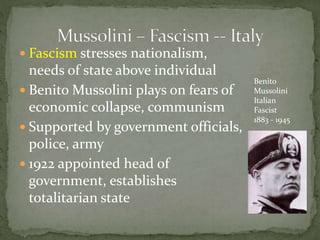
 Fascism stresses nationalism,
needs of state above individual
 Benito Mussolini plays on fears of
economic collapse, communism
 Supported by government officials,
police, army
 1922 appointed head of
government, establishes
totalitarian state
Benito
Mussolini
Italian
Fascist
1883 - 1945
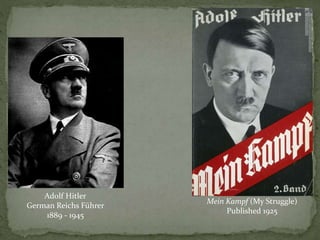
 Adolf Hitler leader of National Socialist German
Workers’ Party (Nazi)
 Mein Kampf—Hitler’s book, basic beliefs of Nazism,
based on extreme nationalism
 Unite German-speaking people, enforce racial
“purification”
 Nazis become strongest political party; Hitler named
chancellor
 Dismantles democratic Weimar Republic; establishes
Third Reich
Adolf Hitler
German Reichs Führer
1889 - 1945
Mein Kampf (My Struggle)
Published 1925
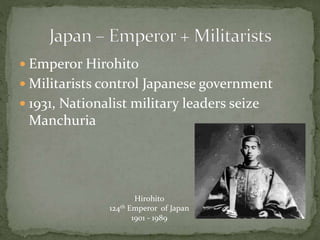
 Emperor Hirohito
 Militarists control Japanese government
 1931, Nationalist military leaders seize
Manchuria
Hirohito
124th Emperor of Japan
1901 - 1989
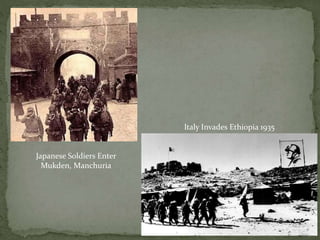
 Japan invades Manchuria (China)
 Mussolini invades Ethiopia
 German Aggression:
 Rhineland
 Austria
 Czechoslovakia
 Poland
Japanese Soldiers Enter
Mukden, Manchuria
Italy Invades Ethiopia 1935
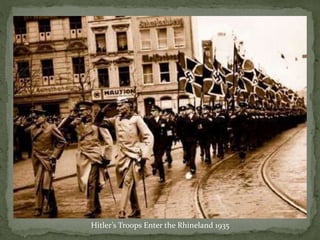
Hitler’s Troops Enter the Rhineland 1935
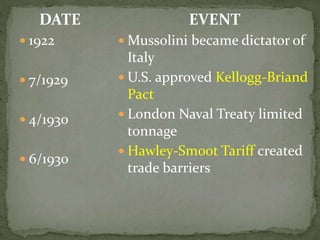
DATE
 1922
 7/1929
 4/1930
 6/1930
EVENT
 Mussolini became dictator of
Italy
 U.S. approved Kellogg-Briand
Pact
 London Naval Treaty limited
tonnage
 Hawley-Smoot Tariff created
trade barriers
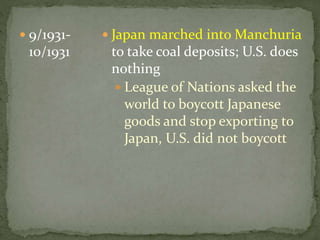
 9/1931-
10/1931
 Japan marched into Manchuria
to take coal deposits; U.S. does
nothing
 League of Nations asked the
world to boycott Japanese
goods and stop exporting to
Japan, U.S. did not boycott
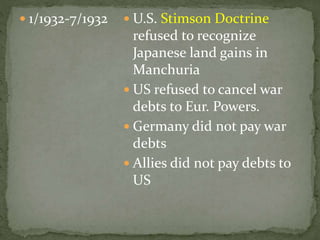
 1/1932-7/1932  U.S. Stimson Doctrine
refused to recognize
Japanese land gains in
Manchuria
 US refused to cancel war
debts to Eur. Powers.
 Germany did not pay war
debts
 Allies did not pay debts to
US
 2/1933-Fall
1933
 Japan walked out of the
League of Nations; no
reprisals
 Nazis came to power and set
up a fascist government
 Hitler became Chancellor of
Germany
 Hitler pulled Germany out of
League of Nations and began
building up German army
 US formally recognized USSR
 US issues good neighbor
policy stating that no country
had the right to intervene in
the affairs of other nations.
 4/1934 - Fall
1934
 Mussolini sent Italian
troops to attack Ethiopia
 Japan gave notice it would
terminate the Wash. Naval
Conference agreement.
 President Paul von
Hindenburg of Germany
dies; Hitler became Fuhrer
 1935  Hitler announced that
Germany would rearm despite
Treaty of Versailles
 Announced existence of
German air force (Luftwaffe)
 Hitler introduced compulsory
military service for German
men.
 8/1935 - 12/1935
 2/1936
 US announced First
Neutrality Act and forbade
sales to belligerents
 US announced Second
Neutrality Act and said it
would make no loans to
belligerents
 3/1936
 7/1936
 Hitler sent troops into the
Rhineland in violation of
Treaty of Versailles; world did
nothing
 Spanish Civil War began;
fascists overthrew existing
government with help of
Germany and Italy.
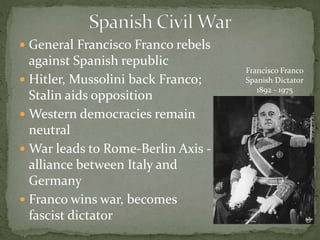
 General Francisco Franco rebels
against Spanish republic
 Hitler, Mussolini back Franco;
Stalin aids opposition
 Western democracies remain
neutral
 War leads to Rome-Berlin Axis -
alliance between Italy and
Germany
 Franco wins war, becomes
fascist dictator
Francisco Franco
Spanish Dictator
1892 - 1975
 10/1936
 5/1937
 Germany and Italy formed a
military alliance: Rome-Berlin
Axis
 US announced Third
Neutrality Act and claimed it
would trade on a “cash and
carry” basis
 Hitler repudiated all
responsibility for WWI
 Japan attacked China
 10/1937
 12/1937
 1938
 FDR’s “Quarantine the
Aggressor Speech” (econ.
Isolation); met with disinterest
 Italy withdraws from League of
Nations
 Germany annexed Austria
 12/1938  Fr., GB, It, and Germ. signed
the Munich Pact
(Appeasement) giving Hitler
the Sudetenland and Hitler
promised to leave the rest of
Czechoslovakia alone.
 Jewish persecution and
pogroms are put in place
throughout Germany
 3 million German-speakers in Sudetenland
 Hitler claims Czechs abuse Sudeten
Germans, masses troops on border
 Prime Ministers of Brit. and Fr. meet with
Hitler
 Sign Munich Pact, hand Sudetenland over to
Germany
 Appeasement—giving up principles to
pacify an aggressor
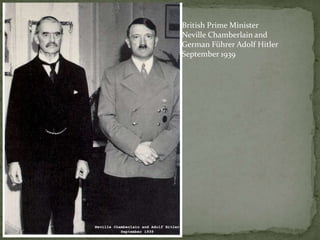
British Prime Minister
Neville Chamberlain and
German Führer Adolf Hitler
September 1939
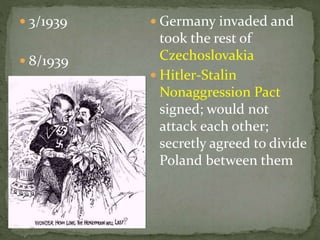
 3/1939
 8/1939
 Germany invaded and
took the rest of
Czechoslovakia
 Hitler-Stalin
Nonaggression Pact
signed; would not
attack each other;
secretly agreed to divide
Poland between them
 9/1939
 9/3/39
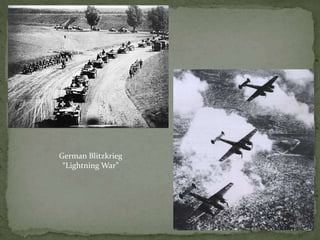
 Hitler invaded Poland
(Blitzkrieg); Poland
surrendered after a month and
was split between Germany
and USSR.
 England & France declared war
on Germany for violation of
Munich Pact.
 WWII begins
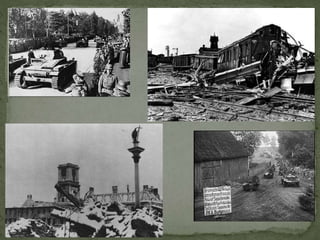
German Blitzkrieg
“Lightning War”
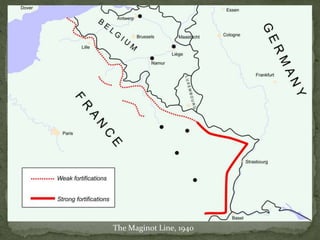
The Maginot Line, 1940
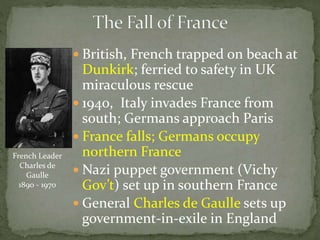
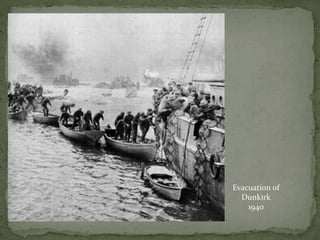
 British, French trapped on beach at
Dunkirk; ferried to safety in UK
miraculous rescue
 1940, Italy invades France from
south; Germans approach Paris
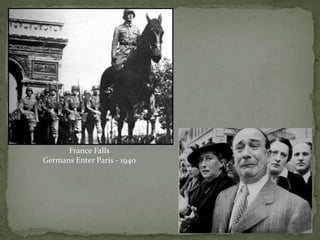
 France falls; Germans occupy
northern France
 Nazi puppet government (Vichy
Gov’t) set up in southern France
 General Charles de Gaulle sets up
government-in-exile in England
French Leader
Charles de
Gaulle
1890 - 1970
Evacuation of
Dunkirk
1940
France Falls
Germans Enter Paris - 1940
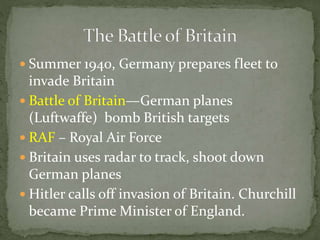
 Summer 1940, Germany prepares fleet to
invade Britain
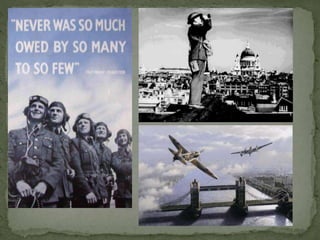
 Battle of Britain—German planes
(Luftwaffe) bomb British targets
 RAF – Royal Air Force
 Britain uses radar to track, shoot down
German planes
 Hitler calls off invasion of Britain. Churchill
became Prime Minister of England.
DATE
 9/1940
EVENT
 Destroyers for Bases Deal: US
sends ships to Brit. And rec’d 99
year leases to naval and air
bases in the Caribbean.
 Japan continues south and
invades French Indo-China
(Vietnam)
 US placed an embargo on
exports to Japan
 Japan, Germany, and Italy
formed a military alliance called
the Axis Powers.
DATE
 11/1940
 1/1941
 6/1941
EVENT
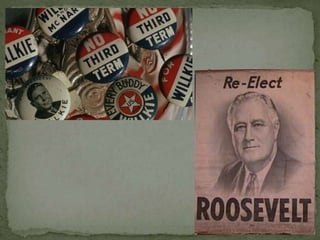
 FDR elected to third term
 FDR delivers his “Four
Freedoms” Speech (speech,
religion, want, fear)
 Congress passed Lend-Lease Act
 Germany invaded Soviet Union
(USSR) – major mistake for
Hitler, must now fight on two
fronts, Germany underestimated
the Soviet’s resolve.
 The U S provides economic and military aid
to help the Allies achieve victory.
 Moving Cautiously Away from Neutrality
 Congress passes “cash-and-carry” provision
 Germany, Japan, Italy alliance aimed at
keeping U.S. out of war by forcing fight on
two oceans
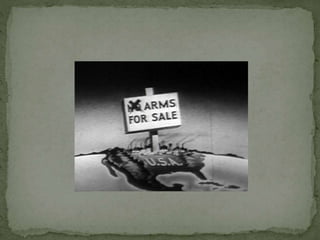
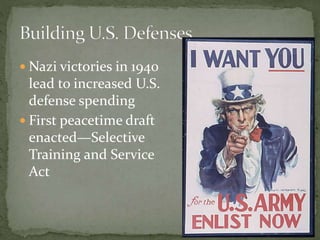
 Nazi victories in 1940
lead to increased U.S.
defense spending
 First peacetime draft
enacted—Selective
Training and Service
Act
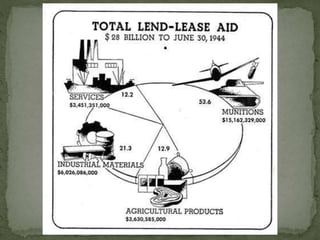
 FDR tells nation if Britain falls, Axis powers
free to conquer world
 U.S. must become “arsenal of democracy”
 Britain has no more cash to buy U.S. arms
 1941 Lend-Lease Act—U.S. to lend or lease
supplies for defense
 Roosevelt sends lend-lease supplies to Soviet
Union
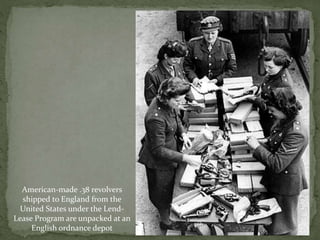
American-made .38 revolvers
shipped to England from the
United States under the Lend-
Lease Program are unpacked at an
English ordnance depot
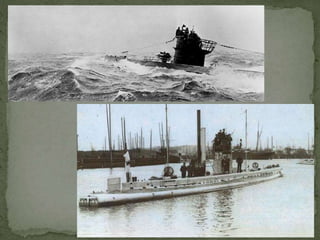
 Hitler deploys U-boats to attack supply
convoys
 Wolf packs—groups of up to 40 submarines
patrol North Atlantic
 sink supply ships
 FDR allows navy to attack German U-boats
in self-defense
 FDR, Churchill issue Atlantic Charter—joint
declaration of war aims
 Charter is basis of “A Declaration of the
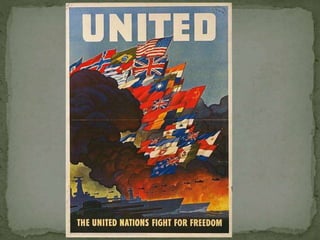
United Nations” or Allies
 Allies—nations that fight Axis powers; 26
nations sign Declaration
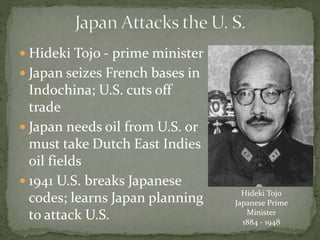
 Hideki Tojo - prime minister
 Japan seizes French bases in
Indochina; U.S. cuts off
trade
 Japan needs oil from U.S. or
must take Dutch East Indies
oil fields
 1941 U.S. breaks Japanese
codes; learns Japan planning
to attack U.S.
Hideki Tojo
Japanese Prime
Minister
1884 - 1948
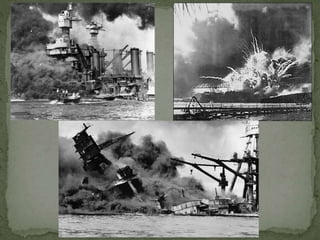
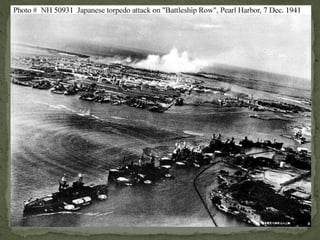
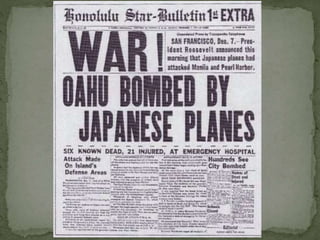
 December 7, 1941 Japanese attack Pearl
Harbor
 2,403 Americans killed; 1,178 wounded
 Over 300 aircraft, 21 ships destroyed or
damaged
 Congress approves FDR’s request for
declaration of war against Japan
 Germany, Italy declare war on U.S.
 U.S. unprepared to fight in both Atlantic,
Pacific Oceans
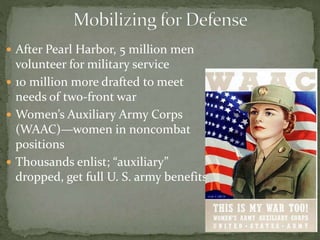
 After Pearl Harbor, 5 million men
volunteer for military service
 10 million more drafted to meet
needs of two-front war
 Women’s Auxiliary Army Corps
(WAAC)—women in noncombat
positions
 Thousands enlist; “auxiliary”
dropped, get full U. S. army benefits
 Minority groups are denied basic citizenship
rights
 Question whether they should fight for
democracy in other countries
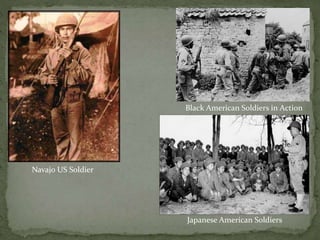
 300,000 Mexican Americans join armed
forces
 1 million African Americans serve; live, work
in segregated units
 13,000 Chinese Americans and 33,000
Japanese Americans serve
 25,000 Native Americans enlist
Navajo US Soldier
Black American Soldiers in Action
Japanese American Soldiers
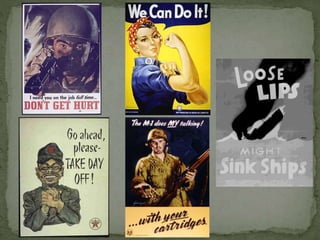
 Factories convert from civilian to war
production
 Shipyards, defense plants expand, new ones
built
 Produce ships, arms rapidly
 use prefabricated parts
 people work at record speeds
 Nearly 18 million workers in war industries;
6 million are women
 Over 2 million minorities hired; face strong
discrimination at first
 FDR executive order forbids discrimination
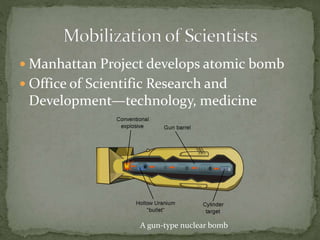
 Manhattan Project develops atomic bomb
 Office of Scientific Research and
Development—technology, medicine
A gun-type nuclear bomb
 Higher taxes, purchase of war bonds, lower
demand for scarce goods
 organizes collection of recyclable materials
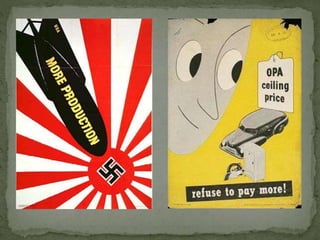
 Office of Price Administration (OPA) freezes
prices, fights inflation
 Mandatory rationing
 War Production Board (WPB) says which
companies convert production
 allocates raw materials
 Allied forces, led by the United States and
Great Britain, battle Axis powers for control
of Europe and North Africa.
 Churchill convinces FDR to strike first
against Hitler
 Hitler orders submarine attacks against
supply ships to Britain
 Wolf packs destroy hundreds of ships in
1942
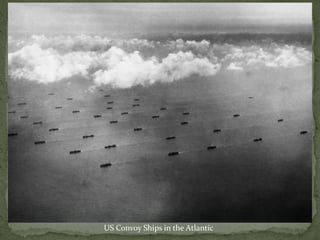
 Allies organize convoys of cargo ships with
escort:
 destroyers with sonar; planes with radar
US Convoy Ships in the Atlantic
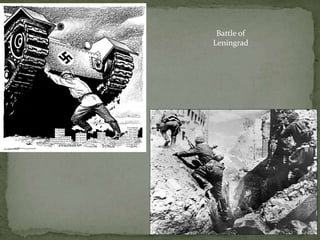
 The Battle of Stalingrad
 Soviets defeat Germans in bitter winter
campaign
 Over 230,000 Germans, 1,100,000 Soviets
die
 Turning point battle in Europe: Soviet army
begins to move towards Germany
Battle of
Leningrad
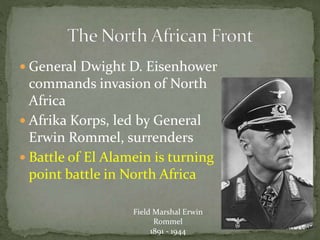
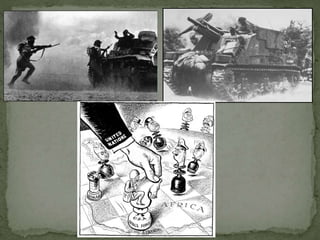
 General Dwight D. Eisenhower
commands invasion of North
Africa
 Afrika Korps, led by General
Erwin Rommel, surrenders
 Battle of El Alamein is turning
point battle in North Africa
Field Marshal Erwin
Rommel
1891 - 1944
 Allies decide will accept only unconditional
surrender from Axis
 Summer 1943, capture Sicily; Mussolini
forced to resign
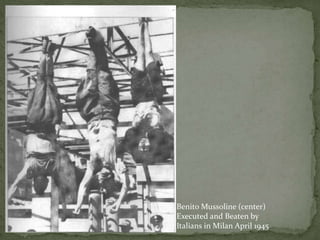
Benito Mussoline (center)
Executed and Beaten by
Italians in Milan April 1945
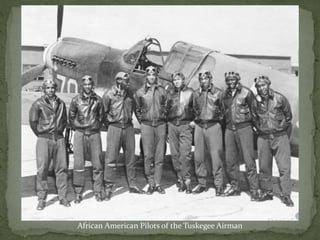
 African Americans —Tuskegee Airmen,
Buffaloes—highly decorated
 Mexican-American soldiers win many
awards
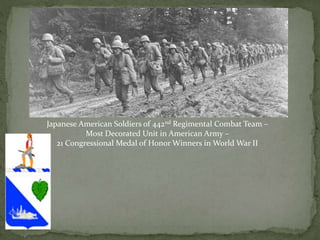
 Japanese-American unit most decorated
unit in U.S. history
Japanese American Soldiers of 442nd Regimental Combat Team –
Most Decorated Unit in American Army –
21 Congressional Medal of Honor Winners in World War II
African American Pilots of the Tuskegee Airman
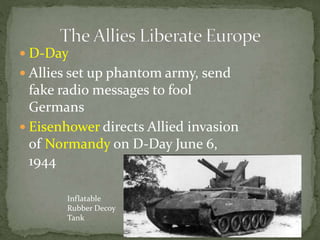
 D-Day
 Allies set up phantom army, send
fake radio messages to fool
Germans
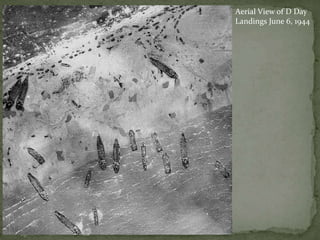
 Eisenhower directs Allied invasion
of Normandy on D-Day June 6,
1944
Inflatable
Rubber Decoy
Tank
Aerial View of D Day
Landings June 6, 1944
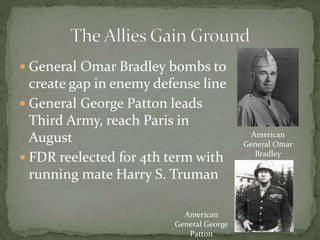
 General Omar Bradley bombs to
create gap in enemy defense line
 General George Patton leads
Third Army, reach Paris in
August
 FDR reelected for 4th term with
running mate Harry S. Truman
American
General Omar
Bradley
American
General George
Patton
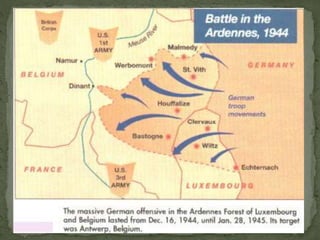
 December German tank divisions drive 60
miles into Allied area
 Battle of the Bulge –
 Germans pushed back
 have irreplaceable losses
 last German offensive
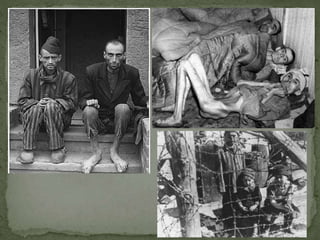
 Allies in Germany, Soviets in Poland liberate
concentration camps
 Find starving prisoners, corpses, evidence of
killing
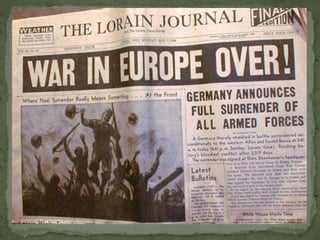
 April 1945, Soviet army storms Berlin; Hitler
commits suicide
 Eisenhower accepts unconditional surrender
of German Reich
 May 8, 1945, V-E Day: Victory in Europe Day
 FDR dies April 12; Vice President Harry S.
Truman becomes president
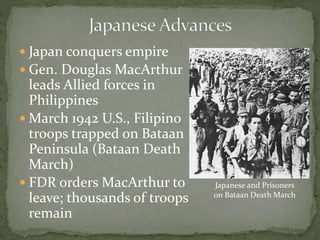
 Japan conquers empire
 Gen. Douglas MacArthur
leads Allied forces in
Philippines
 March 1942 U.S., Filipino
troops trapped on Bataan
Peninsula (Bataan Death
March)
 FDR orders MacArthur to
leave; thousands of troops
remain
Japanese and Prisoners
on Bataan Death March
 Battle of the Coral Sea
 May 1942, U.S., Australian soldiers stop
Japanese drive to Australia
 For first time since Pearl Harbor, Japanese
invasion turned back
 First naval battle fought completely by
aircraft carriers
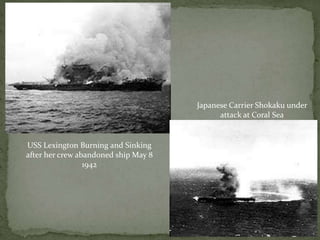
USS Lexington Burning and Sinking
after her crew abandoned ship May 8
1942
Japanese Carrier Shokaku under
attack at Coral Sea
 Admiral Chester Nimitz commands U.S.
naval forces in Pacific
 Allies break Japanese code, win Battle of
Midway, stop Japan again
 Battle of Midway is the turning point battle
of the Pacific
 Allies advance island by island toward Japan
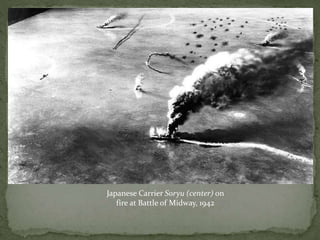
Japanese Carrier Soryu (center) on
fire at Battle of Midway, 1942
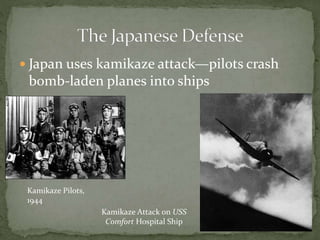
 Japan uses kamikaze attack—pilots crash
bomb-laden planes into ships
Kamikaze Pilots,
1944
Kamikaze Attack on USS
Comfort Hospital Ship
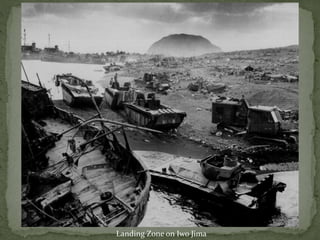
 Iwo Jima critical as base from which planes
can reach Japan
 6,000 marines die taking island; of 20,700
Japanese, 200 survive
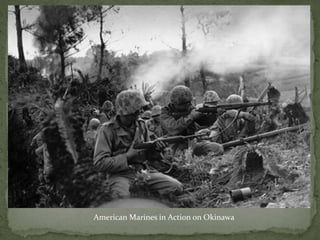
 The Battle for Okinawa
 April–June: 7,600 U.S. troops, 110,000
Japanese die
 Allies fear invasion of Japan may mean 1.5
million Allied casualties
Landing Zone on Iwo Jima
American Marines in Action on Okinawa
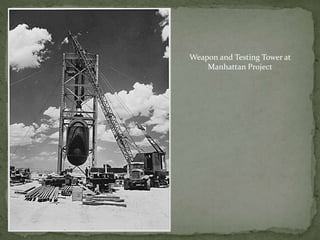
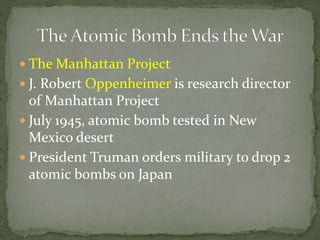
 The Manhattan Project
 J. Robert Oppenheimer is research director
of Manhattan Project
 July 1945, atomic bomb tested in New
Mexico desert
 President Truman orders military to drop 2
atomic bombs on Japan
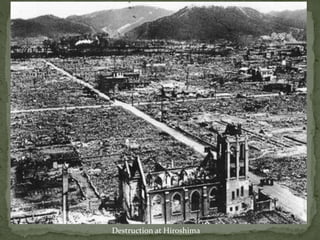
 Hiroshima and Nagasaki
 August 6, Hiroshima, major military center,
destroyed by bomb
 3 days later, bomb dropped on city of
Nagasaki
 September 2, 1945 Japan surrenders
Weapon and Testing Tower at
Manhattan Project
Destruction at Hiroshima
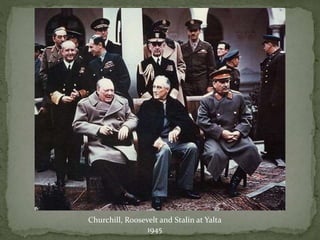
 February 1945, FDR, Churchill, Stalin meet in Yalta
 discuss post-war world
 Temporarily divide Germany into 4 parts
 Stalin promises free elections in Eastern Europe;
will fight Japan
 FDR gets support for conference to establish
United Nations
 Human Costs of the War
 WW II most destructive war in human history
Churchill, Roosevelt and Stalin at Yalta
1945
 During the Holocaust, the Nazis
systematically execute 6 million Jews and 5
million other “non-Aryans.”
 Europe has long history of anti-Semitism
 Germans believe Hitler’s claims, blame Jews
for problems
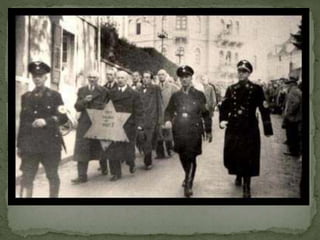
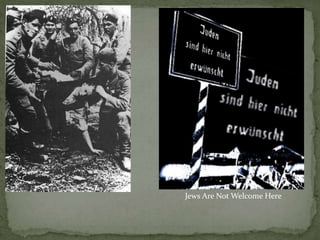
 Nazis take away citizenship, jobs, property;
require Star of David
Jews Are Not Welcome Here
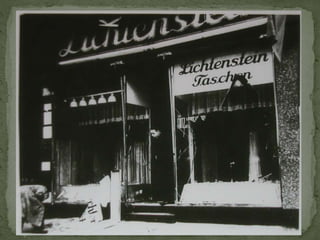
 Kristallnacht—Nazis attack Jewish homes,
businesses, synagogues
 About 100 Jews killed, hundreds injured,
30,000 arrested
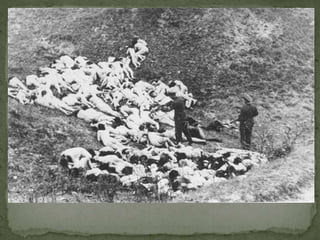
 Hitler’s Final Solution—slavery, genocide of
“inferior” groups
 Genocide—deliberate, systematic killing of an
entire population
 Target Jews, gypsies, freemasons, Jehovah’s
Witnesses, unfit Germans
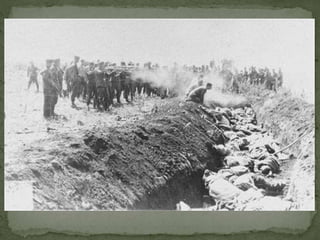
 Nazi death squads round up Jews, shoot them
 Jews forced into ghettos, segregated areas in
Polish cities
 Some form resistance movements; others
maintain Jewish culture
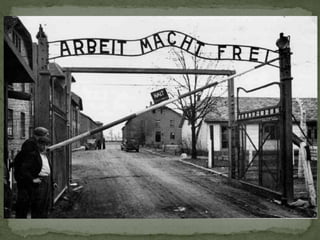
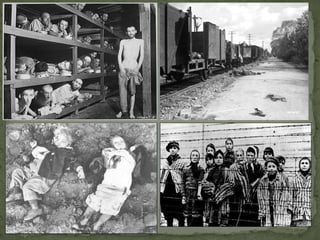
 Many Jews taken to concentration camps, or
labor camps
 Prisoners crammed into wooden barracks,
given little food
 Work dawn to dusk, 7 days per week
 Those too weak to work are killed
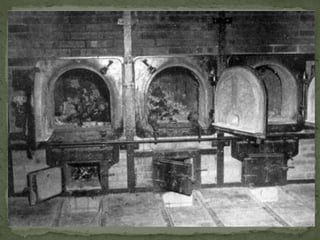
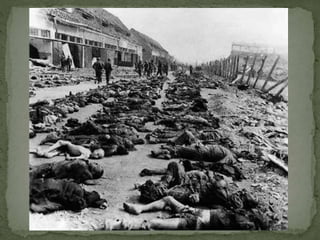
 Germans build death camps; gas chambers
used to kill thousands
 On arrival, SS doctors separate those who can
work
 Those who can’t work immediately killed in gas
chamber
 At first bodies buried in pits; later cremated to
cover up evidence
 Some are shot, hanged, poisoned, or die from
experiments
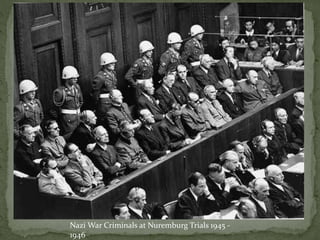
 The Nuremberg War Trials
 24 Nazi leaders tried, sentenced
 Charged with crimes against humanity,
against the peace, war crimes
 Established principle that people are
responsible for own actions in war
Nazi War Criminals at Nuremburg Trials 1945 -
1946
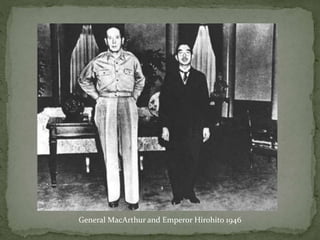
 The Occupation of Japan
 MacArthur commands U.S. occupation
forces in Japan
 Over 1,100 Japanese tried, sentenced
 MacArthur reshapes Japan’s economy,
government
General MacArthur and Emperor Hirohito 1946

WWII

  • 1.
     Treaty ofVersailles causes anger, resentment in Europe  World-wide Depression  Dictators rise; driven by nationalism, desire for more territory  The rise of totalitarianism in Europe and Asia lead to World War II.
  • 4.
     Totalitarian governmentexerts almost complete control over people  replaces private farms with collectives  creates second largest industrial power; famines kill millions  purges anyone who threatens his power; 8–13 million killed Josef Stalin Soviet Dictator 1879 – 1953
  • 5.
    Soviet Collective Camp Victimsof Stalin’s Purges
  • 7.
     Fascism stressesnationalism, needs of state above individual  Benito Mussolini plays on fears of economic collapse, communism  Supported by government officials, police, army  1922 appointed head of government, establishes totalitarian state Benito Mussolini Italian Fascist 1883 - 1945
  • 8.
     Adolf Hitlerleader of National Socialist German Workers’ Party (Nazi)  Mein Kampf—Hitler’s book, basic beliefs of Nazism, based on extreme nationalism  Unite German-speaking people, enforce racial “purification”  Nazis become strongest political party; Hitler named chancellor  Dismantles democratic Weimar Republic; establishes Third Reich
  • 9.
    Adolf Hitler German ReichsFührer 1889 - 1945 Mein Kampf (My Struggle) Published 1925
  • 10.
     Emperor Hirohito Militarists control Japanese government  1931, Nationalist military leaders seize Manchuria Hirohito 124th Emperor of Japan 1901 - 1989
  • 11.
     Japan invadesManchuria (China)  Mussolini invades Ethiopia  German Aggression:  Rhineland  Austria  Czechoslovakia  Poland
  • 12.
    Japanese Soldiers Enter Mukden,Manchuria Italy Invades Ethiopia 1935
  • 13.
    Hitler’s Troops Enterthe Rhineland 1935
  • 14.
    DATE  1922  7/1929 4/1930  6/1930 EVENT  Mussolini became dictator of Italy  U.S. approved Kellogg-Briand Pact  London Naval Treaty limited tonnage  Hawley-Smoot Tariff created trade barriers
  • 15.
     9/1931- 10/1931  Japanmarched into Manchuria to take coal deposits; U.S. does nothing  League of Nations asked the world to boycott Japanese goods and stop exporting to Japan, U.S. did not boycott
  • 16.
     1/1932-7/1932 U.S. Stimson Doctrine refused to recognize Japanese land gains in Manchuria  US refused to cancel war debts to Eur. Powers.  Germany did not pay war debts  Allies did not pay debts to US
  • 18.
     2/1933-Fall 1933  Japanwalked out of the League of Nations; no reprisals  Nazis came to power and set up a fascist government  Hitler became Chancellor of Germany
  • 19.
     Hitler pulledGermany out of League of Nations and began building up German army  US formally recognized USSR  US issues good neighbor policy stating that no country had the right to intervene in the affairs of other nations.
  • 20.
     4/1934 -Fall 1934  Mussolini sent Italian troops to attack Ethiopia  Japan gave notice it would terminate the Wash. Naval Conference agreement.  President Paul von Hindenburg of Germany dies; Hitler became Fuhrer
  • 21.
     1935 Hitler announced that Germany would rearm despite Treaty of Versailles  Announced existence of German air force (Luftwaffe)  Hitler introduced compulsory military service for German men.
  • 22.
     8/1935 -12/1935  2/1936  US announced First Neutrality Act and forbade sales to belligerents  US announced Second Neutrality Act and said it would make no loans to belligerents
  • 23.
     3/1936  7/1936 Hitler sent troops into the Rhineland in violation of Treaty of Versailles; world did nothing  Spanish Civil War began; fascists overthrew existing government with help of Germany and Italy.
  • 24.
     General FranciscoFranco rebels against Spanish republic  Hitler, Mussolini back Franco; Stalin aids opposition  Western democracies remain neutral  War leads to Rome-Berlin Axis - alliance between Italy and Germany  Franco wins war, becomes fascist dictator Francisco Franco Spanish Dictator 1892 - 1975
  • 25.
     10/1936  5/1937 Germany and Italy formed a military alliance: Rome-Berlin Axis  US announced Third Neutrality Act and claimed it would trade on a “cash and carry” basis  Hitler repudiated all responsibility for WWI  Japan attacked China
  • 26.
     10/1937  12/1937 1938  FDR’s “Quarantine the Aggressor Speech” (econ. Isolation); met with disinterest  Italy withdraws from League of Nations  Germany annexed Austria
  • 27.
     12/1938 Fr., GB, It, and Germ. signed the Munich Pact (Appeasement) giving Hitler the Sudetenland and Hitler promised to leave the rest of Czechoslovakia alone.  Jewish persecution and pogroms are put in place throughout Germany
  • 28.
     3 millionGerman-speakers in Sudetenland  Hitler claims Czechs abuse Sudeten Germans, masses troops on border  Prime Ministers of Brit. and Fr. meet with Hitler  Sign Munich Pact, hand Sudetenland over to Germany  Appeasement—giving up principles to pacify an aggressor
  • 29.
    British Prime Minister NevilleChamberlain and German Führer Adolf Hitler September 1939
  • 30.
     3/1939  8/1939 Germany invaded and took the rest of Czechoslovakia  Hitler-Stalin Nonaggression Pact signed; would not attack each other; secretly agreed to divide Poland between them
  • 31.
     9/1939  9/3/39 Hitler invaded Poland (Blitzkrieg); Poland surrendered after a month and was split between Germany and USSR.  England & France declared war on Germany for violation of Munich Pact.  WWII begins
  • 32.
  • 34.
  • 35.
     British, Frenchtrapped on beach at Dunkirk; ferried to safety in UK miraculous rescue  1940, Italy invades France from south; Germans approach Paris  France falls; Germans occupy northern France  Nazi puppet government (Vichy Gov’t) set up in southern France  General Charles de Gaulle sets up government-in-exile in England French Leader Charles de Gaulle 1890 - 1970
  • 36.
  • 37.
  • 38.
     Summer 1940,Germany prepares fleet to invade Britain  Battle of Britain—German planes (Luftwaffe) bomb British targets  RAF – Royal Air Force  Britain uses radar to track, shoot down German planes  Hitler calls off invasion of Britain. Churchill became Prime Minister of England.
  • 40.
    DATE  9/1940 EVENT  Destroyersfor Bases Deal: US sends ships to Brit. And rec’d 99 year leases to naval and air bases in the Caribbean.  Japan continues south and invades French Indo-China (Vietnam)  US placed an embargo on exports to Japan  Japan, Germany, and Italy formed a military alliance called the Axis Powers.
  • 41.
    DATE  11/1940  1/1941 6/1941 EVENT  FDR elected to third term  FDR delivers his “Four Freedoms” Speech (speech, religion, want, fear)  Congress passed Lend-Lease Act  Germany invaded Soviet Union (USSR) – major mistake for Hitler, must now fight on two fronts, Germany underestimated the Soviet’s resolve.
  • 43.
     The US provides economic and military aid to help the Allies achieve victory.  Moving Cautiously Away from Neutrality  Congress passes “cash-and-carry” provision  Germany, Japan, Italy alliance aimed at keeping U.S. out of war by forcing fight on two oceans
  • 45.
     Nazi victoriesin 1940 lead to increased U.S. defense spending  First peacetime draft enacted—Selective Training and Service Act
  • 46.
     FDR tellsnation if Britain falls, Axis powers free to conquer world  U.S. must become “arsenal of democracy”  Britain has no more cash to buy U.S. arms  1941 Lend-Lease Act—U.S. to lend or lease supplies for defense  Roosevelt sends lend-lease supplies to Soviet Union
  • 48.
    American-made .38 revolvers shippedto England from the United States under the Lend- Lease Program are unpacked at an English ordnance depot
  • 49.
     Hitler deploysU-boats to attack supply convoys  Wolf packs—groups of up to 40 submarines patrol North Atlantic  sink supply ships  FDR allows navy to attack German U-boats in self-defense
  • 51.
     FDR, Churchillissue Atlantic Charter—joint declaration of war aims  Charter is basis of “A Declaration of the United Nations” or Allies  Allies—nations that fight Axis powers; 26 nations sign Declaration
  • 53.
     Hideki Tojo- prime minister  Japan seizes French bases in Indochina; U.S. cuts off trade  Japan needs oil from U.S. or must take Dutch East Indies oil fields  1941 U.S. breaks Japanese codes; learns Japan planning to attack U.S. Hideki Tojo Japanese Prime Minister 1884 - 1948
  • 54.
     December 7,1941 Japanese attack Pearl Harbor  2,403 Americans killed; 1,178 wounded  Over 300 aircraft, 21 ships destroyed or damaged  Congress approves FDR’s request for declaration of war against Japan  Germany, Italy declare war on U.S.  U.S. unprepared to fight in both Atlantic, Pacific Oceans
  • 58.
     After PearlHarbor, 5 million men volunteer for military service  10 million more drafted to meet needs of two-front war  Women’s Auxiliary Army Corps (WAAC)—women in noncombat positions  Thousands enlist; “auxiliary” dropped, get full U. S. army benefits
  • 59.
     Minority groupsare denied basic citizenship rights  Question whether they should fight for democracy in other countries
  • 60.
     300,000 MexicanAmericans join armed forces  1 million African Americans serve; live, work in segregated units  13,000 Chinese Americans and 33,000 Japanese Americans serve  25,000 Native Americans enlist
  • 61.
    Navajo US Soldier BlackAmerican Soldiers in Action Japanese American Soldiers
  • 62.
     Factories convertfrom civilian to war production  Shipyards, defense plants expand, new ones built  Produce ships, arms rapidly  use prefabricated parts  people work at record speeds
  • 64.
     Nearly 18million workers in war industries; 6 million are women  Over 2 million minorities hired; face strong discrimination at first  FDR executive order forbids discrimination
  • 65.
     Manhattan Projectdevelops atomic bomb  Office of Scientific Research and Development—technology, medicine A gun-type nuclear bomb
  • 66.
     Higher taxes,purchase of war bonds, lower demand for scarce goods  organizes collection of recyclable materials  Office of Price Administration (OPA) freezes prices, fights inflation  Mandatory rationing  War Production Board (WPB) says which companies convert production  allocates raw materials
  • 68.
     Allied forces,led by the United States and Great Britain, battle Axis powers for control of Europe and North Africa.  Churchill convinces FDR to strike first against Hitler
  • 69.
     Hitler orderssubmarine attacks against supply ships to Britain  Wolf packs destroy hundreds of ships in 1942  Allies organize convoys of cargo ships with escort:  destroyers with sonar; planes with radar
  • 70.
    US Convoy Shipsin the Atlantic
  • 71.
     The Battleof Stalingrad  Soviets defeat Germans in bitter winter campaign  Over 230,000 Germans, 1,100,000 Soviets die  Turning point battle in Europe: Soviet army begins to move towards Germany
  • 72.
  • 73.
     General DwightD. Eisenhower commands invasion of North Africa  Afrika Korps, led by General Erwin Rommel, surrenders  Battle of El Alamein is turning point battle in North Africa Field Marshal Erwin Rommel 1891 - 1944
  • 75.
     Allies decidewill accept only unconditional surrender from Axis  Summer 1943, capture Sicily; Mussolini forced to resign
  • 76.
    Benito Mussoline (center) Executedand Beaten by Italians in Milan April 1945
  • 77.
     African Americans—Tuskegee Airmen, Buffaloes—highly decorated  Mexican-American soldiers win many awards  Japanese-American unit most decorated unit in U.S. history
  • 78.
    Japanese American Soldiersof 442nd Regimental Combat Team – Most Decorated Unit in American Army – 21 Congressional Medal of Honor Winners in World War II
  • 79.
    African American Pilotsof the Tuskegee Airman
  • 80.
     D-Day  Alliesset up phantom army, send fake radio messages to fool Germans  Eisenhower directs Allied invasion of Normandy on D-Day June 6, 1944 Inflatable Rubber Decoy Tank
  • 81.
    Aerial View ofD Day Landings June 6, 1944
  • 82.
     General OmarBradley bombs to create gap in enemy defense line  General George Patton leads Third Army, reach Paris in August  FDR reelected for 4th term with running mate Harry S. Truman American General Omar Bradley American General George Patton
  • 83.
     December Germantank divisions drive 60 miles into Allied area  Battle of the Bulge –  Germans pushed back  have irreplaceable losses  last German offensive
  • 85.
     Allies inGermany, Soviets in Poland liberate concentration camps  Find starving prisoners, corpses, evidence of killing
  • 87.
     April 1945,Soviet army storms Berlin; Hitler commits suicide  Eisenhower accepts unconditional surrender of German Reich  May 8, 1945, V-E Day: Victory in Europe Day  FDR dies April 12; Vice President Harry S. Truman becomes president
  • 89.
     Japan conquersempire  Gen. Douglas MacArthur leads Allied forces in Philippines  March 1942 U.S., Filipino troops trapped on Bataan Peninsula (Bataan Death March)  FDR orders MacArthur to leave; thousands of troops remain Japanese and Prisoners on Bataan Death March
  • 90.
     Battle ofthe Coral Sea  May 1942, U.S., Australian soldiers stop Japanese drive to Australia  For first time since Pearl Harbor, Japanese invasion turned back  First naval battle fought completely by aircraft carriers
  • 91.
    USS Lexington Burningand Sinking after her crew abandoned ship May 8 1942 Japanese Carrier Shokaku under attack at Coral Sea
  • 92.
     Admiral ChesterNimitz commands U.S. naval forces in Pacific  Allies break Japanese code, win Battle of Midway, stop Japan again  Battle of Midway is the turning point battle of the Pacific  Allies advance island by island toward Japan
  • 93.
    Japanese Carrier Soryu(center) on fire at Battle of Midway, 1942
  • 94.
     Japan useskamikaze attack—pilots crash bomb-laden planes into ships Kamikaze Pilots, 1944 Kamikaze Attack on USS Comfort Hospital Ship
  • 95.
     Iwo Jimacritical as base from which planes can reach Japan  6,000 marines die taking island; of 20,700 Japanese, 200 survive  The Battle for Okinawa  April–June: 7,600 U.S. troops, 110,000 Japanese die  Allies fear invasion of Japan may mean 1.5 million Allied casualties
  • 96.
  • 97.
    American Marines inAction on Okinawa
  • 98.
     The ManhattanProject  J. Robert Oppenheimer is research director of Manhattan Project  July 1945, atomic bomb tested in New Mexico desert  President Truman orders military to drop 2 atomic bombs on Japan
  • 99.
     Hiroshima andNagasaki  August 6, Hiroshima, major military center, destroyed by bomb  3 days later, bomb dropped on city of Nagasaki  September 2, 1945 Japan surrenders
  • 100.
    Weapon and TestingTower at Manhattan Project
  • 101.
  • 102.
     February 1945,FDR, Churchill, Stalin meet in Yalta  discuss post-war world  Temporarily divide Germany into 4 parts  Stalin promises free elections in Eastern Europe; will fight Japan  FDR gets support for conference to establish United Nations  Human Costs of the War  WW II most destructive war in human history
  • 103.
    Churchill, Roosevelt andStalin at Yalta 1945
  • 104.
     During theHolocaust, the Nazis systematically execute 6 million Jews and 5 million other “non-Aryans.”  Europe has long history of anti-Semitism  Germans believe Hitler’s claims, blame Jews for problems  Nazis take away citizenship, jobs, property; require Star of David
  • 106.
    Jews Are NotWelcome Here
  • 107.
     Kristallnacht—Nazis attackJewish homes, businesses, synagogues  About 100 Jews killed, hundreds injured, 30,000 arrested
  • 109.
     Hitler’s FinalSolution—slavery, genocide of “inferior” groups  Genocide—deliberate, systematic killing of an entire population  Target Jews, gypsies, freemasons, Jehovah’s Witnesses, unfit Germans  Nazi death squads round up Jews, shoot them  Jews forced into ghettos, segregated areas in Polish cities  Some form resistance movements; others maintain Jewish culture
  • 111.
     Many Jewstaken to concentration camps, or labor camps  Prisoners crammed into wooden barracks, given little food  Work dawn to dusk, 7 days per week  Those too weak to work are killed
  • 114.
     Germans builddeath camps; gas chambers used to kill thousands  On arrival, SS doctors separate those who can work  Those who can’t work immediately killed in gas chamber  At first bodies buried in pits; later cremated to cover up evidence  Some are shot, hanged, poisoned, or die from experiments
  • 118.
     The NurembergWar Trials  24 Nazi leaders tried, sentenced  Charged with crimes against humanity, against the peace, war crimes  Established principle that people are responsible for own actions in war
  • 119.
    Nazi War Criminalsat Nuremburg Trials 1945 - 1946
  • 120.
     The Occupationof Japan  MacArthur commands U.S. occupation forces in Japan  Over 1,100 Japanese tried, sentenced  MacArthur reshapes Japan’s economy, government
  • 121.
    General MacArthur andEmperor Hirohito 1946