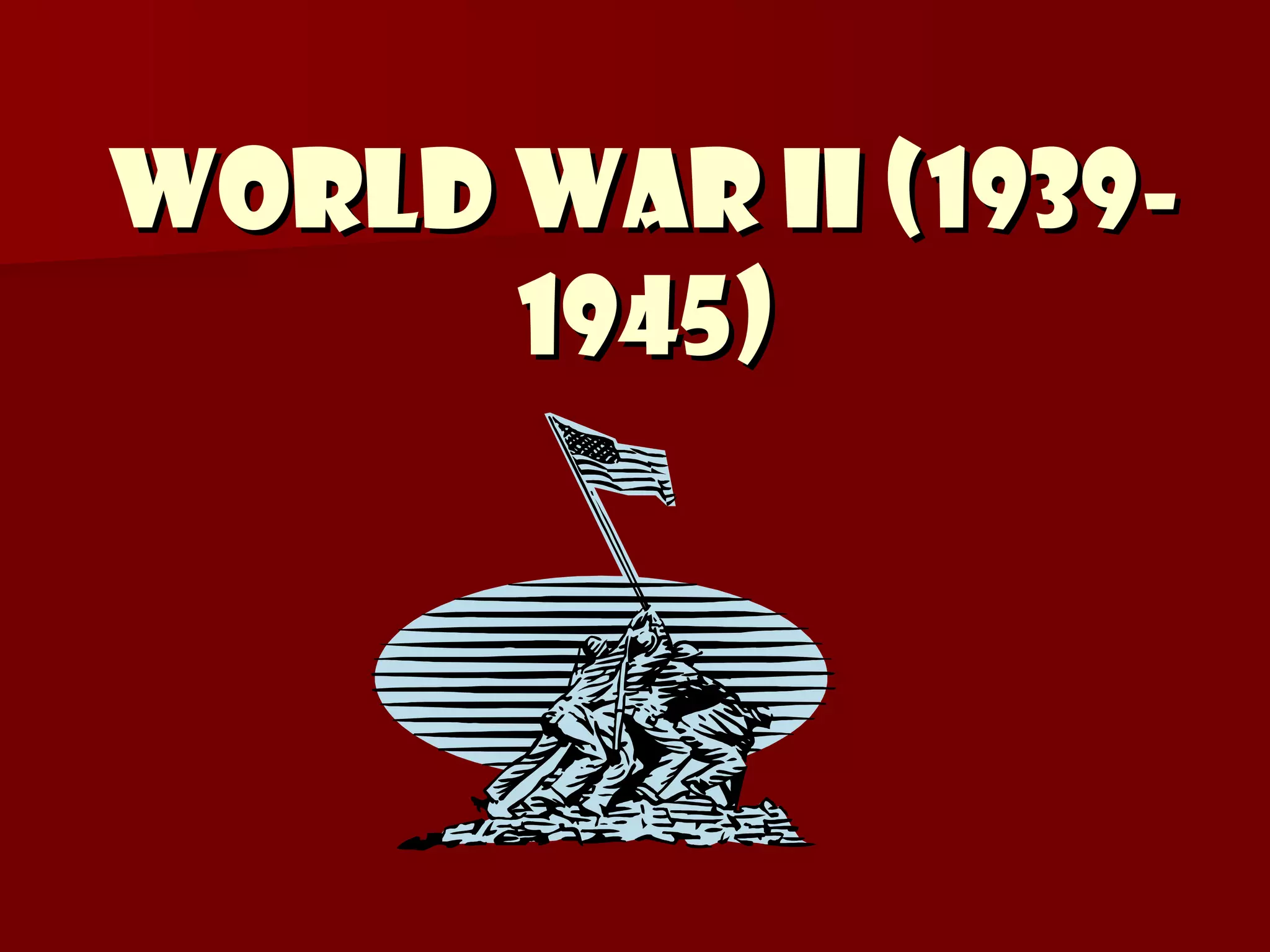
World War II (19391945)
What’s Essential?

 Causes of the War

(underlying and direct)
 Reasons for American
Neutrality (various
acts/events)
 Reason for American
entrance: Pearl Harbor
 Wartime goals of the Allies
 Major battles: D-Day, Iwo
Jima, Okinawa
Essential to Know (con’t)
 American Homefront

(women, blacks,
Japanese internment)
 Yalta and Potsdam
Conferences and their
significance
 Decision to drop atomic
bomb and its lasting
effects
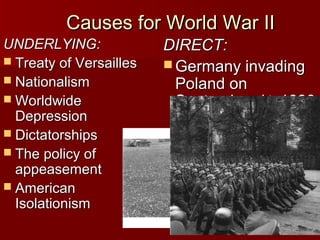
Causes for World War II
UNDERLYING:
 Treaty of Versailles
 Nationalism
 Worldwide
Depression
 Dictatorships
 The policy of
appeasement
 American
Isolationism

DIRECT:
 Germany invading
Poland on
September 1st, 1939
The Axis
Powers!!!
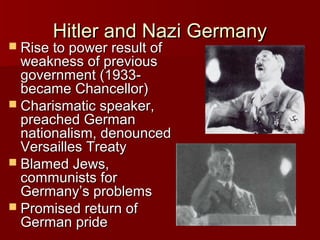
Hitler and Nazi Germany

 Rise to power result of

weakness of previous
government (1933became Chancellor)
 Charismatic speaker,
preached German
nationalism, denounced
Versailles Treaty
 Blamed Jews,
communists for
Germany’s problems
 Promised return of
German pride
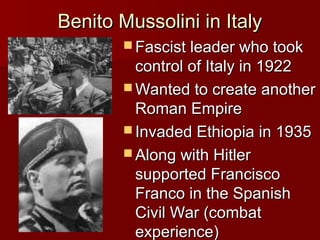
Benito Mussolini in Italy
 Fascist leader who took

control of Italy in 1922
 Wanted to create another
Roman Empire
 Invaded Ethiopia in 1935
 Along with Hitler
supported Francisco
Franco in the Spanish
Civil War (combat
experience)
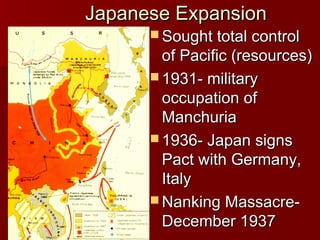
Japanese Expansion
 Sought total control

of Pacific (resources)
 1931- military
occupation of
Manchuria
 1936- Japan signs
Pact with Germany,
Italy
 Nanking MassacreDecember 1937
American Neutrality
 Domestic: U.S. in midst of

President Roosevelt

Great Depression, public
intent on remaining
neutral
 1935: First Neutrality Act
(no sale of arms to
belligerent nations)
 1937: Arm sales only on
“cash and carry” basis
 FDR warns of impending
problems
Isolationism in the United
States
 Economic,

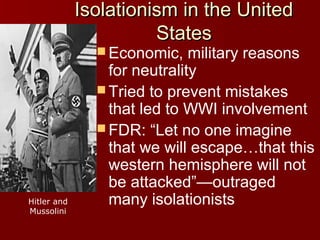
Hitler and
Mussolini

military reasons
for neutrality
 Tried to prevent mistakes
that led to WWI involvement
 FDR: “Let no one imagine
that we will escape…that this
western hemisphere will not
be attacked”—outraged
many isolationists
 1938-

Appeasement

Hitler invades
Austria, Sudetenland on
Czech border
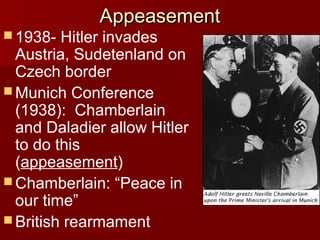
 Munich Conference
(1938): Chamberlain
and Daladier allow Hitler
to do this
(appeasement)
 Chamberlain: “Peace in
our time”
 British rearmament
War Erupts!!!

 March 1939- Hitler

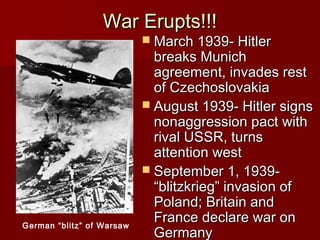
German “blitz” of Warsaw

breaks Munich
agreement, invades rest
of Czechoslovakia
 August 1939- Hitler signs
nonaggression pact with
rival USSR, turns
attention west
 September 1, 1939“blitzkrieg” invasion of
Poland; Britain and
France declare war on
Germany
World War II (19391941)
Hitler’s Wild Ride in Europe
While the U.S. Watches
 April

Hitler Moves in Europe

1940- Hitler seizes
Norway, Denmark
 May- Netherlands,
Belgium, Luxembourg
 By June, Hitler controls
France, turns attention to
Britain
 Fall 1940- Battle of
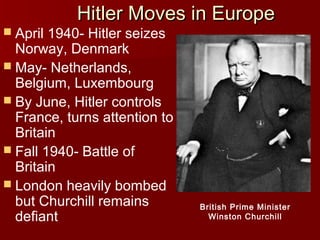
Britain
 London heavily bombed
but Churchill remains
defiant

British Prime Minister
Winston Churchill
The United States and Britain
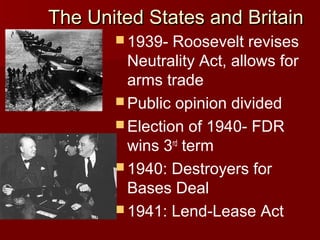
 1939-

Roosevelt revises
Neutrality Act, allows for
arms trade
 Public opinion divided
 Election of 1940- FDR
wins 3rd term
 1940: Destroyers for
Bases Deal
 1941: Lend-Lease Act
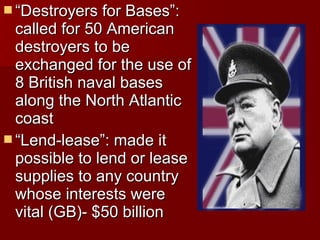
 “Destroyers for Bases”:

called for 50 American
destroyers to be
exchanged for the use of
8 British naval bases
along the North Atlantic
coast
 “Lend-lease”: made it
possible to lend or lease
supplies to any country
whose interests were
vital (GB)- $50 billion
The U.S. Enters the War

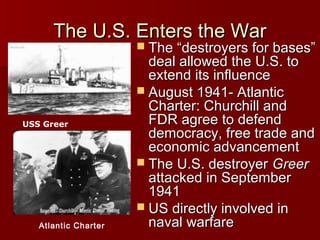
 The “destroyers for bases”

USS Greer

Atlantic Charter

deal allowed the U.S. to
extend its influence
 August 1941- Atlantic
Charter: Churchill and
FDR agree to defend
democracy, free trade and
economic advancement
 The U.S. destroyer Greer
attacked in September
1941
 US directly involved in
naval warfare
United States and Japan
 Japan wanted to extend
influence in Far East
 July 1940: U.S. embargo
of raw materials to Japan
 1941: Lend-Lease aid to
China
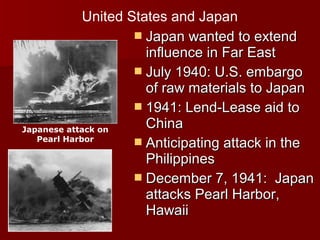
Japanese attack on
Pearl Harbor
 Anticipating attack in the
Philippines
 December 7, 1941: Japan
attacks Pearl Harbor,
Hawaii
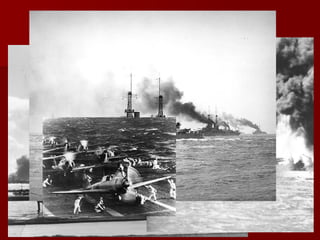
Images of Pearl Harbor
America Enters War
 Pearl Harbor attack

devastates nation
 FDR: “A date which will
live in infamy”
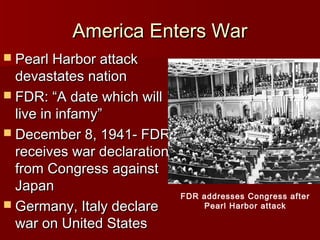
 December 8, 1941- FDR
receives war declaration
from Congress against
Japan
 Germany, Italy declare
war on United States

FDR addresses Congress after
Pearl Harbor attack
Japanese Internment
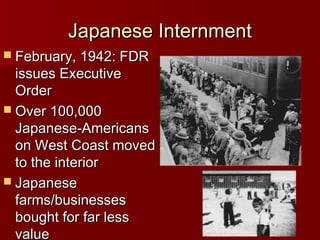
 February, 1942: FDR

issues Executive
Order
 Over 100,000
Japanese-Americans
on West Coast moved
to the interior
 Japanese
farms/businesses
bought for far less
value
Allied Military Strategy
(1941-1945)
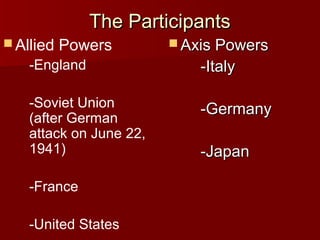
The Participants
 Allied

Powers

 Axis Powers

-England

-Italy

-Soviet Union
(after German
attack on June 22,
1941)

-Germany

-France
-United States

-Japan
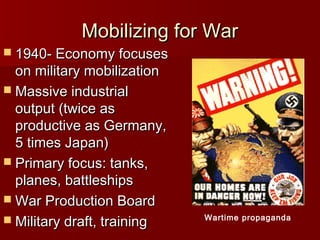
Mobilizing for War

 1940- Economy focuses

on military mobilization
 Massive industrial
output (twice as
productive as Germany,
5 times Japan)
 Primary focus: tanks,
planes, battleships
 War Production Board
 Military draft, training

Wartime propaganda
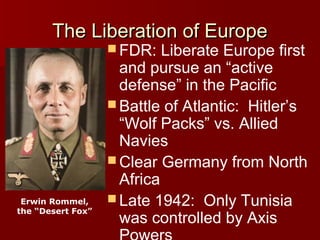
The Liberation of Europe
 FDR:

Erwin Rommel,
the “Desert Fox”

Liberate Europe first
and pursue an “active
defense” in the Pacific
 Battle of Atlantic: Hitler’s
“Wolf Packs” vs. Allied
Navies
 Clear Germany from North
Africa
 Late 1942: Only Tunisia
was controlled by Axis
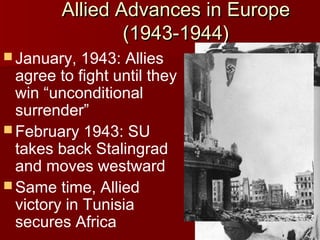
Allied Advances in Europe
(1943-1944)
 January,

1943: Allies
agree to fight until they
win “unconditional
surrender”
 February 1943: SU
takes back Stalingrad
and moves westward
 Same time, Allied
victory in Tunisia
secures Africa
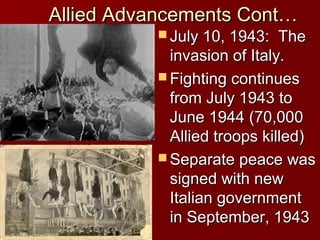
Allied Advancements Cont…
 July 10, 1943:

The
invasion of Italy.
 Fighting continues
from July 1943 to
June 1944 (70,000
Allied troops killed)
 Separate peace was
signed with new
Italian government
in September, 1943
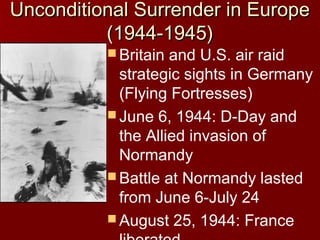
Unconditional Surrender in Europe
(1944-1945)
 Britain

and U.S. air raid
strategic sights in Germany
(Flying Fortresses)
 June 6, 1944: D-Day and
the Allied invasion of
Normandy
 Battle at Normandy lasted
from June 6-July 24
 August 25, 1944: France
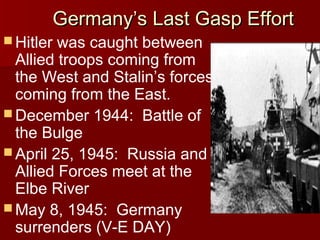
Germany’s Last Gasp Effort
 Hitler

was caught between
Allied troops coming from
the West and Stalin’s forces
coming from the East.
 December 1944: Battle of
the Bulge
 April 25, 1945: Russia and
Allied Forces meet at the
Elbe River
 May 8, 1945: Germany
surrenders (V-E DAY)
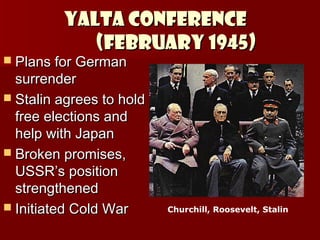
YALTA CONFERENCE
(February 1945)

 Plans for German

surrender
 Stalin agrees to hold
free elections and
help with Japan
 Broken promises,
USSR’s position
strengthened
 Initiated Cold War

Churchill, Roosevelt, Stalin
 By

Allied Military Strategy in the
Pacific (1941-1945)

1942, Japan had controlled almost the
entire area of the Pacific
 Allies were able to hold on to Hawaii and
Samoa
 “Active defense” campaign:
-Battle of the Coral Sea (May,1942)
-Battle of Midway (June, 1942)
-Battle of Guadalcanal (Aug. 1942-Feb.
1943)
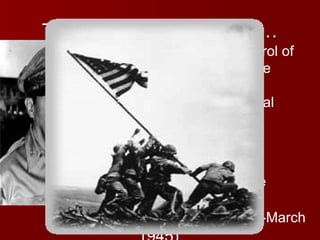
The Pacific Theatre Cont…
 The

Allies took control of
several islands in the
Pacific under the
leadership of General
Douglas MacArthur
-Iwo Jima (1945)
-Okinawa (1945)
 The recapture of the
Philippines was the
highlight (Oct. 1944-March
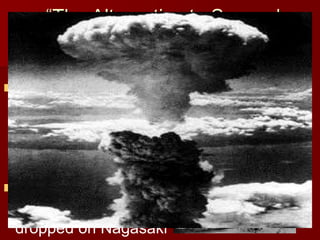
“The Alternative to Surrender
is Prompt and Utter
Destruction”
 August

6, 1945:
Atomic bomb is
dropped on
Hiroshima (at least
75,000 killed)
 August 9, 1945:
Atomic bomb is
dropped on Nagasaki
World War II- The Homefront





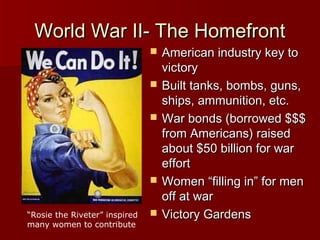
“Rosie the Riveter” inspired
many women to contribute



American industry key to
victory
Built tanks, bombs, guns,
ships, ammunition, etc.
War bonds (borrowed $$$
from Americans) raised
about $50 billion for war
effort
Women “filling in” for men
off at war
Victory Gardens
Blacks in WWII

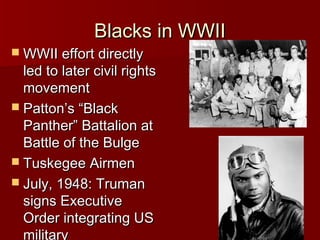
 WWII effort directly

led to later civil rights
movement
 Patton’s “Black
Panther” Battalion at
Battle of the Bulge
 Tuskegee Airmen
 July, 1948: Truman
signs Executive
Order integrating US
military
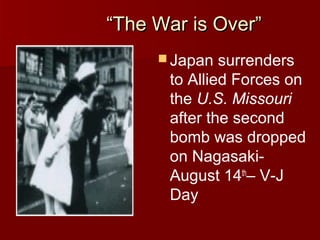
“The War is Over”
 Japan

surrenders
to Allied Forces on
the U.S. Missouri
after the second
bomb was dropped
on NagasakiAugust 14th– V-J
Day
THE COSTS OF THE WAR
 U.S. lost over 300,000
 World suffered at least 60 million
 Over 25 million Russians alone died
 Over 10 million in death camps
 New fears arise after the war– fight to

contain Communism– THE COLD
WAR ERA!!

World war ii powerpoint

  • 1.
    World War II(19391945)
  • 2.
    What’s Essential?  Causesof the War (underlying and direct)  Reasons for American Neutrality (various acts/events)  Reason for American entrance: Pearl Harbor  Wartime goals of the Allies  Major battles: D-Day, Iwo Jima, Okinawa
  • 3.
    Essential to Know(con’t)  American Homefront (women, blacks, Japanese internment)  Yalta and Potsdam Conferences and their significance  Decision to drop atomic bomb and its lasting effects
  • 4.
    Causes for WorldWar II UNDERLYING:  Treaty of Versailles  Nationalism  Worldwide Depression  Dictatorships  The policy of appeasement  American Isolationism DIRECT:  Germany invading Poland on September 1st, 1939
  • 5.
  • 6.
    Hitler and NaziGermany  Rise to power result of weakness of previous government (1933became Chancellor)  Charismatic speaker, preached German nationalism, denounced Versailles Treaty  Blamed Jews, communists for Germany’s problems  Promised return of German pride
  • 7.
    Benito Mussolini inItaly  Fascist leader who took control of Italy in 1922  Wanted to create another Roman Empire  Invaded Ethiopia in 1935  Along with Hitler supported Francisco Franco in the Spanish Civil War (combat experience)
  • 8.
    Japanese Expansion  Soughttotal control of Pacific (resources)  1931- military occupation of Manchuria  1936- Japan signs Pact with Germany, Italy  Nanking MassacreDecember 1937
  • 9.
    American Neutrality  Domestic:U.S. in midst of President Roosevelt Great Depression, public intent on remaining neutral  1935: First Neutrality Act (no sale of arms to belligerent nations)  1937: Arm sales only on “cash and carry” basis  FDR warns of impending problems
  • 10.
    Isolationism in theUnited States  Economic, Hitler and Mussolini military reasons for neutrality  Tried to prevent mistakes that led to WWI involvement  FDR: “Let no one imagine that we will escape…that this western hemisphere will not be attacked”—outraged many isolationists
  • 11.
     1938- Appeasement Hitler invades Austria,Sudetenland on Czech border  Munich Conference (1938): Chamberlain and Daladier allow Hitler to do this (appeasement)  Chamberlain: “Peace in our time”  British rearmament
  • 12.
    War Erupts!!!  March1939- Hitler German “blitz” of Warsaw breaks Munich agreement, invades rest of Czechoslovakia  August 1939- Hitler signs nonaggression pact with rival USSR, turns attention west  September 1, 1939“blitzkrieg” invasion of Poland; Britain and France declare war on Germany
  • 13.
    World War II(19391941) Hitler’s Wild Ride in Europe While the U.S. Watches
  • 14.
     April Hitler Movesin Europe 1940- Hitler seizes Norway, Denmark  May- Netherlands, Belgium, Luxembourg  By June, Hitler controls France, turns attention to Britain  Fall 1940- Battle of Britain  London heavily bombed but Churchill remains defiant British Prime Minister Winston Churchill
  • 15.
    The United Statesand Britain  1939- Roosevelt revises Neutrality Act, allows for arms trade  Public opinion divided  Election of 1940- FDR wins 3rd term  1940: Destroyers for Bases Deal  1941: Lend-Lease Act
  • 16.
     “Destroyers forBases”: called for 50 American destroyers to be exchanged for the use of 8 British naval bases along the North Atlantic coast  “Lend-lease”: made it possible to lend or lease supplies to any country whose interests were vital (GB)- $50 billion
  • 17.
    The U.S. Entersthe War  The “destroyers for bases” USS Greer Atlantic Charter deal allowed the U.S. to extend its influence  August 1941- Atlantic Charter: Churchill and FDR agree to defend democracy, free trade and economic advancement  The U.S. destroyer Greer attacked in September 1941  US directly involved in naval warfare
  • 18.
    United States andJapan  Japan wanted to extend influence in Far East  July 1940: U.S. embargo of raw materials to Japan  1941: Lend-Lease aid to China Japanese attack on Pearl Harbor  Anticipating attack in the Philippines  December 7, 1941: Japan attacks Pearl Harbor, Hawaii
  • 19.
  • 20.
    America Enters War Pearl Harbor attack devastates nation  FDR: “A date which will live in infamy”  December 8, 1941- FDR receives war declaration from Congress against Japan  Germany, Italy declare war on United States FDR addresses Congress after Pearl Harbor attack
  • 21.
    Japanese Internment  February,1942: FDR issues Executive Order  Over 100,000 Japanese-Americans on West Coast moved to the interior  Japanese farms/businesses bought for far less value
  • 22.
  • 23.
    The Participants  Allied Powers Axis Powers -England -Italy -Soviet Union (after German attack on June 22, 1941) -Germany -France -United States -Japan
  • 24.
    Mobilizing for War 1940- Economy focuses on military mobilization  Massive industrial output (twice as productive as Germany, 5 times Japan)  Primary focus: tanks, planes, battleships  War Production Board  Military draft, training Wartime propaganda
  • 25.
    The Liberation ofEurope  FDR: Erwin Rommel, the “Desert Fox” Liberate Europe first and pursue an “active defense” in the Pacific  Battle of Atlantic: Hitler’s “Wolf Packs” vs. Allied Navies  Clear Germany from North Africa  Late 1942: Only Tunisia was controlled by Axis
  • 26.
    Allied Advances inEurope (1943-1944)  January, 1943: Allies agree to fight until they win “unconditional surrender”  February 1943: SU takes back Stalingrad and moves westward  Same time, Allied victory in Tunisia secures Africa
  • 27.
    Allied Advancements Cont… July 10, 1943: The invasion of Italy.  Fighting continues from July 1943 to June 1944 (70,000 Allied troops killed)  Separate peace was signed with new Italian government in September, 1943
  • 28.
    Unconditional Surrender inEurope (1944-1945)  Britain and U.S. air raid strategic sights in Germany (Flying Fortresses)  June 6, 1944: D-Day and the Allied invasion of Normandy  Battle at Normandy lasted from June 6-July 24  August 25, 1944: France
  • 29.
    Germany’s Last GaspEffort  Hitler was caught between Allied troops coming from the West and Stalin’s forces coming from the East.  December 1944: Battle of the Bulge  April 25, 1945: Russia and Allied Forces meet at the Elbe River  May 8, 1945: Germany surrenders (V-E DAY)
  • 30.
    YALTA CONFERENCE (February 1945) Plans for German surrender  Stalin agrees to hold free elections and help with Japan  Broken promises, USSR’s position strengthened  Initiated Cold War Churchill, Roosevelt, Stalin
  • 31.
     By Allied MilitaryStrategy in the Pacific (1941-1945) 1942, Japan had controlled almost the entire area of the Pacific  Allies were able to hold on to Hawaii and Samoa  “Active defense” campaign: -Battle of the Coral Sea (May,1942) -Battle of Midway (June, 1942) -Battle of Guadalcanal (Aug. 1942-Feb. 1943)
  • 32.
    The Pacific TheatreCont…  The Allies took control of several islands in the Pacific under the leadership of General Douglas MacArthur -Iwo Jima (1945) -Okinawa (1945)  The recapture of the Philippines was the highlight (Oct. 1944-March
  • 33.
    “The Alternative toSurrender is Prompt and Utter Destruction”  August 6, 1945: Atomic bomb is dropped on Hiroshima (at least 75,000 killed)  August 9, 1945: Atomic bomb is dropped on Nagasaki
  • 34.
    World War II-The Homefront     “Rosie the Riveter” inspired many women to contribute  American industry key to victory Built tanks, bombs, guns, ships, ammunition, etc. War bonds (borrowed $$$ from Americans) raised about $50 billion for war effort Women “filling in” for men off at war Victory Gardens
  • 35.
    Blacks in WWII WWII effort directly led to later civil rights movement  Patton’s “Black Panther” Battalion at Battle of the Bulge  Tuskegee Airmen  July, 1948: Truman signs Executive Order integrating US military
  • 36.
    “The War isOver”  Japan surrenders to Allied Forces on the U.S. Missouri after the second bomb was dropped on NagasakiAugust 14th– V-J Day
  • 37.
    THE COSTS OFTHE WAR  U.S. lost over 300,000  World suffered at least 60 million  Over 25 million Russians alone died  Over 10 million in death camps  New fears arise after the war– fight to contain Communism– THE COLD WAR ERA!!