The World War II Era
Aggression Leads to War
The Rise of Dictators
 1920s-1930s
    Several nations views democratic gov’ts as too weak
        Turned to dictators
Soviet Communism
 1929
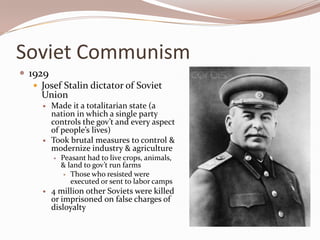
    Josef Stalin dictator of Soviet
     Union
        Made it a totalitarian state (a
         nation in which a single party
         controls the gov’t and every aspect
         of people’s lives)
        Took brutal measures to control &
         modernize industry & agriculture
            Peasant had to live crops, animals,
             & land to gov’t run farms
               Those who resisted were
                executed or sent to labor camps
        4 million other Soviets were killed
         or imprisoned on false charges of
         disloyalty
Fascism in Italy
 Economic & social problems after WWI
    Led to unrest
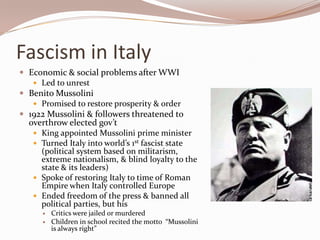
 Benito Mussolini
    Promised to restore prosperity & order
 1922 Mussolini & followers threatened to
  overthrow elected gov’t
    King appointed Mussolini prime minister
    Turned Italy into world’s 1st fascist state
     (political system based on militarism,
     extreme nationalism, & blind loyalty to the
     state & its leaders)
    Spoke of restoring Italy to time of Roman
     Empire when Italy controlled Europe
    Ended freedom of the press & banned all
     political parties, but his
         Critics were jailed or murdered
         Children in school recited the motto “Mussolini
          is always right”
Nazi Germany
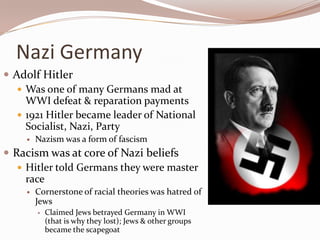
 Adolf Hitler
    Was one of many Germans mad at
     WWI defeat & reparation payments
    1921 Hitler became leader of National
     Socialist, Nazi, Party
        Nazism was a form of fascism
 Racism was at core of Nazi beliefs
    Hitler told Germans they were master
     race
        Cornerstone of racial theories was hatred of
         Jews
            Claimed Jews betrayed Germany in WWI
             (that is why they lost); Jews & other groups
             became the scapegoat
 1933
    Hitler named chancellor of Germany (leader of parliament)
        Created a totalitarian state
          All other parties outlawed

          Secret police enforced strict loyalty

 Anti-Semitic laws passed
    Jews banned from public schools & from certain professions
     (medicine & law)
    Jews communities were attacked
 1938
    Troops began sending Jews to slave labor camps (the worse
     was yet to come)
Militarism in Japan
 Great Depression undermined faith in democratic
  gov’t
    Military leaders pressured gov’t to take control of nearby
     countries
        Island nation need more space & raw materials for industries
 1936
    militarists completely controlled gov’t
        Preached racism
          Japanese were superior to other Asians & non-Asians
Military Aggression
 Japan attacks China
    1931 w/o gov’t approval Japanese army seized Manchuria
     (in Northern China)
       League of Nations (founded to stop aggression) protested, but
        did nothing
   1937 Japanese aggression increased in China
       Chinese treated brutally
         For 6 weeks Japanese forces pillaged Nanjing

           Quarter of a million civilians & prisoners of war were
            massacred
Italy Invades Ethiopia
 1935
    Mussolini’s armies invade Ethiopia
    Ethiopians battled bravely but modern technology
     prevailed
    Ethiopian emperor Haile Selassie appealed to League of
     Nations for aid
        Response was week
German Aggression
 Hitler vowed to create empire to unite all German speaking
  people
    Began rebuilding German army (defined Treaty of Versailles)
    Moved troops to Rhineland region of western Germany
    1938 German armies occupy Austria
        European democracies did nothing to stop him
 France & Britain protest when Hitler threatened to invade
  Czechoslovakia
    Met w/ Hitler in Germany(Munich) to appease him
    Munich Pact
        Agreed to let Germany invade Sudetenland (portion of Czech. Populated
         by people who spoke German)
        In return Hitler promised not to seek further territory
    Neville Chamberlain (British Prime Minister) claimed he had won
     peace
        A few month later Hitler occupied all of Czech.
Neutrality Act
 Passed by Congress in 1935
    1st of several laws designed to keep U.S. at peace
        Forbade President from selling arms, making loans, or giving
         assistance to any nation involved in war
Good Neighbor Policy
 U.S. wanted to strengthen ties to Latin America
 Pres. Herbert Hover rejected Roosevelt Corollary to the
 Monroe Doctrine
   U.S. no longer claimed right to intervene in Latin
    American affairs
   Franklin Roosevelt created Good Neighbor Policy
       American troops withdrew from Nicaragua & Haiti
       Also cancelled Platt Amendment (had limited independence
        of Cuba)
War Begins in Europe
 Poland was next target of Hitler
    France & Britain realize appeasement failed
          Would aid if invaded
 Invasion of Poland
    August 1939
          Hitler & Stalin sign nonaggression agreement (were enemies)
          Nazi-Soviet Pact
              Promised not to attach each other
              Secretly agreed to divide up Poland
     September 1, 1939
       Nazi troops invade Poland
       16 days later Soviet troops seize eastern Poland & invaded Finland & later annexed
         Estonia, Lithuania, & Latvia
       Britain & France declared war on Germany
           WWII had begun

 At 1st Germany army was unstoppable
 1940 Germany army seized Denmark & Norway & later the Netherlands,
  Luxembourg, Belgium, & moved into France
Fall of France
 Britain sent troops to help France
    Overpowered
    Retreated to Dunkirk a port on the English Channel
       Every British ship available was sent to rescue trapped soldiers
 Germans marched on to Paris
 June 22, 1940 Hitler accepted surrender of France
Battle of Britain
 Britain stood alone against Nazi war machine
 Winston Churchill was confident Britain could win
 Hitler ordered air assault on Britain
   Day after day assaults continued (thousands died, but
    spirits never broke)
       They slept in subway stations at night & cleared wreckage,
        buried the dead, & tried to carry on during the day
 British air force fought invading planes overhead
    Battle continued for many months
    Hitler abandoned plans to invade Britain
Invasion of the Soviet Union
 June 22, 1941
    Hitler broke pact w/ Stalin
    German forces invade Soviet Union
    Soviet Union now joined Britain in fighting Germans
       Churchill & Stalin mistrusted each other, but were forced to
        work together

Chapter 24

  • 1.
  • 2.
  • 3.
    The Rise ofDictators  1920s-1930s  Several nations views democratic gov’ts as too weak  Turned to dictators
  • 4.
    Soviet Communism  1929  Josef Stalin dictator of Soviet Union  Made it a totalitarian state (a nation in which a single party controls the gov’t and every aspect of people’s lives)  Took brutal measures to control & modernize industry & agriculture  Peasant had to live crops, animals, & land to gov’t run farms  Those who resisted were executed or sent to labor camps  4 million other Soviets were killed or imprisoned on false charges of disloyalty
  • 5.
    Fascism in Italy Economic & social problems after WWI  Led to unrest  Benito Mussolini  Promised to restore prosperity & order  1922 Mussolini & followers threatened to overthrow elected gov’t  King appointed Mussolini prime minister  Turned Italy into world’s 1st fascist state (political system based on militarism, extreme nationalism, & blind loyalty to the state & its leaders)  Spoke of restoring Italy to time of Roman Empire when Italy controlled Europe  Ended freedom of the press & banned all political parties, but his  Critics were jailed or murdered  Children in school recited the motto “Mussolini is always right”
  • 6.
    Nazi Germany  AdolfHitler  Was one of many Germans mad at WWI defeat & reparation payments  1921 Hitler became leader of National Socialist, Nazi, Party  Nazism was a form of fascism  Racism was at core of Nazi beliefs  Hitler told Germans they were master race  Cornerstone of racial theories was hatred of Jews  Claimed Jews betrayed Germany in WWI (that is why they lost); Jews & other groups became the scapegoat
  • 7.
     1933  Hitler named chancellor of Germany (leader of parliament)  Created a totalitarian state  All other parties outlawed  Secret police enforced strict loyalty  Anti-Semitic laws passed  Jews banned from public schools & from certain professions (medicine & law)  Jews communities were attacked  1938  Troops began sending Jews to slave labor camps (the worse was yet to come)
  • 8.
    Militarism in Japan Great Depression undermined faith in democratic gov’t  Military leaders pressured gov’t to take control of nearby countries  Island nation need more space & raw materials for industries  1936  militarists completely controlled gov’t  Preached racism  Japanese were superior to other Asians & non-Asians
  • 9.
    Military Aggression  Japanattacks China  1931 w/o gov’t approval Japanese army seized Manchuria (in Northern China)  League of Nations (founded to stop aggression) protested, but did nothing  1937 Japanese aggression increased in China  Chinese treated brutally  For 6 weeks Japanese forces pillaged Nanjing  Quarter of a million civilians & prisoners of war were massacred
  • 10.
    Italy Invades Ethiopia 1935  Mussolini’s armies invade Ethiopia  Ethiopians battled bravely but modern technology prevailed  Ethiopian emperor Haile Selassie appealed to League of Nations for aid  Response was week
  • 11.
    German Aggression  Hitlervowed to create empire to unite all German speaking people  Began rebuilding German army (defined Treaty of Versailles)  Moved troops to Rhineland region of western Germany  1938 German armies occupy Austria  European democracies did nothing to stop him  France & Britain protest when Hitler threatened to invade Czechoslovakia  Met w/ Hitler in Germany(Munich) to appease him  Munich Pact  Agreed to let Germany invade Sudetenland (portion of Czech. Populated by people who spoke German)  In return Hitler promised not to seek further territory  Neville Chamberlain (British Prime Minister) claimed he had won peace  A few month later Hitler occupied all of Czech.
  • 12.
    Neutrality Act  Passedby Congress in 1935  1st of several laws designed to keep U.S. at peace  Forbade President from selling arms, making loans, or giving assistance to any nation involved in war
  • 13.
    Good Neighbor Policy U.S. wanted to strengthen ties to Latin America  Pres. Herbert Hover rejected Roosevelt Corollary to the Monroe Doctrine  U.S. no longer claimed right to intervene in Latin American affairs  Franklin Roosevelt created Good Neighbor Policy  American troops withdrew from Nicaragua & Haiti  Also cancelled Platt Amendment (had limited independence of Cuba)
  • 14.
    War Begins inEurope  Poland was next target of Hitler  France & Britain realize appeasement failed  Would aid if invaded  Invasion of Poland  August 1939  Hitler & Stalin sign nonaggression agreement (were enemies)  Nazi-Soviet Pact  Promised not to attach each other  Secretly agreed to divide up Poland  September 1, 1939  Nazi troops invade Poland  16 days later Soviet troops seize eastern Poland & invaded Finland & later annexed Estonia, Lithuania, & Latvia  Britain & France declared war on Germany  WWII had begun  At 1st Germany army was unstoppable  1940 Germany army seized Denmark & Norway & later the Netherlands, Luxembourg, Belgium, & moved into France
  • 15.
    Fall of France Britain sent troops to help France  Overpowered  Retreated to Dunkirk a port on the English Channel  Every British ship available was sent to rescue trapped soldiers  Germans marched on to Paris  June 22, 1940 Hitler accepted surrender of France
  • 16.
    Battle of Britain Britain stood alone against Nazi war machine  Winston Churchill was confident Britain could win  Hitler ordered air assault on Britain  Day after day assaults continued (thousands died, but spirits never broke)  They slept in subway stations at night & cleared wreckage, buried the dead, & tried to carry on during the day  British air force fought invading planes overhead  Battle continued for many months  Hitler abandoned plans to invade Britain
  • 17.
    Invasion of theSoviet Union  June 22, 1941  Hitler broke pact w/ Stalin  German forces invade Soviet Union  Soviet Union now joined Britain in fighting Germans  Churchill & Stalin mistrusted each other, but were forced to work together