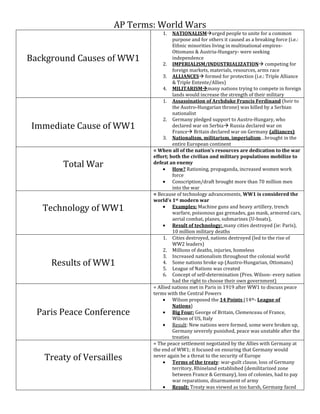
AP Terms: World Wars
Background Causes of WW1
1. NATIONALISMurged people to unite for a common
purpose and for others it caused as a breaking force (i.e.:
Ethnic minorities living in multinational empires-
Ottomans & Austria-Hungary- were seeking
independence
2. IMPERIALISM/INDUSTRIALIZATION competing for
foreign markets, materials, resources, arms race
3. ALLIANCES formed for protection (i.e.: Triple Alliance
& Triple Entente/Allies)
4. MILITARISMmany nations trying to compete in foreign
lands would increase the strength of their military
Immediate Cause of WW1
1. Assassination of Archduke Francis Ferdinand (heir to
the Austro-Hungarian throne) was killed by a Serbian
nationalist
2. Germany pledged support to Austro-Hungary, who
declared war on Serbia Russia declared war on
France Britain declared war on Germany (alliances)
3. Nationalism, militarism, imperialism…brought in the
entire European continent
Total War
= When all of the nation’s resources are dedication to the war
effort; both the civilian and military populations mobilize to
defeat an enemy
How? Rationing, propaganda, increased women work
force
Conscription/draft brought more than 70 million men
into the war
Technology of WW1
= Because of technology advancements, WW1 is considered the
world’s 1st modern war
Examples: Machine guns and heavy artillery, trench
warfare, poisonous gas grenades, gas mask, armored cars,
aerial combat, planes, submarines (U-boats),
Result of technology: many cities destroyed (ie: Paris),
10 million military deaths
Results of WW1
1. Cities destroyed, nations destroyed (led to the rise of
WW2 leaders)
2. Millions of deaths, injuries, homeless
3. Increased nationalism throughout the colonial world
4. Some nations broke up (Austro-Hungarian, Ottomans)
5. League of Nations was created
6. Concept of self-determination (Pres. Wilson- every nation
had the right to choose their own government)
Paris Peace Conference
= Allied nations met in Paris in 1919 after WW1 to discuss peace
terms with the Central Powers
Wilson proposed the 14 Points (14th- League of
Nations)
Big Four: George of Britain, Clemenceau of France,
Wilson of US, Italy
Result: New nations were formed, some were broken up,
Germany severely punished, peace was unstable after the
treaties
Treaty of Versailles
= The peace settlement negotiated by the Allies with Germany at
the end of WW1; it focused on ensuring that Germany would
never again be a threat to the security of Europe
Terms of the treaty: war-guilt clause, loss of Germany
territory, Rhineland established (demilitarized zone
between France & Germany), loss of colonies, had to pay
war reparations, disarmament of army
Result: Treaty was viewed as too harsh, Germany faced
economic depression & the rise of a totalitarian
government occurred in the future
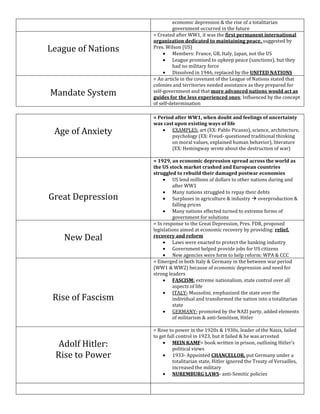
League of Nations
= Created after WW1, it was the first permanent international
organization dedicated to maintaining peace, suggested by
Pres. Wilson (US)
Members: France, GB, Italy, Japan, not the US
League promised to upkeep peace (sanctions), but they
had no military force
Dissolved in 1946, replaced by the UNITED NATIONS
Mandate System
= An article in the covenant of the League of Nations stated that
colonies and territories needed assistance as they prepared for
self-government and that more advanced nations would act as
guides for the less experienced ones; Influenced by the concept
of self-determination
Age of Anxiety
= Period after WW1, when doubt and feelings of uncertainty
was cast upon existing ways of life
EXAMPLES: art (EX: Pablo Picasso), science, architecture,
psychology (EX: Freud- questioned traditional thinking
on moral values, explained human behavior), literature
(EX: Hemingway wrote about the destruction of war)
Great Depression
= 1929, an economic depression spread across the world as
the US stock market crashed and European countries
struggled to rebuild their damaged postwar economies
US lend millions of dollars to other nations during and
after WW1
Many nations struggled to repay their debts
Surpluses in agriculture & industry  overproduction &
falling prices
Many nations effected turned to extreme forms of
government for solutions
New Deal
= In response to the Great Depression, Pres. FDR, proposed
legislations aimed at economic recovery by providing: relief,
recovery and reform
Laws were enacted to protect the banking industry
Government helped provide jobs for US citizens
New agencies were form to help reform: WPA & CCC
Rise of Fascism
= Emerged in both Italy & Germany in the between war period
(WW1 & WW2) because of economic depression and need for
strong leaders
FASCISM: extreme nationalism, state control over all
aspects of life
ITALY- Mussolini, emphasized the state over the
individual and transformed the nation into a totalitarian
state
GERMANY- promoted by the NAZI party, added elements
of militarism & anti-Semitism, Hitler
Adolf Hitler:
Rise to Power
= Rose to power in the 1920s & 1930s, leader of the Nazis, failed
to get full control in 1923, but it failed & he was arrested
MEIN KAMF= book written in prison, outlining Hitler’s
political views
1933- Appointed CHANCELLOR, put Germany under a
totalitarian state, Hitler ignored the Treaty of Versailles,
increased the military
NUREMBURG LAWS- anti-Semitic policies
Adolf Hitler at War
Late 1930s- Hitler took control of Rhineland & Austria
1938- Munich Conference- Hitler promised not to invade
Czechoslovakia in return for the Sudetenland (example of
APPEASEMENT)
1939- took over Czechoslovakia, invaded Poland (begins
WW2)
“Living space”= Hitler argued that Germans need more
space by invaded German lands, as well as cleansing the
land of inferior people (Jews, Holocaust)
1945- Allies marched on Germany, Hitler took his own
life
Benito Mussolini
= Responsible for the establishment of the world’s first fascist
state, emerged as a dictator in postwar Italy (which was
struggling to recover form the depression)
Promised: economic recovery, addition of land to the
Italian empire
Accomplished: suspending people’s liberties, used fear
and terror to enforce his will
ROME-BERLIN AXIS- signed between Germany & Italy in
1936, alliance
Italy experienced many losses, he was striped of his
power, still supported by Germanys
1945- Captured by the Italian resistance & executed
Joseph Stalin
= Leader after Lenin, “man of steel,” became a totalitarian dictator
of the USSR, leader during WW2 and early Cold War
5 YEAR PLAN= program aimed at transforming the
Soviet Union from an agrarian economy to a
modern/industrialized nation
-Set high quotas, focused on industry in the
beginning
- Quotas not met but Stalin claimed it was a success
COLLECTIVIZATION= government took control of land
and created collective farms with the goal of improving
agricultural production (result- famine & anger from
peasants & kulaks)
GREAT PURGE= period in which Stalin’s opponents were
jailed and/or executed
Origins of WW2
1. AXIS POWERS (Germany, Italy, Japan) vs. ALLIED
POWERS (France, GB, USSR, CHINA, US)
2. JAPAN’S IMPERIALIST GOALS Japan invades
Manchuria& the L.o.N gives warnings Japan withdraws
from the League of Nations  invades China
3. ITALY’S IMPERIALIST GOALS Italy invades Ethiopia
violates L.o.N
4. GERMANY’S IMPERIALIST GOALS Violates Treaty of
Versailles by entering the RHINELAND & invading the
SUDENTENLAND
5. APPEASEMENT= Western democracies gave in to the
demands of the aggressor nations (ie: Japan, Italy,
Germany) in an attempt to keep peace
Nazi-Soviet Pact
= A nonaggression treaty signed between Germany & the Soviet
Union in 1939 in which the two nations publicly agreed to avoid
armed conflict with one another
1941- Germany violated the pact by invading the Soviet
Union & took control of the Soviet spheres of influence in
the Baltic countries & eastern Europe
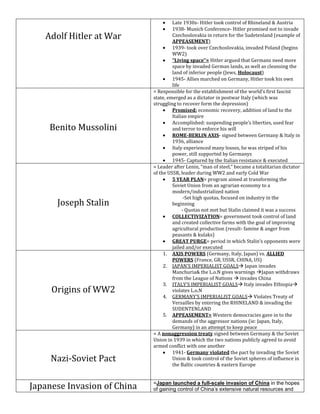
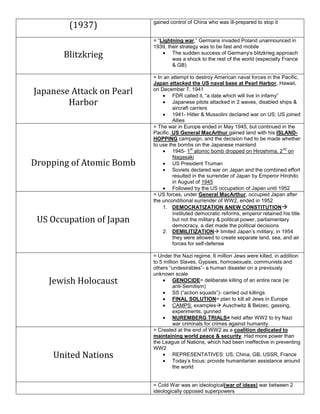
Japanese Invasion of China =Japan launched a full-scale invasion of China in the hopes
of gaining control of China’s extensive natural resources and
(1937) gained control of China who was ill-prepared to stop it
Blitzkrieg
= “Lightning war,” Germans invaded Poland unannounced in
1939, their strategy was to be fast and mobile
The sudden success of Germany’s blitzkrieg approach
was a shock to the rest of the world (especially France
& GB)
Japanese Attack on Pearl
Harbor
= In an attempt to destroy American naval forces in the Pacific,
Japan attacked the US naval base at Pearl Harbor, Hawaii,
on December 7, 1941
FDR called it, “a date which will live in infamy”
Japanese pilots attacked in 2 waves, disabled ships &
aircraft carriers
1941- Hitler & Mussolini declared war on US; US joined
Allies
Dropping of Atomic Bomb
= The war in Europe ended in May 1945, but continued in the
Pacific. US General MacArthur gained land with his ISLAND-
HOPPING campaign, and the decision had to be made whether
to use the bombs on the Japanese mainland
1945- 1
st
atomic bomb dropped on Hiroshima, 2
nd
on
Nagasaki
US President Truman
Soviets declared war on Japan and the combined effort
resulted in the surrender of Japan by Emperor Hirohito
in August of 1945
Followed by the US occupation of Japan until 1952
US Occupation of Japan
= US forces, under General MacArthur, occupied Japan after
the unconditional surrender of WW2, ended in 1952
1. DEMOCRATIZATION &NEW CONSTITUTION
instituted democratic reforms, emperor retained his title
but not the military & political power, parliamentary
democracy, a diet made the political decisions
2. DEMILITIZATION limited Japan’s military, in 1954
they were allowed to create separate land, sea, and air
forces for self-defense
Jewish Holocaust
= Under the Nazi regime, 6 million Jews were killed, in addition
to 5 million Slaves, Gypsies, homosexuals, communists and
others “undesirables”- a human disaster on a previously
unknown scale
GENOCIDE= deliberate killing of an entire race (ie:
anti-Semitism)
SS (“action squads”)- carried out killings
FINAL SOLUTION= plan to kill all Jews in Europe
CAMPS: examples Auschwitz & Belzec, gassing,
experiments, gunned
NUREMBERG TRIALS= held after WW2 to try Nazi
war criminals for crimes against humanity
United Nations
= Created at the end of WW2 as a coalition dedicated to
maintaining world peace & security. Had more power than
the League of Nations, which had been ineffective in preventing
WW2
REPRESENTATIVES: US, China, GB, USSR, France
Today’s focus: provide humanitarian assistance around
the world
= Cold War was an ideological(war of ideas) war between 2
ideologically opposed superpowers
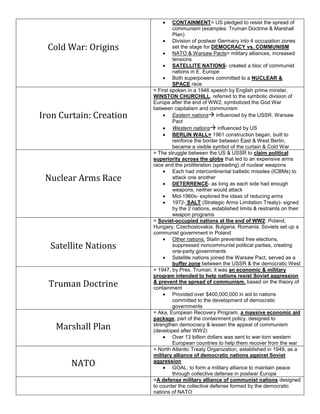
Cold War: Origins
CONTAINMENT= US pledged to resist the spread of
communism (examples: Truman Doctrine & Marshall
Plan)
Division of postwar Germany into 4 occupation zones
set the stage for DEMOCRACY vs. COMMUNISM
NATO & Warsaw Pacts= military alliances, increased
tensions
SATELLITE NATIONS- created a bloc of communist
nations in E. Europe
Both superpowers committed to a NUCLEAR &
SPACE race
Iron Curtain: Creation
= First spoken in a 1946 speech by English prime minster,
WINSTON CHURCHILL, referred to the symbolic division of
Europe after the end of WW2; symbolized the God War
between capitalism and communism
Eastern nations influenced by the USSR, Warsaw
Pact
Western nations influenced by US
BERLIN WALL= 1961 construction began, built to
reinforce the border between East & West Berlin,
became a visible symbol of the curtain & Cold War
Nuclear Arms Race
= The struggle between the US & USSR to claim political
superiority across the globe that led to an expensive arms
race and the proliferation (spreading) of nuclear weapons
Each had intercontinental ballistic missiles (ICBMs) to
attack one another
DETERRENCE- as long as each side had enough
weapons, neither would attack
Mid-1960s- explored the ideas of reducing arms
1972- SALT (Strategic Arms Limitation Treaty)- signed
by the 2 nations, established limits & restraints on their
weapon programs
Satellite Nations
= Soviet-occupied nations at the end of WW2: Poland,
Hungary, Czechoslovakia, Bulgaria, Romania. Soviets set up a
communist government in Poland
Other nations: Stalin prevented free elections,
suppressed noncommunist political parties, creating
one-party governments
Satellite nations joined the Warsaw Pact, served as a
buffer zone between the USSR & the democratic West
Truman Doctrine
= 1947, by Pres. Truman, it was an economic & military
program intended to help nations resist Soviet aggression
& prevent the spread of communism, based on the theory of
containment
Provided over $400,000,000 in aid to nations
committed to the development of democratic
governments
Marshall Plan
= Aka, European Recovery Program, a massive economic aid
package, part of the containment policy, designed to
strengthen democracy & lessen the appeal of communism
(developed after WW2)
Over 13 billion dollars was sent to war-torn western
European countries to help them recover from the war
NATO
= North Atlantic Treaty Organization, established in 1949, as a
military alliance of democratic nations against Soviet
aggression
GOAL: to form a military alliance to maintain peace
through collective defense in postwar Europe
=A defense military alliance of communist nations designed
to counter the collective defense formed by the democratic
nations of NATO
Warsaw Pact Original members: USSR, Poland, East Germany,
Czechoslovakia, Hungary, Romania, Bulgaria
Geneva Conference
=Cold War peace conference held in 1954
Vietnam would temporarily be divided at the 17
th
parallel (N (communist leader Ho Chi Minh) vs. S
Vietnam (noncommunist control))
Pres. Eisenhower feared the DOMINO THEORY would
befall SE Asia (if one fell they all would)
Geneva Agreement required elections, elected Ho Chi
Minh
Korean War
= After WW2, Korea, which had been annexed by Japan, was
occupied by both the Soviet Union & the US- the USSR north of
the 38
th
parallel, and the US to the south of it, condemned by
the UN
Cease-fire agreement divided Korea in 1953, the
nation remains divided by the demilitarized zone
Cuban Missile Crisis
= FIDEL CASTRO, leader of communist Cuba, formed an
alliance with Stalin, leader of Soviet Union, after the BAY OF
PIGS incident and an attempted assassination by rebels funded
by the US
Castro allowed Stalin to build nuclear missile bases in
Cuba (90 miles south of the southern tip of the US)
Pres. Kennedy demanded removal of nuclear
weapons from Cuba, set up a naval blockade & cut off
Cuba until an agreement was reached
Nonalignment
= Represented a “third path” an alternative to allying with
either the US or the USSR
Nations did not take a side during the Cold
War/remained neutral
Examples: India, Yugoslavia, many African nations
Goal: to avoid involvement in the Cold War & maintain
& increase economic progress (by accepting economic
aid from both sides)
Decolonization
= In the post-WW2 world, mother countries could no long
maintain control of their colonies as they attempted to repair
their own war-torn lands
Newly independent states struggled to maintain
autonomy & develop self-determination in the
shadow of the Cold War
More than 90 nations gained independence from the
end of the war to 1980
European Community
= Formed in 1957, 6 founding members nations: France,
Belgium, West Germany, Luxembourg, Italy, the Netherlands;
characterized by a common market & free trade
Signed the TREATY OF ROME= established the
European Economic Community, their goal was to
dissolve tariffs & increase free trade
Détente
= Policy adopted by the Soviet Union & the US during the Cold
War in an effort to reduce tensions between the two
superpowers over the arms race and control of developing
countries
Encouraged: cooperation in the following areas:
environmental research, space explorations, health
research and cultural diffusion
= US intervened in the conflict on the side of the
noncommunist South Vietnam after the French were
defeated
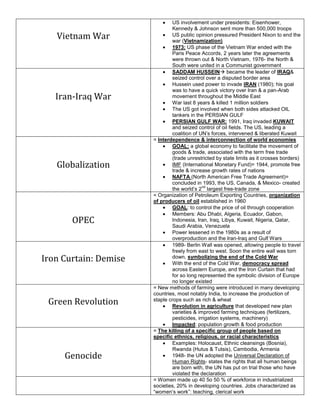
Vietnam War
US involvement under presidents: Eisenhower,
Kennedy & Johnson sent more than 500,000 troops
US public opinion pressured President Nixon to end the
war (Vietnamization)
1973: US phase of the Vietnam War ended with the
Paris Peace Accords, 2 years later the agreements
were thrown out & North Vietnam, 1976- the North &
South were united in a Communist government
Iran-Iraq War
SADDAM HUSSEIN became the leader of IRAQ&
seized control over a disputed border area
Hussein used power to invade IRAN (1980); his goal
was to have a quick victory over Iran & a pan-Arab
movement throughout the Middle East
War last 8 years & killed 1 million soldiers
The US got involved when both sides attacked OIL
tankers in the PERSIAN GULF
PERSIAN GULF WAR: 1991, Iraq invaded KUWAIT
and seized control of oil fields. The US, leading a
coalition of UN’s forces, intervened & liberated Kuwait
Globalization
= Interdependence & interconnection of world economies
GOAL: a global economy to facilitate the movement of
goods & trade, associated with the term free trade
(trade unrestricted by state limits as it crosses borders)
IMF (International Monetary Fund)= 1944, promote free
trade & increase growth rates of nations
NAFTA (North American Free Trade Agreement)=
concluded in 1993, the US, Canada, & Mexico- created
the world’s 2
nd
largest free-trade zone
OPEC
= Organization of Petroleum Exporting Countries, organization
of producers of oil established in 1960
GOAL: to control the price of oil through cooperation
Members: Abu Dhabi, Algeria, Ecuador, Gabon,
Indonesia, Iran, Iraq, Libya, Kuwait, Nigeria, Qatar,
Saudi Arabia, Venezuela
Power lessened in the 1980s as a result of
overproduction and the Iran-Iraq and Gulf Wars
Iron Curtain: Demise
1989- Berlin Wall was opened, allowing people to travel
freely from east to west. Soon the entire wall was torn
down, symbolizing the end of the Cold War
With the end of the Cold War, democracy spread
across Eastern Europe, and the Iron Curtain that had
for so long represented the symbolic division of Europe
no longer existed
Green Revolution
= New methods of farming were introduced in many developing
countries, most notably India, to increase the production of
staple crops such as rich & wheat
Revolution in agriculture that developed new plan
varieties & improved farming techniques (fertilizers,
pesticides, irrigation systems, machinery)
Impacted: population growth & food production
Genocide
= The killing of a specific group of people based on
specific ethnics, religious, or racial characteristics
Examples: Holocaust, Ethnic cleansings (Bosnia),
Rwanda (Hutus & Tutsis), Cambodia, Armenia
1948- the UN adopted the Universal Declaration of
Human Rights- states the rights that all human beings
are born with, the UN has put on trial those who have
violated the declaration
= Women made up 40 5o 50 % of workforce in industrialized
societies, 20% in developing countries. Jobs characterized as
“women’s work”: teaching, clerical work
Feminism Discrimination in the workplace was a catalyst for the
women’s movement
Fought for control over their own bodies (birth control,
abortions)
US Civil Rights Act of 1964 forbids discrimination
based on sex or race
Global Problems
1. POVERTY (unequal distribution of basics- food, water,
shelter)
2. TRAFFICKING (women, children, drugs, forced into
servitude)
3. HIV/AIDS (infection spread through infected blood,
especially problematic in African countries b/c medicine
is expensive)
4. TERRORISM (deliberate use of unpredictable violence,
especially against civilians, to gain revenge or achieve
political goals
NGOs
= Nongovernmental Organizations, a group that has no
connection to a government; not funded by a government
Examples: UN, Red Cross, Greenpeace
Machine Gun
= A weapon invented by Maxim in 1884, could fire 400 to 600
rounds per minute, used as a defensive weapon during WW1
Used as an offensive weapon when mounted on
aircraft, tanks & other vehicles
Improvements were made on later models, 1918 the
machine gun was operated by one man and was
portable
Commercial Cellular/Mobile
Phones
= Developed the radio technology from WW2, cell phones are
divided into 4 generations to mark changes/technological
developments
Communication increased
Information/data services improved
Internet
= After the Soviet’s launched Sputnik, it led the US to fund
technology research, which eventually led to the creation of the
Internet
“Network of networks”- linked, carried a vast array of
information resources & services, most notably the
inter-linked hypertext documents of the World Wide
Web (WWW), electronic mail
Estimated population of Internet users was 1.8 billion
as of 2009

Ap terms world wars

  • 1.
    AP Terms: WorldWars Background Causes of WW1 1. NATIONALISMurged people to unite for a common purpose and for others it caused as a breaking force (i.e.: Ethnic minorities living in multinational empires- Ottomans & Austria-Hungary- were seeking independence 2. IMPERIALISM/INDUSTRIALIZATION competing for foreign markets, materials, resources, arms race 3. ALLIANCES formed for protection (i.e.: Triple Alliance & Triple Entente/Allies) 4. MILITARISMmany nations trying to compete in foreign lands would increase the strength of their military Immediate Cause of WW1 1. Assassination of Archduke Francis Ferdinand (heir to the Austro-Hungarian throne) was killed by a Serbian nationalist 2. Germany pledged support to Austro-Hungary, who declared war on Serbia Russia declared war on France Britain declared war on Germany (alliances) 3. Nationalism, militarism, imperialism…brought in the entire European continent Total War = When all of the nation’s resources are dedication to the war effort; both the civilian and military populations mobilize to defeat an enemy How? Rationing, propaganda, increased women work force Conscription/draft brought more than 70 million men into the war Technology of WW1 = Because of technology advancements, WW1 is considered the world’s 1st modern war Examples: Machine guns and heavy artillery, trench warfare, poisonous gas grenades, gas mask, armored cars, aerial combat, planes, submarines (U-boats), Result of technology: many cities destroyed (ie: Paris), 10 million military deaths Results of WW1 1. Cities destroyed, nations destroyed (led to the rise of WW2 leaders) 2. Millions of deaths, injuries, homeless 3. Increased nationalism throughout the colonial world 4. Some nations broke up (Austro-Hungarian, Ottomans) 5. League of Nations was created 6. Concept of self-determination (Pres. Wilson- every nation had the right to choose their own government) Paris Peace Conference = Allied nations met in Paris in 1919 after WW1 to discuss peace terms with the Central Powers Wilson proposed the 14 Points (14th- League of Nations) Big Four: George of Britain, Clemenceau of France, Wilson of US, Italy Result: New nations were formed, some were broken up, Germany severely punished, peace was unstable after the treaties Treaty of Versailles = The peace settlement negotiated by the Allies with Germany at the end of WW1; it focused on ensuring that Germany would never again be a threat to the security of Europe Terms of the treaty: war-guilt clause, loss of Germany territory, Rhineland established (demilitarized zone between France & Germany), loss of colonies, had to pay war reparations, disarmament of army Result: Treaty was viewed as too harsh, Germany faced
  • 2.
    economic depression &the rise of a totalitarian government occurred in the future League of Nations = Created after WW1, it was the first permanent international organization dedicated to maintaining peace, suggested by Pres. Wilson (US) Members: France, GB, Italy, Japan, not the US League promised to upkeep peace (sanctions), but they had no military force Dissolved in 1946, replaced by the UNITED NATIONS Mandate System = An article in the covenant of the League of Nations stated that colonies and territories needed assistance as they prepared for self-government and that more advanced nations would act as guides for the less experienced ones; Influenced by the concept of self-determination Age of Anxiety = Period after WW1, when doubt and feelings of uncertainty was cast upon existing ways of life EXAMPLES: art (EX: Pablo Picasso), science, architecture, psychology (EX: Freud- questioned traditional thinking on moral values, explained human behavior), literature (EX: Hemingway wrote about the destruction of war) Great Depression = 1929, an economic depression spread across the world as the US stock market crashed and European countries struggled to rebuild their damaged postwar economies US lend millions of dollars to other nations during and after WW1 Many nations struggled to repay their debts Surpluses in agriculture & industry  overproduction & falling prices Many nations effected turned to extreme forms of government for solutions New Deal = In response to the Great Depression, Pres. FDR, proposed legislations aimed at economic recovery by providing: relief, recovery and reform Laws were enacted to protect the banking industry Government helped provide jobs for US citizens New agencies were form to help reform: WPA & CCC Rise of Fascism = Emerged in both Italy & Germany in the between war period (WW1 & WW2) because of economic depression and need for strong leaders FASCISM: extreme nationalism, state control over all aspects of life ITALY- Mussolini, emphasized the state over the individual and transformed the nation into a totalitarian state GERMANY- promoted by the NAZI party, added elements of militarism & anti-Semitism, Hitler Adolf Hitler: Rise to Power = Rose to power in the 1920s & 1930s, leader of the Nazis, failed to get full control in 1923, but it failed & he was arrested MEIN KAMF= book written in prison, outlining Hitler’s political views 1933- Appointed CHANCELLOR, put Germany under a totalitarian state, Hitler ignored the Treaty of Versailles, increased the military NUREMBURG LAWS- anti-Semitic policies
  • 3.
    Adolf Hitler atWar Late 1930s- Hitler took control of Rhineland & Austria 1938- Munich Conference- Hitler promised not to invade Czechoslovakia in return for the Sudetenland (example of APPEASEMENT) 1939- took over Czechoslovakia, invaded Poland (begins WW2) “Living space”= Hitler argued that Germans need more space by invaded German lands, as well as cleansing the land of inferior people (Jews, Holocaust) 1945- Allies marched on Germany, Hitler took his own life Benito Mussolini = Responsible for the establishment of the world’s first fascist state, emerged as a dictator in postwar Italy (which was struggling to recover form the depression) Promised: economic recovery, addition of land to the Italian empire Accomplished: suspending people’s liberties, used fear and terror to enforce his will ROME-BERLIN AXIS- signed between Germany & Italy in 1936, alliance Italy experienced many losses, he was striped of his power, still supported by Germanys 1945- Captured by the Italian resistance & executed Joseph Stalin = Leader after Lenin, “man of steel,” became a totalitarian dictator of the USSR, leader during WW2 and early Cold War 5 YEAR PLAN= program aimed at transforming the Soviet Union from an agrarian economy to a modern/industrialized nation -Set high quotas, focused on industry in the beginning - Quotas not met but Stalin claimed it was a success COLLECTIVIZATION= government took control of land and created collective farms with the goal of improving agricultural production (result- famine & anger from peasants & kulaks) GREAT PURGE= period in which Stalin’s opponents were jailed and/or executed Origins of WW2 1. AXIS POWERS (Germany, Italy, Japan) vs. ALLIED POWERS (France, GB, USSR, CHINA, US) 2. JAPAN’S IMPERIALIST GOALS Japan invades Manchuria& the L.o.N gives warnings Japan withdraws from the League of Nations  invades China 3. ITALY’S IMPERIALIST GOALS Italy invades Ethiopia violates L.o.N 4. GERMANY’S IMPERIALIST GOALS Violates Treaty of Versailles by entering the RHINELAND & invading the SUDENTENLAND 5. APPEASEMENT= Western democracies gave in to the demands of the aggressor nations (ie: Japan, Italy, Germany) in an attempt to keep peace Nazi-Soviet Pact = A nonaggression treaty signed between Germany & the Soviet Union in 1939 in which the two nations publicly agreed to avoid armed conflict with one another 1941- Germany violated the pact by invading the Soviet Union & took control of the Soviet spheres of influence in the Baltic countries & eastern Europe Japanese Invasion of China =Japan launched a full-scale invasion of China in the hopes of gaining control of China’s extensive natural resources and
  • 4.
    (1937) gained controlof China who was ill-prepared to stop it Blitzkrieg = “Lightning war,” Germans invaded Poland unannounced in 1939, their strategy was to be fast and mobile The sudden success of Germany’s blitzkrieg approach was a shock to the rest of the world (especially France & GB) Japanese Attack on Pearl Harbor = In an attempt to destroy American naval forces in the Pacific, Japan attacked the US naval base at Pearl Harbor, Hawaii, on December 7, 1941 FDR called it, “a date which will live in infamy” Japanese pilots attacked in 2 waves, disabled ships & aircraft carriers 1941- Hitler & Mussolini declared war on US; US joined Allies Dropping of Atomic Bomb = The war in Europe ended in May 1945, but continued in the Pacific. US General MacArthur gained land with his ISLAND- HOPPING campaign, and the decision had to be made whether to use the bombs on the Japanese mainland 1945- 1 st atomic bomb dropped on Hiroshima, 2 nd on Nagasaki US President Truman Soviets declared war on Japan and the combined effort resulted in the surrender of Japan by Emperor Hirohito in August of 1945 Followed by the US occupation of Japan until 1952 US Occupation of Japan = US forces, under General MacArthur, occupied Japan after the unconditional surrender of WW2, ended in 1952 1. DEMOCRATIZATION &NEW CONSTITUTION instituted democratic reforms, emperor retained his title but not the military & political power, parliamentary democracy, a diet made the political decisions 2. DEMILITIZATION limited Japan’s military, in 1954 they were allowed to create separate land, sea, and air forces for self-defense Jewish Holocaust = Under the Nazi regime, 6 million Jews were killed, in addition to 5 million Slaves, Gypsies, homosexuals, communists and others “undesirables”- a human disaster on a previously unknown scale GENOCIDE= deliberate killing of an entire race (ie: anti-Semitism) SS (“action squads”)- carried out killings FINAL SOLUTION= plan to kill all Jews in Europe CAMPS: examples Auschwitz & Belzec, gassing, experiments, gunned NUREMBERG TRIALS= held after WW2 to try Nazi war criminals for crimes against humanity United Nations = Created at the end of WW2 as a coalition dedicated to maintaining world peace & security. Had more power than the League of Nations, which had been ineffective in preventing WW2 REPRESENTATIVES: US, China, GB, USSR, France Today’s focus: provide humanitarian assistance around the world = Cold War was an ideological(war of ideas) war between 2 ideologically opposed superpowers
  • 5.
    Cold War: Origins CONTAINMENT=US pledged to resist the spread of communism (examples: Truman Doctrine & Marshall Plan) Division of postwar Germany into 4 occupation zones set the stage for DEMOCRACY vs. COMMUNISM NATO & Warsaw Pacts= military alliances, increased tensions SATELLITE NATIONS- created a bloc of communist nations in E. Europe Both superpowers committed to a NUCLEAR & SPACE race Iron Curtain: Creation = First spoken in a 1946 speech by English prime minster, WINSTON CHURCHILL, referred to the symbolic division of Europe after the end of WW2; symbolized the God War between capitalism and communism Eastern nations influenced by the USSR, Warsaw Pact Western nations influenced by US BERLIN WALL= 1961 construction began, built to reinforce the border between East & West Berlin, became a visible symbol of the curtain & Cold War Nuclear Arms Race = The struggle between the US & USSR to claim political superiority across the globe that led to an expensive arms race and the proliferation (spreading) of nuclear weapons Each had intercontinental ballistic missiles (ICBMs) to attack one another DETERRENCE- as long as each side had enough weapons, neither would attack Mid-1960s- explored the ideas of reducing arms 1972- SALT (Strategic Arms Limitation Treaty)- signed by the 2 nations, established limits & restraints on their weapon programs Satellite Nations = Soviet-occupied nations at the end of WW2: Poland, Hungary, Czechoslovakia, Bulgaria, Romania. Soviets set up a communist government in Poland Other nations: Stalin prevented free elections, suppressed noncommunist political parties, creating one-party governments Satellite nations joined the Warsaw Pact, served as a buffer zone between the USSR & the democratic West Truman Doctrine = 1947, by Pres. Truman, it was an economic & military program intended to help nations resist Soviet aggression & prevent the spread of communism, based on the theory of containment Provided over $400,000,000 in aid to nations committed to the development of democratic governments Marshall Plan = Aka, European Recovery Program, a massive economic aid package, part of the containment policy, designed to strengthen democracy & lessen the appeal of communism (developed after WW2) Over 13 billion dollars was sent to war-torn western European countries to help them recover from the war NATO = North Atlantic Treaty Organization, established in 1949, as a military alliance of democratic nations against Soviet aggression GOAL: to form a military alliance to maintain peace through collective defense in postwar Europe =A defense military alliance of communist nations designed to counter the collective defense formed by the democratic nations of NATO
  • 6.
    Warsaw Pact Originalmembers: USSR, Poland, East Germany, Czechoslovakia, Hungary, Romania, Bulgaria Geneva Conference =Cold War peace conference held in 1954 Vietnam would temporarily be divided at the 17 th parallel (N (communist leader Ho Chi Minh) vs. S Vietnam (noncommunist control)) Pres. Eisenhower feared the DOMINO THEORY would befall SE Asia (if one fell they all would) Geneva Agreement required elections, elected Ho Chi Minh Korean War = After WW2, Korea, which had been annexed by Japan, was occupied by both the Soviet Union & the US- the USSR north of the 38 th parallel, and the US to the south of it, condemned by the UN Cease-fire agreement divided Korea in 1953, the nation remains divided by the demilitarized zone Cuban Missile Crisis = FIDEL CASTRO, leader of communist Cuba, formed an alliance with Stalin, leader of Soviet Union, after the BAY OF PIGS incident and an attempted assassination by rebels funded by the US Castro allowed Stalin to build nuclear missile bases in Cuba (90 miles south of the southern tip of the US) Pres. Kennedy demanded removal of nuclear weapons from Cuba, set up a naval blockade & cut off Cuba until an agreement was reached Nonalignment = Represented a “third path” an alternative to allying with either the US or the USSR Nations did not take a side during the Cold War/remained neutral Examples: India, Yugoslavia, many African nations Goal: to avoid involvement in the Cold War & maintain & increase economic progress (by accepting economic aid from both sides) Decolonization = In the post-WW2 world, mother countries could no long maintain control of their colonies as they attempted to repair their own war-torn lands Newly independent states struggled to maintain autonomy & develop self-determination in the shadow of the Cold War More than 90 nations gained independence from the end of the war to 1980 European Community = Formed in 1957, 6 founding members nations: France, Belgium, West Germany, Luxembourg, Italy, the Netherlands; characterized by a common market & free trade Signed the TREATY OF ROME= established the European Economic Community, their goal was to dissolve tariffs & increase free trade Détente = Policy adopted by the Soviet Union & the US during the Cold War in an effort to reduce tensions between the two superpowers over the arms race and control of developing countries Encouraged: cooperation in the following areas: environmental research, space explorations, health research and cultural diffusion = US intervened in the conflict on the side of the noncommunist South Vietnam after the French were defeated
  • 7.
    Vietnam War US involvementunder presidents: Eisenhower, Kennedy & Johnson sent more than 500,000 troops US public opinion pressured President Nixon to end the war (Vietnamization) 1973: US phase of the Vietnam War ended with the Paris Peace Accords, 2 years later the agreements were thrown out & North Vietnam, 1976- the North & South were united in a Communist government Iran-Iraq War SADDAM HUSSEIN became the leader of IRAQ& seized control over a disputed border area Hussein used power to invade IRAN (1980); his goal was to have a quick victory over Iran & a pan-Arab movement throughout the Middle East War last 8 years & killed 1 million soldiers The US got involved when both sides attacked OIL tankers in the PERSIAN GULF PERSIAN GULF WAR: 1991, Iraq invaded KUWAIT and seized control of oil fields. The US, leading a coalition of UN’s forces, intervened & liberated Kuwait Globalization = Interdependence & interconnection of world economies GOAL: a global economy to facilitate the movement of goods & trade, associated with the term free trade (trade unrestricted by state limits as it crosses borders) IMF (International Monetary Fund)= 1944, promote free trade & increase growth rates of nations NAFTA (North American Free Trade Agreement)= concluded in 1993, the US, Canada, & Mexico- created the world’s 2 nd largest free-trade zone OPEC = Organization of Petroleum Exporting Countries, organization of producers of oil established in 1960 GOAL: to control the price of oil through cooperation Members: Abu Dhabi, Algeria, Ecuador, Gabon, Indonesia, Iran, Iraq, Libya, Kuwait, Nigeria, Qatar, Saudi Arabia, Venezuela Power lessened in the 1980s as a result of overproduction and the Iran-Iraq and Gulf Wars Iron Curtain: Demise 1989- Berlin Wall was opened, allowing people to travel freely from east to west. Soon the entire wall was torn down, symbolizing the end of the Cold War With the end of the Cold War, democracy spread across Eastern Europe, and the Iron Curtain that had for so long represented the symbolic division of Europe no longer existed Green Revolution = New methods of farming were introduced in many developing countries, most notably India, to increase the production of staple crops such as rich & wheat Revolution in agriculture that developed new plan varieties & improved farming techniques (fertilizers, pesticides, irrigation systems, machinery) Impacted: population growth & food production Genocide = The killing of a specific group of people based on specific ethnics, religious, or racial characteristics Examples: Holocaust, Ethnic cleansings (Bosnia), Rwanda (Hutus & Tutsis), Cambodia, Armenia 1948- the UN adopted the Universal Declaration of Human Rights- states the rights that all human beings are born with, the UN has put on trial those who have violated the declaration = Women made up 40 5o 50 % of workforce in industrialized societies, 20% in developing countries. Jobs characterized as “women’s work”: teaching, clerical work
  • 8.
    Feminism Discrimination inthe workplace was a catalyst for the women’s movement Fought for control over their own bodies (birth control, abortions) US Civil Rights Act of 1964 forbids discrimination based on sex or race Global Problems 1. POVERTY (unequal distribution of basics- food, water, shelter) 2. TRAFFICKING (women, children, drugs, forced into servitude) 3. HIV/AIDS (infection spread through infected blood, especially problematic in African countries b/c medicine is expensive) 4. TERRORISM (deliberate use of unpredictable violence, especially against civilians, to gain revenge or achieve political goals NGOs = Nongovernmental Organizations, a group that has no connection to a government; not funded by a government Examples: UN, Red Cross, Greenpeace Machine Gun = A weapon invented by Maxim in 1884, could fire 400 to 600 rounds per minute, used as a defensive weapon during WW1 Used as an offensive weapon when mounted on aircraft, tanks & other vehicles Improvements were made on later models, 1918 the machine gun was operated by one man and was portable Commercial Cellular/Mobile Phones = Developed the radio technology from WW2, cell phones are divided into 4 generations to mark changes/technological developments Communication increased Information/data services improved Internet = After the Soviet’s launched Sputnik, it led the US to fund technology research, which eventually led to the creation of the Internet “Network of networks”- linked, carried a vast array of information resources & services, most notably the inter-linked hypertext documents of the World Wide Web (WWW), electronic mail Estimated population of Internet users was 1.8 billion as of 2009