During great depression of 1930’s the
international trade was badly affected and
various countries imposed import
restrictions for safeguarding their
economies.
It resulted in sharp decline in world
trade.
1n 1945, USA put forward many proposals
for extending international trade and
employment.
On October 30th, 1947; 23 countries at
Geneva signed an agreement related to
tariffs imposed on trade.
BACKGROUND
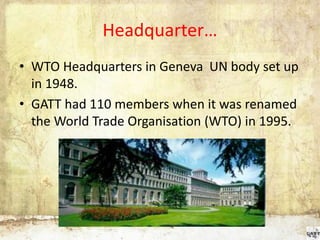
Headquarter…
• WTO Headquarters in Geneva UN body set up
in 1948.
• GATT had 110 members when it was renamed
the World Trade Organisation (WTO) in 1995.
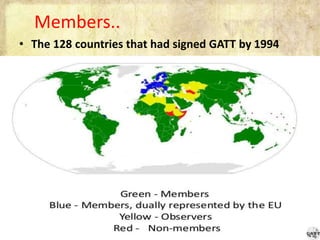
Members..
• The 128 countries that had signed GATT by 1994
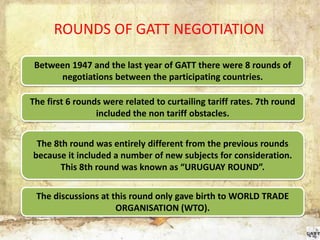
Between 1947 and the last year of GATT there were 8 rounds of
negotiations between the participating countries.
The first 6 rounds were related to curtailing tariff rates. 7th round
included the non tariff obstacles.
The 8th round was entirely different from the previous rounds
because it included a number of new subjects for consideration.
This 8th round was known as “URUGUAY ROUND”.
The discussions at this round only gave birth to WORLD TRADE
ORGANISATION (WTO).
ROUNDS OF GATT NEGOTIATION
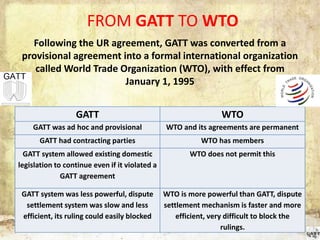
GATT WTO
GATT was ad hoc and provisional WTO and its agreements are permanent
GATT had contracting parties WTO has members
GATT system allowed existing domestic
legislation to continue even if it violated a
GATT agreement
WTO does not permit this
GATT system was less powerful, dispute
settlement system was slow and less
efficient, its ruling could easily blocked
WTO is more powerful than GATT, dispute
settlement mechanism is faster and more
efficient, very difficult to block the
rulings.
Following the UR agreement, GATT was converted from a
provisional agreement into a formal international organization
called World Trade Organization (WTO), with effect from
January 1, 1995
FROM GATT TO WTO
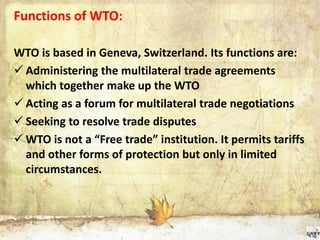
Functions of WTO:
WTO is based in Geneva, Switzerland. Its functions are:
 Administering the multilateral trade agreements
which together make up the WTO
 Acting as a forum for multilateral trade negotiations
 Seeking to resolve trade disputes
 WTO is not a “Free trade” institution. It permits tariffs
and other forms of protection but only in limited
circumstances.
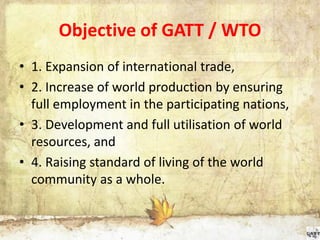
Objective of GATT / WTO
• 1. Expansion of international trade,
• 2. Increase of world production by ensuring
full employment in the participating nations,
• 3. Development and full utilisation of world
resources, and
• 4. Raising standard of living of the world
community as a whole.
Conclusion
• The creation of GATT-Negotiations in 1947
was but a big step towards trade
liberalization. Between 1947 and 1993 Eight-
GATT rounds have taken place for regulating
trade amongst nations and solving various
trade disputes.
Thank You…

Gatt.....niloy

  • 2.
    During great depressionof 1930’s the international trade was badly affected and various countries imposed import restrictions for safeguarding their economies. It resulted in sharp decline in world trade. 1n 1945, USA put forward many proposals for extending international trade and employment. On October 30th, 1947; 23 countries at Geneva signed an agreement related to tariffs imposed on trade. BACKGROUND
  • 3.
    Headquarter… • WTO Headquartersin Geneva UN body set up in 1948. • GATT had 110 members when it was renamed the World Trade Organisation (WTO) in 1995.
  • 4.
    Members.. • The 128countries that had signed GATT by 1994
  • 5.
    Between 1947 andthe last year of GATT there were 8 rounds of negotiations between the participating countries. The first 6 rounds were related to curtailing tariff rates. 7th round included the non tariff obstacles. The 8th round was entirely different from the previous rounds because it included a number of new subjects for consideration. This 8th round was known as “URUGUAY ROUND”. The discussions at this round only gave birth to WORLD TRADE ORGANISATION (WTO). ROUNDS OF GATT NEGOTIATION
  • 6.
    GATT WTO GATT wasad hoc and provisional WTO and its agreements are permanent GATT had contracting parties WTO has members GATT system allowed existing domestic legislation to continue even if it violated a GATT agreement WTO does not permit this GATT system was less powerful, dispute settlement system was slow and less efficient, its ruling could easily blocked WTO is more powerful than GATT, dispute settlement mechanism is faster and more efficient, very difficult to block the rulings. Following the UR agreement, GATT was converted from a provisional agreement into a formal international organization called World Trade Organization (WTO), with effect from January 1, 1995 FROM GATT TO WTO
  • 7.
    Functions of WTO: WTOis based in Geneva, Switzerland. Its functions are:  Administering the multilateral trade agreements which together make up the WTO  Acting as a forum for multilateral trade negotiations  Seeking to resolve trade disputes  WTO is not a “Free trade” institution. It permits tariffs and other forms of protection but only in limited circumstances.
  • 8.
    Objective of GATT/ WTO • 1. Expansion of international trade, • 2. Increase of world production by ensuring full employment in the participating nations, • 3. Development and full utilisation of world resources, and • 4. Raising standard of living of the world community as a whole.
  • 9.
    Conclusion • The creationof GATT-Negotiations in 1947 was but a big step towards trade liberalization. Between 1947 and 1993 Eight- GATT rounds have taken place for regulating trade amongst nations and solving various trade disputes.
  • 10.

Editor's Notes

  • #6 A tariff is a tax levied on imports or exports. Tariffs are usually associated with protectionism.