University of Dhaka
Department of Management Inf ormation Systems

Course No: EMIS-512
Course Title: International
Business
Group Term Paper
Title: World Trade Organization
(WTO)
Submitted By:
I. Ashik Ahmed
II. Md.Masud Kabir
III. Siraj-ud-Dawlla
IV. Lincoln Roy

03-026
03-048
12-038
14-035
What is WTO
The World Trade Organization (WTO) is the
only international organization dealing with
the global rules of trade between nations.
Its main function is to ensure that trade
flows as smoothly, predictably and freely as
possible.
History of WTO
The

World Trade Organization came into
being in 1995.

So

while the WTO is still young, the
multilateral trading system that was
originally set up under GATT is well over 50
years old.
HISTORY OF WTO
THE GATT YEARS: FROM HAVANA TO MARRAKESH

 Much

of the history of those 47 years was written
in Geneva. But it also traces a journey that
spanned the continents, from that hesitant start in
1948 in Havana (Cuba) and finally to Marrakesh
(Morocco) in 1994. During that period, the trading
system came under GATT, salvaged from the
aborted attempt to create the WTO.
Secretariat 
Location: Geneva, Switzerland
Established: 1 January 1995
Created by: Uruguay Round negotiations (198694)  
Membership: 153 countries on 10 February 2011
Budget: 196 million Swiss francs for 2011
Secretariat staff: 640
Head: Pascal Lamy (Director-General)
B
ANGLADESH B
ECOME MEMB ON  1ST  JANUAR 1995
ER
Y
Principles of the trading system
The

WTO agr eement s ar e lengt hy and
complex because t hey ar e legal t ext s cover ing
a wide r ange of act ivit ies. They deal wit h:
agr icult ur e, t ext iles and clot hing, banking,
t elecommunicat ions, gover nment pur chases,
indust r ial st andar ds and pr oduct saf et y and
mor e.
A closer look at t hese pr inciples:
1. Most- f avored- nation (MFN): Treating
other people equally
2. 2. National treatment: Treating f oreigners
and locals equally
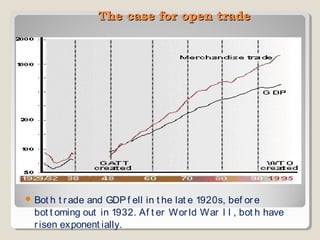
The case for open trade

 Bot h

t r ade and GDP f ell in t he lat e 1920s, bef or e
bot t oming out in 1932. Af t er Wor ld War I I , bot h have
r isen exponent ially.
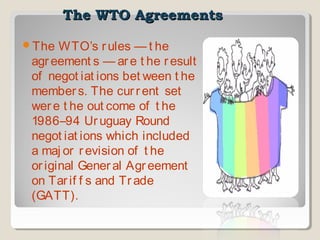
The WTO Agreements
The

WTO’s r ules — t he
agr eement s — ar e t he r esult
of negot iat ions bet ween t he
member s. The cur r ent set
wer e t he out come of t he
1986–94 Ur uguay Round
negot iat ions which included
a maj or r evision of t he
or iginal Gener al Agr eement
on Tar if f s and Tr ade
(GATT).
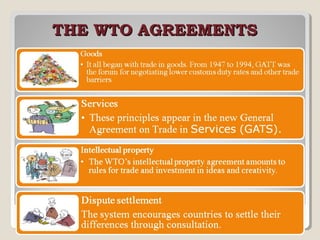
THE WTO AGREEMENTS
Developing Countries
Development and trade
Over

three quarters of WTO members are
developing or least-developed countries.
The 2001 Ministerial Conference in Doha
set out tasks, including negotiations, for a
wide range of issues concerning developing
countries.
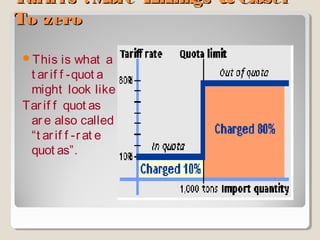
Tarif f s : More B
indings & Closer
To zero
This

is what a
t ar if f -quot a
might look like
Tar if f quot as
ar e also called
“t ar if f -r at e
quot as”.
 Technical Assistance and Training
Technical

r egulat ions and st andar ds
ar e impor t ant , but t hey var y f r om
count r y t o count r y. Having t oo many
dif f er ent st andar ds makes lif e
dif f icult f or pr oducer s and expor t er s.
I f t he st andar ds ar e set ar bit r ar ily,
t hey could be used as an excuse f or
pr ot ect ionism.
10 benefits of the WTO trading system
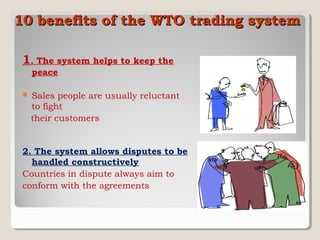
1. The system helps to keep the
peace


Sales people are usually reluctant
to fight
their customers

2. The system allows disputes to be
handled constructively
Countries in dispute always aim to
conform with the agreements
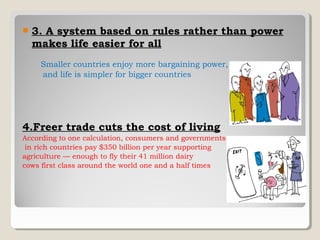
 3.

A system based on rules rather than power
makes life easier for all
Smaller countries enjoy more bargaining power,
and life is simpler for bigger countries

4.Freer trade cuts the cost of living
According to one calculation, consumers and governments
in rich countries pay $350 billion per year supporting
agriculture — enough to fly their 41 million dairy
cows first class around the world one and a half times
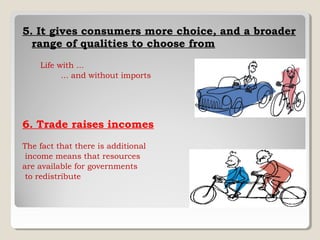
5. It gives consumers more choice, and a broader
range of qualities to choose from
Life with ...
... and without imports

6. Trade raises incomes
The fact that there is additional
income means that resources
are available for governments
to redistribute
7. Trade stimulates economic growth, and that
can be good news for employment
Careful policy-making
harnesses the job-creation
powers of freer trade

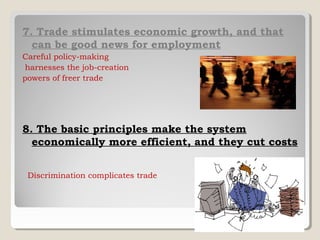
8. The basic principles make the system
economically more efficient, and they cut costs
Discrimination complicates trade
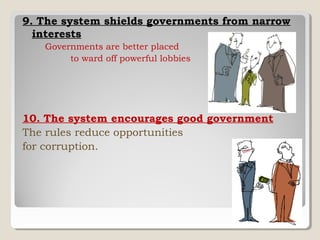
9. The system shields governments from narrow
interests
Governments are better placed
to ward off powerful lobbies

10. The system encourages good government
The rules reduce opportunities
for corruption.
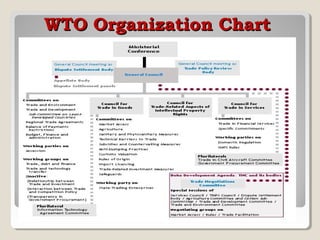
WTO Organization Chart
The WTO and other Organizations
 The

WTO works with a number of other
international governmental organizations under
the banner of “coherence”, which ministers
agreed in Marrakesh, April 1994.
 The WTO maintains extensive institutional
relations with several other international
organizations; there are some 140 international
organizations that have observer status in
WTOIn all, the WTO Secretariat maintains
working relations with almost 200 international
organizations in activities ranging from
statistics, research, standard-setting, and
technical assistance and training bodies.
CONCLUSION
Although continuing the future challenges,
the shared international experience of sixty
years of the GATT/WTO is a positive story.
Plenty of governments, non-state actors,
commentators and critics want to improve
the system, but very few would oppose its
core contribution to a more stable and
prosperous world. An exact look at the less
than fully resolved issues of the past, the
outstanding challenges, and the successes
will stimulate thought on how best to
manage the future.

WTO (World Trade Organization)

  • 1.
    University of Dhaka Departmentof Management Inf ormation Systems Course No: EMIS-512 Course Title: International Business Group Term Paper Title: World Trade Organization (WTO) Submitted By: I. Ashik Ahmed II. Md.Masud Kabir III. Siraj-ud-Dawlla IV. Lincoln Roy 03-026 03-048 12-038 14-035
  • 2.
    What is WTO TheWorld Trade Organization (WTO) is the only international organization dealing with the global rules of trade between nations. Its main function is to ensure that trade flows as smoothly, predictably and freely as possible.
  • 3.
    History of WTO The WorldTrade Organization came into being in 1995. So while the WTO is still young, the multilateral trading system that was originally set up under GATT is well over 50 years old.
  • 4.
    HISTORY OF WTO THEGATT YEARS: FROM HAVANA TO MARRAKESH  Much of the history of those 47 years was written in Geneva. But it also traces a journey that spanned the continents, from that hesitant start in 1948 in Havana (Cuba) and finally to Marrakesh (Morocco) in 1994. During that period, the trading system came under GATT, salvaged from the aborted attempt to create the WTO.
  • 5.
    Secretariat  Location: Geneva, Switzerland Established: 1 January 1995 Createdby: Uruguay Round negotiations (198694)   Membership: 153 countries on 10 February 2011 Budget: 196 million Swiss francs for 2011 Secretariat staff: 640 Head: Pascal Lamy (Director-General) B ANGLADESH B ECOME MEMB ON  1ST  JANUAR 1995 ER Y
  • 6.
    Principles of thetrading system The WTO agr eement s ar e lengt hy and complex because t hey ar e legal t ext s cover ing a wide r ange of act ivit ies. They deal wit h: agr icult ur e, t ext iles and clot hing, banking, t elecommunicat ions, gover nment pur chases, indust r ial st andar ds and pr oduct saf et y and mor e. A closer look at t hese pr inciples: 1. Most- f avored- nation (MFN): Treating other people equally 2. 2. National treatment: Treating f oreigners and locals equally
  • 7.
    The case foropen trade  Bot h t r ade and GDP f ell in t he lat e 1920s, bef or e bot t oming out in 1932. Af t er Wor ld War I I , bot h have r isen exponent ially.
  • 8.
    The WTO Agreements The WTO’sr ules — t he agr eement s — ar e t he r esult of negot iat ions bet ween t he member s. The cur r ent set wer e t he out come of t he 1986–94 Ur uguay Round negot iat ions which included a maj or r evision of t he or iginal Gener al Agr eement on Tar if f s and Tr ade (GATT).
  • 9.
  • 10.
    Developing Countries Development andtrade Over three quarters of WTO members are developing or least-developed countries. The 2001 Ministerial Conference in Doha set out tasks, including negotiations, for a wide range of issues concerning developing countries.
  • 11.
    Tarif f s: More B indings & Closer To zero This is what a t ar if f -quot a might look like Tar if f quot as ar e also called “t ar if f -r at e quot as”.
  • 12.
     Technical Assistance andTraining Technical r egulat ions and st andar ds ar e impor t ant , but t hey var y f r om count r y t o count r y. Having t oo many dif f er ent st andar ds makes lif e dif f icult f or pr oducer s and expor t er s. I f t he st andar ds ar e set ar bit r ar ily, t hey could be used as an excuse f or pr ot ect ionism.
  • 13.
    10 benefits ofthe WTO trading system 1. The system helps to keep the peace  Sales people are usually reluctant to fight their customers 2. The system allows disputes to be handled constructively Countries in dispute always aim to conform with the agreements
  • 14.
     3. A systembased on rules rather than power makes life easier for all Smaller countries enjoy more bargaining power, and life is simpler for bigger countries 4.Freer trade cuts the cost of living According to one calculation, consumers and governments in rich countries pay $350 billion per year supporting agriculture — enough to fly their 41 million dairy cows first class around the world one and a half times
  • 15.
    5. It givesconsumers more choice, and a broader range of qualities to choose from Life with ... ... and without imports 6. Trade raises incomes The fact that there is additional income means that resources are available for governments to redistribute
  • 16.
    7. Trade stimulateseconomic growth, and that can be good news for employment Careful policy-making harnesses the job-creation powers of freer trade 8. The basic principles make the system economically more efficient, and they cut costs Discrimination complicates trade
  • 17.
    9. The systemshields governments from narrow interests Governments are better placed to ward off powerful lobbies 10. The system encourages good government The rules reduce opportunities for corruption.
  • 18.
  • 19.
    The WTO andother Organizations  The WTO works with a number of other international governmental organizations under the banner of “coherence”, which ministers agreed in Marrakesh, April 1994.  The WTO maintains extensive institutional relations with several other international organizations; there are some 140 international organizations that have observer status in WTOIn all, the WTO Secretariat maintains working relations with almost 200 international organizations in activities ranging from statistics, research, standard-setting, and technical assistance and training bodies.
  • 20.
    CONCLUSION Although continuing thefuture challenges, the shared international experience of sixty years of the GATT/WTO is a positive story. Plenty of governments, non-state actors, commentators and critics want to improve the system, but very few would oppose its core contribution to a more stable and prosperous world. An exact look at the less than fully resolved issues of the past, the outstanding challenges, and the successes will stimulate thought on how best to manage the future.