Summarising and Synthesising for PG
Assignments
Describe and apply techniques to summarise your
reading
Synthesise your summaries in a range of different
ways
Support your points with your reading
What is the
difference
between
paraphrasing and
summarising?
Does A or B describe a paraphrase?
A) Using your own words to draw out and
represent the key points of the text.
Provides a brief overview of an idea.
B) Putting the ideas of the author into your
own words. Use when you need to refer to a
fuller amount of information than a
summary would allow. For example, you
may need to discuss in some depth a
particular research paper and its findings.
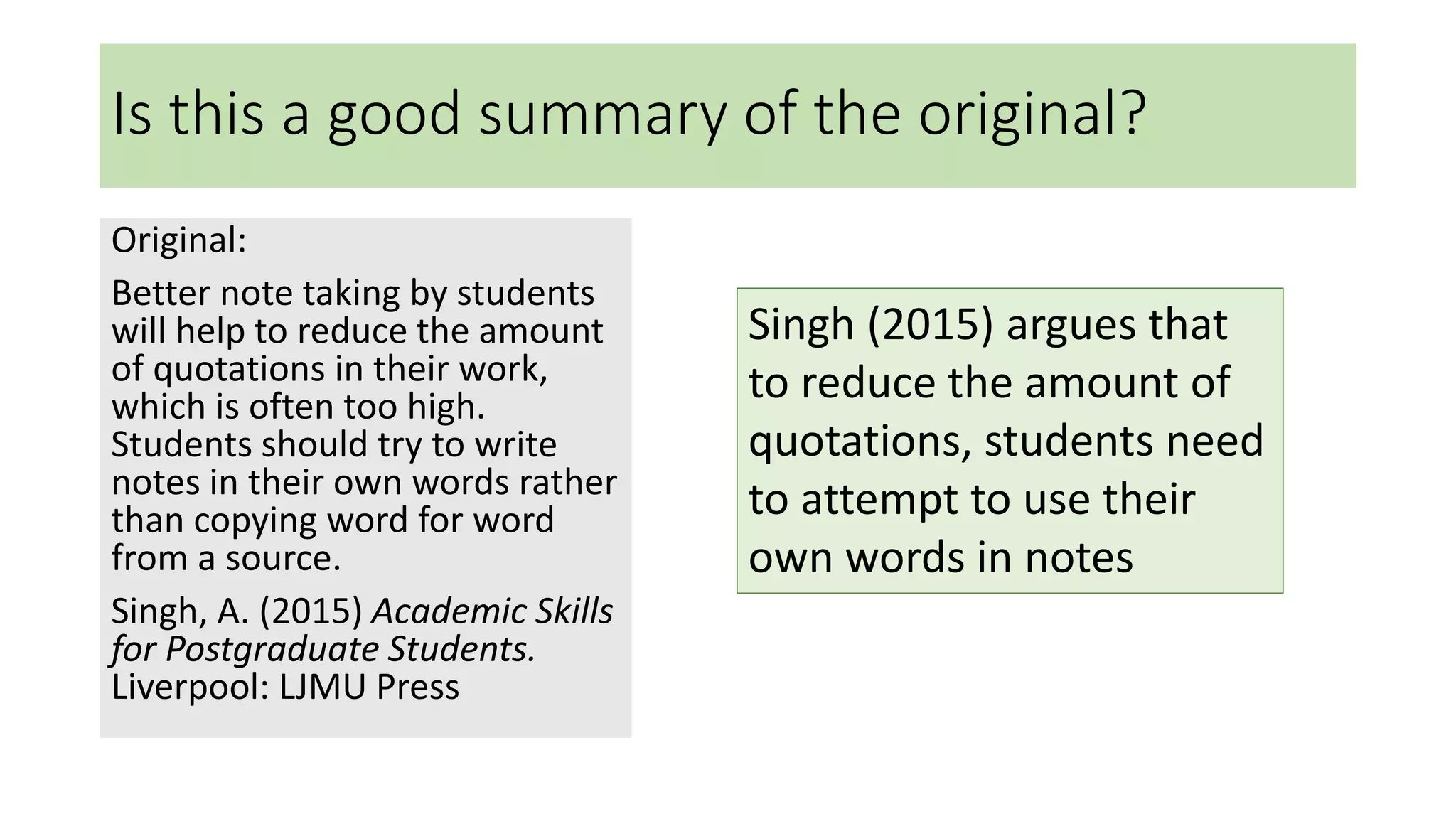
Is this a good summary of the original?
Original:
Better note taking by students
will help to reduce the amount
of quotations in their work,
which is often too high.
Students should try to write
notes in their own words rather
than copying word for word
from a source.
Singh, A. (2015) Academic Skills
for Postgraduate Students.
Liverpool: LJMU Press
Singh (2015) argues that
to reduce the amount of
quotations, students need
to attempt to use their
own words in notes
Better….
Original:
Better note taking by students
will help to reduce the amount
of quotations in their work,
which is often too high.
Students should try to write
notes in their own words rather
than copying word for word
from a source.
Singh, A. (2015) Academic Skills
for Postgraduate Students.
Liverpool: LJMU Press
When reading, students
should make just a few
notes and without
copying so that they use
fewer quotations (Singh,
2015).
Why should you
summarise or paraphrase?
• Academic integrity: avoiding plagiarism.
• Demonstrates your understanding of what you
have read.
• Provides support for your own claims: credibility.
• Enables you to develop your own academic
voice.
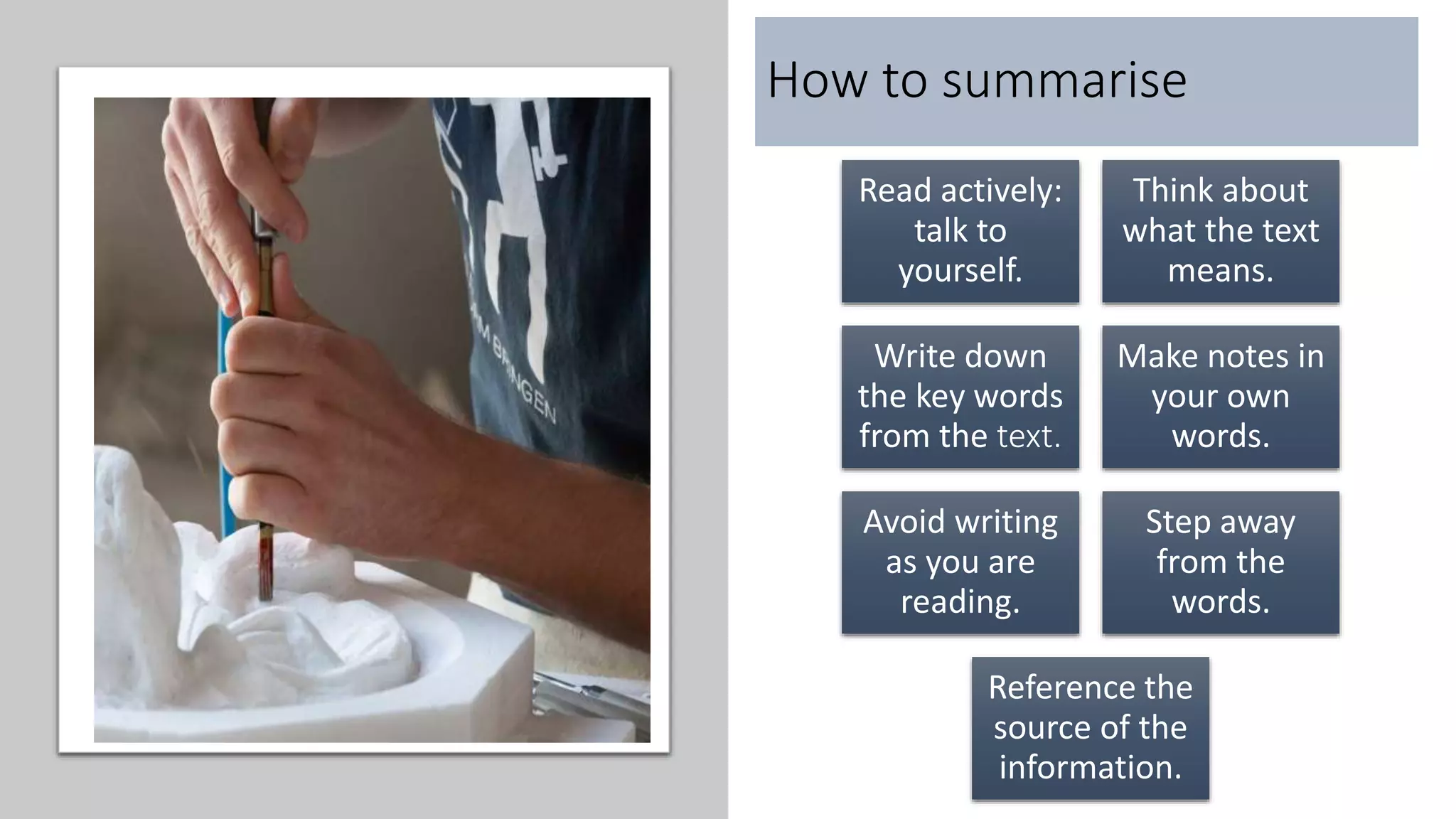
How to summarise
Read actively:
talk to
yourself.
Think about
what the text
means.
Write down
the key words
from the text.
Make notes in
your own
words.
Avoid writing
as you are
reading.
Step away
from the
words.
Reference the
source of the
information.
• Use the same technique as
summarising but then go back
and highlight the key
information that helps to
explain the main points.
• You may need to revisit the
text a number of times.
How to paraphrase
For example….
Original:
Better note taking by students
will help to reduce the amount
of quotations in their work,
which is often too high.
Students should try to write
notes in their own words rather
than copying word for word
from a source.
Singh, A. (2015) Academic Skills
for Postgraduate Students.
Liverpool: LJMU Press
According to Singh (2015), in
research papers students
often quote excessively, failing
to keep quoted material down
to a desirable level. Since the
problem usually originates
during note taking, it is
essential to minimize the
material recorded verbatim.
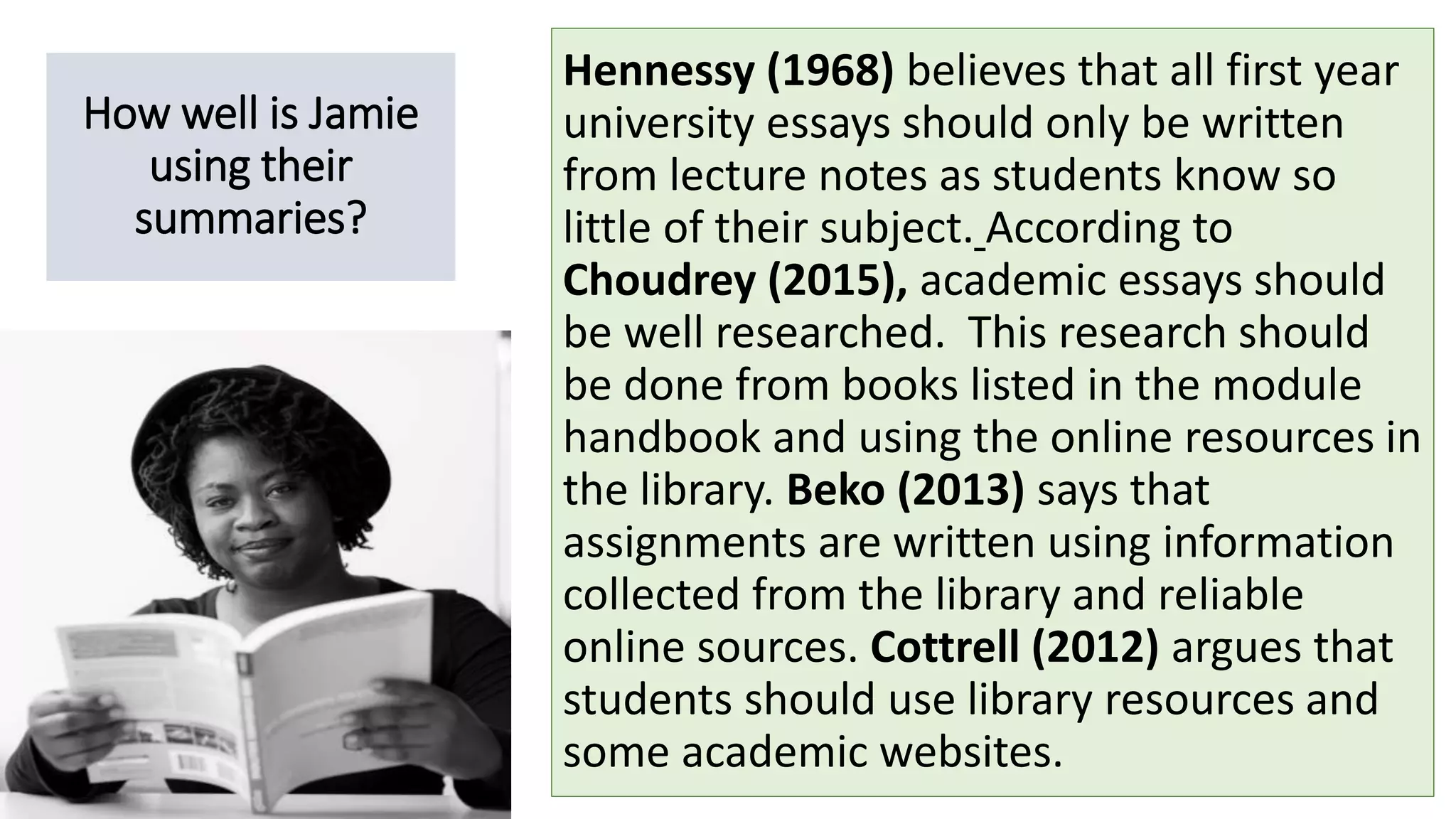
How well is Jamie
using their
summaries?
Hennessy (1968) believes that all first year
university essays should only be written
from lecture notes as students know so
little of their subject. According to
Choudrey (2015), academic essays should
be well researched. This research should
be done from books listed in the module
handbook and using the online resources in
the library. Beko (2013) says that
assignments are written using information
collected from the library and reliable
online sources. Cottrell (2012) argues that
students should use library resources and
some academic websites.
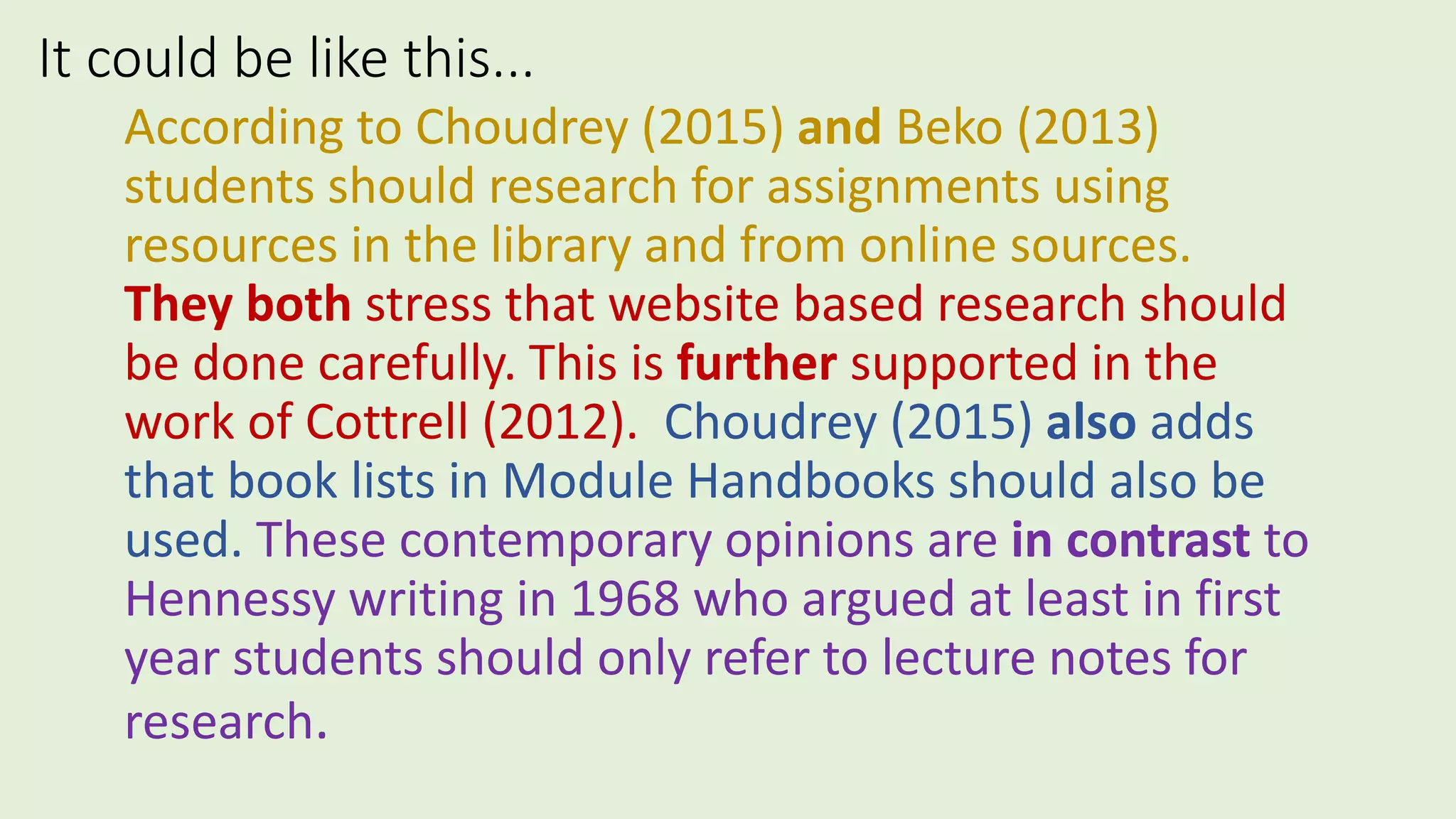
It could be like this...
According to Choudrey (2015) and Beko (2013)
students should research for assignments using
resources in the library and from online sources.
They both stress that website based research should
be done carefully. This is further supported in the
work of Cottrell (2012). Choudrey (2015) also adds
that book lists in Module Handbooks should also be
used. These contemporary opinions are in contrast to
Hennessy writing in 1968 who argued at least in first
year students should only refer to lecture notes for
research.
Jamie needed to synthesise
their reading.
This means you need to
analyse, compare and
contrast your reading
before you can use it in
your writing.
‘Zoom in and zoom out’
‘Zooming out’
• Make comparisons and connections
• Position key points against each other
• Identify themes and trends
• Areas of agreement or disagreement
This is where you start to position yourself.
A) Synthesis B) Not synthesis
Research into mega-events has highlighted their
positive economic impact (Getz and Page, 2016), which
Kasimati (2003) has demonstrated to be frequently
used as justification for event bidding.
This has been argued by both Kapalnidou (2013) and
Chun Ma (2016) to positively affect the social needs of
residents, thus reinforcing the notion that the
economic impacts of hosting a mega-event can act as a
basis for achieving wider social needs.
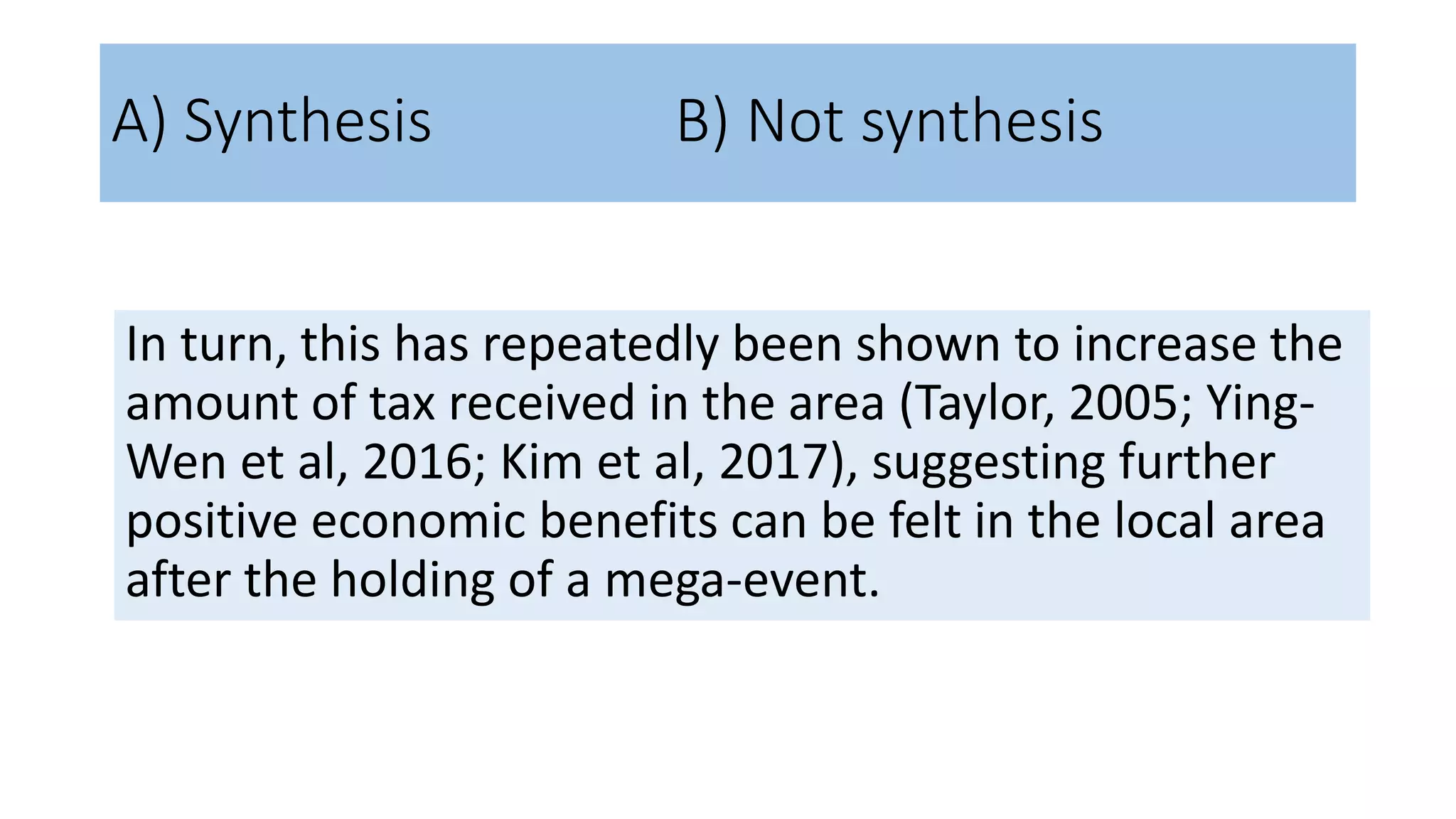
A) Synthesis B) Not synthesis
In turn, this has repeatedly been shown to increase the
amount of tax received in the area (Taylor, 2005; Ying-
Wen et al, 2016; Kim et al, 2017), suggesting further
positive economic benefits can be felt in the local area
after the holding of a mega-event.
A) Synthesis B) Not synthesis
Lee et al., (2017) emphasise the impact of permanent
jobs being created by the hosting of a mega-event and
therefore the long term benefits they bring, but the
figures they present are relatively modest. Taylor’s
convincing longitudinal study (2005) is part of a body of
literature that notes that most employment generated
by hosting events is in fact not permanent due to the
very nature of those events.
A) Synthesis B) Not synthesis
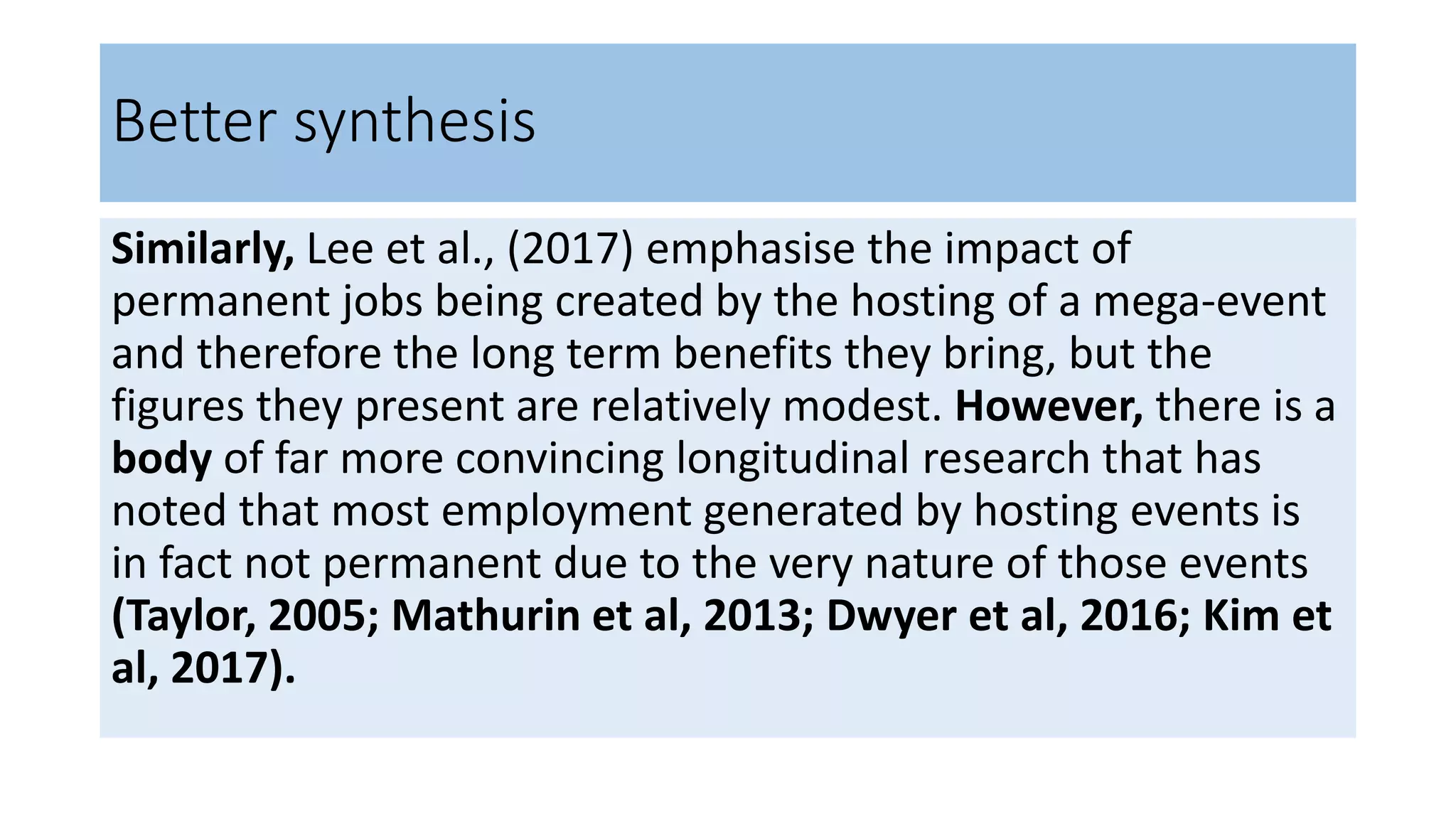
Better synthesis
Similarly, Lee et al., (2017) emphasise the impact of
permanent jobs being created by the hosting of a mega-event
and therefore the long term benefits they bring, but the
figures they present are relatively modest. However, there is a
body of far more convincing longitudinal research that has
noted that most employment generated by hosting events is
in fact not permanent due to the very nature of those events
(Taylor, 2005; Mathurin et al, 2013; Dwyer et al, 2016; Kim et
al, 2017).
Using the synthesis to support a point: using
your voice
Ultimately then, despite some positive economic
impact of hosting a mega-event, the research suggests
that that any economic boost experienced individually
and by the wider community is only temporary. This
may be due to a number of factors, such as
employment they generate tends to be fixed term and
zero hours.
Let’s go back to this...how would you use it to
support a point?
According to Choudrey (2015) and Beko (2013) students should
research for assignments using resources in the library and from
online sources. They both stress that website based research
should be done carefully. This is further supported in the work of
Cottrell (2012). Choudrey (2015) also adds that book lists in
Module Handbooks should also be used. These contemporary
opinions are in contrast to Hennessy writing in 1968 who argued at
least in first year students should only refer to lecture notes for
research.
How to achieve this
Author,
title
Topic Key idea Strength
Weakness
How to use Analysis
Contrast
with…
Show
agreement
with…
Reflection…..
• Which aspects of using your reading
would you now make sure you
remember?
• How will you make those
improvements?
Next steps:
Next Wednesday:
Writing with Critical Analysis
(building on your summaries and
syntheses)
Developing your academic language
(will help you to integrate your
reading into
your writing and find your voice)

Pg summarising and synthesising webinar

  • 1.
    Summarising and Synthesisingfor PG Assignments Describe and apply techniques to summarise your reading Synthesise your summaries in a range of different ways Support your points with your reading
  • 2.
    What is the difference between paraphrasingand summarising? Does A or B describe a paraphrase? A) Using your own words to draw out and represent the key points of the text. Provides a brief overview of an idea. B) Putting the ideas of the author into your own words. Use when you need to refer to a fuller amount of information than a summary would allow. For example, you may need to discuss in some depth a particular research paper and its findings.
  • 3.
    Is this agood summary of the original? Original: Better note taking by students will help to reduce the amount of quotations in their work, which is often too high. Students should try to write notes in their own words rather than copying word for word from a source. Singh, A. (2015) Academic Skills for Postgraduate Students. Liverpool: LJMU Press Singh (2015) argues that to reduce the amount of quotations, students need to attempt to use their own words in notes
  • 4.
    Better…. Original: Better note takingby students will help to reduce the amount of quotations in their work, which is often too high. Students should try to write notes in their own words rather than copying word for word from a source. Singh, A. (2015) Academic Skills for Postgraduate Students. Liverpool: LJMU Press When reading, students should make just a few notes and without copying so that they use fewer quotations (Singh, 2015).
  • 5.
    Why should you summariseor paraphrase? • Academic integrity: avoiding plagiarism. • Demonstrates your understanding of what you have read. • Provides support for your own claims: credibility. • Enables you to develop your own academic voice.
  • 6.
    How to summarise Readactively: talk to yourself. Think about what the text means. Write down the key words from the text. Make notes in your own words. Avoid writing as you are reading. Step away from the words. Reference the source of the information.
  • 7.
    • Use thesame technique as summarising but then go back and highlight the key information that helps to explain the main points. • You may need to revisit the text a number of times. How to paraphrase
  • 8.
    For example…. Original: Better notetaking by students will help to reduce the amount of quotations in their work, which is often too high. Students should try to write notes in their own words rather than copying word for word from a source. Singh, A. (2015) Academic Skills for Postgraduate Students. Liverpool: LJMU Press According to Singh (2015), in research papers students often quote excessively, failing to keep quoted material down to a desirable level. Since the problem usually originates during note taking, it is essential to minimize the material recorded verbatim.
  • 9.
    How well isJamie using their summaries? Hennessy (1968) believes that all first year university essays should only be written from lecture notes as students know so little of their subject. According to Choudrey (2015), academic essays should be well researched. This research should be done from books listed in the module handbook and using the online resources in the library. Beko (2013) says that assignments are written using information collected from the library and reliable online sources. Cottrell (2012) argues that students should use library resources and some academic websites.
  • 10.
    It could belike this... According to Choudrey (2015) and Beko (2013) students should research for assignments using resources in the library and from online sources. They both stress that website based research should be done carefully. This is further supported in the work of Cottrell (2012). Choudrey (2015) also adds that book lists in Module Handbooks should also be used. These contemporary opinions are in contrast to Hennessy writing in 1968 who argued at least in first year students should only refer to lecture notes for research.
  • 11.
    Jamie needed tosynthesise their reading. This means you need to analyse, compare and contrast your reading before you can use it in your writing. ‘Zoom in and zoom out’
  • 12.
    ‘Zooming out’ • Makecomparisons and connections • Position key points against each other • Identify themes and trends • Areas of agreement or disagreement This is where you start to position yourself.
  • 13.
    A) Synthesis B)Not synthesis Research into mega-events has highlighted their positive economic impact (Getz and Page, 2016), which Kasimati (2003) has demonstrated to be frequently used as justification for event bidding.
  • 14.
    This has beenargued by both Kapalnidou (2013) and Chun Ma (2016) to positively affect the social needs of residents, thus reinforcing the notion that the economic impacts of hosting a mega-event can act as a basis for achieving wider social needs. A) Synthesis B) Not synthesis
  • 15.
    In turn, thishas repeatedly been shown to increase the amount of tax received in the area (Taylor, 2005; Ying- Wen et al, 2016; Kim et al, 2017), suggesting further positive economic benefits can be felt in the local area after the holding of a mega-event. A) Synthesis B) Not synthesis
  • 16.
    Lee et al.,(2017) emphasise the impact of permanent jobs being created by the hosting of a mega-event and therefore the long term benefits they bring, but the figures they present are relatively modest. Taylor’s convincing longitudinal study (2005) is part of a body of literature that notes that most employment generated by hosting events is in fact not permanent due to the very nature of those events. A) Synthesis B) Not synthesis
  • 17.
    Better synthesis Similarly, Leeet al., (2017) emphasise the impact of permanent jobs being created by the hosting of a mega-event and therefore the long term benefits they bring, but the figures they present are relatively modest. However, there is a body of far more convincing longitudinal research that has noted that most employment generated by hosting events is in fact not permanent due to the very nature of those events (Taylor, 2005; Mathurin et al, 2013; Dwyer et al, 2016; Kim et al, 2017).
  • 18.
    Using the synthesisto support a point: using your voice Ultimately then, despite some positive economic impact of hosting a mega-event, the research suggests that that any economic boost experienced individually and by the wider community is only temporary. This may be due to a number of factors, such as employment they generate tends to be fixed term and zero hours.
  • 19.
    Let’s go backto this...how would you use it to support a point? According to Choudrey (2015) and Beko (2013) students should research for assignments using resources in the library and from online sources. They both stress that website based research should be done carefully. This is further supported in the work of Cottrell (2012). Choudrey (2015) also adds that book lists in Module Handbooks should also be used. These contemporary opinions are in contrast to Hennessy writing in 1968 who argued at least in first year students should only refer to lecture notes for research.
  • 20.
    How to achievethis Author, title Topic Key idea Strength Weakness How to use Analysis Contrast with… Show agreement with…
  • 21.
    Reflection….. • Which aspectsof using your reading would you now make sure you remember? • How will you make those improvements?
  • 22.
    Next steps: Next Wednesday: Writingwith Critical Analysis (building on your summaries and syntheses) Developing your academic language (will help you to integrate your reading into your writing and find your voice)

Editor's Notes

  • #8 Talk through this, highlighting how it’s been done
  • #10 Do this as whole group q and a
  • #21 Explain how this can organise their reading into themes ready for planning, even down to paragraph level with some compare and contrast etc. It also makes them analyse as they read. I’ve put the critical analysis bit of reading/notes in red. Talk in more detail about how this relates to CA – id of point, evidence, strengths and weakness, compare and contrast, own thoughts triggered. The purple is for them to see how they can colour code themes – very useful for their lit review structure and discussing their findings by theme. So note-making effectively also helps with planning their writing. Lots here, I suppose, but I usually just use this as a springboard to waffle on about anything that could be relevant depending on what the have already said about their own dissertations.. Mind mapping also works but use the same features – really spend some time on this, asking fro examples etc and emphasising the way in which you draw links between works and identify themes
  • #22 2-3 minutes Go around the class and ask each student for their areas (feel confident about [to acknowledge that there are good things about their own writing] and one to improve on) – push them on how they will action their improvement to assess their learning and make the plenary action-focused.