A quick view over
WRITING REPORTS
Presented by:
Khaled Bouokkez
What is a report?
A report is a statement of the results of an
investigation or any matter on which definite
information is required.
(Oxford English Dictionary)
The purpose!!
The report exists to provide the reader with useful
information.
Reports are a highly structured form of writing
often following conventions that have been laid
down to produce a common format.
Structure and convention in written reports stress
the process by which the information was
gathered as much as the information itself.
Objectives of writing reports:
• To take decisions
• To coordinate
• To follow up
• To verify
• To measure
• To determine
• To compare
• To calculate
• To modify
• To develop, update, improve
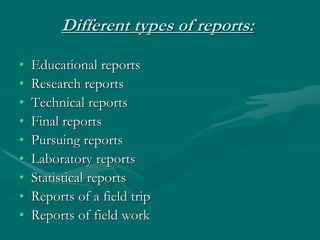
Different types of reports:
• Educational reports
• Research reports
• Technical reports
• Final reports
• Pursuing reports
• Laboratory reports
• Statistical reports
• Reports of a field trip
• Reports of field work
Stages in report writing:
• Clarifying your terms of reference
• Planning your work
• Collecting your information
• Organizing and structuring your information
• Writing the first draft
• Checking and re-drafting
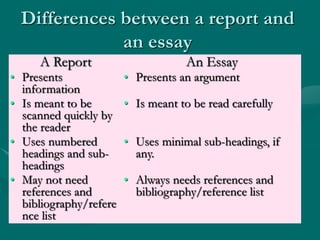
Differences between a report and
an essay
A Report An Essay
• Presents
information
• Presents an argument
• Is meant to be
scanned quickly by
the reader
• Is meant to be read carefully
• Uses numbered
headings and sub-
headings
• Uses minimal sub-headings, if
any.
• May not need
references and
bibliography/refere
nce list
• Always needs references and
bibliography/reference list
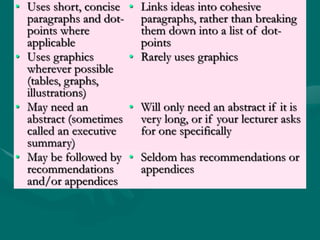
• Uses short, concise
paragraphs and dot-
points where
applicable
• Links ideas into cohesive
paragraphs, rather than breaking
them down into a list of dot-
points
• Uses graphics
wherever possible
(tables, graphs,
illustrations)
• Rarely uses graphics
• May need an
abstract (sometimes
called an executive
summary)
• Will only need an abstract if it is
very long, or if your lecturer asks
for one specifically
• May be followed by
recommendations
and/or appendices
• Seldom has recommendations or
appendices
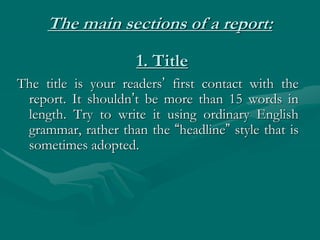
The main sections of a report:
The title is your readers’ first contact with the
report. It shouldn’t be more than 15 words in
length. Try to write it using ordinary English
grammar, rather than the “headline” style that is
sometimes adopted.
1. Title
Example:
“PC business program comparison
survey”
2. Abstract or summary:
The abstract is like a mini report. It summarizes
the whole report in one concise paragraph of
about 100-200 words, so it is not important to
give detailed information in the summary. It’s
sufficient to inform the reader what was carried
out and what results of this investigation were.
For a short report a summary of about 100-150
words is enough; for a major research report, a
summary maybe as long as one page. Although it
must be brief, the summary should be written in
complete sentences, not as notes.
3. Introduction:
The introduction answers the following questions:
• Why is the report being written?
• What kind of information does it contain?
• How is the problem being approached?
• For whom is the report being written?
4. Methods and materials:
This section answers the questions:
• What did I do?
• How did I do it?
• What did I do it with?
5. Results/Findings:
This is the place where you present your evidence.
It should be organized logically so that your
conclusions arise naturally from the facts you
have written. It is important to confine yourself,
stick on facts and resist the temptation to
indulge in personal views. It’s sometimes helpful
to use tables, diagrams or graphs to make your
information more easily understood. Make sure
that graphs and diagrams are well constructed to
make the information easy to understand. A
badly-constructed diagram or graph can make
the information more confusing.
There are a number of
ways in which results can
be presented.
Here are a few :
• Tables
• Graphs
• Pie charts
• Bar charts
• Diagrams
6. Discussion:
In this section, you must briefly describe again in
your own words your results or research
findings and, at greater length, interpret them
with regards to what was expected. You are also
expected to mention problems or elements of
the research that didn’t work out. This is a
crucial part of the report since it is here that you
show your understanding of what you have done
and its context.
7. Conclusions and recommendations:
This is the section of the report which draws
together the main issues. It should be expressed
clearly and shouldn’t present any new
information. You may wish to list your
recommendations in a separate section or
include them with the conclusion. In some
report, styles, the results, discussion, and
conclusion sections can be combined in various
ways.
8.Methodology
• In this section you should state how you carried
out your enquiry. What form did your enquiry
take ? Did you carry out interviews or
questionnaires, how did you collect your data ?
What measurements did you make ? How did
you choose the subjects for your interviews ?
Present this information logically and concisely.
9. References:
Most reports require references at the end. You should give
precise details of all the work by other authors which has been
referred to within the report. Details should include:
• Author’s name and initials
• Date of publication
• Title of the book, paper or journal
• Publisher
• Place of publication
• Page numbers
• Details of the journal volume in which the article has appeared
References should be listed in alphabetical order of the authors’
names. Also make sure that your references are accurate and
comprehensive.
10. Appendices:
An appendix contains additional information
related to the report but which is not essential to
the main findings. This can be consulted if the
reader wishes. Remember you must refer to each
appendix at the appropriate point (or points) in
your report.
Written Style
Gowers (1973) says that the purpose of good style
is to affect the reader. Good style simply means
choosing ways of expressing yourself that will
communicate your ideas clearly. Style is,
therefore, a matter of good manners - of putting
yourself in your readers’ place so that you don’t
make unnecessary demands on them. Your
readers shouldn’t have to struggle to work out
the meaning of what you write.
The elements of style can be summed up vey simply:
be brief; be clear; be human.
Try to avoid phrases that add nothing to your
meaning or could be replaced by one word, e.g.
• Due to the fact that = because
• On a daily basis = daily
• Of a complex nature= complex
Be brief:
Please Read This
“It is of importance to bear in mind the fact
that the Minister’s views in this connection,
which were indicated at the meeting, were
that it was a matter of prime importance
that local authorities appreciate that
information concerning possible breaches
of the regulations should be communicated
to the investigating officers of the ministry
without undue delay.” (57 words)
This could be written:
“The Minister wants Local authorities
to communicate information
concerning possible breaches of the
regulations as soon as possible and
without delay .” (21 words)
Be clear:
“CHIP SHOP OWNER DEATH SCANDAL”.
Here we don’t know whether the chip shop owner found
someone dead, was found dead, killed someone, was
killed, or perhaps, was poisoning customers.
Avoid confusing your readers. Take care to use words
which have the precise meaning you intend to convey,
and, when you have the choice, choose words which
are most easily understood. Avoid words with vague
meanings. It is usually better to use concrete rather
than abstract nouns and to use verbs rather than
nouns. This will make your point more strongly.
Be human:
Your readers will find what you write easier to read if they
feel that a human being has written the text and that you
have understood their needs as human beings. In
particular, try to use active rather than passive voice
forms of verbs. For example, compare the following
statements:
• Performance has improved.
• An improvement in performance has been recorded.
The first is active: it is short and to the point, but the
second is passive; it requires more words and ends up
saying something less clearly.
Things to consider when writing
the report
• Avoid mixing voices (active and passive)
• Simplicity: avoid complicated language.
• Avoid subjective/personal language and use
objective instead.
• Use a progressive numbering system.
• Leave wide margins for binding and feedback
comments from your tutor.
• Paragraphs should be short and concise.
• Headings should be clear - highlighted in bold
• or underlined.
• • All diagrams and illustrations should be
• labeled and numbered.
• • All standard units, measurements and technical
• terminology should be listed in a glossary of
• terms at the back of your report.
Task:
Fill in the report with these headings
• Findings
• Executive summary
• Introduction
• references
• Discussion
• Conclusion
• Recommendations
and
implementation
• Table of content

writing-reports-khalid.pptx

  • 1.
    A quick viewover WRITING REPORTS Presented by: Khaled Bouokkez
  • 4.
    What is areport? A report is a statement of the results of an investigation or any matter on which definite information is required. (Oxford English Dictionary)
  • 5.
    The purpose!! The reportexists to provide the reader with useful information. Reports are a highly structured form of writing often following conventions that have been laid down to produce a common format. Structure and convention in written reports stress the process by which the information was gathered as much as the information itself.
  • 6.
    Objectives of writingreports: • To take decisions • To coordinate • To follow up • To verify • To measure • To determine • To compare • To calculate • To modify • To develop, update, improve
  • 7.
    Different types ofreports: • Educational reports • Research reports • Technical reports • Final reports • Pursuing reports • Laboratory reports • Statistical reports • Reports of a field trip • Reports of field work
  • 8.
    Stages in reportwriting: • Clarifying your terms of reference • Planning your work • Collecting your information • Organizing and structuring your information • Writing the first draft • Checking and re-drafting
  • 9.
    Differences between areport and an essay A Report An Essay • Presents information • Presents an argument • Is meant to be scanned quickly by the reader • Is meant to be read carefully • Uses numbered headings and sub- headings • Uses minimal sub-headings, if any. • May not need references and bibliography/refere nce list • Always needs references and bibliography/reference list
  • 10.
    • Uses short,concise paragraphs and dot- points where applicable • Links ideas into cohesive paragraphs, rather than breaking them down into a list of dot- points • Uses graphics wherever possible (tables, graphs, illustrations) • Rarely uses graphics • May need an abstract (sometimes called an executive summary) • Will only need an abstract if it is very long, or if your lecturer asks for one specifically • May be followed by recommendations and/or appendices • Seldom has recommendations or appendices
  • 11.
    The main sectionsof a report: The title is your readers’ first contact with the report. It shouldn’t be more than 15 words in length. Try to write it using ordinary English grammar, rather than the “headline” style that is sometimes adopted. 1. Title
  • 12.
    Example: “PC business programcomparison survey”
  • 13.
    2. Abstract orsummary: The abstract is like a mini report. It summarizes the whole report in one concise paragraph of about 100-200 words, so it is not important to give detailed information in the summary. It’s sufficient to inform the reader what was carried out and what results of this investigation were. For a short report a summary of about 100-150 words is enough; for a major research report, a summary maybe as long as one page. Although it must be brief, the summary should be written in complete sentences, not as notes.
  • 14.
    3. Introduction: The introductionanswers the following questions: • Why is the report being written? • What kind of information does it contain? • How is the problem being approached? • For whom is the report being written?
  • 15.
    4. Methods andmaterials: This section answers the questions: • What did I do? • How did I do it? • What did I do it with?
  • 16.
    5. Results/Findings: This isthe place where you present your evidence. It should be organized logically so that your conclusions arise naturally from the facts you have written. It is important to confine yourself, stick on facts and resist the temptation to indulge in personal views. It’s sometimes helpful to use tables, diagrams or graphs to make your information more easily understood. Make sure that graphs and diagrams are well constructed to make the information easy to understand. A badly-constructed diagram or graph can make the information more confusing.
  • 17.
    There are anumber of ways in which results can be presented. Here are a few : • Tables • Graphs • Pie charts • Bar charts • Diagrams
  • 18.
    6. Discussion: In thissection, you must briefly describe again in your own words your results or research findings and, at greater length, interpret them with regards to what was expected. You are also expected to mention problems or elements of the research that didn’t work out. This is a crucial part of the report since it is here that you show your understanding of what you have done and its context.
  • 19.
    7. Conclusions andrecommendations: This is the section of the report which draws together the main issues. It should be expressed clearly and shouldn’t present any new information. You may wish to list your recommendations in a separate section or include them with the conclusion. In some report, styles, the results, discussion, and conclusion sections can be combined in various ways.
  • 20.
    8.Methodology • In thissection you should state how you carried out your enquiry. What form did your enquiry take ? Did you carry out interviews or questionnaires, how did you collect your data ? What measurements did you make ? How did you choose the subjects for your interviews ? Present this information logically and concisely.
  • 21.
    9. References: Most reportsrequire references at the end. You should give precise details of all the work by other authors which has been referred to within the report. Details should include: • Author’s name and initials • Date of publication • Title of the book, paper or journal • Publisher • Place of publication • Page numbers • Details of the journal volume in which the article has appeared References should be listed in alphabetical order of the authors’ names. Also make sure that your references are accurate and comprehensive.
  • 22.
    10. Appendices: An appendixcontains additional information related to the report but which is not essential to the main findings. This can be consulted if the reader wishes. Remember you must refer to each appendix at the appropriate point (or points) in your report.
  • 23.
    Written Style Gowers (1973)says that the purpose of good style is to affect the reader. Good style simply means choosing ways of expressing yourself that will communicate your ideas clearly. Style is, therefore, a matter of good manners - of putting yourself in your readers’ place so that you don’t make unnecessary demands on them. Your readers shouldn’t have to struggle to work out the meaning of what you write.
  • 24.
    The elements ofstyle can be summed up vey simply: be brief; be clear; be human. Try to avoid phrases that add nothing to your meaning or could be replaced by one word, e.g. • Due to the fact that = because • On a daily basis = daily • Of a complex nature= complex Be brief:
  • 25.
    Please Read This “Itis of importance to bear in mind the fact that the Minister’s views in this connection, which were indicated at the meeting, were that it was a matter of prime importance that local authorities appreciate that information concerning possible breaches of the regulations should be communicated to the investigating officers of the ministry without undue delay.” (57 words)
  • 26.
    This could bewritten: “The Minister wants Local authorities to communicate information concerning possible breaches of the regulations as soon as possible and without delay .” (21 words)
  • 27.
    Be clear: “CHIP SHOPOWNER DEATH SCANDAL”. Here we don’t know whether the chip shop owner found someone dead, was found dead, killed someone, was killed, or perhaps, was poisoning customers. Avoid confusing your readers. Take care to use words which have the precise meaning you intend to convey, and, when you have the choice, choose words which are most easily understood. Avoid words with vague meanings. It is usually better to use concrete rather than abstract nouns and to use verbs rather than nouns. This will make your point more strongly.
  • 28.
    Be human: Your readerswill find what you write easier to read if they feel that a human being has written the text and that you have understood their needs as human beings. In particular, try to use active rather than passive voice forms of verbs. For example, compare the following statements: • Performance has improved. • An improvement in performance has been recorded. The first is active: it is short and to the point, but the second is passive; it requires more words and ends up saying something less clearly.
  • 29.
    Things to considerwhen writing the report • Avoid mixing voices (active and passive) • Simplicity: avoid complicated language. • Avoid subjective/personal language and use objective instead. • Use a progressive numbering system. • Leave wide margins for binding and feedback comments from your tutor.
  • 30.
    • Paragraphs shouldbe short and concise. • Headings should be clear - highlighted in bold • or underlined. • • All diagrams and illustrations should be • labeled and numbered. • • All standard units, measurements and technical • terminology should be listed in a glossary of • terms at the back of your report.
  • 31.
    Task: Fill in thereport with these headings • Findings • Executive summary • Introduction • references • Discussion • Conclusion • Recommendations and implementation • Table of content