What is a Research Report?
A research report is a completed study that
reports an investigation or exploration of a
problem, identifies questions to be
addressed, and includes data collected,
analyzed, and interpreted by the researcher.
Difference Between Research Report
& Research Proposal
Research Report
 A research report is
prepared after a study
is completed.
 A research report
communicates what was
actually done in a study,
and what resulted.
Research Proposal
 A research proposal is
Prepared before a study
begins.
 A research proposal
communicates a
researcher's plan for a
study.
Difference Between Research Report
& Article
Research Report
 A research report is a
primary source.
 it reports the methods
and results of an
original study
performed by the
researcher.
Article
 An article is a
secondary source.
 It does not report
original research by
the author.
Structure Of A Research Report
The research report format mainly consists of
three main sections:
I. The Introductory Section
II. The Main Body Of The Report
III. The End Matter Section
I) The Introductory
Section
a) Title Page
b) Acknowledgments (if any)
c) Table of Contents
d) List of Tables (if any)
e) List of Figures (if any)
f) Abstract
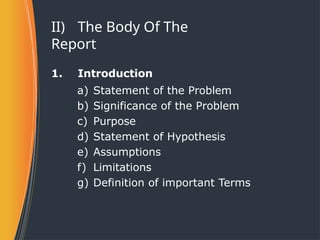
II) The Body Of The
Report
1. Introduction
a) Statement of the Problem
b) Significance of the Problem
c) Purpose
d) Statement of Hypothesis
e) Assumptions
f) Limitations
g) Definition of important Terms
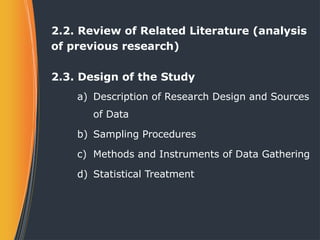
2.2. Review of Related Literature (analysis
of previous research)
2.3. Design of the Study
a) Description of Research Design and Sources
of Data
b) Sampling Procedures
c) Methods and Instruments of Data Gathering
d) Statistical Treatment
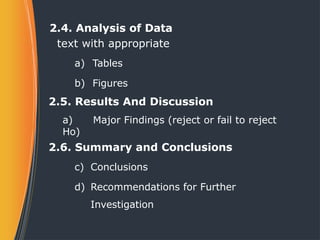
2.4. Analysis of Data
text with appropriate
a) Tables
b) Figures
2.5. Results And Discussion
a) Major Findings (reject or fail to reject
Ho)
2.6. Summary and Conclusions
c) Conclusions
d) Recommendations for Further
Investigation
III) The End Matter Section
a) References/ Bibliography
b) Appendices
I) The Introductory
Section
a) Title Page:
 Title Page identifies the title of the report,
the name of the researcher, the name of the
guide, institution, month and year of
submission.
 The title should communicate what the study is
about. A well constructed title makes it easy for
the reader to understand and determine the
nature of the topic .
b)
Acknowledgments:
This page permits the writer to express
appreciation to persons who have contributed
significantly to the research.
c) Table of Contents:
The table of contents is an outline of the report
that indicates the page number on which each
major section and subsection begins.
d) List of Tables:
A list of all the tables included in the report along
with the page numbers should be provided.
e) List of
Figures:
A list of all the figure included in the report along
with the page numbers should be provided.
f) Abstract:
The abstract is a brief but comprehensive
summary of the research report. It includes a
concise statement of the goal of the research, the
type of participants and instruments, outlines the
methods, major results and conclusions.
Abstract must be limited to a specific number of
words, usually between 100 and 500 words.
II) The Body Of The
Report
Introduction:
 The Introduction section provides the
theoretical framework of the study within
which the research has been conducted,
background information of the topic as well as
the need for and rationale for the research, to
make the material more logical, useful and
interesting for readers.
 The introduction begins with a description of
the research problem or topic and includes
objectives, significance of the problem,
research questions, statement of
hypothesis(if any).
 It also includes the assumptions of the
study(if any), definition of important terms,
limitations and delimitations of the study.
2) Review of Related
Literature
 The Review of Related Literature indicates what
is known about the problem or topic.
 Its function is to educate the reader about the
area under study.
3) Design of the
Study
 This section provides a detailed description of
the methodology used in the study. e.g.
population, sample size and sampling
techniques and tools used in the study.
 The purpose of this section is to describe in
detail how a researcher performed the study so
that someone should be able to replicate the
study based on the information that a
researcher provide in this section.
 For a qualitative study, this section may also
include a detailed description of the nature
and length of interactions with the
participants. The description of participants
includes information about how they were
selected and mainly representative of the
population.
 The description indicate the purpose of the
instrument and the validity and reliability of
the instrument.
4) Analysis of
Data
 This section describes the statistical
techniques or the inferential interpretations
that were applied to the data and the result of
these analyses.
 Tables and figures are used to present findings
or graphic form which add clarity in findings
for a reader.
5) Results And
Discussion
 The Results section is to tell the reader what
was found in the study.
 it includes the descriptive statistics for the
relevant variables (e.g mean, standard
deviation).Then tell the reader what statistical
test you used to test your hypothesis and
what you found.
 The Discussion section is where the researcher
interprets and evaluates the results.
 The discussion of a research report section
presents the theoretical and practical
implications of the findings and make
recommendation for the future research.
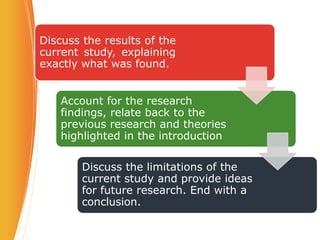
Discuss the results of the
current study, explaining
exactly what was found.
Account for the research
findings, relate back to the
previous research and theories
highlighted in the introduction
Discuss the limitations of the
current study and provide ideas
for future research. End with a
conclusion.
6) Summary and
Conclusions
 Conclusions is a summary of the main ideas
that come out from the discussion.
 It draws all arguments and findings together.
 It indicates whether hypothesis were accepted
or rejected.
 It summarize major findings of the study.
 The purpose of this section is to evaluate
interpret the result, especially with respect to
the original research question.
III) The End Matter Section
References/ Bibliography:
The References section provides the reader with all
the information needed to seek out and obtain all
original sources used in the research. it is written
in the alphabetical order.
Appendices:
This section provide a place for important
information.It includes tools prepared by the
researcher and used in the study.it may be lettered,
interview, names, raw data and data analysis
sheets.
At the end of the report,
Appendices should be enlisted in respect of all technical
data such as questionnaires, sample information,
mathematical derivations and the like ones; bibliography
of sources cited should also be given.
Index (an alphabetical listing of names, places and topics
along with the numbers of the pages in a book or report on
which they are mentioned or discussed)
Use of statistics, charts and graphs:
Statistics are usually presented in the form of tables, charts,
bars and line-graphs and pictograms.
Such presentation should be self explanatory and complete
in itself.
 It should be suitable and appropriate looking to the
problem at hand.
Finally, statistical presentation should be neat and
attractive.
The final draft: Revising and rewriting the rough draft
of the report should be done with great care before
writing the final draft. For the purpose, the researcher
should put to himself questions like:
Are the sentences written in the report clear?
Are they grammatically, correct?
Do they say what is meant?
PRESENTING THE RESULTS
The primary task in the research is the data presented in
tabular form should first be discussed and explained.
At the same time the researcher should avoid repeating
the whole data that the table contains.
While explaining the tables, it is always necessary to
cite relevant column numbers and row numbers for the
convenience of the readers.
The statistical materials presented in the tables should be
systematically checked for accuracy.
Besides explaining the tables, the researcher has to interpret the
data on the basis of evidences.
Such interpretation is the basis of generalization
Arrangement of ideas and the methodical and systematic
presentation is an aid to draw the attention and evoke the interest
of the readers. Heading should be specific, brief and represent the
content. Such headings and sub-headings call the attention of
readers as to the materials presented.
There must be uniformity and consistency in presentation of
Ideas,
Punctuation,
Capitalization,
Abbreviations,
Footnotes, quotations, acknowledgement and bibliography,
typical and summary from the beginning up to the end of the
paragraph, capitalization of key phrases and sentences will
make the presentation meaningful
THANK YOU!
THIS IS THE END
OF
THE COURSE

Research Methodology in cooperatives Ch. Nine.pptx

  • 2.
    What is aResearch Report? A research report is a completed study that reports an investigation or exploration of a problem, identifies questions to be addressed, and includes data collected, analyzed, and interpreted by the researcher.
  • 3.
    Difference Between ResearchReport & Research Proposal Research Report  A research report is prepared after a study is completed.  A research report communicates what was actually done in a study, and what resulted. Research Proposal  A research proposal is Prepared before a study begins.  A research proposal communicates a researcher's plan for a study.
  • 4.
    Difference Between ResearchReport & Article Research Report  A research report is a primary source.  it reports the methods and results of an original study performed by the researcher. Article  An article is a secondary source.  It does not report original research by the author.
  • 5.
    Structure Of AResearch Report The research report format mainly consists of three main sections: I. The Introductory Section II. The Main Body Of The Report III. The End Matter Section
  • 6.
    I) The Introductory Section a)Title Page b) Acknowledgments (if any) c) Table of Contents d) List of Tables (if any) e) List of Figures (if any) f) Abstract
  • 7.
    II) The BodyOf The Report 1. Introduction a) Statement of the Problem b) Significance of the Problem c) Purpose d) Statement of Hypothesis e) Assumptions f) Limitations g) Definition of important Terms
  • 8.
    2.2. Review ofRelated Literature (analysis of previous research) 2.3. Design of the Study a) Description of Research Design and Sources of Data b) Sampling Procedures c) Methods and Instruments of Data Gathering d) Statistical Treatment
  • 9.
    2.4. Analysis ofData text with appropriate a) Tables b) Figures 2.5. Results And Discussion a) Major Findings (reject or fail to reject Ho) 2.6. Summary and Conclusions c) Conclusions d) Recommendations for Further Investigation
  • 10.
    III) The EndMatter Section a) References/ Bibliography b) Appendices
  • 11.
    I) The Introductory Section a)Title Page:  Title Page identifies the title of the report, the name of the researcher, the name of the guide, institution, month and year of submission.  The title should communicate what the study is about. A well constructed title makes it easy for the reader to understand and determine the nature of the topic .
  • 12.
    b) Acknowledgments: This page permitsthe writer to express appreciation to persons who have contributed significantly to the research. c) Table of Contents: The table of contents is an outline of the report that indicates the page number on which each major section and subsection begins. d) List of Tables: A list of all the tables included in the report along with the page numbers should be provided.
  • 13.
    e) List of Figures: Alist of all the figure included in the report along with the page numbers should be provided. f) Abstract: The abstract is a brief but comprehensive summary of the research report. It includes a concise statement of the goal of the research, the type of participants and instruments, outlines the methods, major results and conclusions. Abstract must be limited to a specific number of words, usually between 100 and 500 words.
  • 14.
    II) The BodyOf The Report Introduction:  The Introduction section provides the theoretical framework of the study within which the research has been conducted, background information of the topic as well as the need for and rationale for the research, to make the material more logical, useful and interesting for readers.
  • 15.
     The introductionbegins with a description of the research problem or topic and includes objectives, significance of the problem, research questions, statement of hypothesis(if any).  It also includes the assumptions of the study(if any), definition of important terms, limitations and delimitations of the study.
  • 16.
    2) Review ofRelated Literature  The Review of Related Literature indicates what is known about the problem or topic.  Its function is to educate the reader about the area under study.
  • 17.
    3) Design ofthe Study  This section provides a detailed description of the methodology used in the study. e.g. population, sample size and sampling techniques and tools used in the study.  The purpose of this section is to describe in detail how a researcher performed the study so that someone should be able to replicate the study based on the information that a researcher provide in this section.
  • 18.
     For aqualitative study, this section may also include a detailed description of the nature and length of interactions with the participants. The description of participants includes information about how they were selected and mainly representative of the population.  The description indicate the purpose of the instrument and the validity and reliability of the instrument.
  • 19.
    4) Analysis of Data This section describes the statistical techniques or the inferential interpretations that were applied to the data and the result of these analyses.  Tables and figures are used to present findings or graphic form which add clarity in findings for a reader.
  • 20.
    5) Results And Discussion The Results section is to tell the reader what was found in the study.  it includes the descriptive statistics for the relevant variables (e.g mean, standard deviation).Then tell the reader what statistical test you used to test your hypothesis and what you found.
  • 21.
     The Discussionsection is where the researcher interprets and evaluates the results.  The discussion of a research report section presents the theoretical and practical implications of the findings and make recommendation for the future research.
  • 22.
    Discuss the resultsof the current study, explaining exactly what was found. Account for the research findings, relate back to the previous research and theories highlighted in the introduction Discuss the limitations of the current study and provide ideas for future research. End with a conclusion.
  • 23.
    6) Summary and Conclusions Conclusions is a summary of the main ideas that come out from the discussion.  It draws all arguments and findings together.  It indicates whether hypothesis were accepted or rejected.  It summarize major findings of the study.  The purpose of this section is to evaluate interpret the result, especially with respect to the original research question.
  • 24.
    III) The EndMatter Section References/ Bibliography: The References section provides the reader with all the information needed to seek out and obtain all original sources used in the research. it is written in the alphabetical order. Appendices: This section provide a place for important information.It includes tools prepared by the researcher and used in the study.it may be lettered, interview, names, raw data and data analysis sheets.
  • 25.
    At the endof the report, Appendices should be enlisted in respect of all technical data such as questionnaires, sample information, mathematical derivations and the like ones; bibliography of sources cited should also be given. Index (an alphabetical listing of names, places and topics along with the numbers of the pages in a book or report on which they are mentioned or discussed)
  • 26.
    Use of statistics,charts and graphs: Statistics are usually presented in the form of tables, charts, bars and line-graphs and pictograms. Such presentation should be self explanatory and complete in itself.  It should be suitable and appropriate looking to the problem at hand. Finally, statistical presentation should be neat and attractive.
  • 27.
    The final draft:Revising and rewriting the rough draft of the report should be done with great care before writing the final draft. For the purpose, the researcher should put to himself questions like: Are the sentences written in the report clear? Are they grammatically, correct? Do they say what is meant?
  • 28.
    PRESENTING THE RESULTS Theprimary task in the research is the data presented in tabular form should first be discussed and explained. At the same time the researcher should avoid repeating the whole data that the table contains. While explaining the tables, it is always necessary to cite relevant column numbers and row numbers for the convenience of the readers.
  • 29.
    The statistical materialspresented in the tables should be systematically checked for accuracy. Besides explaining the tables, the researcher has to interpret the data on the basis of evidences. Such interpretation is the basis of generalization Arrangement of ideas and the methodical and systematic presentation is an aid to draw the attention and evoke the interest of the readers. Heading should be specific, brief and represent the content. Such headings and sub-headings call the attention of readers as to the materials presented.
  • 30.
    There must beuniformity and consistency in presentation of Ideas, Punctuation, Capitalization, Abbreviations, Footnotes, quotations, acknowledgement and bibliography, typical and summary from the beginning up to the end of the paragraph, capitalization of key phrases and sentences will make the presentation meaningful
  • 31.
    THANK YOU! THIS ISTHE END OF THE COURSE