Academic Achievement Team
Critical Analysis : What is it?
Lesson Aims
• Define and explain what critical analysis is
• Why it is an important part of your university work
• Practice using critical analysis
Are You a Critical Thinker?
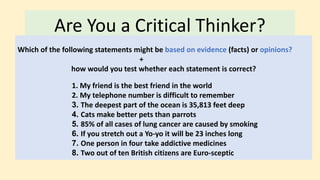
Which of the following statements might be based on evidence (facts) or opinions?
+
how would you test whether each statement is correct?
1. My friend is the best friend in the world
2. My telephone number is difficult to remember
3. The deepest part of the ocean is 35,813 feet deep
4. Cats make better pets than parrots
5. 85% of all cases of lung cancer are caused by smoking
6. If you stretch out a Yo-yo it will be 23 inches long
7. One person in four take addictive medicines
8. Two out of ten British citizens are Euro-sceptic
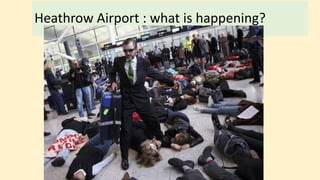
Heathrow Airport : what is happening?
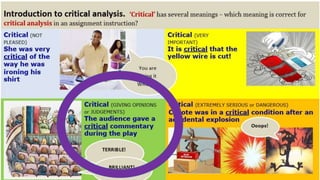
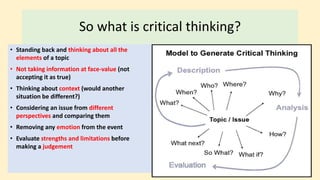
So what is critical thinking?
• Standing back and thinking about all the
elements of a topic
• Not taking information at face-value (not
accepting it as true)
• Thinking about context (would another
situation be different?)
• Considering an issue from different
perspectives and comparing them
• Removing any emotion from the event
• Evaluate strengths and limitations before
making a judgement
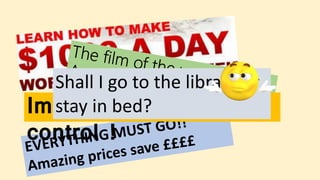
Immigration out of
control !
Shall I go to the library or
stay in bed?
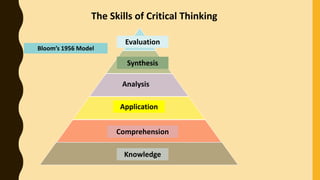
The Skills of Critical Thinking
Bloom’s 1956 Model
Evaluation
Synthesis
Analysis
Application
Comprehension
Knowledge
Evaluation
Synthesis
Analysis
Application
Comprehension
Knowledge
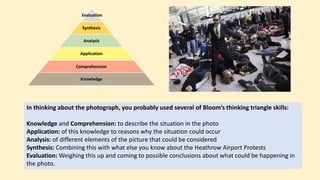
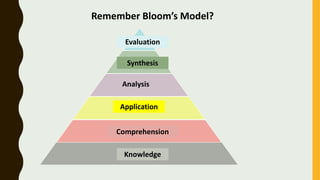
In thinking about the photograph, you probably used several of Bloom’s thinking triangle skills:
Knowledge and Comprehension: to describe the situation in the photo
Application: of this knowledge to reasons why the situation could occur
Analysis: of different elements of the picture that could be considered
Synthesis: Combining this with what else you know about the Heathrow Airport Protests
Evaluation: Weighing this up and coming to possible conclusions about what could be happening in
the photo.
Critical Thinking in Different Subjects
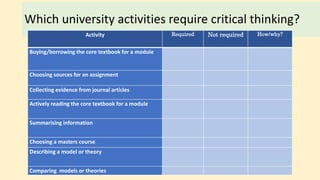
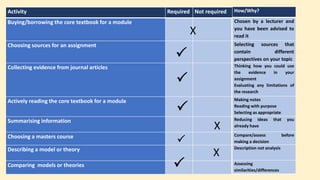
Which university activities require critical thinking?
Activity Required Not required How/why?
Buying/borrowing the core textbook for a module
Choosing sources for an assignment
Collecting evidence from journal articles
Actively reading the core textbook for a module
Summarising information
Choosing a masters course
Describing a model or theory
Comparing models or theories
Activity Required Not required How/Why?
Buying/borrowing the core textbook for a module Chosen by a lecturer and
you have been advised to
read it
Choosing sources for an assignment Selecting sources that
contain different
perspectives on your topic
Collecting evidence from journal articles Thinking how you could use
the evidence in your
assignment
Evaluating any limitations of
the research
Actively reading the core textbook for a module Making notes
Reading with purpose
Selecting as appropriate
Summarising information Reducing ideas that you
already have
Choosing a masters course Compare/assess before
making a decision
Describing a model or theory Description not analysis
Comparing models or theories Assessing
similarities/differences





X
X
X
How/Why?
Chosen by a lecturer and
you have been advised to
read it
Selecting sources that
contain different
perspectives on your topic
Thinking how you could use
the evidence in your
assignment
Evaluating any limitations of
the research
Making notes
Reading with purpose
Selecting as appropriate
Reducing ideas that you
already have
Compare/assess before
making a decision
Description not analysis
Assessing
similarities/differences
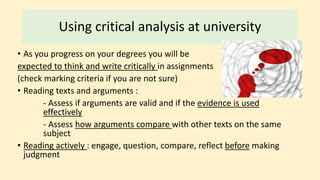
Using critical analysis at university
• As you progress on your degrees you will be
expected to think and write critically in assignments
(check marking criteria if you are not sure)
• Reading texts and arguments :
- Assess if arguments are valid and if the evidence is used
effectively
- Assess how arguments compare with other texts on the same
subject
• Reading actively : engage, question, compare, reflect before making
judgment
Students and Critical Thinking
Over to you…………
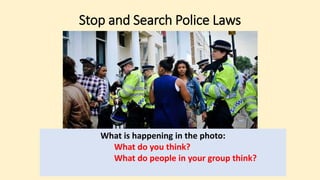
Stop and Search Police Laws
What is happening in the photo:
What do you think?
What do people in your group think?
Remember Bloom’s Model?
Evaluation
Synthesis
Analysis
Application
Comprehension
Knowledge
Before you read more about the context and perspectives, watch the
Home Secretary, speaking in August about how Stop and Search will be
used:
Priti Patel, Home Secretary : Stop and Search
Stop and Search Police Laws
Read the texts and use them to inform your critical
analysis skills
Remember:
- Do not take things at face value
- Be open to different opinions (to inform your thinking)
- Remove emotive thinking
- Evaluate strengths, weaknesses
- Weigh up the evidence before giving judgements
What do you know about critical thinking?
Next lessons:
Critical Reading
Critical Writing
Reflect
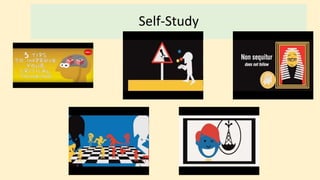
Self-Study

Crtical thinking

  • 1.
    Academic Achievement Team CriticalAnalysis : What is it?
  • 2.
    Lesson Aims • Defineand explain what critical analysis is • Why it is an important part of your university work • Practice using critical analysis
  • 4.
    Are You aCritical Thinker? Which of the following statements might be based on evidence (facts) or opinions? + how would you test whether each statement is correct? 1. My friend is the best friend in the world 2. My telephone number is difficult to remember 3. The deepest part of the ocean is 35,813 feet deep 4. Cats make better pets than parrots 5. 85% of all cases of lung cancer are caused by smoking 6. If you stretch out a Yo-yo it will be 23 inches long 7. One person in four take addictive medicines 8. Two out of ten British citizens are Euro-sceptic
  • 5.
    Heathrow Airport :what is happening?
  • 6.
    So what iscritical thinking? • Standing back and thinking about all the elements of a topic • Not taking information at face-value (not accepting it as true) • Thinking about context (would another situation be different?) • Considering an issue from different perspectives and comparing them • Removing any emotion from the event • Evaluate strengths and limitations before making a judgement
  • 7.
    Immigration out of control! Shall I go to the library or stay in bed?
  • 8.
    The Skills ofCritical Thinking Bloom’s 1956 Model Evaluation Synthesis Analysis Application Comprehension Knowledge
  • 9.
    Evaluation Synthesis Analysis Application Comprehension Knowledge In thinking aboutthe photograph, you probably used several of Bloom’s thinking triangle skills: Knowledge and Comprehension: to describe the situation in the photo Application: of this knowledge to reasons why the situation could occur Analysis: of different elements of the picture that could be considered Synthesis: Combining this with what else you know about the Heathrow Airport Protests Evaluation: Weighing this up and coming to possible conclusions about what could be happening in the photo.
  • 10.
    Critical Thinking inDifferent Subjects
  • 11.
    Which university activitiesrequire critical thinking? Activity Required Not required How/why? Buying/borrowing the core textbook for a module Choosing sources for an assignment Collecting evidence from journal articles Actively reading the core textbook for a module Summarising information Choosing a masters course Describing a model or theory Comparing models or theories
  • 12.
    Activity Required Notrequired How/Why? Buying/borrowing the core textbook for a module Chosen by a lecturer and you have been advised to read it Choosing sources for an assignment Selecting sources that contain different perspectives on your topic Collecting evidence from journal articles Thinking how you could use the evidence in your assignment Evaluating any limitations of the research Actively reading the core textbook for a module Making notes Reading with purpose Selecting as appropriate Summarising information Reducing ideas that you already have Choosing a masters course Compare/assess before making a decision Describing a model or theory Description not analysis Comparing models or theories Assessing similarities/differences      X X X How/Why? Chosen by a lecturer and you have been advised to read it Selecting sources that contain different perspectives on your topic Thinking how you could use the evidence in your assignment Evaluating any limitations of the research Making notes Reading with purpose Selecting as appropriate Reducing ideas that you already have Compare/assess before making a decision Description not analysis Assessing similarities/differences
  • 13.
    Using critical analysisat university • As you progress on your degrees you will be expected to think and write critically in assignments (check marking criteria if you are not sure) • Reading texts and arguments : - Assess if arguments are valid and if the evidence is used effectively - Assess how arguments compare with other texts on the same subject • Reading actively : engage, question, compare, reflect before making judgment
  • 14.
  • 15.
  • 16.
    Stop and SearchPolice Laws What is happening in the photo: What do you think? What do people in your group think?
  • 17.
  • 18.
    Before you readmore about the context and perspectives, watch the Home Secretary, speaking in August about how Stop and Search will be used: Priti Patel, Home Secretary : Stop and Search Stop and Search Police Laws
  • 19.
    Read the textsand use them to inform your critical analysis skills Remember: - Do not take things at face value - Be open to different opinions (to inform your thinking) - Remove emotive thinking - Evaluate strengths, weaknesses - Weigh up the evidence before giving judgements
  • 20.
    What do youknow about critical thinking? Next lessons: Critical Reading Critical Writing Reflect
  • 21.

Editor's Notes

  • #5 Click through one at a time and get students to discuss – the onus is on them, not on you to talk. Some might stimulate more interest than others, so omit as appropriate
  • #13 Suggested answers – if anyone wants to argue alternative answers that is fine, provided they can justify them
  • #21 To deepen our analysis, look at different perspectives and then synthesise these with what we already know (or don’t know), will this enable us to evaluate the situation more effectively? They will be given the reading, but put the video on first (it is very short).