HOW TO WRITE RESEARCH PAPER ABSTRACT
Presenter: Dr. Kshitij Bansal
Senior Resident
Department of Neurology
Government Medical College, Kota
WHAT IS ABSTRACT
An abstract is a short summary of your
(published or unpublished) research paper,
usually about a paragraph.
PURPOSE OF ABSTRACT
Gist or essence of the research paper.
Prepares readers to follow the detailed
information, analyses, and arguments.
Helps to remember the key points.
LENGTH, LAYOUT & POSITION
Length: Between 150 to 250 words.
Layout: Usually written in a single
paragraph.
Position: At the beginning of the paper.
CHARACTERISTICS
 Accurate, Coherent and readable.
 Clear and concise.
 Standalone
 No references
 No table or figures
 No Abbreviations
4 C’S OF ABSTRACT
 Complete
 Concise
 Clear
 Cohesive
WHEN TO WRITE ABSTRACT
The abstract must be written after the full
paper has been drafted.
The research must know what they are
summarizing.
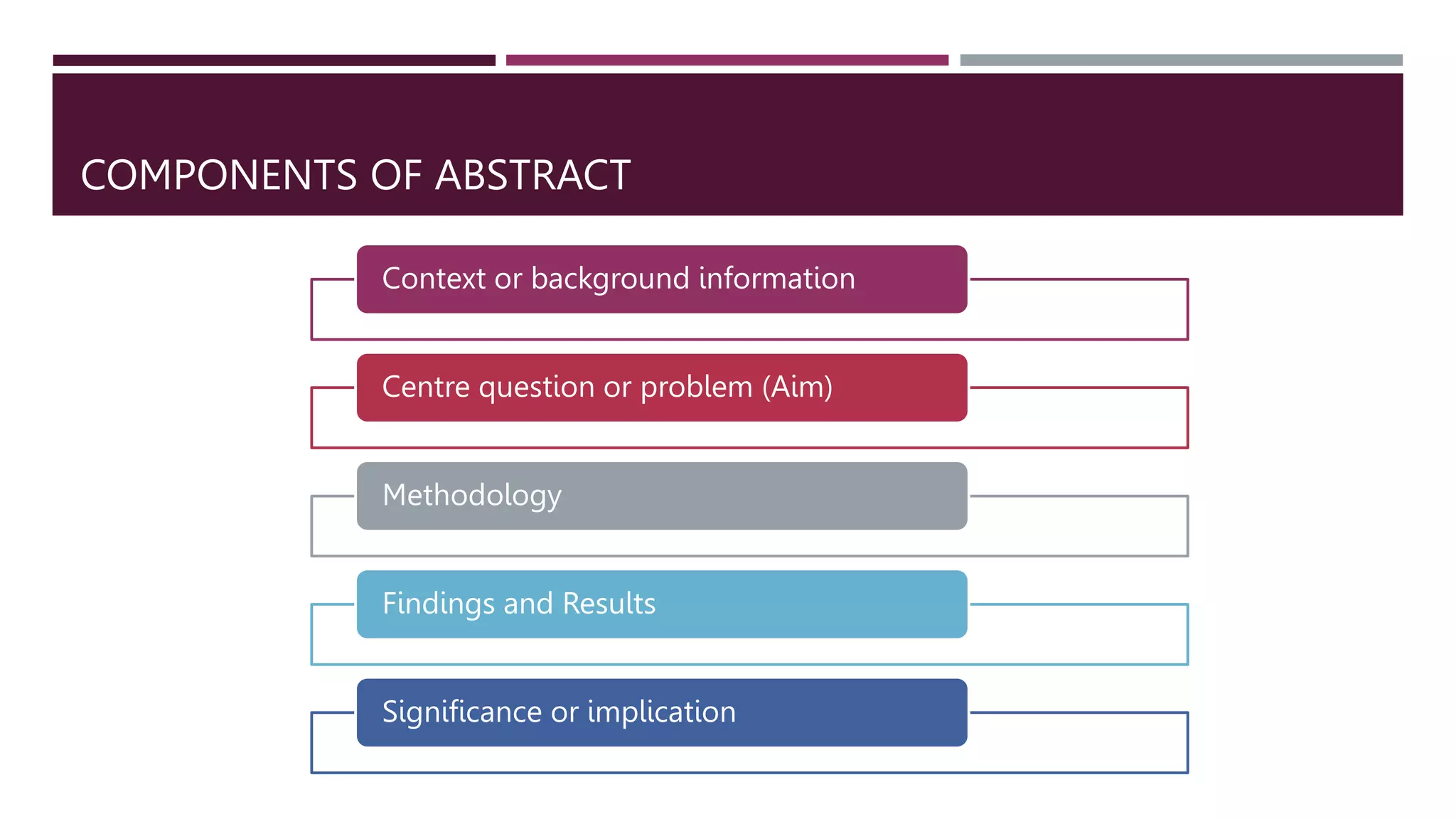
COMPONENTS OF ABSTRACT
Context or background information
Centre question or problem (Aim)
Methodology
Findings and Results
Significance or implication
WRITING THE PARTS OF AN ABSTRACT
Step by step process
 Write 1-2 introduction sentences that explain topic and research question.
 Write 1-2 sentences describing your research methods (including the type of
data collected and analysis technique used).
 Write 1-2 sentences describing the results / findings.
 Write 1-2 sentences containing your conclusion and recommendations.
WHAT TO INCLUDE
To put it simple,
 What the author did?
 How the author did?
 What the author found?
 What the author concluded?
TRY TO AVOID THESE COMMON PROBLEM
 Information that is not included in the original
work.
 References of other’s work
 Quotations from the original work (except aim).
 Lengthy explanation of concepts.
 Unexplained acronyms or abbreviations.
 Tables and charts
REFERENCES
1. Nundy, S., Kakar, A., Bhutta, Z.A. (2022). How to Write an Abstract?. In: How to Practice Academic Medicine and
Publish from Developing Countries?. Springer, Singapore.
2. Cuddy PG, Elenbaas RM, Elenbaas JK. Evaluating the medical literature Part I: Abstract, Introduction, Methods.
Ann Emerg Med 1983;12:549-55.
3. Eger EI. A template for writing a scientific paper. Anesth Analg 1990;70:91-6.
https://journals.lww.com/anesthesia-
analgesia/Citation/1990/01000/A_Template_for_Writing_a_Scientific_Paper.16.aspx
4. Sessler DI, Shafer S, Writing Research Reports. Anesth Analg 2018;126:330-7.
5. Cargill, M., & O'Connor, P. (2009). Writing scientific research articles: strategy and steps. Oxford, UK: Wiley-
Blackwell.
6. P. Mark L. Sandercock (2012) How to Write and Publish a Scientific Article, Canadian Society of Forensic
Science Journal, 45:1, 1-5.
7. https://www.wiley.com/network/researchers/preparing-your-article/how-to-write-a-scientific-abstract
How to write research paper abstract.pptx

How to write research paper abstract.pptx

  • 1.
    HOW TO WRITERESEARCH PAPER ABSTRACT Presenter: Dr. Kshitij Bansal Senior Resident Department of Neurology Government Medical College, Kota
  • 2.
    WHAT IS ABSTRACT Anabstract is a short summary of your (published or unpublished) research paper, usually about a paragraph.
  • 3.
    PURPOSE OF ABSTRACT Gistor essence of the research paper. Prepares readers to follow the detailed information, analyses, and arguments. Helps to remember the key points.
  • 4.
    LENGTH, LAYOUT &POSITION Length: Between 150 to 250 words. Layout: Usually written in a single paragraph. Position: At the beginning of the paper.
  • 5.
    CHARACTERISTICS  Accurate, Coherentand readable.  Clear and concise.  Standalone  No references  No table or figures  No Abbreviations
  • 6.
    4 C’S OFABSTRACT  Complete  Concise  Clear  Cohesive
  • 7.
    WHEN TO WRITEABSTRACT The abstract must be written after the full paper has been drafted. The research must know what they are summarizing.
  • 8.
    COMPONENTS OF ABSTRACT Contextor background information Centre question or problem (Aim) Methodology Findings and Results Significance or implication
  • 9.
    WRITING THE PARTSOF AN ABSTRACT Step by step process  Write 1-2 introduction sentences that explain topic and research question.  Write 1-2 sentences describing your research methods (including the type of data collected and analysis technique used).  Write 1-2 sentences describing the results / findings.  Write 1-2 sentences containing your conclusion and recommendations.
  • 10.
    WHAT TO INCLUDE Toput it simple,  What the author did?  How the author did?  What the author found?  What the author concluded?
  • 11.
    TRY TO AVOIDTHESE COMMON PROBLEM  Information that is not included in the original work.  References of other’s work  Quotations from the original work (except aim).  Lengthy explanation of concepts.  Unexplained acronyms or abbreviations.  Tables and charts
  • 15.
    REFERENCES 1. Nundy, S.,Kakar, A., Bhutta, Z.A. (2022). How to Write an Abstract?. In: How to Practice Academic Medicine and Publish from Developing Countries?. Springer, Singapore. 2. Cuddy PG, Elenbaas RM, Elenbaas JK. Evaluating the medical literature Part I: Abstract, Introduction, Methods. Ann Emerg Med 1983;12:549-55. 3. Eger EI. A template for writing a scientific paper. Anesth Analg 1990;70:91-6. https://journals.lww.com/anesthesia- analgesia/Citation/1990/01000/A_Template_for_Writing_a_Scientific_Paper.16.aspx 4. Sessler DI, Shafer S, Writing Research Reports. Anesth Analg 2018;126:330-7. 5. Cargill, M., & O'Connor, P. (2009). Writing scientific research articles: strategy and steps. Oxford, UK: Wiley- Blackwell. 6. P. Mark L. Sandercock (2012) How to Write and Publish a Scientific Article, Canadian Society of Forensic Science Journal, 45:1, 1-5. 7. https://www.wiley.com/network/researchers/preparing-your-article/how-to-write-a-scientific-abstract

Editor's Notes

  • #5 Depending upon the requirements of each journal. For instance, Neurology India Journal requires the abstract of only 150 words.
  • #7 It covers the major part of the project. It does not contain any unnecessary information. Readable and well organized. Flows smoothly between components