Abstract
Tarek Tawfik Amin
Professor of Epidemiology
Faculty of Medicine, Cairo University, Egypt
email: amin55@myway.com
orcid.org/0000-0003-2502-110X
Scopus ID: Author ID: 23007746000
ResearcherID: E-6189-2012
Abstract [stand alone section]
The mirror of your paper
Reason to read
Reason to cite
• General rules
9/27/20153 2Professor Tarek Tawfik Amin
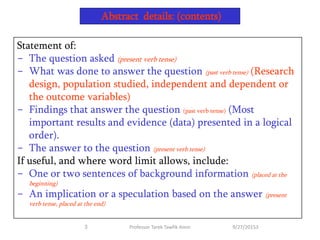
Statement of:
- The question asked (present verb tense)
- What was done to answer the question (past verb tense) (Research
design, population studied, independent and dependent or
the outcome variables)
- Findings that answer the question (past verb tense) (Most
important results and evidence (data) presented in a logical
order).
- The answer to the question (present verb tense)
If useful, and where word limit allows, include:
- One or two sentences of background information (placed at the
beginning)
- An implication or a speculation based on the answer (present
verb tense, placed at the end)
Abstract details: (contents)
9/27/201533 Professor Tarek Tawfik Amin
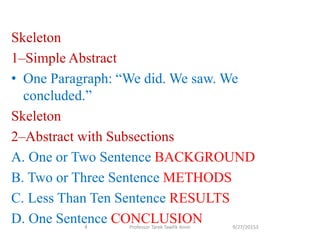
Skeleton
1–Simple Abstract
• One Paragraph: “We did. We saw. We
concluded.”
Skeleton
2–Abstract with Subsections
A. One or Two Sentence BACKGROUND
B. Two or Three Sentence METHODS
C. Less Than Ten Sentence RESULTS
D. One Sentence CONCLUSION 9/27/201534 Professor Tarek Tawfik Amin
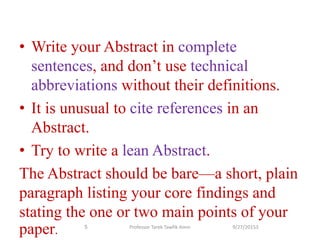
• Write your Abstract in complete
sentences, and don’t use technical
abbreviations without their definitions.
• It is unusual to cite references in an
Abstract.
• Try to write a lean Abstract.
The Abstract should be bare—a short, plain
paragraph listing your core findings and
stating the one or two main points of your
paper. 9/27/201535 Professor Tarek Tawfik Amin
• For the given papers check the structure of
their abstract and keywords
Group work
9/27/201536 Professor Tarek Tawfik Amin
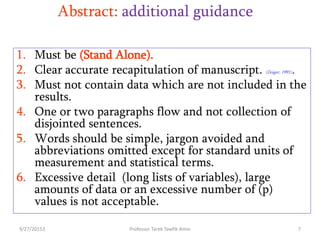
Abstract: additional guidance
1. Must be (Stand Alone).
2. Clear accurate recapitulation of manuscript. (Zeiger, 1991).
3. Must not contain data which are not included in the
results.
4. One or two paragraphs flow and not collection of
disjointed sentences.
5. Words should be simple, jargon avoided and
abbreviations omitted except for standard units of
measurement and statistical terms.
6. Excessive detail (long lists of variables), large
amounts of data or an excessive number of (p)
values is not acceptable.
9/27/20153 7Professor Tarek Tawfik Amin
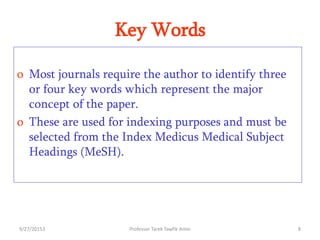
Key Words
o Most journals require the author to identify three
or four key words which represent the major
concept of the paper.
o These are used for indexing purposes and must be
selected from the Index Medicus Medical Subject
Headings (MeSH).
9/27/20153 8Professor Tarek Tawfik Amin

Abstract of research article

  • 1.
    Abstract Tarek Tawfik Amin Professorof Epidemiology Faculty of Medicine, Cairo University, Egypt email: amin55@myway.com orcid.org/0000-0003-2502-110X Scopus ID: Author ID: 23007746000 ResearcherID: E-6189-2012
  • 2.
    Abstract [stand alonesection] The mirror of your paper Reason to read Reason to cite • General rules 9/27/20153 2Professor Tarek Tawfik Amin
  • 3.
    Statement of: - Thequestion asked (present verb tense) - What was done to answer the question (past verb tense) (Research design, population studied, independent and dependent or the outcome variables) - Findings that answer the question (past verb tense) (Most important results and evidence (data) presented in a logical order). - The answer to the question (present verb tense) If useful, and where word limit allows, include: - One or two sentences of background information (placed at the beginning) - An implication or a speculation based on the answer (present verb tense, placed at the end) Abstract details: (contents) 9/27/201533 Professor Tarek Tawfik Amin
  • 4.
    Skeleton 1–Simple Abstract • OneParagraph: “We did. We saw. We concluded.” Skeleton 2–Abstract with Subsections A. One or Two Sentence BACKGROUND B. Two or Three Sentence METHODS C. Less Than Ten Sentence RESULTS D. One Sentence CONCLUSION 9/27/201534 Professor Tarek Tawfik Amin
  • 5.
    • Write yourAbstract in complete sentences, and don’t use technical abbreviations without their definitions. • It is unusual to cite references in an Abstract. • Try to write a lean Abstract. The Abstract should be bare—a short, plain paragraph listing your core findings and stating the one or two main points of your paper. 9/27/201535 Professor Tarek Tawfik Amin
  • 6.
    • For thegiven papers check the structure of their abstract and keywords Group work 9/27/201536 Professor Tarek Tawfik Amin
  • 7.
    Abstract: additional guidance 1.Must be (Stand Alone). 2. Clear accurate recapitulation of manuscript. (Zeiger, 1991). 3. Must not contain data which are not included in the results. 4. One or two paragraphs flow and not collection of disjointed sentences. 5. Words should be simple, jargon avoided and abbreviations omitted except for standard units of measurement and statistical terms. 6. Excessive detail (long lists of variables), large amounts of data or an excessive number of (p) values is not acceptable. 9/27/20153 7Professor Tarek Tawfik Amin
  • 8.
    Key Words o Mostjournals require the author to identify three or four key words which represent the major concept of the paper. o These are used for indexing purposes and must be selected from the Index Medicus Medical Subject Headings (MeSH). 9/27/20153 8Professor Tarek Tawfik Amin