WRITING CONCISE SENTENCES
A sentence is not concise simply because it is short; a concise sentence contains only the number of words necessary to achieve its effect or to make its point.
Eliminating Nonessential Words One way to find out which words are essential to the meaning of a sentence is to underline the key words.  Then, look carefully at the remaining words so that you can see which are unnecessary and delete them.
Nonessential Word Categories: Deadwood Utility Words Circumlocution
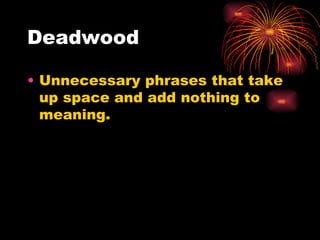
Deadwood Unnecessary phrases that take up space and add nothing to meaning.
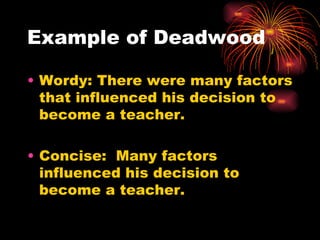
Example of Deadwood Wordy: There were many factors that influenced his decision to become a teacher. Concise:  Many factors influenced his decision to become a teacher.
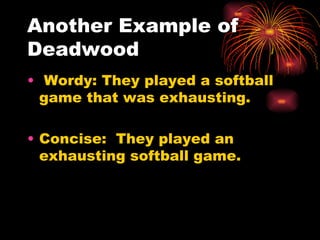
Another Example of Deadwood Wordy: They played a softball game that was exhausting. Concise:  They played an exhausting softball game.
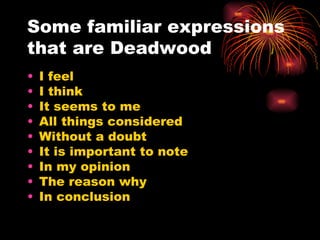
Some familiar expressions that are Deadwood I feel I think It seems to me All things considered Without a doubt It is important to note In my opinion The reason why In conclusion
Deadwood distracts, annoys the reader and weakens your writing style. Eliminate and  empower.
Utility Words Fillers that contribute nothing to a sentence.
Examples of Utility Words to Eliminate or Replace Nouns with imprecise meanings: Factor Situation Kind Type Aspect Sort  Area
Common Adverbs Denoting Degree Basically Very Definitely Quite Eliminate and Empower
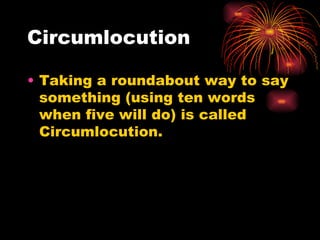
Circumlocution Taking a roundabout way to say something (using ten words when five will do) is called Circumlocution.
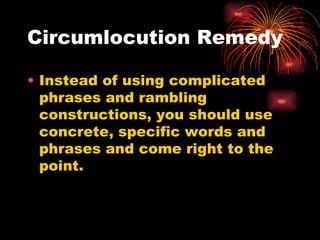
Circumlocution Remedy Instead of using complicated phrases and rambling constructions, you should use concrete, specific words and phrases and come right to the point.
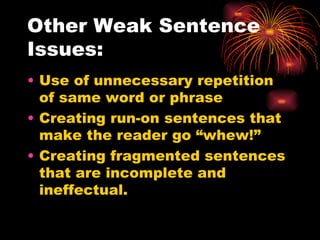
Other Weak Sentence Issues: Use of unnecessary repetition of same word or phrase Creating run-on sentences that make the reader go “whew!” Creating fragmented sentences that are incomplete and ineffectual.
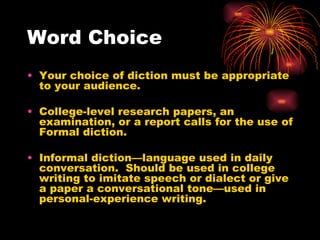
Word Choice Your choice of diction must be appropriate to your audience. College-level research papers, an examination, or a report calls for the use of Formal diction. Informal diction—language used in daily conversation.  Should be used in college writing to imitate speech or dialect or give a paper a conversational tone—used in personal-experience writing.
Choosing the  Right Word Watch out for overused phrases or words—Cliches Watch out for pretentious diction—inappropriate and elevated words. Use concrete words, rather than abstract words whenever possible.
Abstract Word Examples Beauty Truth Good Nice Great  Terrific All refer to ideas, qualities, or conditions that cannot be perceived by the senses.
Concrete Words Convey a vivid picture by naming things that readers can see, hear, taste, smell, or touch. The more concrete your words and phrases, the more vivid the image you evoke in the reader.
Avoid Biased Language Offensive labels referring to a racial, ethnic, gender, or religious group turns off any reader. Avoid offensive labels referring to age, class, geography, occupation, marital status, physical ability or sexual orientation.
And Finally, A Quote… “ A sentence should contain no unnecessary words, for the same reason that a drawing should have no unnecessary lines and a machine no unnecessary parts.”  William Strunk

Writing Concise Sentences

  • 1.
  • 2.
    A sentence isnot concise simply because it is short; a concise sentence contains only the number of words necessary to achieve its effect or to make its point.
  • 3.
    Eliminating Nonessential WordsOne way to find out which words are essential to the meaning of a sentence is to underline the key words. Then, look carefully at the remaining words so that you can see which are unnecessary and delete them.
  • 4.
    Nonessential Word Categories:Deadwood Utility Words Circumlocution
  • 5.
    Deadwood Unnecessary phrasesthat take up space and add nothing to meaning.
  • 6.
    Example of DeadwoodWordy: There were many factors that influenced his decision to become a teacher. Concise: Many factors influenced his decision to become a teacher.
  • 7.
    Another Example ofDeadwood Wordy: They played a softball game that was exhausting. Concise: They played an exhausting softball game.
  • 8.
    Some familiar expressionsthat are Deadwood I feel I think It seems to me All things considered Without a doubt It is important to note In my opinion The reason why In conclusion
  • 9.
    Deadwood distracts, annoysthe reader and weakens your writing style. Eliminate and empower.
  • 10.
    Utility Words Fillersthat contribute nothing to a sentence.
  • 11.
    Examples of UtilityWords to Eliminate or Replace Nouns with imprecise meanings: Factor Situation Kind Type Aspect Sort Area
  • 12.
    Common Adverbs DenotingDegree Basically Very Definitely Quite Eliminate and Empower
  • 13.
    Circumlocution Taking aroundabout way to say something (using ten words when five will do) is called Circumlocution.
  • 14.
    Circumlocution Remedy Insteadof using complicated phrases and rambling constructions, you should use concrete, specific words and phrases and come right to the point.
  • 15.
    Other Weak SentenceIssues: Use of unnecessary repetition of same word or phrase Creating run-on sentences that make the reader go “whew!” Creating fragmented sentences that are incomplete and ineffectual.
  • 16.
    Word Choice Yourchoice of diction must be appropriate to your audience. College-level research papers, an examination, or a report calls for the use of Formal diction. Informal diction—language used in daily conversation. Should be used in college writing to imitate speech or dialect or give a paper a conversational tone—used in personal-experience writing.
  • 17.
    Choosing the Right Word Watch out for overused phrases or words—Cliches Watch out for pretentious diction—inappropriate and elevated words. Use concrete words, rather than abstract words whenever possible.
  • 18.
    Abstract Word ExamplesBeauty Truth Good Nice Great Terrific All refer to ideas, qualities, or conditions that cannot be perceived by the senses.
  • 19.
    Concrete Words Conveya vivid picture by naming things that readers can see, hear, taste, smell, or touch. The more concrete your words and phrases, the more vivid the image you evoke in the reader.
  • 20.
    Avoid Biased LanguageOffensive labels referring to a racial, ethnic, gender, or religious group turns off any reader. Avoid offensive labels referring to age, class, geography, occupation, marital status, physical ability or sexual orientation.
  • 21.
    And Finally, AQuote… “ A sentence should contain no unnecessary words, for the same reason that a drawing should have no unnecessary lines and a machine no unnecessary parts.” William Strunk