Advise on Academic
Writing
University of Toronto
Professor: Saubidet, Stella
Student: Vega, David
How to begin:
An essay should have an argument that answers a question or a few
questions.
It should try to prove something, develop a single thesis by reasoning or
evidence.
It should be necessary to formulate a hypothesis which you test.
It should be well- organized (how it begins, develops, and ends)
Successful methods of composing an essay
Start writing early, even before you think you are not ready to start.
Don´t try to write from begining to end, but rather write what seems
readiest to be written.
Keep the essay’s overall purpose and organization in mind.
Revise extensively. Rearrange the sequence of its larger parts, adding and
deleting sections to take account of what it is discovered in the course of
composition.
Revise sentences. Be able to follow the sequences of ideas within
sentences, from sentence to sentence, and from paragraph to paragraph.
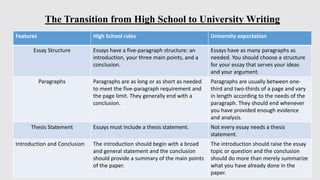
The Transition from High School to University Writing
Features High School rules University expectation
Essay Structure Essays have a five-paragraph structure: an
introduction, your three main points, and a
conclusion.
Essays have as many paragraphs as
needed. You should choose a structure
for your essay that serves your ideas
and your argument.
Paragraphs Paragraphs are as long or as short as needed
to meet the five-paragraph requirement and
the page limit. They generally end with a
conclusion.
Paragraphs are usually between one-
third and two-thirds of a page and vary
in length according to the needs of the
paragraph. They should end whenever
you have provided enough evidence
and analysis.
Thesis Statement Essays must include a thesis statement. Not every essay needs a thesis
statement.
Introduction and Conclusion The introduction should begin with a broad
and general statement and the conclusion
should provide a summary of the main points
of the paper.
The introduction should raise the essay
topic or question and the conclusion
should do more than merely summarize
what you have already done in the
paper.
Organizing
1. You will have to do some reading and weighing of evidence before
you start a plan.
2. As a potential argument begins to take shape in your mind, you
may start to formalize your thoughts in the form of a tentative plan.
3. You can search for evidence for the points in your tentative plan
while you are reading and researching.
4. As you gather evidence, those points that still lack evidence
should guide you in your research.
Thesis Statement
The sentence that captures your position on this main idea is what we
call a thesis statement. Besides, your reader will probably expect a
clear statement of your position. It should present the topic of your
paper and also make a comment about your position in relation to the
topic
Introductions
• Introductions demand much of your attention as a writer.
• A good introduction should identify your topic, provide essential
context, and indicate your particular focus in the essay.
• It also needs to engage your readers’ interest.
• The introductions for most papers can be effectively written in one
paragraph occupying half to three-quarters of the first page.
• If your essay has a thesis, your thesis statement will typically appear
at the end of your introduction, even though that is not a hard-and-
fast rul
Conclusions
• A strong conclusion will provide a sense of closure to the essay while
again placing your concepts in a somewhat wider context.
• It will also, in some instances, add a stimulus to further thought.
• A conclusion is not merely a summary of your points or a re-
statement of your thesis
• The conclusion involves critical thinking. You should reflect upon the
significance of what you’ve written.
• For most essays, one well-developed paragraph is sufficient for a
conclusion
Paragraphs
• A paragraph is a series of related sentences developing a central idea,
called the topic.
• The topic sentence is the main point of the paragraph. A topic
sentence has a unifying function.
• Not all paragraphs need topic sentences. In particular, opening and
closing paragraphs.
• The body paragraph demonstrates and develops your topic sentence
through an ordered, logical progression of ideas.
• The best overall strategy to enhance flow (the movement from one
idea to another) within a paragraph is to show connections.
Topic Sentences
• A topic sentence states the main point of a paragraph. It serves as a
mini-thesis for the paragraph.
• Topic sentences will provide a sketch of the essay’s argument that
help protect your readers from confusion by guiding them through
the argument.
• Topic sentences usually appear at the very beginning of paragraphs.
• Relating your topic sentences to your thesis can help strengthen the
coherence of your essay. However, your topic sentence should do
more than just establish a connection between your paragraph and
your thesis. It also contributes to the development of your argument
by moving it that one extra step forward.
Using Sources
• Footnotes and Endnotes are used by the author for various purposes
such as to provide bibliographical information, outside sources,
copyright permission, explanatory information, citations or some
additional details about the topic under consideration.
• Footnote is the note appearing at the bottom of the page, to cite
relevant sources, references or provide additional details with respect
to the definite portion of the text above,
• Endnote can be understood as a note found at the end of the
document or the book or a section of the book, containing sources of
facts or information and extraneous information on the points used in
the text.
Using Quotations
Quotations come from somewhere, and your reader will want to know
where. Don’t just parachute quotations into your essay without
providing at least some indication of who your source is:
I. The language of the passage is particularly elegant or powerful or
memorable.
II. You wish to confirm the credibility of your argument by enlisting
the support of an authority on your topic.
III. The passage is worthy of further analysis.
IV. You wish to argue with someone else’s position in considerable
detail.
Paraphrase and Summary
• To paraphrase means to restate someone else’s ideas in your own
language at roughly the same level of detail. The paraphrase must be
in your own words. You must do more than merely substitute phrases
here and there. You must also create your own sentence structures.
• To summarize means to reduce the most essential points of someone
else’s work into a shorter form. When you summarize a passage, you
need first to absorb the meaning and then to capture in your own
words the most important elements from the original passage
• Paraphrase and summary are indispensable in argumentative papers
because they allow you to include other people’s ideas without
cluttering up your paragraphs with quotations.
Revising and Editing
• Revising gives you the chance to preview your work on behalf of the
eventual reader.
• Revision may mean changing the shape and reasoning in your paper.
• Good revision and editing can transform a mediocre first draft into an
excellent final paper.
• Check whether you have fulfilled the intention of the assignment.
• Look at overall organization. It’s worthwhile to print out everything so
that you can view the entire document.
Punctuation
• Effective punctuation does involve learning the rules, and this
handout summarizes the most important things.
• Punctuation provides you with considerable control over meaning
and tone.
• Using commas well is a science and an art.
• The semicolon has two main uses. The first is to combine two closely
related independent clauses. The other is to separate list elements
that are long or complex.
• Colons offer a way of urging your reader forward.
• Parentheses offer a third way of introducing interrupting material.
Using the Computer to Improve Your Writing
Computers let you easily type in text, shift it around, and edit it. Word
processing can also do much more for you if you make the most of its
capacities and know its limitations;
A. Composing: Though some writers benefit from the tactile
experience of writing notes and drafts by hand, you may be
surprised how much power you gain by doing nearly all your
drafting on the computer.
B. Revising and Editing: Word processing comes into its own with the
hardest work of good writing—cutting, arranging, rewriting. Get to
know what your computer can and can’t do to support you.
Spelling
English spelling is notoriously difficult to master for native speakers and
language learners alike:
 Use a (good) dictionary.
 Be consistent about using British or American spellings in your
writing.
 Create your own difficult-to-spell lists.
 Learn the standard pronunciations for frequently misspelled words.
 Watch out for homophones, near-homophones, and other easily
confusable words.
The Abstract
• Abstracts are important because they give a first impression of the
document that follows, letting readers decide whether to continue
reading and showing them what to look for if they do.
• An abstract should represent as much as possible of the quantitative
and qualitative information in the document, and also reflect its
reasoning.
• An abstract will nearly always be read along with the title, so do not
repeat or rephrase the title. It will likely be read without the rest of
the document, however, so make it complete enough to stand on its
own.
English Language
Articles are special modifiers that appear before nouns or noun
phrases. They help clarify the meaning of the noun in your sentence.
There are only two articles in the English language: the and a (and its
variant an used before a word that starts with a vowel sound).
Gerunds and infinitives are verb forms that can take the place of a
noun in a sentence.
Expressions of Quantity
Verbs for Referring to Sources: You can indicate your attitude to the
sources you cite by choosing specific verbs to refer to them.
Bibliography:
• Prof. C. A, Department of English, “Some General Advise on
Academic Writing Essay” Toronto, canada: University of Toronto.
Website: https://writing.utoronto.ca/

Presentacion

  • 1.
    Advise on Academic Writing Universityof Toronto Professor: Saubidet, Stella Student: Vega, David
  • 2.
    How to begin: Anessay should have an argument that answers a question or a few questions. It should try to prove something, develop a single thesis by reasoning or evidence. It should be necessary to formulate a hypothesis which you test. It should be well- organized (how it begins, develops, and ends)
  • 3.
    Successful methods ofcomposing an essay Start writing early, even before you think you are not ready to start. Don´t try to write from begining to end, but rather write what seems readiest to be written. Keep the essay’s overall purpose and organization in mind. Revise extensively. Rearrange the sequence of its larger parts, adding and deleting sections to take account of what it is discovered in the course of composition. Revise sentences. Be able to follow the sequences of ideas within sentences, from sentence to sentence, and from paragraph to paragraph.
  • 4.
    The Transition fromHigh School to University Writing Features High School rules University expectation Essay Structure Essays have a five-paragraph structure: an introduction, your three main points, and a conclusion. Essays have as many paragraphs as needed. You should choose a structure for your essay that serves your ideas and your argument. Paragraphs Paragraphs are as long or as short as needed to meet the five-paragraph requirement and the page limit. They generally end with a conclusion. Paragraphs are usually between one- third and two-thirds of a page and vary in length according to the needs of the paragraph. They should end whenever you have provided enough evidence and analysis. Thesis Statement Essays must include a thesis statement. Not every essay needs a thesis statement. Introduction and Conclusion The introduction should begin with a broad and general statement and the conclusion should provide a summary of the main points of the paper. The introduction should raise the essay topic or question and the conclusion should do more than merely summarize what you have already done in the paper.
  • 5.
    Organizing 1. You willhave to do some reading and weighing of evidence before you start a plan. 2. As a potential argument begins to take shape in your mind, you may start to formalize your thoughts in the form of a tentative plan. 3. You can search for evidence for the points in your tentative plan while you are reading and researching. 4. As you gather evidence, those points that still lack evidence should guide you in your research.
  • 6.
    Thesis Statement The sentencethat captures your position on this main idea is what we call a thesis statement. Besides, your reader will probably expect a clear statement of your position. It should present the topic of your paper and also make a comment about your position in relation to the topic
  • 7.
    Introductions • Introductions demandmuch of your attention as a writer. • A good introduction should identify your topic, provide essential context, and indicate your particular focus in the essay. • It also needs to engage your readers’ interest. • The introductions for most papers can be effectively written in one paragraph occupying half to three-quarters of the first page. • If your essay has a thesis, your thesis statement will typically appear at the end of your introduction, even though that is not a hard-and- fast rul
  • 8.
    Conclusions • A strongconclusion will provide a sense of closure to the essay while again placing your concepts in a somewhat wider context. • It will also, in some instances, add a stimulus to further thought. • A conclusion is not merely a summary of your points or a re- statement of your thesis • The conclusion involves critical thinking. You should reflect upon the significance of what you’ve written. • For most essays, one well-developed paragraph is sufficient for a conclusion
  • 9.
    Paragraphs • A paragraphis a series of related sentences developing a central idea, called the topic. • The topic sentence is the main point of the paragraph. A topic sentence has a unifying function. • Not all paragraphs need topic sentences. In particular, opening and closing paragraphs. • The body paragraph demonstrates and develops your topic sentence through an ordered, logical progression of ideas. • The best overall strategy to enhance flow (the movement from one idea to another) within a paragraph is to show connections.
  • 10.
    Topic Sentences • Atopic sentence states the main point of a paragraph. It serves as a mini-thesis for the paragraph. • Topic sentences will provide a sketch of the essay’s argument that help protect your readers from confusion by guiding them through the argument. • Topic sentences usually appear at the very beginning of paragraphs. • Relating your topic sentences to your thesis can help strengthen the coherence of your essay. However, your topic sentence should do more than just establish a connection between your paragraph and your thesis. It also contributes to the development of your argument by moving it that one extra step forward.
  • 11.
    Using Sources • Footnotesand Endnotes are used by the author for various purposes such as to provide bibliographical information, outside sources, copyright permission, explanatory information, citations or some additional details about the topic under consideration. • Footnote is the note appearing at the bottom of the page, to cite relevant sources, references or provide additional details with respect to the definite portion of the text above, • Endnote can be understood as a note found at the end of the document or the book or a section of the book, containing sources of facts or information and extraneous information on the points used in the text.
  • 12.
    Using Quotations Quotations comefrom somewhere, and your reader will want to know where. Don’t just parachute quotations into your essay without providing at least some indication of who your source is: I. The language of the passage is particularly elegant or powerful or memorable. II. You wish to confirm the credibility of your argument by enlisting the support of an authority on your topic. III. The passage is worthy of further analysis. IV. You wish to argue with someone else’s position in considerable detail.
  • 13.
    Paraphrase and Summary •To paraphrase means to restate someone else’s ideas in your own language at roughly the same level of detail. The paraphrase must be in your own words. You must do more than merely substitute phrases here and there. You must also create your own sentence structures. • To summarize means to reduce the most essential points of someone else’s work into a shorter form. When you summarize a passage, you need first to absorb the meaning and then to capture in your own words the most important elements from the original passage • Paraphrase and summary are indispensable in argumentative papers because they allow you to include other people’s ideas without cluttering up your paragraphs with quotations.
  • 14.
    Revising and Editing •Revising gives you the chance to preview your work on behalf of the eventual reader. • Revision may mean changing the shape and reasoning in your paper. • Good revision and editing can transform a mediocre first draft into an excellent final paper. • Check whether you have fulfilled the intention of the assignment. • Look at overall organization. It’s worthwhile to print out everything so that you can view the entire document.
  • 15.
    Punctuation • Effective punctuationdoes involve learning the rules, and this handout summarizes the most important things. • Punctuation provides you with considerable control over meaning and tone. • Using commas well is a science and an art. • The semicolon has two main uses. The first is to combine two closely related independent clauses. The other is to separate list elements that are long or complex. • Colons offer a way of urging your reader forward. • Parentheses offer a third way of introducing interrupting material.
  • 16.
    Using the Computerto Improve Your Writing Computers let you easily type in text, shift it around, and edit it. Word processing can also do much more for you if you make the most of its capacities and know its limitations; A. Composing: Though some writers benefit from the tactile experience of writing notes and drafts by hand, you may be surprised how much power you gain by doing nearly all your drafting on the computer. B. Revising and Editing: Word processing comes into its own with the hardest work of good writing—cutting, arranging, rewriting. Get to know what your computer can and can’t do to support you.
  • 17.
    Spelling English spelling isnotoriously difficult to master for native speakers and language learners alike:  Use a (good) dictionary.  Be consistent about using British or American spellings in your writing.  Create your own difficult-to-spell lists.  Learn the standard pronunciations for frequently misspelled words.  Watch out for homophones, near-homophones, and other easily confusable words.
  • 18.
    The Abstract • Abstractsare important because they give a first impression of the document that follows, letting readers decide whether to continue reading and showing them what to look for if they do. • An abstract should represent as much as possible of the quantitative and qualitative information in the document, and also reflect its reasoning. • An abstract will nearly always be read along with the title, so do not repeat or rephrase the title. It will likely be read without the rest of the document, however, so make it complete enough to stand on its own.
  • 19.
    English Language Articles arespecial modifiers that appear before nouns or noun phrases. They help clarify the meaning of the noun in your sentence. There are only two articles in the English language: the and a (and its variant an used before a word that starts with a vowel sound). Gerunds and infinitives are verb forms that can take the place of a noun in a sentence. Expressions of Quantity Verbs for Referring to Sources: You can indicate your attitude to the sources you cite by choosing specific verbs to refer to them.
  • 20.
    Bibliography: • Prof. C.A, Department of English, “Some General Advise on Academic Writing Essay” Toronto, canada: University of Toronto. Website: https://writing.utoronto.ca/