FLASHBACK
Lesson 2
Identify flashback,
foreshadowing, and
symbolism within
context.
Flashback
Now try breaking the word
FLASHBACK apart.
FLASH: a quick glimpse.
BACK: a look back in the story
at something that previously
happened.
FLASHBACK
What It Is
 Turning back the clock
 Scenes that took place in the past
 Scenes literally “flash back”
 Brings story or play to a standstill
 Interrupts story’s chronological
order
FLASHBACK
 What It Is NOT!
 Just talking about the past
 Referring to past experiences
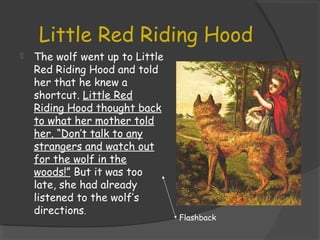
Little Red Riding Hood
 The wolf went up to Little
Red Riding Hood and told
her that he knew a
shortcut. Little Red
Riding Hood thought back
to what her mother told
her. “Don’t talk to any
strangers and watch out
for the wolf in the
woods!” But it was too
late, she had already
listened to the wolf’s
directions.
Flashback
Why Use Flashback?
 Gives audience first hand look
at the past
 Gives background that the
audience needs to understand
situations or characters
 Brings to life the memory of the
character having the flashback
Why Use Flashback?
 Lets audience understand
character behavior and
motivation
 May give some foreshadowing
clues as to the future of the
characters
Examples
“A Christmas Carol”
“It’s a Wonderful Life”
The Diary of Anne Frank(the
(the play version)
Examples
Harry Potter book & movies
https://www.youtube.com/watch?v=buJPw
“Family Guy” television show
“Buffy the Vampire Slayer”
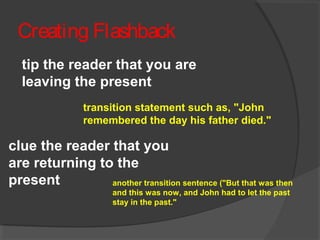
Creating Flashback
tip the reader that you are
leaving the present
transition statement such as, "John
remembered the day his father died."
clue the reader that you
are returning to the
present another transition sentence ("But that was then
and this was now, and John had to let the past
stay in the past."
Buddy Chat
Share with your learning
buddy a flashback from a
book or short story you
have read or a movie story
you have seen
Foreshadowing
Try breaking the word
FORESHADOWING apart.
FORE means ahead.
A SHADOW is a glimpse of
something without the
complete details.
Foreshadowing
a way of indicating or
hinting at what will
come later
Foreshadowing
 can be subtle
like storm clouds on the horizon suggesting
that danger is coming
 more direct
such as Romeo and Juliet talking about
wanting to die rather than live without each
other
Foreshadowing
 adds dramatic tension
 create suspense
 convey information to help
the reader understand what
comes later
Why is it important?
How do I create
foreshadowing
 placing clues, both subtle and
direct, into the text
mentioning an upcoming event
explaining the plans of the
people or characters portrayed
in the text
Ask yourself ????
 Are there phrases about the
future?
 Is there a change happening in
the weather, the setting, or the
mood?
Ask yourself ????
 Are there objects or scenic elements
that suggest something happy, sad,
dangerous, exciting, etc.?
 Do characters or the narrator observe
something in the background that might
be a hint about something to come
later?
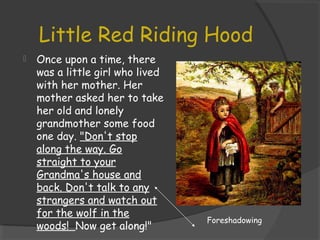
Little Red Riding Hood
 Once upon a time, there
was a little girl who lived
with her mother. Her
mother asked her to take
her old and lonely
grandmother some food
one day. "Don't stop
along the way. Go
straight to your
Grandma's house and
back. Don't talk to any
strangers and watch out
for the wolf in the
woods! Now get along!"
Foreshadowing
Foreshadowing
Examples
https://www.youtube.co
m/watch?
v=LRVRxvNYR7Y
Let’s Chat
Share with the class an
example of foreshadowing
from a book or short story
you have read or a movie
story you have seen
SymbolismSymbolism
 *A person, place or object which*A person, place or object which
has a meaning in itself but suggestshas a meaning in itself but suggests
other meanings as well.*other meanings as well.*
 However, a symbol is not what itHowever, a symbol is not what it
symbolizes.symbolizes.
 Things, characters and actions canThings, characters and actions can
be symbols.be symbols.
 *Anything that suggests a meaning*Anything that suggests a meaning
beyond the obvious.*beyond the obvious.*
 Some symbols are conventional,Some symbols are conventional,
generally meaning the same thing to allgenerally meaning the same thing to all
readers.readers.
 For example: bright sunshineFor example: bright sunshine
symbolizes goodness and water is asymbolizes goodness and water is a
symbolic cleanser.symbolic cleanser.
SymbolismSymbolism
SymbolismSymbolism
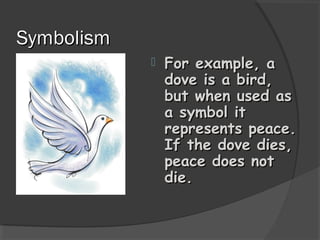
 For example, aFor example, a
dove is a bird,dove is a bird,
but when used asbut when used as
a symbol ita symbol it
represents peace.represents peace.
If the dove dies,If the dove dies,
peace does notpeace does not
die.die.
SymbolismSymbolism
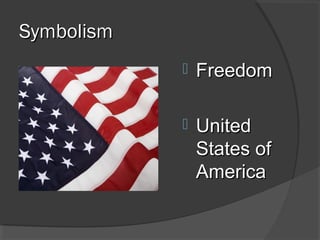
 FreedomFreedom
 UnitedUnited
States ofStates of
AmericaAmerica
How to find symbolism?How to find symbolism?
 Recognize the signs.Recognize the signs.
 the frequency an object or character isthe frequency an object or character is
mentioned in a piece of literature--if it ismentioned in a piece of literature--if it is
mentioned often, it is probably important.mentioned often, it is probably important.
 how much detail is used in describing anhow much detail is used in describing an
objectobject
 These two methods give clues that theThese two methods give clues that the
writer wants you to infer something about awriter wants you to infer something about a
particular object.particular object.
Common Symbols ofCommon Symbols of
LiteratureLiterature SleepSleep is often related to death.is often related to death.
 DreamsDreams are linked to the future orare linked to the future or
fate.fate.
 SeasonsSeasons often represent ages:often represent ages:
○ spring—youthspring—youth
○ summer--prime of lifesummer--prime of life
○ autumn--middle ageautumn--middle age
○ winter--old age or death.winter--old age or death.
Common Symbols ofCommon Symbols of
LiteratureLiterature WaterWater is sometimes linked to the idea ofis sometimes linked to the idea of
birth or purification.birth or purification.
 Colors are often linked to emotions:Colors are often linked to emotions:
○ red--anger,red--anger,
○ blue—happinessblue—happiness
○ green--jealousy.green--jealousy.
They are also used to represent states of being:They are also used to represent states of being:
○ black--death or evilblack--death or evil
○ white--purity or innocencewhite--purity or innocence
○ green--growth.green--growth.
Common Symbols ofCommon Symbols of
LiteratureLiterature
 ForestsForests are often places of testing orare often places of testing or
challenge.challenge.
 LightLight--as the sun, the moon, stars,--as the sun, the moon, stars,
candles--often symbolizes good, hope,candles--often symbolizes good, hope,
freedom.freedom.
 DarknessDarkness is associated with evil, magicis associated with evil, magic
or the unknown.or the unknown.
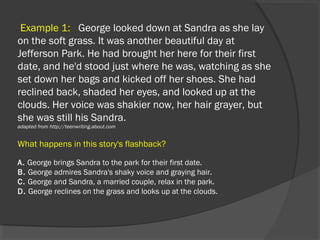
Example 1: George looked down at Sandra as she lay
on the soft grass. It was another beautiful day at
Jefferson Park. He had brought her here for their first
date, and he'd stood just where he was, watching as she
set down her bags and kicked off her shoes. She had
reclined back, shaded her eyes, and looked up at the
clouds. Her voice was shakier now, her hair grayer, but
she was still his Sandra.
adapted from http://teenwriting.about.com
What happens in this story's flashback?
A. George brings Sandra to the park for their first date.
B. George admires Sandra's shaky voice and graying hair.
C. George and Sandra, a married couple, relax in the park.
D. George reclines on the grass and looks up at the clouds.
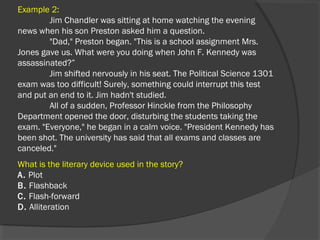
Example 2:
Jim Chandler was sitting at home watching the evening
news when his son Preston asked him a question.
"Dad," Preston began. "This is a school assignment Mrs.
Jones gave us. What were you doing when John F. Kennedy was
assassinated?”
Jim shifted nervously in his seat. The Political Science 1301
exam was too difficult! Surely, something could interrupt this test
and put an end to it. Jim hadn't studied.
All of a sudden, Professor Hinckle from the Philosophy
Department opened the door, disturbing the students taking the
exam. "Everyone," he began in a calm voice. "President Kennedy has
been shot. The university has said that all exams and classes are
canceled."
What is the literary device used in the story?
A. Plot
B. Flashback
C. Flash-forward
D. Alliteration
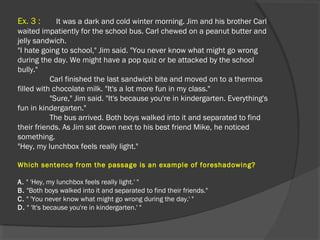
Ex. 3 : It was a dark and cold winter morning. Jim and his brother Carl
waited impatiently for the school bus. Carl chewed on a peanut butter and
jelly sandwich.
"I hate going to school," Jim said. "You never know what might go wrong
during the day. We might have a pop quiz or be attacked by the school
bully."
Carl finished the last sandwich bite and moved on to a thermos
filled with chocolate milk. "It's a lot more fun in my class."
"Sure," Jim said. "It's because you're in kindergarten. Everything's
fun in kindergarten."
The bus arrived. Both boys walked into it and separated to find
their friends. As Jim sat down next to his best friend Mike, he noticed
something.
"Hey, my lunchbox feels really light."
Which sentence from the passage is an example of foreshadowing?
A. " 'Hey, my lunchbox feels really light.' "
B. "Both boys walked into it and separated to find their friends."
C. " 'You never know what might go wrong during the day.' "
D. " 'It's because you're in kindergarten.' "
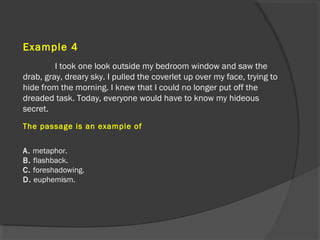
Example 4
I took one look outside my bedroom window and saw the
drab, gray, dreary sky. I pulled the coverlet up over my face, trying to
hide from the morning. I knew that I could no longer put off the
dreaded task. Today, everyone would have to know my hideous
secret.
The passage is an example of
A. metaphor.
B. flashback.
C. foreshadowing.
D. euphemism.
1. A
2. B
3. C
4. C

Foreshadowing flashback

  • 1.
  • 2.
    Lesson 2 Identify flashback, foreshadowing,and symbolism within context.
  • 3.
    Flashback Now try breakingthe word FLASHBACK apart. FLASH: a quick glimpse. BACK: a look back in the story at something that previously happened.
  • 4.
    FLASHBACK What It Is Turning back the clock  Scenes that took place in the past  Scenes literally “flash back”  Brings story or play to a standstill  Interrupts story’s chronological order
  • 5.
    FLASHBACK  What ItIs NOT!  Just talking about the past  Referring to past experiences
  • 6.
    Little Red RidingHood  The wolf went up to Little Red Riding Hood and told her that he knew a shortcut. Little Red Riding Hood thought back to what her mother told her. “Don’t talk to any strangers and watch out for the wolf in the woods!” But it was too late, she had already listened to the wolf’s directions. Flashback
  • 7.
    Why Use Flashback? Gives audience first hand look at the past  Gives background that the audience needs to understand situations or characters  Brings to life the memory of the character having the flashback
  • 8.
    Why Use Flashback? Lets audience understand character behavior and motivation  May give some foreshadowing clues as to the future of the characters
  • 9.
    Examples “A Christmas Carol” “It’sa Wonderful Life” The Diary of Anne Frank(the (the play version)
  • 10.
    Examples Harry Potter book& movies https://www.youtube.com/watch?v=buJPw “Family Guy” television show “Buffy the Vampire Slayer”
  • 11.
    Creating Flashback tip thereader that you are leaving the present transition statement such as, "John remembered the day his father died." clue the reader that you are returning to the present another transition sentence ("But that was then and this was now, and John had to let the past stay in the past."
  • 12.
    Buddy Chat Share withyour learning buddy a flashback from a book or short story you have read or a movie story you have seen
  • 13.
    Foreshadowing Try breaking theword FORESHADOWING apart. FORE means ahead. A SHADOW is a glimpse of something without the complete details.
  • 14.
    Foreshadowing a way ofindicating or hinting at what will come later
  • 15.
    Foreshadowing  can besubtle like storm clouds on the horizon suggesting that danger is coming  more direct such as Romeo and Juliet talking about wanting to die rather than live without each other
  • 16.
    Foreshadowing  adds dramatictension  create suspense  convey information to help the reader understand what comes later Why is it important?
  • 17.
    How do Icreate foreshadowing  placing clues, both subtle and direct, into the text mentioning an upcoming event explaining the plans of the people or characters portrayed in the text
  • 18.
    Ask yourself ???? Are there phrases about the future?  Is there a change happening in the weather, the setting, or the mood?

  • 19.
    Ask yourself ???? Are there objects or scenic elements that suggest something happy, sad, dangerous, exciting, etc.?  Do characters or the narrator observe something in the background that might be a hint about something to come later?
  • 20.
    Little Red RidingHood  Once upon a time, there was a little girl who lived with her mother. Her mother asked her to take her old and lonely grandmother some food one day. "Don't stop along the way. Go straight to your Grandma's house and back. Don't talk to any strangers and watch out for the wolf in the woods! Now get along!" Foreshadowing
  • 21.
  • 22.
    Let’s Chat Share withthe class an example of foreshadowing from a book or short story you have read or a movie story you have seen
  • 23.
    SymbolismSymbolism  *A person,place or object which*A person, place or object which has a meaning in itself but suggestshas a meaning in itself but suggests other meanings as well.*other meanings as well.*  However, a symbol is not what itHowever, a symbol is not what it symbolizes.symbolizes.  Things, characters and actions canThings, characters and actions can be symbols.be symbols.  *Anything that suggests a meaning*Anything that suggests a meaning beyond the obvious.*beyond the obvious.*
  • 25.
     Some symbolsare conventional,Some symbols are conventional, generally meaning the same thing to allgenerally meaning the same thing to all readers.readers.  For example: bright sunshineFor example: bright sunshine symbolizes goodness and water is asymbolizes goodness and water is a symbolic cleanser.symbolic cleanser. SymbolismSymbolism
  • 26.
    SymbolismSymbolism  For example,aFor example, a dove is a bird,dove is a bird, but when used asbut when used as a symbol ita symbol it represents peace.represents peace. If the dove dies,If the dove dies, peace does notpeace does not die.die.
  • 27.
  • 28.
    How to findsymbolism?How to find symbolism?  Recognize the signs.Recognize the signs.  the frequency an object or character isthe frequency an object or character is mentioned in a piece of literature--if it ismentioned in a piece of literature--if it is mentioned often, it is probably important.mentioned often, it is probably important.  how much detail is used in describing anhow much detail is used in describing an objectobject  These two methods give clues that theThese two methods give clues that the writer wants you to infer something about awriter wants you to infer something about a particular object.particular object.
  • 29.
    Common Symbols ofCommonSymbols of LiteratureLiterature SleepSleep is often related to death.is often related to death.  DreamsDreams are linked to the future orare linked to the future or fate.fate.  SeasonsSeasons often represent ages:often represent ages: ○ spring—youthspring—youth ○ summer--prime of lifesummer--prime of life ○ autumn--middle ageautumn--middle age ○ winter--old age or death.winter--old age or death.
  • 30.
    Common Symbols ofCommonSymbols of LiteratureLiterature WaterWater is sometimes linked to the idea ofis sometimes linked to the idea of birth or purification.birth or purification.  Colors are often linked to emotions:Colors are often linked to emotions: ○ red--anger,red--anger, ○ blue—happinessblue—happiness ○ green--jealousy.green--jealousy. They are also used to represent states of being:They are also used to represent states of being: ○ black--death or evilblack--death or evil ○ white--purity or innocencewhite--purity or innocence ○ green--growth.green--growth.
  • 31.
    Common Symbols ofCommonSymbols of LiteratureLiterature  ForestsForests are often places of testing orare often places of testing or challenge.challenge.  LightLight--as the sun, the moon, stars,--as the sun, the moon, stars, candles--often symbolizes good, hope,candles--often symbolizes good, hope, freedom.freedom.  DarknessDarkness is associated with evil, magicis associated with evil, magic or the unknown.or the unknown.
  • 33.
    Example 1: Georgelooked down at Sandra as she lay on the soft grass. It was another beautiful day at Jefferson Park. He had brought her here for their first date, and he'd stood just where he was, watching as she set down her bags and kicked off her shoes. She had reclined back, shaded her eyes, and looked up at the clouds. Her voice was shakier now, her hair grayer, but she was still his Sandra. adapted from http://teenwriting.about.com What happens in this story's flashback? A. George brings Sandra to the park for their first date. B. George admires Sandra's shaky voice and graying hair. C. George and Sandra, a married couple, relax in the park. D. George reclines on the grass and looks up at the clouds.
  • 34.
    Example 2: Jim Chandlerwas sitting at home watching the evening news when his son Preston asked him a question. "Dad," Preston began. "This is a school assignment Mrs. Jones gave us. What were you doing when John F. Kennedy was assassinated?” Jim shifted nervously in his seat. The Political Science 1301 exam was too difficult! Surely, something could interrupt this test and put an end to it. Jim hadn't studied. All of a sudden, Professor Hinckle from the Philosophy Department opened the door, disturbing the students taking the exam. "Everyone," he began in a calm voice. "President Kennedy has been shot. The university has said that all exams and classes are canceled." What is the literary device used in the story? A. Plot B. Flashback C. Flash-forward D. Alliteration
  • 35.
    Ex. 3 :It was a dark and cold winter morning. Jim and his brother Carl waited impatiently for the school bus. Carl chewed on a peanut butter and jelly sandwich. "I hate going to school," Jim said. "You never know what might go wrong during the day. We might have a pop quiz or be attacked by the school bully." Carl finished the last sandwich bite and moved on to a thermos filled with chocolate milk. "It's a lot more fun in my class." "Sure," Jim said. "It's because you're in kindergarten. Everything's fun in kindergarten." The bus arrived. Both boys walked into it and separated to find their friends. As Jim sat down next to his best friend Mike, he noticed something. "Hey, my lunchbox feels really light." Which sentence from the passage is an example of foreshadowing? A. " 'Hey, my lunchbox feels really light.' " B. "Both boys walked into it and separated to find their friends." C. " 'You never know what might go wrong during the day.' " D. " 'It's because you're in kindergarten.' "
  • 36.
    Example 4 I tookone look outside my bedroom window and saw the drab, gray, dreary sky. I pulled the coverlet up over my face, trying to hide from the morning. I knew that I could no longer put off the dreaded task. Today, everyone would have to know my hideous secret. The passage is an example of A. metaphor. B. flashback. C. foreshadowing. D. euphemism.
  • 37.

Editor's Notes

  • #21 Before this slide, there could be a transition slide. Something that allows the reader to know what is coming next. .. Now you will will portions from a story…