Organisation Development Centre (ODC)
Developing Healthy Organisations through People
CAPACITY BUILDING TRAINING PROGRAMME
for Staff Members of
The Regional Renewable Energy Service Centres (RRESCs)
Writing Case Studies
Organisation Development Centre (ODC)
What is a case study?
• A case study includes a description of a
situation (challenge or problem) with relevant
facts and opinions that could influence
individual decision.
• A case study can be factual or fictional
Organisation Development Centre (ODC)
Purpose of a case study
• Case studies are frequently used to examine
complex issues in real-life applications.
• They are ideally suited for understanding
phenomena that require a holistic view, where
cause-and-effect relationships are likely
influenced by a number of factors.
Organisation Development Centre (ODC)
• The goal is to capture an interesting or difficult
situation requiring a creative and illuminating
response.
• It portrays, via a graphic story or situation,
problems, issues or responsibilities typical of a
particular role or institution.
Purpose of a case study
Organisation Development Centre (ODC)
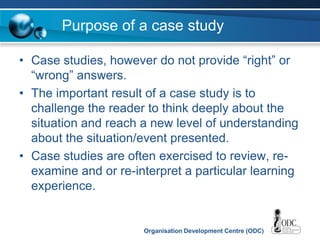
Purpose of a case study
• Case studies, however do not provide “right” or
“wrong” answers.
• The important result of a case study is to
challenge the reader to think deeply about the
situation and reach a new level of understanding
about the situation/event presented.
• Case studies are often exercised to review, re-
examine and or re-interpret a particular learning
experience.
Organisation Development Centre (ODC)
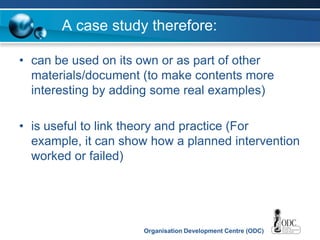
A case study therefore:
• can be used on its own or as part of other
materials/document (to make contents more
interesting by adding some real examples)
• is useful to link theory and practice (For
example, it can show how a planned intervention
worked or failed)
Organisation Development Centre (ODC)
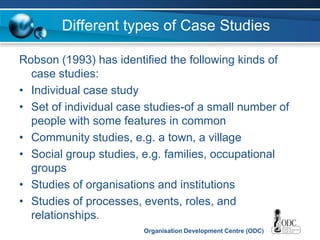
Different types of Case Studies
Robson (1993) has identified the following kinds of
case studies:
• Individual case study
• Set of individual case studies-of a small number of
people with some features in common
• Community studies, e.g. a town, a village
• Social group studies, e.g. families, occupational
groups
• Studies of organisations and institutions
• Studies of processes, events, roles, and
relationships.
Organisation Development Centre (ODC)
Key components of a Case Study
• Situation before (background, physical and
historical setting)
• Process (intervention, activity)
• Situation after (outcome, result, change):
comparing the situation before and after
• Sometimes, analysis of the situation is important
when the writer has to articulate ideas and
comments on the important event. The analysis
helps to identify the key elements that created the
change in the situation.
• Similarly, the lesson learned and the relationship
between the processes and results are also
analysed.
Organisation Development Centre (ODC)
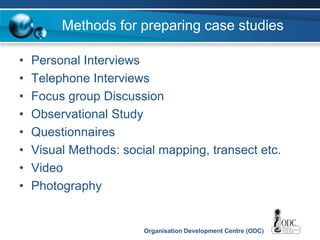
Methods for preparing case studies
• Personal Interviews
• Telephone Interviews
• Focus group Discussion
• Observational Study
• Questionnaires
• Visual Methods: social mapping, transect etc.
• Video
• Photography
Organisation Development Centre (ODC)
Planning a Case Study
What is the case study about ?
1. Identify the Problem/Challenge
2. Define the Context
3. Identify Key Decision-Makers
4. Identify Stakeholders
5. Conclusion
Organisation Development Centre (ODC)
Organising a Case study
• Title of case study: This explains what is the case
study about? Title should be such that is able to
catch people’s attention.
• Introduction to case study: It includes main aims
and themes of the study.
• Introduction to the subjects of the case study: The
introductory information to the subject (people,
organisation or event); name and mission, where
and who does it work with? should be mentioned.
Organisation Development Centre (ODC)
Organising a Case study
• Outline of Projects: If the case study is about a
project, the key areas of the projects should be
outlined.
• Key achievements: (What has the NGO/CBO
done best? What results can it show?)
• Key challenges: Honest briefing of the
challenges and weaknesses of the NGO/CBO or
the subject of the study has to be mentioned in
case studies, however, the writer can avoid using
people’s names or get permission to spell out
their identities.
Organisation Development Centre (ODC)
Organising a Case study
• Lessons learned: What can be done
differently ?
• Conclusions/plans for the future: (What are
the conclusions? What are the future
directions?)
• Support for the work :( Which donors and
others supported the work?)
Organisation Development Centre (ODC)
Things to consider
• Keep your audience in mind – use of language,
depth of context/background
• Use story telling techniques – use of characters,
visualisations
• Openings: Grab the reader with a character facing
his or her biggest problem: set the scene for the
confrontations, the frustrations, and the main
conflicts.
• Present situations and scenes without any attempt
at analysis. Scenes must follow a logical order.
Organisation Development Centre (ODC)
A good case study should
• Communicate a learning experience
• Tell a complete story
• Be relevant to the targeted audience/reader
group
• Be realistic and credible
• Create empathy with the characters
• Be short and simple to read – no technical
jargons or concepts.

Writing case study

  • 1.
    Organisation Development Centre(ODC) Developing Healthy Organisations through People CAPACITY BUILDING TRAINING PROGRAMME for Staff Members of The Regional Renewable Energy Service Centres (RRESCs) Writing Case Studies
  • 2.
    Organisation Development Centre(ODC) What is a case study? • A case study includes a description of a situation (challenge or problem) with relevant facts and opinions that could influence individual decision. • A case study can be factual or fictional
  • 3.
    Organisation Development Centre(ODC) Purpose of a case study • Case studies are frequently used to examine complex issues in real-life applications. • They are ideally suited for understanding phenomena that require a holistic view, where cause-and-effect relationships are likely influenced by a number of factors.
  • 4.
    Organisation Development Centre(ODC) • The goal is to capture an interesting or difficult situation requiring a creative and illuminating response. • It portrays, via a graphic story or situation, problems, issues or responsibilities typical of a particular role or institution. Purpose of a case study
  • 5.
    Organisation Development Centre(ODC) Purpose of a case study • Case studies, however do not provide “right” or “wrong” answers. • The important result of a case study is to challenge the reader to think deeply about the situation and reach a new level of understanding about the situation/event presented. • Case studies are often exercised to review, re- examine and or re-interpret a particular learning experience.
  • 6.
    Organisation Development Centre(ODC) A case study therefore: • can be used on its own or as part of other materials/document (to make contents more interesting by adding some real examples) • is useful to link theory and practice (For example, it can show how a planned intervention worked or failed)
  • 7.
    Organisation Development Centre(ODC) Different types of Case Studies Robson (1993) has identified the following kinds of case studies: • Individual case study • Set of individual case studies-of a small number of people with some features in common • Community studies, e.g. a town, a village • Social group studies, e.g. families, occupational groups • Studies of organisations and institutions • Studies of processes, events, roles, and relationships.
  • 8.
    Organisation Development Centre(ODC) Key components of a Case Study • Situation before (background, physical and historical setting) • Process (intervention, activity) • Situation after (outcome, result, change): comparing the situation before and after • Sometimes, analysis of the situation is important when the writer has to articulate ideas and comments on the important event. The analysis helps to identify the key elements that created the change in the situation. • Similarly, the lesson learned and the relationship between the processes and results are also analysed.
  • 9.
    Organisation Development Centre(ODC) Methods for preparing case studies • Personal Interviews • Telephone Interviews • Focus group Discussion • Observational Study • Questionnaires • Visual Methods: social mapping, transect etc. • Video • Photography
  • 10.
    Organisation Development Centre(ODC) Planning a Case Study What is the case study about ? 1. Identify the Problem/Challenge 2. Define the Context 3. Identify Key Decision-Makers 4. Identify Stakeholders 5. Conclusion
  • 11.
    Organisation Development Centre(ODC) Organising a Case study • Title of case study: This explains what is the case study about? Title should be such that is able to catch people’s attention. • Introduction to case study: It includes main aims and themes of the study. • Introduction to the subjects of the case study: The introductory information to the subject (people, organisation or event); name and mission, where and who does it work with? should be mentioned.
  • 12.
    Organisation Development Centre(ODC) Organising a Case study • Outline of Projects: If the case study is about a project, the key areas of the projects should be outlined. • Key achievements: (What has the NGO/CBO done best? What results can it show?) • Key challenges: Honest briefing of the challenges and weaknesses of the NGO/CBO or the subject of the study has to be mentioned in case studies, however, the writer can avoid using people’s names or get permission to spell out their identities.
  • 13.
    Organisation Development Centre(ODC) Organising a Case study • Lessons learned: What can be done differently ? • Conclusions/plans for the future: (What are the conclusions? What are the future directions?) • Support for the work :( Which donors and others supported the work?)
  • 14.
    Organisation Development Centre(ODC) Things to consider • Keep your audience in mind – use of language, depth of context/background • Use story telling techniques – use of characters, visualisations • Openings: Grab the reader with a character facing his or her biggest problem: set the scene for the confrontations, the frustrations, and the main conflicts. • Present situations and scenes without any attempt at analysis. Scenes must follow a logical order.
  • 15.
    Organisation Development Centre(ODC) A good case study should • Communicate a learning experience • Tell a complete story • Be relevant to the targeted audience/reader group • Be realistic and credible • Create empathy with the characters • Be short and simple to read – no technical jargons or concepts.