Suchandrika Chakrabarti
Community Newswire Manager
Media Trust
Positive change through the power of media
• Open courses- Regular training sessions on marketing, digital and PR
& media relations led by industry professionals
• Bespoke training and consultancy – Expert-led. tailor made
training and consultancy packages to meet the individual needs and
requirements of your organisation
• Productions – Award winning films for charities
• Community newswire – Our free-to-use Community Newswire
service helps charities, communities and citizen journalists get their
stories into the national and regional media
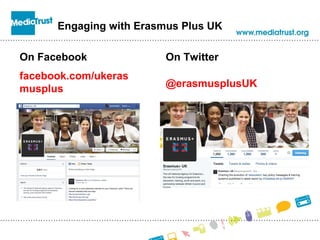
Engaging with Erasmus Plus UK
On Facebook On Twitter
@erasmusplusUK
facebook.com/ukeras
musplus
A case study is an interview with a
happy client
DHT Case Study
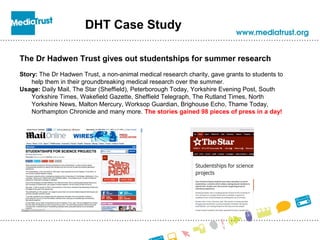
The Dr Hadwen Trust gives out studentships for summer research
Story: The Dr Hadwen Trust, a non-animal medical research charity, gave grants to students to
help them in their groundbreaking medical research over the summer.
Usage: Daily Mail, The Star (Sheffield), Peterborough Today, Yorkshire Evening Post, South
Yorkshire Times, Wakefield Gazette, Sheffield Telegraph, The Rutland Times, North
Yorkshire News, Malton Mercury, Worksop Guardian, Brighouse Echo, Thame Today,
Northampton Chronicle and many more. The stories gained 98 pieces of press in a day!
DHT case study as promo
Be prepared
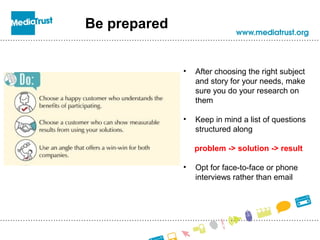
• After choosing the right subject
and story for your needs, make
sure you do your research on
them
• Keep in mind a list of questions
structured along
problem -> solution -> result
• Opt for face-to-face or phone
interviews rather than email
Get the specifics
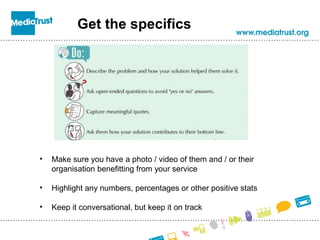
• Make sure you have a photo / video of them and / or their
organisation benefitting from your service
• Highlight any numbers, percentages or other positive stats
• Keep it conversational, but keep it on track
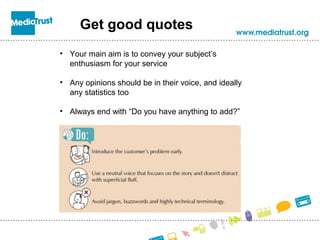
Get good quotes
• Your main aim is to convey your subject’s
enthusiasm for your service
• Any opinions should be in their voice, and ideally
any statistics too
• Always end with “Do you have anything to add?”
Three acts:
->Conflict
->Solution
->Outcome
Beginning: Conflict
• An introduction to your subject and
why they came to use your service –
due to a problem, a shortfall, some
other somewhat negative reason
• Did they have specific needs? What
were they?
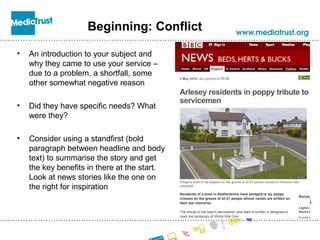
• Consider using a standfirst (bold
paragraph between headline and body
text) to summarise the story and get
the key benefits in there at the start.
Look at news stories like the one on
the right for inspiration
Middle: Solution
• Share the steps the subject took to
overcome the problem, such as
considering organisations / ideas –
helps the reader empathise
• How / why did they find and choose
you?
• How did you help?
• Pitch your service or project here, blow
your own trumpet!
• Be honest about any problems that
arose
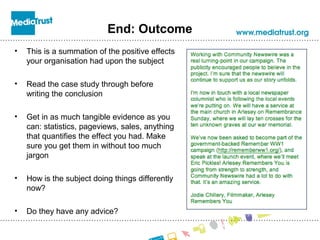
End: Outcome
• This is a summation of the positive effects
your organisation had upon the subject
• Read the case study through before
writing the conclusion
• Get in as much tangible evidence as you
can: statistics, pageviews, sales, anything
that quantifies the effect you had. Make
sure you get them in without too much
jargon
• How is the subject doing things differently
now?
• Do they have any advice?
Then tell the group which details
you remember from your partner’s
story
Writing Case Studies

Writing Case Studies

  • 1.
  • 2.
    Positive change throughthe power of media • Open courses- Regular training sessions on marketing, digital and PR & media relations led by industry professionals • Bespoke training and consultancy – Expert-led. tailor made training and consultancy packages to meet the individual needs and requirements of your organisation • Productions – Award winning films for charities • Community newswire – Our free-to-use Community Newswire service helps charities, communities and citizen journalists get their stories into the national and regional media
  • 3.
    Engaging with ErasmusPlus UK On Facebook On Twitter @erasmusplusUK facebook.com/ukeras musplus
  • 4.
    A case studyis an interview with a happy client
  • 5.
    DHT Case Study TheDr Hadwen Trust gives out studentships for summer research Story: The Dr Hadwen Trust, a non-animal medical research charity, gave grants to students to help them in their groundbreaking medical research over the summer. Usage: Daily Mail, The Star (Sheffield), Peterborough Today, Yorkshire Evening Post, South Yorkshire Times, Wakefield Gazette, Sheffield Telegraph, The Rutland Times, North Yorkshire News, Malton Mercury, Worksop Guardian, Brighouse Echo, Thame Today, Northampton Chronicle and many more. The stories gained 98 pieces of press in a day!
  • 6.
  • 7.
    Be prepared • Afterchoosing the right subject and story for your needs, make sure you do your research on them • Keep in mind a list of questions structured along problem -> solution -> result • Opt for face-to-face or phone interviews rather than email
  • 8.
    Get the specifics •Make sure you have a photo / video of them and / or their organisation benefitting from your service • Highlight any numbers, percentages or other positive stats • Keep it conversational, but keep it on track
  • 9.
    Get good quotes •Your main aim is to convey your subject’s enthusiasm for your service • Any opinions should be in their voice, and ideally any statistics too • Always end with “Do you have anything to add?”
  • 10.
  • 11.
    Beginning: Conflict • Anintroduction to your subject and why they came to use your service – due to a problem, a shortfall, some other somewhat negative reason • Did they have specific needs? What were they? • Consider using a standfirst (bold paragraph between headline and body text) to summarise the story and get the key benefits in there at the start. Look at news stories like the one on the right for inspiration
  • 12.
    Middle: Solution • Sharethe steps the subject took to overcome the problem, such as considering organisations / ideas – helps the reader empathise • How / why did they find and choose you? • How did you help? • Pitch your service or project here, blow your own trumpet! • Be honest about any problems that arose
  • 13.
    End: Outcome • Thisis a summation of the positive effects your organisation had upon the subject • Read the case study through before writing the conclusion • Get in as much tangible evidence as you can: statistics, pageviews, sales, anything that quantifies the effect you had. Make sure you get them in without too much jargon • How is the subject doing things differently now? • Do they have any advice?
  • 14.
    Then tell thegroup which details you remember from your partner’s story

Editor's Notes

  • #2 Media Trust is a charity. We see ourselves as a bridge between the media industry and the charity and community sector. We have corporate members like BBC, ITV, Channel 4, Warner Bros, MTV, News International and IPC Media and we utilise their skills and resources to empower charities and communities to find their voice and get it heard.
  • #5 Media Trust is a charity. We see ourselves as a bridge between the media industry and the charity and community sector. We have corporate members like BBC, ITV, Channel 4, Warner Bros, MTV, News International and IPC Media and we utilise their skills and resources to empower charities and communities to find their voice and get it heard.
  • #11 Media Trust is a charity. We see ourselves as a bridge between the media industry and the charity and community sector. We have corporate members like BBC, ITV, Channel 4, Warner Bros, MTV, News International and IPC Media and we utilise their skills and resources to empower charities and communities to find their voice and get it heard.
  • #15 Media Trust is a charity. We see ourselves as a bridge between the media industry and the charity and community sector. We have corporate members like BBC, ITV, Channel 4, Warner Bros, MTV, News International and IPC Media and we utilise their skills and resources to empower charities and communities to find their voice and get it heard.
  • #16 Media Trust is a charity. We see ourselves as a bridge between the media industry and the charity and community sector. We have corporate members like BBC, ITV, Channel 4, Warner Bros, MTV, News International and IPC Media and we utilise their skills and resources to empower charities and communities to find their voice and get it heard.