Case Study Design Essentials:
Definition, Research
Questions, Propositions
Research Methodology Group
Mansureh Kebritchi, Ph.D.
Agenda
Focus on case study
design essential
components
Provide examples
Answer your
questions
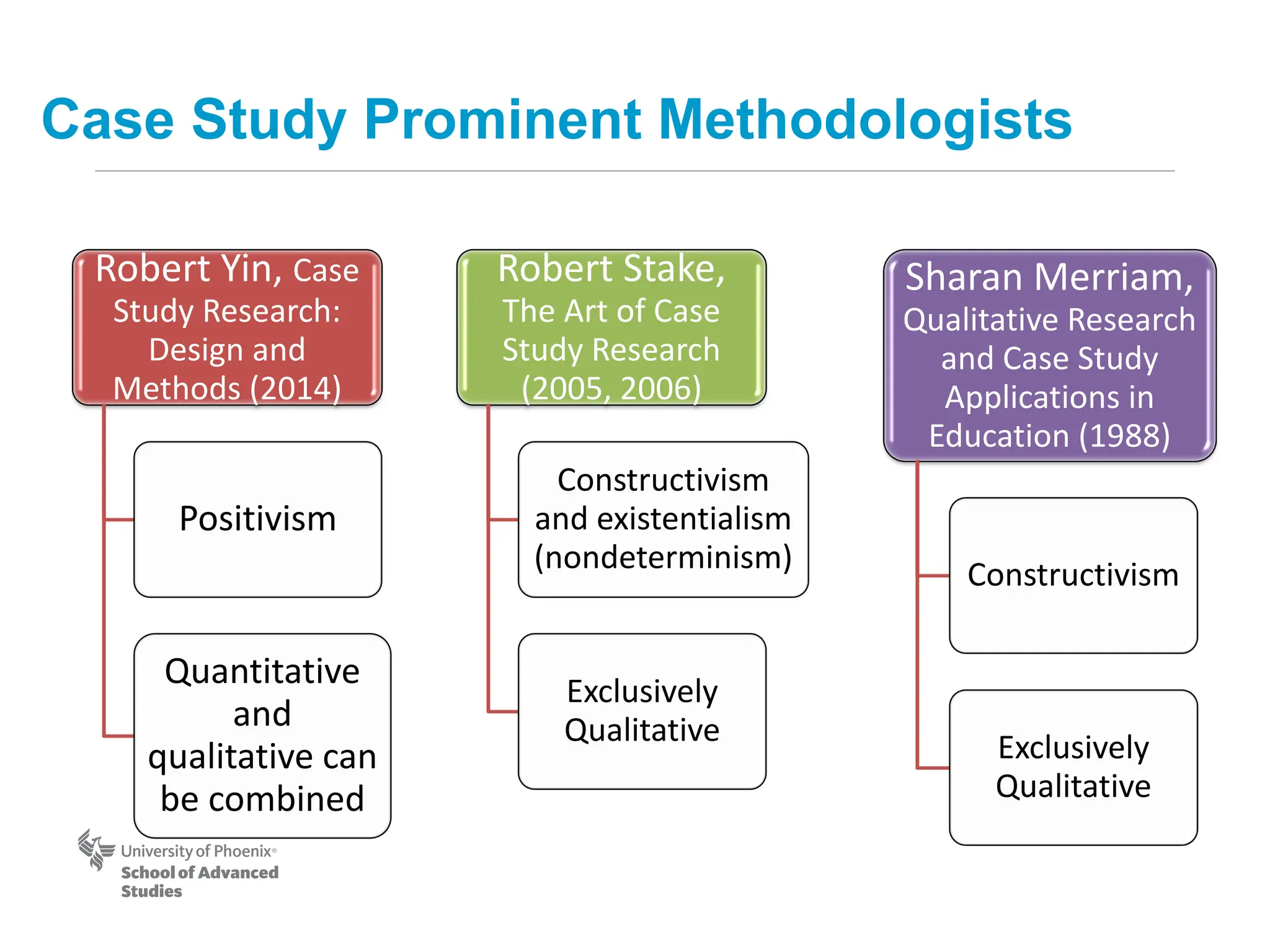
Case Study Prominent Methodologists
Robert Yin, Case
Study Research:
Design and
Methods (2014)
Positivism
Quantitative
and
qualitative can
be combined
Robert Stake,
The Art of Case
Study Research
(2005, 2006)
Constructivism
and existentialism
(nondeterminism)
Exclusively
Qualitative
Sharan Merriam,
Qualitative Research
and Case Study
Applications in
Education (1988)
Constructivism
Exclusively
Qualitative
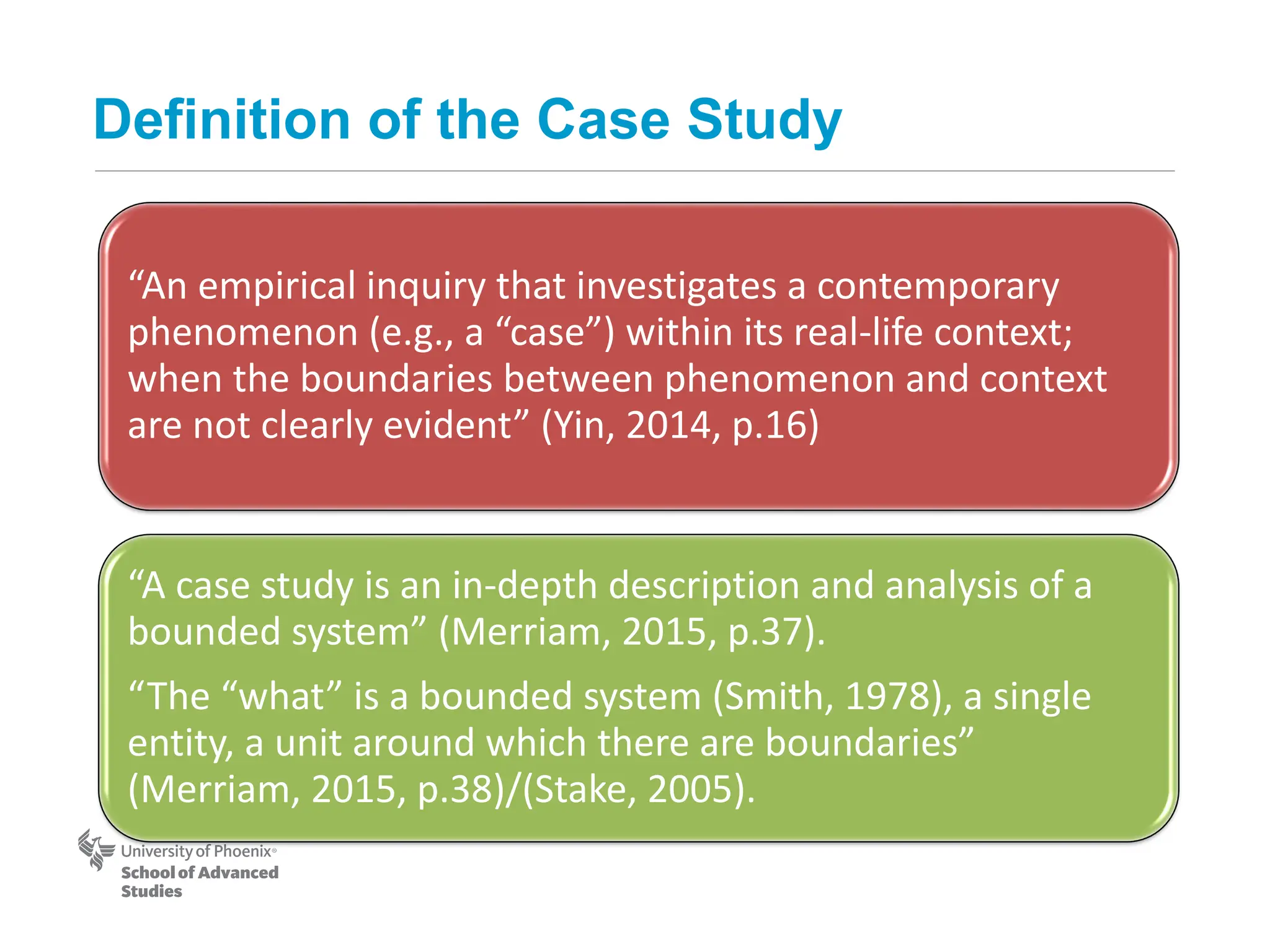
Definition of the Case Study
“An empirical inquiry that investigates a contemporary
phenomenon (e.g., a “case”) within its real-life context;
when the boundaries between phenomenon and context
are not clearly evident” (Yin, 2014, p.16)
“A case study is an in-depth description and analysis of a
bounded system” (Merriam, 2015, p.37).
“The “what” is a bounded system (Smith, 1978), a single
entity, a unit around which there are boundaries”
(Merriam, 2015, p.38)/(Stake, 2005).
When to use the Case Study
The focus in on answering “How” and “Why” questions
You cannot manipulate the behavior of those involved in
the study (Yin, 2014)
When to Use a Case Study
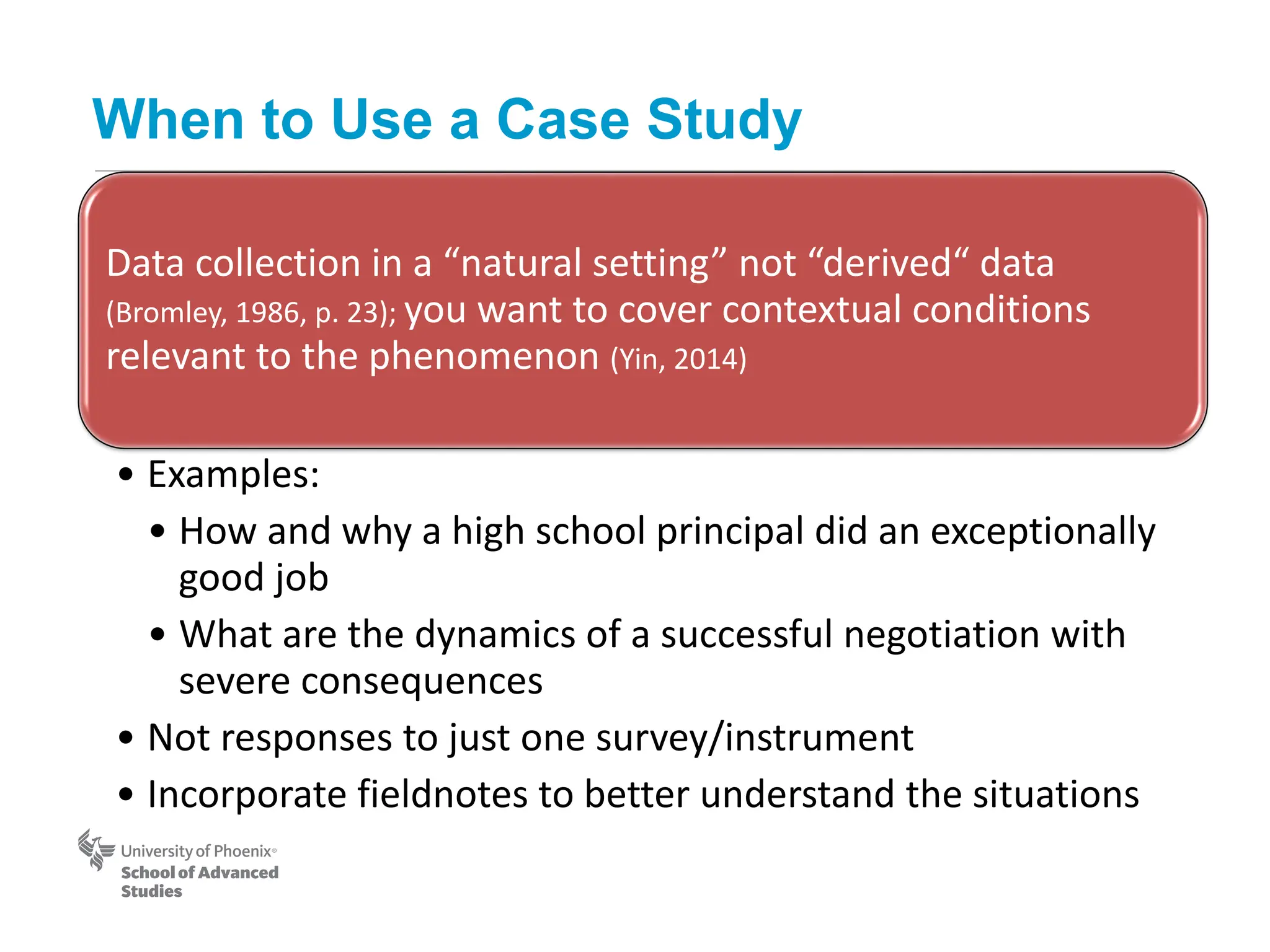
Data collection in a “natural setting” not “derived“ data
(Bromley, 1986, p. 23); you want to cover contextual conditions
relevant to the phenomenon (Yin, 2014)
• Examples:
• How and why a high school principal did an exceptionally
good job
• What are the dynamics of a successful negotiation with
severe consequences
• Not responses to just one survey/instrument
• Incorporate fieldnotes to better understand the situations
When to Use a Case Study
Conducting program evaluations, Examples:
• U.S. Government Accountability Office (e.g., 1990, 2008)
• Case Studies from Ongoing Work Show Examples in Which Wage
and Hour Division Did Not Adequately Pursue Labor Violations
(2008) (https://www.gao.gov/special.pubs/10_1_9.pdf)
• Case Studies of U.S and Chinese Economic Engagement in Angola,
Ghana, and Kenya (2013) (https://www.gao.gov/products/GAO-
08-973T)
• K-12 EDUCATION: Better Use of Information Could Help Agencies
Identify Disparities and Address Racial Discrimination (2016)
(https://www.gao.gov/products/GAO-16-345)
• Yin (1997, 2009)
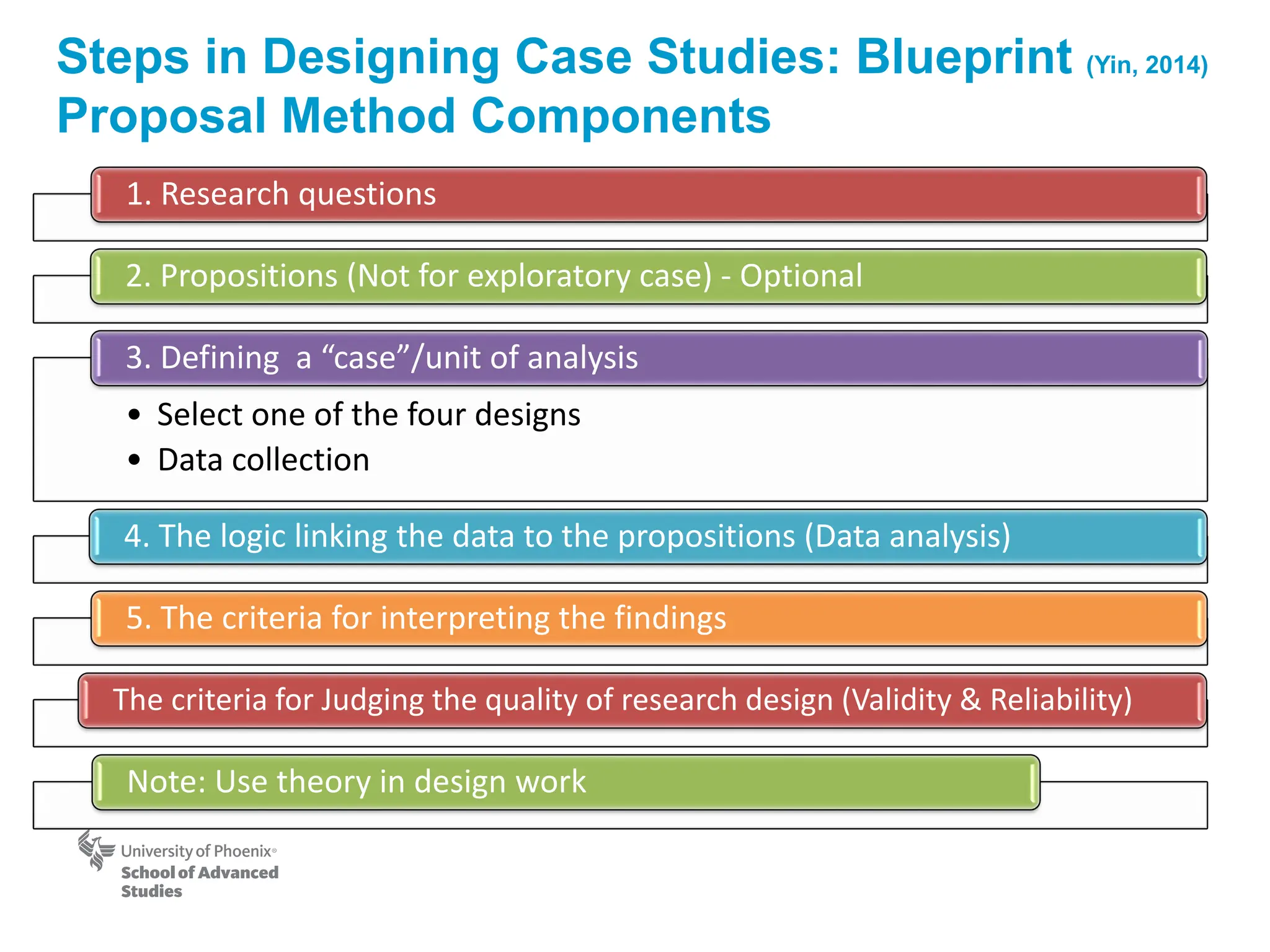
Steps in Designing Case Studies: Blueprint (Yin, 2014)
Proposal Method Components
1. Research questions
2. Propositions (Not for exploratory case) - Optional
• Select one of the four designs
• Data collection
3. Defining a “case”/unit of analysis
4. The logic linking the data to the propositions (Data analysis)
5. The criteria for interpreting the findings
The criteria for Judging the quality of research design (Validity & Reliability)
Note: Use theory in design work
The Most Challenging Steps in Designing a Case Study
Defining a “case”/unit of analysis
Select one of the four designs
Data Collection
• Yin (2013)
Data Analysis
Defining the “case”
The most defining characteristics of case study is delimiting
the object of the study: the case (Merriam, 2015)
• The goal is to understand one thing well: a person, a program,
a group, or specific policy; examples: one playground, one
band.
• Research question must be aligned/define the case/unit of
analysis.
A noun, seldom a verb, a functioning (Stake, 2006). Real
things to visualize. Examples: not training, managing , giving
birth but training modules, managers, labor rooms.
The “Case”
The
Case
The
context
Bounded context
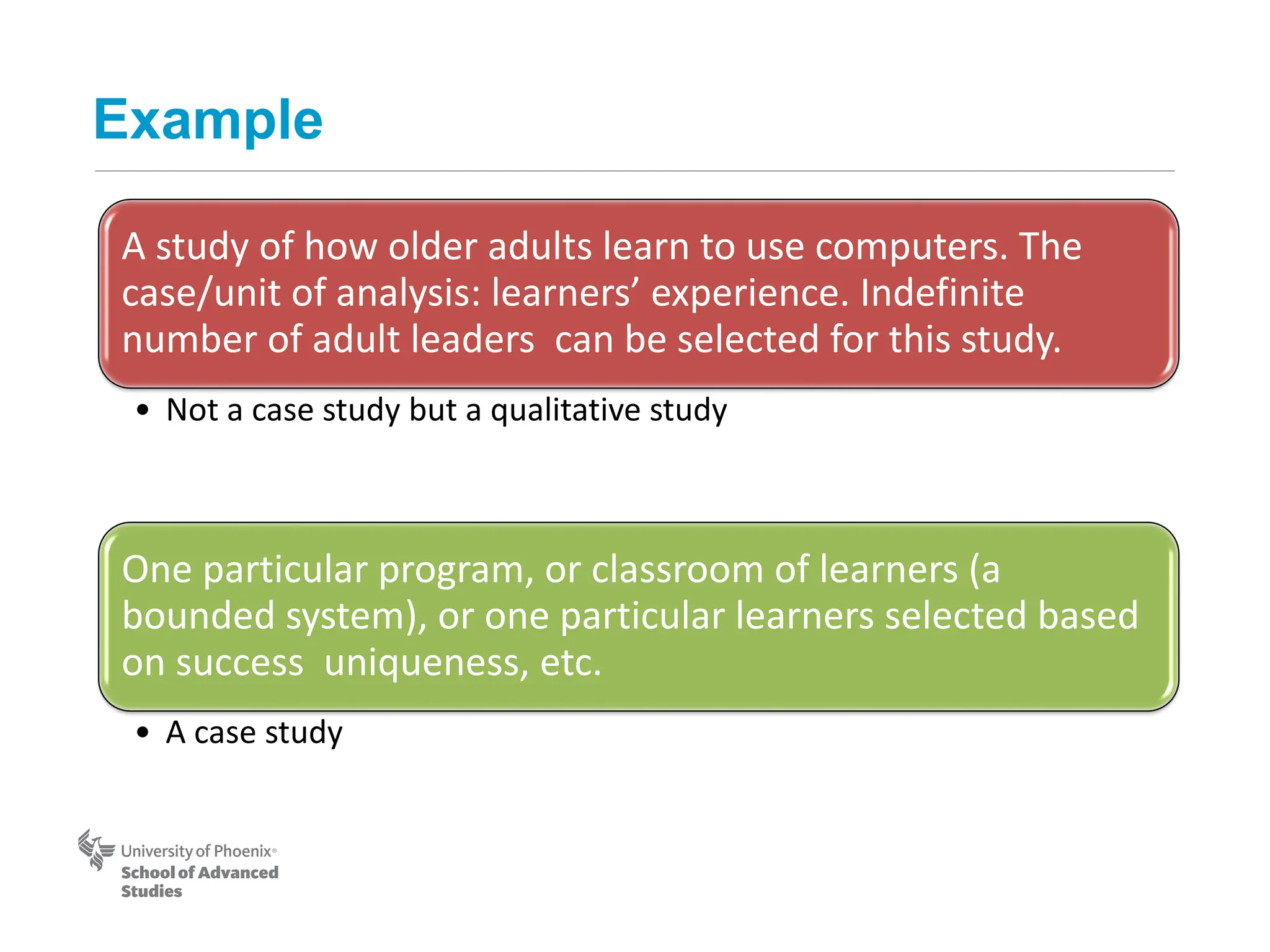
Example
A study of how older adults learn to use computers. The
case/unit of analysis: learners’ experience. Indefinite
number of adult leaders can be selected for this study.
• Not a case study but a qualitative study
One particular program, or classroom of learners (a
bounded system), or one particular learners selected based
on success uniqueness, etc.
• A case study
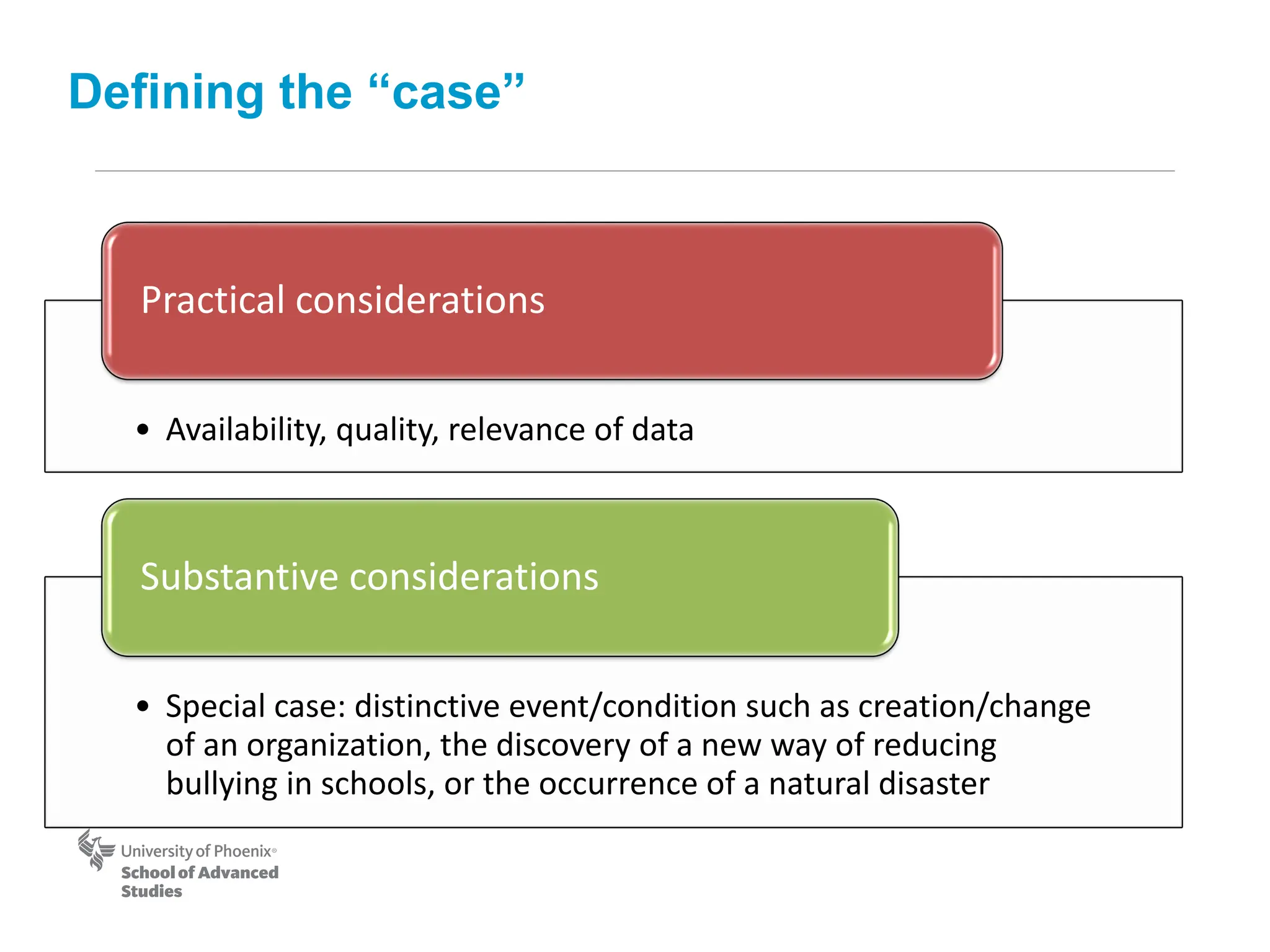
Defining the “case”
• Availability, quality, relevance of data
Practical considerations
• Special case: distinctive event/condition such as creation/change
of an organization, the discovery of a new way of reducing
bullying in schools, or the occurrence of a natural disaster
Substantive considerations
What if you don’t have a distinctive condition?
• Review literature: generate a new knowledge/perspectives
about organizations, communities, other social processes and
outcome
• Example: An average American city, but the framework
highlights a significant development in American history—the
transition from an agricultural to an industrial economy and how
it occurred in the average American city (Lynd & Lynd, 1957).
Define compelling framework to make your case unique
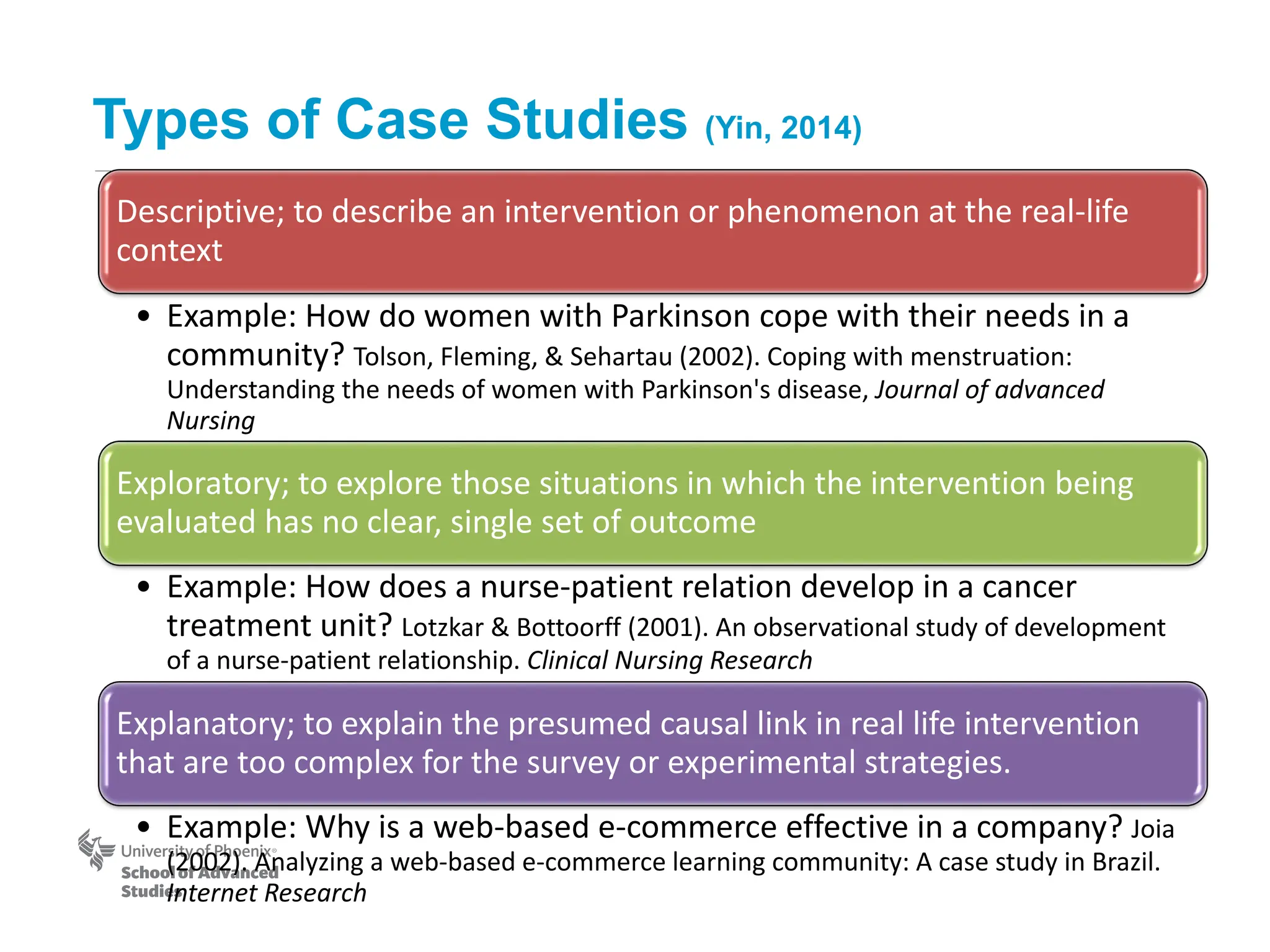
Types of Case Studies (Yin, 2014)
Descriptive; to describe an intervention or phenomenon at the real-life
context
• Example: How do women with Parkinson cope with their needs in a
community? Tolson, Fleming, & Sehartau (2002). Coping with menstruation:
Understanding the needs of women with Parkinson's disease, Journal of advanced
Nursing
Exploratory; to explore those situations in which the intervention being
evaluated has no clear, single set of outcome
• Example: How does a nurse-patient relation develop in a cancer
treatment unit? Lotzkar & Bottoorff (2001). An observational study of development
of a nurse-patient relationship. Clinical Nursing Research
Explanatory; to explain the presumed causal link in real life intervention
that are too complex for the survey or experimental strategies.
• Example: Why is a web-based e-commerce effective in a company? Joia
(2002). Analyzing a web-based e-commerce learning community: A case study in Brazil.
Internet Research
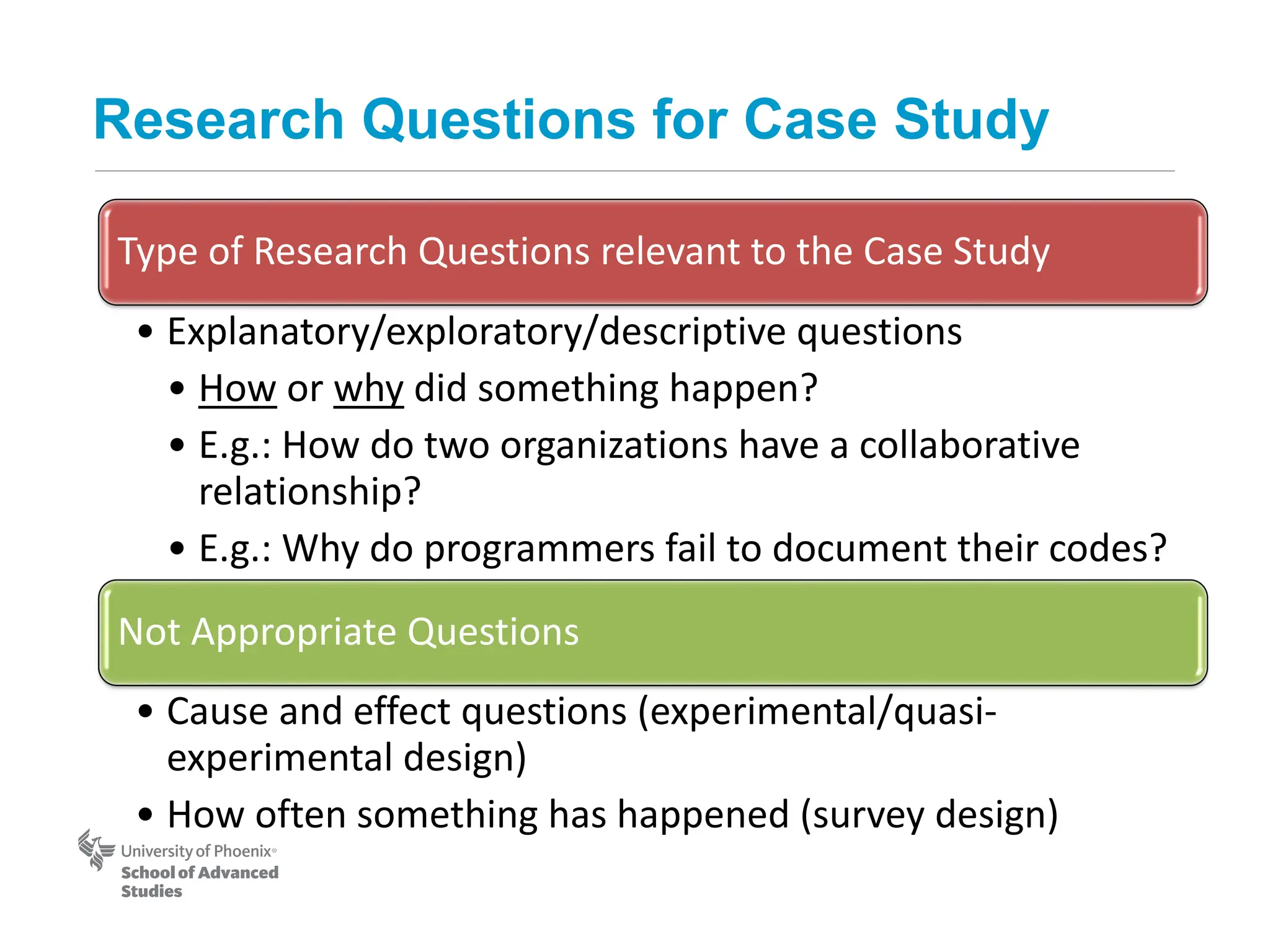
Research Questions for Case Study
Type of Research Questions relevant to the Case Study
• Explanatory/exploratory/descriptive questions
• How or why did something happen?
• E.g.: How do two organizations have a collaborative
relationship?
• E.g.: Why do programmers fail to document their codes?
Not Appropriate Questions
• Cause and effect questions (experimental/quasi-
experimental design)
• How often something has happened (survey design)
Developing Case Study Research Questions
(Baxter P. & Jack, 2008, p. 546)
Binding the case
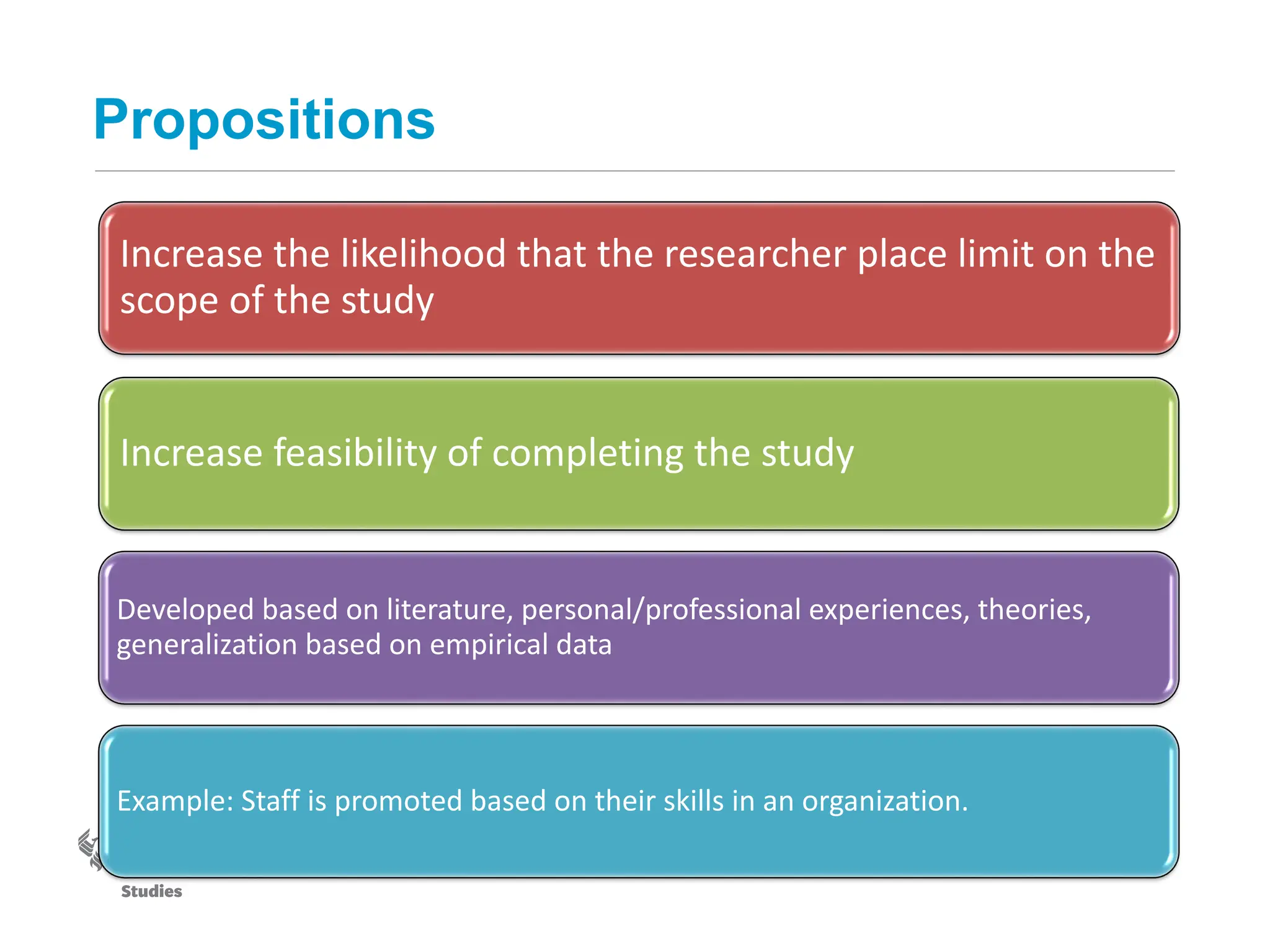
Propositions
Increase the likelihood that the researcher place limit on the
scope of the study
Increase feasibility of completing the study
Developed based on literature, personal/professional experiences, theories,
generalization based on empirical data
Example: Staff is promoted based on their skills in an organization.
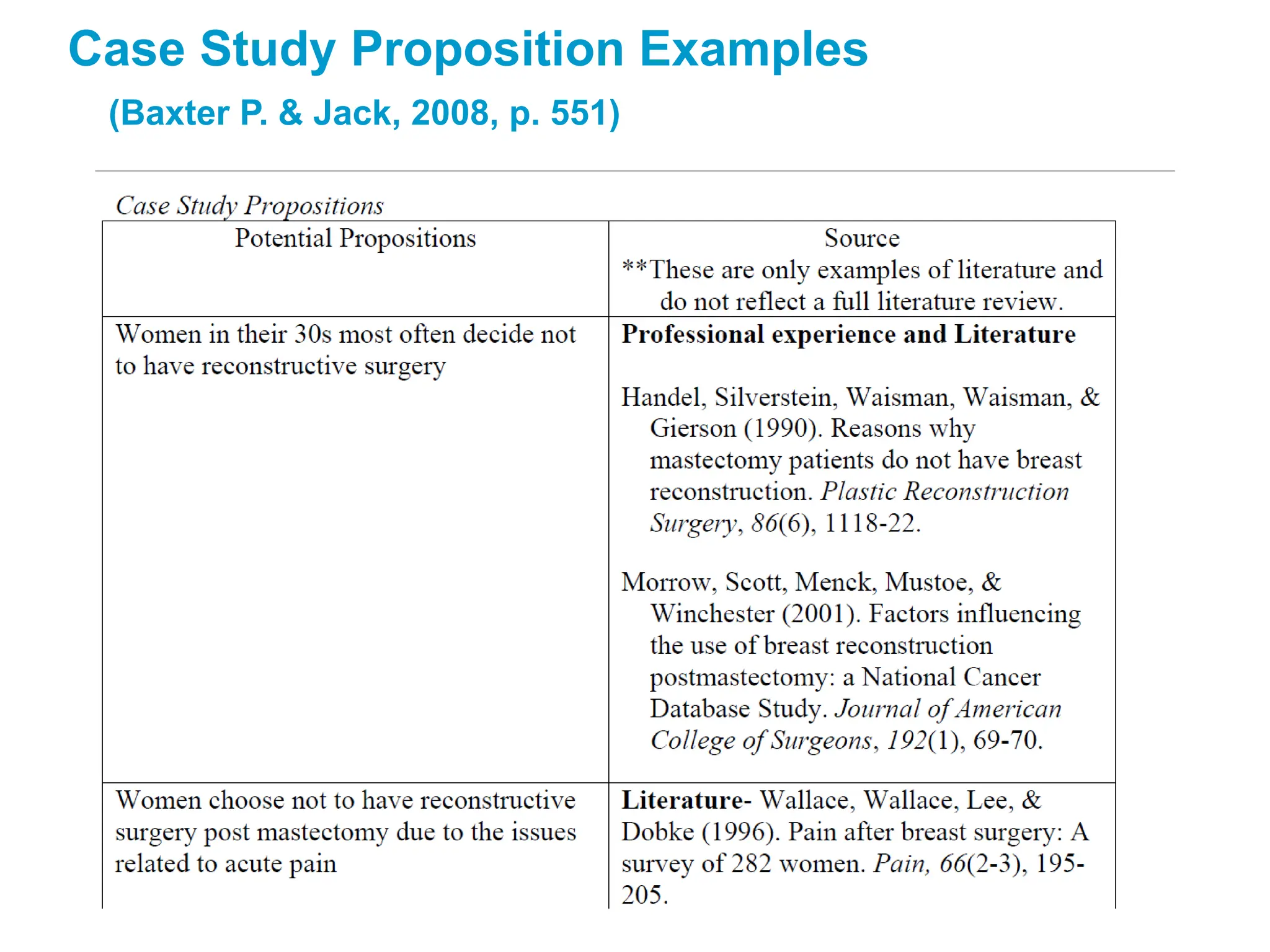
Case Study Proposition Examples
(Baxter P. & Jack, 2008, p. 551)
Defining a unit of analysis
The major entity that is being studied, the “what” or “who”
What unit of analysis to use depends on the research questions/design
• Example: case study of how was the life history of a person; Unit
of analysis or case can be “the individual”
Can be the same as “case” in holistic single and multiple case study
• Example: case study of how a group of software immigrants
naturalize, Units of analysis: Individuals, development team,
organization
Different from “case” in embedded single and multiple case study
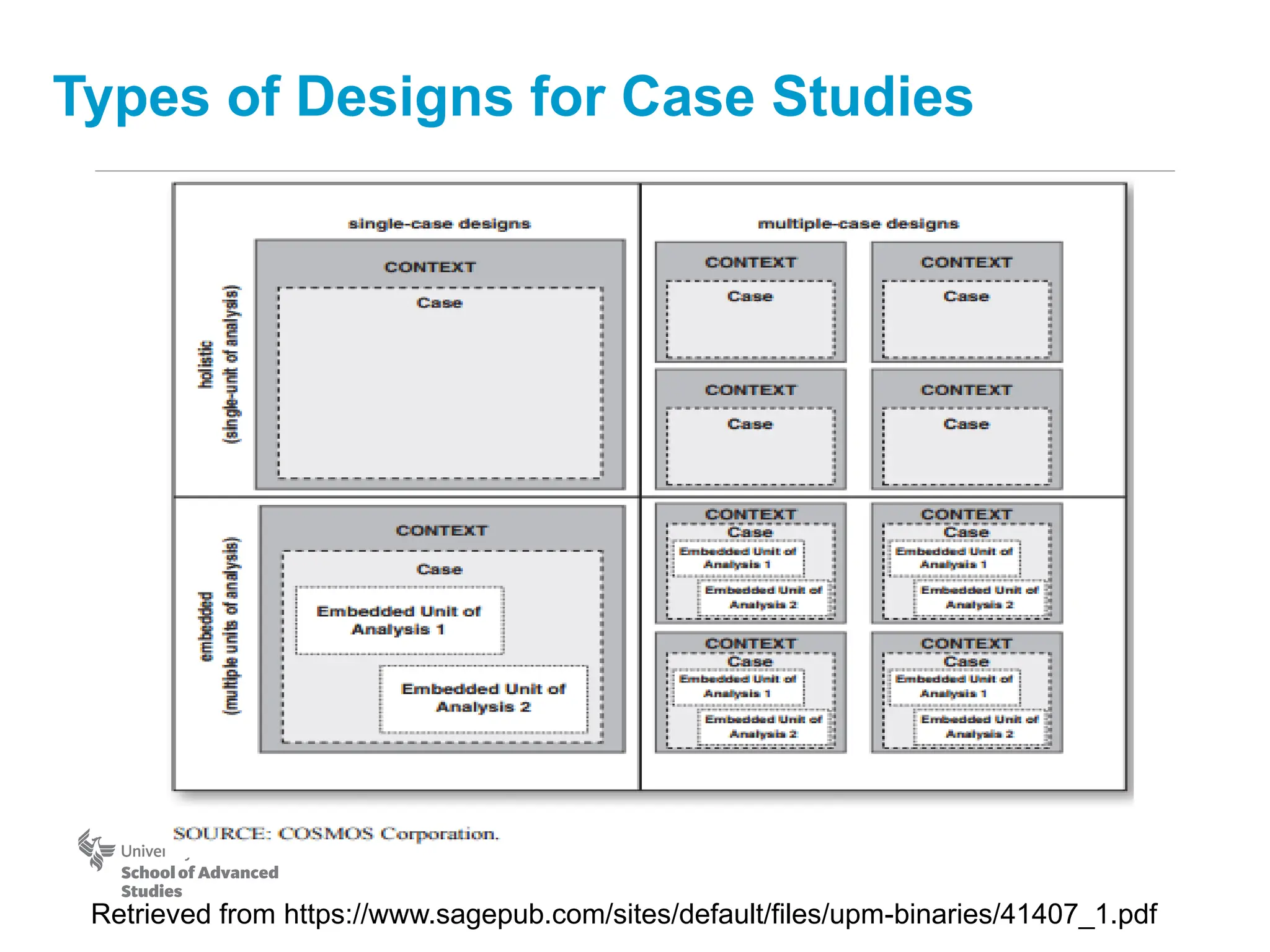
Types of Designs for Case Studies
Retrieved from https://www.sagepub.com/sites/default/files/upm-binaries/41407_1.pdf
Example
How does an organization implement certain staff
promotion policies?
Policies in one organization with one unit of analysis,
holistic single case study.
Policies in two or more organizations with one unit of
analysis, holistic multiple case study.
Policies in one organization with two or more units of
analysis, embedded single case study.
Policies in two or more organizations with two or more units
of analysis, embedded multiple case study.
Types of Designs for Case Studies
Retrieved from https://www.sagepub.com/sites/default/files/upm-binaries/41407_1.pdf
Promotion policies in one
organization
[Unit of Analysis: overall
Performance]
Policies in
Organization 1
UA:[performance]
Policies in
Organization 2
UA:[performance]
Policies in
Organization 3
UA:[performance]
Policies in
Organization 4
UA:[performance]
Promotion policies in one
organization
[Performance]
[Employees]
Policies in
Organization 1
UA1:[performance]
UA2:[Employees]
Policies in
Organization 2
UA1:[performance]
UA2:[Employees]
Policies in
Organization 3
UA1:[performance]
UA2:[Employees]
Policies in
Organization 4
UA1:[performance]
UA2:[Employees]
Why do you need to use multiple case design?
In what ways might the companion case's findings augment those of
the first case?
Could the data from the second case fill a gap left by the first case or
respond better to some obvious shortcoming or criticism of the first
case?
Would the two cases together comprise a stronger case study? Could
yet a third case make the findings even more compelling?
Be mindful of amount of work and feasibility of the study before
switching to multiple case study
Problem Statement, Purpose, and research
questions: Example (Merriam & Tisdell, 2016)
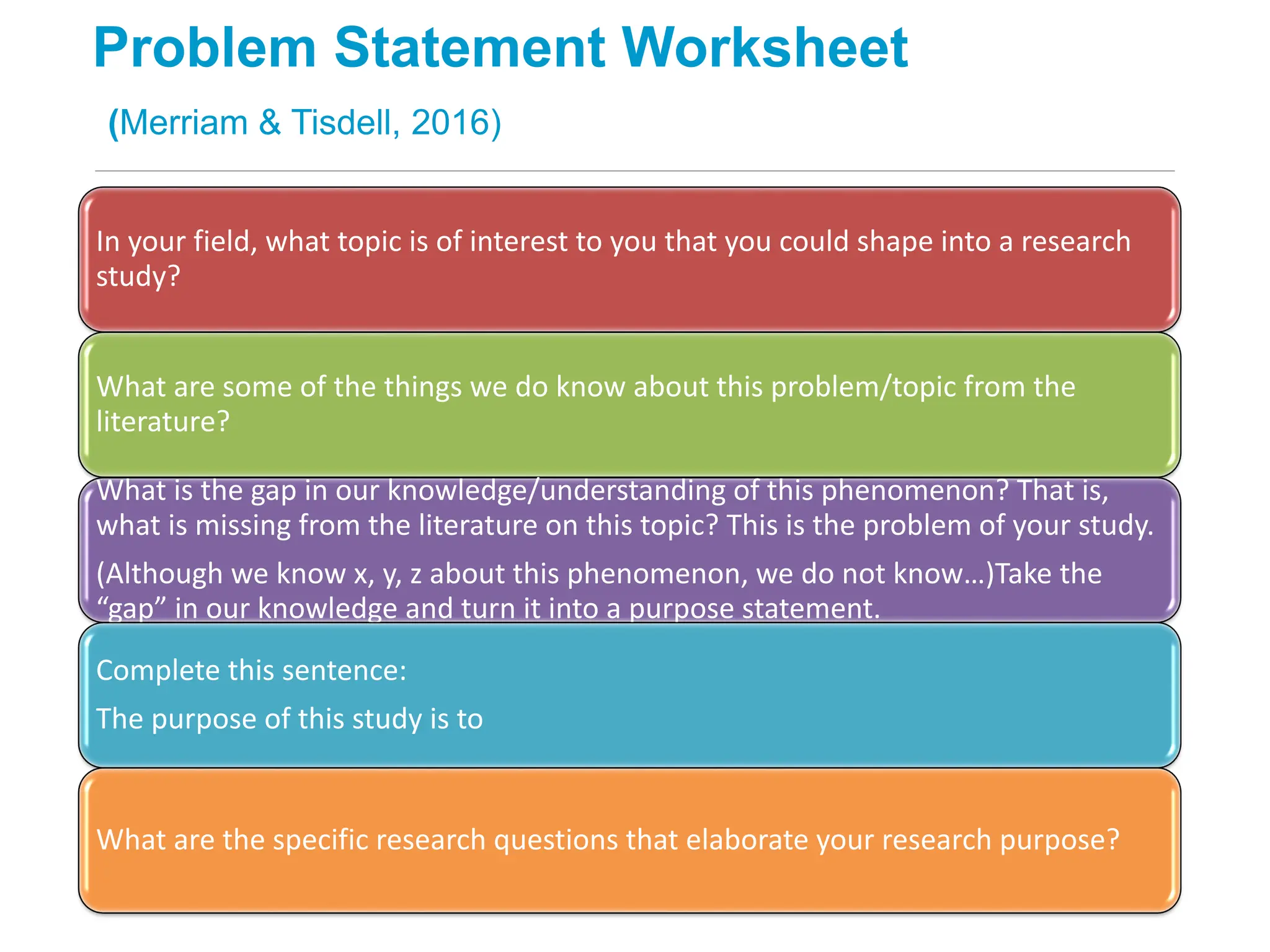
Problem Statement Worksheet
(Merriam & Tisdell, 2016)
In your field, what topic is of interest to you that you could shape into a research
study?
What are some of the things we do know about this problem/topic from the
literature?
What is the gap in our knowledge/understanding of this phenomenon? That is,
what is missing from the literature on this topic? This is the problem of your study.
(Although we know x, y, z about this phenomenon, we do not know…)Take the
“gap” in our knowledge and turn it into a purpose statement.
Complete this sentence:
The purpose of this study is to
What are the specific research questions that elaborate your research purpose?
Next steps…
• Review materials
• Recorded webinars
• Short burst learning Videos
• Office hours
Visit and join the Research
Methodology Group
Join Research Methodology
Group Teams
• Complete this very brief Survey (less
than 1 minute)
Provide us with your
feedback
• Feb 2, 5-6 pm Arizona Time
• Access via the Workshop site
Next meeting: Research
problem, purpose, and
questions for a content
analysis design
References
Baxter P. & Jack, S. (2008). Qualitative case study methodology: Study design and
implementation for novice researchers. The Qualitative Report, 13 (4).
Merriam, S. B. (1988). Case study research in education: A qualitative approach. San Francisco:
Jossey-Bass.
Merriam, S. B., & Tisdell, E. J. (2016). Qualitative research: A guide to design and
implementation. (4th ed.).Wiley & Sons
Stake, R. E. (2005). Qualitative case studies. In N. K. Denzin & Y. S. Lincoln (Eds.), The Sage
handbook of qualitative research (3rd ed.). (pp. 443–466). Thousand Oaks, CA: Sage.
Stake, R. E. (2006). Multiple case study analysis. New York: The Guilford Press.
Yin, R. (1994). Case Study research: Design and Methods (2nd ed.).Beverly Hills, CA: Sage
Publishing
Yin, R. K. (1984). Case study research: Design and methods. Newbury Park, CA: Sage.
Yin, R. K. (2014). Case study research: Design and methods (5th ed.). Thousand Oaks, CA: Sage.
Yin, R.K. (2013). How to do Better Case Studies: (With Illustrations from 20 Exemplary Case
Studies). DOI: http://dx.doi.org/10.4135/9781483348858
Yazan, B. (2015). Three Approaches to Case Study Methods in Education: Yin, Merriam, and
Stake. The Qualitative Report, 20(2), 134-152. https://doi.org/10.46743/2160-3715/2015.2102
Questions?
Research Methodology Group

Case Study Design Essentials: Definition, Research Questions, Propositions

  • 1.
    Case Study DesignEssentials: Definition, Research Questions, Propositions Research Methodology Group Mansureh Kebritchi, Ph.D.
  • 2.
    Agenda Focus on casestudy design essential components Provide examples Answer your questions
  • 3.
    Case Study ProminentMethodologists Robert Yin, Case Study Research: Design and Methods (2014) Positivism Quantitative and qualitative can be combined Robert Stake, The Art of Case Study Research (2005, 2006) Constructivism and existentialism (nondeterminism) Exclusively Qualitative Sharan Merriam, Qualitative Research and Case Study Applications in Education (1988) Constructivism Exclusively Qualitative
  • 4.
    Definition of theCase Study “An empirical inquiry that investigates a contemporary phenomenon (e.g., a “case”) within its real-life context; when the boundaries between phenomenon and context are not clearly evident” (Yin, 2014, p.16) “A case study is an in-depth description and analysis of a bounded system” (Merriam, 2015, p.37). “The “what” is a bounded system (Smith, 1978), a single entity, a unit around which there are boundaries” (Merriam, 2015, p.38)/(Stake, 2005).
  • 5.
    When to usethe Case Study The focus in on answering “How” and “Why” questions You cannot manipulate the behavior of those involved in the study (Yin, 2014)
  • 6.
    When to Usea Case Study Data collection in a “natural setting” not “derived“ data (Bromley, 1986, p. 23); you want to cover contextual conditions relevant to the phenomenon (Yin, 2014) • Examples: • How and why a high school principal did an exceptionally good job • What are the dynamics of a successful negotiation with severe consequences • Not responses to just one survey/instrument • Incorporate fieldnotes to better understand the situations
  • 7.
    When to Usea Case Study Conducting program evaluations, Examples: • U.S. Government Accountability Office (e.g., 1990, 2008) • Case Studies from Ongoing Work Show Examples in Which Wage and Hour Division Did Not Adequately Pursue Labor Violations (2008) (https://www.gao.gov/special.pubs/10_1_9.pdf) • Case Studies of U.S and Chinese Economic Engagement in Angola, Ghana, and Kenya (2013) (https://www.gao.gov/products/GAO- 08-973T) • K-12 EDUCATION: Better Use of Information Could Help Agencies Identify Disparities and Address Racial Discrimination (2016) (https://www.gao.gov/products/GAO-16-345) • Yin (1997, 2009)
  • 8.
    Steps in DesigningCase Studies: Blueprint (Yin, 2014) Proposal Method Components 1. Research questions 2. Propositions (Not for exploratory case) - Optional • Select one of the four designs • Data collection 3. Defining a “case”/unit of analysis 4. The logic linking the data to the propositions (Data analysis) 5. The criteria for interpreting the findings The criteria for Judging the quality of research design (Validity & Reliability) Note: Use theory in design work
  • 9.
    The Most ChallengingSteps in Designing a Case Study Defining a “case”/unit of analysis Select one of the four designs Data Collection • Yin (2013) Data Analysis
  • 10.
    Defining the “case” Themost defining characteristics of case study is delimiting the object of the study: the case (Merriam, 2015) • The goal is to understand one thing well: a person, a program, a group, or specific policy; examples: one playground, one band. • Research question must be aligned/define the case/unit of analysis. A noun, seldom a verb, a functioning (Stake, 2006). Real things to visualize. Examples: not training, managing , giving birth but training modules, managers, labor rooms.
  • 11.
  • 12.
    Example A study ofhow older adults learn to use computers. The case/unit of analysis: learners’ experience. Indefinite number of adult leaders can be selected for this study. • Not a case study but a qualitative study One particular program, or classroom of learners (a bounded system), or one particular learners selected based on success uniqueness, etc. • A case study
  • 13.
    Defining the “case” •Availability, quality, relevance of data Practical considerations • Special case: distinctive event/condition such as creation/change of an organization, the discovery of a new way of reducing bullying in schools, or the occurrence of a natural disaster Substantive considerations
  • 14.
    What if youdon’t have a distinctive condition? • Review literature: generate a new knowledge/perspectives about organizations, communities, other social processes and outcome • Example: An average American city, but the framework highlights a significant development in American history—the transition from an agricultural to an industrial economy and how it occurred in the average American city (Lynd & Lynd, 1957). Define compelling framework to make your case unique
  • 15.
    Types of CaseStudies (Yin, 2014) Descriptive; to describe an intervention or phenomenon at the real-life context • Example: How do women with Parkinson cope with their needs in a community? Tolson, Fleming, & Sehartau (2002). Coping with menstruation: Understanding the needs of women with Parkinson's disease, Journal of advanced Nursing Exploratory; to explore those situations in which the intervention being evaluated has no clear, single set of outcome • Example: How does a nurse-patient relation develop in a cancer treatment unit? Lotzkar & Bottoorff (2001). An observational study of development of a nurse-patient relationship. Clinical Nursing Research Explanatory; to explain the presumed causal link in real life intervention that are too complex for the survey or experimental strategies. • Example: Why is a web-based e-commerce effective in a company? Joia (2002). Analyzing a web-based e-commerce learning community: A case study in Brazil. Internet Research
  • 16.
    Research Questions forCase Study Type of Research Questions relevant to the Case Study • Explanatory/exploratory/descriptive questions • How or why did something happen? • E.g.: How do two organizations have a collaborative relationship? • E.g.: Why do programmers fail to document their codes? Not Appropriate Questions • Cause and effect questions (experimental/quasi- experimental design) • How often something has happened (survey design)
  • 17.
    Developing Case StudyResearch Questions (Baxter P. & Jack, 2008, p. 546) Binding the case
  • 18.
    Propositions Increase the likelihoodthat the researcher place limit on the scope of the study Increase feasibility of completing the study Developed based on literature, personal/professional experiences, theories, generalization based on empirical data Example: Staff is promoted based on their skills in an organization.
  • 19.
    Case Study PropositionExamples (Baxter P. & Jack, 2008, p. 551)
  • 20.
    Defining a unitof analysis The major entity that is being studied, the “what” or “who” What unit of analysis to use depends on the research questions/design • Example: case study of how was the life history of a person; Unit of analysis or case can be “the individual” Can be the same as “case” in holistic single and multiple case study • Example: case study of how a group of software immigrants naturalize, Units of analysis: Individuals, development team, organization Different from “case” in embedded single and multiple case study
  • 21.
    Types of Designsfor Case Studies Retrieved from https://www.sagepub.com/sites/default/files/upm-binaries/41407_1.pdf
  • 22.
    Example How does anorganization implement certain staff promotion policies? Policies in one organization with one unit of analysis, holistic single case study. Policies in two or more organizations with one unit of analysis, holistic multiple case study. Policies in one organization with two or more units of analysis, embedded single case study. Policies in two or more organizations with two or more units of analysis, embedded multiple case study.
  • 23.
    Types of Designsfor Case Studies Retrieved from https://www.sagepub.com/sites/default/files/upm-binaries/41407_1.pdf Promotion policies in one organization [Unit of Analysis: overall Performance] Policies in Organization 1 UA:[performance] Policies in Organization 2 UA:[performance] Policies in Organization 3 UA:[performance] Policies in Organization 4 UA:[performance] Promotion policies in one organization [Performance] [Employees] Policies in Organization 1 UA1:[performance] UA2:[Employees] Policies in Organization 2 UA1:[performance] UA2:[Employees] Policies in Organization 3 UA1:[performance] UA2:[Employees] Policies in Organization 4 UA1:[performance] UA2:[Employees]
  • 24.
    Why do youneed to use multiple case design? In what ways might the companion case's findings augment those of the first case? Could the data from the second case fill a gap left by the first case or respond better to some obvious shortcoming or criticism of the first case? Would the two cases together comprise a stronger case study? Could yet a third case make the findings even more compelling? Be mindful of amount of work and feasibility of the study before switching to multiple case study
  • 25.
    Problem Statement, Purpose,and research questions: Example (Merriam & Tisdell, 2016)
  • 26.
    Problem Statement Worksheet (Merriam& Tisdell, 2016) In your field, what topic is of interest to you that you could shape into a research study? What are some of the things we do know about this problem/topic from the literature? What is the gap in our knowledge/understanding of this phenomenon? That is, what is missing from the literature on this topic? This is the problem of your study. (Although we know x, y, z about this phenomenon, we do not know…)Take the “gap” in our knowledge and turn it into a purpose statement. Complete this sentence: The purpose of this study is to What are the specific research questions that elaborate your research purpose?
  • 27.
    Next steps… • Reviewmaterials • Recorded webinars • Short burst learning Videos • Office hours Visit and join the Research Methodology Group Join Research Methodology Group Teams • Complete this very brief Survey (less than 1 minute) Provide us with your feedback • Feb 2, 5-6 pm Arizona Time • Access via the Workshop site Next meeting: Research problem, purpose, and questions for a content analysis design
  • 28.
    References Baxter P. &Jack, S. (2008). Qualitative case study methodology: Study design and implementation for novice researchers. The Qualitative Report, 13 (4). Merriam, S. B. (1988). Case study research in education: A qualitative approach. San Francisco: Jossey-Bass. Merriam, S. B., & Tisdell, E. J. (2016). Qualitative research: A guide to design and implementation. (4th ed.).Wiley & Sons Stake, R. E. (2005). Qualitative case studies. In N. K. Denzin & Y. S. Lincoln (Eds.), The Sage handbook of qualitative research (3rd ed.). (pp. 443–466). Thousand Oaks, CA: Sage. Stake, R. E. (2006). Multiple case study analysis. New York: The Guilford Press. Yin, R. (1994). Case Study research: Design and Methods (2nd ed.).Beverly Hills, CA: Sage Publishing Yin, R. K. (1984). Case study research: Design and methods. Newbury Park, CA: Sage. Yin, R. K. (2014). Case study research: Design and methods (5th ed.). Thousand Oaks, CA: Sage. Yin, R.K. (2013). How to do Better Case Studies: (With Illustrations from 20 Exemplary Case Studies). DOI: http://dx.doi.org/10.4135/9781483348858 Yazan, B. (2015). Three Approaches to Case Study Methods in Education: Yin, Merriam, and Stake. The Qualitative Report, 20(2), 134-152. https://doi.org/10.46743/2160-3715/2015.2102
  • 29.