1
SAAD HAJ BAKRY, PhD, CEng, FIEESAAD HAJ BAKRY, PhD, CEng, FIEE
BASIC STATISTICS
FOR SYSTEM STUDIES
BASIC STATISTICS
FOR SYSTEM STUDIES
2
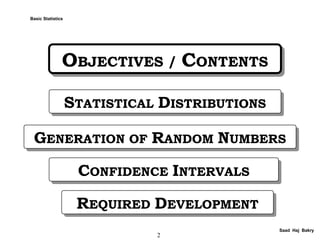
OBJECTIVES / CONTENTSOBJECTIVES / CONTENTS
Saad Haj Bakry
STATISTICAL DISTRIBUTIONSSTATISTICAL DISTRIBUTIONS
GENERATION OF RANDOM NUMBERSGENERATION OF RANDOM NUMBERS
CONFIDENCE INTERVALSCONFIDENCE INTERVALS
Basic Statistics
REQUIRED DEVELOPMENTREQUIRED DEVELOPMENT
3
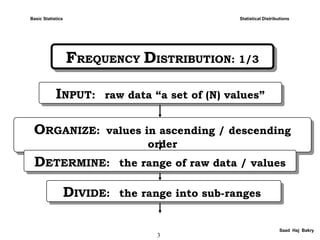
FREQUENCY DISTRIBUTION: 1/3FREQUENCY DISTRIBUTION: 1/3
Saad Haj Bakry
Statistical Distributions
INPUT: raw data “a set of (N) values”INPUT: raw data “a set of (N) values”
ORGANIZE: values in ascending / descending
order
ORGANIZE: values in ascending / descending
order
DETERMINE: the range of raw data / valuesDETERMINE: the range of raw data / values
DIVIDE: the range into sub-rangesDIVIDE: the range into sub-ranges
Basic Statistics
4
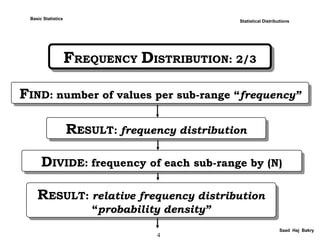
FREQUENCY DISTRIBUTION: 2/3FREQUENCY DISTRIBUTION: 2/3
Saad Haj Bakry
Statistical Distributions
FIND: number of values per sub-range “frequency”FIND: number of values per sub-range “frequency”
RESULT: frequency distributionRESULT: frequency distribution
DIVIDE: frequency of each sub-range by (N)DIVIDE: frequency of each sub-range by (N)
RESULT: relative frequency distribution
“probability density”
RESULT: relative frequency distribution
“probability density”
Basic Statistics
5
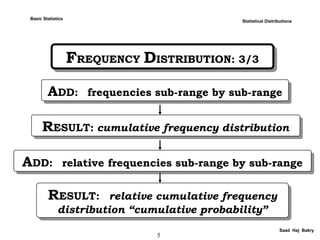
FREQUENCY DISTRIBUTION: 3/3FREQUENCY DISTRIBUTION: 3/3
Saad Haj Bakry
Statistical Distributions
ADD: frequencies sub-range by sub-rangeADD: frequencies sub-range by sub-range
RESULT: cumulative frequency distributionRESULT: cumulative frequency distribution
ADD: relative frequencies sub-range by sub-rangeADD: relative frequencies sub-range by sub-range
RESULT: relative cumulative frequency
distribution “cumulative probability”
RESULT: relative cumulative frequency
distribution “cumulative probability”
Basic Statistics
6
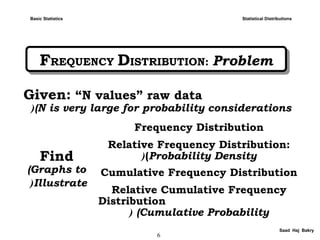
FREQUENCY DISTRIBUTION: ProblemFREQUENCY DISTRIBUTION: Problem
Saad Haj Bakry
Statistical Distributions
Given: “N values” raw data
(N is very large for probability considerations(
Find
(Graphs to
Illustrate(
Frequency Distribution
Relative Frequency Distribution:
(Probability Density(
Cumulative Frequency Distribution
Relative Cumulative Frequency
Distribution
(Cumulative Probability(
Basic Statistics
7
Saad Haj Bakry
MEAN : AVERAGE : EXPECTATIONMEAN : AVERAGE : EXPECTATION
Statistical Distributions
Definition Arithmetic mean
Raw Data Given values: x[1], x[2], …. x[N[
Mean m=
Raw Data
Given ranges: y[1], y[2], ….y[n[
Frequencies: f[1], f[2], …. f[n[
Weighted
Mean
m= :
Problem Write and test computer functions /
Give Illustrations
][].[
1
1
∑
=
=
nj
j
jyjf
N
∑
=
=
Ni
i
ix
N 1
][
1
∑
=
=
=
nj
j
Njf
1
][
Basic Statistics
8
Saad Haj Bakry
MODE / MEDIANMODE / MEDIAN
Statistical Distributions
Median Middle value
Mode Value with highest frequency
Raw Data Given values: x[1], x[2], …. x[N]
Median
For ODD N: m = x[(N+1)/2]
EVEN: m = (1/2) {x[N/2]+x[(N/2)+1]}
Mode
Find frequency distribution:
m = x[k] : f[k] highest frequency
Problem Write and test computer functions /
Give Illustrations
Basic Statistics
9
Saad Haj Bakry
DEVIATION / VARIANCEDEVIATION / VARIANCE
Statistical Distributions
Deviation
Deviation from the “mean”
d[i] = |x[i] – m|
Mean
Deviation
Variance /
Standard
Deviation
Standard
Score
Standardized Variables: z[i] = d[i] / s
Problem Write and test computer functions /
Give Illustrations
∑
=
=
=
Ni
i
id
N
d
1
][
1
∑=
=
n
j
jdjf
n
d
1
][].[
1
∑
=
=
=
nj
j
Njf
1
][
∑
=
=
=
Ni
i
idN
v
1
2
][
1
vs =
Basic Statistics
10
Saad Haj Bakry
UNIFORM DISTRIBUTIONUNIFORM DISTRIBUTION
Statistical Distributions
Features
Range
“min”: Minimum number
“max”: Maximum number
Principle All numbers “x[i] : x” are equally likely
Probability Density p(x,min,max) = 1 / (max-min(
Mean m = (max + min) / 2
Variance v = (max - min)2
/ 12
Problem Write and test computer functions /
Give Illustrations
Basic Statistics
11
Saad Haj Bakry
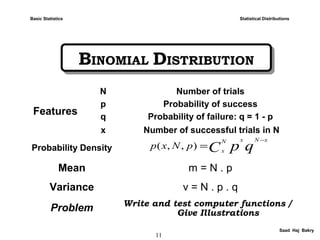
BINOMIAL DISTRIBUTIONBINOMIAL DISTRIBUTION
Statistical Distributions
Features
N Number of trials
p Probability of success
q Probability of failure: q = 1 - p
x Number of successful trials in N
Probability Density
Mean m = N . p
Variance v = N . p . q
Problem Write and test computer functions /
Give Illustrations
qpC
xNxN
x
pNxp
−
=(,,(
Basic Statistics
12
Saad Haj Bakry
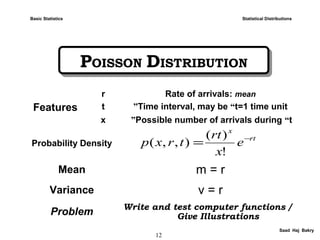
POISSON DISTRIBUTIONPOISSON DISTRIBUTION
Statistical Distributions
Features
r Rate of arrivals: mean
t Time interval, may be “t=1 time unit”
x Possible number of arrivals during “t”
Probability Density
Mean m = r
Variance v = r
Problem Write and test computer functions /
Give Illustrations
rt
x
e
x
rt
trxp −
=
!
((
(,,(
Basic Statistics
13
Saad Haj Bakry
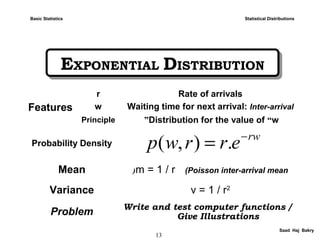
EXPONENTIAL DISTRIBUTIONEXPONENTIAL DISTRIBUTION
Statistical Distributions
Features
r Rate of arrivals
w Waiting time for next arrival: Inter-arrival
Principle Distribution for the value of “w”
Probability Density
Mean m = 1 / r (Poisson inter-arrival mean(
Variance v = 1 / r2
Problem Write and test computer functions /
Give Illustrations
rw
errwp −
= .(,(
Basic Statistics
14
Saad Haj Bakry
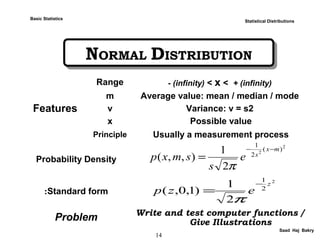
NORMAL DISTRIBUTIONNORMAL DISTRIBUTION
Statistical Distributions
Features
Range - (infinity) < x < + (infinity)
m Average value: mean / median / mode
v Variance: v = s2
x Possible value
Principle Usually a measurement process
Probability Density
Standard form:
Problem Write and test computer functions /
Give Illustrations
2
2
((
2
1
2
1
(,,(
mx
s
e
s
smxp
−−
=
π
2
2
1
2
1
(1,0,(
z
ezp
−
=
π
Basic Statistics
15
Saad Haj Bakry
t DISTRIBUTIONt DISTRIBUTION
Statistical Distributions
Features
Range - (infinity) < t < + (infinity)
m mean / median / mode at “zero”
f Degree of freedom: 0 < f < + (infinity(
Principle Used for estimation: small sample
t Distribution variable: variance unknown
Probability Density
Gamma Function
Problem Write and test computer functions /
Give Illustrations
2/(1(
2
(1(
(2/(
]2/(1[(
(,( +−
+
Γ
+Γ
= f
f
t
ff
f
ftp
π
(!1(((
0
1
−==Γ −
∞
−
∫ fdxexf xf
Basic Statistics
16
Saad Haj Bakry
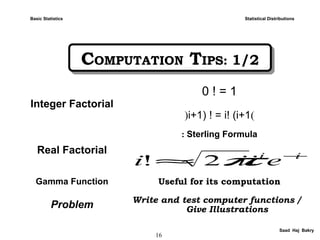
COMPUTATION TIPS: 1/2COMPUTATION TIPS: 1/2
Statistical Distributions
Integer Factorial
0 ! = 1
(i+1) ! = i! (i+1(
Real Factorial
Sterling Formula:
Gamma Function Useful for its computation
Problem Write and test computer functions /
Give Illustrations
ii
eiii −
≈ π2!
Basic Statistics
17
Saad Haj Bakry
Statistical Distributions
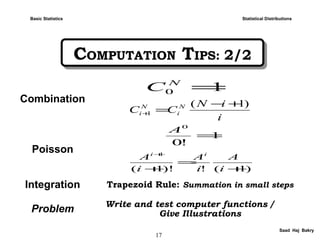
i
iN
CC N
i
N
i
)1(
1
+−
=+
Combination
Poisson
Integration Trapezoid Rule: Summation in small steps
Problem Write and test computer functions /
Give Illustrations
1
!0
0
=
A
10 =N
C
)1(!)!1(
1
+
=
+
+
i
A
i
A
i
A ii
COMPUTATION TIPS: 2/2COMPUTATION TIPS: 2/2
Basic Statistics
18
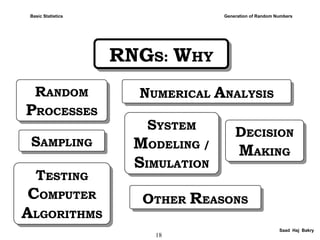
RNGS: WHYRNGS: WHY
Saad Haj Bakry
SYSTEM
MODELING /
SIMULATION
SYSTEM
MODELING /
SIMULATION
SAMPLINGSAMPLING
NUMERICAL ANALYSISNUMERICAL ANALYSISRANDOM
PROCESSES
RANDOM
PROCESSES
TESTING
COMPUTER
ALGORITHMS
TESTING
COMPUTER
ALGORITHMS
DECISION
MAKING
DECISION
MAKING
OTHER REASONSOTHER REASONS
Generation of Random NumbersBasic Statistics
19
Saad Haj Bakry
UNIFORM RNG: U (0,1)UNIFORM RNG: U (0,1)
Features
m
Modulus factor: large (st) prime number within
memory cell size (for wide repeated sequence cycle(
m = 231
- 1 = 2,147,483,674 (for 32 bit cell(
a Multiplier: a = 314,159,269
b Increment: b = 453,806,245
X[0[ Starting value: X[0] = 577,215,665 (the seed)
X[i-1[ “)ith-1)” value: seed for X[i[
Uniform: X (0,m( X[i] = {a . X[i-1] + b} MOD m
Uniform: U (0,1( U[i] = X[i] / m
Problem Write and test computer functions /
Give Illustrations
Generation of Random NumbersBasic Statistics
20
Saad Haj Bakry
UNIFORM RNG: U (min , max)UNIFORM RNG: U (min , max)
Integer
Range
min Required minimum integer value
max Required maximum integer value
U (min, max( min + TRUNC [(max – min + 1) . U (0, 1([
Problem Write and test computer functions /
Give Illustrations
Test
100,000“runs”: Test
• Frequency Distribution
• Mean
• Variance & Standard Deviation
)Relative to theoretical expectations(
Note Every new set of runs should start with
a different seed: X[0]
Generation of Random NumbersBasic Statistics
21
Saad Haj Bakry
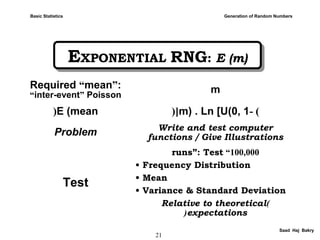
EXPONENTIAL RNG: E (m)EXPONENTIAL RNG: E (m)
Required “mean”:
“inter-event” Poisson
m
E (mean( - )m) . Ln [U(0, 1([
Problem Write and test computer
functions / Give Illustrations
Test
100,000“runs”: Test
• Frequency Distribution
• Mean
• Variance & Standard Deviation
)Relative to theoretical
expectations(
Generation of Random NumbersBasic Statistics
22
Saad Haj Bakry
NORMAL RNG: N (m, s)NORMAL RNG: N (m, s)
Features
m Required “mean” of the normal RNG
s Required “standard deviation”
STEPS
1
V[1] = 2 . { U(0,1)[1] } – 1
V[2] = 2 . { U(0,1)[2] } – 1
2 SUM = V2
[1] + V2
[2[
3 IF SUM >= 1 GO TO STEP 1
4
5 N (m,s) = m + s . Y
Standard Normal N (0,1) = Y
Problem Write and test computer functions /
Give Illustrations
SUMSUMLnVY /)](.2[].2[ −=
Generation of Random NumbersBasic Statistics
23
Saad Haj Bakry
ConfidenceBasic Statistics
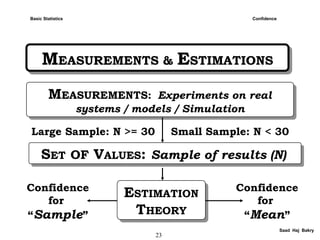
MEASUREMENTS & ESTIMATIONSMEASUREMENTS & ESTIMATIONS
MEASUREMENTS: Experiments on real
systems / models / Simulation
MEASUREMENTS: Experiments on real
systems / models / Simulation
Confidence
for
“Mean”
ESTIMATION
THEORY
ESTIMATION
THEORY
SET OF VALUES: Sample of results (N)SET OF VALUES: Sample of results (N)
Confidence
for
“Sample”
Large Sample: N >= 30 Small Sample: N < 30
24
Saad Haj Bakry
EVALUATION ALGORITHM: GeneralEVALUATION ALGORITHM: General
Confidence IntervalsBasic Statistics
INPUT: Measurements: N & x[1], x[2],….,x[N]
Required “confidence level” : L (%)
INPUT: Measurements: N & x[1], x[2],….,x[N]
Required “confidence level” : L (%)
MEAN: |MEAN: | ∑
=
=
=
Ni
i
ix
N
m
1
][
1
STANDARD DEVIATION:|STANDARD DEVIATION:| ∑
=
=
−
−
=
ni
i
mix
N
s
1
2
}][{
1
1
AREA UNDER CURVE: | a = 1 – (L/100)AREA UNDER CURVE: | a = 1 – (L/100)
25
Saad Haj Bakry
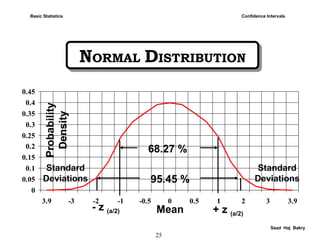
NORMAL DISTRIBUTIONNORMAL DISTRIBUTION
Confidence IntervalsBasic Statistics
0
0.05
0.1
0.15
0.2
0.25
0.3
0.35
0.4
0.45
3.9 -3 -2 -1 -0.5 0 0.5 1 2 3 3.9
Probability
Density
Mean
Standard
Deviations
68.27 %
95.45 %
- z (a/2) + z (a/2)
Standard
Deviations
26
Saad Haj Bakry
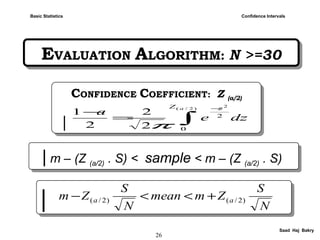
EVALUATION ALGORITHM: N >=30EVALUATION ALGORITHM: N >=30
Confidence IntervalsBasic Statistics
| m – (Z (a/2) . S) < sample < m – (Z (a/2) . S)| m – (Z (a/2) . S) < sample < m – (Z (a/2) . S)
CONFIDENCE COEFFICIENT: Z (a/2)
|
CONFIDENCE COEFFICIENT: Z (a/2)
| ∫
−
=
−
)2/(
2
0
2
2
2
2
1
aZ z
dze
a
π
|| N
S
Zmmean
N
S
Zm aa )2/()2/( +<<−
27
Saad Haj Bakry
EVALUATION ALGORITHM: N < 30EVALUATION ALGORITHM: N < 30
Confidence IntervalsBasic Statistics
| m – (T (a/2) . S) < sample < m – (T (a/2) . S)| m – (T (a/2) . S) < sample < m – (T (a/2) . S)
|| ∫
−
−
+
−−Γ
Γ
=
−
)2/(
0
)2/(
2
)
1
1(
)1(]2/)1[(
)2/(
2
1
aT
N
dt
N
t
NN
Na
π
|| N
S
Tmmean
N
S
Tm aa )2/()2/( +<<−
|| )!1(.)(
0
1
−==Γ ∫
∞
−−
fdxexf xf
28
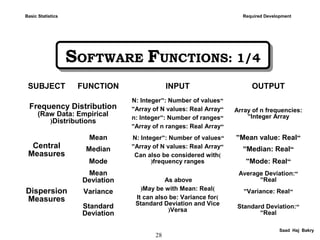
SOFTWARE FUNCTIONS: 1/4SOFTWARE FUNCTIONS: 1/4
Saad Haj Bakry
Basic Statistics Required Development
SUBJECT FUNCTION INPUT OUTPUT
Frequency Distribution
(Raw Data: Empirical
Distributions(
“N: Integer”: Number of values
“Array of N values: Real Array”
“n: Integer”: Number of ranges
“Array of n ranges: Real Array”
Array of n frequencies:
Integer Array”
Central
Measures
Mean “N: Integer”: Number of values
“Array of N values: Real Array”
)Can also be considered with
frequency ranges(
“Mean value: Real”
Median “Median: Real”
Mode “Mode: Real”
Dispersion
Measures
Mean
Deviation As above
)May be with Mean: Real(
)It can also be: Variance for
Standard Deviation and Vice
Versa(
“Average Deviation:
Real”
Variance “Variance: Real”
Standard
Deviation
“Standard Deviation:
Real”
29
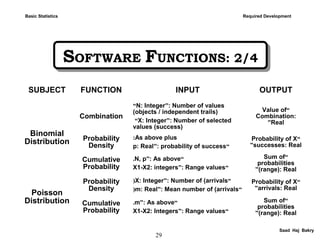
SOFTWARE FUNCTIONS: 2/4SOFTWARE FUNCTIONS: 2/4
Saad Haj Bakry
Basic Statistics Required Development
SUBJECT FUNCTION INPUT OUTPUT
Binomial
Distribution
Combination
“N: Integer”: Number of values
(objects / independent trails)
“X: Integer”: Number of selected
values (success)
“Value of
Combination:
Real”
Probability
Density
As above plus:
“p: Real”: probability of success
“Probability of X
successes: Real”
Cumulative
Probability
“N, p”: As above.
“X1-X2: integers”: Range values
“Sum of
probabilities
(range): Real”
Poisson
Distribution
Probability
Density
“X: Integer”: Number of (arrivals(
“m: Real”: Mean number of (arrivals(
“Probability of X
arrivals: Real”
Cumulative
Probability
“m”: As above.
“X1-X2: Integers”: Range values
“Sum of
probabilities
(range): Real”
30
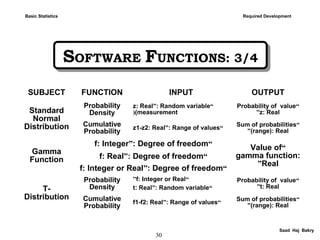
SOFTWARE FUNCTIONS: 3/4SOFTWARE FUNCTIONS: 3/4
Saad Haj Bakry
Basic Statistics Required Development
SUBJECT FUNCTION INPUT OUTPUT
Standard
Normal
Distribution
Probability
Density
“z: Real”: Random variable
(measurement(
“Probability of value
z: Real”
Cumulative
Probability
“z1-z2: Real”: Range of values
“Sum of probabilities
(range): Real”
Gamma
Function
“f: Integer”: Degree of freedom “Value of
gamma function:
Real”
“f: Real”: Degree of freedom
“f: Integer or Real”: Degree of freedom
T-
Distribution
Probability
Density
“f: Integer or Real”
“t: Real”: Random variable
“Probability of value
t: Real”
Cumulative
Probability
“f1-f2: Real”: Range of values
“Sum of probabilities
(range): Real”
31
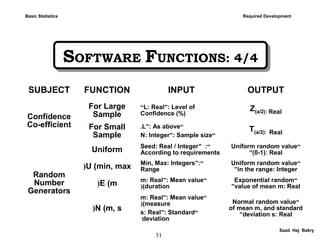
SOFTWARE FUNCTIONS: 4/4SOFTWARE FUNCTIONS: 4/4
Saad Haj Bakry
Basic Statistics Required Development
SUBJECT FUNCTION INPUT OUTPUT
Confidence
Co-efficient
For Large
Sample
“L: Real”: Level of
Confidence (%)
Z(a/2): Real
For Small
Sample
“L”: As above.
“N: Integer”: Sample size
T(a/2): Real
Random
Number
Generators
Uniform “Seed: Real / Integer” :
According to requirements
“Uniform random value
(0-1): Real”
U (min, max( “Min, Max: Integers”:
Range
“Uniform random value
in the range: Integer”
E (m( “m: Real”: Mean value
(duration(
“Exponential random
value of mean m: Real”
N (m, s(
“m: Real”: Mean value
(measure(
“s: Real”: Standard
deviation
“Normal random value
of mean m, and standard
deviation s: Real”
32
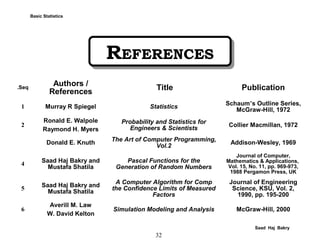
REFERENCESREFERENCES
Saad Haj Bakry
Seq.
Authors /
References
Title Publication
1 Murray R Spiegel Statistics
Schaum’s Outline Series,
McGraw-Hill, 1972
2
Ronald E. Walpole
Raymond H. Myers
Probability and Statistics for
Engineers & Scientists
Collier Macmillan, 1972
Donald E. Knuth
The Art of Computer Programming,
Vol.2
Addison-Wesley, 1969
4
Saad Haj Bakry and
Mustafa Shatila
Pascal Functions for the
Generation of Random Numbers
Journal of Computer,
Mathematics & Applications,
Vol. 15, No. 11, pp. 969-973,
1988 Pergamon Press, UK
5
Saad Haj Bakry and
Mustafa Shatila
A Computer Algorithm for Comp
the Confidence Limits of Measured
Factors
Journal of Engineering
Science, KSU, Vol. 2,
1990, pp. 195-200
6
Averill M. Law
W. David Kelton
Simulation Modeling and Analysis McGraw-Hill, 2000
Basic Statistics

1504 basic statistics

  • 1.
    1 SAAD HAJ BAKRY,PhD, CEng, FIEESAAD HAJ BAKRY, PhD, CEng, FIEE BASIC STATISTICS FOR SYSTEM STUDIES BASIC STATISTICS FOR SYSTEM STUDIES
  • 2.
    2 OBJECTIVES / CONTENTSOBJECTIVES/ CONTENTS Saad Haj Bakry STATISTICAL DISTRIBUTIONSSTATISTICAL DISTRIBUTIONS GENERATION OF RANDOM NUMBERSGENERATION OF RANDOM NUMBERS CONFIDENCE INTERVALSCONFIDENCE INTERVALS Basic Statistics REQUIRED DEVELOPMENTREQUIRED DEVELOPMENT
  • 3.
    3 FREQUENCY DISTRIBUTION: 1/3FREQUENCYDISTRIBUTION: 1/3 Saad Haj Bakry Statistical Distributions INPUT: raw data “a set of (N) values”INPUT: raw data “a set of (N) values” ORGANIZE: values in ascending / descending order ORGANIZE: values in ascending / descending order DETERMINE: the range of raw data / valuesDETERMINE: the range of raw data / values DIVIDE: the range into sub-rangesDIVIDE: the range into sub-ranges Basic Statistics
  • 4.
    4 FREQUENCY DISTRIBUTION: 2/3FREQUENCYDISTRIBUTION: 2/3 Saad Haj Bakry Statistical Distributions FIND: number of values per sub-range “frequency”FIND: number of values per sub-range “frequency” RESULT: frequency distributionRESULT: frequency distribution DIVIDE: frequency of each sub-range by (N)DIVIDE: frequency of each sub-range by (N) RESULT: relative frequency distribution “probability density” RESULT: relative frequency distribution “probability density” Basic Statistics
  • 5.
    5 FREQUENCY DISTRIBUTION: 3/3FREQUENCYDISTRIBUTION: 3/3 Saad Haj Bakry Statistical Distributions ADD: frequencies sub-range by sub-rangeADD: frequencies sub-range by sub-range RESULT: cumulative frequency distributionRESULT: cumulative frequency distribution ADD: relative frequencies sub-range by sub-rangeADD: relative frequencies sub-range by sub-range RESULT: relative cumulative frequency distribution “cumulative probability” RESULT: relative cumulative frequency distribution “cumulative probability” Basic Statistics
  • 6.
    6 FREQUENCY DISTRIBUTION: ProblemFREQUENCYDISTRIBUTION: Problem Saad Haj Bakry Statistical Distributions Given: “N values” raw data (N is very large for probability considerations( Find (Graphs to Illustrate( Frequency Distribution Relative Frequency Distribution: (Probability Density( Cumulative Frequency Distribution Relative Cumulative Frequency Distribution (Cumulative Probability( Basic Statistics
  • 7.
    7 Saad Haj Bakry MEAN: AVERAGE : EXPECTATIONMEAN : AVERAGE : EXPECTATION Statistical Distributions Definition Arithmetic mean Raw Data Given values: x[1], x[2], …. x[N[ Mean m= Raw Data Given ranges: y[1], y[2], ….y[n[ Frequencies: f[1], f[2], …. f[n[ Weighted Mean m= : Problem Write and test computer functions / Give Illustrations ][].[ 1 1 ∑ = = nj j jyjf N ∑ = = Ni i ix N 1 ][ 1 ∑ = = = nj j Njf 1 ][ Basic Statistics
  • 8.
    8 Saad Haj Bakry MODE/ MEDIANMODE / MEDIAN Statistical Distributions Median Middle value Mode Value with highest frequency Raw Data Given values: x[1], x[2], …. x[N] Median For ODD N: m = x[(N+1)/2] EVEN: m = (1/2) {x[N/2]+x[(N/2)+1]} Mode Find frequency distribution: m = x[k] : f[k] highest frequency Problem Write and test computer functions / Give Illustrations Basic Statistics
  • 9.
    9 Saad Haj Bakry DEVIATION/ VARIANCEDEVIATION / VARIANCE Statistical Distributions Deviation Deviation from the “mean” d[i] = |x[i] – m| Mean Deviation Variance / Standard Deviation Standard Score Standardized Variables: z[i] = d[i] / s Problem Write and test computer functions / Give Illustrations ∑ = = = Ni i id N d 1 ][ 1 ∑= = n j jdjf n d 1 ][].[ 1 ∑ = = = nj j Njf 1 ][ ∑ = = = Ni i idN v 1 2 ][ 1 vs = Basic Statistics
  • 10.
    10 Saad Haj Bakry UNIFORMDISTRIBUTIONUNIFORM DISTRIBUTION Statistical Distributions Features Range “min”: Minimum number “max”: Maximum number Principle All numbers “x[i] : x” are equally likely Probability Density p(x,min,max) = 1 / (max-min( Mean m = (max + min) / 2 Variance v = (max - min)2 / 12 Problem Write and test computer functions / Give Illustrations Basic Statistics
  • 11.
    11 Saad Haj Bakry BINOMIALDISTRIBUTIONBINOMIAL DISTRIBUTION Statistical Distributions Features N Number of trials p Probability of success q Probability of failure: q = 1 - p x Number of successful trials in N Probability Density Mean m = N . p Variance v = N . p . q Problem Write and test computer functions / Give Illustrations qpC xNxN x pNxp − =(,,( Basic Statistics
  • 12.
    12 Saad Haj Bakry POISSONDISTRIBUTIONPOISSON DISTRIBUTION Statistical Distributions Features r Rate of arrivals: mean t Time interval, may be “t=1 time unit” x Possible number of arrivals during “t” Probability Density Mean m = r Variance v = r Problem Write and test computer functions / Give Illustrations rt x e x rt trxp − = ! (( (,,( Basic Statistics
  • 13.
    13 Saad Haj Bakry EXPONENTIALDISTRIBUTIONEXPONENTIAL DISTRIBUTION Statistical Distributions Features r Rate of arrivals w Waiting time for next arrival: Inter-arrival Principle Distribution for the value of “w” Probability Density Mean m = 1 / r (Poisson inter-arrival mean( Variance v = 1 / r2 Problem Write and test computer functions / Give Illustrations rw errwp − = .(,( Basic Statistics
  • 14.
    14 Saad Haj Bakry NORMALDISTRIBUTIONNORMAL DISTRIBUTION Statistical Distributions Features Range - (infinity) < x < + (infinity) m Average value: mean / median / mode v Variance: v = s2 x Possible value Principle Usually a measurement process Probability Density Standard form: Problem Write and test computer functions / Give Illustrations 2 2 (( 2 1 2 1 (,,( mx s e s smxp −− = π 2 2 1 2 1 (1,0,( z ezp − = π Basic Statistics
  • 15.
    15 Saad Haj Bakry tDISTRIBUTIONt DISTRIBUTION Statistical Distributions Features Range - (infinity) < t < + (infinity) m mean / median / mode at “zero” f Degree of freedom: 0 < f < + (infinity( Principle Used for estimation: small sample t Distribution variable: variance unknown Probability Density Gamma Function Problem Write and test computer functions / Give Illustrations 2/(1( 2 (1( (2/( ]2/(1[( (,( +− + Γ +Γ = f f t ff f ftp π (!1((( 0 1 −==Γ − ∞ − ∫ fdxexf xf Basic Statistics
  • 16.
    16 Saad Haj Bakry COMPUTATIONTIPS: 1/2COMPUTATION TIPS: 1/2 Statistical Distributions Integer Factorial 0 ! = 1 (i+1) ! = i! (i+1( Real Factorial Sterling Formula: Gamma Function Useful for its computation Problem Write and test computer functions / Give Illustrations ii eiii − ≈ π2! Basic Statistics
  • 17.
    17 Saad Haj Bakry StatisticalDistributions i iN CC N i N i )1( 1 +− =+ Combination Poisson Integration Trapezoid Rule: Summation in small steps Problem Write and test computer functions / Give Illustrations 1 !0 0 = A 10 =N C )1(!)!1( 1 + = + + i A i A i A ii COMPUTATION TIPS: 2/2COMPUTATION TIPS: 2/2 Basic Statistics
  • 18.
    18 RNGS: WHYRNGS: WHY SaadHaj Bakry SYSTEM MODELING / SIMULATION SYSTEM MODELING / SIMULATION SAMPLINGSAMPLING NUMERICAL ANALYSISNUMERICAL ANALYSISRANDOM PROCESSES RANDOM PROCESSES TESTING COMPUTER ALGORITHMS TESTING COMPUTER ALGORITHMS DECISION MAKING DECISION MAKING OTHER REASONSOTHER REASONS Generation of Random NumbersBasic Statistics
  • 19.
    19 Saad Haj Bakry UNIFORMRNG: U (0,1)UNIFORM RNG: U (0,1) Features m Modulus factor: large (st) prime number within memory cell size (for wide repeated sequence cycle( m = 231 - 1 = 2,147,483,674 (for 32 bit cell( a Multiplier: a = 314,159,269 b Increment: b = 453,806,245 X[0[ Starting value: X[0] = 577,215,665 (the seed) X[i-1[ “)ith-1)” value: seed for X[i[ Uniform: X (0,m( X[i] = {a . X[i-1] + b} MOD m Uniform: U (0,1( U[i] = X[i] / m Problem Write and test computer functions / Give Illustrations Generation of Random NumbersBasic Statistics
  • 20.
    20 Saad Haj Bakry UNIFORMRNG: U (min , max)UNIFORM RNG: U (min , max) Integer Range min Required minimum integer value max Required maximum integer value U (min, max( min + TRUNC [(max – min + 1) . U (0, 1([ Problem Write and test computer functions / Give Illustrations Test 100,000“runs”: Test • Frequency Distribution • Mean • Variance & Standard Deviation )Relative to theoretical expectations( Note Every new set of runs should start with a different seed: X[0] Generation of Random NumbersBasic Statistics
  • 21.
    21 Saad Haj Bakry EXPONENTIALRNG: E (m)EXPONENTIAL RNG: E (m) Required “mean”: “inter-event” Poisson m E (mean( - )m) . Ln [U(0, 1([ Problem Write and test computer functions / Give Illustrations Test 100,000“runs”: Test • Frequency Distribution • Mean • Variance & Standard Deviation )Relative to theoretical expectations( Generation of Random NumbersBasic Statistics
  • 22.
    22 Saad Haj Bakry NORMALRNG: N (m, s)NORMAL RNG: N (m, s) Features m Required “mean” of the normal RNG s Required “standard deviation” STEPS 1 V[1] = 2 . { U(0,1)[1] } – 1 V[2] = 2 . { U(0,1)[2] } – 1 2 SUM = V2 [1] + V2 [2[ 3 IF SUM >= 1 GO TO STEP 1 4 5 N (m,s) = m + s . Y Standard Normal N (0,1) = Y Problem Write and test computer functions / Give Illustrations SUMSUMLnVY /)](.2[].2[ −= Generation of Random NumbersBasic Statistics
  • 23.
    23 Saad Haj Bakry ConfidenceBasicStatistics MEASUREMENTS & ESTIMATIONSMEASUREMENTS & ESTIMATIONS MEASUREMENTS: Experiments on real systems / models / Simulation MEASUREMENTS: Experiments on real systems / models / Simulation Confidence for “Mean” ESTIMATION THEORY ESTIMATION THEORY SET OF VALUES: Sample of results (N)SET OF VALUES: Sample of results (N) Confidence for “Sample” Large Sample: N >= 30 Small Sample: N < 30
  • 24.
    24 Saad Haj Bakry EVALUATIONALGORITHM: GeneralEVALUATION ALGORITHM: General Confidence IntervalsBasic Statistics INPUT: Measurements: N & x[1], x[2],….,x[N] Required “confidence level” : L (%) INPUT: Measurements: N & x[1], x[2],….,x[N] Required “confidence level” : L (%) MEAN: |MEAN: | ∑ = = = Ni i ix N m 1 ][ 1 STANDARD DEVIATION:|STANDARD DEVIATION:| ∑ = = − − = ni i mix N s 1 2 }][{ 1 1 AREA UNDER CURVE: | a = 1 – (L/100)AREA UNDER CURVE: | a = 1 – (L/100)
  • 25.
    25 Saad Haj Bakry NORMALDISTRIBUTIONNORMAL DISTRIBUTION Confidence IntervalsBasic Statistics 0 0.05 0.1 0.15 0.2 0.25 0.3 0.35 0.4 0.45 3.9 -3 -2 -1 -0.5 0 0.5 1 2 3 3.9 Probability Density Mean Standard Deviations 68.27 % 95.45 % - z (a/2) + z (a/2) Standard Deviations
  • 26.
    26 Saad Haj Bakry EVALUATIONALGORITHM: N >=30EVALUATION ALGORITHM: N >=30 Confidence IntervalsBasic Statistics | m – (Z (a/2) . S) < sample < m – (Z (a/2) . S)| m – (Z (a/2) . S) < sample < m – (Z (a/2) . S) CONFIDENCE COEFFICIENT: Z (a/2) | CONFIDENCE COEFFICIENT: Z (a/2) | ∫ − = − )2/( 2 0 2 2 2 2 1 aZ z dze a π || N S Zmmean N S Zm aa )2/()2/( +<<−
  • 27.
    27 Saad Haj Bakry EVALUATIONALGORITHM: N < 30EVALUATION ALGORITHM: N < 30 Confidence IntervalsBasic Statistics | m – (T (a/2) . S) < sample < m – (T (a/2) . S)| m – (T (a/2) . S) < sample < m – (T (a/2) . S) || ∫ − − + −−Γ Γ = − )2/( 0 )2/( 2 ) 1 1( )1(]2/)1[( )2/( 2 1 aT N dt N t NN Na π || N S Tmmean N S Tm aa )2/()2/( +<<− || )!1(.)( 0 1 −==Γ ∫ ∞ −− fdxexf xf
  • 28.
    28 SOFTWARE FUNCTIONS: 1/4SOFTWAREFUNCTIONS: 1/4 Saad Haj Bakry Basic Statistics Required Development SUBJECT FUNCTION INPUT OUTPUT Frequency Distribution (Raw Data: Empirical Distributions( “N: Integer”: Number of values “Array of N values: Real Array” “n: Integer”: Number of ranges “Array of n ranges: Real Array” Array of n frequencies: Integer Array” Central Measures Mean “N: Integer”: Number of values “Array of N values: Real Array” )Can also be considered with frequency ranges( “Mean value: Real” Median “Median: Real” Mode “Mode: Real” Dispersion Measures Mean Deviation As above )May be with Mean: Real( )It can also be: Variance for Standard Deviation and Vice Versa( “Average Deviation: Real” Variance “Variance: Real” Standard Deviation “Standard Deviation: Real”
  • 29.
    29 SOFTWARE FUNCTIONS: 2/4SOFTWAREFUNCTIONS: 2/4 Saad Haj Bakry Basic Statistics Required Development SUBJECT FUNCTION INPUT OUTPUT Binomial Distribution Combination “N: Integer”: Number of values (objects / independent trails) “X: Integer”: Number of selected values (success) “Value of Combination: Real” Probability Density As above plus: “p: Real”: probability of success “Probability of X successes: Real” Cumulative Probability “N, p”: As above. “X1-X2: integers”: Range values “Sum of probabilities (range): Real” Poisson Distribution Probability Density “X: Integer”: Number of (arrivals( “m: Real”: Mean number of (arrivals( “Probability of X arrivals: Real” Cumulative Probability “m”: As above. “X1-X2: Integers”: Range values “Sum of probabilities (range): Real”
  • 30.
    30 SOFTWARE FUNCTIONS: 3/4SOFTWAREFUNCTIONS: 3/4 Saad Haj Bakry Basic Statistics Required Development SUBJECT FUNCTION INPUT OUTPUT Standard Normal Distribution Probability Density “z: Real”: Random variable (measurement( “Probability of value z: Real” Cumulative Probability “z1-z2: Real”: Range of values “Sum of probabilities (range): Real” Gamma Function “f: Integer”: Degree of freedom “Value of gamma function: Real” “f: Real”: Degree of freedom “f: Integer or Real”: Degree of freedom T- Distribution Probability Density “f: Integer or Real” “t: Real”: Random variable “Probability of value t: Real” Cumulative Probability “f1-f2: Real”: Range of values “Sum of probabilities (range): Real”
  • 31.
    31 SOFTWARE FUNCTIONS: 4/4SOFTWAREFUNCTIONS: 4/4 Saad Haj Bakry Basic Statistics Required Development SUBJECT FUNCTION INPUT OUTPUT Confidence Co-efficient For Large Sample “L: Real”: Level of Confidence (%) Z(a/2): Real For Small Sample “L”: As above. “N: Integer”: Sample size T(a/2): Real Random Number Generators Uniform “Seed: Real / Integer” : According to requirements “Uniform random value (0-1): Real” U (min, max( “Min, Max: Integers”: Range “Uniform random value in the range: Integer” E (m( “m: Real”: Mean value (duration( “Exponential random value of mean m: Real” N (m, s( “m: Real”: Mean value (measure( “s: Real”: Standard deviation “Normal random value of mean m, and standard deviation s: Real”
  • 32.
    32 REFERENCESREFERENCES Saad Haj Bakry Seq. Authors/ References Title Publication 1 Murray R Spiegel Statistics Schaum’s Outline Series, McGraw-Hill, 1972 2 Ronald E. Walpole Raymond H. Myers Probability and Statistics for Engineers & Scientists Collier Macmillan, 1972 Donald E. Knuth The Art of Computer Programming, Vol.2 Addison-Wesley, 1969 4 Saad Haj Bakry and Mustafa Shatila Pascal Functions for the Generation of Random Numbers Journal of Computer, Mathematics & Applications, Vol. 15, No. 11, pp. 969-973, 1988 Pergamon Press, UK 5 Saad Haj Bakry and Mustafa Shatila A Computer Algorithm for Comp the Confidence Limits of Measured Factors Journal of Engineering Science, KSU, Vol. 2, 1990, pp. 195-200 6 Averill M. Law W. David Kelton Simulation Modeling and Analysis McGraw-Hill, 2000 Basic Statistics