D R . S . L . R I Y A S B A , M A , M B A , P H D ,
M A N A G E M E N T C O N S U L T A N T / T R A I N E R
CPSLANKA@GMAIL.COM
How to write a case study?
Improving your PR and HR skills
What is a case story ?
 In simple terms, writing a case study is like
narrating a story of a person or a group or any
other entity to represent a fact or a real situation.
Now because it should represent a real fact or
situation, a certain system has to be following in
the process of writing the case study.
Introduction
 This guide examines case studies, a form of
qualitative descriptive research that is used to look at
individuals, a small group of participants, or a group
as a whole.
 Researchers collect data about participants using
participant and direct observations, interviews,
protocols, tests, examinations of records, and
collections of writing samples.
 Starting with a definition of the case study, the guide
moves to a brief history of this research method.
Introduction
 Using several well documented case studies, the
guide then looks at applications and methods
including data collection and analysis.
 A discussion of ways to handle validity, reliability,
and generalizability follows, with special attention to
case studies as they are applied to composition
studies. Finally, this guide examines the strengths
and weaknesses of case studies.
What is a Case Study? Definition
 A case study can be described as “a study of a unique
incident relating to an individual or a group or a
community or any other entity.”
 The incident can either express a problem that needs
to be addressed or it could be a story of success that
has to be shared and publicized.
 In most cases, the case study is unique relating to a
single individual, group or any other entity but it can
carry the power of representing facts of a whole area.
What is a Case Study? Definition
 Case study refers to the collection and presentation of
detailed information about a particular participant or
small group, frequently including the accounts of
subjects themselves.
 A form of qualitative descriptive research, the case study
looks intensely at an individual or small participant pool,
drawing conclusions only about that participant or group
and only in that specific context.
 Researchers do not focus on the discovery of a universal,
generalizable truth, nor do they typically look for cause-
effect relationships; instead, emphasis is placed on
exploration and description.
Types of Case Studies
 Under the more generalized category of case study exist
several subdivisions, each of which is custom selected for
use depending upon the goals and/or objectives of the
investigator. These types of case study include the
following:
 Illustrative Case Studies
These are primarily descriptive studies. They typically
utilize one or two instances of an event to show what a
situation is like. Illustrative case studies serve primarily
to make the unfamiliar familiar and to give readers a
common language about the topic in question.
 Exploratory (or pilot) Case Studies
These are condensed case studies performed before
implementing a large scale investigation. Their basic
function is to help identify questions and select types
of measurement prior to the main investigation. The
primary pitfall of this type of study is that initial
findings may seem convincing enough to be released
prematurely as conclusions.
 Cumulative Case Studies
These serve to aggregate information from several
sites collected at different times. The idea behind
these studies is the collection of past studies will
allow for greater generalization without additional
cost or time being expended on new, possibly
repetitive studies.
 Critical Instance Case Studies
These examine one or more sites for either the
purpose of examining a situation of unique interest
with little to no interest in generalizability, or to call
into question or challenge a highly generalized or
universal assertion. This method is useful for
answering cause and effect questions.
Identifying a Theoretical Perspective
 Individual Theories
These focus primarily on the individual
development, cognitive behavior, personality,
learning and disability, and interpersonal
interactions of a particular subject.
 Organizational Theories
These focus on bureaucracies, institutions,
organizational structure and functions, or excellence
in organizational performance.
 Social Theories
These focus on urban development, group behavior,
cultural institutions, or marketplace functions.
Designing a Case Study
 What questions to study?
 What data are relevant?
 What data to collect?
 How to analyze that data?
Conducting Case Studies
 To obtain as complete a picture of the participant as
possible, case study researchers can employ a variety of
approaches and methods. These approaches, methods,
and related issues are discussed in depth in this section.
 Method
 Participants Selection
 Data collection
 Data Analysis
 Composing the Case Study Report
 Issues of Validity and Reliability
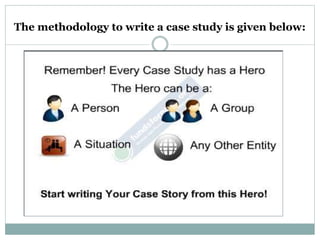
The methodology to write a case study is given below:
First Step: Identify the person, group or the entity on which
you need to write a case study.
Generally, you want to write a case study because you have
already identified or have it in your mind the protagonist of
your story.
The methodology to write a case study is given below:
Second Step:
Start researching and collecting information about
your hero.
Prepare your questions about the hero’s past,
present and future and then go about asking them to
the hero itself and/or those around it.
Information you need to collect while
researching for a case study
 Identify the name, area and the situation of the Hero of
your case study.
 What was the earlier situation or the background story of
your Hero?
 What is the current situation of your Hero?
 Who or what is responsible for the current situation of
your hero? (Note: all that is relevant)
 Give your conclusion : If reporting your problem,
highlight the consequences resulting from the situation
or if documenting a success, then present the changed
picture and you can also explain briefly as to how this can
be replicated elsewhere.
The methodology to write a case study is given below:
 Third Step:
 When the research is complete, come back to your
office with all the information and begin writing the
case study.
The methodology to write a case study is given below:
 Fourth Step: Give a catchy title to your case study.
Follow the pattern of giving an introduction to the
situation. After describing the situation, write about
your hero or the case by giving its background story.
Then, the middle of the case study will have the
information about the change or the uniqueness of
the story reported through an incident. Highlight
this incident as it reflects the real fact or situation of
the story. Then write the conclusion as the end part
of the story.
The methodology to write a case study is given below:
 Fifth Step:
Once you have completed the first draft, read it again
and if necessary, re-write it again to make sure if the
concept has been conveyed to the reader. If possible,
share the draft with a friend or a colleague to get
feedback. Once you are satisfied, you can then
present your case study.
Any Questions ?
WHY IT IS
IMPORTANT TO
WRITE A CASE STORY
2nd Session
Why it is important to write a case story?
 A case study gives an interesting overview of the
existing problem or a success story.
 It attracts the attention of the lay person who will be
able to understand the problem or success in the
format of a story.
 It could be an important document for raising funds
or mobilizing resources for NGOs
 It gives a strong evidence for the problem you are
trying to make someone understand or a success you
want to publicize.
TEMPLATE FOR
WRITING A CASE
STORY
3rd Session
Template for writing a case story
 Case studies can be written in various styles and
expert writers can always come out with new ideas
on the format of a case study. However, a basic
template of a case study is useful for NGOs which
they can work on further to present their point of
view.
Template for writing a case story
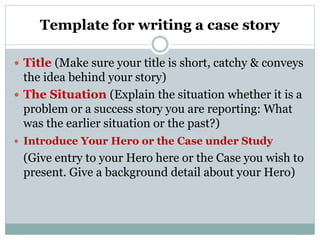
 Title (Make sure your title is short, catchy & conveys
the idea behind your story)
 The Situation (Explain the situation whether it is a
problem or a success story you are reporting: What
was the earlier situation or the past?)
 Introduce Your Hero or the Case under Study
(Give entry to your Hero here or the Case you wish to
present. Give a background detail about your Hero)
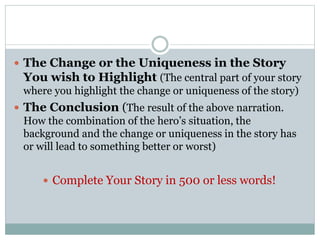
 The Change or the Uniqueness in the Story
You wish to Highlight (The central part of your story
where you highlight the change or uniqueness of the story)
 The Conclusion (The result of the above narration.
How the combination of the hero’s situation, the
background and the change or uniqueness in the story has
or will lead to something better or worst)
 Complete Your Story in 500 or less words!
Commentary on Case Studies
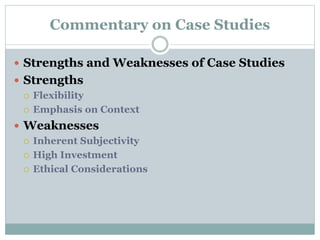
 Strengths and Weaknesses of Case Studies
 Strengths
 Flexibility
 Emphasis on Context
 Weaknesses
 Inherent Subjectivity
 High Investment
 Ethical Considerations
Concerns about Reliability, Validity, and Generalizability
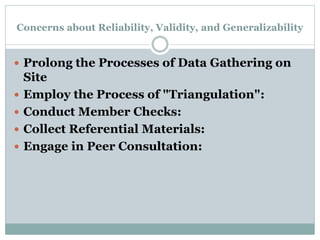
 Prolong the Processes of Data Gathering on
Site
 Employ the Process of "Triangulation":
 Conduct Member Checks:
 Collect Referential Materials:
 Engage in Peer Consultation:
Thank you
cpslanka@gmail.com

How to write a case study-01

  • 1.
    D R .S . L . R I Y A S B A , M A , M B A , P H D , M A N A G E M E N T C O N S U L T A N T / T R A I N E R CPSLANKA@GMAIL.COM How to write a case study?
  • 3.
    Improving your PRand HR skills
  • 4.
    What is acase story ?  In simple terms, writing a case study is like narrating a story of a person or a group or any other entity to represent a fact or a real situation. Now because it should represent a real fact or situation, a certain system has to be following in the process of writing the case study.
  • 5.
    Introduction  This guideexamines case studies, a form of qualitative descriptive research that is used to look at individuals, a small group of participants, or a group as a whole.  Researchers collect data about participants using participant and direct observations, interviews, protocols, tests, examinations of records, and collections of writing samples.  Starting with a definition of the case study, the guide moves to a brief history of this research method.
  • 6.
    Introduction  Using severalwell documented case studies, the guide then looks at applications and methods including data collection and analysis.  A discussion of ways to handle validity, reliability, and generalizability follows, with special attention to case studies as they are applied to composition studies. Finally, this guide examines the strengths and weaknesses of case studies.
  • 7.
    What is aCase Study? Definition  A case study can be described as “a study of a unique incident relating to an individual or a group or a community or any other entity.”  The incident can either express a problem that needs to be addressed or it could be a story of success that has to be shared and publicized.  In most cases, the case study is unique relating to a single individual, group or any other entity but it can carry the power of representing facts of a whole area.
  • 8.
    What is aCase Study? Definition  Case study refers to the collection and presentation of detailed information about a particular participant or small group, frequently including the accounts of subjects themselves.  A form of qualitative descriptive research, the case study looks intensely at an individual or small participant pool, drawing conclusions only about that participant or group and only in that specific context.  Researchers do not focus on the discovery of a universal, generalizable truth, nor do they typically look for cause- effect relationships; instead, emphasis is placed on exploration and description.
  • 9.
    Types of CaseStudies  Under the more generalized category of case study exist several subdivisions, each of which is custom selected for use depending upon the goals and/or objectives of the investigator. These types of case study include the following:  Illustrative Case Studies These are primarily descriptive studies. They typically utilize one or two instances of an event to show what a situation is like. Illustrative case studies serve primarily to make the unfamiliar familiar and to give readers a common language about the topic in question.
  • 10.
     Exploratory (orpilot) Case Studies These are condensed case studies performed before implementing a large scale investigation. Their basic function is to help identify questions and select types of measurement prior to the main investigation. The primary pitfall of this type of study is that initial findings may seem convincing enough to be released prematurely as conclusions.
  • 11.
     Cumulative CaseStudies These serve to aggregate information from several sites collected at different times. The idea behind these studies is the collection of past studies will allow for greater generalization without additional cost or time being expended on new, possibly repetitive studies.
  • 12.
     Critical InstanceCase Studies These examine one or more sites for either the purpose of examining a situation of unique interest with little to no interest in generalizability, or to call into question or challenge a highly generalized or universal assertion. This method is useful for answering cause and effect questions.
  • 13.
    Identifying a TheoreticalPerspective  Individual Theories These focus primarily on the individual development, cognitive behavior, personality, learning and disability, and interpersonal interactions of a particular subject.  Organizational Theories These focus on bureaucracies, institutions, organizational structure and functions, or excellence in organizational performance.
  • 14.
     Social Theories Thesefocus on urban development, group behavior, cultural institutions, or marketplace functions.
  • 15.
    Designing a CaseStudy  What questions to study?  What data are relevant?  What data to collect?  How to analyze that data?
  • 16.
    Conducting Case Studies To obtain as complete a picture of the participant as possible, case study researchers can employ a variety of approaches and methods. These approaches, methods, and related issues are discussed in depth in this section.  Method  Participants Selection  Data collection  Data Analysis  Composing the Case Study Report  Issues of Validity and Reliability
  • 17.
    The methodology towrite a case study is given below: First Step: Identify the person, group or the entity on which you need to write a case study. Generally, you want to write a case study because you have already identified or have it in your mind the protagonist of your story.
  • 18.
    The methodology towrite a case study is given below:
  • 19.
    The methodology towrite a case study is given below: Second Step: Start researching and collecting information about your hero. Prepare your questions about the hero’s past, present and future and then go about asking them to the hero itself and/or those around it.
  • 20.
    Information you needto collect while researching for a case study  Identify the name, area and the situation of the Hero of your case study.  What was the earlier situation or the background story of your Hero?  What is the current situation of your Hero?  Who or what is responsible for the current situation of your hero? (Note: all that is relevant)  Give your conclusion : If reporting your problem, highlight the consequences resulting from the situation or if documenting a success, then present the changed picture and you can also explain briefly as to how this can be replicated elsewhere.
  • 21.
    The methodology towrite a case study is given below:  Third Step:  When the research is complete, come back to your office with all the information and begin writing the case study.
  • 22.
    The methodology towrite a case study is given below:  Fourth Step: Give a catchy title to your case study. Follow the pattern of giving an introduction to the situation. After describing the situation, write about your hero or the case by giving its background story. Then, the middle of the case study will have the information about the change or the uniqueness of the story reported through an incident. Highlight this incident as it reflects the real fact or situation of the story. Then write the conclusion as the end part of the story.
  • 23.
    The methodology towrite a case study is given below:  Fifth Step: Once you have completed the first draft, read it again and if necessary, re-write it again to make sure if the concept has been conveyed to the reader. If possible, share the draft with a friend or a colleague to get feedback. Once you are satisfied, you can then present your case study.
  • 24.
  • 25.
    WHY IT IS IMPORTANTTO WRITE A CASE STORY 2nd Session
  • 26.
    Why it isimportant to write a case story?  A case study gives an interesting overview of the existing problem or a success story.  It attracts the attention of the lay person who will be able to understand the problem or success in the format of a story.  It could be an important document for raising funds or mobilizing resources for NGOs  It gives a strong evidence for the problem you are trying to make someone understand or a success you want to publicize.
  • 27.
    TEMPLATE FOR WRITING ACASE STORY 3rd Session
  • 28.
    Template for writinga case story  Case studies can be written in various styles and expert writers can always come out with new ideas on the format of a case study. However, a basic template of a case study is useful for NGOs which they can work on further to present their point of view.
  • 29.
    Template for writinga case story  Title (Make sure your title is short, catchy & conveys the idea behind your story)  The Situation (Explain the situation whether it is a problem or a success story you are reporting: What was the earlier situation or the past?)  Introduce Your Hero or the Case under Study (Give entry to your Hero here or the Case you wish to present. Give a background detail about your Hero)
  • 30.
     The Changeor the Uniqueness in the Story You wish to Highlight (The central part of your story where you highlight the change or uniqueness of the story)  The Conclusion (The result of the above narration. How the combination of the hero’s situation, the background and the change or uniqueness in the story has or will lead to something better or worst)  Complete Your Story in 500 or less words!
  • 31.
    Commentary on CaseStudies  Strengths and Weaknesses of Case Studies  Strengths  Flexibility  Emphasis on Context  Weaknesses  Inherent Subjectivity  High Investment  Ethical Considerations
  • 32.
    Concerns about Reliability,Validity, and Generalizability  Prolong the Processes of Data Gathering on Site  Employ the Process of "Triangulation":  Conduct Member Checks:  Collect Referential Materials:  Engage in Peer Consultation:
  • 33.