Writing a Police Report
That’s Complete
by Jean Reynolds, Ph.D.
Police reports need to
be complete.
It sounds simple – just start at the beginning
and keep writing until you come to the end.
But it’s not always
that easy.
Three problems can
cause a report to be
incomplete.
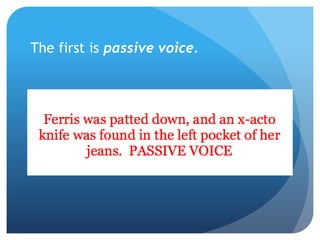
The first is passive voice.
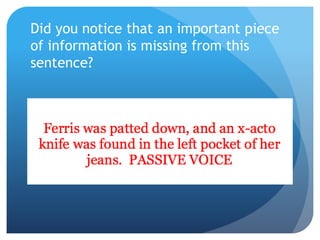
Did you notice that an important piece
of information is missing from this
sentence?
Who searched Ferris?
That information might be important later if
there’s a question about the search.
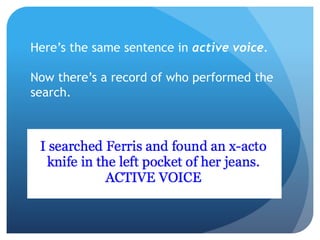
Here’s the same sentence in active voice.
Now there’s a record of who performed the
search.
Passive-voice is a leftover from old-
school report writing.
Years ago, if you
used “I” or “me”
in a report, you
were suspected
of lying.
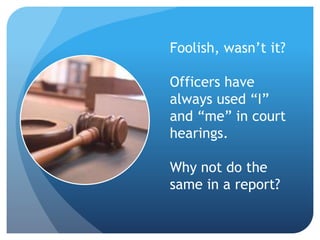
Foolish, wasn’t it?
Officers have
always used “I”
and “me” in court
hearings.
Why not do the
same in a report?
Modern police
reports are
written in active
voice.
But passive voice lives
on.
It often occurs in the
disposition part of a
report (near the end).
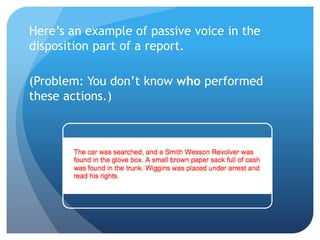
Here’s an example of passive voice in the
disposition part of a report.
(Problem: You don’t know who performed
these actions.)
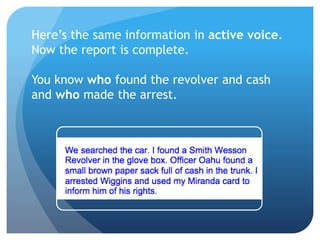
Here’s the same information in active voice.
Now the report is complete.
You know who found the revolver and cash
and who made the arrest.
The second problem
is stating opinions
instead of facts.
If facts are missing,
your report is
incomplete.
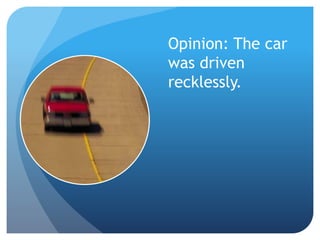
Opinion: The car
was driven
recklessly.
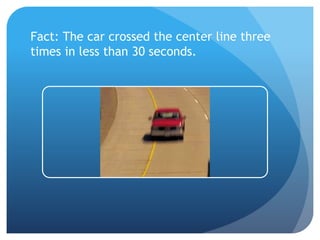
Fact: The car crossed the center line three
times in less than 30 seconds.
Opinions are unlikely to stand up in court.
You need facts, especially when you’re trying
to establish probable cause.
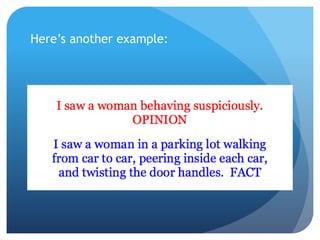
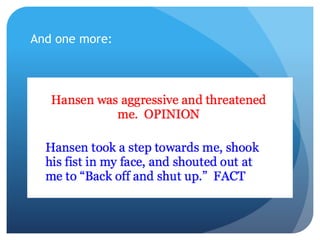
Here’s another example:
And one more:
Here’s the third
problem that
might make a
police report
incomplete:
Omitting the results
of a search.
Reports often say, “I
looked for latent
fingerprints.”
But did you find any?
Here’s a complete
statement:
“I looked for latent
fingerprints but
found none.”
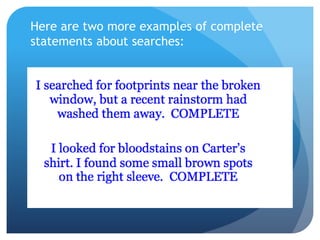
Here are two more examples of complete
statements about searches:
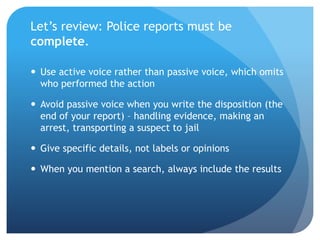
Let’s review: Police reports must be
complete.
 Use active voice rather than passive voice, which omits
who performed the action
 Avoid passive voice when you write the disposition (the
end of your report) – handling evidence, making an
arrest, transporting a suspect to jail
 Give specific details, not labels or opinions
 When you mention a search, always include the results
You can learn more about report writing
at www.YourPoliceWrite.com.
All the resources there are FREE:
www.YourPoliceWrite.com.
And if you’re
looking for a
low-cost,
practical book…
Criminal Justice
Report Writing is
available from
www.Amazon.com.
View a free sample
online.
A discount price is
available for class sets
(minimum five books).
Send your request to
jreynoldswrite @
aol.com.
An e-book edition is
available from
www.Smashwords.com.
A free Instructor’s
Manual is available on
request: Send an e-
mail to jreynoldswrite
at aol.com.

Writing a Police Report That's Complete