How to Write Like a Cop
by Jean Reynolds, Ph.D.
How to Write Like a Cop
by Jean Reynolds, Ph.D.
You learned how to
write police reports
in a law enforcement
training program.
(Perhaps you’re
taking a class right
now.)
But you learned
most of your
writing skills in
high school.
Perhaps you also took English courses
in college.
You studied
grammar, did
workbook
exercises, and
wrote essays.
You learned how
to use a library.
Those learning
experiences were
valuable and
important...
…but not
everything you
learned in your
English classes
applies to police
writing.
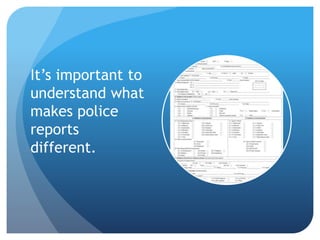
It’s important to
understand what
makes police
reports
different.
No matter how good your writing
skills are…
…you also have to know how to write
like a cop.
So let’s look at the differences.
English teachers
value analytical
thinking and
sophisticated
sentence
patterns.
Police reports
require facts and
straightforward
sentences.
The kind of writing
that would make your
English teacher happy
won’t always work in
a police report.
Let’s look at a
Sherlock Holmes
story.
An English teacher would probably
love this sentence from a Sherlock
story about a murder victim:
But that sentence isn’t objective
enough for a police report.
This sentence is better:
The problem is the words in red
that describe Sherlock’s opinions
and conclusions.
Those descriptions are fine for a novel.
But they DON’T belong in a police
report.
A police report has to record facts—only
the facts.
Good police writing
can help you avoid
problems if you have
to go to court.
A defense attorney
might argue with the
thoughts, guesses, or
hunches you included
in a report.
But if your reports
stick to observable
facts, you’re much
less likely to be
challenged.
Here’s a statement
that can get you
into trouble:
“The driver was
obviously drunk.”
Maybe she was
sleepy, or texting,
or looking down at
a map.
But no one can
argue with you if
you reported what
you saw.
“The car crossed
the yellow line
three times in less
than two
minutes.”
Here are two
sentences about a
fight.
Which one is
suitable for a
police report?
The first version isn’t an objective
fact. You didn’t see the incident.
You can’t be sure that Patel really
backed into Finn’s car.
The second version is better because
you wrote down only what Finn told
you.
Here are two more tips for writing
like a cop.
Forget about trying to impress your
supervisor with your vocabulary. Use
plain, everyday words.
Fancy words don’t prove that you’re
smart. Good police work does.
And don’t waste time with
unnecessary words and expressions.
Let’s review the principles that will
help you write like a cop.
1. Record only the
facts.
2. Omit thoughts,
reasoning, hunches,
and conclusions.
3. Write plain,
straightforward
sentences.
4. Choose plain,
everyday words.
5. Avoid wasting
time with
unnecessary words
and expressions.
Remember:
To be a good
writer, you need
to hang onto
many of the
principles you
learned in your
English classes.
But you also need
to learn to
think...and
write…like a cop.
You can learn more about report
writing at www.YourPoliceWrite.com.
All the resources there are FREE:
www.YourPoliceWrite.com.
And if you’re
looking for a
low-cost,
practical book…
Criminal Justice Report
Writing is available
from www.Amazon.com
for just $19.95.
View a free sample
online.
An e-book edition is
available from
www.Smashwords.com
for only $9.99.
A discount price is
available for class sets
(minimum five books).
A free Instructor’s Manual
is available for instructors
and administrators.
Send an e-mail request
from your official account
to jreynoldswrite at
aol.com.

How to Write Like a Cop