





Report Writing
Jeffery Martin
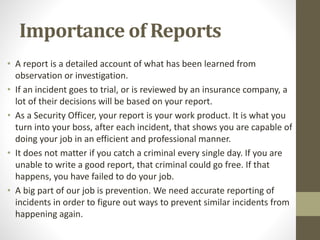
Importance of Reports
• A report is a detailed account of what has been learned from
observation or investigation.
• If an incident goes to trial, or is reviewed by an insurance company, a
lot of their decisions will be based on your report.
• As a Security Officer, your report is your work product. It is what you
turn into your boss, after each incident, that shows you are capable of
doing your job in an efficient and professional manner.
• It does not matter if you catch a criminal every single day. If you are
unable to write a good report, that criminal could go free. If that
happens, you have failed to do your job.
• A big part of our job is prevention. We need accurate reporting of
incidents in order to figure out ways to prevent similar incidents from
happening again.
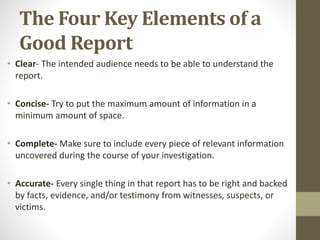
The Four Key Elements of a
Good Report
• Clear- The intended audience needs to be able to understand the
report.
• Concise- Try to put the maximum amount of information in a
minimum amount of space.
• Complete- Make sure to include every piece of relevant information
uncovered during the course of your investigation.
• Accurate- Every single thing in that report has to be right and backed
by facts, evidence, and/or testimony from witnesses, suspects, or
victims.
CLEAR
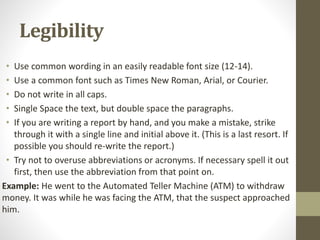
Legibility
• Use common wording in an easily readable font size (12-14).
• Use a common font such as Times New Roman, Arial, or Courier.
• Do not write in all caps.
• Single Space the text, but double space the paragraphs.
• If you are writing a report by hand, and you make a mistake, strike
through it with a single line and initial above it. (This is a last resort. If
possible you should re-write the report.)
• Try not to overuse abbreviations or acronyms. If necessary spell it out
first, then use the abbreviation from that point on.
Example: He went to the Automated Teller Machine (ATM) to withdraw
money. It was while he was facing the ATM, that the suspect approached
him.
Order of Events
• Write your report in chronological order, from your point of
view, starting with the date and time you received the
call/complaint.
• At times, you may need to write something from the point of
view of a witness, victim, or suspect. Do this in chronological
order as well, ensuring that it fits chronologically into your
overall report.
• Remember; It is your report. Not theirs.
Information
NEOTWY
• When did it happen?
• Where did it happen?
• Who did it happen to? (Include “with whom” as necessary.)
• What happened?
• How did it happen?
• Why did it happen?
Most people have heard of the 5 W’s and the H. Using NEOTWY,
puts all of the information in an order that is more suitable for
law enforcement reports.
Information (Continued)
• Include all facts that are relevant to the case.
(If it is an accident, you may want to include weather, traffic
conditions, traffic control devices, etc. For a burglary, you may need
to include alarm systems, location of cameras, who reported the
crime, who was the last person to leave, or the location of broken
glass and/or footprints.)
• Do not put any personal opinions, or jokes, in the report.
(Pointing out that you think the suspect looked like he smelled like
urine may be funny, but Manny will not be impressed.)
• Include all pertinent statements made by victims, witnesses, or
suspects.
Comprehensibility
• You should try to make sure that your report is understandable to
the people that may end up reading them.
• Your audience is not just your supervisor. You report may also be
read by managers, other Officers, Detectives, Prosecuting
Attorneys, Defense Attorneys, insurance companies, victims and/or
suspects.
• If you are ever summoned to testify in court, the questions will
most likely be based on what you wrote in your report. You could
be called into court years after the event happened. It would
behoove you to write a report that is capable of helping you
remember the events that took place, the order in which they
happened, and the people that were involved.
Comprehensibility
(Continued)
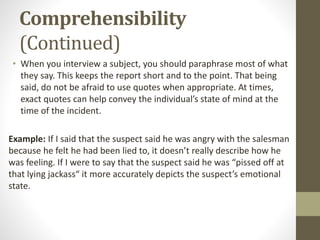
• When you interview a subject, you should paraphrase most of what
they say. This keeps the report short and to the point. That being
said, do not be afraid to use quotes when appropriate. At times,
exact quotes can help convey the individual’s state of mind at the
time of the incident.
Example: If I said that the suspect said he was angry with the salesman
because he felt he had been lied to, it doesn’t really describe how he
was feeling. If I were to say that the suspect said he was “pissed off at
that lying jackass“ it more accurately depicts the suspect’s emotional
state.
Comprehensibility
(Continued)
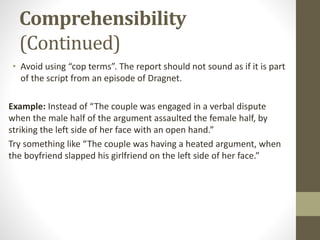
• Avoid using “cop terms”. The report should not sound as if it is part
of the script from an episode of Dragnet.
Example: Instead of “The couple was engaged in a verbal dispute
when the male half of the argument assaulted the female half, by
striking the left side of her face with an open hand.”
Try something like “The couple was having a heated argument, when
the boyfriend slapped his girlfriend on the left side of her face.”
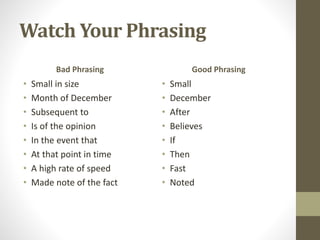
Watch Your Phrasing
Bad Phrasing
• Small in size
• Month of December
• Subsequent to
• Is of the opinion
• In the event that
• At that point in time
• A high rate of speed
• Made note of the fact
Good Phrasing
• Small
• December
• After
• Believes
• If
• Then
• Fast
• Noted
Comprehensibility
(Continued)
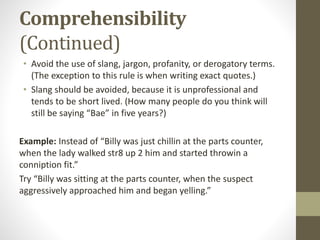
• Avoid the use of slang, jargon, profanity, or derogatory terms.
(The exception to this rule is when writing exact quotes.)
• Slang should be avoided, because it is unprofessional and
tends to be short lived. (How many people do you think will
still be saying “Bae” in five years?)
Example: Instead of “Billy was just chillin at the parts counter,
when the lady walked str8 up 2 him and started throwin a
conniption fit.”
Try “Billy was sitting at the parts counter, when the suspect
aggressively approached him and began yelling.”
Times, Names, and Numbers
• Using military time is best. It helps to prevent confusion. (6:00am and
6:00pm look a lot alike, but 0600 and 1800 do not.)
• When using a subject’s name, for the first time, use the full name.
Afterwards, just use the last name. This keeps things clear and looks
more detached.
(The exception would be when dealing with more than one person with
the same last name. Then it would better to include first names, to
avoid any confusion.)
• There are three different ways to write numbers. The numeral “8”,
the written word “eight”, and the clearest method “eight (8)”. It’s up
to you, but you should remember to strive for clarity and consistency.
(Do it the same way throughout the report.)
Spelling
• If you aren’t sure how to spell a name……. Ask! Remember that even
“common” names can be spelled several different ways.
• Use a dictionary (or Google) if it is a new word, and use spell-check on
your report.
• Watch out for words that sound the same, but are not. For example –
There, They’re, and Their. Spell check will not fix these errors, because
the words are spelled right.
Grammar
• Incorrect grammar can change the meaning of a sentence. It
can also make your report hard to follow. Remember other
people need to be able to read, and understand, what you
have written.
• Remember also that one of the people reading the report may
be a Defense Attorney. He or she will be looking for mistakes
in your report, and will not hesitate to try to make you look
incompetent. (He or she will want to make you look stupid.)
• You never know which report may end up before a judge, so
write them all as if they will.
Grammar (Continued)
• Use complete sentences. This means that every sentence
should have at least a noun and a verb. (“Arrested the
suspect.” is not a complete sentence. “Officer Smith arrested
the suspect.” is.)
• Avoid run-on sentences. These are usually caused by the
overuse of commas or the word and.
Example: “I went to Manny’s office and I was told about the
incident.” is a run-on sentence. It should say “I went to Manny’s
Office. I was told about the incident.”
• Start a new paragraph whenever you start a new subject.
(Remember to double space between paragraphs.)
Grammar (Continued)
• Write your report in first person. (Do not begin a report with
“This Officer did…”)
• Always write in the past tense.
Wrong: This Officer did witness the accident. The car swerves in
front of the service truck and slams on it’s brakes.
Right: I witnessed the accident. The car swerved in front of the
service truck and slammed on it’s brakes.
• Avoid past progressives. (This is when you use the word was,
followed by a verb that ends in -ing.)
Wrong: I was arresting Smith.
Right: I arrested Smith.
Grammar (Continued)
• Use an “active voice” when writing your report, as opposed to
a “passive” one. An active voice clearly states who did what.
Passive: The suspect was pepper sprayed by me. Afterward, he
was arrested.
Active: I pepper sprayed the suspect. Afterwards, I arrested him.
CONCISE
Avoid Clutter
• Make sure that every single sentence you write is necessary
and relevant to the case.
• Use facts. Keep your opinions to yourself.
• Write in a brief, straight forward manner.
• Try not to overwrite. Once you have made your point, move
on to the next topic.
(It is best to keep your report short and to the point, but
overwriting is sometimes safer than leaving something out. If you
are in doubt as to whether you have included enough
information, go ahead and write more. Just don’t make a habit
out of it.)
What Is Important?
• When you were dispatched
• NEOTWY (When, Where, Who, What, How, and Why)
• Any evidence
• Victim, witness, and suspect statements
• Circumstances (If you are investigating a wreck, you would
report the weather conditions. If it is a domestic assault, you
would include the argument that led to it.)
• The final disposition. (Notified the LMT, notified the Legal
Department, notified supervisor, made an arrest, victim went
to hospital, etc.)
Revise-Revise-Revise
• At some point, either before or after spell-checking, go through the
report and look for any information that doesn’t need to be there.
If you find any, delete it.
• Watch for overly long sentences.
• Watch for the overuse of quotations. (Remember to only use exact
quotations when it is necessary to get the point across.)
• Watch for the overuse of commas and the word and.
• Watch for “passive voice”. This usually uses more words than
necessary, and is not as clear.
• Watch for redundancy. This is repeating unnecessary information
repeatedly. (See what I did there?)
• Watch for the use of words like “very” and “really”. (These are a
waste of space.)
COMPLETE
Consequences Of An
Incomplete Report
• A lead may not be followed.
• The person who committed the crime may go free.
• The victim may not get the justice he or she deserves.
• The company could lose money in a civil trial.
• It may make the company look bad.
• It could make the Security Department look bad.
• It will make you, as the reporting Officer, look bad.
“If it isn’t in the report, it
didn’t happen.”
• Information left out of a report, could be the downfall of a
case and lead to your suspect “walking”.
• If you leave something out of your report, and try to bring it
up in a trial, the Defense Attorney will likely state that it is
pretty “convenient” that you are just now bringing it up.
• Your report is supposed to contain all relevant information
regarding your investigation. If you leave something out, the
assumption is that you did not feel that the information is
relevant.
C.Y.A.
• Lets say a member of your LMT called and told you that there was a
suspicious man on the property, threatening employees, and that he
has a gun. Upon arrival you see the suspect, and challenge him. He
becomes combative and reaches for his pocket. You draw down on
him, get him in the prone position, and handcuff him.
• Later it is discovered that what the member of the LMT thought was a
gun, was a cell phone, and while he was arguing with the employees,
he did not actually make any threats. Where you in the wrong for
drawing down on him? No. If you left out the fact that the member of
the LMT stated the suspect was threatening employees, and that he
thought the suspect had a weapon, you are going to have some
explaining to do. Will it all work out in the end? Hopefully, but it
would go a lot smoother if you remembered to include the LMT
member’s statement in the report.
Writing A Complete Report
• As stated before, a complete report should contain all relevant
information.
• As the Officer doing the investigation, you will have to draw on your
experience and common sense to determine what is, or is not,
relevant.
• When unsure whether or not to include a piece of information, ask
yourself if someone, that was not involved in the case, would need
that information to understand what happened. Remember that
most of the people reading the report where not there, and will be
relying on your report to understand what happened.
• If you still aren’t sure whether or not to include a piece of
information, you should probably put it in your report. It is better to
include unnecessary information than to leave something important
out of your report. (While a report with too much useless
information can look cluttered and unprofessional, a report without
enough information can be dangerous.)
Writing A Complete Report
(Continued)
• If you are filling out a preformatted report, that has boxes (such as
our Incident Report form), fill in every applicable box. Those little
boxes, while annoying, are there for a reason. Somebody will want to
know that information.
• While on the topic of the boxes, if you know there is a box on the
form, ask that question when you do your interview.
• When you get a chance try to memorize the boxes that are on the
form, so you remember to ask the questions without having to
constantly glance at it.
• Make sure to include relevant statements made by witnesses, victims,
and/or suspects.
• Remember NEOTWY? Make sure that you include how you came to
know all of that information.
• Make sure to include every action you took, that pertains to the case.
(That means every relevant thing you did from the time you received
the call, until the time you wrote the report.)
ACCURATE
Importance Of Accuracy
• Inaccuracy, in a report, is totally and completely unforgiveable. It is
understandable, if you were given the wrong information, but if you
knew the right information, and recorded it wrong, your report is
nothing more than a waste of paper, ink, and time.
• You have to get it right. When people read a report, written by
someone in the field of Criminal Justice, they expect the information
to be correct. Facts, facts, facts, and more facts.
• A fact is “something that truly exists or happens : something that has
actual existence”. (Merriam-Webster says this, and I don’t argue with
books…..Usually.)
• Bottom line, if you have written an inaccurate report, you may have
failed the company, the victim, the department, and yourself.
Field Notes
• All of us should have a small notebook and a pen on our person,
during our shift.
• The purpose of this, is so that you can take notes.
• These notes can be used later to help jog your memory, when you
finally have the time to write your report.
• They will help you remember how to spell names. (Jayceson Smythe
will not show up on a background check if you run him as Jason
Smith.)
• Notes will also help you recall times, and the order of events.
• Taking notes will also make you appear as if you know what you are
doing. It contributes to our “Officer Presence”.
(Some of you prefer the term “Command Presence”, but I am making
this slide show, so I will use the term I prefer. =P) (Don’t use emoticons
in a report.)
Investigation
• When you are called to investigate something, you have to do just
that.
• Conduct a thorough investigation.
• Ask the right questions.
• Remember NEOTWY.
• Check I.D.s, if possible. (Remember when Fat Amy turned out to be
Fat Patricia? If you don’t, I feel sorry for you. Go watch Pitch Perfect.)
• Speak to all witnesses, suspects, and victims.
• Take good notes.
• Do not assume. (You know what they say about that. If you don’t, go
read Silence of The Lambs.)
• Use an audio recorder, if possible.
• Cross-reference statements made by the subjects of your
investigation. (If “one of these things is not like the other”, you need
to find out why.)
Investigation(Continued)
• Verify everything.
• A little cynicism is ok. (People do tend to lie, even if there is really no
need to.)
• Remember that people don’t always make the best witnesses. If you
start to see that some things aren’t really matching up, dig a little
deeper.
• Don’t take anything at face value. You are there to investigate, not
just to record what everyone says.
• Make sure you get accurate descriptions.
(Don’t just write “black car”, write “Black 2003 Ford Mustang, TX Plates
XXX-XXXX.)
• This includes descriptions of people. (Skin color, scars, accents,
glasses, tattoos, etc.)
Reporting Accurately
• Be specific when you include a piece of information in your report . (If
a service truck flipped over, while trying to avoid hitting a stalled car,
do not write that the service truck was “involved in an accident”.)
• Include exact locations. (Or as close as you can get.)
• Record accurate times, by referring to your notes. (It is almost
impossible to record exact times because most of our watches are not
set to the exact same time. Use approximately, about, or around, to
avoid playing a game of “Let’s compare watches, Officer
Incompetent.” with some Defense Attorney.)
• Verify names, addresses, birthdates, phone numbers, and
descriptions, before you include them in the report.
• Paraphrase accurately, and quote exactly.
• Cross reference your report with your notes and all of the evidence.
(Do this several times, as you write the report, and again when you
think your done.)
Reporting Accurately
(Continued)
• Be sure that you clarify each subjects role in your report.
(Make sure that you don’t get the victim and the suspect mixed up. One
will be happy. The other, not so much.)
• Make sure you assign each subject with the right designation.
If someone called the incident in, they are a complainant.
If they were the person negatively affected by the incident, they are the
victim.
The person suspected of causing the incident , if a law was broken,
would be the suspect.
But what if the person negatively affected by the incident, was the one
that reported it? They would still be the victim, because victim trumps
complainant. Just like the complainant could be listed as a witness, but
complainant trumps witness.
Reporting Accurately
(Continued)
• Leave opinions out of your report. Opinions are just that. Opinions.
Reports are supposed to be facts and facts only. (I feel like we’ve been
here before.)
• The only thing resembling an opinion, that might be ok in a report,
should begin somewhere along the lines of seems or appears, and
should be backed with facts.
Example: “The suspect appeared to be intoxicated, because he smelled
of alcohol, was stumbling, and was slurring his speech.”
Was he intoxicated? I don’t know. Unless you have a toxicology report
in front of you, neither do you. You should still include this little bit of
information. To play it safe, you could just say “The suspect smelled of
alcohol, was stumbling, and was slurring his speech.” The judge should
be able to understand that he appeared to be drunk, just from reading
that.
(If you choose to use these kinds of “opinions” in your report, you
should do so judiciously.)
Proofread
• Spelling and grammar checking software is great, but you still need to
proofread your paper.
• After you have finished writing, re-read the report slowly, watching
for spelling and grammatical errors.
• Make sure that each topic has it’s own paragraph.
• Make sure that each paragraph flows into the next one.
• Make sure that it is in chronological order.
• Most importantly; Make sure that someone, who was not there, can
read and understand what happened, and what you did about it.
Writing The Report
Time To Write
• You know that a report needs to be clear, concise, complete, and
accurate. Now what? It must be time to write.
• One of the best ways to start writing a report is to just start writing.
(This is what your old English teacher would refer to as a “rough draft”.)
• Review your rough draft, and re-write it, taking out anything that
doesn’t need to be there, and adding things that do need to be there.
(This is what they would call “revising”.)
• After this, go through and make sure that everything is accurate,
make sure that everything is in the order in which it happened, and
look for spelling and grammatical errors.
• If possible have someone else read the report. If not, try reading it
out loud.
• Now write it one more time.
(This is your final draft. Where all things come to fruition.)
THE END……
Hope this helps.

Report Writing

  • 1.
  • 2.
    Importance of Reports •A report is a detailed account of what has been learned from observation or investigation. • If an incident goes to trial, or is reviewed by an insurance company, a lot of their decisions will be based on your report. • As a Security Officer, your report is your work product. It is what you turn into your boss, after each incident, that shows you are capable of doing your job in an efficient and professional manner. • It does not matter if you catch a criminal every single day. If you are unable to write a good report, that criminal could go free. If that happens, you have failed to do your job. • A big part of our job is prevention. We need accurate reporting of incidents in order to figure out ways to prevent similar incidents from happening again.
  • 3.
    The Four KeyElements of a Good Report • Clear- The intended audience needs to be able to understand the report. • Concise- Try to put the maximum amount of information in a minimum amount of space. • Complete- Make sure to include every piece of relevant information uncovered during the course of your investigation. • Accurate- Every single thing in that report has to be right and backed by facts, evidence, and/or testimony from witnesses, suspects, or victims.
  • 4.
  • 5.
    Legibility • Use commonwording in an easily readable font size (12-14). • Use a common font such as Times New Roman, Arial, or Courier. • Do not write in all caps. • Single Space the text, but double space the paragraphs. • If you are writing a report by hand, and you make a mistake, strike through it with a single line and initial above it. (This is a last resort. If possible you should re-write the report.) • Try not to overuse abbreviations or acronyms. If necessary spell it out first, then use the abbreviation from that point on. Example: He went to the Automated Teller Machine (ATM) to withdraw money. It was while he was facing the ATM, that the suspect approached him.
  • 6.
    Order of Events •Write your report in chronological order, from your point of view, starting with the date and time you received the call/complaint. • At times, you may need to write something from the point of view of a witness, victim, or suspect. Do this in chronological order as well, ensuring that it fits chronologically into your overall report. • Remember; It is your report. Not theirs.
  • 7.
    Information NEOTWY • When didit happen? • Where did it happen? • Who did it happen to? (Include “with whom” as necessary.) • What happened? • How did it happen? • Why did it happen? Most people have heard of the 5 W’s and the H. Using NEOTWY, puts all of the information in an order that is more suitable for law enforcement reports.
  • 8.
    Information (Continued) • Includeall facts that are relevant to the case. (If it is an accident, you may want to include weather, traffic conditions, traffic control devices, etc. For a burglary, you may need to include alarm systems, location of cameras, who reported the crime, who was the last person to leave, or the location of broken glass and/or footprints.) • Do not put any personal opinions, or jokes, in the report. (Pointing out that you think the suspect looked like he smelled like urine may be funny, but Manny will not be impressed.) • Include all pertinent statements made by victims, witnesses, or suspects.
  • 9.
    Comprehensibility • You shouldtry to make sure that your report is understandable to the people that may end up reading them. • Your audience is not just your supervisor. You report may also be read by managers, other Officers, Detectives, Prosecuting Attorneys, Defense Attorneys, insurance companies, victims and/or suspects. • If you are ever summoned to testify in court, the questions will most likely be based on what you wrote in your report. You could be called into court years after the event happened. It would behoove you to write a report that is capable of helping you remember the events that took place, the order in which they happened, and the people that were involved.
  • 10.
    Comprehensibility (Continued) • When youinterview a subject, you should paraphrase most of what they say. This keeps the report short and to the point. That being said, do not be afraid to use quotes when appropriate. At times, exact quotes can help convey the individual’s state of mind at the time of the incident. Example: If I said that the suspect said he was angry with the salesman because he felt he had been lied to, it doesn’t really describe how he was feeling. If I were to say that the suspect said he was “pissed off at that lying jackass“ it more accurately depicts the suspect’s emotional state.
  • 11.
    Comprehensibility (Continued) • Avoid using“cop terms”. The report should not sound as if it is part of the script from an episode of Dragnet. Example: Instead of “The couple was engaged in a verbal dispute when the male half of the argument assaulted the female half, by striking the left side of her face with an open hand.” Try something like “The couple was having a heated argument, when the boyfriend slapped his girlfriend on the left side of her face.”
  • 12.
    Watch Your Phrasing BadPhrasing • Small in size • Month of December • Subsequent to • Is of the opinion • In the event that • At that point in time • A high rate of speed • Made note of the fact Good Phrasing • Small • December • After • Believes • If • Then • Fast • Noted
  • 13.
    Comprehensibility (Continued) • Avoid theuse of slang, jargon, profanity, or derogatory terms. (The exception to this rule is when writing exact quotes.) • Slang should be avoided, because it is unprofessional and tends to be short lived. (How many people do you think will still be saying “Bae” in five years?) Example: Instead of “Billy was just chillin at the parts counter, when the lady walked str8 up 2 him and started throwin a conniption fit.” Try “Billy was sitting at the parts counter, when the suspect aggressively approached him and began yelling.”
  • 14.
    Times, Names, andNumbers • Using military time is best. It helps to prevent confusion. (6:00am and 6:00pm look a lot alike, but 0600 and 1800 do not.) • When using a subject’s name, for the first time, use the full name. Afterwards, just use the last name. This keeps things clear and looks more detached. (The exception would be when dealing with more than one person with the same last name. Then it would better to include first names, to avoid any confusion.) • There are three different ways to write numbers. The numeral “8”, the written word “eight”, and the clearest method “eight (8)”. It’s up to you, but you should remember to strive for clarity and consistency. (Do it the same way throughout the report.)
  • 15.
    Spelling • If youaren’t sure how to spell a name……. Ask! Remember that even “common” names can be spelled several different ways. • Use a dictionary (or Google) if it is a new word, and use spell-check on your report. • Watch out for words that sound the same, but are not. For example – There, They’re, and Their. Spell check will not fix these errors, because the words are spelled right.
  • 16.
    Grammar • Incorrect grammarcan change the meaning of a sentence. It can also make your report hard to follow. Remember other people need to be able to read, and understand, what you have written. • Remember also that one of the people reading the report may be a Defense Attorney. He or she will be looking for mistakes in your report, and will not hesitate to try to make you look incompetent. (He or she will want to make you look stupid.) • You never know which report may end up before a judge, so write them all as if they will.
  • 17.
    Grammar (Continued) • Usecomplete sentences. This means that every sentence should have at least a noun and a verb. (“Arrested the suspect.” is not a complete sentence. “Officer Smith arrested the suspect.” is.) • Avoid run-on sentences. These are usually caused by the overuse of commas or the word and. Example: “I went to Manny’s office and I was told about the incident.” is a run-on sentence. It should say “I went to Manny’s Office. I was told about the incident.” • Start a new paragraph whenever you start a new subject. (Remember to double space between paragraphs.)
  • 18.
    Grammar (Continued) • Writeyour report in first person. (Do not begin a report with “This Officer did…”) • Always write in the past tense. Wrong: This Officer did witness the accident. The car swerves in front of the service truck and slams on it’s brakes. Right: I witnessed the accident. The car swerved in front of the service truck and slammed on it’s brakes. • Avoid past progressives. (This is when you use the word was, followed by a verb that ends in -ing.) Wrong: I was arresting Smith. Right: I arrested Smith.
  • 19.
    Grammar (Continued) • Usean “active voice” when writing your report, as opposed to a “passive” one. An active voice clearly states who did what. Passive: The suspect was pepper sprayed by me. Afterward, he was arrested. Active: I pepper sprayed the suspect. Afterwards, I arrested him.
  • 20.
  • 21.
    Avoid Clutter • Makesure that every single sentence you write is necessary and relevant to the case. • Use facts. Keep your opinions to yourself. • Write in a brief, straight forward manner. • Try not to overwrite. Once you have made your point, move on to the next topic. (It is best to keep your report short and to the point, but overwriting is sometimes safer than leaving something out. If you are in doubt as to whether you have included enough information, go ahead and write more. Just don’t make a habit out of it.)
  • 22.
    What Is Important? •When you were dispatched • NEOTWY (When, Where, Who, What, How, and Why) • Any evidence • Victim, witness, and suspect statements • Circumstances (If you are investigating a wreck, you would report the weather conditions. If it is a domestic assault, you would include the argument that led to it.) • The final disposition. (Notified the LMT, notified the Legal Department, notified supervisor, made an arrest, victim went to hospital, etc.)
  • 23.
    Revise-Revise-Revise • At somepoint, either before or after spell-checking, go through the report and look for any information that doesn’t need to be there. If you find any, delete it. • Watch for overly long sentences. • Watch for the overuse of quotations. (Remember to only use exact quotations when it is necessary to get the point across.) • Watch for the overuse of commas and the word and. • Watch for “passive voice”. This usually uses more words than necessary, and is not as clear. • Watch for redundancy. This is repeating unnecessary information repeatedly. (See what I did there?) • Watch for the use of words like “very” and “really”. (These are a waste of space.)
  • 24.
  • 25.
    Consequences Of An IncompleteReport • A lead may not be followed. • The person who committed the crime may go free. • The victim may not get the justice he or she deserves. • The company could lose money in a civil trial. • It may make the company look bad. • It could make the Security Department look bad. • It will make you, as the reporting Officer, look bad.
  • 26.
    “If it isn’tin the report, it didn’t happen.” • Information left out of a report, could be the downfall of a case and lead to your suspect “walking”. • If you leave something out of your report, and try to bring it up in a trial, the Defense Attorney will likely state that it is pretty “convenient” that you are just now bringing it up. • Your report is supposed to contain all relevant information regarding your investigation. If you leave something out, the assumption is that you did not feel that the information is relevant.
  • 27.
    C.Y.A. • Lets saya member of your LMT called and told you that there was a suspicious man on the property, threatening employees, and that he has a gun. Upon arrival you see the suspect, and challenge him. He becomes combative and reaches for his pocket. You draw down on him, get him in the prone position, and handcuff him. • Later it is discovered that what the member of the LMT thought was a gun, was a cell phone, and while he was arguing with the employees, he did not actually make any threats. Where you in the wrong for drawing down on him? No. If you left out the fact that the member of the LMT stated the suspect was threatening employees, and that he thought the suspect had a weapon, you are going to have some explaining to do. Will it all work out in the end? Hopefully, but it would go a lot smoother if you remembered to include the LMT member’s statement in the report.
  • 28.
    Writing A CompleteReport • As stated before, a complete report should contain all relevant information. • As the Officer doing the investigation, you will have to draw on your experience and common sense to determine what is, or is not, relevant. • When unsure whether or not to include a piece of information, ask yourself if someone, that was not involved in the case, would need that information to understand what happened. Remember that most of the people reading the report where not there, and will be relying on your report to understand what happened. • If you still aren’t sure whether or not to include a piece of information, you should probably put it in your report. It is better to include unnecessary information than to leave something important out of your report. (While a report with too much useless information can look cluttered and unprofessional, a report without enough information can be dangerous.)
  • 29.
    Writing A CompleteReport (Continued) • If you are filling out a preformatted report, that has boxes (such as our Incident Report form), fill in every applicable box. Those little boxes, while annoying, are there for a reason. Somebody will want to know that information. • While on the topic of the boxes, if you know there is a box on the form, ask that question when you do your interview. • When you get a chance try to memorize the boxes that are on the form, so you remember to ask the questions without having to constantly glance at it. • Make sure to include relevant statements made by witnesses, victims, and/or suspects. • Remember NEOTWY? Make sure that you include how you came to know all of that information. • Make sure to include every action you took, that pertains to the case. (That means every relevant thing you did from the time you received the call, until the time you wrote the report.)
  • 30.
  • 31.
    Importance Of Accuracy •Inaccuracy, in a report, is totally and completely unforgiveable. It is understandable, if you were given the wrong information, but if you knew the right information, and recorded it wrong, your report is nothing more than a waste of paper, ink, and time. • You have to get it right. When people read a report, written by someone in the field of Criminal Justice, they expect the information to be correct. Facts, facts, facts, and more facts. • A fact is “something that truly exists or happens : something that has actual existence”. (Merriam-Webster says this, and I don’t argue with books…..Usually.) • Bottom line, if you have written an inaccurate report, you may have failed the company, the victim, the department, and yourself.
  • 32.
    Field Notes • Allof us should have a small notebook and a pen on our person, during our shift. • The purpose of this, is so that you can take notes. • These notes can be used later to help jog your memory, when you finally have the time to write your report. • They will help you remember how to spell names. (Jayceson Smythe will not show up on a background check if you run him as Jason Smith.) • Notes will also help you recall times, and the order of events. • Taking notes will also make you appear as if you know what you are doing. It contributes to our “Officer Presence”. (Some of you prefer the term “Command Presence”, but I am making this slide show, so I will use the term I prefer. =P) (Don’t use emoticons in a report.)
  • 33.
    Investigation • When youare called to investigate something, you have to do just that. • Conduct a thorough investigation. • Ask the right questions. • Remember NEOTWY. • Check I.D.s, if possible. (Remember when Fat Amy turned out to be Fat Patricia? If you don’t, I feel sorry for you. Go watch Pitch Perfect.) • Speak to all witnesses, suspects, and victims. • Take good notes. • Do not assume. (You know what they say about that. If you don’t, go read Silence of The Lambs.) • Use an audio recorder, if possible. • Cross-reference statements made by the subjects of your investigation. (If “one of these things is not like the other”, you need to find out why.)
  • 34.
    Investigation(Continued) • Verify everything. •A little cynicism is ok. (People do tend to lie, even if there is really no need to.) • Remember that people don’t always make the best witnesses. If you start to see that some things aren’t really matching up, dig a little deeper. • Don’t take anything at face value. You are there to investigate, not just to record what everyone says. • Make sure you get accurate descriptions. (Don’t just write “black car”, write “Black 2003 Ford Mustang, TX Plates XXX-XXXX.) • This includes descriptions of people. (Skin color, scars, accents, glasses, tattoos, etc.)
  • 35.
    Reporting Accurately • Bespecific when you include a piece of information in your report . (If a service truck flipped over, while trying to avoid hitting a stalled car, do not write that the service truck was “involved in an accident”.) • Include exact locations. (Or as close as you can get.) • Record accurate times, by referring to your notes. (It is almost impossible to record exact times because most of our watches are not set to the exact same time. Use approximately, about, or around, to avoid playing a game of “Let’s compare watches, Officer Incompetent.” with some Defense Attorney.) • Verify names, addresses, birthdates, phone numbers, and descriptions, before you include them in the report. • Paraphrase accurately, and quote exactly. • Cross reference your report with your notes and all of the evidence. (Do this several times, as you write the report, and again when you think your done.)
  • 36.
    Reporting Accurately (Continued) • Besure that you clarify each subjects role in your report. (Make sure that you don’t get the victim and the suspect mixed up. One will be happy. The other, not so much.) • Make sure you assign each subject with the right designation. If someone called the incident in, they are a complainant. If they were the person negatively affected by the incident, they are the victim. The person suspected of causing the incident , if a law was broken, would be the suspect. But what if the person negatively affected by the incident, was the one that reported it? They would still be the victim, because victim trumps complainant. Just like the complainant could be listed as a witness, but complainant trumps witness.
  • 37.
    Reporting Accurately (Continued) • Leaveopinions out of your report. Opinions are just that. Opinions. Reports are supposed to be facts and facts only. (I feel like we’ve been here before.) • The only thing resembling an opinion, that might be ok in a report, should begin somewhere along the lines of seems or appears, and should be backed with facts. Example: “The suspect appeared to be intoxicated, because he smelled of alcohol, was stumbling, and was slurring his speech.” Was he intoxicated? I don’t know. Unless you have a toxicology report in front of you, neither do you. You should still include this little bit of information. To play it safe, you could just say “The suspect smelled of alcohol, was stumbling, and was slurring his speech.” The judge should be able to understand that he appeared to be drunk, just from reading that. (If you choose to use these kinds of “opinions” in your report, you should do so judiciously.)
  • 38.
    Proofread • Spelling andgrammar checking software is great, but you still need to proofread your paper. • After you have finished writing, re-read the report slowly, watching for spelling and grammatical errors. • Make sure that each topic has it’s own paragraph. • Make sure that each paragraph flows into the next one. • Make sure that it is in chronological order. • Most importantly; Make sure that someone, who was not there, can read and understand what happened, and what you did about it.
  • 39.
  • 40.
    Time To Write •You know that a report needs to be clear, concise, complete, and accurate. Now what? It must be time to write. • One of the best ways to start writing a report is to just start writing. (This is what your old English teacher would refer to as a “rough draft”.) • Review your rough draft, and re-write it, taking out anything that doesn’t need to be there, and adding things that do need to be there. (This is what they would call “revising”.) • After this, go through and make sure that everything is accurate, make sure that everything is in the order in which it happened, and look for spelling and grammatical errors. • If possible have someone else read the report. If not, try reading it out loud. • Now write it one more time. (This is your final draft. Where all things come to fruition.)
  • 41.