CRI 018
Technical Police Report Writing 2
Jovy D. Elimanao – Mihm, MAEd (English)
Preliminary Activity
The Police Report
At the end of the lesson, students should be
able to
• Understand the purposes of the police report
• List the elements of a well written report
• Understand the various types of investigative
reports and the circumstances in which they
are used
The Police Report
The Police Report
A police report is the physical record of an
incident deemed to be illegal or potentially
illegal. It is taken by a representative of a
police department and filed according to said
department's procedure.
The Police Report
The Police Report
• Police reports are the natural culmination of
field notes
• Reports are a permanent record and are
intended to preserve information
• 15 to 20% of an officer’s duty time is
expended on report writing
Importance of Police Reports
• They provide a source of information while
police carry out an investigation
1. Allows passing of the case from one officer to another
2. Provides a factual record of the work done on a case,
eliminating duplication
3. Is a requisite for the proper preparation and presentation
of a case to the district attorney and to the court
• Helps a department stay organized
1. The memory system of a department
2. Serves as a written, permanent record of all department
business
Importance of Police Reports
• A report is an administrative necessity; most
official forms of communication are
completed using reports.
• Other purposes
• The basis for maintenance of identification and criminal
records in the area
• Aid in the recovery of lost or stolen property
• Contain information used to apprehend criminals
Importance of Police Reports
• Used in civil suits
• Provide factual data to combat ill-advised or
unreasonable demands on police
• Furnish information to the news media
When are incidents documented by
the police?
• Reports are written
– Whenever an arrest is made
– For all serious incidents like
• Bomb threats
• Homicides
• Robberies
• Officer discretion is involved in the report decision for minor
incidents, when no arrest is made, or when a crime has not
been committed
– Minor disturbances
– Noise complaints
– Minor thefts
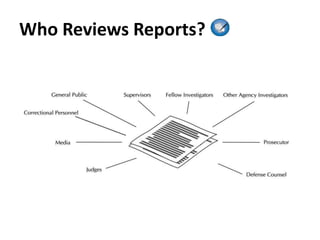
Who Reviews Reports?
Reports are Public Documents
• Most agencies must release law enforcement
reports as public documents
– To media
– To a private requester
• Mandated by law
Questions Police Reports Should Answer
• Who
– Committed the crime
– Was the victim
– Are the witnesses
– Reported the incident
• What
– Happened
– Was stolen
– Evidence exists
• When
– Did the crime occur
– Was the crime reported
• Where
– Did the crime occur
– Is the evidence
• How
– Did the crime occur
– Was the crime discovered
– Were the police notified
• Why
– Did the suspect commit the
crime
General Report Writing Guidelines
• It must contain precise data
• The typical report is totally objective
• Opinions and conclusions not based on fact do
not belong in a report
• Information in the report should be based on
fact
• The majority of facts in a report will have been
experienced by the officer directly
Specific Report Writing Rules
• It should be well organized
• Events should be in chronological order
• Reports should be accurate and brief
• Reports must be complete
• No slang or police jargon should be used
• Quotations should be accurate and reflect
exactly what was said ̶ including vulgarities,
slang, profanity, etc.
Five Essential Elements to a Police Report
• Completeness
• Conciseness
• Clearness
• Correctness
• Courteousness or fairness
Types of Investigative Reports
• Preliminary reports
• Progress reports
• Prosecution reports
Preliminary Reports:
What the Officer MUST Document
• The offense
• Current date and time
• Date and time of the offense, if known
• Identification data pertaining to the victim or
other reporting party
• Location of the offense
• Method of operation
• Identification data pertaining to the suspect
• Identification of the officer
Progress Reports:
What the Officer MUST Document
• Document the progress of the investigation
• Are normally due at specified intervals or
whenever investigative activity dictates
• Designed to ensure constant follow-up to the
initial crime occurrence
• Are common to all detective bureaus
Closing and Prosecution Reports:
What the Officer MUST Document
• May be on a separate “Closing Case” form
• Should be used with greater frequency
– Filters out essential information
– Identity of victims and witness are included
– Evidence information is included
• Lab test results
• How evidence was located at the scene
• Transmission of evidence
Reports are Links to Successful Prosecution
• Well-organized, accurate, and complete
reports are key
• Many successful plea negotiations resulting in
guilty pleas are due to well-written police
reports
• One of the biggest factors to a case going to
trial is a poorly written police report
Expectations from Police Officers
• The ability to write a good report can make or
break a case.
• A report that a police officer writes in his
squad car has the potential to make it to the
Supreme Court.
Expectations from Police Officers
• Observation
• An important skill in law enforcement.
• The better an officer observes things, the
better he or she can describe them
Styles of Reports
• Narrative
– Most widely used
– Information written in a logical manner or
sequence
• Chronological
– Events written in order of occurrence
– Time element is of prime importance
Essential Qualities of a Report
• Clear and complete sentences
• Proper grammar
• Detailed descriptions
Rules for Description
• Describe things without assuming.
• Use vivid language.
• Look for distinguishing marks, color, size, shape,
texture, location, type, etc.
• Paint a picture of a place with words.
• Describe people from top to bottom and include
characteristics such as manner of speaking,
walking, moving, items they are carrying, etc.
• Four Corners Rule – if it's not within the four
corners of the paper then it did not happen
Rules for Description
• Describe things without assuming.
• Use vivid language.
• Look for distinguishing marks, color, size, shape,
texture, location, type, etc.
• Paint a picture of a place with words.
• Describe people from top to bottom and include
characteristics such as manner of speaking,
walking, moving, items they are carrying, etc.
• Four Corners Rule – if it's not within the four
corners of the paper then it did not happen

Cri 018 no 1

  • 1.
    CRI 018 Technical PoliceReport Writing 2 Jovy D. Elimanao – Mihm, MAEd (English)
  • 2.
  • 3.
  • 4.
  • 5.
  • 6.
  • 7.
  • 8.
  • 9.
  • 10.
  • 11.
  • 12.
    The Police Report Atthe end of the lesson, students should be able to • Understand the purposes of the police report • List the elements of a well written report • Understand the various types of investigative reports and the circumstances in which they are used
  • 13.
    The Police Report ThePolice Report A police report is the physical record of an incident deemed to be illegal or potentially illegal. It is taken by a representative of a police department and filed according to said department's procedure.
  • 14.
    The Police Report ThePolice Report • Police reports are the natural culmination of field notes • Reports are a permanent record and are intended to preserve information • 15 to 20% of an officer’s duty time is expended on report writing
  • 15.
    Importance of PoliceReports • They provide a source of information while police carry out an investigation 1. Allows passing of the case from one officer to another 2. Provides a factual record of the work done on a case, eliminating duplication 3. Is a requisite for the proper preparation and presentation of a case to the district attorney and to the court • Helps a department stay organized 1. The memory system of a department 2. Serves as a written, permanent record of all department business
  • 16.
    Importance of PoliceReports • A report is an administrative necessity; most official forms of communication are completed using reports. • Other purposes • The basis for maintenance of identification and criminal records in the area • Aid in the recovery of lost or stolen property • Contain information used to apprehend criminals
  • 17.
    Importance of PoliceReports • Used in civil suits • Provide factual data to combat ill-advised or unreasonable demands on police • Furnish information to the news media
  • 18.
    When are incidentsdocumented by the police? • Reports are written – Whenever an arrest is made – For all serious incidents like • Bomb threats • Homicides • Robberies • Officer discretion is involved in the report decision for minor incidents, when no arrest is made, or when a crime has not been committed – Minor disturbances – Noise complaints – Minor thefts
  • 19.
  • 20.
    Reports are PublicDocuments • Most agencies must release law enforcement reports as public documents – To media – To a private requester • Mandated by law
  • 21.
    Questions Police ReportsShould Answer • Who – Committed the crime – Was the victim – Are the witnesses – Reported the incident • What – Happened – Was stolen – Evidence exists • When – Did the crime occur – Was the crime reported • Where – Did the crime occur – Is the evidence • How – Did the crime occur – Was the crime discovered – Were the police notified • Why – Did the suspect commit the crime
  • 22.
    General Report WritingGuidelines • It must contain precise data • The typical report is totally objective • Opinions and conclusions not based on fact do not belong in a report • Information in the report should be based on fact • The majority of facts in a report will have been experienced by the officer directly
  • 23.
    Specific Report WritingRules • It should be well organized • Events should be in chronological order • Reports should be accurate and brief • Reports must be complete • No slang or police jargon should be used • Quotations should be accurate and reflect exactly what was said ̶ including vulgarities, slang, profanity, etc.
  • 24.
    Five Essential Elementsto a Police Report • Completeness • Conciseness • Clearness • Correctness • Courteousness or fairness
  • 25.
    Types of InvestigativeReports • Preliminary reports • Progress reports • Prosecution reports
  • 26.
    Preliminary Reports: What theOfficer MUST Document • The offense • Current date and time • Date and time of the offense, if known • Identification data pertaining to the victim or other reporting party • Location of the offense • Method of operation • Identification data pertaining to the suspect • Identification of the officer
  • 27.
    Progress Reports: What theOfficer MUST Document • Document the progress of the investigation • Are normally due at specified intervals or whenever investigative activity dictates • Designed to ensure constant follow-up to the initial crime occurrence • Are common to all detective bureaus
  • 28.
    Closing and ProsecutionReports: What the Officer MUST Document • May be on a separate “Closing Case” form • Should be used with greater frequency – Filters out essential information – Identity of victims and witness are included – Evidence information is included • Lab test results • How evidence was located at the scene • Transmission of evidence
  • 29.
    Reports are Linksto Successful Prosecution • Well-organized, accurate, and complete reports are key • Many successful plea negotiations resulting in guilty pleas are due to well-written police reports • One of the biggest factors to a case going to trial is a poorly written police report
  • 30.
    Expectations from PoliceOfficers • The ability to write a good report can make or break a case. • A report that a police officer writes in his squad car has the potential to make it to the Supreme Court.
  • 31.
    Expectations from PoliceOfficers • Observation • An important skill in law enforcement. • The better an officer observes things, the better he or she can describe them
  • 32.
    Styles of Reports •Narrative – Most widely used – Information written in a logical manner or sequence • Chronological – Events written in order of occurrence – Time element is of prime importance
  • 33.
    Essential Qualities ofa Report • Clear and complete sentences • Proper grammar • Detailed descriptions
  • 34.
    Rules for Description •Describe things without assuming. • Use vivid language. • Look for distinguishing marks, color, size, shape, texture, location, type, etc. • Paint a picture of a place with words. • Describe people from top to bottom and include characteristics such as manner of speaking, walking, moving, items they are carrying, etc. • Four Corners Rule – if it's not within the four corners of the paper then it did not happen
  • 35.
    Rules for Description •Describe things without assuming. • Use vivid language. • Look for distinguishing marks, color, size, shape, texture, location, type, etc. • Paint a picture of a place with words. • Describe people from top to bottom and include characteristics such as manner of speaking, walking, moving, items they are carrying, etc. • Four Corners Rule – if it's not within the four corners of the paper then it did not happen