



Understanding
Apostrophes
by Jean Reynolds, Ph.D.
English grammar and
usage rules can be
confusing.
One of the most
confusing topics is the
use of apostrophes.
Does the
apostrophe go
before the “s” or
after the “s”?
And when should
you omit
apostrophes
altogether?
Today we’re going
to clear up that
confusion.
Let’s get started.
Here’s how to do
apostrophes correctly
every time:
Look for the correct
spelling of the word or
name.
Louis
Louis’ shift
women
women’s concerns
boss
boss’ desk
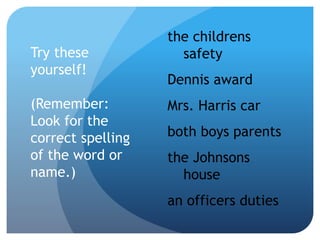
Try these
yourself!
(Remember:
Look for the
correct spelling
of the word or
name.)
the childrens
safety
Dennis award
Mrs. Harris car
both boys parents
the Johnsons
house
an officers duties
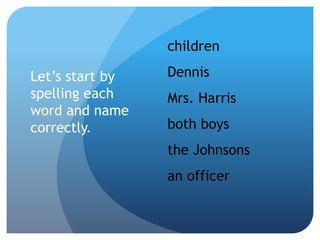
Let’s start by
spelling each
word and name
correctly.
children
Dennis
Mrs. Harris
both boys
the Johnsons
an officer
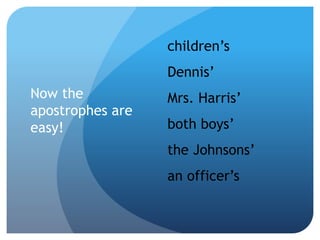
Now the
apostrophes are
easy!
children’s
Dennis’
Mrs. Harris’
both boys’
the Johnsons’
an officer’s
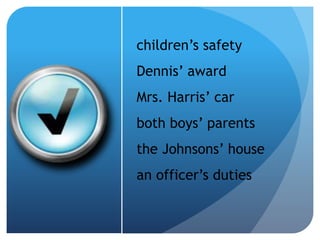
children’s safety
Dennis’ award
Mrs. Harris’ car
both boys’ parents
the Johnsons’ house
an officer’s duties
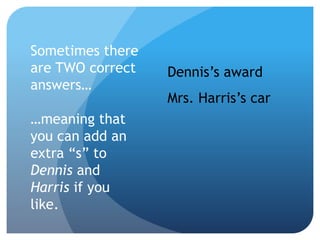
Sometimes there
are TWO correct
answers…
…meaning that
you can add an
extra “s” to
Dennis and
Harris if you
like.
Dennis’s award
Mrs. Harris’s car
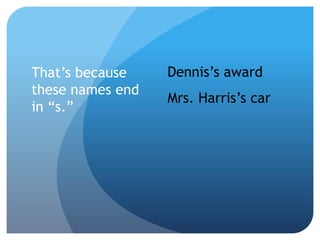
That’s because
these names end
in “s.”
Dennis’s award
Mrs. Harris’s car
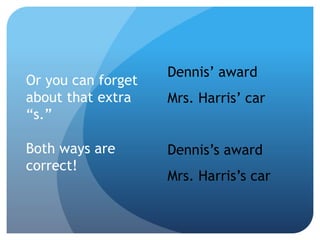
Or you can forget
about that extra
“s.”
Both ways are
correct!
Dennis’ award
Mrs. Harris’ car
Dennis’s award
Mrs. Harris’s car
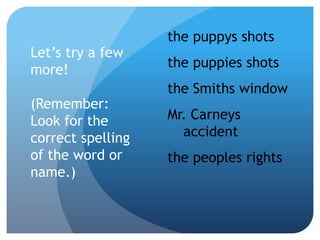
Let’s try a few
more!
(Remember:
Look for the
correct spelling
of the word or
name.)
the puppys shots
the puppies shots
the Smiths window
Mr. Carneys
accident
the peoples rights
First we’ll spell
each one
correctly.
puppy
puppies
the Smiths
Mr. Carney
the people
Now it’s easy!
(Remember:
Look for the
correct spelling
of the word or
name.)
the puppy’s shots
the puppies’ shots
the Smiths’
window
Mr. Carney’s
accident
the people’s rights
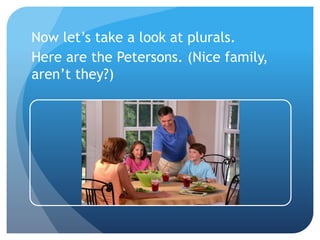
Now let’s take a look at plurals.
Here are the Petersons. (Nice family,
aren’t they?)
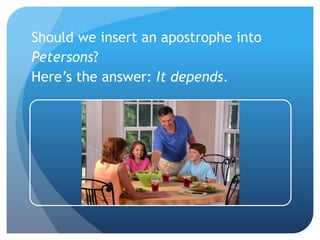
Should we insert an apostrophe into
Petersons?
Here’s the answer: It depends.
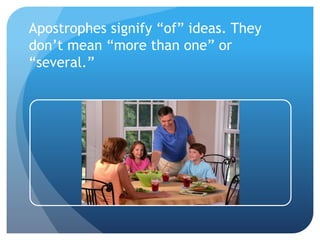
Apostrophes signify “of” ideas. They
don’t mean “more than one” or
“several.”
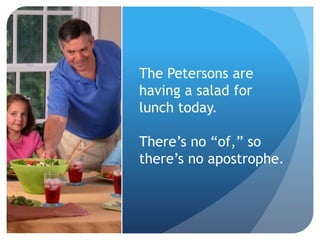
The Petersons are
having a salad for
lunch today.
There’s no “of,” so
there’s no apostrophe.
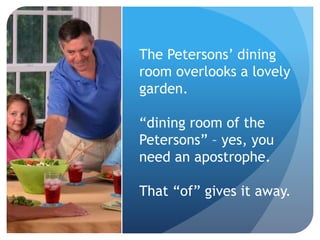
The Petersons’ dining
room overlooks a lovely
garden.
“dining room of the
Petersons” – yes, you
need an apostrophe.
That “of” gives it away.
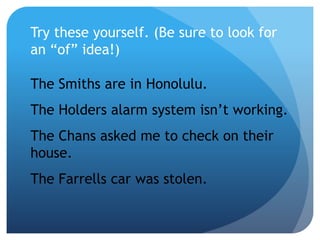
Try these yourself. (Be sure to look for
an “of” idea!)
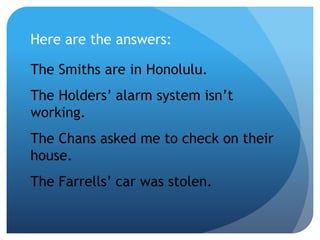
The Smiths are in Honolulu.
The Holders alarm system isn’t working.
The Chans asked me to check on their
house.
The Farrells car was stolen.
The Smiths are in Honolulu.
The Holders’ alarm system isn’t
working.
The Chans asked me to check on their
house.
The Farrells’ car was stolen.
Here are the answers:
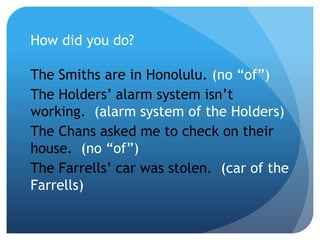
How did you do?
The Smiths are in Honolulu. (no “of”)
The Holders’ alarm system isn’t
working. (alarm system of the Holders)
The Chans asked me to check on their
house. (no “of”)
The Farrells’ car was stolen. (car of the
Farrells)
Now let’s look at one more issue
related to apostrophes: Possessive
pronouns.
Sound difficult? It’s
not.
Here’s a useful trick:
Think about the word
his.
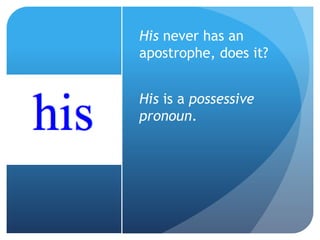
His never has an
apostrophe, does it?
His is a possessive
pronoun.
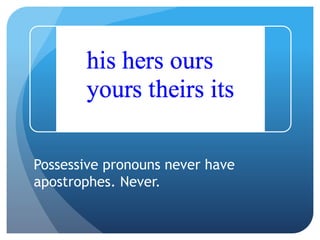
Possessive pronouns never have
apostrophes. Never.
That desk is hers.
While your car is
in the shop, you
can use ours.
Our department
increased its
budget again this
year.
For example:
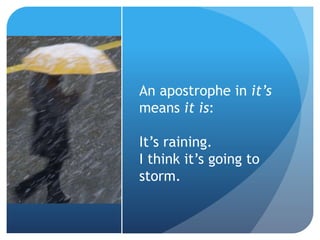
An apostrophe in it’s
means it is:
It’s raining.
I think it’s going to
storm.
You can learn more about apostrophes
at www.YourPoliceWrite.com.
Everything there is free, and no
registration is needed:
www.YourPoliceWrite.com.
And if you’re
looking for a
low-cost,
practical book
that covers
sentence
patterns,
English usage,
and police
reports…
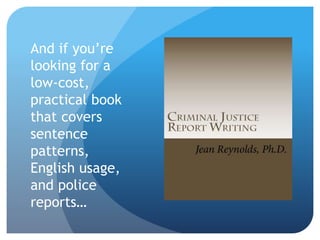
Criminal Justice
Report Writing is
available from
www.Amazon.com for
just $19.95.
View a free sample
online.
A discount price is
available for class sets
(minimum five books).
Send your request to
jreynoldswrite @
aol.com.
An e-book edition is
available from
www.Smashwords.com
for only $9.99.
A free Instructor’s
Manual is available to
instructors and
administrators.
Send an e-mail from
your official account
to jreynoldswrite at
aol.com.

Understanding Apostrophes