















Dealing with Diversity in 
Law Enforcement 
by Jean Reynolds, Ph.D.
Dealing with Diversity in 
Law Enforcement 
by Jean Reynolds, Ph.D.
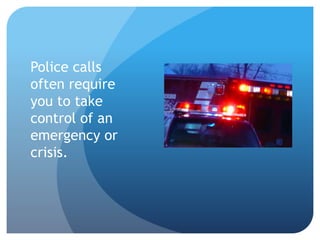
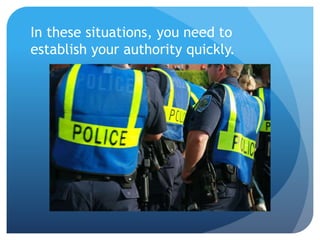
Police calls 
often require 
you to take 
control of an 
emergency or 
crisis.
In these situations, you need to 
establish your authority quickly.
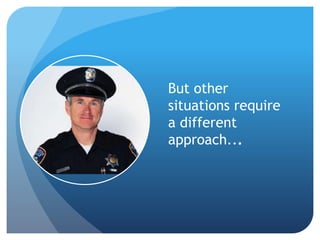
But other 
situations require 
a different 
approach...
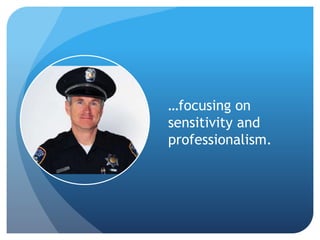
…focusing on 
sensitivity and 
professionalism.
For example, you might be interviewing 
a victim who’s afraid to talk to you…
…a hospital patient…
…a child…
…a person with 
limited English…
…or someone with another challenge.
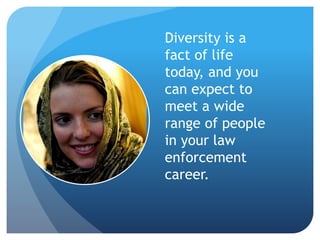
Diversity is a 
fact of life 
today, and you 
can expect to 
meet a wide 
range of people 
in your law 
enforcement 
career.
Here are some tips that can help you 
become an effective communicator: 
1. Make eye contact. 
2. Use your normal voice. 
3. Know how to deal with people in special 
situations, such as persons who are deaf or blind, 
have a physical disability, or aren’t fluent in 
English. 
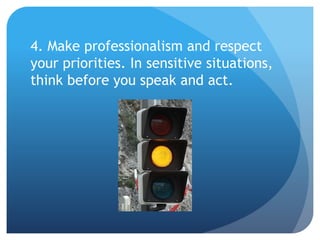
4. Make professionalism and respect your priorities.
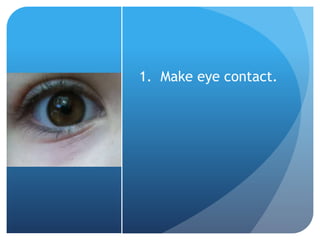
1. Make eye contact.
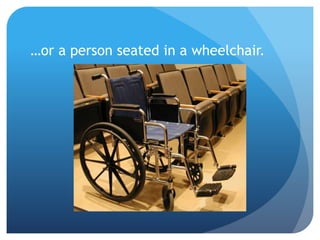
Sit down or bend your knees when 
talking to someone in a hospital bed…
…a child...
…or a person seated in a wheelchair.
-Talk directly to 
the person 
you’re 
interviewing, not 
a family member 
or caregiver.
-Don’t say, “Did 
your mother 
hear anything 
suspicious?” 
-Say, “Did you 
hear anything 
suspicious?”
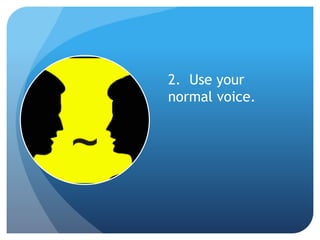
2. Use your 
normal voice.
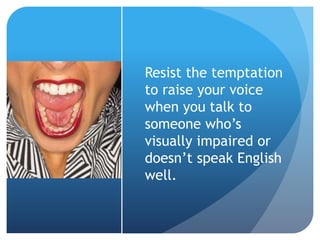
Shouting doesn’t help!
Resist the temptation 
to raise your voice 
when you talk to 
someone who’s 
visually impaired or 
doesn’t speak English 
well.
If you’re having 
communication 
problems, look 
for a solution.
Strategies to try: 
-Ask for an 
interpreter. 
-Switch to 
writing. 
-Slow down!
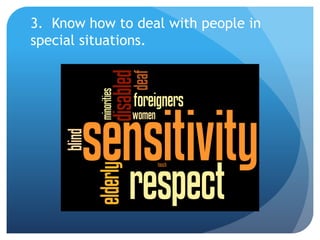
3. Know how to deal with people in 
special situations.
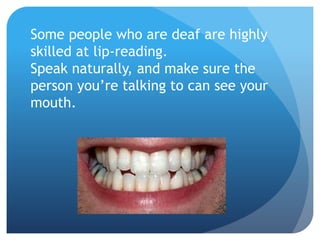
Some people who are deaf are highly 
skilled at lip-reading. 
Speak naturally, and make sure the 
person you’re talking to can see your 
mouth.
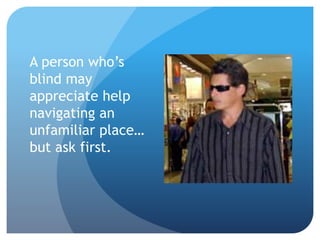
A person who’s 
blind may 
appreciate help 
navigating an 
unfamiliar place… 
but ask first.
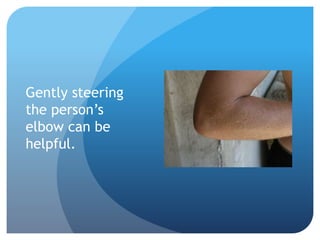
Gently steering 
the person’s 
elbow can be 
helpful.
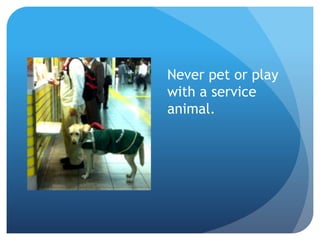
Never pet or play 
with a service 
animal.
4. Make professionalism and respect 
your priorities. In sensitive situations, 
think before you speak and act.
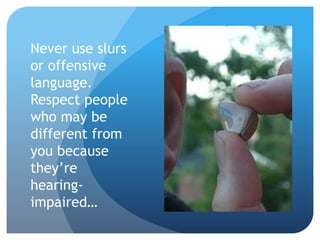
Never use slurs 
or offensive 
language. 
Respect people 
who may be 
different from 
you because 
they’re 
hearing-impaired…
…visually-impaired…
…sitting in a wheelchair…
…gay, bisexual, or transgender…
…or diagnosed with a condition such as 
AIDS…
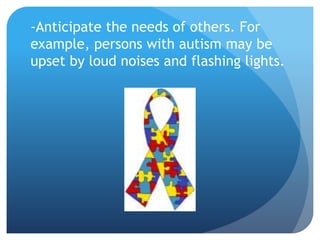
…or autism.
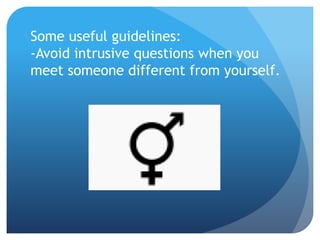
Some useful guidelines: 
-Avoid intrusive questions when you 
meet someone different from yourself.
-Anticipate the needs of others. For 
example, persons with autism may be 
upset by loud noises and flashing lights.
-Respect the intelligence of everyone 
you talk to, regardless of age, ethnicity, 
physical challenges, or lifestyle.
-Don’t fool yourself into thinking that 
“different” means “inferior.”
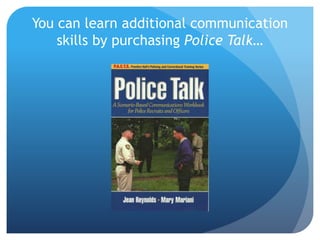
You can learn additional communication 
skills by purchasing Police Talk…
…available for purchase at 
www.Amazon.com.
And be sure to visit 
www.YourPoliceWrite.com for help with 
report writing.
All the resources there are FREE: 
www.YourPoliceWrite.com.

Dealing with Diversity in Law Enforcement