Writing
Writing the Storyline
Who’s story is it? What’s the
problem? What does she want to
do? Is she aware of what she
wants? What will she do? How
does she react to problems?
What’s really her problem? What
are the changes? What’s the
story really about?
The Sentence Outline
- The sentence outline is a
numbered list of scenes in a
story.

- Where narrative threads are
found and realized.
The Writing Structure

Meaning greatly relies on
structure.
Sequence Treatment

Sequence treatment is the
detailed summary of the events
that happen in every scene.
Three-act and Alternative
structure
Three-act structure
- The film is divided into 3 acts; each act has an
element that needs to be present and problems
should be resolved at the end of the film.
Flat structure
- similar to real life; there are no acts; events
can come at random

Episodic
- character driven rather than plot; the story is
held together by a place or an event
Plot points
- the use of units instead of acts; each plot
point indicates a problem that’s being faced or
that will have to be faced by the main character.
The Scene
Scenes not Shots
- Scene is for the writer; shot is
for the director
A scene has emotional content and
point; it contains the characters
and characterization, action and
activity, goal and conflict,
milieu, genre, approach to
reality, dialogue, sound,
lighting, and etc.
Basic content of a scene:
• Physical event
• Point

3 Classes of a Scene based on its
function:
• Establishing scene – introduces a
character or establishes the
story
• Anticipation scene – happens in
order to wait for the next scene
• Confrontation scene – the scene
where the opposing forces meet
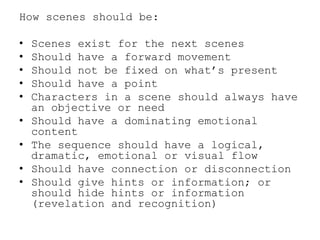
How scenes should be:
•
•
•
•
•
•
•
•
•

Scenes exist for the next scenes
Should have a forward movement
Should not be fixed on what’s present
Should have a point
Characters in a scene should always have
an objective or need
Should have a dominating emotional
content
The sequence should have a logical,
dramatic, emotional or visual flow
Should have connection or disconnection
Should give hints or information; or
should hide hints or information
(revelation and recognition)
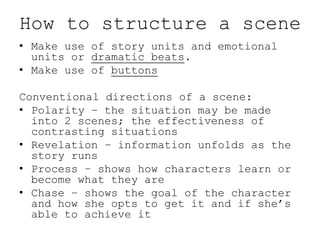
How to structure a scene
• Make use of story units and emotional
units or dramatic beats.
• Make use of buttons
Conventional directions of a scene:
• Polarity – the situation may be made
into 2 scenes; the effectiveness of
contrasting situations
• Revelation – information unfolds as the
story runs
• Process – shows how characters learn or
become what they are
• Chase – shows the goal of the character
and how she opts to get it and if she’s
able to achieve it

Writing for film

  • 1.
  • 2.
    Writing the Storyline Who’sstory is it? What’s the problem? What does she want to do? Is she aware of what she wants? What will she do? How does she react to problems? What’s really her problem? What are the changes? What’s the story really about?
  • 3.
    The Sentence Outline -The sentence outline is a numbered list of scenes in a story. - Where narrative threads are found and realized.
  • 4.
    The Writing Structure Meaninggreatly relies on structure.
  • 5.
    Sequence Treatment Sequence treatmentis the detailed summary of the events that happen in every scene.
  • 6.
    Three-act and Alternative structure Three-actstructure - The film is divided into 3 acts; each act has an element that needs to be present and problems should be resolved at the end of the film. Flat structure - similar to real life; there are no acts; events can come at random Episodic - character driven rather than plot; the story is held together by a place or an event Plot points - the use of units instead of acts; each plot point indicates a problem that’s being faced or that will have to be faced by the main character.
  • 7.
    The Scene Scenes notShots - Scene is for the writer; shot is for the director A scene has emotional content and point; it contains the characters and characterization, action and activity, goal and conflict, milieu, genre, approach to reality, dialogue, sound, lighting, and etc.
  • 8.
    Basic content ofa scene: • Physical event • Point 3 Classes of a Scene based on its function: • Establishing scene – introduces a character or establishes the story • Anticipation scene – happens in order to wait for the next scene • Confrontation scene – the scene where the opposing forces meet
  • 9.
    How scenes shouldbe: • • • • • • • • • Scenes exist for the next scenes Should have a forward movement Should not be fixed on what’s present Should have a point Characters in a scene should always have an objective or need Should have a dominating emotional content The sequence should have a logical, dramatic, emotional or visual flow Should have connection or disconnection Should give hints or information; or should hide hints or information (revelation and recognition)
  • 10.
    How to structurea scene • Make use of story units and emotional units or dramatic beats. • Make use of buttons Conventional directions of a scene: • Polarity – the situation may be made into 2 scenes; the effectiveness of contrasting situations • Revelation – information unfolds as the story runs • Process – shows how characters learn or become what they are • Chase – shows the goal of the character and how she opts to get it and if she’s able to achieve it