BY: CHELDY SYGACO ELUMBA-PABLEO, MPA;LLB
1. Mise en Scene
2. Cinematography
3. Editing
4. Sound
5. Narrative and Characterization
6. Representation
7. Documentary
8. Animation
9. Quebec Cinema
Film excerpt: Citizen Kane (1941), dir. Orson Welles
Article: “Mise en scene”
Introducing Film by Graham Roberts & Heather Wallis
(2001)
Elements include:
1. Setting
2. Costume & Make-Up
3. Figure, Expression & Movement
4. Lighting
Film: Run Lola Run, dir. Tom Tykwer
Article: “Cinematography”
Film: A Critical Introduction, by Maria Pramaggiore &
Tom Wallis (2006)
1. Camera Height
2. Camera Angle
3. Camera Distance
4. Camera Movement
Each can convey: information, motifs, introduce ideas, create mood
CANTED OR DUTCH ANGLE
vs. vs.
Film: Run Lola Run, dir. Tom Tykwer
Article: “Editing”
Film: A Critical Introduction, by Maria Pramaggiore & Tom Wallis (2006)
1. The Kuleshov Effect
2. Interaction between characters
3. Graphic similarities between shots
4. Adjusting the tempo
5. Shot transitions
Film excerpts:
Raging Bull vs Fight Club
Rear Window
Psycho
Requiem for a Dream
Article: “Sound”
Film: A Critical Introduction, by Maria Pramaggiore & Tom Wallis
(2006)
Terms:
1. Foley artist: creates sound effects
2. Soundtrack: ALL the sound within the film (dialogue, effects, music)
3. Direct sound: sound recorded on location / while the film is being
shot
4. Sound Effects: any noise other than dialogue and music
5. On-screen vs. Off-screen sound
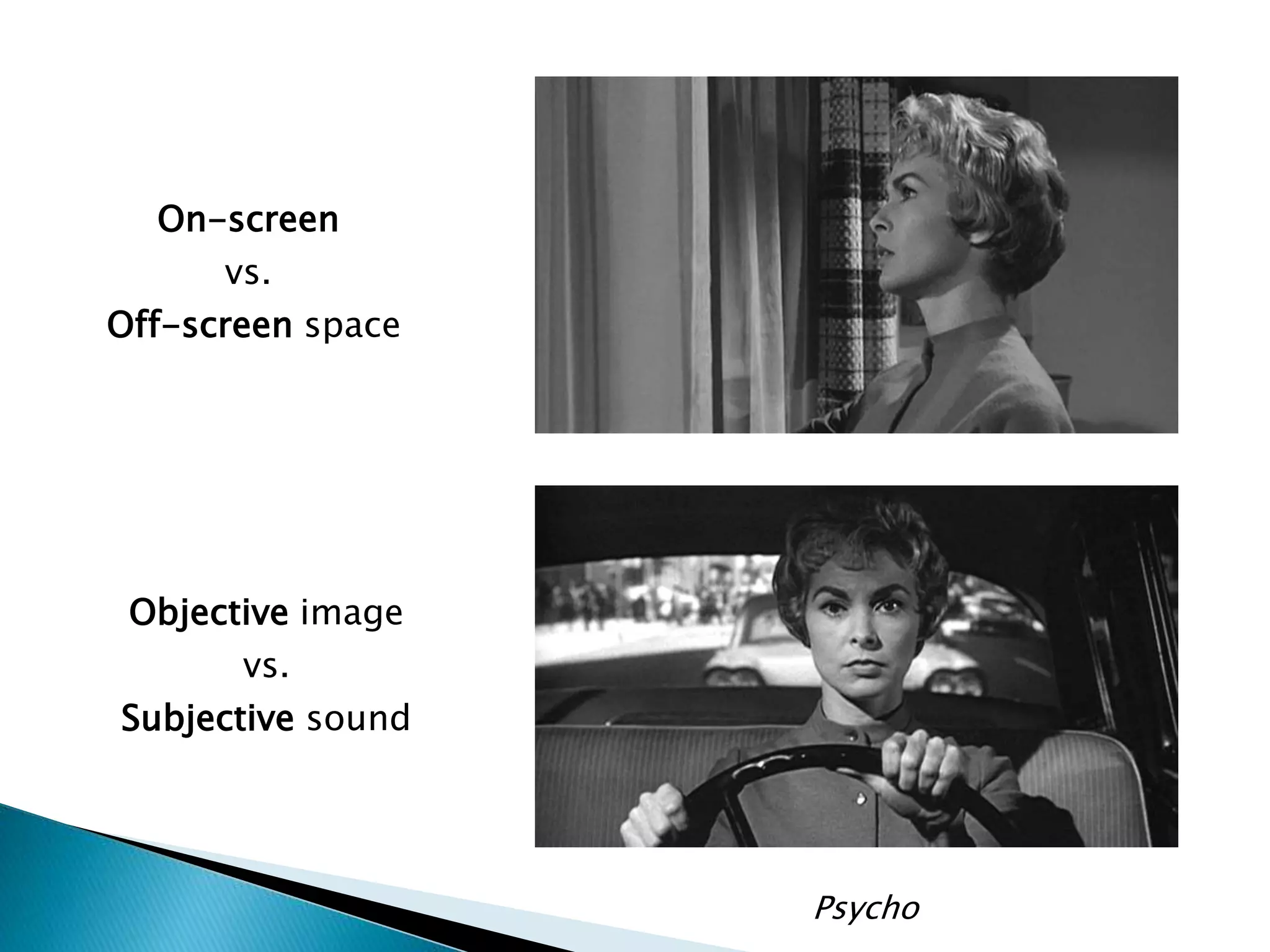
6. Objective image vs. Subjective sound
7. Diegetic: what the characters CAN hear
8. Non-Diegetic sound: what the characters can NOT hear
9. Image Time vs. Sound Time
10.Image Mood vs. Sound Mood
On-screen
vs.
Off-screen space
Objective image
vs.
Subjective sound
Psycho
Diegetic vs. Non-Diegetic sound
Image Time vs. Sound Time
Requiem For a Dream
Like a sound “dissolve” where sound from one scene “bleeds into the next
scene.
Image Mood vs. Sound Mood
Pulp Fiction
Film: Do the Right Thing (1989), dir. Spike Lee
Articles: “Detail” & “Narrative Form”
Film: A Critical Introduction, by Maria Pramaggiore & Tom Wallis (2006)
What is a narrative?
How do details in a film shape the narrative?
1. Motifs
2. Parallels
3. Turning Points
4. Repetition
MOTIFS
•Details that repeat in a film
•Can provide info about the character or reinforce a
significant idea
Do the
Right Thing
PARALLELS
•When two characters, events, or location can be
compared in a film
TURNING POINT
• Typically a pivotal moment in the film/narrative
that changes the course of things to come
WHAT IS THE NARRATIVE OF “DO THE RIGHT
THING”?
RED
How often, when, where did you see the colour RED in the film?
What did the colour symbolize to you?
MUSIC
Where and when did you notice music being played and/or not being played
within the film?
Did you notice/catch what was playing on Radio Raheem’s boom-box
repeatedly?
LOOKING INTO CAMERA
What were the characters saying when they were speaking into the camera?
How did you feel as the viewer?
TURNING POINT
Was there a turning point in the film?
If so, when did it appear?
Film: Do the Right Thing (1989), dir. Spike Lee
Articles: “Film and Ideology”
Film: A Critical Introduction, by Maria Pramaggiore & Tom Wallis (2006)
How is the director representing the issues
in their narrative?
What is the ideology being transmitted to
the audience?
1. What is an ideology?
2. How would you describe the
ideology/ideologies in the film Do The Right
Thing?
3. How do you feel this film depicted class &
cultural differences?
4. Describe the gender differences in the film.
How were the men and women depicted?
5. What were the characteristics that the various
cultural groups depicted have in common
with each other?
DOCUMENTARY
Prior to 1907: films were non-fiction/documentary
2. L'arrivée d'un Train en Gare de La Ciotat /The
Arrival of a Train at La Ciotat Station (1896, RT
30sec)
http://www.youtube.com/watch?v=1dgLEDdFddk
Directed & produced by August and Louis
Lumière/ “The Lumière Brothers” :
1. La Sortie des Usines Lumière à Lyon/ Workers
Leaving the Factory
(1896, RT 46sec)
http://www.youtube.com/watch?v=BO0EkMKfgJI
Who coined the term?
The first Commissioner of the National Film Board of Canada!
DOCUMENTARY FORM/STRUCTURE
1. Voice-over narration
Point-of-View
Balanced or Propaganda?
2. Talking Head doc’s
Interview heavy
3. Director-Participant
Filmmaker in the film
4. Direct Cinema/Cinema Verite/Cinema of Truth
“Observational Documentary”
Minimal intrusion from the filmmaker
5. Self-Reflexive Documentary
Showing the filmmaking team & process
ANIMATION
3 Forms
1. Hand-drawn or Celluloid
2. Stop motion
3. Computer (2D & 3D)
 Rapid display of images in a sequence
 To create the illusion of movement
Frankenweenie (2009)
dir. Tim Burton
• Definition of ‘THEME’: the central idea of the story
• How is the mood of Frankenweenie conveyed? What
production elements allow the mood to be conveyed?
Discuss: Mise-en-scene, sound & cinematography.
• Identify the theme(s) of Frankenweenie
Discuss how these themes are established in the opening
sequences.
QUEBEC CINEMA
•In late the 1930’s QC cinema consisted mostly of work by
amateur filmmakers who were mostly priests.
•The QC mandate for cinema at that time was to produce
mostly propaganda and educational films.
•Many films made for a QC audience were produced in
English and dubbed in French.
•Eventually, a French filmmaking team emerged at the NFB in
the mid 1940’s, post WWII, and a surge of films were being
made about QC identity through the mid 1950’s.
•Highlights of QC cinema emerged in the 1970’s-80s when
cinema verite/direct cinema was being largely used.
Form
 Mise-en-scene (acting, lighting, costumes & make-up,
setting)
 Cinematography (camera height, angle, distance,
movement)
 Editing
 Sound
Content:
 The narrative, the plot… what the film is about
Form + Content = Film
C.R.A.Z.Y (2005)
dir. Jean-Marc Vallée
1. What is the narrative of this film?
2. What motifs did you identify?
3. How was religion used in the film? Or, describe how the
narrative incorporated religion.
4. Describe the relationship between Zac and his:
•Father
•Mother
•Brothers
•Religion
•Form
•Narrative
•Plot
•Theme
•Ideology

Film making

  • 1.
    BY: CHELDY SYGACOELUMBA-PABLEO, MPA;LLB
  • 2.
    1. Mise enScene 2. Cinematography 3. Editing 4. Sound 5. Narrative and Characterization 6. Representation 7. Documentary 8. Animation 9. Quebec Cinema
  • 3.
    Film excerpt: CitizenKane (1941), dir. Orson Welles Article: “Mise en scene” Introducing Film by Graham Roberts & Heather Wallis (2001) Elements include: 1. Setting 2. Costume & Make-Up 3. Figure, Expression & Movement 4. Lighting
  • 6.
    Film: Run LolaRun, dir. Tom Tykwer Article: “Cinematography” Film: A Critical Introduction, by Maria Pramaggiore & Tom Wallis (2006) 1. Camera Height 2. Camera Angle 3. Camera Distance 4. Camera Movement Each can convey: information, motifs, introduce ideas, create mood
  • 8.
    CANTED OR DUTCHANGLE vs. vs.
  • 9.
    Film: Run LolaRun, dir. Tom Tykwer Article: “Editing” Film: A Critical Introduction, by Maria Pramaggiore & Tom Wallis (2006) 1. The Kuleshov Effect 2. Interaction between characters 3. Graphic similarities between shots 4. Adjusting the tempo 5. Shot transitions
  • 10.
    Film excerpts: Raging Bullvs Fight Club Rear Window Psycho Requiem for a Dream Article: “Sound” Film: A Critical Introduction, by Maria Pramaggiore & Tom Wallis (2006)
  • 11.
    Terms: 1. Foley artist:creates sound effects 2. Soundtrack: ALL the sound within the film (dialogue, effects, music) 3. Direct sound: sound recorded on location / while the film is being shot 4. Sound Effects: any noise other than dialogue and music 5. On-screen vs. Off-screen sound 6. Objective image vs. Subjective sound 7. Diegetic: what the characters CAN hear 8. Non-Diegetic sound: what the characters can NOT hear 9. Image Time vs. Sound Time 10.Image Mood vs. Sound Mood
  • 12.
  • 13.
    Diegetic vs. Non-Diegeticsound Image Time vs. Sound Time Requiem For a Dream Like a sound “dissolve” where sound from one scene “bleeds into the next scene.
  • 14.
    Image Mood vs.Sound Mood Pulp Fiction
  • 15.
    Film: Do theRight Thing (1989), dir. Spike Lee Articles: “Detail” & “Narrative Form” Film: A Critical Introduction, by Maria Pramaggiore & Tom Wallis (2006) What is a narrative? How do details in a film shape the narrative? 1. Motifs 2. Parallels 3. Turning Points 4. Repetition
  • 16.
    MOTIFS •Details that repeatin a film •Can provide info about the character or reinforce a significant idea Do the Right Thing
  • 17.
    PARALLELS •When two characters,events, or location can be compared in a film TURNING POINT • Typically a pivotal moment in the film/narrative that changes the course of things to come
  • 18.
    WHAT IS THENARRATIVE OF “DO THE RIGHT THING”? RED How often, when, where did you see the colour RED in the film? What did the colour symbolize to you? MUSIC Where and when did you notice music being played and/or not being played within the film? Did you notice/catch what was playing on Radio Raheem’s boom-box repeatedly? LOOKING INTO CAMERA What were the characters saying when they were speaking into the camera? How did you feel as the viewer? TURNING POINT Was there a turning point in the film? If so, when did it appear?
  • 19.
    Film: Do theRight Thing (1989), dir. Spike Lee Articles: “Film and Ideology” Film: A Critical Introduction, by Maria Pramaggiore & Tom Wallis (2006) How is the director representing the issues in their narrative? What is the ideology being transmitted to the audience?
  • 20.
    1. What isan ideology? 2. How would you describe the ideology/ideologies in the film Do The Right Thing? 3. How do you feel this film depicted class & cultural differences? 4. Describe the gender differences in the film. How were the men and women depicted? 5. What were the characteristics that the various cultural groups depicted have in common with each other?
  • 21.
    DOCUMENTARY Prior to 1907:films were non-fiction/documentary 2. L'arrivée d'un Train en Gare de La Ciotat /The Arrival of a Train at La Ciotat Station (1896, RT 30sec) http://www.youtube.com/watch?v=1dgLEDdFddk Directed & produced by August and Louis Lumière/ “The Lumière Brothers” : 1. La Sortie des Usines Lumière à Lyon/ Workers Leaving the Factory (1896, RT 46sec) http://www.youtube.com/watch?v=BO0EkMKfgJI
  • 22.
    Who coined theterm? The first Commissioner of the National Film Board of Canada!
  • 23.
    DOCUMENTARY FORM/STRUCTURE 1. Voice-overnarration Point-of-View Balanced or Propaganda? 2. Talking Head doc’s Interview heavy 3. Director-Participant Filmmaker in the film 4. Direct Cinema/Cinema Verite/Cinema of Truth “Observational Documentary” Minimal intrusion from the filmmaker 5. Self-Reflexive Documentary Showing the filmmaking team & process
  • 24.
    ANIMATION 3 Forms 1. Hand-drawnor Celluloid 2. Stop motion 3. Computer (2D & 3D)  Rapid display of images in a sequence  To create the illusion of movement
  • 25.
    Frankenweenie (2009) dir. TimBurton • Definition of ‘THEME’: the central idea of the story • How is the mood of Frankenweenie conveyed? What production elements allow the mood to be conveyed? Discuss: Mise-en-scene, sound & cinematography. • Identify the theme(s) of Frankenweenie Discuss how these themes are established in the opening sequences.
  • 26.
    QUEBEC CINEMA •In latethe 1930’s QC cinema consisted mostly of work by amateur filmmakers who were mostly priests. •The QC mandate for cinema at that time was to produce mostly propaganda and educational films. •Many films made for a QC audience were produced in English and dubbed in French. •Eventually, a French filmmaking team emerged at the NFB in the mid 1940’s, post WWII, and a surge of films were being made about QC identity through the mid 1950’s. •Highlights of QC cinema emerged in the 1970’s-80s when cinema verite/direct cinema was being largely used.
  • 27.
    Form  Mise-en-scene (acting,lighting, costumes & make-up, setting)  Cinematography (camera height, angle, distance, movement)  Editing  Sound Content:  The narrative, the plot… what the film is about Form + Content = Film
  • 28.
    C.R.A.Z.Y (2005) dir. Jean-MarcVallée 1. What is the narrative of this film? 2. What motifs did you identify? 3. How was religion used in the film? Or, describe how the narrative incorporated religion. 4. Describe the relationship between Zac and his: •Father •Mother •Brothers •Religion
  • 29.

Editor's Notes

  • #4 SETTING Sense of place and time State of mind (i.e with camera angles etc) Can appear natural, fantastic or other-wordly (i.e star wars) Can create mood, type of story, genre of film COSTUME AND MAKE-UP Indicates period & social milieu Social class, cultural background, character traits Sense of place, time, characterization Type of story and genre Passing of time (as someone ages) FIGURE, EXPRESSION & MOVEMENT The way figures/actors stand or move (key to story telling) Foreground placement of actor = more importance Moving body against stationary background draws our attention Balanced feel=if actors and object positioned evenly Position of character indicates relationship between them Facial expression LIGHTING Use of light=who or what is key in the scene Mystery, tension, suspense… based on: Intensity (hard or soft) Source (natural or artificial) Direction (path of light; where light is coming from) (Colour)
  • #7 MOVEMENTS HORIZONTAL & VERTICAL Movement   SWISH PAN / quick blurred image = passage of time, suspicion   TILT = ex someone as authority or inferior     MOVEMENT IN THREE DIMENSIONS   TRACKING Shots = on dollies ( or wheelchair, shopping kart): to trace movement   *EX: I’ve used it to create suspense   CRANE Shot = classic concluding/ ending shot   AERIAL shot = for great distance: for sense of freedom, set the stage for where you’re going where story takes place, establishing a sense of location where story takes place   HANDHELD CAM & STEADY CAM. = 50’s & 60’s created. Allowed for immediacy of capturing.  to capture intimacy, subtle movement
  • #8 Distance   = how emotionally involved the audience becomes with the character EXL = extreme long shot LS = full figure of character in frame MLS = character from the knees up MS = character from the waste up MCU = character from the chest up CU = close section of the body (ie face) XCU = body part (ie eye)
  • #10 3). Graphic Similarities between Shots   Graphic Match ex Lola: Bag + Phone- show 5). Shot transition   the cut the fade in/out dissolve wipe (shot b pushes shot a out of the way…until it disappears) iris
  • #17 Motifs Details that repeat in a film Can provide info about the character or reinforce a significant idea Red, Music, Characters Addressing the Camera
  • #21 Ideology = worldview, system of beliefs How has the film influenced you to think (about various issues… present in the film)?
  • #23 A pioneering Scottish documentary maker, often considered the father of British and Canadian documentary film. In 1926, Grierson coined the term "documentary"
  • #24 FILM WE WATCHED Man on a Wire (2008), Dir. James Marsh 5. Self-Reflexive Documentary Showing the filmmaking team & process http://www.nickbroomfield.com 4. Direct Cinema/Cinema Verite/Cinema of Truth “Observational Documentary” Minimal intrusion from the filmmaker http://www.youtube.com/watch?v=OT3NLw2IPPw
  • #29 In a bourgeois suburb, Zac is the second-youngest son in a family of five boys overseen by an overbearing father, Gervais, and a religious mother, Laurianne. The mother believes her cherished son has magical healing powers and is destined for greatness. Zac, however, is merely trying to survive his rough-and-tumble brothers as he struggles to come to terms with his homosexuality and his disapproving father, whom he loves dearly. Zac travels as far away as Jerusalem to "find" his father's love and respect, and finds solace in the music of David Bowie, Pink Floyd and the Rolling Stones.