DRAMATIC
STORYTELLING
STRUCTURE
FITV 1550
STRUCTURE
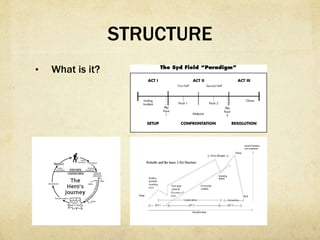
•  What is it?
STRUCTURE
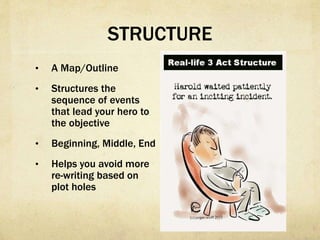
•  A Map/Outline
•  Structures the
sequence of events
that lead your hero to
the objective
•  Beginning, Middle, End
•  Helps you avoid more
re-writing based on
plot holes
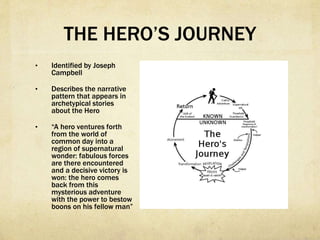
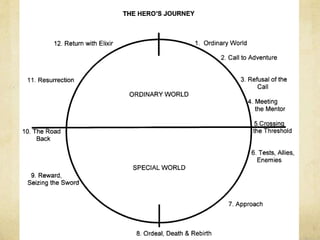
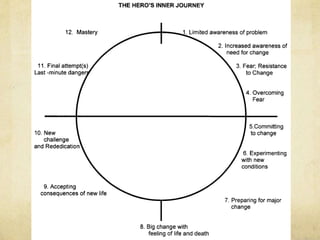
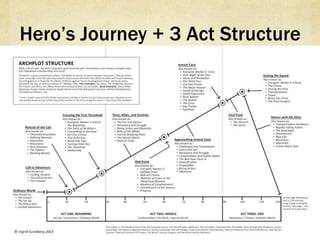
THE HERO’S JOURNEY
•  Identified by Joseph
Campbell
•  Describes the narrative
pattern that appears in
archetypical stories
about the Hero
•  “A hero ventures forth
from the world of
common day into a
region of supernatural
wonder: fabulous forces
are there encountered
and a decisive victory is
won: the hero comes
back from this
mysterious adventure
with the power to bestow
boons on his fellow man”
Hero’s Journey Examples
•  https://www.youtube.com/watch?v=KGV1BvnyvGo
•  https://www.youtube.com/watch?v=YqIJUJmnc-Y
THREE ACT STRUCTURE
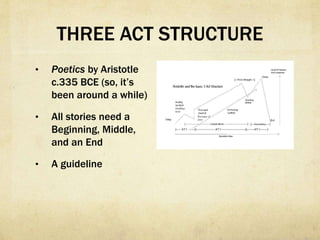
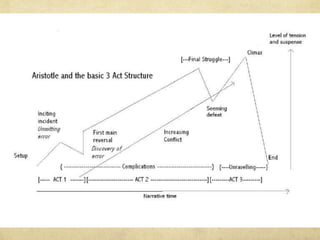
•  Poetics by Aristotle c.
335 BCE (so, it’s been
around a while)
•  All stories need a
Beginning, Middle,
and an End
•  A guideline
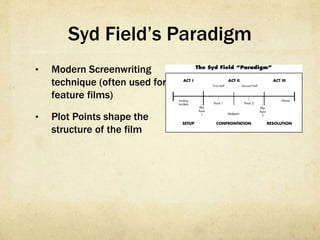
Syd Field’s Paradigm
•  Modern Screenwriting
technique (often used for
feature films)
•  Plot Points shape the
structure of the film
•  Modern Screenwriting
technique (often used for
feature films)
•  Standard
Key Moments
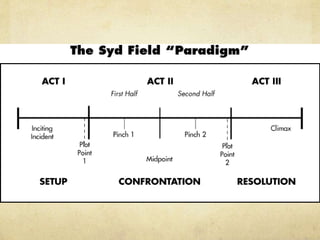
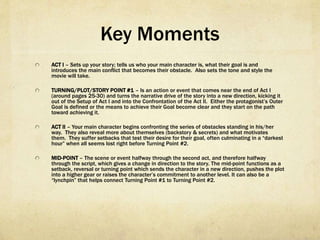
  ACT I – Sets up your story; tells us who your main character is, what their goal is and introduces
the main conflict that becomes their obstacle.  Also sets the tone and style the movie will
take.
  TURNING/PLOT/STORY POINT #1 – Is an action or event that comes near the end of Act I
(around pages 25-30) and turns the narrative drive of the story into a new direction, kicking it
out of the Setup of Act I and into the Confrontation of the Act II.  Either the protagonist’s Outer
Goal is defined or the means to achieve their Goal become clear and they start on the path
toward achieving it.
  ACT II – Your main character begins confronting the series of obstacles standing in his/her way. 
They also reveal more about themselves (backstory & secrets) and what motivates them.  They
suffer setbacks that test their desire for their goal, often culminating in a “darkest hour” when
all seems lost right before Turning Point #2.
  MID-POINT – The scene or event halfway through the second act, and therefore halfway through
the script, which gives a change in direction to the story. The mid-point functions as a setback,
reversal or turning point which sends the character in a new direction, pushes the plot into a
higher gear or raises the character’s commitment to another level. It can also be a “lynchpin”
that helps connect Turning Point #1 to Turning Point #2.
Key Moments
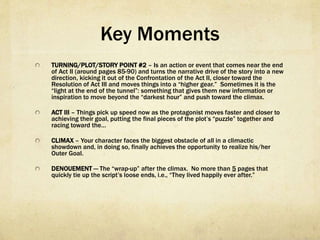
  TURNING/PLOT/STORY POINT #2 – Is an action or event that comes near the end
of Act II (around pages 85-90) and turns the narrative drive of the story into a new
direction, kicking it out of the Confrontation of the Act II, closer toward the
Resolution of Act III and moves things into a “higher gear.”  Sometimes it is the
“light at the end of the tunnel”: something that gives them new information or
inspiration to move beyond the “darkest hour” and push toward the climax.
  ACT III – Things pick up speed now as the protagonist moves faster and closer to
achieving their goal, putting the final pieces of the plot’s “puzzle” together and
racing toward the…
  CLIMAX – Your character faces the biggest obstacle of all in a climactic
showdown and, in doing so, finally achieves the opportunity to realize his/her
Outer Goal.
  DENOUEMENT — The “wrap-up” after the climax.  No more than 5 pages that
quickly tie up the script’s loose ends, i.e., “They lived happily ever after.”
Hero’s Journey + 3 Act Structure
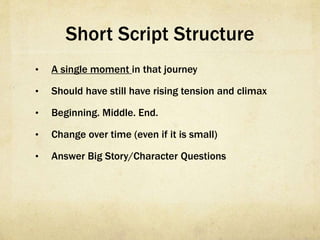
Short Script Structure
•  A single moment in that journey
•  Should have still have rising tension and climax
•  Beginning. Middle. End.
•  Change over time (even if it is small)
•  Answer Big Story/Character Questions
Linda Cowgill
  Know who you’re making your film for. If it’s for yourself, that’s who you
have to satisfy. If you’re making it as an entry into the industry, your film needs to
work dramatically as well as technically. Competition is stiff.
  The longer the story, the better the film has to be. Length comes down to
what the story dictates. But if a film is over 15 minutes it really has to be great to
keep people watching.
  Write the script you can produce. Don’t write a script with production values you
can’t effectively achieve.
  The best ideas are simple. Focus on one main conflict, develop and explore it in
surprising ways.
  Set your film up in the first 60 seconds. If you’re writing a ten minute (10 page)
movie, you can’t take the first 5 pages to introduce your characters before getting
to your conflict. Establish your conflict as soon as possible.
Linda Cowgill
  Know what your character wants (the goal) and what’s preventing him from
getting it (the obstacle), and make sure your audience understands it, too.
  Try to develop the conflict in one main incident as the set piece of your project.
Many great short films develop the conflict in one incident to great effect,
exploring character in ways feature films rarely do because they rely more heavily
on plot.
  If your film is less than 5 minutes, one type of conflict might be sufficient to
satisfy your audience. But if your film is over 5 minutes, you’re going to need to
various obstacles or complications for your hero to face.
  Just because your film is short doesn’t mean you can’t have an effective mid-point
and reversal. Anything that keeps your audience from guessing your ending is an
asset.
  Make sure your ending is the best thing about your great film. Your pay off is what
you’re leaving the audience with and it’s how they’re going to remember you.
http://filmmakeriq.com/2009/07/ten-rules-for-writing-a-successful-short-script/comment-page-1/
More Structure Resources
https://www.filmsourcing.com/writing-a-short-
film/
http://www.indiewire.com/2016/03/sxsw-2016-
what-is-the-key-to-writing-a-good-short-film-
script-58016/
http://www.writersdigest.com/online-editor/7-
ways-writing-a-screenplay-is-different-than-writing-
a-novel

Hero's Journey and Short Script Structure

  • 1.
  • 2.
  • 3.
    STRUCTURE •  A Map/Outline • Structures the sequence of events that lead your hero to the objective •  Beginning, Middle, End •  Helps you avoid more re-writing based on plot holes
  • 4.
    THE HERO’S JOURNEY • Identified by Joseph Campbell •  Describes the narrative pattern that appears in archetypical stories about the Hero •  “A hero ventures forth from the world of common day into a region of supernatural wonder: fabulous forces are there encountered and a decisive victory is won: the hero comes back from this mysterious adventure with the power to bestow boons on his fellow man”
  • 7.
    Hero’s Journey Examples • https://www.youtube.com/watch?v=KGV1BvnyvGo •  https://www.youtube.com/watch?v=YqIJUJmnc-Y
  • 8.
    THREE ACT STRUCTURE • Poetics by Aristotle c. 335 BCE (so, it’s been around a while) •  All stories need a Beginning, Middle, and an End •  A guideline
  • 10.
    Syd Field’s Paradigm • Modern Screenwriting technique (often used for feature films) •  Plot Points shape the structure of the film
  • 11.
    •  Modern Screenwriting technique(often used for feature films) •  Standard
  • 12.
    Key Moments   ACTI – Sets up your story; tells us who your main character is, what their goal is and introduces the main conflict that becomes their obstacle.  Also sets the tone and style the movie will take.   TURNING/PLOT/STORY POINT #1 – Is an action or event that comes near the end of Act I (around pages 25-30) and turns the narrative drive of the story into a new direction, kicking it out of the Setup of Act I and into the Confrontation of the Act II.  Either the protagonist’s Outer Goal is defined or the means to achieve their Goal become clear and they start on the path toward achieving it.   ACT II – Your main character begins confronting the series of obstacles standing in his/her way.  They also reveal more about themselves (backstory & secrets) and what motivates them.  They suffer setbacks that test their desire for their goal, often culminating in a “darkest hour” when all seems lost right before Turning Point #2.   MID-POINT – The scene or event halfway through the second act, and therefore halfway through the script, which gives a change in direction to the story. The mid-point functions as a setback, reversal or turning point which sends the character in a new direction, pushes the plot into a higher gear or raises the character’s commitment to another level. It can also be a “lynchpin” that helps connect Turning Point #1 to Turning Point #2.
  • 13.
    Key Moments   TURNING/PLOT/STORY POINT#2 – Is an action or event that comes near the end of Act II (around pages 85-90) and turns the narrative drive of the story into a new direction, kicking it out of the Confrontation of the Act II, closer toward the Resolution of Act III and moves things into a “higher gear.”  Sometimes it is the “light at the end of the tunnel”: something that gives them new information or inspiration to move beyond the “darkest hour” and push toward the climax.   ACT III – Things pick up speed now as the protagonist moves faster and closer to achieving their goal, putting the final pieces of the plot’s “puzzle” together and racing toward the…   CLIMAX – Your character faces the biggest obstacle of all in a climactic showdown and, in doing so, finally achieves the opportunity to realize his/her Outer Goal.   DENOUEMENT — The “wrap-up” after the climax.  No more than 5 pages that quickly tie up the script’s loose ends, i.e., “They lived happily ever after.”
  • 14.
    Hero’s Journey +3 Act Structure
  • 15.
    Short Script Structure • A single moment in that journey •  Should have still have rising tension and climax •  Beginning. Middle. End. •  Change over time (even if it is small) •  Answer Big Story/Character Questions
  • 16.
    Linda Cowgill   Knowwho you’re making your film for. If it’s for yourself, that’s who you have to satisfy. If you’re making it as an entry into the industry, your film needs to work dramatically as well as technically. Competition is stiff.   The longer the story, the better the film has to be. Length comes down to what the story dictates. But if a film is over 15 minutes it really has to be great to keep people watching.   Write the script you can produce. Don’t write a script with production values you can’t effectively achieve.   The best ideas are simple. Focus on one main conflict, develop and explore it in surprising ways.   Set your film up in the first 60 seconds. If you’re writing a ten minute (10 page) movie, you can’t take the first 5 pages to introduce your characters before getting to your conflict. Establish your conflict as soon as possible.
  • 17.
    Linda Cowgill   Knowwhat your character wants (the goal) and what’s preventing him from getting it (the obstacle), and make sure your audience understands it, too.   Try to develop the conflict in one main incident as the set piece of your project. Many great short films develop the conflict in one incident to great effect, exploring character in ways feature films rarely do because they rely more heavily on plot.   If your film is less than 5 minutes, one type of conflict might be sufficient to satisfy your audience. But if your film is over 5 minutes, you’re going to need to various obstacles or complications for your hero to face.   Just because your film is short doesn’t mean you can’t have an effective mid-point and reversal. Anything that keeps your audience from guessing your ending is an asset.   Make sure your ending is the best thing about your great film. Your pay off is what you’re leaving the audience with and it’s how they’re going to remember you. http://filmmakeriq.com/2009/07/ten-rules-for-writing-a-successful-short-script/comment-page-1/
  • 18.

Editor's Notes

  • #5 The Hero’s Journey is a pattern of narrative identified by the American scholar Joseph Campbell that appears in drama, storytelling, myth, religious ritual, and psychological development.  It describes the typical adventure of the archetype known as The Hero, the person who goes out and achieves great deeds on behalf of the group, tribe, or civilization.  
  • #9 In his Poetics, the Greek philosopher Aristotle put forth the idea that "A whole is what has a beginning and middle and end" (1450b27).[1] This three-part view of a plot structure (with a beginning, middle, and end – technically, the protasis, epitasis, and catastrophe) prevailed until the Roman drama critic Horace advocated a 5-act structure in his Ars Poetica: "Neue minor neu sit quinto productior actu fabula" (lines 189-190) ("A play should not be shorter or longer than five acts").  
  • #12 ACT I – Sets up your story; tells us who your main character is, what their goal is and introduces the main conflict that becomes their obstacle.  Also sets the tone and style the movie will take. TURNING/PLOT/STORY POINT #1 – Is an action or event that comes near the end of Act I (around pages 25-30) and turns the narrative drive of the story into a new direction, kicking it out of the Setup of Act I and into the Confrontation of the Act II.  Either the protagonist’s Outer Goal is defined or the means to achieve their Goal become clear and they start on the path toward achieving it. ACT II – Your main character begins confronting the series of obstacles standing in his/her way.  They also reveal more about themselves (backstory & secrets) and what motivates them.  They suffer setbacks that test their desire for their goal, often culminating in a “darkest hour” when all seems lost right before Turning Point #2. MID-POINT – The scene or event halfway through the second act, and therefore halfway through the script, which gives a change in direction to the story. The mid-point functions as a setback, reversal or turning point which sends the character in a new direction, pushes the plot into a higher gear or raises the character’s commitment to another level. It can also be a “lynchpin” that helps connect Turning Point #1 to Turning Point #2. TURNING/PLOT/STORY POINT #2 – Is an action or event that comes near the end of Act II (around pages 85-90) and turns the narrative drive of the story into a new direction, kicking it out of the Confrontation of the Act II, closer toward the Resolution of Act III and moves things into a “higher gear.”  Sometimes it is the “light at the end of the tunnel”: something that gives them new information or inspiration to move beyond the “darkest hour” and push toward the climax. ACT III – Things pick up speed now as the protagonist moves faster and closer to achieving their goal, putting the final pieces of the plot’s “puzzle” together and racing toward the… CLIMAX – Your character faces the biggest obstacle of all in a climactic showdown and, in doing so, finally achieves the opportunity to realize his/her Outer Goal. DENOUEMENT — The “wrap-up” after the climax.  No more than 5 pages that quickly tie up the script’s loose ends, i.e., “They lived happily ever after.”