WOUND
MANAGEMENT
Submitted by : Sakshi Upadhyay
MPT Sports
DEFINITION
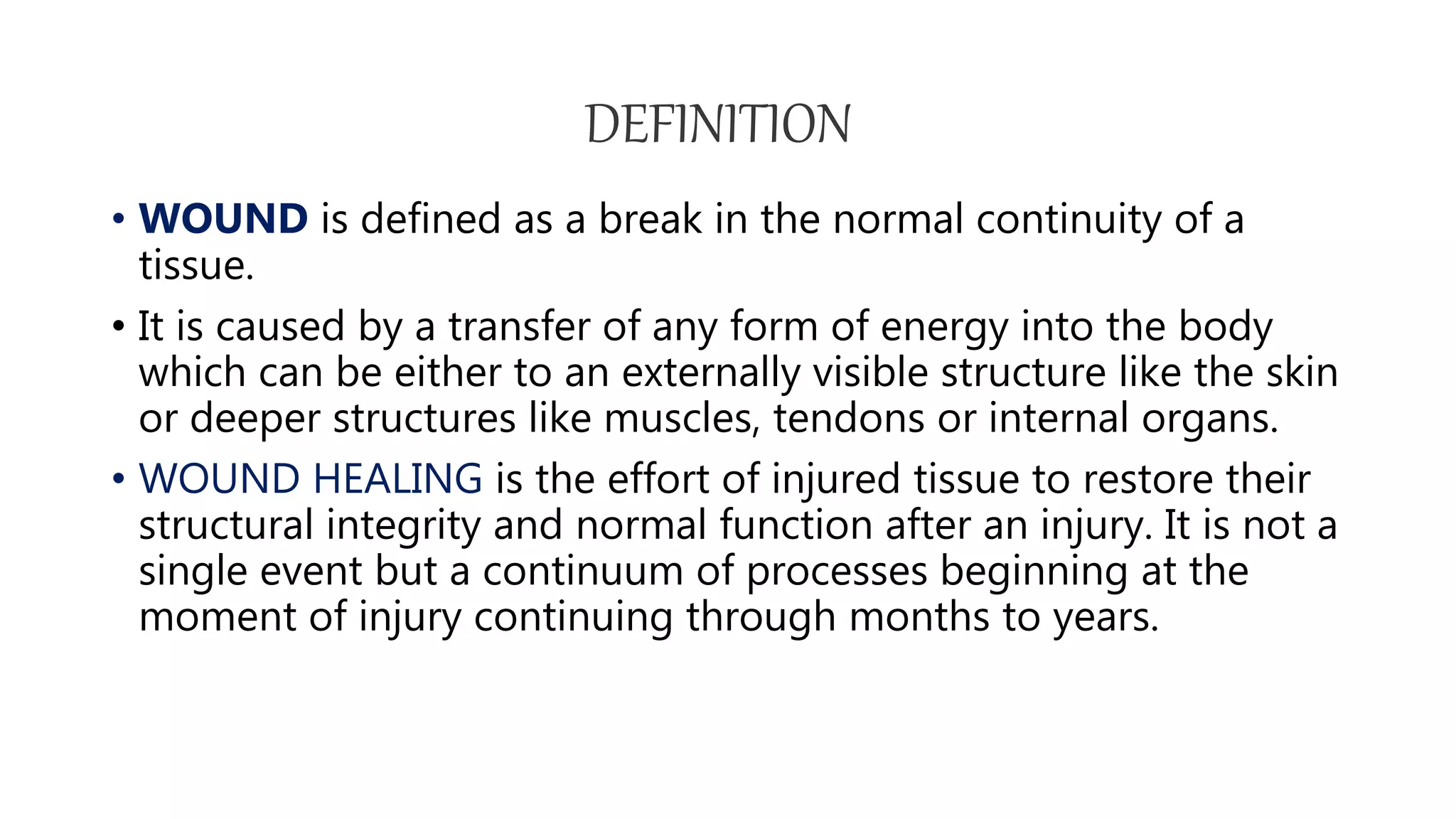
• WOUND is defined as a break in the normal continuity of a
tissue.
• It is caused by a transfer of any form of energy into the body
which can be either to an externally visible structure like the skin
or deeper structures like muscles, tendons or internal organs.
• WOUND HEALING is the effort of injured tissue to restore their
structural integrity and normal function after an injury. It is not a
single event but a continuum of processes beginning at the
moment of injury continuing through months to years.
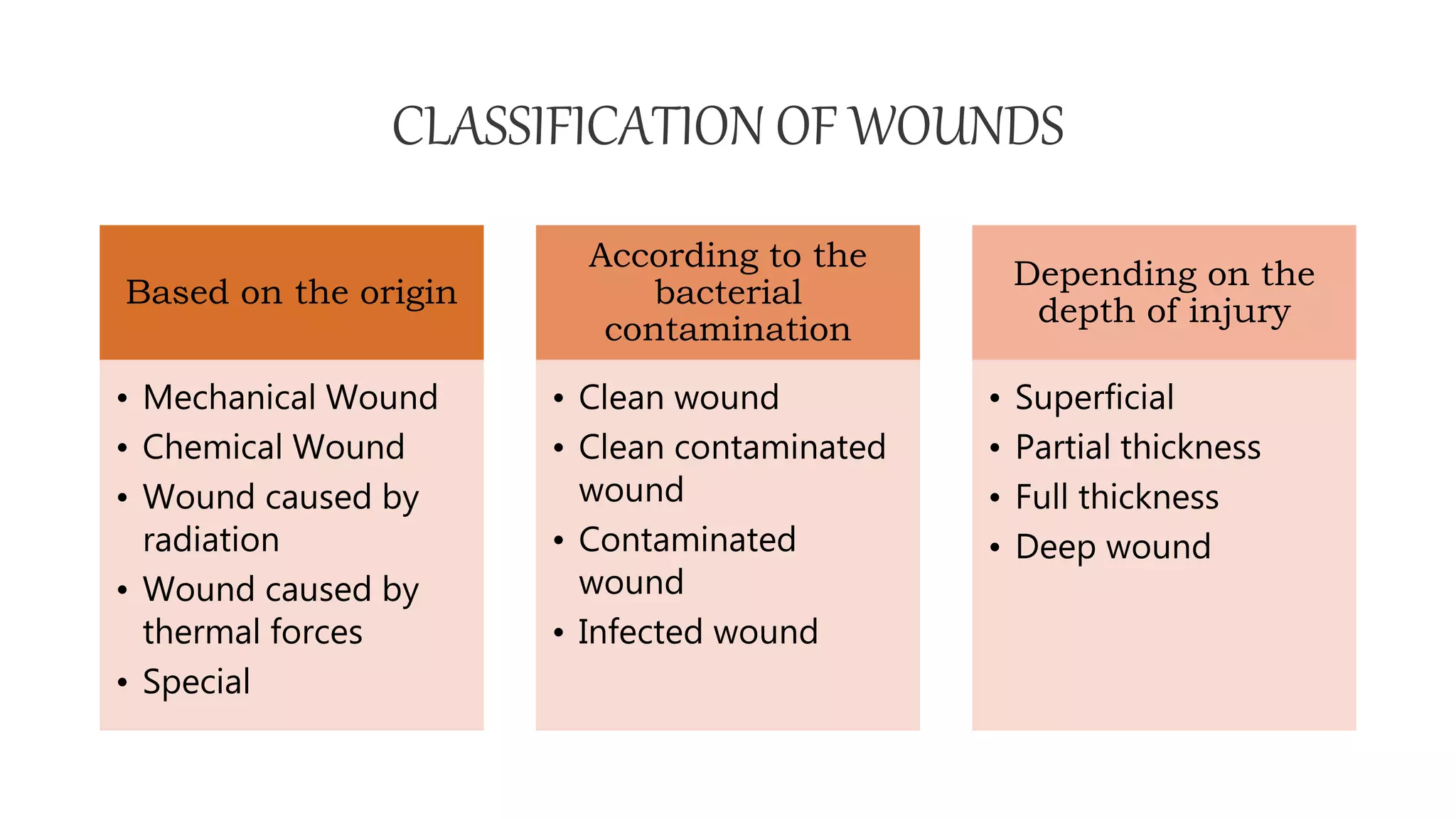
CLASSIFICATION OF WOUNDS
Based on the origin
• Mechanical Wound
• Chemical Wound
• Wound caused by
radiation
• Wound caused by
thermal forces
• Special
According to the
bacterial
contamination
• Clean wound
• Clean contaminated
wound
• Contaminated
wound
• Infected wound
Depending on the
depth of injury
• Superficial
• Partial thickness
• Full thickness
• Deep wound
1. Based on the origin
Mechanical Wound
Abraded
Wound
Punctured
Wound
Incised
Wound
Bite
Wound
Shot
Wound
Crush
Wound
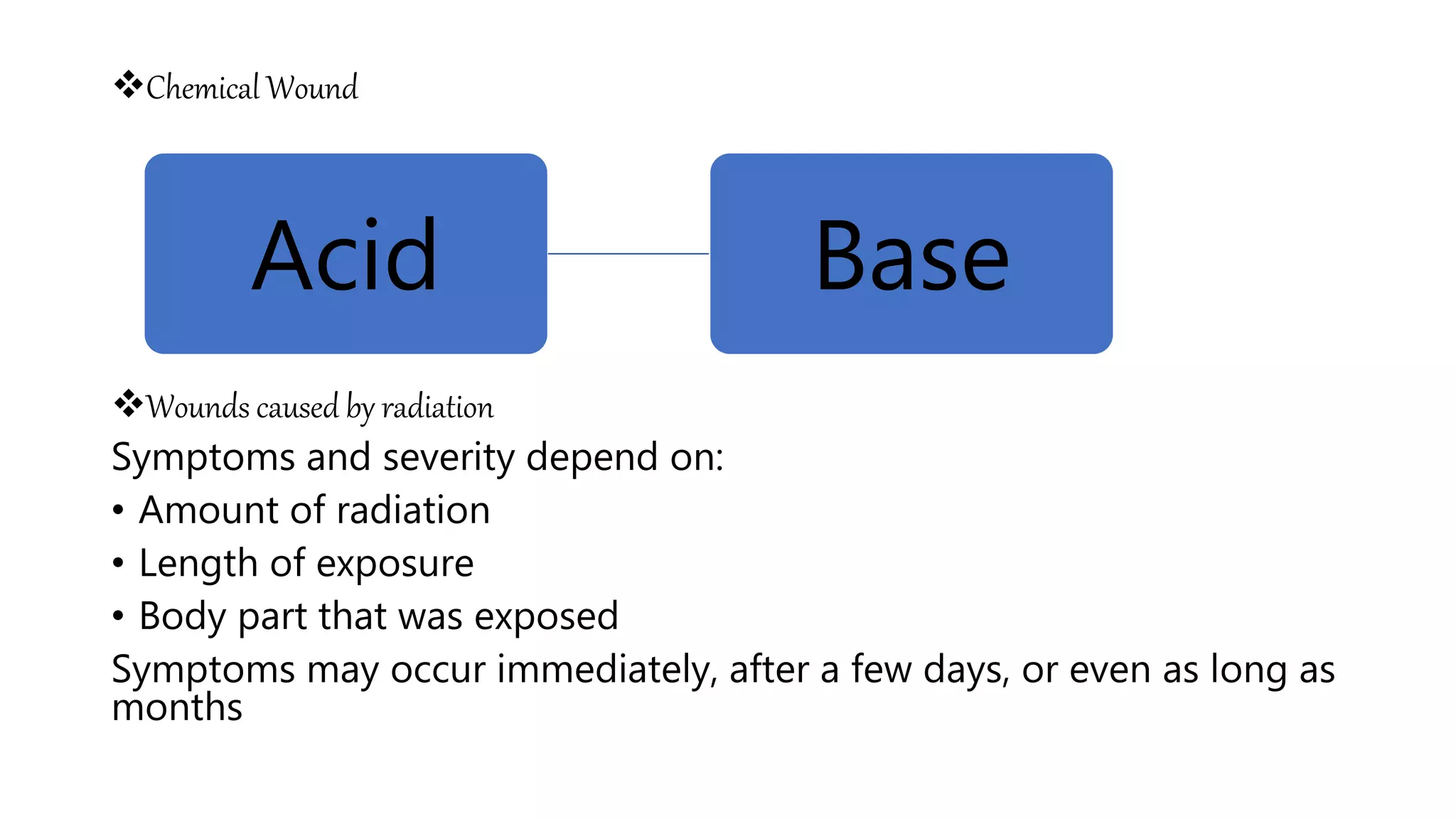
Chemical Wound
Wounds caused by radiation
Symptoms and severity depend on:
• Amount of radiation
• Length of exposure
• Body part that was exposed
Symptoms may occur immediately, after a few days, or even as long as
months
Acid Base
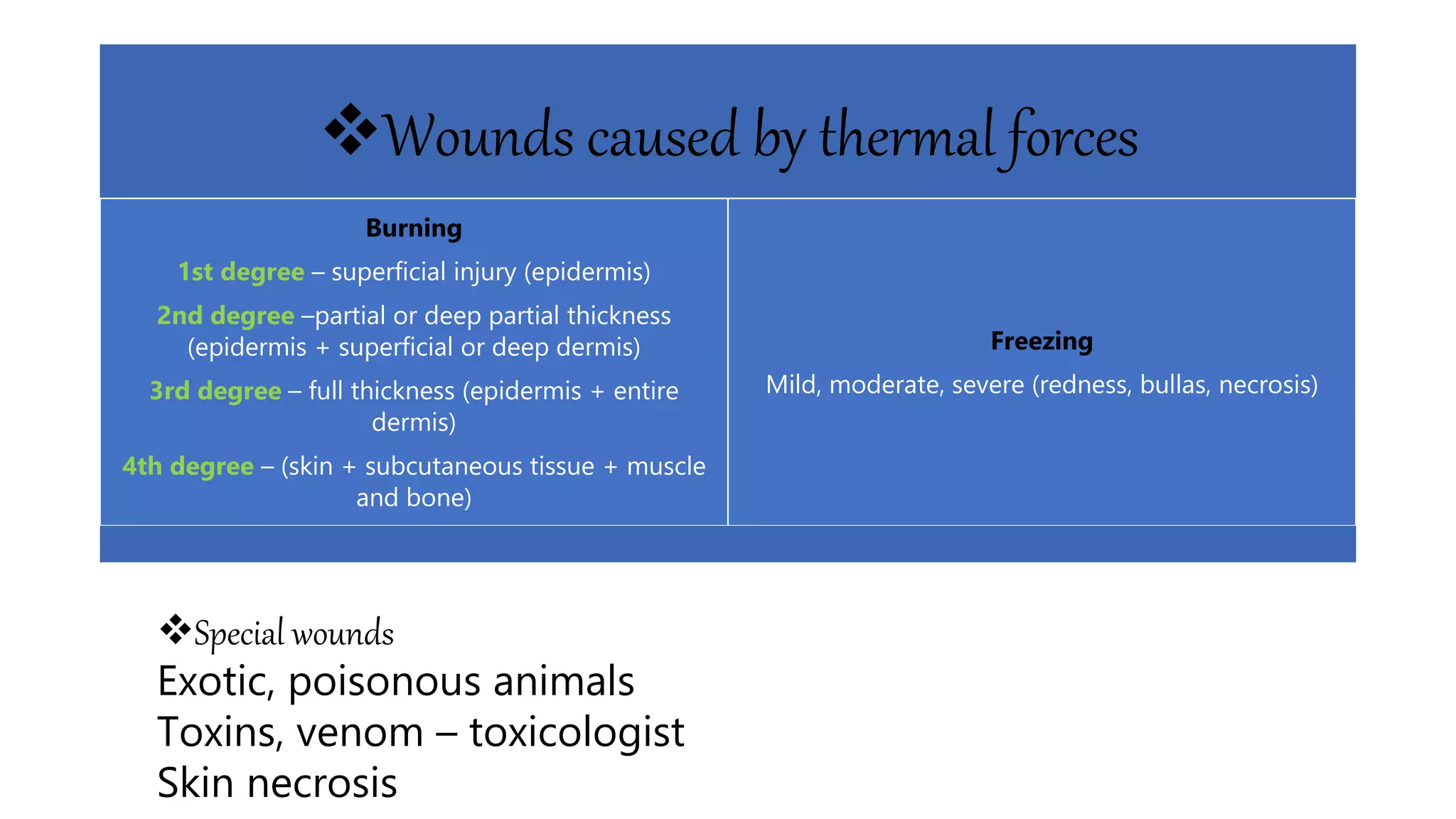
Wounds caused by thermal forces
Burning
1st degree – superficial injury (epidermis)
2nd degree –partial or deep partial thickness
(epidermis + superficial or deep dermis)
3rd degree – full thickness (epidermis + entire
dermis)
4th degree – (skin + subcutaneous tissue + muscle
and bone)
Freezing
Mild, moderate, severe (redness, bullas, necrosis)
Special wounds
Exotic, poisonous animals
Toxins, venom – toxicologist
Skin necrosis
2. According to the Bacterial Contamination
Clean Wound
Ooperative incisional wounds that follow
nonpenetrating (blunt) trauma
Clean-Contaminated Wound
Uninfected wounds in which no inflammation is
encountered but the respiratory, gastrointestinal,
genital, and/or urinary tract have been entered.
Contaminated Wound
Open, traumatic wounds or surgical
wounds involving a major break in sterile
technique that show evidence of
inflammation
Infected Wound
Old, traumatic wounds containing dead
tissue and wounds with evidence of a
clinical infection (e.g., purulent drainage).
3. Depending on the depth of injury
Superficial
Partial
thickness
Full
thickness
Deep
wound
WOUNDS HEALING
• It is a mechanism whereby the body attempts to restore the integrity
of the injured part.
• The disruption in the integrity of tissues, whether surgical or
traumatic, stimulates a series of events that attempts to restore the
injured tissue to a normal state.
• It involves two processes:
1. Regeneration: when healing takes place by proliferation of
parenchymal cells and usually results in complete restoration of the
origin tissues.
2. Repair: when healing takes place by proliferation of connective
tissue resulting in fibrosis and scarring.
Both the processes take place simultaneously.
Types of Wound Healing
Primary Healing
•Uncomplicated healing of a
non-infected, well-
approximated wound is defined
as primary healing.
e.g. Surgical wounds.
Secondary Healing
•If the wound healing course in
this wound is disrupted
by infection, dehiscence,
hypoxia or immune dysfunction,
the secondary healing stage
begins.
STAGES OF Wound Healing
Stage of Inflammation
Stage of Granulation
tissue
Stage of
Epithelialization
Stage of Scar formation
& Reabsorption
Stage of Maturation
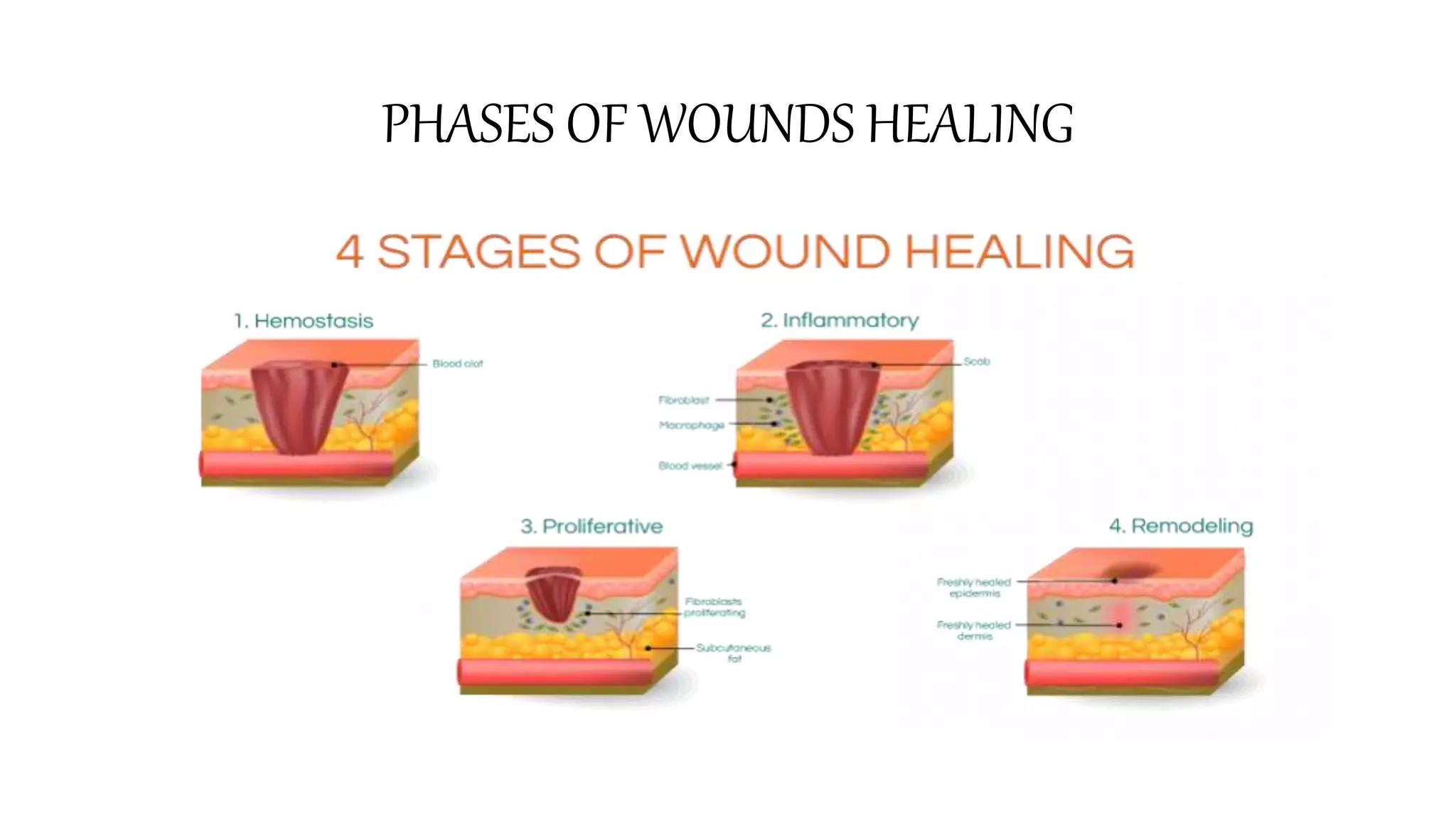
PHASES OF WOUNDS HEALING
Haemostasis Phase
• The wound is being closed by blood.
• It happens very quickly.
• When blood leaks out of the body, the blood vessels start to narrow.
• The platelets adhere to the sub-endothelium surface after a blood vessel's
epithelial wall has been torn.
• The first strands of fibrin begin to adhere in about sixty seconds.
• The blood is transformed from liquid to gel through pro-coagulants and
the release of prothrombin as the fibrin mesh begins.
• The platelets and blood cells are trapped in the wound area when a
thrombus or clot forms.
• If the thrombus detaches from the vessel wall, it can cause a stroke,
pulmonary embolism or heart attack.
Inflammatory Phase
• After an injury, the injured blood vessels leak transudate and
cause swelling.
• Both bleeding and infections can be prevented by inflammation.
• The fluid allows healing and repair cells to move.
• Damages are removed from the wound area during the
inflammatory phase.
• During this stage of wound healing, the white blood cells and
growth factors create swelling, heat, pain and redness.
• Inflammation is a normal part of the wound healing process.
Proliferative Phase
• The wound contracts as new tissues are built when the wound is rebuilt with new
tissue.
• A new network of blood vessels needs to be built so that the tissue can get
enough oxygen and nutrition.
• Myofibroblasts cause the wound to contract by gripping the edges and pulling
them together using a mechanism similar to that of smooth muscle cells.
• In a healthy stage of wound healing, the tissue is pink or red.
• The healthy tissue doesn't bleed easily.
• Dark tissue can be a sign of disease.
• The cells come back to the injury.
• When wounds are kept moist and hydrated Epithelialization happens faster.
• If occlusive or semi-occlusive dressings are applied within 48 hours after an injury,
they will maintain correct tissue humidity.
Maturation Phase (Remodelling Stage)
• The wound fully closes after being remodeled from type III to type I.
• The cells that were used to repair the wound are no longer needed.
• The wound is thick and disorganized after the proliferative phase.
• Increasing the strength of the healing tissues is achieved by
remodeling the skin into a more organized structure.
• Matrix metalloproteinases are produced by fibroblasts.
• The remodeling of type III collagen to type I is aided by the enzymes.
• Remodeling can last for a year or more after an injury.
• Even with cross-linking, healed wound areas are weaker than
uninjured skin, with 80% of the strength of unwounded skin.
Complications of Wound Healing
• Wound dehiscence
• Wound infection
• Haemorrhage
• Fistula formation
• Hypertrophic scar
• Keloids
• Incisional hernias
• Contractures
• Malignant transformation
FACTORS AFFECTING WOUND HEALING
LOCAL FACTORS
• Site of wound
• Mechanism of wounding
• Loss of tissue (large defect)
• Foreign body
• Wound infection
• Presence of necrotic tissue
• Poor apposition
• Vascular insufficiency (Arterial or Venous)
• Previous radiation
• Recurrent Trauma
• Underlying disease (osteomyelitis, malignancy)
SYSTEMICFACTORS
• Age
• Malnutrition
• Vitamins and minerals
• Obesity
• Diabetes mellitus
• Anaemia
• Jaundice
• Use of steroids
• Use of cytotoxic medications
• Cigarette smoking
Wound Care in
Physiotherapy
• The most common wounds that are treated by wound care
physical therapist are:
1. Necrotic wounds.
2. Stage III, IV or unstageable pressure ulcers.
3. Diabetic wounds, see image.
4. Chronic wounds.
5. Venous and/or arterial wounds.
6. Extremity wounds with oedema.
7. Non-healing surgical wounds.
Physiotherapy Role
Common treatment approaches can include:
• Measurement and documentation of the wound characteristics.
• Cleaning of the wound.
• Debridement (removal) of any dead tissue.
• Selection and application of wound dressing.
• Application of compression if necessary.
• Education of the patient, caregivers and/or family members regarding wound care and dressing changes.
Treatment modalities may include:
• Ultrasound mist therapy
• Electrical stimulation
• Pulsed lavage
• Whirlpool
• Negative pressure vacuum therapy
• Compression therapy.

WOUND MANAGEMENT.pptx

  • 1.
    WOUND MANAGEMENT Submitted by :Sakshi Upadhyay MPT Sports
  • 2.
    DEFINITION • WOUND isdefined as a break in the normal continuity of a tissue. • It is caused by a transfer of any form of energy into the body which can be either to an externally visible structure like the skin or deeper structures like muscles, tendons or internal organs. • WOUND HEALING is the effort of injured tissue to restore their structural integrity and normal function after an injury. It is not a single event but a continuum of processes beginning at the moment of injury continuing through months to years.
  • 3.
    CLASSIFICATION OF WOUNDS Basedon the origin • Mechanical Wound • Chemical Wound • Wound caused by radiation • Wound caused by thermal forces • Special According to the bacterial contamination • Clean wound • Clean contaminated wound • Contaminated wound • Infected wound Depending on the depth of injury • Superficial • Partial thickness • Full thickness • Deep wound
  • 4.
    1. Based onthe origin Mechanical Wound Abraded Wound Punctured Wound Incised Wound Bite Wound Shot Wound Crush Wound
  • 5.
    Chemical Wound Wounds causedby radiation Symptoms and severity depend on: • Amount of radiation • Length of exposure • Body part that was exposed Symptoms may occur immediately, after a few days, or even as long as months Acid Base
  • 6.
    Wounds caused bythermal forces Burning 1st degree – superficial injury (epidermis) 2nd degree –partial or deep partial thickness (epidermis + superficial or deep dermis) 3rd degree – full thickness (epidermis + entire dermis) 4th degree – (skin + subcutaneous tissue + muscle and bone) Freezing Mild, moderate, severe (redness, bullas, necrosis) Special wounds Exotic, poisonous animals Toxins, venom – toxicologist Skin necrosis
  • 7.
    2. According tothe Bacterial Contamination Clean Wound Ooperative incisional wounds that follow nonpenetrating (blunt) trauma Clean-Contaminated Wound Uninfected wounds in which no inflammation is encountered but the respiratory, gastrointestinal, genital, and/or urinary tract have been entered. Contaminated Wound Open, traumatic wounds or surgical wounds involving a major break in sterile technique that show evidence of inflammation Infected Wound Old, traumatic wounds containing dead tissue and wounds with evidence of a clinical infection (e.g., purulent drainage).
  • 8.
    3. Depending onthe depth of injury Superficial Partial thickness Full thickness Deep wound
  • 9.
    WOUNDS HEALING • Itis a mechanism whereby the body attempts to restore the integrity of the injured part. • The disruption in the integrity of tissues, whether surgical or traumatic, stimulates a series of events that attempts to restore the injured tissue to a normal state. • It involves two processes: 1. Regeneration: when healing takes place by proliferation of parenchymal cells and usually results in complete restoration of the origin tissues. 2. Repair: when healing takes place by proliferation of connective tissue resulting in fibrosis and scarring. Both the processes take place simultaneously.
  • 10.
    Types of WoundHealing Primary Healing •Uncomplicated healing of a non-infected, well- approximated wound is defined as primary healing. e.g. Surgical wounds. Secondary Healing •If the wound healing course in this wound is disrupted by infection, dehiscence, hypoxia or immune dysfunction, the secondary healing stage begins.
  • 11.
    STAGES OF WoundHealing Stage of Inflammation Stage of Granulation tissue Stage of Epithelialization Stage of Scar formation & Reabsorption Stage of Maturation
  • 12.
  • 13.
    Haemostasis Phase • Thewound is being closed by blood. • It happens very quickly. • When blood leaks out of the body, the blood vessels start to narrow. • The platelets adhere to the sub-endothelium surface after a blood vessel's epithelial wall has been torn. • The first strands of fibrin begin to adhere in about sixty seconds. • The blood is transformed from liquid to gel through pro-coagulants and the release of prothrombin as the fibrin mesh begins. • The platelets and blood cells are trapped in the wound area when a thrombus or clot forms. • If the thrombus detaches from the vessel wall, it can cause a stroke, pulmonary embolism or heart attack.
  • 14.
    Inflammatory Phase • Afteran injury, the injured blood vessels leak transudate and cause swelling. • Both bleeding and infections can be prevented by inflammation. • The fluid allows healing and repair cells to move. • Damages are removed from the wound area during the inflammatory phase. • During this stage of wound healing, the white blood cells and growth factors create swelling, heat, pain and redness. • Inflammation is a normal part of the wound healing process.
  • 15.
    Proliferative Phase • Thewound contracts as new tissues are built when the wound is rebuilt with new tissue. • A new network of blood vessels needs to be built so that the tissue can get enough oxygen and nutrition. • Myofibroblasts cause the wound to contract by gripping the edges and pulling them together using a mechanism similar to that of smooth muscle cells. • In a healthy stage of wound healing, the tissue is pink or red. • The healthy tissue doesn't bleed easily. • Dark tissue can be a sign of disease. • The cells come back to the injury. • When wounds are kept moist and hydrated Epithelialization happens faster. • If occlusive or semi-occlusive dressings are applied within 48 hours after an injury, they will maintain correct tissue humidity.
  • 16.
    Maturation Phase (RemodellingStage) • The wound fully closes after being remodeled from type III to type I. • The cells that were used to repair the wound are no longer needed. • The wound is thick and disorganized after the proliferative phase. • Increasing the strength of the healing tissues is achieved by remodeling the skin into a more organized structure. • Matrix metalloproteinases are produced by fibroblasts. • The remodeling of type III collagen to type I is aided by the enzymes. • Remodeling can last for a year or more after an injury. • Even with cross-linking, healed wound areas are weaker than uninjured skin, with 80% of the strength of unwounded skin.
  • 17.
    Complications of WoundHealing • Wound dehiscence • Wound infection • Haemorrhage • Fistula formation • Hypertrophic scar • Keloids • Incisional hernias • Contractures • Malignant transformation
  • 18.
    FACTORS AFFECTING WOUNDHEALING LOCAL FACTORS • Site of wound • Mechanism of wounding • Loss of tissue (large defect) • Foreign body • Wound infection • Presence of necrotic tissue • Poor apposition • Vascular insufficiency (Arterial or Venous) • Previous radiation • Recurrent Trauma • Underlying disease (osteomyelitis, malignancy) SYSTEMICFACTORS • Age • Malnutrition • Vitamins and minerals • Obesity • Diabetes mellitus • Anaemia • Jaundice • Use of steroids • Use of cytotoxic medications • Cigarette smoking
  • 19.
    Wound Care in Physiotherapy •The most common wounds that are treated by wound care physical therapist are: 1. Necrotic wounds. 2. Stage III, IV or unstageable pressure ulcers. 3. Diabetic wounds, see image. 4. Chronic wounds. 5. Venous and/or arterial wounds. 6. Extremity wounds with oedema. 7. Non-healing surgical wounds.
  • 20.
    Physiotherapy Role Common treatmentapproaches can include: • Measurement and documentation of the wound characteristics. • Cleaning of the wound. • Debridement (removal) of any dead tissue. • Selection and application of wound dressing. • Application of compression if necessary. • Education of the patient, caregivers and/or family members regarding wound care and dressing changes. Treatment modalities may include: • Ultrasound mist therapy • Electrical stimulation • Pulsed lavage • Whirlpool • Negative pressure vacuum therapy • Compression therapy.