Basic
Wound
Management
Notes for medical students
Edited by Mohamed Gabr
University of Mansoura
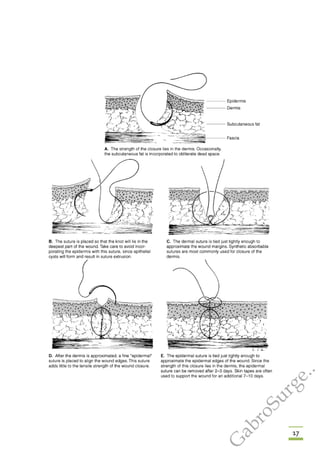
Faculty of Medicine
Medical Series
GabroSurge…
2013
2
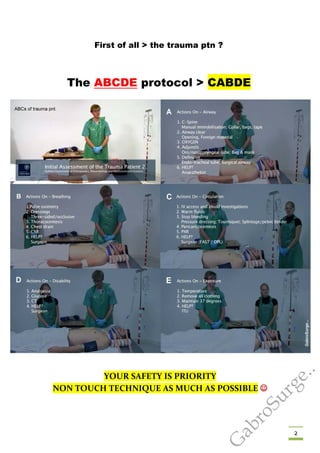
First of all > the trauma ptn ?
The UABCDEU protocol > CABDE
YOUR SAFETY IS PRIORITY
NON TOUCH TECHNIQUE AS MUCH AS POSSIBLE 
G
abroSurge..
3
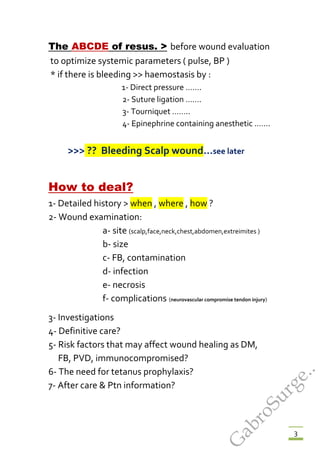
UThe ABCDE of resus. >U before wound evaluation
to optimize systemic parameters ( pulse, BP )
* if there is bleeding >> haemostasis by :
1- Direct pressure …….
2- Suture ligation …….
3- Tourniquet ……..
4- Epinephrine containing anesthetic …….
>>> ?? Bleeding Scalp wound…see later
UHow to deal?U
1- Detailed history > when , where , how ?
2- Wound examination:
a- site (scalp,face,neck,chest,abdomen,extreimites )
b- size
c- FB, contamination
d- infection
e- necrosis
f- complications (neurovascular compromise tendon injury)
3- Investigations
4- Definitive care?
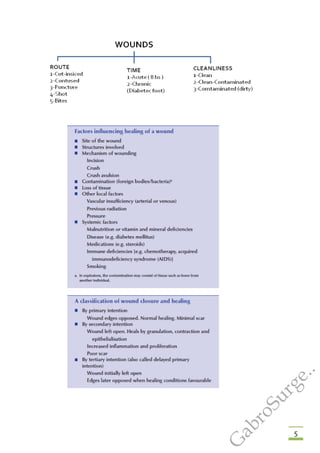
5- Risk factors that may affect wound healing as DM,
FB, PVD, immunocompromised?
6- The need for tetanus prophylaxis?
7- After care & Ptn information?
G
abroSurge..
4
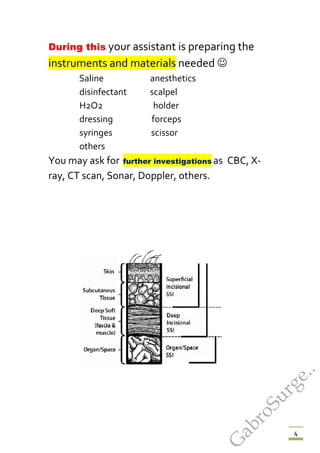
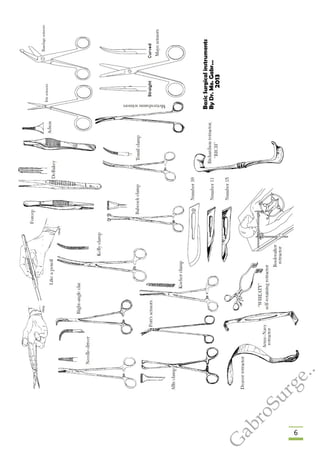
During this your assistant is preparing the
instruments and materials needed 
Saline anesthetics
disinfectant scalpel
H2O2 holder
dressing forceps
syringes scissor
others
You may ask for further investigations as CBC, X-
ray, CT scan, Sonar, Doppler, others.
G
abroSurge..
5
G
abroSurge..
6
G
abroSurge..
7
UDefinitive CareU
U1- SalineU
irrigation with large amount and under high
pressure for mechanical removal of FB and debris
(the most reliable method)
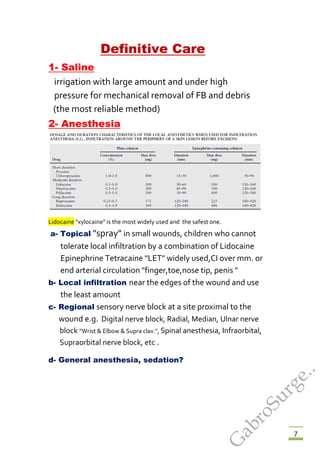
U2- AnesthesiaU
Lidocaine "xylocaine" is the most widely used and the safest one.
a- Topical "spray" in small wounds, children who cannot
tolerate local infiltration by a combination of Lidocaine
Epinephrine Tetracaine "LET" widely used,CI over mm. or
end arterial circulation "finger,toe,nose tip, penis "
b- Local infiltration near the edges of the wound and use
the least amount
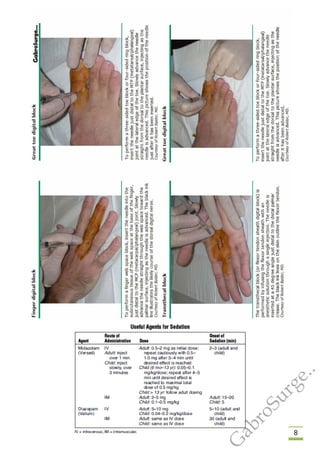
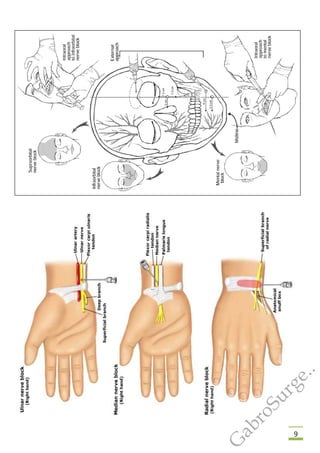
c- Regional sensory nerve block at a site proximal to the
wound e.g. Digital nerve block, Radial, Median, Ulnar nerve
block "Wrist & Elbow & Supra clav.", Spinal anesthesia, Infraorbital,
Supraorbital nerve block, etc .
d- General anesthesia, sedation?
G
abroSurge..
8
G
abroSurge..
9
G
abroSurge..
10
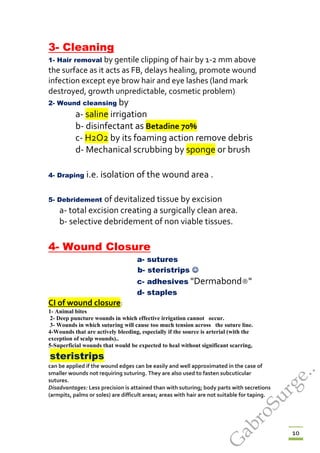
U3- CleaningU
1- Hair removal by gentile clipping of hair by 1-2 mm above
the surface as it acts as FB, delays healing, promote wound
infection except eye brow hair and eye lashes (land mark
destroyed, growth unpredictable, cosmetic problem)
2- Wound cleansing by
a- saline irrigation
b- disinfectant as Betadine 70%
c- H2O2 by its foaming action remove debris
d- Mechanical scrubbing by sponge or brush
4- Draping i.e. isolation of the wound area .
5- Debridement of devitalized tissue by excision
a- total excision creating a surgically clean area.
b- selective debridement of non viable tissues.
U4- Wound ClosureU
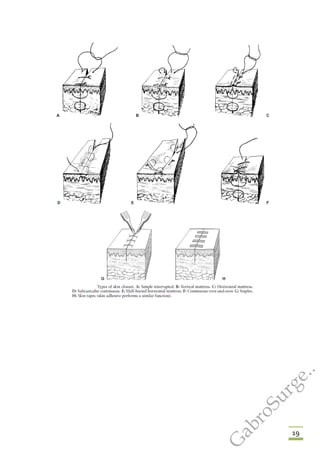
a- sutures
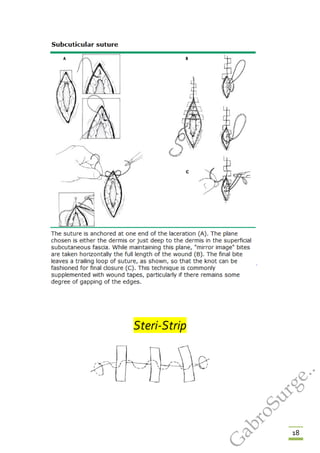
b- steristrips 
c- adhesives "Dermabond®"
d- staples
UCI of wound closureU:
1- Animal bites
2- Deep puncture wounds in which effective irrigation cannot occur.
3- Wounds in which suturing will cause too much tension across the suture line.
4-Wounds that are actively bleeding, especially if the source is arterial (with the
exception of scalp wounds)..
5-Superficial wounds that would be expected to heal without significant scarring,
steristrips
can be applied if the wound edges can be easily and well approximated in the case of
smaller wounds not requiring suturing. They are also used to fasten subcuticular
sutures.
Disadvantages: Less precision is attained than with suturing; body parts with secretions
(armpits, palms or soles) are difficult areas; areas with hair are not suitable for taping.
G
abroSurge..
11
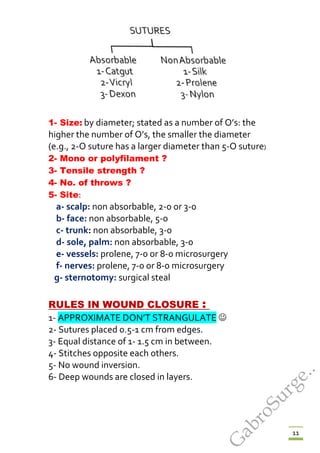
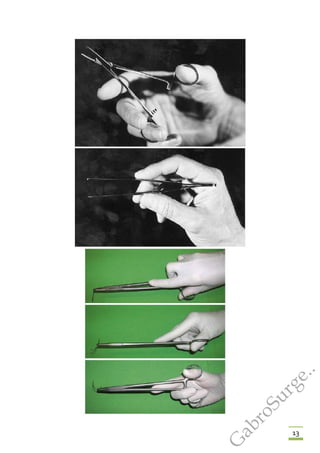
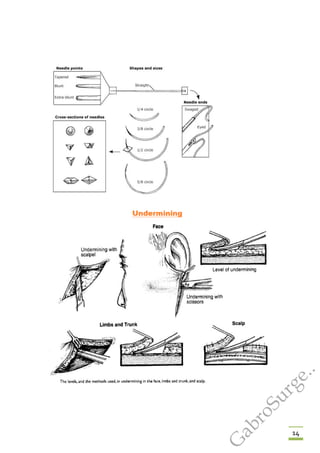
1- Size: by diameter; stated as a number of O’s: the
higher the number of O’s, the smaller the diameter
(e.g., 2-O suture has a larger diameter than 5-O suture)
2- Mono or polyfilament ?
3- Tensile strength ?
4- No. of throws ?
5- Site:
a- scalp: non absorbable, 2-0 or 3-0
b- face: non absorbable, 5-0
c- trunk: non absorbable, 3-0
d- sole, palm: non absorbable, 3-0
e- vessels: prolene, 7-0 or 8-0 microsurgery
f- nerves: prolene, 7-0 or 8-0 microsurgery
g- sternotomy: surgical steal
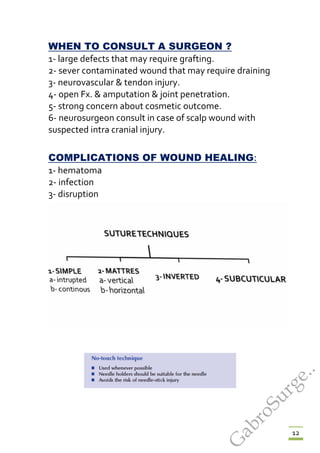
URULES IN WOUND CLOSURE : U
1- APPROXIMATE DON’T STRANGULATE 
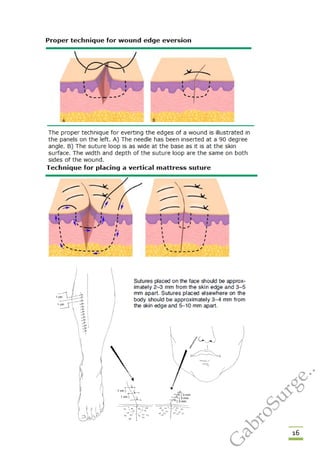
2- Sutures placed 0.5-1 cm from edges.
3- Equal distance of 1- 1.5 cm in between.
4- Stitches opposite each others.
5- No wound inversion.
6- Deep wounds are closed in layers.
G
abroSurge..
12
UWHEN TO CONSULT A SURGEON ?U
1- large defects that may require grafting.
2- sever contaminated wound that may require draining
3- neurovascular & tendon injury.
4- open Fx. & amputation & joint penetration.
5- strong concern about cosmetic outcome.
6- neurosurgeon consult in case of scalp wound with
suspected intra cranial injury.
UCOMPLICATIONS OF WOUND HEALING:U
1- hematoma
2- infection
3- disruption
G
abroSurge..
13
G
abroSurge..
14
G
abroSurge..
15
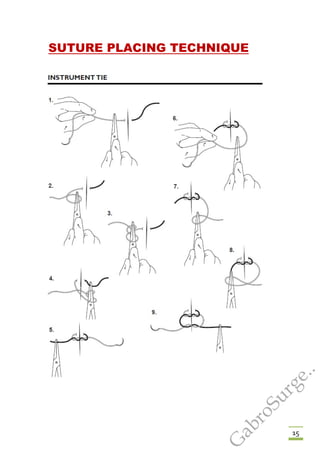
SUTURE PLACING TECHNIQUE
G
abroSurge..
16
G
abroSurge..
17
G
abroSurge..
18
Steri-Strip
G
abroSurge..
19
G
abroSurge..
20
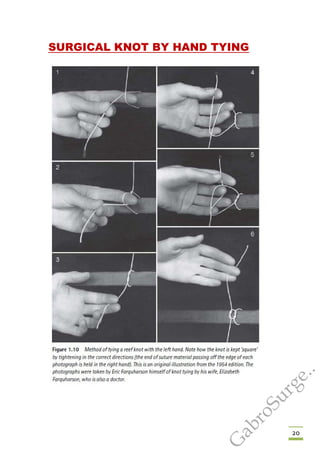
SURGICAL KNOT BY HAND TYING
G
abroSurge..
21
LAYERS CLOSURE:
1- Skin: simple, non absorbable.
2- Mucosa: simple, absorbable.
3- Muscle: simple, absorbable with fascia.
4- Fascia: simple, absorbable.
5- Tendon: special techniques, non absorbable.
6- Nerves: microsurgery.
7- Vessels: microsurgery.
8- Parenchymatous organs: mattress, absorbable.
SPECIFIC SITES:
1- Scalp:
a- Hx.: (traumatic force, symptoms of head injury, FB,
contamination)
b- Exam.: (depth, length, FB, skin loss, skull bones)
c- Investigations:
- X-Ray ( FB, bone Fx. )
- CT-Head ( potential intracranial injury ).
d- Consult:
- Plastic surgeon in case of skin loss.
- Neurosurgeon in case of skull bone injury.
e- preparation:
- Haemostasis:
* 15 min. of direct pressure.
* Lidocaine-epinephrine injection.
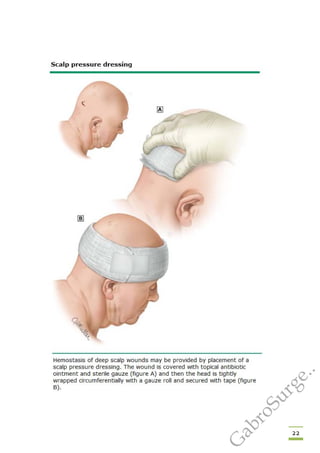
* rapid closure + pressure bandage.
G
abroSurge..
22
G
abroSurge..
23
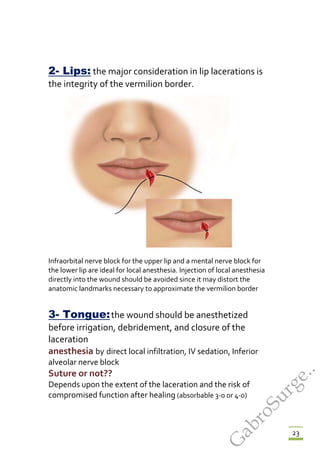
2- Lips: the major consideration in lip lacerations is
the integrity of the vermilion border.
Infraorbital nerve block for the upper lip and a mental nerve block for
the lower lip are ideal for local anesthesia. Injection of local anesthesia
directly into the wound should be avoided since it may distort the
anatomic landmarks necessary to approximate the vermilion border
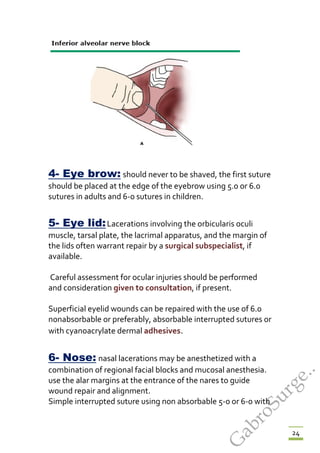
3- Tongue:the wound should be anesthetized
0Tbefore0T irrigation, debridement, and closure of the
laceration
anesthesia by direct local infiltration, IV sedation, Inferior
alveolar nerve block
Suture or not??
Depends upon the extent of the laceration and the risk of
compromised function after healing (absorbable 3-0 or 4-0)
G
abroSurge..
24
4- Eye brow: should never to be shaved, the first suture
should be placed at the edge of the eyebrow using 5.0 or 6.0
sutures in adults and 6-0 sutures in children.
5- Eye lid:Lacerations involving the orbicularis oculi
muscle, tarsal plate, the lacrimal apparatus, and the margin of
the lids often warrant repair by a surgical subspecialist, if
available.
Careful assessment for ocular injuries should be performed
and consideration given to consultation, if present.
Superficial eyelid wounds can be repaired with the use of 6.0
nonabsorbable or preferably, absorbable interrupted sutures or
with cyanoacrylate dermal adhesives.
6- Nose: nasal lacerations may be anesthetized with a
combination of regional facial blocks and mucosal anesthesia.
use the alar margins at the entrance of the nares to guide
wound repair and alignment.
Simple interrupted suture using non absorbable 5-0 or 6-0 with
G
abroSurge..
25
care used to maintain the curvatures and shape of the nose.
Any exposed cartilage should be covered by approximation of
the overlying tissue to prevent infection.
Disruption of the nasal cartilage should be realigned by
repairing the overlying tissue while avoiding direct suturing of
the cartilage.
7- Cheek: deep lacerations are repaired in layers using
simple interrupted sutures while taking care of the parotid
gland and facial nerve.
8- Ear: Wound closure on the ear can proceed in standard
fashion when the cartilage is not involved.
The cartilage should not be sutured if at all possible because of
the risk of infection.
If suturing is necessary, the perichondrium must be included in
the stitch in order for it to hold
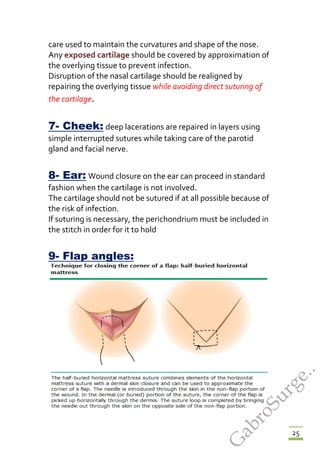
9- Flap angles:
G
abroSurge..
26
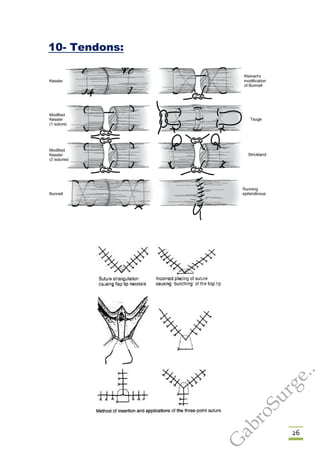
10- Tendons:
G
abroSurge..
27
5- AFTERCARE:
1- Dressing:
most wounds should be covered with an antibiotic
ointment "?" and a nonadhesive dressing immediately
after laceration repair.
the dressing should be left in place for 24 hs., then the
wound could be open to air, wash by H2O2.
2- Abx.:
- Healthy individuals > may not need Abx.
- Abx. Needed in case of :
* large wounds
* bites
* wound contamination, FB
* intraoral wounds
* tendon involvement
* Fx.
* immunocompromised
R/
Adults:
Flumox 500 cap. / 8h or 1 gm vial / 12h
or Velosef 500 cap. / 8h or 1 gm vial / 12h
or Ceporex 500 tab. / 8h or 1gm tab. / 12h
or Hibiotic 625 tab. / 12h
or Magnabiotic 625 tab. / 8h
or Augmentin 625 tab. / 8h or 1 gm tab. / 12h
± Flagyl 500 tab. / 12h
Child:
Flumox 125 or 250 susp. / 8h or 500 vial / 12h
or Duricef 125 or 250 susp. / 8h
G
abroSurge..
28
or Biodroxil 250 susp. / 8h
or Augmentin 156 or 312 susp. / 8h
3- Tetanus prophylaxis ??
4- Analgesics: if needed 
R/
Adults:
Cataflam 25 or 50 tab. / 8h after eating
or 75 supp. / 12h
or 75 amp. / 12h
or Catafast 50 pack. / 8h
or Olfen 25 or 50 tab. / 8h
or 75 supp. / 8h
or 75 amp. / 12h
or If Gastritis or PU disease >>
Mobic 7.5 or 12.5 tab. / 12h
or 15 amp. / 12h
or Anti-Cox amp. / 12h
or Mexicam amp. / 12h
Child:
Cetal syp. / 8h
or Dolphin syp. or supp. / 8h
or Catafly syp. / 8h
5- For Edema:
- if the wound in a limb > elevate, pressure bandage
R/
Adult:
Ambezim-G tab. / 8h
G
abroSurge..
29
or Alphintern tab. / 8h
if sever edema or hematoma > 𝛼𝛼-chymotrypsin
amp. / 24h after hypersensitivity test before every injection
Child:
Maxilase syp. / 8h
6- Suture removal:
kept for the minimal time that allow healing
generally sutures must be kept in place for 3- 14 days.
a- scalp: 7-14 days e- trunk: 7 days
b- face: 4-5 days f- UL: 7 days
c- eye lid: 3 days g- LL: 8-10 days
d- neck: 3-d days h- undertension: 12-14 days
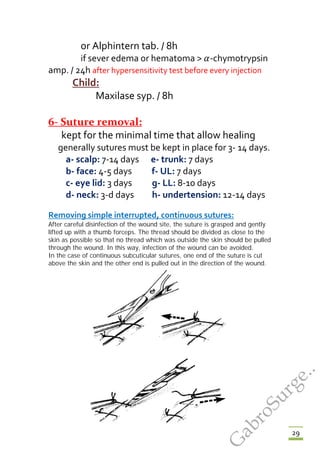
Removing simple interrupted, continuous sutures:
After careful disinfection of the wound site, the suture is grasped and gently
lifted up with a thumb forceps. The thread should be divided as close to the
skin as possible so that no thread which was outside the skin should be pulled
through the wound. In this way, infection of the wound can be avoided.
In the case of continuous subcuticular sutures, one end of the suture is cut
above the skin and the other end is pulled out in the direction of the wound.
G
abroSurge..
30
7- For Scars:
R/ Contractubex cream
or Scaro cream
or Scartex cream
starting after 3 weeks after suture removal
8- Follow up visits
9- Ptn information:
1- keep covered by bandage
2- Keep dry for 2 days, not under running water
3- changing dressing
4- medications
5- rest > avoid activity over the involved area
6- call when> stitches break, feverish, redness, swelling, pus
7- when to remove sutures.
GabroSurge…
2013
G
abroSurge..
1
Appendix:
Bite wounds
Bites and infection
Bites cause contaminated puncture wounds, contaminated
crush injuries, or both. All carry a high risk of bacterial
infection, some also a risk of viral or other infections (eg
rabies).
Bacterial infection is particularly likely in:
 puncture wounds (cat/human bites)
 hand wounds, wounds >24hrs old
 Wounds in diabetics or the immunocompromised.
Bacteria responsible include: streptococci, Staphylococcus
aureus, Clostridium tetani, Pasteurella multocida (cat
bites/scratches), Bacteroides, Eikenella corrodens (human bites).
Approach
Establish what the biting animal was, how long ago and
where the bite occurred. Obtain X-rays if fracture, joint
involvement (look for air) or radio-opaque FB (tooth) is
suspected.
Treatment
1- Cleaning
Explore fresh bite wounds under appropriate anesthetic,
debride and clean thoroughly with copious amounts of
normal saline or tap water, Refer significant facial wounds
and wounds involving tendons or joints to a specialist.
2- Closure
This is controversial. Cosmetic considerations usually
outweigh risks of infection for most facial wounds, so aim
for primary closure.
G
abroSurge..
2
Elsewhere, choose between primary or delayed primary
closure. Do not close puncture bite wounds which cannot
be satisfactorily irrigated.
3- Antibiotics
Also controversial. Many departments advocate
prophylactic antibiotics for all bite wounds. One approach
is to give antibiotics for puncture bites, hand bites,
infected bites, bites from humans, cats and rats and to
those bitten individuals who are immunocompromised.
Co-amoxiclav is an appropriate broad spectrum agent,
effective against strep, staph, pasteurella and eikenella.
Give erythromycin to patients allergic to penicillin/
amoxicillin, although this is less effective against
pasteurella.
4- Tetanus prophylaxis
Bite wounds are tetanus-prone.
Production of the exotoxin tetanospasmin, by the
anaerobic, spore-forming Gram +ve bacillus Clostridium
tetani interferes with neurotransmission. Spore
proliferation and toxin production is likely in heavily
contaminated wounds with devitalized tissue. However,
any wound is a potential portal of entry: ensure tetanus
prevention in every case.
G
abroSurge..
3
Tetanus immunization programme
Standard active immunization involves an initial course of
3 IM or deep SC doses of 0.5mL tetanus toxoid (formalin
inactivated toxin) given at monthly intervals starting at
2months of age, followed by booster doses at 4yrs and
14yrs. A full course of 5 doses is considered to result in
lifelong immunity.
Immunization required after injury depends upon the
immunization status of the patient and the injury.
Anti-tetanus prophylaxis
The need for tetanus immunization after injury depends
upon a patient's tetanus immunity status and whether the
wound is clean or tetanus prone:
The following are regarded as tetanus prone:
 heavy contamination (esp. with soil or faeces)
 devitalized tissue
 infection or wounds >6h old
 puncture wounds and animal bites
Do not give tetanus vaccine if there is a past history of a
severe reaction: give HATI.
Pregnancy is not a contraindication to giving tetanus
prophylaxis.
Patient is already fully immunized
If the patient has received a full 5 dose course of tetanus
vaccines, do not give further vaccines. Consider human
G
abroSurge..
4
anti-tetanus immunoglobulin (HATI 250-500 units IM) only
if the risk is especially high (eg wound contaminated with stable manure).
Patient had complete initial course, boosters up to date
but not yet complete
Vaccine is not required, but do give it if the next dose is
due soon and it is convenient to give it now. Consider
HATI 250-500 units IM in tetanus prone wounds only if the
risk is especially high (eg wound contaminated with stable manure).
Initial course incomplete or boosters not up to date
Give a reinforcing dose of combined tetanus/diphtheria
vaccine and refer to the GP for further doses as required to
complete the schedule. For tetanus-prone wounds, also
give one dose of HATI at a different site. The dose of HATI
is 250 units IM for most tetanus prone wounds, but give
500 units if >24hrs have elapsed since injury or if there is
heavy contamination or following burns.
Not immunized or immunization status unknown or
uncertain
Give a dose of combined tetanus/diphtheria vaccine and
refer to the GP for further doses as required. For tetanus-
prone wounds, also give one dose of HATI (250-500 units
IM) at a different site.
GabroSurge…
2013
G
abroSurge..
References
1- Bailey &Love´s Short Practice Of Surgery 25th
Edition
2008
2- Up To Date 2011
3- Oxford Handbook Of Emergency 2012
4- Current Medical Diagnosis And Treatment: Emergency
Medicine 2011
5- Surgical Recall 2008
6- Grabb And Smith´s Plastic Surgery 6th Edition 2008
7- Fundamental Techniques Of Plastic Surgery And Their
Surgical Applications 10th Edition 2000
8- Surgical Techniques 2006
9- Surgical Knot Tying Manual 3rd Edition 2008
10- Farquharson’s Textbook Of Operative General
Surgery Ninth Edition 2005

Basic wound management

  • 1.
    Basic Wound Management Notes for medicalstudents Edited by Mohamed Gabr University of Mansoura Faculty of Medicine Medical Series GabroSurge… 2013
  • 2.
    2 First of all> the trauma ptn ? The UABCDEU protocol > CABDE YOUR SAFETY IS PRIORITY NON TOUCH TECHNIQUE AS MUCH AS POSSIBLE  G abroSurge..
  • 3.
    3 UThe ABCDE ofresus. >U before wound evaluation to optimize systemic parameters ( pulse, BP ) * if there is bleeding >> haemostasis by : 1- Direct pressure ……. 2- Suture ligation ……. 3- Tourniquet …….. 4- Epinephrine containing anesthetic ……. >>> ?? Bleeding Scalp wound…see later UHow to deal?U 1- Detailed history > when , where , how ? 2- Wound examination: a- site (scalp,face,neck,chest,abdomen,extreimites ) b- size c- FB, contamination d- infection e- necrosis f- complications (neurovascular compromise tendon injury) 3- Investigations 4- Definitive care? 5- Risk factors that may affect wound healing as DM, FB, PVD, immunocompromised? 6- The need for tetanus prophylaxis? 7- After care & Ptn information? G abroSurge..
  • 4.
    4 During this yourassistant is preparing the instruments and materials needed  Saline anesthetics disinfectant scalpel H2O2 holder dressing forceps syringes scissor others You may ask for further investigations as CBC, X- ray, CT scan, Sonar, Doppler, others. G abroSurge..
  • 5.
  • 6.
  • 7.
    7 UDefinitive CareU U1- SalineU irrigationwith large amount and under high pressure for mechanical removal of FB and debris (the most reliable method) U2- AnesthesiaU Lidocaine "xylocaine" is the most widely used and the safest one. a- Topical "spray" in small wounds, children who cannot tolerate local infiltration by a combination of Lidocaine Epinephrine Tetracaine "LET" widely used,CI over mm. or end arterial circulation "finger,toe,nose tip, penis " b- Local infiltration near the edges of the wound and use the least amount c- Regional sensory nerve block at a site proximal to the wound e.g. Digital nerve block, Radial, Median, Ulnar nerve block "Wrist & Elbow & Supra clav.", Spinal anesthesia, Infraorbital, Supraorbital nerve block, etc . d- General anesthesia, sedation? G abroSurge..
  • 8.
  • 9.
  • 10.
    10 U3- CleaningU 1- Hairremoval by gentile clipping of hair by 1-2 mm above the surface as it acts as FB, delays healing, promote wound infection except eye brow hair and eye lashes (land mark destroyed, growth unpredictable, cosmetic problem) 2- Wound cleansing by a- saline irrigation b- disinfectant as Betadine 70% c- H2O2 by its foaming action remove debris d- Mechanical scrubbing by sponge or brush 4- Draping i.e. isolation of the wound area . 5- Debridement of devitalized tissue by excision a- total excision creating a surgically clean area. b- selective debridement of non viable tissues. U4- Wound ClosureU a- sutures b- steristrips  c- adhesives "Dermabond®" d- staples UCI of wound closureU: 1- Animal bites 2- Deep puncture wounds in which effective irrigation cannot occur. 3- Wounds in which suturing will cause too much tension across the suture line. 4-Wounds that are actively bleeding, especially if the source is arterial (with the exception of scalp wounds).. 5-Superficial wounds that would be expected to heal without significant scarring, steristrips can be applied if the wound edges can be easily and well approximated in the case of smaller wounds not requiring suturing. They are also used to fasten subcuticular sutures. Disadvantages: Less precision is attained than with suturing; body parts with secretions (armpits, palms or soles) are difficult areas; areas with hair are not suitable for taping. G abroSurge..
  • 11.
    11 1- Size: bydiameter; stated as a number of O’s: the higher the number of O’s, the smaller the diameter (e.g., 2-O suture has a larger diameter than 5-O suture) 2- Mono or polyfilament ? 3- Tensile strength ? 4- No. of throws ? 5- Site: a- scalp: non absorbable, 2-0 or 3-0 b- face: non absorbable, 5-0 c- trunk: non absorbable, 3-0 d- sole, palm: non absorbable, 3-0 e- vessels: prolene, 7-0 or 8-0 microsurgery f- nerves: prolene, 7-0 or 8-0 microsurgery g- sternotomy: surgical steal URULES IN WOUND CLOSURE : U 1- APPROXIMATE DON’T STRANGULATE  2- Sutures placed 0.5-1 cm from edges. 3- Equal distance of 1- 1.5 cm in between. 4- Stitches opposite each others. 5- No wound inversion. 6- Deep wounds are closed in layers. G abroSurge..
  • 12.
    12 UWHEN TO CONSULTA SURGEON ?U 1- large defects that may require grafting. 2- sever contaminated wound that may require draining 3- neurovascular & tendon injury. 4- open Fx. & amputation & joint penetration. 5- strong concern about cosmetic outcome. 6- neurosurgeon consult in case of scalp wound with suspected intra cranial injury. UCOMPLICATIONS OF WOUND HEALING:U 1- hematoma 2- infection 3- disruption G abroSurge..
  • 13.
  • 14.
  • 15.
  • 16.
  • 17.
  • 18.
  • 19.
  • 20.
    20 SURGICAL KNOT BYHAND TYING G abroSurge..
  • 21.
    21 LAYERS CLOSURE: 1- Skin:simple, non absorbable. 2- Mucosa: simple, absorbable. 3- Muscle: simple, absorbable with fascia. 4- Fascia: simple, absorbable. 5- Tendon: special techniques, non absorbable. 6- Nerves: microsurgery. 7- Vessels: microsurgery. 8- Parenchymatous organs: mattress, absorbable. SPECIFIC SITES: 1- Scalp: a- Hx.: (traumatic force, symptoms of head injury, FB, contamination) b- Exam.: (depth, length, FB, skin loss, skull bones) c- Investigations: - X-Ray ( FB, bone Fx. ) - CT-Head ( potential intracranial injury ). d- Consult: - Plastic surgeon in case of skin loss. - Neurosurgeon in case of skull bone injury. e- preparation: - Haemostasis: * 15 min. of direct pressure. * Lidocaine-epinephrine injection. * rapid closure + pressure bandage. G abroSurge..
  • 22.
  • 23.
    23 2- Lips: themajor consideration in lip lacerations is the integrity of the vermilion border. Infraorbital nerve block for the upper lip and a mental nerve block for the lower lip are ideal for local anesthesia. Injection of local anesthesia directly into the wound should be avoided since it may distort the anatomic landmarks necessary to approximate the vermilion border 3- Tongue:the wound should be anesthetized 0Tbefore0T irrigation, debridement, and closure of the laceration anesthesia by direct local infiltration, IV sedation, Inferior alveolar nerve block Suture or not?? Depends upon the extent of the laceration and the risk of compromised function after healing (absorbable 3-0 or 4-0) G abroSurge..
  • 24.
    24 4- Eye brow:should never to be shaved, the first suture should be placed at the edge of the eyebrow using 5.0 or 6.0 sutures in adults and 6-0 sutures in children. 5- Eye lid:Lacerations involving the orbicularis oculi muscle, tarsal plate, the lacrimal apparatus, and the margin of the lids often warrant repair by a surgical subspecialist, if available. Careful assessment for ocular injuries should be performed and consideration given to consultation, if present. Superficial eyelid wounds can be repaired with the use of 6.0 nonabsorbable or preferably, absorbable interrupted sutures or with cyanoacrylate dermal adhesives. 6- Nose: nasal lacerations may be anesthetized with a combination of regional facial blocks and mucosal anesthesia. use the alar margins at the entrance of the nares to guide wound repair and alignment. Simple interrupted suture using non absorbable 5-0 or 6-0 with G abroSurge..
  • 25.
    25 care used tomaintain the curvatures and shape of the nose. Any exposed cartilage should be covered by approximation of the overlying tissue to prevent infection. Disruption of the nasal cartilage should be realigned by repairing the overlying tissue while avoiding direct suturing of the cartilage. 7- Cheek: deep lacerations are repaired in layers using simple interrupted sutures while taking care of the parotid gland and facial nerve. 8- Ear: Wound closure on the ear can proceed in standard fashion when the cartilage is not involved. The cartilage should not be sutured if at all possible because of the risk of infection. If suturing is necessary, the perichondrium must be included in the stitch in order for it to hold 9- Flap angles: G abroSurge..
  • 26.
  • 27.
    27 5- AFTERCARE: 1- Dressing: mostwounds should be covered with an antibiotic ointment "?" and a nonadhesive dressing immediately after laceration repair. the dressing should be left in place for 24 hs., then the wound could be open to air, wash by H2O2. 2- Abx.: - Healthy individuals > may not need Abx. - Abx. Needed in case of : * large wounds * bites * wound contamination, FB * intraoral wounds * tendon involvement * Fx. * immunocompromised R/ Adults: Flumox 500 cap. / 8h or 1 gm vial / 12h or Velosef 500 cap. / 8h or 1 gm vial / 12h or Ceporex 500 tab. / 8h or 1gm tab. / 12h or Hibiotic 625 tab. / 12h or Magnabiotic 625 tab. / 8h or Augmentin 625 tab. / 8h or 1 gm tab. / 12h ± Flagyl 500 tab. / 12h Child: Flumox 125 or 250 susp. / 8h or 500 vial / 12h or Duricef 125 or 250 susp. / 8h G abroSurge..
  • 28.
    28 or Biodroxil 250susp. / 8h or Augmentin 156 or 312 susp. / 8h 3- Tetanus prophylaxis ?? 4- Analgesics: if needed  R/ Adults: Cataflam 25 or 50 tab. / 8h after eating or 75 supp. / 12h or 75 amp. / 12h or Catafast 50 pack. / 8h or Olfen 25 or 50 tab. / 8h or 75 supp. / 8h or 75 amp. / 12h or If Gastritis or PU disease >> Mobic 7.5 or 12.5 tab. / 12h or 15 amp. / 12h or Anti-Cox amp. / 12h or Mexicam amp. / 12h Child: Cetal syp. / 8h or Dolphin syp. or supp. / 8h or Catafly syp. / 8h 5- For Edema: - if the wound in a limb > elevate, pressure bandage R/ Adult: Ambezim-G tab. / 8h G abroSurge..
  • 29.
    29 or Alphintern tab./ 8h if sever edema or hematoma > 𝛼𝛼-chymotrypsin amp. / 24h after hypersensitivity test before every injection Child: Maxilase syp. / 8h 6- Suture removal: kept for the minimal time that allow healing generally sutures must be kept in place for 3- 14 days. a- scalp: 7-14 days e- trunk: 7 days b- face: 4-5 days f- UL: 7 days c- eye lid: 3 days g- LL: 8-10 days d- neck: 3-d days h- undertension: 12-14 days Removing simple interrupted, continuous sutures: After careful disinfection of the wound site, the suture is grasped and gently lifted up with a thumb forceps. The thread should be divided as close to the skin as possible so that no thread which was outside the skin should be pulled through the wound. In this way, infection of the wound can be avoided. In the case of continuous subcuticular sutures, one end of the suture is cut above the skin and the other end is pulled out in the direction of the wound. G abroSurge..
  • 30.
    30 7- For Scars: R/Contractubex cream or Scaro cream or Scartex cream starting after 3 weeks after suture removal 8- Follow up visits 9- Ptn information: 1- keep covered by bandage 2- Keep dry for 2 days, not under running water 3- changing dressing 4- medications 5- rest > avoid activity over the involved area 6- call when> stitches break, feverish, redness, swelling, pus 7- when to remove sutures. GabroSurge… 2013 G abroSurge..
  • 31.
    1 Appendix: Bite wounds Bites andinfection Bites cause contaminated puncture wounds, contaminated crush injuries, or both. All carry a high risk of bacterial infection, some also a risk of viral or other infections (eg rabies). Bacterial infection is particularly likely in:  puncture wounds (cat/human bites)  hand wounds, wounds >24hrs old  Wounds in diabetics or the immunocompromised. Bacteria responsible include: streptococci, Staphylococcus aureus, Clostridium tetani, Pasteurella multocida (cat bites/scratches), Bacteroides, Eikenella corrodens (human bites). Approach Establish what the biting animal was, how long ago and where the bite occurred. Obtain X-rays if fracture, joint involvement (look for air) or radio-opaque FB (tooth) is suspected. Treatment 1- Cleaning Explore fresh bite wounds under appropriate anesthetic, debride and clean thoroughly with copious amounts of normal saline or tap water, Refer significant facial wounds and wounds involving tendons or joints to a specialist. 2- Closure This is controversial. Cosmetic considerations usually outweigh risks of infection for most facial wounds, so aim for primary closure. G abroSurge..
  • 32.
    2 Elsewhere, choose betweenprimary or delayed primary closure. Do not close puncture bite wounds which cannot be satisfactorily irrigated. 3- Antibiotics Also controversial. Many departments advocate prophylactic antibiotics for all bite wounds. One approach is to give antibiotics for puncture bites, hand bites, infected bites, bites from humans, cats and rats and to those bitten individuals who are immunocompromised. Co-amoxiclav is an appropriate broad spectrum agent, effective against strep, staph, pasteurella and eikenella. Give erythromycin to patients allergic to penicillin/ amoxicillin, although this is less effective against pasteurella. 4- Tetanus prophylaxis Bite wounds are tetanus-prone. Production of the exotoxin tetanospasmin, by the anaerobic, spore-forming Gram +ve bacillus Clostridium tetani interferes with neurotransmission. Spore proliferation and toxin production is likely in heavily contaminated wounds with devitalized tissue. However, any wound is a potential portal of entry: ensure tetanus prevention in every case. G abroSurge..
  • 33.
    3 Tetanus immunization programme Standardactive immunization involves an initial course of 3 IM or deep SC doses of 0.5mL tetanus toxoid (formalin inactivated toxin) given at monthly intervals starting at 2months of age, followed by booster doses at 4yrs and 14yrs. A full course of 5 doses is considered to result in lifelong immunity. Immunization required after injury depends upon the immunization status of the patient and the injury. Anti-tetanus prophylaxis The need for tetanus immunization after injury depends upon a patient's tetanus immunity status and whether the wound is clean or tetanus prone: The following are regarded as tetanus prone:  heavy contamination (esp. with soil or faeces)  devitalized tissue  infection or wounds >6h old  puncture wounds and animal bites Do not give tetanus vaccine if there is a past history of a severe reaction: give HATI. Pregnancy is not a contraindication to giving tetanus prophylaxis. Patient is already fully immunized If the patient has received a full 5 dose course of tetanus vaccines, do not give further vaccines. Consider human G abroSurge..
  • 34.
    4 anti-tetanus immunoglobulin (HATI250-500 units IM) only if the risk is especially high (eg wound contaminated with stable manure). Patient had complete initial course, boosters up to date but not yet complete Vaccine is not required, but do give it if the next dose is due soon and it is convenient to give it now. Consider HATI 250-500 units IM in tetanus prone wounds only if the risk is especially high (eg wound contaminated with stable manure). Initial course incomplete or boosters not up to date Give a reinforcing dose of combined tetanus/diphtheria vaccine and refer to the GP for further doses as required to complete the schedule. For tetanus-prone wounds, also give one dose of HATI at a different site. The dose of HATI is 250 units IM for most tetanus prone wounds, but give 500 units if >24hrs have elapsed since injury or if there is heavy contamination or following burns. Not immunized or immunization status unknown or uncertain Give a dose of combined tetanus/diphtheria vaccine and refer to the GP for further doses as required. For tetanus- prone wounds, also give one dose of HATI (250-500 units IM) at a different site. GabroSurge… 2013 G abroSurge..
  • 35.
    References 1- Bailey &Love´sShort Practice Of Surgery 25th Edition 2008 2- Up To Date 2011 3- Oxford Handbook Of Emergency 2012 4- Current Medical Diagnosis And Treatment: Emergency Medicine 2011 5- Surgical Recall 2008 6- Grabb And Smith´s Plastic Surgery 6th Edition 2008 7- Fundamental Techniques Of Plastic Surgery And Their Surgical Applications 10th Edition 2000 8- Surgical Techniques 2006 9- Surgical Knot Tying Manual 3rd Edition 2008 10- Farquharson’s Textbook Of Operative General Surgery Ninth Edition 2005