SUTURE MATERIALS ANDSUTURE MATERIALS AND
TECHNIQUESTECHNIQUES
PROF. SREEJOY PATNAIK
The Ideal Suture MaterialThe Ideal Suture Material
• Can be used in any tissueCan be used in any tissue
• Easy to handleEasy to handle
• Good knot securityGood knot security
• Minimal tissue reactionMinimal tissue reaction
The Ideal Suture MaterialThe Ideal Suture Material
• Unfriendly to bacteriaUnfriendly to bacteria
• Strong yet smallStrong yet small
• WonWon’’t tear through tissuest tear through tissues
• CheapCheap
WhatWhat’’s It Used for?s It Used for?
• To bring tissue edges together and speedTo bring tissue edges together and speed
wound healing (=tissue apposition)wound healing (=tissue apposition)
• Orthopedic surgery to help stabilize jointsOrthopedic surgery to help stabilize joints
– Repair ligamentsRepair ligaments
• Ligate vessels or tissuesLigate vessels or tissues
Types of NeedlesTypes of Needles
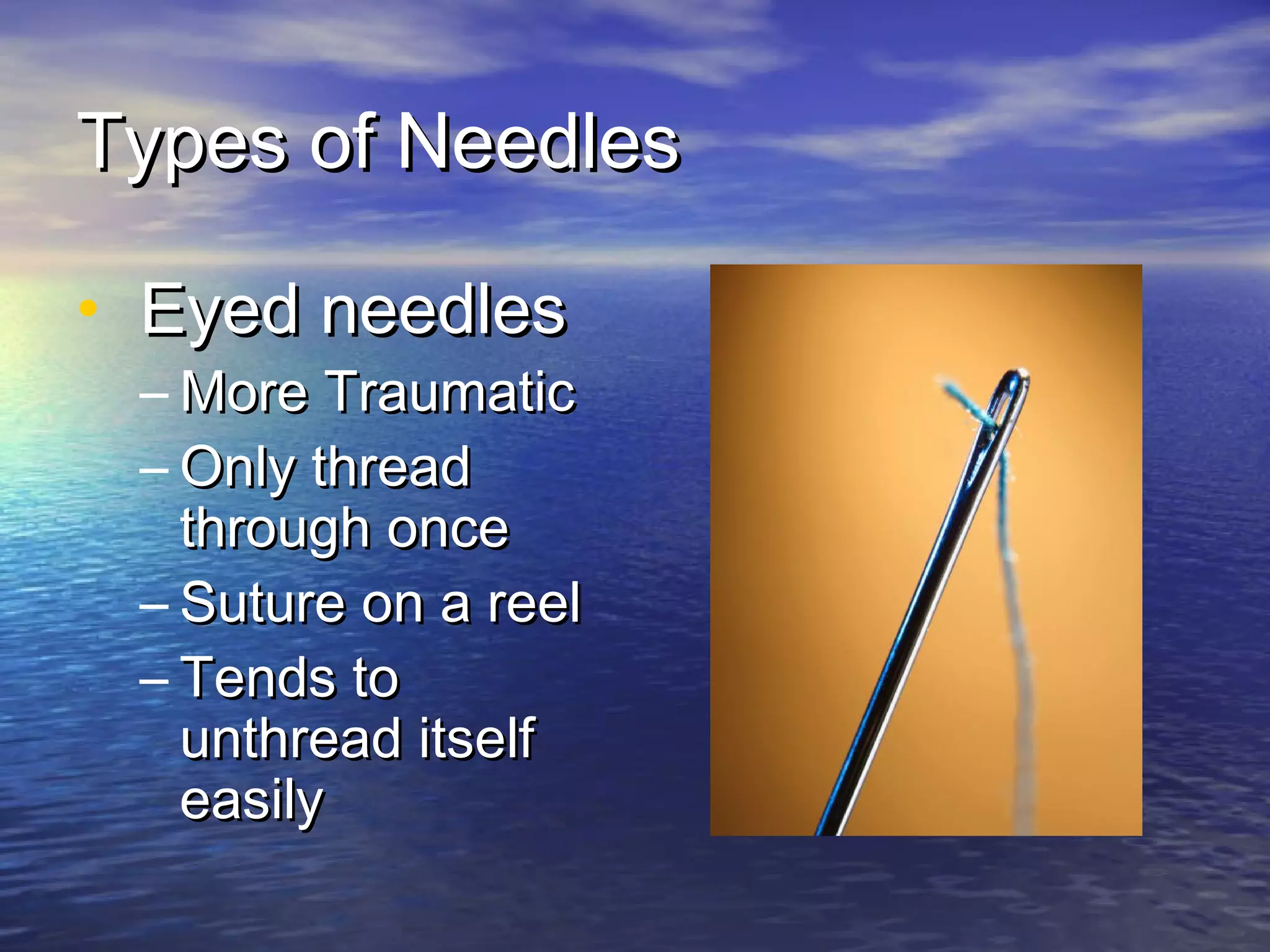
• Eyed needlesEyed needles
– More TraumaticMore Traumatic
– Only threadOnly thread
through oncethrough once
– Suture on a reelSuture on a reel
– Tends toTends to
unthread itselfunthread itself
easilyeasily
Types of NeedlesTypes of Needles
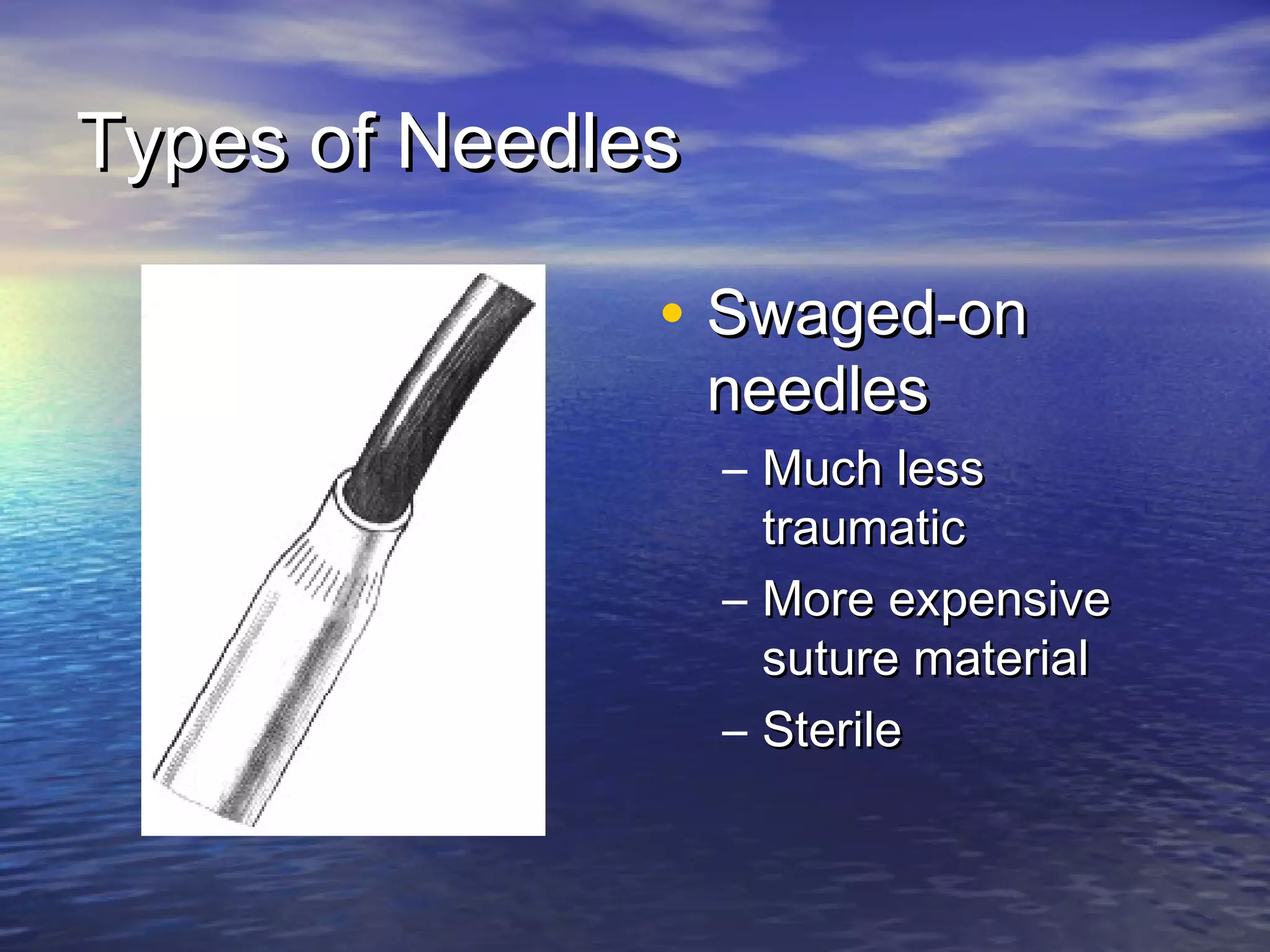
• Swaged-onSwaged-on
needlesneedles
– Much lessMuch less
traumatictraumatic
– More expensiveMore expensive
suture materialsuture material
– SterileSterile
Points of NeedlesPoints of Needles
• TaperTaper
– AtraumaticAtraumatic
– Internal organsInternal organs
Points of NeedlesPoints of Needles
• CuttingCutting
• Cutting edge onCutting edge on
inside of circleinside of circle
• SkinSkin
• TraumaticTraumatic
Points of NeedlesPoints of Needles
• Reverse CuttingReverse Cutting
• Cutting edge onCutting edge on
outside of circleoutside of circle
• SkinSkin
• Less traumaticLess traumatic
than cuttingthan cutting
Cutting vs Reverse CuttingCutting vs Reverse Cutting
• CuttingCutting
• ReverseReverse
cuttingcutting
Shapes of NeedlesShapes of Needles
• 3/8 circle3/8 circle
• 1/2 circle1/2 circle
• StraightStraight
• SpecialtySpecialty
Characteristics of Suture MaterialCharacteristics of Suture Material
• Absorbable Vs. NonabsorbableAbsorbable Vs. Nonabsorbable
• Monofilament Vs. MultifilamentMonofilament Vs. Multifilament
• Natural or SyntheticNatural or Synthetic
Absorbable SuturesAbsorbable Sutures
• InternalInternal
• Intradermal/ subcuticularIntradermal/ subcuticular
• Rarely on skinRarely on skin
Non-absorbable SutureNon-absorbable Suture
• Primarily SkinPrimarily Skin
– Needs to be removed laterNeeds to be removed later
• Stainless steel = exceptionStainless steel = exception
– Can be used internallyCan be used internally
• LigatureLigature
• OrthopedicsOrthopedics
– Can be left in place for long periodsCan be left in place for long periods
Reading the Suture LabelReading the Suture Label
• CompanyCompany
Needle
Size
Order Code
Name
Also:
LENGTH
NEEDLE
SYMBOL
COLOR
Absorbable
or Non
ChoosingChoosing
Absorbable Vs. NonabsorbableAbsorbable Vs. Nonabsorbable
• How long you need itHow long you need it
to workto work
• Do you want to seeDo you want to see
the animal again forthe animal again for
suture removalsuture removal
Monofilament Vs. MultifilamentMonofilament Vs. Multifilament
• memorymemory easy to handleeasy to handle
• less tissue dragless tissue drag more tissue dragmore tissue drag
• doesndoesn’’t wickt wick wicks/ bacteriawicks/ bacteria
• poor knot securitypoor knot security good knot securitygood knot security
• -- tissue reactiontissue reaction ++tissue reactiontissue reaction
Natural Vs. SyntheticNatural Vs. Synthetic
• Natural:Natural:
– GutGut
– Chromic GutChromic Gut
– SilkSilk
– CollagenCollagen
• All are absorbableAll are absorbable
Gut/ Chromic GutGut/ Chromic Gut
• Made of submucosaMade of submucosa
of small intestinesof small intestines
• MultifilamentMultifilament
• Breaks down byBreaks down by
phagocytosis:phagocytosis:
inflammatory reactioninflammatory reaction
commoncommon
Gut/ Chromic GutGut/ Chromic Gut
• Chromic: tanned, lastsChromic: tanned, lasts
longer, less reactivelonger, less reactive
• Easy handlingEasy handling
• Plain: 3-5 daysPlain: 3-5 days
• Chromic: 10-15 daysChromic: 10-15 days
• Bacteria love this stuff!Bacteria love this stuff!
Collagen and SilkCollagen and Silk
• Natural suturesNatural sutures
• VERY reactive,VERY reactive,
absorbableabsorbable
• Ophthalmic surgeryOphthalmic surgery
onlyonly
Vicryl (Polyglactin 910)Vicryl (Polyglactin 910)
• Braided, synthetic, absorbableBraided, synthetic, absorbable
• Stronger than gut: retains strengthStronger than gut: retains strength 33
weeksweeks
• Broken down by enzymes, notBroken down by enzymes, not
phagocytosisphagocytosis
• Break-down products inhibit bacterialBreak-down products inhibit bacterial
growthgrowth
– Can use in contaminated wounds, unlikeCan use in contaminated wounds, unlike
other multifilamentsother multifilaments
Dexon and PGADexon and PGA
• Polymer of glycolic acidsPolymer of glycolic acids
• Braided, synthetic, absorbableBraided, synthetic, absorbable
• Broken down by enzymesBroken down by enzymes
• Both PGA and dexon have increasedBoth PGA and dexon have increased
tissue drag, good knot securitytissue drag, good knot security
• Both are stronger than gutBoth are stronger than gut
PDS (polydioxine)PDS (polydioxine)
• Monofilament (less drag, worse knotMonofilament (less drag, worse knot
security – lots ofsecurity – lots of ““memorymemory””))
• Synthetic, absorbableSynthetic, absorbable
• Very good tensile strength (better thanVery good tensile strength (better than
gut, vicryl, dexon) whichgut, vicryl, dexon) which lasts monthslasts months
• Absorbed completely byAbsorbed completely by 182 days182 days
MMaxon (polyglyconate)axon (polyglyconate)
• MMonofilament-onofilament- mmemoryemory
• Synthetic AbsorbableSynthetic Absorbable
• Very little tissue dragVery little tissue drag
• Poor knot securityPoor knot security
• Very strongVery strong
NONABSORBABLE SUTURESNONABSORBABLE SUTURES
• Natural or SyntheticNatural or Synthetic
• Monofilament or multifilamentMonofilament or multifilament
NYLONNYLON
• SyntheticSynthetic
• Mono or MultifilamentMono or Multifilament
• MemoryMemory
• Very little tissue reactionVery little tissue reaction
• Poor knot securityPoor knot security
Polymerized CaprolactumPolymerized Caprolactum
• Vetafil, Braunamid, SupramidVetafil, Braunamid, Supramid
• Multifilament suture with protein coatingMultifilament suture with protein coating
• SyntheticSynthetic
• Good knot security, easy handlingGood knot security, easy handling
• Not very reactiveNot very reactive
• DonDon’’t use in contaminated woundt use in contaminated wound
• Usually comes on a reelUsually comes on a reel
PolypropylenePolypropylene
• Prolene, SurgileneProlene, Surgilene
• Monofilament, SyntheticMonofilament, Synthetic
• WonWon’’t lose tensile strength over timet lose tensile strength over time
• Good knot securityGood knot security
• Very little tissue reactionVery little tissue reaction
Stainless SteelStainless Steel
• MonofilamentMonofilament
• Strongest !Strongest !
• Great knot securityGreat knot security
• Difficult handlingDifficult handling
• Can cut through tissuesCan cut through tissues
• Very little tissue reaction, wonVery little tissue reaction, won’’t harbort harbor
bacteriabacteria
Suture SizesSuture Sizes
• Sized #5-4-3-2-1-0-00-000-0000…30-0Sized #5-4-3-2-1-0-00-000-0000…30-0
– BIGGER >>>>>>>>>>>>>>>>SMALLERBIGGER >>>>>>>>>>>>>>>>SMALLER
• 00 = 2-0,00 = 2-0, ““two oughttwo ought””
• SA : 0 through 3-0 (Optho 5-0 >>7-0)SA : 0 through 3-0 (Optho 5-0 >>7-0)
• LA : 0 through 3LA : 0 through 3
Suture Sizes (cont)Suture Sizes (cont)
• Stainless SteelStainless Steel
– In gauges (like needles)In gauges (like needles)
• Smaller gauge = bigger, strongerSmaller gauge = bigger, stronger
• Larger gauge= smaller, finerLarger gauge= smaller, finer
– 26 gauge =26 gauge = ““oughtought””
– 28 gauge = 2-028 gauge = 2-0
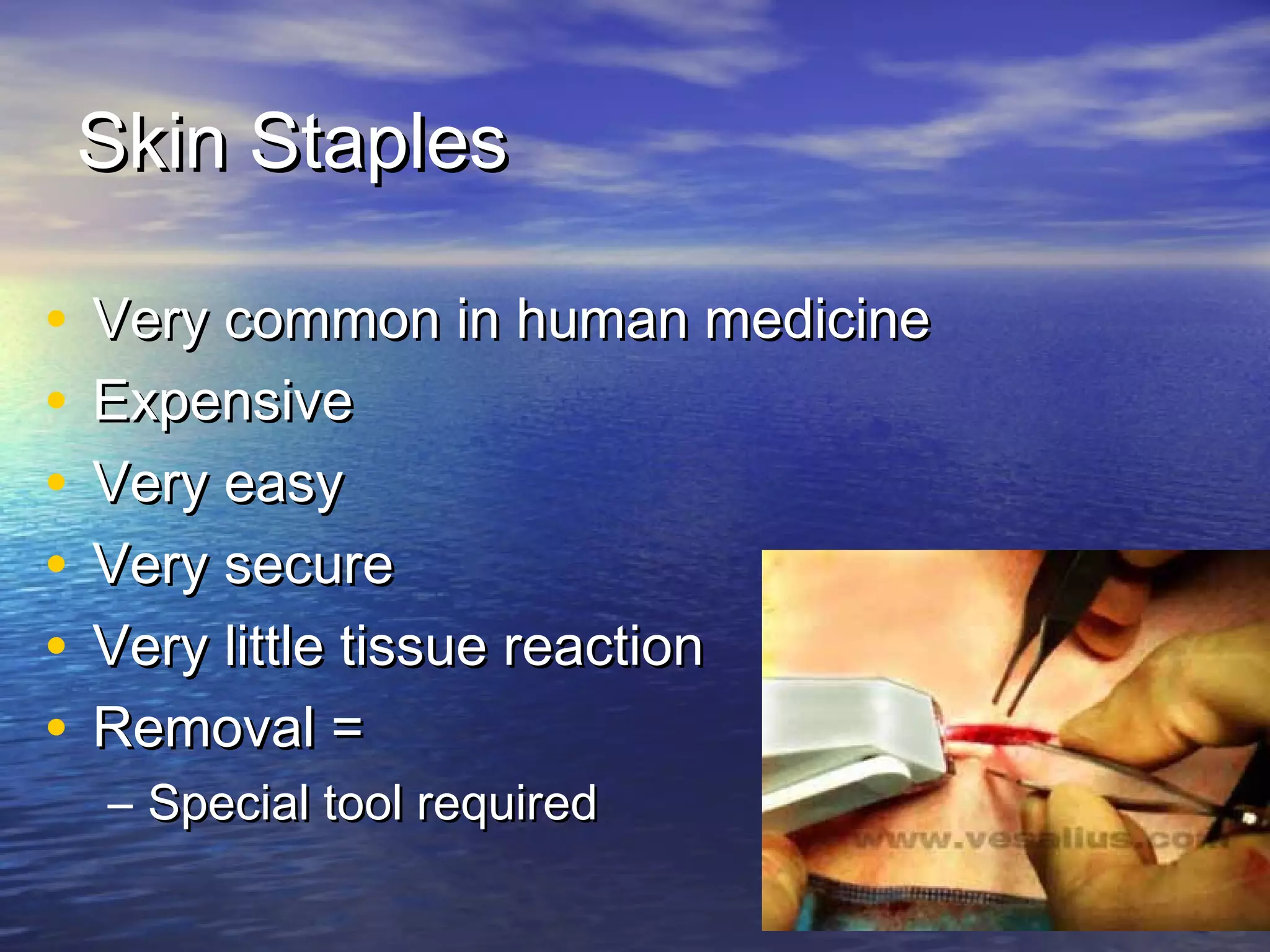
Skin StaplesSkin Staples
• Very common in human medicineVery common in human medicine
• ExpensiveExpensive
• Very easyVery easy
• Very secureVery secure
• Very little tissue reactionVery little tissue reaction
• Removal =Removal =
– Special tool requiredSpecial tool required
Tissue AdhesiveTissue Adhesive
• Nexaband, Vetbond,Nexaband, Vetbond,
and othersand others
• Little strengthLittle strength
• Should not be placedShould not be placed
between skin layersbetween skin layers
or inside bodyor inside body
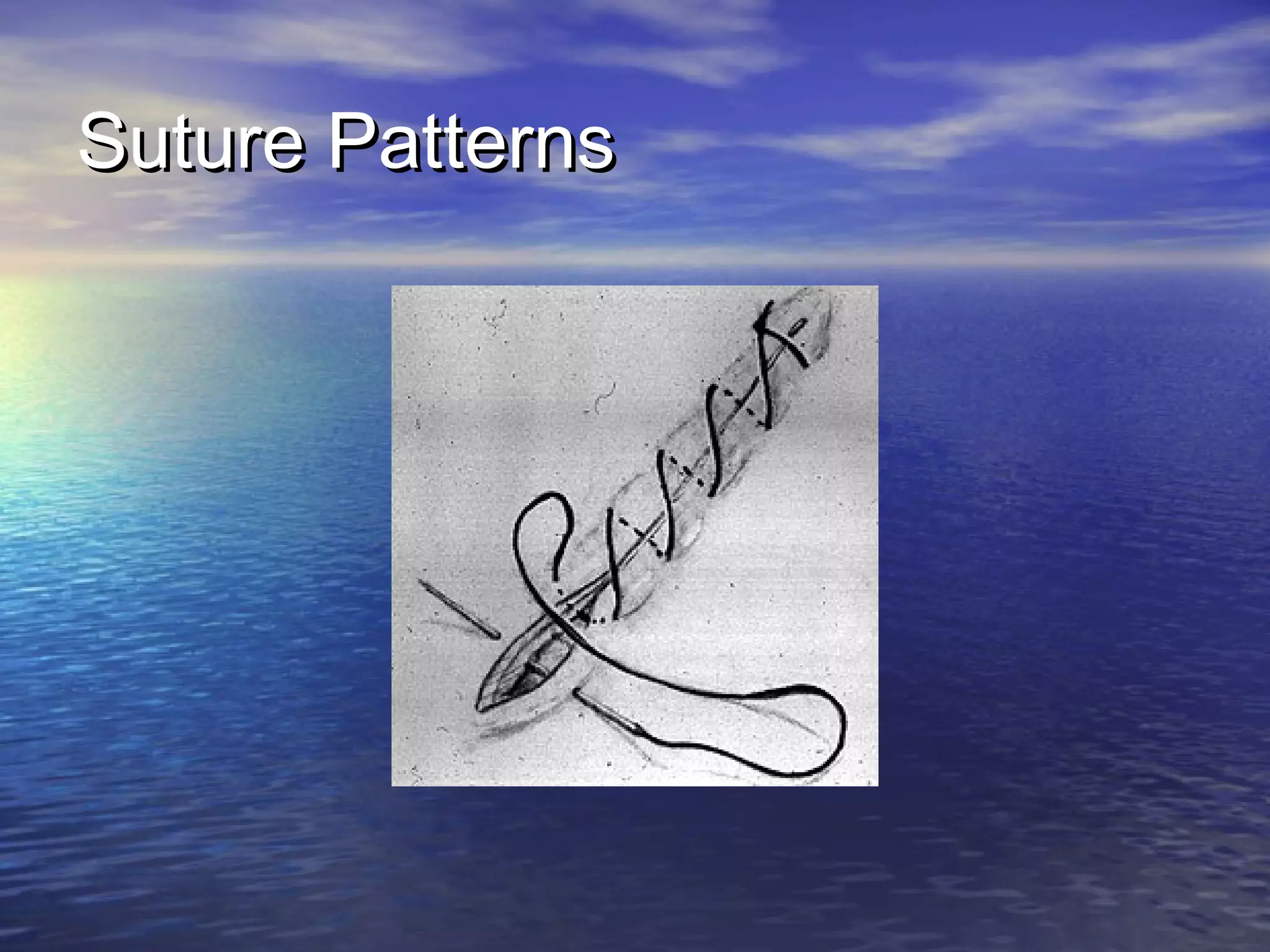
Suture PatternsSuture Patterns
Knot StrengthKnot Strength
• Generally 4Generally 4 ““throwsthrows”” for >90% knotfor >90% knot
security (nylon may need 5)security (nylon may need 5)
– LessLess ““throwsthrows”” = more likely to untie itself= more likely to untie itself
• Stainless steel = exception againStainless steel = exception again
– 22 ““throwsthrows”” = 99% knot security= 99% knot security
Simple InterruptedSimple Interrupted
Simple Interrupted Suture
Simple ContinuousSimple Continuous
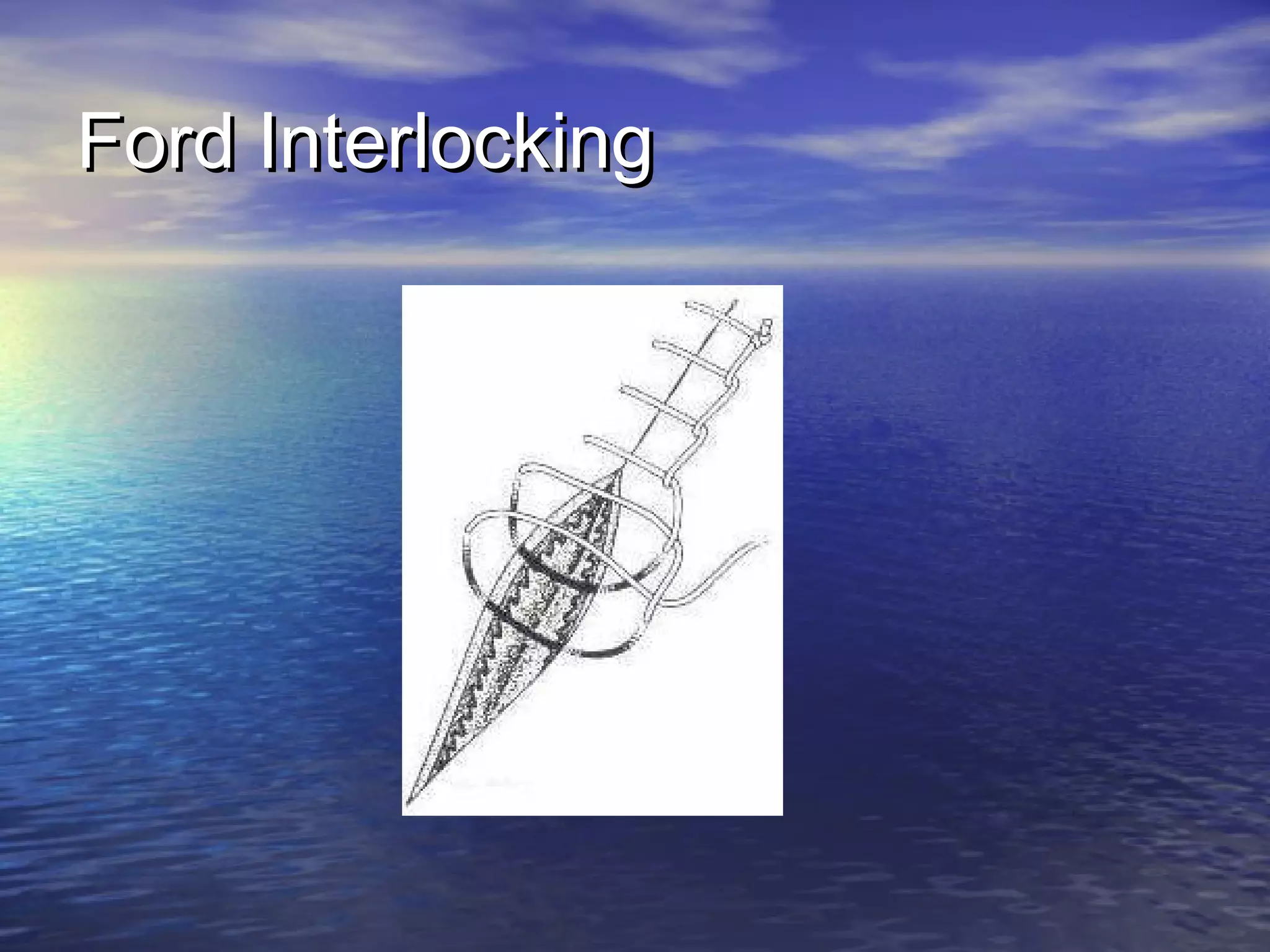
Ford InterlockingFord Interlocking
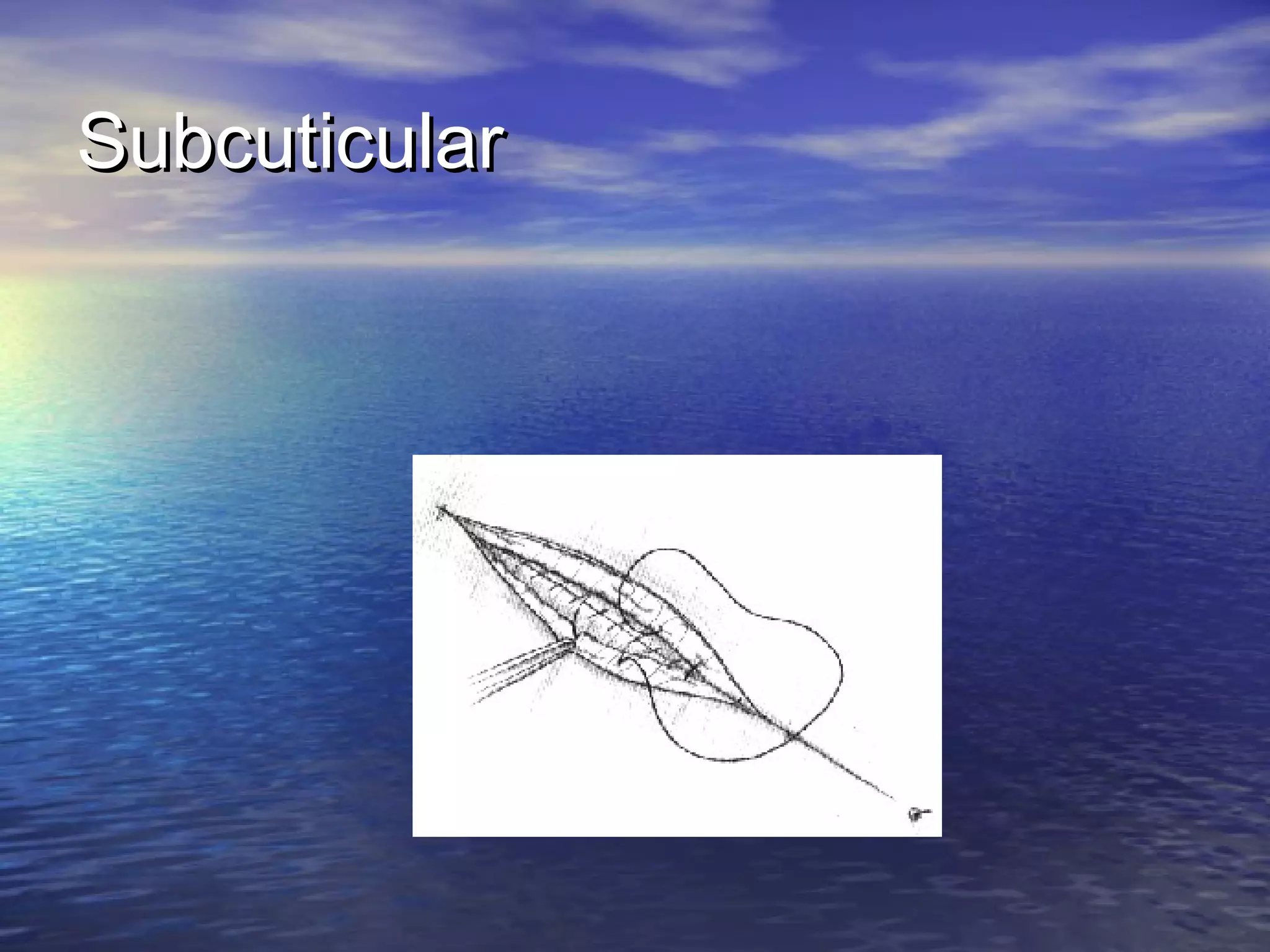
SubcuticularSubcuticular
http://cal.vet.upenn.edu/surgery/index.html

Ideal Suture for Surgeons

  • 1.
    SUTURE MATERIALS ANDSUTUREMATERIALS AND TECHNIQUESTECHNIQUES PROF. SREEJOY PATNAIK
  • 2.
    The Ideal SutureMaterialThe Ideal Suture Material • Can be used in any tissueCan be used in any tissue • Easy to handleEasy to handle • Good knot securityGood knot security • Minimal tissue reactionMinimal tissue reaction
  • 3.
    The Ideal SutureMaterialThe Ideal Suture Material • Unfriendly to bacteriaUnfriendly to bacteria • Strong yet smallStrong yet small • WonWon’’t tear through tissuest tear through tissues • CheapCheap
  • 4.
    WhatWhat’’s It Usedfor?s It Used for? • To bring tissue edges together and speedTo bring tissue edges together and speed wound healing (=tissue apposition)wound healing (=tissue apposition) • Orthopedic surgery to help stabilize jointsOrthopedic surgery to help stabilize joints – Repair ligamentsRepair ligaments • Ligate vessels or tissuesLigate vessels or tissues
  • 5.
    Types of NeedlesTypesof Needles • Eyed needlesEyed needles – More TraumaticMore Traumatic – Only threadOnly thread through oncethrough once – Suture on a reelSuture on a reel – Tends toTends to unthread itselfunthread itself easilyeasily
  • 6.
    Types of NeedlesTypesof Needles • Swaged-onSwaged-on needlesneedles – Much lessMuch less traumatictraumatic – More expensiveMore expensive suture materialsuture material – SterileSterile
  • 7.
    Points of NeedlesPointsof Needles • TaperTaper – AtraumaticAtraumatic – Internal organsInternal organs
  • 8.
    Points of NeedlesPointsof Needles • CuttingCutting • Cutting edge onCutting edge on inside of circleinside of circle • SkinSkin • TraumaticTraumatic
  • 9.
    Points of NeedlesPointsof Needles • Reverse CuttingReverse Cutting • Cutting edge onCutting edge on outside of circleoutside of circle • SkinSkin • Less traumaticLess traumatic than cuttingthan cutting
  • 10.
    Cutting vs ReverseCuttingCutting vs Reverse Cutting • CuttingCutting • ReverseReverse cuttingcutting
  • 11.
    Shapes of NeedlesShapesof Needles • 3/8 circle3/8 circle • 1/2 circle1/2 circle • StraightStraight • SpecialtySpecialty
  • 12.
    Characteristics of SutureMaterialCharacteristics of Suture Material • Absorbable Vs. NonabsorbableAbsorbable Vs. Nonabsorbable • Monofilament Vs. MultifilamentMonofilament Vs. Multifilament • Natural or SyntheticNatural or Synthetic
  • 13.
    Absorbable SuturesAbsorbable Sutures •InternalInternal • Intradermal/ subcuticularIntradermal/ subcuticular • Rarely on skinRarely on skin
  • 14.
    Non-absorbable SutureNon-absorbable Suture •Primarily SkinPrimarily Skin – Needs to be removed laterNeeds to be removed later • Stainless steel = exceptionStainless steel = exception – Can be used internallyCan be used internally • LigatureLigature • OrthopedicsOrthopedics – Can be left in place for long periodsCan be left in place for long periods
  • 16.
    Reading the SutureLabelReading the Suture Label • CompanyCompany Needle Size Order Code Name Also: LENGTH NEEDLE SYMBOL COLOR Absorbable or Non
  • 17.
    ChoosingChoosing Absorbable Vs. NonabsorbableAbsorbableVs. Nonabsorbable • How long you need itHow long you need it to workto work • Do you want to seeDo you want to see the animal again forthe animal again for suture removalsuture removal
  • 18.
    Monofilament Vs. MultifilamentMonofilamentVs. Multifilament • memorymemory easy to handleeasy to handle • less tissue dragless tissue drag more tissue dragmore tissue drag • doesndoesn’’t wickt wick wicks/ bacteriawicks/ bacteria • poor knot securitypoor knot security good knot securitygood knot security • -- tissue reactiontissue reaction ++tissue reactiontissue reaction
  • 19.
    Natural Vs. SyntheticNaturalVs. Synthetic • Natural:Natural: – GutGut – Chromic GutChromic Gut – SilkSilk – CollagenCollagen • All are absorbableAll are absorbable
  • 20.
    Gut/ Chromic GutGut/Chromic Gut • Made of submucosaMade of submucosa of small intestinesof small intestines • MultifilamentMultifilament • Breaks down byBreaks down by phagocytosis:phagocytosis: inflammatory reactioninflammatory reaction commoncommon
  • 21.
    Gut/ Chromic GutGut/Chromic Gut • Chromic: tanned, lastsChromic: tanned, lasts longer, less reactivelonger, less reactive • Easy handlingEasy handling • Plain: 3-5 daysPlain: 3-5 days • Chromic: 10-15 daysChromic: 10-15 days • Bacteria love this stuff!Bacteria love this stuff!
  • 22.
    Collagen and SilkCollagenand Silk • Natural suturesNatural sutures • VERY reactive,VERY reactive, absorbableabsorbable • Ophthalmic surgeryOphthalmic surgery onlyonly
  • 23.
    Vicryl (Polyglactin 910)Vicryl(Polyglactin 910) • Braided, synthetic, absorbableBraided, synthetic, absorbable • Stronger than gut: retains strengthStronger than gut: retains strength 33 weeksweeks • Broken down by enzymes, notBroken down by enzymes, not phagocytosisphagocytosis • Break-down products inhibit bacterialBreak-down products inhibit bacterial growthgrowth – Can use in contaminated wounds, unlikeCan use in contaminated wounds, unlike other multifilamentsother multifilaments
  • 24.
    Dexon and PGADexonand PGA • Polymer of glycolic acidsPolymer of glycolic acids • Braided, synthetic, absorbableBraided, synthetic, absorbable • Broken down by enzymesBroken down by enzymes • Both PGA and dexon have increasedBoth PGA and dexon have increased tissue drag, good knot securitytissue drag, good knot security • Both are stronger than gutBoth are stronger than gut
  • 25.
    PDS (polydioxine)PDS (polydioxine) •Monofilament (less drag, worse knotMonofilament (less drag, worse knot security – lots ofsecurity – lots of ““memorymemory””)) • Synthetic, absorbableSynthetic, absorbable • Very good tensile strength (better thanVery good tensile strength (better than gut, vicryl, dexon) whichgut, vicryl, dexon) which lasts monthslasts months • Absorbed completely byAbsorbed completely by 182 days182 days
  • 26.
    MMaxon (polyglyconate)axon (polyglyconate) •MMonofilament-onofilament- mmemoryemory • Synthetic AbsorbableSynthetic Absorbable • Very little tissue dragVery little tissue drag • Poor knot securityPoor knot security • Very strongVery strong
  • 27.
    NONABSORBABLE SUTURESNONABSORBABLE SUTURES •Natural or SyntheticNatural or Synthetic • Monofilament or multifilamentMonofilament or multifilament
  • 28.
    NYLONNYLON • SyntheticSynthetic • Monoor MultifilamentMono or Multifilament • MemoryMemory • Very little tissue reactionVery little tissue reaction • Poor knot securityPoor knot security
  • 29.
    Polymerized CaprolactumPolymerized Caprolactum •Vetafil, Braunamid, SupramidVetafil, Braunamid, Supramid • Multifilament suture with protein coatingMultifilament suture with protein coating • SyntheticSynthetic • Good knot security, easy handlingGood knot security, easy handling • Not very reactiveNot very reactive • DonDon’’t use in contaminated woundt use in contaminated wound • Usually comes on a reelUsually comes on a reel
  • 30.
    PolypropylenePolypropylene • Prolene, SurgileneProlene,Surgilene • Monofilament, SyntheticMonofilament, Synthetic • WonWon’’t lose tensile strength over timet lose tensile strength over time • Good knot securityGood knot security • Very little tissue reactionVery little tissue reaction
  • 31.
    Stainless SteelStainless Steel •MonofilamentMonofilament • Strongest !Strongest ! • Great knot securityGreat knot security • Difficult handlingDifficult handling • Can cut through tissuesCan cut through tissues • Very little tissue reaction, wonVery little tissue reaction, won’’t harbort harbor bacteriabacteria
  • 32.
    Suture SizesSuture Sizes •Sized #5-4-3-2-1-0-00-000-0000…30-0Sized #5-4-3-2-1-0-00-000-0000…30-0 – BIGGER >>>>>>>>>>>>>>>>SMALLERBIGGER >>>>>>>>>>>>>>>>SMALLER • 00 = 2-0,00 = 2-0, ““two oughttwo ought”” • SA : 0 through 3-0 (Optho 5-0 >>7-0)SA : 0 through 3-0 (Optho 5-0 >>7-0) • LA : 0 through 3LA : 0 through 3
  • 33.
    Suture Sizes (cont)SutureSizes (cont) • Stainless SteelStainless Steel – In gauges (like needles)In gauges (like needles) • Smaller gauge = bigger, strongerSmaller gauge = bigger, stronger • Larger gauge= smaller, finerLarger gauge= smaller, finer – 26 gauge =26 gauge = ““oughtought”” – 28 gauge = 2-028 gauge = 2-0
  • 34.
    Skin StaplesSkin Staples •Very common in human medicineVery common in human medicine • ExpensiveExpensive • Very easyVery easy • Very secureVery secure • Very little tissue reactionVery little tissue reaction • Removal =Removal = – Special tool requiredSpecial tool required
  • 35.
    Tissue AdhesiveTissue Adhesive •Nexaband, Vetbond,Nexaband, Vetbond, and othersand others • Little strengthLittle strength • Should not be placedShould not be placed between skin layersbetween skin layers or inside bodyor inside body
  • 36.
  • 37.
    Knot StrengthKnot Strength •Generally 4Generally 4 ““throwsthrows”” for >90% knotfor >90% knot security (nylon may need 5)security (nylon may need 5) – LessLess ““throwsthrows”” = more likely to untie itself= more likely to untie itself • Stainless steel = exception againStainless steel = exception again – 22 ““throwsthrows”” = 99% knot security= 99% knot security
  • 38.
  • 39.
  • 40.
  • 41.
  • 42.