World War I

                 “The Great War”

                   1914-1918

Ms. Carpenter
Duluth Middle
Social Studies
Rivalry Between Nations
   Industrialization created rivalries among European
    countries.
   Great Britain, France, Germany, and other European
    countries needed natural resources for their factories.
   They also needed markets were they could sell their
    products.
   Imperialism: European countries claimed land in Africa
    and Asia to set up colonies.
   European countries also built up large armies and
    navies to protect their empires.
   Countries formed alliances with one another and
    agreed to support one another in times of war.
World War I
Why did it start?
   nationalism, colonialism,
    and alliances

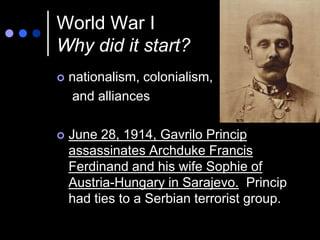
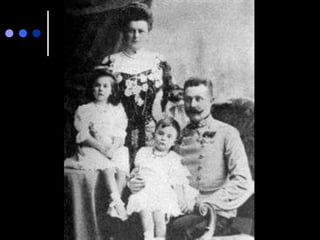
   June 28, 1914, Gavrilo Princip
    assassinates Archduke Francis
    Ferdinand and his wife Sophie of
    Austria-Hungary in Sarajevo. Princip
    had ties to a Serbian terrorist group.
World War I
         Who fought whom?
   July 23rd: Austria-Hungary declares war on Serbia
    because of assassination and Germany agrees to
    support Austria-Hungary.
   August 3-4: Germany declares war on Russia, France,
    and Belgium.
   August 4: Great Britain declares war on Germany.
   August 6: Austria-Hungary declares war on Russia.
   August 10:France declares war on Austria-Hungary.
   August 12: Great Britain declares war on Austria-
    Hungary.
   January 31,1917: Germans resume unrestricted U-boat
    attacks
   April 6,1917: USA declares war on Germany in
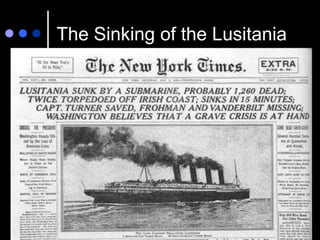
    retaliation for the sinking of the Lusitania cruise ship on
    May 7, 1915 and the resumption of unrestricted warfare.
World War I
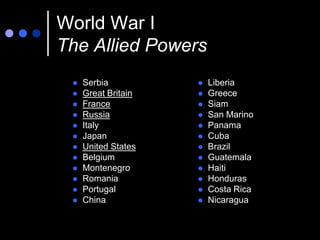
The Allied Powers
    Serbia             Liberia
    Great Britain      Greece
    France             Siam
    Russia             San Marino
    Italy              Panama
    Japan              Cuba
    United States      Brazil
    Belgium            Guatemala
    Montenegro         Haiti
    Romania            Honduras
    Portugal           Costa Rica
    China              Nicaragua
World War I
The Central Powers

  Austria-Hungary
  Germany
  Bulgaria
  Ottoman Empire (Turkey)
World War I
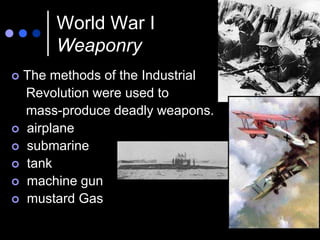
      Weaponry
 The methods of the Industrial
  Revolution were used to
  mass-produce deadly weapons.
 airplane
 submarine
 tank
 machine gun
 mustard Gas
When did the U.S. enter the
           war?
   United States President Woodrow Wilson
    declared a U.S. policy of absolute neutrality,
    an official stance that would last until 1917
    when Germany's policy of unrestricted
    submarine warfare - which seriously
    threatened America's commercial shipping
    forced the U.S. to finally enter the war on 6
    April 1917.
The Sinking of the Lusitania
The War on the Home ront

 George M. Cohen's “Over There”
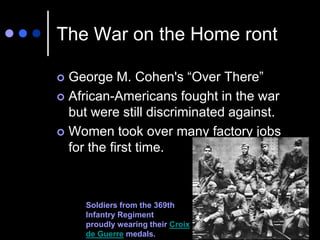
 African-Americans fought in the war
  but were still discriminated against.
 Women took over many factory jobs
  for the first time.


     Soldiers from the 369th
     Infantry Regiment
     proudly wearing their Croix
     de Guerre medals.
World War I
Where did they fight?
 In Europe, trench warfare developed,
  especially along the western front
  between France and Germany.
 in northern Africa
 in the skies above Europe - “dog
  fights” between planes
 in the Atlantic, with Germany’s
  unrestricted warfare and dangerous
  U-boats
World War I
How did it end?
   American troops arrived in Europe and
    Africa.
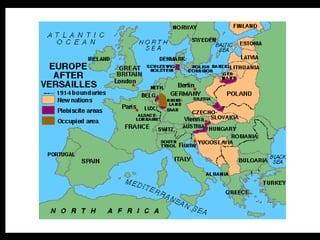
   Paris Peace Conference
   Treaty of Versailles
   The Big Four
       Woodrow Wilson, American President
       David Lloyd George, British Prime Minister
       Georges Clemenceau, French Premier
       Vittorio Orlando, Italian Premier
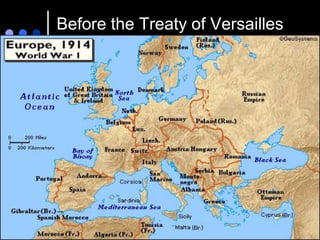
Before the Treaty of Versailles
World War I
The Effects
   Russian Revolution – 1917 revolution
    begun by Vladimir Lenin and led to a
    communist government in Russia
   Germany was blamed for starting the war
    and was asked to pay for the damage
    leaving the country in financial ruins.
   The Austrian-Hungarian empire was
    dismantled.
   The Ottoman Empire was destroyed.
   World War II

World war i ppt

  • 1.
    World War I “The Great War” 1914-1918 Ms. Carpenter Duluth Middle Social Studies
  • 2.
    Rivalry Between Nations  Industrialization created rivalries among European countries.  Great Britain, France, Germany, and other European countries needed natural resources for their factories.  They also needed markets were they could sell their products.  Imperialism: European countries claimed land in Africa and Asia to set up colonies.  European countries also built up large armies and navies to protect their empires.  Countries formed alliances with one another and agreed to support one another in times of war.
  • 3.
    World War I Whydid it start?  nationalism, colonialism, and alliances  June 28, 1914, Gavrilo Princip assassinates Archduke Francis Ferdinand and his wife Sophie of Austria-Hungary in Sarajevo. Princip had ties to a Serbian terrorist group.
  • 5.
    World War I Who fought whom?  July 23rd: Austria-Hungary declares war on Serbia because of assassination and Germany agrees to support Austria-Hungary.  August 3-4: Germany declares war on Russia, France, and Belgium.  August 4: Great Britain declares war on Germany.  August 6: Austria-Hungary declares war on Russia.  August 10:France declares war on Austria-Hungary.  August 12: Great Britain declares war on Austria- Hungary.  January 31,1917: Germans resume unrestricted U-boat attacks  April 6,1917: USA declares war on Germany in retaliation for the sinking of the Lusitania cruise ship on May 7, 1915 and the resumption of unrestricted warfare.
  • 6.
    World War I TheAllied Powers  Serbia  Liberia  Great Britain  Greece  France  Siam  Russia  San Marino  Italy  Panama  Japan  Cuba  United States  Brazil  Belgium  Guatemala  Montenegro  Haiti  Romania  Honduras  Portugal  Costa Rica  China  Nicaragua
  • 7.
    World War I TheCentral Powers  Austria-Hungary  Germany  Bulgaria  Ottoman Empire (Turkey)
  • 8.
    World War I Weaponry  The methods of the Industrial Revolution were used to mass-produce deadly weapons.  airplane  submarine  tank  machine gun  mustard Gas
  • 9.
    When did theU.S. enter the war?  United States President Woodrow Wilson declared a U.S. policy of absolute neutrality, an official stance that would last until 1917 when Germany's policy of unrestricted submarine warfare - which seriously threatened America's commercial shipping forced the U.S. to finally enter the war on 6 April 1917.
  • 10.
    The Sinking ofthe Lusitania
  • 11.
    The War onthe Home ront  George M. Cohen's “Over There”  African-Americans fought in the war but were still discriminated against.  Women took over many factory jobs for the first time. Soldiers from the 369th Infantry Regiment proudly wearing their Croix de Guerre medals.
  • 13.
    World War I Wheredid they fight?  In Europe, trench warfare developed, especially along the western front between France and Germany.  in northern Africa  in the skies above Europe - “dog fights” between planes  in the Atlantic, with Germany’s unrestricted warfare and dangerous U-boats
  • 14.
    World War I Howdid it end?  American troops arrived in Europe and Africa.  Paris Peace Conference  Treaty of Versailles  The Big Four  Woodrow Wilson, American President  David Lloyd George, British Prime Minister  Georges Clemenceau, French Premier  Vittorio Orlando, Italian Premier
  • 15.
    Before the Treatyof Versailles
  • 17.
    World War I TheEffects  Russian Revolution – 1917 revolution begun by Vladimir Lenin and led to a communist government in Russia  Germany was blamed for starting the war and was asked to pay for the damage leaving the country in financial ruins.  The Austrian-Hungarian empire was dismantled.  The Ottoman Empire was destroyed.  World War II