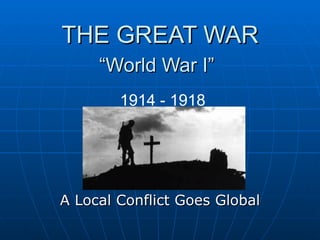
THE GREAT WAR “World War I”   A Local Conflict Goes Global 1914 - 1918
“ MANIA ” Underlying causes of WWI: M ilitarism  A lliances  N ationalism  I mperialism  A narchy (international)
Militarism Glorification of War & Military  Build up of large reserve armies Mobilization  - organize resources for combat (triggers other nations mobilizing)  Naval Expansion  – Kaiser Wilhelm II (GR) fires Bismarck and expands navy  wants to be equal to G.B.  (most powerful)  G.B. feels threatened, expands, develops new battleship - Dreadnought
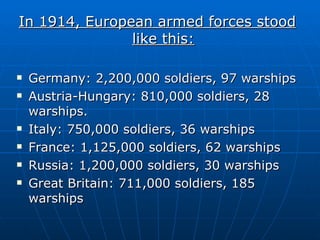
In 1914, European armed forces stood like this: Germany: 2,200,000 soldiers, 97 warships Austria-Hungary: 810,000 soldiers, 28 warships. Italy: 750,000 soldiers, 36 warships France: 1,125,000 soldiers, 62 warships Russia: 1,200,000 soldiers, 30 warships Great Britain: 711,000 soldiers, 185 warships
Another thing the countries of Europe did was to train  all  their young men so that if there was a war they could call, not only on the  standing army , but on huge numbers of trained reservists!!!
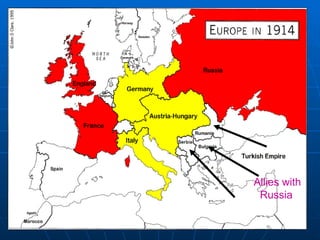
Alliances Defense Agreements Among Nations Triple Alliance  - (1882)  Germany, Italy, Austria-Hungary  - attempt to isolate France  Triple Entente  - (1907)  France, Russia, Great Britian Entente :   Friendly understanding between nations
Nationalism Extreme pride in one’s nation or desire to form a nation French Nationalists sought revenge against Germany for loss of Alsace-Lorraine Slavic Nationalism -  Pan-Slavism :  Unify all Slavic people under one empire
Land of Hope and Glory,  mother of the free... God who made thee mighty,  make thee mightier yet. Land of Hope and Glory (Great Britain) Germany, Germany above all, over everything in the world, When it steadfastly holds together, offensively and defensively. German National Anthem
Imperialism Domination of one country by another  Countries who believed that they were superior thought it was alright to conquer and rule others – particularly if they were inhabited by races they thought were inferior
Anarchy Nations of Europe pursue policies without regard for the wishes of their neighbors Land freaks!!! No democracies! Crisis - No international organization to monitor
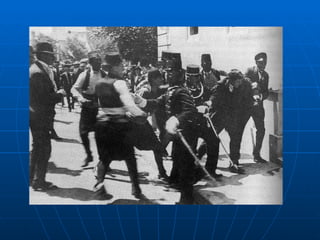
Immediate Causes of WWI Assassination of Archduke Francis Ferdinand  Austria-Hungarian June 28, 1914 Sarajevo Killed by Gavrilo Princip - member of Serbian nationalist group called the “Black Hand”
 
Why assassinated? Ferdinand planned to give Slavs of Bosnia-Herzegovina a voice in the gov’t equal to that of Austria-Hungarians  This  threatened  the movement for a separate Slavic state
What happens next? A-H hold Serbians responsible  A-H seeks assurance (backup) from Germany in event of war  Germany issues “Blank Check” to A-H  Kaiser Wilhelm II gives full support to any actions A-H might take against Serbia
Tension!!! A-H issues  ultimatum  to Serbia  set of final conditions that must be accepted to avoid severe consequences Demands that Serbia allow A-H officials into country to suppress all rebellious movements & conduct investigation  Gives Serbia 48 hours to agree or face war  Serbia does not agree to all parts  A-H declares war on Serbia! (July 28, 1914)
Other Countries Get Involved Russia (friend of the Serbs) mobilizes troops along borders of Germany & A-H  Germany warns Russia to stop - they don’t!  Germany issues ultimatum to France – 18 hours to decide if it would support Russia – France implies it would support Russia
Allies with Russia
Declarations of War Germany declares war on Russia  Aug 1, 1914 Germany declares war on France  Aug 3, 1914 Great Britain still hoped to remain neutral and not go to war, but…
Germany Invades Belgium! Germany demands passage across Belgium to fight France  (*Part of Schlieffen Plan)  British protest demand made by Germany upon  neutral  nation of Belgium  1839 Treaty signed by G.B., Russia, France & Germany guaranteed Belgium’s neutrality
Germany invades Belgium anyway G.B. demands they withdraw  Germany responds calling treaty “ a scrap of paper”  G.B. declares war on Germany  Aug 4, 1914
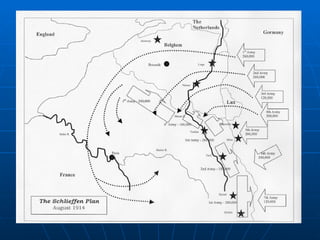
The Schlieffen Plan  Germany’s invasion of Belgium was part of this plan Germany had enemies to East & West &  did not want to fight a war on both fronts at the same time  Believed Russia would be slow to mobilize and that they could fight & defeat France (W. Front) first in 6 weeks & then fight Russia on Eastern Front
 
developed by Germany’s Chief of General Staff Count von Schlieffen Invade France in one crushing blow based on the fact that France did not build any of their defense systems along the  Belgium  border thus leaving the backdoor to France wide open Von Schlieffen calculated that it would take Russia at least six weeks to organize its large Army for an attack on Germany. Schlieffen's plan involved using 90% of Germany's armed forces to attack France
Allies vs. Central Powers Allies Great Britain Russia Italy France United States – April 6, 1917 Central Powers Germany Austria-Hungary Turkey Bulgaria
Expectations Both sides thought the war would be a quick ordeal…  Kaiser told his soldiers, “you’ll be home before the leaves have fallen from the trees.”  They underestimated the role industrialization would play in this war – development of weapons Russia, because of its size was considered a “steamroller” – how untrue!
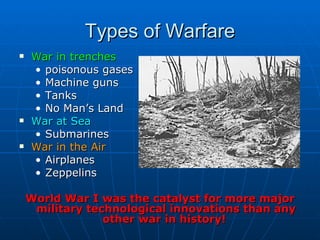
Types of Warfare War in trenches poisonous gases Machine guns Tanks No Man’s Land War at Sea Submarines War in the Air Airplanes Zeppelins World War I was the catalyst for more major military technological innovations than any other war in history!
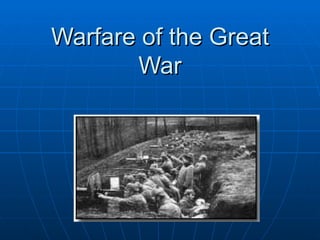
Warfare of the Great War
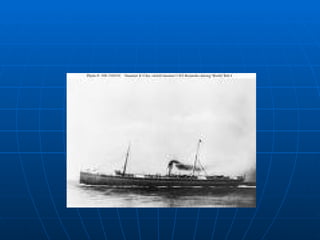
War of the Sea Royal Navy Merchant ships Cargo ships Plant underwater mines
 
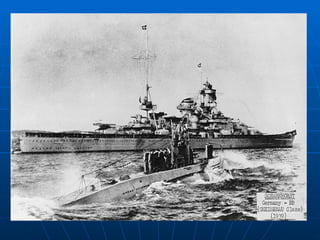
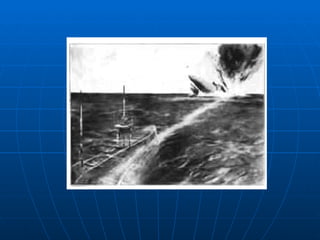
U-Boat Unterseeboot – German term  Attacked merchant convoys bringing supplies to Allied forces from US and Canada Sank three American merchant ships in 1917 – prompting US to enter war
 
Torpedoes Torpedoes were used by submarines The Germans used torpedoes to blow up ships carrying supplies from America to Britain The Germans torpedoed the passenger liner Lusitania on May  7th , 1915 1,195 lives are lost Americans were outraged and joined the war in 1917 on the side of the allies.
 
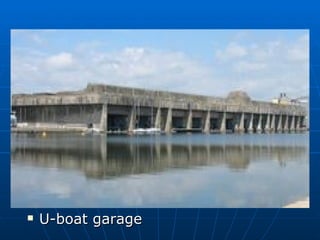
U-boat garage
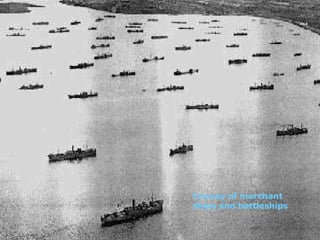
Convoy of merchant ships and battleships
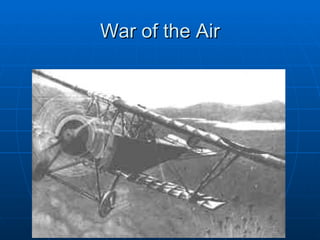
War of the Air
Planes Used to deliver bombs Spy work Later became fighter aircraft armed with machine guns, bombs and some times cannons Dogfights Fights between two planes in the sky
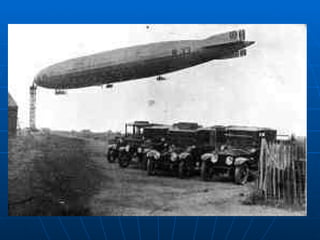
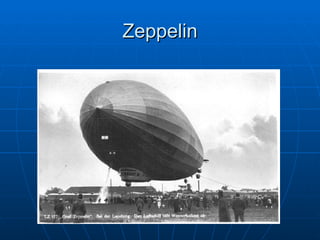
Zeppelin
Blimp Greatly used by Germans Used for passenger transport and military purposes Bombing, machine guns, and scouting Not very successful! Vulnerable to gunfire Most successful as reconnaissance – lead German ships to Allied ships in Sea
 
 
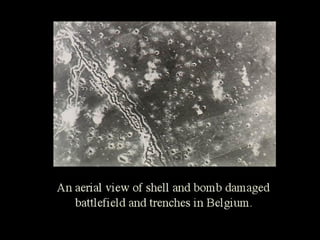
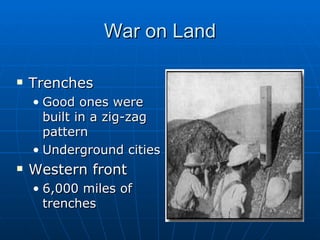
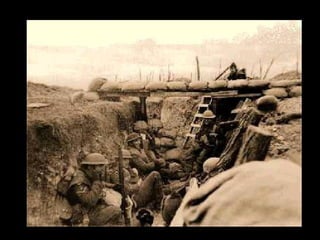
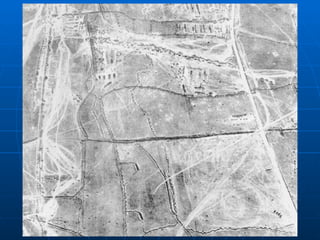
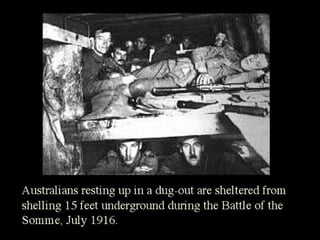
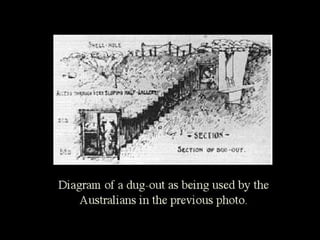
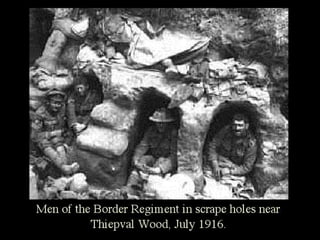
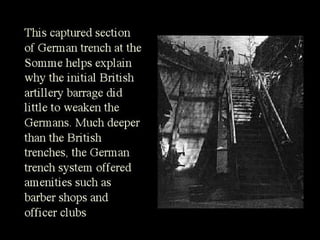
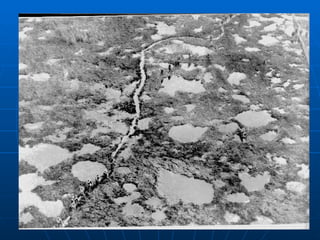
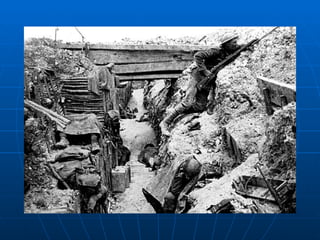
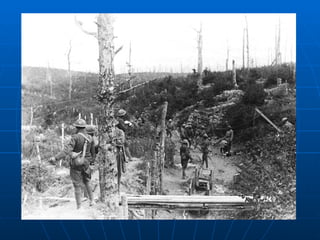
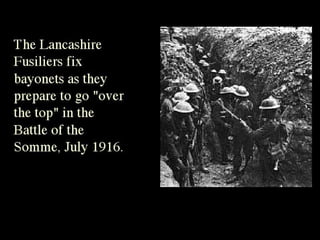
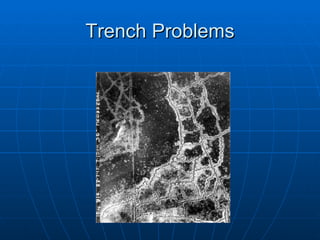
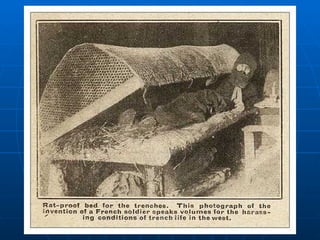
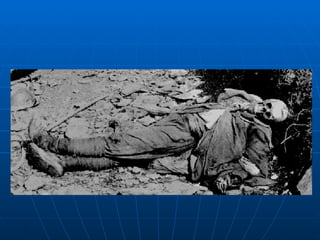
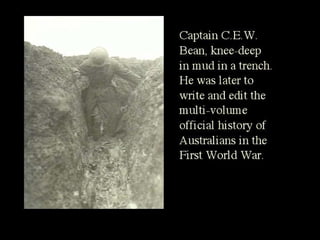
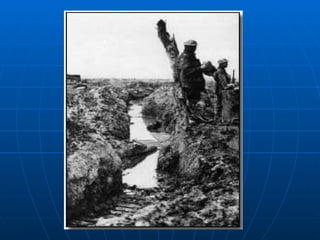
War on Land Trenches Good ones were built in a zig-zag pattern Underground cities Western front 6,000 miles of trenches


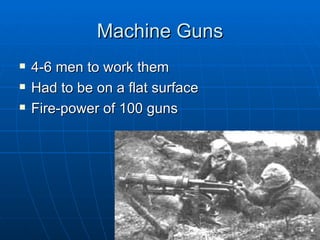
Machine Guns 4-6 men to work them Had to be on a flat surface Fire-power of 100 guns
 
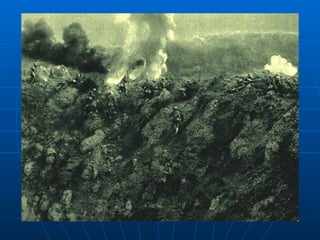
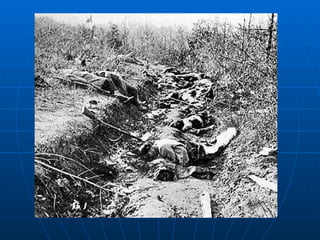
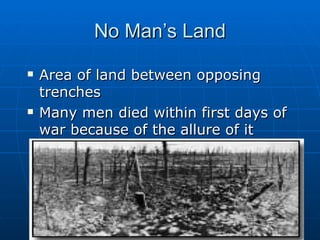
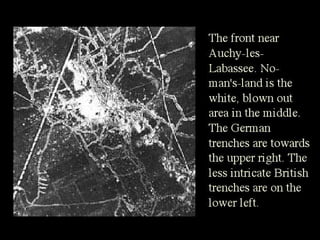
No Man’s Land Area of land between opposing trenches Many men died within first days of war because of the allure of it (peering over the edge – sniper bullet)


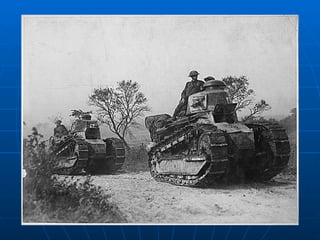
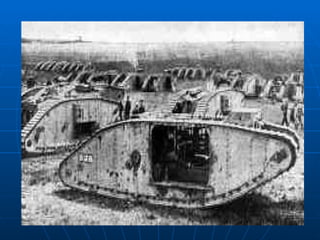
Tanks “ Little Willie” Daimler engine (Chrysler), caterpillar track, crew of 3 Maximum speed was 3mph COULD NOT cross trenches End of War – modernized tank Fits 10 men Revolving turret (gun) 4mph


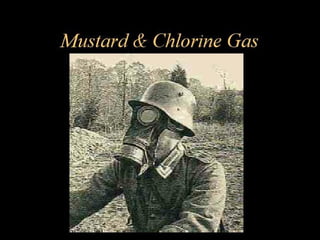
Chlorine German army were the first to use chlorine gas in 1915 Chlorine gas causes a burning sensation in the throat and chest pains Death is painful - you suffocate!  The problem with chlorine gas is that the weather must be right. If the wind is in the wrong direction it could end up killing your own troops rather than the enemy
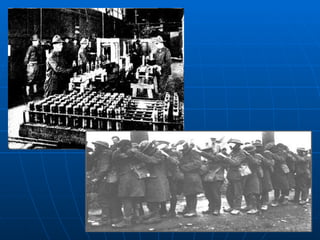
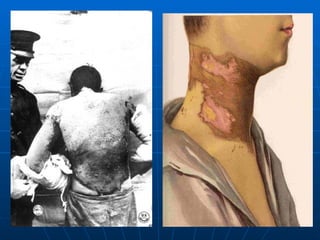
Mustard Gas Mustard gas was the most deadly weapon used Fired into the trenches in shells Colorless and takes 12 hours to take effect Effects include: blistering skin, vomiting, sore eyes, internal and external bleeding Very painful – victims had to be tied to bed! Death can take up to 5 weeks Remain in soil for several more weeks
 
 
Trench Problems
 
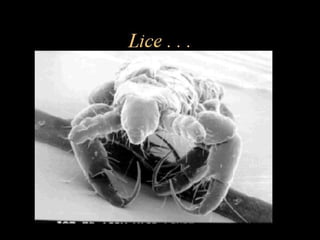
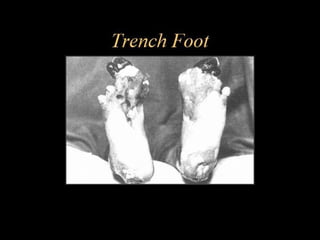
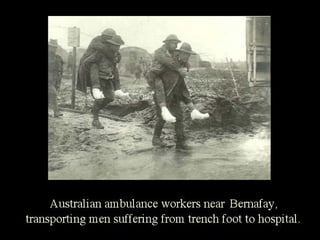
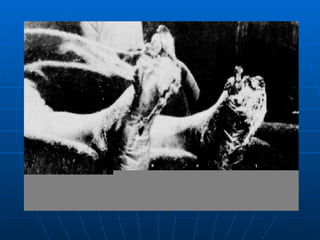
Lice Would breed in the seams of filthy clothing (warm areas) and cause uncontrollable itching  Lice caused Trench Fever painful disease that began suddenly with severe pain followed by high fever Recovery - away from the trenches - took up to twelve weeks.   Lice were not actually identified as the culprit of Trench Fever until 1918
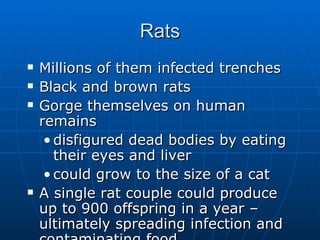
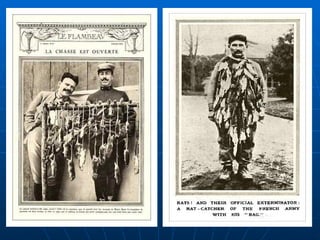
Rats Millions of them infected trenches Black and brown rats Gorge themselves on human remains disfigured dead bodies by eating their eyes and liver could grow to the size of a cat  A single rat couple could produce up to 900 offspring in a year – ultimately spreading infection and contaminating food.


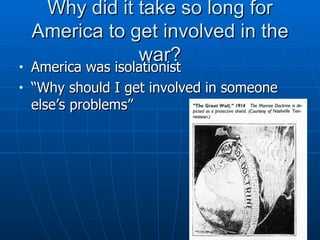
Why did it take so long for America to get involved in the war? America was isolationist  “ Why should I get involved in someone else’s problems”
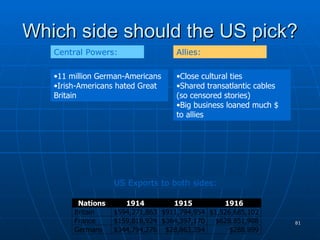
Which side should the US pick? 11 million German-Americans  Irish-Americans hated Great Britain Close cultural ties  Shared transatlantic cables (so censored stories) Big business loaned much $ to allies Central Powers: Allies: US Exports to both sides:
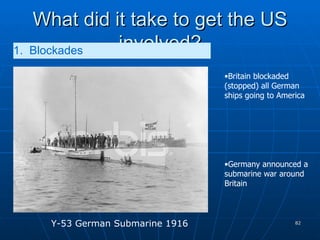
What did it take to get the US involved? 1.  Blockades   Britain blockaded (stopped) all German ships going to America Germany announced a submarine war around Britain Y-53 German Submarine 1916
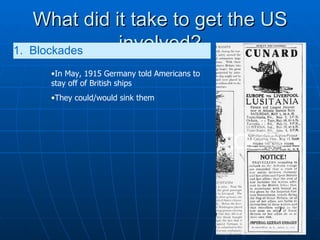
What did it take to get the US involved? 1.  Blockades   In May, 1915 Germany told Americans to stay off of British ships They could/would sink them
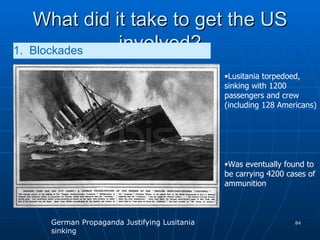
What did it take to get the US involved? 1.  Blockades   Lusitania torpedoed, sinking with 1200 passengers and crew (including 128 Americans) Was eventually found to be carrying 4200 cases of ammunition German Propaganda Justifying Lusitania sinking
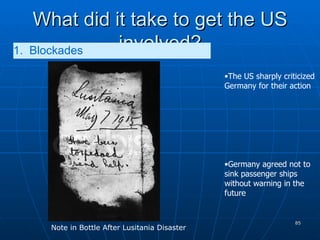
What did it take to get the US involved? 1.  Blockades   The US sharply criticized Germany for their action Germany agreed not to sink passenger ships without warning in the future Note in Bottle After Lusitania Disaster
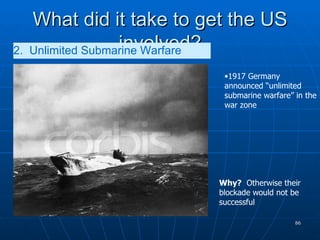
What did it take to get the US involved? 2.  Unlimited Submarine Warfare   1917 Germany announced “unlimited submarine warfare” in the war zone Why?   Otherwise their blockade would not be successful
What did it take to get the US involved? 3.  Zimmerman Note   US intercepted a note from Germany to Mexico,  It promised Texas, New Mexico, and Arizona back in return for an alliance
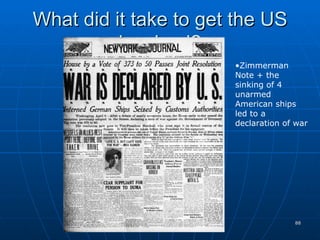
What did it take to get the US involved? Zimmerman Note + the sinking of 4 unarmed American ships led to a declaration of war
Thinking Slide: Should we tell the story of WWI with Germany as the “bad guy”?  Explain.
How was the war looking for the allies? Russia left the war after its communist revolution in 1917 Made it a one front war for Germany - all its troops could concentrate on France Not Good...
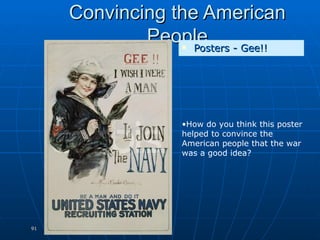
Convincing the American People Posters - Gee!! How do you think this poster helped to convince the American people that the war was a good idea?
Convincing the American People 1.  War to End All Wars Idealism:  2 Goals For War:   2.  Making the World Safe for Democracy
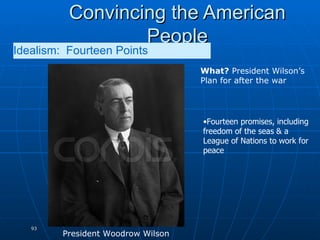
Convincing the American People Idealism:  Fourteen Points   What?  President Wilson’s Plan for after the war  Fourteen promises, including freedom of the seas & a League of Nations to work for peace President Woodrow Wilson
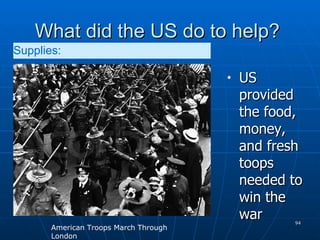
What did the US do to help?  US provided the food, money, and fresh toops needed to win the war American Troops March Through London Supplies:
How did the War Affect the US? Women   Women filled factory jobs May have led 19th Ammendment after the war (Gave women the right to vote) Black soldiers still served in Segregated Units African Americans   “ Great Migration” - thousands of African Americans moved North to work in factories
How did the War Affect the US? Enforcing Loyalty Hatred of all things German Ex. “Liberty Cabbage” Espionage Act 1917 & Sedition Act of 1918 punished those against the war (many labor leaders)
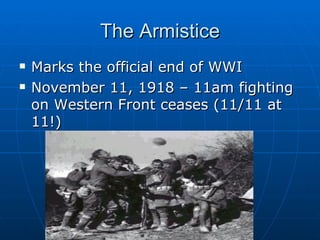
The Armistice Marks the official end of WWI November 11, 1918 – 11am fighting on Western Front ceases (11/11 at 11!)
The Treaty of Versailles January 1919  Paris, France Leader present from 4 great powers Woodrow Wilson (US)   14 points and the League of Nations Georges Clemenceau (France) Impossible for Germany to wage war again David Lloyd George (Britain) Wanted GB to remain independent Vittorio Orlando (Italy)  Wanted territorial rewards promised back in 1915
Punishments on Germany The German Army  was limited to 100,000 men Was not to possess any heavy artillery The general staff was abolished The navy was to be reduced. No air force would be permitted, and the production of military planes was forbidden.  The Treaty  obligated the Germans to pay reparations amounting to over £15 billion to the Allies.
More... Alsace-Lorraine  was to be returned to France, and Poland regained its independence.  Germany  was to pay for all civilian damages caused during the war. This burden, combined with payment of reparations to the Allies of great quantities of industrial goods, merchant shipping, and raw materials, was  expected to prevent Germany from being able to finance any major military effort.
Treaty Backfires How do we know this? WWII – Adolf Hitler! The punishment was so severe, that it wiped out any chance of a democracy in Germany Thus, it give opportunity for someone to rise up in a militaristic dictatorship to re-unify the people WWI set us up for WWII!!!
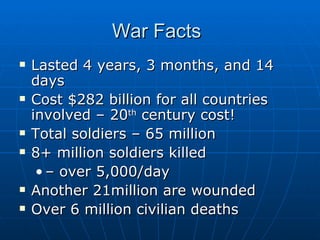
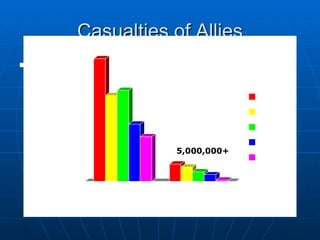
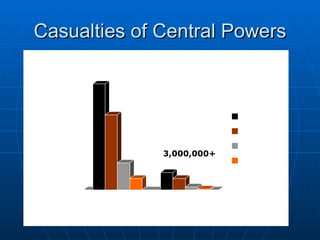
War Facts  Lasted 4 years, 3 months, and 14 days Cost $282 billion for all countries involved – 20 th  century cost! Total soldiers – 65 million 8+ million soldiers killed  –  over 5,000/day Another 21million are wounded Over 6 million civilian deaths
Casualties of Allies 5,000,000+
Casualties of Central Powers 3,000,000+
Final Thought The war we have just been through, though it was shot through with terror, is not to be compared with the war we would have to face next time.  - Woodrow Wilson

World War I

  • 1.
    THE GREAT WAR“World War I” A Local Conflict Goes Global 1914 - 1918
  • 2.
    “ MANIA ”Underlying causes of WWI: M ilitarism A lliances N ationalism I mperialism A narchy (international)
  • 3.
    Militarism Glorification ofWar & Military Build up of large reserve armies Mobilization - organize resources for combat (triggers other nations mobilizing) Naval Expansion – Kaiser Wilhelm II (GR) fires Bismarck and expands navy wants to be equal to G.B. (most powerful) G.B. feels threatened, expands, develops new battleship - Dreadnought
  • 4.
    In 1914, Europeanarmed forces stood like this: Germany: 2,200,000 soldiers, 97 warships Austria-Hungary: 810,000 soldiers, 28 warships. Italy: 750,000 soldiers, 36 warships France: 1,125,000 soldiers, 62 warships Russia: 1,200,000 soldiers, 30 warships Great Britain: 711,000 soldiers, 185 warships
  • 5.
    Another thing thecountries of Europe did was to train all their young men so that if there was a war they could call, not only on the standing army , but on huge numbers of trained reservists!!!
  • 6.
    Alliances Defense AgreementsAmong Nations Triple Alliance - (1882) Germany, Italy, Austria-Hungary - attempt to isolate France Triple Entente - (1907) France, Russia, Great Britian Entente : Friendly understanding between nations
  • 7.
    Nationalism Extreme pridein one’s nation or desire to form a nation French Nationalists sought revenge against Germany for loss of Alsace-Lorraine Slavic Nationalism - Pan-Slavism : Unify all Slavic people under one empire
  • 8.
    Land of Hopeand Glory, mother of the free... God who made thee mighty, make thee mightier yet. Land of Hope and Glory (Great Britain) Germany, Germany above all, over everything in the world, When it steadfastly holds together, offensively and defensively. German National Anthem
  • 9.
    Imperialism Domination ofone country by another Countries who believed that they were superior thought it was alright to conquer and rule others – particularly if they were inhabited by races they thought were inferior
  • 10.
    Anarchy Nations ofEurope pursue policies without regard for the wishes of their neighbors Land freaks!!! No democracies! Crisis - No international organization to monitor
  • 11.
    Immediate Causes ofWWI Assassination of Archduke Francis Ferdinand Austria-Hungarian June 28, 1914 Sarajevo Killed by Gavrilo Princip - member of Serbian nationalist group called the “Black Hand”
  • 12.
  • 13.
    Why assassinated? Ferdinandplanned to give Slavs of Bosnia-Herzegovina a voice in the gov’t equal to that of Austria-Hungarians This threatened the movement for a separate Slavic state
  • 14.
    What happens next?A-H hold Serbians responsible A-H seeks assurance (backup) from Germany in event of war Germany issues “Blank Check” to A-H Kaiser Wilhelm II gives full support to any actions A-H might take against Serbia
  • 15.
    Tension!!! A-H issues ultimatum to Serbia set of final conditions that must be accepted to avoid severe consequences Demands that Serbia allow A-H officials into country to suppress all rebellious movements & conduct investigation Gives Serbia 48 hours to agree or face war Serbia does not agree to all parts A-H declares war on Serbia! (July 28, 1914)
  • 16.
    Other Countries GetInvolved Russia (friend of the Serbs) mobilizes troops along borders of Germany & A-H Germany warns Russia to stop - they don’t! Germany issues ultimatum to France – 18 hours to decide if it would support Russia – France implies it would support Russia
  • 17.
  • 18.
    Declarations of WarGermany declares war on Russia Aug 1, 1914 Germany declares war on France Aug 3, 1914 Great Britain still hoped to remain neutral and not go to war, but…
  • 19.
    Germany Invades Belgium!Germany demands passage across Belgium to fight France (*Part of Schlieffen Plan) British protest demand made by Germany upon neutral nation of Belgium 1839 Treaty signed by G.B., Russia, France & Germany guaranteed Belgium’s neutrality
  • 20.
    Germany invades Belgiumanyway G.B. demands they withdraw Germany responds calling treaty “ a scrap of paper” G.B. declares war on Germany Aug 4, 1914
  • 21.
    The Schlieffen Plan Germany’s invasion of Belgium was part of this plan Germany had enemies to East & West & did not want to fight a war on both fronts at the same time Believed Russia would be slow to mobilize and that they could fight & defeat France (W. Front) first in 6 weeks & then fight Russia on Eastern Front
  • 22.
  • 23.
    developed by Germany’sChief of General Staff Count von Schlieffen Invade France in one crushing blow based on the fact that France did not build any of their defense systems along the Belgium border thus leaving the backdoor to France wide open Von Schlieffen calculated that it would take Russia at least six weeks to organize its large Army for an attack on Germany. Schlieffen's plan involved using 90% of Germany's armed forces to attack France
  • 24.
    Allies vs. CentralPowers Allies Great Britain Russia Italy France United States – April 6, 1917 Central Powers Germany Austria-Hungary Turkey Bulgaria
  • 25.
    Expectations Both sidesthought the war would be a quick ordeal… Kaiser told his soldiers, “you’ll be home before the leaves have fallen from the trees.” They underestimated the role industrialization would play in this war – development of weapons Russia, because of its size was considered a “steamroller” – how untrue!
  • 26.
    Types of WarfareWar in trenches poisonous gases Machine guns Tanks No Man’s Land War at Sea Submarines War in the Air Airplanes Zeppelins World War I was the catalyst for more major military technological innovations than any other war in history!
  • 27.
    Warfare of theGreat War
  • 28.
    War of theSea Royal Navy Merchant ships Cargo ships Plant underwater mines
  • 29.
  • 30.
    U-Boat Unterseeboot –German term Attacked merchant convoys bringing supplies to Allied forces from US and Canada Sank three American merchant ships in 1917 – prompting US to enter war
  • 31.
  • 32.
    Torpedoes Torpedoes wereused by submarines The Germans used torpedoes to blow up ships carrying supplies from America to Britain The Germans torpedoed the passenger liner Lusitania on May 7th , 1915 1,195 lives are lost Americans were outraged and joined the war in 1917 on the side of the allies.
  • 33.
  • 34.
  • 35.
    Convoy of merchantships and battleships
  • 36.
  • 37.
    Planes Used todeliver bombs Spy work Later became fighter aircraft armed with machine guns, bombs and some times cannons Dogfights Fights between two planes in the sky
  • 38.
  • 39.
    Blimp Greatly usedby Germans Used for passenger transport and military purposes Bombing, machine guns, and scouting Not very successful! Vulnerable to gunfire Most successful as reconnaissance – lead German ships to Allied ships in Sea
  • 40.
  • 41.
  • 42.
    War on LandTrenches Good ones were built in a zig-zag pattern Underground cities Western front 6,000 miles of trenches
  • 43.
  • 44.
  • 45.
  • 46.
  • 47.
  • 48.
  • 49.
  • 50.
  • 51.
  • 52.
  • 53.
    Machine Guns 4-6men to work them Had to be on a flat surface Fire-power of 100 guns
  • 54.
  • 55.
    No Man’s LandArea of land between opposing trenches Many men died within first days of war because of the allure of it (peering over the edge – sniper bullet)
  • 56.
  • 57.
  • 58.
  • 59.
  • 60.
    Tanks “ LittleWillie” Daimler engine (Chrysler), caterpillar track, crew of 3 Maximum speed was 3mph COULD NOT cross trenches End of War – modernized tank Fits 10 men Revolving turret (gun) 4mph
  • 61.
  • 62.
  • 63.
  • 64.
    Chlorine German armywere the first to use chlorine gas in 1915 Chlorine gas causes a burning sensation in the throat and chest pains Death is painful - you suffocate! The problem with chlorine gas is that the weather must be right. If the wind is in the wrong direction it could end up killing your own troops rather than the enemy
  • 65.
    Mustard Gas Mustardgas was the most deadly weapon used Fired into the trenches in shells Colorless and takes 12 hours to take effect Effects include: blistering skin, vomiting, sore eyes, internal and external bleeding Very painful – victims had to be tied to bed! Death can take up to 5 weeks Remain in soil for several more weeks
  • 66.
  • 67.
  • 68.
  • 69.
  • 70.
    Lice Would breedin the seams of filthy clothing (warm areas) and cause uncontrollable itching Lice caused Trench Fever painful disease that began suddenly with severe pain followed by high fever Recovery - away from the trenches - took up to twelve weeks.  Lice were not actually identified as the culprit of Trench Fever until 1918
  • 71.
    Rats Millions ofthem infected trenches Black and brown rats Gorge themselves on human remains disfigured dead bodies by eating their eyes and liver could grow to the size of a cat A single rat couple could produce up to 900 offspring in a year – ultimately spreading infection and contaminating food.
  • 72.
  • 73.
  • 74.
  • 75.
  • 76.
  • 77.
  • 78.
  • 79.
  • 80.
    Why did ittake so long for America to get involved in the war? America was isolationist “ Why should I get involved in someone else’s problems”
  • 81.
    Which side shouldthe US pick? 11 million German-Americans Irish-Americans hated Great Britain Close cultural ties Shared transatlantic cables (so censored stories) Big business loaned much $ to allies Central Powers: Allies: US Exports to both sides:
  • 82.
    What did ittake to get the US involved? 1. Blockades Britain blockaded (stopped) all German ships going to America Germany announced a submarine war around Britain Y-53 German Submarine 1916
  • 83.
    What did ittake to get the US involved? 1. Blockades In May, 1915 Germany told Americans to stay off of British ships They could/would sink them
  • 84.
    What did ittake to get the US involved? 1. Blockades Lusitania torpedoed, sinking with 1200 passengers and crew (including 128 Americans) Was eventually found to be carrying 4200 cases of ammunition German Propaganda Justifying Lusitania sinking
  • 85.
    What did ittake to get the US involved? 1. Blockades The US sharply criticized Germany for their action Germany agreed not to sink passenger ships without warning in the future Note in Bottle After Lusitania Disaster
  • 86.
    What did ittake to get the US involved? 2. Unlimited Submarine Warfare 1917 Germany announced “unlimited submarine warfare” in the war zone Why? Otherwise their blockade would not be successful
  • 87.
    What did ittake to get the US involved? 3. Zimmerman Note US intercepted a note from Germany to Mexico, It promised Texas, New Mexico, and Arizona back in return for an alliance
  • 88.
    What did ittake to get the US involved? Zimmerman Note + the sinking of 4 unarmed American ships led to a declaration of war
  • 89.
    Thinking Slide: Shouldwe tell the story of WWI with Germany as the “bad guy”? Explain.
  • 90.
    How was thewar looking for the allies? Russia left the war after its communist revolution in 1917 Made it a one front war for Germany - all its troops could concentrate on France Not Good...
  • 91.
    Convincing the AmericanPeople Posters - Gee!! How do you think this poster helped to convince the American people that the war was a good idea?
  • 92.
    Convincing the AmericanPeople 1. War to End All Wars Idealism: 2 Goals For War: 2. Making the World Safe for Democracy
  • 93.
    Convincing the AmericanPeople Idealism: Fourteen Points What? President Wilson’s Plan for after the war Fourteen promises, including freedom of the seas & a League of Nations to work for peace President Woodrow Wilson
  • 94.
    What did theUS do to help? US provided the food, money, and fresh toops needed to win the war American Troops March Through London Supplies:
  • 95.
    How did theWar Affect the US? Women Women filled factory jobs May have led 19th Ammendment after the war (Gave women the right to vote) Black soldiers still served in Segregated Units African Americans “ Great Migration” - thousands of African Americans moved North to work in factories
  • 96.
    How did theWar Affect the US? Enforcing Loyalty Hatred of all things German Ex. “Liberty Cabbage” Espionage Act 1917 & Sedition Act of 1918 punished those against the war (many labor leaders)
  • 98.
    The Armistice Marksthe official end of WWI November 11, 1918 – 11am fighting on Western Front ceases (11/11 at 11!)
  • 99.
    The Treaty ofVersailles January 1919 Paris, France Leader present from 4 great powers Woodrow Wilson (US) 14 points and the League of Nations Georges Clemenceau (France) Impossible for Germany to wage war again David Lloyd George (Britain) Wanted GB to remain independent Vittorio Orlando (Italy) Wanted territorial rewards promised back in 1915
  • 100.
    Punishments on GermanyThe German Army was limited to 100,000 men Was not to possess any heavy artillery The general staff was abolished The navy was to be reduced. No air force would be permitted, and the production of military planes was forbidden. The Treaty obligated the Germans to pay reparations amounting to over £15 billion to the Allies.
  • 101.
    More... Alsace-Lorraine was to be returned to France, and Poland regained its independence. Germany was to pay for all civilian damages caused during the war. This burden, combined with payment of reparations to the Allies of great quantities of industrial goods, merchant shipping, and raw materials, was expected to prevent Germany from being able to finance any major military effort.
  • 102.
    Treaty Backfires Howdo we know this? WWII – Adolf Hitler! The punishment was so severe, that it wiped out any chance of a democracy in Germany Thus, it give opportunity for someone to rise up in a militaristic dictatorship to re-unify the people WWI set us up for WWII!!!
  • 103.
    War Facts Lasted 4 years, 3 months, and 14 days Cost $282 billion for all countries involved – 20 th century cost! Total soldiers – 65 million 8+ million soldiers killed – over 5,000/day Another 21million are wounded Over 6 million civilian deaths
  • 104.
  • 105.
    Casualties of CentralPowers 3,000,000+
  • 106.
    Final Thought Thewar we have just been through, though it was shot through with terror, is not to be compared with the war we would have to face next time. - Woodrow Wilson